
Introduction
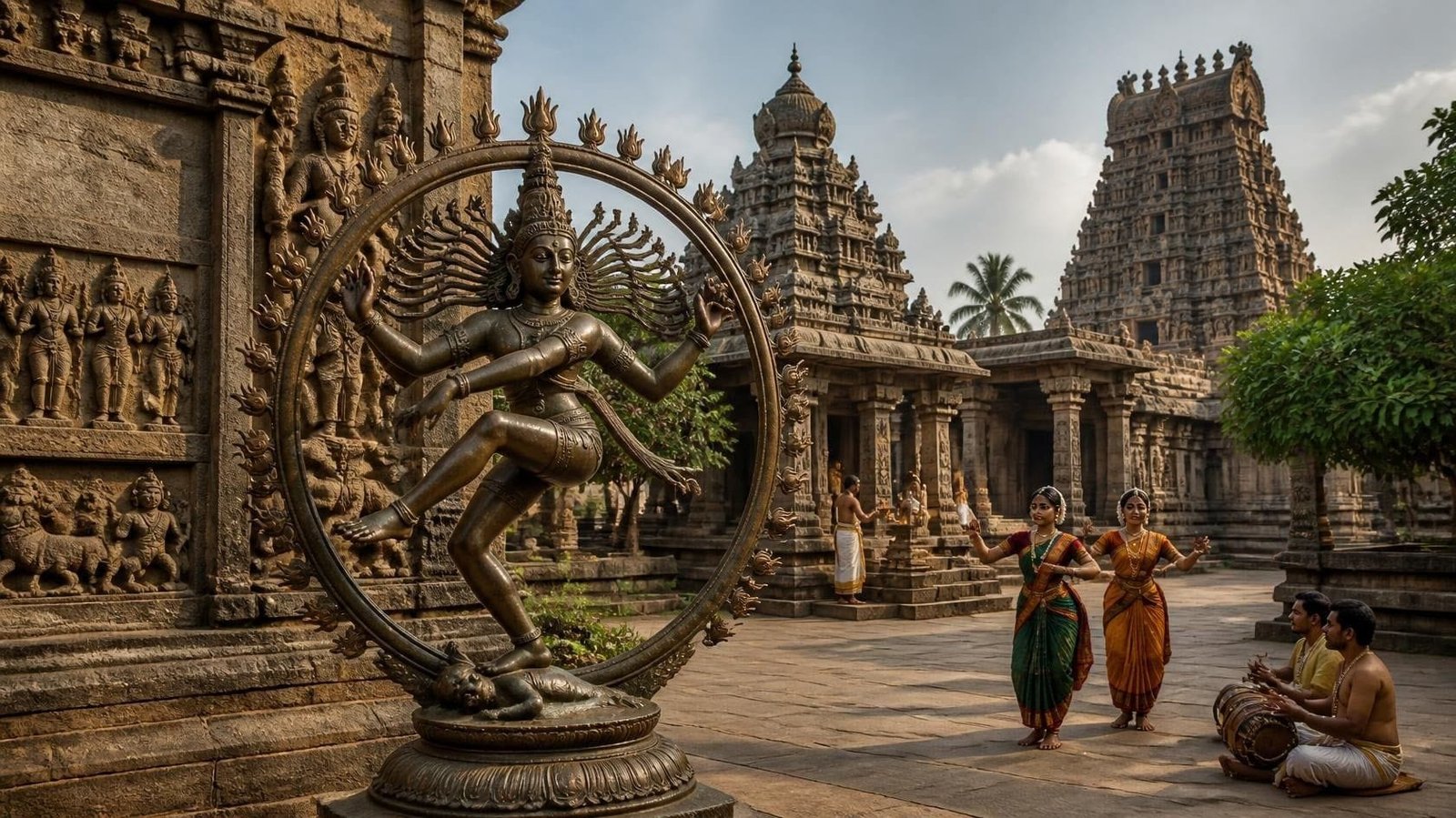
South Indian Sculpture represents one of the most remarkable and continuous artistic traditions in the history of Indian art. Its development was closely associated with the growth of temples, religious institutions, royal patronage and regional artistic traditions. From early stone carvings to the highly refined bronze images of the Chola period, South Indian sculptors developed distinctive techniques, iconographic conventions and aesthetic principles that continue to influence Indian art.
Ancient Tradition of Sculpture in South India
The tradition of sculpture in South India has ancient roots and evolved through several historical phases. Early artistic expressions gradually developed into sophisticated temple sculpture under the patronage of dynasties such as the Pallavas, Chalukyas, Rashtrakutas, Cholas, Hoysalas and Vijayanagara rulers. These traditions produced a wide variety of religious icons, narrative panels, architectural sculptures and decorative motifs.
Relationship Between Sculpture and Temple Architecture
Sculpture and temple architecture in South India developed as closely interconnected artistic forms. Sculptures were integrated into gopurams, vimanas, mandapas, pillars, walls, entrances and subsidiary shrines. Gods, goddesses, mythological episodes, celestial beings, animals, dancers and musicians were represented as integral parts of the architectural design. Therefore, South Indian temple sculpture should be understood not merely as independent artwork but as an essential component of the sacred architectural environment.
Role of Sculpture in Religious, Social and Cultural Life
Sculpture played an important role in the religious and cultural life of South Indian society. Images of Shiva, Vishnu, Devi, Ganesha, Kartikeya and other deities served religious and devotional purposes. At the same time, sculptures depicting dancers, musicians, warriors, animals, royal figures and scenes from everyday life provide valuable evidence about the social and cultural conditions of different historical periods.
Why Is South Indian Sculpture a Distinctive Tradition?
South Indian sculpture is considered a distinctive tradition because of its remarkable combination of religious symbolism, anatomical expression, technical precision, rhythmic movement, decorative richness and architectural integration. The Pallava rock-cut sculptures, Chola bronzes, Hoysala decorative sculptures and Vijayanagara temple carvings demonstrate different stages of artistic experimentation and refinement. The famous image of Nataraja, particularly associated with the Chola bronze tradition, is one of the finest examples of the philosophical and aesthetic depth of Indian sculpture.
Objective of This Article and UPSC Relevance
This article examines the evolution, major dynasties, regional styles, artistic characteristics, important examples and contribution of South Indian sculpture to Indian art. It also explains the relationship between sculpture, religion, temple architecture and society. From the UPSC perspective, the topic is particularly relevant to Indian Art and Culture, Ancient and Medieval History, Temple Architecture, Sculpture and Cultural Heritage. Understanding the distinctive features of Pallava, Chola, Chalukya, Hoysala and Vijayanagara traditions can help aspirants develop comparative answers for both Prelims and Mains examinations.
Background of South Indian Sculpture
The background of South Indian sculpture is rooted in a long and continuous artistic tradition that developed through the interaction of religion, Temple Architecture, royal patronage and regional cultural practices. Over centuries, sculptors transformed stone, metal and other materials into images of deities, mythological narratives, human figures, animals and decorative motifs. This evolution made South Indian sculpture one of the most distinctive traditions of Indian art.
1. Ancient Foundations of the Tradition
The roots of South Indian sculpture can be traced to the broader prehistoric, early historic and early historic religious traditions of the Indian subcontinent. With the growth of organized religious institutions and temple worship, sculptural representation gradually became an important medium for expressing religious ideas and cultural values.
Early traditions were later enriched by the development of Shaivism, Vaishnavism and Shaktism. These religious traditions created a demand for standardized images of deities and mythological figures, encouraging the development of sophisticated iconographic and sculptural conventions.
2. Early Tamil Cultural and Religious Influences
The cultural environment of ancient Tamilakam played an important role in shaping the later development of South Indian artistic traditions. The growth of settlements, trade networks, religious centres and royal institutions created favourable conditions for artistic production.
The emergence of permanent temples gradually changed sculpture from relatively limited religious representation into an integral component of sacred architecture. Sculptural images increasingly became associated with rituals, festivals, devotional practices and the visual presentation of religious stories.
3. Close Relationship with Temple Architecture
One of the most important features of South Indian sculpture is its close relationship with Dravidian temple architecture. As temples became larger and more architecturally complex, sculpture occupied an increasingly important place on temple walls, pillars, gateways, ceilings and subsidiary structures.
Sculptures were therefore not merely decorative objects. They formed part of a larger sacred visual system in which architecture, sculpture, mythology and ritual were closely interconnected.
4. Pallavas and the Transformation of Rock-Cut Sculpture
The Pallavas played a crucial role in transforming the artistic landscape of South India. Under their patronage, rock-cut architecture and structural temples developed significantly. Sites such as Mamallapuram became major centres of experimentation in architecture and sculpture.
Large narrative compositions, relief sculptures and representations of deities demonstrated a growing mastery of movement, proportion and storytelling. This phase established important foundations for later developments in South Indian temple sculpture.
5. Chola Period and the Rise of Bronze Sculpture
The Chola period marked a major milestone in the history of South Indian sculpture. Alongside monumental stone sculpture, the Cholas developed an exceptionally refined tradition of bronze casting, particularly through the lost-wax technique.
Chola bronzes are celebrated for their graceful proportions, controlled movement, spiritual expression and sophisticated craftsmanship. The iconic image of Shiva as Nataraja became one of the most recognizable achievements of Indian sculptural art.
6. Expansion Through Regional Dynasties
The evolution of South Indian sculpture was not limited to the Tamil region. The Chalukyas, Rashtrakutas, Hoysalas, Kakatiyas and Vijayanagara rulers also contributed to the development of regional sculptural traditions.
- Chalukyas: Developed distinctive sculptural traditions in the Deccan and contributed to experimentation in temple architecture.
- Rashtrakutas: Known for monumental rock-cut achievements, especially the Kailasa Temple at Ellora.
- Hoysalas: Developed highly intricate and richly ornamented temple sculpture.
- Vijayanagara: Expanded monumental temple decoration, elaborate pillars, narrative panels and large-scale religious imagery.
7. Sculpture as a Record of Society and Culture
South Indian sculptures also provide valuable information about the social, economic and cultural life of different historical periods. Representations of dancers, musicians, warriors, royal figures, animals, processions and everyday activities help historians reconstruct aspects of past society.
Consequently, sculpture serves not only as a form of religious art but also as an important historical source for understanding the cultural development of South India.
Quick Revision: Background of South Indian Sculpture
Ancient traditions → Religious expansion → Temple architecture → Pallava rock-cut art → Chola bronze tradition → Regional diversification → Vijayanagara monumental sculpture
UPSC Tip: For Mains answers, connect South Indian sculpture with religion, temple architecture, royal patronage, metallurgy, iconography and regional cultural traditions.
Chronological Development of South Indian Sculpture
The chronological development of South Indian sculpture reflects a long process of artistic experimentation, religious transformation, technological advancement and royal patronage. From early historic traditions and rock-cut monuments to the sophisticated Chola bronzes and monumental Vijayanagara sculptures, each period introduced new forms, techniques and aesthetic ideas. The following timeline provides a clear understanding of how South Indian sculpture evolved over time.
Chronological Timeline at a Glance
Early foundations
Rock-cut & structural art
Deccan innovations
Stone & bronze masterpieces
Detailed ornamentation
Monumental temple sculpture
1. Early Historic Foundations
The early foundations of South Indian sculpture developed alongside the growth of settlements, trade, religious traditions and early temple institutions. During this phase, artistic traditions were gradually influenced by broader Indian developments in Buddhist, Jain and Hindu religious art.
Sculptural representation increasingly focused on religious symbols, sacred figures and decorative elements. These early traditions created the cultural and artistic foundation for the more sophisticated temple sculpture of the early medieval period.
2. Pallava Period: The Rise of Rock-Cut and Structural Sculpture (c. 6th–9th century CE)
The Pallavas played a foundational role in the development of classical South Indian sculpture. Under their patronage, artists experimented extensively with rock-cut monuments, monolithic structures and early structural temples.
Mamallapuram (Mahabalipuram) became an important centre of this artistic transformation. The famous relief known as "Descent of the Ganga", commonly associated with the "Arjuna's Penance" relief, demonstrates the Pallava interest in narrative composition, movement and large-scale rock carving.
3. Chalukya and Rashtrakuta Period: Deccan Innovation (c. 6th–10th century CE)
The Chalukyas and later the Rashtrakutas contributed significantly to the evolution of sculpture in the Deccan. Their artistic traditions created an important bridge between northern and southern architectural and sculptural forms.
Sites such as Aihole, Badami and Pattadakal illustrate experimentation in temple design and sculptural composition. The Rashtrakuta period is particularly notable for the monumental Kailasa Temple at Ellora, where architecture and sculpture were carved together from living rock.
4. Chola Period: The Golden Age of South Indian Sculpture (c. 9th–13th century CE)
The Chola period represents one of the most celebrated phases in the history of South Indian sculpture. Chola rulers provided extensive patronage to temples, sculptors, metalworkers and religious institutions.
Monumental stone sculpture reached a high level of refinement, while bronze casting became especially sophisticated. The lost-wax technique enabled artists to create graceful and expressive processional images of Hindu deities.
5. Hoysala and Kakatiya Traditions: Increasing Decorative Complexity (c. 12th–14th century CE)
The Hoysala and Kakatiya traditions added new dimensions to South Indian temple sculpture. Sculptors increasingly emphasized intricate ornamentation, detailed costumes, jewellery, narrative scenes and dynamic human figures.
Hoysala temples are particularly known for their densely carved surfaces and highly detailed sculptural programmes. Kakatiya monuments similarly demonstrate sophisticated stone carving and the close integration of sculpture with Temple Architecture.
6. Vijayanagara Period: Monumental Temple Sculpture (14th–16th century CE)
The Vijayanagara Empire revived and expanded several established South Indian artistic traditions. Temples became large cultural complexes featuring elaborate gateways, mandapas, pillars, processional spaces and extensive sculptural decoration.
Sculptures of Yalis, horses, warriors, dancers, musicians and deities became prominent decorative and symbolic elements. The monumental scale of Vijayanagara architecture gave sculptors new opportunities to combine structural design with dramatic sculptural effects.
7. Later Nayaka Traditions and Continuity (16th–18th century CE)
After the decline of the Vijayanagara Empire, several regional Nayaka kingdoms continued and developed its architectural and sculptural traditions. Temple complexes were expanded with large gopurams, pillared halls, stucco figures and elaborate decorative programmes.
Although artistic priorities changed over time, the continuity of temple patronage ensured that the major traditions of South Indian sculpture remained active and influential.
Evolution of South Indian Sculpture: Quick Revision
Foundations & religious imagery
Rock-cut & monolithic sculpture
Deccan experimentation
Stone sculpture & bronze masterpieces
Intricate ornamentation
Monumental temple traditions
Chola Period Sculpture: Bronze Masterpieces, Stone Art & Nataraja Tradition
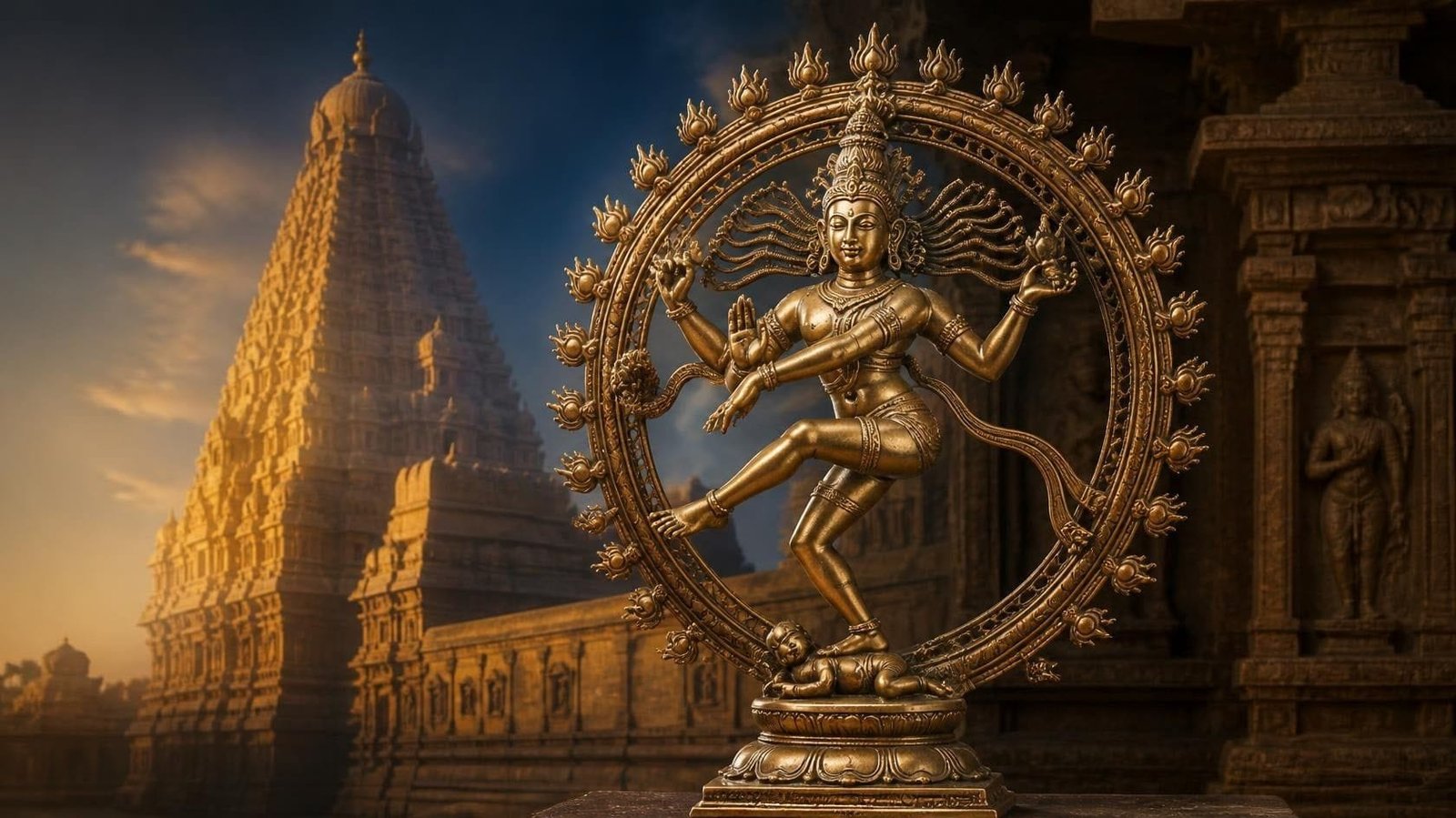
Chola Period Sculpture represents one of the finest achievements in the history of South Indian art. Flourishing mainly between the 9th and 13th centuries CE, Chola artists achieved remarkable excellence in both monumental stone sculpture and metal casting. Their artistic tradition is particularly famous for elegant bronze images of Hindu deities, sophisticated iconography, graceful human forms and the celebrated image of Shiva Nataraja.
1. Historical Background of Chola Sculpture
The Cholas established a powerful political and cultural presence in southern India, particularly in the Tamil region. Royal patronage, temple construction and the expansion of Shaiva and Vaishnava religious traditions created a favourable environment for sculptural development.
Chola rulers invested heavily in temples, which functioned not only as places of worship but also as centres of economic, social and cultural activity. Sculptors, metalworkers, architects and other artisans were therefore closely connected with temple institutions.
2. Chola Stone Sculpture and Temple Art
Stone sculpture formed an essential part of Chola Temple Architecture. Sculptures of deities, divine attendants, guardians, dancers, musicians and mythological figures were integrated into temple walls, niches, pillars and other architectural elements.
The sculptures associated with the great Chola temples demonstrate a balance between monumentality, proportion, anatomical observation and spiritual expression. Rather than functioning merely as decoration, these images formed part of the religious and symbolic programme of the temple.
3. Chola Bronze Sculpture: A Landmark Achievement
The greatest international recognition of Chola sculpture comes from its exceptional bronze casting tradition. Chola metalworkers perfected the use of the lost-wax technique (cire-perdue) to produce detailed and expressive images.
Bronze icons were particularly suitable for temple rituals and processions because they could be carried outside the sanctum during festivals. This functional requirement encouraged sculptors to create images that combined religious symbolism with visual elegance and balanced proportions.
4. Shiva Nataraja: The Iconic Symbol of Chola Art
The image of Shiva as Nataraja is perhaps the most celebrated example of Chola bronze sculpture. The dancing Shiva represents the cosmic rhythm of existence and expresses profound philosophical ideas through movement and symbolism.
Represent the cosmic energy and transformative power associated with Shiva.
Symbolizes the cosmic rhythm and the creative principle.
Conveys protection, reassurance and freedom from fear.
Represents ignorance overcome by knowledge and divine awareness.
5. Major Themes and Deities in Chola Sculpture
Although Shiva and Shaiva imagery occupy a prominent place in Chola sculpture, artists also produced images associated with Vishnu, Devi, Ganesha, Kartikeya, Parvati and other divine figures. Images were created according to established iconographic principles so that posture, attributes, gestures and proportions conveyed specific religious meanings.
- Shiva in various forms and manifestations
- Shiva Nataraja and other dynamic representations
- Parvati and divine feminine imagery
- Vishnu and Vaishnava iconography
- Ganesha and Kartikeya
- Devotees, saints and temple attendants
6. Distinctive Features of Chola Sculpture
Elegant proportions and controlled bodily movement.
Strong emphasis on rhythm, balance and expressive gestures.
Highly refined stone carving and bronze casting techniques.
Iconographic details communicate complex theological ideas.
Sculpture and temple architecture function as a unified visual system.
Human figures combine idealized beauty with expressive vitality.
7. Major Examples of Chola Sculptural Art
- Brihadisvara Temple, Thanjavur: Important example of Chola monumental temple architecture and sculptural decoration.
- Gangaikondacholapuram Temple: Notable for its refined architectural and sculptural programme.
- Airavatesvara Temple, Darasuram: Famous for detailed architectural ornamentation and sculptural craftsmanship.
- Chola Bronze Nataraja: A globally recognized representation of the artistic and philosophical achievements of the Chola period.
8. Contribution of Chola Sculpture to Indian Art
Chola sculpture made a lasting contribution to Indian art by combining technical mastery, religious symbolism and aesthetic sophistication. The bronze tradition became especially influential and demonstrated how metal could be transformed into expressive three-dimensional religious imagery.
The artistic legacy of the Cholas remains important for the study of Indian art history because it illustrates the relationship between state patronage, temple institutions, religion, technology and artistic creativity.
UPSC Exam Focus: Chola Sculpture
Remember these keywords: Chola period → Temple patronage → Stone sculpture → Bronze casting → Lost-wax technique → Nataraja → Shaiva tradition → Graceful movement → Iconography → Temple culture.
Pandya Period Sculpture: Temple Art, Rock-Cut Traditions & Distinctive Features
Pandya Period Sculpture occupies an important place in the history of South Indian art. The Pandyas were one of the major dynasties of the Tamil region, and their artistic traditions developed through a close relationship between religion, temple architecture, rock-cut monuments and royal patronage. Pandya sculptors contributed significantly to the development of Shaiva and Vaishnava imagery, decorative temple sculpture and later South Indian architectural traditions.
1. Historical Background of Pandya Sculpture
The Pandya tradition developed primarily in the southern Tamil region, with Madurai emerging as an important political, religious and cultural centre. Pandya rulers supported temple construction and religious institutions, creating an environment in which sculptors and other artisans could flourish.
The development of Pandya sculpture took place over several phases. Early Pandya monuments show strong connections with rock-cut traditions, while later developments became increasingly integrated with structural temples and the expanding Dravidian architectural tradition.
2. Rock-Cut Sculpture: An Important Pandya Tradition
One of the important contributions associated with the Pandyas is the development and continuation of rock-cut temples and sculptures in southern Tamil Nadu. Instead of constructing every architectural element separately, artisans carved sacred spaces directly into natural rock formations.
Rock-cut images of Shiva, Vishnu, Ganesha, Durga and other religious figures demonstrate the importance of Hindu iconography. These sculptures also reveal the increasing integration of religious imagery with architectural space.
3. Pandya Cave Temples and Sculptural Traditions
Several cave temples associated with the Pandya sphere illustrate the artistic transition from earlier rock-cut traditions toward more elaborate temple forms. The interiors often contain sculptural panels depicting deities and religious narratives.
4. Religious Themes in Pandya Sculpture
Religious imagery formed the central theme of Pandya sculpture. Shaivism had a particularly strong presence, while Vaishnava traditions also contributed to the diversity of sculptural representation.
Representations of Shiva and his various manifestations were important elements of temple iconography.
Vaishnava imagery also formed part of the wider religious landscape of the Tamil region.
Goddess figures such as Durga reflect the importance of Shakti-related traditions.
A wide range of divine figures enriched temple sculptural programmes.
5. Distinctive Features of Pandya Sculpture
Direct carving of sacred spaces and sculptural images into natural rock.
Strong emphasis on Hindu deities and mythological themes.
Sculpture was closely connected with Temple Architecture and ritual.
The art reflects the religious and cultural traditions of southern Tamil Nadu.
Mythological scenes and divine stories enriched sculptural programmes.
Pandya traditions contributed to the later development of South Indian temple art.
6. Important Examples and Centres
- Kalugumalai: An important site for understanding the rock-cut artistic traditions of southern Tamil Nadu.
- Vettuvan Koil: A remarkable monolithic temple associated with the later Pandya artistic environment and known for its unfinished but highly sophisticated sculptural work.
- Madurai Region: A major centre of Pandya political, religious and cultural activity.
- Tirupparankunram: An important religious centre with cave-temple and sculptural traditions connected with the southern Tamil region.
7. Pandya Sculpture and the Wider South Indian Tradition
Pandya sculpture should be understood as part of the broader evolution of South Indian art. While the Pallavas are strongly associated with the development of rock-cut and monolithic sculpture, the Cholas became especially famous for their bronze tradition. The Pandyas contributed to this wider artistic evolution through their own regional styles, temple patronage and rock-cut traditions.
This interaction between dynasties demonstrates that South Indian sculpture developed through continuous exchange, adaptation and experimentation rather than through isolated artistic traditions.
8. Contribution of Pandya Sculpture to Indian Art
The Pandyas helped strengthen the tradition of temple-centred sculpture in southern India. Their monuments preserve important evidence of the evolution of rock-cut architecture, Hindu iconography and regional artistic expression.
Their artistic legacy is particularly important for understanding how the southern Tamil region contributed to the broader development of Dravidian temple architecture and South Indian sculptural traditions.
UPSC Exam Focus: Pandya Sculpture
Remember these keywords: Pandya Dynasty → Southern Tamil Nadu → Madurai → Rock-Cut Temples → Vettuvan Koil → Kalugumalai → Shaivism → Vaishnavism → Dravidian Architecture → Temple Sculpture.
Chera and Kerala Sculpture Tradition: Temple Art, Woodcarving & Regional Features
The Chera and Kerala sculpture tradition represents a distinctive branch of South Indian art that developed under the influence of regional religious practices, Temple Architecture, local materials and cultural exchanges. Unlike the predominantly stone-based sculptural traditions of several other parts of South India, Kerala developed a particularly strong tradition of woodcarving, metal images, mural-associated sculpture and laterite-based architectural forms. The artistic heritage of Kerala also reflects the long cultural interaction between the Chera region and neighbouring Tamil and Deccan traditions.
1. Historical Background of Chera and Kerala Art
The Cheras were an important ruling power of the ancient Tamilakam region, with their influence extending across parts of present-day Kerala and western Tamil Nadu. The western coastal region developed its own cultural identity through maritime trade, religious traditions and interaction with neighbouring regions.
Over time, the artistic traditions of Kerala evolved within a distinctive ecological and architectural environment. Abundant forests provided high-quality timber, while the heavy monsoon climate influenced temple design and encouraged the extensive use of wood rather than exposing monumental stone surfaces to the elements.
2. Local Materials and the Character of Kerala Sculpture
The availability of natural resources strongly influenced Kerala's artistic traditions. While stone sculpture remained important, wood became one of the defining materials of Kerala's temple art. Timber allowed artisans to produce elaborate carvings on temple structures, doors, ceilings, pillars and ritual objects.
A major medium for temple architecture, doors, ceilings and decorative carvings.
Used for temple foundations, selected architectural elements and sculptural images.
Bronze and other metal images were important for ritual and processional traditions.
A locally available material used extensively in Kerala's architectural landscape.
3. Sculpture and Kerala Temple Architecture
Kerala temple architecture developed a distinctive form suited to its tropical climate. The use of sloping roofs, timber structures and protected architectural spaces created an artistic environment in which sculptural decoration could be integrated with wood architecture.
Elaborately carved wooden doors, pillars, ceilings, brackets and temple panels often feature floral patterns, mythical creatures, divine figures and narrative scenes from Hindu traditions.
4. Kerala Woodcarving: A Distinctive Artistic Identity
Woodcarving is one of the most distinctive features of Kerala's traditional art. Skilled craftsmen transformed timber into complex decorative and narrative compositions. Carvings often combine geometric patterns, floral motifs, mythological figures and scenes from sacred literature.
The protected interiors of Kerala temples and palaces helped preserve delicate wooden carvings that might otherwise have been vulnerable to the region's heavy rainfall.
5. Metal Images and Ritual Sculpture
Metal sculpture also forms an important component of Kerala's religious art. Bronze and other metal images were created for worship, ritual processions and temple ceremonies. These images reflect the wider South Indian tradition of creating portable sacred icons.
Kerala's metalwork developed in dialogue with neighbouring Tamil and Deccan traditions while retaining distinctive regional features in iconography, craftsmanship and ritual use.
6. Religious Influences on Kerala Sculpture
Kerala's sculptural and decorative traditions were shaped by several religious currents, particularly Shaivism, Vaishnavism and Shaktism. Temple imagery commonly includes deities, divine attendants, mythical beings and episodes drawn from Hindu mythology.
Shiva-related imagery and temple traditions formed an important part of Kerala's religious art.
Vishnu and his manifestations appear in temple iconography and ritual traditions.
Goddess traditions contributed to the diversity of sacred imagery.
Local ritual practices enriched the wider Hindu artistic tradition.
7. Distinctive Features of Chera–Kerala Sculpture Tradition
- Strong use of wood: Especially important in temple and palace architecture.
- Architectural integration: Sculpture and carving were closely incorporated into buildings.
- Rich decorative patterns: Floral, geometric and mythological motifs are common.
- religious symbolism: Deities and sacred narratives dominate temple imagery.
- Climate adaptation: Protected wooden structures developed in response to Kerala's heavy monsoon environment.
- Regional synthesis: Kerala traditions interacted with Tamil, Deccan and wider Indian artistic influences.
- Craft continuity: Traditional woodcarving and metalwork remain important parts of Kerala's Cultural Heritage.
8. Important Centres and Examples
- Padmanabhaswamy Temple, Thiruvananthapuram: A major centre of Kerala's temple architecture and sacred artistic traditions.
- Vadakkunnathan Temple, Thrissur: Important for understanding Kerala's temple architecture and decorative traditions.
- Krishnapuram Palace: Known for its traditional Kerala architectural and artistic heritage.
- Mattancherry Palace: An important example of Kerala's interaction with different cultural and artistic traditions.
9. Chera Legacy and the Evolution of Kerala Art
The artistic history of Kerala cannot be understood solely through monumental stone sculpture. Its distinctive identity emerged from the interaction of local ecology, temple institutions, religious traditions, maritime connections and regional craftsmanship.
The Chera heritage formed an important historical background, while later Kerala kingdoms and temple institutions continued to develop regional architectural and sculptural practices. This continuity makes Kerala an important case study in the diversity of South Indian art.
10. Contribution to South Indian and Indian Art
The Chera–Kerala tradition demonstrates that South Indian sculpture was never a single uniform style. Kerala developed a distinctive artistic vocabulary based on wood, metal, temple architecture and climate-responsive design.
Its greatest contribution lies in preserving a regional artistic system in which architecture, craftsmanship, ritual and visual culture work together. This makes Kerala's artistic heritage an important component of the broader history of Indian art.
UPSC Exam Focus: Chera and Kerala Sculpture
Remember these keywords: Chera Region → Kerala → Temple Architecture → Woodcarving → Metal Images → Monsoon Climate → Shaivism → Vaishnavism → Shaktism → Regional Artistic Identity.
Contribution of the Chalukya and Rashtrakuta Periods to South Indian Sculpture
The Chalukya and Rashtrakuta dynasties played a crucial role in the development of South Indian and Deccan sculpture. Their artistic achievements demonstrate a remarkable interaction between architecture, sculpture, religion and royal patronage. From the rock-cut caves of Badami and the experimental temples of Aihole to the monumental Kailasa Temple at Ellora, these dynasties created important stages in the evolution of Indian temple art.
1. Historical Background
The Chalukyas emerged as an important political power in the Deccan from the 6th century CE. Their major centres included Badami, Aihole and Pattadakal. They encouraged experimentation in Temple Architecture and sculptural forms, creating an artistic environment where northern and southern traditions could interact.
The later Rashtrakutas further expanded the artistic achievements of the Deccan. Their patronage produced some of the most ambitious rock-cut monuments in India, demonstrating the ability of Indian craftsmen to combine massive architectural forms with detailed sculptural programmes.
2. Chalukya Contribution to Sculpture and Temple Art
Chalukya art is particularly important because it represents a period of experimentation and synthesis. Artists worked with different temple plans, architectural forms and sculptural programmes, gradually developing techniques that influenced later Deccan and South Indian traditions.
Famous for rock-cut cave temples and sculptural representations of Hindu deities.
An important centre of experimentation in temple architecture and decorative sculpture.
Demonstrates the synthesis of northern Nagara and southern Dravida architectural traditions.
3. Badami Cave Sculptures: Mastery of Rock-Cut Art
The cave temples at Badami represent an important stage in the development of Deccan rock-cut sculpture. Sculptors carved monumental figures directly into the sandstone cliffs and created religious compositions with considerable attention to movement, proportion and symbolic attributes.
Images associated with Shiva, Vishnu and other Hindu traditions demonstrate the diversity of religious themes. The sculptures show how rock-cut architecture could function simultaneously as sacred space and as a large-scale artistic canvas.
4. Pattadakal: Synthesis of Architectural and Sculptural Traditions
Pattadakal occupies a special position in Indian art history because its monuments demonstrate interaction between Northern Nagara and Southern Dravida architectural traditions. Sculptural decoration was carefully integrated with temple walls, pillars, entrances and other architectural components.
This combination of architectural experimentation and sculptural refinement helped establish the Deccan as an important bridge between different artistic regions of India.
5. Rashtrakuta Contribution to Indian Sculpture
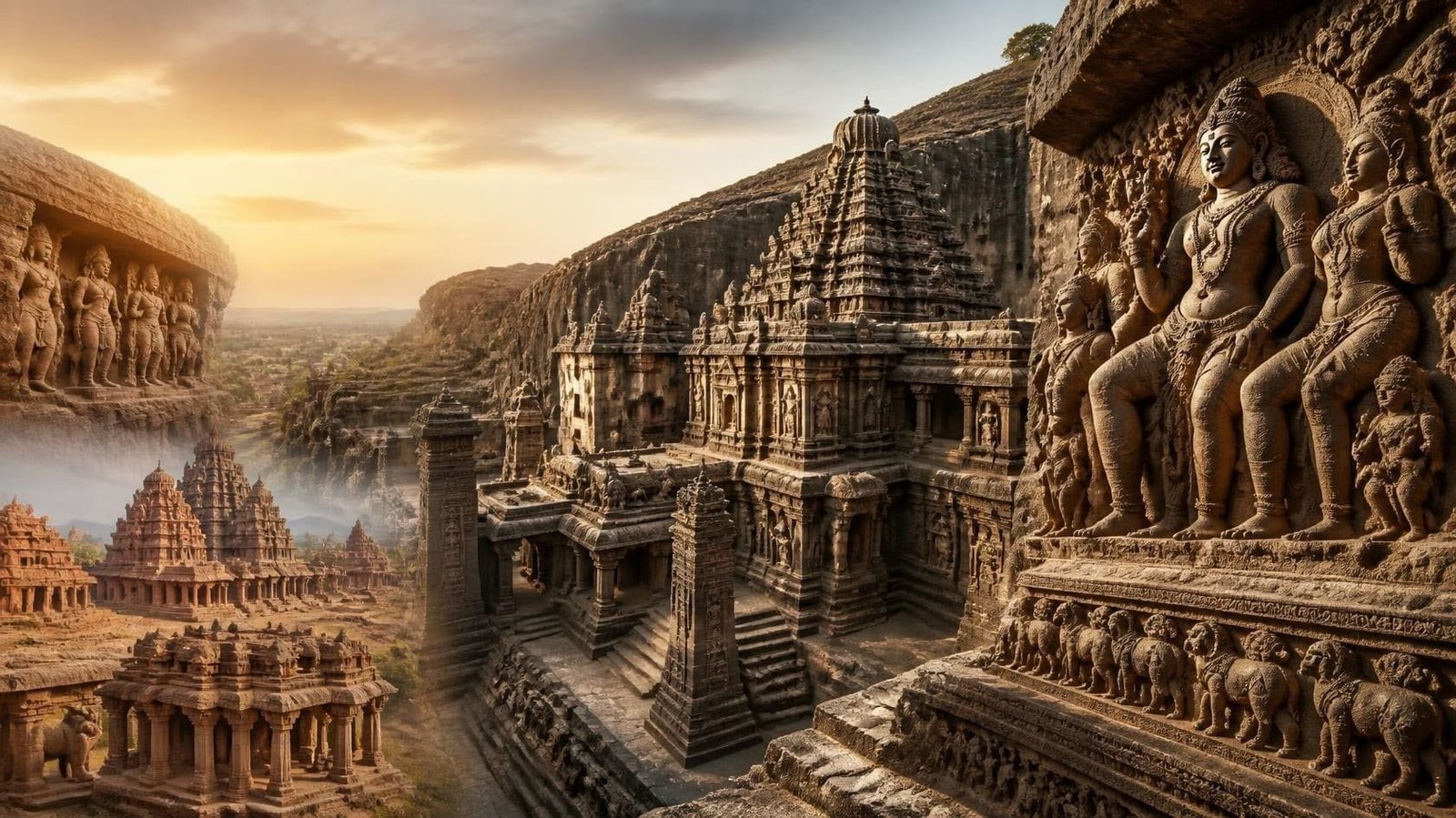
The Rashtrakutas continued and expanded the Deccan's rock-cut tradition. Their greatest artistic achievement is the Kailasa Temple at Ellora, a monumental structure excavated from a single rock mass.
The monument demonstrates extraordinary technical planning because architects and sculptors had to remove enormous quantities of rock while simultaneously preserving the architectural and sculptural composition. The result is an integrated complex of temples, pillars, galleries and sculptural narratives.
6. Kailasa Temple at Ellora: A Masterpiece of Rock-Cut Sculpture
The Kailasa Temple at Ellora is among the most extraordinary achievements of Indian rock-cut architecture. Instead of assembling the temple from individual stone blocks, artisans carved the monument out of the existing rock.
A vast architectural composition carved directly from living rock.
Mythological and religious stories appear across the monument.
Architecture and sculpture were conceived as one integrated artwork.
Demonstrates extraordinary control over large-scale rock excavation.
7. Religious Themes and Iconography
Chalukya and Rashtrakuta sculpture drew heavily from Hindu religious traditions while also reflecting the wider religious diversity of the Deccan. Sculptural programmes included Shiva, Vishnu, Devi, Ganesha, Surya and mythological narratives.
Religious images were created according to established iconographic conventions, but artists also demonstrated considerable creativity in posture, movement, composition and architectural placement.
8. Distinctive Features of Chalukya–Rashtrakuta Sculpture
- Rock-cut excellence: Large-scale sculptures were carved directly into natural rock.
- Architectural experimentation: Different temple plans and structural forms were tested.
- Regional synthesis: Northern and southern architectural ideas interacted in the Deccan.
- Dynamic figures: Sculptors emphasized movement, posture and expressive gestures.
- Rich iconography: Hindu deities and mythological narratives dominated sculptural programmes.
- Royal patronage: Large monuments reflected the political and cultural ambitions of rulers.
- Integration of art and architecture: Sculpture was inseparable from the temple environment.
9. Chalukyas vs Rashtrakutas: Key Artistic Contribution
| Aspect | Chalukyas | Rashtrakutas |
|---|---|---|
| Major Centres | Badami, Aihole, Pattadakal | Ellora and Deccan centres |
| Main Contribution | Architectural experimentation and sculptural synthesis | Monumental rock-cut architecture |
| Famous Example | Pattadakal temples | Kailasa Temple, Ellora |
| Artistic Importance | Bridge between architectural traditions | Peak of large-scale rock excavation |
10. Legacy in the Development of South Indian Sculpture
The Chalukya and Rashtrakuta traditions influenced subsequent developments in Deccan and South Indian temple art. Their experiments with temple plans, sculptural composition and rock-cut architecture provided important precedents for later dynasties.
Their contribution is especially significant because it demonstrates how the Deccan acted as a cultural bridge between different artistic regions. This interaction enriched the broader evolution of Indian temple architecture and sculpture.
UPSC Exam Focus: Chalukya and Rashtrakuta Contribution
Remember these keywords: Chalukyas → Badami → Aihole → Pattadakal → Architectural Experimentation → Nagara–Dravida Synthesis → Rashtrakutas → Ellora → Kailasa Temple → Rock-Cut Sculpture → Deccan Cultural Bridge.
Hoysala Period Sculpture: Intricate Carvings, Temple Art & Distinctive Features
Hoysala Period Sculpture represents one of the most refined traditions of medieval South Indian art. Flourishing mainly between the 11th and 14th centuries CE in present-day Karnataka, Hoysala artists developed an exceptionally detailed style of temple sculpture. Their work is renowned for intricate ornamentation, dynamic figures, narrative panels, polished stone surfaces and close integration with Temple Architecture.
1. Historical Background of Hoysala Sculpture
The Hoysala dynasty emerged as an important regional power in southern Karnataka and played a major role in the development of medieval temple architecture and sculpture. Hoysala rulers provided extensive patronage to temples, religious institutions, architects and highly skilled craftsmen.
Under royal and religious patronage, sculptors developed a distinctive artistic language characterized by dense decoration, carefully carved figures and elaborate narrative programmes. The temples at Belur, Halebidu and Somanathapura are among the finest surviving examples of this tradition.
2. Stone and the Hoysala Sculptural Technique
Hoysala sculptors extensively used soapstone, also known as chloritic schist, which was relatively soft when freshly quarried and could be carved with exceptional precision. Over time, the material hardens, helping preserve the fine details of the sculptures.
This material enabled artisans to create extremely fine jewellery, hairstyles, costumes, floral patterns, miniature figures and ornamental details that would have been difficult to execute on harder stone.
3. Sculpture and Hoysala Temple Architecture
Hoysala sculpture cannot be separated from its distinctive temple architecture. Temples often feature star-shaped or highly articulated plans, projecting walls and numerous sculptural surfaces that provide space for elaborate artistic programmes.
Sculptures were placed on exterior walls, pillars, doorways, ceilings and decorative bands. Architecture effectively became a three-dimensional canvas on which sculptors represented gods, goddesses, dancers, warriors, animals and mythological stories.
4. Major Hoysala Temples and Sculptural Masterpieces
Chennakeshava Temple, Belur
Famous for richly decorated exterior walls, graceful figures, bracket sculptures and detailed narrative imagery.
Hoysaleswara Temple, Halebidu
Known for extensive sculptural panels, divine figures, mythological narratives and elaborate decorative bands.
Keshava Temple, Somanathapura
A major example of Hoysala architectural planning and highly refined sculptural decoration.
5. Religious Themes and Iconography
Hoysala sculptural programmes reflect the religious diversity of medieval Karnataka. Images of Vishnu, Shiva, Devi, Ganesha, Surya and other deities appear alongside mythological scenes and figures associated with religious traditions.
Vishnu and his avatars occupy an important place in several Hoysala temples.
Shiva-related forms and mythological episodes enrich temple sculptural programmes.
Divine feminine forms are represented with elaborate ornaments and expressive poses.
Episodes from epics and religious literature appear throughout temple walls.
6. Decorative Bands and Narrative Panels
One of the most recognizable features of Hoysala temples is the systematic arrangement of sculptural bands. Different horizontal zones may contain elephants, horses, foliage, epic narratives, divine figures and decorative motifs.
This layered arrangement creates a visual rhythm around the temple and demonstrates the remarkable ability of Hoysala sculptors to combine narrative storytelling with ornamental design.
7. Madanika and Bracket Figures
The Madanika or bracket figures associated especially with the Chennakeshava Temple at Belur are among the most celebrated examples of Hoysala sculptural craftsmanship. These graceful female figures are shown in varied poses and activities, including dancing, playing musical instruments and attending to everyday adornment.
Their elaborate jewellery, hairstyles, costumes and bodily movement demonstrate the sculptors' extraordinary attention to detail.
8. Distinctive Features of Hoysala Sculpture
Fine details in jewellery, costumes, hairstyles and ornaments.
Soapstone enabled exceptionally precise and delicate carving.
Epics and religious stories were transformed into visual narratives.
Dancing, musical and dramatic poses create visual movement.
Sculptures display elaborate jewellery and decorative patterns.
Sculpture and temple architecture form an integrated artistic system.
9. Sculpture as a Record of Social and Cultural Life
Hoysala sculptures are valuable not only as religious art but also as visual sources for understanding medieval society. Figures of dancers, musicians, warriors, animals, attendants and performers provide insights into clothing, ornaments, musical traditions, martial culture and social practices.
The sculptures therefore combine religious symbolism with observations of human life, making Hoysala temples important sources for cultural history.
10. Contribution of Hoysala Sculpture to Indian Art
Hoysala sculpture made a major contribution to Indian art by pushing the possibilities of stone carving, architectural ornamentation and narrative sculpture. The extraordinary density of detail and precision achieved by Hoysala craftsmen represents a high point in medieval South Indian artistic expression.
The Hoysala tradition also demonstrates how temple architecture could become a comprehensive visual narrative combining religion, mythology, decorative art and representations of everyday life.
UPSC Exam Focus: Hoysala Sculpture
Remember these keywords: Hoysala Dynasty → Karnataka → Belur → Halebidu → Somanathapura → Soapstone → Star-Shaped Plan → Intricate Carving → Madanika → Narrative Panels → Temple Sculpture.
Vijayanagara Empire Sculpture: Temple Art, Iconic Pillars, Yali Figures & Major Features
Vijayanagara Empire Sculpture marks one of the most spectacular phases in the development of South Indian temple art. Flourishing mainly between the 14th and 16th centuries CE, Vijayanagara artists combined earlier traditions with new monumental forms. Their sculpture is especially known for massive temple complexes, richly carved pillars, dynamic Yali figures, horse riders, dancers, musicians, deities and elaborate narrative panels.
1. Historical Background of Vijayanagara Sculpture
The Vijayanagara Empire emerged in the 14th century and became a major political and cultural power in southern India. Its rulers invested heavily in temples, religious institutions, urban centres and monumental architecture. This patronage created favourable conditions for architects, sculptors, metalworkers and other artisans.
Vijayanagara sculpture inherited important elements from earlier Chola, Pandya, Chalukya and Hoysala traditions but transformed them on a larger architectural scale. The result was a distinctive sculptural style closely associated with monumental temple complexes.
2. Sculpture and Vijayanagara Temple Architecture
Sculpture was an integral part of Vijayanagara temple architecture. Large temple complexes included gopurams, mandapas, kalyana mandapas, chariot structures, gateways and elaborate pillared halls, all of which provided extensive surfaces for sculptural decoration.
Sculptors used pillars and walls as visual narratives, depicting gods, goddesses, mythical creatures, warriors, dancers, musicians and scenes associated with religious traditions. Architecture and sculpture were therefore conceived as a unified artistic environment.
3. The Famous Vijayanagara Sculpted Pillars
One of the most recognizable features of Vijayanagara architecture is the highly decorated pillared mandapa. Sculptors transformed structural pillars into elaborate artistic compositions. Some pillars contain multiple projections and subsidiary sculptural elements, creating a dramatic three-dimensional effect.
Dynamic horse and warrior figures became prominent decorative motifs.
Mythical lion-like creatures appear extensively on temple pillars.
Figures associated with music and dance reflect temple culture.
Hindu gods and goddesses form the central religious imagery.
4. Yali Sculptures: A Signature Feature of Vijayanagara Art
The Yali, a mythical composite creature often depicted with lion-like characteristics, became one of the most recognizable motifs of Vijayanagara temple sculpture. Yalis are frequently shown on pillars, sometimes accompanied by riders or warriors.
These figures combine power, movement and visual drama. Their elaborate forms demonstrate the sculptors' ability to transform structural architectural elements into dynamic sculptural compositions.
5. Major Centres and Examples of Vijayanagara Sculpture
Virupaksha Temple, Hampi
An important temple complex illustrating the continuity and development of Vijayanagara architectural and sculptural traditions.
Vittala Temple, Hampi
Famous for its elaborate mandapas, sculpted pillars and the iconic stone chariot complex.
Hazara Rama Temple
Particularly important for narrative reliefs associated with episodes from the Ramayana.
6. Narrative Sculpture and Epic Themes
Vijayanagara sculptors used temple walls and architectural surfaces to narrate stories from the Ramayana, Mahabharata and Puranic traditions. These compositions transformed religious literature into visual storytelling.
The Hazara Rama Temple at Hampi is particularly significant for its extensive narrative reliefs depicting episodes associated with the Ramayana. Such sculptures provide evidence of the close relationship between literature, religion and visual art.
7. Stone Chariot and Monumental Sculptural Design
The Stone Chariot at the Vittala Temple complex is one of the most recognizable monuments associated with Hampi. It demonstrates how architectural structures could be designed to resemble ritual objects while incorporating detailed stone craftsmanship.
Although commonly discussed as an architectural monument, its decorative details and sculptural treatment illustrate the broader Vijayanagara tendency to merge architecture, symbolism and sculpture into a unified visual experience.
8. Religious Themes in Vijayanagara Sculpture
Vijayanagara sculpture reflects the strong influence of Shaivism, Vaishnavism and other Hindu devotional traditions. Temples contain representations of major deities, divine attendants, mythological figures and sacred narratives.
Shiva and Shaiva-related imagery remained important in temple art.
Vishnu and his avatars were widely represented in temple sculpture.
Gods, sages, celestial beings and epic characters enriched sculptural narratives.
Sculptural programmes reflected the ritual and cultural life of temples.
9. Distinctive Features of Vijayanagara Sculpture
- Monumental scale: Sculptural decoration was integrated into massive temple complexes.
- Elaborate pillars: Pillars became major centres of sculptural experimentation.
- Yali imagery: Mythical lion-like creatures became a signature architectural motif.
- Dynamic figures: Horse riders, warriors, dancers and musicians created movement.
- Narrative reliefs: Epics and Puranic stories were represented through visual storytelling.
- religious symbolism: Deities and sacred narratives dominated temple imagery.
- Architectural integration: Sculpture, architecture and ritual functioned as a unified system.
10. Sculpture as a Record of Vijayanagara Society
Vijayanagara sculptures also provide valuable visual evidence of military culture, courtly life, music, dance, dress and religious practices. Horse riders and warriors reflect the importance of military power, while musicians and dancers reveal the cultural life associated with temples and royal institutions.
These representations make Vijayanagara sculpture an important source for understanding not only religious history but also the broader social and cultural environment of medieval South India.
11. Contribution of Vijayanagara Sculpture to Indian Art
Vijayanagara sculpture made a lasting contribution by transforming the temple into a vast integrated artistic environment. It brought together architecture, sculpture, mythology, ritual, music, dance and royal symbolism.
The tradition also preserved and reinterpreted earlier South Indian artistic forms while creating new monumental expressions. Its influence continued through later Nayaka traditions in southern India.
Quick Revision: Vijayanagara Sculpture
Vijayanagara → Hampi → Monumental Temples → Sculpted Pillars → Yali Figures → Horse Riders → Narrative Reliefs → Vittala Temple → Stone Chariot → Hazara Rama Temple → Nayaka Legacy
UPSC Exam Focus: Vijayanagara Sculpture
Remember these keywords: Vijayanagara Empire → Hampi → Temple Architecture → Sculpted Pillars → Yali → Horse Riders → Vittala Temple → Stone Chariot → Hazara Rama Temple → Narrative Reliefs → Nayaka Tradition.
Nayaka Period Sculpture: Temple Art, Pillared Halls, Stucco Figures & Key Features
Nayaka Period Sculpture represents an important later phase in the evolution of South Indian temple art. Developing mainly between the 16th and 18th centuries CE, Nayaka rulers continued and expanded several artistic traditions inherited from the Vijayanagara Empire. The period is especially associated with enormous temple complexes, richly carved pillared halls, dynamic sculptures, elaborate stucco figures, mythological narratives and highly decorative architectural surfaces.
1. Historical Background of Nayaka Sculpture
The Nayaka period emerged in the aftermath of the decline of the Vijayanagara Empire. Regional Nayaka rulers established powerful centres in parts of present-day Tamil Nadu and continued the temple-building and artistic traditions associated with Vijayanagara.
Important centres such as Madurai, Thanjavur and Tiruchirappalli became associated with major temple expansions. Royal patronage and religious institutions encouraged architects, sculptors and artisans to develop increasingly elaborate decorative programmes.
2. Vijayanagara Legacy in Nayaka Sculpture
Nayaka sculptors inherited several important features of Vijayanagara art, including elaborately carved pillars, Yali figures, horse-riding warriors, dynamic human forms and monumental temple decoration.
However, Nayaka artists often expanded these forms to create even more elaborate mandapas, larger sculptural compositions and highly decorated temple surfaces. Thus, the Nayaka tradition represents both continuity and transformation.
3. Pillared Halls and Nayaka Sculptural Art
One of the most distinctive features of Nayaka Temple Architecture is the development of large mandapas or pillared halls. These spaces were used for religious ceremonies, festivals, processions and other temple activities.
Their pillars became major sculptural surfaces, carrying images of deities, warriors, dancers, musicians, mythical creatures, guardians and narrative figures. The extensive use of sculpture transformed these halls into highly elaborate visual environments.
4. Yali, Horse Riders and Dynamic Sculptures
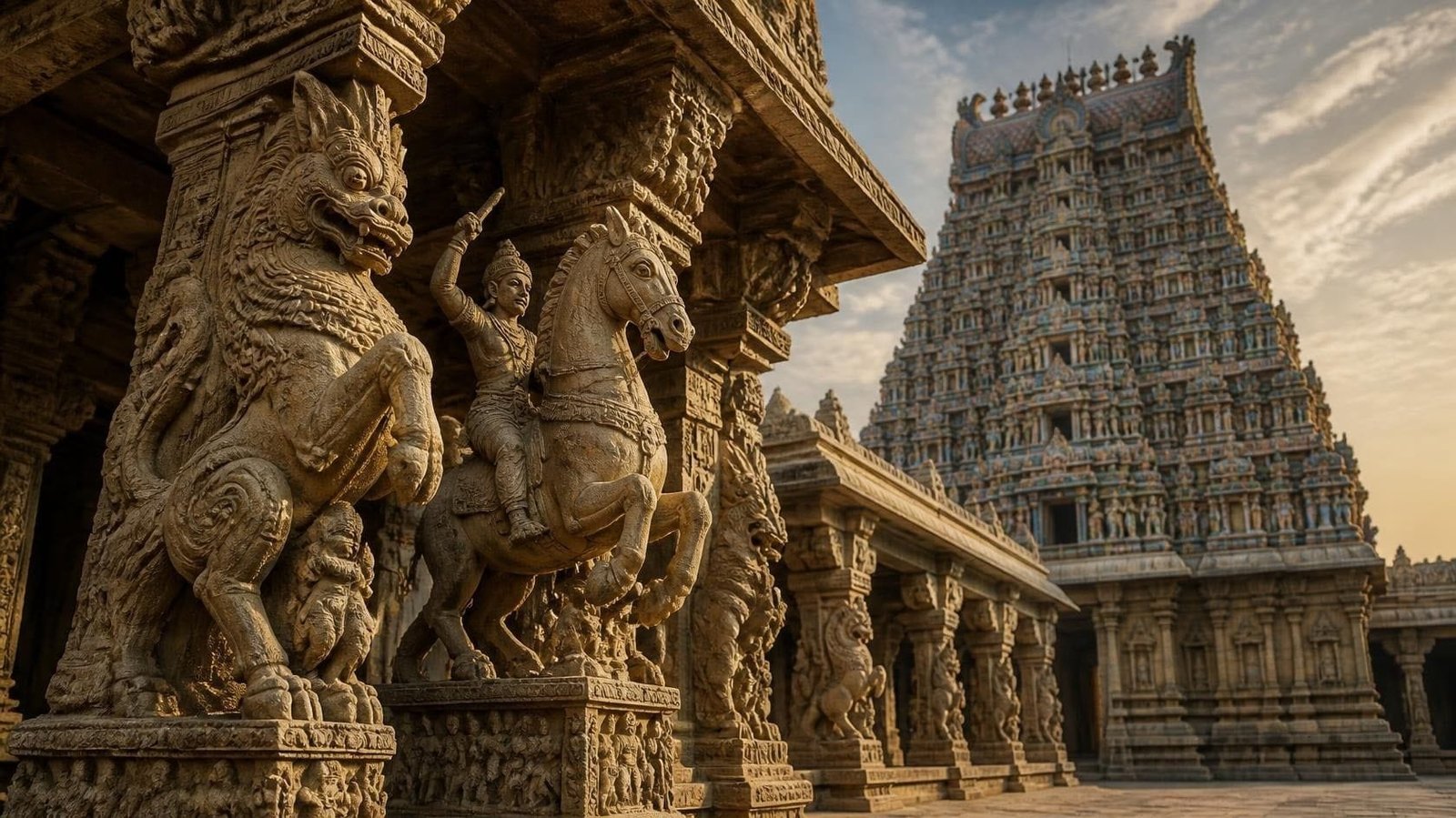
Yali sculptures remained an important feature of Nayaka temple pillars. These mythical creatures were frequently shown in powerful, dynamic compositions and sometimes appeared with mounted warriors.
Horse-riding figures and warrior sculptures added a sense of movement and drama. Their elaborate costumes, weapons, ornaments and expressive poses also provide useful visual evidence for the study of contemporary material and military culture.
Symbolic mythical creature frequently used on pillars.
Dynamic figures reflecting power, movement and martial imagery.
Detailed representations of weapons, costumes and military figures.
5. Stucco Sculpture and Temple Gopurams
The Nayaka period witnessed a major expansion of sculptural decoration on gopurams and temple superstructures. Stucco became particularly useful for creating large, colourful and visually dramatic figures that could be placed on tall gateways.
Deities, divine attendants, guardians, mythical creatures and episodes from Hindu mythology were represented in large-scale stucco compositions. This gave later South Indian temples a highly expressive and monumental visual character.
6. Major Temples and Centres of Nayaka Sculpture
Meenakshi-Sundareswarar Temple, Madurai
Major example of later temple expansion, elaborate mandapas, sculptural pillars and richly decorated gopurams.
Ranganathaswamy Temple, Srirangam
Expanded over several periods, with significant Nayaka-era contributions to mandapas and sculptural decoration.
Thanjavur Temple Complexes
Later additions and artistic traditions demonstrate the continuing development of South Indian temple sculpture.
7. Religious Themes and Iconography
Religious imagery remained at the centre of Nayaka sculpture. Shaivism, Vaishnavism and Shaktism strongly influenced temple iconography. Sculptures represented major deities, avatars, mythological figures, saints and episodes from sacred literature.
Shiva, Parvati, Ganesha, Kartikeya and related narratives.
Vishnu, his avatars and Vaishnava devotional traditions.
Devi forms and Shakti-related imagery in temple decoration.
Religious teachers and devotional traditions were incorporated into temple art.
8. Narrative Sculpture and Mythological Themes
Nayaka artists continued the South Indian tradition of transforming religious literature into visual narratives. Scenes from the Ramayana, Mahabharata and Puranas were represented through sculptural panels, pillars and temple decorations.
The increased scale of temple complexes provided more space for storytelling, allowing artists to create elaborate sequences of mythological and devotional imagery.
9. Distinctive Features of Nayaka Sculpture
- Vijayanagara influence: Continued use of Yali, horse riders and monumental pillars.
- Large mandapas: Pillared halls became major centres of sculptural expression.
- Elaborate gopurams: Extensive use of stucco figures on temple gateways.
- Dynamic compositions: Warriors, dancers, musicians and mythical creatures create movement.
- Rich ornamentation: Detailed jewellery, costumes and decorative patterns.
- Mythological narratives: Epics and Puranic stories were represented visually.
- Temple-centred art: Sculpture remained closely connected with religious rituals and festivals.
10. Sculpture as a Source of Social and Cultural history
Nayaka sculptures provide valuable visual evidence about the society and cultural life of early modern South India. Representations of musicians, dancers, warriors, royal figures, animals and religious processions help historians understand contemporary dress, ornaments, performance traditions and martial culture.
The sculptures therefore function not only as religious art but also as important historical sources for reconstructing the cultural environment of the period.
11. Contribution of Nayaka Sculpture to South Indian Art
The Nayaka period played a major role in preserving and expanding the South Indian temple tradition after the decline of Vijayanagara political power. Nayaka rulers transformed existing temples into increasingly elaborate architectural complexes through the addition of mandapas, gopurams, corridors and sculptural programmes.
Their artistic legacy influenced later temple architecture in Tamil Nadu and helped preserve many traditional forms of South Indian sculpture, woodwork, stucco decoration and ritual art.
12. Vijayanagara vs Nayaka Sculpture
| Aspect | Vijayanagara | Nayaka |
|---|---|---|
| Major Character | Monumental temple sculpture | Expansion and elaboration of temple complexes |
| Signature Elements | Yali pillars, horse riders, narrative reliefs | Large mandapas, stucco gopurams, elaborate pillars |
| Artistic Trend | Monumentality and structural integration | Greater decorative complexity |
Quick Revision: Nayaka Sculpture
Vijayanagara Legacy → Nayaka Kingdoms → Madurai & Tamil Nadu → Large Mandapas → Sculpted Pillars → Yali & Horse Riders → Stucco Gopurams → Mythological Narratives → Temple Expansion → Later South Indian Tradition
UPSC Exam Focus: Nayaka Sculpture
Remember these keywords: Nayaka Period → Vijayanagara Legacy → Madurai → Tamil Nadu → Mandapas → Sculpted Pillars → Yali → Horse Riders → Stucco → Gopurams → Mythological Narratives → Temple Expansion.
South Indian Temple Sculpture: Styles, Features, Themes & Cultural Significance
South Indian Temple Sculpture is one of the most remarkable expressions of India's artistic and religious heritage. Closely connected with Dravidian Temple Architecture, sculpture developed as an integral part of temple walls, pillars, gateways, mandapas and sacred spaces. From the rock-cut monuments of the Pallavas to the bronze masterpieces of the Cholas and the monumental sculptures of the Vijayanagara and Nayaka periods, South Indian temple art reflects centuries of artistic innovation, religious symbolism and royal patronage.
1. Historical Development of South Indian Temple Sculpture
The development of temple sculpture in South India took place over many centuries. Different dynasties introduced distinctive techniques and artistic preferences while building upon earlier traditions.
Rock-cut and monolithic sculpture
Stone sculpture and bronze icons
Rock-cut and temple traditions
Intricate soapstone carving
Monumental pillars and Yali figures
Large mandapas and stucco decoration
2. Sculpture as an Integral Part of Temple Architecture
In South India, sculpture was rarely treated as an isolated art form. It was deeply integrated with the structure and ritual function of the temple. Sculptural images appeared on vimanas, gopurams, mandapas, pillars, doorways, walls, niches and subsidiary shrines.
This close relationship between architecture and sculpture transformed the temple into a complete visual and sacred environment. The placement of each image could have religious, symbolic or architectural significance.
3. Major Deities and Religious Themes
Religious iconography forms the foundation of South Indian temple sculpture. Sculptors followed established iconographic principles while also adapting figures to regional artistic styles.
Nataraja, Dakshinamurti, Lingodbhava and other manifestations.
Vishnu and avatars such as Rama, Krishna and Narasimha.
Durga, Parvati, Lakshmi and other forms of the divine feminine.
Ganesha, Kartikeya, Surya, celestial beings and guardian figures.
4. Major Locations of Sculpture in South Indian Temples
Large gateways often carry numerous stucco and sculptural figures.
Pillared halls provide extensive surfaces for elaborate carvings.
Sculptural imagery is integrated with the temple superstructure.
Deities, narrative scenes and decorative motifs appear in niches and panels.
Particularly elaborate in Vijayanagara and Nayaka traditions.
Guardian figures and decorative motifs mark sacred entrances.
5. Materials Used in South Indian Temple Sculpture
The choice of material varied according to region, artistic purpose and period. Stone remained the principal material for monumental temple sculpture, while metal and wood were also important in different regional traditions.
- Granite: Widely used for major South Indian temple structures and durable sculptures.
- Sandstone: Important in several Deccan and related sculptural traditions.
- Soapstone: Especially important in Hoysala sculpture because of its suitability for fine carving.
- Bronze: Particularly famous in the Chola tradition for portable sacred images.
- Wood: Especially significant in Kerala's temple and architectural traditions.
- Stucco: Widely used for later monumental gopurams and temple superstructures.
6. Major Styles and Regional Traditions
| Tradition | Major Features | Key Examples |
|---|---|---|
| Pallava | Rock-cut and monolithic sculpture | Mamallapuram |
| Chola | Refined stone and bronze sculpture | Nataraja, Thanjavur |
| Hoysala | Intricate carving and dense ornamentation | Belur, Halebidu, Somanathapura |
| Vijayanagara | Monumental pillars, Yalis and narrative art | Hampi |
| Nayaka | Large mandapas and elaborate stucco decoration | Madurai |
7. Mythological Narratives and Storytelling
South Indian temple sculpture transformed religious literature into visual narratives. Scenes from the Ramayana, Mahabharata, Puranas and regional devotional traditions were represented on walls, pillars and architectural panels.
These narrative sculptures served an educational and devotional purpose while also adding artistic richness to the temple environment.
8. Chola Bronzes: The Portable Dimension of Temple Sculpture
The Chola period added a remarkable portable dimension to South Indian temple sculpture through its sophisticated bronze images. The lost-wax technique allowed sculptors to create graceful icons that could be carried during temple processions and festivals.
9. Sculpture as a Source of Social and Cultural history
Temple sculptures provide valuable evidence about the social and cultural life of South India. Representations of dancers, musicians, warriors, royal figures, animals, devotees and everyday activities help historians reconstruct aspects of dress, ornaments, performance traditions, military culture and social practices.
Thus, temple sculpture functions not only as religious art but also as an important visual historical source.
10. Key Features of South Indian Temple Sculpture
- Integration with architecture: Sculpture forms an essential part of temple design.
- Religious symbolism: Deities and sacred narratives dominate the visual programme.
- Royal patronage: Dynasties supported large-scale temple construction and artistic production.
- Technical diversity: Stone carving, bronze casting, woodcarving and stucco developed side by side.
- Dynamic human figures: Dancers, musicians, warriors and devotees create visual movement.
- Mythological storytelling: Epics and Puranic narratives were translated into visual form.
- Regional diversity: Tamil, Karnataka, Kerala and Deccan traditions developed distinctive characteristics.
11. Contribution to Indian Art and Cultural Heritage
South Indian temple sculpture made an enormous contribution to Indian art by demonstrating how architecture, sculpture, religion, mythology, technology and social life could be integrated into a single cultural environment.
Its legacy extends from the rock-cut monuments of the Pallavas and the bronze masterpieces of the Cholas to the intricate Hoysala carvings and monumental Vijayanagara and Nayaka temple complexes. This continuity makes South Indian temple sculpture one of the most important subjects in the study of Indian art history.
Quick Revision: South Indian Temple Sculpture
Pallava Rock-Cut Art → Chola Stone & Bronze → Pandya Traditions → Hoysala Fine Carving → Vijayanagara Monumental Pillars → Nayaka Mandapas & Stucco → Continuity of Dravidian Temple Art
Major Gods and Goddesses in South Indian Sculpture: Iconography, Forms & Symbolism
The depiction of major gods and goddesses in South Indian sculpture forms the core of the region's temple-art tradition. From the Pallava and Chola periods to the Vijayanagara and Nayaka eras, sculptors represented Hindu deities through carefully defined iconographic attributes, gestures, postures, vehicles, weapons and symbolic forms. These images were not merely decorative; they were connected with worship, mythology, temple rituals and the philosophical traditions of Hinduism.
1. Religious Iconography in South Indian Sculpture
South Indian sculptors followed established principles of Hindu iconography while developing distinctive regional styles. A deity could be identified through specific attributes such as weapons, hand gestures, crowns, ornaments, vehicles and accompanying figures.
The same deity could appear in multiple forms depending on the theological tradition, temple, dynasty and ritual purpose. This combination of standardized symbolism and artistic creativity is a defining feature of South Indian temple sculpture.
2. Shiva: The Most Important Shaiva Sculptural Theme
Shiva occupies a central position in South Indian sculpture, particularly in the Shaiva temple tradition. He appears in numerous forms representing different aspects of divine power, meditation, cosmic creation and destruction.
Shiva as the cosmic dancer, symbolizing the dynamic rhythm of the universe.
Shiva as the divine teacher associated with wisdom and knowledge.
Symbolizes Shiva's infinite and transcendent nature.
Represents the integrated unity of Shiva and Shakti.
3. Nataraja: The Iconic Chola Representation of Shiva
The Chola bronze Nataraja is one of the most celebrated achievements of South Indian sculpture. Shiva is represented dancing within a circular prabhamandala, symbolizing the cosmic cycle of creation, preservation and destruction.
- Damru: Associated with creation and cosmic rhythm.
- Fire: Represents destruction and transformation.
- Raised foot: Associated with liberation and spiritual release.
- Apasmara: Represents ignorance overcome by divine knowledge.
- Flaming aureole: Symbolizes the cosmic universe and its continuous movement.
4. Vishnu and Vaishnava Sculpture
Vishnu occupies a major position in South Indian Vaishnava temple sculpture. He is commonly represented with his characteristic attributes—the chakra, shankha, gada and padma.
Vishnu's avatars became especially important subjects for narrative sculpture, allowing temple artists to depict stories of divine intervention and protection.
Represents divine protection and the triumph of dharma.
Associated with righteousness, duty and the Ramayana tradition.
Depicted in stories connected with devotion, childhood and the Mahabharata.
Vishnu's cosmic stride represents the expansion of divine power.
5. Devi and Shakti: The Divine Feminine in South Indian Sculpture
The Devi or Shakti tradition occupies an important place in South Indian temple art. Goddess figures represent different aspects of feminine power, fertility, protection, prosperity and spiritual energy.
Warrior goddess associated with protection and victory over evil.
Represents divine feminine energy and appears in multiple forms.
Goddess associated with prosperity, abundance and auspiciousness.
Important regional manifestations of the goddess in Tamil traditions.
6. Ganesha: Remover of Obstacles
Ganesha appears extensively in South Indian temples. His elephant head, pot belly, broken tusk, multiple arms and association with the mouse provide distinctive iconographic features.
Ganesha sculptures are often placed near temple entrances or in subsidiary shrines because of his association with auspicious beginnings and the removal of obstacles.
7. Kartikeya or Murugan: Warrior Deity of South India
Kartikeya, known widely as Murugan in Tamil traditions, holds a particularly important position in South Indian religious art. He is commonly depicted with his vel (spear) and peacock vehicle.
Murugan's imagery reflects both his identity as a warrior deity and the strong devotional traditions associated with Tamil Nadu.
8. Surya: The Solar Deity
Surya appears in South Indian temple sculpture as a standing divine figure associated with the sun, light, energy and cosmic order. He is commonly represented with royal ornaments and symbolic attributes associated with solar power.
9. Other Important Divine and Mythical Figures
Symbolizes devotion, strength and service to Rama.
Vishnu's vehicle and an important Vaishnava symbol.
Shiva's sacred bull and a common feature of Shaiva temples.
Guardian figures traditionally placed at sacred entrances.
Celestial female figures associated with beauty, music and dance.
Divine attendants often associated with Shiva and temple decoration.
10. Major Deities and Their Iconographic Symbols
| Deity | Major Form | Important Symbols |
|---|---|---|
| Shiva | Nataraja, Dakshinamurti | Trident, damru, third eye, Nandi |
| Vishnu | Various avatars | Chakra, shankha, gada, lotus |
| Durga | Mahishasuramardini | Multiple arms, weapons, lion |
| Ganesha | Elephant-headed deity | Broken tusk, modak, mouse |
| Murugan | Warrior deity | Vel, peacock |
| Surya | Solar deity | Solar imagery, chariot tradition |
11. Regional Variations in the Depiction of Deities
Although the basic iconographic principles remained consistent, representations varied across regions and dynasties. Tamil Nadu became especially famous for Chola bronze images, Karnataka developed highly detailed stone traditions, while Kerala developed distinctive wooden and metal traditions alongside its Temple Architecture.
These variations demonstrate that South Indian sculpture was not a single uniform style but a collection of interconnected regional traditions.
12. Religious, Social and Cultural Significance
Images of gods and goddesses served multiple purposes. They functioned as objects of worship, visual representations of sacred narratives and symbols of theological ideas. Temple sculptures also formed an important part of festivals, processions and devotional practices.
At the same time, sculptural representations of dancers, musicians, attendants and mythical beings provide valuable evidence about the social and cultural life of medieval South India.
13. Key Features of Divine Representation in South Indian Sculpture
- Iconographic precision: Deities are identified through specific attributes and symbols.
- Multiple manifestations: A single deity may appear in numerous theological forms.
- Dynamic movement: Dancing and action-based forms create visual energy.
- Rich ornamentation: Crowns, jewellery and costumes receive detailed treatment.
- Mythological storytelling: Sculptures visually narrate episodes from sacred literature.
- Architectural integration: Divine images are carefully incorporated into temple structures.
- Regional diversity: Different dynasties and regions developed distinctive visual styles.
14. Contribution to Indian Art history
The representation of gods and goddesses in South Indian sculpture demonstrates the close relationship between religion, philosophy, mythology and artistic expression. From the cosmic Nataraja to the powerful Mahishasuramardini and the devotional forms of Vishnu, sculptors translated complex religious ideas into accessible visual forms.
This tradition played a major role in shaping the visual vocabulary of Indian art and continues to influence temple art, bronze casting, classical dance and cultural traditions.
Quick Revision: Major Deities in South Indian Sculpture
Shiva → Nataraja → Dakshinamurti → Vishnu → Avatars → Devi → Durga → Ganesha → Murugan → Surya → Hanuman → Garuda → Nandi → Dvarapalas
South Indian Bronze Sculpture: Chola Bronzes, Lost-Wax Technique, Nataraja & Major Features
South Indian Bronze Sculpture is one of the finest traditions of metal art in Indian history. Although bronze casting developed in several regions and periods, the Chola period of Tamil Nadu is especially renowned for its sophisticated production of sacred bronze images. These sculptures combine technical mastery, graceful human forms, religious symbolism, movement and devotional purpose, with the iconic image of Shiva Nataraja representing one of the highest achievements of Indian sculptural art.
1. Historical Background of South Indian Bronze Sculpture
The tradition of metal image-making in South India has ancient roots, but it reached an exceptional level of refinement during the Chola period, particularly between the 9th and 13th centuries CE. Chola rulers and temple institutions supported highly skilled metalworkers who produced images for ritual worship and temple processions.
Earlier South Indian traditions provided an important foundation, while Chola artisans developed a distinctive style characterized by elegant proportions, balanced compositions and expressive movement.
2. Lost-Wax Technique: The Core of South Indian Bronze Casting
The traditional lost-wax technique, known as cire-perdue, was central to the production of many South Indian bronze images. The method allowed artisans to create complex forms with fine details and individualized compositions.
A detailed figure was first created in wax.
Clay was applied around the wax model to form a mould.
Heating removed the wax and created the empty mould.
Molten metal was poured into the cavity.
The cast image was cleaned, polished and finely finished.
3. Chola Bronze Sculpture: The Golden Age
The Chola period is widely regarded as a high point in South Indian bronze sculpture. Chola artists achieved an exceptional balance between anatomical idealization, graceful movement and iconographic precision.
Bronze images were created not only as artistic objects but as ritual icons. Many were designed to be carried outside the sanctum during festivals and processions, allowing the deity to symbolically interact with devotees and the surrounding community.
4. Nataraja: The Masterpiece of South Indian Bronze Art
The Shiva Nataraja is the most famous icon associated with the South Indian bronze tradition. Shiva is represented in a dynamic dancing posture, surrounded by a circular ring of flames. The image combines movement, balance, symbolism and philosophical ideas within a single composition.
Associated with creation and cosmic rhythm.
Represents destruction and transformation.
Symbolizes protection and reassurance.
Represents ignorance overcome by divine knowledge.
Associated with liberation and spiritual release.
5. Other Important Deities in South Indian Bronze Sculpture
Often depicted with the chakra, shankha, gada and lotus.
Graceful representations emphasize divine femininity and devotion.
Family composition featuring Shiva, Parvati and Skanda.
Important especially within Tamil Shaiva and Murugan traditions.
Frequently represented as an auspicious and devotional icon.
Goddess images represent protection, prosperity and divine power.
6. Distinctive Features of South Indian Bronze Sculpture
- Graceful proportions: Figures display idealized yet natural human forms.
- Dynamic movement: Dancing postures create a sense of rhythm and energy.
- Iconographic precision: Attributes, gestures and ornaments follow established conventions.
- Fine craftsmanship: Jewellery, hair, clothing and facial features are carefully modeled.
- Portable images: Many bronzes were created for ritual processions outside the sanctum.
- Religious symbolism: Every major element can carry theological meaning.
- Technical sophistication: Lost-wax casting allowed complex three-dimensional forms.
7. Religious and Ritual Importance of Bronze Images
South Indian bronze sculptures had a direct connection with temple worship. Unlike purely decorative objects, many bronze icons were ritually consecrated and treated as embodiments of the deity.
During festivals, the processional image could be taken from the temple and carried through the streets. This created a close relationship between the deity, temple institution and community of devotees.
8. Metallurgical Skill and the Panchaloha Tradition
Traditional South Indian sacred metal images are often associated with Panchaloha, a five-metal alloy tradition. The exact composition could vary according to period and tradition, but the concept reflects the close relationship between metallurgy, ritual practice and sacred image-making.
9. Major Centres of South Indian Bronze Art
Major centre of classical South Indian bronze casting.
Closely associated with the wider Chola temple-art landscape.
Famous for continuing the traditional South Indian bronze-casting craft.
Temple institutions played an important role in commissioning and preserving sacred images.
10. Bronze Sculpture as a Reflection of Society and Culture
South Indian bronze images reveal important aspects of religious institutions, craftsmanship and social organization. The production of a major bronze required the collaboration of metalworkers, sculptors, religious authorities and patrons.
Their use in festivals and processions also demonstrates the importance of temples as centres of community life, performing arts and religious culture.
11. Stone Sculpture vs Bronze Sculpture in South India
| Aspect | Stone Sculpture | Bronze Sculpture |
|---|---|---|
| Primary Function | Architectural and sacred decoration | Ritual and processional images |
| Material | Granite, sandstone, soapstone etc. | Bronze and traditional sacred alloys |
| Major Strength | Monumentality and durability | Movement, portability and fine modelling |
| Famous Tradition | Temple wall and pillar sculpture | Chola bronze images |
12. Key Features for UPSC Revision
- Chola period: Major high point of South Indian bronze sculpture.
- Lost-wax casting: Key technique used to produce complex three-dimensional images.
- Nataraja: Most iconic example of the tradition.
- Ritual function: Bronzes served as processional and worship images.
- Graceful movement: Dynamic postures are a major artistic characteristic.
- Iconographic precision: Attributes and gestures convey theological meanings.
- Temple patronage: Religious institutions played a central role in commissioning and preserving bronzes.
13. Contribution of South Indian Bronze Sculpture to Indian Art
South Indian bronze sculpture represents a remarkable synthesis of metallurgy, religious thought, iconography and aesthetic expression. Chola artists demonstrated that metal could be transformed into graceful, dynamic and spiritually powerful images.
The tradition continues to influence Indian art, temple rituals and classical cultural practices. It also occupies an important place in the global history of sacred sculpture because of its combination of technical sophistication and philosophical symbolism.
Quick Revision: South Indian Bronze Sculpture
Chola Period → Tamil Nadu → Lost-Wax Technique → Bronze Icons → Panchaloha Tradition → Nataraja → Ritual Processions → Temple Patronage → Graceful Movement → Iconographic Precision
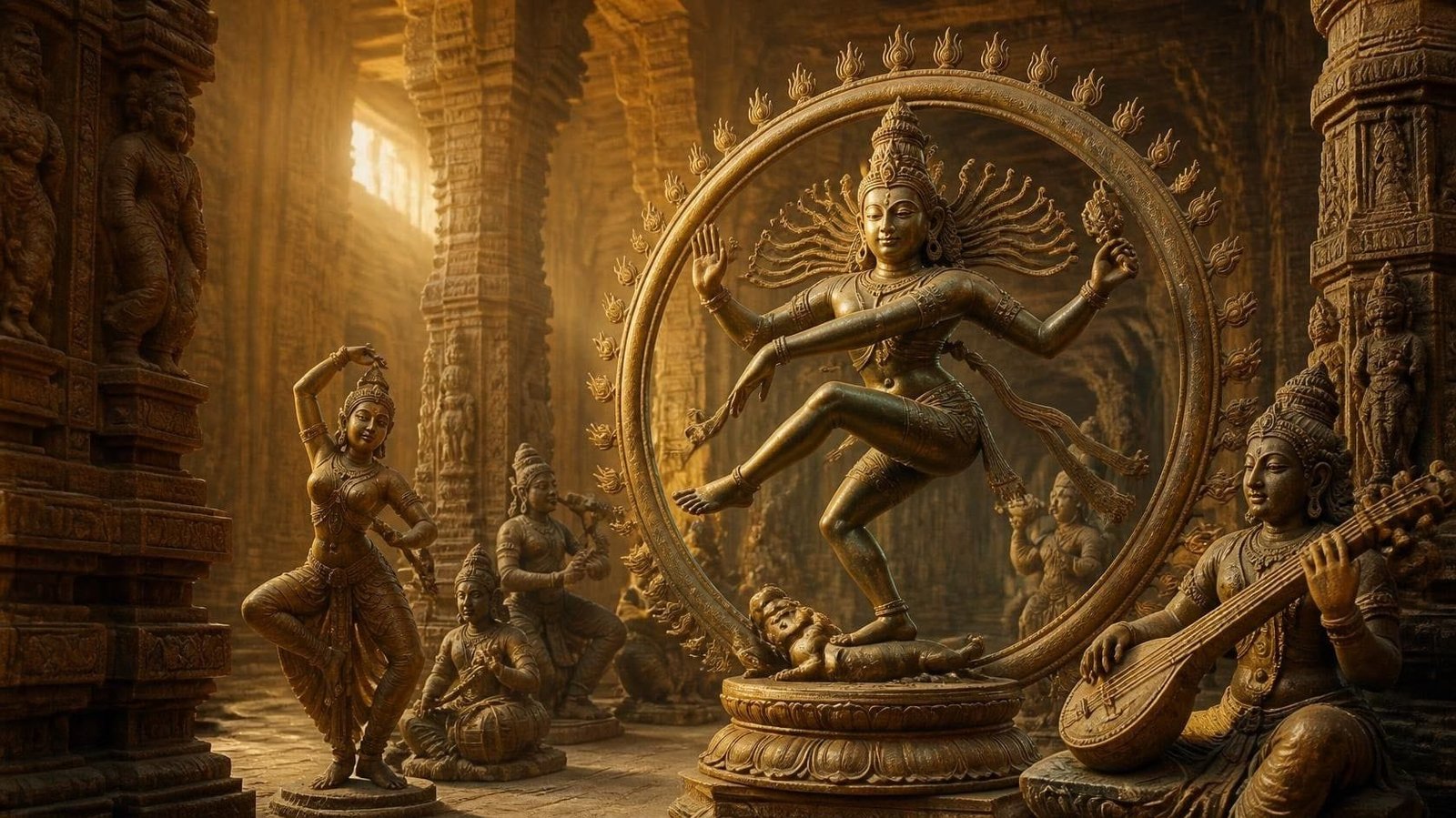
Dance and Music in South Indian Sculpture: Nataraja, Temple Art, Performing Arts & Cultural Heritage
Dance and music in South Indian sculpture represent the close relationship between visual art and performing arts. South Indian temples were not only places of worship but also important centres of music, dance, festivals and cultural activities. Sculptors represented dancers, musicians, instruments and divine performers on temple walls, pillars and bronze images, creating a visual record of the region's rich artistic traditions.
1. Introduction: Performing Arts in South Indian Temple Sculpture
In South Indian artistic traditions, dance, music and sculpture developed in close association with temples. Sculptors attempted to capture movement in stone and metal by representing dancers in different postures, hand gestures and body positions.
Musical instruments were also carefully depicted, making temple sculpture an important source for understanding the history of Indian performing arts.
2. Nataraja: Shiva as the Cosmic Dancer
The most celebrated connection between dance and South Indian sculpture is the image of Shiva Nataraja. Particularly famous in the Chola bronze tradition, Nataraja represents Shiva performing the cosmic dance.
The composition combines movement, rhythm and philosophical symbolism. Shiva's dance represents the dynamic processes of the universe, while the surrounding flame and accompanying symbols communicate ideas of creation, destruction, transformation and liberation.
Symbolically connected with sound and creation.
Represents destruction and transformation.
Represents cosmic movement and divine energy.
Symbolizes ignorance overcome by divine knowledge.
3. Depiction of Dance Postures and Gestures
South Indian sculptors represented dancers through carefully balanced poses, hand gestures and body movements. These sculptures preserve visual evidence of the sophisticated relationship between dance technique, religious ritual and temple culture.
Sculptures preserve numerous symbolic hand positions.
Bent knees, curved torsos and dynamic poses create visual rhythm.
Expressions contribute to the emotional dimension of dance.
Detailed ornaments and costumes reflect performing traditions.
4. Relationship with the Natya Shastra Tradition
Indian dance traditions were shaped by long-standing theoretical traditions associated with texts such as the Natya Shastra. South Indian temple sculpture reflects an artistic environment in which posture, gesture, expression and movement were considered important elements of performance.
Sculptures should not, however, be treated as exact photographic records of every historical dance technique. They provide valuable visual evidence of the artistic and religious environment in which dance traditions developed.
5. Musical Instruments Depicted in South Indian Sculpture
Temple sculptures frequently show musicians playing different types of instruments. These representations provide useful evidence for the development of string, wind and percussion instruments in South Indian musical culture.
Percussion instruments appear frequently in representations of temple musicians.
String instrument associated with classical musical traditions.
Wind instruments appear in religious and mythological scenes.
Used in ritual and ceremonial contexts.
Associated with rhythm and devotional performance.
6. Temple Musicians and Performers
South Indian temples historically functioned as important cultural institutions. Sculptural representations of musicians, dancers, attendants and celestial performers reflect the important role of performing arts within temple life.
These figures can be found on temple pillars, walls, gateways and narrative panels, demonstrating how visual art celebrated the performing arts alongside religious themes.
7. Chola Period: Dance and Music in Temple Art
The Chola period is particularly important for the relationship between temple sculpture and performing arts. Chola temples contain numerous representations of dancers, musicians, divine performers and musical instruments.
The famous Nataraja tradition demonstrates how the idea of divine dance could be translated into both stone and bronze sculpture. The movement of the figure became an important artistic language.
8. Vijayanagara and Nayaka Periods
During the Vijayanagara and Nayaka periods, the development of large mandapas created extensive spaces for sculptural representation of dancers and musicians.
Pillars frequently contain dynamic figures, musicians with instruments, dancers and mythological performers. These compositions reveal the continued importance of performing arts within temple culture.
9. Dance and Music Motifs in South Indian Sculpture
| Artistic Element | Sculptural Representation | Cultural Significance |
|---|---|---|
| Nataraja | Shiva performing cosmic dance | Cosmic rhythm and divine energy |
| Dancers | Dynamic poses and gestures | Temple performance traditions |
| Musicians | Figures playing instruments | Musical culture and ritual |
| Instruments | Drums, veena, flute, conch and others | Evidence for historical musical practices |
10. Sculpture as a Historical Source for Performing Arts
Sculptures provide valuable visual evidence about the history of Indian dance and music. They reveal body postures, gestures, costumes, jewellery, instruments and performance contexts.
However, sculptural evidence should be studied alongside literary, epigraphic and other historical sources. A sculpture represents an artistic interpretation and should not automatically be treated as an exact record of a particular performance.
11. Religious Significance of Dance and Music
In temple culture, music and dance were closely associated with devotional expression. Performance could form part of festivals, rituals and ceremonial occasions. The presence of dancers and musicians in temple sculpture therefore reflects the sacred and cultural dimensions of performance.
The visual representation of these activities helped reinforce the idea that the temple was not simply an architectural structure but a living centre of religious and cultural life.
12. Key Features: Dance and Music in South Indian Sculpture
- Nataraja: The most famous representation of divine dance.
- Dynamic postures: Sculptors captured movement through body curves and gestures.
- Musical instruments: Drums, veena, flutes, conch and other instruments appear in temple art.
- Temple performers: Dancers and musicians were represented as part of sacred and cultural life.
- Chola bronzes: Demonstrate the combination of movement, rhythm and three-dimensional modelling.
- Vijayanagara-Nayaka pillars: Provide numerous examples of dancers and musicians.
- Historical evidence: Sculptures help reconstruct aspects of India's performing-art traditions.
13. Contribution to Indian Art and Performing Arts
The representation of dance and music in South Indian sculpture demonstrates the extraordinary interaction between visual art, religion and performing traditions. Sculptors transformed movement and rhythm into stone and metal, creating images that continue to influence the understanding of Indian cultural heritage.
These sculptures are especially valuable because they preserve visual evidence of artistic practices that might otherwise be difficult to reconstruct from textual sources alone.
Quick Revision: Dance and Music in South Indian Sculpture
Nataraja → Cosmic Dance → Chola Bronzes → Dancers → Hand Gestures → Musical Instruments → Temple Musicians → Chola Period → Vijayanagara → Nayaka Mandapas → Performing Arts → Religious & Cultural Heritage
Major Techniques of South Indian Sculpture: Stone Carving, Bronze Casting, Rock-Cut Art & Sculptural Methods
The major techniques of South Indian sculpture reflect centuries of experimentation with stone, metal, wood and stucco. From the rock-cut monuments of the Pallavas to the refined Chola bronze tradition and the elaborate pillar carvings of the Vijayanagara and Nayaka periods, South Indian artists developed highly specialized methods of carving, modelling, casting and finishing.
1. Introduction: Technical Diversity in South Indian Sculpture
South Indian sculpture cannot be understood as a single technique. Different regions and dynasties developed methods suited to the available materials, architectural requirements and religious purposes.
The major techniques include rock-cut excavation, monolithic carving, relief carving, free-standing sculpture, stone polishing, lost-wax bronze casting, wood carving and stucco modelling.
2. Rock-Cut Sculpture Technique
Rock-cut sculpture involves creating architectural and sculptural forms directly from a natural rock mass. Instead of assembling separate blocks, artisans removed unwanted stone to reveal the desired form.
The Pallavas made this technique especially famous at Mamallapuram, where cave temples, open-air reliefs and monolithic monuments demonstrate exceptional control over stone.
3. Monolithic Carving Technique
In monolithic carving, an entire architectural or sculptural composition is carved from a single block of stone. This requires careful planning because an error during carving cannot easily be corrected.
The Pancha Rathas at Mamallapuram are among the best-known examples of this approach. The technique demonstrates the ability of Pallava sculptors to combine architectural form with sculptural treatment.
4. Relief Carving Technique
Relief carving involves sculpting figures so that they project from a background surface. Depending on the depth of carving, reliefs may appear relatively flat or strongly three-dimensional.
South Indian temples contain extensive relief work depicting deities, mythological narratives, dancers, musicians, warriors, animals and decorative motifs.
5. Free-Standing Sculpture
Free-standing sculptures are carved as independent three-dimensional figures rather than being attached to a wall. They can be viewed from multiple directions and were often created as deities, guardians, animals and commemorative figures.
This technique required careful attention to balance, proportion and structural stability, particularly when projecting limbs or ornaments extended away from the main body.
6. Detailed Stone Carving and Surface Finishing
South Indian sculptors used a combination of rough shaping, controlled chiselling and fine finishing to produce detailed stone images. Different stages gradually transformed a rough block into a finished sculptural form.
Removal of large quantities of unwanted stone.
Establishing proportions, anatomy and major details.
Refining facial features, ornaments and surface details.
Final smoothing, polishing and surface treatment.
7. Lost-Wax Technique: The Chola Bronze Tradition
The lost-wax or cire-perdue technique is one of the most important methods associated with South Indian bronze sculpture. It allowed artisans to produce highly expressive three-dimensional figures, particularly during the Chola period.
Detailed sculpture formed in wax.
Clay mould created around the model.
Heating removes the wax.
Molten metal fills the cavity.
Casting is cleaned and refined.
8. Panchaloha and Traditional Metalworking
Sacred metal-image traditions in South India are often associated with Panchaloha, a traditional five-metal alloy concept. The precise composition could vary according to period, workshop and tradition.
The importance of Panchaloha lies not only in metallurgy but also in the relationship between material, ritual consecration and sacred image-making.
9. Wood Carving Technique
Wood carving developed distinctive regional forms in South India, particularly in Kerala and other areas where timber was readily available. Artisans carved architectural components, ritual objects, decorative figures and temple elements from suitable varieties of wood.
Wood allowed artists to create comparatively light and detailed forms, but it required protection from moisture, insects and environmental deterioration.
10. Stucco Modelling and Gopuram Decoration
Stucco modelling became particularly prominent in the decoration of later South Indian temple gopurams and superstructures. A workable mixture was shaped over architectural surfaces to create large figures and ornamental compositions.
The technique was especially useful for producing large-scale representations of deities, mythical creatures, guardians and narrative figures at heights where fine stone carving would have been more difficult.
11. Pillar and Architectural Sculpture
The pillars of South Indian temples became major spaces for sculptural experimentation. This is particularly visible in the Vijayanagara and Nayaka traditions.
Sculptors created projecting figures of Yalis, horse riders, warriors, dancers and deities. Such work required careful control of structural strength because parts of the figures could project significantly from the pillar surface.
12. Iconographic and Proportional Techniques
Technical skill in South Indian sculpture was not limited to carving or casting. Sculptors also followed established systems governing the proportions, posture, gestures, attributes and visual identity of divine figures.
These conventions helped ensure that a deity could be recognized through characteristic symbols and physical attributes while still allowing artists considerable scope for stylistic expression.
13. Major Techniques at a Glance
| Technique | Material | Major Association |
|---|---|---|
| Rock-Cut | Natural Rock | Pallava / Mamallapuram |
| Monolithic | Single Stone Block | Pancha Rathas |
| Relief Carving | Stone | Temple Walls & Panels |
| Lost-Wax Casting | Bronze / Metal Alloy | Chola Bronzes |
| Wood Carving | Wood | Kerala & Regional Traditions |
| Stucco Modelling | Stucco / Plaster Materials | Later Gopurams |
| Pillar Sculpture | Stone | Vijayanagara & Nayaka |
14. Why Were These Techniques Significant?
The technical diversity of South Indian sculpture allowed artists to create different types of visual experiences. Stone provided durability and monumentality, bronze enabled mobility and graceful three-dimensional forms, while wood and stucco allowed flexible decorative applications.
These techniques also demonstrate the advanced knowledge of materials, proportions, structural stability, metallurgy and surface treatment possessed by traditional artisan communities.
15. Key Points for UPSC Examination
- Pallavas: Rock-cut and monolithic sculptural techniques.
- Cholas: Exceptional bronze casting, especially through the lost-wax technique.
- Hoysala tradition: Highly detailed stone carving and ornamentation.
- Vijayanagara: Elaborate sculpted pillars, Yalis and dynamic figures.
- Nayaka: Large mandapas and extensive stucco decoration.
- Kerala: Important wood-carving and regional temple-art traditions.
- Iconography: Proportion, posture, gesture and attributes were governed by established conventions.
16. Contribution of Sculptural Techniques to Indian Art
The technical achievements of South Indian sculptors demonstrate the remarkable relationship between craft knowledge, religious thought and artistic innovation. Their methods allowed monumental temples, narrative reliefs, dynamic bronze images and elaborately decorated architectural elements to flourish.
These techniques were transmitted through artisan traditions and adapted across centuries, creating a continuous but diverse history of South Indian sculpture.
Quick Revision: Major Techniques of South Indian Sculpture
Rock-Cut → Monolithic → Relief Carving → Free-Standing → Detailed Stone Carving → Lost-Wax Bronze Casting → Panchaloha → Wood Carving → Stucco Modelling → Pillar Sculpture → Iconographic Proportions
Major Features of South Indian Sculpture: Style, Iconography, Temples, Materials & Artistic Excellence
South Indian sculpture represents one of the most distinctive traditions of Indian art. Its development was closely connected with Temple Architecture, religious beliefs, royal patronage, mythology and regional craftsmanship. From the Pallava rock-cut monuments to Chola bronzes and the richly carved temples of the Vijayanagara and Nayaka periods, South Indian sculptors created a remarkable combination of technical precision, spiritual symbolism, movement, ornamentation and narrative expression.
1. Close Relationship with Temple Architecture
One of the most important characteristics of South Indian sculpture is its integration with temple architecture. Sculpture was not treated merely as an independent art form. It became an essential part of temple walls, pillars, entrances, mandapas, vimanas and gopurams.
Deities, guardians, mythical creatures, dancers, musicians and narrative scenes were carefully positioned within the architectural design. Consequently, architecture and sculpture often functioned as a unified artistic composition.
2. Strong Religious and Spiritual Character
religion was a central force behind South Indian sculptural traditions. Temples contain representations of Shiva, Vishnu, Devi, Ganesha, Kartikeya, Surya and numerous other divine and mythical figures.
Sculptures were often created for worship and ritual purposes. Their forms communicated theological concepts through posture, gesture, attributes, vehicles and symbolic compositions.
3. Highly Developed Iconography
South Indian sculpture follows established principles of iconography. The identity of a deity is communicated through specific weapons, hand gestures, crowns, ornaments, vehicles and bodily attributes.
Trident, damru, third eye and Nandi.
Chakra, conch, mace and lotus.
Multiple arms, weapons and lion.
Vel and peacock.
4. Monumentality and Architectural Scale
South Indian temple complexes often use sculpture on a monumental scale. Large gopurams, mandapas and temple walls provide extensive surfaces for sculptural programmes.
This creates an important contrast between monumental stone sculpture and the more portable bronze images used in ritual processions.
5. Exceptional Technical Skill and Craftsmanship
South Indian sculptors demonstrated sophisticated knowledge of stone carving, relief work, monolithic carving, bronze casting, wood carving and stucco modelling.
Fine details such as jewellery, facial expressions, hair, clothing, weapons and ornaments were carefully executed, demonstrating the high level of specialization among traditional artisan communities.
6. Mastery of Bronze Casting
The Chola bronze tradition is one of the greatest achievements of South Indian sculpture. Using the lost-wax technique, artists produced highly expressive three-dimensional images.
The famous Nataraja represents the ability of Chola sculptors to combine movement, balance, anatomical elegance and complex symbolism in a single image.
7. Dynamic Movement and Sense of Rhythm
A distinctive feature of South Indian sculpture is its ability to represent movement in stone and metal. Dancers, musicians, warriors and divine figures are often shown in dynamic postures.
The Nataraja image is the finest example, where the entire composition creates a powerful sense of cosmic rhythm and movement.
8. Rich Ornamentation and Decorative Detail
Elaborate jewellery, crowns, necklaces, armlets, waistbands, earrings, costumes and floral motifs are characteristic of many South Indian sculptural traditions.
Particularly in the Hoysala and later temple traditions, sculptors achieved remarkable levels of decorative detail without losing the overall composition.
9. Narrative and Mythological Representation
Temple sculpture frequently transforms mythology into visual narratives. Episodes from the Ramayana, Mahabharata, Puranic traditions and regional devotional literature appear in sculptural panels.
This narrative quality enabled temples to communicate religious stories and cultural values through visual means.
10. Representation of Social and Cultural Life
South Indian sculpture goes beyond divine imagery and includes kings, queens, warriors, dancers, musicians, attendants, devotees, animals and ceremonial scenes.
Such representations provide valuable visual evidence for studying clothing, jewellery, weapons, musical instruments, festivals and aspects of social organization.
11. Importance of Dance and Music
Dancers and musicians appear extensively in South Indian temple art. Sculptures of veena players, drummers, flute players and dancers reflect the close relationship between temple culture and performing arts.
The tradition of Nataraja further demonstrates how dance could become a philosophical representation of cosmic processes.
12. Use of Different Materials
Used extensively for temples, pillars and monumental sculpture.
Famous for portable ritual images and Chola bronzes.
Important in Kerala and other regional traditions.
Widely used for later gopurams and large decorative figures.
13. Regional Diversity and Stylistic Variation
South Indian sculpture is not a single uniform style. Each major political and cultural tradition contributed distinctive characteristics.
Rock-cut and monolithic experimentation at Mamallapuram.
Refined stone sculpture and celebrated bronze images.
Intricate carving and elaborate ornamental detail.
Monumental pillars, Yalis, warriors and dynamic figures.
Elaborate mandapas, narrative sculpture and decorative abundance.
14. Balance Between Idealism and Naturalism
South Indian sculpture often combines idealized divine forms with observations of human anatomy and movement. The figures are not simply realistic portraits; they follow artistic conventions while maintaining a convincing sense of proportion, grace and physical presence.
This balance is especially visible in Chola bronzes and many later temple sculptures.
15. Integration of Art, Religion and Society
Perhaps the most important feature of South Indian sculpture is its ability to bring together religion, architecture, mythology, politics, social life, music and dance.
The temple therefore became a complete cultural environment in which sculpture served devotional, architectural, educational, aesthetic and social functions.
16. Major Features at a Glance
| Feature | Description | Important Association |
|---|---|---|
| Temple Integration | Sculpture forms part of architectural design. | South Indian Temple Architecture |
| religious symbolism | Deities represented through iconographic conventions. | Shaiva & Vaishnava Traditions |
| Bronze Casting | Highly refined lost-wax casting. | Chola Bronzes |
| Ornamentation | Rich jewellery and decorative details. | Hoysala & Later Traditions |
| Dynamic Movement | Dancers, musicians and dynamic divine forms. | Nataraja & Temple Sculpture |
| Social Representation | Royal, military and cultural scenes. | Medieval Temple Art |
17. UPSC Quick Revision
Temple Integration → Religious Symbolism → Iconography → Monumentality → Technical Excellence → Chola Bronzes → Lost-Wax Casting → Dynamic Movement → Ornamentation → Mythological Narratives → Social Life → Dance & Music → Material Diversity → Regional Styles
Comparative Study of Major South Indian Sculptural Styles: Pallava, Chola, Hoysala, Vijayanagara & Nayaka Traditions
The major sculptural styles of South India developed over several centuries under different political, religious and cultural traditions. Although they shared common foundations in Hindu iconography, Temple Architecture and sacred art, each tradition developed distinctive characteristics in terms of material, technique, ornamentation, composition and subject matter. A comparative study of the Pallava, Chola, Hoysala, Vijayanagara and Nayaka traditions helps explain the evolution of South Indian sculpture.
1. Introduction: Diversity within a Shared Tradition
South Indian sculpture evolved alongside the growth of monumental temple architecture. From the early experimentation of the Pallavas to the refined bronze tradition of the Cholas, the intricate stone carving of the Hoysalas and the monumental pillar and mandapa sculpture of the Vijayanagara and Nayaka periods, artistic priorities changed over time.
The result was not a single South Indian style but a family of interconnected regional traditions.
2. Chronological Development
c. 6th–9th centuries CE
c. 9th–13th centuries CE
c. 11th–14th centuries CE
c. 14th–16th centuries CE
Mainly 16th–18th centuries CE
3. Pallava Sculptural Style
The Pallava tradition represents an important stage in the development of South Indian temple sculpture. Pallava artists experimented extensively with rock-cut architecture, monolithic monuments and large narrative reliefs.
- Strong association with Mamallapuram.
- Rock-cut cave temples and monolithic monuments.
- Large open-air narrative reliefs.
- Relatively restrained ornamentation compared with some later traditions.
- Strong integration of sculpture and architecture.
4. Chola Sculptural Style
The Chola period produced some of the most celebrated achievements of South Indian sculpture. Its stone temple sculpture is accompanied by an exceptional tradition of bronze casting, particularly through the lost-wax technique.
- Elegant and balanced human forms.
- Highly developed Shaiva and Vaishnava iconography.
- Outstanding bronze images.
- Dynamic representations of Shiva Nataraja.
- Strong connection between sculpture, ritual and temple festivals.
5. Hoysala Sculptural Style
The Hoysala tradition of Karnataka is famous for exceptionally detailed stone carving and rich ornamental treatment. Soapstone, which is relatively workable, enabled artisans to produce intricate details.
- Extremely intricate carving.
- Rich jewellery and ornamental details.
- Multiple horizontal narrative friezes.
- Detailed representations of deities and mythological scenes.
- Strong emphasis on surface decoration.
6. Vijayanagara Sculptural Style
The Vijayanagara style is characterized by monumental temple complexes, elaborate mandapas and richly sculpted pillars. Sculpture increasingly became integrated with large architectural spaces.
- Large and powerful sculptural forms.
- Highly decorated pillars.
- Frequent depiction of Yalis and horse riders.
- Warriors, dancers, musicians and mythological figures.
- Strong ceremonial and processional character.
7. Nayaka Sculptural Style
The Nayaka period continued and expanded several Vijayanagara architectural and sculptural traditions. Temple complexes became increasingly elaborate, with large mandapas, pillars and monumental gopurams.
- Elaborate mandapa sculpture.
- Highly decorative pillars.
- Large narrative and mythological compositions.
- Extensive use of stucco on later temple superstructures.
- Richly ornamented and visually dramatic figures.
8. Comparative Table: Major South Indian Sculptural Styles
| Feature | Pallava | Chola | Hoysala | Vijayanagara | Nayaka |
|---|---|---|---|---|---|
| Period | 6th–9th c. | 9th–13th c. | 11th–14th c. | 14th–16th c. | 16th–18th c. |
| Major Region | Tamil Nadu | Tamil Nadu | Karnataka | Karnataka & South India | Tamil Nadu |
| Material | Stone | Stone & Bronze | Soapstone | Granite & Stone | Stone & Stucco |
| Main Technique | Rock-cut & monolithic | Stone carving & lost-wax casting | Fine stone carving | Pillar & architectural carving | Elaborate carving & stucco |
| Style | Monumental & relatively restrained | Elegant & graceful | Intricate & ornamental | Monumental & dynamic | Highly elaborate & dramatic |
| Special Feature | Rock-cut experimentation | Nataraja & bronze icons | Ornamental detail | Yali & horse-rider pillars | Large mandapas & stucco work |
| Representative Centre | Mamallapuram | Chola temple region | Belur–Halebidu | Hampi | Madurai & other Tamil centres |
9. Similarities Among Major South Indian Styles
- Strong connection with temple architecture.
- Extensive representation of Hindu deities and mythological narratives.
- Use of established iconographic conventions.
- Royal and temple patronage played an important role.
- Integration of sculpture with religious rituals and festivals.
- Representation of dance, music and aspects of social life.
- High degree of specialization among artisan communities.
10. Major Differences: Style at a Glance
Emphasis on rock-cut and monolithic experimentation.
Emphasis on graceful forms and exceptional bronze casting.
Emphasis on minute detail and ornamental richness.
Emphasis on monumental pillars and dynamic sculptural forms.
Emphasis on elaborate mandapas, decoration and later stucco work.
11. Evolution of South Indian Sculptural Expression
The broad evolution can be understood as a movement from experimentation with rock-cut and monolithic forms towards increasingly elaborate temple sculpture, refined bronze images, intricate ornamentation and monumental pillar compositions.
12. Significance in Indian Art history
The comparative study of these styles shows that South Indian sculpture was constantly evolving while preserving a strong continuity of religious symbolism and temple-based artistic traditions.
The traditions contributed significantly to Indian art through monumental architecture, narrative sculpture, bronze casting, iconography, decorative carving and representations of dance and social life.
13. UPSC Quick Revision
Pallava → Rock-Cut & Monolithic → Mamallapuram
Chola → Graceful Forms & Bronze → Nataraja
Hoysala → Intricate Ornamentation → Belur–Halebidu
Vijayanagara → Monumental Pillars → Yali & Horse Riders
Nayaka → Elaborate Mandapas → Stucco & Decorative Sculpture
Comparative Study of North Indian and South Indian Sculpture: Styles, Materials, Themes, Techniques & Temple Traditions
The sculptural traditions of North and South India developed within a shared religious and cultural framework, yet each region developed distinctive artistic languages. Differences in geography, available materials, political history, Temple Architecture, religious traditions and regional craftsmanship influenced the appearance of sculpture. At the same time, both traditions share important features such as iconography, mythological narratives and the integration of sculpture with sacred architecture.
1. Introduction: Two Major Streams of Indian Sculpture
Indian sculpture developed through multiple regional traditions rather than through a single uniform style. In the north, major artistic traditions include Mathura, Gandhara, Gupta, post-Gupta and Nagara temple traditions. In the south, important traditions include Pallava, Chola, Pandya, Hoysala, Vijayanagara and Nayaka sculpture.
These traditions interacted with one another, so the comparison should be understood as a study of broad regional tendencies rather than absolute divisions.
2. Historical Development
Indus traditions → Mauryan → Gandhara & Mathura → Gupta → Medieval regional schools.
Early traditions → Pallava → Chola → Pandya → Hoysala → Vijayanagara → Nayaka.
3. Major Characteristics of North Indian Sculpture
- Important early traditions of Mathura and Gandhara.
- Major refinement during the Gupta period.
- Strong development of Buddhist, Jain and Hindu imagery.
- Development of regional temple traditions associated with the Nagara style.
- Rich sculptural traditions in central and eastern India, including Khajuraho and Odisha.
- Use of sandstone and other regionally available stones in many major centres.
4. Major Characteristics of South Indian Sculpture
- Strong relationship with Dravida temple architecture.
- Extensive development of temple-based stone sculpture.
- Exceptional Chola bronze tradition.
- Strong representation of Shiva, Vishnu, Devi and regional deities.
- Elaborate pillars, mandapas, gopurams and narrative sculpture.
- Rich traditions of dance, music and social-life representation.
5. North India vs South India: Comparative Table
| Basis | North Indian Sculpture | South Indian Sculpture |
|---|---|---|
| Major Tradition | Mathura, Gandhara, Gupta and Nagara-region traditions | Pallava, Chola, Pandya, Hoysala, Vijayanagara and Nayaka |
| Temple Connection | Strong, particularly in medieval temple traditions | Extremely strong and often architecturally integrated |
| Temple Architecture | Mainly associated with Nagara traditions and regional variants | Strongly associated with Dravida traditions |
| Major Materials | Sandstone, red sandstone, schist and other regional stones | Granite, soapstone, sandstone in some regions, bronze and wood |
| Bronze Tradition | Important in several traditions but less strongly identified with one dominant school | Outstanding Chola lost-wax bronze tradition |
| Iconography | Buddhist, Jain and Hindu imagery | Strong Shaiva, Vaishnava, Shakta and regional devotional imagery |
| Ornamentation | Varies considerably by regional school | Often highly elaborate, especially in later temple traditions |
| Movement | Varies from idealized Gupta forms to dynamic medieval compositions | Strong emphasis on dynamic dance and ritual imagery |
| Social Scenes | Narrative, courtly and cultural representations | Strong representation of dancers, musicians, warriors and processions |
| Major Examples | Sanchi, Mathura, Khajuraho, Konark, Ellora and other centres | Mamallapuram, Chola temples, Belur–Halebidu, Hampi and Madurai |
6. Difference in Materials and Technical Traditions
Material availability significantly influenced regional sculptural traditions. Northern centres are famous for the extensive use of sandstone, red sandstone and schist in different periods. Gandharan sculpture, for example, made extensive use of schist and also reflects interaction with Hellenistic artistic traditions.
In South India, granite and other hard stones were widely used for monumental temple architecture, while the Chola tradition achieved exceptional refinement in bronze through the lost-wax casting process.
7. Treatment of the Human and Divine Form
The Gupta tradition of North India is often noted for serene faces, idealized anatomy and spiritual calm. Later northern schools developed a wide range of forms, including highly ornate temple sculpture.
South Indian sculpture frequently emphasizes graceful bodily movement, especially in Chola bronzes and representations of dance. Later temple sculpture can become highly dynamic and ornamented.
8. Religious Themes and Iconography
Buddhist, Jain and Hindu traditions developed major regional schools.
Shaiva, Vaishnava and Shakta traditions became deeply integrated with temple sculpture.
9. Relationship with Temple Architecture
The distinction between northern and southern sculpture becomes particularly clear when sculpture is studied together with temple architecture. Northern medieval temples are often associated with Nagara-style architectural forms, while South Indian temple complexes are strongly associated with the Dravida tradition.
North: Nagara Context
Sculptures are integrated with temple walls, projections, niches and narrative surfaces.
South: Dravida Context
Sculpture extends across vimanas, mandapas, pillars, gateways and monumental temple complexes.
10. Representation of Social and Cultural Life
Both northern and southern traditions represent aspects of social life, including royalty, musicians, dancers, warriors, attendants, devotees and animals. However, South Indian temple sculpture developed an especially extensive visual language around temple festivals, processions, music and dance.
11. Dance, Music and Movement
Dance and music are important subjects across Indian temple art, but South Indian sculpture is particularly famous for the visual expression of movement through Nataraja, dancers and musicians.
The Chola bronze tradition demonstrates how a sculptor could translate dynamic movement into a balanced three-dimensional form.
12. Ornamentation and Decorative Style
Both traditions use jewellery and decorative motifs, but their expression varies by period and region. Northern medieval temple traditions such as Khajuraho are known for densely populated sculptural surfaces, while South Indian traditions such as Hoysala and later temple sculpture are noted for extremely intricate ornamental treatment.
13. Important Examples: North vs South
| North India | South India |
|---|---|
| Mathura sculptures | Mamallapuram sculptures |
| Gandhara sculptures | Chola bronzes |
| Gupta sculpture | Belur–Halebidu |
| Khajuraho | Hampi |
| Konark | Madurai and other Nayaka centres |
14. Major Similarities
- Both developed within a broad framework of Indian religious art.
- Hindu, Buddhist and Jain traditions influenced different regional schools.
- Iconography and symbolic attributes are important.
- Sculpture is closely associated with sacred architecture.
- Mythological narratives are extensively represented.
- Royal and institutional patronage contributed to artistic development.
- Both traditions reflect social and cultural life alongside religious themes.
15. Major Differences in One View
Greater diversity of early regional schools such as Gandhara, Mathura and Gupta.
Strong continuity of temple-centred sculptural traditions.
Major contributions from Mathura, Gandhara and Gupta traditions.
Major contribution of Chola bronzes and Dravida temple sculpture.
16. Analytical Conclusion
The comparison between North and South Indian sculpture demonstrates that Indian art developed through both unity and regional diversity. Northern traditions contributed major developments such as Gandhara naturalism, Mathura sculpture and Gupta classicism, while South Indian traditions made outstanding contributions through temple sculpture, Dravida architectural integration and Chola bronze casting.
Rather than viewing the two regions as completely separate, they should be understood as interconnected traditions that adapted common religious and artistic ideas to different geographical and cultural environments.
17. UPSC Quick Revision
North India → Mathura → Gandhara → Gupta → Nagara Traditions
South India → Pallava → Chola → Hoysala → Vijayanagara → Nayaka
Influence of Shilpa Shastra and Agama Traditions on South Indian Sculpture
The Shilpa Shastra and Agama traditions played a major role in shaping the religious, architectural and sculptural traditions of South India. These textual and ritual traditions provided frameworks for the creation of temples, sacred images, proportions, gestures, iconographic attributes, ritual spaces and methods of consecration. Their influence can be seen across major South Indian traditions, from Pallava and Chola temples to later Vijayanagara and Nayaka monuments.
1. Introduction: Text, Ritual and Sculpture
South Indian temple sculpture was not created only according to the personal imagination of an artist. Sculptors worked within established religious and artistic conventions. The Shilpa Shastra literature dealt broadly with architecture, sculpture, iconography, proportions and craftsmanship, while the Agamas provided important ritual and theological frameworks for temple worship and sacred images.
2. What is Shilpa Shastra?
Shilpa Shastra is a broad term used for traditional Indian knowledge systems dealing with artistic and technical practices, especially architecture, sculpture and image-making. Different texts and regional traditions contain instructions concerning measurement, proportion, iconography, materials, construction and decorative design.
It is therefore better understood as a body of related traditions and texts rather than a single uniform book that governed every South Indian sculpture.
3. What are the Agamas?
The Agamas are important bodies of Hindu religious literature concerned with theology, temple worship, ritual practices, iconography and related subjects. In South India, Shaiva and Vaishnava Agamic traditions had a particularly important relationship with temple institutions.
Agamic traditions helped establish how sacred images were to be installed, worshipped and incorporated into the ritual life of a temple.
4. Influence on the Creation of Deity Images
One of the most important influences of these traditions was the establishment of recognizable conventions for divine images. A deity was identified through a combination of body posture, number of arms, hand gestures, weapons, ornaments, vehicle and other attributes.
Defines the visual character and symbolic position of the deity.
Hand gestures communicate specific meanings.
Weapons and symbolic objects identify the deity.
The associated vehicle adds another layer of identification.
5. Rules of Proportion and Measurement
Traditional sculptural systems emphasized proportion and measurement. The body of a sacred image was organized through prescribed relationships between different parts rather than being modeled entirely according to ordinary human anatomy.
These conventions helped create visually balanced and recognizable images while leaving room for regional and workshop-level variation.
6. Influence on Temple Architecture and Sculpture
Agamic traditions were closely connected with the organization of temple space. The temple was understood as a sacred environment in which architecture, sculpture and ritual formed an integrated system.
This helped establish the importance of sanctum, subsidiary shrines, mandapas, gateways, circumambulatory spaces and sculptural niches within South Indian temple complexes.
7. Iconographic Identity of Major Deities
| Deity | Common Iconographic Elements | Examples of South Indian Tradition |
|---|---|---|
| Shiva | Trident, damru, third eye, matted hair, Nandi | Nataraja and other Shaiva forms |
| Vishnu | Conch, discus, mace, lotus | Standing and reclining Vishnu forms |
| Devi | Multiple arms, weapons and symbolic attributes | Durga and other Shakta forms |
| Ganesha | Elephant head and distinctive attributes | Temple and household devotional imagery |
8. Influence on Nataraja and Chola Bronzes
The famous Chola Nataraja demonstrates how iconographic conventions could be combined with exceptional artistic creativity. The figure follows established symbolic principles while simultaneously conveying movement, balance and cosmic rhythm.
The ritual function of bronze images was also important. Portable processional images could participate in temple festivals and ceremonies, linking sculpture directly with the ritual life of the community.
9. Ritual Purpose of Sacred Images
Under Agamic traditions, the temple image was not merely a decorative sculpture. It was part of a ritual and theological system. Installation, consecration, daily worship, festivals and processions gave the sacred image an active role within temple life.
Sculptural conventions guide the form.
Ritual processes establish sacred status.
The image becomes central to temple rituals.
Processional images participate in public ceremonies.
10. Influence on Sculptural Postures and Mudras
Sacred images use carefully defined postures, gestures and bodily positions. These elements are not merely decorative; they can communicate the identity, mood and theological meaning of a figure.
The same principle is visible in depictions of dancing deities and celestial figures, where movement is transformed into a symbolic visual language.
11. Influence on Temple Sculptural Programmes
The placement of sculptures within temples was connected to the larger religious and architectural organization of the sacred space. Niches and architectural zones could contain principal deities, subsidiary deities, guardians, mythological figures and decorative motifs.
This helped create a coherent visual programme rather than a random collection of individual sculptures.
12. Major Textual and Traditional Influences
| Tradition / Textual Category | Broad Area of Influence | Relevance to Sculpture |
|---|---|---|
| Shilpa Shastra Traditions | Art, architecture and craftsmanship | Proportion, measurement, materials and iconographic principles |
| Shaiva Agamas | Shaiva theology and temple ritual | Shiva images, temple worship and ritual context |
| Vaishnava Agamas | Vaishnava temple traditions | Vishnu and related iconographic and ritual traditions |
| Regional Traditions | Local artistic and workshop practices | Stylistic variation and adaptation |
13. Shilpa Shastra and the Artisan Tradition
The transmission of sculptural knowledge depended not only on texts but also on living artisan traditions. Skills were learned through apprenticeship, workshop practice and inherited knowledge.
Consequently, actual sculptures do not always reproduce textual rules mechanically. Artists adapted traditional principles to the material, architectural setting, regional style and specific commission.
14. Influence on Major South Indian Sculptural Traditions
Helped shape the integration of sacred imagery with emerging temple architecture.
Strong relationship between iconography, ritual images and bronze casting.
Detailed iconographic and ornamental programmes.
Monumental temple spaces with elaborate sculptural programmes.
Expansion of mandapas, decorative sculpture and later temple additions.
15. Balance Between Rules and Artistic Creativity
An important point for understanding South Indian sculpture is that textual traditions did not eliminate artistic creativity. Instead, they provided a shared conceptual and technical framework within which individual workshops and sculptors could develop distinctive forms.
This explains why sculptures can follow common iconographic principles while still showing significant differences in facial expression, ornamentation, movement and regional style.
16. Overall Impact on South Indian Sculpture
- Established conventions for divine iconography.
- Influenced proportions, posture and symbolic gestures.
- Connected sculpture with temple architecture.
- Integrated sacred images with ritual practice.
- Supported the development of processional bronze images.
- Created a common visual vocabulary across different regional traditions.
- Allowed regional artists to combine established rules with creative expression.
17. UPSC Quick Revision
Shilpa Shastra → Art & Craft Framework →
Proportion → Measurement → Iconography → Posture → Mudra →
Attributes
Agamas → Theology → Temple Ritual → Sacred Images →
Consecration → Worship → Festivals → Processions
South Indian Sculpture and Indian Culture: religion, Society, Dance, Music, Heritage & Cultural Identity
South Indian sculpture is not merely a form of visual art; it is an important cultural record of India. Through temples, bronzes, reliefs and architectural sculpture, it preserves ideas related to religion, philosophy, mythology, social life, dance, music, literature, craftsmanship and political patronage. Its contribution to Indian culture can be understood as a continuous interaction between artistic expression and the living traditions of society.
1. Sculpture as a Mirror of Indian Culture
South Indian sculpture reflects the cultural environment in which it developed. Temples became centres of religious worship, education, music, dance, festivals, charity and community activity. Sculptural programmes therefore recorded far more than religious beliefs.
Figures of kings, warriors, musicians, dancers, devotees, animals and mythological characters provide valuable evidence for understanding different dimensions of historical society.
2. Contribution to Religious and spiritual Traditions
Religion is one of the strongest cultural dimensions of South Indian sculpture. Images of Shiva, Vishnu, Devi, Ganesha, Kartikeya and other deities became central elements of temple art.
Sculptures transformed abstract religious and philosophical ideas into visual forms. Attributes, mudras, postures and symbolic compositions helped communicate theological concepts to devotees.
3. Influence of Hindu Philosophy and Mythology
Indian mythology provided an enormous source of sculptural themes. Episodes from the Ramayana, Mahabharata and Puranic traditions were translated into visual narratives on temple walls and pillars.
Images such as Nataraja express philosophical ideas about creation, preservation, destruction and cosmic rhythm through a single visual composition.
4. Sculpture and Indian Dance Tradition
One of the most important cultural contributions of South Indian sculpture is its relationship with Indian classical dance. Temple sculptures preserve numerous images of dancers and divine dancing figures in carefully defined postures.
The visual representation of movement in temple sculpture demonstrates the close relationship between sculpture, performance and religious practice.
5. Sculpture and Music
Temple sculptures frequently depict veena players, drummers, flute players and other musicians. These representations provide visual evidence of the importance of music within religious and cultural life.
The presence of musicians in temple sculpture reflects the traditional understanding of temples as spaces where music, ritual and devotion interacted.
6. Contribution to Literature and Storytelling
Sculpture functioned as a visual form of storytelling. Mythological narratives, devotional stories and symbolic episodes were represented through sequences of figures and scenes.
This visual storytelling helped connect oral, literary and religious traditions with the physical environment of the temple.
7. Reflection of Social Life
South Indian temple sculpture contains representations of different sections of society. Kings, queens, warriors, attendants, ascetics, devotees, dancers and ordinary cultural figures appear in various contexts.
Kings, queens and courtly imagery.
Dancers and musicians.
Warriors, weapons and processions.
Clothing, ornaments and occupations.
8. Representation of Clothing and Jewellery
Sculptural figures preserve valuable visual information about clothing, hairstyles, crowns, necklaces, earrings, armlets, waist ornaments and other forms of jewellery.
Although such representations are often idealized, they provide useful evidence for reconstructing aspects of historical material culture when studied alongside literary and archaeological sources.
9. Role in Temple-Centred Cultural Life
In historical South India, major temples were not simply places of worship. They could function as centres of artistic production, ritual activity, festivals, music, dance and community interaction.
Sculpture contributed to this environment by creating a visual language through which religious stories, cultural values and social identities were expressed.
10. Sculpture and Regional Cultural Identity
South Indian sculpture also contributed to the formation and preservation of regional cultural identities. Different dynasties and regions developed recognizable artistic traditions while remaining connected to broader Indian religious culture.
Rock-cut and monolithic artistic traditions.
Temple sculpture and celebrated bronze tradition.
Intricate stone carving and ornamental detail.
Monumental pillars, mandapas and dynamic figures.
Elaborate mandapas and decorative temple sculpture.
11. Contribution to Indian Craft Traditions
South Indian sculpture preserved highly specialized craft knowledge. Stone carving, bronze casting, wood carving and decorative techniques required extensive training and workshop traditions.
The continuity of artisan knowledge demonstrates how Indian culture has been transmitted not only through texts but also through practice, apprenticeship and living craft traditions.
12. Preservation of Intangible Cultural Heritage
The significance of South Indian sculpture extends beyond physical monuments. Traditional practices associated with temple rituals, bronze casting, dance, music, icon-making and craftsmanship connect tangible heritage with living cultural traditions.
13. Role in Cultural Integration
South Indian sculpture demonstrates how regional traditions can contribute to a wider idea of Indian cultural unity in diversity. Local artistic styles developed their own characteristics while sharing broad themes of mythology, sacred symbolism, temple worship and philosophical thought.
Thus, regional diversity became an important component of the larger Indian artistic tradition.
14. South Indian Sculpture as a Historical Source
| Cultural Area | What Sculpture Reveals |
|---|---|
| Religion | Deities, rituals, mythology and devotional traditions |
| Society | Social groups, occupations and ceremonial life |
| Material Culture | Clothing, jewellery, weapons and musical instruments |
| Performing Arts | Dance, music, gestures and performance traditions |
| Political Culture | Royal patronage, dynastic power and ceremonial representation |
| Craft Tradition | Stone carving, bronze casting and artisan knowledge |
15. Global Recognition and Indian Cultural Identity
South Indian sculpture has become one of the internationally recognized expressions of Indian artistic heritage. Chola bronzes, temple architecture and major sculptural monuments demonstrate the technical sophistication and philosophical depth of Indian art.
Their global visibility contributes to a broader understanding of India's cultural diversity, artistic continuity and heritage.
16. Overall Contribution to Indian Culture
Visual expression of faith, mythology and philosophy.
Evidence of historical society and material culture.
Strong visual connection with dance and music.
Preservation of advanced sculptural techniques.
Contribution to India's unity in cultural diversity.
17. UPSC Conclusion
South Indian sculpture represents a remarkable synthesis of religion, philosophy, architecture, society, literature, dance, music and craftsmanship. Its greatest cultural contribution lies not only in the beauty of individual sculptures but also in the way sculpture became part of a living cultural system.
Sculpture → Religion → Temple → Society → Dance & Music → Literature → Craftsmanship → Cultural Identity → Heritage
Importance of South Indian Sculpture in Modern Times: Heritage, Art, Tourism, Education & Cultural Identity
South Indian sculpture continues to remain relevant in the modern world because it represents a living connection between India's ancient artistic traditions and contemporary society. Its importance extends beyond historical monuments to Cultural Heritage, tourism, museums, education, conservation, traditional craftsmanship, contemporary art and India's global cultural identity.
1. Preservation of India's Cultural Heritage
South Indian temples, stone sculptures and bronze images preserve centuries of Indian artistic and religious traditions. They provide tangible evidence of the achievements of dynasties such as the Pallavas, Cholas, Hoysalas, Vijayanagara rulers and Nayakas.
In the modern era, protecting these monuments helps preserve not only physical objects but also the historical memory associated with them.
2. Importance for Cultural Identity
Sculpture contributes to a sense of regional and national cultural identity. Temple traditions, bronze images and sculptural heritage connect contemporary communities with their historical and cultural roots.
3. Contribution to Tourism and Local Economies
Major sculptural and temple heritage sites attract domestic and international visitors. Places such as Mamallapuram, Thanjavur, Hampi, Belur, Halebidu and Madurai form important cultural tourism destinations.
Heritage Tourism can generate employment and income for guides, artisans, transport providers, hospitality businesses, museums and local communities.
4. Importance for Art Education and Research
South Indian sculpture provides a rich field for research in art history, archaeology, anthropology, architecture, religious studies, conservation and cultural studies.
Students can study how artistic techniques, iconography, materials, patronage and social conditions changed across different historical periods.
5. Revival of Traditional Craftsmanship
Traditional sculptural practices remain relevant through artisan communities working with stone, bronze and wood. The continuation of these skills is important because many techniques depend on long-term apprenticeship and practical knowledge.
Supporting traditional artisans can therefore help preserve both tangible and intangible cultural heritage.
6. Inspiration for Contemporary Indian Art
Modern artists and sculptors continue to engage with traditional Indian forms, including iconography, movement, symbolism, stylized anatomy and traditional materials.
Contemporary artists may reinterpret these elements rather than simply reproducing historical sculptures. This creates a dialogue between tradition and modern artistic expression.
7. Connection with Dance and Performing Arts
Sculptural representations of Nataraja, dancers and musicians continue to be important for understanding the relationship between visual art and Indian performing traditions.
Temple sculpture can therefore be studied alongside classical dance, music and performance traditions to understand the broader cultural ecosystem of South India.
8. Museums and Cultural Institutions
Museums play an important role in preserving and interpreting South Indian sculptures. Bronze images, stone sculptures and other artefacts can be studied in controlled environments where they are documented, conserved and made accessible to researchers and visitors.
Digital cataloguing and high-resolution imaging are also expanding the ways in which researchers and students can study sculptural heritage.
9. Digital Documentation and Technology
Modern technologies such as 3D scanning, digital photography, photogrammetry, virtual archives and digital mapping are creating new opportunities for documenting sculptures and monuments.
Creates detailed digital records.
Improves access to research material.
Enables remote learning and interpretation.
Helps document heritage locations.
10. Role in Heritage Conservation
Conservation has become essential because historic sculptures face threats from weathering, pollution, biological growth, inappropriate restoration, physical damage and uncontrolled tourism.
Scientific conservation attempts to balance the preservation of original material with the continued cultural and religious use of heritage sites.
11. Contribution to India's Soft Power
India's ancient sculpture contributes to the country's international cultural image. South Indian temple art and Chola bronzes demonstrate India's achievements in craftsmanship, philosophy, religion, architecture and visual culture.
Cultural heritage can therefore function as an important component of India's broader cultural diplomacy and soft power.
12. Educational Importance for UPSC and Indian Art History
South Indian sculpture is highly relevant to the study of Indian Art and Culture. Understanding its dynasties, techniques, iconography and cultural significance helps students connect art history with broader themes of religion, society, architecture and heritage conservation.
13. Challenges in the Modern Era
- Environmental pollution and weathering of stone surfaces.
- Loss of traditional artisan knowledge in some areas.
- Damage caused by uncontrolled tourism and physical contact.
- Illegal trafficking and theft of antiquities.
- Need for scientific conservation and proper documentation.
- Balancing living religious traditions with heritage-management requirements.
14. Future Opportunities
Expand 3D archives and virtual documentation.
Encourage traditional skills and sustainable livelihoods.
Develop responsible cultural tourism.
Integrate heritage studies into modern learning.
15. Overall Significance in Modern India
The modern importance of South Indian sculpture lies in its ability to connect heritage with contemporary needs. It contributes to education, tourism, conservation, creative industries, artisan livelihoods and India's cultural diplomacy while preserving links with historical traditions.
16. UPSC Quick Revision & Conclusion
Modern Relevance of South Indian Sculpture = Cultural Heritage + Identity + Tourism + Education + Conservation + Traditional Crafts + Contemporary Art + Digital Documentation + Soft Power
South Indian sculpture should therefore be viewed not simply as a collection of ancient monuments but as a living heritage resource. Its continued preservation, scholarly study and responsible adaptation can help India carry its artistic traditions into the future.
Challenges in the Conservation of South Indian Sculpture: Threats, Management & Preservation
The conservation of South Indian sculpture is a major cultural-heritage challenge. Ancient stone sculptures, bronze images and temple carvings face threats from weathering, pollution, biological growth, water damage, inappropriate restoration, tourism pressure, neglect, theft and loss of traditional craftsmanship. Effective conservation therefore requires a balance between scientific preservation and the continued cultural and religious use of heritage.
1. Natural Weathering and Ageing
Many South Indian sculptures are exposed to sunlight, rainfall, humidity and temperature variations for centuries. Continuous exposure can gradually weaken stone surfaces and reduce the sharpness of carved details.
2. Humidity, Rainfall and Water Damage
Water is one of the major agents of deterioration. Moisture can enter cracks and porous stone surfaces, while repeated wetting and drying may accelerate deterioration. Poor drainage around monuments can further increase the problem.
3. Biological Growth
Algae, moss, lichens and other biological growth can develop on damp stone surfaces. Roots and vegetation around monuments may also affect structures and drainage systems.
Removing biological growth requires care because aggressive cleaning methods may damage the original surface of a sculpture.
4. Air Pollution and Environmental Contamination
Increasing urbanization and industrial activity can expose heritage structures to pollutants and particulate matter. Pollution may contribute to the deterioration of exposed stone surfaces and decorative details.
5. Pressure from Tourism and Visitors
Popular heritage sites receive large numbers of visitors. Uncontrolled movement, touching of sculptures, crowd pressure and inappropriate visitor behaviour can accelerate physical deterioration.
6. Inappropriate Restoration and Repairs
One of the most serious conservation issues is restoration that does not adequately respect the original material, technique or historical character of a sculpture.
Excessive reconstruction, unsuitable materials or aggressive cleaning can permanently alter the appearance of an ancient work.
7. Loss of Traditional Craftsmanship
Conservation also depends on skilled artisans who understand traditional methods of stone carving, bronze casting and restoration. If these skills are not transmitted to younger generations, maintaining and repairing traditional works becomes increasingly difficult.
8. Theft, Illegal Trafficking and Antiquities Protection
Portable sculptures, especially valuable bronze and stone images, can become targets for theft and illegal trafficking. Once removed from their original cultural context, an object loses part of its historical and ritual significance.
Strong documentation, inventory systems, security and cooperation among heritage institutions are therefore essential.
9. Conflict Between Living Traditions and Conservation
Many South Indian temples are living religious institutions. Their sculptures may still be worshipped and form part of daily rituals and festivals. Conservation policies must therefore consider both historical preservation and legitimate religious practices.
10. Lack of Comprehensive Documentation
Effective conservation begins with accurate documentation. In some cases, insufficient records of an object's location, condition, dimensions, material, iconography, provenance and previous conservation history can make long-term management more difficult.
High-quality visual records.
Digital preservation of form and detail.
Identification and tracking.
11. Financial and Institutional Challenges
Conservation requires trained professionals, scientific equipment, regular monitoring and long-term funding. Large temple complexes and extensive sculptural collections can make conservation a continuous rather than one-time responsibility.
Coordination among government agencies, conservation specialists, museums, religious institutions, local communities and researchers is therefore essential.
12. Climate Change and New Conservation Risks
Changing climatic conditions can create additional conservation pressures through variations in rainfall, humidity, temperature and extreme weather events. Heritage planning therefore needs to consider long-term environmental changes rather than focusing only on existing damage.
13. Key Conservation Challenges at a Glance
| Challenge | Major Impact | Broad Response |
|---|---|---|
| Weathering | Loss of surface details | Scientific monitoring and conservation |
| Water & Humidity | Moisture-related deterioration | Drainage and environmental control |
| Pollution | Surface contamination | Pollution management and monitoring |
| Tourism Pressure | Physical wear and crowd pressure | Responsible visitor management |
| Theft | Loss of cultural objects | Security and documentation |
| Skill Loss | Decline of traditional knowledge | Artisan training and support |
14. Way Forward for Sustainable Conservation
Use evidence-based conservation and compatible materials.
Create detailed digital records and 3D archives.
Involve local communities and temple stakeholders.
Preserve traditional skills through apprenticeships.
Protect monuments while maintaining public access.
15. Role of Technology in Future Conservation
Technology can strengthen conservation through 3D scanning, high-resolution imaging, digital inventories, GIS mapping, condition monitoring and virtual access. These tools can create permanent records that are valuable for research, restoration planning and disaster preparedness.
16. UPSC Quick Revision & Conclusion
Conservation Challenges = Weathering + Water Damage + Pollution + Biological Growth + Tourism Pressure + Poor Restoration + Theft + Skill Loss + Climate Risks + Documentation Gaps
The conservation of South Indian sculpture requires a long-term, multidisciplinary and community-sensitive approach. The objective should not be limited to repairing damaged objects; it should also preserve the historical context, traditional knowledge and living cultural practices associated with them.
Conservation Measures for South Indian Sculpture: Scientific Preservation, Heritage Management & Sustainable Protection
The conservation of South Indian sculpture requires a long-term approach that combines scientific conservation, traditional craftsmanship, digital documentation, heritage management, community participation and responsible tourism. Since many sculptures are located in living temples and heritage complexes, conservation must protect their historical authenticity while respecting their continuing cultural significance.
1. Scientific Conservation and Preventive Care
Conservation should begin with regular inspection and preventive maintenance rather than waiting until serious damage occurs. Specialists should monitor cracks, surface erosion, moisture, biological growth and structural instability.
2. Detailed Documentation and Inventory
Every important sculpture should have a reliable conservation record containing information about its location, dimensions, material, condition, iconography, historical context and previous interventions.
High-resolution images from multiple angles.
Record cracks, erosion and other changes.
Helps identify and track objects.
3. Digital Documentation and 3D Preservation
Modern technology can create detailed digital records of sculptures. 3D scanning, photogrammetry, high-resolution photography, GIS mapping and digital databases can help preserve information even if the physical object is later damaged.
4. Protection from Water and Moisture
Proper drainage, roof maintenance, Water Management and moisture monitoring are essential for temple sculptures. Water should not be allowed to accumulate around foundations or remain continuously on vulnerable stone surfaces.
5. Control of Biological Growth
Moss, algae, lichens and unwanted vegetation should be managed through carefully selected conservation methods. Harsh chemicals or abrasive cleaning should be avoided where they may damage the original surface.
6. Use of Compatible Materials in Restoration
Restoration should respect the original material, structure and historical character of a sculpture. New materials should be carefully selected for compatibility so that restoration does not accelerate deterioration.
7. Protection from Theft and Illegal Trafficking
Portable bronze and stone sculptures require strong security measures. Important steps include inventory systems, secure storage, surveillance, access control, photography and provenance records.
Proper documentation also makes it easier to identify missing or stolen cultural objects.
8. Responsible Tourism and Visitor Management
Tourism should be managed in a way that protects sculptures from unnecessary physical contact, overcrowding and environmental pressure. Visitor pathways, barriers, clear signage, trained guides and awareness campaigns can reduce damage.
9. Preservation of Traditional Artisan Skills
Conservation is not limited to monuments. Traditional knowledge of stone carving, bronze casting, icon-making and restoration must also be preserved.
Transfer skills to younger generations.
Provide structured technical training.
Improve sustainable livelihoods.
10. Community Participation in Conservation
Local communities and temple stakeholders should be included in conservation planning. Community participation can improve awareness, monitoring, security and sustainable management of heritage.
This is especially important for living temples where sculpture remains connected with religious practices.
11. Conservation of Living Temple Traditions
Many South Indian sculptures continue to have religious functions. Conservation plans should therefore distinguish between museum conservation and the requirements of living religious heritage.
Dialogue among conservation experts, temple authorities, scholars and devotees can help develop practical solutions.
12. Strengthening Heritage Institutions
Effective conservation requires cooperation among archaeological agencies, museums, state heritage departments, conservation laboratories, universities, local administrations and temple institutions.
Regular training, technical expertise and long-term conservation plans can improve institutional capacity.
13. Climate-Resilient Heritage Management
Conservation planning should account for changing environmental conditions. Regular monitoring of rainfall, humidity, temperature, drainage and structural conditions can help identify emerging risks.
14. Public Awareness and Heritage Education
Public awareness is essential for long-term protection. Schools, universities, museums and tourism programmes can educate citizens about the historical, artistic and cultural value of South Indian sculpture.
When visitors understand the significance of an artwork, they are more likely to behave responsibly around heritage sites.
15. Key Conservation Measures at a Glance
| Measure | Purpose | Expected Outcome |
|---|---|---|
| Scientific Conservation | Prevent deterioration | Longer physical life |
| Digital Documentation | Create permanent records | Better research and monitoring |
| Water Management | Control moisture damage | Reduced deterioration |
| Security | Prevent theft | Better protection of artefacts |
| Artisan Training | Preserve traditional knowledge | Continuity of craftsmanship |
| Responsible Tourism | Reduce visitor pressure | Sustainable Heritage Tourism |
| Community Participation | Build local ownership | Long-term protection |
16. Integrated Conservation Model
Record the heritage.
Prevent avoidable damage.
Use scientific methods.
Create public awareness.
Ensure future continuity.
17. UPSC Quick Revision & Conclusion
Conservation Measures = Documentation + Scientific Conservation + Digital Technology + Water Management + Security + Artisan Skills + Responsible Tourism + Community Participation
The preservation of South Indian sculpture should follow the principle of “conservation with continuity”. Scientific techniques must be combined with traditional knowledge, community participation and responsible heritage tourism so that historic sculptures remain protected while retaining their cultural significance for future generations.
South Indian Sculpture from the UPSC Examination Perspective
South Indian sculpture is an important topic for UPSC because it connects Indian Art and Culture, Temple Architecture, religion, history, society, literature, dance, music and heritage conservation. For UPSC preparation, students should focus not only on identifying sculptures but also on understanding their historical context, distinctive features, materials, techniques and cultural significance.
1. Why is South Indian Sculpture Important for UPSC?
UPSC frequently tests Indian art and culture through dynasties, monuments, architectural styles, sculpture, iconography and cultural traditions. South Indian sculpture is particularly important because several major dynasties made significant contributions to temple art and image-making.
Dynasty → Temple → Sculpture → Material → Technique → Iconography → Cultural Significance
2. Major Dynasties and Their Sculptural Contributions
| Dynasty / Period | Major Contribution | Important Example / Association |
|---|---|---|
| Pallava | Rock-cut, monolithic and structural temple sculpture | Mamallapuram |
| Chola | Monumental temple sculpture and exceptional bronze casting | Nataraja and Chola temples |
| Pandya | Temple expansion and sculptural traditions in southern Tamil region | Madurai region |
| Hoysala | Highly intricate stone carving and ornamental sculpture | Belur and Halebidu |
| Vijayanagara | Monumental temple complexes, pillars and dynamic sculpture | Hampi |
| Nayaka | Elaborate mandapas and highly decorative sculpture | Madurai and other temple centres |
3. Most Important Sculptural Traditions for UPSC
- Pallava rock-cut and monolithic sculpture
- Chola bronze sculpture
- Nataraja iconography
- Hoysala ornamental stone sculpture
- Vijayanagara temple sculpture
- Nayaka-period mandapa sculpture
- Relationship between sculpture and Dravida temple architecture
4. Key Features to Remember
Sculpture forms an integral part of temple architecture.
Deities are represented through symbolic attributes and gestures.
Strong representation of dance and dynamic forms.
Rich decorative and architectural detailing.
Advanced stone carving and bronze casting traditions.
5. Chola Bronze Sculpture: High-Priority UPSC Topic
Chola bronze sculpture is one of the most important topics under Indian art and culture. The tradition is particularly famous for its lost-wax casting technique, graceful forms, dynamic movement and religious iconography.
6. Pallava Sculpture and Mamallapuram
Pallava art is important for understanding the development of rock-cut, monolithic and structural temple traditions in South India. Mamallapuram is particularly important for its combination of architecture, relief sculpture and monolithic forms.
7. Hoysala Sculpture: What UPSC Students Should Remember
- Known for extremely detailed stone carving.
- Rich ornamental treatment of figures and architectural surfaces.
- Important association with Belur and Halebidu.
- Strong integration of sculpture and temple architecture.
- Useful for comparative questions on regional temple traditions.
8. Vijayanagara and Nayaka Sculpture
Vijayanagara and Nayaka traditions are important for understanding the later development of South Indian temple sculpture. Students should focus on monumental temple complexes, elaborate pillars, mandapas, dynamic figures and decorative programmes.
9. Shilpa Shastra and Agama Tradition
UPSC preparation should also connect sculpture with the traditional knowledge systems of Shilpa Shastra and Agama traditions. These traditions influenced the broader framework of iconography, proportions, temple ritual and sacred image-making.
10. Sculpture, Dance and Music
Temple sculpture provides important evidence for the close relationship between visual art, dance and music. Nataraja imagery, dancing figures and musicians are particularly useful examples for linking art history with Indian cultural traditions.
11. Sculpture as a Source of Social History
Sculptures can also be used as Historical evidence for studying clothing, ornaments, weapons, musical instruments, courtly culture, occupations and ceremonial practices.
However, UPSC answers should mention that sculpture is often idealized and should therefore be interpreted alongside inscriptions, literature and archaeological evidence.
12. North India vs South India: UPSC Comparison
| Basis | North India | South India |
|---|---|---|
| Major Temple Context | Nagara and regional traditions | Dravida traditions |
| Important Schools | Mathura, Gandhara, Gupta and regional schools | Pallava, Chola, Hoysala, Vijayanagara and Nayaka |
| Special Contribution | Major early and classical sculptural traditions | Temple sculpture and Chola bronze tradition |
| Material | Varied stone traditions | Granite, soapstone, bronze and other regional materials |
13. Prelims: Important Facts to Memorize
Mamallapuram and rock-cut traditions.
Bronze casting and Nataraja.
Intricate stone sculpture.
Monumental temple sculpture and pillars.
Elaborate mandapas and decorative sculpture.
14. Mains: How to Write a High-Scoring Answer?
For a GS Paper-I answer, avoid writing only a list of dynasties and monuments. A high-quality answer should combine historical context, features, examples, cultural significance and analytical comparison.
Introduction → Historical Background → Major Dynasties → Key Features → Materials & Techniques → Iconography → Temple Architecture → Cultural Significance → Examples → Contemporary Relevance → Conclusion
15. Possible UPSC Mains Questions
- Discuss the major features of South Indian temple sculpture with suitable examples.
- Examine the contribution of the Chola period to Indian sculpture, particularly bronze sculpture.
- Compare the sculptural traditions of North India and South India.
- Explain the relationship between South Indian sculpture and temple architecture.
- Discuss how South Indian sculpture reflects the religious and social life of medieval India.
- Explain the influence of Shilpa Shastra and Agama traditions on South Indian sculpture.
- Discuss the contemporary challenges and conservation measures related to South Indian sculptural heritage.
16. One-Page UPSC Revision Map
Mamallapuram
Bronze + Nataraja
Intricate Stone Carving
Pillars + Mandapas
Decorative Sculpture
17. Conclusion
From the rock-cut traditions of the Pallavas to the sophisticated bronze images of the Cholas and the elaborate temple sculpture of later South Indian kingdoms, the region demonstrates the continuity and diversity of Indian artistic traditions. For UPSC, its importance lies in understanding sculpture as an intersection of art, architecture, religion, society, technology and Cultural Heritage.
“Do not memorize monuments in isolation — connect every sculpture with its dynasty, architectural style, material, technique, iconography and cultural significance.”
Frequently Asked Questions (FAQs) About South Indian Sculpture
Find quick and exam-oriented answers to the most important questions about South Indian Sculpture, including its major features, dynasties, Chola bronzes, Nataraja, temple art, techniques, Vijayanagara sculpture and conservation challenges.
1. What are the major features of South Indian sculpture?
The major features include close integration with Temple Architecture, religious iconography, dynamic human figures, elaborate ornamentation, narrative reliefs and refined craftsmanship. South Indian sculpture also developed important traditions in stone carving and bronze casting.
2. What is the most important centre of Pallava sculpture?
Mahabalipuram (Mamallapuram) is the most important centre associated with Pallava sculpture. It is particularly known for its rock-cut monuments, monolithic rathas, cave temples and large sculptural reliefs.
3. Why are Chola bronze sculptures famous?
Chola bronze sculptures are famous for their technical excellence, graceful proportions, expressive movement and sophisticated iconography. They are especially associated with the lost-wax casting tradition and images of Hindu deities such as Nataraja.
4. What is the significance of the Nataraja sculpture?
The Nataraja represents Shiva as the cosmic dancer. Its symbolism expresses ideas related to creation, preservation, destruction, cosmic rhythm and liberation. The dynamic composition also demonstrates the close relationship between South Indian sculpture and Indian dance traditions.
5. What are the major features of Hoysala sculpture?
Hoysala sculpture is known for intricate stone carving, rich ornamentation, detailed figures, narrative panels and close integration of sculpture with temple architecture. Belur and Halebidu are major centres associated with this tradition.
6. What was the role of sculptures in South Indian temples?
Sculptures served religious, symbolic, decorative and narrative functions. They represented deities, mythological stories, dancers, musicians and other figures. Temple sculpture also helped communicate religious beliefs, philosophical ideas and cultural traditions.
7. What is the Lost-Wax Technique?
The Lost-Wax Technique, also known as cire perdue, is a casting method in which a wax model is used to create a mould. The wax is then removed during the casting process and molten metal is poured into the resulting cavity. The technique allows artisans to create highly detailed bronze images.
8. What are the major features of Vijayanagara sculpture?
Vijayanagara sculpture is associated with large temple complexes, elaborate pillars, mandapas, dynamic figures, religious imagery and decorative architectural elements. Hampi is the most important centre for studying Vijayanagara art and architecture.
9. What is the difference between North Indian and South Indian sculpture?
North and South Indian sculpture developed diverse regional traditions. South Indian sculpture is particularly notable for its close association with Dravida temple architecture, monumental temple complexes, Chola bronze images and elaborate stone carving traditions. North India, meanwhile, developed its own distinctive traditions associated with Nagara architecture and several regional sculptural schools.
10. What are the major challenges in conserving South Indian sculpture?
Major challenges include natural weathering, humidity and water damage, pollution, biological growth, uncontrolled tourism, inappropriate restoration, theft and illegal trafficking, loss of traditional craftsmanship and inadequate documentation. Scientific conservation, digital documentation, community participation and responsible tourism are important parts of the solution.
🎯 FAQ Quick Revision for UPSC
Mahabalipuram
Bronze + Nataraja
Intricate Stone Carving
Pillars + Mandapas
Lost-Wax Casting
Science + Technology
Conclusion: South Indian Sculpture and Its Enduring Legacy
South Indian sculpture should not be viewed merely as a collection of religious images. It represents a remarkable visual record of Indian history, religion, philosophy, society, technology, craftsmanship and aesthetic traditions. Across centuries, sculptors transformed stone and metal into forms that continue to communicate India's cultural ideas and artistic achievements.
🪨 Pallava Contribution
The Pallavas played a major role in developing rock-cut, monolithic and early structural temple traditions, particularly at Mahabalipuram.
🟠 Chola Contribution
The Cholas raised bronze sculpture to an exceptional level through refined craftsmanship, graceful forms and sophisticated iconography.
🟣 Hoysala Contribution
Hoysala artists became renowned for intricate stone carving, detailed ornamentation and elaborate sculptural programmes.
🟢 Vijayanagara & Nayaka Contribution
Later traditions expanded the monumental scale, mandapa decoration, dynamic figures and narrative sculpture of temple complexes.
South Indian Sculpture as a Visual Cultural Document
The sculptural traditions of South India provide valuable evidence for understanding religious beliefs, philosophical concepts, social life, clothing, jewellery, dance, music, mythology and architectural practices. The close relationship between sculpture and Temple Architecture also demonstrates how art became integrated into everyday religious and cultural life.
🏛️ Evolution at a Glance
🌿 Importance for Modern India
Today, South Indian sculpture is an invaluable part of India's Cultural Heritage. It contributes to Heritage Tourism, art education, archaeological research, traditional craftsmanship, museums and India's cultural identity.
🔐 Need for Conservation and Digital Preservation
Environmental deterioration, pollution, uncontrolled tourism, theft, inappropriate restoration and the gradual loss of traditional craftsmanship make conservation essential. Modern approaches should combine scientific conservation, traditional artisan knowledge, community participation and digital technologies.
🎯 UPSC-Oriented Final Conclusion
South Indian sculpture is therefore much more than a collection of religious images. It is a visual document of India's civilization, reflecting the interaction of religion, philosophy, society, technology, architecture and aesthetics across centuries.
From the Pallava rock-cut tradition and the Chola bronze masterpieces to the intricate Hoysala carvings and the monumental sculptural traditions of the Vijayanagara and Nayaka periods, South Indian art demonstrates remarkable continuity as well as regional diversity.
For future generations, the combined use of scientific conservation, digital documentation, traditional craftsmanship and responsible heritage management will be essential to ensure that this extraordinary artistic legacy remains accessible and meaningful.
Depiction of Social Life in South Indian Sculpture: Society, Occupations, Dress, Festivals & Cultural history
The depiction of social life in South Indian sculpture provides an important visual window into the history and culture of the region. Temple sculptures do not represent only gods and goddesses; they also portray royal figures, warriors, dancers, musicians, devotees, craftsmen, animals, processions and everyday social activities. As a result, sculpture becomes an important source for understanding the cultural and material life of medieval and early modern South India.
1. Sculpture as a Visual Record of Society
South Indian temple sculpture developed within a society where temples served as major centres of religion, economy, administration, education, music and festivals. Consequently, sculptural programmes often included scenes that went beyond purely religious imagery.
These representations allow historians to study aspects of social life that are not always fully described in literary or administrative texts. At the same time, sculptures must be interpreted carefully because they are artistic and symbolic representations rather than photographs of everyday life.
2. Royal and Courtly Life
Royal patronage played a major role in the development of South Indian temple art. Sculptures sometimes portray kings, queens, royal attendants, courtly figures and ceremonial scenes.
Such representations provide clues about royal clothing, jewellery, hairstyles, weapons, ceremonial practices and the visual language of political authority.
Representations emphasize authority, devotion and royal patronage.
Jewellery, clothing and courtly representation provide cultural clues.
Court and temple attendants appear in ceremonial compositions.
3. Warriors and Military Life
Warriors are frequently represented in South Indian temple sculpture, particularly in the monumental traditions associated with the Vijayanagara and Nayaka periods. Horse riders, armed guards and martial figures appear prominently on pillars and other architectural surfaces.
These figures provide visual information about weapons, armour, horses, costumes and concepts of military power. They also demonstrate the close relationship between political authority and temple patronage.
4. Dancers, Musicians and Performing Arts
South Indian temple sculpture preserves numerous representations of dancers and musicians. Figures are shown playing drums, veena, flutes, cymbals and other instruments, while dancers are depicted in dynamic postures and expressive gestures.
These sculptures demonstrate that temples were important centres of performing arts and cultural activity. They also provide useful visual evidence for the history of dance, music, costumes and performance traditions.
5. Occupations, Crafts and Economic Activities
Some sculptural programmes include representations of people engaged in different activities. Although such scenes cannot provide a complete picture of the economy, they can offer clues about the visibility of craftsmanship, agriculture, trade, animal care and service activities in the cultural imagination of the period.
Artisans and skilled workers formed an important part of temple society.
Agricultural themes may appear within broader narrative compositions.
Animals, vehicles and people can provide clues about movement and commerce.
Attendants and service figures appear frequently in temple contexts.
6. Dress, Jewellery and Hairstyles
One of the most valuable aspects of South Indian sculpture is the detailed representation of clothing, jewellery and hairstyles. Sculptors carefully represented necklaces, armlets, earrings, crowns, waist ornaments and other accessories.
These details provide useful evidence for the study of historical fashion and material culture. However, they should be interpreted as artistic representations that may emphasize idealized or ceremonial dress.
7. Representation of Women in Sculpture
Women appear in South Indian sculpture in many forms—as goddesses, queens, dancers, musicians, attendants and devotees. Their representations provide insights into the visual ideals, religious symbolism and cultural aesthetics of different historical periods.
Female figures are often shown with elaborate ornaments, graceful postures and carefully modeled hairstyles. In some contexts, they also participate in narrative and performance scenes.
8. Festivals, Processions and Community Life
Temple festivals were important social and religious events. Sculptures sometimes depict processions, musicians, dancers, elephants, horses, devotees and ceremonial activities.
Such imagery illustrates the role of temples as shared community spaces where religious rituals and social celebrations intersected.
9. Animals and Their Role in Social Representation
Animals occupy an important place in South Indian sculpture. Apart from religious symbolism, they appear in scenes associated with royal processions, warfare, transportation and everyday cultural life.
Associated with royalty, warfare, processions and temple culture.
Frequently connected with cavalry and royal power.
Reflect agricultural and religious contexts.
Yali and other creatures combine symbolism with decorative art.
10. Relationship Between Religious and Social Life
In South Indian temple culture, the distinction between religious and social life was often fluid. Temples were institutions connected with rituals, festivals, music, dance, patronage, craftsmanship and community organization.
Therefore, social scenes appearing in temple sculpture should be understood within the larger religious and institutional environment of the temple.
11. Why Are These Sculptures Important for Historians?
Sculptures are valuable historical sources because they preserve visual information about aspects of life that may not always survive in written records. They can help historians investigate:
12. Social Life Across Major South Indian Sculptural Traditions
13. Key Features of Social-Life Depiction in South Indian Sculpture
14. Contribution to the Understanding of Indian Social History
South Indian sculpture provides a valuable bridge between art history and social history. It allows researchers to examine visual representations of clothing, jewellery, music, dance, warfare, animals, rituals and ceremonial life.
When combined with inscriptions, literary sources and archaeological evidence, these sculptures help construct a richer understanding of medieval and early modern South Indian society.
Quick Revision: Social Life in South Indian Sculpture
Royal Life → Warriors → Dancers → Musicians → Occupations → Dress & Jewellery → Women → Festivals → Processions → Animals → Temple Society → Cultural History