
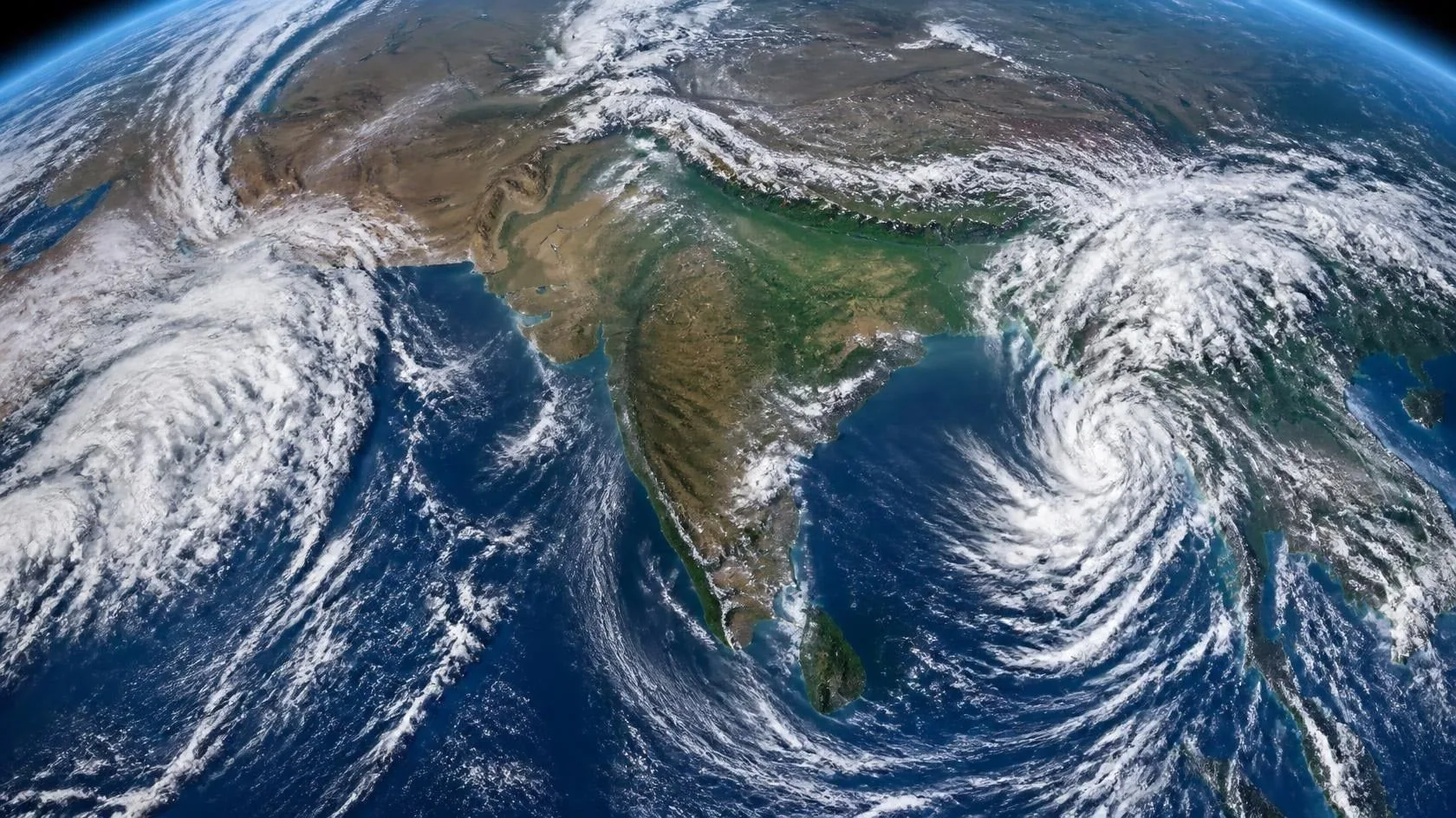
Introduction
The monsoon is one of the most important seasonal atmospheric phenomena on Earth. In the Indian subcontinent, the monsoon is not merely a source of rainfall; it plays a crucial role in agriculture, water resources, food security, the economy, energy production, and rural livelihoods.
To understand the Indian monsoon, it is important to understand the role of trade winds, the Inter-Tropical Convergence Zone (ITCZ), seasonal changes in atmospheric pressure, land-sea thermal contrast, jet streams, the Tibetan Plateau, ENSO, and the Indian Ocean Dipole (IOD).
Trade winds generally blow from the subtropical high-pressure belts toward the equatorial low-pressure region. Due to seasonal changes in temperature and atmospheric pressure, the position of the ITCZ also shifts northward and southward. These seasonal changes play an important role in the development of the Indian monsoon circulation.
During the summer season, the south-easterly trade winds of the Southern Hemisphere cross the Equator and enter the Northern Hemisphere. Under the influence of the Coriolis force, their direction changes and they become south-westerly winds. These winds contribute significantly to the development of the South-West Monsoon over India.
Therefore, the relationship between monsoon and trade winds is an important concept in physical geography and is highly relevant for the UPSC Civil Services Examination, particularly for Prelims, Mains, Essay, and Interview preparation.
What is Monsoon?
Monsoon refers to a seasonal wind system in which the direction of prevailing winds changes significantly between seasons. This seasonal reversal of wind direction is mainly associated with changes in atmospheric pressure, land-sea thermal contrast, and the seasonal movement of the Inter-Tropical Convergence Zone (ITCZ).
The word Monsoon is derived from the Arabic word “Mausim”, meaning season. Unlike ordinary winds that may blow in a relatively consistent direction, monsoon winds undergo a seasonal reversal. This makes the monsoon a distinctive feature of the tropical and subtropical climate system.
In India, the monsoon is most closely associated with the South-West Monsoon, which generally brings widespread rainfall during the summer months. It is followed by the North-East or Retreating Monsoon, which is particularly important for parts of southeastern India.
Why is the Indian monsoon Important?
The Indian monsoon is often described as the “lifeline of the Indian economy” because a large part of agriculture, water availability, reservoir levels, hydropower generation, and rural economic activity is influenced by the timing and distribution of monsoon rainfall.
- Agriculture: Supports major Kharif crops and rain-fed farming.
- water resources: Replenishes rivers, reservoirs, and groundwater.
- food security: Influences crop production and food availability.
- Energy: Supports hydropower generation through reservoir inflows.
- Rural Economy: Affects farm income, employment, and rural demand.
Key Concept for UPSC
Monsoon is not simply “seasonal rainfall”. It is a broader atmospheric circulation system involving the seasonal reversal of winds, pressure differences, ITCZ migration, land-sea thermal contrast, Coriolis force, jet streams, ocean-atmosphere interactions, and regional topography.
UPSC Quick Revision: Monsoon = Seasonal Reversal of Winds + Pressure Changes + ITCZ Shift + Land-Sea Thermal Contrast + Atmospheric & Oceanic Interactions.
What Are Trade Winds? Definition, Direction and Role in the Monsoon
Trade Winds are the major permanent planetary winds that generally blow from the subtropical high-pressure belts toward the equatorial low-pressure belt. Their direction is modified by the Coriolis force caused by the rotation of the Earth.
Trade winds are an important component of the global atmospheric circulation system. They operate mainly in the tropical regions of both hemispheres and play a major role in the redistribution of heat and moisture across the Earth.
In simple terms, air moves from areas of higher atmospheric pressure toward areas of lower atmospheric pressure. Around the subtropical latitudes, descending air creates high-pressure belts, while strong heating near the Equator causes warm air to rise and creates the equatorial low-pressure belt. The resulting pressure gradient generates the trade-wind circulation.
🌍 Direction of Trade Winds in Both Hemispheres
Northern Hemisphere
Trade winds generally blow from the North-East toward the South-West. They are therefore called North-East Trade Winds.
Southern Hemisphere
Trade winds generally blow from the South-East toward the North-West. They are therefore called South-East Trade Winds.
Why Do Trade Winds Blow?
The formation of trade winds is primarily associated with the global pressure belts and planetary circulation. Intense solar heating near the Equator causes air to rise, producing a zone of low pressure. Around the subtropics, air descends and produces areas of relatively high pressure.
Air therefore flows from the subtropical high-pressure belts toward the equatorial low-pressure belt. The Earth's rotation then deflects this moving air, producing the characteristic trade-wind directions.
🌐 Role of the Coriolis Force
The Coriolis force is an apparent force associated with the rotation of the Earth. It deflects moving air to the right in the Northern Hemisphere and to the left in the Southern Hemisphere.
Southern Hemisphere → Deflection to the Left
🌧️ How Are Trade Winds Related to the Indian monsoon?
Trade winds have an important connection with the South-West Monsoon of India. During the Northern Hemisphere summer, the seasonal migration of the Inter-Tropical Convergence Zone (ITCZ) toward the north contributes to a major reorganization of atmospheric circulation.
The South-East Trade Winds of the Southern Hemisphere can cross the Equator and enter the Northern Hemisphere. After crossing the Equator, the Coriolis force deflects them toward the right, giving them a south-westerly direction.
South-East Trade Winds → Cross the Equator → Coriolis Deflection → Become South-Westerly → Contribute to the Indian Summer Monsoon
Key Features of Trade Winds
- They are part of the planetary wind system.
- They generally blow from subtropical high pressure toward equatorial low pressure.
- They occur in both the Northern and Southern Hemispheres.
- Their direction is strongly influenced by the Coriolis force.
- They converge near the Inter-Tropical Convergence Zone (ITCZ).
- They play an important role in the global transfer of heat and moisture.
- Their seasonal behavior is closely connected with the broader monsoon circulation.
🎯 UPSC Prelims & Mains Key Point
Trade Winds ≠ Monsoon Winds. Trade winds are components of the global planetary circulation, whereas monsoon winds are characterized by a significant seasonal reversal of wind direction.
However, the seasonal movement of pressure belts and the ITCZ can modify the trade-wind circulation, making trade winds an important part of the physical mechanism behind the Indian monsoon.
⚡ Quick Revision
Subtropical High Pressure → Equatorial Low Pressure → Trade Winds → Coriolis Force → ITCZ Convergence → Seasonal Monsoon Circulation
How Are Trade Winds Formed? Origin, Pressure Belts & Coriolis Force
Trade winds are formed as part of the Earth's global atmospheric circulation due to the combined effects of unequal solar heating, atmospheric pressure differences, Earth's rotation, and the Coriolis force. They generally flow from the subtropical high-pressure belts toward the equatorial low-pressure belt.
The origin of trade winds can be understood through the movement of air between different global pressure belts. The Equatorial region receives intense solar heating throughout the year. As a result, warm and moist air rises, creating a zone of low atmospheric pressure.
At around 30° North and 30° South latitudes, a significant portion of the air that rises near the Equator descends toward the Earth's surface. This descending air contributes to the development of the subtropical high-pressure belts.
🌍 Formation of Trade Winds: Step-by-Step
Strong solar heating near the Equator warms the surface and causes air to rise.
Rising warm air creates a broad belt of low pressure near the Equator.
Air descends around the subtropics, contributing to high-pressure belts.
Air begins moving from the high-pressure belt toward low pressure.
Earth's rotation deflects the moving air and changes its direction.
The resulting winds become the North-East and South-East Trade Winds.
🔄 Role of the Hadley Cell
The formation of trade winds is closely associated with the Hadley Cell, a major component of tropical atmospheric circulation. Air rises in the equatorial region, moves poleward at higher altitudes, and eventually descends in the subtropical regions.
The surface branch of this circulation flows back toward the Equator. Because of the Earth's rotation, this return flow is deflected and forms the characteristic trade winds.
📍 Role of Global Pressure Belts
The pressure gradient between the subtropical high-pressure belts and the equatorial low-pressure belt provides the fundamental force that drives the surface flow of trade winds.
- Equator: Dominant zone of rising air and low pressure.
- Subtropics: Dominant zone of descending air and high pressure.
- Pressure Gradient: Drives air toward the Equator.
- Coriolis Force: Deflects the moving air.
🌀 How Does the Coriolis Force Change Their Direction?
If the Earth did not rotate, air would move more directly from the subtropical high-pressure regions toward the Equator. However, Earth's rotation causes moving air to be deflected.
Northern Hemisphere
Moving air is deflected toward the right, producing the North-East Trade Winds.
Southern Hemisphere
Moving air is deflected toward the left, producing the South-East Trade Winds.
🌐 Simple Formation Model
Subtropical High Pressure → Pressure Gradient → Equatorial Low Pressure
↓
Coriolis Deflection
↓
North-East Trade Winds + South-East Trade Winds
🌧️ Connection Between Trade Winds and Indian monsoon
The seasonal migration of pressure belts and the Inter-Tropical Convergence Zone (ITCZ) can significantly alter the normal trade-wind circulation. During the Northern Hemisphere summer, the ITCZ shifts northward toward the Indian subcontinent.
The South-East Trade Winds from the Southern Hemisphere can cross the Equator and, after being deflected by the Coriolis force, contribute to the South-West Monsoon circulation over India.
🎯 UPSC Prelims & Mains Key Point
The origin of trade winds is best understood through the combined action of global pressure belts, Hadley circulation, pressure-gradient force, Earth's rotation, and Coriolis deflection.
Do not confuse: Trade winds are a part of the planetary wind system, whereas monsoon winds are characterized by a pronounced seasonal reversal of wind direction.
⚡ Quick Revision: How Trade Winds Form
Unequal Solar Heating → Equatorial Rising Air → Equatorial Low Pressure → Subtropical High Pressure → Pressure Gradient → Earth's Rotation → Coriolis Deflection → Trade Winds
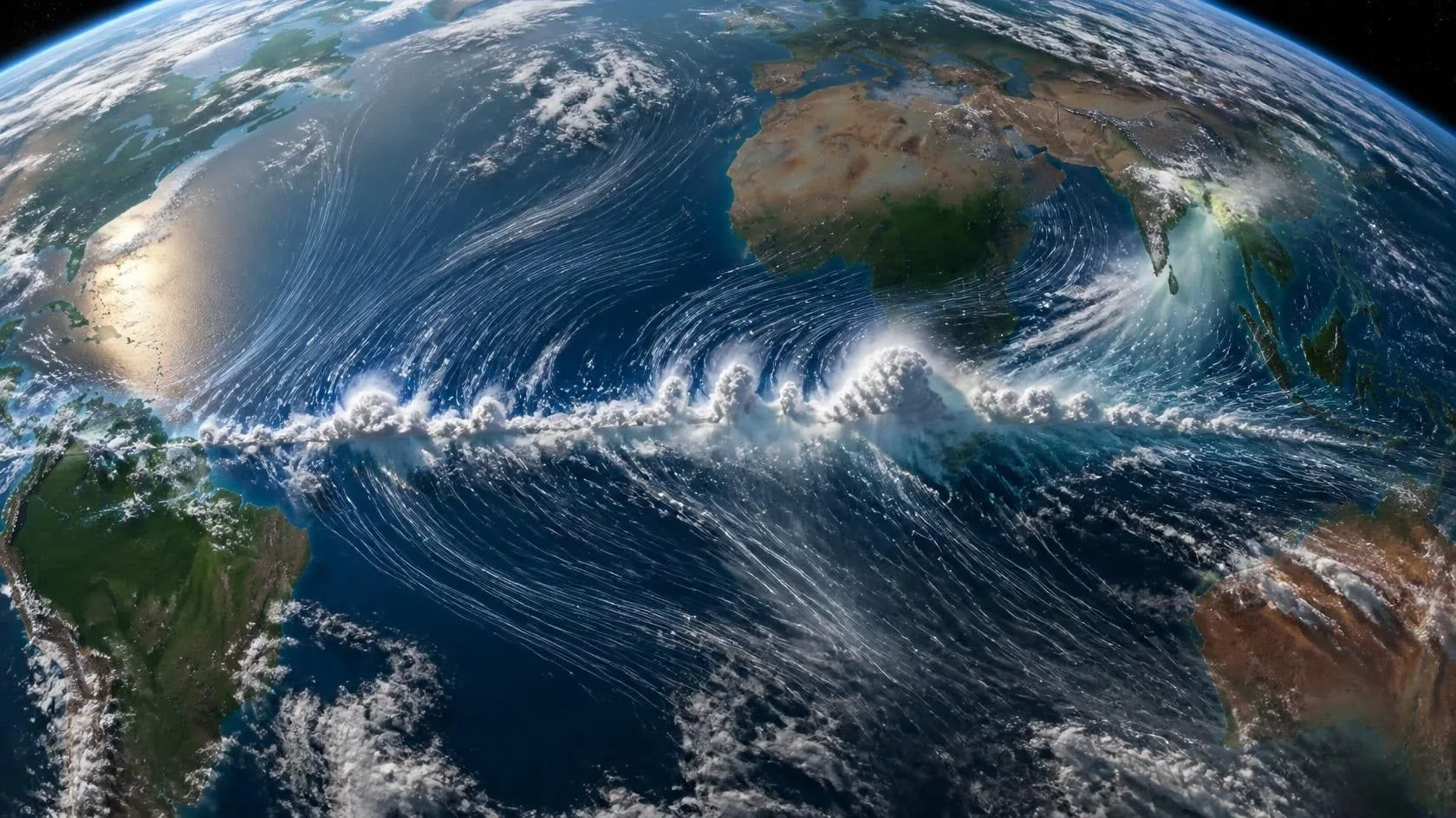
Key Features of Trade Winds: Direction, Nature and Global Role
Trade Winds are a major component of the Earth's planetary circulation system. Their direction, pressure relationship, regularity, and interaction with the ITCZ make them important for understanding global atmospheric circulation and the Indian monsoon system.
Trade winds are not random local winds. They are part of the large-scale planetary wind circulation and are primarily found between the subtropical high-pressure belts and the equatorial low-pressure belt. Their characteristics are controlled by pressure gradients, Earth's rotation, and tropical atmospheric circulation.
🌍 1. Planetary Winds
Trade winds are part of the global planetary wind system and extend across large tropical regions rather than being limited to a small local area.
🧭 2. Definite Direction
They generally blow from the subtropical high-pressure belts toward the equatorial low-pressure belt.
🌀 3. Coriolis Effect
Earth's rotation deflects the winds to the right in the Northern Hemisphere and to the left in the Southern Hemisphere.
🌬️ 4. Regular Nature
Trade winds are relatively persistent and regular compared with many local wind systems, although their strength can vary.
🌡️ 5. Tropical Location
They primarily occur in the tropical belt between the subtropical high-pressure zones and the equatorial low-pressure region.
🌧️ 6. Moisture Transport
Over oceans, trade winds can transport substantial amounts of heat and moisture toward the tropical convergence zone.
🧭 Direction of Trade Winds in Both Hemispheres
Northern Hemisphere
North-East Trade Winds
General flow: North-East → South-West
Southern Hemisphere
South-East Trade Winds
General flow: South-East → North-West
🌐 7. Convergence Near the ITCZ
The trade winds from the Northern and Southern Hemispheres generally converge near the Inter-Tropical Convergence Zone (ITCZ). This convergence promotes the rising of warm, moist air and contributes to cloud formation and tropical rainfall.
📉 8. Controlled by Pressure Gradient
The basic driving force behind trade winds is the pressure gradient between the subtropical high-pressure belts and the equatorial low-pressure belt.
In simple terms: High Pressure → Low Pressure, while the Coriolis force modifies the actual direction of airflow.
🌎 9. Importance in Global Climate
Trade winds contribute to the redistribution of heat and moisture within the tropical atmosphere. They also influence ocean currents, tropical rainfall patterns, and interactions between the atmosphere and oceans.
Their large-scale circulation makes them important for understanding tropical climate, ocean-atmosphere interactions, and monsoon systems.
🇮🇳 10. Role in the Indian Monsoon
Trade winds have an important connection with the Indian Summer Monsoon. During the Northern Hemisphere summer, the seasonal northward migration of the ITCZ changes the tropical circulation pattern.
The South-East Trade Winds can cross the Equator and enter the Northern Hemisphere. Due to the Coriolis force, their direction changes, contributing to the development of the South-West Monsoon flow toward India.
⚠️ Important: Trade Winds ≠ Monsoon Winds
A common mistake is to treat trade winds and monsoon winds as identical. Trade winds are a component of the planetary circulation system, whereas monsoon winds are characterized by a pronounced seasonal reversal in prevailing wind direction.
However, seasonal changes in the pressure belts and ITCZ can modify trade-wind circulation and contribute to the development of monsoon systems.
🎯 UPSC Prelims & Mains: Must-Remember Points
- Trade winds are part of the planetary wind system.
- They generally blow from subtropical high pressure toward equatorial low pressure.
- Northern Hemisphere → North-East Trade Winds.
- Southern Hemisphere → South-East Trade Winds.
- Coriolis force deflects winds right in the Northern Hemisphere.
- Coriolis force deflects winds left in the Southern Hemisphere.
- Trade winds converge around the ITCZ.
- They are important for understanding the Indian monsoon circulation.
⚡ Quick Revision
Planetary Winds → Subtropical High Pressure → Equatorial Low Pressure → Pressure Gradient → Coriolis Deflection → Trade Winds → ITCZ Convergence → Monsoon Connection
ITCZ and Trade Winds: Relationship, Seasonal Shift & Role in Monsoon
The Inter-Tropical Convergence Zone (ITCZ) is a broad belt of low pressure near the Equator where the North-East and South-East Trade Winds converge. This zone is characterized by rising warm, moist air, cloud formation, and frequent rainfall. Its seasonal movement is a key factor in understanding the Indian monsoon.
The relationship between the ITCZ and Trade Winds is fundamental to global atmospheric circulation. Trade winds from both hemispheres generally move toward the equatorial low-pressure region. When they meet, air is forced to rise, creating an area of strong convection and cloud development.
The ITCZ is not a fixed line at the Equator. It shifts northward and southward with the seasonal movement of maximum solar heating. This seasonal migration is particularly important for the development of monsoon circulation over South Asia.
🌍 What is the ITCZ?
The Inter-Tropical Convergence Zone (ITCZ) is a zone of relatively low pressure formed by the convergence of the trade winds of both hemispheres.
Because intense solar heating causes warm air to rise in this region, the ITCZ is associated with strong convection, clouds, thunderstorms, and tropical rainfall.
🧭 How Do Trade Winds Converge at the ITCZ?
Trade winds generally flow from the subtropical high-pressure belts toward the equatorial low-pressure region. As the North-East Trade Winds and South-East Trade Winds approach the Equator, they converge in the ITCZ.
North-East Trade Winds ↘
South-East Trade Winds ↗
↓
ITCZ – Convergence Zone
↓
Rising Air → Clouds → Convection → Rainfall
☀️ Seasonal Migration of the ITCZ
The ITCZ moves with the seasonal shift of the zone receiving maximum solar heating. It generally shifts northward during the Northern Hemisphere summer and moves southward during the Southern Hemisphere summer.
Northern Hemisphere Summer
Stronger heating in the Northern Hemisphere causes the ITCZ to shift northward, contributing to the development of monsoon circulation over South Asia.
Southern Hemisphere Summer
The zone of maximum heating shifts southward, and the ITCZ generally follows this seasonal movement.
🇮🇳 Why is ITCZ Important for the Indian Monsoon?
During the Northern Hemisphere summer, the ITCZ shifts substantially northward over the Indian subcontinent and adjoining regions. In South Asian climatology, this seasonal northward displacement is closely associated with the monsoon trough.
As the pressure pattern changes, the South-East Trade Winds from the Southern Hemisphere cross the Equator and enter the Northern Hemisphere. The Coriolis force then deflects these winds, contributing to the South-West Monsoon flow.
📊 ITCZ vs Trade Winds
| Feature | ITCZ | Trade Winds |
|---|---|---|
| Nature | Convergence zone | Planetary wind system |
| Pressure | Relatively low pressure | Flow from subtropical high pressure |
| Movement | Shifts seasonally | Generally persistent |
| Main Process | Convergence and rising air | Horizontal air movement |
| Monsoon Role | Seasonal shift helps organize monsoon circulation | Cross-equatorial flow contributes to monsoon winds |
🎯 UPSC Concept: Do Not Confuse ITCZ with the Equator
The ITCZ is not a permanent line located exactly on the Equator. Its position changes seasonally and can vary significantly from region to region. Over South Asia, its northward displacement during summer is especially important for the monsoon circulation.
Therefore, in UPSC answers, it is better to describe the ITCZ as a seasonally migrating zone of convergence and convection rather than simply calling it the “Equatorial Low-Pressure Belt”.
⚡ Quick Revision
Subtropical High Pressure → Trade Winds → ITCZ Convergence → Rising Warm & Moist Air → Cloud Formation → Tropical Rainfall → Seasonal ITCZ Shift → Monsoon Circulation
Direct Relationship Between Monsoon and Trade Winds
The Indian monsoon and Trade Winds are closely connected through the seasonal shift of the ITCZ, pressure belts, and cross-equatorial air circulation. During the Northern Hemisphere summer, the South-East Trade Winds cross the Equator and, after being deflected by the Coriolis force, contribute to the South-West Monsoon over India.
The direct relationship between monsoon and trade winds can be understood as a seasonal transformation of the tropical atmospheric circulation. Trade winds normally flow toward the equatorial low-pressure region. However, during the Northern Hemisphere summer, strong heating over the Asian landmass shifts the zone of low pressure and the ITCZ northward.
This creates a strong pressure gradient between the relatively higher-pressure areas over the southern Indian Ocean and the lower-pressure region over the Indian subcontinent. As a result, air from the Southern Hemisphere moves northward across the Equator.
🌧️ How Trade Winds Become Part of the Indian Monsoon
The Indian subcontinent heats strongly during summer, helping create a broad low-pressure region.
The zone of tropical convergence moves northward toward South Asia.
South-East Trade Winds from the Southern Hemisphere move across the Equator.
After crossing the Equator, the winds are deflected toward the right in the Northern Hemisphere.
The cross-equatorial winds acquire a south-westerly direction.
These moisture-bearing winds contribute to the South-West Monsoon over India.
🔄 Monsoon–Trade Wind Connection: Easy Flow
Intense Summer Heating over Land
↓
Low Pressure + Northward ITCZ Shift
↓
South-East Trade Winds Cross the Equator
↓
Coriolis Force Deflects the Winds
↓
South-West Monsoon Winds
→ Moisture Transport → Rainfall over India
🌍 Cross-Equatorial Flow: The Key Link
One of the most important links between trade winds and the Indian monsoon is the cross-equatorial flow. During the Northern Hemisphere summer, the pressure pattern favors the northward movement of air from the Southern Hemisphere.
The South-East Trade Winds are therefore drawn across the Equator toward the lower-pressure region over South Asia. Once they enter the Northern Hemisphere, the Coriolis force turns them to the right.
🌬️ Somali Jet and Strong Cross-Equatorial Flow
The cross-equatorial flow becomes particularly strong over the western Indian Ocean. A prominent low-level current known as the Somali Jet or Findlater Jet develops along the East African coast and across the Arabian Sea during the summer monsoon season.
This strong low-level flow transports large quantities of moisture from the Indian Ocean toward the Indian subcontinent, supporting the rainfall-producing monsoon circulation.
🇮🇳 From Trade Winds to Two Monsoon Branches
Arabian Sea Branch
The moisture-laden south-westerly flow moves across the Arabian Sea toward the west coast of India and interacts strongly with the Western Ghats.
Bay of Bengal Branch
Another major flow reaches the Bay of Bengal and moves toward North-East India and the Ganga-Brahmaputra region, producing widespread rainfall.
⚠️ Important UPSC Clarification
It is scientifically more accurate to say that the Indian monsoon is influenced by the seasonal reorganization of tropical circulation rather than describing it simply as “trade winds changing direction”.
Trade winds provide an important component of the cross-equatorial flow, but the Indian monsoon is a complex system involving land-sea thermal contrast, ITCZ, pressure gradients, jet streams, the Tibetan Plateau, Himalayas, ocean temperatures, ENSO and IOD.
🎯 UPSC Prelims & Mains Key Points
- South-East Trade Winds are important for cross-equatorial flow.
- They cross the Equator during the Northern Hemisphere summer.
- The Coriolis force deflects them to the right after entering the Northern Hemisphere.
- The resulting flow acquires a south-westerly direction.
- These moisture-bearing winds contribute to the South-West Monsoon.
- The ITCZ's northward migration is an important part of this seasonal reorganization.
- The Somali Jet strengthens the low-level cross-equatorial flow over the western Indian Ocean.
⚡ Quick Revision
Summer Heating → Low Pressure over South Asia → ITCZ Shifts North → South-East Trade Winds Cross Equator → Coriolis Deflection → South-Westerly Flow → Moisture Transport → South-West Monsoon
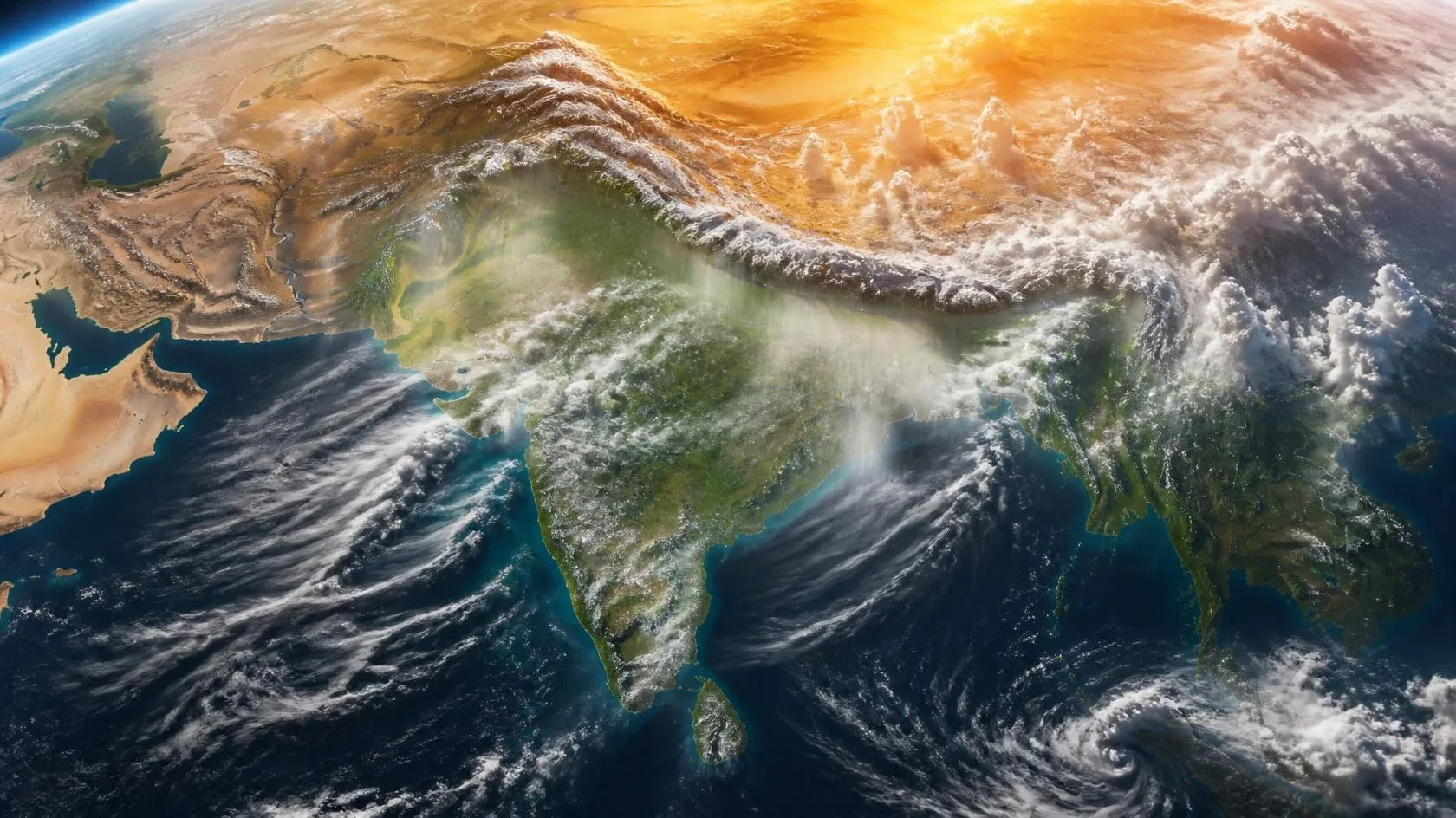
Formation of the South-West Monsoon in India: Mechanism, Trade Winds & ITCZ
The South-West Monsoon in India develops through a complex interaction of seasonal heating, pressure differences, northward migration of the ITCZ, cross-equatorial flow, Coriolis force, oceanic moisture, and large-scale atmospheric circulation. The South-East Trade Winds from the Southern Hemisphere become an important component of this circulation after crossing the Equator and turning toward the southwest.
The formation of the Indian summer monsoon is not caused by a single factor. During the Northern Hemisphere summer, intense heating over the Indian subcontinent and the adjoining Asian landmass alters the atmospheric pressure pattern. At the same time, the ITCZ shifts northward, helping organize the monsoon circulation over South Asia.
According to the India Meteorological Department (IMD), the southwest monsoon normally sets in over Kerala around 1 June, although the actual onset date varies from year to year. The monsoon subsequently advances northward, usually in surges, and normally covers the country around mid-July. :contentReference[oaicite:0]{index=0}
🌧️ How Is the South-West Monsoon Formed?
During summer, the Indian landmass heats strongly, increasing the temperature of the continental surface and lower atmosphere.
Strong heating contributes to the development of a broad low-pressure region over South Asia.
The zone of tropical convergence shifts northward with the seasonal migration of maximum solar heating.
South-East Trade Winds from the Southern Hemisphere move northward across the Equator.
After entering the Northern Hemisphere, the winds are deflected toward the right.
The resulting south-westerly winds pick up moisture from the Indian Ocean and bring rainfall to India.
☀️ Step 1: Summer Heating of the Indian Landmass
During the pre-monsoon months, the Indian subcontinent experiences intense solar heating. The northwestern parts of the country and the wider Asian landmass become particularly hot.
This strong heating contributes to the formation of a large thermal low-pressure region over the subcontinent. The resulting pressure gradient becomes an important part of the summer monsoon circulation.
📉 Step 2: Development of Low Pressure over South Asia
As the land heats, atmospheric pressure over the heated continental region becomes relatively lower than over the surrounding oceanic areas.
This creates conditions favorable for the movement of moist air from the Indian Ocean toward the Indian subcontinent.
🌍 Step 3: Northward Shift of the ITCZ
During the Northern Hemisphere summer, the Inter-Tropical Convergence Zone (ITCZ) shifts northward following the seasonal movement of maximum solar heating.
Over South Asia, this northward displacement is closely associated with the monsoon trough. The northward shift helps draw moist tropical air toward the Indian subcontinent. :contentReference[oaicite:1]{index=1}
🌬️ Step 4: South-East Trade Winds Cross the Equator
As the pressure pattern reorganizes during summer, the South-East Trade Winds of the Southern Hemisphere are drawn toward the lower-pressure region over South Asia.
These winds cross the Equator and enter the Northern Hemisphere. The cross-equatorial flow is a crucial component of the summer monsoon circulation. Observational studies by the IMD have linked the establishment of strong cross-equatorial low-level flow with the onset of the southwest monsoon. :contentReference[oaicite:2]{index=2}
🌀 Step 5: Coriolis Force Changes the Wind Direction
After crossing the Equator, the winds enter the Northern Hemisphere. Due to the Coriolis force, moving air is deflected toward the right.
Consequently, the cross-equatorial flow acquires a predominantly south-westerly direction and becomes part of the South-West Monsoon circulation.
💧 Step 6: Moisture Supply from the Indian Ocean
The south-westerly winds travel across the warm waters of the Arabian Sea and Bay of Bengal. During this journey, they acquire large amounts of atmospheric moisture.
When these moisture-laden winds reach the Indian landmass and are forced to rise by topography or atmospheric convergence, condensation and cloud formation produce widespread monsoon rainfall.
🌊 Step 7: Role of the Cross-Equatorial Low-Level Jet
A strong low-level cross-equatorial flow develops over the western Indian Ocean during the summer monsoon. This flow is closely associated with the Somali Jet or Findlater Jet.
The strengthening of this low-level jet helps transport moisture toward the Arabian Sea and Indian subcontinent. The establishment of strong cross-equatorial flow is also associated with the onset of heavy monsoon rains over the southern peninsula. :contentReference[oaicite:3]{index=3}
🇮🇳 Step 8: Formation of Two Major Monsoon Branches
Arabian Sea Branch
The moisture-bearing flow from the Arabian Sea reaches the west coast of India. The Western Ghats force the moist air to rise, producing heavy orographic rainfall.
Bay of Bengal Branch
Another major flow moves through the Bay of Bengal toward northeastern India and the Ganga-Brahmaputra plains, where topography and convergence enhance rainfall.
📅 When Does the South-West Monsoon Begin?
The climatological onset of the southwest monsoon over Kerala is around 1 June. However, the actual onset varies from year to year. The IMD uses multiple indicators rather than rainfall alone, including rainfall, wind-field characteristics, and outgoing longwave radiation (OLR) when declaring onset over Kerala. :contentReference[oaicite:4]{index=4}
This is important for UPSC because the onset of the monsoon is not simply defined as “the first rainfall in Kerala”; it is based on the establishment of a broader monsoon circulation.
🔄 Complete Formation of the Indian South-West Monsoon
Intense Summer Heating of Land
↓
Low Pressure over South Asia
↓
Northward Shift of ITCZ / Monsoon Trough
↓
South-East Trade Winds Cross the Equator
↓
Coriolis Deflection
↓
South-Westerly Moisture-Laden Winds
↓
South-West Monsoon → Widespread Rainfall over India
⚠️ UPSC Concept: Monsoon Is Not Caused by One Factor
A common simplification is to explain the Indian monsoon only through “land heating” or “reversal of trade winds”. In reality, the South-West Monsoon is a coupled atmosphere-ocean system.
Its formation and variability involve the land-sea thermal contrast, ITCZ migration, cross-equatorial flow, pressure gradients, jet streams, Tibetan Plateau, Himalayan orography, Indian Ocean conditions, ENSO and IOD.
Therefore, a high-quality UPSC answer should present the monsoon as the combined result of dynamic and thermal processes.
🎯 UPSC Prelims & Mains Key Points
- Summer heating creates a strong continental thermal low over South Asia.
- The ITCZ shifts northward during the Northern Hemisphere summer.
- South-East Trade Winds cross the Equator.
- The Coriolis force turns the cross-equatorial flow toward the right.
- The winds acquire a south-westerly direction.
- The winds gain moisture while crossing the Indian Ocean.
- The Somali Jet strengthens the low-level cross-equatorial flow.
- The monsoon reaches India through the Arabian Sea and Bay of Bengal branches.
- IMD normally considers rainfall, wind-field and OLR conditions for declaring onset over Kerala.
⚡ Quick Revision
Summer Heating → Thermal Low over South Asia → ITCZ Shifts North → Cross-Equatorial Trade Winds → Coriolis Deflection → South-Westerly Moisture Flow → Arabian Sea & Bay of Bengal Branches → Indian Summer Monsoon
Monsoon Is Not Caused by Trade Winds Alone: Major Factors Behind Its Origin
The Indian monsoon cannot be explained by trade winds alone. Trade winds are an important component of the monsoon circulation, but the origin, onset, strength, and variability of the Indian monsoon result from the combined interaction of land-sea thermal contrast, ITCZ migration, pressure gradients, jet streams, the Tibetan Plateau, Himalayan orography, ocean temperatures, ENSO, and the Indian Ocean Dipole (IOD).
The traditional explanation of the Indian monsoon emphasized the seasonal reversal of winds caused by the different rates at which land and sea heat and cool. According to this simplified view, the summer heating of the Indian landmass creates low pressure and draws moisture-bearing winds from the surrounding oceans.
However, modern understanding shows that the Indian monsoon is a complex atmosphere-ocean circulation system. Several regional and global processes interact with each other to determine when the monsoon begins, how strong it becomes, where rainfall occurs, and how long active or weak phases last.
⚠️ Why Are Trade Winds Alone Not Enough?
Trade winds explain an important part of the cross-equatorial flow, especially the role of the South-East Trade Winds from the Southern Hemisphere. But they do not fully explain the seasonal development and complex behavior of the Indian monsoon.
The monsoon is controlled by a combination of thermal, dynamic, oceanic, atmospheric, and topographic factors. Therefore, UPSC answers should avoid presenting the monsoon as a simple “reversal of trade winds”.
☀️ 1. Land-Sea Thermal Contrast
Land heats and cools more rapidly than the ocean. This seasonal thermal contrast creates important pressure differences that help drive monsoon circulation.
🌍 2. ITCZ Migration
The Inter-Tropical Convergence Zone shifts northward during the Northern Hemisphere summer and becomes an important part of the South Asian monsoon circulation.
🏔️ 3. Tibetan Plateau
The elevated Tibetan Plateau plays an important role in the thermal and dynamical structure of the Asian summer monsoon circulation.
💨 4. Jet Streams
Seasonal changes in the subtropical westerly jet and tropical easterly jet are important for the development and maintenance of the Indian summer monsoon.
🌊 5. Ocean Temperature
Sea-surface temperatures influence evaporation, atmospheric moisture, pressure patterns, and ocean-atmosphere interactions associated with monsoon rainfall.
🌐 6. ENSO & IOD
El Niño, La Niña and the Indian Ocean Dipole can influence the strength and distribution of Indian monsoon rainfall.
☀️ 1. Land-Sea Thermal Contrast
One of the fundamental factors behind the seasonal monsoon circulation is the difference in the rate at which land and water heat and cool. During summer, the Asian landmass heats strongly, while the surrounding oceans respond more slowly.
This thermal contrast contributes to the development of a low-pressure system over the heated continental region and establishes conditions favorable for the inflow of moist oceanic air.
🌍 2. Northward Shift of the ITCZ
During the Northern Hemisphere summer, the zone of maximum solar heating shifts northward. The ITCZ also moves northward and, over South Asia, becomes closely associated with the monsoon trough.
This northward migration helps reorganize tropical circulation and supports the development of a large-scale monsoon flow toward the Indian subcontinent.
🏔️ 3. Role of the Tibetan Plateau
The Tibetan Plateau is a major elevated landmass located at a considerable height above sea level. During summer, its heating affects the atmospheric temperature structure and contributes to the circulation of the Asian monsoon system.
Its influence demonstrates why the Indian monsoon cannot be explained only by the behavior of low-level trade winds.
💨 4. Role of Jet Streams
Seasonal changes in upper-air circulation are critical to the Indian monsoon. The northward displacement of the subtropical westerly jet from the Indian region and the establishment of the tropical easterly jet are associated with the summer monsoon circulation.
These upper-air changes interact with the lower-level circulation and help create favorable conditions for the establishment and maintenance of the monsoon.
🏔️ 5. Role of the Himalayas
The Himalayas form a major geographical barrier between the Indian subcontinent and the cold continental regions of Central Asia.
Their massive topography also affects the path and ascent of moisture-bearing monsoon winds, contributing to the spatial distribution of rainfall across South Asia.
🌊 6. Ocean-Atmosphere Interaction
The Indian Ocean provides the principal source of moisture for much of the South-West Monsoon. Sea-surface temperature, evaporation, atmospheric moisture, and oceanic circulation can influence the strength and distribution of monsoon rainfall.
Therefore, the monsoon should be viewed as a coupled ocean-atmosphere system rather than merely a continental wind reversal.
🌐 7. ENSO: El Niño and La Niña
The El Niño-Southern Oscillation (ENSO) is one of the major sources of interannual variability in the Indian monsoon.
El Niño is often associated with weaker-than-normal Indian monsoon rainfall, while La Niña has frequently been associated with stronger monsoon conditions. However, these are statistical relationships, not absolute rules.
This distinction is important for UPSC answers: El Niño does not automatically mean drought in India every year.
🌊 8. Indian Ocean Dipole (IOD)
The Indian Ocean Dipole represents an important pattern of sea-surface temperature differences between the western and eastern tropical Indian Ocean.
Its positive and negative phases can alter atmospheric circulation over the Indian Ocean and influence the strength and distribution of rainfall over India.
📊 Trade Winds vs Complete Monsoon Mechanism
| Factor | Role in Monsoon |
|---|---|
| Trade Winds | Contribute to cross-equatorial flow and moisture transport. |
| Land-Sea Thermal Contrast | Creates important seasonal pressure differences. |
| ITCZ | Its seasonal migration helps organize monsoon circulation. |
| Jet Streams | Influence upper-air circulation and monsoon onset and maintenance. |
| Tibetan Plateau | Influences the thermal and dynamical structure of the Asian monsoon. |
| ENSO & IOD | Influence year-to-year variability in monsoon rainfall. |
🔄 Complete Concept: How the Indian Monsoon Develops
Land-Sea Thermal Contrast + ITCZ Migration
↓
Pressure & Circulation Changes
↓
Cross-Equatorial Trade-Wind Flow
↓
Jet Streams + Tibetan Plateau + Himalayas
↓
Ocean-Atmosphere Interaction
↓
South-West Monsoon
🎯 UPSC Prelims & Mains Key Takeaway
Do not write: “The Indian monsoon is caused by the reversal of trade winds.”
Write instead: “The Indian monsoon is a complex seasonal circulation produced by the interaction of thermal contrasts, pressure-gradient changes, ITCZ migration, cross-equatorial flow, upper-air circulation, topography, and ocean-atmosphere interactions, with trade winds forming an important component of the system.”
⚡ Quick Revision
Trade Winds are important, but Monsoon ≠ Trade Winds Alone. Remember: Thermal Contrast + ITCZ + Pressure Gradient + Jet Streams + Tibetan Plateau + Himalayas + Ocean Conditions + ENSO/IOD → Indian Monsoon.
Two Major Branches of the South-West Monsoon in India
After reaching the Indian subcontinent, the South-West Monsoon divides into two major branches — the Arabian Sea Branch and the Bay of Bengal Branch. These two branches are responsible for transporting large amounts of moisture and producing rainfall across different parts of India.
The two branches are mainly determined by the geographical position of India, the surrounding seas, pressure patterns, and the major mountain systems such as the Western Ghats and Himalayas. Their paths and interactions with India's topography explain much of the spatial variation in monsoon rainfall.
🌊 1. Arabian Sea Branch
The Arabian Sea Branch reaches the west coast of India after crossing the Arabian Sea. It is an important source of rainfall for the western coastal region.
- Reaches the Kerala coast around the onset period.
- Moves northward along the western coast.
- Interacts strongly with the Western Ghats.
- Produces heavy orographic rainfall on the windward side.
- Influences Maharashtra, Gujarat and parts of central and northwestern India.
🌧️ 2. Bay of Bengal Branch
The Bay of Bengal Branch enters the Indian subcontinent from the east and moves toward northeastern India and the Ganga-Brahmaputra plains.
- Moves toward North-East India.
- Interacts strongly with the Himalayas and regional hills.
- Produces heavy rainfall in northeastern India.
- Moves westward along the Ganga plains.
- Contributes significantly to rainfall over eastern and northern India.
🌊 Arabian Sea Branch: Route and Rainfall Pattern
The Arabian Sea branch is a major component of the South-West Monsoon. It reaches the western coast of India after crossing the Arabian Sea and carries abundant moisture.
When these moisture-laden winds encounter the Western Ghats, they are forced to rise. As the air rises, it cools and moisture condenses, resulting in heavy rainfall along the windward slopes.
Important Rainfall Pattern
The windward western slopes generally receive heavy rainfall, while areas lying east of the Western Ghats experience a rain-shadow effect and are comparatively drier.
🌧️ Bay of Bengal Branch: Route and Rainfall Pattern
The Bay of Bengal branch moves northward and northeastward toward North-East India. The region's hills and the southern slopes of the Himalayas provide favorable conditions for the uplift of moisture-bearing air.
After producing substantial rainfall over northeastern India, a significant portion of this flow turns westward along the Ganga-Brahmaputra plains.
⛰️ Why Does North-East India Receive Very Heavy Rainfall?
The hills of northeastern India provide strong orographic uplift. Moist air from the Bay of Bengal is forced to rise when it encounters the surrounding hills.
This combination of high moisture availability, convergence, and topographic uplift helps produce some of the world's highest annual rainfall totals in parts of Meghalaya.
📊 Arabian Sea Branch vs Bay of Bengal Branch
| Feature | Arabian Sea Branch | Bay of Bengal Branch |
|---|---|---|
| Source Region | Arabian Sea | Bay of Bengal |
| Major Path | West Coast of India | North-East India and Ganga Plains |
| Major Relief Feature | Western Ghats | Northeastern Hills & Himalayas |
| Major Rainfall Type | Orographic Rainfall | Orographic + Convectional Rainfall |
| Major Impact Area | Western & Central India | North-East, East & Northern India |
| Special Feature | Western Ghats Rainfall & Rain Shadow | Heavy Rainfall in Northeast |
🌧️ Why Do the Two Branches Create Different Rainfall Patterns?
India has a highly varied physical landscape. Mountain ranges, plateaus, plains, coastal areas, and the direction of prevailing winds determine how much moisture is converted into rainfall.
Therefore, the two monsoon branches do not produce uniform rainfall. Instead, they create distinct patterns of heavy rainfall, moderate rainfall, rain-shadow regions, and comparatively dry areas.
🎯 UPSC Prelims & Mains Key Points
- The South-West Monsoon has two major branches: Arabian Sea and Bay of Bengal.
- The Arabian Sea branch is strongly influenced by the Western Ghats.
- The Bay of Bengal branch is strongly influenced by the northeastern hills and Himalayas.
- The Western Ghats create heavy rainfall on their windward side and a rain-shadow region to the east.
- The Bay of Bengal branch contributes significantly to rainfall in Northeast and northern India.
- Topography plays a major role in determining the spatial distribution of monsoon rainfall.
⚡ Quick Revision
South-West Monsoon → Arabian Sea Branch + Bay of Bengal Branch → Western Ghats + Northeast Hills + Himalayas → Orographic Uplift → Regional Rainfall Patterns

Monsoon and Mountainous Topography: How Mountains Control Rainfall in India
Mountainous topography plays a crucial role in determining the distribution, intensity, and direction of monsoon rainfall in India. When moisture-laden monsoon winds encounter mountains, they are forced to rise. Rising air cools, condensation occurs, and rainfall is produced. This process is known as orographic rainfall.
India's diverse relief features, including the Western Ghats, Himalayas, Northeastern Hills, and various regional hill ranges, strongly influence the movement of monsoon winds. As a result, rainfall is not uniformly distributed across the country.
Mountain barriers can produce very heavy rainfall on windward slopes while creating relatively dry rain-shadow regions on their leeward sides. Thus, understanding the relationship between monsoon winds and relief is essential for explaining India's regional rainfall patterns.
⛰️ How Mountains Produce Orographic Rainfall
Moisture-laden monsoon winds move toward the mountainous region.
The mountain barrier forces the moving air to rise along its slope.
Rising air expands and cools, reducing its ability to hold water vapour.
Water vapour condenses into clouds when the air reaches saturation.
Cloud development and continued uplift can produce intense rainfall.
Descending air on the leeward side becomes warmer and drier, creating comparatively dry conditions.
🌊 1. Western Ghats and the Arabian Sea Branch
The Western Ghats are one of the clearest examples of the influence of mountains on Indian monsoon rainfall.
The Arabian Sea branch of the South-West Monsoon reaches India's western coast carrying large amounts of moisture. When these winds encounter the steep western slopes of the Western Ghats, they are forced to rise rapidly.
The resulting uplift produces substantial rainfall along the Konkan, Goa, coastal Karnataka, and Kerala regions, although rainfall varies considerably from place to place.
🌵 2. Rain-Shadow Effect Behind the Western Ghats
After losing much of their moisture on the windward side, the air masses cross the Western Ghats and descend toward the eastern side.
Descending air warms and becomes relatively dry. Consequently, parts of the interior Deccan Plateau receive substantially less rainfall than the windward western slopes.
🏔️ 3. Himalayas and the Indian Monsoon
The Himalayas are a major geographical barrier that strongly influences the South Asian monsoon system.
Moisture-bearing monsoon winds moving northward encounter the Himalayan mountain system. The mountains prevent the monsoon flow from simply continuing far into the cold continental interior of Central Asia.
At the same time, the forced ascent of moist air along Himalayan slopes contributes to substantial rainfall across parts of the Himalayan foothills and adjoining plains.
🌧️ 4. Northeastern Hills and Heavy Rainfall
The hills of Northeast India play an important role in enhancing monsoon rainfall. Moist air from the Bay of Bengal is funneled toward the region and encounters the surrounding hills.
The combination of abundant moisture and strong topographic uplift can produce exceptionally high rainfall in parts of Meghalaya.
🛡️ 5. Himalayas as a Climatic Barrier
the Himalayas do more than cause orographic rainfall. Their enormous height and continuous mountain system also act as a major climatic barrier.
They restrict the direct southward movement of very cold continental air from Central Asia during winter and help maintain the distinctive climatic characteristics of the Indian subcontinent.
📊 How Different mountain systems Affect Monsoon Rainfall
| Mountain / Relief | Monsoon Interaction | Main Effect |
|---|---|---|
| Western Ghats | Arabian Sea Branch | Heavy windward rainfall + rain shadow |
| Himalayas | Monsoon flow from south | Uplift + climatic barrier |
| Khasi Hills | Bay of Bengal moisture | Very heavy orographic rainfall |
| Deccan Plateau | Leeward of Western Ghats | Rain-shadow conditions in many areas |
🧭 Windward Side vs Leeward Side
Windward Side
The side facing the incoming moist winds. Air rises along the slope, cools, condenses, and generally produces more rainfall.
Leeward Side
The side away from the prevailing moist winds. Descending air becomes warmer and drier, producing relatively less rainfall.
🌾 Why Is Mountain Topography Important for Agriculture?
Because mountains create sharp differences in rainfall over short distances, they influence cropping patterns, irrigation requirements, vegetation, soil moisture, water availability, and settlement patterns.
Regions receiving abundant orographic rainfall may support moisture-demanding crops, while rain-shadow regions may require greater dependence on irrigation and drought-resistant crops.
⚠️ UPSC Concept: Mountains Do Not Always Mean Heavy Rainfall
A common mistake is to assume that every mountainous region receives heavy rainfall. The amount of rainfall depends on the direction of incoming winds, mountain orientation, moisture supply, elevation, and atmospheric stability.
Therefore, mountains enhance rainfall mainly when they are positioned favorably across the path of moisture-bearing winds.
🔄 Monsoon + Mountain Topography: Complete Process
Moisture-Laden Monsoon Winds
↓
Mountain Barrier
↓
Forced Uplift
↓
Cooling + Condensation
↓
Orographic Rainfall
↓
Leeward Side → Descending Dry Air → Rain Shadow
🎯 UPSC Prelims & Mains Key Points
- Western Ghats enhance rainfall along the west coast through orographic uplift.
- The eastern side of the Western Ghats contains important rain-shadow regions.
- The Himalayas act as a major climatic and orographic barrier.
- Northeastern hills help produce very heavy rainfall in parts of Meghalaya.
- Windward slopes generally receive more rainfall than leeward slopes.
- Mountain orientation relative to the prevailing wind is crucial for rainfall distribution.
- Orographic rainfall is closely linked to forced ascent, cooling, and condensation.
⚡ Quick Revision
Moist Monsoon Winds → Mountain Barrier → Forced Uplift → Cooling → Condensation → Orographic Rainfall → Leeward Descending Air → Rain Shadow
Burst of Monsoon: Meaning, Causes and Importance in India
The Burst of Monsoon refers to the sudden and marked increase in rainfall that accompanies the establishment of the South-West Monsoon over India. After the hot and relatively dry pre-monsoon period, the arrival of organized moisture-laden monsoon winds can produce a rapid increase in rainfall, cloudiness, humidity, and strong winds.
The onset of the Indian summer monsoon is not simply the occurrence of the first rain shower. Pre-monsoon thunderstorms and local rainfall may occur before the monsoon is officially established. The term monsoon burst is used for the noticeable transition to persistent and widespread monsoon conditions.
This phenomenon is particularly important for India because it marks the beginning of the main rainy season over many regions and has major implications for agriculture, water resources, reservoirs, soil moisture, and Kharif crop sowing.
🌧️ What Happens During the Burst of Monsoon?
Rainfall increases sharply as organized monsoon circulation becomes established.
Extensive cloud formation develops as moisture and convection increase.
Moisture-laden winds from the surrounding oceans sharply increase atmospheric humidity.
Cloud cover and rainfall often provide relief from intense pre-monsoon summer heat.
⚡ Why Does the Monsoon Burst Occur?
The monsoon burst is associated with the rapid establishment and strengthening of the summer monsoon circulation. By late spring and early summer, strong heating over the Indian subcontinent contributes to low pressure over South Asia, while the ITCZ shifts northward.
At the same time, cross-equatorial flow strengthens over the Indian Ocean. Moist south-westerly winds become established over the Arabian Sea and adjoining regions, transporting large quantities of water vapour toward India.
When favorable atmospheric circulation, moisture supply, convection, and wind conditions become established together, rainfall can increase rapidly, producing the characteristic burst of the monsoon.
🔄 How Does the Monsoon Burst Develop?
Intense Summer Heating
↓
Low Pressure + Northward Shift of ITCZ
↓
Strengthening Cross-Equatorial Flow
↓
Large Moisture Transport from the Indian Ocean
↓
Strong Convection & Cloud Formation
↓
Sudden Increase in Rainfall = Burst of Monsoon
🌴 Monsoon Burst and Kerala
The South-West Monsoon normally begins its advance over mainland India through Kerala. Its establishment over Kerala is therefore closely watched as an important stage in the beginning of India's summer monsoon season.
However, the onset date can vary from year to year. The monsoon then advances into other parts of India in stages rather than reaching the entire country simultaneously.
Important: Heavy rainfall on a single day does not necessarily mean that the monsoon has officially arrived.
📊 Monsoon Onset vs Burst of Monsoon
| Basis | Monsoon Onset | Monsoon Burst |
|---|---|---|
| Meaning | Establishment of monsoon conditions over a region | Sudden marked increase in monsoon rainfall |
| Main Indicator | Organized rainfall and atmospheric circulation | Sharp increase in rainfall intensity |
| Nature | Meteorological transition | Noticeable rainfall response |
| UPSC Point | First rainfall alone does not define onset | Refers to a sudden increase in monsoon rainfall |
⚠️ Burst of Monsoon vs Break in Monsoon
Burst and break are not the same. A monsoon burst refers to a rapid increase in rainfall associated with the establishment or strengthening of monsoon conditions.
A break in the monsoon, on the other hand, refers to a period during the rainy season when rainfall decreases considerably over large parts of the core monsoon region, even though the monsoon season itself has not ended.
🌾 Why Is the Monsoon Burst Important for Indian agriculture?
The establishment of monsoon rainfall is crucial for the beginning and progress of the Kharif agricultural season. Farmers use rainfall, soil-moisture conditions, and weather forecasts to make decisions regarding sowing and other farm operations.
- Improves soil moisture.
- Supports Kharif crop sowing.
- Recharges rivers, reservoirs and groundwater.
- Reduces dependence on irrigation in rain-fed regions.
- Influences rural economic activity and agricultural planning.
🎯 UPSC Prelims & Mains Key Points
- Burst of Monsoon means a sudden marked increase in rainfall with established monsoon conditions.
- It should not be confused with the first pre-monsoon rainfall.
- The South-West Monsoon normally begins its mainland advance through Kerala.
- Strong moisture transport, convection and organized circulation are important for monsoon rainfall.
- Monsoon Burst ≠ Monsoon Break.
- A monsoon break represents a temporary weakening of rainfall over large parts of the monsoon region.
- The timing of monsoon establishment is highly important for Kharif agriculture.
⚡ Quick Revision
Summer Heating → Pressure Changes → ITCZ Shift → Cross-Equatorial Flow → Moisture Transport → Strong Convection → Sudden Heavy Rainfall = Burst of Monsoon
Advance of the Monsoon in India: Onset, Progress and Northern Limit
The advance of the South-West Monsoon refers to the gradual northward and eastward progression of established monsoon conditions across India after its onset over Kerala. The monsoon normally sets in over Kerala around 1 June and advances in stages, generally covering the entire country by around 15 July. The India Meteorological Department (IMD) describes this progression as occurring through intermittent surges rather than as a continuous movement. :contentReference[oaicite:0]{index=0}
The advance of the monsoon marks the transition from the hot and comparatively dry pre-monsoon season to the main rainy season. As the monsoon progresses, rainfall, humidity, cloud cover, and moisture availability generally increase across successive regions.
However, the monsoon does not move across India at a uniform speed. Its progress can be rapid, slow, or temporarily stagnant depending on atmospheric circulation, pressure patterns, moisture supply, topography, and large-scale ocean-atmosphere conditions. :contentReference[oaicite:1]{index=1}
🌧️ How Does the South-West Monsoon Advance?
The South-West Monsoon normally reaches Kerala around 1 June.
Established monsoon conditions progressively spread toward northern India.
The advance generally occurs in pulses or surges rather than at a constant rate.
The monsoon spreads across central, eastern, northern and northwestern regions.
The NLM indicates the farthest northern position reached by the monsoon on a given day.
Normally, the monsoon covers the entire country by around 15 July.
🌴 1. Monsoon Onset over Kerala
The mainland advance of the South-West Monsoon is conventionally marked by its onset over Kerala. The climatological normal onset date is around 1 June, although the actual date varies from year to year. IMD notes a standard deviation of about seven days around this normal date. :contentReference[oaicite:2]{index=2}
Importantly, IMD does not declare onset merely because rain occurs in Kerala. The declaration also considers the establishment of the appropriate wind field and Outgoing Longwave Radiation (OLR) conditions along with rainfall. :contentReference[oaicite:3]{index=3}
IMD Onset Concept
Rainfall + Established Westerly Wind Field + Favorable OLR Conditions → Official Monsoon Onset over Kerala
🗺️ 2. How Does the Monsoon Spread Across India?
After reaching Kerala, the monsoon circulation expands progressively toward other parts of the country. The advance is influenced by the interaction of the Arabian Sea branch, Bay of Bengal branch, pressure gradients, topography, and large-scale atmospheric circulation.
The two major branches help distribute moisture across different regions. The Arabian Sea branch influences the western and central parts of India, while the Bay of Bengal branch moves toward northeastern and eastern India and then contributes to rainfall across the northern plains.
🌊 3. Monsoon Advances in Surges, Not at a Constant Speed
One of the most important characteristics of monsoon progression is that it does not advance smoothly every day. According to IMD, the monsoon generally advances northward in intermittent surges. :contentReference[oaicite:4]{index=4}
A strong surge can result in a rapid expansion of rainfall activity into neighboring regions. On the other hand, unfavorable circulation patterns can temporarily slow or halt the advance.
Active Surge
Strong moisture transport and favorable circulation can accelerate rainfall and monsoon expansion.
Slow / Stagnant Phase
Unfavorable atmospheric conditions may temporarily slow the northward advance of the monsoon.
📍 4. Northern Limit of Monsoon (NLM)
The Northern Limit of Monsoon (NLM) is an important meteorological concept used by the IMD. It represents the northernmost boundary up to which the monsoon has advanced on a particular day. :contentReference[oaicite:5]{index=5}
The position of the NLM changes from day to day as the monsoon progresses. Tracking this boundary helps meteorologists monitor the spatial expansion of monsoon conditions across India.
📅 Normal Progress of South-West Monsoon
| Stage | Normal Period / Position | Importance |
|---|---|---|
| Onset | Around 1 June — Kerala | Marks the beginning of the mainland monsoon advance |
| Early Advance | Early to mid-June | Monsoon expands into southern, central and eastern regions |
| Major Expansion | Late June to early July | Rainfall spreads across much of central and northern India |
| Countrywide Coverage | Around 15 July | Monsoon normally covers the entire country |
Note: These are climatological normal dates, not fixed dates for every year. Actual monsoon progress varies annually. :contentReference[oaicite:6]{index=6}
🌦️ 5. Factors Affecting the Advance of Monsoon
The speed and pattern of monsoon progression depend on several interacting atmospheric and oceanic factors.
- Pressure Gradient: Controls the strength of monsoon flow.
- ITCZ Position: Influences the location of tropical convergence.
- Cross-Equatorial Flow: Supplies moisture from the Southern Hemisphere.
- Sea-Surface Temperature: Influences evaporation and moisture availability.
- Jet Streams: Affect upper-air circulation and monsoon organization.
- Topography: Himalayas, Western Ghats and northeastern hills modify wind and rainfall.
- ENSO and IOD: Can influence large-scale monsoon variability.
🌾 6. Why Is Monsoon Progress Important for Agriculture?
The timing and speed of monsoon advance directly influence agricultural operations, especially the sowing of Kharif crops. A timely and well-distributed monsoon improves soil moisture and supports agricultural planning.
A delayed or stagnant monsoon can affect sowing schedules, irrigation demand, crop growth, and rural economic activity. Therefore, monsoon progression is closely monitored by farmers, governments, and meteorological agencies.
⚠️ UPSC Concept: Onset and Advance Are Different
Monsoon onset refers to the establishment of monsoon conditions over a particular region, especially Kerala in the context of the southwest monsoon's mainland onset.
Monsoon advance refers to the subsequent spread of established monsoon conditions into progressively larger parts of the country. Therefore, onset is a beginning point, while advance describes the spatial progression of the monsoon.
🔄 Complete Process of Monsoon Advance
Summer Heating & Pressure Changes
↓
Monsoon Onset over Kerala
↓
Northward & Eastward Expansion
↓
Intermittent Monsoon Surges
↓
NLM Moves Northward
↓
Countrywide Monsoon Coverage around Mid-July
🎯 UPSC Prelims & Mains Key Points
- South-West Monsoon normally sets in over Kerala around 1 June.
- The monsoon generally advances northward in intermittent surges.
- The entire country is normally covered by around 15 July.
- Northern Limit of Monsoon (NLM) represents the northernmost position reached on a given day.
- Monsoon advance can be rapid, slow, or temporarily stagnant.
- Onset over Kerala is determined using rainfall, wind-field and OLR conditions.
- Actual dates vary from year to year; normal dates should not be treated as fixed dates.
⚡ Quick Revision
Kerala Onset → Monsoon Surges → Northward & Eastward Expansion → NLM Progression → Central & Northern India → Countrywide Coverage by Around 15 July
Withdrawal of the South-West Monsoon in India: Process, Causes and Importance
The withdrawal of the South-West Monsoon refers to the gradual retreat of the southwest monsoon circulation from different parts of India after the rainy season. Unlike monsoon onset, withdrawal generally begins from northwestern India and progresses gradually toward the southern peninsula. The process is associated with declining rainfall, decreasing atmospheric moisture, establishment of anticyclonic circulation, and a gradual change in the prevailing wind pattern. :contentReference[oaicite:0]{index=0}
The withdrawal of the monsoon marks the transition from the South-West Monsoon season toward the post-monsoon season. During this period, the atmosphere over northwestern India becomes progressively drier, rainfall activity decreases, and the southwest monsoon circulation weakens.
The retreat does not occur simultaneously throughout the country. The monsoon withdraws in stages, generally beginning from the northwest and gradually moving southward and eastward. This gradual withdrawal is an important feature of the Indian monsoon system.
🌤️ What Is the Withdrawal of Monsoon?
Monsoon withdrawal means the cessation of established southwest monsoon conditions over a region. It is not simply the occurrence of a few dry days. The India Meteorological Department uses a combination of rainfall, circulation and moisture-related conditions to determine withdrawal.
📍 1. Withdrawal Begins from Northwestern India
The withdrawal of the South-West Monsoon normally begins from the extreme northwestern parts of India. According to the IMD, withdrawal from these areas is not considered before 1 September. :contentReference[oaicite:1]{index=1}
The retreat then gradually progresses toward other parts of the country as southwest monsoon circulation weakens and dry atmospheric conditions become established.
🔍 2. IMD Criteria for Withdrawal of Southwest Monsoon
The IMD considers several major synoptic features while declaring the first withdrawal from western parts of northwestern India. These conditions are considered only after 1 September. :contentReference[oaicite:2]{index=2}
1. Rainfall Stops
Rainfall activity should cease over the concerned area for five consecutive days.
2. Anticyclone Develops
An anticyclone should become established in the lower troposphere, generally at 850 hPa and below.
3. Moisture Decreases
There should be a considerable reduction in atmospheric moisture, assessed using satellite water-vapour imagery and other observations.
🔄 3. How Does the Monsoon Withdraw?
As solar heating shifts southward after the summer season, the pressure and circulation pattern over the Indian subcontinent gradually changes. The southwest monsoon circulation weakens over northwestern India and dry continental air becomes increasingly dominant.
Rainfall activity decreases, atmospheric moisture declines, and anticyclonic circulation becomes established in the lower atmosphere. These changes indicate that the southwest monsoon is retreating.
Summer Season Ends
↓
Land Heating Weakens
↓
South-West Monsoon Circulation Weakens
↓
Moisture & Rainfall Decline
↓
Monsoon Withdraws
🗺️ 4. Direction of Monsoon Withdrawal
The withdrawal of the southwest monsoon generally begins in northwestern India and gradually progresses toward the remaining parts of the country.
Northwestern India
↓
Central & Northern India
↓
Eastern & Southern Regions
↓
South-West Monsoon Ends
📅 5. Normal Withdrawal Dates
The exact withdrawal date varies from year to year. Revised climatological normals developed from recent IMD operational data show that withdrawal from northwest India occurs later than older normal dates, while withdrawal from most of the country is generally complete by mid-October. :contentReference[oaicite:3]{index=3}
| Stage | Approximate Period | Main Feature |
|---|---|---|
| Beginning of Withdrawal | September | Withdrawal begins from northwest India |
| Progressive Retreat | Late September–October | Southwest monsoon retreats from successive regions |
| Final Withdrawal | October | Southwest monsoon withdraws from the remaining areas |
Note: These are broad climatological patterns. Actual withdrawal dates vary from year to year.
🌦️ 6. Transition Toward the North-East Monsoon
The withdrawal of the southwest monsoon is followed by important changes in atmospheric circulation over the Indian subcontinent and surrounding seas. Over the southern peninsula, the circulation eventually changes from the southwest monsoon regime toward the northeast monsoon regime.
The northeast monsoon becomes particularly important for Tamil Nadu, coastal Andhra Pradesh, Puducherry and adjoining southeastern areas during the post-monsoon season.
🍂 7. Why Is It Called the Retreating Monsoon?
The term “Retreating Monsoon” is commonly used for the transition period when the southwest monsoon withdraws from India. During this period, the wind circulation changes and the Indian subcontinent moves toward the post-monsoon season.
The retreating phase is particularly important in southern and southeastern India because the changing wind direction helps establish conditions favorable for rainfall from the northeast monsoon.
⚠️ UPSC Concept: Withdrawal ≠ Break in Monsoon
A break in the monsoon is a temporary period of reduced rainfall during the active monsoon season. It does not mean that the monsoon has ended.
In contrast, monsoon withdrawal is a seasonal and progressive retreat of the southwest monsoon circulation from India.
📊 Monsoon Onset vs Monsoon Withdrawal
| Feature | Onset | Withdrawal |
|---|---|---|
| Direction | Generally advances northward | Begins from northwest and retreats southward |
| Rainfall | Rainfall increases | Rainfall activity decreases |
| Moisture | Moisture increases | Atmospheric moisture decreases |
| Circulation | Southwesterly monsoon circulation strengthens | Southwesterly circulation weakens and changes |
| Season | Beginning of rainy season | End of rainy season / post-monsoon transition |
🔄 Complete Process of Monsoon Withdrawal
Summer Heating Weakens
↓
South-West Monsoon Circulation Weakens
↓
Rainfall Activity Declines for Several Days
↓
Lower-Tropospheric Anticyclone Develops
↓
Atmospheric Moisture Decreases
↓
South-West Monsoon Withdraws → Post-Monsoon Season
🎯 UPSC Prelims & Mains Key Points
- South-West Monsoon withdrawal generally begins from northwestern India.
- IMD does not attempt withdrawal from extreme northwest India before 1 September. :contentReference[oaicite:4]{index=4}
- One key criterion is cessation of rainfall for five continuous days.
- Establishment of a lower-tropospheric anticyclone is another important criterion.
- A significant reduction in atmospheric moisture is also considered.
- Withdrawal progresses gradually rather than occurring simultaneously across India.
- The southwest monsoon withdraws from the southern peninsula and the entire country only after 1 October when the circulation pattern indicates a change from the southwesterly regime. :contentReference[oaicite:5]{index=5}
- The withdrawal phase is followed by the establishment of the northeast monsoon over parts of southern India.
⚡ Quick Revision
South-West Monsoon Weakens → Rainfall Declines → Moisture Decreases → Anticyclone Develops → Withdrawal from Northwest India → Progressive Retreat → Post-Monsoon / Northeast Monsoon
Northeast Monsoon and Trade Winds: Origin, Relationship & Importance in India
The Northeast Monsoon is closely associated with the seasonal reversal of surface and lower-tropospheric winds after the withdrawal of the Southwest Monsoon. During October–December, the pressure gradient reverses from land toward the Indian Ocean, producing northeasterly trade winds. These winds are especially important for rainfall over Tamil Nadu, coastal Andhra Pradesh, Rayalaseema, South Interior Karnataka and Kerala. :contentReference[oaicite:0]{index=0}
The Northeast Monsoon is also known as the Retreating Monsoon because it develops during the period when the Southwest Monsoon withdraws from India. Unlike the summer monsoon, which is dominated by southwesterly winds, the post-monsoon circulation over peninsular India becomes predominantly northeasterly.
This seasonal wind reversal provides an important example of the relationship between trade winds and monsoon circulation. The northeast winds are essentially part of the Northern Hemisphere trade-wind circulation, but their seasonal strengthening over the Indian subcontinent is controlled by the changing pressure pattern and the retreat of the monsoon circulation. :contentReference[oaicite:1]{index=1}
🌬️ Northeast Monsoon–Trade Wind Relationship
After summer, the Indian landmass cools relatively rapidly.
Surface pressure increases over the cooling continental interior.
The surface pressure gradient changes from ocean-to-land to land-to-ocean.
Northeasterly winds become the basic low-level circulation.
Over the Bay of Bengal, the winds acquire moisture.
Moisture-bearing winds bring important rainfall to Tamil Nadu and adjoining regions.
🌡️ 1. How Does the Northeast Monsoon Develop?
During October, the Indian subcontinent begins to cool after the summer monsoon season. The land cools more rapidly than the surrounding ocean, resulting in a gradual change in the pressure pattern.
As the Southwest Monsoon retreats, the pressure gradient reverses. Instead of air flowing predominantly from the ocean toward the land, the lower-level flow becomes directed broadly from the land toward the ocean.
This circulation establishes the northeasterly trade-wind regime associated with the Northeast Monsoon. :contentReference[oaicite:2]{index=2}
🧭 2. What Is the Direct Link with Trade Winds?
In the Northern Hemisphere, the general trade-wind circulation is directed from the subtropical high-pressure belt toward lower-pressure regions. Because of the Earth's rotation, these winds are deflected toward the right and acquire a northeasterly direction.
During the post-monsoon season, the continental high-pressure pattern over South Asia favors the strengthening of these northeasterly winds. Thus, the Northeast Monsoon can be understood as a seasonally organized northeasterly trade-wind flow over the southern peninsula. :contentReference[oaicite:3]{index=3}
🌊 3. Why Does the Northeast Monsoon Bring Rain to Tamil Nadu?
At first glance, the Northeast Monsoon appears contradictory: the winds originate over the relatively dry Indian landmass, yet they produce substantial rainfall over southeastern India.
The key is the Bay of Bengal. As the northeasterly winds travel across the warm waters of the Bay, they acquire moisture. When these moisture-laden winds reach the southeastern coast of India, they can produce widespread rainfall.
🌧️ 4. Tamil Nadu and the Northeast Monsoon
Tamil Nadu is one of the principal beneficiaries of the Northeast Monsoon. During the Southwest Monsoon, much of southeastern peninsular India lies in a relative rain-shadow region. Consequently, the October–December Northeast Monsoon season becomes especially important for the state's annual rainfall.
IMD's training material notes that the post-monsoon season is the principal rainfall period for Tamil Nadu, while the broader Northeast Monsoon affects the southern peninsular region. :contentReference[oaicite:4]{index=4}
🌀 5. Role of Bay of Bengal Depressions and Cyclones
The Northeast Monsoon season is also associated with weather systems forming over the Bay of Bengal, including low-pressure areas, depressions and tropical cyclones.
These systems can significantly enhance rainfall over Tamil Nadu, Andhra Pradesh and other parts of southeastern India. Therefore, Northeast Monsoon rainfall is influenced not only by the background trade-wind circulation but also by synoptic-scale weather systems. :contentReference[oaicite:5]{index=5}
🌍 6. Role of ITCZ and Seasonal Migration
The seasonal movement of the tropical convergence zone is another important part of the transition from the Southwest Monsoon to the Northeast Monsoon. During the post-monsoon season, the convergence zone shifts toward lower latitudes.
This southward movement accompanies the broader reversal of the atmospheric circulation and helps create the conditions associated with the Northeast Monsoon. :contentReference[oaicite:6]{index=6}
📅 7. Northeast Monsoon Season in India
| Feature | Northeast Monsoon |
|---|---|
| Main Season | October–December |
| Basic Wind | Northeasterly trade winds |
| Pressure Gradient | Generally from land toward ocean |
| Main Moisture Source | Bay of Bengal |
| Main Beneficiary | Tamil Nadu and parts of southeastern/southern India |
| Important Weather Systems | Low-pressure areas, depressions and cyclones |
📊 Southwest Monsoon vs Northeast Monsoon
| Feature | Southwest Monsoon | Northeast Monsoon |
|---|---|---|
| Season | June–September | October–December |
| Dominant Wind | Southwesterly | Northeasterly |
| Pressure Flow | Ocean → Land | Land → Ocean |
| Major Moisture Route | Arabian Sea & Bay of Bengal | Mainly Bay of Bengal for southeastern India |
| Major Beneficiary | Most of India | Southern & southeastern peninsula |
| Trade Wind Link | Cross-equatorial SE trades contribute to SW flow | NE trade winds form the basic low-level flow |
⚠️ UPSC Concept: Northeast Monsoon Is Not Simply “Reverse SW Monsoon”
Although the Northeast Monsoon is associated with a seasonal reversal of winds, it should not be understood as a simple mechanical reversal of the Southwest Monsoon.
The Northeast Monsoon involves a distinct combination of continental high pressure, northeasterly trade winds, southward migration of the convergence zone, Bay of Bengal moisture, and tropical weather systems. Therefore, it has its own characteristic rainfall pattern and variability. :contentReference[oaicite:7]{index=7}
🎯 UPSC Prelims & Mains Key Points
- Northeast Monsoon is mainly associated with the October–December post-monsoon season.
- It is also called the Retreating Monsoon.
- The basic low-level circulation consists of northeasterly trade winds.
- The pressure gradient reverses from land → ocean.
- Northeasterly winds acquire moisture while crossing the Bay of Bengal.
- Tamil Nadu is the principal beneficiary of Northeast Monsoon rainfall.
- Bay of Bengal low-pressure systems and cyclones can substantially enhance rainfall.
- The Northeast Monsoon is a seasonal atmospheric circulation system, not merely a mechanical reversal of the Southwest Monsoon.
⚡ Quick Revision
Southwest Monsoon Withdraws → Land Cools → Continental High Pressure → Land-to-Ocean Pressure Gradient → NE Trade Winds → Moisture from Bay of Bengal → Tamil Nadu & Southeast India Rainfall
Monsoon Uncertainty in India: Causes, Impacts and UPSC Importance
Monsoon uncertainty refers to the year-to-year and within-season fluctuations in the timing, intensity, duration and spatial distribution of monsoon rainfall. The Indian monsoon is a highly complex atmosphere–ocean system, so rainfall can vary significantly from one year or region to another. This uncertainty makes the monsoon a major factor influencing Indian agriculture, water resources, economy, food security and disaster management.
India receives a large share of its annual rainfall from the South-West Monsoon. However, monsoon rainfall is not uniform in either time or space. A year may receive near-normal rainfall at the national level while some regions experience drought-like conditions and others face floods.
Monsoon uncertainty can appear in several forms, including delayed onset, sudden advances, prolonged breaks, intense rainfall events, uneven distribution, early or delayed withdrawal and fluctuations in seasonal rainfall. Understanding these variations is essential for both UPSC Prelims and Mains.
🌦️ Major Forms of Monsoon Uncertainty
The monsoon may arrive earlier or later than its climatological normal.
Rainfall can be abundant in one region and deficient in another.
Rainfall can temporarily decline over large parts of the monsoon region.
Short-duration intense rainfall may cause flash floods and urban flooding.
The retreat of the monsoon can occur earlier or later than normal.
Total seasonal rainfall may fluctuate significantly from year to year.
🔍 Why Is the Indian Monsoon Uncertain?
The Indian monsoon is controlled by interactions between the atmosphere, oceans, land surface and large-scale circulation systems. Small changes in one part of this interconnected system can influence rainfall elsewhere.
Major factors include ENSO, Indian Ocean Dipole, sea-surface temperature, snow cover, jet streams, pressure patterns, Madden-Julian Oscillation, land-surface conditions and topography.
🌊 1. ENSO: El Niño and La Niña
The El Niño–Southern Oscillation (ENSO) is one of the most important sources of interannual climate variability affecting the Indian monsoon.
El Niño is often associated with weaker Indian monsoon rainfall, while La Niña is often associated with stronger monsoon conditions. However, this relationship is not absolute.
🌊 2. Indian Ocean Dipole (IOD)
The Indian Ocean Dipole represents a pattern of sea-surface temperature differences between the western and eastern tropical Indian Ocean.
Its positive and negative phases can modify atmospheric circulation over the Indian Ocean and influence monsoon rainfall. The IOD can therefore reinforce or offset the influence of ENSO in some years.
🌏 3. Madden–Julian Oscillation (MJO)
The Madden–Julian Oscillation (MJO) is an eastward-moving tropical disturbance involving changes in convection, winds, clouds and rainfall.
Its location and phase can influence periods of enhanced or suppressed convection over the Indian Ocean and South Asia, contributing to intraseasonal monsoon variability.
🌡️ 4. Sea-Surface Temperature and Ocean Conditions
Ocean temperature affects evaporation, atmospheric moisture and convection. Changes in sea-surface temperature (SST) over the Arabian Sea, Bay of Bengal and wider Indian Ocean can influence the availability of moisture for monsoon rainfall.
Therefore, the monsoon cannot be understood by looking only at conditions over the Indian landmass.
💨 5. Jet Streams and Upper-Air Circulation
Changes in the subtropical westerly jet, tropical easterly jet and other upper-air circulation features can influence the onset, intensity and progression of the monsoon.
Because monsoon circulation extends from the surface to the upper troposphere, changes at higher atmospheric levels can affect rainfall at the surface.
🌱 6. Land-Surface Conditions
Soil moisture, vegetation, snow cover and land-surface temperature can influence the exchange of heat and moisture between the land and atmosphere.
These land-atmosphere interactions can modify pressure patterns and convection, adding another layer of complexity to monsoon prediction.
⛰️ 7. Mountainous Topography
The Himalayas, Western Ghats and Northeastern Hills modify the movement of moisture-bearing winds and strongly influence rainfall distribution.
Consequently, even when the large-scale monsoon circulation is normal, local topography can produce substantial differences in rainfall between neighboring regions.
⏸️ 8. Monsoon Breaks
The Indian monsoon is characterized by alternating periods of active rainfall and breaks. During a break, rainfall decreases considerably over large parts of the core monsoon zone.
These intraseasonal fluctuations can be influenced by changes in the monsoon trough, convection, atmospheric waves and ocean-atmosphere interactions.
📊 Why Can Normal Monsoon Still Produce Floods and Droughts?
One of the most important concepts in understanding monsoon uncertainty is that total seasonal rainfall and rainfall distribution are not the same thing.
Normal Total Rainfall
Seasonal rainfall may be close to normal at the national level.
Extreme Distribution
A large share of rainfall may occur in a few intense events, increasing flood risk while leaving dry periods between events.
Regional Contrast
One region may receive excess rainfall while another experiences deficit rainfall.
💥 Impacts of Monsoon Uncertainty
- Agriculture: affects sowing, crop growth and yields.
- Water Resources: influences reservoirs, groundwater and river flows.
- food security: rainfall variability can affect food production and prices.
- Floods: intense rainfall can trigger riverine and urban flooding.
- Drought: prolonged rainfall deficiency can create agricultural and hydrological stress.
- Energy: rainfall influences hydropower generation and electricity demand.
- Economy: agriculture-dependent sectors can be affected by monsoon variability.
- Disaster Management: extreme rainfall requires better forecasting and preparedness.
🌍 9. Climate Change and Increasing Monsoon Risks
Climate change adds another layer of complexity to monsoon behavior. A warmer atmosphere can hold more water vapour, potentially increasing the intensity of heavy rainfall when suitable atmospheric conditions occur.
At the same time, changes in rainfall timing, dry spells and extreme rainfall events can create greater challenges for agriculture and urban infrastructure.
Therefore, the key concern is not simply whether annual rainfall increases or decreases, but how rainfall is distributed across time and space and how frequently extreme events occur.
🔮 10. Why Is Monsoon Prediction Difficult?
Monsoon prediction is challenging because it involves interactions across multiple spatial and temporal scales. A seasonal forecast may correctly predict overall rainfall while failing to capture the timing or location of individual extreme rainfall events.
Modern forecasting therefore combines satellite observations, ocean monitoring, numerical weather prediction, climate models and statistical techniques to improve prediction and early warning.
📋 Major Factors Behind Monsoon Uncertainty
| Factor | Possible Influence |
|---|---|
| ENSO | Changes large-scale tropical circulation and monsoon strength. |
| IOD | Modifies Indian Ocean circulation and rainfall. |
| MJO | Influences active and suppressed convection phases. |
| Sea-Surface Temperature | Controls evaporation, moisture and convection. |
| Jet Streams | Influence upper-air monsoon circulation. |
| Topography | Creates strong regional differences in rainfall. |
| Land Surface | Modifies land-atmosphere heat and moisture exchange. |
🎯 UPSC Prelims & Mains Key Points
- Monsoon uncertainty includes variability in onset, intensity, duration and spatial distribution.
- ENSO is an important source of year-to-year monsoon variability.
- IOD can modify or sometimes offset the influence of ENSO.
- MJO contributes to intraseasonal variability in convection and rainfall.
- Monsoon breaks can create alternating periods of active and weak rainfall.
- Normal seasonal rainfall does not necessarily mean normal regional rainfall distribution.
- Extreme rainfall events can cause floods even during years with near-normal seasonal rainfall.
- Delayed onset, prolonged dry spells and uneven rainfall can adversely affect agriculture.
- Climate change increases the importance of understanding rainfall extremes and distribution.
⚡ Quick Revision
ENSO + IOD + MJO + Ocean Temperature + Jet Streams + Land Conditions + Topography → Monsoon Variability → Delayed Onset / Breaks / Uneven Rainfall / Extremes → Agriculture + Water + Economy + Disaster Risk
ENSO and the Indian monsoon: El Niño, La Niña and Their Impact on Rainfall
ENSO (El Niño–Southern Oscillation) is one of the most important global ocean-atmosphere phenomena influencing the variability of the Indian Summer Monsoon. In general, El Niño is associated with weaker-than-normal monsoon rainfall over India, while La Niña is generally associated with stronger monsoon conditions. However, the relationship is not one-to-one: El Niño does not always produce drought, and La Niña does not always produce excess rainfall. :contentReference[oaicite:0]{index=0}
ENSO develops over the tropical Pacific Ocean through a coupled interaction between sea-surface temperature and atmospheric circulation. Because the tropical atmosphere is interconnected over very large distances, changes in the Pacific can influence the circulation over the Indian Ocean and South Asia. This long-distance atmospheric connection is known as a teleconnection.
For UPSC, the most important point is that ENSO should not be treated as an isolated Pacific Ocean phenomenon. It can modify the Walker circulation, convection, pressure patterns and moisture transport, thereby influencing the strength and distribution of the Indian monsoon.
🌊 What Is ENSO?
ENSO stands for El Niño–Southern Oscillation. It represents a coupled ocean-atmosphere phenomenon involving changes in sea-surface temperatures over the tropical Pacific and associated changes in atmospheric pressure and circulation.
🔥 El Niño
The warm phase of ENSO, characterized by anomalous warming of the central and eastern tropical Pacific.
❄️ La Niña
The cold phase of ENSO, characterized by anomalous cooling of the central and eastern tropical Pacific.
⚖️ ENSO-Neutral
Neither El Niño nor La Niña conditions dominate the tropical Pacific.
🔥 1. El Niño and the Indian Monsoon
During El Niño, sea-surface temperatures become unusually warm across parts of the central and eastern tropical Pacific. This changes tropical convection and atmospheric circulation.
These circulation anomalies can affect the large-scale atmospheric circulation over the Indian Ocean and South Asia, often reducing the strength of the Indian summer monsoon.
Historical observations show a general tendency toward deficient Indian monsoon rainfall during El Niño years, although exceptions are important. :contentReference[oaicite:1]{index=1}
🔄 2. How Does ENSO Affect the Indian Monsoon?
One of the key mechanisms is the modification of the Walker circulation, an east-west atmospheric circulation pattern over the tropical belt.
Changes in Pacific Ocean temperatures alter the location and intensity of tropical convection. These changes can modify large-scale atmospheric pressure and circulation, eventually influencing the monsoon circulation over South Asia.
Pacific SST Anomaly
↓
Change in Tropical Convection
↓
Walker Circulation Changes
↓
Indian Ocean–Atmosphere Response
↓
Indian monsoon variability
❄️ 3. La Niña and the Indian Monsoon
La Niña represents the cold phase of ENSO, characterized by below-normal sea-surface temperatures across the central and eastern tropical Pacific.
La Niña generally produces atmospheric circulation conditions that are favorable for a stronger Indian summer monsoon. Consequently, La Niña years are often associated with above-normal monsoon rainfall.
However, just as with El Niño, the relationship is statistical rather than deterministic. Other factors can strengthen, weaken or even reverse the expected ENSO signal. :contentReference[oaicite:2]{index=2}
📊 El Niño vs La Niña: Impact on Indian Monsoon
| Feature | El Niño | La Niña |
|---|---|---|
| ENSO Phase | Warm Phase | Cold Phase |
| Pacific SST | Warmer than normal | Cooler than normal |
| General Monsoon Tendency | Weaker / deficient | Stronger / surplus |
| Typical Indian Impact | Greater drought risk | Greater excess-rainfall tendency |
| Important Qualification | Does not always cause drought | Does not always cause floods |
⚠️ 4. ENSO and Indian Monsoon: No One-to-One Relationship
This is one of the most important UPSC concepts. Although the statistical relationship between ENSO and Indian monsoon is strong, it is not perfect.
IMD notes a general inverse relationship between ENSO and the Indian monsoon, but historical records show that not every El Niño year produced deficient rainfall and not every La Niña year produced excess rainfall. :contentReference[oaicite:3]{index=3}
❌ Wrong: El Niño = drought in India every time.
✅ Correct: El Niño generally increases the probability of a weaker Indian monsoon, but the final outcome depends on other oceanic and atmospheric factors.
🌊 5. Role of Indian Ocean Dipole (IOD)
The Indian Ocean Dipole (IOD) is an important factor that can modify the ENSO–monsoon relationship. A positive IOD is generally associated with more favorable monsoon rainfall conditions over India.
In some El Niño years, a positive IOD can partially offset the adverse influence of El Niño on the Indian monsoon. This is one reason why El Niño does not always lead to drought in India. :contentReference[oaicite:4]{index=4}
🌏 6. Other Factors That Modify ENSO's Impact
ENSO is important, but it is not the only driver of Indian monsoon variability. The final monsoon outcome can also be influenced by:
Indian Ocean temperature gradients.
Intraseasonal convection and rainfall variability.
Can influence land heating and circulation patterns.
Modify upper-air circulation.
Influences moisture and convection.
Controls regional rainfall distribution.
🌐 7. ENSO as a Teleconnection
ENSO demonstrates how a climate event occurring thousands of kilometres away from India can influence the Indian monsoon. This occurs through changes in the large-scale atmospheric circulation rather than through a direct movement of Pacific Ocean water toward India.
🌾 8. Impact of ENSO on Indian agriculture
Because a large part of Indian agriculture remains dependent on monsoon rainfall, ENSO-related changes in monsoon behavior can have significant implications for agricultural production.
- Weak monsoon conditions can increase drought risk.
- Delayed rainfall can affect Kharif sowing.
- Excess rainfall can cause waterlogging and crop damage.
- Rainfall variability can influence food prices and rural incomes.
- Reservoir inflows and hydropower generation can also be affected.
📋 ENSO–Indian Monsoon: UPSC Quick Table
| Concept | Key Point |
|---|---|
| ENSO | Coupled ocean-atmosphere phenomenon in the tropical Pacific. |
| El Niño | Generally associated with weaker Indian summer monsoon. |
| La Niña | Generally associated with stronger Indian summer monsoon. |
| Mechanism | ENSO modifies tropical convection and large-scale atmospheric circulation. |
| IOD | Can reinforce or offset ENSO's influence. |
| UPSC Trap | ENSO has a strong statistical relationship, but no one-to-one relationship with Indian rainfall. |
🎯 UPSC Prelims & Mains Key Points
- ENSO is one of the major drivers of year-to-year Indian monsoon variability.
- El Niño generally increases the probability of deficient Indian monsoon rainfall.
- La Niña generally increases the probability of above-normal monsoon rainfall.
- The ENSO–monsoon relationship is a statistical relationship, not a deterministic rule.
- ENSO influences India through large-scale atmospheric teleconnections, including changes in Walker circulation.
- Positive IOD can sometimes reduce the negative impact of El Niño on the Indian monsoon.
- ENSO should always be studied along with IOD, MJO, Indian Ocean SST and other circulation factors.
⚡ Quick Revision
ENSO → El Niño / La Niña → Pacific SST & Convection Changes → Walker Circulation Changes → Indian Ocean Atmospheric Response → Indian Monsoon Variability → Rainfall + Agriculture + Economy
Indian Ocean Dipole (IOD) and the Indian monsoon: Phases, Mechanism and Impact
The Indian Ocean Dipole (IOD) is an important ocean-atmosphere climate phenomenon in the tropical Indian Ocean. It is characterized by a difference in sea-surface temperatures between the western Indian Ocean near Africa and the eastern Indian Ocean near Indonesia and Australia. The IOD can significantly influence the strength, timing and distribution of Indian monsoon rainfall and can also modify the impact of ENSO on the Indian monsoon.
The IOD is particularly important for understanding why the Indian monsoon does not always behave according to the expected ENSO pattern. For example, an El Niño is generally associated with a weaker Indian monsoon, but a favorable IOD phase can sometimes reduce this negative influence.
Therefore, for UPSC preparation, the Indian Ocean Dipole should be studied as an important component of the broader Indian Ocean–atmosphere–monsoon system rather than as an isolated oceanic phenomenon.
🌊 What Is the Indian Ocean Dipole (IOD)?
The Indian Ocean Dipole describes an east-west pattern of sea-surface temperature anomalies across the tropical Indian Ocean. It is commonly represented by the difference in sea-surface temperature between the western and eastern tropical Indian Ocean.
The index used to describe the strength and phase of the IOD is called the Dipole Mode Index (DMI).
🌡️ Major Phases of the Indian Ocean Dipole
🟠 Positive IOD
The western tropical Indian Ocean becomes warmer than normal, while the eastern tropical Indian Ocean near Indonesia becomes relatively cooler.
This can favor enhanced convection and moisture transport toward the Indian subcontinent.
🔵 Negative IOD
The eastern tropical Indian Ocean becomes warmer than normal, while the western Indian Ocean becomes relatively cooler.
This configuration can be less favorable for Indian monsoon rainfall in some circumstances.
⚪ Neutral IOD
The east-west sea-surface temperature gradient remains within the normal range.
Neither positive nor negative IOD conditions dominate.
🟠 1. Positive IOD and Indian Monsoon
During a positive IOD, warmer-than-normal waters develop in the western tropical Indian Ocean, while relatively cooler conditions occur toward the eastern Indian Ocean.
This temperature pattern can shift convection and atmospheric circulation westward, creating conditions that may be favorable for moisture transport toward India.
As a result, a positive IOD is generally considered favorable for Indian monsoon rainfall, although its actual effect varies according to the background atmospheric and oceanic conditions.
🔵 2. Negative IOD and Indian Monsoon
During a negative IOD, the eastern tropical Indian Ocean becomes relatively warmer while the western tropical Indian Ocean becomes relatively cooler.
This configuration can shift convection toward the eastern Indian Ocean and alter atmospheric circulation in a way that may become less favorable for rainfall over India.
However, a negative IOD should not automatically be interpreted as a drought signal because the Indian monsoon is influenced by several interacting factors.
🔄 3. How Does IOD Influence the Indian Monsoon?
The IOD affects the monsoon mainly by changing sea-surface temperature, convection, atmospheric pressure and moisture transport across the tropical Indian Ocean.
Indian Ocean SST Gradient
↓
Convection Pattern Changes
↓
Atmospheric Pressure & Wind Changes
↓
Moisture Transport toward South Asia
↓
Indian Monsoon Rainfall Variability
🌐 4. IOD and ENSO: A Very Important UPSC Connection
The relationship between the IOD and ENSO is one of the most important concepts for understanding Indian monsoon variability.
A positive IOD can sometimes counteract or reduce the negative influence of El Niño on the Indian monsoon. This explains why some El Niño years have not experienced severe monsoon deficiency.
+
Positive IOD → Favorable Monsoon Influence
↓
Overall Impact May Be Moderated
📊 IOD vs ENSO
| Feature | IOD | ENSO |
|---|---|---|
| Main Ocean | Indian Ocean | Tropical Pacific Ocean |
| Main Gradient | West–East Indian Ocean SST difference | Central/Eastern Pacific SST anomalies |
| Warm Phase | Positive IOD | El Niño |
| Cold / Opposite Phase | Negative IOD | La Niña |
| Monsoon Influence | Can support or suppress Indian rainfall | Major global influence on monsoon variability |
🌧️ 5. Impact of IOD on Indian Rainfall
The IOD can influence both the amount and spatial distribution of monsoon rainfall. A favorable positive phase can enhance rainfall in parts of India, while a negative phase can contribute to reduced rainfall under suitable background conditions.
However, the IOD signal is not uniform across all regions. The response can vary because Indian rainfall is also controlled by topography, local convection, ENSO, monsoon depressions and other atmospheric systems.
🌾 6. Importance of IOD for Indian agriculture
Since Indian agriculture depends substantially on monsoon rainfall, changes associated with the IOD can influence soil moisture, crop sowing, irrigation requirements, reservoir levels and agricultural productivity.
IOD information is therefore useful for seasonal climate forecasting, agricultural planning and drought or flood preparedness.
🌍 7. IOD and Climate Variability
The IOD is part of the broader system of Indian Ocean climate variability. Its effects are linked to changes in ocean temperatures, atmospheric convection and circulation.
Studying IOD along with ENSO provides a more complete understanding of why the Indian monsoon can behave differently in different years.
⚠️ UPSC Concept: Positive IOD Does Not Guarantee Excess Rainfall
A common mistake is to assume that Positive IOD = Flood in India. This is incorrect.
The IOD is only one component of the monsoon system. The final rainfall outcome depends on the combined influence of ENSO, atmospheric circulation, ocean temperatures, monsoon systems, topography and intraseasonal variability.
📋 Positive IOD vs Negative IOD
| Feature | Positive IOD | Negative IOD |
|---|---|---|
| Western Indian Ocean | Warmer than normal | Cooler than normal |
| Eastern Indian Ocean | Cooler than normal | Warmer than normal |
| Convection | Tends to shift westward | Tends to shift eastward |
| General Monsoon Tendency | More favorable | Less favorable |
| Important Note | Not a guarantee of excess rainfall | Not a guarantee of drought |
🎯 UPSC Prelims & Mains Key Points
- IOD is an ocean-atmosphere phenomenon of the tropical Indian Ocean.
- It is based on the east-west sea-surface temperature gradient of the Indian Ocean.
- Positive IOD: western Indian Ocean warmer and eastern Indian Ocean relatively cooler.
- Negative IOD: eastern Indian Ocean warmer and western Indian Ocean relatively cooler.
- Positive IOD is generally considered favorable for Indian monsoon rainfall.
- A positive IOD can sometimes offset the negative influence of El Niño.
- IOD should not be studied independently of ENSO and other monsoon drivers.
- Positive IOD does not automatically mean excess rainfall in every part of India.
⚡ Quick Revision
Indian Ocean SST Gradient → Positive / Negative IOD → Convection Changes → Pressure & Wind Changes → Moisture Transport → Indian Monsoon Variability → Rainfall Impact
Impact of Monsoon on the Indian economy: Agriculture, Inflation, Employment and Growth
The Indian monsoon is one of the most important natural factors influencing the country's economy. Its impact extends far beyond agriculture and affects rural demand, food prices, inflation, employment, water availability, electricity generation, industrial activity and overall economic growth. A normal and well-distributed monsoon generally supports agricultural production and rural demand, while deficient or highly erratic rainfall can create pressures on farm incomes, food prices and water resources. India's Economic Survey has also highlighted the role of normal monsoon rainfall in supporting agricultural performance and rural demand. :contentReference[oaicite:0]{index=0}
The importance of the monsoon is particularly high because a significant portion of India's cultivated area remains dependent on rainfall. Recent government assessments note that nearly half of India's net sown area is rainfed, making deficient, delayed or uneven rainfall an important source of agricultural and rural-income risk. :contentReference[oaicite:1]{index=1}
Therefore, the relationship between the monsoon and Indian economy is not limited to the question of whether rainfall is "normal" or "below normal". The timing, intensity, duration and spatial distribution of rainfall are equally important.
🌧️ Monsoon → Economy Transmission Mechanism
Monsoon Rainfall
↓
Agricultural Production
↓
Farm Income & Rural Employment
↓
Rural Consumption & Demand
↓
Industry, Services & Economic Growth
🌾 1. Impact of Monsoon on Agriculture
Agriculture is the most direct sector affected by the monsoon. Adequate and well-distributed rainfall supports Kharif crops such as rice, pulses, oilseeds, cotton and coarse cereals.
A delayed onset, prolonged dry spell or deficient rainfall can reduce soil moisture and affect sowing and crop growth. On the other hand, excessively intense rainfall can cause waterlogging, soil erosion, crop damage and floods.
Government assessments have found a strong relationship between significant rainfall deficits and crop-yield losses, particularly for Kharif crops. :contentReference[oaicite:2]{index=2}
👨🌾 2. Impact on Farmers' Income and Rural Economy
A good monsoon can increase crop production, improve farm incomes and strengthen the financial position of rural households. Higher agricultural incomes can increase spending on consumer goods, two-wheelers, farm machinery, housing, education and other services.
In contrast, a weak monsoon can reduce agricultural earnings and weaken rural purchasing power. This can have a multiplier effect because rural households form an important market for several consumer and agricultural industries.
🛒 3. Monsoon and Rural Demand
The monsoon influences rural demand through its effect on farm incomes and agricultural employment. A favorable agricultural season generally improves rural purchasing power.
This can increase demand for FMCG products, motorcycles, tractors, agricultural equipment, construction materials and consumer durables.
📈 4. Impact on Food Inflation
Monsoon rainfall has an important influence on the supply of agricultural commodities. Deficient rainfall can reduce production and tighten supplies, potentially increasing food prices.
At the same time, excessive or unseasonal rainfall can damage vegetables, fruits and other horticultural crops, creating supply disruptions and price volatility. The Economic Survey has specifically highlighted the sensitivity of vegetables and horticultural commodities to extreme weather events. :contentReference[oaicite:3]{index=3}
Deficient Rainfall → Lower Crop Output → Lower Supply → Higher Food Prices → Inflationary Pressure
💧 5. Monsoon and Water Resources
Monsoon rainfall is critical for reservoirs, rivers, groundwater recharge and irrigation. A good monsoon can improve reservoir storage and support water availability for agriculture, households and industries.
Conversely, inadequate rainfall can increase dependence on groundwater and irrigation systems and intensify water stress.
This is particularly important because agriculture remains a major user of India's water resources. :contentReference[oaicite:4]{index=4}
⚡ 6. Impact on Hydroelectric Power
Monsoon rainfall replenishes reservoirs and increases river flows, which can improve the availability of water for hydroelectric power generation.
A weak monsoon can reduce reservoir inflows and create pressure on hydropower generation, particularly in regions heavily dependent on water-based electricity production.
🏭 7. Impact on Industry
The monsoon affects industry both directly and indirectly. Agricultural raw materials are important inputs for industries such as textiles, sugar, food processing, edible oils and other agro-based sectors.
A strong agricultural season can increase demand for farm machinery, fertilizers, tractors and consumer goods. Weak agricultural performance can have the opposite effect.
Depends on agricultural raw materials.
Demand can rise with better farm incomes.
Rural consumption affects sales.
📊 8. Monsoon and Economic Growth
A favorable monsoon can support economic growth through multiple channels: higher agricultural output, stronger rural incomes, increased consumption, improved water availability and better agricultural-linked industrial activity.
However, India's economy is now much more diversified than it was several decades ago. Therefore, the impact of the monsoon on aggregate GDP is smaller than its impact on agriculture and rural incomes.
This distinction is important for UPSC: monsoon remains economically important, but the Indian economy is no longer entirely monsoon-dependent.
👷 9. Impact on Employment
Agriculture and allied activities provide livelihoods to a large section of India's population. A good monsoon can increase demand for agricultural labour during sowing, harvesting and other farm operations.
A poor monsoon may reduce agricultural employment and farm income and can increase dependence on alternative employment opportunities and rural employment-support programmes.
🏛️ 10. Impact on Government Finances and Policy
Poor monsoon conditions can increase the need for government intervention through crop insurance, drought relief, irrigation support, food distribution and rural employment programmes.
A favorable monsoon can reduce some of these immediate pressures and improve agricultural market conditions, although extreme rainfall can simultaneously increase expenditure on disaster relief and infrastructure repair.
🌐 11. Impact on Trade and External Sector
Monsoon performance can influence India's agricultural production and therefore the availability of commodities for both domestic consumption and exports.
A production shortfall may increase the need for imports of certain agricultural commodities, while a strong harvest can improve export availability, subject to government trade policies and global market conditions.
🏦 12. Monsoon and Banking & Rural Credit
Agricultural income influences farmers' ability to repay loans and demand fresh agricultural credit. A good agricultural season can improve repayment capacity, while crop losses caused by drought or excessive rainfall can increase financial stress among farmers.
Therefore, monsoon variability can indirectly influence agricultural credit demand, loan repayment and rural financial stability.
📋 Good Monsoon vs Poor Monsoon: Economic Effects
| Economic Factor | Good / Well-Distributed Monsoon | Deficient / Erratic Monsoon |
|---|---|---|
| Agriculture | Higher production potential | Crop losses / lower yields |
| Farm Income | Generally improves | Generally declines |
| Rural Demand | Strengthens | Weakens |
| Food Prices | Supply conditions generally improve | Price pressure may increase |
| Reservoirs | Better replenishment | Lower inflows |
| Hydropower | Potentially improves | Potentially declines |
| Rural Employment | Generally stronger | May weaken |
| Economic Growth | Supports growth through multiple channels | Creates downside risks |
🌍 13. Climate Change and Economic Risks
Climate change increases the importance of understanding extreme rainfall, prolonged dry spells and changing rainfall distribution. Economic losses may arise not only from drought but also from floods, crop damage and disruptions to infrastructure and supply chains.
Recent Economic Survey analysis emphasizes the need for greater irrigation coverage and crop diversification toward crops that are more resilient to heat and water stress. :contentReference[oaicite:5]{index=5}
⚠️ UPSC Concept: Normal Rainfall ≠ Normal Economic Impact
A key point for UPSC is that national-level normal rainfall does not necessarily mean normal economic conditions everywhere.
Rainfall can be close to normal at the national level but poorly distributed across regions or concentrated in short-duration extreme events. Thus, spatial and temporal distribution matters as much as the seasonal total.
💡 14. How Can India Reduce Monsoon-Related Economic Risks?
Reduce excessive dependence on rainfall.
Promote less water-intensive and climate-resilient crops.
Improve local water security and groundwater recharge.
Strengthen early-warning and agricultural advisories.
Reduce farmers' financial vulnerability.
Reduce flood and extreme-weather losses.
🎯 UPSC Prelims & Mains Key Points
- Monsoon directly affects agriculture and rural incomes.
- Good rainfall can support rural demand and consumption.
- Deficient rainfall can reduce agricultural output and increase food-price pressure.
- Excessive rainfall can damage crops and disrupt supply chains and infrastructure.
- Monsoon rainfall is important for reservoir storage, groundwater recharge and irrigation.
- Good monsoon conditions can support hydropower generation.
- Monsoon variability can influence agro-based industries and rural markets.
- India's diversified economy has reduced its direct dependence on monsoon for aggregate GDP, but the monsoon remains highly important for agriculture and rural demand.
- Rainfall distribution is as important as total seasonal rainfall.
- Climate-resilient agriculture, irrigation, crop diversification and better forecasting can reduce monsoon-related economic risks.
⚡ Quick Revision
Monsoon → Agriculture → Farm Income → Rural Demand → Industrial & Service Demand → Food Prices & Inflation → Water & Hydropower → Overall Economic Growth
Conclusion: The Significance of Monsoon and Trade Winds
The Indian monsoon and Trade Winds represent an important connection between global atmospheric circulation and India's climatic system. The seasonal movement of trade winds, shifting position of the ITCZ, thermal contrast between land and sea, and interactions between the ocean and atmosphere collectively shape the complex Indian monsoon system.
During the South-West Monsoon, the south-easterly trade winds cross the Equator and are deflected to become south-westerly monsoon winds. After the withdrawal of the summer monsoon, the pressure pattern reverses and northeasterly trade winds become dominant. After acquiring moisture over the Bay of Bengal, these winds bring important rainfall to southeastern India, particularly Tamil Nadu.
However, the Indian monsoon cannot be explained by trade winds alone. ITCZ migration, ENSO, Indian Ocean Dipole (IOD), Madden–Julian Oscillation (MJO), sea-surface temperatures, jet streams, the Himalayas and other topographic features also influence the onset, intensity, distribution and withdrawal of the monsoon. This makes the Indian monsoon a highly dynamic and variable climatic system.
🌏 The Complete Concept at a Glance
Trade Winds
↓
Seasonal Migration of the ITCZ
↓
Seasonal Reversal of Wind Direction
↓
South-West Monsoon
↓
Rainfall over India
↓
Agriculture → water resources → Economy → Livelihoods
🎯 UPSC Perspective
From the UPSC perspective, the monsoon should not be understood merely as “India's rainy season.” It should be studied as a broader geographical system connecting global atmospheric circulation, trade winds, ITCZ, ocean-atmosphere interactions, topography and the Indian economy. Understanding monsoon variability and its economic consequences is useful across geography, Environment, Agriculture, Economy and Essay sections of the UPSC examination.
“Trade winds provide the global atmospheric foundation for the monsoon, while oceanic, atmospheric and topographic factors determine its actual behaviour and variability.”
Frequently Asked Questions (FAQs) on Monsoon and Trade Winds
1. What is the relationship between trade winds and the Indian monsoon?
Trade winds provide an important global atmospheric background for the Indian monsoon. During summer, south-easterly trade winds cross the Equator and are deflected to become south-westerly winds, contributing to the South-West Monsoon over India.
2. Why do trade winds change their direction during the monsoon season?
The seasonal heating and cooling of land and oceans changes the pressure pattern over South Asia. As the ITCZ shifts northward during summer, the cross-equatorial pressure gradient strengthens and the south-easterly trade winds cross the Equator. Due to the Coriolis effect, they are deflected toward the right and become south-westerly winds.
3. What is the role of the ITCZ in the Indian monsoon?
The Inter-Tropical Convergence Zone (ITCZ) is a zone where trade winds from the two hemispheres converge. Its seasonal northward movement during summer helps establish a low-pressure belt over the Indian subcontinent and supports the development of the South-West Monsoon.
4. What is the difference between South-West and North-East Monsoon winds?
The South-West Monsoon is dominated by moisture-bearing south-westerly winds that generally flow from the ocean toward India during June–September. The North-East Monsoon develops mainly during October–December and is associated with northeasterly winds flowing from the Indian landmass toward the surrounding seas.
5. How does ENSO affect the Indian monsoon?
El Niño is generally associated with a weaker Indian summer monsoon, while La Niña generally favors stronger monsoon conditions. However, the relationship is not absolute because other factors such as the Indian Ocean Dipole (IOD), MJO and regional ocean-atmosphere conditions can modify the outcome.
6. Why is the Indian monsoon important for the Indian economy?
The monsoon strongly influences agriculture, rural incomes, food prices, water availability, hydropower, employment and rural demand. A well-distributed monsoon can support agricultural production and rural consumption, while deficient or highly erratic rainfall can increase drought, crop-loss and inflation risks.
7. Why is the Indian monsoon considered uncertain or variable?
The Indian monsoon is influenced by several interacting factors, including ENSO, Indian Ocean Dipole, MJO, sea-surface temperatures, jet streams, land-sea thermal contrast and topography. These factors can affect the timing, intensity, duration and spatial distribution of rainfall, making the monsoon highly variable from year to year.
⚡ Quick FAQ Revision
Trade Winds → Global Circulation → ITCZ Migration → Seasonal Wind Reversal → Indian Monsoon → Rainfall → Agriculture & Economy