
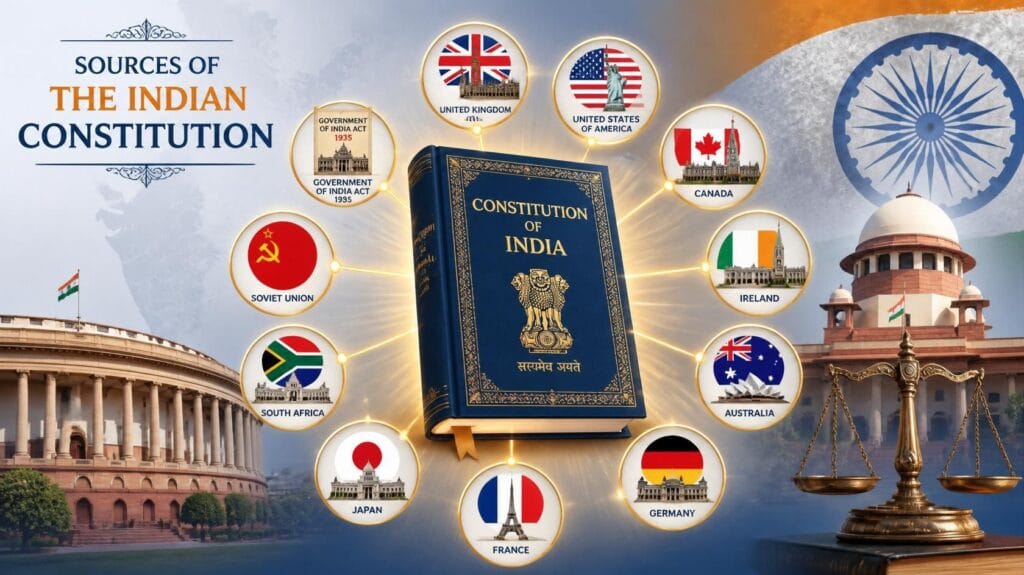
📖 What are the Sources of the Indian Constitution?
The Constitution is the supreme law of every nation, providing the legal framework for governance, protecting citizens' rights, and defining the powers of various government institutions. But have you ever wondered where the Indian Constitution came from and what inspired its provisions? The answer lies in understanding the Sources of the Indian Constitution.
The Indian Constitution is the longest written Constitution in the world. Instead of copying a single country's constitutional system, the framers carefully examined the constitutions of many nations, historical documents, political traditions, and India's own administrative experience. They selected the best features from different systems and adapted them to suit India's unique social, cultural, and political conditions.
Major sources of the Indian Constitution include the Government of India Act, 1935, and the constitutions of the United Kingdom, United States, Ireland, Canada, Australia, Germany, South Africa, Japan, France, and the former Soviet Union. These sources influenced important constitutional features such as Fundamental Rights, Directive Principles of State Policy, the Parliamentary System, Federalism, Judicial Review, Emergency Provisions, and the Constitutional Amendment Process.
- What are the Sources of the Indian Constitution?
- Why were foreign constitutions studied by the Constituent Assembly?
- Which constitutional features were borrowed from different countries?
- How these sources shaped the world's largest democratic Constitution?
- Important facts for UPSC, SSC, State PCS, and other competitive examinations.
📖 Why Were the Sources of the Indian Constitution Necessary?
India is a vast, diverse, and multicultural nation with different languages, religions, cultures, and social traditions. Drafting a Constitution for such a diverse country required a balanced legal framework that could ensure democracy, justice, equality, and effective governance. Instead of copying a single constitution, the Constituent Assembly carefully studied the constitutional systems of many countries and adopted their best features according to India's unique needs.
🌍 Managing Diversity
India's cultural, linguistic, and religious diversity required a Constitution capable of maintaining unity while respecting regional differences.
⚖️ Learning from Successful Democracies
The Constituent Assembly adopted constitutional provisions that had already proven successful in countries with stable democratic systems.
🏛️ Establishing Democratic Governance
Borrowing democratic principles helped create a responsible government based on liberty, equality, justice, and the rule of law.
🛡️ Protecting Fundamental Rights
Strong constitutional safeguards were needed to protect individual freedoms and ensure equal rights for every citizen.
⚡ Building an Efficient Administration
The Constitution incorporated administrative features that would provide stability, accountability, and effective governance.
📚 Using Historical Experience
The Government of India Act, 1935, along with constitutional practices from various countries, provided a practical foundation for drafting the Constitution.
The sources of the Indian Constitution were necessary because they enabled the Constitution makers to combine the world's best constitutional practices with India's own social, political, and historical realities. This approach helped create a Constitution that is democratic, flexible, comprehensive, and capable of meeting the needs of the world's largest democracy.
🌍 Major Foreign Sources of the Indian Constitution
While drafting the Constitution of India, the Constituent Assembly carefully examined the constitutional systems of several countries. Instead of copying any one constitution, the framers selected the best constitutional principles and institutions from around the world and adapted them to India's unique social, political, and administrative needs. This thoughtful approach made the Indian Constitution one of the most comprehensive and balanced constitutions in the world.
🇬🇧 United Kingdom
- Parliamentary System of Government
- Cabinet System
- Collective Responsibility of the Council of Ministers
- Office of the Prime Minister
- Rule of Law
- Single Citizenship
🇺🇸 United States of America
- Fundamental Rights
- Judicial Review
- Independent Judiciary
- Impeachment of the President
- Office of the Vice-President
- Supremacy of the Constitution
🇮🇪 Ireland
- Directive Principles of State Policy (DPSPs)
- Indirect Election of the President
- Nomination of Members to the Rajya Sabha
🇨🇦 Canada
- Federal System with a Strong Centre
- Distribution of Powers
- Residuary Powers to the Union
- Appointment of State Governors
🇦🇺 Australia
- Concurrent List
- Freedom of Trade and Commerce
- Joint Sitting of Both Houses of Parliament
🇩🇪 Germany (Weimar Constitution)
- Emergency Provisions
- Suspension of Fundamental Rights during Emergency
🇿🇦 South Africa
- Procedure for Constitutional Amendment
- Election of Members of the Rajya Sabha
🇫🇷 France
- Liberty
- Equality
- Fraternity
🇷🇺 Former Soviet Union (USSR)
- Fundamental Duties
- Social, Economic, and Political Justice
- Socialist Ideals
🇯🇵 Japan
- Procedure Established by Law
The framers of the Indian Constitution borrowed only those constitutional features that were practical, democratic, and suitable for India's diverse society. By combining the best ideas from different countries with India's own constitutional vision, they created a Constitution that is flexible, democratic, comprehensive, and capable of meeting the needs of the world's largest democracy.
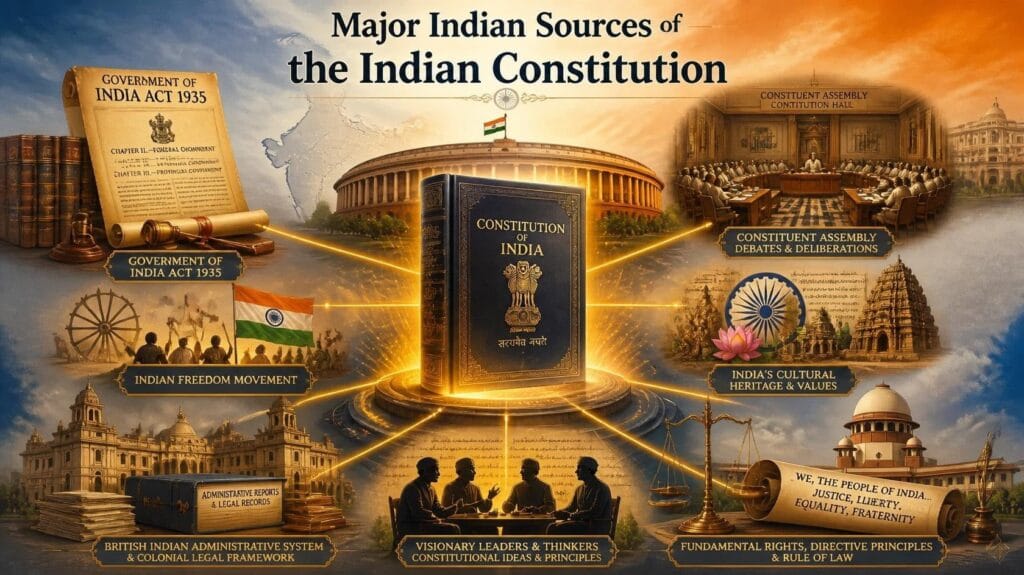
🇮🇳 Major Indian Sources of the Indian Constitution
Although the Indian Constitution was influenced by several foreign constitutions, it was also deeply rooted in India's own historical, political, administrative, and cultural traditions. The Constituent Assembly carefully considered India's unique conditions, the ideals of the freedom struggle, and the administrative experience gained during British rule while drafting the Constitution.
📜 Government of India Act, 1935
- Federal Structure of Government
- Division of Powers between the Union and the States
- Office and Powers of the Governor
- Public Service Commissions
- Emergency Administration Provisions
- Provincial Autonomy
✊ Indian Freedom Movement
- Democratic Values
- Demand for Fundamental Rights
- Social Justice and Equality
- Secularism
- National Unity and Integrity
🏛️ Constituent Assembly Debates
- Adaptation to Indian Conditions
- Detailed Deliberations and Amendments
- Democratic Ideals
- Balanced Constitutional Framework
🕉️ Indian Cultural & Social Traditions
- Justice and Tolerance
- Unity in Diversity
- Social Harmony
- Respect for Human Dignity
⚖️ British Indian Administrative System
- Civil Services
- Judicial Administration
- Legislative Institutions
- Responsible Government
🎯 Vision of National Leaders
- Mahatma Gandhi's Gram Swaraj
- Dr. B. R. Ambedkar's Constitutional Vision
- Jawaharlal Nehru's Democratic Ideals
- Sardar Patel's National Integration
The Indian Constitution is not merely a collection of borrowed provisions. It is the result of India's freedom struggle, historical experience, administrative traditions, cultural heritage, and the visionary work of the Constituent Assembly. These Indian sources gave the Constitution its unique identity, making it democratic, inclusive, practical, and well-suited to the needs of the world's largest democracy.
🌍 Constitutional Provisions Borrowed from Different Countries
The framers of the Indian Constitution carefully examined the constitutions of several countries before drafting India's supreme law. Instead of copying any one constitution, they adopted the best constitutional principles from different nations and modified them to suit India's democratic ideals, administrative requirements, and socio-cultural conditions. The following table highlights the major constitutional provisions borrowed from various countries.
| 🌎 Country | 📜 Constitutional Provisions Borrowed |
|---|---|
| 🇬🇧 United Kingdom | Parliamentary System of Government, Cabinet System, Collective Responsibility, Office of the Prime Minister, Rule of Law, Single Citizenship, Parliamentary Procedures. |
| 🇺🇸 United States of America | Fundamental Rights, Judicial Review, Independent Judiciary, Impeachment of the President, Office of the Vice-President, Supremacy of the Constitution. |
| 🇮🇪 Ireland | Directive Principles of State Policy (DPSPs), Indirect Election of the President, Nomination of Members to the Rajya Sabha. |
| 🇨🇦 Canada | Federal System with a Strong Centre, Distribution of Powers, Residuary Powers to the Union, Appointment of Governors. |
| 🇦🇺 Australia | Concurrent List, Freedom of Trade and Commerce, Joint Sitting of Both Houses of Parliament. |
| 🇩🇪 Germany (Weimar Constitution) | Emergency Provisions and Suspension of Fundamental Rights during a National Emergency. |
| 🇿🇦 South Africa | Procedure for Constitutional Amendment and Election of Members of the Rajya Sabha. |
| 🇫🇷 France | Ideals of Liberty, Equality, and Fraternity. |
| 🇷🇺 Former Soviet Union (USSR) | Fundamental Duties, Socialist Ideals, Social and Economic Justice. |
| 🇯🇵 Japan | Procedure Established by Law. |
The Constitution of India reflects the wisdom of its framers, who combined the most effective constitutional principles from different countries with India's own historical experience and democratic aspirations. This thoughtful blend has made the Indian Constitution one of the most comprehensive, flexible, and respected constitutions in the world.
⭐ Importance of the Sources of the Indian Constitution
The sources of the Indian Constitution are more than historical references—they provide the intellectual, legal, and democratic foundation of India's constitutional framework. By studying successful constitutional systems from around the world and combining them with India's own historical experiences and democratic aspirations, the framers created a Constitution that is practical, flexible, and capable of governing one of the world's most diverse nations.
⚖️ Protects Democratic Values
The constitutional sources helped establish the core principles of democracy, justice, liberty, equality, and the rule of law, which form the foundation of the Indian Republic.
🏛️ Ensures Effective Governance
By adopting successful Administrative Systems from different countries, India developed a responsible, transparent, and efficient system of government.
🌍 Incorporates Global Best Practices
The framers carefully selected proven constitutional ideas from various nations and adapted them to India's unique political and social conditions.
🛡️ Safeguards Fundamental Rights
The Constitution guarantees individual freedoms and legal protection through Fundamental Rights, judicial independence, and constitutional remedies.
⚙️ Maintains Federal Balance
The constitutional sources helped establish a balanced distribution of powers between the Union and the States, ensuring administrative stability and cooperative federalism.
📖 Valuable for Competitive Exams
The sources of the Indian Constitution are an important topic in UPSC, SSC, State PCS, UGC NET, CLAT, and other competitive examinations.
The importance of the sources of the Indian Constitution lies in their contribution to creating a Constitution that is democratic, inclusive, flexible, and resilient. By blending India's own constitutional vision with the best ideas from across the world, the framers produced one of the most comprehensive and respected constitutions in the world, capable of meeting the needs of a modern democratic nation.
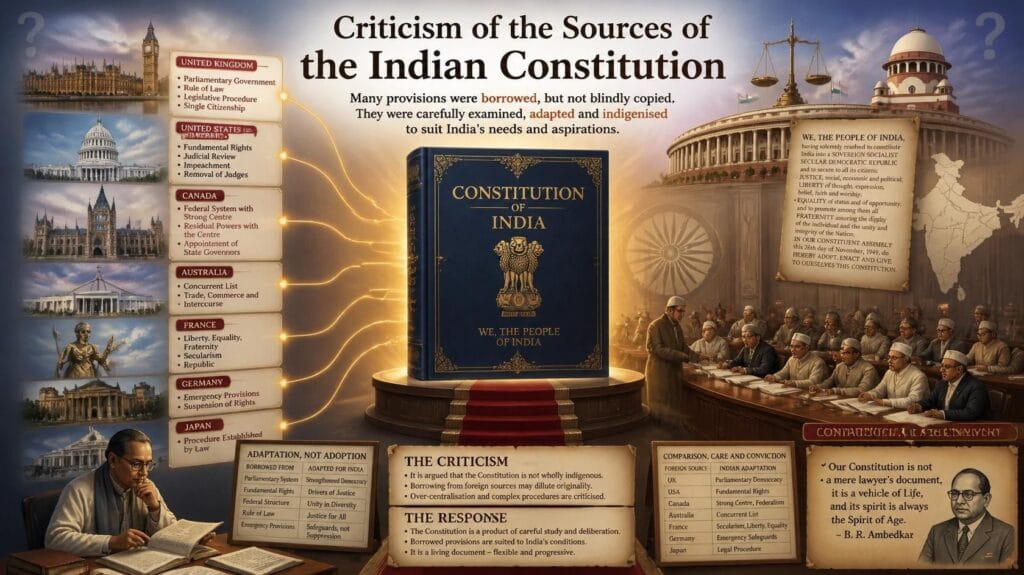
⚖️ Criticism of the Sources of the Indian Constitution
The Constitution of India is widely regarded as one of the most comprehensive and detailed constitutions in the world. Although its framers borrowed the best constitutional features from several countries, scholars and constitutional experts have raised certain criticisms regarding its sources. Most of these criticisms focus on the extensive influence of foreign constitutions and the complexity of the constitutional framework.
🌍 Extensive Foreign Influence
One of the most common criticisms is that many constitutional provisions were borrowed from foreign constitutions, leading some critics to question the originality of the Indian Constitution.
📖 Lengthy and Complex Constitution
Because provisions were adopted from multiple constitutional systems, the Indian Constitution became the world's longest written constitution, making it more detailed and complex.
⚖️ Administrative Complexity
The combination of different constitutional models sometimes results in administrative procedures that are more complicated and time-consuming.
🏛️ Limited Emphasis on Indigenous Traditions
Some scholars argue that greater importance could have been given to India's traditional systems of governance and indigenous political institutions.
🔄 Mixture of Different Constitutional Systems
The integration of parliamentary government, federalism, judicial review, and other constitutional principles from different countries is considered by some critics to be overly complex.
📚 The "Borrowed Constitution" Argument
The Indian Constitution is sometimes described as a "Borrowed Constitution" because it incorporates provisions from many foreign constitutions. However, this criticism is widely challenged because every borrowed provision was carefully modified to suit Indian conditions.
Despite these criticisms, the Constitution of India remains a remarkable constitutional achievement. The framers successfully combined the world's best constitutional practices with India's own democratic ideals, historical experiences, and social realities to create a flexible, democratic, inclusive, and enduring Constitution. Its continued success for more than seven decades demonstrates the wisdom and foresight of the Constituent Assembly.
📜 Is the Indian Constitution Merely a Borrowed Constitution?
The Indian Constitution is often referred to as a "Borrowed Constitution" because many of its provisions were inspired by the constitutions of different countries. However, describing it as merely a borrowed constitution is inaccurate. The framers of the Constitution did not simply copy foreign constitutional provisions; instead, they carefully selected the most effective ideas, modified them, and adapted them to India's unique historical background, democratic values, and socio-political conditions.
🌍 Inspired, Not Copied
The Constituent Assembly studied the constitutions of the United Kingdom, the United States, Canada, Ireland, Australia, France, and several other countries, but no constitution was adopted in its entirety.
🇮🇳 Adapted to Indian Conditions
Every borrowed provision was carefully modified to suit India's social diversity, political realities, cultural traditions, and administrative requirements.
⚖️ Unique Constitutional Features
The Constitution reflects India's own democratic vision through universal adult franchise, parliamentary democracy, an independent judiciary, federalism, Social Justice, and constitutional supremacy.
🏛️ Contribution of the Constituent Assembly
After nearly three years of detailed debates, discussions, and amendments, the Constituent Assembly produced a Constitution that was original in structure, philosophy, and application.
📖 Influence of the Freedom Movement
The ideals of liberty, equality, secularism, democracy, and social justice were deeply influenced by India's freedom struggle and became the guiding principles of the Constitution.
⭐ A Unique Constitutional Document
The Indian Constitution successfully combines the world's best constitutional practices with India's own constitutional philosophy, making it one of the most comprehensive and respected constitutions in the world.
"The Indian Constitution may have borrowed ideas from many constitutions, but its philosophy, objectives, and implementation are distinctly Indian. It is an original constitutional document shaped by India's democratic aspirations."
The Indian Constitution is not merely a borrowed constitution. While it incorporates valuable constitutional principles from different countries, every provision was carefully adapted to India's own needs. Its true strength lies in blending global constitutional wisdom with India's history, diversity, democratic ideals, and the vision of the Constituent Assembly. This unique combination has made it one of the most comprehensive, flexible, and enduring constitutions in the world.
🎯 Important Facts for UPSC & SSC Examinations
Questions related to the Sources of the Indian Constitution are frequently asked in UPSC, SSC, State PCS, CDS, CAPF, Banking, Railway, and other competitive examinations. Candidates should have a clear understanding of the constitutional provisions borrowed from different countries, the Government of India Act, 1935, and the important features of the Constituent Assembly.
🇬🇧 United Kingdom
- Parliamentary System of Government
- Prime Minister & Cabinet System
- Single Citizenship
- Rule of Law
🇺🇸 United States of America
- Fundamental Rights
- Judicial Review
- Independent Judiciary
- Impeachment of the President
🇮🇪 Ireland
- Directive Principles of State Policy
- Indirect Election of the President
- Nomination of Rajya Sabha Members
🇨🇦 Canada
- Federal System
- Strong Centre
- Residuary Powers to the Union
🇦🇺 Australia
- Concurrent List
- Joint Sitting of Parliament
- Freedom of Trade and Commerce
🇩🇪 Germany
- Emergency Provisions
- Suspension of Fundamental Rights During Emergency
🇿🇦 South Africa
- Constitutional Amendment Procedure
- Election of Rajya Sabha Members
🇫🇷 France
- Liberty
- Equality
- Fraternity
🇷🇺 Former Soviet Union (USSR)
- Fundamental Duties
- Socialist Ideals
📜 Government of India Act, 1935
- Federal Framework
- Office of the Governor
- Public Service Commissions
- Administrative Structure
🧠 Quick Revision
✔ United Kingdom → Parliamentary System, Rule of Law
✔ United States → Fundamental Rights, Judicial Review
✔ Ireland → Directive Principles of State Policy (DPSPs)
✔ Canada → Strong Centre, Residuary Powers
✔ Australia → Concurrent List, Joint Sitting
✔ Germany → Emergency Provisions
✔ South Africa → Constitutional Amendment Procedure
✔ France → Liberty, Equality & Fraternity
✔ Former Soviet Union → Fundamental Duties
✔ Japan → Procedure Established by Law
✔ Government of India Act, 1935 → Federal & Administrative Framework
📌 Conclusion
The sources of the Indian Constitution demonstrate that the framers did not simply copy the constitutional system of any one country. Instead, they carefully examined the best constitutional practices from around the world and combined them with India's own historical experiences, democratic values, administrative traditions, and socio-political realities. The result was a Constitution specifically designed to meet the needs of a diverse and independent nation.
The Constituent Assembly thoroughly debated every constitutional provision before its adoption. By blending global constitutional wisdom with India's own aspirations for democracy, justice, equality, liberty, and national unity, it created one of the most comprehensive, flexible, and enduring constitutions in the world.
"The Indian Constitution is not merely a legal document—it is the foundation of the world's largest democracy, reflecting the collective vision, values, and aspirations of the people of India."
By understanding the sources of the Indian Constitution, their significance, the constitutional provisions borrowed from different countries, the role of the Government of India Act, 1935, the importance and criticisms of these sources, and their relevance for competitive examinations, you gain a strong conceptual foundation in Indian Polity. This topic is highly important for UPSC, SSC, State PCS, CDS, CAPF, CLAT, Judiciary, UGC NET, Banking, Railway, and other competitive examinations.