
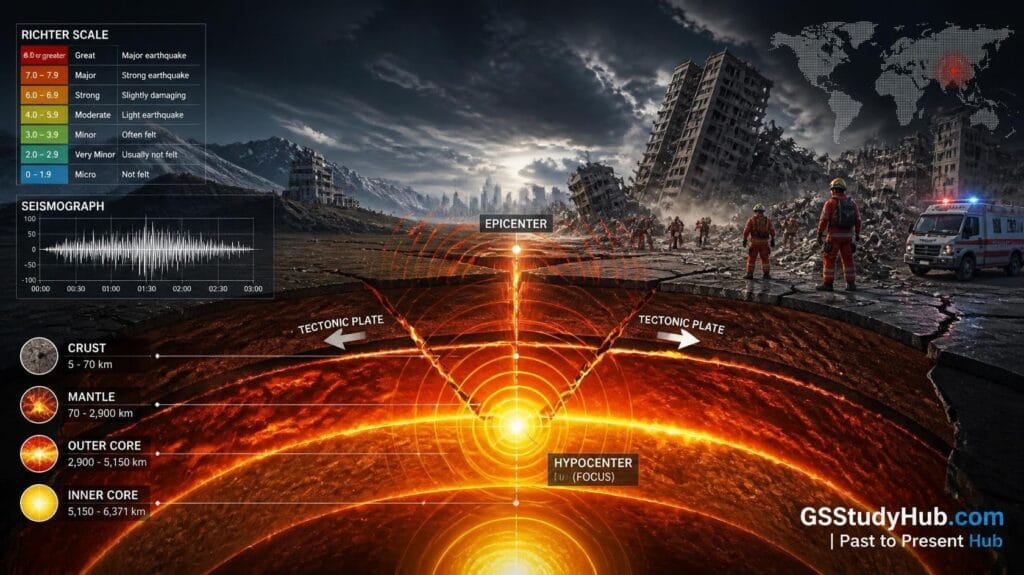
🌍 Introduction to Earthquake – Causes and Measurement
📖 Introduction
Earthquake – Causes and Measurement is one of the most important topics in Geography, Disaster Management, and Earth Science. An earthquake occurs when a large amount of energy stored inside the Earth is suddenly released, causing the ground to shake. Earthquakes are among the most destructive natural disasters, capable of damaging buildings, roads, bridges, and infrastructure within seconds. Understanding their causes, measurement methods, and impacts is essential for reducing risks and improving disaster preparedness.
🌍 What is an Earthquake?
An earthquake is the sudden shaking or vibration of the Earth's surface caused by the rapid release of energy within the Earth's crust. This energy travels in the form of seismic waves, which spread outward from the point of origin and create ground motion. Earthquakes may vary from minor tremors to powerful events capable of causing widespread destruction.
📚 Definition of an Earthquake
An earthquake is a natural geological phenomenon in which the Earth's surface vibrates due to the sudden release of stored energy inside the Earth. This energy is usually generated by the movement of tectonic plates, faulting, volcanic activity, or, in some cases, human activities such as mining or reservoir construction.
🌋 Earth's Internal Energy and Earthquakes
The Earth contains an enormous amount of internal heat and pressure. This internal energy drives the movement of tectonic plates that make up the Earth's outer shell. As these plates collide, separate, or slide past each other, stress gradually builds up in rocks. When the accumulated stress exceeds the strength of the rocks, they suddenly break or slip along faults, releasing energy in the form of seismic waves. These seismic waves travel through the Earth and cause the ground shaking that we experience as an earthquake. Therefore, the Earth's internal energy is considered the primary source of earthquake activity.
🌍 What is an Earthquake?
An earthquake is the sudden shaking or vibration of the Earth's surface caused by the rapid release of stored energy within the Earth's crust. The shaking may last from a few seconds to several minutes, and its impact depends on the magnitude and depth of the earthquake.
📘 Simple Explanation
When enormous pressure builds up inside the Earth, rocks eventually break or suddenly slip along faults. This releases a large amount of energy that travels through the Earth as seismic waves, causing the ground to shake. This phenomenon is known as an earthquake.
Imagine stretching a rubber band until it suddenly snaps. The stored energy is released instantly. In a similar way, rocks inside the Earth release stored energy when they break, producing an earthquake.
📖 Scientific Definition
Scientifically, an earthquake is a natural event that occurs when the elastic energy stored within the Earth's crust is suddenly released due to the movement or fracturing of rocks along geological faults. This energy propagates through the Earth in the form of seismic waves, resulting in ground motion.
⚡ Release of Energy
The continuous movement of tectonic plates creates stress within rocks beneath the Earth's surface. When this stress exceeds the strength of the rocks, they suddenly fracture or slide past one another. The stored energy is then released rapidly as seismic waves, which travel outward from the focus and produce the shaking experienced during an earthquake.
🌍 Major Causes of Earthquakes
🌐 1. Plate Tectonics
Plate tectonics is the primary cause of earthquakes. The Earth's outer rigid shell (lithosphere) is divided into several large and small tectonic plates. These plates are constantly moving. When they collide, move apart, or slide past one another, stress accumulates along their boundaries. Once the stress exceeds the strength of rocks, it is suddenly released, producing an earthquake.
- Convergent Boundary
- Divergent Boundary
- Transform Boundary
⚡ 2. Faulting
A fault is a fracture or crack in the Earth's crust where rocks move relative to each other. When stress builds up along a fault and the rocks suddenly slip, the stored energy is released as seismic waves, resulting in an earthquake.
Most major earthquakes occur along active geological faults where tectonic stress is continuously accumulating.
🌋 3. Volcanic Activity
Earthquakes can also occur due to volcanic activity. As magma, gases, and steam move upward through the Earth's crust, they create pressure and fractures in surrounding rocks. This movement generates volcanic earthquakes, especially before or during volcanic eruptions.
🏗️ 4. Human-Induced Causes
Some earthquakes are caused by human activities and are known as induced earthquakes. Although they are generally smaller than natural earthquakes, they can still cause local damage and pose significant risks.
- 🏞️ Large dams and reservoirs (Reservoir-Induced Seismicity)
- ⛏️ Deep mining operations
- 💥 Blasting and underground nuclear tests
- 💧 Excessive groundwater extraction
- 🛢️ Oil and natural gas extraction
- ♨️ Geothermal energy projects
📚 Conclusion
More than 90% of the world's earthquakes are caused by the movement of tectonic plates. Volcanic activity and human-induced factors account for a much smaller proportion of earthquakes. Understanding these causes is essential for earthquake prediction research, disaster preparedness, and the construction of earthquake-resistant infrastructure.
For UPSC, SSC, State PCS, and other competitive examinations, the Plate Tectonic Theory is considered the most important explanation for the occurrence of earthquakes.
🌍 Types of Earthquakes
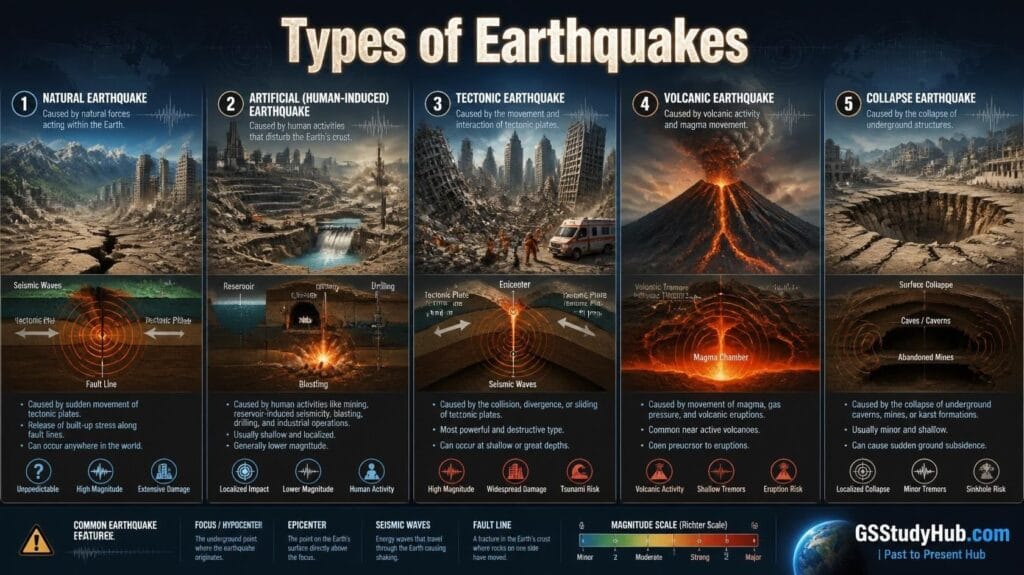
🌎 1. Natural Earthquakes
Natural earthquakes occur due to natural geological processes within the Earth. They are primarily caused by tectonic plate movements, faulting, volcanic activity, and other natural forces acting beneath the Earth's surface.
🏗️ 2. Artificial (Human-Induced) Earthquakes
Earthquakes resulting from human activities are known as artificial or human-induced earthquakes. These events usually affect a limited area and are generally less powerful than natural earthquakes.
- 💥 Explosions and underground nuclear tests
- ⛏️ Deep mining operations
- 🏞️ Large dams and reservoirs
- 💧 Excessive groundwater extraction
🌐 3. Tectonic Earthquakes
Tectonic earthquakes are the most common and destructive type of earthquakes. They occur when stress builds up due to the movement of tectonic plates and is suddenly released along geological faults. Approximately 90–95% of all earthquakes belong to this category.
🌋 4. Volcanic Earthquakes
Volcanic earthquakes are caused by the movement of magma, gases, and volcanic fluids beneath the Earth's surface. They usually occur before, during, or after volcanic eruptions and are mainly confined to active volcanic regions.
⛰️ 5. Collapse Earthquakes
Collapse earthquakes occur when underground caves, limestone formations, mines, or tunnels suddenly collapse. These earthquakes are generally low in magnitude and their effects are limited to a small geographical area.
📚 Summary
- 🌎 Natural Earthquakes
- 🏗️ Artificial (Human-Induced) Earthquakes
- 🌐 Tectonic Earthquakes
- 🌋 Volcanic Earthquakes
- ⛰️ Collapse Earthquakes
Most earthquakes occurring around the world are tectonic earthquakes, produced by the movement of tectonic plates and the sudden release of accumulated stress along faults.
🌍 Major Parts of an Earthquake
🎯 1. Focus (Hypocenter)
The Focus, also known as the Hypocenter, is the point inside the Earth where an earthquake originates. It is the location where rocks suddenly break or slip along a fault, releasing stored energy that generates seismic waves.
The focus lies beneath the Earth's surface and may occur at depths ranging from a few kilometers to about 700 km, depending on the type of earthquake.
📍 2. Epicenter
The Epicenter is the point on the Earth's surface located directly above the focus. It is usually the area where the strongest ground shaking is first experienced and where the greatest damage often occurs.
The Focus is located inside the Earth, whereas the Epicenter is located on the Earth's surface directly above it.
🌊 3. Seismic Waves
When energy is released at the focus, it travels outward in the form of seismic waves. These waves pass through the Earth's interior and across its surface, causing the ground to shake during an earthquake.
Scientists analyze seismic waves to determine an earthquake's magnitude, depth, location, and to study the internal structure of the Earth.
- 🔹 Primary Waves (P-Waves)
- 🔹 Secondary Waves (S-Waves)
- 🔹 Surface Waves (Love Waves & Rayleigh Waves)
📚 Summary
- 🎯 Focus (Hypocenter): The point inside the Earth where an earthquake begins.
- 📍 Epicenter: The point on the Earth's surface directly above the focus.
- 🌊 Seismic Waves: Energy waves released from the focus that travel through the Earth and produce ground shaking.
The Focus (Hypocenter) is the actual source of an earthquake, while the Epicenter is the surface location where earthquake effects are generally the strongest.
🌊 Seismic Waves
Seismic waves are energy waves generated at the focus (hypocenter) of an earthquake. They travel outward through the Earth's interior and across its surface in all directions, causing the ground to shake. Scientists use these waves to determine an earthquake's location, magnitude, depth, and to study the Earth's internal structure.
- Primary Waves (P-Waves)
- Secondary Waves (S-Waves)
- Surface Waves
🔹 1. Primary Waves (P-Waves)
P-Waves, also known as Primary or Compressional (Longitudinal) Waves, are the fastest seismic waves. They are the first to reach seismographs after an earthquake.
- ✅ Fastest seismic waves (about 5–14 km/s).
- ✅ Travel through solids, liquids, and gases.
- ✅ Arrive first at seismic stations.
- ✅ Usually cause the least amount of damage.
🔸 2. Secondary Waves (S-Waves)
S-Waves, also called Shear or Transverse Waves, travel more slowly than P-Waves and move particles perpendicular to the direction of wave propagation.
- ✅ Slower than P-Waves.
- ✅ Travel only through solid materials.
- ✅ Cannot pass through liquids or gases.
- ✅ Produce stronger ground shaking than P-Waves.
🌍 3. Surface Waves
Surface waves travel only along the Earth's surface. They are the slowest seismic waves but are the most destructive because they produce large ground movements that damage buildings, roads, bridges, and other structures.
- ✅ Travel only along the Earth's surface.
- ✅ Slowest seismic waves.
- ✅ Cause the greatest destruction.
- ✅ Main types: Love Waves and Rayleigh Waves.
📊 Difference Between P-Waves, S-Waves & Surface Waves
| Feature | P-Waves | S-Waves | Surface Waves |
|---|---|---|---|
| Speed | Fastest | Moderate | Slowest |
| Medium | Solids, Liquids & Gases | Only Solids | Earth's Surface |
| Arrival Time | First | Second | Last |
| Damage Potential | Low | Moderate | Highest |
| Wave Type | Longitudinal | Transverse | Surface Motion |
- 🔹 P-Waves are the fastest seismic waves.
- 🔹 S-Waves cannot travel through liquids, proving that the Earth's outer core is liquid.
- 🔹 Surface Waves are responsible for most earthquake-related destruction.
- 🔹 Love Waves produce horizontal ground motion, while Rayleigh Waves create rolling, wave-like motion.
📏 Measurement of Earthquakes
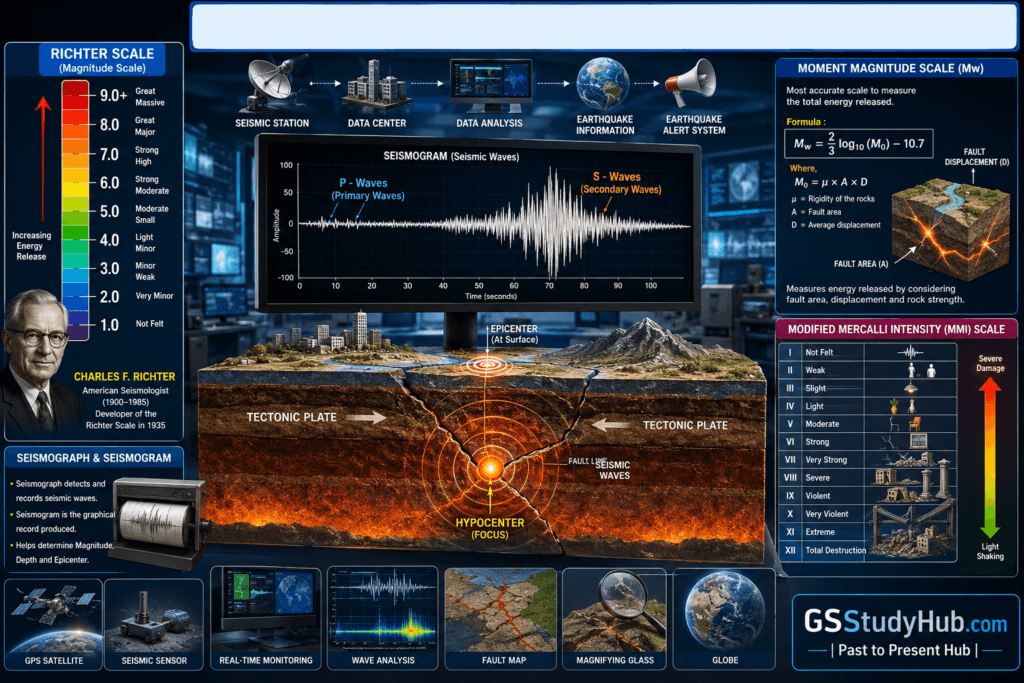
Earthquakes are measured using scientific instruments and standardized scales. Two important aspects are measured: Magnitude, which represents the amount of energy released, and Intensity, which describes the effects and damage caused at a particular location.
Magnitude is the total energy released by an earthquake, whereas Intensity describes how strongly the earthquake is felt and the level of damage at a specific place.
📊 1. Richter Scale
The Richter Scale was developed in 1935 by American seismologist Charles F. Richter. It is a logarithmic scale used to measure the magnitude of an earthquake based on the amplitude of seismic waves recorded by a seismograph.
- ✅ Each one-unit increase represents approximately 32 times more energy released.
- ✅ One of the earliest and most widely used earthquake magnitude scales.
- ✅ Less accurate for measuring very large earthquakes.
🌍 2. Moment Magnitude Scale (Mw)
The Moment Magnitude Scale (Mw) is the modern and most scientifically accurate method for measuring earthquake magnitude. It calculates the total energy released by considering the fault area, the amount of rock displacement, and the strength of the rocks involved.
It provides reliable measurements for both small and extremely large earthquakes and has largely replaced the Richter Scale in modern seismology.
🏠 3. Modified Mercalli Intensity (MMI) Scale
The Modified Mercalli Intensity (MMI) Scale measures the intensity of an earthquake by evaluating its observed effects on people, buildings, and the natural environment rather than the energy released.
- 📌 Ranges from I to XII.
- 📌 I = Not felt except by sensitive instruments.
- 📌 XII = Total destruction.
📡 4. Seismograph
A Seismograph is a scientific instrument used to detect and record seismic waves generated during an earthquake. It is sensitive enough to record even very small ground vibrations.
- Records the exact time of an earthquake.
- Measures the amplitude and duration of seismic waves.
- Helps determine the earthquake's magnitude, depth, and epicenter.
📈 5. Seismogram
A Seismogram is the graphical record produced by a seismograph. It displays the arrival time, amplitude, and pattern of seismic waves, allowing scientists to analyze earthquake characteristics.
- Analyzes earthquake characteristics.
- Determines the location of the focus and epicenter.
- Calculates earthquake magnitude.
- Helps study the Earth's internal structure.
📊 Comparison of Earthquake Measurement Systems
| Scale / Instrument | Measures | Main Feature |
|---|---|---|
| Richter Scale | Magnitude | Logarithmic scale |
| Moment Magnitude Scale (Mw) | Total Energy Released | Most accurate modern scale |
| Modified Mercalli Intensity (MMI) | Observed Intensity & Damage | Grades I to XII |
| Seismograph | Seismic Waves | Instrument that records earthquakes |
| Seismogram | Graphical Earthquake Record | Output produced by a seismograph |
- ✅ The Richter Scale was introduced in 1935 by Charles F. Richter.
- ✅ The Moment Magnitude Scale (Mw) is the most widely used and scientifically accepted earthquake magnitude scale today.
- ✅ The Modified Mercalli Intensity (MMI) Scale measures earthquake intensity and damage, not magnitude.
- ✅ A Seismograph records seismic waves.
- ✅ A Seismogram is the graphical record produced by a seismograph.
📊 Features of the Richter Scale
📖 What is the Richter Scale?
The Richter Scale is a logarithmic scale used to measure the magnitude of an earthquake. It was developed in 1935 by American seismologist Charles F. Richter. The scale estimates the amount of energy released during an earthquake by analyzing the amplitude of seismic waves recorded by a seismograph.
⭐ Key Features of the Richter Scale
- ✅ Measures the magnitude of an earthquake.
- ✅ It is a logarithmic scale, not a linear one.
- ✅ Every increase of 1 unit represents a 10-fold increase in the amplitude of seismic waves.
- ✅ Every increase of 1 unit represents approximately 32 times more energy released.
- ✅ Provides an estimate of the total energy released by an earthquake.
- ✅ For very large earthquakes, it has largely been replaced by the Moment Magnitude Scale (Mw).
📐 Logarithmic Nature
The Richter Scale is logarithmic, meaning that each whole-number increase represents a multiplication rather than a simple addition. As a result, even a small increase in magnitude corresponds to a dramatic increase in energy released.
- 📌 Increase of 1 magnitude = 10× greater seismic wave amplitude.
- 📌 Increase of 1 magnitude = approximately 32× more energy.
- 📌 Increase of 2 magnitudes = about 1,000× more energy (32 × 32 ≈ 1,024).
💡 Examples
Example 1:
If one earthquake has a magnitude of 5.0 and another has a magnitude of 6.0, the 6.0 earthquake releases approximately 32 times more energy than the 5.0 earthquake.
Example 2:
If one earthquake measures 5.0 and another measures 7.0, the 7.0 earthquake releases approximately 1,000 times more energy than the 5.0 earthquake.
📊 General Effects by Richter Magnitude
| Magnitude | General Effects |
|---|---|
| Below 3.0 | Usually not felt by people |
| 3.0 – 3.9 | Minor shaking |
| 4.0 – 4.9 | Noticeable shaking |
| 5.0 – 5.9 | Light to moderate damage |
| 6.0 – 6.9 | Serious damage possible |
| 7.0 – 7.9 | Major destruction |
| 8.0 and above | Catastrophic devastation |
- ✅ The Richter Scale was developed by Charles F. Richter in 1935.
- ✅ It measures earthquake magnitude, not intensity.
- ✅ It is a logarithmic scale.
- ✅ A one-unit increase means approximately 32 times more energy is released.
- ✅ The Moment Magnitude Scale (Mw) is now the preferred scale for measuring large earthquakes.
🌍 Why Was the Moment Magnitude Scale (Mw) Adopted?
📖 Introduction
The Moment Magnitude Scale (Mw) is the modern and most scientifically accurate method for measuring the magnitude of earthquakes. It was introduced because the Richter Scale has important limitations, especially when measuring large earthquakes. Today, Mw is the international standard used by seismologists worldwide.
⚠️ Limitations of the Richter Scale
- ❌ It cannot accurately measure the true energy released by very large earthquakes (generally above magnitude 7.0).
- ❌ It is based mainly on the amplitude of seismic waves recorded by a seismograph.
- ❌ Results may vary depending on the distance from the earthquake and local geological conditions.
- ❌ It suffers from magnitude saturation, meaning extremely large earthquakes may receive similar magnitude values despite significant differences in energy.
- ❌ It is less suitable for comparing earthquakes on a global scale.
✅ Advantages of the Moment Magnitude Scale (Mw)
- ✔️ Measures the actual energy released during an earthquake.
- ✔️ Considers the fault area, amount of rock displacement, and rock rigidity.
- ✔️ Provides accurate results for both small and extremely large earthquakes.
- ✔️ Does not suffer from the saturation problem found in the Richter Scale.
- ✔️ It is the internationally accepted standard in modern seismology.
- ✔️ Widely used for evaluating major earthquakes and tsunami-generating events.
📊 Difference Between the Richter Scale and the Moment Magnitude Scale
| Feature | Richter Scale | Moment Magnitude Scale (Mw) |
|---|---|---|
| Measurement Basis | Amplitude of seismic waves | Total seismic moment (actual energy) |
| Large Earthquakes | Less accurate | Highly accurate |
| Reliability | Limited | Very high |
| Current Usage | Limited | Global standard |
| Suitable For | Small to moderate earthquakes | All earthquake magnitudes |
- ✅ The Moment Magnitude Scale (Mw) is now the preferred method for measuring earthquake magnitude worldwide.
- ✅ It overcomes the major limitations of the Richter Scale.
- ✅ Mw is based on the seismic moment, which represents the actual energy released during an earthquake.
- ✅ It is the standard scale used by major organizations such as the USGS and other international seismic agencies.
🌍 Effects of Earthquakes
Earthquakes not only cause ground shaking but also produce widespread social, economic, environmental, and infrastructural impacts. The severity of these effects depends on factors such as the earthquake's magnitude, depth, duration, distance from the epicenter, and local geological conditions.
👨👩👧👦 1. Loss of Life
Earthquakes can result in significant casualties due to collapsing buildings, bridge failures, fires, landslides, and other secondary disasters. Densely populated urban areas are particularly vulnerable to high death and injury rates.
💰 2. Economic Loss
Earthquakes often cause severe economic damage by destroying industries, businesses, agricultural land, transportation systems, and public infrastructure. Recovery and reconstruction may require enormous financial resources and can affect economic growth for years.
- Damage to industries and commercial establishments
- Disruption of trade and tourism
- Loss of employment and income
- High reconstruction and rehabilitation costs
🌊 3. Tsunami
Strong underwater earthquakes can suddenly displace the ocean floor, generating massive sea waves known as tsunamis. These waves can travel across oceans at high speeds and cause catastrophic destruction in coastal regions.
⛰️ 4. Landslides
In mountainous regions, earthquakes can destabilize slopes, causing rocks, soil, and debris to move downhill. Landslides may block roads, dam rivers, destroy settlements, and complicate rescue operations.
🕳️ 5. Land Subsidence
Earthquakes can cause the ground to sink or develop large cracks, particularly in areas with soft sediments or water-saturated soils. Land subsidence may permanently alter the landscape and damage buildings, roads, and underground utilities.
🏗️ 6. Impact on Infrastructure
Earthquakes can severely damage buildings, bridges, highways, railways, airports, power transmission lines, water supply systems, gas pipelines, and communication networks. Such damage disrupts essential services and makes emergency response and recovery more difficult.
- 🏢 Residential and commercial buildings
- 🌉 Bridges and flyovers
- 🛣️ Roads and highways
- 🚆 Railway networks
- ⚡ Electricity and communication systems
- 💧 Water supply and gas pipelines
📊 Summary of Major Earthquake Effects
| Effect | Main Consequence |
|---|---|
| Loss of Life | Deaths and injuries |
| Economic Loss | Damage to property, industries, and businesses |
| Tsunami | Destruction in coastal regions |
| Landslides | Slope failures in mountainous areas |
| Land Subsidence | Ground sinking and surface cracks |
| Infrastructure Damage | Destruction of buildings, roads, bridges, and utilities |
- ✅ Powerful undersea earthquakes can generate tsunamis.
- ✅ Landslides are one of the most common secondary hazards in mountainous earthquake-prone regions.
- ✅ Land subsidence is more common in areas with soft or water-saturated soils.
- ✅ The greatest social impact of earthquakes is loss of life, while the greatest economic impact is the destruction of infrastructure and property.

🇮🇳 Seismic Zones of India
India is one of the world's most earthquake-prone countries because of its active tectonic setting, particularly the collision between the Indian Plate and the Eurasian Plate. According to the Bureau of Indian Standards (BIS), the country is divided into four seismic zones—Zone II, Zone III, Zone IV, and Zone V—based on earthquake hazard. Zone I was removed in the revised seismic zoning map.
🟢 Zone II (Low Seismic Risk)
Zone II represents areas with relatively low seismic activity. Mild earthquakes may occur occasionally, and standard building practices are generally considered adequate, although earthquake-resistant construction is always recommended.
🟡 Zone III (Moderate Seismic Risk)
Zone III includes regions where moderate earthquakes are expected. Buildings in these areas should follow earthquake-resistant design standards to minimize damage during seismic events.
🟠 Zone IV (High Seismic Risk)
Zone IV is classified as a high-risk seismic region. Strong earthquakes may occur, making strict compliance with earthquake-resistant construction codes essential for protecting lives and infrastructure.
🔴 Zone V (Very High Seismic Risk)
Zone V is the most earthquake-prone region of India. It is highly vulnerable to severe and destructive earthquakes. Major areas in this zone include the Himalayan region, Northeast India, the Andaman and Nicobar Islands, and the Kutch region of Gujarat.
🗺️ Seismic Map of India
| Seismic Zone | Risk Level | Major Regions |
|---|---|---|
| Zone II | Low | Many stable regions of Central and Southern India |
| Zone III | Moderate | Parts of Kerala, Karnataka, Maharashtra, and several regions of Central India |
| Zone IV | High | Delhi, parts of Jammu & Kashmir, northern Bihar, and sections of the Himalayan belt |
| Zone V | Very High | Northeast India, Andaman & Nicobar Islands, Kutch (Gujarat), and the Himalayan region |
Approximately 59% of India's land area is vulnerable to earthquakes of varying intensities. Therefore, adopting earthquake-resistant construction practices is essential for disaster risk reduction.
- ✅ India is currently divided into Zone II, Zone III, Zone IV, and Zone V.
- ✅ Zone V has the highest seismic hazard.
- ✅ Zone II has the lowest seismic hazard.
- ✅ Delhi falls under Zone IV.
- ✅ The Himalayan region, Northeast India, the Andaman & Nicobar Islands, and Kutch (Gujarat) are part of Zone V.
- ✅ India's seismic zoning is defined under IS 1893 by the Bureau of Indian Standards (BIS).
🇮🇳 Major Earthquakes in India
India is one of the world's most earthquake-prone countries due to the ongoing collision between the Indian Plate and the Eurasian Plate. This tectonic activity makes the Himalayan region, Northeast India, and the Kutch region particularly vulnerable to major earthquakes. The following are some of the most significant earthquakes that have affected India and its neighboring regions.
📍 1897 – Assam Earthquake
Date: 12 June 1897
Magnitude: Approximately 8.1–8.2 Mw
This was one of the strongest earthquakes ever recorded in India. Its epicenter was near the Shillong Plateau, causing widespread destruction across Assam and Northeast India. It remains one of the most significant seismic events in the country's history.
📍 1905 – Kangra Earthquake
Date: 4 April 1905
Magnitude: Approximately 7.8 Mw
The Kangra Earthquake struck Himachal Pradesh and caused catastrophic destruction. Around 20,000 people lost their lives, making it one of the deadliest earthquakes in the Himalayan region.
📍 1934 – Bihar–Nepal Earthquake
Date: 15 January 1934
Magnitude: Approximately 8.0 Mw
This devastating earthquake severely affected Bihar in India and neighboring Nepal. Thousands of people were killed, and numerous towns and villages suffered extensive damage.
📍 1993 – Latur Earthquake
Date: 30 September 1993
Magnitude: Approximately 6.2–6.4 Mw
The earthquake struck Latur and Osmanabad districts in Maharashtra. It surprised scientists because it occurred in the relatively stable Peninsular India. Nearly 10,000 people lost their lives.
📍 2001 – Bhuj Earthquake
Date: 26 January 2001
Magnitude: Approximately 7.7 Mw
The Bhuj Earthquake in Gujarat's Kutch region was one of the most destructive natural disasters in modern Indian history. Around 20,000 people were killed, and hundreds of thousands were left homeless.
📍 2005 – Kashmir Earthquake
Date: 8 October 2005
Magnitude: Approximately 7.6 Mw
Although the epicenter was located in Pakistan-administered Kashmir, the earthquake caused severe damage across Jammu & Kashmir and the Himalayan region. More than 80,000 people lost their lives.
📍 2015 – Nepal Earthquake
Date: 25 April 2015
Magnitude: Approximately 7.8 Mw
The Nepal Earthquake caused widespread devastation in Nepal and was strongly felt in several Indian states, including Bihar, Uttar Pradesh, West Bengal, and Sikkim. Thousands of people died, and many historic monuments were destroyed.
📊 Summary of Major Earthquakes
| Year | Location | Magnitude (Mw) | Major Impact |
|---|---|---|---|
| 1897 | Assam | 8.1–8.2 | Severe destruction in Northeast India |
| 1905 | Kangra | 7.8 | About 20,000 deaths |
| 1934 | Bihar–Nepal | 8.0 | Massive destruction in India and Nepal |
| 1993 | Latur | 6.2–6.4 | Around 10,000 deaths |
| 2001 | Bhuj | 7.7 | Around 20,000 deaths |
| 2005 | Kashmir | 7.6 | Over 80,000 deaths |
| 2015 | Nepal | 7.8 | Heavy destruction in Nepal and northern India |
- ✅ The 1897 Assam Earthquake was one of the strongest earthquakes ever recorded in India.
- ✅ The 1905 Kangra Earthquake is among the deadliest earthquakes in the Himalayan region.
- ✅ The 2001 Bhuj Earthquake is considered one of the worst natural disasters in modern India.
- ✅ The 1993 Latur Earthquake occurred in Peninsular India, which is generally considered tectonically stable.
- ✅ The 2015 Nepal Earthquake significantly affected several northern Indian states in addition to Nepal.
🛡️ Earthquake Safety Measures
Earthquakes cannot be prevented, but their impact can be significantly reduced through proper preparedness, earthquake-resistant construction, public awareness, and timely emergency response. Being prepared at the individual, family, and community levels is essential for protecting lives and property.
🏢 1. Earthquake-Resistant Buildings
Buildings should be designed and constructed according to earthquake-resistant engineering standards and national building codes. Strong foundations, high-quality construction materials, and proper structural design greatly reduce the risk of collapse during earthquakes.
- Strong foundations and structural frames
- Lightweight roofs and balanced building design
- Compliance with earthquake-resistant building codes
- Retrofitting older and vulnerable buildings
🎯 2. Mock Drills
Regular earthquake mock drills should be conducted in schools, offices, hospitals, and public institutions. These drills help people respond calmly and evacuate safely during real earthquake emergencies.
- Improves emergency preparedness
- Reduces panic during disasters
- Ensures faster and safer evacuation
🛑 3. Safe Places
During an earthquake, take shelter under a sturdy table or desk and stay away from windows, glass panels, heavy furniture, electrical poles, and elevators. If you are outdoors, move to an open area away from buildings, trees, bridges, and power lines.
- ❌ Never use elevators during an earthquake.
- ❌ Stay away from windows and glass.
- ✅ If it is safe to do so, move to an open area away from hazards.
🎒 4. Emergency Disaster Kit
Every household should keep an emergency disaster kit ready with essential supplies needed during and after an earthquake.
- 💧 Drinking water
- 🥫 Non-perishable food
- 💊 First Aid Kit and essential medicines
- 🔦 Flashlight with extra batteries
- 📻 Battery-powered or solar radio
- 📱 Power bank and mobile charger
- 📑 Copies of important documents
- 💵 Emergency cash
🤲 5. "Drop, Cover and Hold"
The internationally recommended safety technique during an earthquake is "Drop, Cover and Hold". It helps minimize injuries caused by falling objects and collapsing structures.
- ⬇️ Drop: Drop to your hands and knees to prevent being knocked over.
- 🛡️ Cover: Take cover under a sturdy table or desk and protect your head and neck.
- ✋ Hold: Hold on to the shelter until the shaking completely stops.
📊 Summary of Earthquake Safety Measures
| Safety Measure | Purpose |
|---|---|
| Earthquake-Resistant Buildings | Reduce structural damage and save lives |
| Mock Drills | Improve emergency preparedness |
| Safe Places | Prevent injuries and fatalities |
| Emergency Disaster Kit | Meet essential needs during emergencies |
| Drop, Cover and Hold | Protect individuals during ground shaking |
- ✅ "Drop, Cover and Hold" is the internationally recommended earthquake safety procedure.
- ✅ Never use an elevator during an earthquake.
- ✅ Earthquake-resistant buildings significantly reduce casualties and property damage.
- ✅ Every family should maintain a well-equipped emergency disaster kit.
- ✅ Regular mock drills improve disaster preparedness and emergency response.
🇮🇳 Disaster Management in India
India is highly vulnerable to both natural and human-induced disasters, including earthquakes, floods, cyclones, tsunamis, landslides, droughts, and industrial accidents. To minimize loss of life and property, the country has developed a comprehensive Disaster Management System that focuses on preparedness, mitigation, response, relief, recovery, and rehabilitation.
🏛️ 1. National Disaster Management Authority (NDMA)
The National Disaster Management Authority (NDMA) was established under the Disaster Management Act, 2005. It is the apex body responsible for disaster management policies in India, and it is chaired by the Prime Minister of India.
- Formulates national disaster management policies and guidelines.
- Promotes Disaster Risk Reduction (DRR).
- Provides technical guidance and support to state governments.
- Coordinates national disaster preparedness and response strategies.
🚑 2. National Disaster Response Force (NDRF)
The National Disaster Response Force (NDRF) was established in 2006 as India's specialized force for disaster response. It is trained to conduct rescue, evacuation, and relief operations during natural and man-made disasters.
- Search and rescue operations.
- Relief work during earthquakes, floods, cyclones, and other disasters.
- Medical assistance and emergency evacuation.
- Community awareness and disaster preparedness training.
🌍 3. India Meteorological Department (IMD)
The India Meteorological Department (IMD) is India's principal agency for weather forecasting and seismic monitoring. It operates a nationwide network to monitor earthquakes and issues warnings for cyclones, severe weather events, and other natural hazards.
- Detects and records earthquakes.
- Provides weather forecasts.
- Issues cyclone and severe weather warnings.
- Operates the National Seismological Network.
🏗️ 4. Bureau of Indian Standards (BIS) Building Codes
The Bureau of Indian Standards (BIS) develops and maintains national standards for earthquake-resistant construction. Important codes such as IS 1893, IS 4326, and IS 13828 provide technical guidelines for designing and constructing earthquake-resistant buildings.
- Promote earthquake-resistant building design.
- Improve construction quality and structural safety.
- Reduce loss of life and property during earthquakes.
- Support safe construction in accordance with the National Building Code (NBC).
📊 Major Organizations and Their Roles
| Organization | Full Name | Primary Role |
|---|---|---|
| NDMA | National Disaster Management Authority | Policy formulation and coordination |
| NDRF | National Disaster Response Force | Search, rescue, and relief operations |
| IMD | India Meteorological Department | Earthquake monitoring and weather forecasting |
| BIS | Bureau of Indian Standards | Earthquake-resistant building standards |
- ✅ The NDMA was established under the Disaster Management Act, 2005.
- ✅ The NDRF was constituted in 2006 as India's specialized disaster response force.
- ✅ The IMD is responsible for earthquake monitoring, weather forecasting, and issuing early warnings.
- ✅ The BIS publishes important earthquake-resistant building codes such as IS 1893, IS 4326, and IS 13828.
- ✅ NDMA, NDRF, IMD, and BIS play crucial roles in disaster preparedness, response, recovery, and mitigation across India.
🌍 Climate Change and Earthquakes
A common question in recent years is whether climate change causes earthquakes. According to current scientific evidence, there is no confirmed direct relationship between climate change and tectonic earthquakes. Most earthquakes are caused by the movement of tectonic plates and the release of stress along geological faults deep within the Earth's crust.
❓ Is There a Relationship Between Climate Change and Earthquakes?
In general, climate change does not directly trigger earthquakes. Earthquakes primarily occur due to tectonic plate movement, fault activity, and the accumulation and release of geological stress.
- Melting glaciers reduce the weight on the Earth's crust, which may slightly alter stress in some regions.
- Changes in sea level may influence geological stress in certain coastal areas.
- Heavy rainfall, groundwater changes, or large reservoirs can sometimes contribute to induced seismicity (human- or water-related small earthquakes) in specific locations.
🔬 Scientific Perspective
Scientists agree that there is no conclusive evidence proving that climate change directly causes major tectonic earthquakes. However, ongoing research suggests that rapid glacier melting or significant changes in surface loading may slightly influence faults that are already close to failure in certain regions.
- ✅ Most earthquakes are caused by plate tectonics.
- ✅ Climate change is not considered a direct cause of major earthquakes.
- ✅ Some indirect influences are being actively studied by scientists.
- ✅ More research is needed to fully understand these complex interactions.
📊 Direct vs. Indirect Relationship
| Factor | Influence on Earthquakes |
|---|---|
| Plate Tectonics | Primary and direct cause |
| Geological Faults | Direct cause |
| Climate Change | No proven direct cause |
| Glacier Melting | Possible indirect influence in some regions |
| Heavy Rainfall / Large Reservoirs | May contribute to induced seismicity in certain areas |
- ✅ Current scientific evidence does not support climate change as a direct cause of major earthquakes.
- ✅ The vast majority of earthquakes result from tectonic plate movement and geological stress.
- ✅ Scientists continue to study the possible indirect effects of glacier melting and surface loading changes on fault activity.
- ✅ Questions on this topic in UPSC, SSC, and State PCS examinations are generally conceptual and focus on distinguishing proven causes from ongoing research.
🎯 Important Facts for UPSC & Competitive Examinations
- ✅ Plate Tectonics is the primary cause of most earthquakes.
- ✅ The point inside the Earth where an earthquake originates is called the Focus (Hypocenter), while the point directly above it on the Earth's surface is the Epicenter.
- ✅ P-Waves (Primary Waves) are the fastest seismic waves and can travel through solids, liquids, and gases.
- ✅ S-Waves (Secondary Waves) travel only through solid materials.
- ✅ Surface Waves are the slowest but cause the greatest destruction.
- ✅ The Richter Scale measures the magnitude of an earthquake.
- ✅ The Moment Magnitude Scale (Mw) is the modern international standard for measuring large earthquakes.
- ✅ The Modified Mercalli Intensity (MMI) Scale measures the observed intensity and damage caused by an earthquake.
- ✅ A Seismograph records seismic waves, and the recorded graph is called a Seismogram.
- ✅ India is divided into Seismic Zones II, III, IV, and V.
- ✅ Zone V is the highest earthquake hazard zone in India.
- ✅ The Himalayan region, Northeast India, the Andaman & Nicobar Islands, and the Kutch region of Gujarat are among India's most earthquake-prone areas.
- ✅ The 2001 Bhuj Earthquake was one of the most devastating natural disasters in modern Indian history.
- ✅ Powerful undersea earthquakes can generate tsunamis.
- ✅ The internationally recommended earthquake safety procedure is "Drop, Cover and Hold".
- ✅ The major Disaster Management organizations in India are NDMA, NDRF, IMD, and BIS.
- ✅ IS 1893 is the principal Indian Standard for earthquake-resistant structural design.
- ✅ According to current scientific evidence, climate change is not a direct cause of major tectonic earthquakes.
For UPSC, State PCS, SSC, Banking, CDS, CAPF, and other competitive examinations, focus on Plate Tectonics, Seismic Waves, Richter Scale, Moment Magnitude Scale, Seismic Zones of India, Major Earthquakes, Earthquake Safety Measures, Disaster Management, and Earthquake-Resistant Building Standards. These topics are frequently tested in both Prelims and Mains examinations.
📌 Conclusion
Understanding Earthquake Causes and Measurement helps reduce disaster risks and improve preparedness.Earthquake – Causes and Measurement is an essential topic in Geography and Disaster Management because earthquakes are among the most powerful and destructive natural disasters. Although earthquakes cannot be prevented, understanding their causes, seismic waves, and measurement techniques helps scientists assess risks, improve forecasting capabilities, and reduce their impact on human life and infrastructure.
Most earthquakes occur due to plate tectonics, fault movements, and the sudden release of energy stored within the Earth's crust. Since a significant portion of the world, including many densely populated regions, lies in earthquake-prone zones, adopting earthquake-resistant construction, strengthening disaster management systems, conducting mock drills, maintaining emergency kits, and following the "Drop, Cover, and Hold On" safety technique can significantly reduce casualties and property damage.
A clear understanding of Earthquake – Causes and Measurement enables individuals, communities, and governments to make informed decisions about preparedness and risk reduction. Public awareness, scientific research, safe engineering practices, and timely emergency response are the keys to building disaster-resilient societies capable of minimizing the devastating effects of future earthquakes.
Earthquakes cannot be stopped, but by understanding Earthquake – Causes and Measurement, following scientific safety practices, and implementing effective disaster management strategies, their destructive impacts can be greatly reduced.