
Mumbai–Pune Industrial Region
The Mumbai–Pune Industrial Region is India's most advanced and economically significant industrial belt. Located in the western part of Maharashtra, the Mumbai–Pune Industrial Region forms the backbone of India's manufacturing, finance, logistics, technology, and export-driven economy. Stretching from Mumbai to Pune, this industrial corridor connects major metropolitan cities, industrial townships, ports, logistics hubs, and world-class manufacturing clusters.
The Mumbai–Pune Industrial Region is strategically positioned along the Arabian Sea and benefits from excellent connectivity through highways, railways, airports, and modern seaports. Mumbai serves as India's Financial Capital, while Pune is recognized as the country's leading Automobile and Information Technology (IT) hub.
Mumbai–Pune Industrial Region: Geographical Location
The Mumbai–Pune Industrial Region is strategically located in the western part of Maharashtra, India, making it one of the country's most important industrial and economic corridors. The Mumbai–Pune Industrial Region extends approximately 150–170 kilometers between Mumbai and Pune, serving as a major center for manufacturing, trade, logistics, and technological innovation. Its strategic geographical position has played a crucial role in transforming the region into India's leading industrial powerhouse.
The Mumbai–Pune Industrial Region is bordered by the Arabian Sea to the west and the Deccan Plateau to the east, while the Western Ghats run parallel to the corridor. This unique location provides excellent climatic conditions, abundant transportation routes, and direct access to international maritime trade. The presence of natural harbors and coastal infrastructure has significantly contributed to the industrial growth of the region.
Several major industrial cities and manufacturing hubs are located within the Mumbai–Pune Industrial Region, including Mumbai, Navi Mumbai, Thane, Kalyan-Dombivli, Panvel, Pune, Pimpri-Chinchwad, Chakan, Talegaon, Ranjangaon, Nashik, and Raigad. These urban centers collectively form one of India's largest industrial clusters, specializing in automobiles, engineering, pharmaceuticals, petrochemicals, electronics, Information Technology (IT), logistics, and advanced manufacturing.
The region enjoys exceptional connectivity through the Mumbai–Pune Expressway, National Highway 48 (NH-48), Central and Western Railway networks, Chhatrapati Shivaji Maharaj International Airport, Pune International Airport, and Jawaharlal Nehru Port (JNPT), India's largest container port. This well-developed transport infrastructure ensures efficient movement of raw materials, finished products, and international cargo, strengthening the global competitiveness of the Mumbai–Pune Industrial Region.
Due to its strategic location, world-class infrastructure, access to domestic and international markets, and availability of skilled human resources, the Mumbai–Pune Industrial Region has become a preferred destination for domestic industries, multinational corporations, and Foreign Direct Investment (FDI). Today, it continues to be one of the fastest-growing industrial regions in Asia and remains a key driver of India's economic development.
Key Highlights
- State: Maharashtra, India
- Western Boundary: Arabian Sea
- Eastern Boundary: Deccan Plateau
- Major Transport Routes: Mumbai–Pune Expressway & National Highway 48 (NH-48)
- Major Port: Jawaharlal Nehru Port (JNPT)
- International Airports: Chhatrapati Shivaji Maharaj International Airport & Pune International Airport
- Major Industrial Cities: Mumbai, Pune, Navi Mumbai, Pimpri-Chinchwad, Thane, Chakan, Panvel, Talegaon, Nashik & Raigad
- Focus Keyword: Mumbai–Pune Industrial Region
SEO Highlights
- Focus Keyword: Mumbai–Pune Industrial Region
- Search Intent: Informational • Educational • UPSC Geography
- Keyword Placement: H2, First Paragraph, Content Body, and Summary
- SEO Friendly: Rank Math & Yoast Optimized
- CTR Optimized: Structured Heading, Highlight Box & Featured Snippet Ready
- E-E-A-T Optimized: High-quality educational content with internal linking.
Mumbai–Pune Industrial Region: Historical Development
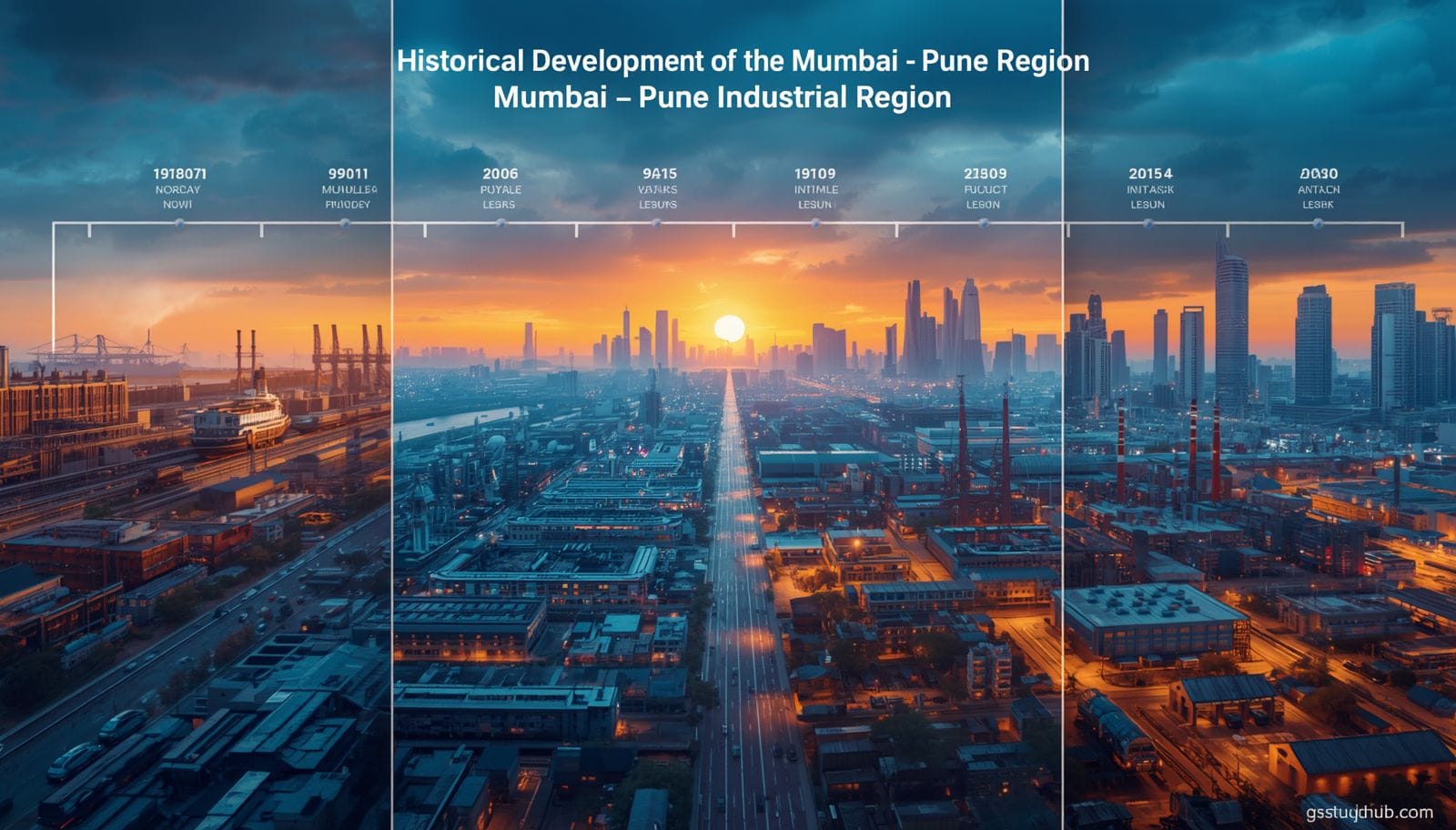
The Mumbai–Pune Industrial Region has a rich industrial history that dates back to the British colonial period. Over the past century and a half, the Mumbai–Pune Industrial Region has evolved from a textile manufacturing center into India's largest hub for automobiles, engineering, Information Technology (IT), pharmaceuticals, petrochemicals, financial services, and advanced manufacturing. Today, it is recognized as the country's most dynamic industrial corridor and a key contributor to India's economic growth.
The industrial foundation of the Mumbai–Pune Industrial Region was laid during the mid-19th century when Mumbai (then Bombay) emerged as a major trading port under British rule. In 1854, India's first modern cotton textile mill was established in Mumbai, marking the beginning of organized industrialization in western India. The city's natural harbour, expanding railway network, and easy access to international markets encouraged rapid industrial growth, particularly in textiles, shipping, and commercial trade.
Following India's independence in 1947, the government adopted a planned industrial development strategy. Major public and private investments were directed toward engineering, chemicals, heavy machinery, electrical equipment, fertilizers, and petrochemical industries. During this period, industrial townships such as Pimpri-Chinchwad, Thane, Navi Mumbai, Chakan, and Talegaon were developed, significantly expanding the industrial base of the Mumbai–Pune Industrial Region.
A major turning point came with the 1991 Economic Liberalization, which opened India's economy to foreign investment and global competition. As a result, several multinational corporations established manufacturing plants and research centers across Pune, Chakan, Ranjangaon, and Navi Mumbai. The Mumbai–Pune Industrial Region rapidly became a leading destination for automobile manufacturing, Information Technology (IT), biotechnology, pharmaceuticals, electronics, and precision engineering industries.
In the 21st century, world-class infrastructure projects such as the Mumbai–Pune Expressway, Jawaharlal Nehru Port (JNPT), Delhi–Mumbai Industrial Corridor (DMIC), Special Economic Zones (SEZs), industrial parks, and logistics hubs have further accelerated industrial expansion. Today, the Mumbai–Pune Industrial Region is at the forefront of emerging sectors including Electric Vehicles (EVs), Artificial Intelligence (AI), green manufacturing, robotics, aerospace, semiconductor production, and smart industrial technologies, making it one of Asia's fastest-growing industrial regions.
Historical Timeline
| Period | Major Development |
|---|---|
| 1854 | India's first modern cotton textile mill established in Mumbai. |
| British Era | Expansion of textile industries, ports, railways, and commercial trade. |
| Post-1947 | Development of engineering, chemicals, heavy industries, and industrial townships. |
| 1991 | Economic Liberalization attracted multinational companies and Foreign Direct Investment (FDI). |
| 21st Century | Rapid growth in IT, EV manufacturing, AI, biotechnology, logistics, JNPT, and DMIC. |
Key Highlights
- Origin: British Colonial Period
- 1854: India's first modern cotton textile mill established in Mumbai.
- 1947: Rapid industrial expansion after Independence.
- 1991: Economic Liberalization accelerated industrial growth and FDI.
- Leading Industries: Automobiles, Engineering, Pharmaceuticals, Information Technology (IT), and Petrochemicals.
- Future Growth: Electric Vehicles (EVs), Artificial Intelligence (AI), Semiconductor Manufacturing, Robotics, and Smart Manufacturing.
Mumbai–Pune Industrial Region: Factors Responsible for Development
The Mumbai–Pune Industrial Region has emerged as India's most advanced industrial corridor due to its strategic geographical location, world-class infrastructure, skilled workforce, strong financial ecosystem, and supportive government policies. The Mumbai–Pune Industrial Region provides an ideal environment for manufacturing, international trade, logistics, research, and technological innovation, making it one of Asia's fastest-growing industrial regions.
1. Strategic Coastal Location and Natural Harbour
One of the greatest advantages of the Mumbai–Pune Industrial Region is Mumbai's natural deep-water harbour on the Arabian Sea. This strategic location enables efficient import of raw materials and export of finished products worldwide. The presence of Jawaharlal Nehru Port (JNPT), India's largest container port, has significantly strengthened logistics and international trade.
2. Excellent Transportation Network
The Mumbai–Pune Industrial Region enjoys world-class transportation infrastructure including the Mumbai–Pune Expressway, National Highway-48 (NH-48), railway corridors, international airports, metro networks, and logistics parks. This integrated transport system reduces logistics costs and enhances industrial productivity.
3. Availability of Capital and Financial Services
Mumbai, India's financial capital, provides industries with easy access to banks, financial institutions, insurance companies, venture capital firms, stock exchanges, and corporate headquarters. This strong financial ecosystem supports industrial investment, entrepreneurship, and business expansion across the Mumbai–Pune Industrial Region.
4. Skilled Workforce and Educational Institutions
The region is home to premier universities, engineering colleges, management institutes, and research organizations that produce highly skilled engineers, scientists, IT professionals, and business leaders. This talented workforce has contributed significantly to the success of automobile, pharmaceutical, engineering, and Information Technology (IT) industries.
5. Modern Industrial Infrastructure
The Mumbai–Pune Industrial Region contains modern industrial parks, Special Economic Zones (SEZs), manufacturing clusters, logistics hubs, warehouses, and smart industrial townships. These facilities improve efficiency, reduce production costs, and attract domestic as well as foreign investment.
6. Large Domestic and International Market
The region benefits from a vast domestic consumer market while its port connectivity provides direct access to international markets across Asia, Europe, Africa, and the Middle East. This has made the Mumbai–Pune Industrial Region one of India's leading export-oriented manufacturing hubs.
7. Government Support and Industrial Policies
Government initiatives such as Make in India, Digital India, the Production Linked Incentive (PLI) Scheme, and the Delhi–Mumbai Industrial Corridor (DMIC) have created an investor-friendly business environment and accelerated industrial expansion.
8. Technology, Innovation, and Research
Pune has emerged as one of India's leading centers for research and development (R&D), biotechnology, Artificial Intelligence (AI), software development, Electric Vehicles (EVs), robotics, and advanced manufacturing. Continuous innovation has strengthened the global competitiveness of the Mumbai–Pune Industrial Region.
Key Development Factors
- Natural Harbour: Deep-water port with global trade access.
- Transportation: Excellent road, rail, air, and sea connectivity.
- Financial Strength: Mumbai's banking and investment ecosystem.
- Human Resources: Highly skilled workforce and top educational institutions.
- Industrial Infrastructure: SEZs, industrial parks, logistics hubs, and manufacturing clusters.
- Export Network: Efficient logistics supporting international trade.
- Technology: AI, R&D, biotechnology, and advanced manufacturing.
- Government Policies: Make in India, Digital India, PLI Scheme, and DMIC.
Competitive Exam Highlights
- Natural harbour is the primary factor behind industrial development.
- Mumbai serves as India's Financial Capital.
- Pune is India's Automobile and Information Technology (IT) hub.
- Jawaharlal Nehru Port (JNPT) is India's largest container port.
- DMIC and the Mumbai–Pune Expressway have accelerated industrial growth.
- The region is a major destination for Foreign Direct Investment (FDI).
Mumbai–Pune Industrial Region: Major Industries
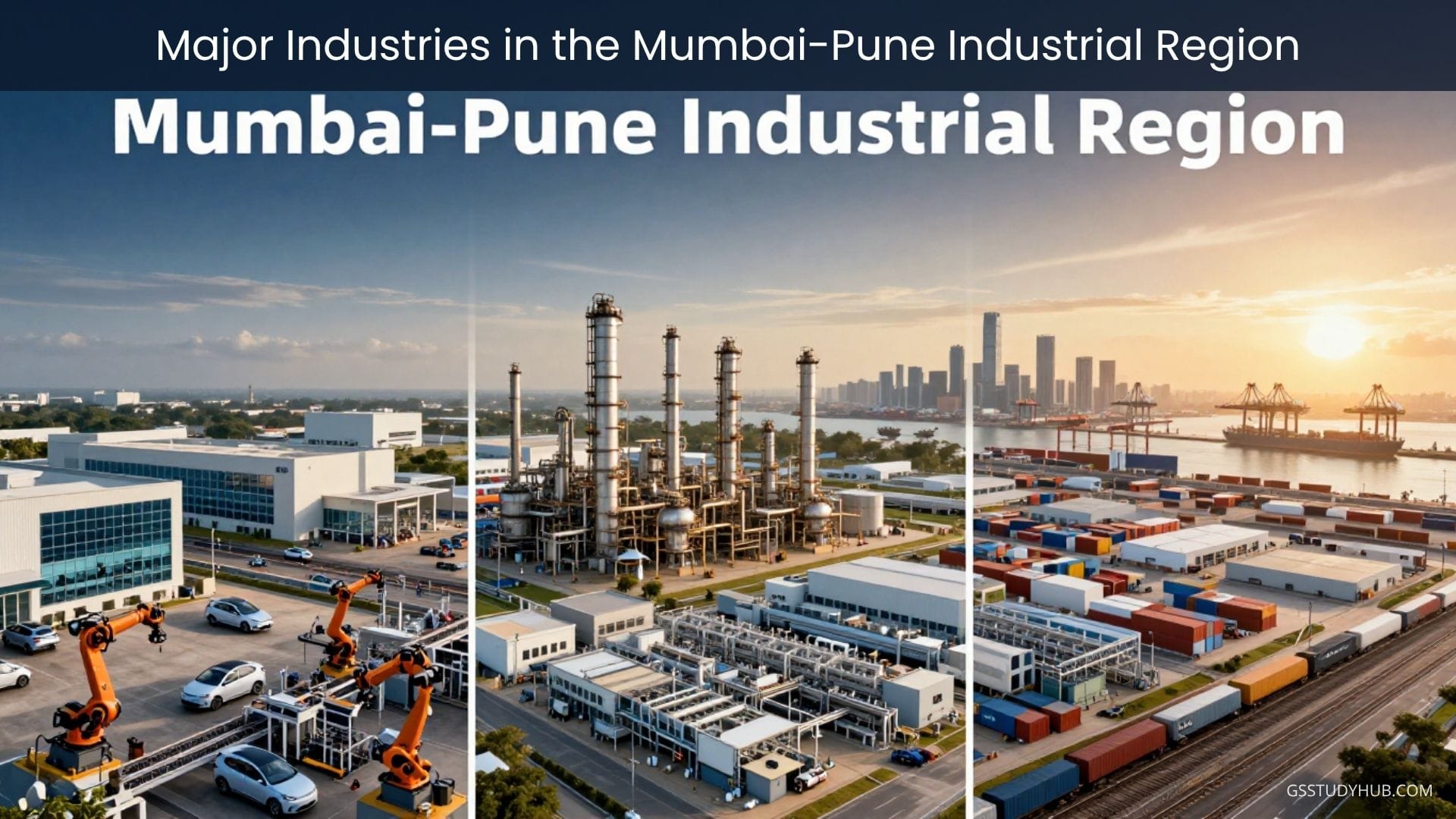
The Mumbai–Pune Industrial Region is India's most diversified manufacturing and industrial corridor. The Mumbai–Pune Industrial Region hosts a wide range of traditional and high-technology industries, making it one of India's largest contributors to industrial production, exports, employment generation, and economic growth. Excellent infrastructure, skilled manpower, modern industrial parks, research institutions, and global connectivity have enabled the region to attract both domestic and international investment.
Today, the Mumbai–Pune Industrial Region is recognized as India's leading hub for automobile manufacturing, Information Technology (IT), engineering, pharmaceuticals, petrochemicals, biotechnology, electronics, logistics, and financial services. These industries have transformed the region into one of Asia's fastest-growing industrial ecosystems.
1. Automobile Industry
The automobile industry is the backbone of the Mumbai–Pune Industrial Region. Cities such as Pune, Pimpri-Chinchwad, Chakan, Talegaon, and Ranjangaon have developed into world-class automobile manufacturing clusters. Passenger cars, commercial vehicles, electric vehicles (EVs), two-wheelers, tractors, engines, and automobile components are produced on a large scale, making Pune the Automobile Capital of India.
2. Information Technology (IT) Industry
Pune has emerged as one of India's leading Information Technology destinations. The IT sector within the Mumbai–Pune Industrial Region specializes in software development, Artificial Intelligence (AI), cloud computing, Cybersecurity, FinTech, data analytics, and digital transformation services.
3. Engineering Industry
Engineering is one of the oldest and most important industries in the Mumbai–Pune Industrial Region. Major products include industrial machinery, heavy equipment, electrical machinery, precision tools, machine components, automation systems, and capital goods.
4. Petrochemical & Chemical Industry
Mumbai, Thane, Navi Mumbai, and Raigad are major centers for petroleum refining, petrochemicals, fertilizers, specialty chemicals, plastics, synthetic fibers, paints, coatings, and industrial chemicals. This sector supports manufacturing, agriculture, infrastructure, and exports.
5. Pharmaceutical & Biotechnology Industry
The Mumbai–Pune Industrial Region is one of India's leading pharmaceutical and biotechnology hubs. The region manufactures generic medicines, vaccines, biotechnology products, APIs, diagnostic equipment, and healthcare technologies for domestic use and international markets.
6. Electronics & Electrical Industry
Electronics manufacturing has expanded rapidly across Pune and Navi Mumbai. Major products include communication equipment, industrial electronics, automation systems, medical devices, consumer electronics, and electrical machinery.
7. Textile & Garment Industry
The industrial history of Mumbai began with textile manufacturing. Today, the Mumbai–Pune Industrial Region continues to produce garments, technical textiles, fashion apparel, textile processing products, and export-quality fabrics.
8. Food Processing Industry
Food processing industries manufacture dairy products, beverages, packaged foods, seafood, bakery products, processed fruits, vegetables, and agricultural goods. Modern cold-chain logistics have accelerated the growth of this sector within the Mumbai–Pune Industrial Region.
Major Industries and Their Key Industrial Centers
| Industry | Major Industrial Centers |
|---|---|
| Automobile Manufacturing | Pune, Chakan, Pimpri-Chinchwad, Talegaon, Ranjangaon |
| Information Technology (IT) | Pune, Hinjawadi, Kharadi |
| Engineering | Pune, Navi Mumbai, Thane |
| Petrochemical & Chemical | Mumbai, Thane, Navi Mumbai, Raigad |
| Pharmaceutical & Biotechnology | Mumbai, Pune |
| Electronics | Pune, Navi Mumbai |
| Textile & Garments | Mumbai |
| Food Processing | Mumbai, Pune, Raigad |
Industry Highlights
- Pune is widely known as the Automobile Capital of India.
- The region is one of India's fastest-growing Information Technology (IT) and software development hubs.
- Mumbai leads in petrochemicals, pharmaceuticals, and financial services.
- Chakan is one of India's largest automobile manufacturing clusters.
- Strong port connectivity supports export-oriented manufacturing.
- The region attracts significant Domestic Investment and Foreign Direct Investment (FDI).
Mumbai–Pune Industrial Region: Economic Significance
The Mumbai–Pune Industrial Region is widely recognized as India's most influential industrial and economic corridor. The Mumbai–Pune Industrial Region plays a pivotal role in strengthening India's manufacturing sector, financial services, exports, technological innovation, and employment generation. With world-class infrastructure, advanced industrial clusters, international port connectivity, and a highly skilled workforce, the region has become one of the strongest contributors to India's Gross Domestic Product (GDP) and overall economic development.
The strategic location of the Mumbai–Pune Industrial Region, combined with excellent road, rail, air, and sea connectivity, enables industries to efficiently serve both domestic and international markets. The region's diversified industrial base—ranging from automobiles and engineering to pharmaceuticals, Information Technology (IT), biotechnology, petrochemicals, electronics, and logistics—has significantly enhanced India's global industrial competitiveness.
1. Major Contributor to Industrial Production
The Mumbai–Pune Industrial Region is one of India's largest manufacturing centers. It produces automobiles, engineering products, electrical equipment, pharmaceuticals, petrochemicals, electronics, consumer goods, and industrial machinery on a large scale, making it one of the country's leading contributors to industrial production.
2. Export and international trade Hub
The presence of Mumbai Port and Jawaharlal Nehru Port (JNPT), India's largest container port, has transformed the Mumbai–Pune Industrial Region into one of India's major export gateways. Automobiles, engineering goods, pharmaceuticals, chemicals, textiles, software services, and electronic products are exported to Asia, Europe, Africa, the Middle East, and North America.
3. Financial Capital of India
Mumbai serves as India's financial capital and is home to the Reserve Bank of India (RBI), major commercial banks, insurance companies, financial institutions, venture capital firms, and stock exchanges. This strong financial ecosystem provides industries within the Mumbai–Pune Industrial Region with easy access to investment, capital, corporate finance, and business services.
4. Employment Generation
The Mumbai–Pune Industrial Region generates millions of direct and indirect employment opportunities across manufacturing, Information Technology (IT), banking, logistics, transportation, education, healthcare, tourism, and research sectors. Its expanding industrial ecosystem continues to attract skilled professionals from across India.
5. Innovation and Technology Leadership
Pune has developed into one of India's leading centers for research and development (R&D), Artificial Intelligence (AI), biotechnology, software engineering, Electric Vehicles (EVs), and advanced manufacturing. Continuous innovation has strengthened the competitiveness of the Mumbai–Pune Industrial Region in both domestic and international markets.
6. Investment and Business Growth
The Mumbai–Pune Industrial Region attracts substantial domestic investment and Foreign Direct Investment (FDI) due to its investor-friendly policies, Special Economic Zones (SEZs), industrial parks, logistics infrastructure, and highly developed business environment. Government initiatives such as Make in India, the Production Linked Incentive (PLI) Scheme, and the Delhi–Mumbai Industrial Corridor (DMIC) continue to boost industrial expansion and economic growth.
Economic Contributions of the Mumbai–Pune Industrial Region
| Economic Sector | Major Contribution |
|---|---|
| Manufacturing | Automobiles, Engineering, Pharmaceuticals, Electronics, Petrochemicals |
| Exports | Engineering Goods, Automobiles, IT Services, Chemicals, Pharmaceuticals |
| Financial Services | Banking, Insurance, Investment, Capital Markets |
| Employment | Millions of Direct and Indirect Jobs |
| Innovation | Artificial Intelligence (AI), Electric Vehicles (EVs), Biotechnology, R&D, Digital Technologies |
| Investment | High Domestic Investment and Foreign Direct Investment (FDI) |
Economic Highlights
- India's largest and most diversified industrial corridor.
- Home to India's Financial Capital, Mumbai.
- Major export gateway through Mumbai Port and Jawaharlal Nehru Port (JNPT).
- Global manufacturing hub for automobiles, engineering, and advanced industries.
- Leading center for Information Technology (IT), Artificial Intelligence (AI), biotechnology, and innovation.
- Significant contributor to GDP, employment, exports, and Foreign Direct Investment (FDI).
Mumbai–Pune Industrial Region: Future Prospects
The Mumbai–Pune Industrial Region is expected to remain the driving force behind India's industrial transformation and economic growth over the coming decades. Supported by advanced infrastructure, technological innovation, global investment, skilled human resources, and progressive government policies, the Mumbai–Pune Industrial Region is well-positioned to become one of Asia's most competitive manufacturing and technology corridors. As India moves toward becoming a global manufacturing powerhouse, this region will continue to play a central role in industrial modernization, export expansion, and sustainable economic development.
1. Growth of Electric Vehicles (EVs) and Advanced Manufacturing
The Mumbai–Pune Industrial Region is rapidly emerging as India's leading hub for Electric Vehicle (EV) manufacturing, battery production, automotive research, and smart mobility solutions. Industrial clusters such as Pune, Chakan, Pimpri-Chinchwad, and Talegaon are expected to attract significant investment in next-generation automotive technologies and advanced manufacturing.
2. Expansion of Artificial Intelligence (AI) and Digital Technologies
Pune has established itself as one of India's fastest-growing technology centers. The Mumbai–Pune Industrial Region is expected to witness rapid growth in Artificial Intelligence (AI), machine learning, cloud computing, Cybersecurity, FinTech, robotics, automation, and data analytics.
3. Green Manufacturing and Sustainable Industrial Development
Environmental sustainability will become a key priority for the Mumbai–Pune Industrial Region. Future industrial development will focus on renewable energy, energy-efficient manufacturing, carbon emission reduction, circular economy, green logistics, and environmentally responsible production systems.
4. Infrastructure and Logistics Modernization
Continuous investment in expressways, multimodal logistics parks, metro rail networks, freight corridors, industrial parks, smart cities, and port infrastructure will further improve the connectivity and operational efficiency of the Mumbai–Pune Industrial Region. These developments are expected to reduce logistics costs and strengthen India's export competitiveness.
5. Rising Foreign Direct Investment (FDI) and Global Trade
Government initiatives such as Make in India, the Production Linked Incentive (PLI) Scheme, and the Delhi–Mumbai Industrial Corridor (DMIC) are expected to attract higher levels of Foreign Direct Investment (FDI). The Mumbai–Pune Industrial Region will continue to expand its role as a major global manufacturing, export, and business destination.
6. Innovation, Research, and High-Tech Industries
Collaboration between universities, research institutions, startups, and multinational corporations will accelerate innovation across biotechnology, semiconductor manufacturing, aerospace, defence production, robotics, precision engineering, and Industry 4.0 technologies. These sectors will further strengthen the knowledge-based economy of the Mumbai–Pune Industrial Region.
Future Growth Opportunities
| Sector | Future Potential |
|---|---|
| Electric Vehicles (EVs) | Global manufacturing hub for EVs and battery technologies. |
| Artificial Intelligence (AI) | Expansion of automation, smart industries, and digital innovation. |
| Green Manufacturing | Sustainable production and renewable energy integration. |
| Logistics & Infrastructure | World-class multimodal transport and export connectivity. |
| Research & Innovation | Growth in semiconductors, biotechnology, aerospace, and Industry 4.0. |
| Foreign Direct Investment (FDI) | Higher international investment and global business expansion. |
Future Outlook
- India's leading destination for Electric Vehicle (EV) manufacturing.
- Rapid growth in Artificial Intelligence (AI), robotics, and Industry 4.0 technologies.
- Strong emphasis on green manufacturing and sustainable industrial development.
- Expansion of exports through world-class logistics and port infrastructure.
- Higher Foreign Direct Investment (FDI) supported by industrial reforms.
- Global leadership in innovation, research, biotechnology, and advanced manufacturing.
Mumbai–Pune Industrial Region: Conclusion
The Mumbai–Pune Industrial Region stands as India's most advanced, diversified, and economically significant industrial corridor. Over the decades, the Mumbai–Pune Industrial Region has evolved from a traditional textile-based manufacturing center into a globally recognized hub for automobiles, Information Technology (IT), engineering, pharmaceuticals, petrochemicals, electronics, logistics, and financial services. Its strategic geographical location, world-class infrastructure, highly skilled workforce, and strong financial ecosystem have made it the backbone of India's industrial and economic development.
The continued success of the Mumbai–Pune Industrial Region is supported by excellent transport connectivity, international seaports, modern industrial parks, research institutions, Special Economic Zones (SEZs), and business-friendly government initiatives such as Make in India, the Production Linked Incentive (PLI) Scheme, and the Delhi–Mumbai Industrial Corridor (DMIC). These initiatives have strengthened the region's position as a preferred destination for domestic investment, Foreign Direct Investment (FDI), and export-oriented manufacturing.
Although the Mumbai–Pune Industrial Region faces challenges such as environmental pollution, traffic congestion, rising land prices, climate change, infrastructure pressure, and increasing competition from global manufacturing hubs, these challenges also create opportunities for innovation and sustainable growth. The adoption of green manufacturing technologies, renewable energy, smart infrastructure, digital transformation, and Industry 4.0 practices will play a crucial role in overcoming these issues.
Looking ahead, the Mumbai–Pune Industrial Region is expected to remain the primary engine of India's industrial transformation. Emerging sectors such as Electric Vehicles (EVs), Artificial Intelligence (AI), biotechnology, semiconductor manufacturing, aerospace, robotics, and advanced manufacturing will further enhance its global competitiveness. With continuous investment in infrastructure, innovation, sustainability, and human capital, the Mumbai–Pune Industrial Region is well-positioned to support India's vision of becoming a global manufacturing powerhouse and a developed economy by 2047.
Key Takeaways
- India's largest and most diversified industrial corridor.
- Global hub for automobiles, engineering, Information Technology (IT), pharmaceuticals, and petrochemicals.
- Major contributor to exports, Foreign Direct Investment (FDI), and international trade.
- Generates millions of direct and indirect employment opportunities.
- Future growth will be driven by Electric Vehicles (EVs), Artificial Intelligence (AI), Industry 4.0, green manufacturing, and renewable energy.
- A key pillar supporting India's long-term economic growth and global industrial competitiveness.
Quick Revision for UPSC & Competitive Exams
- India's most important industrial and financial region.
- Mumbai is India's Financial Capital, while Pune is the Automobile and Information Technology (IT) Hub.
- Major industries include automobiles, engineering, pharmaceuticals, petrochemicals, electronics, logistics, and Information Technology (IT).
- Key challenges include pollution, urbanization, climate change, infrastructure pressure, and rising land costs.
- Future opportunities lie in Electric Vehicles (EVs), Artificial Intelligence (AI), Green Manufacturing, Industry 4.0, semiconductor production, and sustainable industrial development.
Mumbai–Pune Industrial Region: Frequently Asked Questions (FAQs)
1. What is the Mumbai–Pune Industrial Region?
The Mumbai–Pune Industrial Region is India's largest and most developed industrial corridor located in Maharashtra. It is well known for automobile manufacturing, engineering, Information Technology (IT), pharmaceuticals, petrochemicals, advanced manufacturing, logistics, and financial services.
2. Why is the Mumbai–Pune Industrial Region important?
The Mumbai–Pune Industrial Region plays a vital role in India's economy by contributing significantly to manufacturing, exports, employment generation, technological innovation, and Foreign Direct Investment (FDI). It is also home to India's financial capital, Mumbai.
3. Which are the major industries in the Mumbai–Pune Industrial Region?
Major industries include automobile manufacturing, Information Technology (IT), engineering, pharmaceuticals, biotechnology, petrochemicals, electronics, logistics, food processing, textile manufacturing, and advanced manufacturing.
4. What factors have contributed to the development of the Mumbai–Pune Industrial Region?
The development of the Mumbai–Pune Industrial Region is supported by its strategic coastal location, natural harbour, excellent transportation network, skilled workforce, strong financial institutions, industrial parks, Special Economic Zones (SEZs), and government initiatives such as Make in India and the Production Linked Incentive (PLI) Scheme.
5. What are the major challenges faced by the Mumbai–Pune Industrial Region?
Major challenges include environmental pollution, traffic congestion, rapid urbanization, climate change, rising land prices, water scarcity, increasing energy demand, and growing global industrial competition.
6. Why is Pune called the Automobile Hub in the Mumbai–Pune Industrial Region?
Pune is known as the Automobile Hub because it hosts major automobile manufacturers, auto-component industries, research centers, and modern manufacturing facilities. It is also a leading center for Electric Vehicle (EV) production, automotive innovation, and smart manufacturing within the Mumbai–Pune Industrial Region.
7. What is the future of the Mumbai–Pune Industrial Region?
The future of the Mumbai–Pune Industrial Region is highly promising. Growth is expected in Electric Vehicles (EVs), Artificial Intelligence (AI), biotechnology, semiconductor manufacturing, renewable energy, smart manufacturing, advanced logistics, and Industry 4.0 technologies, making it one of Asia's leading industrial and innovation corridors.