
Geography of West Bengal
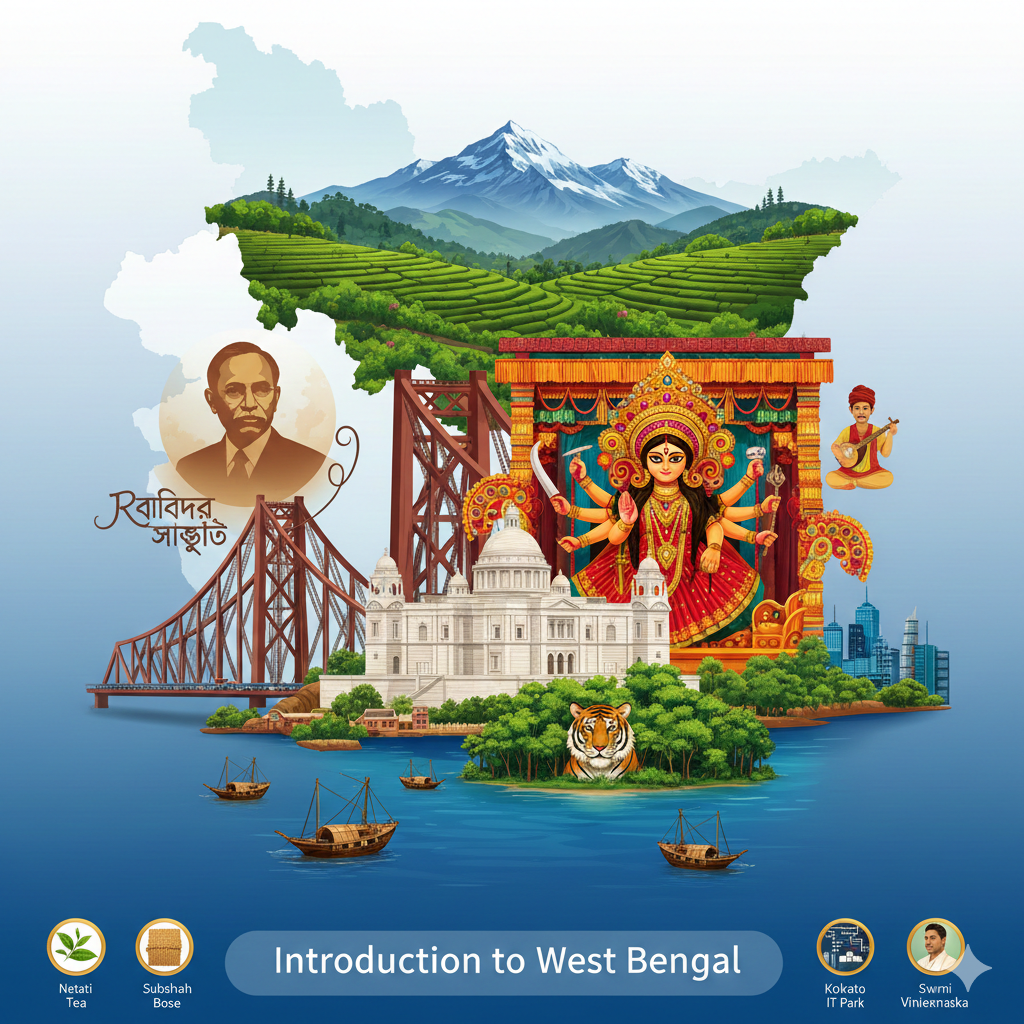
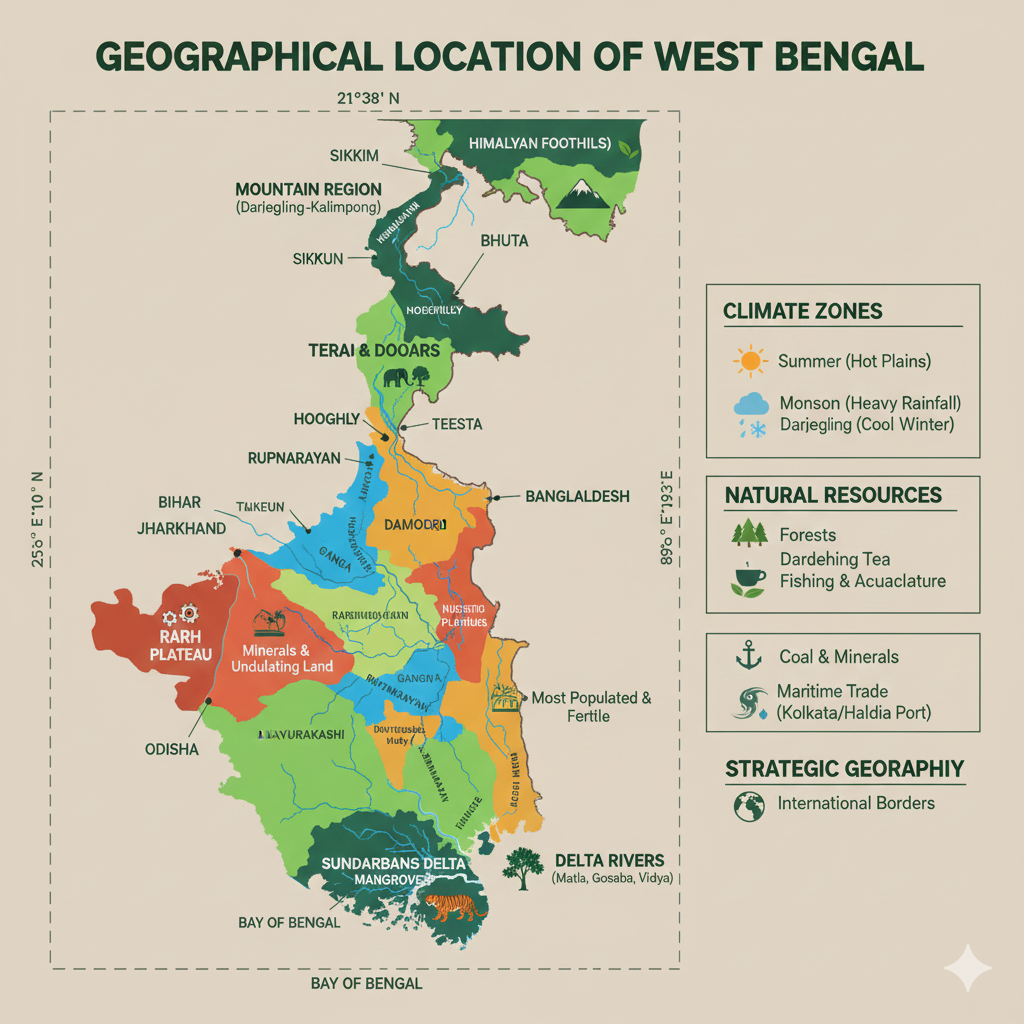
West Bengal is one of India’s most geographically diverse states, stretching from the Himalayan mountains in the north to the Sundarbans mangrove delta in the south. The state includes mountains, plains, plateaus, forests, rivers, and coastal regions that strongly influence its climate, economy, agriculture, biodiversity, and tourism.
Table of Contents
- Geographical Extent
- Major Physical Regions
- Climate of West Bengal
- Major Rivers of West Bengal
- Natural Resources and Biodiversity
- Economic Importance of Geography
- Strategic Importance
- FAQs About Geography of West Bengal
- Conclusion
Geographical Extent
West Bengal is located in eastern India and shares international borders with Bangladesh, Bhutan, and Nepal (through Sikkim). It also shares boundaries with the Indian states of Bihar, Jharkhand, Odisha, and Sikkim.
- Latitude: 21°38′ N to 27°10′ N
- Longitude: 85°50′ E to 89°53′ E
- Total Area: Approximately 88,752 square kilometers
Despite its relatively moderate size, West Bengal possesses remarkable geographical diversity ranging from Himalayan hills to fertile river plains and coastal ecosystems.
Major Physical Regions
1. Himalayan Region
The northern districts of Darjeeling and Kalimpong form the Himalayan region of West Bengal. These areas are famous for tea plantations, forests, cool climate, and scenic mountain landscapes.
Mount Kanchenjunga, the third-highest mountain in the world, dominates the northern skyline and attracts tourists and mountaineers from across the world.
2. Terai and Dooars Region
The Terai and Dooars region lies at the foothills of the Himalayas. It is known for dense forests, wildlife sanctuaries, fertile land, and tea gardens.
Major rivers such as Teesta, Torsa, and Raidak flow through this region and support agriculture and biodiversity.
3. Gangetic Plains
The Gangetic alluvial plains cover central and southern West Bengal and are among the most fertile regions in India. Intensive agriculture is practiced here due to fertile soil and abundant river water.
Major rivers including the Ganga, Hooghly, Damodar, Ajay, and Rupnarayan flow through this region.
4. Rarh Plateau Region
The western districts of Purulia, Bankura, and parts of Birbhum form the Rarh plateau region, which is an extension of the Chota Nagpur Plateau.
This region is characterized by red soil, mineral deposits, rocky terrain, and mining activities.
5. Sundarbans Delta
The Sundarbans delta is located in southern West Bengal near the Bay of Bengal. It is the world’s largest mangrove forest and a UNESCO World Heritage Site.
The region is famous for the Royal Bengal Tiger, tidal rivers, fisheries, and rich biodiversity.
Climate of West Bengal
West Bengal experiences a tropical monsoon climate with considerable regional variations because of differences in altitude, terrain, and distance from the sea.
Summer Season
- Duration: March to June
- Temperature: 30°C to 40°C in plains
- Hill Temperature: 15°C to 25°C
The plains and coastal areas remain hot and humid during summer, while the hilly areas experience pleasant weather.
Monsoon Season
- Duration: June to September
- Average Rainfall: 1,500–2,000 mm annually
The southwest monsoon brings heavy rainfall to the state, especially in North Bengal and coastal regions. Floods occasionally affect rivers such as the Ganga and Damodar.
Winter Season
- Duration: November to February
- Plains Temperature: 10°C to 20°C
- Hill Temperature: 2°C to 10°C
Winter is generally cool and pleasant across the state, especially in northern hill districts.
Regional Climatic Differences
- North Bengal: Cooler climate and heavy rainfall
- Sundarbans: Humid climate and cyclone-prone region
- Rarh Plateau: Hotter and comparatively drier climate
Major Rivers of West Bengal
Rivers play an important role in the agriculture, economy, transportation, fisheries, and culture of West Bengal.
Ganga River
The Ganga is the most important river in West Bengal. The Hooghly River is its major distributary flowing through Kolkata and eventually joining the Bay of Bengal.
Hooghly River
The Hooghly River supports trade, navigation, fisheries, irrigation, and port activities. Important landmarks such as Howrah Bridge and Vidyasagar Setu are built over it.
Teesta River
The Teesta River originates in Sikkim and is important for irrigation and hydropower projects in North Bengal.
Damodar River
The Damodar River was historically known as the “Sorrow of Bengal” because of devastating floods. The Damodar Valley Project later helped control floods and generate hydroelectric power.
Sundarbans Waterways
The Sundarbans region contains numerous tidal rivers and channels including Matla, Gosaba, and Vidya rivers, which support fisheries and mangrove ecosystems.
⭐ Recommended Study Resource
Explore a highly rated educational resource selected to support learning, revision, and exam preparation with trusted content and positive reader feedback.
Natural Resources and Biodiversity
West Bengal possesses rich natural resources including forests, rivers, minerals, fertile agricultural land, fisheries, and biodiversity hotspots.
- Forest Cover: Himalayan forests and Sundarbans mangroves
- Minerals: Coal, iron ore, and other minerals in western districts
- Wildlife: Royal Bengal Tiger, elephants, crocodiles, turtles, and migratory birds
The Sundarbans and North Bengal forests are among the most important biodiversity regions in India.
Economic Importance of Geography
The geography of West Bengal strongly influences the state’s economy and development.
Agriculture
Fertile alluvial plains support large-scale cultivation of rice, jute, vegetables, tea, and fruits.
Industry
Mineral-rich plateau areas and river ports support industries in Kolkata, Durgapur, Asansol, and Haldia.
Tourism
Tourism flourishes in Darjeeling, Sundarbans, Kolkata, Kalimpong, and Shantiniketan because of geographical diversity and cultural attractions.
Strategic Importance
West Bengal has significant geopolitical importance because of its international borders and access to the Bay of Bengal.
- Important trade gateway to northeastern India
- Strong maritime and port activities
- Cross-border trade with Bangladesh, Bhutan, and Nepal
- Strategic importance for defense and regional connectivity
FAQs About Geography of West Bengal
Which is the most important river of West Bengal?
The Ganga-Hooghly river system is considered the most important river network in West Bengal.
Which climate is found in West Bengal?
West Bengal mainly experiences a tropical monsoon climate.
Why is the Sundarbans important?
The Sundarbans is important for biodiversity, fisheries, mangrove forests, and coastal protection.
Which region of West Bengal is famous for tea production?
Darjeeling and the Dooars region are famous for tea production.
Conclusion
The geography of West Bengal is highly diverse and economically important. From the Himalayan hills of Darjeeling to the mangrove forests of the Sundarbans, the state possesses rich natural resources, fertile plains, major rivers, and unique biodiversity. These geographical features strongly influence the state’s agriculture, tourism, trade, climate, and cultural
History of West Bengal
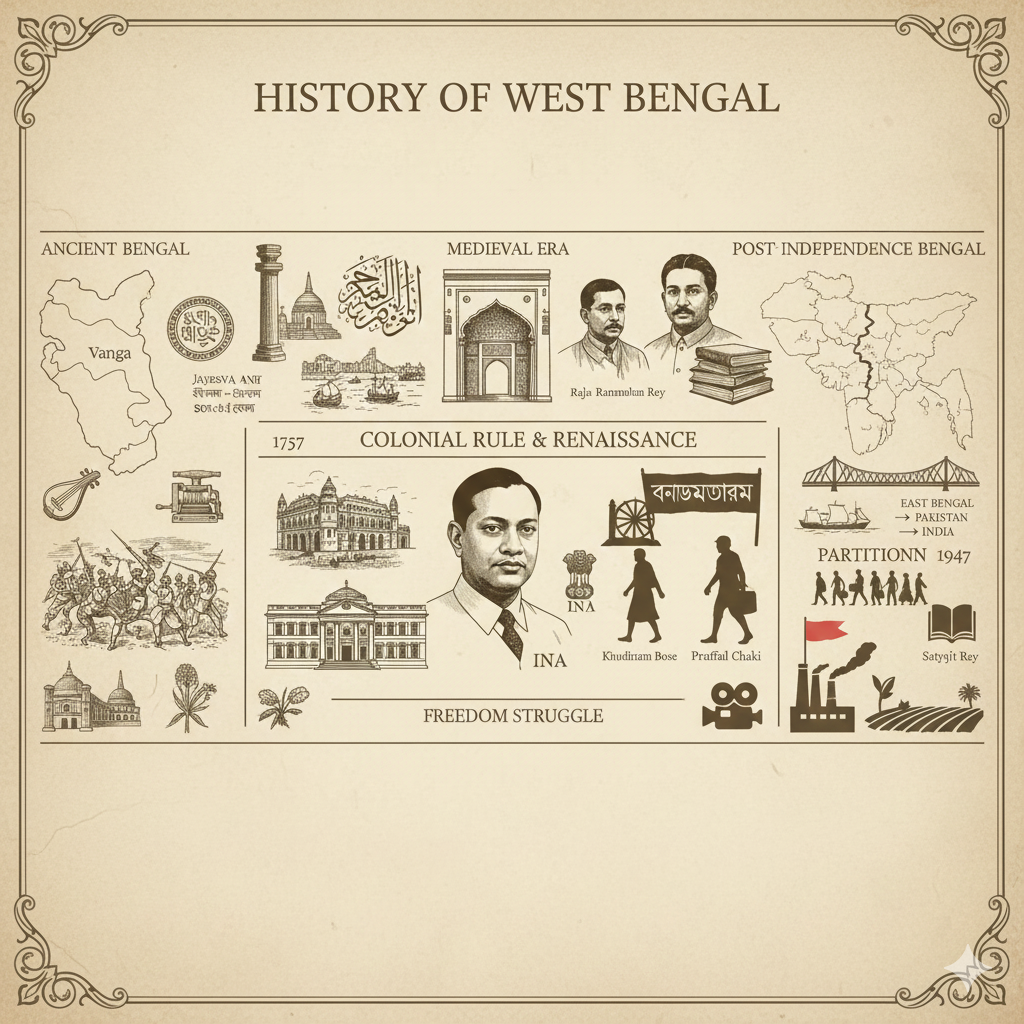
The history of West Bengal is rich, diverse, and deeply connected with India’s cultural, political, and intellectual development. From ancient kingdoms and Buddhist learning centers to the Bengal Renaissance and India’s freedom movement, Bengal has played an important role in shaping Indian civilization and modern national identity.
Table of Contents
- Ancient History of West Bengal
- Medieval History
- British Rule and Bengal Renaissance
- Freedom Movement in Bengal
- Partition of Bengal
- Post-Independence Developments
- Cultural and Religious Influences
- Economic Impact of Historical Events
- FAQs About History of West Bengal
- Conclusion
Ancient History of West Bengal
The ancient history of Bengal dates back to the Vedic age and early Indian civilizations. Ancient texts referred to the region as “Vanga,” which later evolved into Bengal.
Vedic and Epic Period
Bengal finds mention in ancient Indian texts such as the Mahabharata and Ramayana. The region was known for maritime trade, river-based commerce, and cultural exchanges with Southeast Asia.
Mauryan Empire
During the Mauryan period under Emperor Ashoka, Bengal became an important administrative and cultural region. Buddhism spread widely during this era.
Gupta Empire
The Gupta period is often considered a golden age of Indian culture, literature, science, and education. Bengal benefited greatly from economic prosperity and artistic growth during this period.
Pala Dynasty
The Pala dynasty ruled Bengal between the 8th and 12th centuries and strongly supported Buddhism. Major educational centers such as Nalanda and Vikramashila flourished during this time.
Sena Dynasty
The Sena rulers promoted Hindu culture, Sanskrit literature, and temple architecture. Poet Jayadeva and other scholars contributed significantly to Bengali literary traditions.
Medieval History
The medieval period witnessed major political, cultural, and religious developments across Bengal.
Delhi Sultanate Influence
From the 13th century onward, Bengal came under the influence of the Delhi Sultanate. Islamic architecture, Persian culture, and Sufi traditions expanded during this period.
Mughal Rule
Under the Mughal Empire, Bengal became one of the wealthiest provinces in India because of agriculture, textile production, and trade.
Cities such as Murshidabad and Hooghly emerged as important commercial and administrative centers.
Independent Nawabs
As Mughal authority weakened, Bengal’s Nawabs gained greater autonomy. Siraj-ud-Daulah became the last independent Nawab of Bengal before British dominance expanded after the Battle of Plassey in 1757.
British Rule and Bengal Renaissance
The Battle of Plassey marked the beginning of British political control in Bengal and later across India.
British Administration
Kolkata became the capital of British India in 1773 and developed into a major center of trade, education, administration, and industry.
British economic policies transformed Bengal’s textile industry and introduced exploitative land systems such as the Zamindari system.

⭐ Recommended Study Resource
Explore a highly rated educational resource selected to support learning, revision, and exam preparation with trusted content and positive reader feedback.
Bengal Renaissance
The 19th century Bengal Renaissance brought major social, educational, literary, and cultural reforms.
Reformers such as Raja Rammohan Roy and Ishwar Chandra Vidyasagar promoted women’s education, social reforms, and modern education.
Rabindranath Tagore later became one of the most influential literary figures in world history and won the Nobel Prize in Literature.
Freedom Movement in Bengal
West Bengal played a major role in India’s struggle for independence through political activism, revolutionary organizations, and mass movements.
Partition of Bengal (1905)
Lord Curzon divided Bengal in 1905, which triggered the Swadeshi Movement and widespread protests across India.
The movement promoted indigenous industries, boycott of British goods, and nationalist awareness.
Revolutionary Organizations
Organizations such as Anushilan Samiti and Yugantar carried out revolutionary activities against British rule.
Famous revolutionaries included Khudiram Bose, Prafulla Chaki, Binoy, Badal, and Dinesh.
Subhash Chandra Bose
Netaji Subhash Chandra Bose became one of India’s most influential freedom fighters. He later founded the Indian National Army (Azad Hind Fauj) to fight British rule.
Partition of Bengal
During the Partition of India in 1947, Bengal was divided into two parts based on religious demographics.
- East Bengal: Became part of Pakistan and later Bangladesh in 1971
- West Bengal: Remained a state of independent India
Partition caused large-scale migration, communal violence, refugee crises, and major social and economic changes across Bengal.
Post-Independence Developments
After independence, West Bengal experienced major political, social, and economic transformations.
Political Changes
The state witnessed long periods of left-wing political governance before the rise of the Trinamool Congress in recent decades.
The Naxalite movement during the 1960s and 1970s also influenced Bengal’s political history.
economic development
Land reforms, industrial development, education, literature, and cultural institutions continued shaping the state after independence.
Cultural Legacy
Writers, filmmakers, musicians, and intellectuals from Bengal continued contributing to Indian and global culture.
Cultural and Religious Influences
West Bengal has historically been a meeting point of multiple religions, languages, and cultural traditions.
- Influence of Hinduism, Buddhism, Islam, and Christianity
- Growth of Bengali literature and arts
- Development of temple, mosque, and colonial architecture
- Influence of Bengali theatre, cinema, and music
Economic Impact of Historical Events
Historical developments strongly influenced the economy of West Bengal.
- British policies damaged local textile industries
- Kolkata emerged as a major trade and port city
- Partition affected industries, migration, and trade networks
- Land reforms later reshaped agriculture and rural society
FAQs About History of West Bengal
Who was the last independent Nawab of Bengal?
Siraj-ud-Daulah was the last independent Nawab of Bengal before British dominance expanded after the Battle of Plassey.
Why is the Battle of Plassey important?
The Battle of Plassey in 1757 marked the beginning of British political control in India.
What was the Bengal Renaissance?
The Bengal Renaissance was a cultural and intellectual reform movement during the 19th century that promoted education, literature, and social reforms.
Who was Subhash Chandra Bose?
Subhash Chandra Bose was a major Indian freedom fighter and founder of the Indian National Army (Azad Hind Fauj).
Conclusion
The history of West Bengal reflects centuries of political transformation, cultural brilliance, intellectual movements, and social reform. From ancient kingdoms and Buddhist learning centers to the Bengal Renaissance and India’s independence movement, Bengal has played a major role in shaping Indian civilization and national identity. Its historical legacy continues to influence modern literature, politics, education, and cultural traditions.

Partition of Bengal, Population & Language of West Bengal
The Partition of Bengal in 1947 was one of the most important historical events in South Asian History. It changed the political, social, economic, and cultural structure of Bengal forever. Along with the impact of Partition, West Bengal also developed a unique demographic and linguistic identity shaped by migration, urbanization, and cultural diversity.
Table of Contents
- Reasons for the Partition of Bengal
- Partition of Bengal in 1947
- Effects of Partition
- Challenges After Partition
- Population of West Bengal
- Languages of West Bengal
- Migration and Urbanization
- Cultural and Ethnic Diversity
- Economic Impact of Population Growth
- FAQs
- Conclusion
Reasons for the Partition of Bengal
Religious Tensions
Religious tensions between Hindu and Muslim communities increased during the early 20th century. Bengal had a mixed population, making communal politics more intense in the region.
Partition of Bengal in 1905
Lord Curzon divided Bengal in 1905 on communal lines. Although the partition was canceled in 1911 because of public protests and the Swadeshi Movement, it created long-term political and religious divisions.
Political Developments
The demand for Pakistan by the Muslim League and political disagreements between the Muslim League and the Indian National Congress increased the possibility of Partition.
Partition of Bengal in 1947
During the Partition of India in 1947, Bengal was divided into two regions based mainly on religious demographics.
- West Bengal: Became part of India
- East Bengal: Became part of Pakistan and later Bangladesh in 1971
The division separated communities, industries, agricultural regions, transportation networks, and cultural institutions that had existed together for centuries.
Effects of Partition
Communal Violence
Partition caused widespread communal violence and riots in several regions including Kolkata and Noakhali. Thousands of people lost their lives during the violence.
Refugee Crisis
Millions of Hindu refugees migrated from East Bengal to West Bengal. Refugee rehabilitation became one of the biggest challenges for the newly independent Indian government.
Economic Impact
Partition disrupted trade and industry. Many jute-producing agricultural areas remained in East Bengal, while jute mills and industries were located in West Bengal.
Social and Cultural Changes
Partition changed the demographic structure of Bengal and created long-term social and political effects. Despite division, Bengali cultural traditions continued on both sides of the border.
Challenges After Partition
Urban Pressure
Kolkata and nearby urban areas experienced overcrowding, housing shortages, unemployment, and pressure on public services because of large-scale migration.
political instability
Refugee settlements, communal tensions, and economic stress created political instability in the early years after independence.
Refugee Rehabilitation
The government established refugee camps, housing projects, and employment programs to support displaced people.

⭐ Recommended Study Resource
Explore a highly rated educational resource selected to support learning, revision, and exam preparation with trusted content and positive reader feedback.
Population of West Bengal
West Bengal is one of the most densely populated states in India with a large rural and urban population.
Total Population
According to recent estimates, the population of West Bengal is around 10 crore people.
Population Density
The state has one of the highest population densities in India with approximately 1,000 people per square kilometer.
Urban and Rural Population
- Urban Population: Concentrated mainly in Kolkata and surrounding cities
- Rural Population: Majority of people still live in villages and depend on agriculture
Religious Composition
- Hindus: Majority population
- Muslims: Significant minority community
- Others: Christians, Buddhists, Sikhs, Jains, and tribal communities
Languages of West Bengal
Bengali Language
Bengali is the official and most widely spoken language of West Bengal. It is also one of the most important literary languages in India and Bangladesh.
Rabindranath Tagore, Kazi Nazrul Islam, and Sarat Chandra Chattopadhyay made Bengali literature globally respected.
Hindi
Hindi is widely spoken in urban and industrial regions because of migration from other Indian states.
Urdu
Urdu is commonly spoken in several Muslim-majority areas including parts of Kolkata, Murshidabad, and Malda.
Nepali
Nepali is spoken mainly in Darjeeling and Kalimpong districts by the Gorkha community.
Tribal Languages
Languages such as Santali, Mundari, and Kurukh are spoken in tribal regions including Purulia, Jhargram, and Birbhum.
English
English is widely used in higher education, administration, business, media, and information technology sectors.
Migration and Urbanization
Migration has played a major role in shaping the demographic structure of West Bengal.
Refugee Migration
Large-scale migration occurred after the 1947 Partition and the 1971 Bangladesh Liberation War.
Urbanization
Rapid urbanization has expanded cities such as Kolkata, Howrah, Durgapur, Siliguri, and Asansol.
Urban growth has increased economic opportunities but also created pressure on housing, transportation, healthcare, and infrastructure.
Cultural and Ethnic Diversity
West Bengal has a culturally diverse population including Bengalis, Marwaris, Biharis, Nepalis, tribal communities, and migrants from other states.
Tribal Communities
Major tribal groups include Santals, Oraons, Mundas, and Lodhas, mainly living in western districts.
Multicultural Society
The state celebrates different festivals, languages, cuisines, and cultural traditions, making West Bengal one of India’s most culturally vibrant regions.
Economic Impact of Population Growth
The large population of West Bengal contributes to labor supply, markets, agriculture, and industrial growth.
- Growth of consumer markets
- Expansion of agriculture and services
- Pressure on housing and urban infrastructure
- Need for employment generation and education
FAQs
Why was Bengal divided in 1947?
Bengal was divided mainly on religious lines during the Partition of India in 1947.
What was the impact of Partition on West Bengal?
Partition caused migration, refugee crises, communal violence, and economic disruption.
Which is the main language of West Bengal?
Bengali is the official and most widely spoken language in West Bengal.
Which districts have large Muslim populations?
Murshidabad, Malda, and North Dinajpur have significant Muslim populations.
Why is Kolkata important?
Kolkata is the cultural, educational, economic, and administrative center of West Bengal.
Conclusion
The Partition of Bengal deeply transformed the political, social, and economic landscape of eastern India. At the same time, West Bengal evolved into a culturally rich and linguistically diverse state shaped by migration, urbanization, and historical experiences. Its population diversity, literary traditions, and multicultural identity continue to make West Bengal one of India’s most significant and influential states.
Cultural Heritage of West Bengal
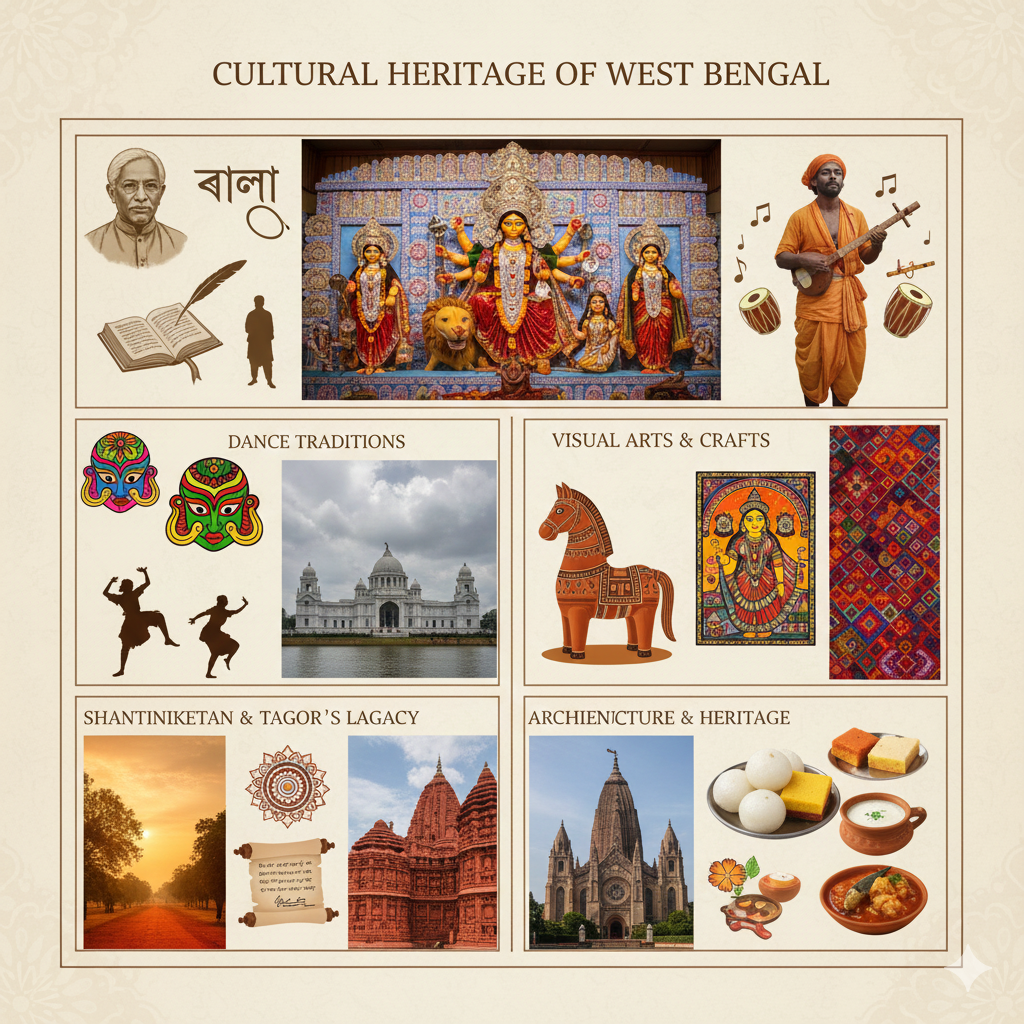
West Bengal is one of India’s most culturally vibrant and intellectually rich states. The state is famous for its literature, music, festivals, theatre, arts, cinema, cuisine, and deep philosophical traditions. From Rabindranath Tagore’s poetry to Durga Puja celebrations and Baul folk music, the cultural identity of Bengal has influenced India and the world for centuries.
Table of Contents
- Literature and Language
- Festivals and Traditions
- Arts and Crafts
- Music and Dance
- Architectural Heritage
- Folk Theatre and Village Traditions
- Food and Sweets
- Shantiniketan and Tagore’s Contribution
- Modern Literature and Performing Arts
- FAQs About West Bengal Culture
- Conclusion
Literature and Language
Bengali Literature
Bengali literature is one of the richest literary traditions in India. Great writers such as Rabindranath Tagore, Bankim Chandra Chattopadhyay, Sarat Chandra Chattopadhyay, and Kazi Nazrul Islam made Bengali literature internationally respected.
Rabindranath Tagore became the first Asian Nobel Prize winner in Literature for his famous work “Gitanjali.”
Bengali Language
The Bengali language is the heart of West Bengal’s cultural identity. It is widely spoken in West Bengal and Bangladesh and has a long tradition of poetry, songs, novels, and philosophical writings.
Modern Literary Contributions
Modern Bengali literature continued to grow through writers such as Mahasweta Devi, Sunil Gangopadhyay, Buddhadev Guha, and many contemporary poets and novelists.
Festivals and Traditions
Durga Puja
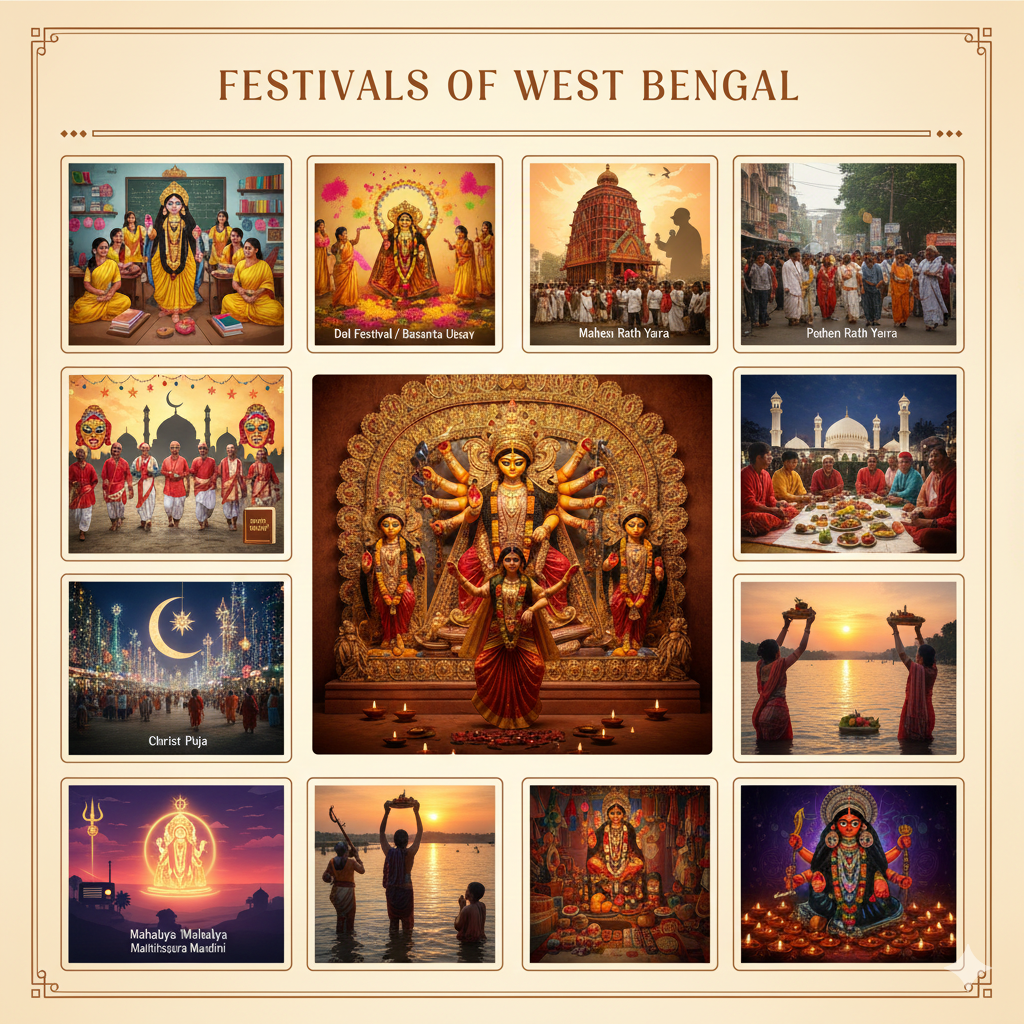
Durga Puja is the largest and most important festival in West Bengal. The festival includes artistic pandals, idol-making, music, dance, lighting, cultural performances, and community celebrations.
Durga Puja was recognized by UNESCO as an Intangible Cultural Heritage event because of its artistic and social importance.
Poila Boishakh
Poila Boishakh marks the Bengali New Year and is celebrated with cultural programs, traditional food, and social gatherings.
Poush Mela and Basanta Utsav
These festivals are celebrated in Shantiniketan and reflect the cultural philosophy of Rabindranath Tagore through music, dance, handicrafts, and open-air performances.
Religious Harmony
Festivals such as Eid, Christmas, Rath Yatra, Kali Puja, and Saraswati Puja are celebrated with equal enthusiasm, reflecting Bengal’s multicultural society.
Arts and Crafts
Kalighat Paintings
Kalighat paintings are traditional Bengal paintings known for their bold lines, bright colors, and depiction of mythological and social themes.
Terracotta Art
The terracotta temples of Bishnupur and Bankura are famous for their detailed carvings and unique architectural beauty.
Kantha Embroidery
Kantha embroidery is a traditional handicraft made mainly by rural women using decorative stitching techniques on sarees, quilts, and fabrics.
Clay Idol Making
Kumartuli in Kolkata is internationally famous for creating Durga idols and traditional clay sculptures.
Music and Dance
Rabindra Sangeet
Rabindra Sangeet refers to the songs written and composed by Rabindranath Tagore. These songs express spirituality, love, nature, and human emotions.
Baul Music
Baul music is a mystical folk tradition combining spiritual philosophy with simple melodies and emotional expression.
Folk Music
Other important folk music traditions include Bhatiali, Kirtan, Jatra music, and devotional songs.
Dance Forms
Chhau dance from Purulia is one of the most famous traditional dance forms of West Bengal. Classical dance, tribal dances, and folk performances are also widely practiced.

⭐ Recommended Study Resource
Explore a highly rated educational resource selected to support learning, revision, and exam preparation with trusted content and positive reader feedback.
Architectural Heritage
colonial architecture in Kolkata
Kolkata contains many famous colonial buildings including Victoria Memorial, Writers’ Building, St. Paul’s Cathedral, and the Indian Museum.
temple architecture
Dakshineswar Temple, Kalighat Temple, and the terracotta temples of Bishnupur represent Bengal’s religious and artistic heritage.
Murshidabad Heritage
Murshidabad preserves Nawabi palaces, mosques, and historical buildings reflecting Mughal and regional architecture.
Folk Theatre and Village Traditions
Jatra
Jatra is a popular folk theatre tradition in Bengal involving music, storytelling, historical narratives, and dramatic performances.
Village Fairs
Traditional fairs and rural festivals continue to preserve Bengal’s folk culture and social traditions.
Folk Performances
Many villages organize traditional performances during harvest festivals, religious events, and local celebrations.
Food and Sweets
Traditional Bengali Cuisine
- Macher Jhol (Fish Curry)
- Shukto
- Luchi and Aloo Dum
- Chingri Malai Curry
- Payesh
Famous Bengali Sweets
West Bengal is famous for sweets such as Rasgulla, Sandesh, Mishti Doi, Chamcham, and Rajbhog.
Shantiniketan and Tagore’s Contribution
Visva-Bharati University
Rabindranath Tagore established Visva-Bharati University in Shantiniketan to promote open-air learning, art, music, literature, and global cultural exchange.
Tagore’s Influence
Tagore’s philosophy, literature, songs, paintings, and educational ideas continue to influence Bengali and global culture.
Modern Literature and Performing Arts
West Bengal continues to contribute significantly to Indian cinema, theatre, music, and literature.
Bengali Cinema
Legendary filmmaker Satyajit Ray brought international recognition to Bengali cinema through films such as Pather Panchali.
Theatre and Performing Arts
Kolkata remains one of India’s most important theatre centers with modern plays, political theatre, experimental performances, and cultural festivals.
FAQs About West Bengal Culture
Why is West Bengal culturally important?
West Bengal is culturally important because of its literature, festivals, music, arts, cinema, and intellectual traditions.
What is the most famous festival of West Bengal?
Durga Puja is the most famous and widely celebrated festival of West Bengal.
Who was Rabindranath Tagore?
Rabindranath Tagore was a Nobel Prize-winning poet, philosopher, writer, and composer from Bengal.
What is Baul music?
Baul music is a mystical Bengali folk music tradition based on spirituality and humanism.
Why is Shantiniketan famous?
Shantiniketan is famous for Visva-Bharati University and the cultural philosophy of Rabindranath Tagore.
Conclusion
The cultural heritage of West Bengal is a remarkable blend of literature, music, festivals, theatre, art, spirituality, and intellectual traditions. From Rabindranath Tagore’s poetry and Durga Puja celebrations to Baul music and Bengali cuisine, Bengal’s cultural identity remains one of the richest and most influential in India. Its traditions continue to inspire generations across the world.
Economy of West Bengal
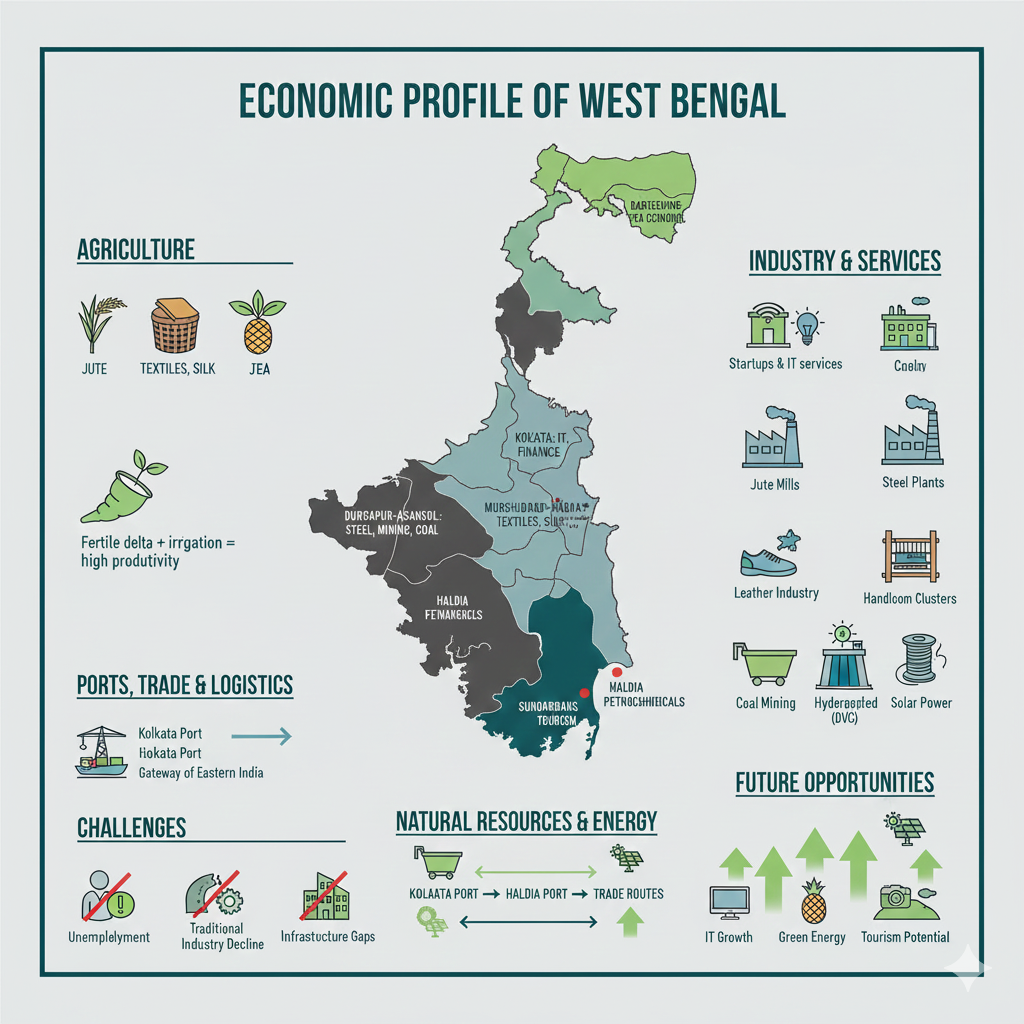
West Bengal has one of the most diversified economies in eastern India. Agriculture, industry, trade, tourism, services, and information technology together contribute significantly to the state’s economic development. The strategic geographical location of West Bengal, along with rich natural resources, fertile agricultural land, ports, and cultural tourism, makes it an important economic center of India.
Table of Contents
- Agriculture in West Bengal
- Industrial Development
- Tea and Jute Industry
- Service and IT Sector
- Ports and Trade
- Tourism Economy
- Natural Resources and Energy
- Government Policies and Economic Reforms
- Challenges Facing the Economy
- Future Growth Opportunities
- FAQs About West Bengal Economy
- Conclusion
Agriculture in West Bengal
Agriculture is one of the most important sectors of West Bengal’s economy and supports a large rural population.
Major Crops
- Rice
- Jute
- Tea
- Potato
- Wheat
- Pulses
- Vegetables and Fruits
The fertile Gangetic plains and favorable climate support high agricultural productivity across the state.
Rice Production
West Bengal is one of India’s leading rice-producing states and is often called the “Rice Bowl of Eastern India.”
Jute Cultivation
The state is historically famous for jute cultivation and jute-based industries located mainly around Kolkata and the Hooghly industrial belt.
Tea Production
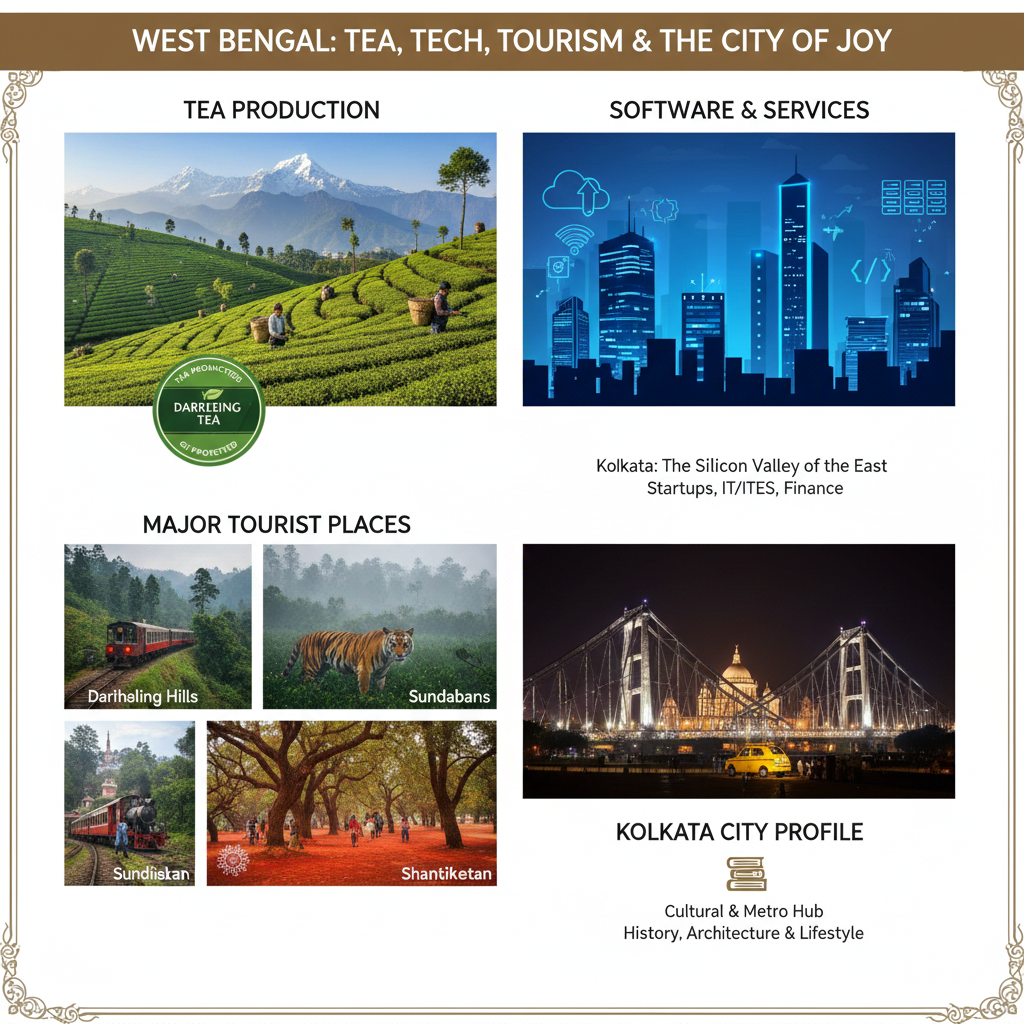
Darjeeling tea is internationally famous for its aroma and premium quality. Tea gardens in Darjeeling, Jalpaiguri, and Dooars generate employment and export revenue.
Irrigation and Agricultural Development
Major rivers, canals, and projects such as the Damodar Valley Project support irrigation and farming activities.
Industrial Development
West Bengal has an important industrial base ranging from traditional manufacturing industries to modern services and technology sectors.
Major Industrial Areas
- Kolkata
- Durgapur
- Asansol
- Haldia
- Howrah
Steel and Mining Industry
The Durgapur-Asansol region is known for steel plants, coal mining, thermal power generation, and engineering industries.
Petrochemical Industry
Haldia has developed into a major petrochemical and refinery center in eastern India.
Textile and Handloom Industry
Murshidabad silk, handloom weaving, cotton textiles, and traditional crafts contribute significantly to employment and exports.
Tea and Jute Industry
Darjeeling Tea Industry
Darjeeling tea has a Geographical Indication (GI) tag and is exported to many countries around the world.
Tea tourism has also become an important source of income in North Bengal.
Jute Industry
West Bengal remains India’s leading jute-producing state. Jute mills around the Hooghly River employ thousands of workers.
Jute products such as bags, ropes, carpets, and eco-friendly packaging materials are important export items.
⭐ Recommended Study Resource
Explore a highly rated educational resource selected to support learning, revision, and exam preparation with trusted content and positive reader feedback.
Service and IT Sector
The service sector contributes significantly to West Bengal’s Gross State Domestic Product (GSDP).
Information Technology
Salt Lake Sector V and New Town in Kolkata have emerged as important IT and software hubs in eastern India.
Several national and international companies operate in software development, IT services, and business process outsourcing sectors.
Banking and Finance
Kolkata serves as a major financial and commercial center for eastern and northeastern India.
Education and Healthcare
Educational institutions, universities, medical colleges, and hospitals contribute significantly to employment and the service economy.
Ports and Trade
Kolkata Port
Kolkata Port is one of India’s oldest and most important river ports. It supports trade activities with South Asia and Southeast Asia.
Haldia Port
Haldia Port handles petrochemical products, minerals, industrial goods, and export-import trade.
Cross-Border Trade
West Bengal’s international borders with Bangladesh, Bhutan, and Nepal support regional trade and transportation.
Tourism Economy
Tourism contributes significantly to the economy of West Bengal through hotels, transport, handicrafts, restaurants, and local employment.
Major Tourist Destinations
- Darjeeling
- Sundarbans
- Kolkata
- Shantiniketan
- Kalimpong
- Digha
Eco-tourism, heritage tourism, tea tourism, and religious tourism are growing sectors in the state.
Natural Resources and Energy
Mineral Resources
Coal reserves in Raniganj support thermal power plants and industrial development.
Renewable Energy
The government is encouraging investments in solar power and renewable energy projects.
Forests and Fisheries
Forests, fisheries, and mangrove ecosystems contribute to biodiversity and local livelihoods.
Government Policies and Economic Reforms
The government has introduced policies to support industrial investment, infrastructure development, tourism, startups, MSMEs, and rural development.
- Ease of Doing Business initiatives
- MSME support programs
- Industrial parks and SEZs
- Skill development schemes
- Tourism promotion policies
Challenges Facing the Economy
- Unemployment and underemployment
- Urban overcrowding
- Infrastructure gaps
- Floods and natural disasters
- Decline in traditional industries
- Need for industrial modernization
Future Growth Opportunities
West Bengal has strong future potential in multiple sectors.
- IT and Startup Ecosystem
- Tea Tourism and Eco-Tourism
- Food Processing Industry
- Renewable Energy Projects
- Export-Oriented Manufacturing
- Logistics and Cross-Border Trade
With improved infrastructure, skill development, and industrial investment, West Bengal can further strengthen its position as a major economic center in India.
FAQs About West Bengal Economy
Which is the main economic sector of West Bengal?
Agriculture remains one of the most important sectors of West Bengal’s economy.
Why is Darjeeling tea famous?
Darjeeling tea is famous worldwide for its aroma, flavor, and premium quality.
Which industries are important in West Bengal?
Tea, jute, steel, petrochemicals, IT services, textiles, and tourism are major industries in West Bengal.
Why is Kolkata important economically?
Kolkata is an important financial, commercial, industrial, and transportation center in eastern India.
What are the future growth sectors in West Bengal?
IT, tourism, renewable energy, food processing, logistics, and export industries have strong future growth potential.
Conclusion
The economy of West Bengal is highly diversified and strategically important for eastern India. Agriculture, industry, tourism, ports, trade, IT services, and cultural resources together create a strong economic foundation for the state. Despite challenges such as unemployment and infrastructure gaps, West Bengal possesses enormous growth potential in manufacturing, tourism, renewable energy, and digital industries. With continued investment and modernization, the state can emerge as one of India’s leading economic centers in the future.
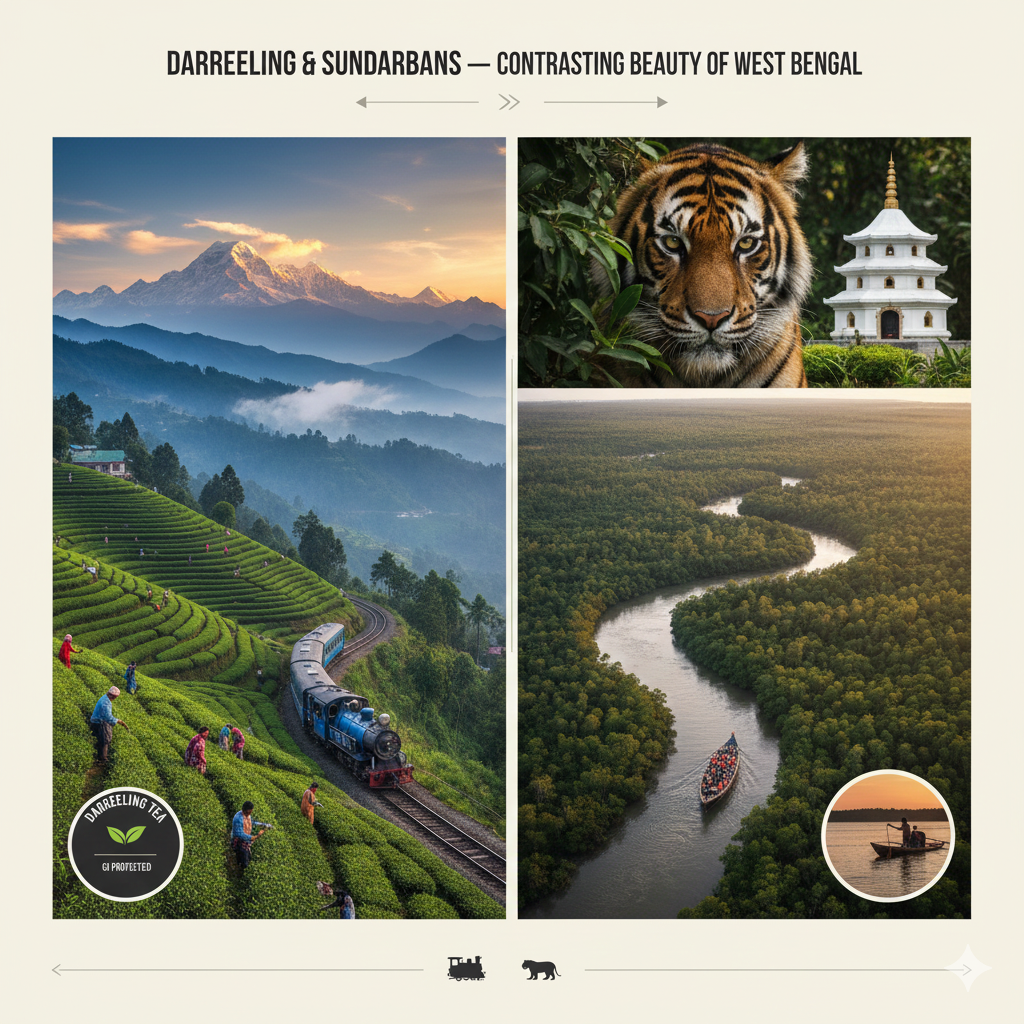
Darjeeling & Sundarbans of West Bengal
Darjeeling and the Sundarbans are two of the most famous tourist destinations in West Bengal. Darjeeling is known for Himalayan beauty, tea gardens, cool climate, and colonial heritage, while the Sundarbans is globally famous for mangrove forests, biodiversity, and the Royal Bengal Tiger. Together, they represent the natural beauty and ecological richness of West Bengal.
Table of Contents
- Darjeeling – Queen of the Hills
- History of Darjeeling
- Tourist Attractions in Darjeeling
- Culture and Food of Darjeeling
- Darjeeling Tea Industry
- Sundarbans – The Mangrove Delta
- Biodiversity of Sundarbans
- Tourism in Sundarbans
- Environmental Challenges
- Transport and Connectivity
- FAQs About Darjeeling and Sundarbans
- Conclusion
Darjeeling – Queen of the Hills
Darjeeling is one of India’s most famous hill stations located in northern West Bengal. Situated in the Himalayan foothills, Darjeeling is internationally known for tea gardens, scenic mountain views, and pleasant weather.
Geographical Location
Darjeeling is located at an altitude of approximately 2,042 meters above sea level. The region offers breathtaking views of the Himalayan mountain range including Mount Kanchenjunga.
Climate
Darjeeling experiences cool and pleasant weather throughout most of the year, making it one of the most popular tourist destinations in eastern India.
History of Darjeeling
The name “Darjeeling” is believed to have originated from the Tibetan word “Dorje-ling,” meaning “Land of the Thunderbolt.”
During the British colonial period, Darjeeling developed as a summer hill station and tea cultivation center.
Darjeeling Himalayan Railway
The Darjeeling Himalayan Railway, also known as the “Toy Train,” was established in 1881 and later recognized as a UNESCO World Heritage Site.
Tourist Attractions in Darjeeling
Tiger Hill
Tiger Hill is famous for spectacular sunrise views over Mount Kanchenjunga and the Himalayan range.
Batasia Loop
Batasia Loop is a unique railway loop offering panoramic views of Darjeeling and surrounding mountains.
Tea Gardens
Darjeeling tea estates attract tourists from around the world for tea tasting and plantation tours.
Padmaja Naidu Himalayan Zoological Park
This zoo is famous for conserving rare Himalayan wildlife including red pandas and snow leopards.
Japanese Peace Pagoda
The Peace Pagoda is a symbol of harmony and offers scenic views of the hills.
Culture and Food of Darjeeling
Darjeeling reflects a blend of Nepali, Tibetan, Bengali, and Himalayan cultures.
Major Festivals
- Losar
- Dussehra
- Tihar
- Maghe Sankranti
Popular Foods
- Momos
- Thukpa
- Noodles
- Traditional Nepali dishes
- Darjeeling Tea

⭐ Recommended Study Resource
Explore a highly rated educational resource selected to support learning, revision, and exam preparation with trusted content and positive reader feedback.
Darjeeling Tea Industry
Darjeeling tea is one of the most famous tea varieties in the world and is often called the “Champagne of Teas.”
Importance of Tea Industry
- Provides employment to thousands of workers
- Supports tourism and exports
- Contributes to the economy of North Bengal
- Promotes organic and premium tea production
Tea Tourism
Many tea estates now offer tea tourism experiences including plantation stays, tea tasting, and guided tours.
Sundarbans – The Mangrove Delta
The Sundarbans is the world’s largest mangrove forest located in southern West Bengal near the Bay of Bengal.
It is a UNESCO World Heritage Site and one of the most important ecological regions in the world.
Geographical Importance
The Sundarbans is formed by the delta of the Ganga, Brahmaputra, and Meghna river systems.
Mangrove Forests
The region contains dense mangrove vegetation adapted to tidal and saline conditions.
Biodiversity of Sundarbans
Royal Bengal Tiger
The Sundarbans is globally famous for the Royal Bengal Tiger, which is adapted to the mangrove ecosystem.
Other Wildlife
- Estuarine crocodiles
- Spotted deer
- Olive Ridley turtles
- Dolphins
- Kingfishers and migratory birds
Bird Watching
The Sundarbans is an important destination for birdwatching and wildlife photography.
Tourism in Sundarbans
The Sundarbans attracts eco-tourists, researchers, wildlife photographers, and nature lovers from around the world.
Major Tourist Activities
- Boat safaris
- Wildlife observation
- Mangrove exploration
- Bird watching
- Village tourism
Best Time to Visit
October to March is considered the best time to visit the Sundarbans because of pleasant weather and better wildlife visibility.
Environmental Challenges
Both Darjeeling and the Sundarbans face environmental challenges because of climate change and human activities.
Darjeeling Challenges
- Landslides
- Deforestation
- Tourism pressure
- Climate-related impact on tea production
Sundarbans Challenges
- Sea-level rise
- Cyclones and Floods
- Salinity increase
- Human-wildlife conflict
- Coastal erosion
Transport and Connectivity
Darjeeling Connectivity
- Nearest Airport: Bagdogra Airport
- Nearest Railway Station: New Jalpaiguri (NJP)
- Connected by roads from Siliguri and Kolkata
Sundarbans Connectivity
- Accessible from Kolkata by road and boat services
- River transport is important for tourism and local travel
FAQs About Darjeeling and Sundarbans
Why is Darjeeling famous?
Darjeeling is famous for tea gardens, Himalayan scenery, toy train rides, and pleasant weather.
Why is the Sundarbans important?
The Sundarbans is important for mangrove forests, biodiversity, eco-tourism, and the Royal Bengal Tiger.
Which is the best time to visit Darjeeling?
March to May and October to December are considered the best times to visit Darjeeling.
Which animal is most famous in the Sundarbans?
The Royal Bengal Tiger is the most famous animal of the Sundarbans.
Why is Darjeeling tea world famous?
Darjeeling tea is famous for its aroma, premium quality, and unique flavor.
Conclusion
Darjeeling and the Sundarbans represent two of the most extraordinary natural regions of West Bengal. Darjeeling offers Himalayan beauty, tea culture, and mountain tourism, while the Sundarbans preserves one of the world’s most important mangrove ecosystems and wildlife habitats. Together, they highlight the ecological diversity, tourism potential, and cultural richness of West Bengal.