
Introduction
Volcanoes are one of the most significant geological phenomena on Earth, formed when molten magma, volcanic gases, ash, and other materials escape from the Earth's interior through openings in the crust. Volcanic activity plays a crucial role in shaping landforms, influencing climate, creating fertile soils, and providing valuable mineral resources. However, volcanic eruptions can also cause widespread destruction, affecting human settlements, ecosystems, and global weather patterns.
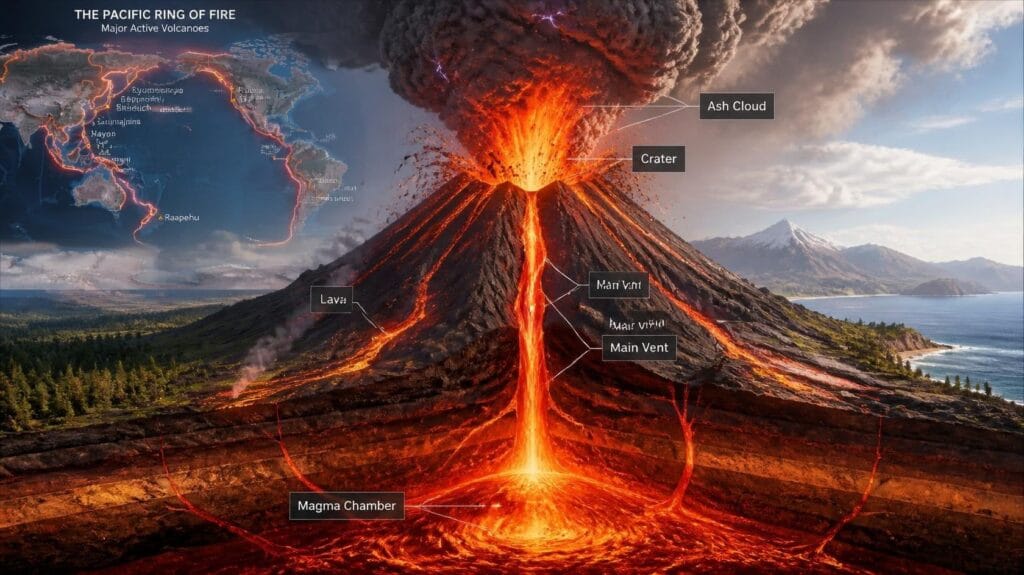
Most of the world's active volcanoes are concentrated around the Pacific Ring of Fire, while India's only active volcano is Barren Island, located in the Andaman and Nicobar Islands. Understanding the origin, classification, and distribution of volcanoes is an essential part of Physical Geography and is highly relevant for competitive examinations such as UPSC, SSC, State PCS, and various university courses.
In this article, we will explore the meaning of volcanoes, their formation process, different types, global and Indian distribution, major volcanic belts, advantages, disadvantages, and important examination-oriented facts. By the end of this guide, you will have a comprehensive understanding of volcanoes and their significance in Earth's geological and environmental systems.
Quick Summary
- Definition: A volcano is an opening in the Earth's crust through which magma, gases, ash, and volcanic materials erupt onto the surface.
- Formation: Volcanoes are mainly formed due to tectonic plate movements, subduction zones, divergent plate boundaries, and mantle hotspots.
- Main Types (By Activity): Active Volcano, Dormant Volcano, and Extinct Volcano.
- Main Types (By Structure): Shield Volcano, Composite (Stratovolcano), Cinder Cone Volcano, and Lava Dome.
- Global Distribution: Most volcanoes are located along the Pacific Ring of Fire, Mid-Ocean Ridges, Mediterranean Volcanic Belt, and Hotspot regions.
- Volcanoes in India: Barren Island is India's only active volcano, Narcondam is a dormant volcanic island, and the Deccan Traps represent ancient volcanic activity.
- Advantages: Volcanoes create fertile soils, provide geothermal energy, form valuable mineral deposits, create new landforms, and support tourism.
- Disadvantages: Volcanic eruptions can cause loss of life, destruction of infrastructure, air pollution, climate impacts, tsunamis, and severe environmental damage.
- Most Important Exam Fact: Approximately 75% of the world's active volcanoes are located around the Pacific Ring of Fire.
- Exam Relevance: An important topic for UPSC, State PCS, SSC, UGC NET, and Geography examinations.
Exam Point
Key Facts for Competitive Exams
- Definition: A volcano is an opening in the Earth's crust through which magma, lava, volcanic ash, and gases are released to the surface.
- World's Largest Volcanic Belt: The Pacific Ring of Fire, which contains nearly 75% of the world's active volcanoes.
- India's Only Active Volcano: Barren Island in the Andaman and Nicobar Islands.
- Dormant Volcano in India: Narcondam Island.
- Ancient Volcanic Region of India: Deccan Traps, formed by extensive basaltic lava flows around 66 million years ago.
- Hottest Material Inside a Volcano: Magma (called Lava after it reaches the Earth's surface).
- Major Types by Activity: Active, Dormant, and Extinct Volcanoes.
- Major Types by Shape: Shield Volcano, Composite (Stratovolcano), Cinder Cone, and Lava Dome.
- Major Causes of Volcanic Eruptions: Plate tectonics, subduction, rifting, and mantle hotspot activity.
- Famous Volcanoes: Mount Fuji (Japan), Mount Vesuvius (Italy), Mount Etna (Italy), Krakatoa (Indonesia), Mauna Loa (Hawaii), and Mount St. Helens (USA).
- UPSC Tip: Always differentiate between Magma and Lava, and remember the locations of major volcanic belts and India's volcanic regions.
Table of Contents
Introduction of Volcanoes
Volcanoes are among the most dynamic geological features on Earth, playing a vital role in shaping the planet's surface over millions of years. They are formed when molten rock (magma), volcanic gases, and ash escape from beneath the Earth's crust through natural openings. These eruptions create a variety of landforms, influence the Earth's atmosphere, and contribute significantly to the continuous evolution of the planet's geology.
Volcanic activity is closely associated with plate tectonics, particularly at convergent and divergent plate boundaries, as well as at mantle hotspots. While volcanic eruptions are often viewed as destructive natural disasters due to their ability to cause widespread damage, they also provide numerous long-term benefits, including fertile soils, geothermal energy, mineral resources, and the formation of new islands and landscapes.
The global distribution of volcanoes is not random. Most active volcanoes are concentrated along major tectonic plate boundaries, especially around the Pacific Ring of Fire, which contains nearly three-fourths of the world's active volcanoes. Other important volcanic regions include the Mid-Ocean Ridge system, the Mediterranean Volcanic Belt, and hotspot locations such as Hawaii and Iceland. Studying their distribution helps scientists understand the movement of tectonic plates and the internal structure of the Earth.
India has limited volcanic activity compared to many other countries. However, it is home to Barren Island, the country's only active volcano, located in the Andaman and Nicobar Islands. The Narcondam Island represents a dormant volcanic system, while the Deccan Traps are evidence of one of the largest volcanic events in Earth's history, which occurred approximately 66 million years ago.
Understanding volcanoes is essential for students of Physical Geography, Environmental Studies, Geology, and Disaster Management. This topic is highly important for competitive examinations such as UPSC Civil Services, State PCS, SSC, UGC NET, and various university-level geography courses. A clear understanding of volcanic processes, types, global distribution, and their environmental impacts also helps in analyzing natural hazards and Earth's geological evolution.
What is a Volcano?
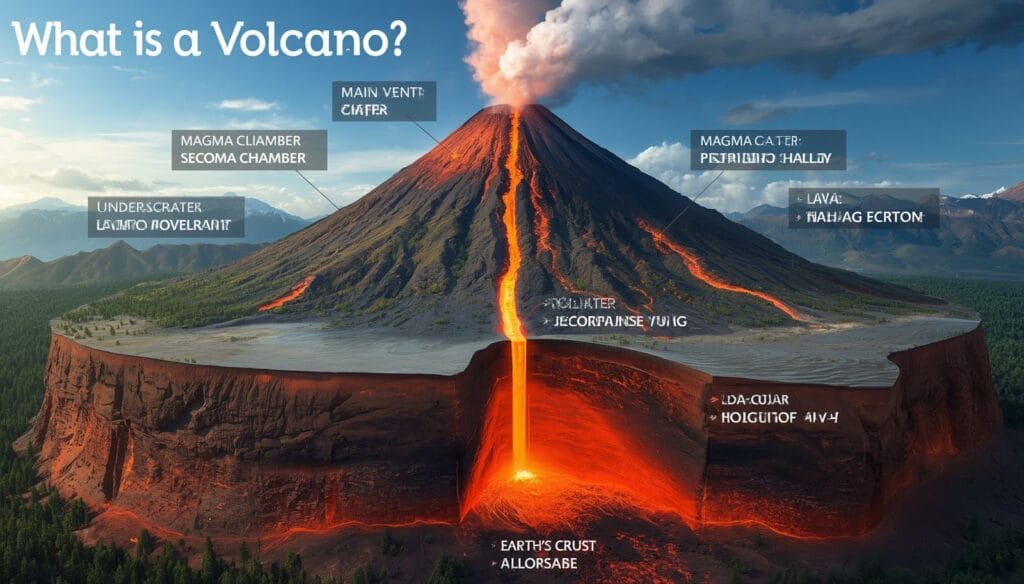
A volcano is a natural opening or vent in the Earth's crust through which magma, volcanic gases, ash, and other materials are expelled from the Earth's interior. When magma reaches the Earth's surface, it is known as lava. Over time, repeated volcanic eruptions accumulate layers of lava and ash, forming volcanic mountains and other distinctive landforms.
Volcanoes are primarily formed due to tectonic plate movements, including subduction zones, divergent plate boundaries, and mantle hotspots. They are an important part of the Earth's internal geological processes and play a significant role in shaping the planet's surface.
Formation of Volcanoes
Volcanoes are formed when intense heat inside the Earth melts rocks in the mantle, producing magma. Because magma is less dense than the surrounding rocks, it rises through cracks and weak zones in the Earth's crust. As pressure continues to build, the magma eventually erupts through a volcanic vent, releasing lava, volcanic ash, gases, and rock fragments onto the Earth's surface.
Most volcanoes develop along tectonic plate boundaries, particularly at convergent (subduction) boundaries and divergent boundaries. Some volcanoes also form over mantle hotspots, where hot mantle material rises independently of plate boundaries, creating volcanic islands such as Hawaii.
- Heat inside the Earth's mantle melts rocks, forming magma.
- Magma rises toward the surface due to its lower density.
- Pressure builds inside underground magma chambers.
- Magma escapes through cracks or volcanic vents during an eruption.
- Lava cools and solidifies, gradually building volcanic cones and mountains.
Types of Volcanoes Based on Activity
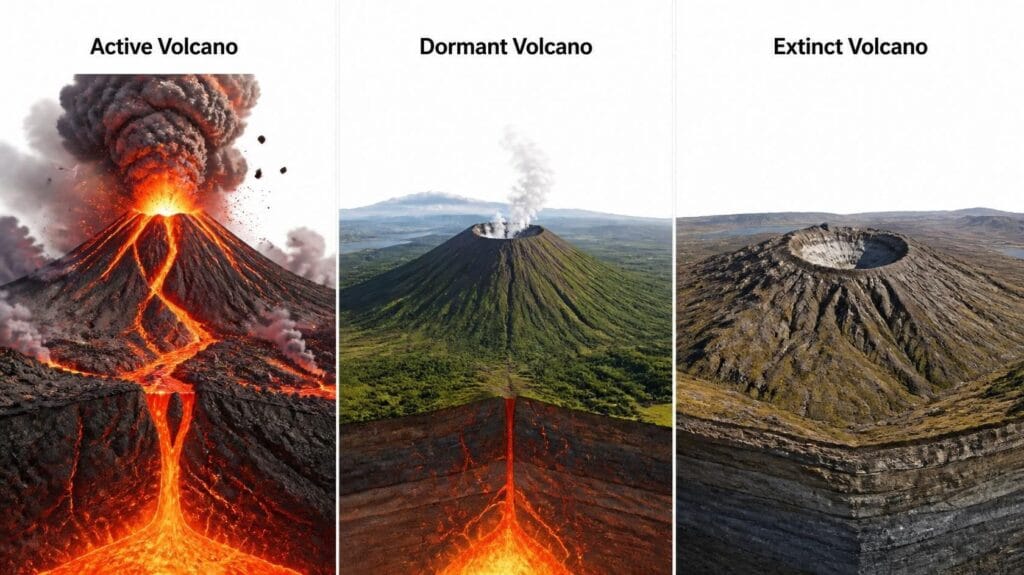
Based on their eruption history and present level of activity, volcanoes are classified into three main categories: Active, Dormant, and Extinct. This classification helps scientists assess volcanic hazards and understand the likelihood of future eruptions.
1. Active Volcano
An active volcano is one that is currently erupting or has erupted in recent history and is likely to erupt again in the future. These volcanoes continuously release lava, volcanic ash, gases, or seismic activity.
- Characteristics: Frequent eruptions, earthquakes, gas emissions, and continuous geological activity.
- Example: Barren Island (India), Mount Etna (Italy), Kilauea (Hawaii).
2. Dormant Volcano
A dormant volcano is a volcano that has not erupted for a long period but still has the potential to become active in the future. It is often referred to as a "sleeping volcano."
- Characteristics: No recent eruptions but signs of possible future volcanic activity.
- Example: Narcondam Island (India), Mount Fuji (Japan).
3. Extinct Volcano
An extinct volcano is a volcano that has not erupted for thoUSAnds or millions of years and is not expected to erupt again because its magma supply has ceased.
- Characteristics: No volcanic activity, cooled magma chamber, and negligible possibility of future eruptions.
- Example: Arthur's Seat (Scotland), Kohala Volcano (Hawaii).
Types of Volcanoes Based on Eruption and Structure
Based on the nature of volcanic eruptions, lava composition, and the shape of the volcanic cone, volcanoes are classified into four major types: Shield Volcano, Composite (Stratovolcano), Cinder Cone, and Lava Dome. Each type has distinct characteristics, eruption styles, and geological features.
1. Shield Volcano
A Shield Volcano is a broad, gently sloping volcano formed by the repeated eruption of highly fluid basaltic lava. Because the lava flows easily over long distances, these volcanoes have a shield-like appearance and are generally associated with non-explosive eruptions.
- Lava Type: Basaltic (low viscosity)
- Eruption Style: Quiet and non-explosive
- Shape: Broad with gentle slopes
- Example: Mauna Loa and Mauna Kea (Hawaii)
2. Composite (Stratovolcano)
A Composite Volcano, also known as a Stratovolcano, is built from alternating layers of lava, volcanic ash, and pyroclastic materials. These volcanoes have steep sides and are known for powerful, explosive eruptions.
- Lava Type: Andesitic to rhyolitic (high viscosity)
- Eruption Style: Highly explosive
- Shape: Tall, steep, and symmetrical cone
- Example: Mount Fuji (Japan), Mount Etna (Italy), Mount St. Helens (USA)
3. Cinder Cone Volcano
A Cinder Cone Volcano is the smallest and simplest type of volcano. It is formed by the accumulation of volcanic cinders, ash, and rock fragments around a single vent. These volcanoes usually experience short-lived explosive eruptions.
- Lava Type: Basaltic to andesitic
- Eruption Style: Moderately explosive
- Shape: Small, steep-sided cone
- Example: Parícutin (Mexico), Sunset Crater (USA)
4. Lava Dome
A Lava Dome is formed when highly viscous lava slowly accumulates near the volcanic vent instead of flowing away. As the thick lava piles up, it creates a rounded, dome-shaped structure. Lava domes may collapse suddenly, producing dangerous pyroclastic flows.
- Lava Type: Rhyolitic (very high viscosity)
- Eruption Style: Slow lava extrusion with occasional explosive activity
- Shape: Rounded or dome-shaped mound
- Example: Lassen Peak (USA), Novarupta (Alaska)
Global Distribution of Volcanoes
Volcanoes are not randomly distributed across the Earth's surface. Most of them are located along tectonic plate boundaries, where geological activity is intense. The majority of active volcanoes are concentrated in four major volcanic regions: the Pacific Ring of Fire, Mid-Ocean Ridge System, Mediterranean Volcanic Belt, and Hotspot Volcanoes.
1. Pacific Ring of Fire
The Pacific Ring of Fire is the world's largest and most active volcanic belt, encircling the Pacific Ocean. It contains nearly 75% of the world's active volcanoes and is associated with frequent earthquakes due to subduction of tectonic plates.
- Location: Around the Pacific Ocean
- Plate Boundary: Convergent (Subduction Zones)
- Major Countries: Japan, Indonesia, Philippines, New Zealand, Chile, Peru, Mexico, USA, and Canada
- Key Feature: Highest concentration of active volcanoes and earthquakes
2. Mid-Ocean Ridge System
The Mid-Ocean Ridge is the world's longest underwater mountain chain, formed where tectonic plates move apart. Basaltic magma rises through the gap, creating new oceanic crust and underwater volcanoes.
- Location: Atlantic, Indian, and Pacific Oceans
- Plate Boundary: Divergent Plate Boundary
- Example: Mid-Atlantic Ridge, Iceland
- Key Feature: Continuous seafloor spreading and submarine volcanism
3. Mediterranean Volcanic Belt
The Mediterranean Volcanic Belt, also known as the Alpine-Himalayan Belt, extends from Southern Europe through the Mediterranean region to Asia. Volcanoes in this belt are mainly produced by the collision of the African and Eurasian tectonic plates.
- Location: Southern Europe to Western Asia
- Plate Boundary: Convergent Plate Boundary
- Major Volcanoes: Mount Etna, Mount Vesuvius, Stromboli (Italy)
- Key Feature: Frequent volcanic and seismic activity
4. Hotspot Volcanoes
Hotspot Volcanoes are formed above stationary mantle plumes rather than along tectonic plate boundaries. As tectonic plates move over these hotspots, chains of volcanic islands are created over millions of years.
- Formation: Mantle plume (Hotspot) activity
- Plate Boundary: Independent of plate boundaries
- Examples: Hawaiian Islands, Yellowstone (USA), Réunion Island
- Key Feature: Formation of volcanic island chains and shield volcanoes
Volcanoes in India
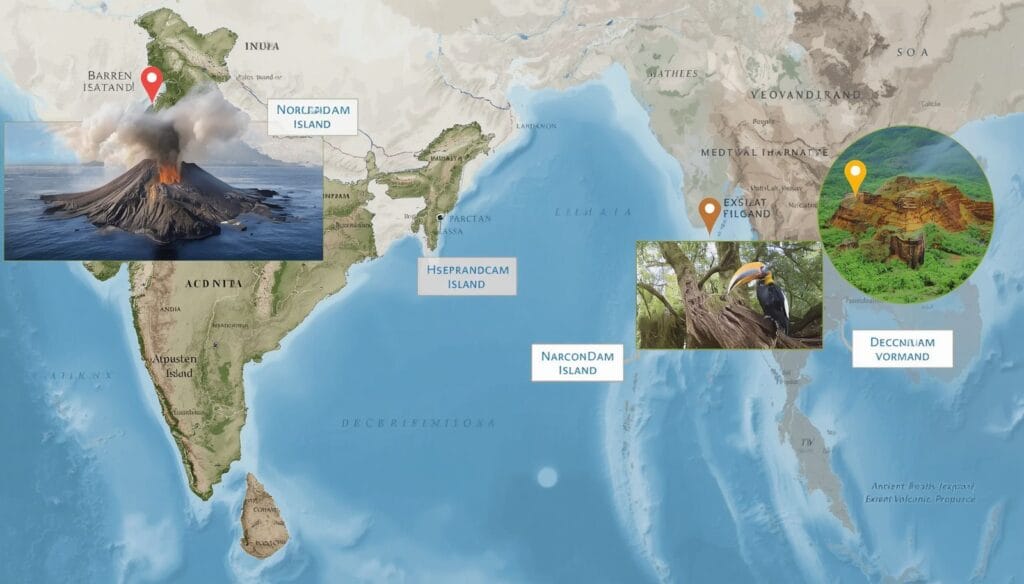
India has relatively limited volcanic activity compared to many other countries. However, it possesses significant volcanic features, including the country's only active volcano, a dormant volcanic island, and one of the world's largest ancient volcanic provinces. These volcanoes are important from both geological and examination perspectives.
1. Barren Island
Barren Island, located in the Andaman and Nicobar Islands, is the only active volcano in India. It lies in the Andaman Sea and forms part of the Pacific Ring of Fire. The volcano has experienced several eruptions in recent decades, making it an important site for geological research.
- Status: Active Volcano
- Location: Andaman Sea, Andaman and Nicobar Islands
- Significance: India's only active volcano
2. Narcondam Island
Narcondam Island is a volcanic island situated northeast of Barren Island in the Andaman and Nicobar archipelago. It is considered a dormant volcano, as there is no record of recent volcanic eruptions. The island is also famous for the endangered Narcondam Hornbill, which is found only on this island.
- Status: Dormant Volcano
- Location: Andaman and Nicobar Islands
- Significance: Home to the endemic Narcondam Hornbill
3. Deccan Traps
The Deccan Traps represent one of the largest volcanic provinces in the world. They were formed by massive basaltic lava flows approximately 66 million years ago, covering large parts of western and central India. Although no longer active, the Deccan Traps provide important evidence of ancient volcanic activity and are believed to have influenced global climate during the late Cretaceous period.
- Status: Extinct (Ancient Volcanic Province)
- Location: Maharashtra, Madhya Pradesh, Gujarat, Karnataka, and nearby regions
- Significance: One of the world's largest flood basalt formations
Advantages of Volcanoes
Although volcanic eruptions can be destructive, volcanoes also provide numerous long-term benefits to the environment, economy, and human society. They contribute to the formation of fertile land, valuable natural resources, and renewable energy sources.
- Fertile Soil: Volcanic ash is rich in minerals such as potassium, phosphorus, and magnesium, making the surrounding soil highly fertile for agriculture.
- Geothermal Energy: Heat generated by volcanic activity is used to produce clean and renewable geothermal electricity in countries such as Iceland, New Zealand, and the Philippines.
- Mineral Resources: Volcanoes are important sources of valuable minerals, including copper, gold, silver, sulfur, and other economically significant ores.
- Formation of New Land: Repeated volcanic eruptions can create new islands and expand existing landforms, as seen in Hawaii and Iceland.
- Tourism: Volcanic landscapes, hot springs, geysers, and volcanic mountains attract millions of tourists every year, contributing to local economies.
- Scientific Research: Volcanoes provide valuable insights into the Earth's internal structure, plate tectonics, and geological evolution.
- Building Materials: Volcanic rocks such as basalt, pumice, and volcanic ash are widely used in construction, road building, and cement production.
- Unique Ecosystems: Volcanic regions support specialized plant and animal species that have adapted to extreme environmental conditions.
Disadvantages of Volcanoes
While volcanoes provide several long-term benefits, volcanic eruptions can also cause severe destruction to human life, infrastructure, ecosystems, and the global environment. Explosive eruptions release lava, volcanic ash, toxic gases, and pyroclastic flows that pose significant natural hazards.
- Loss of Life and Property: Volcanic eruptions can destroy settlements, roads, bridges, and other infrastructure, leading to significant casualties and economic losses.
- Lava Flows: Hot lava can burn and bury forests, agricultural land, buildings, and transportation networks.
- Volcanic Ash: Ash clouds reduce visibility, damage crops, contaminate water supplies, and disrupt air travel over large areas.
- Toxic Gases: Volcanoes release harmful gases such as sulfur dioxide (SO₂), carbon dioxide (CO₂), and hydrogen sulfide (H₂S), which can affect human health and the environment.
- Pyroclastic Flows: Fast-moving mixtures of hot gases, ash, and rock fragments are among the deadliest volcanic hazards due to their extremely high temperature and speed.
- Climate Impact: Large eruptions can inject ash and sulfur aerosols into the atmosphere, reducing global temperatures temporarily and affecting weather patterns.
- Tsunamis and Landslides: Underwater volcanic eruptions or volcanic collapses may generate tsunamis and trigger landslides in nearby regions.
- Environmental Damage: Volcanic eruptions can destroy forests, wildlife habitats, and ecosystems, requiring years for natural recovery.
UPSC & SSC Important Facts
The following facts are highly important for UPSC, State PCS, SSC, UGC NET, and other competitive examinations. These points are frequently asked in both Prelims and objective-type exams.
- India's Only Active Volcano: Barren Island (Andaman and Nicobar Islands).
- Dormant Volcano in India: Narcondam Island.
- Ancient Volcanic Province: Deccan Traps, formed about 66 million years ago.
- Largest Volcanic Belt: Pacific Ring of Fire.
- Active Volcanoes: Nearly 75% of the world's active volcanoes are located around the Pacific Ring of Fire.
- Longest Underwater Volcanic System: Mid-Ocean Ridge.
- Largest Shield Volcano: Mauna Loa (Hawaii, USA).
- Difference: Magma is molten rock beneath the Earth's surface, while Lava is magma that reaches the surface.
- Main Plate Boundaries for Volcanoes: Convergent (Subduction), Divergent, and Hotspots.
- Most Explosive Volcano Type: Composite (Stratovolcano).
- Least Explosive Volcano Type: Shield Volcano.
- Most Common Volcanic Rock: Basalt.
- Important Volcanic Gases: Water vapour (H₂O), Carbon dioxide (CO₂), Sulfur dioxide (SO₂), and Hydrogen sulfide (H₂S).
- Most Famous Volcanoes: Mount Fuji (Japan), Mount Etna (Italy), Mount Vesuvius (Italy), Krakatoa (Indonesia), and Mount St. Helens (USA).
- Exam Tip: Always remember the sequence: Barren Island (Active) → Narcondam (Dormant) → Deccan Traps (Extinct/Ancient Volcanic Province).
✔ Barren Island – Only Active Volcano in India
✔ Narcondam – Dormant Volcano
✔ Deccan Traps – Ancient Flood Basalt Province
✔ Pacific Ring of Fire – 75% of World's Active Volcanoes
✔ Magma (Inside Earth) → Lava (On Earth's Surface)
Frequently Asked Questions (FAQs)
1. What is a volcano?
A volcano is a natural opening or vent in the Earth's crust through which magma, lava, volcanic gases, and ash are released onto the Earth's surface.
2. What is the difference between magma and lava?
Magma is molten rock beneath the Earth's surface, while lava is magma that has erupted onto the Earth's surface.
3. Which is the only active volcano in India?
Barren Island, located in the Andaman and Nicobar Islands, is the only active volcano in India.
4. What are the three main types of volcanoes based on activity?
Based on volcanic activity, volcanoes are classified into Active, Dormant, and Extinct volcanoes.
5. What is the Pacific Ring of Fire?
The Pacific Ring of Fire is the world's largest volcanic belt, surrounding the Pacific Ocean and containing nearly 75% of the world's active volcanoes.
6. Why are volcanoes important?
Volcanoes create fertile soils, provide geothermal energy, form valuable mineral deposits, create new landforms, and help scientists understand the Earth's internal structure.
7. What are the major hazards caused by volcanic eruptions?
Major volcanic hazards include lava flows, volcanic ash, pyroclastic flows, toxic gases, landslides, tsunamis, and climate-related impacts.
8. Which type of volcano is the most explosive?
Composite (Stratovolcano) is the most explosive type of volcano due to its highly viscous magma and powerful eruptions.
Conclusion
Volcanoes are among the most powerful geological forces that continuously shape the Earth's surface. Although volcanic eruptions can cause significant loss of life, property, and environmental damage, they also provide numerous long-term benefits such as fertile soils, geothermal energy, valuable mineral resources, and the formation of new landforms. Their occurrence is closely linked to tectonic plate movements and mantle hotspot activity, making them an essential topic in Physical Geography.
Understanding the formation, classification, and global distribution of volcanoes helps us better interpret Earth's internal processes and assess natural hazards. For students preparing for UPSC, State PCS, SSC, and other competitive examinations, knowledge of important volcanic regions such as the Pacific Ring of Fire, India's Barren Island, Narcondam Island, and the Deccan Traps is particularly important. A clear understanding of this topic not only strengthens geographical concepts but also enhances disaster management and environmental awareness.