India-Pakistan Border Tensions 2026: Complete Geopolitical Analysis for UPSC & SSC

India Pakistan Tensions 2026 border conflict and military strategy analysis

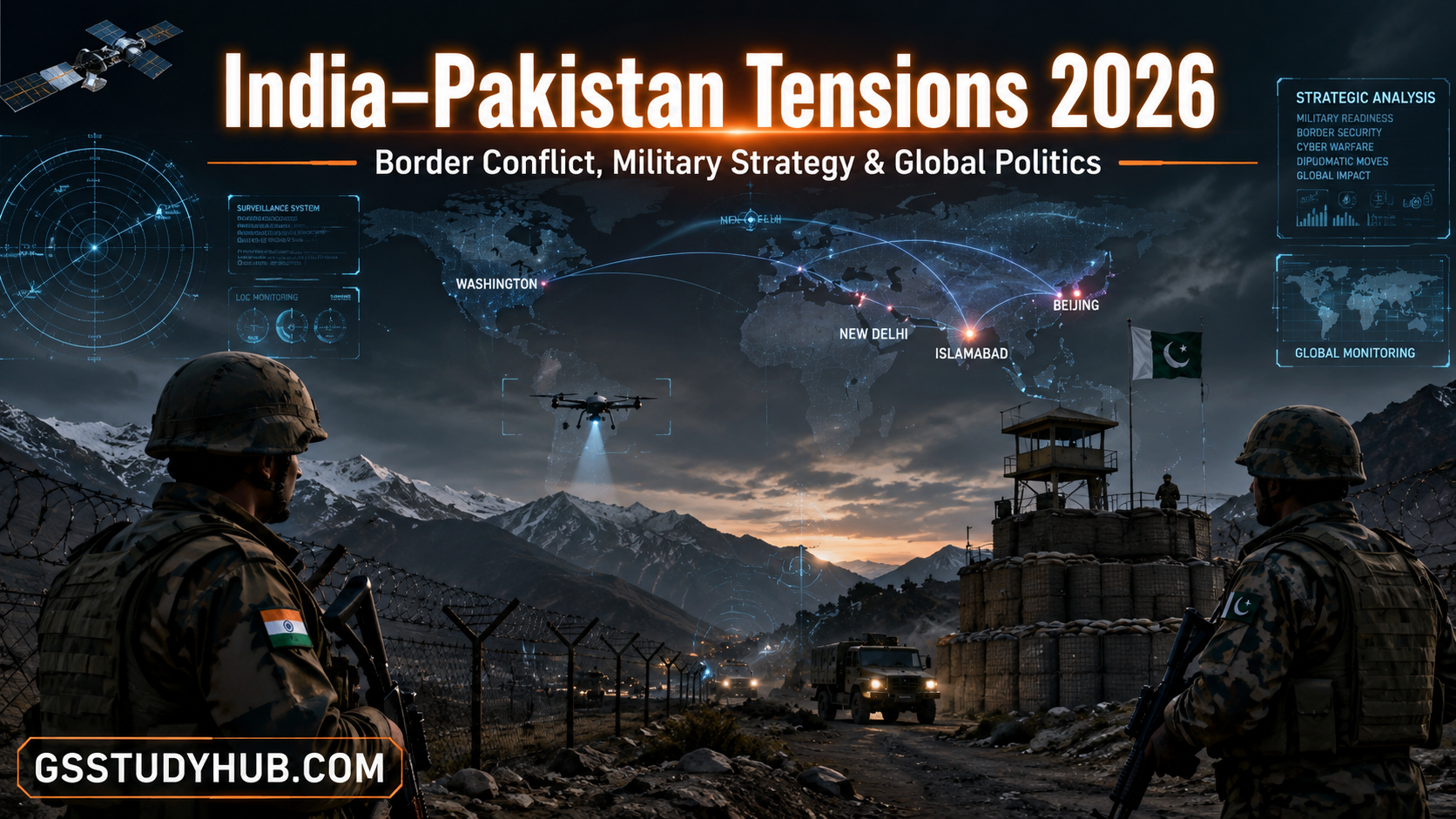
India–Pakistan Tensions 2026 have once again become one of the biggest geopolitical concerns in South Asia...

India–Pakistan Tensions 2026: Complete Analysis of Border Conflict, Military Strategy and Global Politics

India Pakistan Conflict 2026: Rising LoC tension, military alertness, geopolitical rivalry and growing concerns over South Asian stability.

South Asia has once again become the center of global strategic attention. India–Pakistan Tensions 2026 are no longer viewed as a routine border dispute between two neighboring nations. The growing military alertness along the Line of Control (LoC), increased drone surveillance, and aggressive diplomatic exchanges have transformed the situation into a major geopolitical concern with regional and international implications.

Over the past few years, India Pakistan Conflict 2026 has evolved beyond headline-driven news coverage. Today, it is closely monitored by defence analysts, strategic experts and global policymakers. Every development related to the India-Pakistan border dispute is now observed not only in New Delhi and Islamabad, but also in Washington, Beijing and the United Nations. As a result, the ongoing border conflict is increasingly influencing trade routes, cybersecurity concerns, energy stability and regional diplomacy across Asia.

Why Is This Tension Significant?

  • Increasing military activities along the LoC
  • New defence and strategic doctrines from both countries
  • Growing role of drones, cyber warfare and AI surveillance
  • Rising involvement of China, the United States and global powers
  • Potential impact on South Asian geopolitical stability

India’s military strategy, Pakistan’s internal political and economic challenges, and the strategic interests of major global powers such as China and the United States are making the situation increasingly complex. Modern warfare technologies, cyber operations and information warfare have expanded the conflict beyond traditional battlefield dynamics.

The key question now is whether these tensions will remain limited to strategic pressure along the border, or whether South Asia is moving toward a larger geopolitical turning point. In this detailed analysis, we will explore every major dimension of India–Pakistan Tensions 2026 — from military preparedness and diplomatic strategy to economic consequences and global political reactions.

```
```html

🌍 India–Pakistan tensions continue to impact South Asia’s geopolitical stability in 2026.

⚔️ Border security, military strategy and hybrid warfare remain major strategic concerns.

🛰️ AI surveillance, cyber warfare and drone technology are transforming modern conflicts.

🌐 Global powers including the US, China and Russia are closely monitoring regional developments.

🔥 Read More: Operation Sindoor – India’s Strategic Military Response →

© GSSTUDYHUB.COM • Defence • Geopolitics • Strategic Affairs

```
```html id="amz93kp"
Best Amazon Product for Students and Daily Use

🔥 Best Trending Product for Students & Smart Learning

Upgrade your daily study experience and productivity with this highly recommended Amazon product. Perfect for students, professionals and competitive exam preparation.

  • ✅ Premium Quality & User Friendly
  • ⚡ Popular Choice on Amazon
  • 📚 Ideal for Study, Office & Daily Use
  • 🎯 Recommended by GSSTUDYHUB.COM
🛒 Check Latest Price on Amazon →

© GSSTUDYHUB.COM • Best Amazon Deals • Student Essentials • Smart Recommendations

```

Background of India–Pakistan Tensions 2026

India Pakistan Conflict 2026: The legacy of Partition, the Kashmir dispute, LoC tensions, cross-border terrorism and evolving military strategies continue to shape relations between the two nuclear-armed neighbors.

The history of relations between India and Pakistan is considered one of the most complex geopolitical rivalries in South Asia. Since the Partition of 1947, border disputes, the Kashmir issue, military confrontations and cross-border terrorism have remained major sources of tension between the two countries. The current India–Pakistan Tensions 2026 are not merely the result of recent border incidents, but rather the continuation of decades of strategic rivalry, political mistrust and regional competition.

1947 Partition and Early Conflict

Following the Partition of British India in 1947, India and Pakistan emerged as two independent nations. Soon after independence, the princely state of Jammu and Kashmir became the center of the first military conflict between the two countries. Kashmir’s accession to India and the tribal invasion supported from Pakistan laid the foundation for long-term hostility and strategic distrust.

Major India–Pakistan Wars

  • 1947–48 War: The first Kashmir war and the emergence of the Line of Control (LoC)
  • 1965 War: Large-scale military confrontation over Kashmir
  • 1971 War: Creation of Bangladesh and a major strategic defeat for Pakistan
  • 1999 Kargil War: High-altitude conflict caused by infiltration in the Kargil sector

Kashmir Dispute and LoC Tensions

The Kashmir dispute remains the most sensitive issue in India–Pakistan relations. Frequent ceasefire violations, infiltration attempts and military build-ups along the Line of Control have deepened the trust deficit between both nations. Over the last decade, the increasing use of surveillance technology, drones and advanced border monitoring systems has significantly changed the nature of border conflict and military engagement.

Cross-Border Terrorism and Strategic Shift

Since the early 2000s, cross-border terrorism has become one of the central drivers of India–Pakistan tensions. Major incidents such as the Uri attack in 2016 and the Pulwama attack in 2019 significantly influenced India’s national security doctrine and military response strategy.

Key Strategic Events

  • Uri Attack (2016): Terrorist attack on an Indian Army camp
  • Surgical Strike (2016): India’s cross-LoC targeted military operation
  • Pulwama Attack (2019): Major suicide attack on a CRPF convoy
  • Balakot Air Strike (2019): Indian Air Force strike on terrorist infrastructure

Strategic Evolution Over the Last Decade

Over the past ten years, India–Pakistan relations have evolved beyond traditional military confrontation into an era of hybrid warfare, cyber operations and information warfare. India has focused heavily on border infrastructure, air defence modernization and military preparedness, while Pakistan has continued emphasizing asymmetric warfare and tactical deterrence strategies.

Today, India Pakistan Conflict 2026 is not only rooted in historical disputes but is also shaped by changing global politics, regional power competition and modern military doctrines. As a result, India–Pakistan tensions are no longer viewed solely as a bilateral issue, but as a significant geopolitical challenge affecting South Asian stability and the broader international strategic balance.

```
```html id="amz74bx"
Best Study Product for Students and UPSC Aspirants

🔥 Recommended Study Product for Students & UPSC Aspirants

Boost your productivity and study experience with this highly recommended educational product. Ideal for UPSC, SSC, defence exam preparation and daily learning needs.

  • ✅ High Quality & Student Friendly
  • ⚡ Best Seller on Amazon
  • 📚 Perfect for Study & Productivity
  • 🎯 Recommended by GSSTUDYHUB.COM
🛒 Check Latest Price on Amazon →

© GSSTUDYHUB.COM • Best Study Products • Student Essentials • Amazon Recommendations

```

📜 The Partition of India remains one of the most important historical and geopolitical events in South Asian history.

⚔️ Political tensions, religious divisions and British colonial policies played major roles in the 1947 partition.

🌍 The impact of Partition continues to influence India–Pakistan relations, border disputes and regional geopolitics even today.

📖 Read Full Article: Main Causes of the Partition of India →

🔥 Explore More Historical & Geopolitical Analysis on GSSTUDYHUB.COM

© GSSTUDYHUB.COM • History • Geopolitics • Strategic Affairs
```
India Pakistan Tensions 2026 border conflict and military strategy analysis

Military Strategy in India–Pakistan Tensions 2026

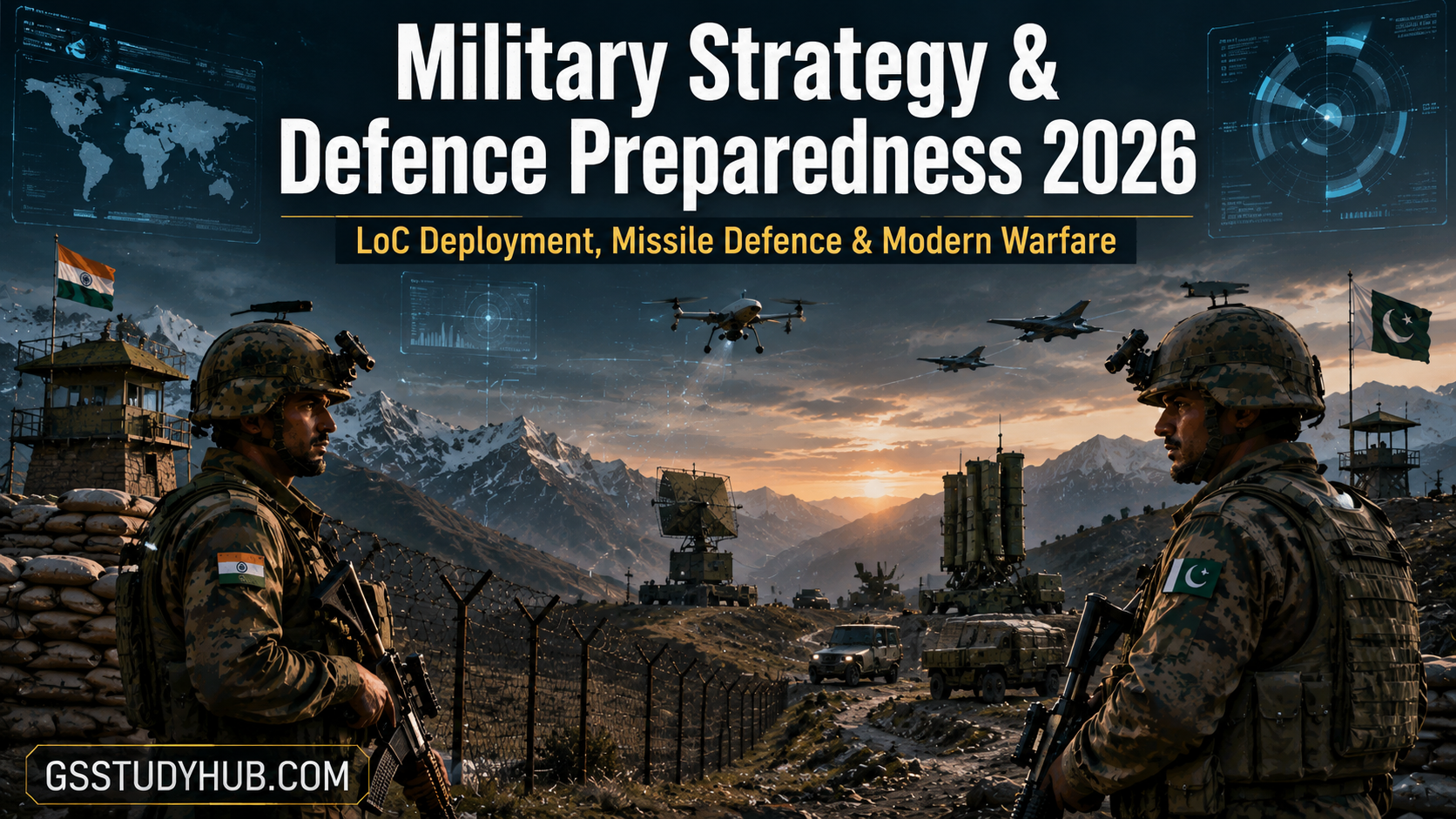
India Pakistan Conflict 2026: Border deployment, air defence systems, drone warfare, missile deterrence and tactical military strategy are shaping the evolving security landscape in South Asia.

The military dimension of India–Pakistan Tensions 2026 has become increasingly complex due to rapid technological modernization, evolving battlefield doctrines and geopolitical competition in South Asia. Unlike earlier conventional confrontations, modern military preparedness now involves a combination of air power, missile defence, cyber capabilities, electronic warfare and real-time surveillance systems.

Both India and Pakistan continue to maintain significant military deployments near sensitive border sectors and along the Line of Control (LoC). However, the strategic priorities of the two nations differ considerably based on geography, defence spending, military doctrine and international partnerships.

Indian Army Deployment Near Borders

India has significantly strengthened its border infrastructure and rapid deployment capabilities over the past decade. Advanced road networks, tunnel projects and logistics corridors in northern regions have improved troop mobility near sensitive sectors. The Indian Army maintains high operational readiness along both the western border with Pakistan and the northern frontier facing China.

Key Strategic Priorities of India

  • Rapid mobilization capability near border sectors
  • Integrated battle groups and modern combat formations
  • Advanced surveillance and intelligence coordination
  • Border infrastructure modernization
  • Improved high-altitude warfare preparedness

Air Force Readiness and Air Defence Systems

Air superiority remains one of the most critical factors in any modern conflict scenario. The Indian Air Force has increasingly focused on multi-role fighter aircraft, integrated radar networks and long-range precision strike capability. Advanced air defence systems, including layered missile defence architecture and surveillance radars, are designed to improve strategic deterrence and reduce vulnerability against aerial threats.

Pakistan also maintains a highly active air force posture with emphasis on rapid response capability and tactical coordination. Air combat readiness remains central to Pakistan’s military doctrine, particularly due to the relatively shorter geographical depth between major cities and border regions.

Naval Deterrence and Maritime Strategy

The naval dimension of India Pakistan Conflict 2026 has gained strategic importance due to the increasing focus on the Arabian Sea and Indian Ocean region. India’s naval strategy emphasizes maritime dominance, sea lane protection and strategic deterrence through aircraft carriers, submarines and long-range naval assets.

Pakistan’s naval strategy, while comparatively smaller in scale, focuses on coastal defence, asymmetric maritime tactics and strategic deterrence through submarine capability.

Missile Systems and Tactical Deterrence

Missile capability remains a core element of strategic balance in South Asia. Both India and Pakistan possess a range of short-range, medium-range and long-range missile systems designed for conventional and strategic deterrence.

CapabilityIndiaPakistan
Missile StrategyMulti-layer strategic deterrenceTactical and rapid response focus
Air DefenceIntegrated layered systemsMobile tactical defence systems
Naval StrengthBlue-water naval capabilityCoastal defence-oriented
Drone WarfareGrowing surveillance and combat roleIncreasing tactical usage

Drone Warfare and Surveillance Technology

Drone warfare has transformed the modern battlefield. Both India and Pakistan are increasingly integrating drones for surveillance, reconnaissance and tactical operations. Advanced monitoring systems, satellite intelligence and real-time battlefield data analysis have improved situational awareness across border sectors.

The rise of electronic warfare capabilities has also become a defining feature of regional military strategy. Communication jamming, radar disruption and cyber-assisted battlefield operations are now considered essential components of modern conflict preparedness.

Tactical Nuclear Deterrence Theory

One of the most sensitive aspects of India–Pakistan military relations is nuclear deterrence. Both nations possess nuclear capability, which significantly influences strategic decision-making and limits the possibility of full-scale conventional war.

Pakistan’s military doctrine has traditionally emphasized tactical nuclear deterrence to counter conventional military imbalance, while India maintains a broader strategic deterrence posture focused on credible minimum deterrence and second-strike capability.

Strategic Observation

The military preparedness seen in India Pakistan Conflict 2026 reflects a broader transformation in modern warfare across South Asia. Traditional troop deployment is now deeply connected with cyber operations, electronic warfare, artificial intelligence and geopolitical competition among major global powers. As a result, military strategy in the region is no longer limited to border defence alone, but increasingly linked to regional stability, technological superiority and international strategic balance.

```
```html id="amz82nx"
Best Educational Product for Students

🔥 Top Recommended Product for Students & Daily Learning

Enhance your study setup and daily productivity with this highly recommended educational product. Perfect for UPSC, SSC, competitive exam preparation and smart learning needs.

  • ✅ High Quality & Durable Design
  • ⚡ Trending Product on Amazon
  • 📚 Ideal for Students & Professionals
  • 🎯 Smart Choice Recommended by GSSTUDYHUB.COM
🛒 Buy Now on Amazon →

© GSSTUDYHUB.COM • Best Study Products • Smart Learning • Amazon Recommendations

```

🌏 India’s Foreign Policy plays a crucial role in shaping its global diplomatic and strategic influence.

🤝 Strategic partnerships, regional diplomacy and Indo-Pacific cooperation are central pillars of India’s global approach.

🛰️ India’s relations with the US, Russia, China and neighboring countries continue to impact global geopolitics.

📖 Read Full Analysis: India’s Foreign Policy – Strategic & Global Analysis →

🔥 Explore More Defence, International Relations & Geopolitical Insights on GSSTUDYHUB.COM

© GSSTUDYHUB.COM • International Relations • Geopolitics • Strategic Affairs
```

Global Politics and India–Pakistan Tensions 2026

The global impact of India–Pakistan Tensions 2026 extends beyond South Asia into Indo-Pacific strategic calculations.

India Pakistan Conflict 2026: China, the United States, Russia, BRICS, SCO and Indo-Pacific power competition are significantly shaping South Asia’s strategic stability.

India–Pakistan Tensions 2026 are no longer limited to a bilateral border dispute between two neighboring countries. Due to South Asia’s geopolitical sensitivity, nuclear deterrence dynamics and critical global trade routes, the conflict has become an important component of international strategic politics. Rising tensions between India and Pakistan are being closely monitored by major global powers because any escalation could affect Indo-Pacific security, regional stability and the broader balance of power.

In today’s geopolitical environment, South Asia is no longer viewed merely as a regional theatre but as a major arena of global power competition. The strategic interests of China, the United States, Russia and Gulf countries are making the regional equation increasingly complex.

China’s Strategy and South Asian Power Dynamics

China continues to expand its strategic influence across South Asia. Its economic and military partnership with Pakistan has deepened through projects such as the China-Pakistan Economic Corridor (CPEC) and the Belt and Road Initiative (BRI).

For Beijing, India–Pakistan tensions are not merely a regional security issue but also part of the broader Indo-Pacific competition. China’s strategic priorities include strengthening its position in the Indian Ocean region, securing trade connectivity and maintaining influence within the regional balance of power.

China’s Key Strategic Priorities

  • Protection of CPEC and regional connectivity projects
  • Securing access to the Indian Ocean
  • Expanding geopolitical influence in South Asia
  • Balancing strategic competition with India
  • Countering Indo-Pacific alliance structures

The United States and Indo-Pacific Strategy

The United States views India–Pakistan tensions through both the South Asian security framework and the broader Indo-Pacific strategy. Over the past decade, defence cooperation, maritime coordination and technology partnerships between India and the United States have expanded significantly.

At the same time, Washington continues to maintain limited security engagement with Pakistan in areas such as counter-terrorism and regional stability. The primary American objective is to prevent full-scale military escalation in South Asia, as such a conflict could disrupt global economic and strategic stability.

Russia’s Role and Strategic Balancing

Russia has historically been one of India’s most important defence partners. However, in recent years Moscow has also explored limited defence engagement with Pakistan. Russia’s broader strategy appears focused on maintaining strategic balance in South Asia while limiting regional instability.

For Moscow, South Asia remains important due to energy routes, defence exports and Eurasian geopolitical considerations. As a result, Russia generally adopts a balanced diplomatic approach toward India–Pakistan tensions.

United Nations and International Diplomacy

The United Nations consistently emphasizes restraint, dialogue and diplomatic engagement in South Asia. International diplomacy largely aims to prevent military escalation and preserve regional stability.

However, geopolitical realities and major power competition often limit the effectiveness of the United Nations in resolving regional disputes. Despite these limitations, UN platforms remain important for global diplomatic messaging and international pressure-building efforts.

Gulf Countries Diplomacy and Economic Interests

For Gulf countries, both India and Pakistan hold strategic importance. India represents a major economic and energy market, while Pakistan continues to maintain relevance through religious, labour and security cooperation ties.

As a result, Gulf diplomacy generally prioritizes regional stability and de-escalation. Energy security and uninterrupted trade connectivity remain key strategic concerns for the Gulf region.

BRICS, SCO and the Emerging Multipolar Order

Multilateral organizations such as BRICS and the Shanghai Cooperation Organisation (SCO) play an increasingly important role in South Asian diplomacy. These platforms aim to encourage regional dialogue, economic cooperation and security coordination.

However, India–China rivalry and wider geopolitical competition continue to influence the effectiveness of these institutions. Nevertheless, BRICS and SCO are widely viewed as indicators of an emerging multipolar global order.

Global ActorPrimary Strategic Interest
ChinaRegional influence and Indo-Pacific balance
United StatesStrategic stability and Indo-Pacific security
RussiaStrategic balancing and defence cooperation
Gulf CountriesEnergy security and regional stability

Strategic Observation

India–Pakistan Tensions 2026 clearly demonstrate that South Asia has become a major center of global strategic competition. In the modern geopolitical landscape, regional conflicts rarely remain confined within local borders. Instead, they increasingly affect global trade, energy security, Indo-Pacific balance and international diplomacy. This is why major world powers now view India Pakistan Conflict 2026 not merely as a bilateral dispute, but as a broader geopolitical challenge with international implications.

```

🇮🇳 Lal Bahadur Shastri remains one of India’s most respected leaders known for honesty, simplicity and strong leadership.

⚔️ His leadership during the 1965 India–Pakistan War strengthened India’s national confidence and defence strategy.

📜 “Jai Jawan Jai Kisan” became a historic slogan symbolizing national unity, agriculture and military strength.

📖 Read Full Biography: Lal Bahadur Shastri – Death, Awards, Legacy & Biography →

🔥 Explore More History, Leadership & Geopolitical Analysis on GSSTUDYHUB.COM

© GSSTUDYHUB.COM • Indian History • Leadership • Strategic Affairs

```
Top Recommended Amazon Product for Students

🔥 Smart Study & Productivity Essential for Students

Discover one of the most useful and trending Amazon products designed to improve productivity, study efficiency and daily convenience for students and professionals.

  • ✅ High Quality & Reliable Performance
  • ⚡ Trending Product on Amazon
  • 📚 Perfect for Students & Office Use
  • 🎯 Recommended by GSSTUDYHUB.COM
🛒 Buy Now on Amazon →

© GSSTUDYHUB.COM • Best Amazon Deals • Study Essentials • Smart Recommendations

```
India Pakistan Tensions 2026 border conflict and military strategy analysis

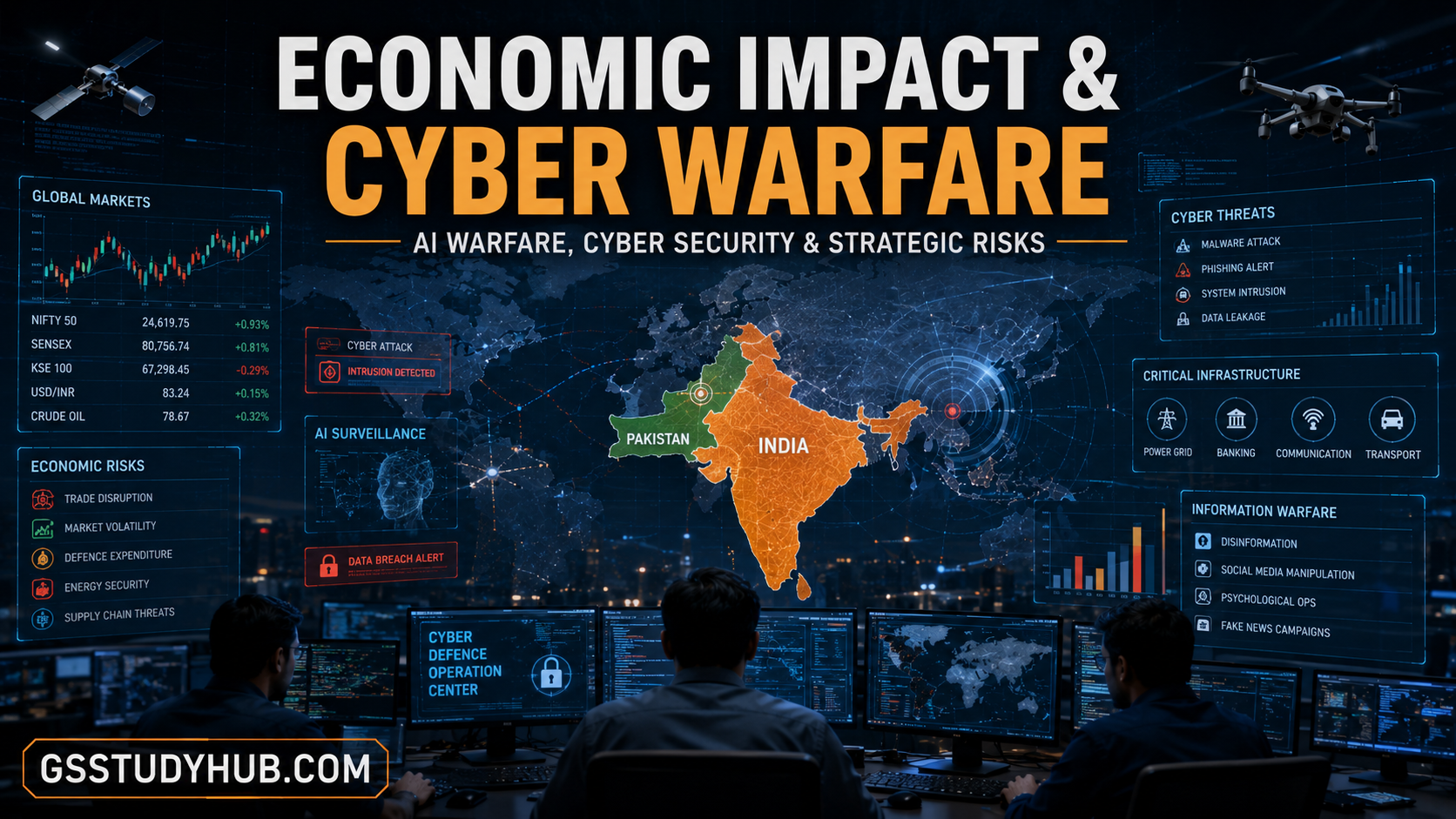
Economic Impact and Cyber Warfare: Strategic Analysis of India–Pakistan Tensions 2026

India Pakistan Conflict 2026: Trade disruption, cyber attacks, AI-based warfare, information warfare and digital surveillance are rapidly becoming the defining realities of modern conflict.

India–Pakistan Tensions 2026 are no longer limited to conventional military confrontation. Modern geopolitical conflicts increasingly involve economic instability, cyber security threats, digital surveillance and information warfare. In today’s strategic environment, wars are not fought only on physical battlefields; stock markets, banking systems, communication networks and social media platforms have also become critical arenas of conflict.

Due to South Asia’s geopolitical sensitivity and regional trade dependency, rising tensions between India and Pakistan can influence economic and technological systems far beyond border regions. As a result, economic security and cyber preparedness have become central pillars of modern national security strategy.

Trade Impact and Border Economy

Growing tensions between India and Pakistan directly affect cross-border trade and regional economic connectivity. Commercial activities, transport corridors and logistics operations in border areas can face disruption during periods of heightened military or diplomatic friction. This creates pressure on local businesses, small industries and border economies.

Although formal bilateral trade remains limited, regional instability can still influence broader South Asian market sentiment. Energy supply chains, shipping routes and investor confidence are particularly vulnerable to geopolitical uncertainty.

Stock Market Volatility and Economic Uncertainty

Geopolitical tensions often increase volatility in financial markets. Border confrontations, military escalation or diplomatic uncertainty can trigger sudden fluctuations in stock markets. Investors generally adopt a cautious approach during periods of heightened geopolitical risk.

Major Economic Risks

  • Declining investor confidence
  • Rising defence expenditure
  • Strategic pressure on trade routes
  • Energy price and supply chain risks
  • Regional market instability

Defence Spending and Strategic Priorities

Both India and Pakistan continue to increase investment in defence modernization. Spending on air defence systems, drone technology, cyber security infrastructure and surveillance capabilities reflects the realities of modern warfare.

However, continuously rising defence expenditure can also create pressure on development priorities and fiscal stability. Balancing economic growth with national security therefore remains a major strategic challenge for both countries.

Energy Security and Regional Connectivity

South Asia remains heavily dependent on energy imports. Any major regional conflict could affect oil supply routes, maritime shipping lanes and energy prices. Strategic competition in the Arabian Sea and Indian Ocean has further increased the importance of energy security in regional geopolitics.

Cyber Attacks and Information Warfare

Cyber warfare has emerged as one of the most critical dimensions of modern conflict. Cyber attacks can target banking systems, communication networks, power grids and government infrastructure. In contemporary military doctrine, cyber capability is increasingly viewed as an essential element of strategic deterrence.

Information warfare and fake news ecosystems are also becoming increasingly influential in geopolitical conflicts. Misinformation campaigns, propaganda narratives and psychological influence operations conducted through social media platforms are designed to shape public opinion and strategic perception.

AI-Based Warfare and Digital Surveillance

Artificial Intelligence and drone technology are rapidly transforming the nature of warfare. AI-assisted surveillance systems, automated threat detection and real-time battlefield analytics significantly improve decision-making speed and operational efficiency.

Drone warfare is no longer limited to reconnaissance missions. Modern drones are increasingly used for surveillance, tactical strikes and electronic intelligence gathering. Digital surveillance networks and satellite monitoring systems have also made border management and strategic intelligence collection far more advanced.

Traditional War vs Hybrid Warfare

Traditional wars were primarily focused on troop deployment and territorial control. However, modern hybrid warfare now combines cyber attacks, economic pressure, misinformation campaigns, proxy operations and digital influence tactics alongside conventional military action.

Traditional WarfareHybrid Warfare
Troop deployment and direct combatCyber attacks and digital operations
Physical battlefield dominanceInformation and psychological influence
Conventional military strategyAI-assisted strategic operations

Strategic Observation

India–Pakistan Tensions 2026 clearly demonstrate that modern conflicts are no longer confined to traditional border warfare. Economic security, cyber preparedness, AI-based warfare and digital influence operations have become central components of national power. As a result, strategic competition in South Asia is increasingly shaped not only by military capability, but also by technological superiority, economic resilience and information dominance.

```
```html id="pb74mk"

🌾 Punjab is known for its rich agriculture, vibrant culture, tourism and rapidly developing economy.

🏏 From sports excellence to natural resources and industrial growth, Punjab plays a major role in India’s development.

🌍 Tourism, food culture, historical heritage and economic strength make Punjab one of India’s most dynamic states.

📖 Read Full Analysis: Natural Resources, Tourism, Sports & Economy of Punjab →

🔥 Explore More Indian Geography, Economy & Current Affairs on GSSTUDYHUB.COM

© GSSTUDYHUB.COM • Punjab • Economy • Geography • Current Affairs

```
```html id="amz58vx"
Best Amazon Product for Students and Productivity

🔥 Trending Amazon Product for Smart Study & Daily Use

Upgrade your productivity and learning experience with this highly recommended Amazon product. Perfect for students, office work, competitive exam preparation and daily smart usage.

  • ✅ Premium Quality & Modern Design
  • ⚡ Best Trending Choice on Amazon
  • 📚 Ideal for Students, Office & Home
  • 🎯 Recommended by GSSTUDYHUB.COM
🛒 Check Latest Price on Amazon →

© GSSTUDYHUB.COM • Best Amazon Deals • Smart Study Essentials • Product Recommendations

```
india pakistan war 2026 analysis.jpg

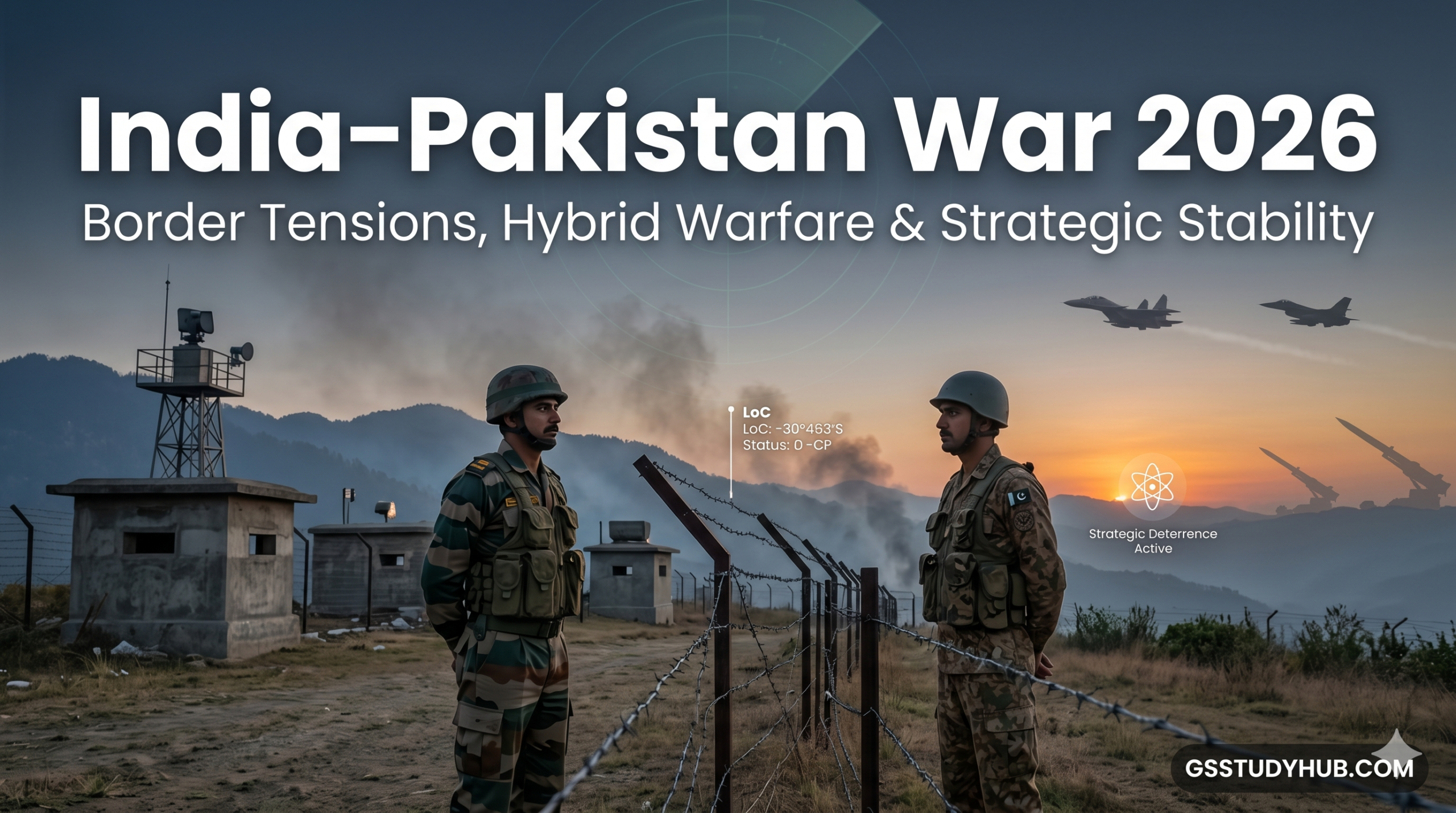
India–Pakistan War 2026: Can Rising Border Tensions Escalate Into a Major Military Conflict?

India Pakistan Conflict 2026 is reshaping South Asia’s strategic landscape through nuclear deterrence, hybrid warfare, diplomatic pressure and evolving military escalation scenarios.

The biggest question surrounding India–Pakistan Tensions 2026 is whether South Asia is moving toward a full-scale military confrontation or whether the current crisis will remain limited to strategic signaling and controlled escalation. In today’s geopolitical environment, the answer depends not only on military capability but also on diplomacy, economic resilience, international pressure and nuclear deterrence dynamics.

Most strategic analysts believe that both India and Pakistan fully understand the enormous human, economic and geopolitical consequences of a large-scale conventional war. As a result, modern conflict scenarios increasingly revolve around limited escalation, hybrid warfare, cyber operations and calibrated military responses instead of prolonged direct confrontation.

How Realistic Is a Full-Scale India–Pakistan War?

In the current strategic environment, a full-scale war between India and Pakistan cannot be completely ruled out. However, most defence experts consider it a relatively low-probability scenario due to the presence of nuclear deterrence and strong international diplomatic engagement.

Global economic interdependence, advanced surveillance systems and rapid diplomatic communication channels also help reduce escalation risks. These factors significantly limit the possibility of a prolonged conventional conflict in South Asia.

Possible Conflict Scenarios in 2026

  • Limited border clashes and artillery exchanges
  • Cross-border tactical military operations
  • Surgical retaliation and precision strikes
  • Cyber warfare and information operations
  • Proxy warfare and asymmetric conflict tactics

Limited Conflict Models and Surgical Retaliation

Modern military doctrine increasingly favors limited conflict models instead of traditional full-scale wars. Events such as the Uri attack and the Balakot air strike demonstrated how future confrontations could involve targeted military responses, rapid escalation control and strong political signaling.

In such scenarios, military operations are often designed to remain strategically limited while simultaneously delivering political and psychological impact. This approach reflects the realities of modern warfare in a nuclearized regional environment.

Hybrid Warfare and Proxy Conflict Dynamics

Modern warfare is increasingly evolving into a hybrid conflict model where cyber operations, misinformation campaigns, psychological warfare and proxy tactics operate alongside conventional military strategies. Strategic experts believe that future India Pakistan Conflict 2026 scenarios are more likely to involve controlled hybrid escalation rather than direct large-scale battlefield warfare.

Hybrid warfare also allows states to maintain strategic pressure while avoiding the extremely high economic and political costs associated with conventional war.

Nuclear Deterrence and Strategic Stability

Nuclear deterrence remains one of the most important stabilizing factors in South Asia’s security architecture. The existence of nuclear capability on both sides significantly reduces the probability of a prolonged full-scale war.

However, tactical nuclear doctrines and rapid escalation risks continue to create strategic uncertainty. This is why military communication channels, diplomatic engagement and crisis management mechanisms remain critically important.

Diplomatic Restraint and International Pressure

Major global powers including the United States, China, Gulf countries and the United Nations consistently emphasize diplomatic restraint in order to prevent military escalation in South Asia.

Backchannel diplomacy, strategic dialogue and international crisis management efforts play an increasingly important role in ensuring that localized military incidents do not evolve into a broader regional conflict.

Economic Costs of War and Strategic Limitations

The economic consequences of a major war would be severe for both countries. Rising defence expenditure, trade disruption, market instability and energy insecurity could significantly affect economic growth and long-term development priorities.

Modern warfare is also highly technology-driven, requiring strong cyber infrastructure, logistics resilience and sustainable economic capacity. These realities create strategic limitations for prolonged military confrontation.

Strategic Factor Impact on Conflict Probability
Nuclear Deterrence Reduces the likelihood of full-scale war
Hybrid Warfare Increases limited conflict scenarios
International Pressure Encourages diplomatic restraint
Economic Costs Discourages prolonged escalation

Strategic Observation

India–Pakistan Tensions 2026 indicate that future conflicts in South Asia are more likely to evolve toward controlled escalation, hybrid warfare and strategic signaling rather than traditional full-scale wars. Nuclear deterrence, economic interdependence and international diplomacy continue to act as critical stabilizing factors. As a result, diplomacy and strategic restraint may remain just as important as military capability in shaping the future security architecture of the region.

```

🌍 Balochistan remains one of South Asia’s most strategically important and geopolitically sensitive regions.

⚔️ Natural resources, regional instability and strategic location continue to shape Balochistan’s geopolitical importance.

🛰️ China-Pakistan Economic Corridor (CPEC), Gwadar Port and regional security dynamics have increased global attention on the region.

📖 Read Full Analysis: Balochistan – Strategic Importance, History & Geopolitical Analysis →

🔥 Explore More Geopolitics, International Relations & Strategic Affairs on GSSTUDYHUB.COM

© GSSTUDYHUB.COM • Geopolitics • South Asia • Strategic Affairs

```
Top Recommended Amazon Product for Students and Professionals

🔥 Premium Amazon Pick for Smart Study & Productivity

Boost your learning, productivity and daily performance with this highly recommended Amazon product. Designed for students, professionals and competitive exam aspirants.

  • ✅ Premium Build Quality & Reliable Performance
  • ⚡ Highly Rated & Trending on Amazon
  • 📚 Perfect for Study, Work & Daily Productivity
  • 🎯 Recommended by GSSTUDYHUB.COM
🛒 Buy Now on Amazon →

© GSSTUDYHUB.COM • Best Amazon Deals • Smart Productivity • Study Essentials

```

UPSC & SSC Exam Notes 2026: India–Pakistan Conflict, Geopolitics and Strategic Affairs Explained

Important UPSC GS Paper 2 & GS Paper 3 notes covering India Pakistan Conflict 2026, international relations, defence strategy, nuclear deterrence and geopolitical security concepts.

India–Pakistan Tensions 2026 is an important topic for UPSC, SSC, State PCS and other competitive examinations because it combines international relations, internal security, defence strategy, geopolitics and economic security. Questions related to border conflict, nuclear deterrence, hybrid warfare and Indo-Pacific strategy are highly relevant for both Prelims and Mains examinations.

UPSC Prelims Important Facts

  • Line of Control (LoC): Military control line between India and Pakistan in Jammu & Kashmir.
  • 1947, 1965, 1971 and Kargil War: Major military conflicts between India and Pakistan.
  • Balakot Air Strike (2019): Indian air operation targeting terror infrastructure.
  • Surgical Strike (2016): Cross-border tactical military response by India.
  • Nuclear Deterrence: Strategic concept to prevent full-scale war through nuclear capability.
  • Hybrid Warfare: Combination of cyber attacks, misinformation and conventional warfare.
  • SCO & BRICS: Important international organizations linked with regional diplomacy.

UPSC GS Paper 2 & GS Paper 3 Relevance

This topic is highly relevant for GS Paper 2 because it involves India’s foreign policy, bilateral relations, international diplomacy and regional security cooperation. It is equally important for GS Paper 3 due to its connection with internal security, border management, cyber warfare and defence modernization.

UPSC Mains Answer Writing Points

  • Discuss strategic stability in South Asia.
  • Explain the role of nuclear deterrence in preventing full-scale war.
  • Analyze the impact of hybrid warfare and cyber security threats.
  • Evaluate the role of global powers such as the US, China and Russia.
  • Highlight the importance of diplomacy and crisis management.
  • Explain India’s Indo-Pacific and defence modernization strategy.

Important Essay & Interview Keywords

Nuclear Deterrence Hybrid Warfare Strategic Stability Indo-Pacific Strategy Cyber Warfare

SSC & State PCS Quick Revision Notes

  • LoC = Line of Control between India and Pakistan.
  • Kargil War took place in 1999.
  • Balakot Air Strike occurred in February 2019.
  • India follows the doctrine of credible minimum deterrence.
  • Hybrid warfare combines military and cyber operations.
  • South Asia is strategically important due to nuclear powers and Indo-Pacific connectivity.

Strategic Observation for Aspirants

For UPSC and other competitive exams, India–Pakistan Conflict 2026 should be understood not only as a border dispute but also as a multidimensional geopolitical issue involving diplomacy, defence strategy, cyber security, economic stability and international relations. A balanced analytical approach with strategic clarity is essential for high-quality answer writing and interview performance.

```
```html id="aj92xm"

🌍 A year after the India–Pakistan conflict, both nations continue reassessing military strategy, deterrence and regional stability.

⚔️ Modern warfare technologies including drones, cyber operations and missile defence played a major role in the conflict dynamics.

🛰️ Global powers and strategic analysts are closely monitoring South Asia’s evolving geopolitical balance and security environment.

📖 Read International Analysis: What India & Pakistan Learned a Year After War →

🔥 Explore More Defence, Geopolitics & Strategic Affairs on GSSTUDYHUB.COM

© GSSTUDYHUB.COM • Geopolitics • Defence Analysis • Strategic Affairs

```
Best Amazon Product for Students and Daily Productivity

🔥 Best Amazon Essential for Smart Study & Daily Use

Discover a highly useful and trending Amazon product designed to improve productivity, learning efficiency and everyday convenience for students and professionals.

  • ✅ Premium Quality & Reliable Performance
  • ⚡ Top Trending Product on Amazon
  • 📚 Ideal for Students, Office & Home Use
  • 🎯 Recommended by GSSTUDYHUB.COM
🛒 Check Latest Price on Amazon →

© GSSTUDYHUB.COM • Best Amazon Deals • Smart Study Essentials • Product Recommendations

```

India–Pakistan Conflict 2026: Important FAQs and Expert Answers

Key questions and expert insights about India Pakistan Conflict 2026, LoC tensions, nuclear deterrence, cyber warfare and South Asian geopolitics. India–Pakistan Tensions 2026 remain one of the most important geopolitical developments for UPSC and international relations studies.

1. Why have India–Pakistan tensions increased in 2026?

India–Pakistan tensions in 2026 have increased due to multiple geopolitical and strategic factors, including LoC tensions, cross-border security concerns, military preparedness, regional power competition and diplomatic disagreements. South Asia’s strategic sensitivity and broader global geopolitical competition are also influencing the situation.

2. Is there a possibility of war between India and Pakistan?

A full-scale war cannot be completely ruled out, but most strategic experts consider it a relatively low-probability scenario. Nuclear deterrence, international diplomacy, economic costs and global pressure continue to encourage controlled escalation and diplomatic restraint between both countries.

3. What is the LoC (Line of Control)?

The Line of Control (LoC) is the military control line between India and Pakistan in the Jammu and Kashmir region. It is not an official international border, but a ceasefire line where military tensions, surveillance activities and security operations frequently occur.

4. What is China’s role in India–Pakistan tensions?

China is attempting to expand its strategic influence in South Asia through economic and infrastructure cooperation with Pakistan, especially through the China-Pakistan Economic Corridor (CPEC). China also plays an important role in Indo-Pacific competition and regional balance-of-power politics.

5. How has the United States responded?

The United States generally supports diplomatic restraint, crisis management and regional de-escalation in South Asia. At the same time, Washington continues expanding defence cooperation and strategic coordination with India as part of its broader Indo-Pacific strategy.

6. How strong is India’s military position?

India is considered one of the strongest military powers in South Asia. The Indian Army, Air Force and Navy continue investing heavily in modern defence systems, missile capability, surveillance technology and strategic deterrence. Defence modernization and border infrastructure are also being rapidly strengthened.

7. Is there a risk of nuclear war?

A nuclear war is considered an extremely low-probability scenario because both countries possess nuclear deterrence capability. Strategic experts generally believe that nuclear weapons primarily serve as a deterrent to prevent large-scale conventional war and maintain strategic balance.

8. What is cyber warfare?

Cyber warfare involves cyber attacks targeting digital networks, banking systems, communication infrastructure and information systems. In modern conflicts, cyber operations, misinformation campaigns and digital surveillance have become essential components of strategic warfare.

9. How could South Asia be affected?

India–Pakistan tensions can affect South Asia’s economic stability, trade connectivity, energy security and regional diplomacy. Prolonged geopolitical instability may also impact investor confidence, tourism and broader regional cooperation initiatives.

10. Why is this topic important for UPSC and competitive exams?

This topic is highly important for UPSC GS Paper 2 and GS Paper 3 because it covers international relations, internal security, defence strategy, cyber warfare, diplomacy and geopolitical stability. It is also relevant for essays, interviews and current affairs analysis in competitive examinations.

```
Top Amazon Product for Students and Productivity

🔥 Must-Have Amazon Product for Smart Learning & Daily Use

Improve your productivity and daily learning experience with this highly recommended Amazon product. Perfect for students, professionals and smart work setups.

  • ✅ Premium Quality & Easy to Use
  • ⚡ Highly Rated & Trending on Amazon
  • 📚 Ideal for Study, Office & Productivity
  • 🎯 Recommended by GSSTUDYHUB.COM
🛒 Buy Now on Amazon →

© GSSTUDYHUB.COM • Best Amazon Deals • Smart Productivity • Study Essentials

```

🌍 Rising India–Pakistan tensions continue to draw global attention as South Asia faces growing geopolitical uncertainty.

⚔️ Military preparedness, border security and strategic deterrence remain central to regional stability.

🛰️ Modern warfare technologies including drones, cyber operations and missile defence systems are reshaping conflict dynamics.

📖 Read International Report: BBC Analysis on India–Pakistan Tensions & Strategic Risks →

🔥 Explore More Geopolitics, Defence Analysis & International Relations on GSSTUDYHUB.COM

© GSSTUDYHUB.COM • Defence • Geopolitics • Strategic Affairs

```

Conclusion: India–Pakistan Conflict 2026 and the Future of Strategic Stability in South Asia

India–Pakistan Tensions 2026 continue to shape South Asia’s strategic and geopolitical environment.

India Pakistan Conflict 2026 is no longer just a border dispute, but a broader strategic challenge involving geopolitics, nuclear deterrence, diplomacy and regional stability.

India–Pakistan Tensions 2026 clearly demonstrate that modern South Asia is no longer defined only by traditional border conflicts. The region has increasingly become a center of global geopolitics, strategic competition and technological warfare. Border security, military preparedness, cyber capability, economic resilience and diplomatic engagement are now critical factors shaping regional stability.

Although historical mistrust, LoC tensions and strategic rivalry between India and Pakistan continue to exist, nuclear deterrence, economic costs and international diplomacy remain important factors limiting the possibility of full-scale war. This is why controlled escalation, strategic signaling and diplomatic pressure are currently viewed as more realistic conflict scenarios in the regional security environment.

Strategic Takeaways

  • South Asia has become a major center of global strategic competition.
  • Nuclear deterrence plays a critical role in maintaining regional stability.
  • Hybrid warfare and cyber security are redefining future conflicts.
  • Diplomacy and crisis management remain essential for escalation control.
  • Economic stability and regional cooperation are vital for long-term peace.

India’s long-term strategic approach is no longer limited to traditional military strength alone. Defence modernization, Indo-Pacific partnerships, economic growth, technological capability and diplomatic influence have become integral parts of its broader national security framework. At the same time, regional cooperation, dialogue mechanisms and strategic restraint remain equally important for preserving stability across South Asia.

Ultimately, India Pakistan Conflict 2026 is not merely a story of border tensions or military rivalry. It also reflects the deeper realities of 21st-century geopolitics, technological warfare and strategic diplomacy. In the coming years, the future of South Asia will depend not only on military power, but also on diplomacy, economic resilience, regional trust-building and responsible geopolitical leadership. Maintaining this balance may ultimately become the strongest foundation for long-term peace and stability in the region.

```

India–Pakistan Tensions 2026: Strategic Stability, Geopolitics & Future Outlook

India–Pakistan Tensions 2026 highlight the growing strategic complexity of South Asia in an era of hybrid warfare, cyber operations and global geopolitical competition.

While military preparedness and border security remain critical, diplomacy and strategic restraint continue to play an equally important role in maintaining regional stability.

The evolving relationship between India and Pakistan now influences Indo-Pacific strategy, global diplomacy, economic security and international strategic discussions.

Modern conflicts are increasingly shaped by cyber warfare, AI surveillance, information warfare and technological capability alongside traditional military power.

Understanding these developments is essential for students, defence analysts, policymakers and readers interested in international relations and geopolitical affairs.

As South Asia navigates an uncertain strategic future, long-term peace and stability will depend on balanced leadership, diplomatic engagement and responsible regional cooperation.

© GSSTUDYHUB.COM

Geopolitics • Defence Analysis • Current Affairs • Strategic Insights

```

Leave a Comment

Your email address will not be published. Required fields are marked *

Scroll to Top