
What Were the Effects of Colonialism?
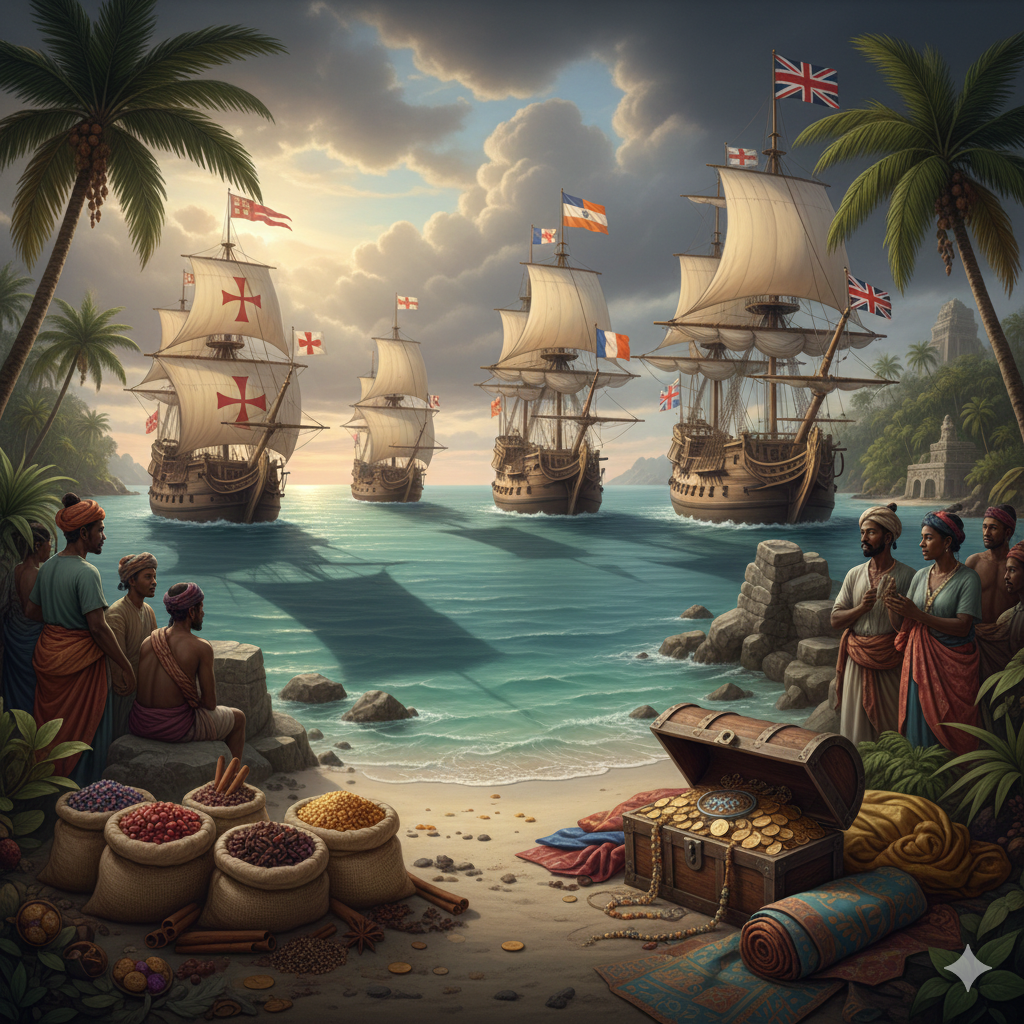
The effects of colonialism included economic exploitation, destruction of local industries, political domination, social and cultural changes, the spread of Western education, and the emergence of nationalist movements. Colonial powers controlled the resources and markets of colonized countries while reshaping their administration, economy, and society.
Effects of Colonialism
The effects of colonialism transformed the political, economic, social, and cultural structures of countries across Asia, Africa, and Latin America. European colonial powers exploited natural resources, weakened many local industries, imposed foreign rule, and reshaped societies to serve their economic and strategic interests. Colonial rule also introduced or expanded modern administrative institutions, railways, education, and communication systems, although these developments often served colonial priorities. Understanding the positive and negative effects of colonialism is important for UPSC, SSC, State PCS, and other competitive examinations.
1. Background and Objectives of Colonialism
European overseas expansion accelerated towards the end of the 15th century when European powers began exploring new maritime trade routes. The main objectives behind this expansion were varied but interconnected.
1.1 Key Objectives of European Colonialism
- Economic Interests: To gain control over valuable resources and commodities such as spices, gold, silver, and other goods, and to expand commercial markets.
- Religious Expansion: To spread Christianity through missionary activities and, in some regions, convert local populations.
- Geographical Exploration: To discover new lands, maritime routes, and natural resources and expand territorial influence.
- Strategic Control: To capture important sea routes, ports, and territories for military, political, and commercial advantages.
2. Arrival of Major European Powers
Several European powers entered Asia, Africa, and the Americas with different strategies, time frames, and areas of control. Each of them left a distinct mark on the regions they dominated.
2.1 Portuguese Colonialism (1498)
- Vasco da Gama reached Calicut (now Kozhikode) on the western coast of India by sea in 1498.
- Portugal established control over important settlements such as Goa, Diu, and Daman on the western coast of India.
- The Portuguese established a strong maritime presence and sought to control important routes in the Indian Ocean spice trade.
2.2 Spanish Colonialism
- Spain established extensive colonies in Central and South America and also controlled the Philippines.
- Spanish colonialism focused heavily on the extraction of gold and silver, particularly in the Americas.
- Spanish authorities and missionaries actively promoted Christianity among local populations.
2.3 Dutch Colonialism
- The Dutch East India Company (VOC), established in 1602, developed trading bases in Southeast Asia and parts of India.
- Its commercial interests focused mainly on spices, textiles, and maritime trade.
- The Dutch developed an extensive commercial network through ports, trading posts, and fortified settlements.
2.4 French Colonialism
- The French East India Company established trading settlements in India, including Pondicherry, Chandannagar, and Mahé.
- French colonial ambitions in India included expanding trade and challenging growing British influence.
- The French attempted to strengthen their position through political and commercial alliances with Indian rulers.

Recommended Study Resource
Explore this recommended product on Amazon. Check its features, specifications, customer reviews, and suitability before purchasing.
Affiliate Disclosure: This page contains an affiliate link. We may earn a commission if you make a purchase through this link, at no additional cost to you.
2.5 British Colonialism
- The British East India Company was established in 1600 and entered India primarily for trade.
- The British gradually established political dominance in India, particularly after the Battle of Plassey (1757) and the Battle of Buxar (1764) in Bengal.
- Following the Revolt of 1857, the Government of India Act 1858 transferred the administration of India from the East India Company to the British Crown.
3. Effects of Colonialism
European colonialism changed the internal structures of colonized societies in many ways. Its impact can be studied under economic, social, political, and cultural dimensions.
3.1 Economic Impact
- Decline of many traditional local industries, including parts of India's traditional textile industry.
- Systematic extraction and exploitation of natural resources and human labour in colonized countries.
- Introduction of new taxation systems and land revenue arrangements, such as the Permanent Settlement in India.
- Restructuring of local economies to serve the needs of European markets and industries.
3.2 Social Impact
- Significant influence of European culture, lifestyles, and ideas on local societies.
- Expansion of Western-style education and the establishment of new educational and medical institutions in many regions.
- Changes in traditional caste, class, and social relationships under colonial administration and economic policies.
- Emergence of educated middle classes, some members of which later contributed to social reform movements and nationalist struggles.
3.3 Political Influence
- Defeat or subordination of local rulers and the establishment of direct or indirect European control.
- Political instability and conflicts during the transition from traditional kingdoms to colonial administration.
- Creation of centralized and bureaucratic colonial administrative systems.
- Introduction of new legal and judicial frameworks that reshaped governance structures.
3.4 Cultural Influences
- Significant influence on local languages, literature, art, architecture, and cultural traditions.
- Activities of Christian missionaries, which led to conversions in some regions and also influenced education and social reform.
- Cultural suppression and the devaluation of many indigenous traditions and belief systems.
- Cross-cultural interactions that contributed to new forms of literature, ideas, and social thought.
4. Protests and Freedom Struggle
European colonial rule did not remain uncontested. People in many regions resisted foreign domination through uprisings, political movements, revolutions, and other forms of opposition.
4.1 Forms of Resistance
- In India, people resisted British rule through several uprisings. One of the most significant was the Revolt of 1857, also known in Indian nationalist historiography as the First War of Independence.
- In Africa, various kingdoms, communities, and resistance movements challenged European conquest and colonial control.
- In North and South America, independence movements gradually ended Spanish and other European colonial rule in many territories.
4.2 End of Colonialism
- After World War II, decolonisation accelerated across Asia and Africa.
- Many colonized countries gained political independence during the mid-20th century, although the process continued in some regions later.
- New nation-states emerged and began rebuilding their economies, societies, and political institutions.
Conclusion
Legacy of European Colonialism
European colonialism brought about major and long-lasting changes in global politics, economies, and societies. On the one hand, colonial rule expanded certain systems of modern education, transportation, communication, and administration. On the other hand, it was responsible for extensive economic exploitation, inequality, political domination, and cultural suppression.
Although colonialism formally ended in much of the world during the 20th century, its effects remain visible in political boundaries, economic structures, social inequalities, and development patterns. Understanding the history of colonialism is essential for understanding the modern world and the continuing challenges faced by former colonies.
Background and Aims of Colonialism
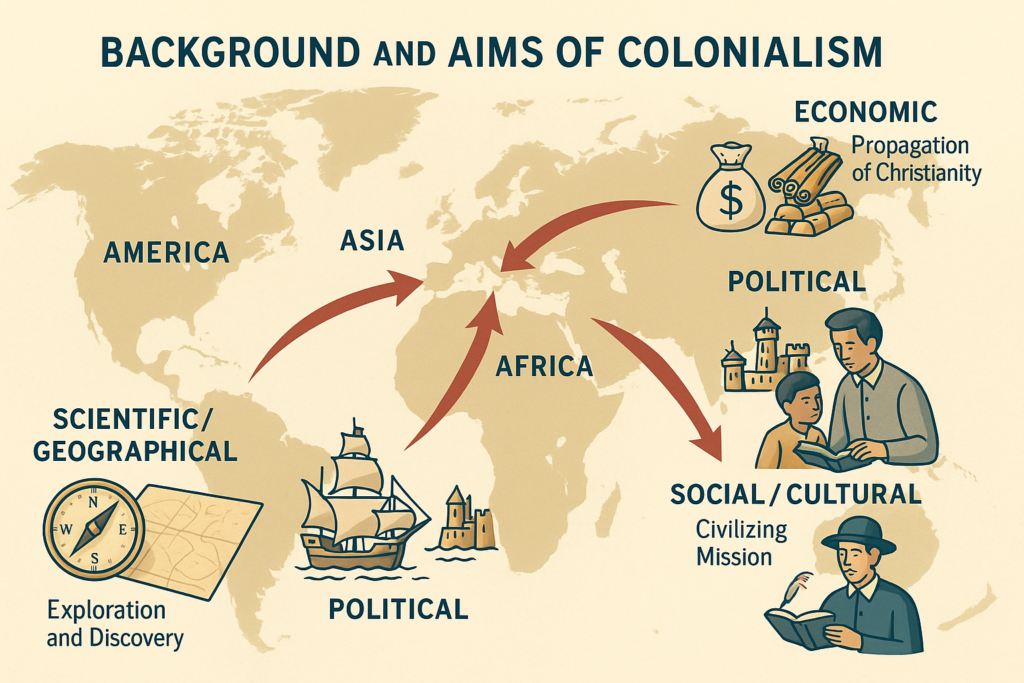
Colonialism refers to a system in which powerful countries, known as colonial powers, established political, economic, and territorial control over other regions and their populations. They generally used this control to advance their own commercial, strategic, and political interests. Modern European overseas colonial expansion accelerated during the 15th and 16th centuries and continued in different forms until the 20th century.
1. Background of Colonialism
1.1 Renaissance and Development of Geographical Knowledge
- The Renaissance in Europe, beginning in the 14th century, encouraged developments in science, art, literature, and geographical knowledge.
- Growing interest in exploration, navigation, and geographical discoveries encouraged European powers to search for new maritime routes.
- Improvements in navigational knowledge, maps, and shipbuilding supported long-distance sea voyages.
1.2 Commercial Expansion and Economic Reasons
- The 15th and 16th centuries witnessed the expansion of European overseas trade and commercial activities.
- European traders sought direct access to Asian markets for valuable commodities such as spices, textiles, silk, and other luxury goods.
- European powers increasingly wanted to reduce dependence on existing trade intermediaries and establish direct commercial connections with Asia and other regions.
1.3 Religion and Religious Expansion
- The spread of Christianity was an important motivation behind some European colonial expeditions.
- Christian missionaries accompanied or followed European expansion and attempted to spread Christianity among local populations.
- Religious objectives sometimes worked alongside commercial and political interests in colonial territories.
1.4 Impact of the Industrial Revolution
- The Industrial Revolution, which began in Britain during the 18th century, increased the demand for raw materials such as cotton, coal, and other industrial resources.
- Industrial economies also required expanding markets for manufactured goods.
- Colonies increasingly became sources of raw materials, markets for European products, and areas for investment and economic expansion.

Recommended Product on Amazon
Explore this product and check its features, specifications, customer reviews, and suitability before purchasing.
Affiliate Disclosure: This page contains an affiliate link. We may earn a commission if you make a purchase through this link, at no additional cost to you.
1.5 Strategic and Political Reasons
- European powers wanted to strengthen their military and political influence by controlling important sea routes, ports, and strategic territories.
- Competition among European powers encouraged the expansion of overseas empires and colonial possessions.
- Control over strategic locations also helped colonial powers protect their trade networks and naval interests.
1.6 The Idea of Social and Racial Superiority
- Many European colonial powers promoted the belief that European societies were culturally and racially superior to the populations of Asia, Africa, and the Americas.
- Colonial authorities often used the idea of a so-called "Civilizing Mission" to justify foreign domination and cultural interference.
- Racial prejudice and ideas of White Supremacy were used to legitimize unequal treatment and colonial exploitation.
2. The Objectives of Colonialism
2.1 Economic Objectives
Exploitation of natural resources
- Obtaining valuable commodities such as spices, tea, silk, cotton, silver, and gold from colonial territories.
- Securing raw materials such as cotton, coal, iron, sugar, and other resources for European industries.
Expansion of Markets
- Using colonies as markets for European manufactured products.
- Establishing commercial networks that benefited the economies of colonial powers.
Control over Labour
- Exploiting local labour through low wages, coercive labour systems, forced labour, and, in several colonial regions, slavery.
- Using colonial populations to support agricultural production, mining, plantations, and infrastructure projects.
2.2 Political Objectives
Expansion of Empires
- European powers sought to expand their territorial possessions and establish large overseas empires.
- Colonial expansion increased their international influence and political prestige.
Strategic Control
- Capturing important ports, naval bases, islands, and maritime routes to secure military and commercial advantages.
- Controlling strategic territories to strengthen geopolitical influence and restrict the expansion of rival powers.
2.3 Religious Objectives
Propagation of Christianity
- Spreading Christianity through missionary activities and religious institutions in colonial territories.
- In some regions, colonial authorities and missionaries attempted to replace or transform local religious and cultural practices.
Activities of Missionaries
- Missionaries established schools, hospitals, and religious institutions in several colonial territories.
- Educational, medical, and religious activities sometimes contributed to the expansion of Christian influence and also interacted with local social reform movements.
2.4 Social and Cultural Objectives
The Civilizing Mission
- European powers claimed that they were bringing civilization, education, and progress to colonized societies.
- They often attempted to impose European languages, cultural practices, educational systems, and administrative institutions.
- These policies frequently undermined local traditions and were used to justify colonial domination.
Propaganda of Racial Superiority
- Colonial powers promoted racial hierarchies and the ideology of White Supremacy.
- These ideas were used to justify unequal rights, racial segregation, discrimination, and political domination.
2.5 Scientific and Geographical Objectives
Exploration and Research
- European expeditions explored geographical regions, natural resources, flora, fauna, and mineral deposits.
- Scientific surveys and geographical studies often supported commercial, administrative, and military objectives.
Discovery and Control of Maritime Routes
- European powers searched for new maritime routes connecting Europe with Asia, Africa, and the Americas.
- Control over important sea routes helped them expand trade, strengthen naval power, and establish overseas colonies.
3. Conclusion
The background and objectives of colonialism reveal that European overseas expansion was not merely a process of geographical exploration or commercial development. It was a complex historical process shaped by economic ambitions, political competition, religious motivations, strategic interests, and ideas of racial and cultural superiority.
European powers often justified colonial expansion as a "civilizing mission", but colonial rule frequently resulted in economic exploitation, political domination, social inequalities, and the suppression of indigenous cultures. Its consequences continued to influence the political, economic, and social development of former colonies long after independence.
Arrival of the Major European Powers
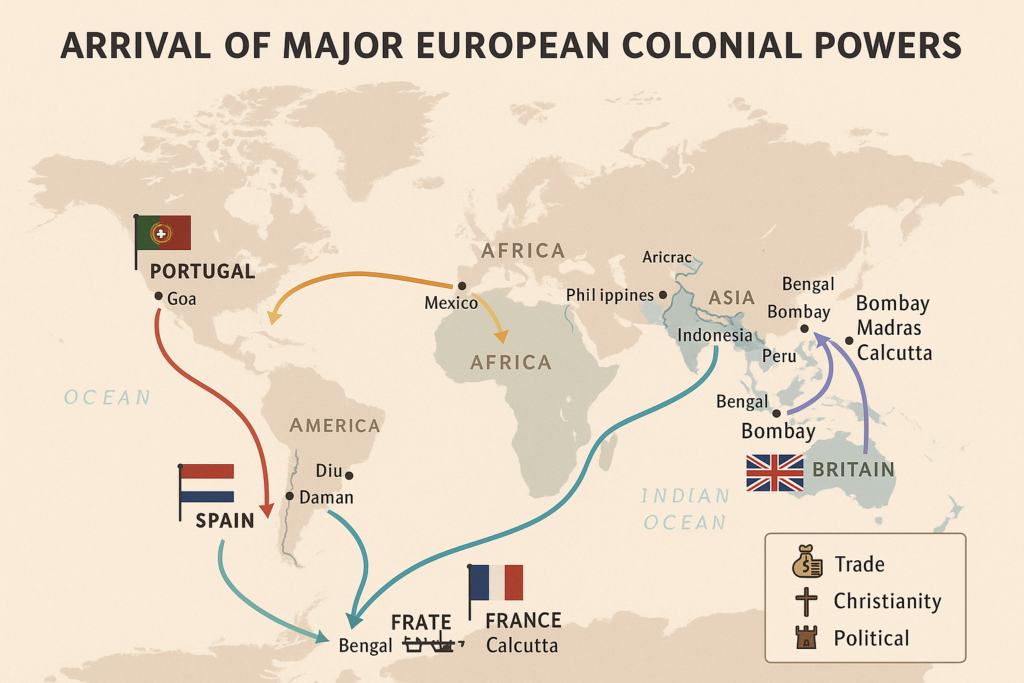
From the late 15th century onward, European powers began exploring maritime routes to Asia, Africa, and the Americas to expand trade, establish overseas settlements, and gain political and economic influence. The Portuguese and Spanish were among the earliest major participants in this expansion, followed by the Dutch, French, and British. Their arrival transformed trade networks, political systems, and societies across several regions of the world.
Quick Overview
- Portugal: Reached India by sea in 1498 and established Goa as its major Asian centre.
- Spain: Expanded its empire in the Americas and the Philippines.
- Netherlands: Established the Dutch East India Company in 1602 and expanded its Asian trading network.
- France: Established trading settlements in India and competed with Britain.
- Britain: Gradually developed political control over large parts of India through the East India Company.
1. Portugal: Beginning of European Colonial Expansion in India
Entry and Objectives
- Portugal played a leading role in European maritime exploration during the 15th century.
- Its primary commercial objective was to establish direct access to the spice trade of India and Asia.
- Portuguese expansion also aimed to control important maritime routes and trading centres in the Indian Ocean.
Key Events
Vasco da Gama (1498)
- Vasco da Gama reached Calicut (now Kozhikode) on the western coast of India in 1498 by sailing around the Cape of Good Hope.
- This voyage established a direct maritime connection between Europe and India through the Indian Ocean.
Establishment of Portuguese Bases
- Goa was captured by Afonso de Albuquerque in 1510 and became the principal centre of Portuguese power in Asia.
- The Portuguese also established control over Diu, Daman, and other coastal settlements at different times.
Control of the Spice Trade
- The Portuguese established trading settlements and maritime networks in India and Southeast Asia.
- They sought to dominate the trade in pepper, cloves, and other valuable spices.
Effects of Portuguese Expansion
- Portugal gained considerable influence over important maritime trade routes between Europe and Asia.
- Goa emerged as an important political, commercial, cultural, and religious centre under Portuguese rule.
- Portuguese rule influenced local architecture, cuisine, religious practices, and cultural traditions.
Read more about Portuguese Influence in India and Their Decline.
2. Spain: Colonialism in the Americas and the Philippines
Entry and Objectives
- Spain established extensive colonial territories mainly in Central America, South America, the Caribbean, and the Philippines.
- Its major objectives included acquiring gold, silver, and other valuable resources and expanding Christianity through missionary activities.
Key Events
Christopher Columbus (1492)
- Christopher Columbus reached the Caribbean in 1492 under the Spanish Crown's sponsorship.
- His voyage initiated sustained European contact and subsequent colonial expansion in the Americas.
Conquest of Central and South America
- Spanish forces under Hernán Cortés conquered the Aztec Empire in Mexico between 1519 and 1521.
- Francisco Pizarro led the Spanish conquest of the Inca Empire in the 1530s.
- Spain established extensive colonial administration across large parts of Central and South America.
Colonies in the Philippines
- Spain began establishing colonial control over the Philippines in the second half of the 16th century.
- Manila became an important centre of Spanish administration and trade in Asia.
Effects of Spanish Colonialism
- Spanish colonialism brought significant religious, linguistic, and cultural changes to the Americas and the Philippines.
- Indigenous populations suffered from warfare, forced labour, displacement, disease, and exploitation.
- Mining of gold and silver, particularly in the Americas, became an important source of wealth for Spain.
3. Netherlands: Rise as a Trading Power
Entry and Objectives
- The Dutch expanded their overseas commercial activities during the late 16th and early 17th centuries.
- The Dutch East India Company (VOC) was established in 1602 to develop and protect Dutch commercial interests in Asia.
- Their major objective was to expand the spice trade and compete with Portuguese and other European merchants.
Key Events
Expansion in Indonesia
- The Dutch established important trading bases in the Indonesian archipelago.
- Batavia (present-day Jakarta) became the main administrative and commercial centre of Dutch activities in Asia.
- The Dutch gradually expanded their political and commercial control over several parts of the region.
Establishment of Trading Bases in India
- The Dutch established trading settlements at Surat, Machilipatnam, Nagapattinam, and other locations in India.
- They participated in the trade of textiles, spices, and other commercial goods.
Control over the Spice Trade
- The Dutch developed strong commercial influence over spice-producing regions in Southeast Asia.
- They competed with Portugal and Britain for control over important maritime routes and trading networks.
Effects of Dutch Expansion
- The Dutch developed an extensive Asian commercial network and gained significant influence in the spice trade.
- Their political and commercial influence in India declined as British power expanded.
- The Dutch retained a major colonial presence in the Indonesian archipelago for a long period.

Recommended Study Resource
Explore this product on Amazon and check its features, specifications, customer reviews, and suitability before purchasing.
Affiliate Disclosure: This page contains an affiliate link. We may earn a commission if you purchase through this link, at no additional cost to you.
4. France: Influence in India and Other Regions
Entry and Objectives
- France established the French East India Company in 1664 to expand its commercial activities in Asia.
- Its objectives included increasing its share in Asian trade and challenging the growing commercial and political influence of Britain.
Key Events
Pondicherry (1674)
- The French established a permanent settlement at Pondicherry in 1674, which later became their principal centre in India.
Other French Settlements
- The French established settlements at Chandannagar, Mahe, Karaikal, and Yanam.
- These settlements became important centres of French trade and administration in India.
Conflict with the British
- The Carnatic Wars were a series of conflicts involving the French and British East India Companies and their Indian allies.
- These wars played an important role in determining the balance of European political influence in South India.
Effects of French Expansion
- France left a notable cultural, architectural, and political influence in parts of India, particularly Pondicherry.
- The Treaty of Paris (1763) restored several French trading settlements but greatly limited French political ambitions in India.
- France retained its Indian settlements until their eventual transfer to independent India.
Learn more about Puducherry: History, Culture, Tourism and Economy.
5. Britain: The Major Colonial Power in India
Entry and Objectives
- The British East India Company was established in 1600 and began its commercial activities in Asia in the early 17th century.
- The British initially focused on acquiring valuable commodities, developing trading networks, and expanding markets for manufactured goods.
- Over time, commercial interests developed into political and territorial ambitions in India.
Key Events
Battle of Plassey (1757)
- The British East India Company defeated Siraj-ud-Daulah, the Nawab of Bengal, in the Battle of Plassey in 1757.
- This victory marked a major turning point in the expansion of British political influence in Bengal.
Battle of Buxar (1764)
- The British defeated the combined forces of Mir Qasim, the Nawab of Awadh, and Mughal Emperor Shah Alam II in the Battle of Buxar in 1764.
- The victory strengthened British political and military power in eastern India.
- In 1765, the Company obtained the Diwani rights of Bengal, Bihar, and Orissa, giving it control over revenue collection in these territories.
Beginning of Direct Crown Rule (1858)
- Following the Revolt of 1857, the Government of India Act 1858 transferred the administration of India from the East India Company to the British Crown.
- This marked the beginning of direct British Crown rule in India, commonly known as the British Raj.
Effects of British Colonialism
- British rule deeply influenced India's political institutions, society, education, economy, and administration.
- railways, telegraph services, postal systems, and modern administrative institutions expanded during British rule, often serving colonial economic and strategic interests.
- Colonial economic policies contributed to the decline of several traditional industries, resource extraction, and widespread economic hardship.
- British rule also contributed to the emergence of new political ideas, social reform movements, and organized nationalist resistance.
Read more about the Effects of the Battles of Plassey and Buxar and the Government of India Act 1858.
Conclusion
The arrival of European powers marked a major turning point in world history. Portugal, Spain, the Netherlands, France, and Britain followed different commercial, political, and strategic approaches to overseas expansion. Their activities transformed global trade networks and influenced the political and economic development of Asia, Africa, and the Americas.
However, European colonial expansion also resulted in the exploitation of natural resources, forced labour, political domination, cultural disruption, and social inequalities. Understanding the arrival, objectives, and impact of these European powers is essential for studying the development of modern colonialism and its lasting influence on the contemporary world.
Effects of Colonialism
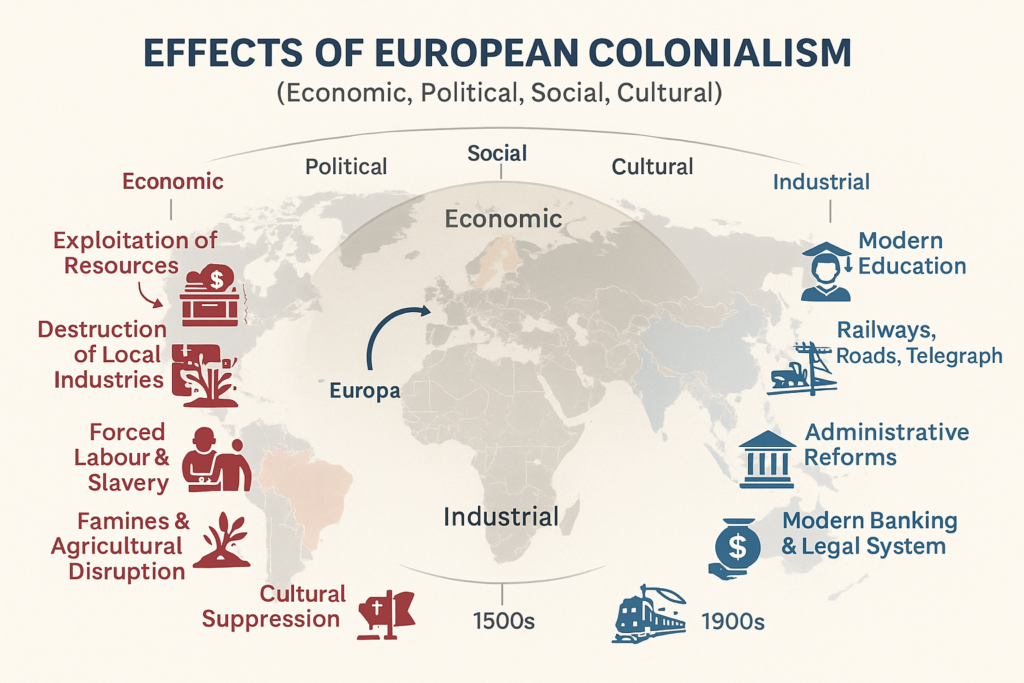
European colonialism had profound, far-reaching, and long-lasting effects on the societies, politics, economies, and cultures of colonized regions. These effects shaped the modern world in significant ways. While colonial rule introduced or expanded certain administrative institutions, technologies, transportation networks, and educational systems, it also caused economic exploitation, inequality, cultural suppression, and long-term dependency. The true impact of colonialism can be understood by examining its economic, political, social, cultural, industrial, and global dimensions.
1. Economic Impact of Colonialism
1.1 Exploitation and Extraction of Resources
- The central economic objective of colonialism was the exploitation of natural and human resources in colonized regions.
- Minerals, spices, cotton, tea, timber, agricultural products, and other valuable resources were exported to European markets.
- Wealth extracted from colonies contributed to the commercial and industrial expansion of European powers.
- Colonial economic policies weakened several traditional industries, including India's handloom and textile sectors.
- Colonies increasingly became suppliers of raw materials and markets for manufactured European goods, creating long-term economic dependency.
1.2 Commercialisation of Agriculture
- Colonial powers encouraged the cultivation of cash crops such as indigo, sugarcane, cotton, rubber, and tea.
- In several regions, agricultural production shifted towards commercial crops to meet the demands of colonial markets.
- Heavy dependence on cash crops sometimes reduced the land and resources available for food production, increasing vulnerability to food shortages.
- The shift from subsistence farming to commercial agriculture disrupted rural economies and affected farmers' livelihoods.
1.3 New Tax Systems and Land Revenue Arrangements
- In India, British authorities introduced land revenue systems such as Zamindari, Ryotwari, and Mahalwari.
- Revenue demands often remained burdensome even during droughts, crop failures, and agricultural crises.
- Heavy taxation and indebtedness pushed many farmers into debt, landlessness, and exploitative labour arrangements.
- Colonial land policies transformed traditional patterns of landholding and weakened several community-based rural institutions.
1.4 Trade Imbalance and Deindustrialisation
- Many colonies exported raw materials and imported manufactured goods from European industrial economies.
- This unequal economic relationship contributed to the decline of several traditional industries and handicrafts.
- Colonial trade policies and European commercial advantages restricted the development of many local industries.
- In several regions, colonial economic structures weakened indigenous entrepreneurship and industrial development.
1.5 Labour Exploitation
- Colonial powers exploited local labour through low wages, coercive labour systems, forced labour, and slavery.
- Plantation labour in the Caribbean, mining labour in Africa, and indentured labour systems in different colonies affected millions of people.
- Workers frequently faced harsh working conditions, long hours, poor living standards, and inadequate compensation.
- In several colonial territories, labour exploitation became an important part of the colonial economic system.
2. Political Influence of Colonialism
2.1 Military Control and Territorial Expansion
- European powers established political dominance by defeating local rulers, kingdoms, and independent political authorities.
- In India, British political expansion accelerated after the Battles of Plassey (1757) and Buxar (1764).
- Colonial governments maintained armies and military establishments to protect their territories, suppress resistance, and maintain control.
2.2 Introduction of European Administrative Systems
- Colonial authorities introduced centralized administrative institutions, legal codes, and bureaucratic systems.
- In British India, institutions such as the Indian Civil Service (ICS) helped administer the colonial state.
- Although some administrative institutions influenced later governance systems, they were primarily designed to maintain colonial authority and facilitate revenue collection.
- Colonial legal and administrative structures often prioritized imperial interests over the political rights of local populations.
Recommended Study Resource
Explore this product on Amazon and check its features, specifications, customer reviews, and suitability before purchasing.
Affiliate Disclosure: This page contains an affiliate link. We may earn a commission if you purchase through this link, at no additional cost to you.
2.3 Political Unity and National Awareness
- Colonial powers brought large territories under centralized administrative frameworks, although many regions continued to have different legal and political arrangements.
- Colonial integration, despite being imposed for imperial purposes, sometimes created administrative and communication networks that later facilitated nationalist movements.
- Modern political awareness developed through education, newspapers, political associations, and social reform movements.
- These developments contributed to the growth of anti-colonial nationalism and demands for self-government.
2.4 Control of Strategic Regions
- Colonial powers captured ports, naval bases, islands, and important maritime trade routes for military and economic advantages.
- Competition for strategic territories frequently resulted in wars, political conflicts, and instability within colonized regions.
- Control over important geographical locations helped European powers protect their commercial and military interests.
3. Social and Cultural Influences
3.1 Transformation of Traditional Social Structures
- Colonial rule weakened or transformed several traditional authority systems, including local kingdoms, tribal institutions, clans, and community leadership structures.
- New laws, land policies, administrative practices, and economic changes influenced caste, class, and religious relationships.
- Colonial classifications and policies sometimes reinforced existing social divisions and created new forms of inequality.
3.2 Spread of Western Education and Ideology
- Western-style education introduced European literature, modern science, rationalist ideas, and new political concepts in several colonies.
- A new educated middle class emerged in many regions, and some of its members later participated in social reform and independence movements.
- However, colonial education policies were also designed to meet administrative requirements and serve the interests of colonial governments.
- Educated people used concepts such as liberty, equality, nationalism, and democracy to question colonial domination.
3.3 Missionary Activities and Religious Conversion
- Christian missionaries established religious institutions and attempted to spread Christianity in several colonial territories.
- Missionary activities also included the establishment of schools, hospitals, and educational institutions.
- Some missionaries criticized local religious and cultural traditions, contributing to debates, resistance, and social change.
- The impact of missionary activities varied across regions and communities.
3.4 Cultural Suppression and Westernisation
- In several colonies, local arts, crafts, literature, languages, and traditions were marginalized under colonial rule.
- European languages, lifestyles, and cultural practices were frequently promoted as superior.
- Indigenous traditions sometimes declined due to cultural suppression, economic changes, and the loss of traditional institutions.
- At the same time, interactions between European and local cultures also produced new forms of literature, art, architecture, and social thought.
4. Economic and Industrial Development: Infrastructure and Institutional Changes
4.1 Development of Infrastructure
- Colonial governments constructed railways, roads, ports, and other transportation networks in several territories.
- Telegraph and postal systems expanded communication across large geographical areas.
- These infrastructure projects were frequently designed to facilitate resource extraction, troop movement, trade, and colonial administration.
- Some infrastructure later became useful for independent countries, although its original purpose often served colonial interests.
4.2 Expansion of Trade and Industry
- Colonial rule connected many regions more closely to international commercial networks.
- New markets developed for European manufactured goods and colonial raw materials.
- However, these trading arrangements often benefited European industries more than local producers.
- In many colonies, unequal trade policies restricted the growth of indigenous industries and manufacturing.
4.3 Introduction of Modern Banking and Finance
- Modern banking institutions, financial arrangements, and commercial systems expanded in several colonial territories.
- These institutions facilitated trade, taxation, investment, and administrative activities.
- However, access to financial institutions and their benefits remained unequal, and many systems primarily served colonial commercial interests.
5. National Movements and Freedom Struggles
- Colonial oppression, economic exploitation, racial discrimination, and political domination inspired resistance movements across the world.
- The Revolt of 1857 in India and various tribal, community-based, and anti-colonial uprisings in Africa challenged European rule.
- Independence movements in North America, Latin America, Asia, and Africa contributed to the gradual decline of European colonial empires.
- Nationalism spread through political organisations, newspapers, public movements, and demands for self-government.
- Decolonisation accelerated after the Second World War, leading to the independence of many former colonies.
6. Global Impact of Colonialism
6.1 Expansion of Cultural Diversity and Interaction
- Colonialism facilitated the movement and exchange of languages, food, ideas, religious traditions, and cultural practices across continents.
- Migration and colonial trade contributed to the formation of multicultural societies in several regions.
- However, these exchanges often took place under unequal conditions and frequently favoured European political and economic dominance.
6.2 Modernisation and Technological Development
- Colonial administrations introduced or expanded certain systems of modern education, medicine, printing, sanitation, transportation, and communication.
- Scientific and technological developments influenced administrative and commercial activities in colonized territories.
- However, access to these developments was often unequal, and many projects primarily supported colonial administration, military control, and economic extraction.
Conclusion
Colonialism transformed colonized regions economically, politically, socially, and culturally. It introduced or expanded certain systems of education, transportation, communication, and administration, but these developments generally took place within structures designed to serve colonial interests. At the same time, colonial rule caused economic exploitation, inequality, industrial decline, political domination, and cultural suppression.
The legacy of colonialism continues to influence global inequalities, political boundaries, economic structures, and social institutions. Resistance to colonial rule also encouraged nationalist movements that inspired colonized nations to rebuild their identities, establish sovereignty, and work towards self-reliance and independence.
Protests and Independence Struggle
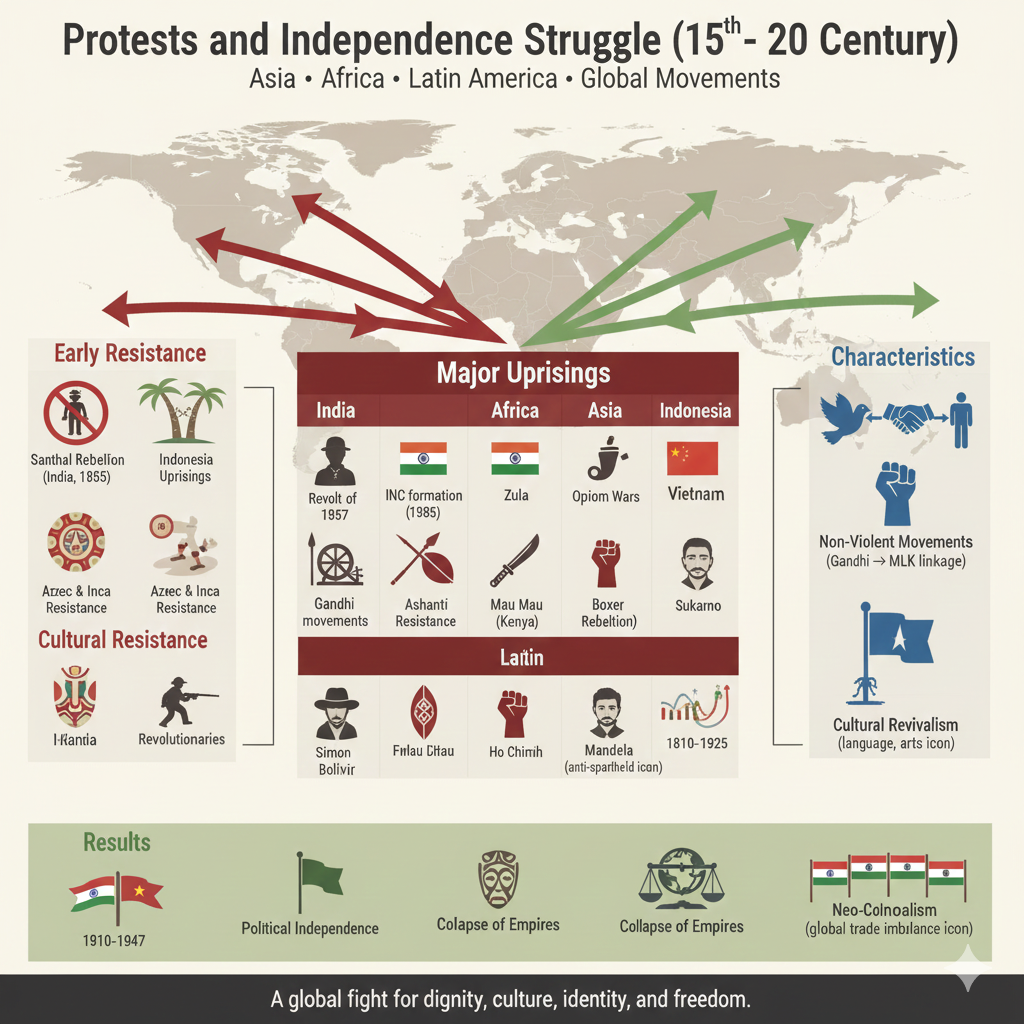
European colonialism subjected the people of colonized countries to extensive economic, social, political, and cultural exploitation. The oppressive policies of colonial rulers generated widespread resentment, resulting in protests, rebellions, and organized national independence movements. These struggles evolved from local resistance into broader movements that transformed world history. The Freedom Struggle was not only a fight for political liberation but also a struggle to protect cultural identity, social dignity, economic independence, and the right to self-determination.
1. Beginning of Opposition to Colonialism
1.1 Initial Local Rebellions
During the early phases of colonial expansion, resistance emerged from local rulers, tribal communities, peasants, and regional kingdoms. These rebellions were often reactions to land occupation, unfair taxation, forced labour, exploitation, and interference in religious and social practices.
- Santhal Rebellion (India, 1855–1856): A major uprising led by the Santhals against exploitation by moneylenders, zamindars, and colonial authorities, as well as oppressive revenue arrangements and displacement.
- Indonesian Rebellions: Various local uprisings challenged Dutch colonial control, forced cultivation systems, economic exploitation, and political interference.
- Aztec and Inca Resistance: Indigenous communities and rulers resisted Spanish conquest in present-day Mexico and Peru to defend their territories, political authority, and cultural traditions.
1.2 Opposition to Religious Interference and Cultural Suppression
European colonial expansion was sometimes accompanied by missionary activities and attempts to spread Christianity. In several regions, colonial authorities and missionaries criticized or marginalized local religious traditions. This contributed to cultural resistance and movements to preserve indigenous identities.
- Communities in parts of the Philippines, Africa, and India resisted interference in their indigenous religious and cultural practices.
- Local leaders and communities organized resistance to protect traditional customs, religious institutions, and cultural identities.
- The nature and intensity of religious resistance varied across colonial territories.
2. Major Rebellions and Independence Struggles
2.1 India's Freedom Struggle
(i) Revolt of 1857 – The First War of Independence
The Revolt of 1857 was the first major widespread armed challenge to British rule in India. It began among sections of the Indian army and expanded into a broader rebellion involving rulers, peasants, soldiers, and other groups in several regions. It is also known as the Sepoy Rebellion and, in Indian nationalist historiography, the First War of Independence.
Major Causes:- Introduction of the Enfield rifle cartridges, which were believed to be greased with cow and pig fat, hurting the religious sentiments of Hindu and Muslim soldiers.
- Heavy land revenue demands and economic exploitation affecting peasants and traditional landholders.
- British annexation policies and the loss of political authority among several Indian rulers.
- Interference in established social, religious, and military practices.
- The rebellion was suppressed by the British, but it exposed the weaknesses and unpopularity of Company rule.
- The Government of India Act 1858 transferred the administration of India from the East India Company to the British Crown.
- The revolt became an important reference point for later Indian nationalist movements.
(ii) Growth of the National Movement (1885–1947)
After 1857, organized political activity gradually developed in India. Different groups adopted constitutional methods, mass protests, revolutionary activities, and other approaches to challenge British rule.
- Formation of the Indian National Congress (1885): The Congress initially promoted constitutional reforms and greater Indian participation in administration. Leaders such as Dadabhai Naoroji and Gopal Krishna Gokhale played important roles in early nationalist politics.
- Revolutionary Activities: Revolutionaries such as Bhagat Singh and Chandrashekhar Azad adopted militant methods against colonial rule. Subhas Chandra Bose organized the Indian National Army to fight British rule with military support from outside India.
- Mahatma Gandhi's Leadership: Gandhi transformed the freedom struggle into a mass movement through non-violent methods and Satyagraha. Important movements included the Non-Cooperation Movement (1920–1922), Civil Disobedience Movement and Dandi March (1930), and Quit India Movement (1942).
2.2 Freedom Struggle in Africa
(i) Early Conflicts
- Anglo-Zulu War (1879): The Zulu Kingdom fought against British expansion in southern Africa. This was a major anti-colonial conflict, rather than a rebellion within an already fully established British colony.
- War of the Golden Stool (1900): The Ashanti people resisted British attempts to establish control over their kingdom in present-day Ghana.
- Various African kingdoms and communities resisted European conquest through armed conflicts and local uprisings.
(ii) Rise of Nationalist Movements
- African nationalist movements expanded during the 20th century in response to colonial exploitation, racial discrimination, and demands for political rights.
- Mau Mau Uprising (Kenya, 1952–1960): An armed uprising against British colonial rule, particularly associated with demands for land, freedom, and political rights.
- Nelson Mandela and the Anti-Apartheid Struggle: Nelson Mandela became a leading figure in the struggle against apartheid, the system of institutionalized racial segregation in South Africa. Apartheid was a racial system of domination, and the struggle against it was closely connected to broader anti-colonial and liberation movements.
(iii) Achievement of Independence
- Ghana (1957): Became the first sub-Saharan African country to achieve independence from colonial rule under majority African government.
- Algeria (1962): Gained independence from France after a prolonged and violent war of liberation.
- During the 1960s and 1970s, many African territories gained independence, transforming the political map of the continent.
2.3 Freedom Movements in Asia
(i) Opposition to Foreign Influence in China
- Opium Wars (1839–1842 and 1856–1860): China fought against British and other foreign powers over trade, diplomatic privileges, and foreign influence.
- Boxer Rebellion (1899–1901): An anti-foreign and anti-Christian uprising in China that opposed foreign influence and missionary activities.
- Sun Yat-sen: Played a major role in the revolutionary movement that overthrew the Qing dynasty in 1911 and contributed to the establishment of the Republic of China in 1912.

Recommended Study Resource
Explore this product on Amazon and check its features, specifications, customer reviews, and suitability before purchasing.
Affiliate Disclosure: This page contains an affiliate link. We may earn a commission if you purchase through this link, at no additional cost to you.
(ii) Vietnam's Independence Struggle
- Vietnamese people resisted French colonial rule through political movements, nationalist organizations, and armed resistance.
- Ho Chi Minh: Led the Vietnamese independence movement and played a central role in the declaration of independence in 1945 and the struggle against French colonial rule.
- Vietnam War (1955–1975): The conflict involved North Vietnam, South Vietnam, and major foreign powers. It ended with the fall of Saigon in 1975 and the reunification of Vietnam in 1976.
(iii) Indonesia's Independence Struggle
- Indonesian nationalists organized a long struggle against Dutch colonial rule.
- Sukarno: Played a central role in the independence movement and became Indonesia's first president.
- Indonesia proclaimed independence on 17 August 1945. The Netherlands formally recognized Indonesian sovereignty in December 1949 after a period of conflict and negotiations.
2.4 Independence Movements in Latin America
- During the early 19th century, major independence movements emerged against Spanish and Portuguese colonial rule in Latin America.
- Simon Bolivar: Known as the "Liberator", he played a central role in the independence of Venezuela, Colombia, Ecuador, Peru, and Bolivia.
- Jose de San Martin: Played a major role in the independence struggles of Argentina, Chile, and Peru.
- Many Latin American territories gained independence between 1810 and 1825, although Brazil became independent in 1822 and several Caribbean territories achieved independence much later.
3. Characteristics of Independence Movements
- Non-Violent Movements: Several independence movements adopted peaceful resistance, civil disobedience, and mass mobilization. Mahatma Gandhi's Satyagraha influenced international civil rights leaders, including Martin Luther King Jr.
- Armed Resistance: Revolutionary groups and national movements used armed struggle against colonial authorities. Examples include the Mau Mau fighters in Kenya and various guerrilla movements in Latin America.
- Cultural Revivalism: Colonized societies revived indigenous languages, literature, traditions, and historical identities to strengthen collective national consciousness.
- Political Mobilization: Political parties, trade unions, newspapers, student organizations, and mass movements helped spread nationalist ideas.
4. Results of the Freedom Struggle
4.1 Political Independence
- Many Asian, African, and Latin American countries gained independence through struggles against colonial rule.
- Important examples include India (1947), Ghana (1957), and Algeria (1962).
- New nation-states emerged and began establishing their own political institutions and constitutional systems.
4.2 Global Impact
- Decolonisation weakened and eventually ended many European colonial empires, transforming international political boundaries.
- The United Nations, established in 1945, provided an international framework for peace, cooperation, human rights, and the principle of self-determination.
- Newly independent countries increasingly participated in international diplomacy and global political institutions.
- The rise of the Non-Aligned Movement reflected the desire of many newly independent countries to maintain an independent position during the Cold War.
4.3 Neo-Colonialism
- Despite achieving political independence, many countries continued to face indirect economic and political pressures from powerful states and international institutions.
- Unequal trade relationships, external debt, foreign investment dependence, and multinational corporate influence became subjects of debate about neo-colonialism.
- Neo-colonialism refers to forms of indirect influence or dependency that may continue even after formal colonial rule has ended.
Conclusion
Protests and independence struggles were not limited to political resistance; they also represented a broader fight for cultural survival, economic freedom, social dignity, and human rights. These movements challenged colonial domination and paved the way for the emergence of independent nation-states across Asia, Africa, and Latin America.
Through these struggles, people asserted their rights to self-governance, equality, and national identity. The legacy of anti-colonial movements continues to influence global politics, international relations, and human rights discussions. Their history remains a powerful reminder of the enduring human desire for freedom, justice, and self-determination.
Recommended Study Resource
Recommended Study Resource
Explore this recommended resource for additional reading and learning. Check the product details and customer reviews before making a purchase.
Affiliate Disclosure: This section contains an affiliate link. We may earn a commission if you make a purchase through this link, at no additional cost to you.
References
-
Books and Publications:
- Bipan Chandra – India's Struggle for Independence
- R.C. Majumdar – The Freedom Struggle in India
- Romila Thapar – A history of India
- John Darwin – After Tamerlane: The Global History of Empire
-
Government and Historical Documents:
- National Archives of India
- British Colonial Records – The UK National Archives
- United Nations – Reports on Decolonization
-
Academic Journals and Research Sources:
- Journal of Asian Studies
- African Historical Review
- Cambridge History of the British Empire
- Oxford University Press – Research on Colonial and Post-Colonial Studies
-
Online Sources:
- Indian Council of Historical Research (ICHR) – Articles on Colonial History
- UNESCO – Cultural Heritage and Colonialism
- Stanford History Education Group – Colonialism Study Materials
- BBC History – Articles on Colonial Rule and Independence Movements
-
Other Important Sources:
- The Collected Works of Mahatma Gandhi
- Nelson Mandela – Long Walk to Freedom
- Ho Chi Minh – Revolutionary Writings and Speeches
- Simon Bolivar – Selected Letters and Speeches