
India Of Division

Why did India split in 1947? Was it only about religion, or was there a deeper political game behind it?

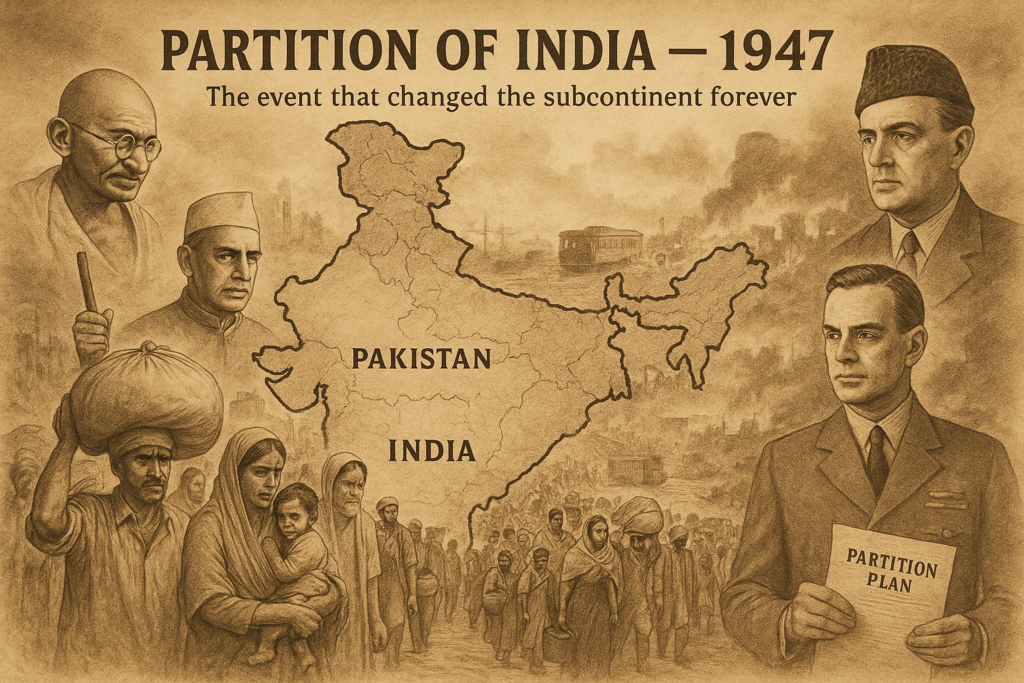
The Partition of India (1947) was not a sudden decision—it was the result of years of tension, British policies, and political conflicts. This historic event divided one nation into India and Pakistan, leading to one of the largest migrations and tragic violence in history.

In this article, you will discover the 7 main causes of the Partition of India, explained in a simple and exam-focused way with facts, examples, and key insights.

The Partition of India – Causes, Process, Consequences & Impact

Introduction

The Partition of India was one of the most significant and tragic events of the 20th century. It marked the division of British India into two independent nations—India and Pakistan—on August 15, 1947. The event reshaped the lives of millions, leaving behind stories of struggle, displacement, courage, and resilience. Understanding its causes and consequences is essential to learning from history and honoring those who lived through this extraordinary moment.

Main Reasons for the Partition of India

1. Religious Differences

Growing disagreements and tensions between the Hindu and Muslim communities created deep social divides.

2. Demand of the Muslim League

The Muslim League, led by Mohammad Ali Jinnah, strongly demanded a separate nation—Pakistan—for Muslims.

3. British “Divide and Rule” Policy

The British government strategically promoted divisions to weaken Hindu-Muslim unity.

4. Political Instability

Frequent conflicts between the Congress and the Muslim League over power-sharing and representation worsened tensions.

5. 1946 Communal Riots

Following the Muslim League’s “Direct Action Day,” widespread riots occurred in Kolkata, Noakhali, Bihar, and Punjab, intensifying the demand for partition.

Process of Partition

June 3, 1947 – The Mountbatten Plan

Lord Mountbatten presented the proposal to divide India, which was accepted by the Congress and the Muslim League.

August 1947 – Independence

India and Pakistan emerged as two independent countries in August 1947.

Geographical Division of Pakistan

Pakistan was formed as two regions separated by over 1,600 km:

  • West Pakistan (now Pakistan)
  • East Pakistan (now Bangladesh)

Consequences of Partition

1. Massive Population Migration

Nearly 15 million people migrated across borders in search of safety and identity.

2. Widespread Violence

Large numbers of people were killed, and incidents of looting, kidnapping, and assault occurred on an unprecedented scale.

3. Refugee Crisis

Both nations struggled to provide shelter, food, and support to millions of displaced families.

4. Kashmir Dispute

The partition left Jammu and Kashmir as a disputed region, leading to conflicts that continue even today.

Important Personalities

Mahatma Gandhi

Opposed the partition and undertook fasts to end communal violence.

Pandit Jawaharlal Nehru

Became the first Prime Minister of independent India.

Mohammad Ali Jinnah

The founder of Pakistan and its first Governor-General.

Product available on Amazon
Top Pick on Amazon

Reliable and high-quality product trusted by customers. Check availability and latest offers on Amazon.

Check Price on Amazon

Lord Mountbatten

The last Viceroy of India who supervised the execution of the Partition Plan.

Conclusion

The Partition of India was not just a political event—it was an emotional and life-changing moment for millions. Its impact continues to shape the history, identity, and relations of both India and Pakistan. Remembering it encourages us to reflect on unity, peace, and the importance of building a future free from division and hatred.
Background and History of the Partition of India

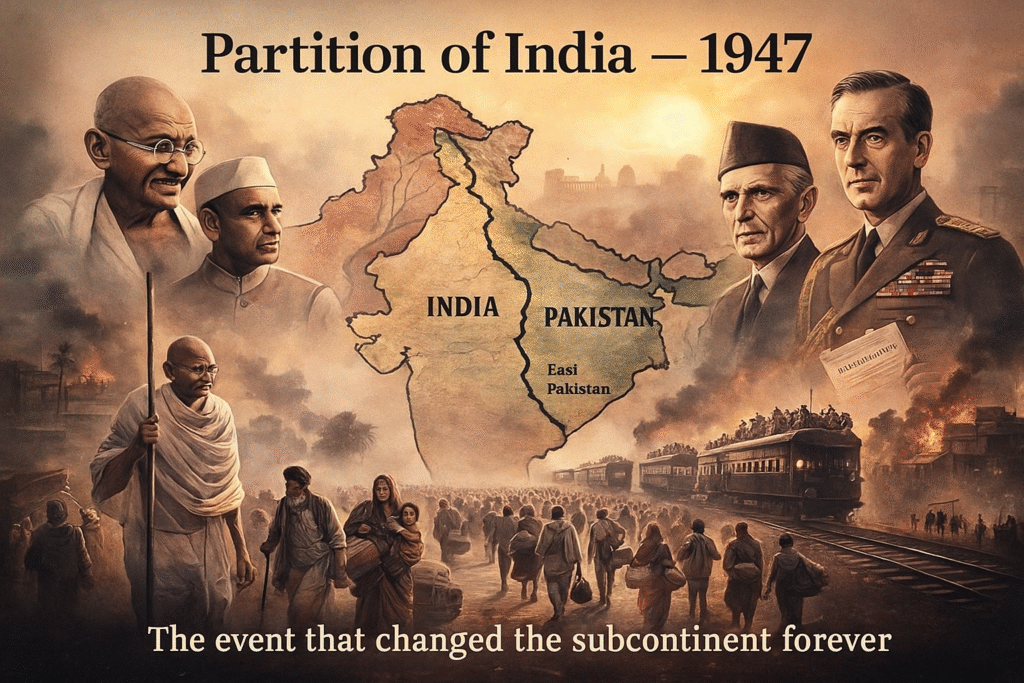
To understand the background and history of the Partition of India, we must examine the social, religious, and political changes of the 19th and 20th centuries. This partition did not occur suddenly; rather, it was the result of a series of historical events, conflicts, and policies that gradually led to it.

Historical Background of the Partition of India

1. British Colonialism (1757–1947)

  • After the Battle of Plassey in 1757, the East India Company began to establish its rule in India.
  • After the Revolt of 1857 (the First War of Independence), India came under direct British Crown rule.
  • The British policy of “divide and rule” weakened Hindu-Muslim unity.

2. Indian National Movement and Religious Polarization

  • 1885: The Indian National Congress was founded, initiating organized political demands for greater Indian participation in governance.
  • 1906: The Muslim League was formed to safeguard the political rights of Muslims.
  • 1909: The Morley-Minto Reforms introduced separate electorates for Muslims, deepening political divisions.

3. Khilafat and Non-Cooperation Movements (1919–1922)

  • Gandhiji supported the Khilafat Movement to strengthen Hindu-Muslim unity.
  • This unity weakened after the movement's decline and the Chauri Chaura incident in 1922.

4. 1930s: Rise of the Two-Nation Theory

  • Muhammad Iqbal (1930) and Muhammad Ali Jinnah played important roles in the development and promotion of ideas about Muslim political identity and a separate homeland.
  • 1940: The Muslim League passed the Lahore Resolution, demanding independent states in Muslim-majority areas. It became an important milestone in the demand that eventually led to Pakistan.
Product available on Amazon
Best Value Amazon Product

Popular and trusted product with good customer feedback. Check the latest price and availability on Amazon.

View on Amazon

5. World War II and the Quit India Movement

  • 1939–1945: Britain involved India in World War II without prior consultation with Indian political leaders.
  • 1942: Congress launched the Quit India Movement in protest.
  • The Muslim League did not support the Quit India Movement and continued its political activities during the war.

History of the Partition of India (Chronological Events)

Year / DateEventDescription
1940Lahore ResolutionThe Muslim League adopted a resolution calling for independent states in Muslim-majority areas.
1946Cabinet Mission PlanAn attempt to preserve India's unity through a proposed constitutional arrangement, which ultimately failed.
16 August 1946Direct Action DayCommunal violence erupted in Kolkata and spread to other regions.
3 June 1947Mountbatten PlanThe British government announced the plan for the partition of British India.
14 August 1947Pakistan IndependencePakistan became independent.
15 August 1947Indian IndependenceIndia became independent.

Social and Political Impact of Partition

  • Nearly 15 million people migrated between India and Pakistan.
  • Large numbers of people lost their lives in communal violence during Partition.
  • Massive riots and violence occurred in regions such as Bengal and Punjab.
  • India faced the enormous challenge of rehabilitating refugees.
  • The Partition contributed to long-term hostility and tensions between India and Pakistan.

Conclusion

The partition of India was not merely a political decision; it was the outcome of religious disagreements, colonial strategies, and leadership failures. It remains a significant event that continues to shape India-Pakistan relations and serves as a reminder of the suffering endured by millions during this turbulent period.
“Main Causes of the Partition of India (1947)”

Main Causes of the Partition of India

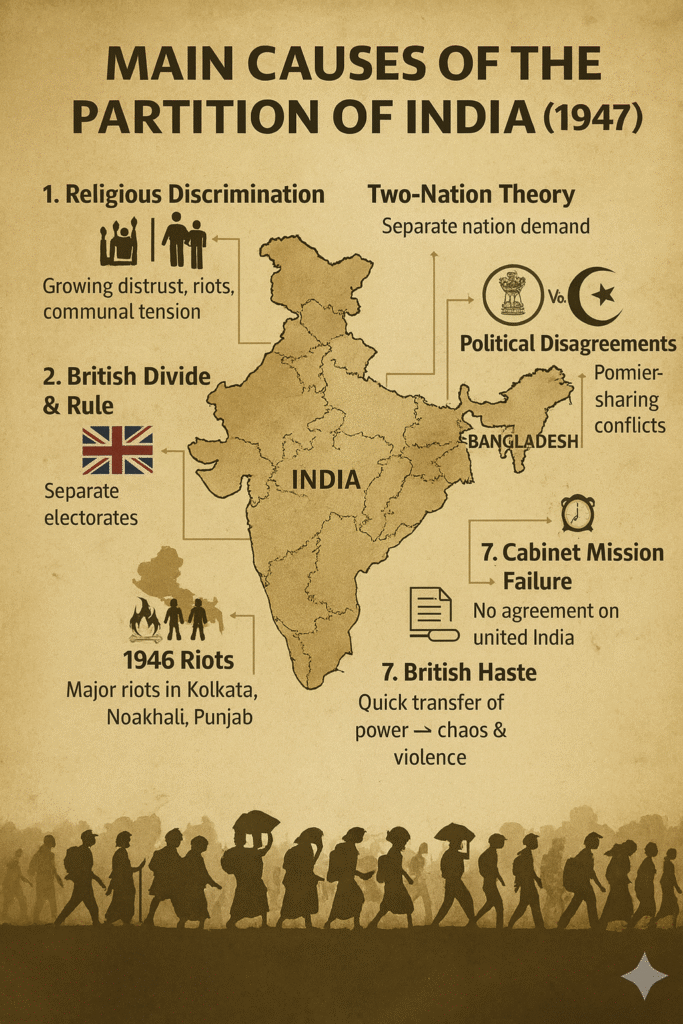
The Partition of India (1947) had many deep and complex causes. These causes were linked to political, religious, social, and colonial policies. The main causes of the Partition of India are detailed below:

Main Causes of the Partition of India

1. 🕌 Religious Discrimination and Communalism

  • Growing religious distance between the Hindu and Muslim communities over the years.
  • Distrust and fear between the two communities towards each other.
  • Communal tensions and riots had been occurring since the 19th century, which strengthened the feeling of a separate nation.

2. 🏛️ Muslim League and the Two-Nation Theory

  • Mohammad Ali Jinnah and the Muslim League believed that Hindus and Muslims were two separate "nations."
  • The Lahore Resolution of 1940 demanded independent states in Muslim-majority areas.
  • According to the two-nation theory, Muslims have a distinct cultural, religious, and political identity, which cannot be preserved in a Hindu-majority India.

3. 🇬🇧 British Policy: 'Divide and Rule'

  • The British deliberately weakened Hindu-Muslim unity.
  • The Morley-Minto Reforms of 1909 and the Communal Award of 1932 introduced separate communal representation in the electoral system.
  • This encouraged communal politics and weakened unity.

4. ⚖️ Political Disagreements and Power Struggles

  • Constant disputes between the Congress and the Muslim League over power sharing.
  • Congress won a majority in the 1937 elections, while the Muslim League performed poorly in several provinces, contributing to political disagreements.
  • The Muslim League feared that Muslims would be politically disadvantaged in independent India.
Product available on Amazon
Recommended Amazon Product

Reliable and well-reviewed product trusted by buyers. Check the latest price and availability on Amazon.

Check Price on Amazon

5. 🔥 Communal Riots of 1946 and Direct Action Day

  • The Muslim League called for 'Direct Action Day' on August 16, 1946.
  • Horrific communal riots broke out in Kolkata, Noakhali, Bihar, and Punjab.
  • This violence severely weakened the remaining prospects of Hindu-Muslim political unity.

6. 📜 Failure of the Cabinet Mission (1946)

  • The British government made a final effort to keep India united, but agreement between the Congress and the Muslim League failed.
  • The Muslim League eventually withdrew its acceptance of the plan and renewed its demand for Pakistan.

7. ⏳ Britain's Haste and the Partition Plan

  • Britain was economically weakened after World War II.
  • It decided to transfer power from India as quickly as possible.
  • Lord Mountbatten announced the Partition Plan on June 3, 1947. The accelerated transfer of power created serious administrative challenges and contributed to the chaotic conditions surrounding Partition.

Conclusion

The Partition of India was the result of numerous historical events, religious differences, political disagreements, and colonial maneuvers. It was not merely a geographical division, but also a symbol of deep social and emotional pain that affected the lives of millions.
The Role of Religious Differences in the Partition of India

Religious differences were one of the important factors behind the Partition of India (1947). The religious, cultural, and social differences between Hindu and Muslim communities became increasingly politicized over the years and contributed to the circumstances that led to the division of British India.

1. What Were the Religious Differences?

India was a multi-religious country, with Hindus and Muslims being its two largest religious communities.

  • Different religious beliefs and practices.
  • Different customs, festivals, clothing, and food habits.
  • Different social structures and legal traditions, including Muslim Personal Law.

These differences were further influenced by political developments and colonial rule, rather than automatically leading to social division.

2. Growing Distrust on Religious Basis

  • Issues such as cow slaughter and temple-mosque disputes contributed to communal tensions.
  • Sections of the Muslim community feared that the Hindu majority could dominate political institutions in independent India.
  • Many Hindus opposed the Muslim League's demand for a separate nation.

3. Communal Riots and Violence

  • Hindu-Muslim riots occurred in different regions, including Kolkata, Kanpur, Punjab, and Bengal.
  • After Direct Action Day in 1946, severe communal violence erupted, further weakening efforts to maintain political unity.

4. The Muslim League and the Demand for a Separate Nation

  • The Muslim League increasingly argued that Muslims constituted a separate political nation with distinct religious, cultural, and political interests.
  • Muhammad Ali Jinnah became the leading advocate of the Muslim League's two-nation position.
  • The two-nation theory became an important ideological foundation of the demand for Pakistan.

Conclusion

Religious differences were not merely a matter of faith; they became closely connected with political representation, communal organizations, and colonial policies. These developments contributed to one of the most painful chapters in India's history—the Partition of 1947.

The Muslim League's Demands and Its Role in the Partition of India

The Muslim League was one of the most prominent political forces in the Partition of India. Its demands and ideology shaped the political developments that ultimately led to India's partition in 1947.

1. Establishment of the Muslim League

  • Establishment: December 30, 1906, Dhaka (Bengal).
  • Objective: To protect the political rights and interests of Muslims and initially maintain cooperation with the British government.
  • Early Leadership: Aga Khan, Nawab Salimullah, Mohsin ul Mulk, and others.

2. Evolution of the Muslim League's Demands

Early Period (1906–1930)

  • Initially maintained political distance from the Congress, although cooperation between the organizations also occurred at different times.
  • Demanded separate electorates for Muslims, introduced under the Morley-Minto Reforms of 1909.
  • Initially pursued constitutional safeguards and political representation for Muslims.

Changes After 1930

  • In 1930, Allama Iqbal presented an important vision for the consolidation of Muslim-majority areas in north-western India.
  • The Muslim League performed poorly in the 1937 elections in several provinces, contributing to its concerns about Muslim political representation.

3. Lahore Resolution (1940) – Demand for Pakistan

  • Passed on March 23, 1940, at the Lahore session of the Muslim League.
  • The resolution called for independent states in the Muslim-majority areas of north-western and eastern India.
  • This marked a major turning point in the development of the demand that eventually led to Pakistan.

4. Jinnah's Role and the Two-Nation Theory

  • Jinnah transformed the Muslim League into a powerful political force.
  • He strongly argued that Hindus and Muslims had distinct religious, cultural, historical, and political identities.
  • This position became the ideological basis of the Muslim League's two-nation theory.

5. Direct Action Day (August 16, 1946)

  • The Muslim League called for Direct Action Day to press its demand for Pakistan.
  • This was followed by devastating communal riots in Kolkata and other regions.

6. Mountbatten Plan and Partition

  • The Muslim League accepted the Mountbatten Plan announced on June 3, 1947.
  • Pakistan became independent on August 14, 1947, and India on August 15, 1947.

Conclusion

The Muslim League's demand was not merely a political one; it developed into an ideological movement centered on the separate identity, political rights, and security of Muslims. Its demand for a separate homeland played a major role in the Partition of British India and changed the lives of millions of people.

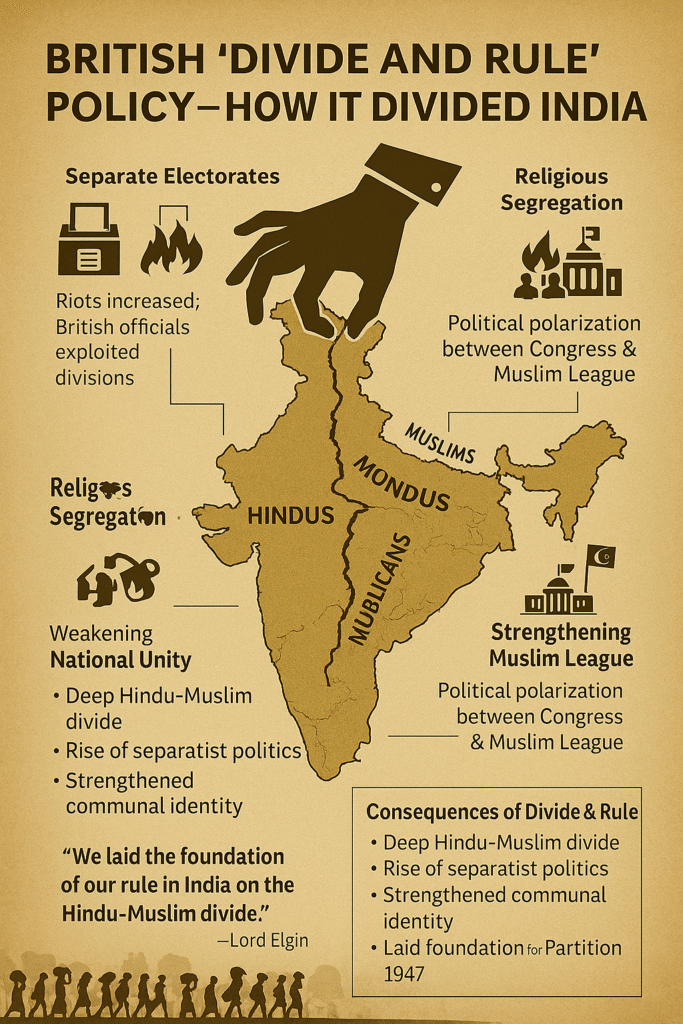
“British ‘Divide and Rule’ Policy – How It Divided India”

British 'Divide and Rule' Policy

"Divide and Rule" was a strategy used by the British Empire to maintain its control over India by exploiting divisions within Indian society along religious, ethnic, linguistic, and regional lines. This policy contributed to growing political divisions and tensions between communities and formed part of the historical background to the Partition of India (1947).

1. Objective of the Policy

The British government's primary objective was to weaken organized opposition to colonial rule by exploiting existing social and political divisions.

  • Encouraged political and ideological divisions between different religious communities.
  • Used differences involving caste, religion, and regional identities to influence political representation.

2. How Was the Policy Used?

(a) Separate Electorates

  • Morley-Minto Reforms of 1909:
    • Introduced separate electorates for Muslims, allowing Muslim voters to elect Muslim representatives.
    • Institutionalized communal representation in the colonial electoral system.
  • Communal Award of 1932:
    • Provided separate electoral arrangements for several communities, including Muslims, Sikhs, and Depressed Classes.
    • Gandhi opposed separate electorates for the Depressed Classes, leading to negotiations that resulted in the Poona Pact of 1932.

(b) Role in Communal Riots

  • Colonial administration was often criticized for failing to prevent or adequately control communal violence.
  • Administrative decisions and political policies sometimes intensified existing community tensions.

(c) Religious Segregation in Institutions and Education

  • Colonial policies and recruitment practices sometimes reflected regional, caste, and community identities in education, the army, and administration.
  • These practices contributed to the development of separate political and social identities.

3. Consequences

  • Hindu-Muslim unity associated with the Revolt of 1857 gradually weakened amid later political developments.
  • Political polarization between the Muslim League and the Congress increased.
  • Communal identities increasingly influenced political representation and debates about nationalism.
  • These developments contributed to the circumstances that eventually led to the Partition of India.

4. Important Quotes

The phrase "Divide and Rule" is widely used to describe British colonial strategies. Specific quotations attributed to Lord Elgin should be included only after verifying their original source.

Conclusion

British colonial policies contributed to political and social divisions within Indian society. The use of separate electorates and community-based political representation influenced the development of communal politics. These policies formed one part of the complex historical background to the Partition of 1947.

The Role of Political Instability in the Partition of India

The Partition of India (1947) was not solely due to religious reasons; political instability was also a major factor. In the final years of British rule, disagreements between the Congress, the Muslim League, and the British government created an unstable political environment.

1. What Was Political Instability?

Political instability means:

A situation in which persistent disagreements over leadership, decision-making, political cooperation, and government formation weaken the functioning of institutions.

This situation became increasingly visible in Indian politics during the 1940s:

  • Lack of trust between the Congress and the Muslim League.
  • Disagreements over British constitutional proposals and political arrangements.
  • Lack of agreement among political leaders about the future structure of independent India.

2. Main Causes of Political Instability

(a) Conflict Between the Congress and the Muslim League

  • The Muslim League wanted recognition as the principal representative of Indian Muslims.
  • The Congress claimed to represent Indians across religious communities.

(b) 1937 Provincial Elections

  • The Congress performed strongly and formed ministries in several provinces.
  • The Muslim League performed poorly in several provinces and became increasingly concerned about its political position and Muslim representation.

(c) Failure of the Cabinet Mission (1946)

  • The British government's final major attempt to preserve India's unity through a constitutional arrangement.
  • Disagreements between the Congress and the Muslim League over constitutional provisions, provincial grouping, and power-sharing weakened the plan.
  • The Muslim League eventually withdrew its acceptance of the plan and renewed its demand for Pakistan.

(d) Conflict in the Interim Government

  • The Interim Government included representatives of both the Congress and the Muslim League.
  • Differences between the two political groups affected cooperation and decision-making.
  • Political disagreements made the functioning of the government difficult.

3. Consequences of Instability

  • The constitution-making process faced serious political obstacles.
  • Communal tensions and riots increased.
  • The Muslim League's Direct Action Day call in 1946 was followed by widespread communal violence.
  • The British government moved towards the transfer of power and the Partition Plan.

Conclusion

Political instability played an important role in the Partition of India. Lack of communication, mutual distrust, and disagreements over constitutional arrangements pushed the country towards partition. This instability was not merely a leadership failure but the result of deep and long-standing political conflicts.

The 1946 Riots—Direct Action Day and Its Terrible Consequences
Product available on Amazon
Top Rated Amazon Product

High-quality and trusted product with positive customer feedback. Check the latest price and availability on Amazon.

View on Amazon

The communal riots of 1946, just before the Partition of India, were among the most horrific and significant events in modern Indian history. The violence began with the Muslim League's call for "Direct Action Day" on August 16, 1946, aimed at strongly advocating for Pakistan.

Background: The Demand for Pakistan and the Cabinet Mission

  • The Cabinet Mission Plan (1946) was a major attempt to preserve India's unity.
  • The Congress and the Muslim League could not reach an agreement on the implementation of the plan.
  • Following the failure of negotiations, the Muslim League announced Direct Action. Jinnah declared that the League would pursue direct action to achieve its political objectives.

Direct Action Day — August 16, 1946

  • The Muslim League organized Direct Action Day as a demonstration of political strength.
  • Place: Calcutta (now Kolkata), where a major Muslim League rally was held.
  • Objective: To demonstrate support for the demand for Pakistan and put political pressure on the British government and Congress.

What Happened on Direct Action Day?

1. Terrible Communal Riots (Kolkata Riots)

  • From August 16 to 19, 1946, severe communal violence erupted in Kolkata.
  • Homes, shops, and religious sites were attacked and burned during the violence.
  • People were attacked and killed, and incidents of arson, looting, and sexual violence were reported.

2. Death and Destruction

  • Approximately 4,000–5,000 people were killed, according to commonly cited historical estimates.
  • Thousands of people were injured.
  • Large numbers of people were displaced and left homeless.

This episode is widely known as the Great Calcutta Killing.

Noakhali and Bihar Riots (1946)

The communal violence of 1946 was not limited to Kolkata. Serious outbreaks of violence also occurred in other regions.

Noakhali (East Bengal – now Bangladesh)

  • In October 1946, large-scale communal attacks targeted Hindu communities in Noakhali.
  • People were killed, displaced, and subjected to violence and coercion.

Bihar Riots

  • In October and November 1946, communal violence against Muslims occurred in several parts of Bihar.
  • Many people were killed, injured, displaced, and their homes and settlements were attacked.

Consequences

  • Trust between Hindu and Muslim communities suffered a severe setback.
  • Communal polarization and political distrust increased.
  • The British government and Indian political leaders faced growing pressure to find a political settlement.
  • The violence strengthened the belief among several political leaders that maintaining a united India would be extremely difficult.

Conclusion

The riots of 1946, especially Direct Action Day, were an important turning point in the events leading to the Partition of India. The violence intensified communal polarization and weakened the possibility of a political settlement between the Congress and the Muslim League. These events contributed to the political and social conditions that preceded the division of British India in 1947.

The Process of Partition of India (1947)

The Partition of India was not a one-day event; rather, it was a political, administrative, and constitutional process. This process developed after years of political disagreements, communal tensions, and the failure of constitutional negotiations. It culminated in the creation of India and Pakistan as two independent Dominions in August 1947.

1. Background

  • 1940: The Muslim League adopted the Lahore Resolution, calling for independent states in Muslim-majority areas.
  • 1946: The failure of the Cabinet Mission Plan and communal violence following Direct Action Day intensified political tensions.
  • By early 1947, political negotiations had reached a serious deadlock, and the prospect of Partition became increasingly likely.

2. Mountbatten Plan (June 3, 1947)

The foundation for the final transfer of power and the Partition of British India was laid through the June 3 Plan, also known as the Mountbatten Plan.

  • British India would be divided into two Dominions: India and Pakistan.
  • Punjab and Bengal would be divided through legislative voting procedures, with separate arrangements for their respective regions.
  • Both India and Pakistan would initially become Dominion states within the British Commonwealth.
  • The existing Constituent Assembly would frame India's Constitution, while a separate Constituent Assembly would be established for Pakistan.

3. Indian Independence Act (18 July 1947)

The Indian Independence Act, passed by the British Parliament on July 18, 1947, provided the legal framework for the creation of the two independent Dominions.

  • India and Pakistan would become independent Dominions from August 15, 1947.
  • British sovereignty and authority over British India would end.
  • The Act provided for the division of British Indian territories and the establishment of separate constitutional arrangements.
  • Boundary Commissions were appointed to determine the boundaries of Punjab and Bengal.

4. Boundary Commission

  • Sir Cyril Radcliffe was appointed chairman of the boundary commissions for Punjab and Bengal.
  • He was given a very short period to complete the boundary demarcation, despite having no previous experience of India's geographical and social conditions.
  • The Radcliffe Award was announced on August 17, 1947, after India and Pakistan had become independent.

Consequences of Boundary Demarcation:

  • Many villages, towns, and agricultural lands were divided by the newly drawn borders.
  • Millions of people found themselves on the other side of the newly established international boundary.
  • Uncertainty, displacement, communal violence, and administrative disruption increased across the affected regions.

5. Population Migration and Violence

  • Approximately 15 million people migrated between India and Pakistan during Partition, including Hindus, Muslims, and Sikhs.
  • Estimates of deaths vary widely, with some historical estimates reaching around one million.
  • Abductions, sexual violence, murders, and attacks on refugee trains became tragic features of the Partition.
  • Millions of families lost their homes, property, livelihoods, and social connections.

6. Independence of India and Pakistan

  • August 14, 1947: Pakistan became an independent Dominion. Muhammad Ali Jinnah became its first Governor-General.
  • August 15, 1947: India became an independent Dominion. Jawaharlal Nehru became its first Prime Minister.

Conclusion

The process of India's Partition was completed through political agreements, constitutional legislation, and administrative arrangements. However, it was accompanied by an immense human tragedy. The Partition of 1947 remains one of the most painful and decisive turning points in the history of the Indian subcontinent.

3 June 1947 Plan (Mountbatten Plan / 3rd June Plan)

The 3 June 1947 Plan, also known as the "Mountbatten Plan," was the official plan for the partition and transfer of power in British India. It provided the framework for the creation of two independent Dominions, India and Pakistan. The plan was presented by British Viceroy Lord Mountbatten.

Objective of the Plan

Following the growing political crisis in India, communal violence, and the failure of negotiations between the Congress and the Muslim League, the British government decided to transfer power through the partition of British India.

Key Points – Major Provisions of the June 3rd Plan

1. Partition of India Accepted

  • Decision to divide British India into two Dominions:
    • India
    • Pakistan

2. Freedom of Decision for Provinces

  • Legislative Assemblies in Punjab and Bengal were to vote on whether their provinces should be divided.
  • Sindh's Legislative Assembly was to decide whether to join the Constituent Assembly of India or Pakistan.
  • The North-West Frontier Province (NWFP) was to decide through a referendum whether to join India or Pakistan.
  • Separate arrangements were also made for Sylhet in Assam through a referendum.

3. Demarcation of Boundaries

  • Boundary Commissions were established to demarcate the borders of Punjab and Bengal.
  • Sir Cyril Radcliffe was appointed chairman of both Boundary Commissions.

4. Two Independent Dominions

  • India and Pakistan would become independent Dominions within the British Commonwealth.
  • Both countries would have separate Constituent Assemblies to frame their constitutional arrangements.

5. Status of Princely States

  • British paramountcy over princely states would lapse when power was transferred.
  • Princely states were expected to consider accession to India or Pakistan based on relevant geographical and political circumstances.
  • The plan did not provide an unrestricted legal right for princely states to remain independent under the new arrangement.

6. Date Fixed for Transfer of Power

  • The transfer of power was scheduled for August 15, 1947.

Plan Announced

The plan was announced on June 3, 1947, by British Prime Minister Clement Attlee, Lord Mountbatten, and representatives of the major political groups, including Jawaharlal Nehru, Muhammad Ali Jinnah, and Sikh leader Baldev Singh.

Results of the Mountbatten Plan

  • The Indian Independence Act, 1947, was passed by the British Parliament.
  • India and Pakistan emerged as two independent Dominions.
  • Punjab and Bengal were partitioned.
  • Millions of people were displaced, and widespread communal violence occurred during Partition.

Conclusion

The June 3rd Plan was a pivotal moment in Indian history. It provided the framework for independence but also led to the Partition of British India. Although it established a constitutional route for the transfer of power, the process was accompanied by immense human suffering, communal violence, and the displacement of millions.

15 August 1947: India's Independence Day

15 August 1947 is the historic day when India gained independence from British colonial rule and emerged as an independent Dominion. This day is celebrated every year as Independence Day in India.

Significance of August 15, 1947

  • End of British Rule: Marked the end of British colonial authority over British India.
  • Partition of India: Pakistan also emerged as an independent Dominion in August 1947.
  • Transfer of Power: Political authority was transferred to the new Indian government.
  • Constitutional Development: The Constituent Assembly continued its work towards drafting the Indian Constitution.

Major Events

In India 🇮🇳

  • Jawaharlal Nehru delivered his historic "Tryst with Destiny" speech in the Constituent Assembly in New Delhi.
  • India became a Dominion within the British Commonwealth.
  • Jawaharlal Nehru became the first Prime Minister of independent India.

In Pakistan 🇵🇰

  • Muhammad Ali Jinnah became Pakistan's first Governor-General.
  • Pakistan emerged as an independent Dominion on August 14, 1947.

Challenges After Independence

  • The Partition led to the displacement of nearly 15 million people.
  • Widespread communal riots and violence affected millions of people.
  • India faced the challenge of establishing its administrative system, government institutions, and constitutional framework.
  • The integration of princely states became a major political and administrative challenge.

Nehru's Speech on August 14–15, 1947 (Tryst with Destiny)

Jawaharlal Nehru delivered his famous "Tryst with Destiny" speech in the Constituent Assembly shortly before midnight on August 14, 1947, as India approached independence.

"At the stroke of the midnight hour, when the world sleeps, India will awake to life and freedom."

Conclusion

August 15, 1947, is a proud day in Indian history, bringing freedom while also marking the beginning of a difficult period of Partition and human tragedy. This day reminds us of the sacrifices made during the freedom struggle and the importance of national unity.

Pakistan Was Divided into Two Parts

Product available on Amazon
Amazon Recommended Product

Well-built and trusted product with positive customer feedback. Check the latest offers and availability on Amazon.

Check Price on Amazon

After the Partition of India, Pakistan consisted of two geographically separated regions. Understanding this division is important because it deeply influenced Pakistan's politics and history in the decades that followed.

Two Parts of Pakistan

1. West Pakistan

  • The western part of Pakistan, which later continued as the present-day Pakistan.
  • Included Punjab, Sindh, Balochistan, and NWFP (now Khyber Pakhtunkhwa).
  • Located to the west of India.

2. East Pakistan

  • Present-day Bangladesh.
  • Consisted mainly of the eastern part of Bengal, which became part of Pakistan in 1947.
  • Located east of India and separated from West Pakistan by approximately 1,600 kilometres of Indian territory.

Why Was Pakistan Divided into Two Parts?

  • Pakistan was created on the basis of the demand for a separate homeland for Muslims, but its Muslim-majority territories were geographically separated.
  • Muslim-majority regions of western Punjab and eastern Bengal became parts of Pakistan.
  • These two regions were not geographically connected, as Indian territory lay between them.

Impact and Challenges

1. Political and Administrative Difficulties

  • Administration was difficult because of the vast geographical distance separating the two regions.
  • Bengali-speaking people formed the majority in East Pakistan, while Punjabi, Sindhi, Pashtun, and other communities lived in West Pakistan.
  • Cultural, linguistic, and regional differences created further political tensions.

2. Economic Inequality

  • West Pakistan dominated much of the country's political and administrative power.
  • People in East Pakistan increasingly felt economically and politically neglected.
  • Disagreements over resource allocation, representation, and economic development deepened regional tensions.

3. The Birth of Bangladesh (1971)

  • Growing political, linguistic, and economic grievances in East Pakistan led to a major autonomy and liberation movement.
  • The Bengali Language Movement and the political crisis of 1970–71 played important roles in the struggle.
  • Following the Liberation War of 1971, East Pakistan became independent as Bangladesh on December 16, 1971.

In Brief

West PakistanEast Pakistan
Punjab, Sindh, Balochistan, and NWFPEastern Bengal (present-day Bangladesh)
Located west of IndiaLocated east of India
Dominated the central political and administrative institutionsHad a Bengali-speaking population majority
Continued as Pakistan after 1971Became independent in 1971 as Bangladesh

The division of Pakistan in 1971 demonstrated how geographical separation, political inequality, linguistic differences, and economic grievances could contribute to the breakup of a country.

Consequences of the Partition of India

The Partition of India had profound and wide-ranging consequences, affecting society, politics, and the economy—not only at the time but for decades to come.

1. Human Tragedy and Displacement

  • Approximately 14–18 million people were displaced during the Partition.
  • Large numbers of Hindu, Muslim, and Sikh communities became refugees between India and Pakistan.
  • Hundreds of thousands of people lost their lives. Some estimates suggest that the death toll may have reached one million or more.
  • Kidnapping, sexual violence, and atrocities against women increased during the communal violence.

2. Communal Violence

  • During and after the Partition, massive communal riots broke out in different parts of India and Pakistan.
  • Thousands of villages and towns were burned or destroyed.
  • Deep tension and hostility grew between the two countries.

3. Political and Administrative Impacts

  • India and Pakistan emerged as two independent nations in August 1947.
  • Both countries had to establish their own governments, administrative systems, and constitutional frameworks.
  • Geographical separation and political disputes between East and West Pakistan created long-term tensions, eventually contributing to the creation of Bangladesh in 1971.

4. Economic Losses

  • The economies of both countries were affected by the Partition.
  • Trade routes and established commercial networks were disrupted.
  • Industries, agricultural areas, financial assets, and other resources were divided.
  • Both nations faced significant economic and rehabilitation challenges.

5. Social Impact

  • The social structure of the Indian subcontinent changed drastically.
  • Many communities were separated along religious lines.
  • Massive efforts were made to rehabilitate refugees, resettle displaced families, and restore social harmony.

6. Future Conflicts and Tensions

  • The Kashmir dispute emerged in the context of Partition and the accession of princely states.
  • The dispute contributed to multiple wars and conflicts between India and Pakistan.
  • Political tensions and mutual mistrust increased between the two nations.

In Summary

TypeConsequences
HumanitarianMillions displaced, mass deaths, and atrocities
CommunalLarge-scale riots and violence
PoliticalTwo nations formed, new governments, and new disputes
EconomicTrade disruption, divided resources, and economic losses
SocialSocial divisions and large-scale refugee rehabilitation
Long-termKashmir dispute and enduring India-Pakistan conflicts

Population Migration During the Partition of India

One of the most significant and painful consequences of the Partition of India was the massive displacement and migration of people. It is considered one of the largest forced migrations in modern history.

What Was Population Migration?

  • After Partition, Hindus, Sikhs, and Muslims migrated between India and Pakistan amid widespread violence and insecurity.
  • Millions of Muslims migrated from India to West Pakistan and East Pakistan.
  • Millions of Hindus and Sikhs migrated from Pakistan to India.

Statistics and Facts

Migrant GroupNumber (Approx.)
Muslims from India to PakistanApproximately 7–8 million
Hindus and Sikhs from Pakistan to IndiaApproximately 7–8 million
Total displacedApproximately 14–18 million people

Note: These figures are approximate. Estimates vary among historians and sources because migration occurred over several years and records were incomplete.

Problems During Migration

  • Violence and Riots: Attacks, massacres, sexual violence, and torture occurred during migration.
  • Train Atrocities: Refugee trains were attacked, and many passengers were killed.
  • Homelessness: Millions of people were left without shelter, food, or clothing.
  • Abduction and Assault of Women: Women on both sides experienced kidnapping, sexual violence, and other atrocities.

Major Routes of Migration

  • Large-scale migration took place between Indian Punjab and Pakistani Punjab.
  • Many people migrated between Sindh and different parts of India.
  • Migration also occurred between East Bengal (East Pakistan) and West Bengal (India).
  • Refugee camps were established in different parts of India to provide shelter and assistance to displaced people.

Consequences of Population Migration

  • A widespread humanitarian crisis unfolded across the subcontinent.
  • The social fabric of communities on both sides was severely damaged.
  • Tensions and hostility between India and Pakistan increased.
  • Both nations undertook massive efforts to rehabilitate refugees and resettle displaced families.

In Brief

SubjectDescription
Population DisplacementApproximately 14–18 million people were displaced
CausesPartition, communal violence, insecurity, and forced displacement
ProblemsViolence, massacres, homelessness, and refugee crisis
EffectsSocial disruption, rehabilitation challenges, and long-term tensions

Violence and Riots During the Partition of India

Popular Amazon product

Popular Amazon Product

Reliable and well-reviewed product trusted by buyers. Check the latest price, offers, and availability on Amazon.

View on Amazon

The violence and riots that occurred during the Partition of India made this historic event extremely tragic and painful. The violence was primarily driven by communal tensions and involved widespread attacks among Hindu, Muslim, and Sikh communities.

Causes of Violence and Riots

  • Religious and Communal Tensions: Long-standing religious and political differences escalated during the Partition.
  • Divide and Rule Policy: British colonial policies contributed to the growth of communal divisions.
  • Population Migration: Mass migration increased insecurity, fear, and violence in several regions.
  • Political Instability: The breakdown of political negotiations and uncertainty over the transfer of power increased tensions.
  • Ambiguity in Boundary Demarcation: The hurried announcement of the new boundaries created uncertainty and intensified violence in affected areas.

Nature of the Riots

  • Villages, towns, and cities were burned and destroyed.
  • Hundreds of thousands of people were killed in communal violence, according to many historical estimates.
  • Abduction, rape, and other forms of sexual violence against women were widespread.
  • Families were separated, and millions of people lost their homes and property.
  • Refugee trains were attacked, and some arrived at their destinations carrying the bodies of passengers killed during the journey. These became known as "trains of blood."

Major Riots and Violent Incidents

IncidentPlaceTimeDetails
Direct Action DayCalcutta, Bengal16 August 1946Large-scale communal violence following the Muslim League's call for Direct Action.
Punjab RiotsPunjab Province1947Widespread communal violence, killings, and forced migration during Partition.
Bengal Partition ViolenceBengal1946–1947Communal violence and displacement affected different parts of Bengal.
Delhi RiotsDelhi1947Communal attacks and violence against Muslims amid the arrival of refugees and mass displacement.

Impact of the Riots

  • Hundreds of thousands of people lost their lives, while many others were injured.
  • The social fabric of many communities was severely damaged.
  • Millions of people lost their homes, property, and livelihoods.
  • The refugee crisis worsened significantly.
  • Tension and hostility between India and Pakistan escalated.

Conclusion

The violence and riots of the Partition of India overshadowed the joy of independence and led to one of the worst human tragedies in modern South Asian history. This dark chapter reminds us of the importance of communal harmony, mutual understanding, and peace.

Refugee Crisis After the Partition of India

One of the most serious problems after the Partition of India was the refugee crisis. Millions of people left their homes and became refugees in the newly created nations, causing a widespread humanitarian and social crisis.

What Was the Refugee Crisis?

  • Hindus, Sikhs, and Muslims migrated between India and Pakistan following Partition.
  • Millions of people arrived in their new locations with little or no preparation and without basic necessities.
  • Many refugees lacked housing, employment, clean water, food, and medical facilities.

Refugee Crisis Statistics

CountryPeople Arriving (Approx.)
India (from Pakistan)Approximately 7–8 million
Pakistan (from India)Approximately 7–8 million

Note: These figures are approximate. Historical estimates vary depending on the period, region, and method used to calculate migration.

Major Problems Faced by Refugees

  • Housing Crisis: Many refugees lived in temporary camps, tents, or under the open sky.
  • Food and Health Issues: Shortages of food, clean drinking water, and sanitation increased the risk of disease.
  • Unemployment: Many displaced people lost their jobs, businesses, and sources of income.
  • Social Tensions: Pressure on housing, employment, and local resources sometimes created tensions between refugees and local communities.
  • Women's Safety: Many women experienced kidnapping, sexual violence, and other forms of abuse during and after migration.

Rehabilitation Efforts

  • India and Pakistan established temporary refugee camps and resettlement colonies.
  • Government departments and relief organizations provided food, shelter, medical assistance, and other essential services.
  • India introduced rehabilitation measures, including the allocation of housing and property to eligible displaced families.
  • Over time, many refugees rebuilt their lives and became part of the economic and social development of their new communities.

Impact of the Refugee Crisis

  • The social structures of communities in both countries changed drastically.
  • The economic and administrative burden increased in India and Pakistan.
  • Large-scale displacement transformed the demographic composition of several regions.
  • The human suffering and displacement deepened hostility and mistrust between the two nations.

In Summary

ProblemDescription
DisplacementMillions of people forced to leave their homes.
HousingMany refugees lived in temporary camps and shelters.
Food and HealthShortages of food, sanitation, and medical facilities.
EmploymentLoss of jobs, businesses, and livelihoods.
Social TensionsPressure on local resources and tensions in affected communities.
RehabilitationGovernment relief, resettlement, and rebuilding of lives.

The Kashmir Dispute — India-Pakistan's Longest and Most Complex Conflict

The Kashmir dispute is one of the most sensitive and long-standing issues between India and Pakistan. It emerged during the Partition of British India in 1947 and has remained a major source of political tension, military confrontation, and diplomatic disagreement between the two countries.

Geographic and Political Perspective of Kashmir

  • Kashmir is part of a wider Himalayan region that includes Jammu, the Kashmir Valley, and Ladakh.
  • At the end of British rule in 1947, Jammu and Kashmir was a princely state ruled by Maharaja Hari Singh, with a Muslim-majority population.
  • Following the end of British paramountcy, princely states were given the option to accede to India or Pakistan.
  • The Maharaja initially sought to maintain the independence of his state before signing the Instrument of Accession to India in October 1947.

Origin of the Dispute

  • In October 1947, armed tribal raiders from Pakistan's side entered Jammu and Kashmir.
  • Facing the invasion, Maharaja Hari Singh sought military assistance from India and signed the Instrument of Accession on 26 October 1947. India accepted it on 27 October 1947.
  • Indian troops were sent to the state, and fighting developed into the First India-Pakistan War (1947–1948).
  • The conflict subsequently became an issue before the United Nations Security Council.

Major Events in the Kashmir Dispute

YearEvent
1947Maharaja Hari Singh signed the Instrument of Accession in favour of India.
1947–1948First India-Pakistan War over Jammu and Kashmir.
1948United Nations Security Council adopted Resolution 47, recommending measures for restoring peace and creating conditions for a plebiscite.
1949India and Pakistan agreed on a ceasefire line under the Karachi Agreement.
1965Second India-Pakistan War.
1971–1972After the 1971 war, the Simla Agreement was signed in 1972, and the former ceasefire line was redesignated as the Line of Control (LoC).
1999Kargil War between India and Pakistan.
2019The former Indian state of Jammu and Kashmir was reorganised into the Union Territory of Jammu and Kashmir and the Union Territory of Ladakh.

United Nations Resolutions and the Plebiscite Proposal

  • In 1948, the United Nations Security Council adopted Resolution 47, recommending a sequence of measures to restore peace and create conditions for a free and impartial plebiscite in Jammu and Kashmir.
  • The proposed process included the withdrawal of tribesmen and Pakistani nationals who had entered the state to fight, followed by the reduction of Indian forces under the conditions described in the resolution.
  • The resolution envisaged a plebiscite to determine whether the state would accede to India or Pakistan.
  • The proposed process was never completed, and the plebiscite was not held.

Major Reasons for the Dispute

  • Geographical and Strategic Importance: Kashmir occupies a strategically important position in the Himalayas and is significant for regional security, borders, and water resources.
  • Political Claims: India and Pakistan have different positions regarding the status and future of the region.
  • Historical Circumstances: The Maharaja's accession to India, the conflict of 1947–1948, and subsequent international developments shaped the dispute.
  • Regional and Religious Identities: The region's diverse religious, cultural, and regional identities have influenced political debates and tensions.
  • Strategic and Security Concerns: Military deployments, cross-border tensions, and security concerns have made the dispute difficult to resolve.

Consequences and Impact of the Kashmir Dispute

  • It contributed to multiple wars and military confrontations between India and Pakistan.
  • Thousands of people have lost their lives, and many communities have experienced displacement and insecurity.
  • Diplomatic relations between the two countries have repeatedly deteriorated.
  • The region continues to face political, security, and development-related challenges.
  • The dispute remains an important issue in South Asian regional politics and international diplomacy.

Current Political and Territorial Status

  • India administers the Union Territory of Jammu and Kashmir and the Union Territory of Ladakh, created on 31 October 2019.
  • Pakistan administers territories known as Azad Jammu and Kashmir and Gilgit-Baltistan.
  • China controls areas of the wider former princely state, including Aksai Chin.
  • The Line of Control separates the Indian- and Pakistani-administered parts of the region; it is not recognised by both countries as an international border.

In Brief

AspectDescription
RegionFormer princely state of Jammu and Kashmir in the Himalayan region.
Origin of DisputePartition of 1947, accession of the princely state, and subsequent conflict.
Major Wars1947–1948, 1965, and Kargil War in 1999.
UN ResolutionSecurity Council Resolution 47 (1948), which recommended a process involving a proposed plebiscite.
Ceasefire LineEstablished under the 1949 Karachi Agreement.
Line of ControlRedesignated under the 1972 Simla Agreement.
Current StatusRegion is administered by India, Pakistan, and China in different parts; the dispute remains unresolved.

The Partition of India and Important Figures

Many political leaders, social reformers, and thinkers influenced the events leading to the Partition of India in 1947. Their political ideas, negotiations, decisions, and movements shaped the course of the freedom struggle and the eventual division of British India. Here are some important figures associated with the Partition and its historical background.

1. Mahatma Gandhi

  • Role: Leader of India's freedom struggle and advocate of nonviolence and communal harmony.
  • Views: Strongly opposed the Partition of India and supported Hindu-Muslim unity.
  • Contribution: Worked to reduce communal violence through peace missions, public appeals, and fasts in affected areas.

2. Jawaharlal Nehru

  • Role: Senior Indian National Congress leader and first Prime Minister of independent India.
  • Views: Favoured a united India but accepted Partition in 1947 after political negotiations failed.
  • Contribution: Participated in negotiations over the transfer of power and helped establish the government of independent India.

3. Muhammad Ali Jinnah

  • Role: Leader of the All-India Muslim League and the leading political figure behind the Pakistan Movement.
  • Political Position: Initially advocated Hindu-Muslim cooperation but later became the principal advocate of a separate political homeland for Muslims.
  • Contribution: Led the Muslim League's demand for Pakistan and became the first Governor-General of Pakistan in 1947.

4. Lord Mountbatten

  • Role: Last Viceroy of British India.
  • Responsibility: Oversaw the final transfer of British power and the Partition process.
  • Contribution: Announced the 3 June Plan in 1947, which provided the framework for the Partition of British India and the transfer of power.

5. Sir Syed Ahmad Khan

  • Role: Muslim educationist, social reformer, and founder of the Aligarh Movement.
  • Ideas: Promoted modern education, scientific learning, and social reform among Indian Muslims.
  • Historical Influence: His educational and intellectual movement influenced later Muslim political and social developments in British India. However, he died in 1898, before the formation of the All-India Muslim League in 1906.

6. Sardar Vallabhbhai Patel

  • Role: Senior Congress leader and India's first Deputy Prime Minister and Home Minister.
  • Political Position: Initially supported a united India but accepted Partition in 1947 as a political settlement amid the failure of negotiations and growing communal conflict.
  • Contribution: Played a major role in maintaining internal order, refugee rehabilitation, and the integration of princely states into the Indian Union.

7. Allama Muhammad Iqbal

  • Role: Poet, philosopher, and political thinker.
  • Ideas: In his 1930 Allahabad Address, he proposed the consolidation of Muslim-majority regions in north-western India into a self-governing political unit within a broader Indian framework.
  • Historical Influence: His political ideas later became an important intellectual influence on the Pakistan Movement. However, his proposal should not be treated as an exact blueprint for the Pakistan created in 1947.

Summary of Important Figures

NameRoleContribution or Influence
Mahatma GandhiCongress leader and advocate of nonviolenceOpposed Partition and worked for communal harmony.
Jawaharlal NehruCongress leader and first Prime MinisterParticipated in negotiations and accepted the 1947 Partition plan.
Muhammad Ali JinnahMuslim League leaderLed the political movement for Pakistan.
Lord MountbattenLast British ViceroyOversaw the transfer of power and implementation of the Partition plan.
Sir Syed Ahmad KhanEducationist and social reformerEstablished the Aligarh Movement and promoted modern education among Muslims.
Sardar Vallabhbhai PatelCongress leader and first Deputy Prime MinisterAccepted Partition and led the integration of princely states into India.
Allama Muhammad IqbalPoet and political thinkerPresented an influential proposal for a Muslim-majority political unit in north-western India.

Mahatma Gandhi — Leader of India's Freedom Struggle and Opponent of Partition

Full Name: Mohandas Karamchand Gandhi

Popular Names: Bapu and Mahatma Gandhi

Born: 2 October 1869, Porbandar, present-day Gujarat, India

Died: 30 January 1948, New Delhi, India

Biography of Mahatma Gandhi

Mahatma Gandhi was a major leader of India's freedom struggle, a political thinker, and an advocate of nonviolence. He developed and popularised the method of Satyagraha, based on truth and nonviolent resistance. His leadership played an important role in mobilising people against British colonial rule.

Mahatma Gandhi's Views on the Partition of India

  • Believed that India's unity and peaceful coexistence among different religious communities were essential.
  • Strongly opposed the Partition of India on communal grounds.
  • Was deeply saddened by the communal violence, displacement, and loss of life during Partition.
  • Worked to restore peace through visits to violence-affected areas, public appeals, prayers, and fasts.
  • Undertook a fast in Calcutta in 1947 amid communal violence and another fast in Delhi in January 1948 to promote communal harmony.

Gandhiji's Main Principles and Efforts

PrincipleDescription
Nonviolence (Ahimsa)Opposition to violence and the use of peaceful methods to resolve conflicts.
SatyagrahaResistance to injustice through truth, moral courage, and nonviolent action.
SwarajSelf-rule, political freedom, and individual responsibility.
Communal HarmonyPeaceful coexistence, mutual respect, and cooperation among different religious communities.

Contributions of Mahatma Gandhi

  • Played a leading role in the Non-Cooperation Movement, Civil Disobedience Movement, and Quit India Movement.
  • Worked for Hindu-Muslim unity and opposed communal hatred.
  • Visited violence-affected areas in Bengal, Bihar, and Delhi to promote peace.
  • Supported the rehabilitation of displaced people and efforts to restore communal harmony after Partition.
  • Mobilised ordinary people to participate in India's freedom struggle through nonviolent movements.

Death of Mahatma Gandhi

Mahatma Gandhi was assassinated by Nathuram Vinayak Godse on 30 January 1948 at Birla House in New Delhi while he was going to attend his evening prayer meeting. His assassination caused widespread grief across India and the world.

Mahatma Gandhi's Place in History

Mahatma Gandhi is widely known as the Father of the Nation in India and remains an influential global figure associated with nonviolence, civil resistance, and peace. His ideas and methods continue to be studied and discussed around the world.

Pandit Jawaharlal Nehru — India's First Prime Minister and Freedom Fighter

Full Name: Jawaharlal Nehru

Born: 14 November 1889, Allahabad, British India

Died: 27 May 1964, New Delhi, India

Biography of Pandit Nehru

Jawaharlal Nehru was a prominent leader of the Indian independence movement and became the first Prime Minister of independent India. A leading member of the Indian National Congress and a close associate of Mahatma Gandhi, Nehru played an important role in the freedom struggle and the establishment of India's democratic institutions.

Nehru's Role in the Partition of India

  • As a senior Congress leader and Congress President in 1946, Nehru participated in important negotiations concerning India's independence and constitutional future.
  • He supported the idea of a united and independent India but ultimately accepted Partition in 1947 amid political deadlock and growing communal violence.
  • He played a central role in the Interim Government formed in September 1946 and became India's first Prime Minister on 15 August 1947.
  • After Partition, his government faced major challenges, including refugee rehabilitation, communal violence, national integration, and economic reconstruction.

Nehru's Key Ideas and Ideals

TopicDescription
DemocracyEstablishing parliamentary democracy and representative institutions in India.
ModernisationPromoting science, technology, industrialisation, and modern education.
SecularismSupporting equal citizenship and freedom of religion in a diverse society.
Social ReformSupporting social equality, education, and the removal of discriminatory practices.
Economic PlanningPromoting planned economic development and Five-Year Plans.

Nehru's Contributions

  • Played a major role in India's freedom struggle, including the Quit India Movement of 1942.
  • Helped lead the Interim Government during the final phase of British rule.
  • Led the first government of independent India and supported the development of democratic institutions.
  • Promoted scientific research, higher education, industrial development, and economic planning.
  • Supported the Non-Aligned Movement and an independent foreign policy during the Cold War.
  • Contributed to the development of institutions and infrastructure for India's scientific and technological progress.

Nehru's India After Partition

  • His government organised relief and rehabilitation measures for millions of displaced people.
  • He faced the challenge of restoring communal harmony and maintaining national unity.
  • He dealt with the Kashmir dispute through diplomatic initiatives and military decisions during the 1947–1948 conflict.
  • He supported the integration of princely states and the establishment of a stable political system.

Conclusion

Jawaharlal Nehru was one of the leading figures of India's freedom struggle and the first Prime Minister of independent India. His leadership during the transition from British rule to independence and his contribution to democratic institutions, economic planning, education, and scientific development shaped the early years of modern India.

Muhammad Ali Jinnah — Founder of Pakistan and Leader of the Muslim League

Full Name: Muhammad Ali Jinnah

Born: 25 December 1876, Karachi, British India (present-day Pakistan)

Died: 11 September 1948, Karachi, Pakistan

Biography of Muhammad Ali Jinnah

Muhammad Ali Jinnah was a prominent lawyer and political leader who played a central role in the politics of British India. He initially advocated Hindu-Muslim cooperation and constitutional safeguards for political representation. Later, as the leading figure of the All-India Muslim League, he became the principal advocate of a separate Muslim homeland. After the Partition of British India in 1947, he became the first Governor-General of Pakistan.

Jinnah's Role in the Partition of India

  • Joined the All-India Muslim League in 1913 and later became its leading political figure.
  • Initially supported Hindu-Muslim cooperation and played an important role in the Lucknow Pact of 1916 between the Congress and the Muslim League.
  • Gradually shifted towards demanding stronger political safeguards and a separate political arrangement for Muslims.
  • Led the Muslim League during the negotiations surrounding the Cabinet Mission Plan of 1946.
  • Played a central role in the Muslim League's demand for Pakistan and the political developments leading to Partition.
  • Became the first Governor-General of Pakistan in August 1947.

Jinnah's Key Ideas and Political Beliefs

TopicDescription
Muslim Political RepresentationDemanded constitutional safeguards and effective political representation for Muslims in British India.
Two-Nation TheoryArgued that Muslims and Hindus constituted distinct political communities with different historical and cultural identities.
Demand for PakistanLed the Muslim League's political campaign for a separate homeland for Muslims.
Constitutional PoliticsInitially pursued political objectives through legal, constitutional, and negotiated methods.

Jinnah's Influence and Contributions

  • Strengthened the All-India Muslim League as a major political organisation.
  • Represented Muslim League demands in negotiations with the British government and the Indian National Congress.
  • Played a central role in the political developments surrounding the Lahore Resolution of 1940.
  • Led the Muslim League during the final negotiations over the transfer of power in 1946–1947.
  • Became Pakistan's first Governor-General and played an important role in establishing its new administration.

After Jinnah

  • Jinnah died on 11 September 1948, approximately one year after the creation of Pakistan.
  • His death removed a central political figure during the early years of Pakistan's state-building process.
  • He continues to be remembered in Pakistan as Quaid-e-Azam (Great Leader) and the founder of the country.

Summary

AspectDetails
Born25 December 1876
Main RoleLeader of the All-India Muslim League and founder of Pakistan.
Major Political ContributionLed the Muslim League's movement for Pakistan.
Position After PartitionFirst Governor-General of Pakistan.
Died11 September 1948

Frequently Asked Questions (FAQs) About the Partition of India

1. What was the Partition of India?

The Partition of India was the division of British India into two independent dominions—India and Pakistan—in August 1947. It was one of the most significant and tragic events in South Asian history, leading to widespread migration, communal violence, and major political changes.

2. What were the main causes of the Partition of India?

The major causes included growing communal tensions, the Muslim League's demand for Pakistan, British colonial policies, political disagreements between the Indian National Congress and the Muslim League, communal riots, and the failure of constitutional negotiations.

3. What was the Mountbatten Plan?

The Mountbatten Plan, announced on 3 June 1947 by Lord Mountbatten, proposed the partition of British India into two independent dominions—India and Pakistan. It provided the framework for the transfer of power in August 1947.

4. What were the major consequences of the Partition of India?

The Partition caused the displacement of approximately 14–18 million people, widespread communal violence, a major refugee crisis, economic disruption, the division of resources, and the emergence of the Kashmir dispute between India and Pakistan.

5. Who were the key leaders associated with the Partition?

The major political figures included Mahatma Gandhi, Jawaharlal Nehru, Muhammad Ali Jinnah, and Lord Mountbatten. Other influential figures included Sardar Vallabhbhai Patel, Liaquat Ali Khan, and Abul Kalam Azad. Their political decisions and leadership influenced the events leading to Partition.

6. Why is the Partition of India considered a human tragedy?

The Partition resulted in one of the largest forced migrations in modern history. It caused widespread displacement, communal violence, family separation, loss of property, and hundreds of thousands of deaths. Some historical estimates suggest that the death toll may have reached one million or more, although exact figures remain disputed.

7. What lessons can be learned from the Partition of India?

The Partition highlights the importance of communal harmony, secularism, peaceful dialogue, political cooperation, and respect for diversity. It serves as a reminder of the devastating consequences of communal hatred, political division, and violence.

Featured product available on Amazon

Recommended Product

Check the latest price, offers, customer reviews, and availability on Amazon.

View on Amazon

Lord Mountbatten — Last British Viceroy and Key Representative of India's Independence

Full Name: Louis Francis Albert Victor Nicholas Mountbatten, 1st Earl Mountbatten of Burma
Born: June 25, 1900, Windsor, England
Died: August 27, 1979, Mullaghmore, County Sligo, Ireland

Introduction to Lord Mountbatten

Lord Mountbatten was the last Viceroy of British India. He was appointed in March 1947 to oversee the transfer of power from British rule to independence. He played a significant role in the final negotiations that led to the independence and Partition of India and Pakistan in August 1947.

After independence, he continued as the first Governor-General of independent India until June 1948.

Mountbatten's Role in India's Partition

  • In March 1947, Britain appointed Mountbatten as the last Viceroy of British India to oversee the transfer of power.
  • He announced the Mountbatten Plan on June 3, 1947, which proposed the partition of British India into India and Pakistan.
  • The transfer of power took place in August 1947. India became independent on August 15, 1947, while Pakistan marked its independence on August 14, 1947.
  • He held discussions with the Indian National Congress, the Muslim League, and other political representatives.
  • He played a central role in accelerating the transfer of power, bringing British rule in India to an end.

Mountbatten's Challenges and Responsibilities

Task/ChallengeDescription
Creating the Partition PlanDeveloping the plan for the division of British India into India and Pakistan.
Communal ViolenceDealing with widespread communal violence and instability during the Partition period.
Transfer of PowerManaging the political transition from British rule to independence.
Princely StatesAddressing the future of more than 500 princely states. Sardar Vallabhbhai Patel and V.P. Menon played leading roles in their integration into India.

Impact of Mountbatten's Decisions

  • The rapid transfer of power and the hurried implementation of Partition contributed to administrative difficulties, displacement, and humanitarian suffering.
  • The Partition created India and Pakistan as separate independent dominions and left a lasting impact on relations between the two countries.
  • The rushed process, along with other political and administrative factors, contributed to the difficulties faced by millions of people during the migration and violence of 1947.
  • The Kashmir dispute emerged in 1947 and later became a major source of tension between India and Pakistan. The Line of Control was established under the Simla Agreement of 1972, not directly by the Partition itself.

Mountbatten's Later Life

  • After leaving India in 1948, Mountbatten continued his career in the British Royal Navy and held senior military positions.
  • He served as First Sea Lord and later as Chief of the Defence Staff of the United Kingdom.
  • On August 27, 1979, he was assassinated in a bombing carried out by the Provisional Irish Republican Army (IRA) while aboard his boat near Mullaghmore, Ireland.

Summary of Lord Mountbatten

Key DetailsInformation
BornJune 25, 1900
Position in British IndiaLast Viceroy of British India
Appointment as ViceroyMarch 1947
Mountbatten PlanJune 3, 1947
Main RoleOversaw the transfer of power and played a key role in the Partition process.
Governor-General of India1947–1948
DiedAugust 27, 1979

Conclusion: The Partition of India

The Partition of India in 1947 was one of the most significant political and social events in modern South Asian history. Alongside independence, it became a major humanitarian tragedy that caused widespread violence, displacement, and the loss of hundreds of thousands of lives. Historical estimates of deaths vary considerably.

Key Points

  • Causes of Partition: Political disagreements, communal tensions, British policies, the Muslim League's demand for Pakistan, and the failure of political negotiations.
  • Process: British India was divided into two independent dominions, India and Pakistan, through the Mountbatten Plan and the Indian Independence Act of 1947.
  • Consequences: Communal violence, mass migration, refugee crises, and long-term political tensions.
  • Role of Key Figures: Mahatma Gandhi, Jawaharlal Nehru, Muhammad Ali Jinnah, Sardar Vallabhbhai Patel, and Lord Mountbatten influenced the events surrounding independence and Partition.
  • Legacy: Partition continues to shape relations between India and Pakistan, particularly in relation to the Kashmir dispute.

Final Thoughts

The Partition of India profoundly shaped the history of the Indian subcontinent. It highlights the importance of democratic values, secularism, tolerance, and peaceful coexistence. The events of 1947 remain a reminder of the human cost of political conflict and the need to maintain social harmony and national unity.

Leave a Comment

Your email address will not be published. Required fields are marked *

Scroll to Top