
BRICS Summit 2026: India’s Role in the New World Order
As India prepares to host the BRICS Summit 2026, the world is witnessing a major transformation in global politics. At a time when debates over multipolarity, de-dollarisation, AI governance, and the rise of the Global South are reshaping international relations, the upcoming BRICS Summit could redefine the future of the global order.
India’s leadership is being closely watched as it attempts to balance strategic autonomy, economic cooperation, and global diplomacy. For UPSC aspIrants, the BRICS Summit 2026 is an important topic in International Relations, Global Governance, the World Economy, and India’s evolving foreign policy.
UPSC Perspective: BRICS Summit 2026 is expected to strengthen India’s global Influence and amplify the voice of developing nations in the emerging multipolar world.
“`
Official Source: BRICS India 2026 Official Website
What is BRICS?
BRICS is a major group of emerging economies formed to strengthen global economic, political, and strategic cooperation. The organisation is often viewed as an alternative platform to the Western-dominated global order and plays an increasingly important role in shaping international relations.
Establishment of BRICS
The term “BRIC” was first coined in 2001 by Goldman Sachs economist Jim O’Neill. The first BRIC Summit was held in 2009. Later, South Africa joined the group in 2010, after which the organisation became known as BRICS.
Member Countries of BRICS
- Brazil
- Russia
- India
- China
- South Africa
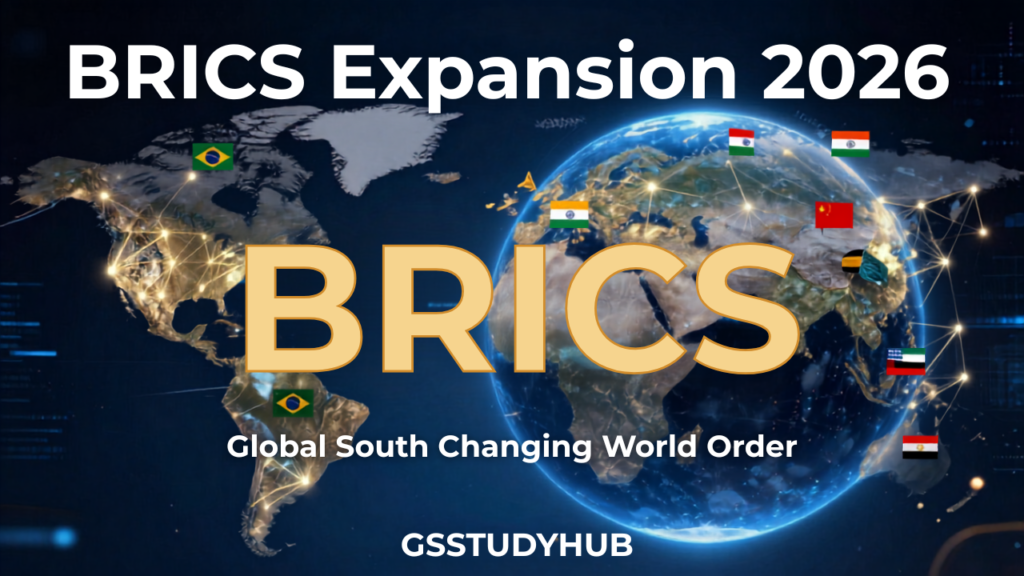
In recent years, BRICS has expanded further with the inclusion of countries such as Iran, UAE, Egypt, and Ethiopia, increasing its global Influence.
Main Objectives of BRICS
- Promoting global economic cooperation
- Strengthening the voice of developing countries
- Encouraging a multipolar world order
- Expanding trade, investment, and technological cooperation
- Advocating reforms in institutions like the IMF, World Bank, and UNSC
Why is BRICS Expansion Important?
The expansion of BRICS is considered a major shift in global geopolitics. With the addition of new member countries, BRICS is no longer just an economic grouping but is increasingly emerging as the collective voice of the Global South. The expansion also reflects growing demands for a more balanced and inclusive international order.
UPSC Quick Note: BRICS is highly important for topics related to International Relations, Global Governance, De-Dollarisation, and the Global South.
“`
Related UPSC Topics:
Why is the BRICS Summit 2026 Important?
BRICS Summit 2026 is not just another international conference; it represents a major shift in global politics, economic balance, and the rising Influence of developing nations. Under India’s leadership, the summit is expected to focus on critical issues such as Global South cooperation, AI Governance, De-Dollarisation, Climate Finance, and reforms in global institutions.
4.1 India’s Presidency
India will chair BRICS in 2026, highlighting its growing global Influence. As president, India is expected to strengthen the voice of developing countries and promote a more multipolar world order.
4.2 Global South Leadership
Global South leadership is likely to become one of the central themes of the BRICS Summit 2026. India may raise issues related to climate justice, food security, economic equality, and development financing for emerging economies.
4.3 AI Governance
Artificial Intelligence is rapidly transforming global politics and the world economy. India may encourage cooperation among BRICS nations on Ethical AI, Data Security, Digital Infrastructure, and inclusive technological development.
4.4 De-Dollarisation
In recent years, BRICS nations have intensified discussions on reducing dependence on the US Dollar. The group is exploring trade in local currencies and alternative payment systems to strengthen economic independence.
4.5 Climate Finance
Climate change remains one of the biggest challenges for developing countries. India may use the BRICS platform to push for greater climate funding, green energy cooperation, and sustainable development initiatives.
4.6 UNSC Reform
India has consistently called for reforms to the United Nations Security Council (UNSC). During the BRICS Summit 2026, India may strongly advocate for a more democratic and representative global governance system.
“`
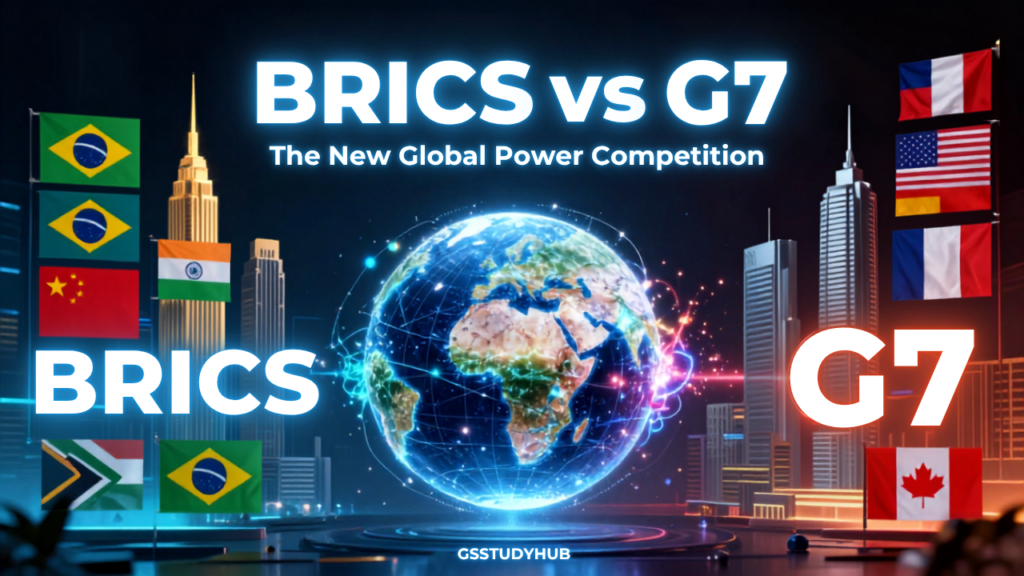
BRICS vs G7: The New Global Power Competition
The comparison between BRICS and G7 has become increasingly important in modern global politics. While BRICS represents emerging economies and the voice of the Global South, G7 reflects the traditional leadership of developed Western nations. This growing rivalry highlights the transition toward a more multipolar world order.
“`
Related Geopolitical Topics:
BRICS 2026: Key Data & Statistics
BRICS has emerged as one of the world’s most influential economic and strategic groups. The expanded BRICS+ now holds a significant share of the global Population, GDP, energy production, and international trade.
Major Benefits of BRICS
- Strengthened the global voice of developing nations
- Promoted trade in local currencies
- Increased infrastructure financing through the New Development Bank
- Enhanced cooperation among Global South countries
- Created new opportunities in AI, Digital Economy, and Technology Cooperation
- Emerged as an alternative platform to Western dominance
- Boosted collaboration in energy security, food security, and climate action
“`

Political & Physical Map Book for UPSC Preparation
Helpful for Geography, Mapping Practice, International Relations, and Current Affairs preparation.
BRICS Summit 2026: Major Opportunities for India
BRICS Summit 2026 is not just a diplomatic event for India; it is a historic opportunity to strengthen its global Influence and strategic position. The summit can help India expand its economic partnerships, diplomatic reach, technological leadership, and role in shaping the emerging multipolar world order.
Global Leadership
Through BRICS, India can strengthen the voice of the Global South and position itself as a leading power in the evolving multipolar world order. Successful leadership during the BRICS Summit 2026 could significantly enhance India’s international reputation.
Investment Opportunities
BRICS cooperation may help India attract foreign investment, infrastructure funding, and new technology partnerships. The New Development Bank (NDB) can also support major development projects across India.
Diplomacy & Strategic Influence
BRICS Summit 2026 offers India an opportunity to strengthen its strategic autonomy and diplomatic Influence. India can play a balancing role between Western powers and developing nations while expanding its geopolitical importance.
Trade Expansion
Increasing trade cooperation with BRICS nations could open new export markets and economic opportunities for India. Trade in local currencies and alternative payment systems may further strengthen India’s economic position.
Digital India Model
India’s UPI system, Digital Public Infrastructure, and Aadhaar-based governance model are increasingly being recognised globally. Through BRICS, India can expand its Digital India model to other developing nations and strengthen digital cooperation.
UPSC Mains Perspective: This section is highly important for understanding India’s foreign policy, Global South leadership, economic diplomacy, and strategic autonomy.
“`
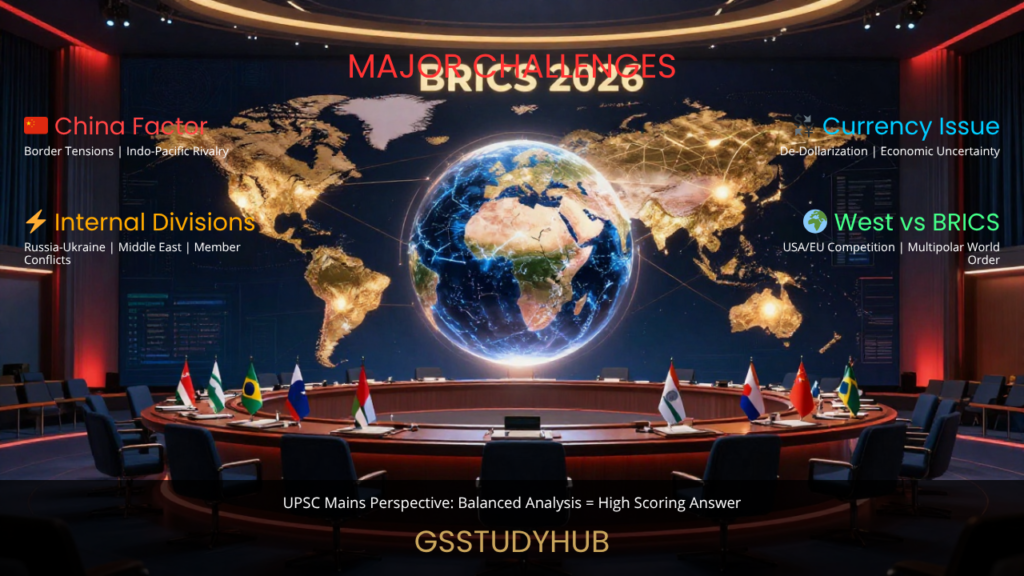
BRICS Summit 2026: Major Challenges
Although the BRICS Summit 2026 presents major opportunities for India, it also faces several important challenges. From a UPSC perspective, a balanced analysis is essential while discussing any international issue.
China Factor
Border disputes, strategic competition, and growing tensions in the Indo-Pacific region may make it difficult to maintain balance within BRICS. China’s economic and political Influence could significantly shape the organisation’s direction.
Internal Divisions
BRICS member countries often have different views on major global issues. Conflicts such as the Russia-Ukraine War, tensions in the Middle East, and global security concerns may create divisions within the group.
Currency Issue
BRICS nations have different approaches toward De-Dollarisation. While some countries strongly support alternatives to the US Dollar, India prefers a balanced and practical strategy.
West vs BRICS Rivalry
Growing competition between Western nations and BRICS could further complicate global politics. India’s challenge will be to maintain strong relations with Western countries while also playing a leading role within BRICS.
UPSC Mains Perspective: Including both opportunities and challenges makes an answer more balanced, analytical, and scoring in the UPSC examination.
“`
Related Geopolitical Topics:
➤ Pakistan-Iran Controversy & US Reaction Explained
➤ India Foreign Policy 2026: Strategy & Challenges
Future Outlook / Way Forward: The
BRICS Summit 2026 is not only a platform to discuss present global challenges but also an opportunity to shape the future world order. For India, it will be important to adopt a balanced strategy that strengthens economic growth, technological cooperation, and global leadership.
India’s Strategy
India will need to follow a balanced and practical approach within BRICS. While leading the Global South, India must also maintain strong economic and strategic relations with Western countries.
Multilateral Reforms
India should continue to push for reforms in global institutions such as the IMF, the World Bank, and the United Nations Security Council (UNSC). Such reforms would provide greater representation and decision-making power to developing nations.
Technology Cooperation
Cooperation in areas such as Artificial Intelligence, Digital Infrastructure, Cyber Security, and Innovation will be crucial for the future of BRICS. India can strengthen its technological leadership through initiatives like Digital India and the UPI model.
Strategic Autonomy
Strategic autonomy has remained a key pillar of India’s foreign policy. During the BRICS Summit 2026, India will need to protect its national interests without becoming overly dependent on any single global power bloc.
UPSC Mains Perspective: A strong “Way Forward” section makes an answer more visionary, balanced, policy-oriented, and highly scoring in the UPSC examination.
“`

LED Study Lamp for Long Study Hours
Helpful for night study, note-making, reading NCERTs, and reducing eye strain during long UPSC preparation sessions.
Conclusion
The world is rapidly moving toward a new era of shifting geopolitics, economic competition, and a multipolar global order. In such a situation, the BRICS Summit 2026 is not just another international conference for India, but a historic opportunity to help shape the global order of the 21st Century.
If India successfully promotes balanced diplomacy, technological leadership, economic cooperation, and the voice of the Global South, it can emerge as a responsible and influential global power in the coming decades.
The BRICS Summit 2026 is not only a platform to discuss present challenges, but also a symbol of India’s growing role in shaping the future world order.
“`
Must Read for UPSC Aspirants
- West Bengal Election 2026: Key Facts & Data Analysis
- BRICS Expansion & New World Order Explained
- India–Pakistan Border Tensions 2026
BRICS Summit 2026 – FAQ
Q1. Who will host the BRICS Summit 2026?
India will host the BRICS Summit 2026.
Q2. What is the main objective of BRICS?
The main objective of BRICS is to strengthen economic, political, and strategic cooperation among emerging economies and developing nations.
Q3. Which countries are members of BRICS?
BRICS includes Brazil, Russia, India, China, and South Africa. In recent years, the group has expanded to include new member countries.
Q4. What is De-Dollarisation?
De-Dollarization refers to reducing dependence on the US Dollar in international trade and financial transactions.
Q5. Why is BRICS important for UPSC preparation?
BRICS is an important topic for UPSC because it is related to International Relations, Global Governance, Economy, and Current Affairs
“`