
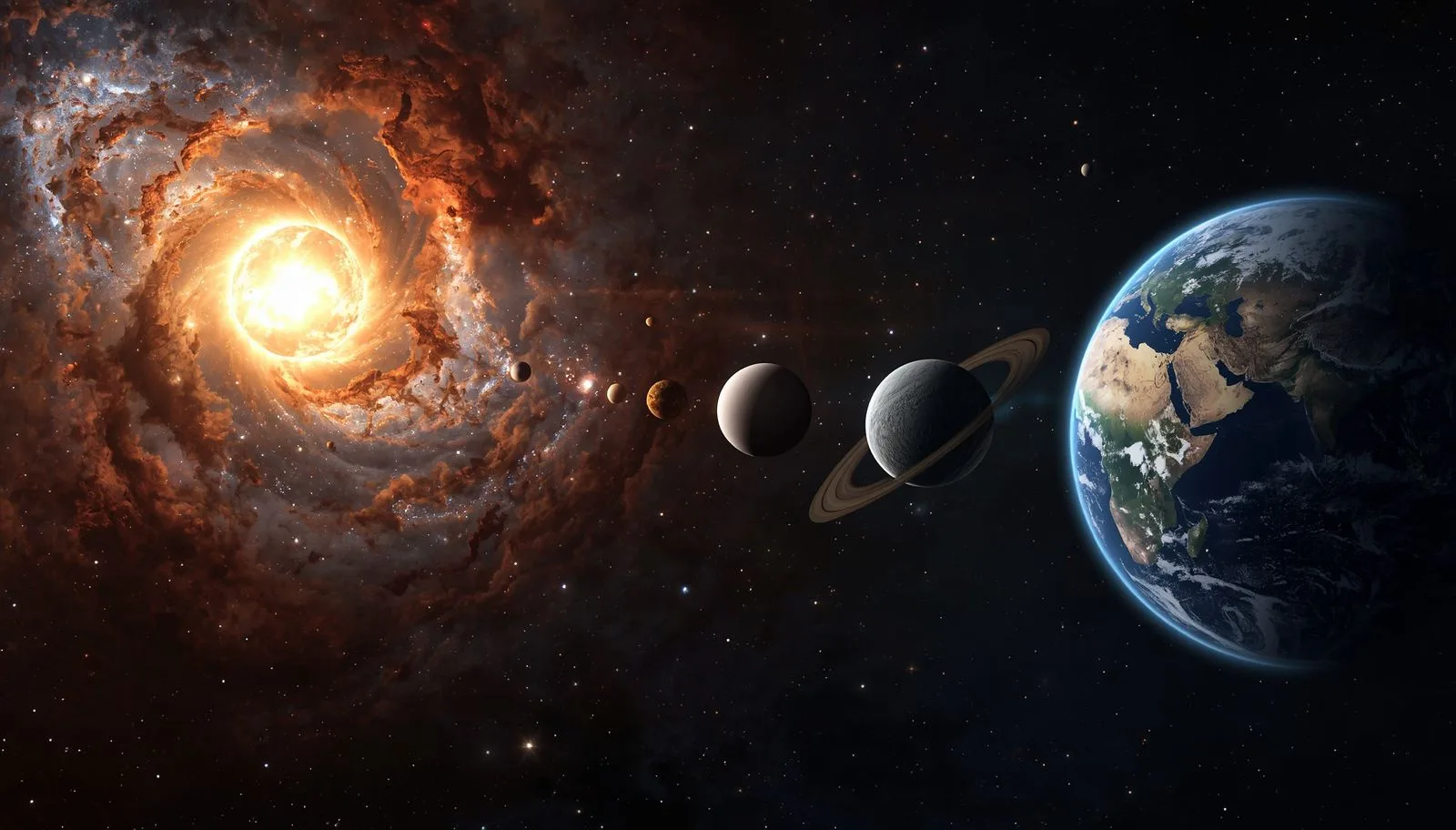
Theories of Earth Origin Introduction
Earth is the only known planet in our Solar System that supports life. It is not only the home of human civilization but also the habitat of millions of species of plants and animals. Understanding the origin and evolution of Earth is one of the most important areas of scientific research because it helps us understand the formation of the Universe, the Solar System, and the conditions that made life possible.
Importance of Earth
Earth is the third planet from the Sun and possesses unique physical and chemical characteristics that make life possible. The presence of liquid water, a protective atmosphere, suitable temperatures, and gravitational stability distinguishes Earth from other planets in the Solar System. These remarkable features make Earth a central subject of study for scientists seeking to understand planetary formation and the development of life.
Earth's Age: Approximately 4.54 Billion Years
According to modern scientific research, Earth is approximately 4.54 billion years old. This estimate has been determined through radiometric dating, a technique used to analyze the age of rocks, meteorites, and lunar samples. Studies indicate that Earth and the rest of the Solar System formed around the same time, roughly 4.6 billion years ago.
Why Is Studying Earth's Origin Important?
Investigating Earth's origin provides valuable insights into how planets form, how life emerged, and whether similar conditions may exist elsewhere in the Universe. Understanding Earth's early history also helps scientists explain geological processes, climate evolution, and the formation of natural resources that continue to shape our planet today.
- Helps explain the formation and evolution of the Solar System.
- Provides clues about the origin and development of life.
- Assists in the search for potentially habitable planets beyond Earth.
- Improves understanding of geological and climatic changes over time.
- Supports the validation and refinement of cosmological theories.
Relationship Between the Universe, Solar System, and Earth's Formation
To understand Earth's origin, it is essential to first understand the origins of the Universe and the Solar System. According to the widely accepted Big Bang Theory, the Universe began approximately 13.8 billion years ago from an enormous expansion of space, time, matter, and energy. Over billions of years, galaxies, stars, and cosmic clouds of gas and dust gradually formed.
Around 4.6 billion years ago, a vast cloud of gas and dust known as the Solar Nebula collapsed under its own gravity. This collapse led to the formation of the Sun at the center and a rotating disk of material around it. Within this disk, tiny particles collided and combined, eventually forming planets, moons, asteroids, and other celestial bodies.
Earth was formed through this process of accretion, where dust and rock particles gradually merged under gravitational forces to create larger bodies. Over time, these bodies combined to form the young Earth. Therefore, Earth's origin is directly connected to the formation of the Solar System and, ultimately, to the evolution of the Universe itself.
Studying Earth's formation allows scientists to better understand the history of our planet and provides valuable insights into the broader story of cosmic evolution.

⭐ Editor's Choice
Discover a well-reviewed product that combines quality, functionality, and everyday convenience. Explore its features and customer experiences to learn more.
1. Why Is the Study of Earth Origin Important?
The study of Earth's origin is one of the most important fields in planetary science and astronomy. Understanding how Earth formed helps scientists explain the evolution of our planet, the Solar System, and the Universe itself. It also provides valuable insights into the conditions that made life possible and supports ongoing research into the formation of other planets.
1.1 Understanding the Universe
Earth's formation is closely linked to the evolution of the Universe. By studying the origin of Earth, scientists gain a deeper understanding of how stars, galaxies, and planetary systems develop over time. This knowledge helps explain the large-scale structure and history of the cosmos.
1.2 Connection to the Origin of Life
Earth is the only known planet that supports life. Studying its early conditions allows scientists to investigate how life emerged from simple chemical compounds and evolved into complex organisms. This research also guides the search for life on other planets and moons.
1.3 Study of Geological Evolution
The formation of Earth marked the beginning of numerous geological processes, including the development of continents, oceans, mountains, and the atmosphere. Understanding Earth's origin helps scientists explain plate tectonics, volcanic activity, earthquakes, and the long-term evolution of the planet's surface.
1.4 Role in Modern Space Research
Modern space exploration relies heavily on knowledge gained from studying Earth's formation. Scientists compare Earth with other planets to understand planetary evolution, assess habitability, and identify worlds that may possess conditions suitable for life.
2. The State of the Universe Before the Formation of Earth
Long before Earth existed, the Universe had already undergone billions of years of evolution. Galaxies, stars, and cosmic structures formed well before the Solar System emerged. To understand Earth's origin, it is essential to first examine the origins and development of the Universe.
2.1 Big Bang Theory
Introduction to the Theory
The Big Bang Theory is the most widely accepted scientific explanation for the origin of the Universe. According to this theory, the Universe began in an extremely hot and dense state and has been expanding ever since.
The Event That Occurred 13.8 Billion Years Ago
Scientists estimate that approximately 13.8 billion years ago, the Universe originated from a massive cosmic event known as the Big Bang. This event marked the beginning of space, time, matter, and energy.
Expansion of the Universe
Following the Big Bang, the Universe expanded rapidly. As it expanded, temperatures decreased, allowing the formation of elementary particles, atoms, stars, galaxies, and eventually planetary systems. The Universe continues to expand even today.
Evidence
Several scientific observations strongly support the Big Bang Theory. These discoveries have made it the dominant model for explaining the origin and evolution of the Universe.
Evidence Supporting the Big Bang Theory
1. Cosmic Microwave Background Radiation (CMBR)
Cosmic Microwave Background Radiation is considered one of the strongest pieces of evidence for the Big Bang Theory. It is the faint thermal radiation left over from the early Universe and can be detected uniformly throughout space.
2. Red Shift
Light emitted from distant galaxies appears shifted toward the red end of the electromagnetic spectrum. This phenomenon, known as Red Shift, indicates that galaxies are moving away from one another, supporting the idea of an expanding Universe.
3. Expansion of Galaxies
Astronomical observations show that most galaxies are moving away from each other. The greater the distance between galaxies, the faster they appear to recede. This observation provides strong evidence for the continuous expansion of the Universe.
UPSC Facts
- Age of the Universe: Approximately 13.8 billion years.
- Age of the Solar System: Approximately 4.6 billion years.
- Age of Earth: Approximately 4.54 billion years.
- Most Accepted Theory of the Universe's Origin: Big Bang Theory.
- Major Evidence: CMBR, Red Shift, and Galactic Expansion.
Proposal of the Big Bang Theory
The fundamental concept of the Big Bang Theory was first proposed by Belgian physicist and astronomer Georges Lemaître in 1927. He suggested that the Universe originated from an extremely dense and compact state and has been expanding ever since.
Major Scientists
- Georges Lemaître – Originator of the Big Bang concept.
- Edwin Hubble – Provided evidence for the expansion of the Universe.
- George Gamow – Developed theoretical models of the early Universe.
- Arno Penzias and Robert Wilson – Discovered Cosmic Microwave Background Radiation in 1965.
- Stephen Hawking – Made significant contributions to cosmology and the study of the early Universe.
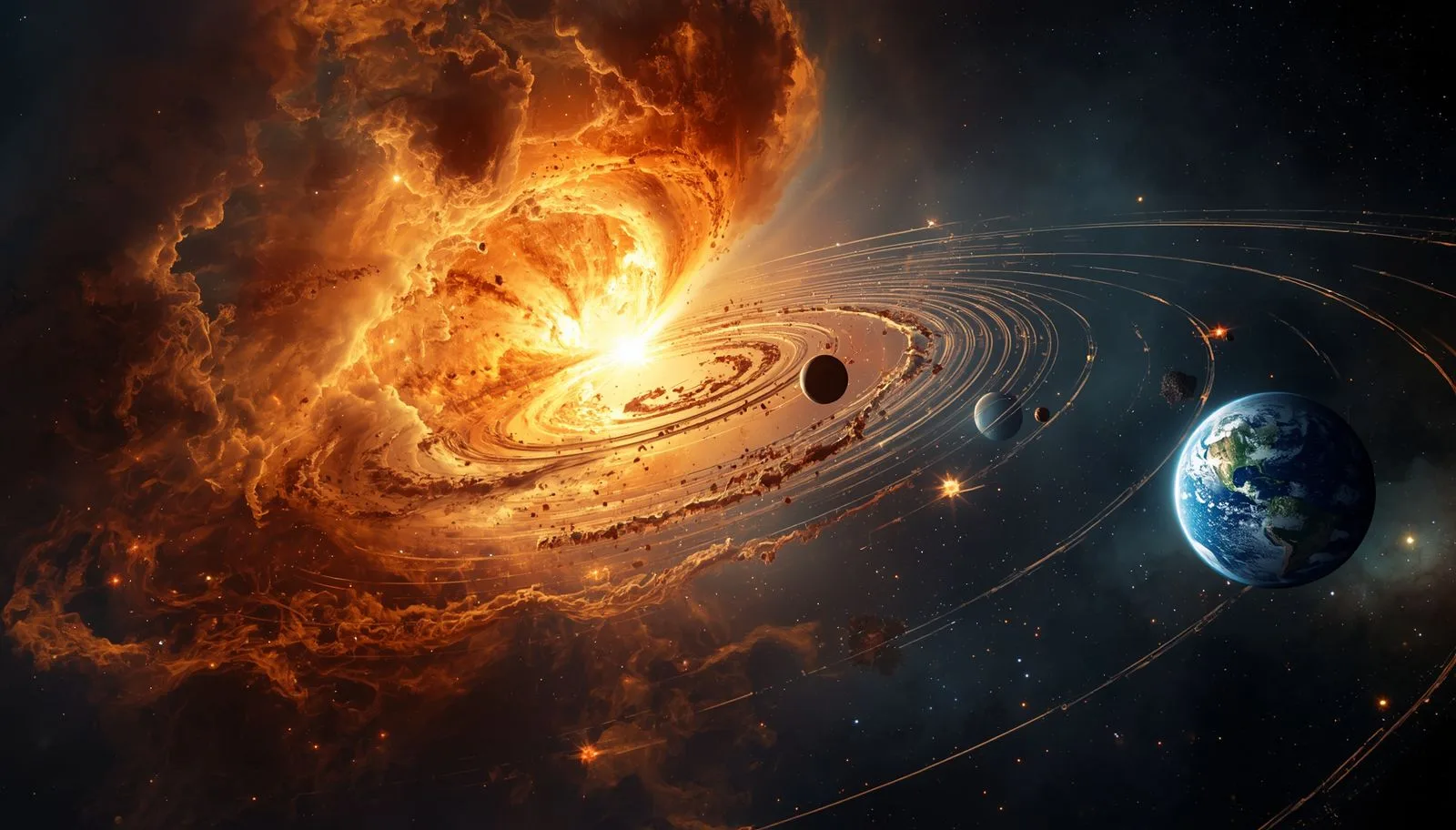
3.Theories of Earth Origin Nebular Hypothesis
The Nebular Hypothesis is one of the most influential and widely accepted theories explaining the origin of the Earth and the Solar System. According to this theory, the Solar System formed from a vast rotating cloud of gas and dust known as a nebula. Modern astronomical observations and scientific research support a modified version of this hypothesis.
3.1 Contribution of Immanuel Kant
The German philosopher and scientist Immanuel Kant first proposed ideas related to the origin of the Solar System in 1755. He suggested that the Solar System developed from a large cloud of gas and dust that gradually condensed under the influence of gravity.
Early Ideas
Kant believed that matter scattered throughout space slowly gathered together due to gravitational attraction. As the cloud contracted, it began to rotate, eventually leading to the formation of the Sun and planets.
3.2 Pierre-Simon Laplace's Modified Theory
In 1796, French mathematician and astronomer Pierre-Simon Laplace refined Kant's ideas and presented a more detailed explanation of the Nebular Hypothesis.
Gaseous Cloud
According to Laplace, the Solar System originally existed as a vast, hot, rotating cloud of gas.
Rotation Process
As the cloud contracted under gravity, its rotational speed increased due to the conservation of angular momentum. This caused the cloud to flatten into a disk-like structure.
Formation of the Sun and Planets
Most of the material accumulated at the center of the disk to form the Sun, while the remaining matter in the outer regions gradually condensed into planets and other celestial bodies.
Process of the Nebular Hypothesis
1. Giant Cloud of Gas and Dust
The process began with a massive nebula composed primarily of hydrogen, helium, and cosmic dust.
2. Gravitational Contraction
Gravity caused the nebula to collapse inward, increasing its density and rotational speed.
3. Formation of the Sun
Most of the material concentrated at the center, where rising temperature and pressure eventually triggered nuclear fusion, forming the Sun.
4. Formation of the Planets
The remaining material in the surrounding disk collided and combined to form larger bodies known as planetary embryos.
5. Formation of Earth
Through continuous collisions and accretion, these bodies grew larger, eventually forming Earth approximately 4.54 billion years ago. Early Earth was extremely hot and largely molten.
Advantages of the Nebular Hypothesis
- Explains why most planets orbit the Sun in the same direction.
- Provides a logical explanation for the simultaneous formation of the Sun and planets.
- Is broadly consistent with modern astronomical observations.
- Helps explain the formation of planetary systems around other stars.
- Forms the foundation of the modern Solar Nebula Model.
Limitations of the Nebular Hypothesis
- Does not fully explain the distribution of angular momentum in the Solar System.
- Cannot completely account for certain orbital characteristics of planets.
- The original version required significant modifications based on modern scientific discoveries.
4. Planetesimal Theory
The Planetesimal Theory is another important explanation for the origin of the Solar System and planets. Unlike the Nebular Hypothesis, this theory emphasizes the role of small solid bodies called planetesimals in the formation of planets.
Proponents of the Theory
The Planetesimal Theory was proposed in 1905 by American scientists Thomas Chamberlin and Forest Ray Moulton.
Thomas Chamberlin
Chamberlin emphasized the importance of small solid particles in planetary formation and developed the concept of planetesimals.
Forest Ray Moulton
Moulton contributed mathematical analysis and theoretical support to strengthen the theory.
Main Concept
According to the Planetesimal Theory, a massive star once passed close to the Sun. The gravitational pull of the passing star caused material to be drawn out from the Sun. This material later cooled and condensed into countless small bodies called planetesimals, which eventually combined to form planets.
1. A Star Passing Near the Sun
A large star moved close to the Sun, exerting a strong gravitational influence on it.
2. Ejection of Material
The gravitational interaction pulled streams of gaseous material away from the Sun and into space.
3. Formation of Planetesimals
Over time, the expelled material cooled and condensed into numerous small solid bodies known as planetesimals.
4. Formation of Planets
These planetesimals collided and merged with one another, gradually forming larger bodies that eventually became planets.
Characteristics
- Emphasizes the role of planetesimals in planetary formation.
- Suggests a gradual evolutionary process for the development of planets.
- Highlights collision and accretion as key mechanisms.
- Shares certain similarities with the modern accretion theory of planet formation.
Criticism
- The likelihood of a massive star passing extremely close to the Sun is considered very low.
- The theory does not adequately explain how hot solar material condensed into solid planetesimals.
- Many modern astronomical observations do not support the theory.
- As a result, the Planetesimal Theory is no longer widely accepted by the scientific community.

⭐ Top Recommendation
Explore a highly rated product chosen for its quality, reliability, and everyday usefulness. Check its features and customer reviews for more details.
5. Tidal Theory
The Tidal Theory is an important hypothesis proposed to explain the origin of the Solar System and the planets. Similar to the Planetesimal Theory, it suggests that planetary formation resulted from the gravitational interaction between the Sun and a passing massive star. According to this theory, tidal forces generated during this close encounter pulled material away from the Sun, which later condensed to form planets.
Proponents
The Tidal Theory was proposed in 1917 by British astronomer Sir James Jeans and physicist Harold Jeffreys.
James Jeans
James Jeans suggested that the gravitational influence of a massive star passing close to the Sun could draw out solar material, eventually leading to the formation of planets.
Harold Jeffreys
Harold Jeffreys contributed mathematical and physical explanations to support the theory and describe the process of planetary formation.
Explanation of the Theory
According to the Tidal Theory, the Sun originally existed as an isolated star. At some point, a massive star passed very close to it. The intense gravitational attraction between the two stars generated powerful tidal forces that disturbed the Sun's outer layers and pulled large amounts of material into space.
A Massive Star Passing Near the Sun
The theory proposes that a giant star moved extremely close to the Sun, exerting a strong gravitational influence on it.
Effect of Tidal Forces
These tidal forces stretched and drew out long streams of gaseous material from the Sun. Over time, the expelled matter dispersed and broke into smaller fragments.
Formation of the Planets
The ejected material gradually cooled and condensed into smaller bodies. Through gravitational attraction and accretion, these bodies eventually developed into planets and their satellites.
Limitations of the Tidal Theory
- The probability of a massive star passing extremely close to the Sun is considered very low.
- The theory does not satisfactorily explain how hot solar material condensed into solid planets.
- Modern astronomical observations provide little support for the theory.
- It fails to fully explain the present composition and structure of planets.
- Today, the theory is largely rejected by the scientific community.
6. Binary Star Theory
The Binary Star Theory was another attempt to explain the origin of planets. According to this theory, the Sun was not originally a solitary star but was accompanied by a companion star. Interactions between these two stars eventually led to the formation of planets.
Main Concept
The central idea of the Binary Star Theory is that the Sun and its companion formed a binary star system. Due to gravitational interactions between the two stars, some material separated and later condensed to form planets.
Presence of a Companion Star
According to the theory, a second star existed near the Sun during the early stages of the Solar System. Both stars were gravitationally bound and influenced each other's evolution.
Separation of Matter
Strong gravitational interactions between the two stars caused a portion of matter to be pulled away and dispersed into surrounding space.
Formation of Planets
The separated material gradually cooled and condensed into smaller bodies. Over time, these bodies collided and merged, eventually forming planets and other celestial objects.
Scientific Evaluation
Modern scientific research does not provide strong support for the Binary Star Theory. No direct evidence has been found to confirm that the Sun once had a companion star responsible for the formation of the planets.
- No direct evidence exists for a former companion star of the Sun.
- The theory does not adequately explain the present orbital characteristics of planets.
- It is considered less convincing than the modern Solar Nebula Model.
- Current astronomical observations provide only limited support.
- Today, the theory is regarded mainly as a historical contribution to planetary science.
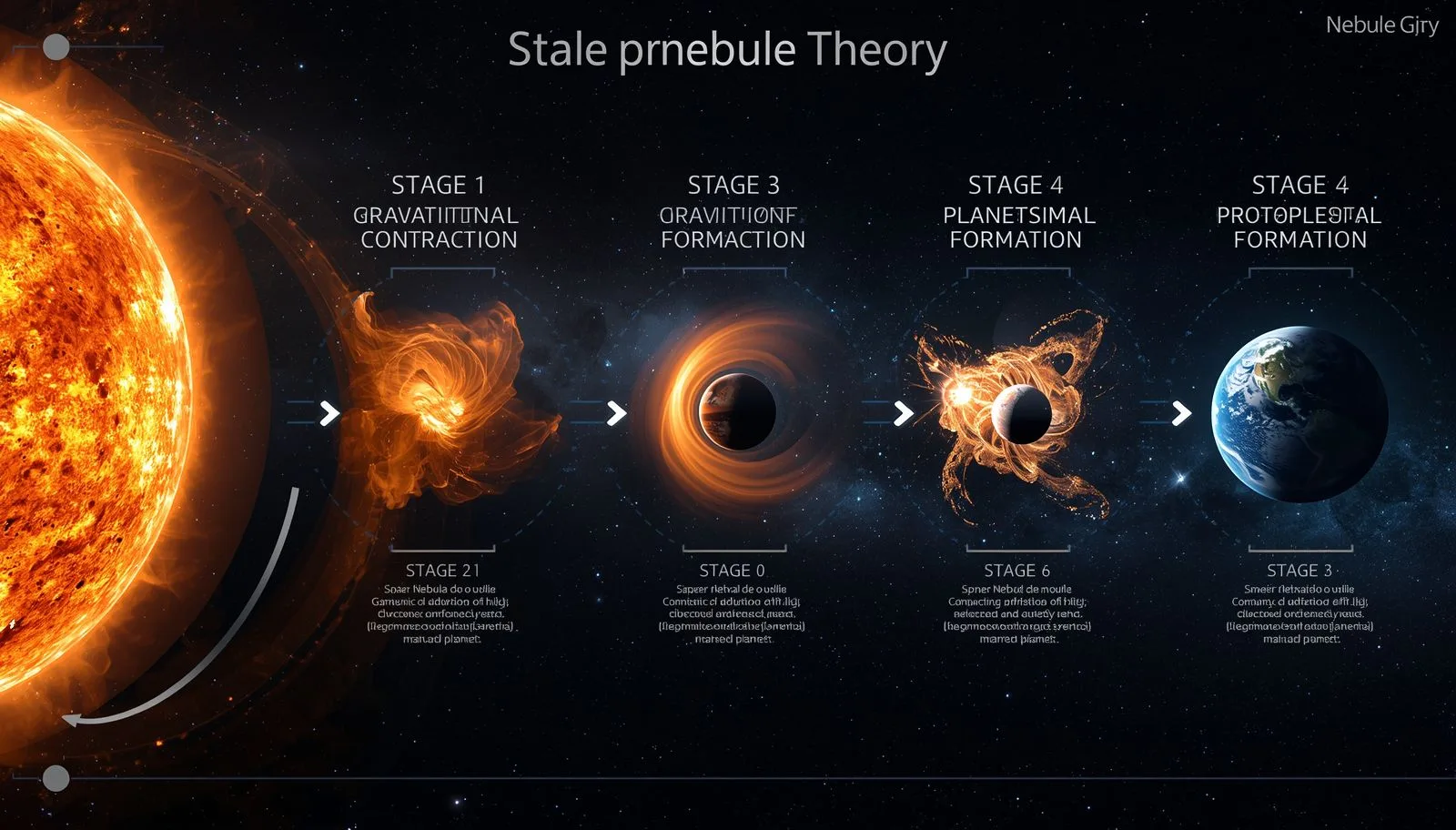
7. Modern Nebular Theory
The Modern Nebular Theory is the most widely accepted scientific explanation for the origin of the Earth and the Solar System. It is a refined and updated version of the classical Nebular Hypothesis, supported by modern astronomical observations, space missions, and computer simulations. According to this theory, the Solar System formed approximately 4.6 billion years ago from a vast cloud of gas and dust.
Currently the Most Accepted Theory
Among all theories proposed to explain planetary formation, the Modern Nebular Theory is considered the most reliable and scientifically supported model. It successfully explains the formation of the Sun, planets, moons, asteroids, and other bodies within the Solar System.
Major Stages of the Theory
7.1 Formation of the Solar Nebula
Around 4.6 billion years ago, a giant cloud of gas, dust, and other cosmic material existed in space. This cloud, known as the Solar Nebula, consisted mainly of hydrogen and helium along with traces of heavier elements.
7.2 Gravitational Contraction
A disturbance, possibly caused by a nearby supernova explosion, triggered the collapse of the Solar Nebula. Under the influence of gravity, the cloud began to contract and rotate faster, eventually flattening into a disk-shaped structure.
7.3 Formation of the Protosun
As contraction continued, most of the material accumulated at the center of the disk. Increasing temperature and pressure led to the formation of a protosun, the precursor to the Sun.
7.4 Formation of Planetesimals
Within the surrounding disk, tiny particles of dust and ice collided and stuck together. Over millions of years, these particles grew into larger solid bodies known as planetesimals, which served as the building blocks of planets.
7.5 Formation of the Planets
Through repeated collisions and accretion, planetesimals combined to form larger bodies called protoplanets. These protoplanets continued to grow and eventually developed into the planets of the Solar System.
7.6 Formation of Earth
Approximately 4.54 billion years ago, Earth formed through the accretion of numerous planetesimals and protoplanets. The young Earth was extremely hot and molten but gradually cooled and evolved into a stable planet capable of supporting life.
Scientific Evidence
Several lines of scientific evidence strongly support the Modern Nebular Theory, making it the dominant model of planetary formation today.
Study of Meteorites
Meteorites are believed to be remnants of the early Solar System. Radiometric dating shows that many meteorites are approximately 4.6 billion years old, matching the estimated age of the Solar System and supporting the theory.
Space Missions
Observations from modern telescopes and space missions have revealed protoplanetary disks around young stars. These discoveries provide direct evidence that planetary systems form from rotating clouds of gas and dust.
Computer Models
Advanced computer simulations successfully demonstrate how gas and dust clouds can collapse, form stars, and eventually produce planets through accretion, consistent with the Modern Nebular Theory.
8. The Process of Earth's Formation
Earth formed approximately 4.54 billion years ago. After its formation, the planet underwent numerous physical and chemical changes that gradually transformed it into the Earth we know today. The early Earth was dramatically different from its present state.
Early Earth
During its infancy, Earth experienced intense bombardment from asteroids and planetesimals. Combined with radioactive decay and gravitational compression, these impacts generated enormous amounts of heat.
Extremely Hot State
The young Earth was extremely hot, with temperatures reaching thousands of degrees Celsius. Most of the planet's material existed in a molten state during this period.
Molten Surface
Earth's outer layer consisted of a vast ocean of molten rock, often referred to as a magma ocean. Over time, the planet gradually cooled, allowing solid rocks to form on the surface.
Formation of Internal Structure
As Earth cooled, materials separated according to their density in a process known as planetary differentiation. This led to the development of Earth's layered internal structure.
Core
Heavy elements such as iron and nickel sank toward the center of the planet, forming Earth's core. The core is the densest and innermost layer of the Earth.
Mantle
Above the core, a thick layer of silicate-rich material formed the mantle. The mantle constitutes the largest portion of Earth's volume and plays a crucial role in tectonic activity.
Crust
The outermost solid layer of Earth is known as the crust. As the planet cooled further, the crust solidified and eventually gave rise to continents and ocean basins.
Formation of the Atmosphere
Earth's first atmosphere was created primarily through volcanic outgassing. Volcanoes released large quantities of water vapor, carbon dioxide, nitrogen, and other gases, which gradually accumulated around the planet.
Formation of the Oceans
As Earth's temperature continued to decline, water vapor in the atmosphere condensed into liquid water. Continuous rainfall over millions of years filled depressions on the surface, leading to the formation of oceans. These oceans later provided the environment necessary for the emergence and evolution of life.

⭐ Recommended Pick
Discover a popular and well-reviewed product selected for its quality, practicality, and overall value. Explore its features to see why it stands out.
9.Theories of Earth Origin Relationship Between Earth's Formation and the Origin of Life
The formation of Earth is closely connected to the origin of life. The physical and chemical conditions that developed after Earth's formation created an environment capable of supporting living organisms. Scientists believe that life emerged hundreds of millions of years after Earth was formed, eventually leading to the evolution of complex organisms and, ultimately, human civilization.
Early Conditions
The early Earth was vastly different from the planet we know today. Free oxygen was nearly absent from the atmosphere, and volcanic activity was extremely intense. Frequent lightning, strong ultraviolet radiation, and volcanic gases created conditions that promoted a wide range of chemical reactions essential for the development of life.
Availability of Water
As Earth cooled, water vapor in the atmosphere condensed and fell as rain. Over time, this process led to the formation of oceans, lakes, and other bodies of water. Scientists believe that life most likely originated in aquatic environments because water serves as an ideal medium for chemical reactions and biological processes.
Chemical Evolution
Before the emergence of life, numerous complex chemical processes occurred on Earth. Simple inorganic compounds gradually combined to form more complex organic molecules. This process is known as Chemical Evolution. The formation of amino acids, proteins, and nucleic acids represented crucial steps toward the development of living organisms.
Earliest Forms of Life
Scientific evidence suggests that life first appeared on Earth approximately 3.5 to 3.8 billion years ago. These earliest life forms were simple, single-celled microorganisms. Over billions of years, biological evolution produced increasingly complex organisms and the tremendous diversity of life seen today.
10. How Was Earth's Age Determined?
The age of Earth has been determined through modern scientific techniques and geological investigations. By studying rocks, minerals, and meteorites, scientists have been able to estimate Earth's age with remarkable accuracy. Today, Earth is believed to be approximately 4.54 billion years old.
Radiometric Dating
The most important method used to determine Earth's age is Radiometric Dating. This technique measures the decay rates of radioactive elements such as uranium, thorium, and potassium. Because radioactive decay occurs at a predictable rate, scientists can accurately calculate the age of rocks and minerals.
Study of Meteorites
Meteorites are considered remnants of the early Solar System. Radiometric analysis of various meteorites has shown that many are approximately 4.56 billion years old. Since Earth and the Solar System formed around the same time, these findings provide important evidence for determining Earth's age.
Study of Rocks
The examination of Earth's oldest rocks and minerals has also contributed significantly to age determination. Zircon crystals discovered in Australia have been dated to approximately 4.4 billion years old, providing valuable information about Earth's earliest history.
Current Estimate
Based on evidence from geology, astronomy, and radiometric dating, scientists have concluded that Earth is approximately 4.54 billion years old. This estimate is widely accepted by the global scientific community and serves as the standard age of our planet.
Key Facts
- Estimated Age of Earth: 4.54 Billion Years
- Estimated Age of the Solar System: 4.6 Billion Years
- Oldest Known Zircon Crystals: Approximately 4.4 Billion Years
- Estimated Age of Meteorites: Approximately 4.56 Billion Years
- Primary Dating Method: Radiometric Dating
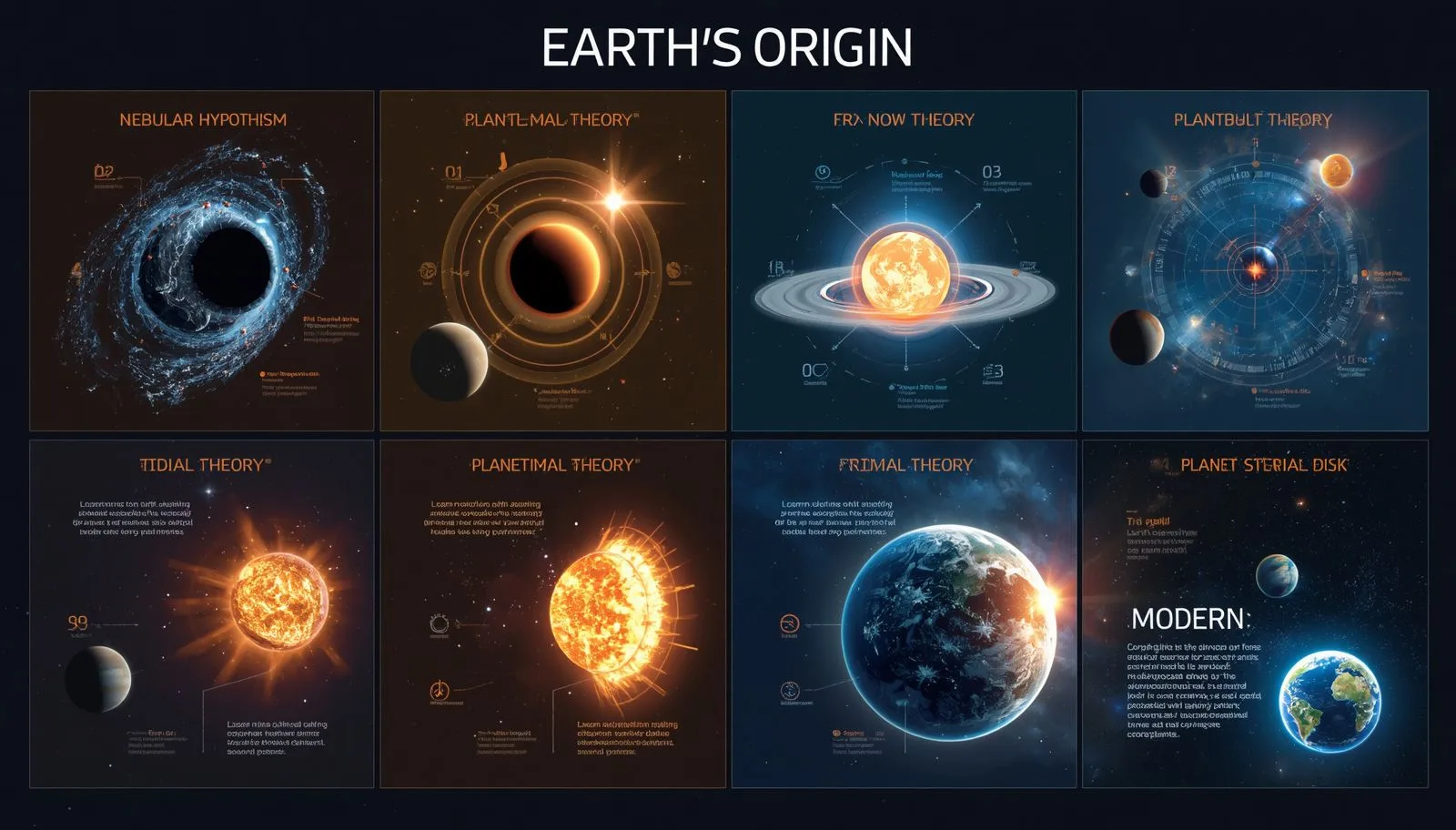
11. Comparison of Major Theories of Earth's Origin
Over time, scientists have proposed several theories to explain the origin of Earth and the Solar System. Each theory attempted to explain planetary formation based on the scientific knowledge available during its era. While some theories have been modified and incorporated into modern scientific understanding, others have largely been rejected due to a lack of supporting evidence.
| Theory | Proponents | Main Idea | Current Status |
|---|---|---|---|
| Nebular Hypothesis | Immanuel Kant, Pierre-Simon Laplace | Formation of the Sun and planets from a giant cloud of gas and dust | Accepted in a modified form |
| Planetesimal Theory | Thomas Chamberlin, Forest Ray Moulton | Planets formed through the accumulation of planetesimals | Limited acceptance |
| Tidal Theory | James Jeans, Harold Jeffreys | Planets formed from material pulled from the Sun by a passing star | Rejected |
| Modern Nebular Theory | Modern Scientific Community | Formation of planets through gravitational collapse of the solar nebula and accretion | Most Widely Accepted |
Comparative Analysis
Among all proposed theories, the Modern Nebular Theory has received the strongest scientific support. It is consistent with evidence from space telescopes, meteorite studies, computer simulations, and observations of planetary systems around other stars. While the Planetesimal Theory and Tidal Theory played important historical roles in the development of planetary science, they are no longer considered the primary explanations for the origin of Earth and the Solar System.
12. What Does Modern Science Say?
Modern science concludes that Earth and the Solar System formed approximately 4.6 billion years ago from a vast cloud of gas and dust known as the Solar Nebula. This conclusion is supported by decades of astronomical observations, space missions, laboratory studies, and advanced computer modeling.
NASA's Findings
Research conducted by NASA and other international space agencies has revealed that young stars are often surrounded by protoplanetary disks composed of gas and dust. Within these disks, particles collide and combine to form planets. These observations provide direct evidence supporting the Modern Nebular Theory.
Solar System Formation Model
According to the modern model of Solar System formation, the center of the collapsing solar nebula formed the Sun, while the surrounding disk of gas and dust gave rise to planetesimals and protoplanets. Through millions of years of accretion and collisions, these bodies eventually developed into the planets, including Earth.
Exoplanet Studies
The discovery of thousands of exoplanets—planets orbiting stars outside our Solar System—has significantly improved our understanding of planetary formation. These discoveries demonstrate that planet formation is a common process throughout the Universe and not unique to our Solar System.
Modern Research
Current scientific research focuses on understanding planetary formation, the conditions on the early Earth, and the connection between planetary evolution and the origin of life. Advanced instruments such as the James Webb Space Telescope (JWST) and sophisticated computer simulations are providing unprecedented insights into the formation of planetary systems.
Modern scientific evidence suggests that Earth's formation was the result of a long and complex process involving gravitational collapse, accretion of matter, planetary differentiation, and countless collisions among early celestial bodies. For this reason, the Modern Nebular Theory remains the most reliable and widely accepted explanation for the origin of Earth.

⭐ Featured Recommendation
Explore a highly rated product chosen for its quality, functionality, and excellent user experience. Discover its key features and benefits.
Important Facts for UPSC/SSC Examinations
Questions related to the origin of Earth, the formation of the Solar System, and the evolution of the Universe are frequently asked in UPSC, SSC, State PSC, Railway, Banking, and other competitive examinations. Therefore, the following facts are essential for exam preparation and quick revision.
Key Points
- Age of Earth: Approximately 4.54 billion years
- Age of the Solar System: Approximately 4.6 billion years
- Age of the Universe (Big Bang): Approximately 13.8 billion years
- Most Widely Accepted Theory: Modern Nebular Theory
- Proponents of the Nebular Hypothesis: Immanuel Kant and Pierre-Simon Laplace
- Proponents of the Planetesimal Theory: Thomas Chamberlin and Forest Ray Moulton
- Proponents of the Tidal Theory: James Jeans and Harold Jeffreys
- Originator of the Big Bang Concept: Georges Lemaître
- Main Method for Determining Earth's Age: Radiometric Dating
- Oldest Known Mineral: Zircon (approximately 4.4 billion years old)
MCQ-Based Facts
Question 1: What is the estimated age of Earth?
Answer: Approximately 4.54 billion years.
Question 2: Which theory is the most widely accepted explanation for the formation of the Solar System?
Answer: Modern Nebular Theory.
Question 3: The Big Bang Theory explains the origin of what?
Answer: The Universe.
Question 4: Who proposed the Planetesimal Theory?
Answer: Thomas Chamberlin and Forest Ray Moulton.
Question 5: What does the Nebular Hypothesis explain?
Answer: The origin of the Solar System and planets.
Question 6: Which is the most reliable method for determining Earth's age?
Answer: Radiometric Dating.
Question 7: What is the estimated age of the Universe?
Answer: Approximately 13.8 billion years.
Question 8: Who proposed the Tidal Theory?
Answer: James Jeans and Harold Jeffreys.
Question 9: Which model is currently considered the most reliable explanation for Earth's formation?
Answer: Modern Nebular Theory.
Question 10: The concept of a protosun is associated with which theory?
Answer: Modern Nebular Theory.
Conclusion
The origin of Earth has remained one of humanity's most fascinating scientific questions. From ancient philosophical ideas to modern astronomical research, scientists have continuously sought to understand how Earth, the Solar System, and the Universe came into existence.
Over the centuries, several theories have been proposed, including the Nebular Hypothesis, Planetesimal Theory, Tidal Theory, and Binary Star Theory. Each contributed to the development of scientific knowledge and improved our understanding of planetary formation.
Based on evidence from space missions, meteorite analysis, astronomical observations, and computer simulations, the Modern Nebular Theory has emerged as the most widely accepted explanation for the formation of Earth and the Solar System. It provides the most comprehensive and scientifically supported model of planetary evolution.
Although scientists now possess extensive knowledge about Earth's formation, many questions remain unanswered. Topics such as the origin of life, the conditions on the early Earth, and the possibility of life elsewhere in the Universe continue to be major areas of scientific research.
Future discoveries from advanced observatories, interplanetary missions, and next-generation space telescopes are expected to deepen our understanding of Earth's origins. The study of Earth's formation not only helps us understand our planet's past but also provides valuable insights into humanity's place within the vast Universe.
Frequently Asked Questions (FAQs) on Theories of Earth Origin
1. What are the major theories of Earth's origin?
The major theories of Earth's origin include the Nebular Hypothesis, Planetesimal Theory, Tidal Theory, Binary Star Theory, and the Modern Nebular Theory. Among these, the Modern Nebular Theory is the most widely accepted scientific explanation for the formation of Earth and the Solar System.
2. How old is Earth according to modern science?
According to modern scientific research and radiometric dating techniques, Earth is approximately 4.54 billion years old. This estimate is supported by meteorite studies, ancient rock samples, and radioactive decay analysis.
3. What is the Modern Nebular Theory?
The Modern Nebular Theory states that the Solar System formed around 4.6 billion years ago from a giant cloud of gas and dust known as the Solar Nebula. Through gravitational collapse, accretion, and planetary formation processes, Earth and the other planets gradually developed.
4. What is the difference between the Nebular Hypothesis and the Modern Nebular Theory?
The Nebular Hypothesis was originally proposed by Immanuel Kant and Pierre-Simon Laplace. The Modern Nebular Theory is an updated version supported by modern astronomical observations, meteorite studies, space missions, and computer simulations, making it more scientifically reliable.
5. How was Earth's age determined?
Scientists determined Earth's age through radiometric dating, meteorite analysis, and the study of ancient rocks and minerals. These scientific methods consistently indicate that Earth formed approximately 4.54 billion years ago.
6. Which theory of Earth's origin is most accepted today?
The Modern Nebular Theory is currently the most widely accepted theory of Earth's origin because it is supported by evidence from protoplanetary disk observations, meteorite studies, computer simulations, and modern space missions.
7. Why is the study of Earth's origin important?
The study of Earth's origin helps scientists understand the formation of the Solar System, the evolution of planets, the origin of life, geological processes, and the history of the Universe. It is also an important topic for UPSC, SSC, and other competitive examinations.