
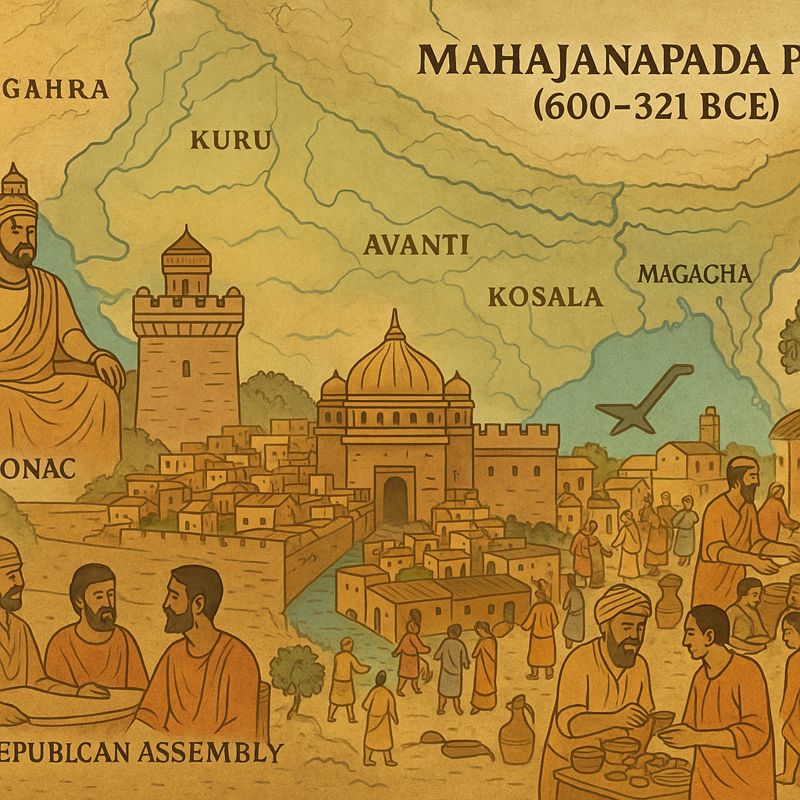
Mahajanapada Period (600–321 BCE)
The Mahajanapada Period was a decisive and transformative phase in Indian history, lasting roughly from 600 BCE to 321 BCE. This era bridges the gap between the later Vedic age and the rise of the Maurya Empire. It was during this time that large territorial states known as Mahajanapadas emerged, reshaping India’s political, economic, and cultural foundations.
Studying this period is not just about learning names and dates—it is about understanding how organized governance, urban economies, and new philosophical ideas took root and influenced Indian civilization for centuries.
Mahajanapada: Definition
The term Mahajanapada literally means “great territory” or “large state”. These were well-defined political units with centralized administrative systems. Unlike the earlier tribal structures, Mahajanapadas represented mature states that were governed either as monarchies or republics.
The Sixteen Mahajanapadas
References to the sixteen Mahajanapadas are found in ancient texts such as Panini’s Ashtadhyayi and the Buddhist text Anguttara Nikaya. These Mahajanapadas were:
- Anga – near the Magadha region
- Magadha – modern Bihar
- Kashi – Varanasi region
- Kosala – Ayodhya region
- Vajji – Vaishali (a republican state)
- Malla – Kushinagar and Pava
- Chedi – Bundelkhand region
- Vatsa – Prayagraj region
- Kuru – Delhi and Haryana region
- Panchala – western Uttar Pradesh
- Matsya (Machch) – Jaipur region
- Surasena – Mathura region
- Ashmaka – Deccan region (Andhra Pradesh)
- Avanti – Madhya Pradesh (Ujjain)
- Gandhara – Peshawar region (modern Pakistan)
- Kamboja – Kashmir and Afghanistan region
Main Aspects of the Mahajanapada Period
Political Organization
The political landscape of this period was diverse. Some Mahajanapadas, such as Magadha and Kosala, were monarchies ruled by powerful kings. Others, like the Lichchavi Sangha of Vajji, followed a republican system where power was shared among assemblies.
Among all these states, Magadha gradually emerged as the most dominant Mahajanapada, due to strong leadership, strategic location, and efficient administration.
Economic Conditions
Agriculture formed the backbone of the economy during the Mahajanapada period. The use of iron tools improved agricultural productivity, leading to surplus production.
This surplus encouraged the growth of towns and urban centers, which became hubs of trade and commerce. Crafts, internal trade, and early forms of currency further strengthened the economy.
Cultural and Religious Developments
The Mahajanapada period witnessed profound cultural and intellectual changes. The composition of the Upanishads reflected deeper philosophical inquiry, while Jainism and Buddhism emerged as powerful reform movements challenging orthodox Vedic practices.
Much of what we know about this era comes from Buddhist and Jain texts, which provide valuable insights into society, governance, and daily life.
Military Organization
⭐ Editor's Choice
Discover a highly rated product selected for its quality, functionality, and positive customer feedback.
View Details & Reviews →A notable feature of this period was the establishment of standing armies. States maintained permanent military forces instead of relying solely on tribal warriors.
The use of elephants and horses in warfare increased significantly, giving stronger kingdoms a decisive military advantage.
Rise of Magadha
By the end of the Mahajanapada period, Magadha had emerged as the most powerful state. Kings like Bimbisara and Ajatashatru expanded its territory through diplomacy, marriage alliances, and warfare.
Magadha’s strong administrative system and military strength laid the foundation for the Maurya Empire, which would later unify a large part of the Indian subcontinent.
Importance of the Mahajanapada Era
The Mahajanapada era was a turning point in Indian history. It introduced organized governance, strengthened economic structures, and encouraged intellectual and religious freedom.
The political ideas, administrative practices, and cultural movements of this period shaped the future of Indian civilization and prepared the ground for large empires like the Mauryas.
Key Learnings and Reflections
From a personal learning perspective, the Mahajanapada period teaches us that progress often comes from experimentation and diversity. Monarchies and republics coexisted, new philosophies challenged old beliefs, and innovation transformed society.
This era reminds us that strong institutions, open thinking, and adaptability are essential for long-term stability and growth—lessons that remain relevant even in the modern world.
Frequently Asked Questions (FAQ)
What was the Mahajanapada period?
The Mahajanapada period (600–321 BCE) was a phase in ancient Indian history marked by the rise of sixteen large territorial states with organized political systems.
How many Mahajanapadas were there?
There were sixteen Mahajanapadas, as mentioned in Buddhist texts like the Anguttara Nikaya and works of Panini.
Which Mahajanapada was the most powerful?
Magadha emerged as the most powerful Mahajanapada due to strong rulers, strategic location, and military strength.
Why is the Mahajanapada period important?
This period laid the foundation for urbanization, centralized administration, major religious movements, and the rise of empires such as the Maurya Empire.
Related Reading
To understand how governance evolved further in ancient India, you may also read our detailed article on The Rise of the Maurya Empire.
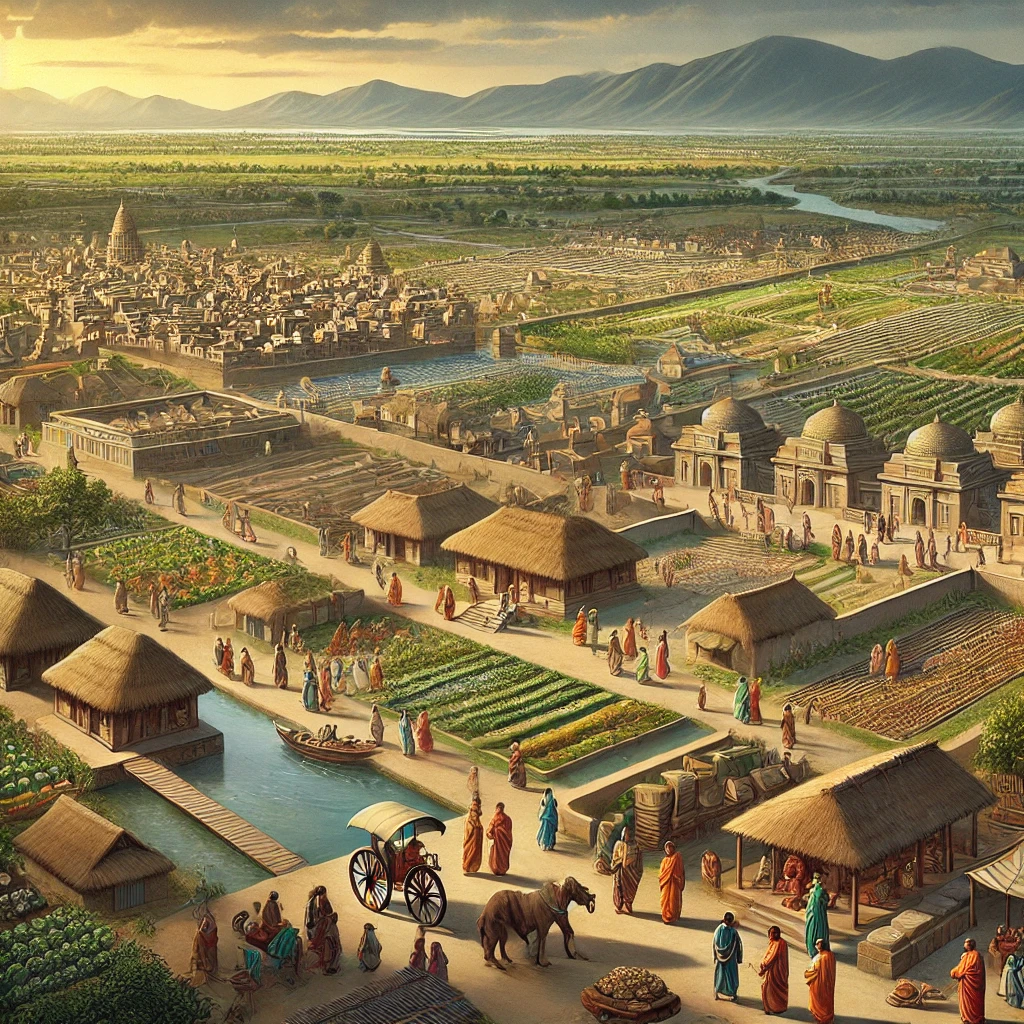
Large District (Mahajanapada), State and Monarchy
While studying ancient Indian history, concepts such as Large District (Mahajanapada), State, and Monarchy frequently appear. These ideas help us understand how early political systems evolved and how organized governance gradually took shape. Below is a clear and structured explanation of these terms, without altering their original meaning.
Large District (Mahajanapada)
The term Large District broadly refers to a region or state spread over a vast area, where political, social, and economic systems function in an organized manner. During the Mahajanapada period, the word Janapada was derived from two terms: “jana” (people) and “pada” (place), meaning the land where people lived.
As these Janapadas expanded in size, population, and power, they came to be known as Mahajanapadas, or large territorial states.
Features of Large Districts (Mahajanapadas)
1. Wide Terrain
Mahajanapadas were much larger than early Janapadas. They included multiple cities, towns, villages, and vast agricultural lands.
2. Political Structure
These large districts had organized political systems. Some followed a centralized monarchy, while others adopted republican forms of governance.
3. Economic Progress
Mahajanapadas were economically advanced. Agriculture, trade, crafts, and industry flourished due to better tools, surplus production, and expanding markets.
4. Strategic Importance
Strong armies, fortified cities, and strategic locations helped protect the boundaries of these regions and strengthened their political dominance.
5. Religious and Cultural Centers
Many Mahajanapadas became centers of religious and cultural activity, increasing their influence and importance in society.
Examples: Magadha, Kosala, and Avanti were prominent Mahajanapadas, known for their regional influence, prosperity, and strategic power.
State
A State refers to an organized political unit that governs a specific territory. It maintains law and order and operates through a definite administrative structure. The concept of a state is based on four fundamental elements: territory, population, government, and sovereignty.
Key Elements of the State
1. Territory
A state has a clearly defined and recognized geographical area. This territory includes natural features such as mountains, rivers, forests, and other resources.
2. Population
The people living within the territory constitute the population of the state. They may belong to different castes, religions, cultures, and linguistic groups.
3. Government
The government is the authority that makes laws, enforces them, and ensures justice. It generally consists of three organs:
- Legislature
- Executive
- Judiciary
4. Sovereignty
Sovereignty refers to the supreme and independent power of the state, allowing it to take decisions in internal as well as external matters.
Characteristics of the State
- Independence: The state is not subordinate to any other authority.
- Law and Order: It has the power to frame and enforce laws.
- Centralisation of Power: Authority is centralized for efficient administration.
- National Identity: A state possesses symbols such as a constitution, flag, or official language.
Difference Between State and Mahajanapada
Mahajanapadas were organized political units of ancient India that displayed several features of a modern state, such as administration and territory. However, they did not fully represent the modern concept of a state.
⭐ Editor's Choice
Discover a highly rated product selected for its quality, functionality, and positive customer feedback.
View Details & Reviews →Modern states are based on complete sovereignty, international recognition, and systematic administrative institutions, which were absent in ancient Mahajanapadas.
Examples
- Ancient Kingdoms: Magadha, Kosala, Maurya Empire
- Modern States: India, United States of america, Japan
Monarchy
Monarchy is a system of governance in which supreme power is concentrated in the hands of a king or queen. Power is usually hereditary, meaning it is passed down within the same family or dynasty.
Monarchy is one of the oldest forms of government and has existed from ancient times to the present in various parts of the world.
Characteristics of Monarchy
1. Hereditary Rule
Power is transferred from one generation to the next, commonly from parent to child. In some cases, succession may involve selection within the royal family.
2. Supreme Authority
The monarch holds supreme power, and royal commands are often treated as law.
3. Long-Term Governance
The ruler generally governs for life, unless abdication or death occurs.
4. Political and Religious Role
In ancient times, kings were regarded not only as political leaders but also as religious authorities, often seen as representatives of divine power.
Types of Monarchy
Absolute Monarchy
The king holds unlimited powers, and his decisions are final.
Examples: Ancient Egypt, France during the reign of Louis XIV.
Constitutional Monarchy
The powers of the monarch are limited by a constitution. The ruler performs ceremonial duties, while real power lies with elected representatives.
Examples: United Kingdom, Japan.
History of Monarchy in India
Monarchy was widely prevalent in ancient India:
- Mahajanapada Period: States like Magadha and Kosala were monarchical.
- Maurya and Gupta Empires: Highly influential centralized monarchies.
- Rajput Period: Hereditary rule of local kings.
In the modern era, India adopted a republican system in 1950 and abolished monarchy.
Advantages and Disadvantages of Monarchy
Advantages
- Political stability and continuity
- Quick decision-making
- Sense of national unity
Disadvantages
- Excessive centralization of power
- Risk of incompetent hereditary rulers
- Limited public participation
Monarchy in the Modern World
Today, monarchy has declined significantly. Most surviving monarchies have transformed into constitutional monarchies.
Examples: United Kingdom, Japan, Thailand
Related Reading
To better understand the political background of ancient India, read our article on The Mahajanapada Period: Features and Importance.
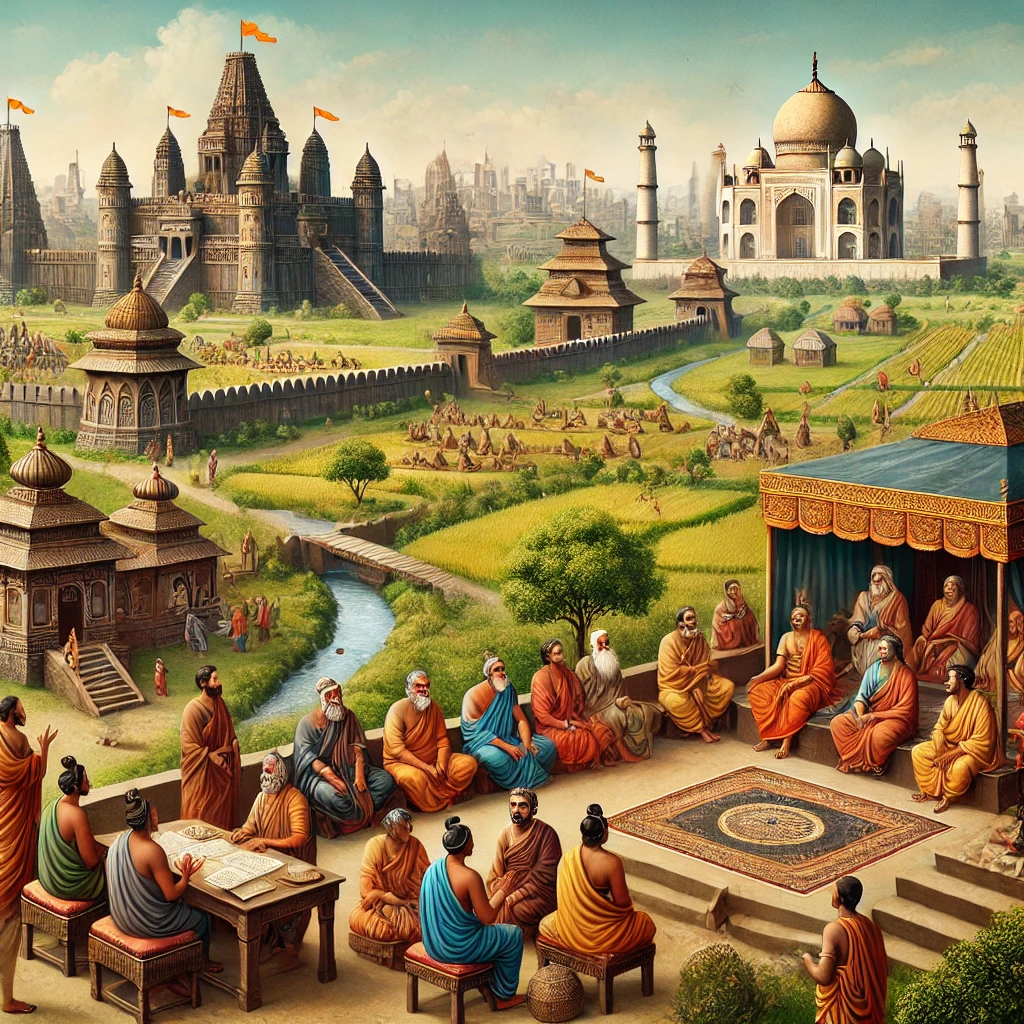
Republic System and the Mahajanapada Period (600–321 BCE)
The concepts of Republic, Monarchy, and the political systems of the Mahajanapada period form the foundation of India’s political evolution. This period witnessed experimentation with governance, military expansion, economic growth, and cultural transformation, which later paved the way for the Maurya Empire.
Republic
A Republic is a system of government in which the head of the state is elected directly or indirectly by the people. The government functions through representatives chosen by the public, and political power does not pass hereditarily.
Definition of Republic
The word “Gan” means group or people, and “Tantra” means system of governance. Thus, a republic means:
“Government of the people, by the people, and for the people.”
Characteristics of a Republic
1. Supremacy of the People
In a republic, people are the ultimate source of power. Citizens elect their representatives and participate in governance.
2. Elected Leadership
The head of the state (such as the President) is elected directly or indirectly. Power is not inherited.
3. Supremacy of the Constitution
The Constitution is the highest authority. All citizens, officials, and heads of state are accountable to it.
4. justice and Equality
All citizens enjoy equal rights and opportunities. Law applies equally to everyone.
5. Democratic Process
Public participation is ensured through elections, and governments can change peacefully.
Growth of the Republic System
Republican systems existed in ancient India during the Mahajanapada period, particularly in states like the Vajji Sangha and Malla.
In the modern era, republics developed strongly in Europe and america, especially during the 18th century.
Republic in India
India became a sovereign democratic republic on 26 January 1950 with the implementation of its Constitution.
- The President is the head of the Republic.
- Government is run by elected representatives in Parliament.
Republic Day
Republic Day is celebrated every year on 26 January to mark the adoption of the Constitution.
Difference Between Republic and Monarchy
| Aspect | Republic | Monarchy |
|---|---|---|
| Source of Power | People | King or Queen |
| Selection of Leadership | Elected | Hereditary |
| Supreme Authority | Constitution | King or Constitution (in constitutional monarchy) |
| Examples | India, USA, France | UK, Japan |
Advantages and Disadvantages of Republic
Advantages
- Governance based on equality and justice
- Selection of capable leadership
- Accountability reduces misuse of power
Disadvantages
- Corruption in elections
- Delay in decision-making
- Wrong choices due to lack of political awareness
Political Situation of the Mahajanapada Period (600–321 BCE)
The Mahajanapada period was marked by political upheaval and competition among 16 powerful states. Continuous conflicts, military expansion, and administrative reforms defined this era.
Rise and Structure of Mahajanapadas
Small Janapadas merged to form larger political units known as Mahajanapadas. Their capitals were fortified and served as administrative and military centers.
Monarchy and Republic

⭐ Editor's Choice
Discover a highly rated product selected for its quality, functionality, and positive customer feedback.
View Details & Reviews →- Monarchies: Magadha, Avanti, Kosala
- Republics: Vajji Sangha, Malla
Power Struggles
Frequent wars occurred among Mahajanapadas for territorial dominance. Magadha emerged supreme under rulers like Bimbisara and Ajatashatru.
administrative system
Kings were assisted by councils of ministers. Officials handled taxation, justice, and military administration.
Political Integration
Smaller states merged into stronger ones, preparing the ground for The Rise of the Maurya Empire.
Economic Condition of the Mahajanapada Period
1. Agriculture
Agriculture was the backbone of the economy. Crops included rice, wheat, barley, sugarcane, and cotton. Irrigation systems enhanced productivity.
2. Crafts and Industry
Metalwork, pottery, textiles, and jewellery flourished. Iron tools improved efficiency.
3. Trade and Commerce
Internal and external trade expanded. Trade routes connected India with Mesopotamia and Iran.
4. Currency
Punch-marked coins facilitated trade and tax collection.
5. Taxes
Revenue came mainly from agricultural produce, crafts, and trade.
Economic Centres
- Magadha: Arms manufacturing
- Kashi: Textiles and jewellery
- Avanti: Western trade routes
Cultural Condition of the Mahajanapada Period
religion and Philosophy
Buddhism and Jainism emerged, emphasizing morality and non-violence. Vedic rituals continued alongside new philosophies like Sankhya, Yoga, and Charvaka.
Literature and Education
Upanishads, Tripitaka, and Jain Agamas were composed. Education flourished at Takshila and Varanasi.
Art and Architecture
Fortified cities, early sculptures, stupas, and viharas developed.
Social Structure
The caste system became more rigid. Merchant and artisan guilds emerged in cities.
Military Organization of the Mahajanapada Period
Chaturangini Army
- Infantry
- Cavalry
- Chariots
- Elephants
Weapons and Strategy
Iron weapons, fortifications, espionage, and siege warfare were common.
Republican Armies
Republics like Vajji had collective military leadership and citizen soldiers.
Conclusion
The Mahajanapada period laid the political, economic, cultural, and military foundations of ancient India. The development of monarchy and republic systems, organized armies, urban economies, and philosophical traditions prepared the ground for the rise of the Maurya Empire and shaped India’s historical trajectory.
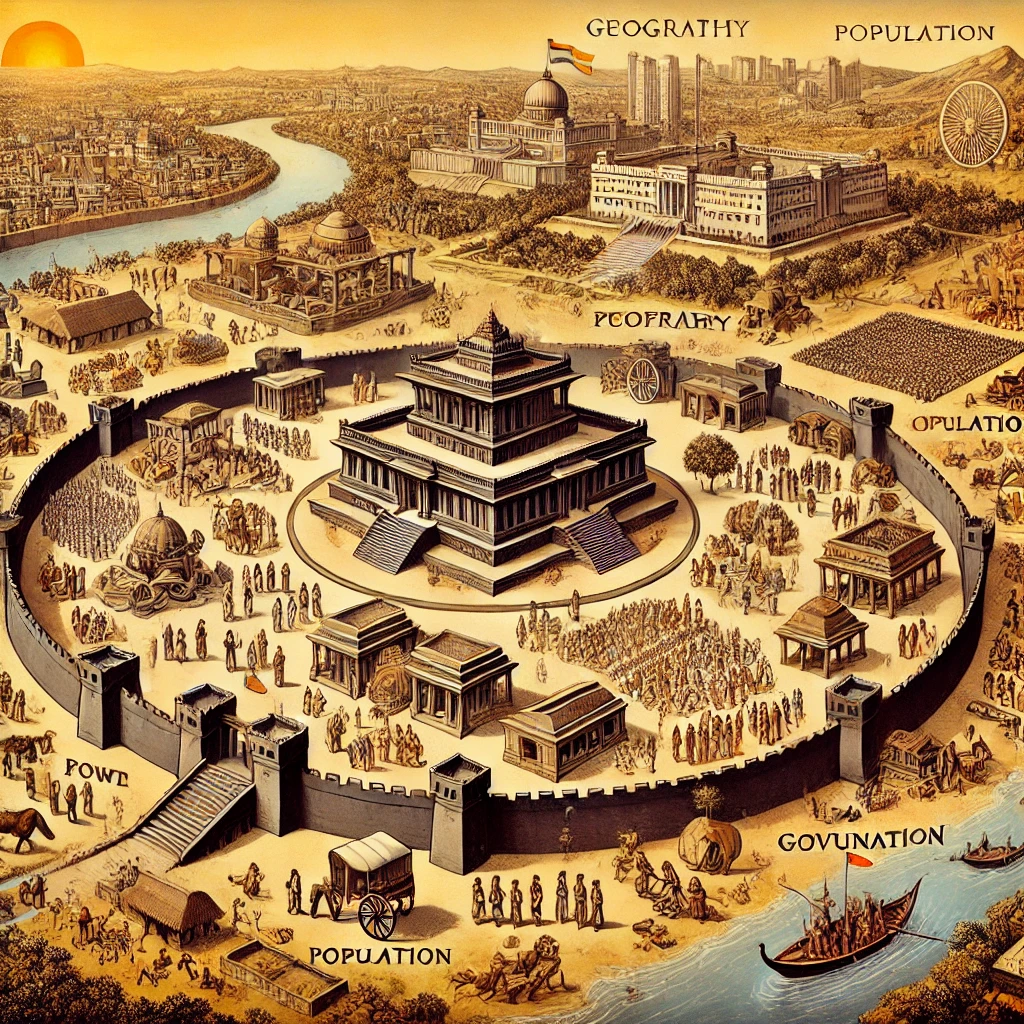
Importance of the Mahajanapada Era (600 BCE – 321 BCE)
The Mahajanapada Era (600 BCE – 321 BCE) was one of the most significant phases in Indian history. This period witnessed far-reaching changes in the political, economic, social, religious, military, and cultural spheres.
For the first time, India moved from tribal and regional units toward structured political entities, laying the foundation for powerful empires such as the Maurya Empire.
1. Political Significance
Process of State Formation
Small Janapadas gradually merged to form larger political units known as Mahajanapadas. In total, sixteen Mahajanapadas emerged during this period. Political centralization increased, and organized administrative systems developed.
Establishment of Monarchy and Republic
The Mahajanapada period witnessed the development of two distinct systems of governance.
- Monarchy: States like Magadha and Kashi were ruled by powerful kings.
- Republic: States like Vajji and Malla practiced collective decision-making.
Political Competition
Continuous power struggles among Mahajanapadas led to the rise of dominant states. Magadha emerged as the most powerful kingdom and laid the groundwork for pan-Indian political unity.
2. Economic Importance
Development of a Systematic Economy
The economy became more organized and was primarily based on agriculture and trade. The use of iron tools and irrigation systems significantly increased agricultural productivity.
Circulation of Currency
For the first time in Indian History, punch-marked coins came into circulation. This facilitated trade, market exchange, and tax collection.
Internal and External Trade
Trade expanded through roads, rivers, and sea routes. Major commercial centers included Magadha, Kashi, and Avanti.
3. Social Significance
Impact of the Varna System
Society was divided into four varnas—Brahmin, Kshatriya, Vaishya, and Shudra. The caste system became increasingly rigid during this period.
Status of Women
Women generally had limited participation in social and religious life. However, Buddhism and Jainism offered greater opportunities for women.
Growth of Urbanisation
Urban centers developed rapidly, becoming homes to artisans, traders, and merchants.
4. Religious and Cultural Significance
Rise of New Religions
Buddhism and Jainism emerged as major reform movements promoting non-violence and ethical conduct.
Development of Philosophy and Ethics
Concepts such as truth, compassion, morality, and non-violence gained importance.
Education and Literature
Educational centers like Takshila and Varanasi flourished during this period.
5. Military and Strategic Importance
Development of an Organised Army
The Chaturangini army consisting of infantry, cavalry, chariots, and elephants became the standard military structure.
Use of Military Power
Mahajanapadas expanded their territories through warfare. Magadha became the strongest state through military efficiency.
6. Administrative Importance
Growth of Organised Administration
Administrative institutions developed to manage taxation, law and order, and public welfare.
Central and Provincial Administration
States introduced divisions between central and provincial administration.

⭐ Editor's Choice
Discover a highly rated product selected for its quality, functionality, and positive customer feedback.
View Details & Reviews →Intelligence System
Intelligence networks were developed to maintain internal security and counter external threats.
7. Culture and Art
Art and Architecture
Cities and forts were constructed for defense and administration. Buddhist stupas and viharas also emerged.
Music and Dance
Music and dance played an important role in social and religious life.
Conclusion
The Mahajanapada Era was a transformative phase in Indian history. It established strong political, economic, administrative, and cultural foundations and paved the way for The Rise of the Maurya Empire.
```