
Introduction to the Maratha Empire
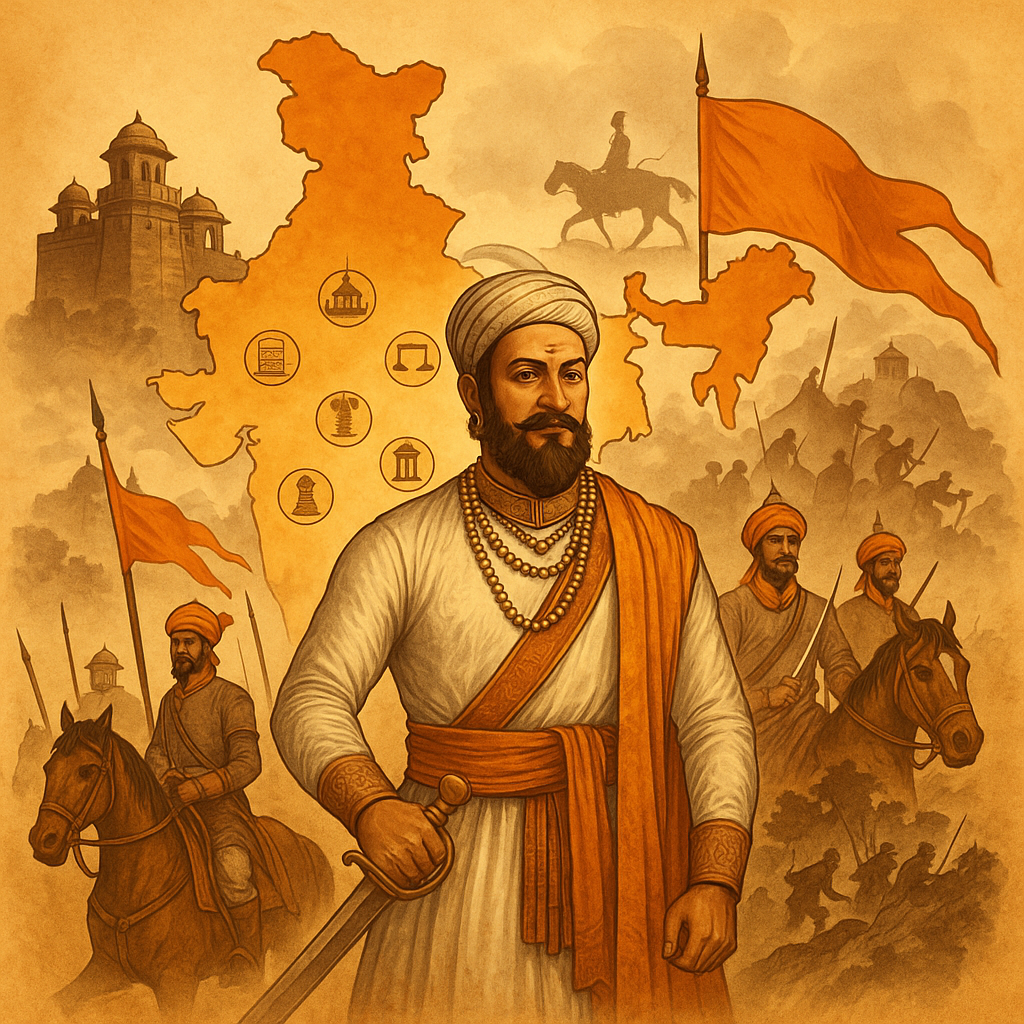
The Maratha Empire occupies an important place in the history of India. It emerged as a major political and military power during the 17th century and played a decisive role in Indian politics throughout the 18th century.
The rise of the Marathas was closely associated with Chhatrapati Shivaji Maharaj, who established an independent Maratha kingdom based on the ideal of Hindavi Swarajya. Through military organisation, administrative reforms, strategic forts and regional alliances, the Marathas gradually expanded their influence across large parts of the Indian subcontinent.
The Maratha political system later developed into a powerful confederacy under the Peshwas. Its history includes remarkable military achievements, administrative innovations, cultural contributions and important conflicts with the Mughal Empire, the Durrani Empire and the British East India Company.
1. Establishment of the Maratha Empire
The foundation of Maratha political power was laid by Shivaji Maharaj during the 17th century. He challenged the authority of the Bijapur Sultanate and the Mughal Empire and gradually established an independent kingdom in the western Deccan.
Contribution of Chhatrapati Shivaji Maharaj
- Coronation in 1674: Shivaji Maharaj was formally crowned at Raigad Fort and assumed the title of Chhatrapati.
- Hindavi Swarajya: He promoted the ideal of self-rule and established an independent Maratha kingdom.
- Administrative Reforms: He organised the administration through the Ashtapradhan Mandal, a council of eight ministers.
- Fort Development: He strengthened and developed strategic forts to protect his kingdom and control important routes.
- Military Strategy: He effectively used mobility, intelligence, terrain and surprise attacks, commonly associated with the Maratha method of warfare known as Ganimi Kava.
- Naval Development: He recognised the importance of maritime security and developed a naval force to protect the western coastline.
2. Administrative System of the Maratha Empire
The administrative system developed under Shivaji Maharaj was designed to strengthen central authority, improve revenue collection, maintain military organisation and ensure effective governance.
Ashtapradhan Mandal
The Ashtapradhan Mandal was a council of eight important ministers who assisted the Chhatrapati in the administration of the kingdom.
| Minister | Main Responsibility |
|---|---|
| Peshwa | Chief minister and coordination of administration. |
| Amatya | Finance and accounts of the state. |
| Mantri | Records of the court and intelligence-related duties. |
| Senapati | Commander of the military forces. |
| Sumant | Foreign affairs and relations with other states. |
| Nyayadhish | Judicial administration and justice. |
| Panditrao | Religious matters and charitable activities. |
| Sachiv | Official correspondence and administrative documents. |
The council helped organise the administration, although the Chhatrapati remained the supreme authority. The responsibilities of ministers could also vary according to administrative circumstances.
Revenue Administration
Land revenue was an important source of income for the Maratha kingdom. Shivaji Maharaj introduced measures to improve revenue assessment and collection, with attention to agricultural production and the condition of cultivators.
Chauth and Sardeshmukhi
Chauth and Sardeshmukhi became important sources of Maratha revenue, particularly in territories outside their directly administered kingdom.
- Chauth: Traditionally amounted to one-fourth (25%) of the assessed revenue of a territory. It was collected as a form of tribute or protection payment.
- Sardeshmukhi: An additional levy traditionally calculated at 10% of the assessed revenue, associated with the Marathas' claimed superior hereditary right as Deshmukhs.
These collections were important instruments of Maratha political and financial influence during their expansion.
3. Expansion of the Maratha Empire
After the death of Shivaji Maharaj in 1680, the Maratha kingdom faced serious military challenges, particularly from Mughal emperor Aurangzeb. His long Deccan campaigns placed considerable pressure on the Maratha leadership.
Successors of Shivaji Maharaj
- Sambhaji Maharaj: He continued the resistance against the Mughals but was captured and executed in 1689.
- Rajaram Maharaj: He continued the struggle from southern India, particularly from Gingee Fort.
- Tarabai: After Rajaram's death, she played a major role in organising Maratha resistance against Mughal forces.
- Shahu Maharaj: Following his release from Mughal captivity in 1707, a succession conflict developed between Shahu and Tarabai's faction.
Rise of the Peshwas
During the 18th century, the Peshwas became increasingly powerful in Maratha politics. Under their leadership, Maratha influence expanded beyond the Deccan into central, northern and western India.
Important Peshwas and Their Contributions
- Balaji Vishwanath (1713–1720): Strengthened the position of the Peshwa and helped consolidate Maratha political power under Shahu.
- Bajirao I (1720–1740): Expanded Maratha influence into Malwa, Gujarat and northern India through successful military campaigns.
- Balaji Bajirao (Nanasaheb, 1740–1761): Maratha influence reached a major geographical extent during his period, although the empire faced a devastating defeat at Panipat in 1761.
- Madhavrao I (1761–1772): Restored much of the Maratha political and military strength after the Third Battle of Panipat.
Third Battle of Panipat (1761)
The Third Battle of Panipat was fought on 14 January 1761 between the Maratha forces and the army of Ahmad Shah Abdali, also known as Ahmad Shah Durrani.
The Marathas suffered a major defeat, resulting in heavy military and political losses. However, the defeat did not immediately destroy Maratha power. Under Madhavrao I, the Marathas recovered considerable influence in the following years.
4. Military Strength of the Maratha Empire
The military strength of the Marathas was based on mobility, strategic planning, geographical knowledge and effective use of forts. Their military organisation evolved considerably during the 17th and 18th centuries.
1. Guerrilla Warfare
Maratha commanders frequently used surprise attacks, rapid movement, intelligence networks and knowledge of local terrain. This method of warfare is commonly associated with the term Ganimi Kava.
2. Cavalry
Cavalry played a major role in Maratha military campaigns. Fast-moving horsemen enabled the Marathas to conduct raids, disrupt enemy supply lines and cover long distances.
3. Forts and Defence
Hill forts and strategically located strongholds were central to Maratha defence. Raigad, Pratapgad, Sinhagad and other forts played important military and administrative roles.
4. Naval Power
Shivaji Maharaj recognised the strategic importance of the Arabian Sea and developed naval capabilities to protect coastal territories and maritime trade. Later, Maratha naval power was also associated with commanders such as Kanhoji Angre.
5. Artillery and Infantry
The Marathas used infantry and artillery alongside cavalry. Their military organisation changed over time, with greater use of European-style military training and artillery during parts of the 18th century.
5. Cultural and Social Impact of the Maratha Empire
The Maratha period contributed to the political, cultural and architectural history of India. Its influence extended across the Deccan and several other regions through administration, religious patronage, literature and architecture.
1. Religious and Cultural Traditions
The Maratha period was influenced by the Bhakti tradition of Maharashtra. Saints and poets such as Tukaram, Eknath and Ramdas formed part of the broader cultural and religious heritage that shaped the region.
2. Architecture and Forts
Forts, temples, palaces and other structures reflected the political and cultural priorities of Maratha rulers and their regional chiefs. Many historic forts remain important heritage sites.
3. Literature and Language
Marathi literature and administrative writing developed during the Maratha period. Marathi and Modi script were important in administrative records, while Persian continued to be used in several political and diplomatic contexts.
4. Administration and Regional Influence
Maratha political institutions and revenue practices influenced several regions. Their expansion also encouraged the development of regional centres of power, including Pune, which became an important political and cultural centre under the Peshwas.
6. Causes of the Decline of the Maratha Empire
The decline of the Maratha Empire was a gradual process caused by political divisions, military setbacks, leadership conflicts and the growing power of the British East India Company.
1. Third Battle of Panipat (1761)
The defeat at Panipat resulted in heavy casualties and weakened Maratha political and military influence. However, the Marathas recovered considerable strength under Madhavrao I.
2. Internal Conflicts and Political Rivalries
Rivalries among the Peshwas and powerful Maratha chiefs weakened central coordination. The major Maratha houses, including the Scindias, Holkars, Gaekwads and Bhonsles, increasingly pursued their own political interests.
3. Anglo-Maratha Wars
The three Anglo-Maratha Wars were decisive in the decline of Maratha political independence.
- First Anglo-Maratha War (1775–1782): Ended with the Treaty of Salbai in 1782.
- Second Anglo-Maratha War (1803–1805): The British defeated several major Maratha powers and expanded their influence.
- Third Anglo-Maratha War (1817–1818): The British defeated the Peshwa and other resisting Maratha forces, bringing the Peshwa's political authority to an end.
4. British Political and Military Expansion
The British East India Company used diplomacy, military strength, political agreements and conflicts among Indian powers to expand its control over large parts of the subcontinent.
Conclusion
The Maratha Empire occupies a significant position in Indian History. Its rise under Chhatrapati Shivaji Maharaj, expansion under the Peshwas, military organisation and administrative institutions shaped the political history of the Indian subcontinent during the 17th and 18th centuries.
Although internal divisions, military setbacks and the Anglo-Maratha Wars eventually brought the Peshwa's rule to an end in 1818, Maratha-ruled princely states continued to exist under British paramountcy.
The legacy of the Marathas remains important in India's political, military, cultural and architectural history. Their story illustrates the role of regional leadership, strategic organisation and political change in the making of modern India.

Recommended Study Resource
Explore this recommended resource for additional learning and historical study.
Affiliate Disclosure: This page contains affiliate links. We may earn a commission if you purchase through these links, at no additional cost to you.
Introduction to the Establishment of the Maratha Empire
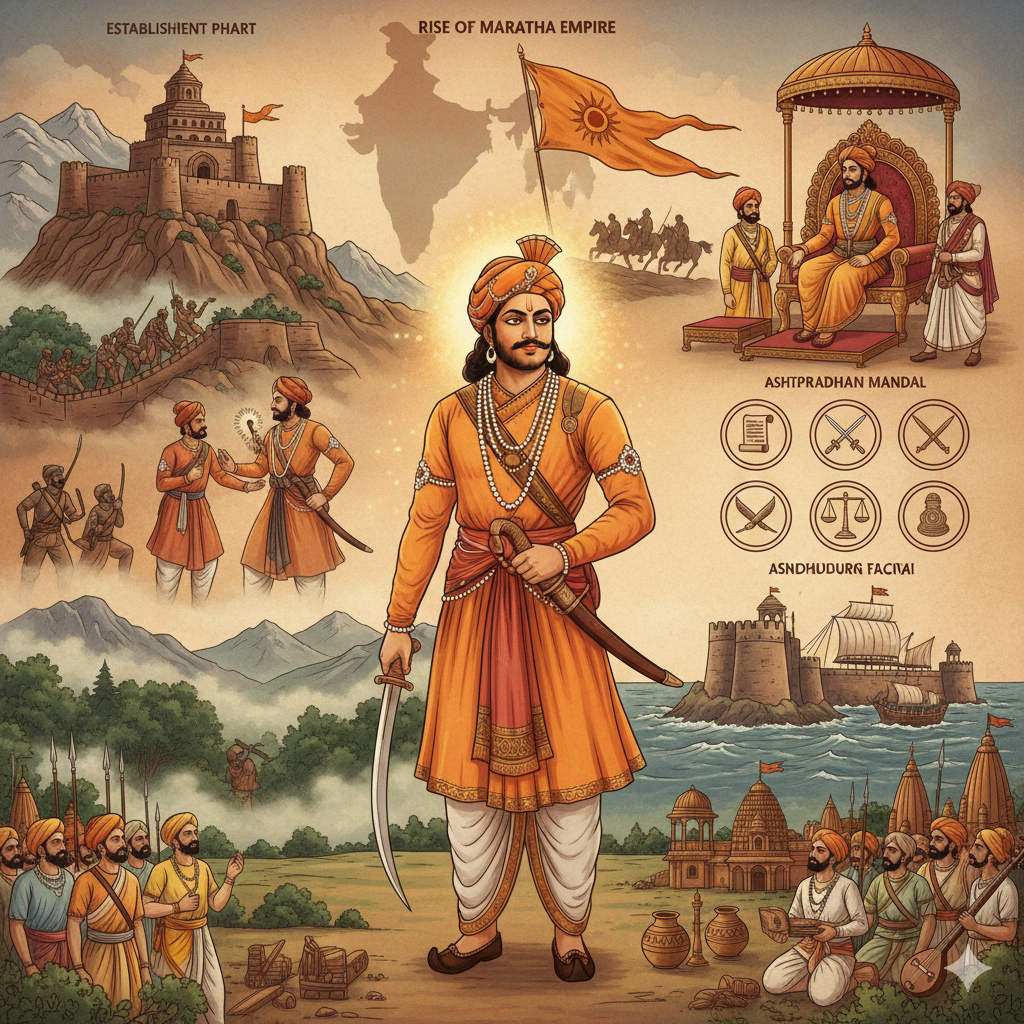
The establishment of the Maratha Empire was a significant development in the history of India. It emerged during the 17th century under the leadership of Chhatrapati Shivaji Maharaj, at a time when powerful political forces such as the Mughal Empire and the Deccan Sultanates dominated large parts of the Indian subcontinent.
Shivaji Maharaj established an independent Maratha kingdom through military organisation, strategic planning, fort-based defence and administrative reforms. His vision of Hindavi Swarajya became an important symbol of indigenous self-rule. The kingdom he established later developed into a major political and military power under the leadership of his successors and the Peshwas.
1. Background of the Establishment of the Maratha Empire
The rise of the Marathas took place in a politically competitive environment in the Deccan. The Mughal Empire was expanding southwards, while the Deccan Sultanates, including Bijapur and Golconda, controlled important territories. These political conditions created opportunities for regional powers to emerge.
Geographical Location and Strategic Importance
- Western Ghats: The rugged terrain of the Western Ghats (Sahyadri Mountains) provided natural defensive advantages.
- Hill Forts: Numerous forts located on hills and mountain routes helped control strategic passages and protect territories.
- Regional Support: Local military groups, landholding communities and regional networks contributed to the growth of Maratha political power.
- Political Rivalries: Conflicts among the Mughal Empire and Deccan Sultanates created opportunities for Shivaji to expand his influence.
Early Life of Shivaji Maharaj
- Shivaji Maharaj was born at Shivneri Fort, traditionally dated to 19 February 1630.
- His father, Shahaji Bhosale, was an influential military commander who served different Deccan powers, including the Bijapur Sultanate.
- His mother, Jijabai, played an important role in his upbringing and helped shape his values, ambitions and sense of responsibility.
- Shivaji grew up in the Deccan region, where political rivalries and local conditions influenced his early military and political activities.
Inspiration and Ideals
- Shivaji's upbringing was influenced by religious, cultural and literary traditions, including stories from the Ramayana and Mahabharata.
- He developed the vision of Hindavi Swarajya, generally understood as indigenous self-rule.
- His political and military activities aimed to establish an independent kingdom rather than remain subordinate to the major powers of the Deccan.
2. Main Stages of the Establishment of the Maratha Empire
The establishment of Maratha power was a gradual process involving fort conquests, conflicts with regional sultanates, military resistance against the Mughals and the development of an independent administration.
1. Capture of the First Forts (1645–1655)
- Capture of Torna: Shivaji captured Torna Fort in 1645 or 1646, according to different historical accounts. It became one of his earliest important military successes.
- Expansion of Fort Control: He gradually brought several strategically important forts and surrounding territories under his control.
- Development of Raigad: Raigad was later developed into a major administrative and political centre of the Maratha kingdom.
- Military Strategy: Shivaji used mobility, surprise attacks and knowledge of local terrain, methods commonly associated with Ganimi Kava.
2. Struggle Against the Adilshahi Sultanate
- Shivaji initially expanded his power by challenging the authority of the Adilshahi Sultanate of Bijapur.
- His growing control over forts and territories created tensions with the Bijapur government.
- In 1659, Bijapur sent Afzal Khan to suppress Shivaji's growing power.
- Shivaji and Afzal Khan met near Pratapgad Fort in November 1659. Afzal Khan was killed during the encounter, followed by a Maratha victory against the Adilshahi forces.
3. Struggle Against the Mughal Empire
After establishing a strong position in the western Deccan, Shivaji increasingly came into conflict with the Mughal Empire. Mughal expansion into the Deccan threatened Maratha territories and political independence.
Conflict with Mughal Authorities
- Shivaji's expansion brought him into conflict with Mughal officials and military commanders operating in the Deccan.
- In 1663, Shivaji carried out a surprise attack on the Mughal commander Shaista Khan in Pune.
- In January 1664, Shivaji raided Surat, an important Mughal port and commercial centre. The campaign provided substantial wealth and demonstrated his ability to strike important Mughal economic centres.
- In 1665, the Treaty of Purandar was concluded between Shivaji and Mughal commander Jai Singh I. Shivaji agreed to surrender several forts and accept certain Mughal conditions.
- In 1666, Shivaji visited Agra, where he was placed under restrictions by the Mughal authorities. He subsequently escaped and returned to the Deccan.
After his return, Shivaji gradually rebuilt his political and military position. In 1670, he resumed military campaigns against Mughal-held territories and recovered several forts.
4. Coronation of Shivaji Maharaj (1674)
The coronation of Shivaji Maharaj was a landmark event in the establishment of the Maratha kingdom. On 6 June 1674, he was formally crowned at Raigad Fort and assumed the sovereign title of Chhatrapati.
Importance of the Coronation
- Formal Sovereignty: The coronation publicly established Shivaji as an independent ruler.
- Political Legitimacy: It strengthened the legitimacy of the Maratha kingdom among contemporary political powers.
- Administrative Organisation: It provided a stronger institutional foundation for the administration of the kingdom.
- Hindavi Swarajya: The event symbolised the achievement of Shivaji's vision of indigenous self-rule.
- Royal Institutions: The coronation was accompanied by formal court ceremonies and the development of royal administrative practices.
5. Administrative Reforms of Shivaji Maharaj
Shivaji Maharaj established an organised Administrative System to manage his growing kingdom. His reforms covered political administration, revenue collection, military organisation and justice.
Ashtapradhan Mandal
The Ashtapradhan Mandal was a council of eight ministers who assisted the Chhatrapati in different areas of governance.
- Peshwa: Chief minister and coordinator of state administration.
- Amatya: Responsible for finance and accounts.
- Mantri: Responsible for court records and intelligence-related duties.
- Senapati: Commander of the military forces.
- Sumant: Responsible for foreign affairs and relations with other states.
- Nyayadhish: Responsible for judicial administration.
- Panditrao: Responsible for religious matters and charitable activities.
- Sachiv: Responsible for official correspondence and administrative documents.
Revenue Administration
Shivaji introduced measures to improve land revenue assessment and collection. The administration sought to assess agricultural production and regulate revenue demands. These measures helped strengthen the financial foundation of the Maratha kingdom.
Military Organisation
Shivaji strengthened the army through organised cavalry, infantry, fort-based defence and naval development. Military organisation was essential for protecting the kingdom and maintaining control over newly acquired territories.
6. Main Reasons for the Establishment of the Maratha Empire
Several political, geographical, military and social factors contributed to the rise of the Maratha kingdom.
1. Effective Leadership
Shivaji Maharaj's leadership, strategic thinking and ability to organise military and administrative institutions provided a strong foundation for Maratha power.
2. Guerrilla Warfare
The use of Ganimi Kava, surprise attacks, rapid movement and knowledge of local terrain helped Maratha forces challenge larger and better-resourced armies.
3. Geographical Advantage
The rugged Sahyadri Mountains, narrow mountain passes and strategically located forts provided natural defensive advantages.
4. Support from Local Communities
Local military groups, cultivators, administrators and regional networks contributed to the organisation and expansion of Maratha political power.
5. Political Conditions in the Deccan
Rivalries among the Deccan Sultanates and the Mughal Empire created opportunities for Shivaji to expand his territories and establish an independent kingdom.
6. Strong Fort Network
The capture, construction and strengthening of forts helped the Marathas protect their territories, control important routes and maintain military positions.
Conclusion
The establishment of the Maratha Empire was a major political development in Indian history. Through military organisation, strategic planning, fort-based defence and administrative reforms, Chhatrapati Shivaji Maharaj laid the foundation of an independent Maratha kingdom.
His coronation at Raigad in 1674 marked the formal establishment of his sovereign kingship. The political institutions and military foundations created under his leadership enabled his successors to expand Maratha influence across large parts of India.
The legacy of Shivaji Maharaj remains important in India's political, military and cultural history. His role in the development of indigenous governance continues to be a significant subject of historical study.

Recommended Study Resource
Explore this recommended resource for additional historical learning and exam preparation.
Affiliate Disclosure: This page contains affiliate links. We may earn a commission if you purchase through these links, at no additional cost to you.
Chhatrapati Shivaji Maharaj: Contributions, Administration and Legacy
Chhatrapati Shivaji Maharaj was one of the most influential rulers in Indian history. He laid the foundation of the Maratha state through his military leadership, political vision, and administrative abilities. His contributions extended beyond territorial expansion and included the development of an organised administration, a strong military system, coastal defence, and the idea of Hindavi Swaraj.
Major Contributions of Shivaji Maharaj
1. Establishment of Hindavi Swaraj
- Shivaji Maharaj promoted the idea of Hindavi Swaraj, generally understood as self-rule or indigenous political authority.
- He established an independent Maratha kingdom in a period when large parts of the Deccan were controlled by powerful sultanates and the Mughal Empire.
- His leadership encouraged political independence, regional identity, and self-respect among his supporters.
2. Guerrilla Warfare System (Ganimi Kava)
- Shivaji Maharaj effectively used guerrilla warfare, traditionally known as Ganimi Kava.
- This military approach involved surprise attacks, rapid movements, strategic withdrawals, and the effective use of hills, forests, and difficult terrain.
- It helped his forces challenge the larger armies of the Bijapur Sultanate and the Mughal Empire.
- His military strategy demonstrated how geographical knowledge, intelligence, and mobility could overcome numerical disadvantages.
3. Military Organisation and Naval Development
- Shivaji Maharaj developed an organised military structure with infantry, cavalry, and specialised units.
- He maintained disciplined forces and paid attention to military training, intelligence, logistics, and the management of forts.
- He recognised the importance of naval power for protecting the Konkan coastline, coastal settlements, and maritime trade.
- He developed a navy and strengthened coastal fortifications, including Sindhudurg and Vijaydurg.
- His naval initiatives contributed to the development of maritime defence under the Maratha state.
4. administrative reforms and Ashtapradhan Mandal
- Shivaji Maharaj established an organised Administrative System to manage the kingdom's civil, financial, military, and judicial affairs.
- One of its important features was the Ashtapradhan Mandal, a council of eight ministers who assisted the Chhatrapati in administration.
| Minister | Principal Responsibility |
|---|---|
| Peshwa | Chief minister and overall coordination of administration |
| Amatya | Finance and accounts |
| Sumant (Dabir) | Foreign affairs and diplomatic relations |
| Senapati | Military affairs and army command |
| Mantri | Royal records and intelligence-related responsibilities |
| Panditrao | Religious grants and ceremonial matters |
| Nyayadhish | Judicial administration |
| Sachiv | State correspondence and official documents |
- The council helped organise different branches of government, although the Chhatrapati retained supreme authority.
- Shivaji also worked to improve land-revenue administration and reduce arbitrary demands on cultivators.
- Revenue assessment and collection were organised to strengthen state finances and improve administrative control.
Recommended Study Resource
Explore this recommended resource for learning, revision, and general educational use.
Affiliate Disclosure: This page contains affiliate links. We may earn a commission if you purchase through these links, at no additional cost to you.
5. Religious Tolerance
- Shivaji Maharaj is generally recognised for following a policy that respected different religious communities.
- People from different religious backgrounds served in his military and administrative establishments.
- Historical accounts describe his instructions against the unnecessary destruction of places of worship and the mistreatment of women.
- His approach to governance reflected the importance of political cooperation across different communities.
6. Construction and Strategic Use of Forts
- Forts formed the backbone of Shivaji Maharaj's military and administrative strategy. He captured, strengthened, repaired, and developed numerous forts.
- Important forts associated with his rule include Raigad, Sindhudurg, Pratapgad, and Purandar.
- Hill forts provided defensive advantages and helped control important routes and surrounding territories.
- Some forts also functioned as administrative centres, military bases, and storage facilities.
7. Economic and Revenue Reforms
- Shivaji Maharaj strengthened the financial foundations of his kingdom through organised revenue collection and attention to agriculture and trade.
- He worked to reduce the exploitation of cultivators by improving land assessment and revenue administration.
- Chauth was generally a levy equivalent to one-fourth of the assessed revenue, collected from certain territories outside direct Maratha administration in return for protection or political arrangements.
- Sardeshmukhi was an additional levy traditionally calculated at 10% of the assessed revenue, claimed on the basis of the Marathas' asserted hereditary rights.
- These levies later became important sources of revenue during the expansion of Maratha power.
8. Resistance Against the Deccan Sultanates and Mughal Empire
- Shivaji Maharaj challenged the authority of the Bijapur Sultanate and the Mughal Empire in the Deccan.
- His campaigns, diplomatic negotiations, and military strategies helped establish and defend an independent Maratha kingdom.
- His resistance became an important factor in the changing political balance of the Deccan during the seventeenth century.
- His achievements provided the foundation for the later expansion of Maratha political power across large parts of the Indian subcontinent.
9. Coronation and Cultural Contributions
- Shivaji Maharaj was formally crowned at Raigad Fort on 6 June 1674 and assumed the title of Chhatrapati.
- His coronation established the political and ceremonial legitimacy of his independent kingdom.
- He encouraged the use of Marathi in administration and supported the development of regional cultural traditions.
- He also supported religious institutions and the preservation of cultural heritage within his kingdom.
10. Protection of Women and Farmers
- Shivaji Maharaj's military code emphasised respect for women and prohibited their mistreatment during military campaigns.
- Historical accounts describe disciplinary action against soldiers who violated these principles.
- He recognised the importance of agriculture and sought to protect cultivators from arbitrary revenue demands and military exploitation.
- His administrative approach gave importance to the stability of rural communities and the economic strength of the kingdom.
Conclusion
Chhatrapati Shivaji Maharaj made a lasting contribution to Indian history through the establishment of an independent Maratha kingdom, effective military organisation, administrative reforms, and the development of coastal defence. His use of guerrilla warfare, the Ashtapradhan system, strategic forts, and revenue administration strengthened the foundations of Maratha power. His leadership and political vision continue to be remembered as important chapters in the history of India.
Administrative System of Chhatrapati Shivaji Maharaj
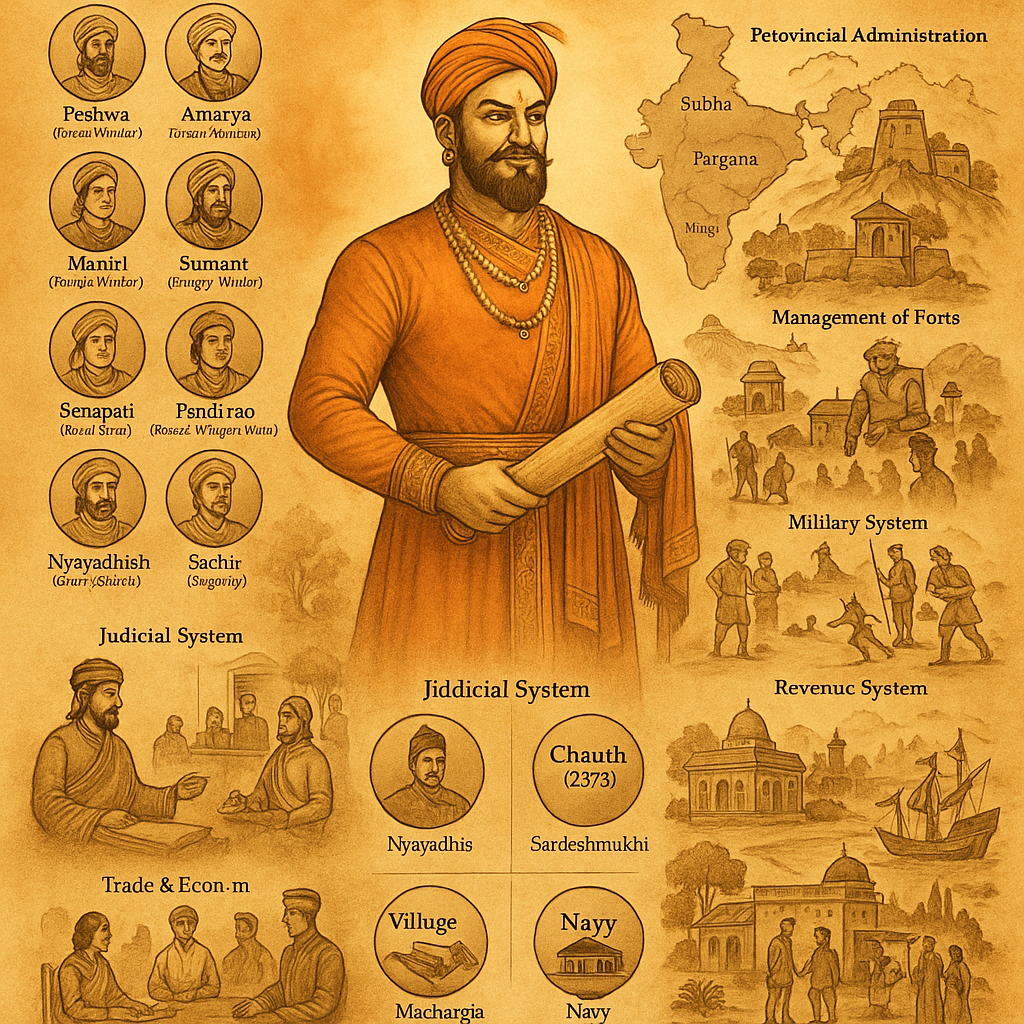
Chhatrapati Shivaji Maharaj established a well-organised administrative system that strengthened the foundations of the Maratha state. His governance model focused on effective administration, military security, revenue management, justice, and the protection of agricultural and commercial activities. The system reflected his political vision and helped maintain stability across the territories under his control.
Major Aspects of Shivaji Maharaj's Administrative System
1. Ashtapradhan Mandal
One of the most important features of Shivaji Maharaj's administration was the Ashtapradhan Mandal, a council of eight ministers who assisted the Chhatrapati in managing different departments of the state. The council provided administrative support, although the king retained supreme authority.
| Minister | Position and Responsibilities |
|---|---|
| Peshwa | Chief minister who coordinated general administration and assisted the ruler in important matters. |
| Amatya | Managed state finances, revenue accounts, and financial administration. |
| Mantri | Maintained royal records and handled intelligence-related responsibilities. |
| Sumant (Dabir) | Managed foreign affairs, diplomatic relations, and communication with other states. |
| Senapati | Headed the military and supervised army-related matters. |
| Panditrao | Looked after religious grants, charitable activities, and religious matters. |
| Nyayadhish | Oversaw judicial administration and the delivery of justice. |
| Sachiv | Managed official correspondence, royal documents, and administrative records. |
2. Provincial and Local Administration
- The territories under Shivaji Maharaj were organised into larger administrative divisions, commonly referred to as Prants or provinces.
- Provincial administration was supervised by appointed officials who were responsible for revenue collection, law and order, and the implementation of royal orders.
- Smaller administrative units included Paraganas and villages.
- Local officials such as Deshmukhs, Deshpandes, Patils, and Kulkarnis played important roles in local administration and revenue-related work.
- Village-level administration helped maintain records, collect revenue, and address local issues.
3. Management and Administration of Forts
- Forts were essential to Shivaji Maharaj's military and administrative system because they provided defence, territorial control, and secure storage facilities.
- Fort administration generally involved three important officers: Havaldar, Sabnis, and Karkhanis.
- The Havaldar was responsible for the fort's security and military command.
- The Sabnis generally looked after accounts and administrative records.
- The Karkhanis managed stores, supplies, and other material arrangements.
- This distribution of responsibilities helped prevent excessive concentration of authority in the hands of a single fort officer.
- Important forts associated with Shivaji Maharaj included Raigad, Pratapgad, Sindhudurg, and Purandar.
4. Army and Military Administration
- Shivaji Maharaj maintained a disciplined military organisation consisting mainly of infantry and cavalry, supported by artillery and other specialised units.
- His army included the Mavala infantry, which was particularly effective in the hilly terrain of the Western Ghats.
- Military officers were appointed to supervise troops, maintain discipline, and organise military operations.
- He placed importance on regular salaries, military discipline, and proper arrangements for supplies and equipment.
- His forces effectively used Ganimi Kava, a form of guerrilla warfare involving surprise attacks, mobility, and knowledge of local geography.
- He also developed naval capabilities to protect the Konkan coastline and important maritime interests.
5. Tax and revenue system
Shivaji Maharaj worked to establish an organised revenue system that could provide financial stability to the state while reducing arbitrary demands on cultivators.
- Land revenue was an important source of income for the Maratha state.
- Revenue assessment took land quality, cultivation, and agricultural productivity into consideration.
- Officials were responsible for maintaining revenue records and collecting payments according to state regulations.
- Chauth: A levy generally equivalent to 25% of the assessed revenue of certain territories outside direct Maratha administration. It was associated with Maratha claims of protection and political authority.
- Sardeshmukhi: An additional levy traditionally calculated at 10% of the assessed revenue, based on the Maratha claim of hereditary rights.
- These two levies later became important sources of income during the expansion of Maratha power.
- Shivaji's administration also emphasised the protection of cultivators from arbitrary collection and unnecessary military exploitation.

Recommended Study Resource
Explore this educational resource for historical learning, revision, and general study purposes.
Affiliate Disclosure: This page contains affiliate links. We may earn a commission if you purchase through these links, at no additional cost to you.
6. Judicial System
- Shivaji Maharaj's administration recognised the importance of justice and the settlement of disputes.
- The Nyayadhish was responsible for overseeing judicial matters at the higher level.
- Traditional customs, established practices, and local institutions played a role in resolving disputes.
- Village-level bodies and local authorities helped settle many everyday disputes.
- Administrative officials were expected to maintain order and implement the ruler's instructions.
7. Religious and Cultural Policy
- Shivaji Maharaj's administration included people from different religious communities.
- Muslim soldiers and officers served in the Maratha military and administrative establishments.
- Historical accounts describe instructions against the unnecessary desecration of places of worship.
- He supported religious institutions and grants, while religious policy also formed part of the political and social context of his rule.
- His administration demonstrated that military and political service was not restricted exclusively to one religious community.
8. Trade and Economic Policy
- Shivaji Maharaj recognised the importance of agriculture, inland commerce, and maritime trade for the prosperity of his kingdom.
- He strengthened coastal defences and naval capabilities to protect maritime interests.
- Ports and coastal settlements were strategically important for trade, revenue, and military security.
- His administration sought to protect merchants and commercial activities in territories under Maratha control.
- Forts, roads, and strategic locations helped maintain control over important routes and regional markets.
Key Features of Shivaji Maharaj's Administrative System
- Centralised Authority: The Chhatrapati exercised supreme authority, supported by a council of ministers.
- Administrative Organisation: Different officials were assigned specific responsibilities for governance and revenue management.
- Military Security: A disciplined army, strategic forts, and naval capabilities strengthened state defence.
- Revenue Management: Land assessment and organised collection helped maintain the financial stability of the state.
- Local Administration: Village-level officials and traditional institutions helped manage local affairs.
- Justice and Public Order: Judicial officials and local authorities played important roles in dispute resolution.
Conclusion
Chhatrapati Shivaji Maharaj's administrative system was an important foundation of the Maratha state. Through the Ashtapradhan Mandal, organised revenue administration, strategic fort management, military reforms, and local governance, he developed a system suited to the political and geographical conditions of his time. His administrative approach strengthened the kingdom and remains an important subject of study in Indian medieval history.
Expansion of the Maratha Empire
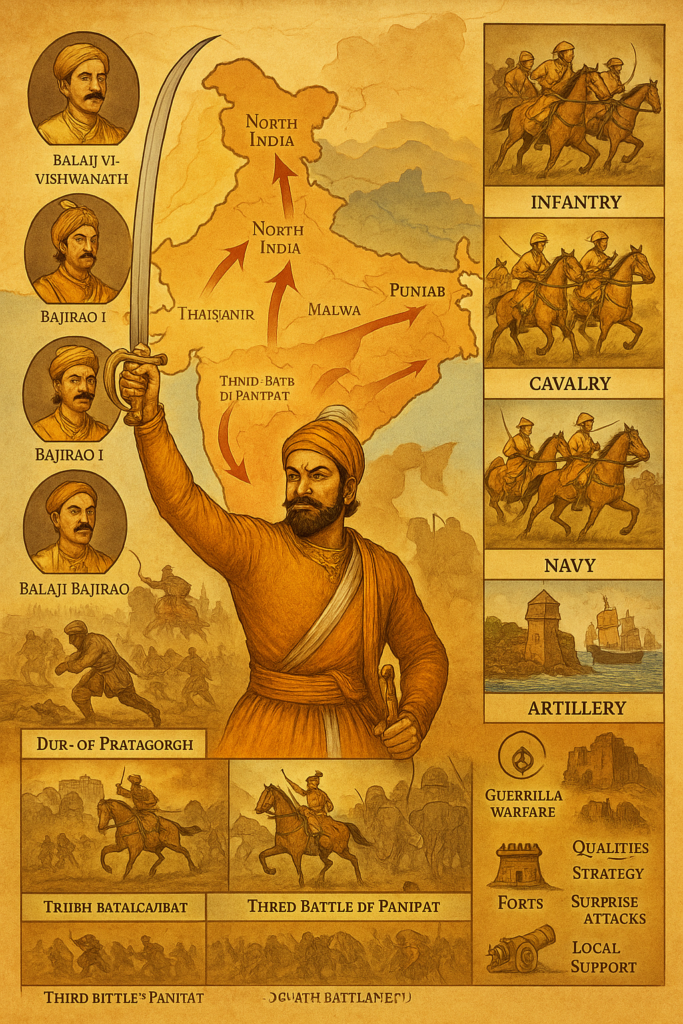
The expansion of the Maratha Empire during the 17th and 18th centuries was one of the most important developments in Indian history. It began under the leadership of Chhatrapati Shivaji Maharaj and continued under his successors, the Peshwas, and powerful Maratha chiefs. From its original base in western India, Maratha political and military influence gradually extended into central, northern, and southern parts of the Indian subcontinent.
Major Phases of the Expansion of the Maratha Empire
1. Initial Expansion under Shivaji Maharaj (1645–1680)
- Shivaji Maharaj laid the foundation of an independent Maratha kingdom by capturing strategically important forts and territories.
- His early expansion focused on the Pune region, the Konkan coast, and parts of the Western Ghats in present-day Maharashtra.
- Battle of Pratapgad (1659): Shivaji's forces defeated the army of Afzal Khan, an important commander of the Bijapur Sultanate. This victory strengthened Maratha power.
- First attack on Surat (1664): Shivaji conducted a major raid on Surat, an important Mughal commercial centre, to obtain resources and weaken Mughal economic interests.
- Following the Treaty of Purandar (1665), his visit to Agra (1666), and the recovery of several forts from 1670, Shivaji restored and expanded his political position.
- After his coronation at Raigad on 6 June 1674, he formally established the status of his independent kingdom as Chhatrapati.
- His southern campaigns of 1676–1678 extended Maratha influence into parts of the Karnataka region.
2. Period after Shivaji Maharaj (1680–1707)
- After Shivaji Maharaj's death in 1680, his son Sambhaji Maharaj succeeded him and continued resistance against the Mughal Empire.
- Mughal emperor Aurangzeb launched an extensive Deccan campaign to bring the Maratha kingdom and other Deccan states under Mughal control.
- After Sambhaji's capture and execution in 1689, Rajaram Maharaj continued the resistance from southern strongholds, including Jinji Fort.
- Following Rajaram's death in 1700, Maharani Tarabai continued leading the Maratha resistance on behalf of her son.
- The prolonged conflict placed considerable pressure on Mughal resources and prevented the complete suppression of Maratha resistance.
- Aurangzeb died in 1707. The political instability that followed created new opportunities for the Marathas to reorganise and expand.
3. Expansion under the Peshwas (1713–1761)
Balaji Vishwanath (1713–1720)
- Balaji Vishwanath became the Peshwa under Chhatrapati Shahu and played a major role in consolidating Maratha political power.
- He strengthened the administration and helped unite influential Maratha chiefs under Shahu's authority.
- The Mughal agreement of 1719 recognised Maratha claims to collect Chauth and Sardeshmukhi from specified territories in the Deccan.
Bajirao I (1720–1740)
- Bajirao I was one of the most successful military leaders in Maratha history and played a major role in northward expansion.
- His campaigns extended Maratha influence into Malwa, Gujarat, and Bundelkhand.
- He intervened in the politics of northern India and brought Maratha military power close to Delhi.
- His alliance with Bundela ruler Chhatrasal strengthened Maratha influence in Bundelkhand.
- His campaigns helped extend Maratha political influence towards the Narmada and the Ganga-Yamuna region.
Balaji Bajirao (1740–1761)
- Also known as Nana Saheb, Balaji Bajirao continued the expansion of Maratha influence after the death of Bajirao I.
- Maratha power expanded further into northern India, including Punjab, where Maratha forces intervened in regional politics.
- Maratha influence also extended into parts of Odisha, where revenue claims and political control developed through military campaigns and agreements.
- However, growing territorial commitments and political rivalries created administrative and military challenges.
- The period ended with the Third Battle of Panipat in 1761, which caused severe losses to the Maratha forces.
4. Third Battle of Panipat (1761)
- The Third Battle of Panipat was fought on 14 January 1761 between the Maratha army and the forces of Ahmad Shah Durrani (Abdali), supported by several Indian allies.
- The Marathas suffered a major military defeat and lost many important commanders and soldiers.
- The defeat temporarily weakened Maratha influence in northern India and disrupted their expansion plans.
- However, it did not permanently end Maratha power. The Marathas reorganised under Peshwa Madhavrao I in the following years.
5. Reconstruction and Later Expansion (1761–1818)
Madhavrao I (1761–1772)
- Madhavrao I played a major role in rebuilding Maratha power after the defeat at Panipat.
- He strengthened the administration, restored financial stability, and led successful military campaigns.
- His leadership helped the Marathas recover much of their earlier political influence.
Mahadji Shinde
- Mahadji Shinde became one of the most influential Maratha chiefs in northern India.
- He restored Maratha influence in Delhi and played an important role in the politics of the Mughal court.
- In 1788, he helped restore Mughal emperor Shah Alam II to the throne after the emperor had been blinded by Ghulam Qadir.
- The Mughal emperor subsequently remained under strong Maratha political and military protection.
Nana Fadnavis
- Nana Fadnavis was an influential statesman who helped maintain the political stability of the Maratha Confederacy.
- He used diplomacy and political alliances to protect Maratha interests during a period of internal rivalries and British expansion.
- His diplomatic role was particularly important during the period of the First Anglo-Maratha War.
By the late 18th century, Maratha influence extended across large parts of central and northern India, as well as areas of the Deccan and southern India. However, the Maratha Confederacy consisted of several powerful houses with considerable regional autonomy.
Major Regions of Maratha Expansion
South India
- Shivaji Maharaj's southern campaigns extended Maratha influence into parts of present-day Karnataka and adjoining regions.
- His half-brother Ekoji (Venkoji) established a separate Maratha kingdom at Thanjavur in the 17th century.
- Later Maratha campaigns and political interventions extended their influence into parts of southern India.
- Maratha influence should not be confused with complete or permanent control over all southern territories or Goa.
North India
- Under the Peshwas and powerful Maratha chiefs, Maratha forces expanded into Malwa, Bundelkhand, Delhi, and Punjab.
- In 1757, Maratha forces intervened in Delhi and restored their influence over the Mughal court.
- Maratha power became a major factor in the political affairs of northern India during the mid-18th century.
- The Mughal emperor continued to occupy the throne, but his political independence was increasingly limited by powerful regional forces.
Western and Central India
- Western India remained the original centre of Maratha power, particularly the regions of Maharashtra and the Konkan.
- Maratha influence expanded into Gujarat and Malwa through military campaigns, political agreements, and revenue arrangements.
- Bundelkhand became an important area of Maratha influence following the alliance with Chhatrasal.
- Maratha chiefs also intervened in the politics of Rajasthan, although control varied across different states and periods.
Main Reasons for the Expansion of the Maratha Empire
- Military Organisation: A combination of infantry, cavalry, forts, and mobile military operations supported Maratha expansion.
- Guerrilla Warfare: Shivaji Maharaj's use of Ganimi Kava helped Maratha forces challenge larger armies.
- Leadership of the Peshwas: The political and military leadership of the Peshwas, particularly Bajirao I, accelerated territorial expansion.
- Decline of Mughal Authority: Political instability and weakening Mughal control created opportunities for regional powers.
- Diplomacy and Alliances: Agreements with local rulers and regional political groups helped extend Maratha influence.
- Revenue Resources: Revenue claims, including Chauth and Sardeshmukhi, helped finance military campaigns and administration.
- Regional Support: Local networks, military leaders, and supporters contributed to the maintenance of Maratha power.
Conclusion
The expansion of the Maratha Empire was a gradual process that began under Chhatrapati Shivaji Maharaj and reached its greatest territorial influence during the Peshwa period. The Marathas became one of the most powerful political forces in 18th-century India. Although the Third Battle of Panipat in 1761 caused a major setback, the Marathas recovered under Madhavrao I and continued to influence Indian politics. Their power eventually declined following internal conflicts and the Anglo-Maratha Wars, culminating in the end of Peshwa rule in 1818.
Recommended Study Resource
Explore this educational resource for historical learning, revision, and exam preparation.
Affiliate Disclosure: This page contains affiliate links. We may earn a commission if you purchase through these links, at no additional cost to you.
Military Strength of the Maratha Empire
The military strength of the Maratha Empire was a major factor behind its political expansion and survival. The military foundations developed by Chhatrapati Shivaji Maharaj combined mobility, knowledge of local geography, strategic forts, and disciplined troops. Later Maratha rulers, Peshwas, and regional chiefs expanded these military traditions. The Maratha military system was particularly effective because it combined rapid cavalry movements with infantry operations, fort defence, and naval capabilities.
Structure of the Maratha Army
1. Infantry
- Maratha infantry played an important role in defending forts and conducting operations in hilly and forested regions.
- Soldiers used weapons such as swords, spears, bows, and firearms, including matchlocks.
- Infantry units were familiar with difficult terrain and supported surprise attacks and defensive operations.
- The Mavala soldiers from the Western Ghats were especially associated with Shivaji Maharaj's early military campaigns.
2. Cavalry
- Cavalry was one of the most important components of the Maratha military system.
- Its speed and mobility allowed Maratha forces to conduct raids, reconnaissance, rapid attacks, and long-distance campaigns.
- Two important categories of Maratha cavalry were:
- Bargir: Cavalrymen who generally received horses and equipment from the state.
- Shiledar: Cavalrymen who generally maintained their own horses and equipment.
- Both categories contributed to the mobility and operational flexibility of the Maratha army.
3. Navy
- Shivaji Maharaj recognised the importance of naval power for protecting the Konkan coastline and maritime trade.
- He developed an organised naval force and strengthened coastal defence.
- Sea forts such as Sindhudurg and Vijaydurg supported maritime security and naval operations.
- The Maratha navy later developed further under naval commanders such as the Angres.
- Maratha naval forces challenged European and regional maritime powers, including the Portuguese and British, at different times.
Military Organisation and Strategies
1. Guerrilla Warfare (Ganimi Kava)
- Ganimi Kava was an important military strategy associated with Shivaji Maharaj.
- It relied on surprise attacks, rapid movement, intelligence, and the effective use of hills and forests.
- Maratha forces often avoided prolonged direct battles when facing larger enemy armies.
- This approach helped them disrupt enemy supply lines and retreat strategically when necessary.
2. Strategic Role of Forts
- Forts formed the backbone of Maratha defence and territorial administration.
- Shivaji Maharaj captured, repaired, strengthened, and constructed numerous forts.
- Important forts included Raigad, Pratapgad, Sindhudurg, and Purandar.
- Forts served as military bases, administrative centres, supply depots, and defensive positions.
- The fort network helped the Marathas maintain control over strategic routes and difficult terrain.
3. Military Discipline and Organisation
- Military discipline was an important feature of Shivaji Maharaj's army.
- Troops were organised under appointed commanders and officers.
- Regular payment arrangements and regulations helped maintain military discipline, although practices varied across periods and units.
- Rules concerning the treatment of civilians and the handling of captured property formed part of military discipline.
- Under the Peshwas, military organisation expanded to support campaigns across distant regions.
4. Weapons, Artillery, and Military Technology
- The Marathas used swords, spears, matchlocks, cannons, and other weapons available during the period.
- They adopted and adapted military technologies through contact with Deccan states and European powers.
- Artillery became increasingly important in later Maratha campaigns, particularly during the 18th century.
- European military specialists and trained soldiers were employed by some Maratha chiefs to improve artillery and infantry capabilities.
- The effectiveness of Maratha forces depended not only on weapons but also on mobility, logistics, leadership, and strategy.
Success in Major Military Operations
1. Battle of Pratapgad (1659)
- Shivaji Maharaj confronted Afzal Khan, a senior commander of the Bijapur Sultanate.
- The encounter took place near Pratapgad in November 1659.
- The subsequent Maratha victory significantly strengthened Shivaji's political and military position.
2. Attacks on Surat (1664 and 1670)
- Shivaji Maharaj conducted two major raids on Surat, an important Mughal commercial centre.
- These operations provided financial resources and demonstrated the ability of Maratha forces to strike important economic centres.
- The raids also exposed weaknesses in the protection of important Mughal commercial routes and cities.
3. Resistance against the Mughals
- Maratha resistance continued during Aurangzeb's prolonged Deccan campaign.
- After Shivaji Maharaj, Sambhaji, Rajaram, and Maharani Tarabai played important roles in continuing the struggle.
- Maratha forces used mobile warfare, fort defence, and local networks to sustain resistance.
- The prolonged conflict placed significant military and financial pressure on the Mughal Empire.
4. Third Battle of Panipat (1761)
- The Maratha army fought Ahmad Shah Durrani's forces at Panipat on 14 January 1761.
- The Marathas suffered a major defeat and experienced heavy losses.
- Despite the setback, Maratha political and military power recovered under Madhavrao I in the following years.
Key Features of the Maratha Military System
- Mobility: Fast cavalry and flexible military operations enabled campaigns over large distances.
- Guerrilla Strategy: Surprise attacks and knowledge of local terrain provided important tactical advantages.
- Fort Network: Forts supported defence, administration, and the protection of strategic routes.
- Naval Capabilities: Naval development strengthened coastal security and maritime operations.
- Military Adaptability: The Marathas adopted different weapons, technologies, and military practices over time.
- Regional Networks: Local commanders, supporters, and political alliances helped sustain military campaigns.
Conclusion
The military strength of the Maratha Empire was based on mobility, strategic leadership, fortifications, cavalry, infantry, and naval development. Shivaji Maharaj established important military traditions that were later expanded by the Peshwas and Maratha chiefs. Although the Marathas experienced a major defeat at Panipat in 1761, their military and political recovery demonstrated the resilience of their state. Their military organisation remains an important subject in the study of medieval and early modern Indian history.
Cultural and Social Impact of the Maratha Empire
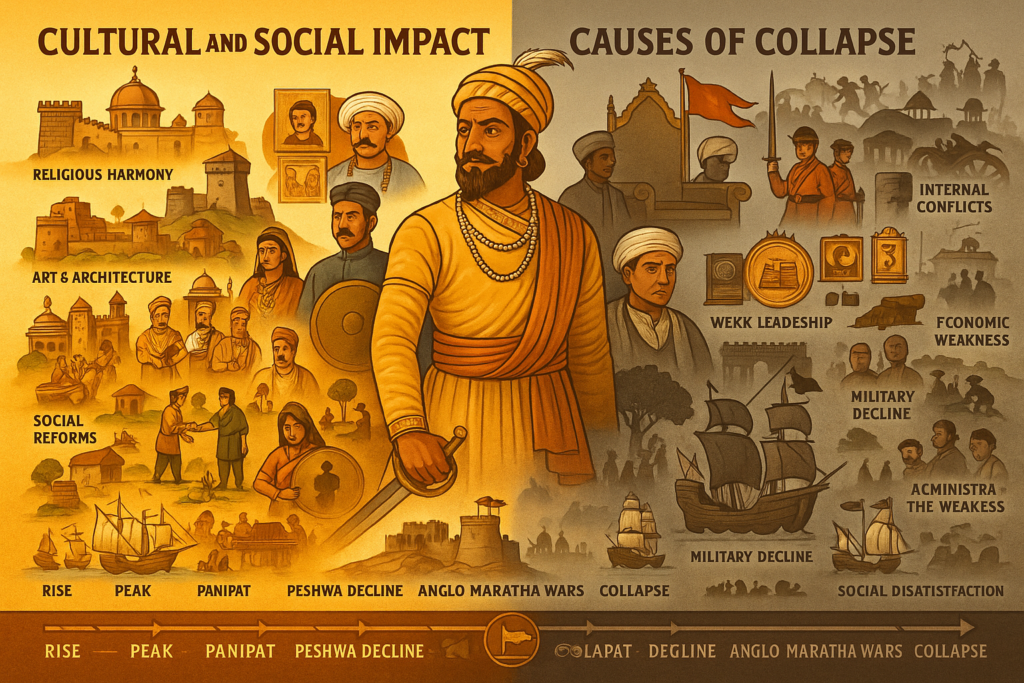
The Maratha Empire had a significant influence on the political, cultural, and social development of India, particularly during the 17th and 18th centuries. Under the leadership of Chhatrapati Shivaji Maharaj and his successors, Maratha rulers contributed to regional administration, literature, architecture, religious institutions, and trade. Their cultural legacy was especially important in Maharashtra and several other regions of the Indian subcontinent.
Cultural Influences of the Maratha Empire
1. Religion and Religious Policy
Respect for Different Religious Communities
- Shivaji Maharaj's administration included people from different religious communities.
- Muslim soldiers, officers, and other personnel served in the Maratha military and administrative establishments.
- Historical accounts describe instructions against the unnecessary destruction of places of worship and the mistreatment of religious communities.
- Religious considerations formed part of the political and social environment of Maratha rule, although policies varied across rulers and periods.
Religious Institutions and Freedom
- Maratha rulers provided patronage to temples, religious institutions, and charitable activities.
- Shivaji Maharaj's policies included respect for religious figures and places of worship.
- Religious grants and institutional support continued under several later Maratha rulers and chiefs.
Preservation of Religious Traditions
- Maratha rulers supported temples and traditional religious institutions in territories under their influence.
- Religious literature, pilgrimage centres, and regional traditions received patronage at different times.
- These activities contributed to the continuity of religious and cultural practices.
2. Art and Architecture
- Maratha rulers developed and strengthened forts, palaces, temples, administrative buildings, and other structures.
- Important forts associated with Maratha history include Raigad, Pratapgad, Sindhudurg, and Vijaydurg.
- Fort architecture reflected the military requirements of the region, including defensive walls, gateways, water-storage systems, and strategic locations.
- Maratha-era temples, palaces, and residential structures reflected regional architectural traditions and local craftsmanship.
- Music, religious ceremonies, folk traditions, and courtly cultural activities received patronage in different Maratha centres.
3. Literature and Language
- Development of Marathi: Marathi became increasingly important in regional administration, communication, and literary expression.
- Bhakti Literature: The works of saints such as Sant Dnyaneshwar, Namdev, Eknath, and Tukaram had a lasting influence on Marathi religious and literary traditions.
- Administrative Records: Modi script was widely used for Marathi administrative and financial records during the Maratha period.
- Persian and Sanskrit: Persian continued to be used in diplomacy and administration in several contexts, while Sanskrit retained importance in religious, scholarly, and ceremonial traditions.
- Historical Writing: Bakhars, chronicles, letters, and official records provide important information about Maratha political and social history.
Social Impact of the Maratha Empire
1. Social Structure and Community Participation
- Maratha military and administrative institutions included people from different social and regional backgrounds.
- Military service and political loyalty created opportunities for some local leaders and families to gain influence.
- However, caste-based distinctions and traditional social hierarchies continued to exist during the Maratha period.
- Therefore, Maratha rule should not be described as having completely eliminated caste or social inequality.
2. Agrarian and Rural Administration
- Agriculture was an important foundation of the Maratha economy.
- Shivaji Maharaj's revenue administration emphasised land assessment and the regulation of revenue collection.
- Administrative measures sought to reduce arbitrary demands and protect cultivators from unnecessary exploitation.
- Village officials played important roles in maintaining agricultural and revenue records.
- However, the burden of taxation and military demands varied across regions and periods.
3. Development of Trade and Industry
- Maratha rulers recognised the importance of agriculture, trade, crafts, and commercial centres.
- Coastal forts and naval forces helped protect important maritime interests along the Konkan coast.
- Merchants, traders, and artisans contributed to the economic activity of Maratha territories.
- Textile production, metalwork, traditional crafts, and regional markets remained important parts of the economy.
- Political stability and military security influenced the growth of trade, although warfare sometimes disrupted commercial activities.
4. Religious Movements and Social Traditions
- The Bhakti tradition had a deep influence on the cultural and religious life of Maharashtra.
- Saints such as Tukaram, Dnyaneshwar, Namdev, and Eknath contributed to devotional literature and religious expression.
- Their teachings often emphasised devotion, ethical conduct, and the spiritual value of individuals.
- These traditions influenced regional society, religious practices, and Marathi literature over several centuries.
Policies Toward Women
- Historical accounts of Shivaji Maharaj's military conduct emphasise the protection of women and prohibit their mistreatment during campaigns.
- Women from different social backgrounds appear in the political and military history of the Maratha period, including influential royal women such as Maharani Tarabai.
- Women in royal households sometimes played important roles in diplomacy, succession disputes, and political decision-making.
- However, it would be inaccurate to claim that the Maratha Empire introduced comprehensive reforms in women's marriage rights, education, or social equality.
- Women's experiences continued to be shaped by the social customs and hierarchies of the period.
Importance of the Cultural and Social Contributions
- Regional Identity: Maratha political development strengthened Marathi regional identity and cultural institutions.
- Literary Development: Marathi devotional, administrative, and historical literature continued to develop.
- Architectural Heritage: Forts and other historical structures remain important parts of India's cultural heritage.
- Religious Traditions: Patronage of temples, religious institutions, and devotional movements influenced regional culture.
- Administrative Legacy: Maratha revenue and military institutions contributed to the history of regional governance.
- Political Legacy: The Maratha resistance to Mughal expansion and later political influence became important themes in Indian history.
Conclusion
The Maratha Empire made important contributions to the cultural, social, and political history of India. Its legacy can be seen in Marathi literature, Bhakti traditions, fort architecture, regional administration, and the development of trade and military institutions. Although traditional social hierarchies continued during this period, Maratha history remains an important chapter in understanding the political and cultural transformations of early modern India.
Causes of the Fall of the Maratha Empire
The decline of Maratha political power was a gradual process involving internal divisions, leadership struggles, military challenges, financial difficulties, and the expansion of British power. Although the Marathas became one of the strongest political forces in 18th-century India, their influence weakened during the late 18th and early 19th centuries. The Third Anglo-Maratha War (1817–1818) brought an end to Peshwa rule and established British supremacy over the major Maratha powers.
Main Reasons for the Decline of the Maratha Empire
1. Third Battle of Panipat (1761)
- The Third Battle of Panipat was fought on 14 January 1761 between the Marathas and the forces of Ahmad Shah Durrani, also known as Ahmad Shah Abdali.
- The Marathas suffered a major military defeat and lost several important commanders and large numbers of soldiers.
- The defeat weakened Maratha influence in northern India and created a temporary political and military crisis.
- However, the Marathas recovered significantly under Peshwa Madhavrao I, so Panipat alone cannot explain their eventual decline.
2. Internal Divisions and Conflicts
- Political rivalries developed among the major Maratha houses and the Peshwa administration.
- The Scindia, Holkar, Gaekwad, and Bhonsle families exercised considerable regional power.
- Disagreements over territory, revenue, succession, and political authority weakened collective decision-making.
- These divisions made it difficult to maintain a united response to British expansion.
3. Weak and Unstable Leadership
- After the death of Madhavrao I in 1772, the Peshwa administration experienced increasing political instability.
- Succession disputes and rivalries among influential ministers and chiefs weakened central authority.
- Peshwa Baji Rao II faced major political and military challenges and increasingly depended on British support.
- Leadership conflicts reduced the ability of the Maratha Confederacy to coordinate its military and diplomatic policies.
4. Rise of British Power
- The British East India Company expanded its political and military influence through diplomacy, alliances, and warfare.
- The British exploited rivalries among Indian powers and negotiated agreements that increased their influence over Maratha politics.
- The Anglo-Maratha Wars were decisive in the decline of Maratha political independence.
- The Third Anglo-Maratha War (1817–1818) ended the Peshwa's rule and established British supremacy over the major Maratha states.
5. Economic and Financial Weakness
- Continuous military campaigns placed heavy pressure on Maratha financial resources.
- Political instability and warfare sometimes disrupted agriculture, trade, and revenue collection.
- Competition among regional chiefs created difficulties in maintaining a stable financial and Administrative System.
- British military and financial resources gave the East India Company important advantages during prolonged conflicts.
6. Military and Technological Challenges
- Maratha forces remained capable and adaptable, but military organisation varied among the different Maratha chiefs.
- Some Maratha leaders adopted European-style infantry, artillery, and military training, but these reforms were not consistently coordinated across the confederacy.
- The British developed increasingly effective systems of military logistics, artillery, communication, and command.
- Internal divisions and inconsistent military coordination reduced the effectiveness of Maratha resistance.
- It would be inaccurate to say that the Marathas completely abandoned guerrilla warfare; rather, their military methods evolved according to changing political and strategic conditions.

Recommended Study Resource
Explore this educational resource for historical learning, revision, and exam preparation.
Affiliate Disclosure: This page contains affiliate links. We may earn a commission if you purchase through these links, at no additional cost to you.
7. Administrative Problems
- The Maratha Confederacy included several powerful regional houses with substantial autonomy.
- Although this arrangement helped extend Maratha influence across a large territory, it also made central coordination difficult.
- Differences in regional interests and revenue arrangements weakened collective political authority.
- Succession disputes and administrative rivalries further reduced the stability of the Peshwa government.
8. Diplomatic Challenges and External Conflicts
- The Marathas faced challenges from several regional and external powers, including the Nizam of Hyderabad, Mysore, and Afghan forces under Ahmad Shah Durrani.
- Political competition among Indian states sometimes prevented the formation of stable alliances.
- The British East India Company used diplomacy and military intervention to take advantage of these rivalries.
- These developments gradually weakened the Marathas' strategic position.
9. Decline of Naval Strength
- Shivaji Maharaj had recognised the strategic importance of naval power and developed coastal forts and naval forces.
- Maratha naval power continued under important commanders, including members of the Angre family.
- However, political divisions and changing military priorities affected the continuity and coordination of naval strength.
- The British and other European maritime powers possessed significant naval resources, which gave them an advantage in controlling important sea routes.
10. Regional and Social Pressures
- Frequent warfare and revenue demands could create difficulties for cultivators, traders, and local communities.
- Political instability sometimes disrupted the administration of rural and commercial areas.
- Different regions experienced Maratha rule in different ways, and local conditions varied considerably.
- These pressures contributed to administrative difficulties, although they were not the sole or principal cause of the empire's decline.
Effects of the Decline of Maratha Power
- End of Peshwa Rule: In 1818, the British defeated Peshwa Baji Rao II and brought Peshwa rule to an end.
- Expansion of British Authority: British political and military supremacy expanded across large parts of India.
- Loss of Political Independence: Major Maratha powers lost their independent political position, although some princely states continued under British paramountcy.
- Reorganisation of Indian Politics: The decline of Maratha power transformed the political balance of the Indian subcontinent.
- Continuing Cultural Legacy: Maratha forts, literature, administrative traditions, and historical memory continued to influence regional and national history.
Anglo-Maratha Wars and the End of Peshwa Rule
| War | Period | Historical Significance |
|---|---|---|
| First Anglo-Maratha War | 1775–1782 | Ended with the Treaty of Salbai and temporarily restored a political balance. |
| Second Anglo-Maratha War | 1803–1805 | British victories weakened the power of several major Maratha chiefs. |
| Third Anglo-Maratha War | 1817–1818 | Ended Peshwa rule and established British supremacy over the major Maratha powers. |
Conclusion
The decline of the Maratha Empire was the result of several interconnected factors, including internal political divisions, leadership struggles, financial pressures, military challenges, and the expansion of British power. The defeat at Panipat in 1761 was a major setback, but the Marathas recovered under Madhavrao I. Their eventual political decline resulted from the combined impact of internal rivalries and the Anglo-Maratha Wars. In 1818, Peshwa rule ended, although some Maratha princely states continued under British paramountcy. Despite the loss of political independence, the Marathas left a lasting legacy in India's political, cultural, and military history.
References and Further Reading
- Historical Biographies: Historical accounts and biographies of Chhatrapati Shivaji Maharaj and other important Maratha rulers.
- Primary Historical Sources: Archival records, copper-plate inscriptions, royal correspondence, administrative documents, and regional chronicles from the Maratha period.
- Indian History Textbooks: University-level textbooks covering medieval and early modern Indian history.
- Academic Research: Historical research papers and scholarly studies on the political expansion, administration, military organisation, and decline of the Maratha Empire.
- Archaeological Sources: Reports and publications of the Archaeological Survey of India relating to historical forts, monuments, and heritage sites associated with Maratha history.
- Peshwa Period: Historical documents and scholarly literature on Peshwa administration, Maratha diplomacy, military campaigns, and regional politics.
- Maratha Legacy: Historical studies examining the contribution of Shivaji Maharaj and the Marathas to India's political and cultural history.

Recommended History Study Resource
Explore this resource for additional historical reading, learning, and exam preparation.
Affiliate Disclosure: This page contains affiliate links. We may earn a commission if you purchase through these links, at no additional cost to you.