
Dadra and Nagar Haveli and Daman and Diu
Dadra and Nagar Haveli and Daman and Diu is a Union Territory of western India with a distinctive history, diverse culture, and beautiful natural landscapes. Its story reflects tribal traditions, Portuguese colonial influence, the freedom movement, and modern development. This article explores its geography, history, culture, economy, tourism, and important features in a simple and informative way.
To understand its administrative position, you can also read our detailed article on Union Territories of India and the administrative structure of India.
Overview of Dadra and Nagar Haveli and Daman and Diu
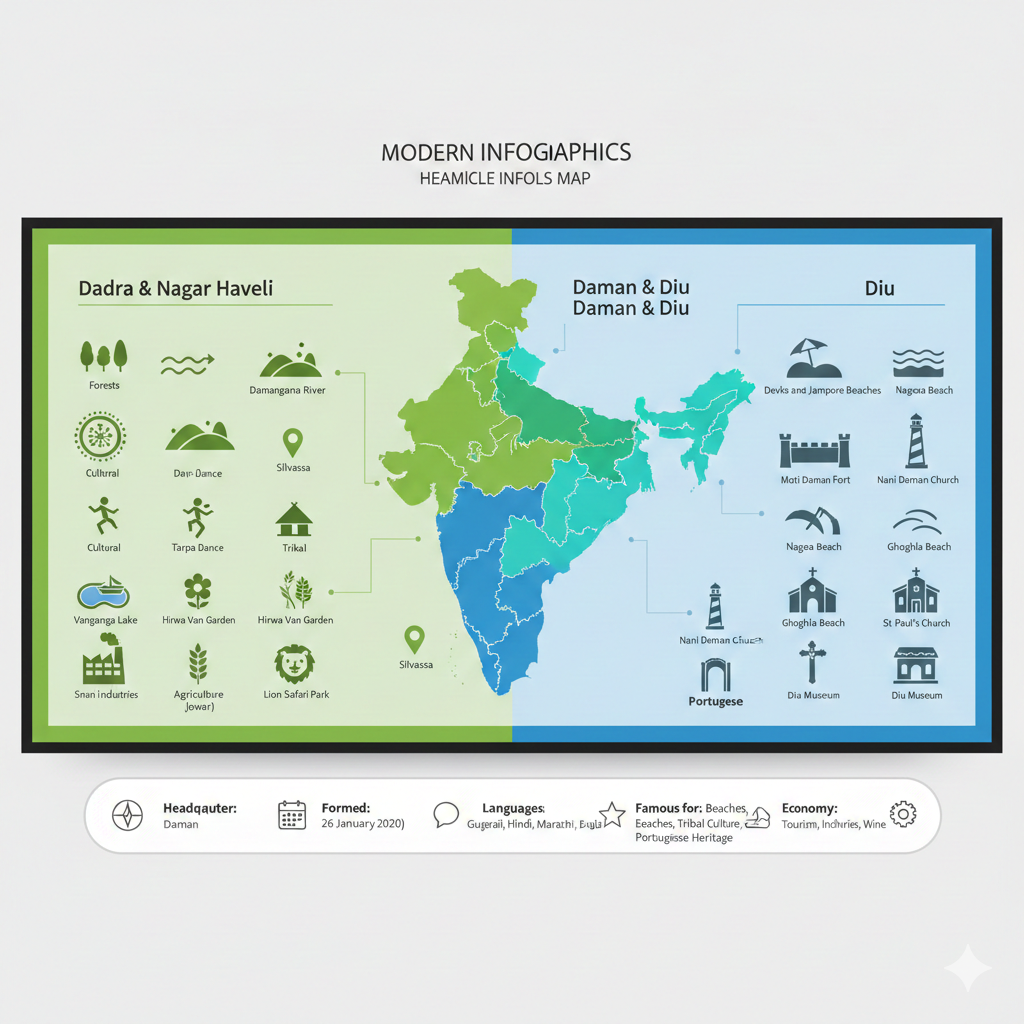
Dadra and Nagar Haveli and Daman and Diu is a Union Territory of India. It was formed on 26 January 2020 through the merger of two earlier Union Territories: Dadra and Nagar Haveli, and Daman and Diu.
The administrative headquarters of the merged Union Territory is located in Daman. Silvassa is the principal town and district headquarters of Dadra and Nagar Haveli. The region combines tribal traditions, Indian cultural practices, and Portuguese historical influences.
Geographical Location
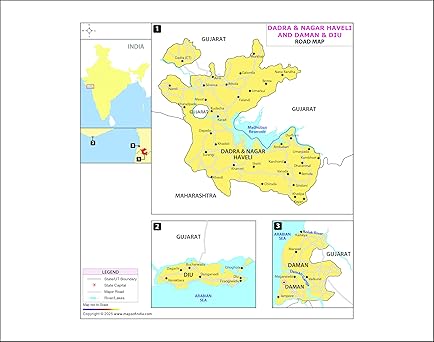
The Union Territory is located in western India, close to the Arabian Sea and surrounded by the states of Gujarat and Maharashtra.
- Dadra and Nagar Haveli: A landlocked region situated between Gujarat and Maharashtra.
- Daman: A coastal area on the Arabian Sea, near the southern part of Gujarat.
- Diu: An island and adjoining coastal region near the southern coast of the Saurashtra Peninsula in Gujarat.
- Administrative headquarters: Daman.
- Major town of Dadra and Nagar Haveli: Silvassa.
Historical Background
The history of this Union Territory is closely associated with Portuguese colonial rule and the freedom movements that ended foreign control in the region.
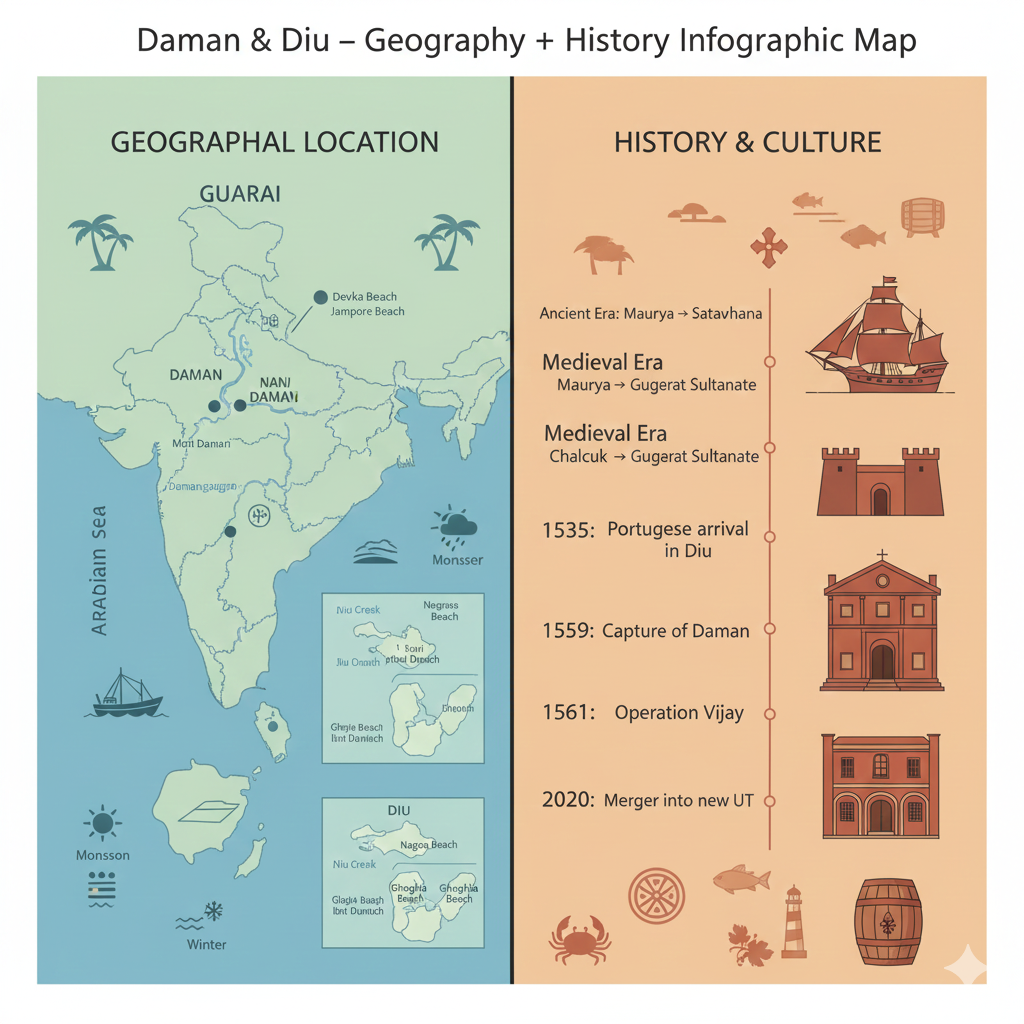
- Dadra and Nagar Haveli: The Portuguese established control over the region during the late eighteenth century. It was liberated in 1954 through the efforts of local freedom fighters and volunteers.
- Daman and Diu: These territories remained under Portuguese rule until December 1961, when India liberated them during Operation Vijay.
- 1961: Dadra and Nagar Haveli became formally integrated into India and was administered as a Union Territory.
- 1987: Goa became a separate state, while Daman and Diu continued as a Union Territory.
- 2020: Dadra and Nagar Haveli and Daman and Diu were merged into a single Union Territory on 26 January 2020.
This journey from colonial rule to liberation and administrative reorganisation is an important chapter in the modern history of western India.
Culture and Languages
The cultural identity of this Union Territory reflects a combination of tribal traditions, Gujarati and Marathi influences, Indian customs, and Portuguese heritage.
- Major languages: Gujarati, Hindi, Marathi, and English are used in different communities and administrative settings.
- Tribal languages: Various local tribal languages and dialects are spoken in Dadra and Nagar Haveli.
- Folk music, traditional dances, and local festivals form an important part of its cultural heritage.
- Portuguese-era churches, forts, and buildings reflect the region's colonial history.
- Different religious and cultural communities contribute to the region's diversity.
Natural Beauty and Major Tourist Places
Dadra and Nagar Haveli and Daman and Diu are known for their beaches, forests, lakes, wildlife attractions, and historical monuments. Each part of the Union Territory offers a different experience for visitors.
Daman – Beaches and Heritage
- Devka Beach: A popular coastal attraction known for its seaside views and recreational surroundings.
- Jampore Beach: Known for its sandy shoreline and opportunities for relaxation and selected water activities.
- Fort St. Jerome (Nani Daman Fort): A historic Portuguese-era fort reflecting the region's colonial architecture and defence history.
- Moti Daman Fort: An important historical fortification built during Portuguese rule.
- Lighthouse: A coastal landmark associated with the maritime landscape of Daman.
Diu – Island of Calm and Culture
- Nagoa Beach: A well-known beach popular for relaxation and selected water activities.
- Diu Fort: A major historical monument representing Portuguese military architecture.
- St. Paul's Church: Known for its decorative architecture and Portuguese-era religious heritage.
- Ghoghla Beach: A popular coastal destination for visitors seeking a peaceful seaside experience.
- Diu Museum: Preserves historical objects and artefacts associated with the region's heritage.
Dadra and Nagar Haveli – Greenery and Nature
- Dadra and Nagar Haveli Wildlife Sanctuary: An important natural area for wildlife and biodiversity.
- Vanganga Lake Garden: A scenic garden and lake area near Silvassa, known for its greenery and boating facilities.
- Satmalia Deer Park: A wildlife attraction where visitors can observe deer and other natural surroundings.
- Lion Safari Park: A popular wildlife attraction in the Silvassa region.
- Water-based recreation: Selected lakes and recreational areas provide opportunities for boating and outdoor activities.
Economic Situation
The economy of Dadra and Nagar Haveli and Daman and Diu is supported by industrial activity, tourism, agriculture, fisheries, trade, and services. The contribution of these sectors varies across the different parts of the Union Territory.
- Industry: Industrial units, particularly around Silvassa and Daman, contribute to manufacturing, employment, and economic activity.
- Tourism: Beaches, forts, churches, gardens, and natural attractions support tourism-related businesses.
- Agriculture: Agriculture remains important in rural areas, with crops such as paddy and other regionally suitable crops.
- Fisheries: Fishing and related activities support livelihoods in coastal areas, particularly Daman and Diu.
- Trade and services: Retail, transport, hospitality, and other services contribute to the regional economy.
The combination of Industrial development, coastal tourism, agriculture, and local businesses gives the Union Territory economic importance despite its relatively small geographical area.
Key Features of the Union Territory
- It is a Union Territory located in western India.
- It was formed on 26 January 2020 through the merger of two earlier Union Territories.
- Daman is the administrative headquarters of the merged Union Territory.
- Silvassa is the principal town of Dadra and Nagar Haveli.
- The region is known for its beaches, forts, churches, forests, lakes, and wildlife attractions.
- Its culture reflects tribal traditions, Gujarati and Marathi influences, and Portuguese heritage.
- Industrial development, tourism, agriculture, and fisheries contribute to its economy.
Dadra and Nagar Haveli and Daman and Diu is a distinctive region where history, geography, cultural diversity, and modern development come together.
Introduction to Dadra and Nagar Haveli
Dadra and Nagar Haveli is a landlocked region in western India, situated between Gujarat and Maharashtra. It is known for its natural landscapes, tribal communities, forests, and cultural traditions. The region offers an interesting combination of nature, history, and local life.
Geographical Location of Dadra and Nagar Haveli
- Location: Between the Valsad region of Gujarat and the Palghar region of Maharashtra.
- Area: Approximately 491 square kilometres.
- Major town: Silvassa.
- Important river: The Damanganga River is a major river of the region and an important source of water resources.
- Landscape: The region includes river valleys, forests, agricultural land, and gently undulating terrain.
Historical Background
- The Portuguese established control over Dadra and Nagar Haveli during the eighteenth century.
- Dadra was liberated in July 1954, followed by the liberation of Nagar Haveli in August 1954.
- The liberation movement was carried out by local freedom fighters and volunteers.
- In 1961, the region was formally integrated into India and became a Union Territory.
- In 2020, it was merged with Daman and Diu to form the present Union Territory.
Culture of Dadra and Nagar Haveli
The culture of Dadra and Nagar Haveli is strongly influenced by tribal traditions, folk arts, and local customs. Several tribal communities, including the Warli, Kokna, and Dodhia, have contributed to its cultural identity.
- Folk dance and music: Tarpa dance is an important traditional dance associated with tribal communities.
- Warli painting: A distinctive tribal art form known for its geometric figures and depictions of everyday life, nature, and community activities.
- Major festivals: Diwali, Holi, and different tribal and community festivals are celebrated in the region.
- Traditional music, folk performances, and community gatherings help preserve local cultural practices.
Languages Spoken
- Gujarati: Widely spoken in the region.
- Hindi: Used for communication across different communities.
- Marathi: Spoken by sections of the population, reflecting neighbouring regional influences.
- Tribal languages: Local tribal languages and dialects are also spoken.
Tourist Spots in Dadra and Nagar Haveli
Silvassa
Silvassa is the principal town and district headquarters of Dadra and Nagar Haveli. It is known for its gardens, cultural attractions, and access to nearby natural destinations.
Vanganga Lake Garden
Vanganga Lake Garden is a scenic recreational area near Silvassa. Its landscaped surroundings, water features, and boating facilities make it a popular destination for visitors.
Lion Safari Park
Lion Safari Park is a wildlife attraction in the Silvassa region. It provides visitors with an opportunity to observe wildlife in a managed setting.
Hiran Garden
Hiran Garden is a landscaped recreational space known for its greenery and family-friendly surroundings.
Religious and Natural Places
Balaji Temple, Satmalia Deer Park, and the natural surroundings of Vanganga Lake are among the attractions that offer visitors a combination of religious, recreational, and nature-based experiences.
Economy of Dadra and Nagar Haveli
- Agriculture: Agriculture supports rural livelihoods. Paddy is an important crop, along with other crops suited to local soil and climatic conditions.
- Industry: Silvassa and its surrounding areas have several industrial units, including manufacturing and processing businesses.
- Tourism: Forests, gardens, wildlife attractions, and cultural heritage support tourism and related services.
- Trade and services: Local businesses, transport, retail, and other services contribute to economic activity.
The region is known for its tribal culture, forests, rivers, and industrial development. Its natural resources and strategic location have contributed to its importance as both an ecological and economic area in western India.
Introduction to Daman and Diu
Daman and Diu was a separate Union Territory of India until 25 January 2020. On 26 January 2020, it was merged with Dadra and Nagar Haveli to form the present Union Territory of Dadra and Nagar Haveli and Daman and Diu. The region is known for its beaches, Portuguese-era architecture, coastal landscapes, and cultural heritage.
Daman – Location and Features
Location
- Daman is located on the western coast of India along the Arabian Sea.
- It is situated near Valsad district in Gujarat.
- The Damanganga River forms an important geographical feature of the area.
Geographical Features
- Area: Approximately 72 square kilometres.
- Major river: The Damanganga River flows into the Arabian Sea near Daman and is an important feature of the local landscape.
- Two historic areas: Moti Daman and Nani Daman are the two well-known parts of the town.
- Coastal setting: The region has beaches, estuarine areas, and coastal landscapes.
Historical Background of Daman
- Daman came under Portuguese control in 1559.
- It remained under Portuguese rule until December 1961.
- India liberated Daman during Operation Vijay in December 1961.
- After liberation, Daman became part of the Union Territory of Goa, Daman and Diu.
- In 1987, following Goa's statehood, Daman and Diu became a separate Union Territory.
- In 2020, Daman and Diu merged with Dadra and Nagar Haveli.
Tourist Places in Daman
- Devka Beach: A popular coastal attraction known for its seaside views and recreational surroundings.
- Jampore Beach: Known for its sandy shoreline and opportunities for relaxation.
- Moti Daman Fort: A historic Portuguese-era fortification with important architectural and defensive features.
- Fort St. Jerome: Also known as Nani Daman Fort, it reflects the region's colonial military heritage.
- Church of Our Lady of the Sea: A historic church associated with the Portuguese period.
- Lighthouse: A coastal landmark offering views of the surrounding maritime landscape.
Diu – Island of History and Calm
Location
- Diu is situated near the southern coast of the Saurashtra Peninsula in Gujarat.
- It is separated from the mainland by a narrow channel and connected through road links.
- It lies along the Arabian Sea and has an important coastal setting.
Geographical Features
- Area: Approximately 40 square kilometres.
- Its island and coastal landscape includes beaches, rocky stretches, and low-lying terrain.
- The coastal location influences the region's climate and tourism activities.
Historical Background of Diu
- Diu came under Portuguese control in the sixteenth century.
- It remained under Portuguese administration until December 1961.
- It was liberated by India during Operation Vijay in December 1961.
- Diu subsequently became part of the Union Territory of Goa, Daman and Diu and later the separate Union Territory of Daman and Diu.
- In 2020, it became part of the merged Union Territory.
Tourist Places in Diu
- Diu Fort: A major historical monument reflecting Portuguese military architecture and colonial history.
- Nagoa Beach: A popular beach known for its coastal scenery and recreational activities.
- Ghoghla Beach: A well-known beach offering opportunities for relaxation and seaside walks.
- St. Paul's Church: A historic church recognised for its decorative architecture and Portuguese heritage.
- Diu Museum: Preserves historical objects and artefacts associated with the region's past.
Culture of Daman and Diu
The culture of Daman and Diu reflects a combination of Portuguese colonial heritage and Indian regional traditions. Gujarati culture has a strong influence on everyday life, while historic churches, forts, and festivals reflect the region's diverse past.
- Major languages: Gujarati, Hindi, and English are used in different settings.
- Local folk music, dance, and community celebrations form part of the cultural landscape.
- Christian festivals such as Christmas and Easter are celebrated by Christian communities.
- Indian festivals and regional customs are also important parts of local life.
- Portuguese-era buildings and religious monuments preserve important elements of the region's architectural heritage.
Economy of Daman and Diu
- Tourism: Beaches, forts, churches, and coastal attractions support hotels, restaurants, transport, and other tourism-related services.
- Fisheries: Fishing and related activities provide livelihoods in coastal communities.
- Industry: Manufacturing and industrial activities contribute to employment and the local economy, particularly in Daman.
- Trade and services: Retail, hospitality, transport, and other service activities support economic development.
Daman and Diu may be geographically small, but they have considerable historical, cultural, and natural importance. Their coastal landscapes and Portuguese-era heritage make them distinctive parts of western India.

Recommended Study Resource
Explore this educational resource for learning, revision, and exam preparation. Check the product details and reader reviews before purchasing.
Frequently Asked Questions (FAQs) About Dadra and Nagar Haveli and Daman and Diu
1. What is Dadra and Nagar Haveli and Daman and Diu?
Dadra and Nagar Haveli and Daman and Diu is a Union Territory of India. It was formed on 26 January 2020 through the merger of the two earlier Union Territories of Dadra and Nagar Haveli, and Daman and Diu.
2. What is the capital of Dadra and Nagar Haveli and Daman and Diu?
Daman is the administrative headquarters of the merged Union Territory. Silvassa is the principal town and district headquarters of Dadra and Nagar Haveli.
3. Why is this Union Territory historically important?
The region remained under Portuguese rule for several centuries. Dadra and Nagar Haveli was liberated in 1954 through the efforts of local freedom fighters, while Daman and Diu were liberated by India in 1961 during Operation Vijay. This history of colonial rule and liberation makes the region historically significant.
4. What are the main tourist attractions in Daman and Diu?
Major attractions in Daman include Devka Beach, Jampore Beach, Moti Daman Fort, and Fort St. Jerome. In Diu, popular attractions include Diu Fort, Nagoa Beach, Ghoghla Beach, St. Paul's Church, and Diu Museum.
5. What is special about the culture of Dadra and Nagar Haveli?
The culture of Dadra and Nagar Haveli is strongly influenced by tribal traditions. Communities such as the Warli, Kokna, and Dodhia contribute to its cultural identity. Warli painting, Tarpa dance, folk music, and local festivals are important cultural features.
6. Which languages are commonly spoken in this Union Territory?
Gujarati, Hindi, Marathi, and English are used across different parts of the Union Territory. Various tribal languages and dialects are also spoken in Dadra and Nagar Haveli.
7. What are the main economic activities of this Union Territory?
Major economic activities include manufacturing, tourism, agriculture, fisheries, trade, and services. Industrial activity is particularly important around Silvassa and Daman, while coastal tourism and fishing support livelihoods in Daman and Diu.
Conclusion
Dadra and Nagar Haveli and Daman and Diu may appear small on the map, but the region has a rich history and diverse cultural identity. From tribal traditions and Warli art to Portuguese architecture, from peaceful beaches to forest landscapes, it reflects the diversity of western India. Its history of liberation, administrative reorganisation, industrial development, and tourism makes it an important subject for understanding India's geography and modern history.
Studying this Union Territory provides a useful understanding of how geography, culture, colonial history, and economic development shape a region. It is a distinctive part of India's diverse social and historical landscape.
Culture and Language of Daman and Diu
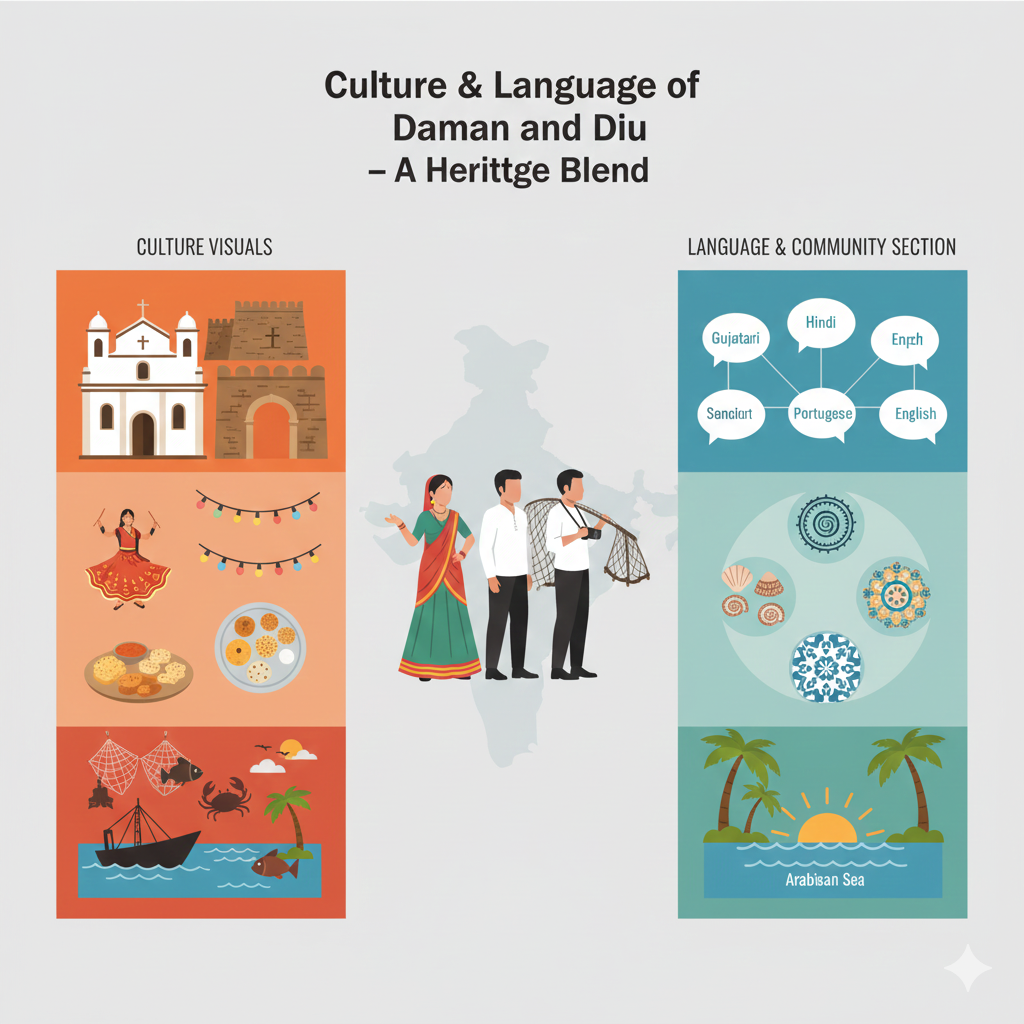
Daman and Diu, located on the western coast of India, represent a cultural blend shaped by Portuguese influence, Gujarati traditions, and local coastal customs. The region's cultural diversity is reflected in its languages, religious practices, architecture, festivals, food, art, and everyday lifestyle. Its historical connections with maritime trade and Portuguese colonial rule have also contributed to its distinctive cultural identity.
Culture of Daman and Diu
The culture of Daman and Diu reflects the influence of different communities and historical traditions. Gujarati customs remain important in everyday life, while Portuguese-era architecture and Christian traditions form a distinctive part of the region's heritage.
1. Religious Influence
- Hinduism: Hinduism is widely practised in the region. Temples and religious celebrations form an important part of local cultural life.
- Christianity: Christianity has a significant historical presence due to centuries of Portuguese rule. Important religious landmarks include St. Paul's Church in Diu and Bom Jesus Church in Daman.
- Islam: Muslim communities also contribute to the region's religious and cultural diversity through their traditions, festivals, and social activities.
2. Architecture and Art
- Portuguese influence is visible in several historic buildings and monuments.
- Forts, churches, and colonial-era structures reflect European architectural styles.
- Local handicrafts, decorative traditions, and community-based art forms contribute to the cultural heritage.
- The combination of Gujarati and Portuguese influences gives the region a distinctive architectural character.
3. Music and Dance
- Folk music, devotional songs, and community performances are important parts of local cultural life.
- Gujarati folk traditions, including Garba and Dandiya, are popular during festivals.
- Portuguese cultural influence can be seen in certain musical traditions and community celebrations.
- Traditional songs connected with fishing and coastal life also reflect the region's maritime identity.
4. Festivals and Celebrations
- Navratri: Celebrated with enthusiasm, particularly under Gujarati cultural influence. Garba and Dandiya performances are common during the festival.
- Christmas and Easter: Important Christian festivals celebrated through church services, prayers, decorations, and community gatherings.
- Diu Festival: Cultural and tourism events organised in Diu have featured music, dance, entertainment, and other programmes for visitors. The timing and format may vary from year to year.
- Diwali and Holi: These festivals are also celebrated by Hindu communities and form part of the region's wider cultural calendar.
5. Food and Dishes
- Seafood: Fish, prawns, and crab are important ingredients in the coastal cuisine of Daman and Diu.
- Gujarati Cuisine: Dhokla, fafda, khandvi, and other Gujarati dishes are popular in the region.
- Portuguese Influence: Portuguese-era culinary traditions have influenced some local food practices. Dishes such as vindaloo are associated with the broader Portuguese-influenced cuisine of western India.
- Local Food Traditions: The region's cuisine also reflects the food habits of fishing communities and coastal settlements.
Recommended Study Resource
Explore this educational resource to support learning, revision, and exam preparation.
Languages of Daman and Diu
Daman and Diu have a diverse linguistic environment shaped by regional interaction, migration, trade, and historical influences. Gujarati is particularly important in everyday communication, while Hindi and English are also used in different social, administrative, and professional settings.
1. Gujarati
Gujarati is one of the most widely spoken languages in Daman and Diu. It is commonly used in everyday communication, local markets, social interactions, and cultural activities because of the region's close geographical and historical connection with Gujarat.
2. Hindi
Hindi is also commonly understood and spoken. It helps people communicate across different linguistic communities and is frequently used in education, public communication, and interactions with visitors.
3. Portuguese
Portuguese was historically associated with colonial administration, religious institutions, and education during Portuguese rule. Although its historical influence remains visible in architecture, place names, and cultural heritage, it is not a major everyday spoken language in present-day Daman and Diu.
4. English
English is used in education, administration, tourism, business, and professional communication. It also helps the region interact with visitors and people from other parts of India and abroad.
Cultural Mix of Daman and Diu
The cultural identity of Daman and Diu represents a combination of Gujarati traditions, Portuguese heritage, and local coastal customs.
Gujarati Influence
Gujarati influence is visible in local languages, food habits, religious celebrations, traditional clothing, and folk performances such as Garba and Dandiya.
Portuguese Influence
Portuguese influence is particularly visible in historic forts, churches, colonial-era buildings, Christian traditions, and certain elements of local food and cultural heritage.
Local Coastal Traditions
Fishing communities and coastal settlements contribute to the region's distinctive lifestyle. Their traditional occupations, food habits, festivals, and relationship with the Arabian Sea are important elements of local identity.
Importance of Culture and Language
The culture and languages of Daman and Diu reflect the region's historical development and social diversity. The coexistence of different religious traditions, languages, and cultural practices represents India's principle of unity in diversity. Tourism, historical conservation, and community celebrations also contribute to preserving and promoting this cultural heritage.
Conclusion
The culture and languages of Daman and Diu reflect a unique combination of Gujarati traditions, Portuguese historical influence, and local coastal customs. Their festivals, religious practices, architecture, food, and linguistic diversity make the region an important part of India's cultural heritage. This blend of traditions gives Daman and Diu a distinctive identity along the western coast of India.
Key Features of Daman and Diu
Daman and Diu are part of the Union Territory of Dadra and Nagar Haveli and Daman and Diu, located along the western coast of India. Their geographical, historical, cultural, economic, and environmental characteristics make them distinctive. The region is known for its coastal landscapes, Portuguese heritage, historic monuments, beaches, and cultural diversity.
1. Geographical Features
(i) Coastal Region
- Daman and Diu are located along the Arabian Sea.
- The region is known for its beaches, coastal landscapes, and marine ecosystems.
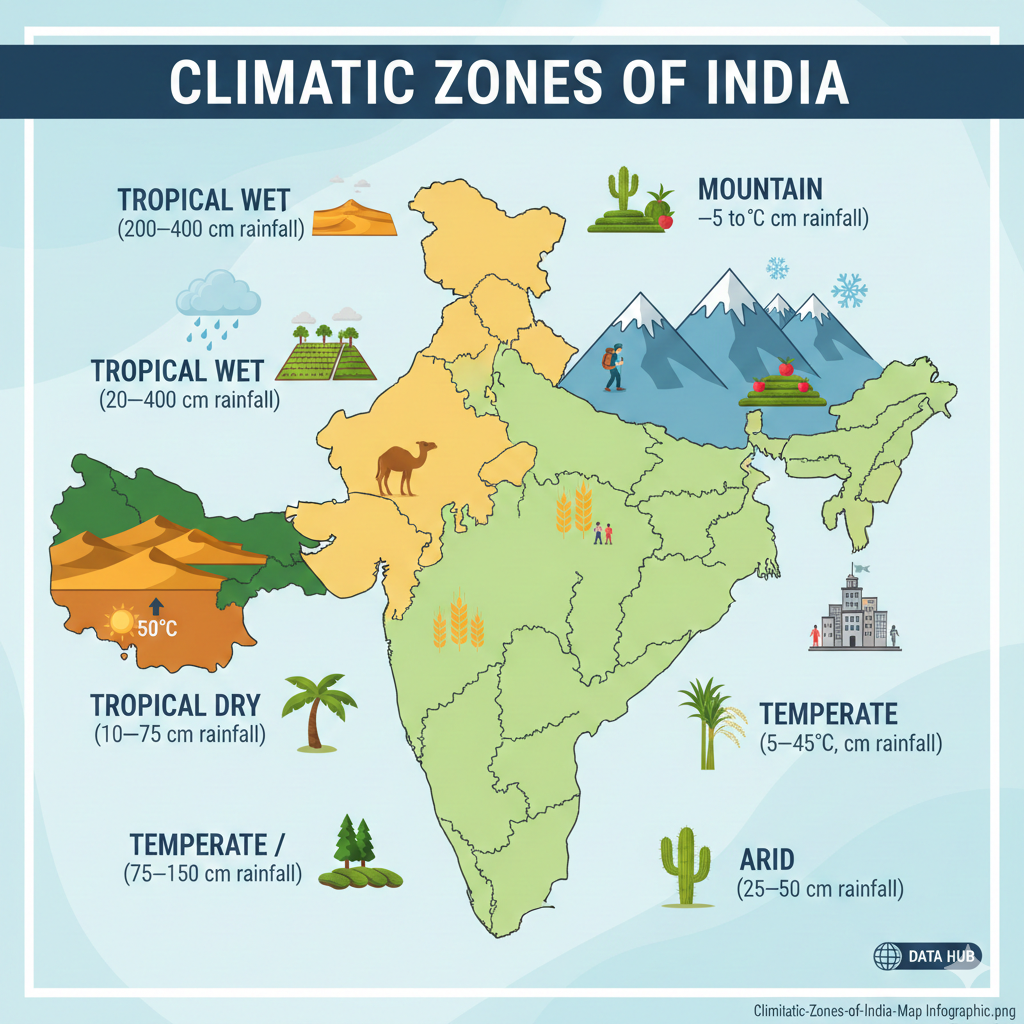
- It experiences a tropical coastal climate, with hot and humid summers and relatively pleasant winters.
(ii) Regional Division
- Daman: Located near Valsad district in Gujarat. It is known for its historical attractions, tourism, and industrial activities.
- Diu: Situated near the southern coast of the Kathiawar Peninsula in Gujarat. It is known for its beaches, coastal scenery, and Portuguese-era heritage.
(iii) Marine Life and Biodiversity
- The coastal waters support Marine Biodiversity, including different species of fish, crabs, and other aquatic organisms.
- Coastal habitats also provide shelter and feeding grounds for several resident and migratory bird species.
- Fishing and marine ecosystems are important parts of the region's natural environment.
2. Historical Features
(i) Portuguese Influence
- Daman and Diu remained under Portuguese rule for several centuries, from the 16th century until 1961.
- The Portuguese constructed forts, churches, and other architectural structures that remain important historical landmarks.
- Portuguese influence is visible in the region's architecture, religious heritage, food traditions, and cultural practices.
(ii) Freedom Struggle and Merger with India
- Daman and Diu were liberated from Portuguese rule in December 1961 during India's Operation Vijay.
- After liberation, Goa, Daman, and Diu were administered together as a Union Territory.
- In 1987, Goa became a separate state, while Daman and Diu continued as a Union Territory.
- On 26 January 2020, Daman and Diu merged with Dadra and Nagar Haveli to form the present Union Territory.
3. Cultural Characteristics
(i) Religion and Traditions
- Communities following Hinduism, Christianity, and Islam contribute to the region's religious diversity.
- Important religious landmarks include St. Paul's Church in Diu, Bom Jesus Church in Daman, and local Hindu temples.
- Festivals such as Navratri, Christmas, Easter, and Diwali are celebrated by different communities.
(ii) Language and Arts
- Gujarati is widely spoken in everyday life, while Hindi and English are also used in different settings.
- Portuguese has left a historical and cultural influence, although it is not a major everyday spoken language today.
- Folk music, regional dance traditions, religious performances, and handicrafts contribute to the cultural identity of the region.
(iii) Festivals and Celebrations
- Navratri is celebrated with traditional Gujarati cultural activities, including Garba and Dandiya.
- Christmas and Easter are important celebrations among Christian communities.
- Cultural and tourism events, including the Diu Festival, promote local heritage, music, and entertainment. Their programmes may vary from year to year.
4. Characteristics of Tourist Destinations
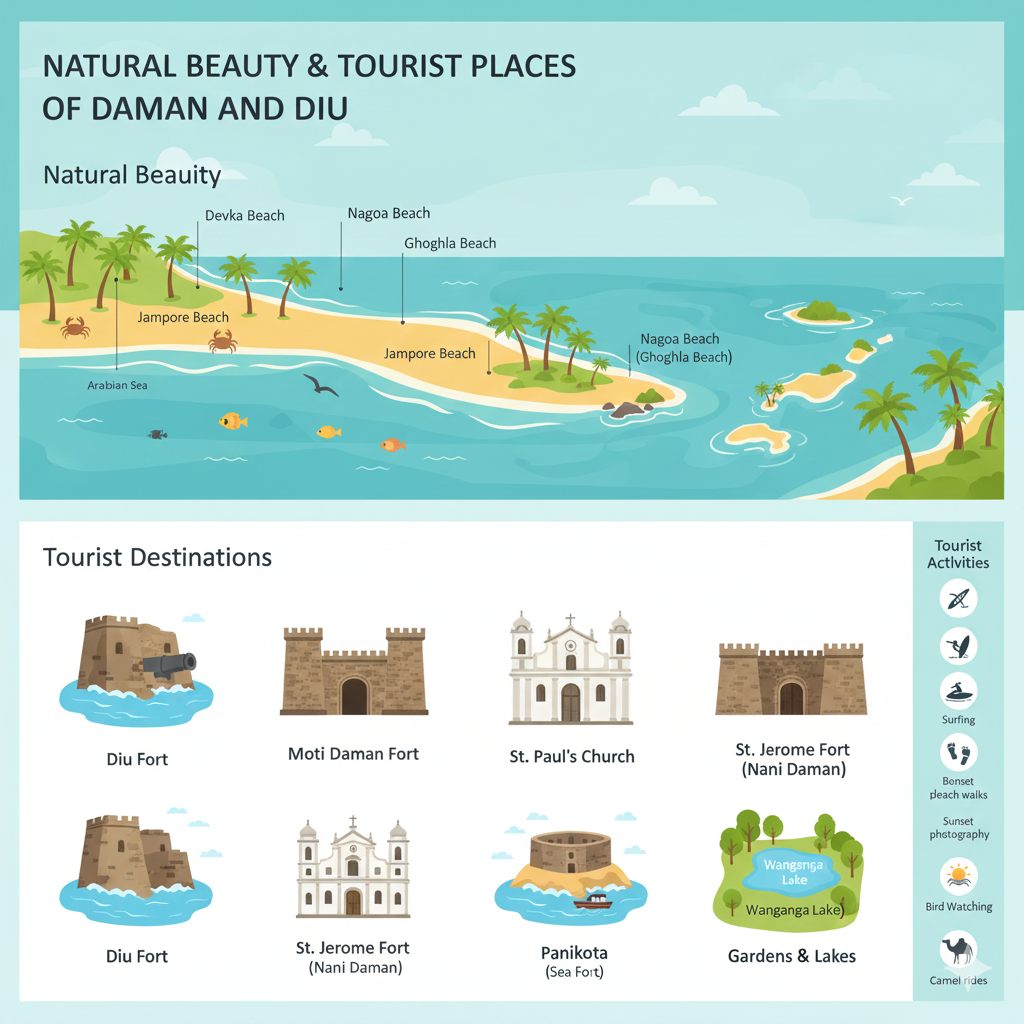
Beaches
- Jampore Beach (Daman): Known for its coastal scenery, peaceful surroundings, and recreational activities.
- Nagoa Beach (Diu): Popular for its scenic coastline, palm trees, and selected water-based activities.
- Devka Beach (Daman): A well-known tourist attraction offering sea views, sunset scenery, and nearby recreational facilities.
Historical Places
- Diu Fort: A major Portuguese-era fort overlooking the Arabian Sea.
- Moti Daman Fort: An important historic fort reflecting Portuguese military and administrative architecture.
- St. Paul's Church: A famous historic church in Diu, recognised for its Portuguese Baroque architectural features.
- Bom Jesus Church: A historic church in Daman associated with Portuguese-era religious heritage.
Recommended Study Resource
Explore this educational resource to support learning, revision, and exam preparation.
5. Economic Characteristics
(i) Tourism-Based Economy
- Tourism is an important economic activity in Daman and Diu, supported by beaches, forts, churches, and cultural attractions.
- Tourist visits support hotels, restaurants, transport services, retail businesses, and other hospitality-related activities.
- Tourism-related employment contributes to the livelihoods of local communities.
(ii) Industrial Activities
- Daman has a significant industrial base, with manufacturing activities in sectors such as plastics, textiles, chemicals, and pharmaceuticals.
- Industrial estates and supporting infrastructure contribute to manufacturing and commercial development.
- Investment decisions are influenced by infrastructure, market access, government policies, and business conditions.
- Industrial activities create employment opportunities for local residents and workers from neighbouring states.
(iii) Fisheries and Marine Trade
- Fishing is an important traditional livelihood in coastal communities.
- Fish and other marine products are supplied to regional and wider domestic markets.
- Fishing, processing, storage, and distribution support related economic activities.
6. Environmental Characteristics
(i) Coastal Protection
- Beach cleanliness, coastal conservation, and responsible tourism are important for protecting the region's natural environment.
- Coastal erosion, marine pollution, and waste management require continued attention.
- Public awareness and environmental protection measures can help maintain the quality of coastal ecosystems.
(ii) Biodiversity
- The region supports coastal and marine biodiversity, including fish, crabs, and several bird species.
- Coastal habitats provide opportunities for bird watching and nature observation.
- Protection of marine ecosystems is important for fisheries and the long-term sustainability of the coastal environment.
7. Social and Lifestyle Characteristics
Lifestyle
- The lifestyle of Daman and Diu reflects a combination of Gujarati traditions, Portuguese heritage, and local coastal customs.
- Seafood and Gujarati cuisine are important elements of the region's food culture.
- Fishing, tourism, trade, and industrial employment influence the everyday lives of different communities.
Education and Healthcare
Educational institutions and healthcare facilities serve the local population. Access to schools, colleges, hospitals, and other public services is important for improving social development and quality of life. These facilities are supported through government administration and other service providers.
8. Modern Development and Government Initiatives
(i) Promotion of Tourism
- Tourism promotion activities include cultural events, destination development, and improvement of visitor facilities.
- Events such as the Diu Festival help showcase local culture and attract visitors.
- Development of tourist infrastructure can support local businesses and employment.
(ii) Promotion of Industries
- Industrial infrastructure and business-support policies contribute to manufacturing and investment.
- Road connectivity, industrial facilities, and access to markets support commercial development.
- Government policies and applicable incentives may influence investment decisions.
(iii) Environmental Protection
- Coastal conservation and responsible waste management are important for maintaining environmental quality.
- Protection of beaches, marine habitats, and coastal vegetation supports sustainable tourism and local livelihoods.
- Public participation and effective implementation of environmental regulations are necessary for long-term conservation.
Conclusion
Daman and Diu are distinctive coastal regions of western India, known for their natural beauty, Portuguese historical heritage, cultural diversity, and economic activities. Their geographical location, tourist attractions, Industrial development, and marine resources contribute to their regional importance. Sustainable tourism, balanced economic development, and environmental conservation are essential for preserving the region's natural and cultural heritage.