

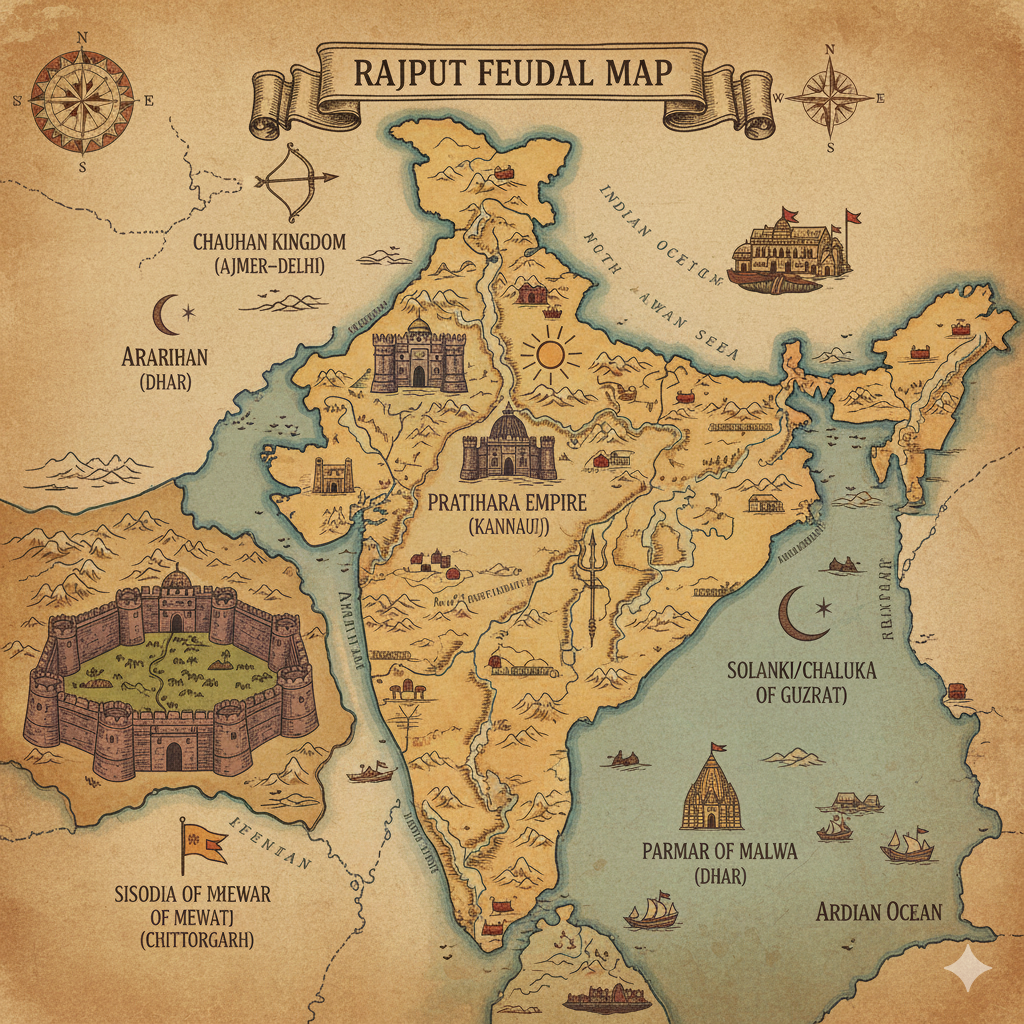

Chauhan and Solanki Dynasties: history, Rulers, Achievements and Legacy
The Chauhan and Solanki dynasties were important ruling houses of medieval western India. The Chauhans, also known as the Chahamanas, ruled several regions of present-day Rajasthan and neighbouring areas, while the Solankis, also known as the Chaulukyas of Gujarat, played a major role in Gujarat's political, economic, and cultural history. Both dynasties contributed to medieval Indian architecture, administration, Religion, and literature.
1. Chauhan Dynasty
The Chauhan Dynasty, also known as the Chahamana Dynasty, was one of the important ruling houses of medieval India. Different branches of the Chauhans ruled regions of present-day Rajasthan and other parts of northern India. The Shakambhari-Ajmer branch became particularly prominent during the 11th and 12th centuries.
1.1 Origin and Establishment of the Chauhan Dynasty
Beginning of the Dynasty
- Traditional genealogies associate the Chauhans with the Agnivanshi lineage and the legendary Agnikund near Mount Abu.
- Historical accounts identify the Chauhans as the Chahamanas, an important ruling lineage of early medieval India.
- Their early political centre was associated with Shakambhari, near present-day Sambhar in Rajasthan. Their territories later expanded towards Ajmer and other regions.
Capital and Political Centre
Ajmer, historically known as Ajayameru, became an important political and cultural centre of the Chauhans. Ajayaraja II is traditionally credited with establishing or developing Ajmer as a major capital in the early 12th century. Taragarh Fort became an important part of the city's defensive history.
Meaning of the Name
The name Chauhan is associated with the historical Chahamana lineage. Explanations connecting the name with the idea of being "four-times-born" belong to traditional interpretations and should not be treated as an established linguistic origin.
2. Important Rulers of the Chauhan Dynasty
2.1 Ajayaraja II
- Was an important ruler of the Shakambhari Chahamana dynasty.
- Is traditionally associated with the establishment and development of Ajmer (Ajayameru).
- Strengthened Chauhan political influence in the region.
2.2 Vigraharaja IV
- Was a powerful Chauhan ruler and an important patron of literature and learning.
- Was associated with the Sanskrit literary work Harikeli Nataka.
- Supported educational and cultural activities in his kingdom.
- His reign is remembered for the expansion of Chauhan political influence.
2.3 Prithviraja III (Prithviraj Chauhan)
Prithviraja III, popularly known as Prithviraj Chauhan, was one of the best-known rulers of the Chauhan dynasty. He ruled during the 12th century and became associated with the political history of Ajmer and Delhi.
First Battle of Tarain (1191 CE)
Prithviraja III defeated the invading army of Muhammad Ghori in the First Battle of Tarain in 1191 CE.
Second Battle of Tarain (1192 CE)
In the Second Battle of Tarain in 1192 CE, Muhammad Ghori defeated Prithviraja III. This victory significantly weakened Chauhan power and helped expand Ghurid influence in northern India.
The defeat marked an important turning point in the political history of northern India. The subsequent establishment of the Delhi Sultanate took place through later military and political developments.
3. Political Structure and governance of the Chauhans
3.1 Central Government
The king was the highest political authority in the Chauhan kingdom. Royal administration included officials responsible for revenue, military affairs, and other governing functions.
3.2 Samanta and Feudal System
- Subordinate chiefs and local rulers assisted the king in administration.
- They could provide military forces, tribute, and revenue support.
- Local authorities exercised varying degrees of control over their territories.
3.3 Military Strength
- The military included cavalry, infantry, and war elephants.
- Forts and defensive structures strengthened territorial security.
- Military alliances and the support of subordinate chiefs were important during campaigns.
3.4 Justice System
- The king was regarded as the highest judicial authority.
- Customs, religious traditions, and established practices influenced the settlement of disputes.
- Local institutions and community authorities also played roles in resolving disputes.
4. Cultural and Religious Contributions of the Chauhans
4.1 Architecture
The Chauhans contributed to the architectural development of Ajmer and other parts of Rajasthan. Their period is associated with forts, temples, and other historical structures.
- Taragarh Fort: An important historic fort associated with Ajmer and its strategic importance.
- Ajmer's Historical Structures: The region contains monuments and architectural remains reflecting different phases of medieval history.
4.2 Religion
Chauhan rulers supported different religious traditions. Hindu traditions, including Shaivism and Vaishnavism, were influential, while Jain religious institutions also received patronage in various regions.
4.3 Patronage of Literature
Literature and scholarship flourished under rulers such as Vigraharaja IV. Sanskrit literary traditions and educational activities received royal support.
5. Decline of the Chauhan Dynasty
5.1 Battles of Tarain
The Second Battle of Tarain in 1192 CE was a major turning point in the history of the Shakambhari-Ajmer Chauhans. Their political influence declined significantly following the defeat of Prithviraja III.
5.2 Expansion of Ghurid Influence
Following Muhammad Ghori's victory, Ghurid influence expanded across important parts of northern India. This changed the political balance in the region.
5.3 Internal Conflicts
Political rivalries and conflicts among regional powers also influenced the changing fortunes of Chauhan branches. Different Chauhan lineages continued to rule in some regions even after the decline of the Ajmer branch.
6. Importance of the Chauhan Dynasty
- Political History: The Chauhans played an important role in the development of medieval regional kingdoms.
- Military History: Their conflicts with Ghurid forces became significant events in northern Indian history.
- Cultural Heritage: Their contributions to architecture, literature, and religious patronage remain historically important.
- Regional Identity: The Chauhans occupy an important place in the historical traditions of Rajasthan.
7. Conclusion: Chauhan Dynasty
The Chauhan dynasty occupies an important position in medieval Indian history. Its rulers contributed to regional administration, military affairs, literature, and architecture. The reign of Prithviraja III and the Battles of Tarain remain particularly significant in the political history of northern India.
Editor's Choice
Explore this recommended product for additional reading and learning resources.
8. Solanki Dynasty
The Solanki Dynasty, also known as the Chaulukya Dynasty of Gujarat, was an important ruling house of western India. It exercised political authority in Gujarat from approximately the 10th to the 13th centuries. The dynasty is particularly remembered for its administrative activities, temple architecture, stepwells, and patronage of Hinduism and Jainism.
8.1 Origin and History of the Solanki Dynasty
Origin
- The Solankis of Gujarat are historically identified with the Chaulukya dynasty.
- Traditional genealogies associate them with the Agnivanshi lineage, although such origin accounts are not established historical facts.
- The dynasty emerged as a major political power in Gujarat during the 10th century.
Capital
The principal capital of the Gujarat Chaulukyas was Anahilwara (modern Patan). It developed into an important political, economic, and cultural centre.
Name and Identity
The terms Solanki and Chaulukya are associated with this ruling house. Historical inscriptions and texts frequently use the name Chaulukya, while Solanki is widely used in regional historical traditions.
9. Important Solanki Rulers and Their Contributions
9.1 Mularaja I (c. 10th Century)
- Established the political foundation of the Gujarat Chaulukya dynasty.
- Strengthened Chaulukya authority in Gujarat.
- Made Anahilwara an important centre of the kingdom.
9.2 Bhima I (c. 1022–1064 CE)
- Ruled Gujarat during the invasion of Mahmud of Ghazni in 1025 CE.
- His reign is associated with the reconstruction and religious history of the Somnath region.
- Rani Udayamati, his queen, commissioned Rani ki Vav at Patan in his memory.
9.3 Siddharaja Jayasimha (c. 1094–1143 CE)
Siddharaja Jayasimha was one of the most influential rulers of the Gujarat Chaulukya dynasty.
- Expanded the political influence of the dynasty.
- Strengthened Anahilwara as a major political and cultural centre.
- Was associated with the construction and development of Rudra Mahalaya at Siddhpur.
- Supported religious institutions and cultural activities.
9.4 Kumarapala (c. 1143–1172 CE)
- Was one of the prominent rulers of the Solanki dynasty.
- Is traditionally associated with the influence of Jain teacher Hemachandra.
- Supported Jain religious institutions and temple construction.
- His reign is remembered for important developments in religious and cultural patronage.
9.5 Ajayapala (c. 1172–1176 CE)
Ajayapala succeeded Kumarapala. His reign was relatively short and was followed by further political changes within the Chaulukya ruling house.
10. Political Structure and Governance of the Solankis
10.1 Central Government
The king was the central authority of the Gujarat Chaulukya kingdom. Royal officials assisted in administration, revenue collection, military affairs, and the management of royal territories.
10.2 Local Administration
- Local chiefs and subordinate authorities managed different territories.
- Revenue collection and military obligations supported the kingdom.
- Local administrative arrangements varied according to region and political circumstances.
10.3 Military Strength
- The army included infantry, cavalry, and war elephants.
- Forts and defensive structures protected important territories.
- Military campaigns helped maintain and expand political influence.
11. Cultural Achievements of the Solanki Dynasty
11.1 Architecture
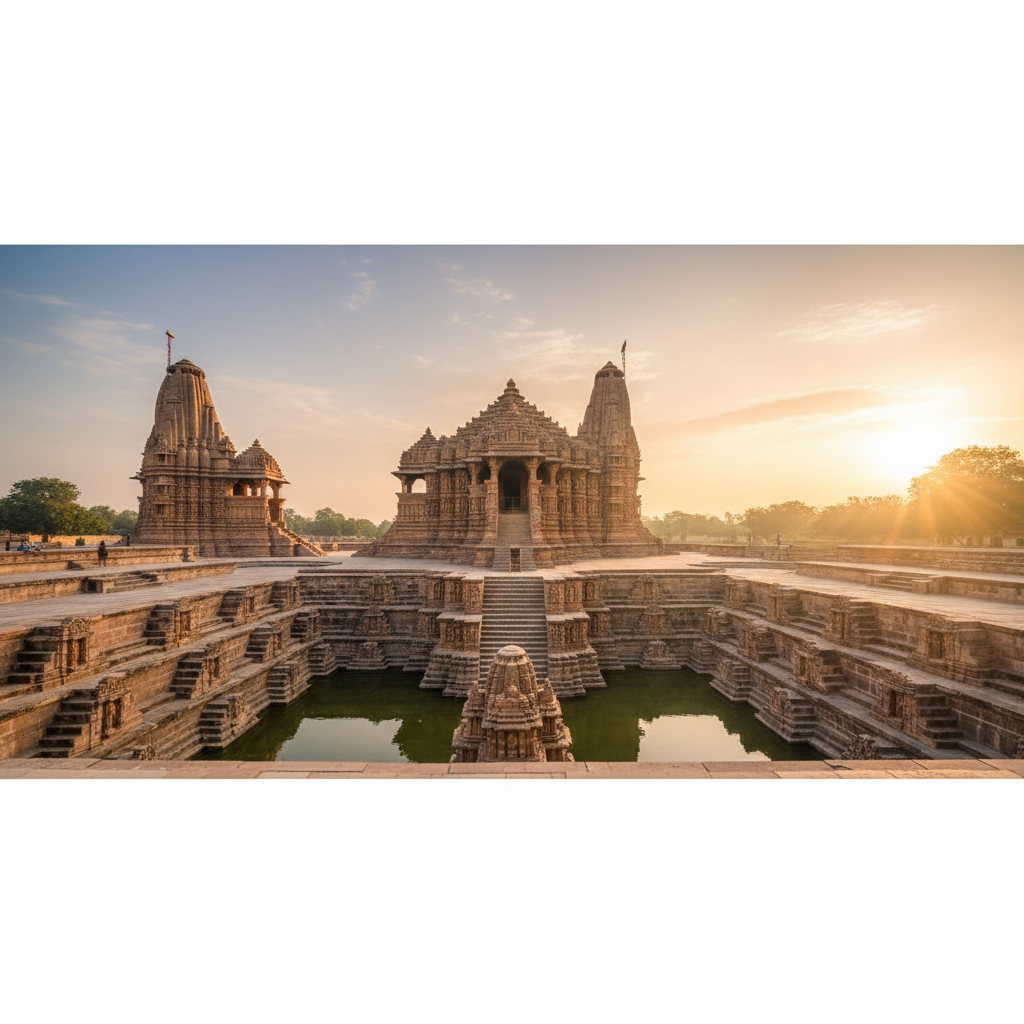
The Solanki period is particularly famous for its temple architecture, stepwells, and intricate stone carvings. The architectural tradition associated with this period is often described as the Maru-Gurjara style.
- Rani ki Vav (Patan): A remarkable stepwell commissioned by Queen Udayamati in memory of Bhima I. It is recognised as a UNESCO World Heritage Site.
- Rudra Mahalaya (Siddhpur): An important temple complex associated with Siddharaja Jayasimha.
- Modhera Sun Temple: A major example of Solanki-period temple architecture, traditionally associated with Bhima I.
11.2 Religious Patronage
The Solanki rulers supported different religious traditions, particularly Hinduism and Jainism. Temple construction, religious institutions, and the activities of scholars contributed to the cultural development of Gujarat.
11.3 Literature and Education
- Sanskrit and Prakrit literary traditions received patronage.
- Jain scholars and religious teachers contributed to intellectual life.
- Acharya Hemachandra became one of the most influential scholars associated with the period.
12. Decline of the Solanki Dynasty
12.1 External Challenges
Political and military challenges from neighbouring powers affected the stability of the Gujarat Chaulukya kingdom during its later period.
12.2 Internal Political Changes
Succession disputes, changing political alliances, and the growing influence of subordinate ruling houses weakened the authority of the later Chaulukya rulers.
12.3 Rise of the Vaghela Dynasty
During the 13th century, the Vaghelas gradually emerged as the dominant ruling house in Gujarat, succeeding the Chaulukyas in regional political authority.
13. Importance of the Solanki Dynasty
- Architectural Development: Their period is associated with remarkable temples, stepwells, and stone carvings.
- Religious Patronage: They supported Hindu and Jain institutions and traditions.
- Literature and Learning: Their period witnessed important scholarly and literary activities.
- Political History: The dynasty established Gujarat as an influential regional power in medieval western India.
14. Conclusion: Solanki Dynasty
The Solanki dynasty played a major role in shaping Gujarat's political, religious, and architectural history. Its rulers supported temple construction, stepwells, literature, and religious institutions. The monuments associated with their period remain important examples of India's medieval cultural heritage.
15. Overall Conclusion
The Chauhan and Solanki dynasties were significant ruling houses of medieval western India. The Chauhans are remembered for their political and military history, particularly the Battles of Tarain, while the Solankis are noted for their contributions to Gujarat's architecture, literature, and religious patronage. Together, their histories form an important part of the cultural and political heritage of medieval India.
Sisodia Dynasty and Military Prowess of Rajputs: history, Culture and Warfare
The Sisodia Dynasty of Mewar occupies an important place in medieval Indian history. Known for its political struggles, military traditions, and cultural contributions, the dynasty produced prominent rulers such as Rana Kumbha and Maharana Pratap. Rajput military traditions also developed through the use of cavalry, infantry, fortifications, weapons, and strategic warfare.
1. Sisodia Dynasty
The Sisodia Dynasty was one of the most prominent ruling houses of Mewar in present-day Rajasthan. It emerged from the broader Guhila ruling tradition and became especially influential during the medieval period. The Sisodias are remembered for their resistance to external powers, cultural patronage, and contributions to the history of Mewar.
1.1 Origin and History of the Sisodia Dynasty
Origin
- The Sisodias are traditionally included among the prominent Rajput clans of India.
- The dynasty emerged from the Guhila (Guhilot) ruling lineage of Mewar.
- The name Sisodia is associated with the village of Sisoda, from which the lineage is traditionally believed to have derived its name.
- Chittorgarh was an important political centre of Mewar, while Udaipur became the capital after Maharana Udai Singh II founded the city in 1559 CE.
1.2 Major Rulers and Their Contributions
Rana Kumbha (1433–1468 CE)
- Was one of the most powerful rulers of Mewar.
- Strengthened the kingdom's military defences and constructed or renovated several important forts.
- Is traditionally associated with the construction of Kumbhalgarh Fort.
- Promoted music, literature, architecture, and cultural activities at his court.
- Contributed significantly to the political and cultural development of Mewar.
Maharana Pratap (1540–1597 CE)
- Was one of the most celebrated rulers of the Sisodia lineage.
- Refused to accept Mughal political supremacy under Emperor Akbar.
- Fought the famous Battle of Haldighati in 1576 CE against Mughal forces led by Man Singh I of Amber.
- Continued resistance against Mughal authority through military campaigns and strategic operations.
- His horse Chetak became an important figure in popular historical and cultural traditions.
- Worked to preserve Mewar's political independence during a prolonged period of conflict.
1.3 Later History and Cultural Development
After Maharana Pratap, the Sisodia rulers continued efforts to restore and strengthen Mewar. His son Amar Singh I later concluded a treaty with the Mughal emperor Jahangir in 1615 CE. The Sisodia dynasty continued to play an important role in the political, artistic, and cultural history of Rajasthan.
2. Political and Military Organisation of the Sisodia Dynasty
2.1 Centralised governance
- The Rana was the highest political authority in the kingdom.
- The ruler supervised important political, administrative, judicial, and military matters.
- Royal officials and subordinate chiefs assisted in administration.
2.2 Military Structure
- The Sisodia military included cavalry, infantry, and war elephants.
- Forts and defensive positions were important components of military planning.
- Local chiefs and subordinate rulers could provide soldiers and military assistance.
- Knowledge of local terrain played an important role in the defence of Mewar.
2.3 Conflicts with Neighbouring States
- The Sisodias were involved in conflicts with the Delhi Sultanate, the Mughal Empire, and neighbouring Rajput kingdoms.
- Rana Kumbha fought against several regional powers to strengthen Mewar.
- Maharana Pratap's resistance against Akbar became a major episode in the political history of medieval Rajasthan.
3. Cultural Heritage of the Sisodia Dynasty
3.1 Architecture
The Sisodia rulers contributed to the development of forts, palaces, temples, and other historical structures in Mewar.
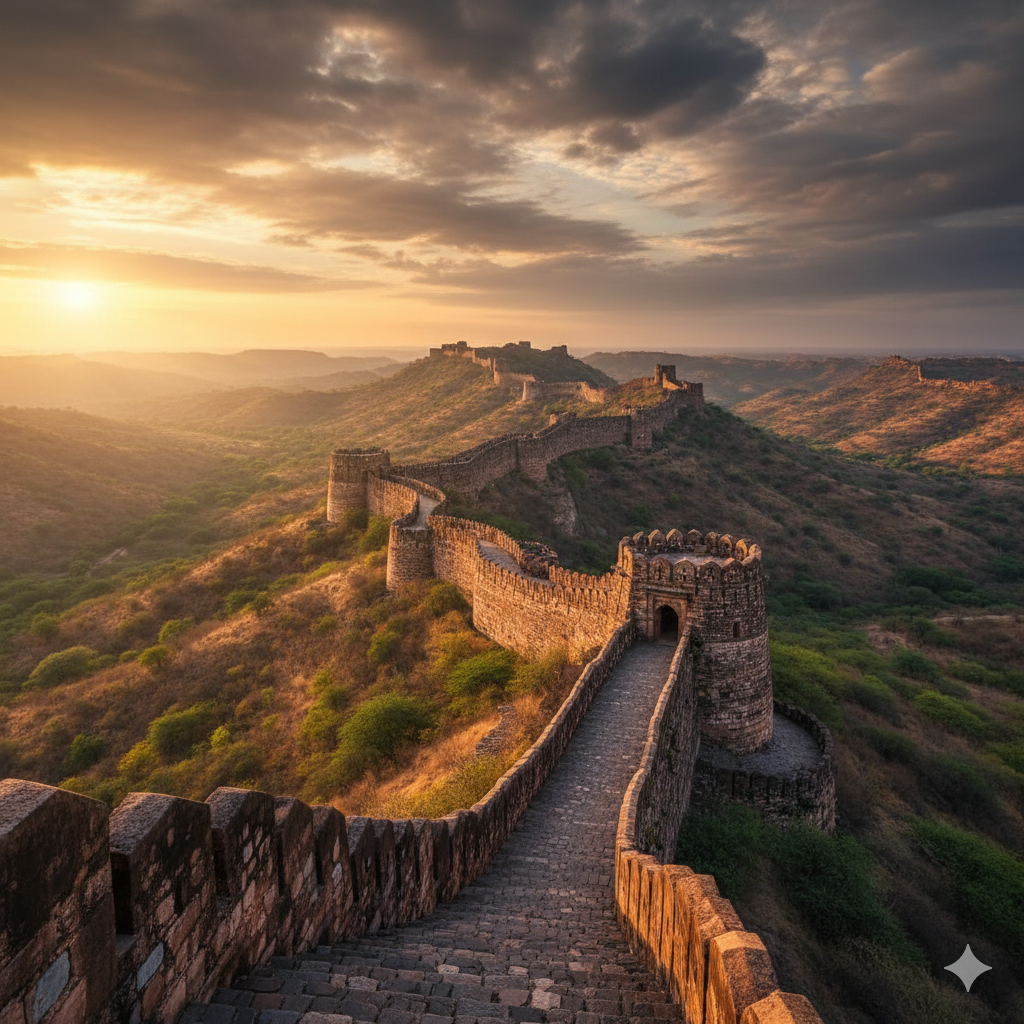
- Kumbhalgarh Fort: An important hill fort associated with Rana Kumbha and famous for its massive defensive wall.
- Chittorgarh Fort: A major historical fort associated with the political history and traditions of Mewar.
- Udaipur City Palace: A historic palace complex reflecting the architectural and artistic traditions of the Mewar rulers.
3.2 Literature and Art
- The court of Rana Kumbha became an important centre of music, literature, and scholarship.
- Music and artistic traditions received royal patronage.
- Mewar later became an important centre of Rajput painting traditions.
3.3 Religious Patronage
- The Sisodia rulers supported Hindu religious traditions.
- Worship of Shiva, Vishnu, and Krishna formed important parts of the religious life of Mewar.
- Temples and religious institutions received patronage from different rulers.
4. Decline and Political Transformation of the Sisodia Dynasty
- The Sisodias faced repeated military conflicts with powerful regional and imperial states.
- Akbar captured Chittorgarh Fort in 1568 CE during the reign of Maharana Udai Singh II.
- Maharana Pratap continued resistance against Mughal authority and recovered several territories of Mewar during his later years.
- Under Amar Singh I, a settlement with the Mughal Empire was concluded in 1615 CE.
Rather than disappearing after these conflicts, the Sisodia ruling house continued to govern Mewar through later political changes and remained an important part of Rajasthan's history.
5. Conclusion: Sisodia Dynasty
The Sisodia Dynasty remains an important part of India's medieval political and cultural history. Rulers such as Rana Kumbha and Maharana Pratap are remembered for their military leadership, political decisions, and cultural contributions. The forts, palaces, and artistic traditions of Mewar continue to preserve the historical legacy of the Sisodias.
Editor's Choice

Explore this recommended product for additional reading and learning resources.
6. Military Prowess of Rajputs
Military prowess was an important feature of medieval Rajput kingdoms. Rajput armies developed military traditions based on cavalry, infantry, war elephants, fortifications, and the leadership of regional rulers and chiefs. Their military history reflects the importance of battlefield strategy, territorial defence, and political alliances in medieval India.
6.1 History and Development of Military Skills
Ancient Indian Warfare
- The Vedas, Upanishads, Mahabharata, and other ancient texts contain references to warfare, weapons, military duties, and political strategy.
- The Mahabharata describes military formations, battlefield conduct, and the strategic guidance given by Krishna to Arjuna.
- Ancient Indian military traditions included archery, swordsmanship, chariot warfare, cavalry, and the use of elephants.
- Texts such as the Arthashastra discuss military organisation, diplomacy, intelligence, and statecraft.
Medieval Indian Warfare
- Rajput kingdoms maintained armies based on cavalry, infantry, and war elephants.
- Forts and defensive structures became essential elements of regional military systems.
- Military campaigns involved alliances, territorial strategies, sieges, and battlefield formations.
- Different Rajput kingdoms developed military practices according to their geographical and political conditions.
7. Characteristics of Rajput Military Excellence
7.1 Strategy and War Tactics
- Rajput rulers used different battlefield formations and defensive strategies.
- Knowledge of local terrain helped in protecting forts and mountainous regions.
- Military alliances and diplomatic relationships influenced the outcome of campaigns.
- In some conflicts, particularly during Maharana Pratap's resistance, mobile warfare and the use of difficult terrain played important roles.
7.2 Cavalry
- Cavalry was an important component of many Rajput armies.
- Horses provided mobility during military campaigns and battlefield operations.
- Mounted warriors used weapons such as swords, spears, bows, and lances.
- Horse riding and mounted combat were important military skills.
7.3 War Elephants
- War elephants were used in several medieval Indian armies, including Rajput forces.
- They could be deployed to support formations and create pressure against enemy forces.
- Elephants also carried commanders and soldiers in certain military campaigns.
- Their effectiveness depended on battlefield conditions, training, and the tactics used by opposing forces.
7.4 Forts and Fortifications
- Forts formed an essential part of Rajput military defence.
- Many forts were constructed on hills and strategically important locations.
- Fortifications included defensive walls, gates, watchtowers, and water storage systems.
- These structures helped withstand sieges and protect important settlements.
8. Military Training and Army Organisation
8.1 Military Training
- Training included horse riding, archery, swordsmanship, and the use of spears.
- Warriors developed physical endurance and battlefield awareness.
- Military leadership required knowledge of terrain, formations, and tactical planning.
8.2 Army Structure
- Rajput armies included rulers, military commanders, subordinate chiefs, and soldiers.
- Commanders supervised troops and coordinated military operations.
- Scouts and guards supported communication, observation, and security.
- Subordinate chiefs could bring their own troops during military campaigns.
9. Weapons and Equipment Used by Rajputs
9.1 Bow and Arrow
Archery was an important military skill in ancient and medieval India. Bows and arrows were used in battlefield combat, defence, and hunting.
9.2 Swords and Spears
Swords and spears were widely used in close combat. Spears and lances were also important weapons for mounted warriors.
9.3 Shields and Armour
Shields and body armour provided protection against enemy attacks. Materials and designs varied according to the period, region, and military resources available.
9.4 Other Military Equipment
Daggers, axes, helmets, protective clothing, and other weapons were also used by different Rajput armies. Military equipment evolved over time with changes in warfare and technology.
10. Conclusion: Military Prowess of Rajputs
The military traditions of the Rajputs form an important chapter in Indian history. Their use of cavalry, infantry, elephants, fortifications, and battlefield strategies shaped the military history of medieval India. Their forts and military heritage continue to provide valuable insights into the political and strategic traditions of the period.
11. Overall Conclusion
The Sisodia Dynasty and the military traditions of the Rajputs represent important dimensions of medieval Indian history. The Sisodias of Mewar contributed to regional politics, architecture, literature, and military resistance. More broadly, Rajput military systems demonstrate the importance of cavalry, fortifications, weapons, leadership, and regional strategy in the history of Indian warfare.
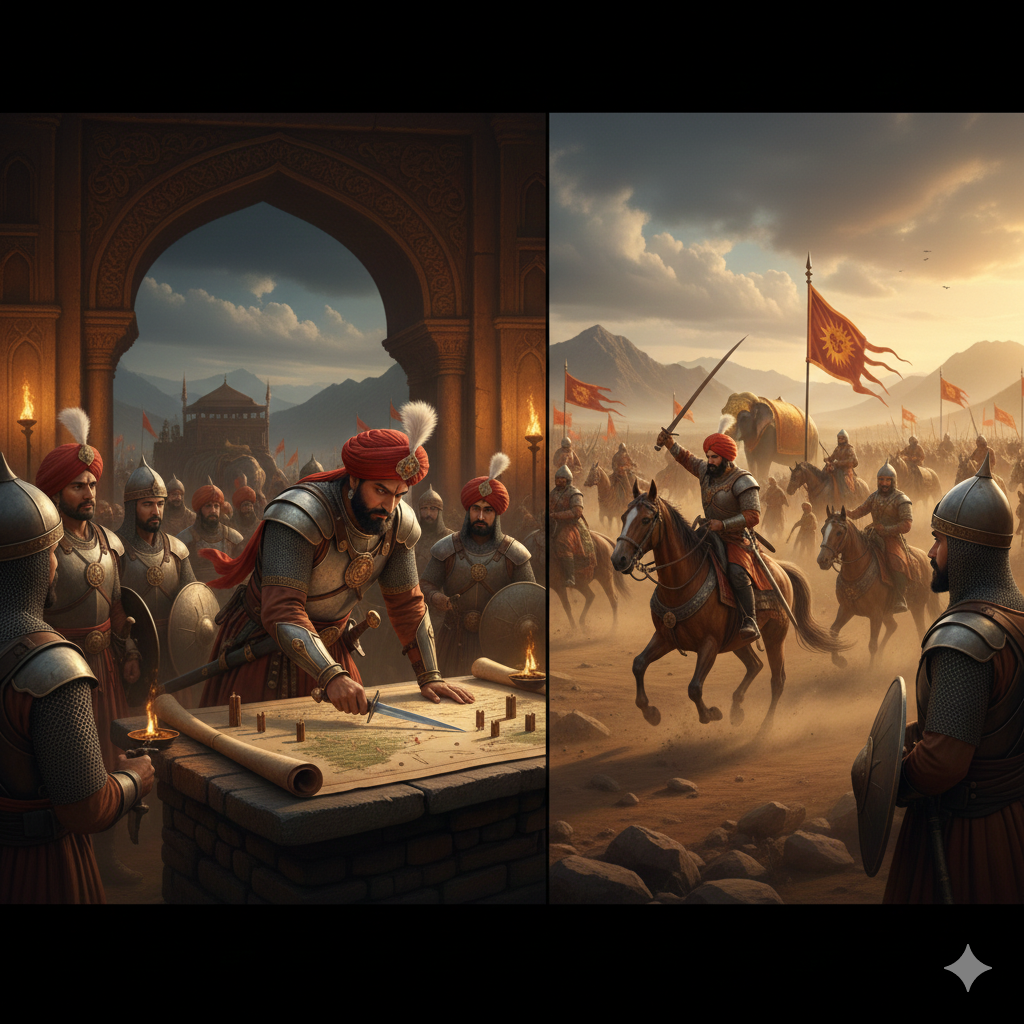
Strategy and Might: Indian Warfare, Art and Architecture
Indian history reflects a rich tradition of military strategy, courage, artistic creativity, and architectural excellence. From ancient warfare and medieval Rajput military traditions to magnificent temples, Buddhist monuments, paintings, and Mughal buildings, these developments shaped India's historical and cultural heritage.
1. Strategy and Might
Strategy and valour are important elements of warfare and military leadership. Throughout Indian history, military success depended on planning, leadership, resources, geographical conditions, diplomacy, and the courage of soldiers. From the military ideas described in ancient Indian texts to the battles of medieval Rajput kingdoms, these elements influenced the development of Indian military traditions.
1.1 Strategy: The Foundation of Victory
Strategy refers to the planning and execution of actions to achieve a particular objective. In warfare, strategic thinking involves the effective use of manpower, resources, terrain, intelligence, and timing.
Preparation for War
- Assessment of the enemy's military strength, geographical position, and possible tactics.
- Planning the availability of soldiers, weapons, food supplies, and other resources.
- Preparing alternative plans to respond to unexpected battlefield situations.
- Gathering intelligence about enemy movements and military preparations.
Selection of the Battlefield
- The geographical location of a battlefield can influence the outcome of a military campaign.
- High ground may provide defensive and observational advantages.
- Natural barriers such as rivers, hills, and mountains can support military defence.
- Knowledge of local terrain can help commanders plan movements and protect important positions.
Deception and Diplomacy
- Military commanders have historically used intelligence, diversionary tactics, and deception to influence enemy decisions.
- Diplomatic negotiations and political alliances were important parts of warfare.
- Ancient Indian political thought, particularly the Arthashastra, discusses diplomacy, intelligence, and strategies for dealing with rival states.
Attack Strategies
- The timing and coordination of military attacks can influence battlefield outcomes.
- Cavalry movements were important for mobility and offensive operations in many medieval Indian armies.
- Military formations and coordinated movements helped commanders organise their forces.
- Defensive operations and counterattacks were also important elements of military planning.
1.2 Valour: Symbol of Courage and Sacrifice
Valour refers to courage, determination, and the willingness to face danger while performing one's duty. It has been an important theme in Indian historical narratives, literature, and military traditions.
Bravery in Battle
- Maharana Pratap: His resistance against Mughal Emperor Akbar and his role in the Battle of Haldighati in 1576 CE made him a prominent figure in Rajasthan's history.
- Rani Durgavati: The Gond queen fought against the Mughal forces led by Asaf Khan in 1564 CE and died during the conflict rather than surrendering.
Self-Sacrifice
- Self-sacrifice has been an important theme in the historical traditions of several Indian kingdoms.
- Rani Durgavati is remembered for her resistance during the Mughal campaign against her kingdom.
- Historical accounts of Rajput resistance also describe acts of sacrifice during periods of siege and military conflict.
Defence of Forts
- Forts played a significant role in the defence of Rajput kingdoms.
- The sieges of Chittorgarh in 1303, 1535, and 1568 CE are important episodes in the history of Mewar.
- Accounts of the siege of Chittorgarh include traditions of jauhar and saka. Stories associated with Rani Padmini are especially prominent in later literary and historical traditions, although details of her story remain debated.
1.3 Combined Effect of Strategy and Valour
Military strategy and courage often worked together in historical conflicts. Strategy provided planning and direction, while courage, discipline, and leadership influenced the actions of soldiers. However, the outcome of warfare also depended on resources, technology, political alliances, and the strength of opposing armies.
1.4 Conclusion: Strategy and Might
Strategy and valour are important themes in Indian military history. Strategic planning, diplomacy, battlefield knowledge, and courage influenced the development of military traditions across different historical periods. These qualities remain important subjects for understanding India's political and military past.
2. Art and Architecture
Indian art and architecture represent a diverse cultural heritage that developed over thousands of years. From prehistoric rock paintings and ancient sculptures to magnificent temples, Buddhist monuments, forts, palaces, and Mughal buildings, India's artistic traditions reflect its religious, social, political, and historical developments.
2.1 Indian Art: A Medium of Creativity
Painting
- Prehistoric rock paintings at Bhimbetka in Madhya Pradesh provide evidence of early artistic expression and human activities.
- The paintings of Ajanta in Maharashtra are famous for their Buddhist themes, narrative scenes, and artistic techniques.
- Indian miniature painting traditions developed in several regions, including Rajasthan, Gujarat, the Mughal court, and the Himalayan kingdoms.
- Rajput painting schools are known for their depictions of religious stories, royal life, nature, and courtly traditions.
Editor's Choice
Explore this recommended product for additional reading and learning resources.
Sculpture
- Indian sculpture reflects religious beliefs, cultural traditions, mythology, and artistic creativity.
- Important examples can be found at Khajuraho, Sanchi, Ellora, and the Mahabodhi Temple complex at Bodh Gaya.
- During the Gupta period, sculpture developed distinctive forms known for balanced proportions, refined craftsmanship, and religious expression.
- Stone, metal, and terracotta were among the materials used by Indian sculptors.
Dance and Music
- Indian classical dance traditions include Bharatanatyam, Kathak, Odissi, Kathakali, Kuchipudi, Manipuri, Mohiniyattam, and Sattriya.
- Hindustani and Carnatic music developed distinct traditions, with ragas and talas forming important elements of their musical systems.
- Dance and music were associated with religious ceremonies, courtly culture, festivals, and community traditions.
- Regional folk music and dance forms also contributed to India's diverse cultural heritage.
3. Indian architecture: A Fusion of Culture and Engineering
3.1 Hindu Temple Architecture
- Indian temple architecture developed through different regional styles and religious traditions.
- Vastu Shastra and Shilpa Shastra texts influenced several aspects of traditional architecture and artistic design.
- Important architectural elements include the garbhagriha (sanctum), mandapa (pillared hall), and shikhara or vimana, depending on the regional style.
- Famous temples include Kashi Vishwanath, Somnath, and Kedarnath.
- The Nagara, Dravida, and Vesara traditions represent important categories used to study Indian temple architecture.
3.2 Buddhist Stupas and Monasteries
- Buddhist architecture developed around stupas, monasteries, chaityas, and other religious structures.
- The Great Stupa at Sanchi is one of the most important examples of ancient Buddhist architecture.
- The Mahabodhi Temple at Bodh Gaya is associated with the place where Gautama Buddha attained enlightenment.
- Buddhist cave complexes and viharas served as centres of religious practice, meditation, education, and monastic life.
- Ajanta and Ellora are important examples of India's rock-cut architectural and artistic heritage.
3.3 Indo-Islamic and Mughal Architecture
- Indo-Islamic architecture developed through interactions between regional Indian building traditions and architectural influences from the Islamic world.
- Mughal architecture combined Persian, Central Asian, and Indian artistic and construction traditions.
- Important monuments include the Taj Mahal, Qutb Minar, and Agra Fort.
- Common architectural features include domes, arches, minarets, decorative stonework, geometric patterns, and landscaped gardens.
- Charbagh garden layouts became a notable feature of several Mughal architectural complexes.
3.4 Rajput Forts and Palaces
- Rajput forts and palaces reflected political authority, military requirements, royal lifestyles, and regional artistic traditions.
- Important examples include City Palace in Udaipur, Jaisalmer Fort, and Amer Fort in Jaipur.
- Many forts included massive defensive walls, gateways, watchtowers, water storage systems, and strategically located structures.
- Palaces often featured courtyards, decorative paintings, carved stonework, balconies, and elaborate interiors.
- Rajasthan's hill forts are important examples of the relationship between architecture, military strategy, and geography.
4. Conclusion: Art and Architecture of India
Indian art and architecture reflect the creativity, technical knowledge, religious traditions, and cultural diversity of Indian civilisation. From prehistoric paintings and classical sculpture to temples, Buddhist monuments, Mughal buildings, and Rajput forts, these artistic traditions preserve important evidence of India's historical development. Protecting this heritage is essential for future generations and for understanding the country's cultural identity.
5. Overall Conclusion
Strategy, military courage, art, and architecture represent interconnected dimensions of Indian history. Military traditions reveal how kingdoms organised their defence and exercised political power, while artistic and architectural achievements reflect their cultural values and technical skills. Together, these subjects provide a broader understanding of India's historical and cultural development.

Dilwara Temples, City Palace Udaipur and Rajasthani & Pahari Architecture
India's architectural heritage reflects its religious traditions, regional cultures, geographical conditions, and historical developments. The Dilwara Jain Temples of Mount Abu, City Palace of Udaipur, and the Rajasthani and Pahari architectural traditions represent important examples of India's artistic and architectural diversity.
1. Dilwara Jain Temples
The Dilwara Jain Temples, located near Mount Abu in Rajasthan, are among the finest examples of Jain temple architecture in India. Famous for their intricate marble carvings, beautifully decorated ceilings, and detailed sculptures, these temples demonstrate the artistic excellence and religious traditions of Jainism.
1.1 history and Construction
The Dilwara temple complex was developed mainly between the 11th and 13th centuries. The temples were commissioned by wealthy Jain patrons, ministers, and merchants. Vimal Shah and the brothers Vastupal and Tejpal were among the important patrons associated with the construction of the complex.
The complex consists of five major Jain temples, each associated with a different Tirthankara. Together, they represent an important centre of Jain religious and architectural heritage.
1.2 Architecture of Dilwara Temples
The Dilwara temples are particularly famous for their use of white marble. Their pillars, ceilings, domes, doorways, and decorative panels feature highly detailed carvings. The craftsmanship demonstrates the skill of medieval Indian artisans.
Vimal Vasahi Temple
- Constructed in 1031 CE under the patronage of Vimal Shah.
- Dedicated to the first Jain Tirthankara, Lord Adinath (Rishabhanatha).
- Famous for its marble pillars, decorated ceilings, and intricate sculptures.
- Its Rang Mandap and other architectural features demonstrate exceptional craftsmanship.
Luna Vasahi Temple
- Constructed in 1230 CE under the patronage of Vastupal and Tejpal.
- Dedicated to the 22nd Jain Tirthankara, Lord Neminath.
- Known for its elaborately carved marble ceiling and decorative sculptures.
- The temple is an outstanding example of medieval Jain artistic traditions.
Other Temples in the Complex
- Pittalhar Temple: Associated with the worship of Lord Adinath and known for its large metal idol.
- Parshvanath Temple: Dedicated to the 23rd Jain Tirthankara, Lord Parshvanath.
- Mahavir Swami Temple: Dedicated to the 24th Jain Tirthankara, Lord Mahavira.
1.3 Religious Importance
- The Dilwara temples are important places of worship and pilgrimage for followers of Jainism.
- They reflect Jain principles such as non-violence, spiritual discipline, and devotion.
- Ritual worship, prayers, meditation, and religious ceremonies form part of the temple traditions.
- The temples preserve the religious and artistic heritage of the Jain community.
1.4 Cultural and Tourist Importance
The Dilwara temples attract visitors because of their architectural beauty, marble craftsmanship, and peaceful surroundings. Their location near Mount Abu also makes them an important part of Rajasthan's tourism circuit. Nearby attractions include Nakki Lake, Toad Rock, and Guru Shikhar.
1.5 Conclusion: Dilwara Jain Temples
The Dilwara Jain Temples are remarkable examples of India's religious architecture and artistic excellence. Their marble carvings, detailed sculptures, and spiritual significance make them an important part of Rajasthan's cultural heritage.
2. City Palace of Udaipur
The City Palace of Udaipur, situated on the eastern bank of Lake Pichola in Rajasthan, is one of the most impressive palace complexes in India. Built and expanded by successive rulers of Mewar, it reflects the political history, artistic traditions, and royal lifestyle of the Mewar dynasty.
2.1 History and Construction
The construction of the City Palace began under Maharana Udai Singh II after he founded Udaipur in 1559 CE. Successive rulers of Mewar expanded and modified the complex over several centuries. As a result, the palace combines different architectural influences and building traditions.
2.2 Architecture of City Palace
The palace complex features a combination of Rajput architectural traditions and influences from other regional and imperial styles. Its structures include courtyards, balconies, decorated windows, gateways, royal chambers, and terraces. Marble, granite, and decorative materials were used in different parts of the complex.
Jagdish Temple
- Jagdish Temple is situated close to the City Palace, in the heart of Udaipur.
- It is dedicated to Lord Vishnu.
- Built by Maharana Jagat Singh I in 1651 CE.
- It is famous for its carved pillars, sculptures, and Indo-Aryan temple architecture.
Editor's Choice

Explore this recommended product for additional reading and learning resources.
Krishna Vilas
- Krishna Vilas is a historic section of the City Palace complex.
- It is associated with royal life and the artistic traditions of the Mewar rulers.
- Its decorated interiors and historical collections reflect the palace's cultural heritage.
Suraj Gokhda
- Suraj Gokhda is an architectural feature associated with the palace complex.
- It is known for its balcony-like design and views of the surrounding landscape.
- It reflects the decorative and functional features of Mewar palace architecture.
2.3 Palace Museum and Art Heritage
The City Palace Museum preserves a variety of historical objects and artistic collections associated with the royal family of Mewar.
- Rajput and Mughal paintings.
- Royal clothing, jewellery, and decorative objects.
- Historical weapons, including swords, shields, bows, and daggers.
- Sculptures, religious objects, and royal artefacts.
- Historical documents and objects associated with the Mewar rulers.
2.4 Cultural and Tourist Importance
Cultural Events and Festivals
- The palace and its surrounding heritage area are associated with Mewar's cultural traditions.
- Traditional music, cultural programmes, and celebrations contribute to Udaipur's tourism appeal.
- Festivals and royal heritage events help preserve the cultural identity of the region.
Scenic Views
The palace offers impressive views of several landmarks of Udaipur, including:
- Lake Pichola.
- Lake Palace.
- Jag Mandir.
- Udaipur's historic cityscape and surrounding hills.
2.5 Conclusion: City Palace of Udaipur
The City Palace of Udaipur is an important symbol of the royal history and architectural heritage of Mewar. Its palaces, courtyards, museum collections, decorative features, and scenic location make it one of Rajasthan's most significant heritage attractions.
3. Rajasthani and Pahari Architectural Styles
Indian architecture developed through different regional traditions influenced by geography, climate, Religion, available materials, and political history. Among these traditions, Rajasthani and Pahari architecture are important examples of regional adaptation and artistic expression.
3.1 Rajasthani Architectural Style
Rajasthani architecture reflects the historical, cultural, and political traditions of the Rajput kingdoms. It is particularly visible in the region's forts, palaces, temples, havelis, and stepwells.
Main Features of Rajasthani Architecture
- Forts and Palaces: Examples include Chittorgarh Fort, Amer Fort, Kumbhalgarh Fort, and City Palace Udaipur.
- Use of Marble and Sandstone: Regional building materials were used for walls, pillars, decorative elements, and sculptures.
- Jharokhas and Jaalis: Decorative balconies and perforated stone screens provided ventilation, shade, privacy, and visual beauty.
- Courtyards: Internal courtyards supported ventilation, domestic activities, and social gatherings.
- Water Architecture: Stepwells, reservoirs, tanks, and water channels helped communities manage water in the dry climate.
- Decorative Art: Frescoes, mirror work, carved stonework, and painted interiors enriched many palaces and havelis.
3.2 Pahari Architectural Style
Pahari architecture developed across the Himalayan and sub-Himalayan regions, including parts of Himachal Pradesh, Uttarakhand, and Jammu and Kashmir. Its forms vary according to local geography, climate, building materials, and cultural traditions.
Main Features of Pahari Architecture
- Use of Wood and Stone: Timber and stone are widely used in traditional buildings, with construction methods varying by region.
- Sloping Roofs: Sloping roofs help remove rainwater and snow in areas with heavy precipitation.
- Compact Structures: Many traditional buildings use compact plans suited to mountain terrain and local climatic conditions.
- Traditional Joinery: Some Himalayan regions use distinctive timber-and-stone construction techniques, including Kath-Kuni architecture in Himachal Pradesh.
- Earthquake Adaptation: Certain traditional construction techniques provide flexibility and can improve structural performance during earthquakes, although safety depends on design and construction quality.
- Local Materials: Builders traditionally used materials available in their surroundings, adapting structures to steep slopes and mountain environments.
3.3 Similarities and Differences
Similarities
- Both architectural traditions developed in response to their geographical and climatic conditions.
- Both use locally available construction materials.
- Both reflect regional cultural practices and artistic traditions.
- Both include structures adapted to local lifestyles and environmental conditions.
Differences
- Rajasthani Architecture: Often features large forts, palaces, courtyards, jharokhas, carved stonework, and elaborate decorative elements.
- Pahari Architecture: Often uses timber, stone, sloping roofs, and construction methods adapted to mountain terrain and colder climates.
- Climate: Rajasthani architecture responds to heat, limited rainfall, and water scarcity, whereas Pahari architecture responds to cold temperatures, rainfall, snow, and steep terrain.
- Building Forms: Rajasthani royal architecture includes large defensive and residential complexes, while many traditional Pahari buildings are more compact and adapted to local settlements.
3.4 Conclusion: Rajasthani and Pahari Architecture
Rajasthani and Pahari architecture demonstrate how India's regional building traditions developed in response to different environmental and cultural conditions. Rajasthani architecture is particularly known for its forts, palaces, and decorative stonework, while Pahari architecture reflects the practical use of timber, stone, and climate-adapted construction techniques. Together, they highlight India's architectural diversity.
4. Overall Conclusion
The Dilwara Jain Temples, City Palace of Udaipur, and the Rajasthani and Pahari architectural traditions represent important aspects of India's cultural heritage. The Dilwara temples demonstrate the artistic achievements of Jain craftsmanship, the City Palace preserves the royal history of Mewar, and regional architectural styles reveal how communities adapted buildings to their geographical and climatic conditions. These monuments and traditions remain valuable parts of India's historical identity.
References
Editor's Choice
Explore this recommended product for additional reading and learning resources.
- “Rajput history and Culture” – Rajasthan State Archives.
- “medieval Indian Kingdoms and Dynasties” – National Museum of India Publications.
- “Architecture of Rajasthan: Forts and Palaces” – Archaeological Survey of India (ASI).
- “Jain Art and Temples of India” – Jain Cultural Research Society.
- “The Forts of Mewar: Chittorgarh and Kumbhalgarh” – Department of Tourism, Government of Rajasthan.
- “Indian Art and Architectural Heritage” – Indira Gandhi National Centre for the Arts (IGNCA).
- Historical accounts of Rajput dynasties – Indian history journals and academic publications.