
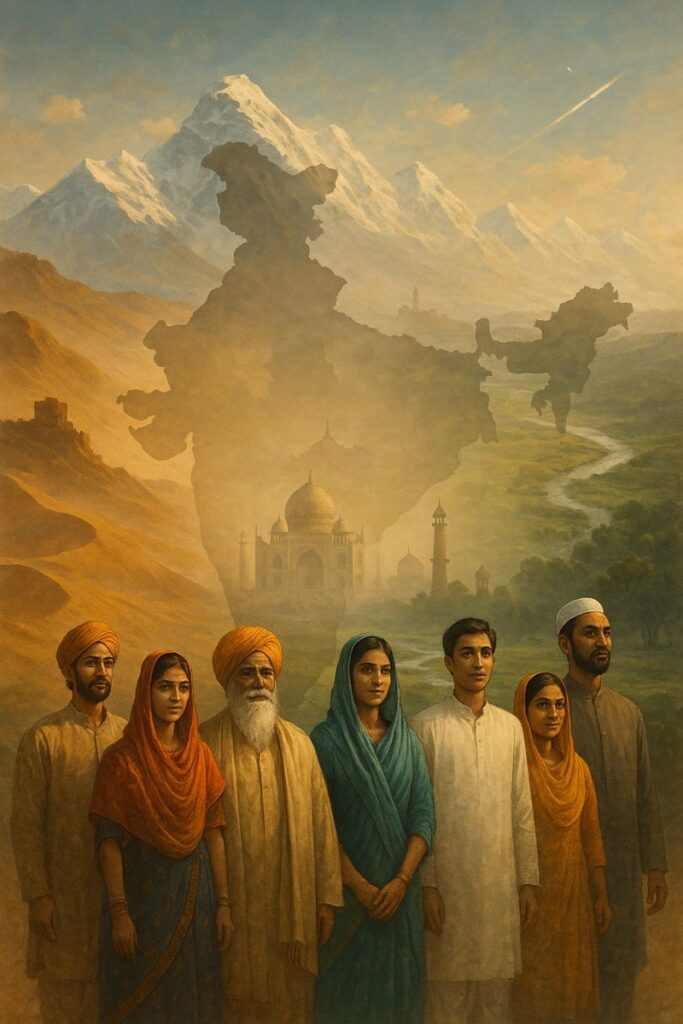
Introduction to India
India, officially known as the Republic of India, is not just a country—it is an experience shaped by history, geography, and the everyday lives of over a billion people. While studying and exploring India over the years, I realized that understanding India means understanding diversity, resilience, and continuity all at once. This article shares my learning journey about India’s geography, culture, and national identity in a way that is both informative and inspiring.
Geographical Location of India
India in South Asia
India is located in the southern part of Asia and is one of the most geographically diverse countries in the world. It is the seventh-largest country by area and the second-largest by population. This vast size plays a crucial role in shaping India’s climate, culture, and economic activities.
Natural Boundaries
The mighty Himalayan mountain range stands guard to the north, acting as a natural barrier and influencing weather patterns. To the south lies the Indian Ocean, while the Arabian Sea borders India to the west and the Bay of Bengal to the east.
Neighboring Countries
India shares its land boundaries with Pakistan, China, Nepal, Bhutan, Bangladesh, and Myanmar. These borders have shaped India’s history, trade, and cultural exchanges for centuries.
History and Culture of India
An Ancient Civilization
India’s history stretches back thousands of years. From learning about the Indus Valley Civilization to understanding the impact of Vedic culture, I found that India’s past is deeply rooted in knowledge, philosophy, and social organization.
Major Historical Phases
India has witnessed the rise and fall of powerful empires such as the Maurya and Gupta Empires, the spread of Buddhism, the grandeur of Mughal rule, and finally the era of the British Raj. Each phase added new layers to India’s cultural and political identity.
Independence and Modern India
After a long freedom struggle, India became an independent nation on 15 August 1947. This moment marked the beginning of a democratic journey that continues to evolve today.
Unity in Diversity
One of the most inspiring lessons I learned is the idea of “Unity in Diversity”. Despite differences in language, religion, customs, and traditions, India functions as a single nation bound by shared values and constitutional principles.

⭐ Editor's Choice
Discover a highly rated product selected for its quality, functionality, and positive customer feedback.
View Details & Reviews →Language and Religion
Linguistic Diversity
India recognizes 22 official languages. Among them, Hindi and English play a major role in administration and communication. This linguistic diversity reflects India’s cultural depth and regional identities.
Religious Harmony
Major religions practiced in India include Hinduism, Islam, Sikhism, Christianity, Buddhism, and Jainism. Over time, I have learned that India’s spiritual traditions emphasize tolerance and coexistence.
Natural Beauty and Tourism
Diverse Landscapes
India’s natural beauty is unmatched. From the serene valleys of Kashmir to the golden deserts of Rajasthan, from the peaceful backwaters of Kerala to the majestic mountain ranges of Uttarakhand, every region offers a unique experience.
Historical and Cultural Attractions
Iconic monuments such as the Taj Mahal, Qutub Minar, and Khajuraho temples attract millions of tourists and tell stories of India’s architectural and artistic excellence.
Economic and Technology Sector
A Rapidly Emerging Economy
India is one of the fastest-growing economies in the world. Agriculture, industry, and the information technology sector form the backbone of its economy.
Science and Technology
Organizations like the Indian space research Organisation (ISRO) have given India a strong global presence in science and technology. India’s achievements in space research are a source of national pride and inspiration.
National Symbols of India
Symbols of Identity
- National Flag: Tricolor
- National Bird: Peacock
- National Animal: Tiger
- National Flower: Lotus
- National Song: Vande Mataram
- National Anthem: Jana Gana Mana
Personal Reflection and Learning
What India Taught Me
While studying India’s geography and history, I realized that India is not defined by a single narrative. It is a living civilization that adapts while preserving its roots. This balance between tradition and modernity is what makes India truly unique.
Frequently Asked Questions (FAQ)
What is the geographical location of India?
India is located in South Asia, with the Himalayas to the north, the Indian Ocean to the south, the Arabian Sea to the west, and the Bay of Bengal to the east.
Why is India called a land of diversity?
India is called a land of diversity because it has multiple languages, religions, cultures, climates, and traditions coexisting within one nation.
When did India become independent?
India gained independence from British rule on 15 August 1947.
What are the main economic sectors of India?
The major economic sectors of India include agriculture, industry, and information technology.
Which organization represents India in space technology?
The Indian Space Research Organisation (ISRO) represents India in space research and technology at the global level.
Related Reading
To deepen your understanding, you may also explore our detailed articles on Indian History and Physical Geography of India.