
📖 Interior Structure of the Earth
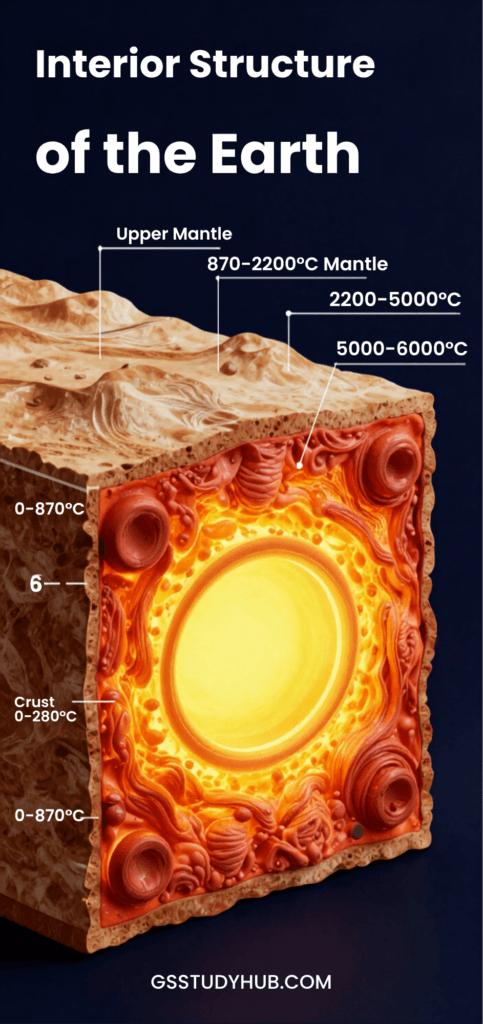
Earth is the only known planet in the Solar System that supports life. Understanding its internal structure is a key aspect of Geography and Geology. Scientists have discovered through seismic studies that Earth is composed of three major layers: Crust, Mantle, and Core.
The study of these internal layers helps us understand earthquakes, volcanic eruptions, plate tectonics, and the distribution of mineral resources. Therefore, the Interior Structure of the Earth is an important topic in physical geography and earth sciences.
🌍 Meaning of the Interior Structure of the Earth
The Interior Structure of the Earth refers to the arrangement, composition, density, and physical properties of the different layers found inside the Earth. Although the Earth appears as a solid sphere from the outside, its interior consists of several distinct layers.
According to scientists, the Earth is mainly composed of three major layers: Crust, Mantle, and Core. These layers differ in their composition, temperature, pressure, and density.
🌍 Sources of Studying the Interior Structure of the Earth
Since it is impossible to directly access the Earth's deep interior, scientists rely on Direct Sources and Indirect Sources to understand the structure and composition of the Earth's interior.
Direct Sources
Direct sources provide information obtained directly from materials and observations within the Earth's crust.
Mining Activities
Mining operations help scientists study rocks, minerals, and temperature conditions present in the upper layers of the Earth.
️ Deep Drilling Projects
Deep drilling projects allow researchers to examine subsurface rocks and gather valuable information about the Earth's internal composition.
Study of Volcanic Materials
Lava, gases, and rock fragments released during volcanic eruptions provide important clues about the Earth's interior.
Indirect Sources
Indirect sources help scientists infer the structure of the Earth's interior without physically reaching it.
Seismic Waves
The study of P-waves and S-waves generated during earthquakes is the most important method for understanding the Earth's internal layers and density variations.
Study of Gravitational Force
Variations in the Earth's gravitational field reveal differences in the distribution and density of materials within the planet.
Study of the Magnetic Field
Analysis of the Earth's magnetic field helps scientists understand the composition and behavior of the Earth's core.
️ Study of Meteorites
Meteorites are believed to have formed during the early stages of the Solar System and provide valuable insights into the Earth's composition and origin.
Seismic Waves and Their Importance
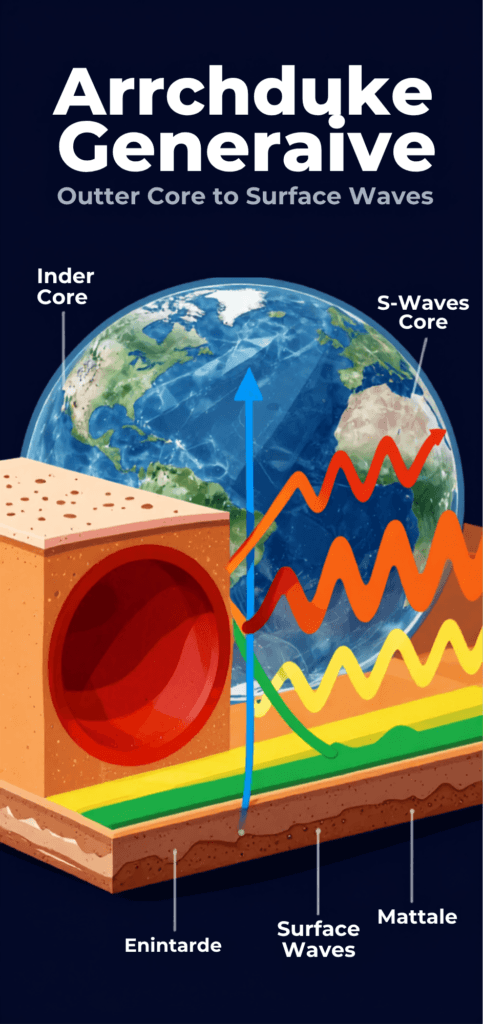
During an earthquake, energy is released from within the Earth and travels in the form of Seismic Waves. These waves are the most important tool for studying the Earth's interior structure.
P Waves (Primary Waves)
P Waves are the fastest seismic waves and are the first to reach seismic stations. They can travel through solids, liquids, and gases, making them highly useful for studying the Earth's internal layers.
S Waves (Secondary Waves)
S Waves travel slower than P Waves and can move only through solid materials. Since they cannot pass through liquids, they provided evidence that the Earth's outer core is in a liquid state.
L Waves (Surface Waves)
L Waves, also known as Surface Waves, travel along the Earth's surface. Although they are slower than body waves, they cause the greatest destruction during earthquakes.
Information Obtained from Seismic Waves
- Identification of the Earth's internal layers.
- Information about the density and composition of different layers.
- Evidence that the outer core is liquid and the inner core is solid.
- Discovery of major discontinuities such as Mohorovičić, Gutenberg, and Lehmann discontinuities.
️ Classification of the Earth's Interior Structure
The Earth's interior is generally classified on the basis of chemical composition and physical properties.
Based on Chemical Composition
Based on chemical composition, the Earth is divided into three major layers: Crust, Mantle, and Core.
- Crust – Rich in silica and aluminum.
- Mantle – Rich in silica and magnesium.
- Core – Mainly composed of nickel and iron (NiFe).
Based on Physical Properties
Based on mechanical behavior and physical characteristics, the Earth is divided into the following layers:
- Lithosphere – Rigid and solid outer layer.
- Asthenosphere – Semi-molten and plastic-like layer.
- Mesosphere – Stronger and denser lower mantle region.
- Outer Core – Liquid in nature.
- Inner Core – Solid due to extremely high pressure.
Crust
Introduction to the Crust
The Crust is the outermost and thinnest solid layer of the Earth. It forms the surface on which humans, animals, and plants live. Although it represents less than 1% of the Earth's total volume, it is of immense geographical and geological importance.
️ Continental Crust
The crust underlying the continents is known as the Continental Crust. It has an average thickness of 30–70 km and is primarily composed of granite-rich rocks. It is relatively less dense than the oceanic crust.
Oceanic Crust
The crust beneath the oceans is called the Oceanic Crust. It is generally 5–10 km thick and is mainly composed of basaltic rocks. It is denser but thinner than the continental crust.
SIAL
The upper part of the crust is rich in Silica (Si) and Aluminum (Al), collectively known as SIAL. It is predominantly found in continental regions.
SIMA
The lower part of the crust is rich in Silica (Si) and Magnesium (Ma), known as SIMA. It is mainly associated with the oceanic crust.
Major Characteristics of the Crust
- It is the outermost and thinnest layer of the Earth.
- Its thickness ranges from about 5 km to 70 km.
- The continental crust is thicker than the oceanic crust.
- It is mainly composed of silica, aluminum, and magnesium-rich rocks.
- Mountains, plateaus, plains, oceans, and all forms of life exist on the crust.
- The boundary between the crust and mantle is known as the Mohorovičić Discontinuity (Moho).
Mohorovicic Discontinuity (Moho)
🔎 Discovery and Significance
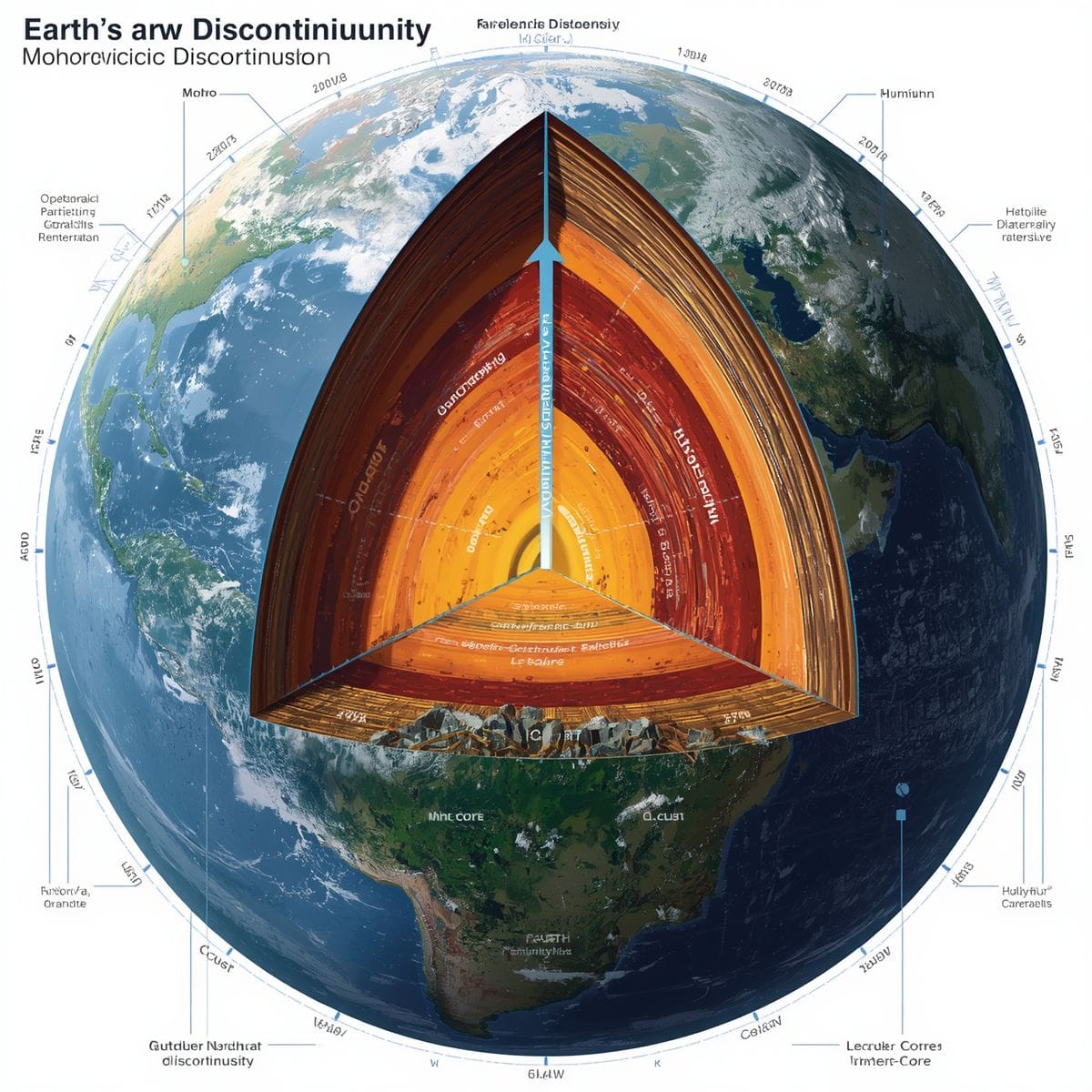
The Mohorovicic Discontinuity, commonly known as the Moho, is an important boundary within the Earth's interior. It was discovered in 1909 by the Croatian seismologist Andrija Mohorovičić through the study of Seismic Waves.
Mohorovičić observed that seismic waves suddenly increased in velocity at a certain depth beneath the Earth's surface. This change indicated a transition between layers of different composition and density.
Boundary Between the Crust and Mantle
The Mohorovicic Discontinuity marks the boundary between the Crust and the Mantle.
Above this boundary lie lighter, less dense crustal rocks, while below it are denser mantle rocks. This difference in composition causes seismic waves to travel much faster through the mantle.
- Its depth ranges from approximately 30–70 km beneath continents.
- Under oceans, it is generally found at depths of about 5–10 km.
- It is considered the first major internal boundary of the Earth.
- It plays a vital role in the interpretation of seismic wave data.
🌍 Mantle
📖 Introduction to the Mantle
The Mantle is the largest layer of the Earth, located between the Crust and the Core. It extends to a depth of about 2,900 km and accounts for nearly 84% of the Earth's volume and about 67% of its mass.
🟢 Upper Mantle
The Upper Mantle extends from the Mohorovicic Discontinuity (Moho) to a depth of approximately 660 km. It contains the rigid Lithosphere and the semi-molten Asthenosphere, which plays a key role in plate tectonics.
🔵 Lower Mantle
The Lower Mantle extends from about 660 km to 2,900 km below the Earth's surface. Due to extremely high pressure and temperature, the rocks in this region are denser and more rigid.
🧪 Chemical Composition of the Mantle
The mantle is primarily composed of minerals rich in Silicon (Si), Magnesium (Mg), and Iron (Fe). Because of its silica and magnesium-rich composition, it is sometimes referred to as the SIMA layer.
- Oxygen (O)
- Silicon (Si)
- Magnesium (Mg)
- Iron (Fe)
🌡️ Temperature and Density of the Mantle
Both temperature and density increase with depth within the mantle. Temperatures range from approximately 500°C–900°C in the upper mantle to nearly 4,000°C near the core-mantle boundary.
- Average density ranges from 3.3 to 5.7 g/cm³.
- The upper mantle is relatively less dense.
- The lower mantle is denser and more rigid.
🌍 Lithosphere
🏔️ Structure of the Lithosphere
The Lithosphere is the Earth's rigid and outermost layer, consisting of the Crust and the uppermost part of the Upper Mantle. Its average thickness ranges from approximately 50 to 200 kilometers.
The lithosphere is hard and brittle in nature and forms the continents, ocean floors, mountains, and other major landforms found on the Earth's surface.
🌎 Lithospheric Plates
The lithosphere is divided into several large and small rigid sections known as Lithospheric Plates. These plates float on the semi-molten asthenosphere and move slowly over time.
- Pacific Plate
- Eurasian Plate
- Indian Plate
- African Plate
- North American Plate
- South American Plate
- Antarctic Plate
The movement of these plates is responsible for earthquakes, volcanic eruptions, mountain building, and the formation of ocean trenches.
⚙️ Plate Tectonics Theory
According to the Plate Tectonics Theory, the Earth's lithosphere is divided into several moving plates that slowly drift over the asthenosphere.
The movement of these plates is primarily driven by convection currents within the mantle. Interactions between plates lead to various geological and geomorphological processes.
- Divergent Boundary – Plates move away from each other.
- Convergent Boundary – Plates move toward each other.
- Transform Boundary – Plates slide past one another horizontally.
🌋 Asthenosphere
📖 Introduction to the Asthenosphere
The Asthenosphere is a semi-molten, plastic-like layer located directly beneath the Lithosphere. It forms part of the upper mantle and is generally found at depths of approximately 100 to 350 kilometers below the Earth's surface.
Due to extremely high temperatures and pressure, the rocks in this layer are partially molten and capable of slow flow. As a result, the asthenosphere is less rigid than the lithosphere and behaves in a ductile manner.
🌎 Role in Plate Movement
The asthenosphere plays a crucial role in the movement of tectonic plates. The rigid lithospheric plates float and move slowly over this semi-molten layer.
Convection currents generated within the mantle transfer energy through the asthenosphere, driving the movement of tectonic plates. This process forms the basis of the Plate Tectonics Theory.
- Facilitates the movement of continents.
- Influences earthquakes and volcanic activity.
- Contributes to mountain-building processes.
- Supports seafloor spreading and the formation of ocean basins.
🔥 Mantle Convection Currents
🔄 Process of Convection Currents
Mantle Convection Currents are thermal movements that occur within the Earth's mantle due to the intense heat generated from the Earth's interior. When mantle rocks are heated, they become less dense and slowly rise toward the surface.
As these materials approach the upper regions of the mantle, they cool down, become denser, and sink back toward deeper levels. This continuous cycle of rising and sinking material creates circular movements known as convection currents.
🌎 Geomorphic Effects
Mantle convection currents drive the movement of tectonic plates and are responsible for many major geomorphic and geological processes on Earth. They form the fundamental mechanism behind plate tectonics.
- 🏔️ Mountain Building
- 🌋 Volcanic Activity
- 🌍 Continental Drift
- 🌊 Seafloor Spreading
- ⚡ Earthquake Generation
- 🕳️ Formation of Ocean Trenches and Island Arcs
The movement, collision, separation, and sliding of tectonic plates are ultimately driven by convection currents operating within the mantle.
🌍 Gutenberg Discontinuity
📍 Location and Characteristics
The Gutenberg Discontinuity is a major boundary between the Earth's Mantle and the Outer Core. It is located at a depth of approximately 2,900 kilometers beneath the Earth's surface.
This discontinuity is named after the German seismologist Beno Gutenberg. Through the study of Seismic Waves, scientists discovered that P-waves slow down significantly at this boundary, while S-waves disappear completely beyond it.
- Located at a depth of about 2,900 km.
- Separates the mantle from the outer core.
- P-wave velocity decreases abruptly.
- S-waves cannot pass beyond this boundary.
- Provides strong evidence that the outer core is liquid.
🔗 Relationship Between the Mantle and the Core
The Gutenberg Discontinuity separates two major layers of the Earth—the Mantle and the Outer Core. The mantle above this boundary is composed mainly of solid silicate rocks, whereas the outer core below it consists largely of molten iron (Fe) and nickel (Ni).
A sudden change in density, temperature, and chemical composition occurs across this boundary. These differences cause seismic waves to behave differently when they reach the core-mantle boundary.
🔥 Core
📖 Introduction to the Core
The Core is the innermost and densest layer of the Earth. It extends from the Gutenberg Discontinuity at a depth of about 2,900 km to the center of the Earth at approximately 6,371 km.
The core accounts for nearly 16% of the Earth's volume and about 32% of its total mass. It is composed mainly of Iron (Fe) and Nickel (Ni), which is why it is often referred to as the NiFe Layer.
🧩 Structure of the Core
The Earth's core is divided into two major parts:
- 🌊 Outer Core: Extends from about 2,900 km to 5,150 km depth and exists in a liquid state.
- ⚙️ Inner Core: Extends from about 5,150 km to 6,371 km and remains solid due to immense pressure despite extremely high temperatures.
The movement of molten iron and nickel in the outer core generates the Earth's Magnetic Field, which protects the planet from harmful solar radiation.
🌡️ Temperature and Density of the Core
The core is the hottest and densest region of the Earth. Both temperature and density increase toward the center of the planet.
- Temperature ranges from approximately 4,000°C to 6,000°C.
- The temperature of the inner core is comparable to that of the Sun's surface.
- Average density ranges from about 10 to 13 g/cm³.
- It is the densest layer of the Earth.
🌊 Outer Core
🌡️ Reason for Its Liquid State
The Outer Core is the outer portion of the Earth's core, extending from approximately 2,900 km to 5,150 km below the Earth's surface. It is composed mainly of Iron (Fe) and Nickel (Ni).
The temperature of the outer core is extremely high, ranging from about 4,000°C to 5,500°C. Although the pressure is immense, the temperature is high enough to keep iron and nickel in a molten state. As a result, the outer core exists in a liquid form.
🧲 Contribution to the Earth's Magnetic Field
The molten iron and nickel in the outer core are constantly moving due to convection currents and the Earth's rotation. This movement generates electric currents that create the Earth's magnetic field through a process known as the Geo-Dynamo Mechanism.
The Earth's magnetic field acts as a protective shield against harmful charged particles and solar winds from the Sun, making life on Earth possible.
⭐ Characteristics of the Outer Core
- 📍 Depth: Approximately 2,900 km to 5,150 km.
- 🌊 State: Liquid.
- 🧪 Composition: Mainly Iron (Fe) and Nickel (Ni).
- 🌡️ Temperature: Around 4,000°C–5,500°C.
- 🧲 Primary source of the Earth's magnetic field.
- 📈 S-waves cannot travel through this layer.
- ⚡ P-waves slow down significantly within this region.
⚙️ Inner Core
🧊 Reason for Its Solid State
The Inner Core is the innermost layer of the Earth, extending from approximately 5,150 km below the surface to the Earth's center at about 6,371 km.
Although the temperature of the inner core is estimated to be between 5,000°C and 6,000°C, it remains in a solid state. This is because the immense pressure at the Earth's center prevents iron and nickel from melting despite the extremely high temperatures.
🧪 Structure of the Inner Core
The inner core is composed primarily of Iron (Fe) and Nickel (Ni). Small amounts of sulfur, oxygen, and other heavy elements may also be present.
- Iron (Fe) – Major Component
- Nickel (Ni) – Major Component
- Sulfur (S) and Other Heavy Elements
⭐ Major Characteristics
- 📍 Depth: Approximately 5,150 km to 6,371 km.
- ⚙️ State: Solid.
- 🧪 Composition: Mainly Iron and Nickel.
- 🌡️ Temperature: Around 5,000°C–6,000°C.
- 📈 Highest density among all Earth's layers.
- 🌍 Forms the central part of the Earth.
- 🧲 Contributes to the stability of the Earth's magnetic field.
Scientists believe that the inner core is gradually growing as some of the molten material from the outer core slowly solidifies over time.
🌍 Lehmann Discontinuity
🔎 Discovery and Significance
The Lehmann Discontinuity is an important boundary between the Outer Core and the Inner Core of the Earth. It was discovered in 1936 by the Danish seismologist Inge Lehmann.
While studying Seismic Waves, Lehmann observed that certain P-waves reappeared after passing through the Earth's core. This observation led to the conclusion that a solid inner region exists within the Earth's core.
⚙️ Boundary Between the Outer and Inner Core
The Lehmann Discontinuity is located at a depth of approximately 5,150 kilometers and marks the boundary between the liquid Outer Core and the solid Inner Core.
At this boundary, significant changes occur in the physical state, density, and behavior of seismic waves. Because the inner core is solid, the velocity of P-waves increases again after crossing this boundary.
- 📍 Depth: Approximately 5,150 km.
- 🌊 Separates the liquid outer core from the solid inner core.
- 📈 P-wave velocity increases across the boundary.
- 🌍 Provides evidence for the existence of the Earth's inner core.
- 🔬 Plays a crucial role in understanding the Earth's internal structure.
📊 Comparative Table of the Earth's Internal Layers
🌍 Comparison of the Crust, Mantle, and Core
| Feature | 🌎 Crust | 🌋 Mantle | 🔥 Core |
|---|---|---|---|
| Location | Outermost Layer | Between the Crust and the Core | Innermost Layer |
| Thickness | 5–70 km | About 2,900 km | About 3,480 km |
| Main Elements | Silica and Aluminum | Silica, Magnesium, and Iron | Iron and Nickel |
| Physical State | Solid | Solid to Semi-Molten | Liquid Outer Core and Solid Inner Core |
| Temperature | 200°C–1,000°C | 500°C–4,000°C | 4,000°C–6,000°C |
| Density | Lowest | Moderate | Highest |
| Major Significance | Supports Life and Landforms | Convection Currents and Plate Tectonics | Generation of the Earth's Magnetic Field |
🌍 Importance of the Earth's Interior Structure in Geography
The study of the Earth's Interior Structure is of great importance in Geography, Geology, and Geophysics. Processes occurring deep within the Earth significantly influence surface features, landforms, and natural phenomena.
🌎 Origin of earthquakes
Earthquakes are primarily caused by the movement, collision, separation, and friction of tectonic plates. Understanding the Earth's internal structure helps scientists explain the causes, patterns, and impacts of seismic activity.
🌋 Volcanic Activities
Volcanic eruptions are driven by magma and heat originating from within the Earth. Knowledge of the Earth's interior helps explain the formation of volcanoes and the mechanisms behind volcanic eruptions.
🏔️ Mountain Building
Mountains are formed through the convergence and collision of tectonic plates. For example, the collision between the Indian Plate and the Eurasian Plate led to the formation of the Himalayan mountain range.
🔄 Plate Tectonics
Convection currents within the mantle drive the movement of lithospheric plates. The theory of Plate Tectonics is based on the Earth's internal structure and is fundamental to understanding many geological and geomorphological processes.
⛏️ Mineral and Energy Resources
Various layers of the Earth contain valuable mineral deposits, metals, petroleum, natural gas, and geothermal energy resources. Studying the Earth's interior helps in locating and utilizing these resources effectively.
🧲 Earth's Magnetic Field
The movement of molten iron and nickel in the outer core generates the Earth's magnetic field. This magnetic shield protects the planet from harmful solar winds and cosmic radiation.
🔬 Earth's Interior Structure and Modern Research
Advances in science and technology have significantly improved our understanding of the Earth's interior structure. Using modern seismic techniques, satellite observations, and computer simulations, scientists are uncovering new details about the deep regions of the Earth.
📈 Recent Seismic Studies
Modern seismic instruments and high-resolution imaging techniques enable scientists to study the Earth's internal layers with greater accuracy. Seismic tomography has made it possible to create three-dimensional models of the Earth's interior.
- Detailed analysis of seismic wave behavior and velocity.
- Investigation of convection currents within the mantle.
- Improved understanding of plate tectonic processes.
- Research aimed at enhancing earthquake prediction methods.
🔥 Research on the Earth's Core
Scientists continue to investigate the composition, temperature, and dynamics of both the outer and inner core. Recent studies suggest that the inner core may rotate at a slightly different rate than the Earth's surface.
- Analysis of the structure and composition of the inner core.
- Study of the Geo-Dynamo process that generates the Earth's magnetic field.
- Research on variations in the Earth's magnetic field.
- Investigation of interactions between the mantle and the core.
🚀 Future Prospects
In the coming years, the use of Artificial Intelligence (AI), supercomputing, and advanced geophysical technologies is expected to provide even more accurate insights into the Earth's interior structure.
- Development of improved earthquake forecasting techniques.
- Enhanced monitoring of volcanic activity.
- Detailed 3D mapping of the Earth's mantle and core.
- Better exploration of mineral and energy resources.
- Deeper understanding of the Earth's origin and evolution.
🎯 Importance in UPSC and Competitive Examinations
The Interior Structure of the Earth is one of the most important topics in physical geography. Questions related to this subject are frequently asked in UPSC, State PCS, SSC, CDS, CAPF, NDA, and other competitive examinations.
📚 Important Facts for the Preliminary Examination
- 🌍 Major layers of the Earth – Crust, Mantle, and Core.
- 📍 Mohorovicic, Gutenberg, and Lehmann Discontinuities.
- 📈 Characteristics of P-Waves, S-Waves, and L-Waves.
- 🧲 Relationship between the Outer Core and the Earth's Magnetic Field.
- 🌋 Asthenosphere and the Plate Tectonics Theory.
- 🏔️ Differences between Continental and Oceanic Crust.
- ⚙️ Features of the Inner Core and Outer Core.
- 🔄 Mantle Convection Currents and Plate Movement.
✍️ Analytical Points for the Main Examination
In the UPSC Mains Examination, candidates are expected not only to know facts but also to present analytical and interconnected explanations related to the Earth's interior structure.
- 🌍 Relationship between the Earth's Interior Structure and Plate Tectonics.
- 🌋 Role of Internal Processes in Volcanic Activity and earthquakes.
- 🏔️ Analysis of Mountain Building and Continental Drift.
- 🧲 Contribution of the Outer Core to the Earth's Magnetic Field.
- 📈 Study of the Earth's Interior through Seismic Waves.
- 🔬 Importance of Modern Research and Seismic Tomography.
- ⚡ Linkages with Natural Disasters and Geomorphological Processes.
📌 Conclusion
🌍 Overall Evaluation of the Earth's Interior Structure
The Earth's interior is composed of three major layers— Crust, Mantle, and Core—each having distinct composition, density, temperature, and physical properties. Studies of seismic waves have revealed that the Earth's interior is highly complex and dynamic.
The discovery of major discontinuities such as the Mohorovicic, Gutenberg, and Lehmann discontinuities has greatly enhanced our understanding of the Earth's layered structure. Modern research has further improved our knowledge of the core, mantle convection currents, and plate tectonic processes.
🌎 Relevance to Human Life and Geography
The study of the Earth's interior structure is not only important for scientific understanding but also highly relevant to human life and geography. It helps explain earthquakes, volcanic eruptions, mountain formation, plate tectonics, and the distribution of mineral and energy resources.
Furthermore, the Earth's magnetic field, generated by the movement of molten materials in the outer core, protects the planet from harmful solar radiation and charged particles. Understanding the Earth's interior is therefore essential for disaster management, resource exploration, environmental planning, and sustainable development.
❓ Frequently Asked Questions (FAQs) – Interior Structure of the Earth
1. What is the Interior Structure of the Earth?
The Earth's interior structure consists of three main layers: the Crust, the Mantle, and the Core, each having distinct physical and chemical properties.
2. What is the Mohorovicic Discontinuity (Moho)?
The Mohorovicic Discontinuity, commonly called the Moho, is the boundary between the Earth's crust and mantle where seismic wave velocities increase abruptly.
3. What is the difference between P-Waves and S-Waves?
P-Waves can travel through solids, liquids, and gases, whereas S-Waves can travel only through solids and cannot pass through liquids.
4. Why is the Earth's Outer Core in a Liquid State?
The outer core remains liquid because extremely high temperatures keep iron and nickel in a molten state despite immense pressure.
5. What is the Importance of the Asthenosphere?
The Asthenosphere is a semi-molten layer beneath the lithosphere that enables tectonic plates to move, making plate tectonic activity possible.
6. How is the Earth's Magnetic Field Generated?
The Earth's magnetic field is generated by the movement of molten iron and nickel in the outer core through the Geo-Dynamo Process.
7. Why is the Earth's Interior Structure Important for UPSC Preparation?
The Earth's interior structure is a crucial topic in UPSC Geography, covering seismic waves, plate tectonics, discontinuities, earthquakes, volcanoes, and the Earth's core.