
Akbar's Empire Building Introduction
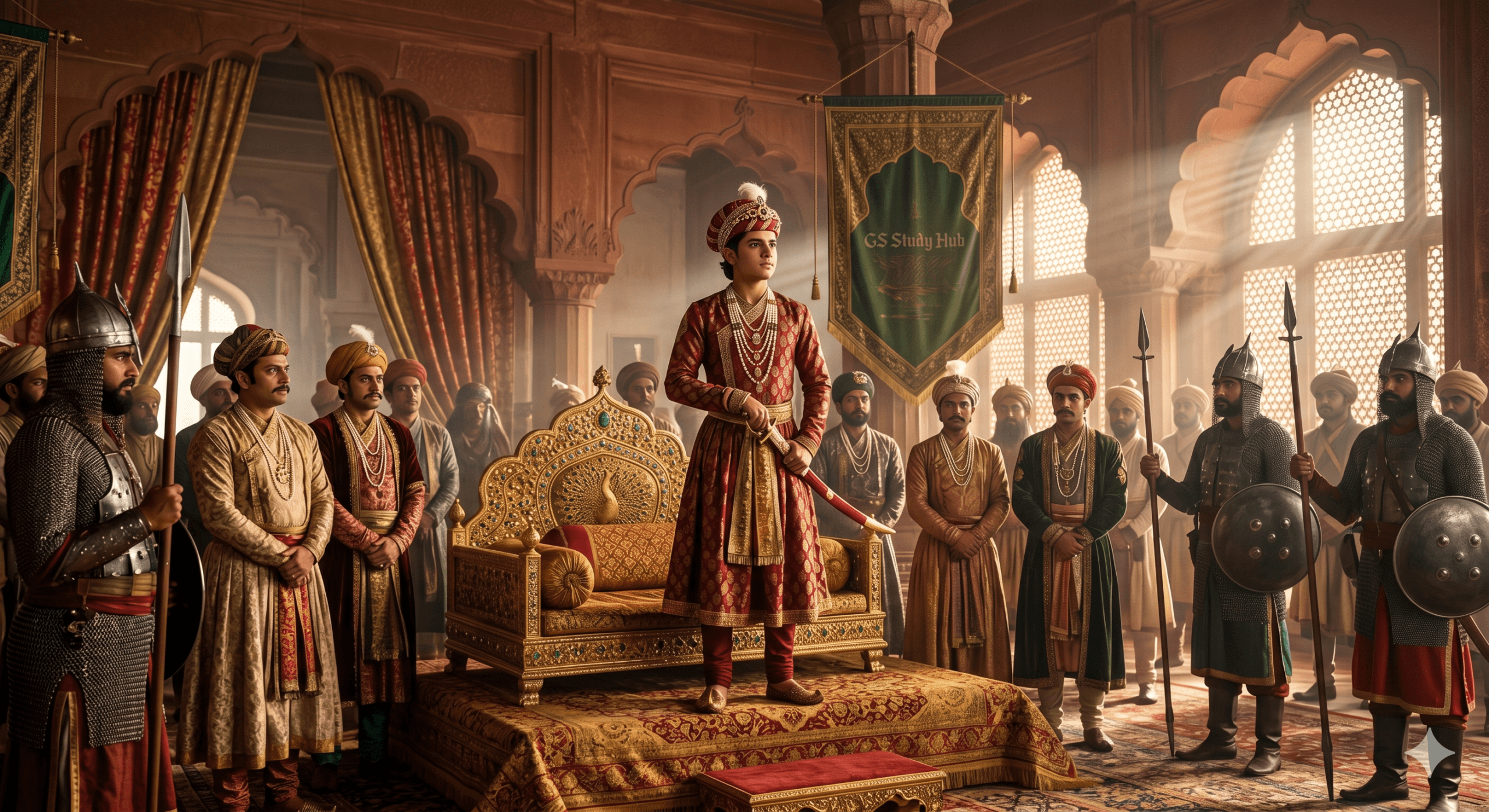
Akbar (1556–1605) is widely regarded as the true architect of the Mughal Empire and one of the greatest rulers in Indian history. While Babur laid the foundation of Mughal rule and Humayun struggled to preserve it, Akbar transformed a fragile kingdom into a powerful, centralized, and prosperous empire. Ascending the throne at the age of thirteen, he faced numerous challenges, including Afghan resistance, independent Rajput kingdoms, and regional powers competing for influence across the Indian subcontinent.
Through a remarkable combination of military conquests, strategic diplomacy, administrative reforms, and religious tolerance, Akbar successfully expanded Mughal authority across vast territories, including Gujarat, Bengal, Kashmir, and parts of the Deccan. His innovative policies not only strengthened imperial control but also laid the foundations for long-term political stability and economic growth.
Among his most significant achievements was his Rajput Policy, which fostered cooperation between the Mughal state and influential Rajput rulers. Combined with the Mansabdari System and comprehensive revenue reforms, these measures helped create one of the most efficient administrative structures of medieval India.
This article explores Akbar's Empire Building, examining his expansionist policies, governance model, military strategies, administrative innovations, and diplomatic relations. Understanding Akbar's reign provides valuable insights into the rise of the Mughal Empire and the political evolution of early modern India.
🏰 Explore the Power and Legacy of the Rajputs:
Before becoming allies and rivals of the Mughal Empire, the Rajputs had already established powerful kingdoms, magnificent forts, rich cultural traditions, and a proud warrior heritage. Discover how Rajput rulers shaped the political, military, and cultural landscape of medieval India.
👉 Rajput Empire: History, Forts, Culture, Art and Glorious Legacy

Explore this detailed reference book for further study
Akbar's Empire Building Early Reign of Akbar
The story of Akbar's rise to power began during one of the most uncertain periods in Mughal history. In 1556, following the sudden death of Emperor Humayun, the Mughal throne passed to his thirteen-year-old son, Akbar. At such a young age, he inherited not a secure empire but a fragile kingdom surrounded by powerful rivals. Afghan chiefs, ambitious regional rulers, and independent Rajput states were all eager to challenge Mughal authority.
During the initial years of his reign, the administration was effectively managed by his trusted guardian and military commander, Bairam Khan. However, the greatest threat to the Mughal Empire emerged in the form of Hemu Vikramaditya, a capable military leader who had successfully captured Delhi and Agra and declared himself ruler. The future of Mughal rule in India hung in the balance as both forces prepared for a decisive confrontation.
On 5 November 1556, the two armies met at the historic Second Battle of Panipat. The battle proved to be a turning point in Indian history. During the fierce fighting, Hemu was struck in the eye by an arrow, causing confusion and a collapse in his army's morale. The Mughal forces emerged victorious, securing Akbar's position on the throne and restoring Mughal authority in northern India.
Following this crucial victory, Akbar gradually freed himself from the influence of Bairam Khan and assumed direct control over the empire. What began as the reign of a young and inexperienced ruler soon evolved into one of the most remarkable success stories in world history. Over the next five decades, Akbar transformed the Mughal state into a vast, prosperous, and highly centralized empire, laying the foundation for centuries of Mughal dominance in the Indian subcontinent.
🛡️ Discover the Legacy of the Rajputs:
To fully understand Akbar's relationship with the Rajput kingdoms, explore the rise, achievements, cultural contributions, and eventual decline of the Rajput Era. This detailed guide explains how Rajput rulers shaped the political and military history of medieval India.
👉 Rajput Era: Rise, Decline, Causes and Cultural Heritage

Imperial Expansion Policy
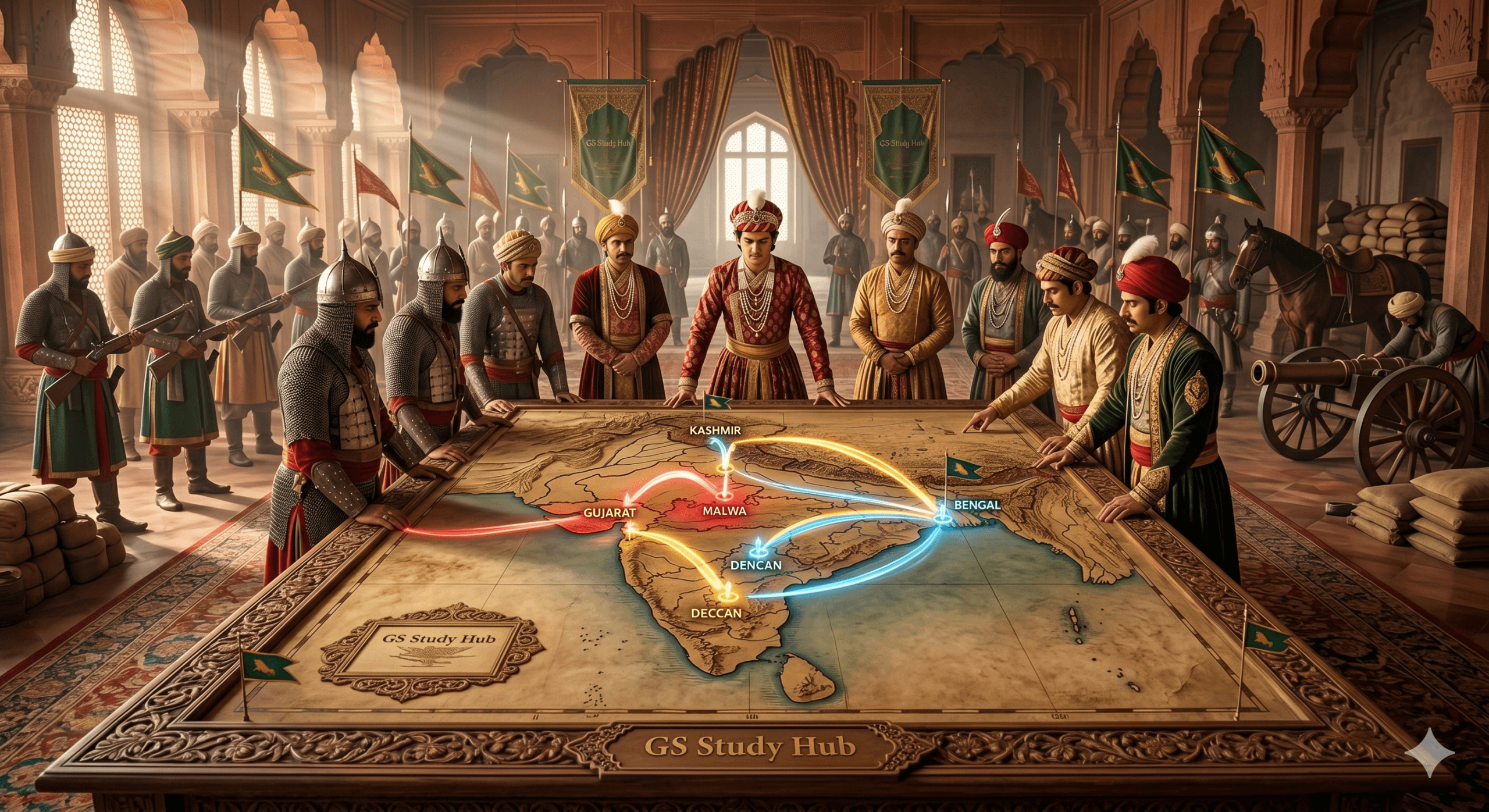
Following the decisive Mughal victory in the Second Battle of Panipat (1556), Akbar realized that controlling only Delhi and Agra would not be enough to ensure the long-term survival of the Mughal Empire. Northern India remained politically fragmented, with Afghan chiefs, Rajput rulers, and regional kingdoms constantly challenging Mughal authority. For the young emperor, the task was not merely to defend his throne but to transform a fragile kingdom into a powerful and unified empire.
Unlike many medieval conquerors, Akbar's expansion policy was not based solely on military force. He skillfully combined military campaigns, diplomatic alliances, and administrative integration to strengthen imperial control. Where resistance was strong, he relied on military power; where cooperation was possible, he used diplomacy, strategic marriages, and political partnerships. This balanced approach ensured that conquered territories became permanent parts of the Mughal state rather than temporary acquisitions.
Akbar's expansion began with the conquest of Malwa in 1561, followed by campaigns in Gondwana, Gujarat, Bengal, Kashmir, Sindh, and Kandahar. Among these achievements, the conquest of Gujarat (1572–1573) was particularly significant because it provided access to prosperous maritime trade routes and strengthened the empire's economic position. Similarly, the annexation of Bengal in 1576 brought immense revenue and control over important river-based trade networks.
The primary objective of Akbar's imperial expansion was not simply territorial growth. His strategy aimed to secure frontiers, control major trade routes, increase state revenue, and establish political stability across the subcontinent. Through this vision, Akbar transformed the Mughal Empire into one of the most powerful and well-organized states of early modern India. His expansion policy remains a remarkable example of how military strength, diplomacy, and governance can work together to build a lasting empire.
⚔️ Continue Your Journey Through Indian history:
After understanding how Akbar built and strengthened the Mughal Empire, explore the rise of another powerful Indian state that challenged Mughal authority and transformed the political landscape of the subcontinent.
👉 Maratha Empire: Expansion, Administration, Culture and Historical Legacy

Discover this valuable resource for deeper learning and research
Expansion in Northern and Central India
After securing his position following the Second Battle of Panipat (1556), Akbar understood that controlling only Delhi and Agra would not be sufficient to establish a lasting empire. Large parts of Northern and Central India remained under the influence of regional rulers, Afghan chiefs, and independent kingdoms. If the Mughal Empire was to survive and prosper, these strategically important territories had to be brought under imperial authority.
The first major step in this direction came in 1561, when Akbar launched a campaign against Malwa. At the time, the region was ruled by Baz Bahadur, a ruler renowned for his love of music and culture. Although Malwa was celebrated for its artistic traditions, it also held immense strategic value. Located between Northern India and the Deccan, it served as a crucial political and commercial link. The Mughal victory in Malwa strengthened Akbar's influence and opened new opportunities for further expansion.
Akbar's attention then shifted toward Gondwana in 1564. The region was defended by the courageous Rani Durgavati, who fought bravely against the advancing Mughal forces. Although Gondwana eventually came under Mughal control, Rani Durgavati's resistance earned her a lasting place in Indian history as a symbol of courage and sacrifice.
In Northern India, Akbar further consolidated his authority over important regions such as Jaunpur, Allahabad, and surrounding territories. These campaigns were not merely about territorial expansion; they were designed to improve security, strengthen administration, increase revenue, and integrate diverse regions into a unified imperial framework.
The successful expansion into Northern and Central India laid the foundation for the Mughal Empire's transformation from a vulnerable kingdom into the dominant political power of the Indian subcontinent. These victories marked the beginning of Akbar's remarkable journey as one of history's greatest empire builders.
Gujarat Campaign and the Conquest of Bengal
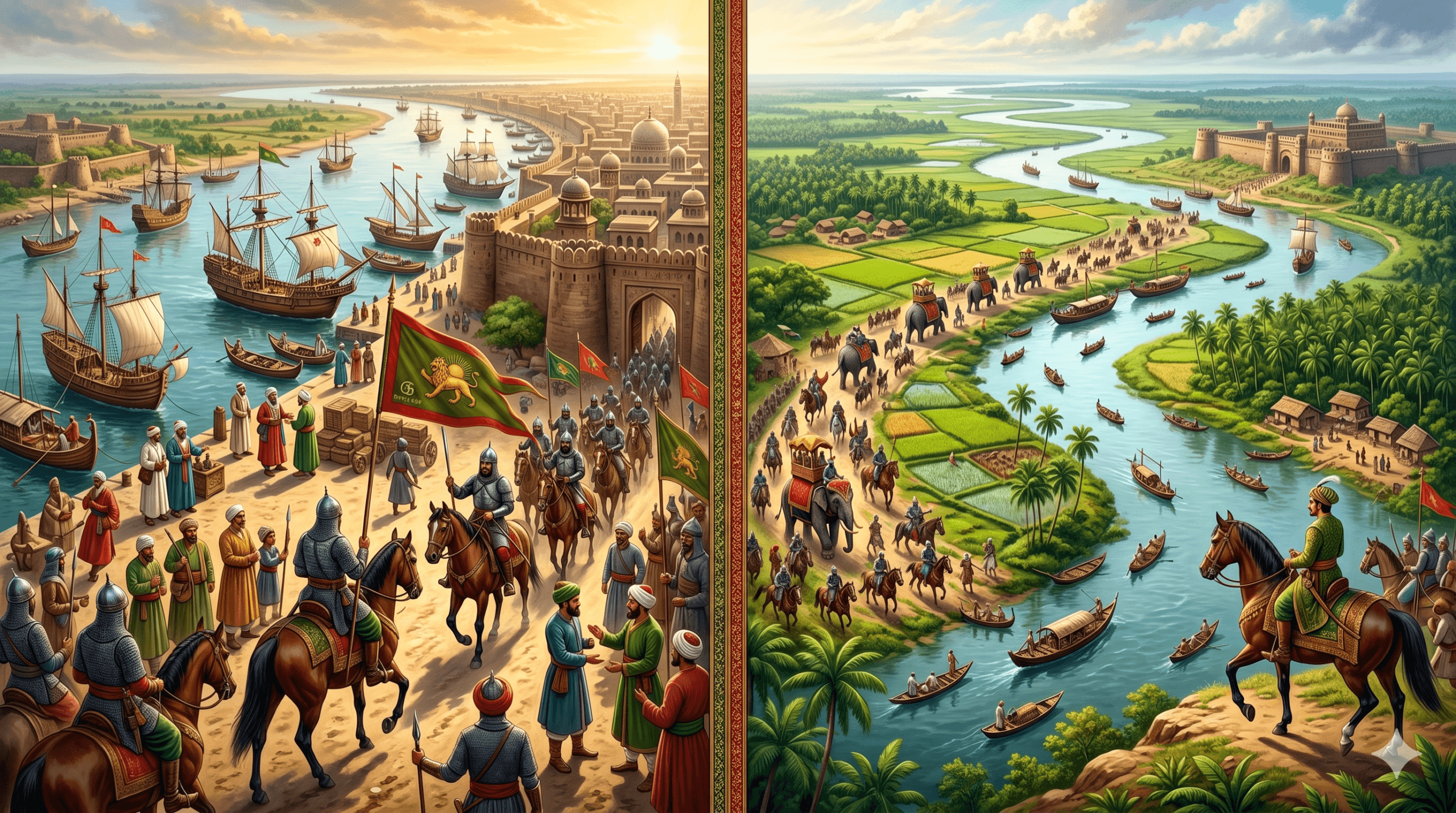
After consolidating Mughal authority in Northern and Central India, Emperor Akbar turned his attention toward two of the wealthiest and most strategically important regions of the Indian subcontinent— Gujarat in the west and Bengal in the east. These provinces were not only economically prosperous but also controlled major trade routes that were vital for the growth of the Mughal Empire. Akbar understood that long-term imperial stability depended on securing these regions and integrating them into the Mughal administrative framework.
The Gujarat Campaign (1572–1573)
During the sixteenth century, Gujarat was regarded as one of the richest commercial centers in India. Its major ports, including Surat, Cambay (Khambhat), and Bharuch, connected India with Arabia, Persia, Africa, and Europe. Valuable commodities such as textiles, spices, silk, and precious goods passed through these ports, making Gujarat a hub of international commerce.
Recognizing its immense economic value, Akbar launched a campaign against Gujarat in 1572. At that time, the Gujarat Sultanate was weakened by internal conflicts and political instability. Taking advantage of this situation, Akbar rapidly advanced through the region and captured important cities, including Ahmedabad. Although several local chiefs resisted Mughal rule, they were ultimately defeated by the imperial forces.
Soon after the conquest, rebellions erupted across the province. Demonstrating extraordinary leadership and military efficiency, Akbar personally traveled nearly 800 kilometers in a remarkably short period to suppress the uprising. His swift action restored order and firmly established Mughal authority. The annexation of Gujarat significantly increased imperial revenues and provided the Mughal Empire with direct access to maritime trade networks, strengthening its economic foundation.
The Conquest of Bengal (1574–1576)
Following his success in Gujarat, Akbar focused on Bengal, one of the most fertile and prosperous regions in South Asia. Rich agricultural lands, extensive river systems, and flourishing trade made Bengal a prized territory. However, it remained under the control of the Afghan ruler Daud Khan Karrani, who refused to acknowledge Mughal supremacy.
In 1574, the Mughal army launched a major military campaign into Bengal. After capturing several strategic centers, the decisive phase of the conflict occurred between 1575 and 1576. The defeat of Daud Khan ultimately brought Bengal under Mughal control, marking one of the most significant achievements of Akbar's reign.
The incorporation of Bengal greatly enhanced the empire's financial strength. The province generated substantial agricultural revenue, expanded Mughal influence into northeastern India, and provided control over important river-based trade routes. Bengal soon became one of the wealthiest provinces of the Mughal Empire and played a crucial role in supporting imperial administration and military operations.
Together, the conquests of Gujarat and Bengal transformed the Mughal Empire into an economic powerhouse. By securing maritime trade in the west and agricultural wealth in the east, Akbar demonstrated that successful empire-building required not only military victories but also strategic control of commerce, resources, and trade networks. These achievements laid the foundation for the Mughal Empire's emergence as the dominant political and economic force in early modern India.
🏰 Explore Mughal Architectural Heritage:
Want to discover the magnificent fortress that served as the political and administrative heart of the Mughal Empire? Explore the history, architecture, hidden secrets, and strategic importance of one of India's most iconic landmarks.
👉 Agra Fort: History, Architecture, Mughal Legacy and Interesting Facts

Explore this insightful resource for deeper study and understanding
North-West Frontier Policy
Akbar was not only a successful conqueror but also a visionary strategist who understood that the strength of an empire depended as much on secure frontiers as on territorial expansion. Throughout Indian history, several foreign invaders, including Mahmud of Ghazni, Muhammad Ghori, Timur, and Babur, had entered the Indian subcontinent through the north-western passes. Learning from history, Akbar made the security of this region a central pillar of his imperial strategy.
Among the most important territories in the north-west were Kabul, Kandahar, and Kashmir. Kabul held deep historical significance for the Mughal dynasty, while Kandahar served as the primary gateway connecting India with Central Asia. Control over Kandahar meant control over major trade routes, military movements, and diplomatic contacts. Recognizing its strategic importance, Akbar successfully brought Kandahar under Mughal control in 1595, strengthening the empire's defensive position against external threats.
Akbar further enhanced frontier security by annexing Kashmir in 1586. Surrounded by mountains and located near critical invasion routes, Kashmir held immense geopolitical value. Its incorporation into the Mughal Empire not only secured the northern frontier but also improved the empire's ability to monitor strategic mountain passes and regional developments.
The primary objective of Akbar's North-West Frontier Policy was not merely territorial expansion. It was a carefully designed strategy aimed at preventing foreign invasions, protecting vital commercial routes, maintaining links with Central Asia, and ensuring long-term imperial stability. By securing these frontier regions, Akbar transformed the Mughal Empire into a stronger and more resilient state capable of defending its borders while expanding its political and economic influence.
From a modern geopolitical perspective, Akbar's frontier policy demonstrates how strategic geography, trade corridors, and border security can shape the rise of a great power. His decisions in the north-west laid the foundation for Mughal dominance and helped safeguard the empire for generations.
Rajput Policy of Akbar
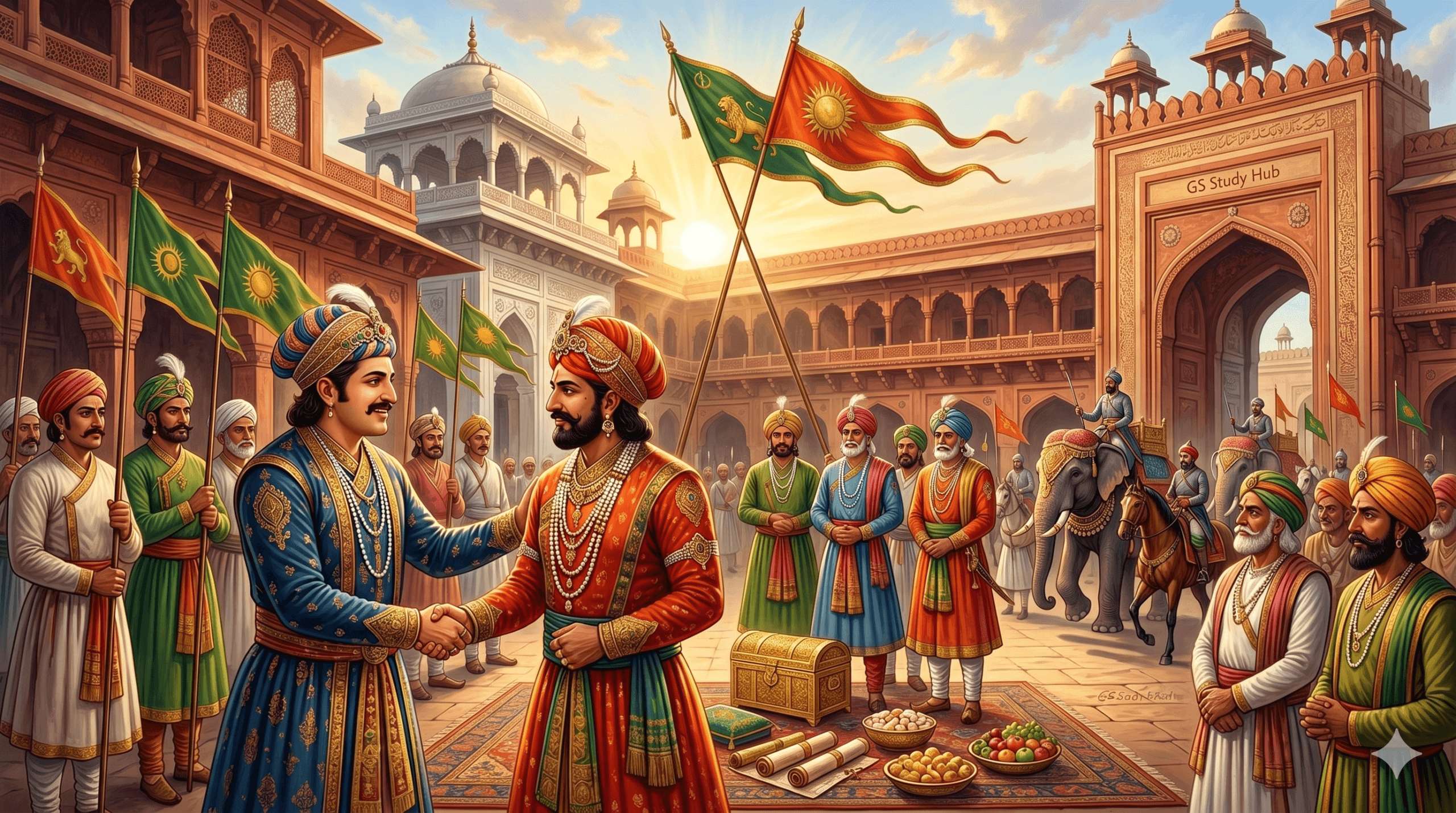
Among all the policies introduced by Emperor Akbar, his Rajput Policy is widely regarded as one of the most successful and visionary. When Akbar ascended the throne, powerful Rajput kingdoms controlled large parts of northern and western India. Rather than relying solely on military conquest, Akbar recognized that long-term imperial stability required cooperation with these influential warrior states. His approach combined diplomacy, mutual respect, and political partnership, creating a foundation for lasting peace and integration.
The policy began in 1562 when Raja Bharmal of Amer entered into an alliance with Akbar through a royal marriage. This event marked the beginning of a new relationship between the Mughal Empire and the Rajput states. Over time, prominent Rajput leaders such as Raja Bhagwan Das and Raja Man Singh were appointed to important positions in the Mughal administration and military. Their loyalty and military expertise significantly strengthened the empire.
A key feature of Akbar's Rajput Policy was his willingness to grant respect and autonomy to Rajput rulers. In return for acknowledging Mughal supremacy, they were allowed to retain control over their territories and traditions. This pragmatic approach encouraged many Rajput states to join the Mughal political system voluntarily, reducing resistance and enhancing administrative efficiency across the empire.
However, not all Rajput rulers accepted Mughal authority. The most notable exception was Maharana Pratap of Mewar, who chose to resist Akbar's expansion. This conflict culminated in the famous Battle of Haldighati (1576). Although the Mughals achieved a tactical advantage, Maharana Pratap's determination and resistance became a lasting symbol of Rajput courage and independence.
Akbar's Rajput Policy provided the Mughal Empire with political stability, military support, and administrative cooperation. More importantly, it helped integrate diverse regional powers into a unified imperial framework. Historians often regard this policy as one of the principal reasons behind the remarkable success and longevity of the Mughal Empire under Akbar's rule.
⚔️ Related Historical Figure:
Want to explore the extraordinary life of the legendary Rajput warrior who challenged Mughal supremacy? Discover the inspiring story of courage, sacrifice, and resistance that made Maharana Pratap a symbol of Rajput pride and Indian history.
👉 Maharana Pratap: Complete Biography, Struggles, Battles and Legacy

Administrative Reforms
While Akbar is celebrated as one of India's greatest conquerors, his true genius lay in his ability to govern a vast and diverse empire. He understood that military victories alone could not guarantee long-term stability. A strong empire required an efficient administrative system capable of maintaining order, collecting revenue, and managing distant provinces. With this vision, Akbar introduced a series of reforms that transformed the Mughal Empire into one of the most organized states of the medieval world.
One of his most significant innovations was the Mansabdari System, which established a structured ranking system for military officers and civil administrators. Each official was assigned a specific rank, determining their responsibilities, status, and salary. This reform strengthened central authority and ensured greater efficiency within both the administration and the army.
Akbar also revolutionized the empire's financial administration with the assistance of Raja Todar Mal. Through detailed land surveys and scientific revenue assessments, the government introduced a fairer taxation system. These measures reduced arbitrary tax collection, improved agricultural productivity, and significantly increased state revenue.
To improve governance, the empire was divided into several provinces (Subahs), each administered by appointed officials responsible for law, finance, and military affairs. This decentralized structure allowed the Mughal government to maintain effective control over its expanding territories.
These administrative reforms laid the foundation for a stable, prosperous, and centralized empire. By combining efficient governance with strong leadership, Akbar created a political system that continued to support Mughal power for generations, making his reign a defining chapter in the history of India.
Deccan Policy
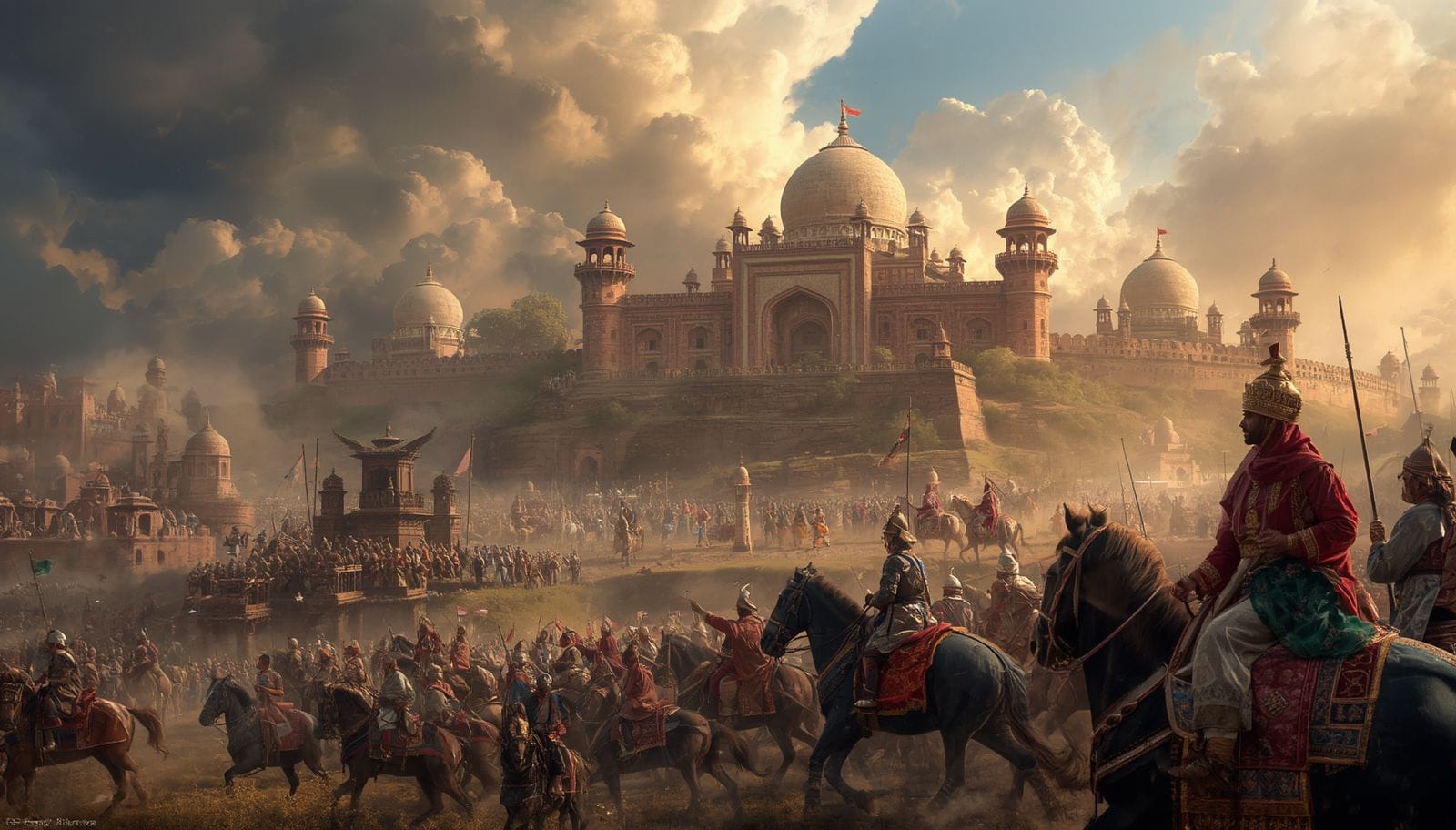
During the final decades of his reign, Emperor Akbar shifted his attention toward the Deccan region of Southern India. At that time, the Deccan was dominated by several powerful Sultanates, including Ahmadnagar, Bijapur, Golconda, Berar, and Khandesh. These states controlled important trade routes, fertile territories, and strategic military positions. Akbar realized that securing influence in the Deccan was essential for transforming the Mughal Empire into the dominant power of the Indian subcontinent.
The foundation of Akbar's Deccan Policy was laid in 1591, when he dispatched diplomatic envoys to the Deccan rulers, requesting them to acknowledge Mughal supremacy. Most of these rulers rejected the proposal, forcing the Mughal Empire to adopt a military approach. This marked the beginning of a prolonged struggle between the Mughal Empire and the Deccan Sultanates.
The most significant conflict emerged with Ahmadnagar, which was courageously defended by the legendary Chand Bibi. Known for her bravery, leadership, and determination, Chand Bibi successfully resisted Mughal advances for several years and became one of the most respected figures in medieval Indian history. Despite her resistance, the Mughal forces gradually gained the upper hand.
By 1600, the Mughals had captured important parts of Ahmadnagar and brought regions such as Berar and Khandesh under imperial control. Although Akbar did not succeed in conquering the entire Deccan during his lifetime, he established a strong foundation for future Mughal expansion in Southern India.
The primary objective of Akbar's Deccan Policy was not merely territorial conquest. It was designed to secure trade routes, increase imperial revenues, strengthen political influence, and integrate the economically rich southern regions into the Mughal sphere. This strategic vision later guided the Deccan campaigns of Jahangir, Shah Jahan, and particularly Aurangzeb, who devoted much of his reign to expanding Mughal authority in the Deccan.
From a geopolitical perspective, Akbar's Deccan Policy represented a calculated effort to control the economic and strategic heartland of Southern India. It demonstrated his long-term vision of building a unified and powerful empire capable of dominating both northern and southern regions of the subcontinent.

Explore this trusted resource for deeper learning and research
⚔️ Related history Article:
Want to understand how later conflicts reshaped power in India after the Mughal era? Explore the historic battle that changed the political future of the Indian subcontinent and weakened the Maratha Empire.
👉 Third Battle of Panipat (1761): Causes, Events, and Historical Impact
Religious Policy of Akbar
Among the many achievements of Emperor Akbar, his Religious Policy stands out as one of the most progressive and visionary aspects of his reign. During the sixteenth century, India was home to diverse religious communities, including Hindus, Muslims, Jains, Buddhists, Sikhs, Parsis, and Christians. Akbar realized that ruling such a vast and diverse empire through force alone would be impossible. Instead, he chose a path of tolerance, dialogue, and mutual respect.
A major turning point came in 1563, when Akbar abolished the pilgrimage tax imposed on Hindu pilgrims. A year later, in 1564, he removed the controversial Jizya Tax on non-Muslims. These decisions were revolutionary for their time and significantly improved relations between different religious communities and the Mughal state.
In 1575, Akbar established the famous Ibadat Khana (House of Worship) at Fatehpur Sikri. Scholars, philosophers, and religious leaders from various faiths were invited to engage in discussions and debates. Through these interactions, Akbar developed the belief that all religions contained valuable moral and spiritual teachings. This idea later evolved into his policy of Sulh-i-Kul (Universal Peace), which emphasized equal respect for all faiths and communities.
Toward the later years of his reign, Akbar introduced Din-i-Ilahi, a spiritual and ethical movement that sought to promote harmony and moral values. Although it attracted only a small number of followers, it reflected Akbar's desire to bridge religious divisions and encourage unity within the empire.
Akbar's Religious Policy played a crucial role in strengthening political stability, fostering social harmony, and promoting cultural integration across the Mughal Empire. His commitment to tolerance and inclusiveness remains one of the defining features of his legacy, making him one of the most respected rulers in Indian history.

Explore this comprehensive resource for deeper learning and academic study
🏛️ Explore More Mughal history:
Interested in learning about the rise, administration, military achievements, and legacy of the Mughal rulers? Discover our comprehensive guide covering the most important Mughal emperors and their contributions to Indian history.
👉 Mughal Empire: Important Rulers, Administration and Legacy
Akbar and Geopolitics
Although the term "Geopolitics" did not exist during the sixteenth century, many of Akbar's policies demonstrated a remarkable understanding of geography, trade, security, diplomacy, and power projection. Unlike many rulers who focused solely on military conquest, Akbar viewed territorial expansion as a means to secure strategic routes, strengthen economic resources, and enhance the long-term stability of the Mughal Empire.
One of the clearest examples of Akbar's geopolitical vision was the conquest of Gujarat (1572–1573). Gujarat was home to some of India's most important ports, including Surat and Cambay, which connected the subcontinent to international markets in Arabia, Persia, Africa, and Europe. By bringing Gujarat under Mughal control, Akbar gained access to lucrative maritime trade networks, significantly increasing imperial revenue and economic influence.
Similarly, the annexation of Bengal in 1576 provided control over fertile agricultural lands, major river systems, and valuable trade routes in eastern India. Bengal quickly became one of the wealthiest provinces of the empire, contributing substantial revenue and strengthening Mughal authority in the region.
Akbar's North-West Frontier Policy further highlights his geopolitical strategy. By securing strategic territories such as Kabul, Kandahar, and Kashmir, he protected the empire from potential invasions originating in Central Asia while safeguarding key commercial and military routes. Kandahar, in particular, served as a crucial gateway between India and Central Asia, making its control essential for both trade and security.
Akbar's famous Rajput Policy also reflected geopolitical thinking. Instead of relying exclusively on warfare, he integrated powerful Rajput kingdoms into the Mughal political system through alliances, diplomacy, and administrative participation. This reduced internal resistance, strengthened military capabilities, and ensured political stability across vast territories.
From a modern perspective, Akbar's reign demonstrates how successful state-building depends on the effective combination of geography, economic power, strategic diplomacy, and military security. His ability to balance these elements transformed the Mughal Empire into one of the most powerful and stable states of early modern Asia, making him not only a great emperor but also one of history's most successful geopolitical strategists.
📖 Recommended Reading:
Want a deeper understanding of Akbar's administration, military campaigns, religious reforms, and imperial policies? Explore this comprehensive study resource prepared for UPSC aspirants and history enthusiasts.
👉 Read the Complete Analysis of Akbar (1556–1605)
Conclusion
The reign of Emperor Akbar (1556–1605) stands as one of the most remarkable chapters in Indian history. He was far more than a successful conqueror; he was a visionary ruler who transformed a fragile kingdom into one of the most powerful and stable empires of the early modern world. Through a combination of military strength, political wisdom, administrative innovation, and diplomatic skill, Akbar laid the foundations of a Mughal state that would dominate the Indian subcontinent for generations.
His successful campaigns in Malwa, Gujarat, Bengal, Kashmir, and parts of the Deccan greatly expanded the territorial reach of the Mughal Empire. At the same time, his Rajput Policy helped establish political stability by integrating powerful regional rulers into the imperial system. These achievements ensured that the empire was not only larger but also stronger and more unified.
Akbar's administrative reforms, including the Mansabdari System and the revenue reforms of Raja Todar Mal, created an efficient framework for governance and taxation. His policy of religious tolerance, supported by the principles of Sulh-i-Kul, promoted social harmony and strengthened imperial legitimacy among diverse communities.
From a modern perspective, Akbar's reign also offers valuable lessons in state-building, Geopolitics, economic management, and strategic diplomacy. His ability to balance military power with political cooperation enabled the Mughal Empire to achieve long-term stability and prosperity.
For these reasons, Akbar is remembered not only as one of the greatest Mughal emperors but also as one of the finest empire-builders in world history. His legacy continues to be studied as a model of effective leadership, inclusive governance, and visionary statecraft, making his reign a defining era in the history of India.
📚 Want to Explore More About Akbar?
For a deeper understanding of Akbar's administration, military campaigns, religious policies, and Mughal governance, read this detailed UPSC-focused resource by Vajiram & Ravi:
👉 Complete Guide to Emperor Akbar and the Mughal Empire
Frequently Asked Questions (FAQs)
1. Why is Akbar considered the true architect of the Mughal Empire?
Akbar transformed a fragile kingdom into a vast and stable empire through military conquests, administrative reforms, diplomatic alliances, and effective governance. His policies laid the foundation for Mughal dominance across the Indian subcontinent.
2. What were the major territorial conquests of Akbar?
Akbar expanded the Mughal Empire by conquering important regions such as Malwa, Gujarat, Bengal, Kashmir, Sindh, Khandesh, and parts of the Deccan. These victories significantly increased the empire's political and economic strength.
3. What was Akbar's Rajput Policy?
Akbar's Rajput Policy focused on cooperation rather than conflict. He formed alliances through diplomacy and royal marriages, appointed Rajput nobles to high positions, and integrated them into the Mughal administration, ensuring long-term political stability.
4. What was the Mansabdari System introduced by Akbar?
The Mansabdari System was a military and administrative ranking structure that classified officials according to their rank, responsibilities, and salary. It helped create an efficient and centralized administrative framework.
5. Why was the conquest of Gujarat important for the Mughal Empire?
The conquest of Gujarat in 1572–1573 gave the Mughal Empire access to major ports and international maritime trade routes. This increased revenue, strengthened economic power, and expanded Mughal influence in global commerce.
6. What was Akbar's policy of religious tolerance?
Akbar promoted religious harmony by abolishing the pilgrimage tax and Jizya tax, encouraging interfaith dialogue through the Ibadat Khana, and introducing the principle of Sulh-i-Kul (Universal Peace), which advocated respect for all religions.
7. How did Akbar's policies reflect modern geopolitical thinking?
Akbar focused on controlling strategic regions such as Gujarat, Bengal, Kandahar, and Kashmir to secure trade routes, strengthen border security, increase revenue, and maintain political stability. These actions demonstrate principles that closely resemble modern geopolitical strategy.