
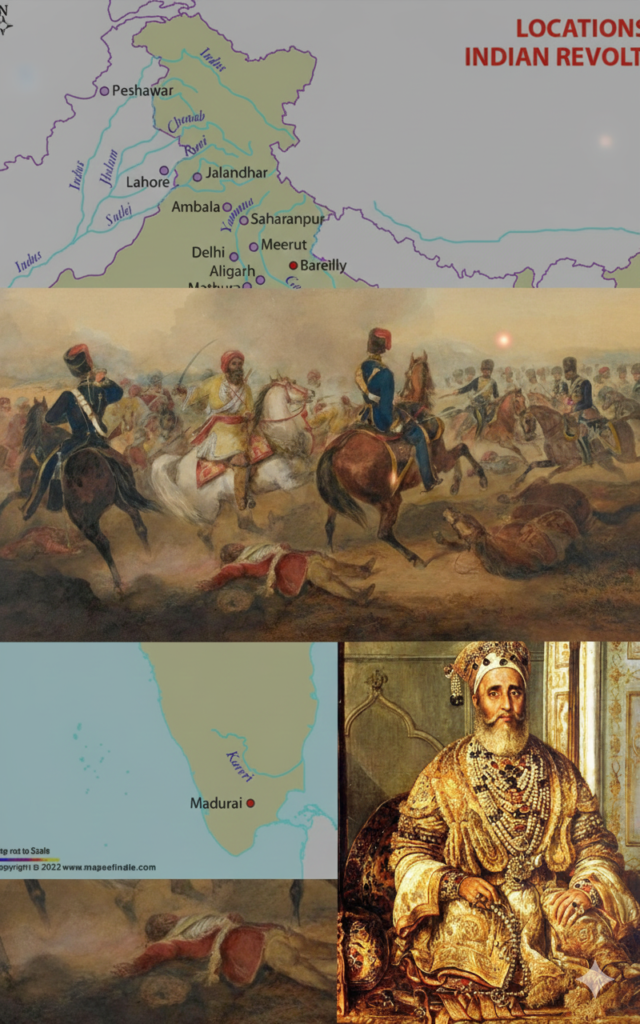
Main Reasons for the Revolt of 1857
Main Causes of the Revolt of 1857
- Political causes and British expansionist policies.
- Economic exploitation of farmers, artisans, and traders.
- Social and religious fears among Indian communities.
- Discrimination against Indian soldiers in the British Army.
- The Enfield rifle cartridge controversy as the immediate trigger.
The Revolt of 1857 was not a sudden or isolated event. It was the outcome of multiple political, economic, social, religious, and military factors that created widespread dissatisfaction across India. These grievances affected Indian rulers, soldiers, farmers, artisans, merchants, and different sections of society. Let us understand the major causes of the revolt in detail.
1. Political Reasons
The expansionist policies and administrative practices of the British East India Company created deep resentment among Indian rulers, princes, and nawabs.
Doctrine of Lapse
- Lord Dalhousie extensively applied the Doctrine of Lapse, under which princely states could be annexed if their rulers died without a natural male heir accepted by the British.
- States such as Satara, Jhansi, and Nagpur were annexed under this policy.
- The annexation of Jhansi deeply angered Rani Lakshmibai, who resisted British authority.
Annexation of Awadh
- Awadh was annexed by the British in 1856 on the grounds of alleged misgovernment.
- The annexation angered the Nawab's supporters, landlords, soldiers, and sections of the local population.
- Awadh's annexation became an important source of discontent before the revolt.
Insult and Humiliation of Indian Rulers
- The prestige and authority of several traditional Indian rulers were weakened under British political control.
- Bahadur Shah Zafar faced restrictions concerning his position and the future of the Mughal dynasty.
- The British interference in the affairs of Indian princely states created widespread dissatisfaction among ruling families.
2. Economic Reasons
British economic and revenue policies affected Indian farmers, artisans, traders, and traditional industries. These changes contributed to economic hardship and resentment against Company rule.
Exploitation of Farmers
- Heavy land revenue demands placed considerable pressure on farmers.
- Inability to pay revenue could result in the loss of land or other property under certain revenue arrangements.
- Many cultivators became dependent on moneylenders and faced increasing debt.
- Economic hardship and rural distress contributed to dissatisfaction with British administration.
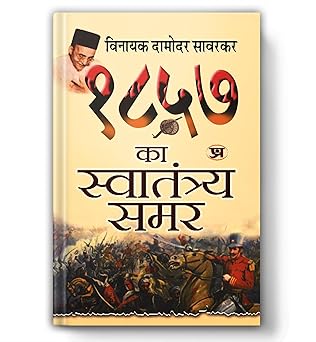
Recommended history Study Resource
Explore this study resource on Amazon for additional reading and learning about Indian history.
Affiliate Disclosure: This article contains an affiliate link. We may earn a commission if you purchase through this link, at no additional cost to you.
Decline of Artisans and Handicraft Industries
- Traditional Indian handicraft industries faced serious challenges under colonial economic policies.
- Many Indian weavers and artisans lost their livelihoods due to changing market conditions and competition from machine-made British goods.
- Textile, metal, and other traditional industries experienced significant difficulties in several regions.
British trade policies
- British trade policies increasingly favoured the import and sale of British manufactured products in Indian markets.
- Traditional Indian producers faced disadvantages in the colonial trading system.
- These developments weakened the economic position of many Indian merchants and artisans.
4. Military Reasons: Discontent Among Indian Soldiers
Discriminatory policies and unequal treatment within the British Indian Army created deep resentment among Indian soldiers, commonly known as sepoys.
Discrimination and Injustice
- Indian soldiers faced discrimination in pay, allowances, and service conditions.
- They had limited opportunities for promotion to higher ranks.
- Many sepoys were dissatisfied with certain military regulations and service requirements.
- Religious and cultural concerns were also affected by some military practices and orders.
The Greased Cartridges Issue
- A rumour spread that the cartridges used in the new Enfield rifle were greased with cow and pig fat.
- Cows held religious significance for Hindus, while pigs were forbidden in Islam.
- Soldiers had to bite open the cartridges before loading the rifle, which caused serious religious concerns.
- The controversy intensified the existing anger among Indian soldiers and became the immediate trigger for the uprising.
5. Immediate Cause of the Revolt of 1857
The Enfield rifle cartridge controversy became the immediate cause of the uprising. Events at Barrackpore and Meerut played an important role in turning military discontent into an open rebellion.
- 29 March 1857: Mangal Pandey attacked British officers at Barrackpore. He was arrested and subsequently executed on 8 April 1857.
- 9 May 1857: Indian soldiers at Meerut who had refused to use the cartridges were punished and imprisoned.
- 10 May 1857: Soldiers at Meerut revolted, released their imprisoned comrades, and marched towards Delhi.
The events of 10 May 1857 at Meerut are generally regarded as the beginning of the widespread Revolt of 1857.
Conclusion
The Revolt of 1857 was the result of accumulated political, economic, social, religious, and military grievances against British rule. Its causes affected different sections of Indian society, including rulers, soldiers, farmers, merchants, and artisans. The Enfield rifle cartridge controversy acted as the immediate trigger, but the roots of the uprising went much deeper. Although the revolt failed to overthrow British authority, it became a major turning point in Indian history and left a lasting legacy of resistance. The courage and sacrifices of its participants inspired later generations in India's long struggle for independence.
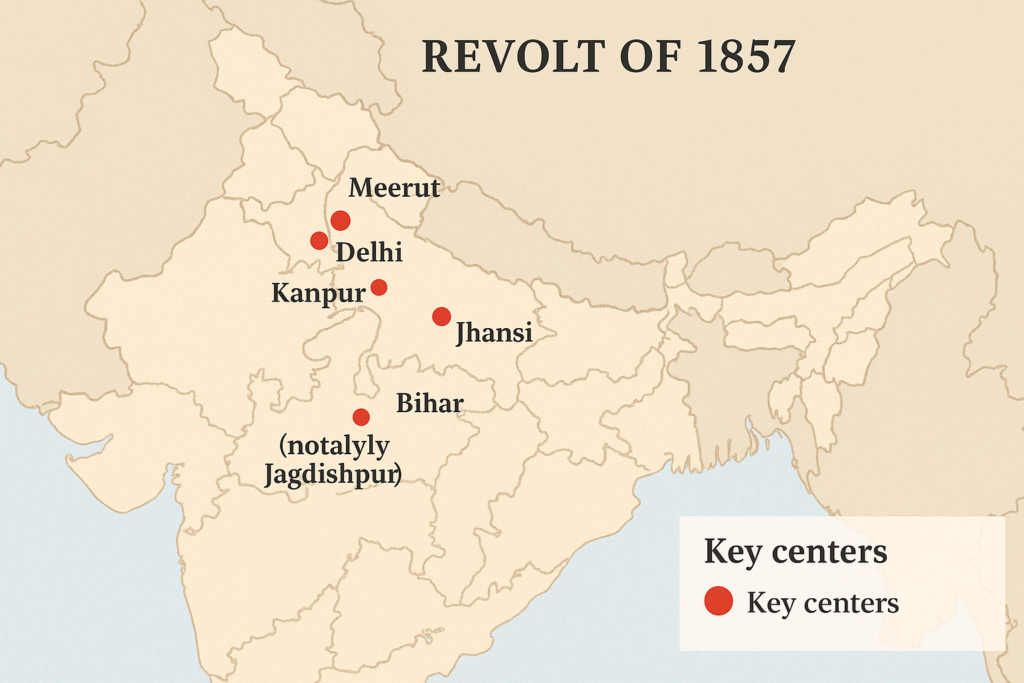
Major Events of the Revolt of 1857
Major Events – Quick Summary
- 10 May 1857: Revolt began at Meerut.
- 11 May 1857: Rebels reached Delhi and declared Bahadur Shah Zafar their symbolic leader.
- June 1857: Major uprisings took place at Kanpur, Lucknow, and other centres.
- 1857–1858: Rani Lakshmibai, Kunwar Singh, and other leaders resisted British forces.
- June 1858: The British recaptured Gwalior, marking the defeat of a major rebel stronghold.
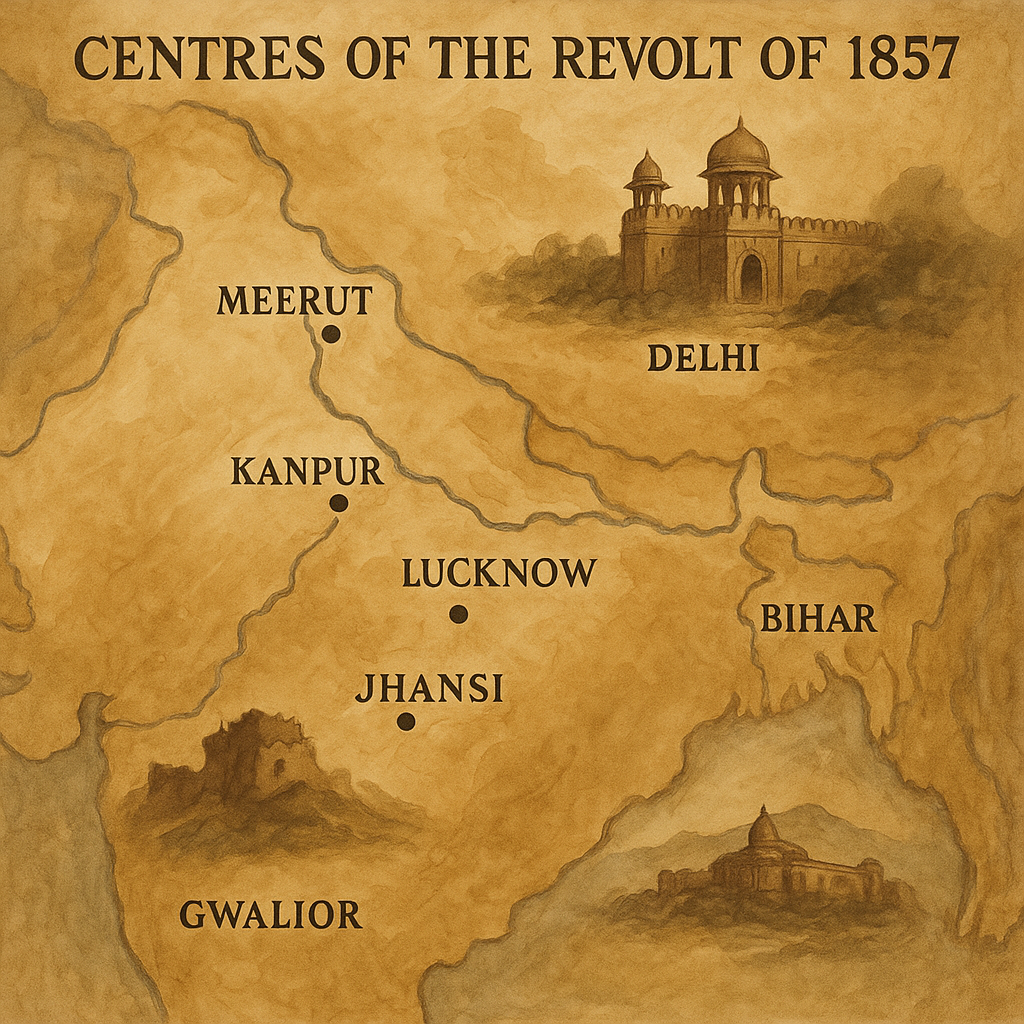
The Revolt of 1857 spread across several parts of northern and central India. It was led by different leaders in different regions and involved soldiers, rulers, landlords, peasants, and other sections of society. Beginning at Meerut, the uprising extended to major centres such as Delhi, Kanpur, Jhansi, Lucknow, Bihar, and Gwalior. The following is a chronological account of its important events.
1. The Rebellion Begins at Meerut (10 May 1857)
- Date: 10 May 1857.
- Event: Indian soldiers at Meerut revolted against British authority following growing military discontent and the Enfield rifle cartridge controversy.
- Background: On 9 May 1857, soldiers who had refused to use the controversial cartridges were sentenced and imprisoned.
- The rebel soldiers released their imprisoned comrades and attacked British officers and establishments.
- They subsequently marched towards Delhi, spreading the uprising to another major centre.
Mangal Pandey's earlier action at Barrackpore on 29 March 1857 was an important preceding event, but the widespread revolt is generally considered to have begun at Meerut on 10 May 1857.
2. Rebels Reach Delhi (11 May 1857)
- Rebel soldiers from Meerut reached Delhi on 11 May 1857.
- They proclaimed the Mughal emperor Bahadur Shah Zafar as their symbolic leader.
- Delhi became one of the principal political and military centres of the uprising.
- Bakht Khan later emerged as an important military leader among the rebels in Delhi.
- British forces recaptured Delhi in September 1857 after a prolonged military campaign.
3. Revolt at Kanpur (June–July 1857)
- Prominent Leaders: Nana Saheb, Tatya Tope, and Azimullah Khan.
- Nana Saheb led the uprising against British authority at Kanpur and declared himself Peshwa.
- Kanpur became an important centre of the rebellion in June 1857.
- The Sati Chaura Ghat incident occurred during the evacuation of British people from Kanpur and resulted in the deaths of many British men, women, and children.
- British forces subsequently recaptured Kanpur in July 1857, followed by severe reprisals against the rebels and local population.
4. Revolt and Resistance at Jhansi (1857–1858)
- Prominent Leader: Rani Lakshmibai.
- Rani Lakshmibai became a leading figure in the resistance against British rule following the annexation of Jhansi under the Doctrine of Lapse.
- British forces under Sir Hugh Rose besieged Jhansi in March 1858 and captured the city in April 1858.
- Rani Lakshmibai escaped from Jhansi and continued her resistance.
- She later joined forces with Tatya Tope and other rebels in the Gwalior region.
- Rani Lakshmibai died fighting near Gwalior on 18 June 1858.

Recommended history Study Resource
Explore this study resource on Amazon for additional reading about the Revolt of 1857 and Indian history.
Affiliate Disclosure: This article contains an affiliate link. We may earn a commission if you purchase through this link, at no additional cost to you.
5. Revolt at Lucknow (June 1857 – March 1858)
- Prominent Leaders: Begum Hazrat Mahal and her son Birjis Qadr.
- After the annexation of Awadh in 1856 and the removal of Nawab Wajid Ali Shah, Lucknow became a major centre of resistance.
- Rebel forces surrounded the British Residency, where British officials, soldiers, and civilians had taken refuge.
- Begum Hazrat Mahal played an important role in organizing resistance against British authority.
- British forces eventually recaptured Lucknow in March 1858.
6. Kunwar Singh's Rebellion in Bihar (1857–1858)
- Prominent Leader: Kunwar Singh, the zamindar of Jagdishpur in Bihar.
- Despite being around 80 years old, Kunwar Singh led armed resistance against the British.
- He organized rebel forces in Bihar and fought several engagements against British troops.
- During the campaign, he sustained a serious injury but continued to lead the resistance.
- He returned to Jagdishpur in April 1858 and defeated British forces there.
- Kunwar Singh died on 26 April 1858, shortly after his victory at Jagdishpur.
7. Battle for Gwalior (June 1858)
- Rani Lakshmibai, Tatya Tope, and other rebel leaders played important roles in the campaign around Gwalior.
- Rebel forces captured Gwalior in June 1858 after the Scindia ruler's forces failed to stop their advance.
- The British launched a military campaign to recover the city and its strategic fort.
- Rani Lakshmibai died fighting near Gwalior on 18 June 1858.
- British forces recaptured Gwalior later in June 1858, marking the defeat of one of the last major rebel strongholds.
- Tatya Tope continued resistance through guerrilla warfare before his capture and execution in 1859.
End of the Revolt (1858–1859)
- September 1857: British forces recaptured Delhi.
- March 1858: British forces regained control of Lucknow.
- June 1858: Gwalior was recaptured by the British, bringing the major phase of organized resistance to an end in central India.
- 1859: Tatya Tope was captured, tried, and executed on 18 April 1859.
- Government of India Act, 1858: The British government ended the East India Company's rule and transferred the administration of India directly to the British Crown.
Although the major centres of the revolt were suppressed by 1858, resistance and military operations continued in some areas into 1859.
Important Points About the Revolt of 1857
- Beginning: Meerut, 10 May 1857.
- Delhi: Bahadur Shah Zafar was proclaimed the symbolic leader of the revolt.
- Kanpur: Nana Saheb and Tatya Tope.
- Jhansi: Rani Lakshmibai.
- Lucknow: Begum Hazrat Mahal.
- Bihar: Kunwar Singh.
- Major phase of suppression: 1857–1858, with resistance continuing in some areas into 1859.
- Nature of the revolt: The uprising was not limited to soldiers; rulers, landlords, peasants, artisans, and other sections of society also participated in different regions.
Conclusion
The Revolt of 1857 was one of the most significant uprisings against British rule in India. Beginning at Meerut, it spread to several important centres, including Delhi, Kanpur, Jhansi, Lucknow, Bihar, and Gwalior. Although the British eventually suppressed the rebellion, the courage and sacrifice of its leaders became an enduring part of India's freedom struggle. The uprising also led to the end of East India Company rule and the beginning of direct British Crown administration in 1858. Its legacy continued to inspire later generations in the movement for independence.
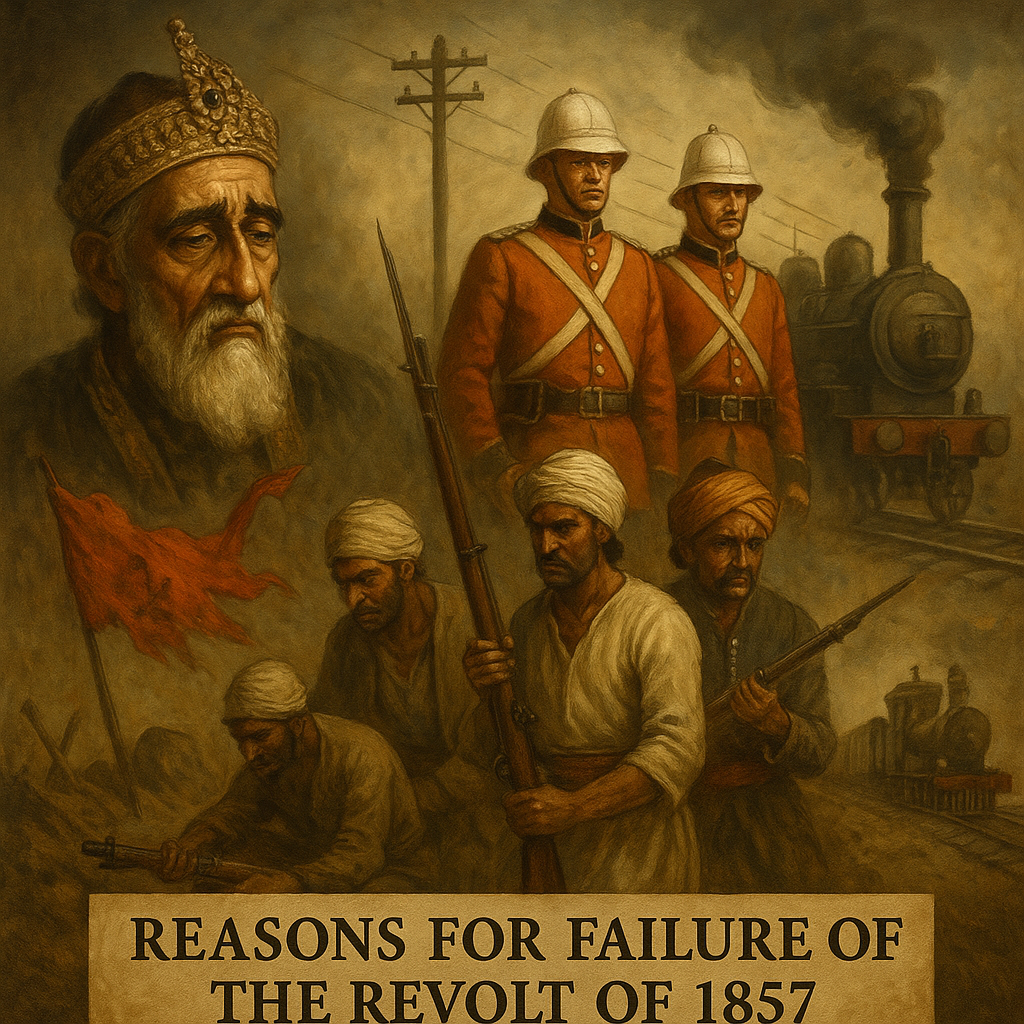
Reasons for the Failure of the Revolt of 1857
Main Reasons for the Failure of the Revolt of 1857
- Lack of unified leadership and central command.
- Weak coordination and organization among rebel groups.
- Limited military resources and logistical support.
- British military superiority and strategic advantages.
- Limited geographical spread of the uprising.
- Support or neutrality of several Indian rulers and groups towards the British.
- Effective British communication, diplomacy, and military reinforcements.
- Harsh British suppression of the rebellion.
The Revolt of 1857, also known as the First War of Independence or the Indian Rebellion of 1857, was a major uprising against the rule of the British East India Company. Although it seriously challenged British authority in several regions, it ultimately failed due to various political, military, organizational, and strategic factors. The major reasons for its failure are explained below.
1. Lack of Unified Leadership
- The rebels did not have a strong central leadership or a unified national command.
- Bahadur Shah Zafar was accepted as a symbolic leader, but he lacked the resources and authority to coordinate all rebel forces effectively.
- Leaders such as Rani Lakshmibai, Nana Saheb, Tatya Tope, and Begum Hazrat Mahal operated mainly in their respective regions.
- Different rebel groups often pursued their own political and military objectives.
- In contrast, the British benefited from an established administrative and military command structure under senior officers and officials such as Lord Canning and Sir Colin Campbell.
2. Lack of Organization and Coordination
- The revolt lacked a coordinated plan for a nationwide campaign.
- Different rebel centres operated independently, making joint military action difficult.
- Regional, political, and social differences sometimes limited cooperation among rebel groups.
- Although Hindu and Muslim soldiers and leaders participated together in several centres, this cooperation did not develop into a unified command across all regions.
- Several important parts of India did not experience a comparable large-scale uprising, limiting the overall reach of the rebellion.
3. Military Weakness of the Rebels
- The rebel forces lacked a consistently organized military structure and unified command.
- They faced shortages of modern weapons, ammunition, artillery, and other military supplies.
- The British had better access to military reinforcements, trained troops, artillery, and logistical support.
- Several groups, including Sikh and Gurkha soldiers, served with British forces, although the participation and loyalties of different communities varied by region.
- The rebels also faced difficulties in maintaining discipline and coordinating military operations over large distances.

Recommended history Study Resource
Explore this study resource on Amazon for additional reading about the Revolt of 1857 and modern Indian history.
Affiliate Disclosure: This article contains an affiliate link. We may earn a commission if you purchase through this link, at no additional cost to you.
4. British Diplomacy and Support from Indian Rulers
- The British used diplomatic alliances and political negotiations to maintain the support of several Indian rulers and influential groups.
- Some princely states supported the British, while others remained neutral.
- The Scindia ruler of Gwalior, Jayajirao Scindia, remained aligned with the British, although many of his troops joined the rebels.
- The Nizam of Hyderabad also remained loyal to the British during the uprising.
- This support and neutrality prevented the rebels from receiving wider political and military assistance.
5. Limited Geographical Spread
- The revolt was concentrated mainly in northern and central India.
- Several regions, including much of southern India, remained largely outside the main uprising.
- Punjab became an important base for British military operations and recruitment during the revolt.
- The absence of a simultaneous large-scale uprising across the entire subcontinent limited the rebels' ability to challenge British authority everywhere.
6. Mixed Support from Different Sections of Society
- The revolt did not receive equal support from every region or section of Indian society.
- Some landlords, merchants, and influential groups supported the British or avoided joining the rebellion to protect their interests.
- Several Indian soldiers, including Sikh and Gurkha troops, served in British forces.
- Peasant participation and local support varied considerably from one region to another.
- The rebels could not build a common political programme that united all Indian groups behind a single objective.
7. Lack of Communication and Resources
- The rebel groups lacked an effective and reliable communication network.
- Coordination between different centres of the revolt was difficult because of distance and limited communication facilities.
- The British used existing telegraph lines to transmit information and coordinate military responses.
- Railways, where available, helped the British move troops and supplies more efficiently.
- The rebels faced shortages of money, food, ammunition, transport, and long-term logistical support.
8. Harsh British Repression
- The British used extensive military force to suppress the uprising.
- Rebels and suspected supporters faced executions, imprisonment, confiscation of property, and other severe punishments.
- In several places, British reprisals involved widespread violence against civilians.
- Such repression weakened rebel networks and made continued resistance increasingly difficult.
Conclusion
The Revolt of 1857 failed due to a combination of weak coordination, lack of unified leadership, limited military resources, restricted geographical spread, and the political and military advantages enjoyed by the British. Although the uprising did not overthrow colonial rule, it had far-reaching consequences. The Government of India Act of 1858 ended the rule of the East India Company and transferred the administration of India directly to the British Crown. The revolt also became an enduring symbol of resistance and sacrifice, inspiring later generations in India's long struggle for independence.
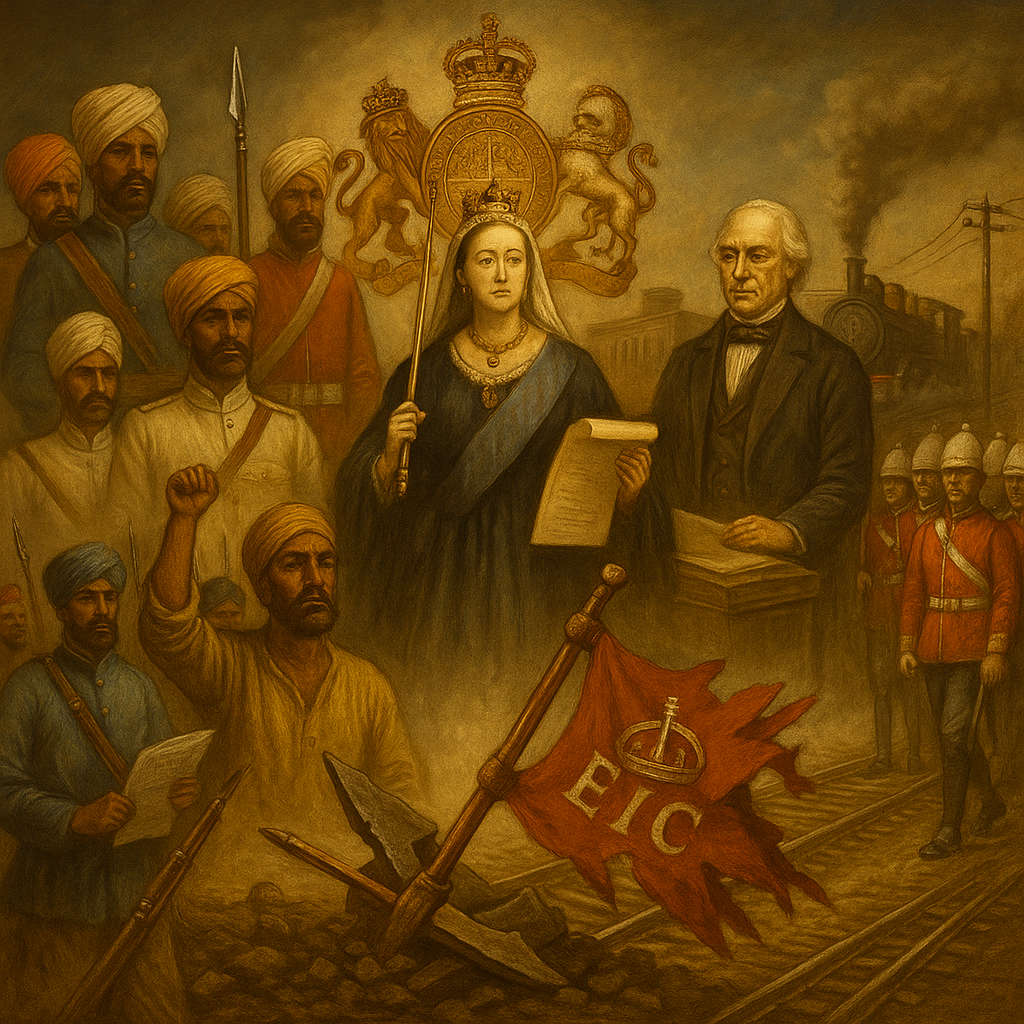
3. Social and Religious Reasons
Certain British social and religious policies created suspicion and fear among sections of Indian society. Many people believed that colonial authorities were interfering in their established customs and religious traditions.
Opposition to Social Reforms
Fear of Religious Interference