
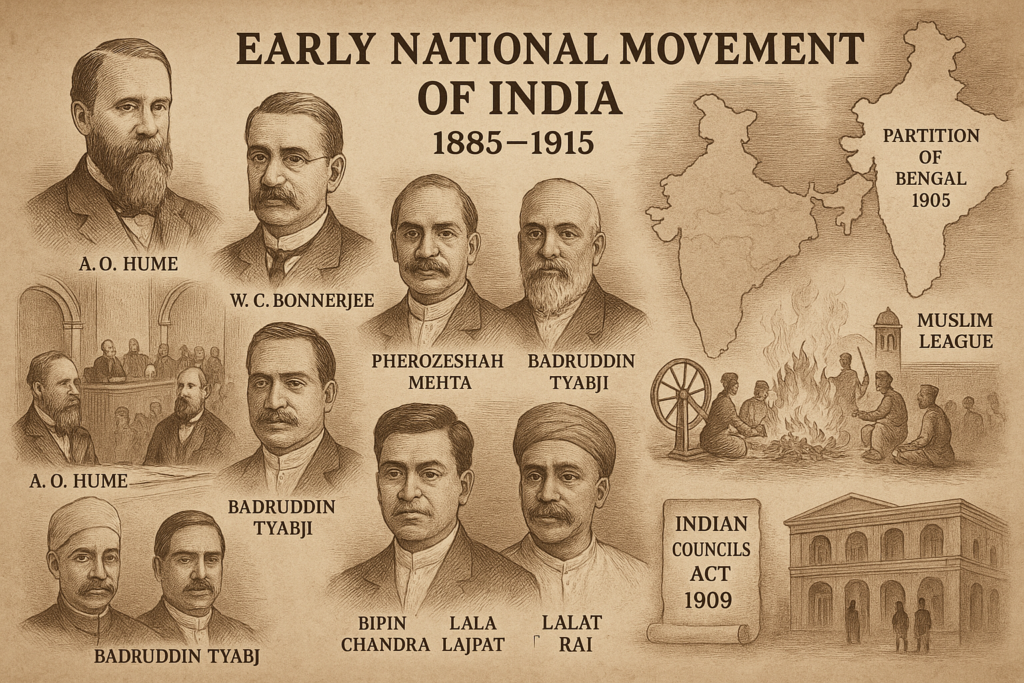
Early National Movement of India (1885–1915)
The Indian National Movement was one of the most important struggles in modern world history and ultimately led to India's independence in 1947. The period from the formation of the Indian National Congress in 1885 to the emergence of revolutionary activities and the Ghadar Movement witnessed the growth of political awareness, economic nationalism, and organized resistance against British colonial rule. This article examines the major leaders, organizations, movements, constitutional reforms, and important developments of the Early National Movement (1885–1915).
1. Establishment of the Indian National Congress (1885)
The Indian National Congress (INC) was founded on 28 December 1885 through the efforts of Allan Octavian Hume, a retired British civil servant, along with several Indian political leaders. Its first session was held in Bombay (now Mumbai) and was presided over by Womesh Chandra Bonnerjee. The Congress initially focused on promoting political awareness, increasing Indian participation in administration, and demanding constitutional reforms.
2. Moderate Phase (1885–1905)
The early phase of the Indian National Congress is known as the Moderate Phase. Moderate leaders believed in constitutional and peaceful methods, including petitions, resolutions, public meetings, and appeals to the British government, to achieve political and administrative reforms.
Prominent Moderate Leaders
- Dadabhai Naoroji
- Gopal Krishna Gokhale
- Surendranath Banerjee
- Pherozeshah Mehta
- Badruddin Tyabji
Key Features of the Moderate Phase
- Demand for constitutional and administrative reforms.
- Demand for greater Indian representation in legislative councils and government services.
- Protection of civil rights, freedom of the press, and freedom of expression.
- Dadabhai Naoroji's Drain Theory, which explained the economic drain of Indian wealth under British rule.
- Criticism of discriminatory economic policies and excessive military expenditure.
- Demand for reforms in the Indian Councils Act and greater participation of Indians in governance.
The Indian Councils Act of 1892 introduced limited indirect representation and expanded the functions of legislative councils, although it did not establish responsible government.
3. Partition of Bengal and Swadeshi Movement (1905–1911)
On 16 October 1905, the British government under Lord Curzon implemented the Partition of Bengal. The government justified the decision on administrative grounds, but many Indian nationalists viewed it as an attempt to weaken the growing nationalist movement by dividing Bengal along communal and regional lines. The decision triggered widespread protests and gave rise to the Swadeshi and Boycott movements.
Main Features of the Swadeshi Movement
- Boycott of British-made goods, particularly foreign cloth.
- Promotion of indigenous industries, products, and enterprises.
- Encouragement of national education and indigenous educational institutions.
- Public meetings, processions, and patriotic campaigns.
- Expansion of economic nationalism and political participation.
The Swadeshi Movement became an important turning point in India's freedom struggle. The partition of Bengal was annulled in 1911, although Bengal's administrative boundaries were reorganized.
4. Rise of Extremists and Surat Split (1907)
During the early twentieth century, differences developed within the Congress between the Moderates and the Extremists. Extremist leaders advocated stronger political action, mass mobilization, Swadeshi, and Boycott as methods of opposing British rule. These differences resulted in the Surat Split at the Congress session in 1907.
Prominent Extremist Leaders
- Bal Gangadhar Tilak
- Bipin Chandra Pal
- Lala Lajpat Rai

Recommended Study Resource
Explore this study resource for additional reading and preparation related to modern Indian history.
Affiliate Disclosure: This article contains an affiliate link. We may earn a commission if you purchase through this link, at no additional cost to you.
5. Establishment of the All-India Muslim League (1906)
The All-India Muslim League was established on 30 December 1906 in Dhaka. Nawab Salimullah of Dhaka played an important role in promoting its formation, along with other prominent Muslim leaders, including Aga Khan and Nawab Viqar-ul-Mulk. The organization initially sought to protect the political rights and interests of Muslims and to represent their demands before the British government.
6. Morley-Minto Reforms (1909)
The Indian Councils Act of 1909, commonly known as the Morley-Minto Reforms, expanded the legislative councils at the central and provincial levels. One of its most significant provisions was the introduction of separate electorates for Muslims, allowing Muslim voters to elect representatives from designated Muslim constituencies. This development institutionalized separate communal representation within the colonial legislative system.
7. Ghadar Movement (1913–1915)
The Ghadar Movement emerged among Indian expatriates, particularly in North America, who sought to overthrow British colonial rule through armed revolution. The Ghadar Party was formally established in 1913 in the United States, with its activities centered in San Francisco. Lala Har Dayal, Sohan Singh Bhakna, and other revolutionary activists played important roles in the movement. Kartar Singh Sarabha later became one of its prominent young revolutionaries.
The movement published the newspaper Ghadar and encouraged Indians, particularly soldiers in the British Indian Army, to participate in an uprising. During the First World War, revolutionaries attempted to organize an armed revolt in India in 1915, but the plans were disrupted by British intelligence and arrests.
8. Characteristics of the Early National Movement
- Development of political awareness and organized nationalism.
- Growth of constitutional demands and peaceful political methods during the Moderate Phase.
- Emergence of assertive nationalism and stronger methods of protest.
- Promotion of Swadeshi, Boycott, indigenous industries, and national education.
- Formation of political organizations representing different interests.
- Growing revolutionary activities and attempts to challenge British colonial rule.
- Increasing public participation in political movements.
Conclusion
The period from 1885 to 1915 laid the political and organizational foundation for India's freedom struggle. The formation of the Indian National Congress, the Moderate and Extremist phases, the Swadeshi Movement, constitutional reforms, and revolutionary activities strengthened Indian nationalism. With Mahatma Gandhi's return to India from South Africa in 1915, the national movement gradually entered a new phase of wider mass mobilization. This later developed into major movements such as the Non-Cooperation Movement and the Civil Disobedience Movement.
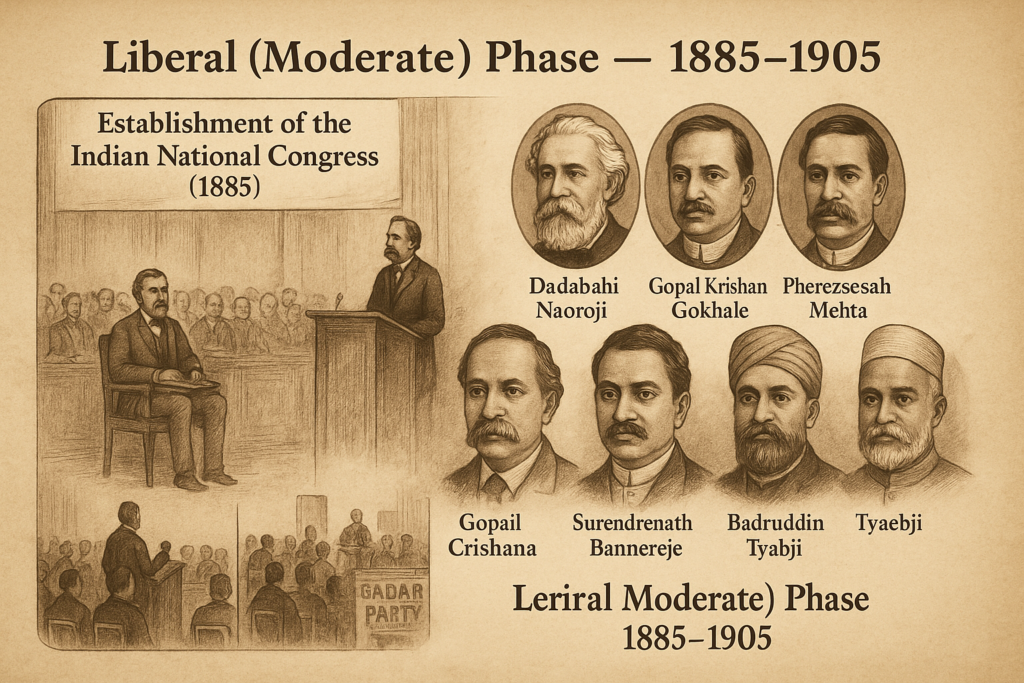
Establishment of the Indian National Congress (1885)
The Indian National Congress (INC) was established on 28 December 1885 through the efforts of Allan Octavian Hume (A.O. Hume), a retired British civil servant, and several prominent Indian political leaders. Its formation marked an important milestone in the development of organized political nationalism in India. The organization provided a common platform for Indians to discuss political issues, express their demands, and seek greater participation in administration under British colonial rule.
Main Objectives of the Establishment
- To establish a common political platform for Indians from different regions.
- To promote political awareness and national consciousness among Indians.
- To encourage dialogue between Indian political leaders and the British government.
- To demand constitutional reforms and greater Indian participation in administration.
- To promote national unity beyond regional, caste, religious, and linguistic differences.
- To develop an organized national movement for the protection of Indian political and economic interests.
Founders and Key Personalities
- A.O. Hume – Retired British civil servant who played a central role in organizing the first Congress session.
- Dadabhai Naoroji – Prominent early nationalist leader who developed the Drain Theory.
- Surendranath Banerjee – Bengali nationalist leader who contributed to the growth of political awareness.
- Pherozeshah Mehta – Influential political leader from Bombay and supporter of constitutional reforms.
- Womesh Chandra Bonnerjee – President of the first session of the Indian National Congress.
- Badruddin Tyabji – Important early Congress leader who later became its first Muslim president in 1887.
- Gopal Krishna Gokhale – Prominent Moderate leader who later became an important advocate of constitutional and administrative reforms.
First Session of the Congress (1885)
- The first session was held from 28 to 31 December 1885 in Bombay (now Mumbai).
- It was presided over by Womesh Chandra Bonnerjee (W.C. Bonnerjee).
- A total of 72 delegates from different parts of India participated.
- The session discussed political, administrative, and economic issues affecting Indians.
- It provided an organized platform for the discussion of common national demands.
British Government's Response
The British administration initially viewed the Indian National Congress with varying degrees of caution and interest. Some colonial officials considered it a limited forum for expressing educated Indian opinion. However, as Congress increasingly criticized colonial policies and demanded political reforms, official attitudes became more hostile.
The idea that A.O. Hume created the Congress as a deliberate political safety valve is commonly known as the Safety Valve Theory. However, historians have debated this interpretation, and it should not be treated as the sole or universally accepted explanation for the establishment of the Congress.
Significance and Impact of the Congress
- It encouraged the growth of organized political consciousness among Indians.
- It provided an important all-India platform for political discussion and coordination.
- It helped develop a common language of constitutional demands and political rights.
- It promoted cooperation among political leaders from different regions.
- It laid the organizational foundation for later phases of the Indian National Movement.
- It subsequently played a major role in the opposition to the Partition of Bengal and the Swadeshi Movement.
Liberal Phase (1885–1905)
The early phase of the Indian National Movement, from 1885 to 1905, is commonly known as the Liberal or Moderate Phase. During this period, Congress leaders relied mainly on peaceful and constitutional methods to demand political, administrative, and economic reforms from the British government. These leaders came to be known as Moderates.
1. Characteristics of the Liberal Phase
- Constitutional and peaceful methods: Moderates used petitions, resolutions, public meetings, speeches, and appeals to express their demands.
- Faith in constitutional reform: Many leaders initially believed that British public opinion and parliamentary institutions could be persuaded to support reforms in India.
- Demand for political representation: They sought greater Indian participation in legislative councils and government administration.
- Development of nationalism: They promoted political unity and a common national identity among Indians.
- Economic criticism: They examined the economic impact of British colonial policies, including the drain of Indian wealth.
- Emphasis on civil rights: They demanded freedom of the press, freedom of expression, and equality before the law.
2. Prominent Liberal Leaders
- Dadabhai Naoroji: Developed the Drain Theory and explained how British colonial policies transferred Indian wealth to Britain.
- Gopal Krishna Gokhale: Advocated constitutional reforms, education, and responsible administration.
- Surendranath Banerjee: Promoted political awareness, civil rights, and national unity.
- Pherozeshah Mehta: Supported constitutional reforms and greater Indian representation in legislative institutions.
- Badruddin Tyabji: Promoted political cooperation and Hindu-Muslim unity.
3. Major Demands and Struggles
(i) Political Reforms
- Greater participation of Indians in the administration.
- Appointment of qualified Indians to higher government positions.
- Expansion of legislative councils and greater Indian representation.
- Introduction of reforms to make government administration more accountable.
- Reduction of excessive military expenditure and administrative costs.
(ii) Economic Reforms
- Reduction of the economic drain from India to Britain.
- Promotion of Indian industries and indigenous economic development.
- Reduction of excessive taxation and the financial burden on farmers.
- Reform of land revenue policies and protection of Indian economic interests.
- Reduction of discriminatory economic policies affecting Indian businesses.
(iii) Social and Civil Reforms
- Expansion of modern and higher education.
- Protection of freedom of the press and expression.
- Greater equality in public employment and administration.
- Promotion of social awareness and national unity.
- Opposition to discriminatory practices and restrictions on civil liberties.
4. Major Events During the Liberal Phase (1885–1905)
(i) Indian Councils Act of 1892
The Indian Councils Act of 1892 was an important constitutional development during the Moderate Phase. It expanded the membership of central and provincial legislative councils and allowed members to discuss the annual financial statement and ask questions, subject to restrictions.
- Increased the number of additional members in legislative councils.
- Introduced a limited system of indirect representation through recommendations by certain bodies.
- Allowed members to discuss the annual budget, although they could not vote on it.
- Permitted members to ask questions under specified conditions.
- Did not establish responsible government or full legislative control for Indians.
(ii) Drain Theory of Dadabhai Naoroji
Dadabhai Naoroji developed and popularized the Drain Theory, which explained how a significant portion of India's wealth was transferred to Britain through colonial administration, salaries and pensions of British officials, military expenditure, and other financial arrangements. His arguments were presented in his writings and were systematically discussed in his influential book Poverty and Un-British Rule in India, published in 1901.
The Drain Theory became an important part of Indian economic nationalism because it challenged the claim that British rule was economically beneficial to India.
(iii) Partition of Bengal (1905) and the Swadeshi Movement
The Partition of Bengal was implemented by Lord Curzon on 16 October 1905. The British government justified the decision on administrative grounds, but Indian nationalists strongly opposed it and viewed it as an attempt to weaken political unity in Bengal.
- Widespread protests were organized against the partition.
- The Swadeshi Movement encouraged the use of Indian-made goods.
- The Boycott Movement promoted the rejection of British-made products.
- National education and indigenous industries received greater attention.
- Differences between Moderates and Extremists within the Congress became more pronounced.
The partition was annulled in 1911, although the administrative boundaries of Bengal were reorganized.
5. Limitations of the Liberal Phase
- Limited mass participation: The movement largely depended on educated and politically active sections of society.
- Dependence on petitions: Its methods relied heavily on constitutional appeals and resolutions.
- Limited political achievements: The British government accepted only a small number of the demands raised by Congress leaders.
- Faith in British justice: Many Moderates initially placed considerable hope in the fairness of British institutions.
- Organizational limitations: The Congress had not yet developed the nationwide mass organization that emerged in later decades.
6. Conclusion
The Liberal Phase (1885–1905) was an essential stage in the development of the Indian National Movement. Moderate leaders created an organized political platform, promoted national consciousness, exposed the economic consequences of colonial rule, and demanded constitutional reforms. Although their methods and achievements were limited, they laid the intellectual and organizational foundation for later nationalist struggles. Growing dissatisfaction with the slow pace of reforms contributed to the rise of Extremist politics in the early twentieth century, while the arrival of Mahatma Gandhi in India in 1915 eventually opened another important phase in the freedom struggle.
Recommended Study Resource
Explore this study resource for additional reading and preparation related to modern Indian history.
Affiliate Disclosure: This article contains an affiliate link. We may earn a commission if you purchase through this link, at no additional cost to you.
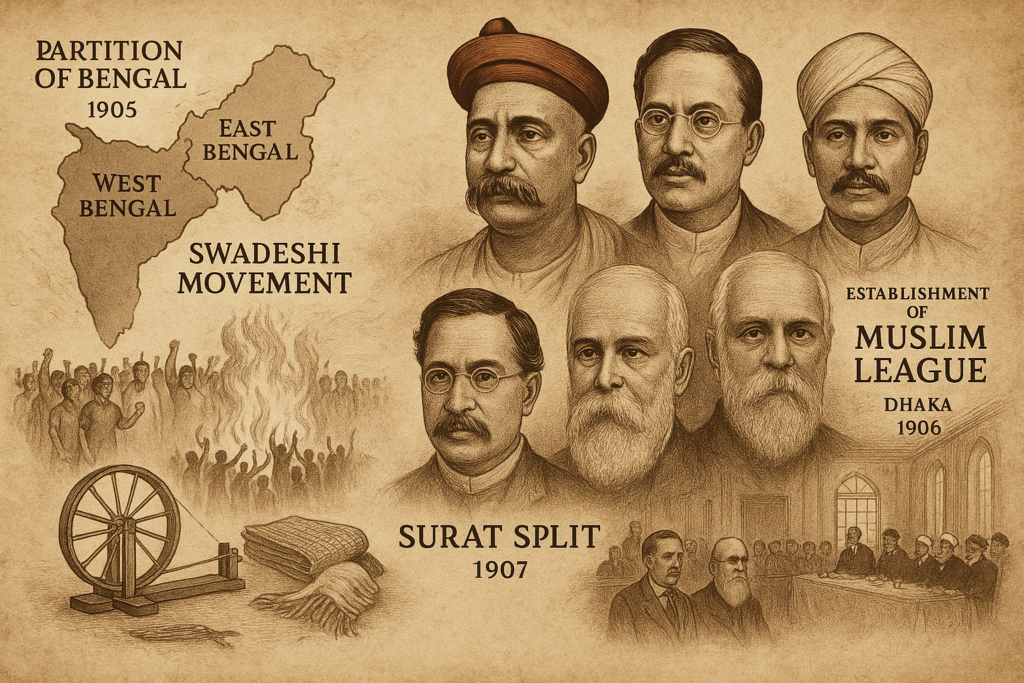
Partition of Bengal (1905) and Swadeshi Movement (1905–1911)
The Partition of Bengal, implemented on 16 October 1905, and the Swadeshi Movement that followed became important milestones in India's freedom struggle. The decision, taken under Lord Curzon, generated widespread opposition and encouraged Indians to adopt indigenous goods, boycott British products, and participate in organized political protests. The movement also strengthened economic nationalism and expanded political participation beyond the traditional leadership of the Indian National Congress.
1. Partition of Bengal (16 October 1905)
(i) Reasons for the Partition of Bengal
- Bengal was one of the largest and most politically significant provinces of British India.
- The British government officially justified the partition on administrative grounds, arguing that the province was too large to be governed efficiently.
- However, Indian nationalists believed that the partition was also intended to weaken growing political nationalism in Bengal.
- The division created separate administrative units with different religious and regional population compositions.
- Lord Curzon, Viceroy of India from 1899 to 1905, implemented the partition.
(ii) Partition Plan
- Eastern Bengal and Assam: A new province with Dacca (now Dhaka) as its capital, containing a Muslim-majority population.
- Western Bengal: The remaining Bengal region, with a Hindu-majority population in important areas, remained under a separate administration. Bihar and Orissa were also part of the reorganized administrative structure.
- The division was strongly opposed by Bengali nationalists, who considered it harmful to regional identity and political unity.
2. Opposition to the Bengal Partition
(i) Reaction of Indians
- The partition was widely criticized as an attack on Bengal's cultural and political unity.
- Public meetings, demonstrations, strikes, and protest campaigns were organized.
- 16 October 1905 was observed as a day of mourning by opponents of the partition.
- Rabindranath Tagore encouraged the Raksha Bandhan observance to symbolize unity and solidarity among communities.
- Political opposition gradually expanded beyond Bengal and influenced nationalist activities in other parts of India.
3. Swadeshi Movement (1905–1911)
(i) Beginning of the Swadeshi Movement
The Swadeshi Movement emerged as a major response to the Partition of Bengal in 1905. The term Swadeshi refers to the use and promotion of goods produced within one's own country. The movement encouraged Indians to boycott foreign products, promote indigenous industries, and develop economic self-reliance.
(ii) Major Activities of the Swadeshi Movement
- Boycott of foreign goods: British-made cloth and other imported products were boycotted through public campaigns.
- Promotion of indigenous products: Indian-made goods, particularly textiles, were encouraged.
- National education: Indian educational institutions and alternative systems of education were promoted.
- Indigenous industries: Indian enterprises, manufacturing, and commercial initiatives received encouragement.
- Public participation: Students, women, traders, professionals, and sections of the wider population participated in the movement.
- Public demonstrations: Meetings, processions, bonfires of foreign cloth, and patriotic activities became important methods of protest.
(iii) Prominent Leaders of the Swadeshi Movement
- Bal Gangadhar Tilak: Supported Swadeshi and boycott campaigns and helped extend nationalist activities beyond Bengal.
- Lala Lajpat Rai: Strengthened nationalist activities in Punjab.
- Bipin Chandra Pal: Played a major role in promoting Swadeshi and nationalist ideas in Bengal.
- Aurobindo Ghosh: Supported assertive nationalism and revolutionary political ideas.
- Rabindranath Tagore: Promoted cultural unity and participated in opposition to the partition.
4. Reaction of the British Government
- The colonial government used police action and administrative restrictions to suppress protests.
- Several nationalist leaders and activists faced surveillance, restrictions, or imprisonment.
- Restrictions were imposed on political activities and some forms of public mobilization.
- The Morley-Minto Reforms of 1909 introduced separate electorates for Muslims, creating a separate system of political representation.
- The British government's response intensified political disagreements and dissatisfaction among Indian nationalists.
5. Revocation of the Bengal Partition (1911)
- The British government announced the annulment of the Partition of Bengal in 1911.
- King George V announced the decision at the Delhi Durbar in December 1911.
- The administrative arrangements of Bengal were reorganized.
- Bihar and Orissa were separated from Bengal as a new province in 1912.
- The capital of British India was shifted from Calcutta to Delhi.
6. Importance and Impact of the Swadeshi Movement
(i) Positive Impact
- Strengthened political nationalism and organized resistance against British rule.
- Encouraged the growth of indigenous industries and Indian enterprises.
- Promoted economic self-reliance and national self-respect.
- Expanded political awareness and public participation.
- Encouraged national education and cultural activities.
- Provided a foundation for later forms of boycott and mass political mobilization.
(ii) Limitations
- The movement was particularly strong in Bengal and some urban centres, while its influence varied across regions.
- Participation among different social and economic groups was uneven.
- British repression weakened several aspects of the movement.
- Differences between Moderates and Extremists created organizational difficulties within the Congress.
7. Conclusion
The Partition of Bengal and the Swadeshi Movement became turning points in the Indian National Movement. They encouraged economic nationalism, indigenous production, public participation, and organized opposition to colonial policies. Although the movement faced repression and internal disagreements, it created important political and organizational foundations for subsequent nationalist struggles, including the Non-Cooperation Movement.
Rise of Extremists and Surat Split (1907)
The rise of Extremist nationalism in the early twentieth century reflected growing dissatisfaction with the limited achievements of the Moderate leadership. Extremist leaders advocated stronger political action, Swadeshi, boycott, and wider public mobilization against British colonial rule. Differences between Moderates and Extremists eventually resulted in the Surat Split of 1907.
1. Rise of Extremists
(i) Prominent Leaders
- Bal Gangadhar Tilak: Advocated Swaraj and stronger political action against British rule.
- Lala Lajpat Rai: Played an important role in nationalist activities in Punjab.
- Bipin Chandra Pal: Promoted Swadeshi, boycott, and assertive nationalism in Bengal.
- Aurobindo Ghosh: Supported assertive nationalism and revolutionary political ideas.
(ii) Main Ideas of the Extremists
- Demand for Swaraj and greater political self-government.
- Promotion of Swadeshi and boycott of foreign goods.
- Encouragement of national education and indigenous industries.
- Use of stronger methods of political protest and public mobilization.
- Development of self-reliance and resistance to colonial policies.
Important clarification: The Extremists supported assertive political methods, but not every Extremist leader advocated revolutionary violence. Their approach should be distinguished from the activities of secret revolutionary organizations.
2. Moderates' Views
(i) Prominent Moderate Leaders
- Gopal Krishna Gokhale: Supported constitutional and administrative reforms.
- Dadabhai Naoroji: Criticized the economic exploitation of India under British rule.
- Surendranath Banerjee: Advocated constitutional methods and political negotiation.
- Pherozeshah Mehta: Supported legislative reforms and political representation.
(ii) Main Views of the Moderates
- Belief in peaceful and constitutional political methods.
- Use of petitions, resolutions, speeches, and public appeals.
- Demand for gradual administrative and constitutional reforms.
- Promotion of education, civil liberties, and freedom of the press.
- Preference for negotiation rather than confrontational political action.
3. Surat Split (1907)
(i) Causes of the Split
- Ideological differences: Moderates preferred gradual constitutional reforms, while Extremists wanted stronger political action.
- Disagreement over Swadeshi and Boycott: The two groups differed over the extent and methods of these campaigns.
- Leadership dispute: Differences emerged over the choice of Congress president for the Surat session.
- Growing organizational tensions: Disagreements over the direction of the national movement became increasingly serious.
- Colonial political environment: British policies and repression further complicated relations between nationalist groups.
(ii) Events at the Surat Session
- The Congress session was held at Surat in Gujarat in December 1907.
- The two groups disagreed over the leadership and political programme of the Congress.
- Arguments and disorder disrupted the proceedings.
- The session ended in a split between the Moderates and Extremists.
- Rash Behari Ghosh was subsequently elected Congress president.
4. Effects of the Surat Split
(i) Impact on the Congress
- The organizational unity of the Congress was weakened.
- The Moderates continued to dominate the Congress organization for several years.
- Many Extremist leaders and supporters operated outside the main Congress organization.
- The split reduced the ability of the Congress to present a unified political strategy.
(ii) British Government's Response
- The colonial government continued to monitor and suppress assertive nationalist activities.
- Bal Gangadhar Tilak was arrested in 1908 and sentenced to transportation to Mandalay in Burma.
- Several nationalist activists faced imprisonment and restrictions.
(iii) Revolutionary Activities
- Revolutionary organizations such as Anushilan Samiti and Jugantar became active in Bengal.
- Revolutionary activities also developed in regions such as Punjab and Maharashtra.
- These organizations followed approaches distinct from the constitutional methods of the Moderates.
5. Important Events After the Surat Split
- Morley-Minto Reforms (1909): The Indian Councils Act of 1909 introduced separate electorates for Muslims.
- Annulment of Bengal Partition (1911): The British government announced the cancellation of the 1905 partition.
- Reunion of Congress (1916): The Lucknow Congress session helped bring the Moderates and Extremists together again.
- Lucknow Pact (1916): The Congress and the All-India Muslim League reached an agreement on constitutional reforms.
6. Conclusion
The Surat Split of 1907 was an important turning point in the history of the Indian National Congress. It exposed ideological and strategic differences within the nationalist movement and temporarily weakened Congress unity. However, both Moderate and Extremist leaders contributed to the development of Indian nationalism. Their eventual reunion in 1916 helped create a stronger political platform for the next phase of the freedom struggle.
Establishment of the All-India Muslim League (1906)
The All-India Muslim League was established in 1906 in Dhaka during a period of major political changes in British India. Its formation was influenced by debates over political representation, the interests of Muslim elites, the Partition of Bengal, and developments in colonial constitutional politics. Initially, the organization sought to protect Muslim political interests and maintain cooperation with the British government.
1. Background of the Establishment
(i) Reasons for Establishment
- Political representation: Some Muslim leaders sought separate political representation and safeguards for their community.
- Political developments: The expansion of organized Indian nationalism and the activities of the Congress influenced debates about representation.
- Partition of Bengal (1905): The creation of Eastern Bengal and Assam affected political alignments and encouraged different responses among regional political groups.
- British constitutional policies: The colonial government increasingly engaged with demands for separate political representation.
- Educational and political awareness: Muslim political leaders sought to strengthen education, public participation, and representation in government institutions.
2. Establishment of the Muslim League
(i) When and Where?
- The All-India Muslim League was established on 30 December 1906.
- The founding meeting took place in Dhaka, in present-day Bangladesh.
- The meeting was held at Shahbagh during the annual session of the Muhammadan Educational Conference.
- Nawab Salimullah of Dhaka played an important role in promoting the establishment of the organization.
(ii) Founding Leaders and Personalities
- Nawab Salimullah: Played a major role in organizing support for the League's formation.
- Nawab Viqar-ul-Mulk: Played an important role in the founding meeting and early organization.
- Nawab Mohsin-ul-Mulk: Contributed to Muslim political and educational initiatives.
- Aga Khan III: Became an important leader and the League's first permanent president.
- Syed Ameer Ali: Was an influential Muslim political thinker and advocate of political representation.
3. Objectives of the Muslim League
- To promote loyalty to the British government among Muslims, as stated in its original objectives.
- To protect and advance the political rights and interests of Muslims in India.
- To present Muslim political demands before the colonial administration.
- To promote understanding between Muslims and other communities, while safeguarding the League's stated political objectives.
- To encourage political awareness and educational development among Muslims.
4. Early Activities and Political Developments
(i) Morley-Minto Reforms (1909)
- The Indian Councils Act of 1909 introduced separate electorates for Muslims.
- Muslim voters were allowed to elect representatives from designated Muslim constituencies.
- The reform gave separate communal representation a formal place in the colonial legislative system.
(ii) Relations with the Indian National Congress
- In its early years, the Muslim League and Congress followed different political approaches, although their positions were not permanently fixed.
- Some Muslim political leaders also participated in Congress activities.
- In 1916, the Congress and Muslim League reached the Lucknow Pact, agreeing on a common set of constitutional demands.
5. Muslim League and the Indian Independence Movement
(i) Change of Political Policy (1913)
In 1913, the Muslim League modified its political objectives and adopted the goal of attaining self-government suitable to India, subject to the protection of Muslim interests. Muhammad Ali Jinnah, who had earlier been associated with Congress politics, joined the League in 1913 and later became one of its most influential leaders.
(ii) Allahabad Address (1930)
In his presidential address to the All-India Muslim League at Allahabad in 1930, Allama Muhammad Iqbal discussed the idea of consolidating Muslim-majority regions in north-western India into an autonomous political unit within a restructured Indian political arrangement. His address became an important reference in later debates about Muslim political aspirations. It should not be described as the formal adoption of the Pakistan demand.
(iii) Lahore Resolution (1940)
- The Muslim League adopted the Lahore Resolution on 23 March 1940.
- The resolution called for independent political arrangements in Muslim-majority areas in north-western and eastern parts of British India.
- It became a major turning point in the League's demand for separate political arrangements.
- The resolution did not use the word Pakistan in its original text, although it later became widely associated with the Pakistan movement.
6. Effects of the Establishment of the Muslim League
(i) Political Impact
- Provided an organized political platform for Muslim leaders.
- Strengthened debates over minority rights and political representation.
- Played an important role in the constitutional negotiations of British India.
- Participated in the Lucknow Pact of 1916 and later constitutional developments.
(ii) Long-Term Political Impact
- Separate electorates contributed to the institutionalization of communal political representation.
- Political disagreements between the Congress and Muslim League became increasingly significant in later decades.
- The League gradually developed into the principal organization advocating the creation of Pakistan.
- Its political activities played an important role in the negotiations and events leading to the Partition of British India in 1947.
7. Conclusion
The establishment of the All-India Muslim League in 1906 was an important development in the political history of British India. Initially focused on Muslim political representation and cooperation with the colonial government, the League's objectives and political strategy evolved over time. Its role in constitutional negotiations, the Lucknow Pact, the Lahore Resolution, and the final years of British rule made it a major force in the events leading to the Partition of India and the creation of Pakistan in 1947.

Recommended Study Resource
Explore this study resource for additional reading and preparation related to modern Indian history and the freedom struggle.
Affiliate Disclosure: This article contains an affiliate link. We may earn a commission if you purchase through this link, at no additional cost to you.
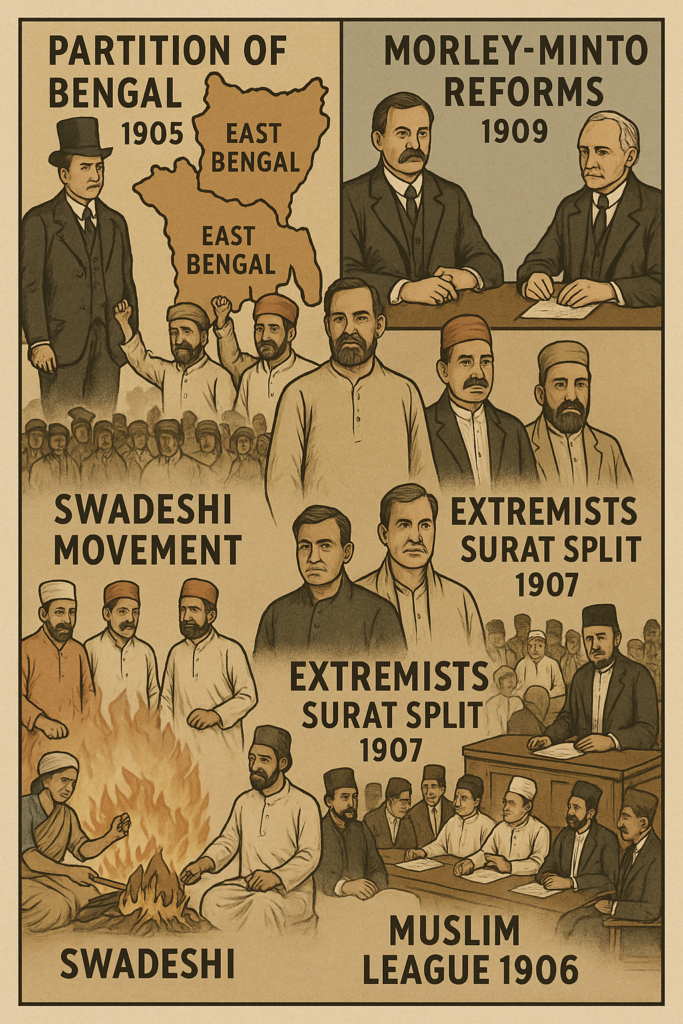
Morley-Minto Reforms (1909)
The Morley-Minto Reforms of 1909 were an important constitutional development introduced by the British government in India. Also known as the Indian Councils Act, 1909, these reforms expanded the legislative councils and introduced separate electorates for Muslims. Although they provided limited opportunities for Indian participation in legislative institutions, they did not establish responsible government or transfer substantial political power to Indians.
1. Introduction
The reforms were introduced during the period when Indian nationalism was growing and political organizations were demanding greater representation in administration. The British government attempted to respond to some of these demands while maintaining colonial control over India.
Main Features and Objectives
- To increase Indian participation in legislative councils.
- To expand the representation of different political and social interests.
- To introduce separate electorates for Muslims.
- To maintain British control over the administration and legislative system.
- To respond to growing political demands without introducing responsible government.
Why Are They Called Morley-Minto Reforms?
- Lord Minto: Viceroy of India from 1905 to 1910.
- John Morley: Secretary of State for India in the British government.
2. Major Provisions of the Morley-Minto Reforms
(i) Expansion of Legislative Councils
- The membership of the Central Legislative Council was increased from 16 to 60 additional members.
- Provincial legislative councils were also expanded, with membership varying from province to province.
- The reforms increased the opportunities for Indians to participate in legislative discussions.
- However, the official executive retained control over the administration.
(ii) Introduction of Separate Electorates
- The reforms introduced separate electorates for Muslims.
- Muslim voters could elect representatives from designated Muslim constituencies.
- This created a separate system of communal political representation within the colonial legislative structure.
- The provision became an important development in the growth of communal politics in British India.
(iii) Limited Powers of Legislative Councils
- Members were allowed to discuss the annual budget and raise questions on public matters, subject to prescribed rules.
- Members could move resolutions on certain public issues.
- They could not exercise full control over the budget or government policy.
- The executive government was not responsible to the elected members of the councils.
(iv) Inclusion of Indians in the Executive Council
- The reforms opened the way for Indian participation in the highest executive institutions.
- Satyendra Prasanna Sinha (S.P. Sinha) became the first Indian member of the Viceroy's Executive Council in 1909.
- He was appointed as the Law Member.
- This was an important symbolic development, although executive authority remained largely under British control.
(v) No Responsible Government
- The reforms did not introduce parliamentary or responsible government in India.
- The executive remained answerable to the British colonial administration rather than to elected Indian representatives.
- Indians continued to have limited influence over major administrative decisions.
3. Effects of the Morley-Minto Reforms
(i) Positive Impact
- Expanded the membership of central and provincial legislative councils.
- Provided greater opportunities for Indians to discuss government policies.
- Allowed limited participation in budget discussions and legislative proceedings.
- Marked the appointment of the first Indian member of the Viceroy's Executive Council.
(ii) Negative Impact
- Separate electorates institutionalized communal political representation.
- The reforms did not provide responsible government or substantial legislative authority to Indians.
- British control over executive administration remained intact.
- The separate electorate system contributed to the development of communal divisions in colonial politics.
4. Reaction of Indian Leaders
(i) Reaction of the Indian National Congress
- Many Congress leaders considered the reforms inadequate because they did not provide meaningful self-government.
- Moderate leaders recognized the limited constitutional changes but continued to demand wider political representation.
- Extremist leaders remained critical of the limited nature of the reforms and British political control.
(ii) Reaction of the Muslim League
- The introduction of separate electorates was welcomed by many Muslim League leaders.
- The provision gave Muslims a distinct channel of representation in legislative councils.
- It became an important development in the League's political demands.
5. Conclusion
The Morley-Minto Reforms of 1909 were an important stage in the constitutional development of British India. They expanded legislative councils and introduced separate electorates for Muslims, but they did not establish responsible government. Their long-term significance lies particularly in the formal introduction of communal electorates, which influenced the subsequent development of constitutional and communal politics in India.
6. Main Points in Brief
- Introduced through the Indian Councils Act, 1909.
- Associated with John Morley and Lord Minto.
- Expanded the Central and Provincial Legislative Councils.
- Introduced separate electorates for Muslims.
- S.P. Sinha became the first Indian member of the Viceroy's Executive Council.
- Did not introduce responsible government in India.
Ghadar Movement (1913–1915)
The Ghadar Movement was a revolutionary movement organized by Indian immigrants living abroad, particularly in North America. It aimed to overthrow British colonial rule in India through an armed uprising. The movement became especially active during the First World War, when its leaders attempted to organize a revolt among Indian soldiers and revolutionary groups in India.
1. Background of the Ghadar Movement
(i) Condition of Indian Immigrants
- During the late nineteenth and early twentieth centuries, many Indians migrated to Canada, the United States, Southeast Asia, and other regions in search of employment.
- Indian immigrants frequently faced racial discrimination and restrictions on immigration and civil rights.
- Discriminatory treatment and exclusion from political rights generated dissatisfaction among sections of the overseas Indian community.
- These experiences encouraged political awareness and opposition to British colonial rule.
(ii) Political Situation in India
- The Partition of Bengal in 1905 intensified opposition to British colonial policies.
- The Morley-Minto Reforms of 1909 introduced separate electorates and generated debate over political representation.
- Repression of nationalist leaders and revolutionary activists contributed to the growth of anti-colonial sentiment.
- Some overseas Indian activists concluded that armed resistance was necessary to end British rule.
2. Establishment of the Ghadar Party (1913)
The Ghadar Party, also known as the Hindustan Ghadar Party, emerged in 1913 among Indian immigrants on the Pacific Coast of North America. It was associated with the Hindustan Association of the Pacific Coast and sought to organize an international revolutionary movement against British rule in India.
(i) When and Where?
- The organization was established in 1913 in the United States.
- San Francisco became its principal centre of activity.
- The Yugantar Ashram in San Francisco served as its headquarters.
- The movement was supported by Indian immigrants, particularly Punjabi workers and political activists.
(ii) Founders and Prominent Leaders
- Lala Har Dayal: An important ideologue and organizer who helped shape the movement's revolutionary programme.
- Sohan Singh Bhakna: A leading founding figure and the first president of the organization.
- Kartar Singh Sarabha: A young revolutionary who became one of the movement's most prominent activists.
- Kanshi Ram: An important Ghadar activist and revolutionary associated with the movement.
- Rash Behari Bose: A revolutionary leader who later became involved in the planned uprising in India.
(iii) Objectives of the Ghadar Party
- To overthrow British colonial rule in India.
- To organize Indian immigrants and overseas revolutionaries against colonial rule.
- To encourage Indian soldiers to participate in an armed uprising.
- To spread revolutionary literature and nationalist ideas.
- To coordinate revolutionary activities between overseas Indian communities and activists in India.
3. Major Activities of the Ghadar Movement (1913–1915)
(i) Publication of the Ghadar Newspaper
- The Ghadar Party published a revolutionary newspaper known as Ghadar.
- It was published in multiple languages, including Urdu, Punjabi, and other Indian languages.
- The newspaper exposed colonial exploitation and encouraged Indians to participate in the struggle for independence.
- It circulated revolutionary ideas among overseas Indian communities and readers in India.
(ii) First World War and Plans for Rebellion
- The First World War began in 1914.
- Ghadar leaders viewed Britain's involvement in the war as an opportunity to organize an uprising in India.
- They encouraged overseas Indians to return to India and participate in revolutionary activities.
- Plans were made to encourage mutiny among Indian soldiers serving in the British Indian Army.
- Revolutionary networks attempted to coordinate activities in Punjab and other parts of northern India.
(iii) The Failed Revolt of February 1915
- Ghadar revolutionaries planned an armed uprising in February 1915.
- Kartar Singh Sarabha and other activists participated in efforts to organize the revolt.
- Rash Behari Bose also became involved in coordinating revolutionary activities in India.
- The original plan was associated with 21 February 1915, but the date was brought forward to 19 February after information about the plan reached the British authorities.
- British intelligence and police action disrupted the preparations, and the planned uprising failed to develop into a widespread military revolt.
4. Reasons for the Failure of the Ghadar Revolt
(i) Strong British Intelligence
- British intelligence agencies monitored revolutionary networks and overseas activities.
- Information about the planned uprising reached the authorities before the intended date.
- Arrests and preventive measures disrupted revolutionary preparations.
(ii) Limited Support within the Army
- The movement failed to secure widespread participation from Indian soldiers.
- Several planned military uprisings were prevented by British authorities.
(iii) Shortage of Resources
- The revolutionaries faced difficulties in obtaining weapons and financial resources.
- Communication and coordination between overseas activists and groups in India were difficult.
(iv) Organizational Difficulties
- The movement operated across several countries and faced significant coordination challenges.
- The departure of Lala Har Dayal from the United States in 1914 affected the organization's leadership structure.
- British surveillance and arrests further weakened the movement.
5. Impact and Importance of the Ghadar Movement
(i) Impact on the Indian Freedom Struggle
- It demonstrated the willingness of overseas Indians to participate in India's independence struggle.
- It strengthened revolutionary nationalism and encouraged anti-colonial political activity.
- It established connections between overseas Indian communities and revolutionary networks in India.
- It became an important chapter in the history of revolutionary resistance against British rule.
(ii) British Repression
- The British government launched investigations and prosecutions against suspected Ghadar revolutionaries.
- The Lahore Conspiracy Cases of 1915 and subsequent trials targeted participants in the revolutionary activities.
- Kartar Singh Sarabha and several other revolutionaries were executed in November 1915.
- Many activists were imprisoned or faced other forms of colonial punishment.
(iii) Growth of Nationalism Among Overseas Indians
- The movement encouraged political consciousness among Indian immigrant communities.
- It helped connect the experiences of racial discrimination abroad with opposition to colonial rule in India.
- It demonstrated the international dimension of India's freedom struggle.
6. Conclusion
The Ghadar Movement was an important revolutionary effort to overthrow British colonial rule through an armed uprising. Although the planned revolt of 1915 failed, the movement demonstrated the commitment of overseas Indians to India's independence. Its revolutionary activities, publications, and sacrifices became significant parts of the wider history of India's freedom struggle.
7. Main Points in Brief
- The Ghadar Party was established in 1913 in the United States.
- San Francisco became its principal centre, with Yugantar Ashram as its headquarters.
- Lala Har Dayal and Sohan Singh Bhakna were important founding figures.
- Kartar Singh Sarabha became a prominent young revolutionary.
- The party published the revolutionary newspaper Ghadar.
- It attempted to organize an armed uprising in India during February 1915.
- The planned revolt was disrupted by British intelligence and repression.

Recommended Study Resource
Explore this study resource for additional reading and preparation related to modern Indian history and the revolutionary freedom movement.
Affiliate Disclosure: This article contains an affiliate link. We may earn a commission if you purchase through this link, at no additional cost to you.
References
- NCERT History Textbooks – Classes 8, 9, 10, and 12.
- Bipan Chandra – India's Struggle for Independence.
- Rajiv Ahir (Spectrum) – A Brief History of Modern India.
- R.C. Majumdar – History of the Freedom Movement in India.
- B.L. Grover – A New Look at Modern Indian History.
- National Archives of India – Historical records and official documents.
- Academic research papers and university publications on Modern Indian History.
Recommended Study Resource
Explore this study resource on Amazon for additional learning and preparation materials related to your studies.
Affiliate Disclosure: This article contains an affiliate link. We may earn a commission if you make a purchase through this link, at no additional cost to you.