


Product Name
यह प्रोडक्ट अपनी उत्कृष्ट गुणवत्ता, मजबूत निर्माण और शानदार प्रदर्शन के कारण सबसे लोकप्रिय विकल्पों में से एक है। यदि आप भरोसेमंद और लंबे समय तक चलने वाला विकल्प चाहते हैं, तो यह एक बेहतरीन चयन हो सकता है।
- ✅ Premium Quality
- ✅ Best Value for Money
- ✅ Fast Delivery Available
- ✅ Amazon Trusted Seller
📖 Introduction
The Constitution of India is not merely a legal document that defines the framework of governance; it is the embodiment of the nation's democratic ideals, social aspirations, and constitutional values. It reflects the vision of the Constitution-makers to establish a nation where every individual enjoys dignity, equal opportunities, justice, and freedom regardless of caste, religion, gender, language, or economic background.
At the heart of the Indian Constitution lie the timeless principles of Justice, Liberty, and Equality. These constitutional ideals, beautifully expressed in the Preamble, serve as the guiding philosophy for governance, law-making, and the protection of fundamental rights. Together, they ensure that democracy remains meaningful, inclusive, and responsive to the needs of every citizen.
🌟 Core Constitutional Values
- Justice ensures social, economic, and political fairness.
- Liberty protects freedom of thought, expression, belief, faith, and worship.
- Equality guarantees equal status and equal opportunities before the law.
- Fraternity promotes national unity, integrity, and human dignity.
The framers of the Constitution envisioned India as a democratic republic where constitutional morality prevails over discrimination and arbitrary power. To realise this vision, the Constitution guarantees Fundamental Rights, directs the State through the Directive Principles of State Policy, and encourages responsible citizenship through Fundamental Duties. These provisions collectively strengthen the constitutional commitment to justice, liberty, equality, and fraternity.
Exam Insight: Understanding the constitutional ideals of Justice, Liberty, and Equality is essential for UPSC, State PCS, SSC, Judiciary, and other competitive examinations. Questions are frequently asked from the Preamble, Fundamental Rights, Basic Structure Doctrine, landmark Supreme Court judgments, and constitutional philosophy.
This article provides a comprehensive analysis of the Spirit of the Constitution—Justice, Liberty, and Equality. It explores their meaning, constitutional provisions, significance, judicial interpretation, contemporary challenges, and relevance in strengthening India's democratic framework.
⚖️ What is the Spirit of the Constitution?
The Spirit of the Constitution refers to the fundamental ideals, principles, and constitutional values that form the foundation of the entire Constitution. These values transform the Constitution from a mere legal document into a living framework that protects democracy, justice, human dignity, and the rights of every citizen.
In the Indian context, the spirit of the Constitution is primarily embodied in the Preamble, which declares India to be a Sovereign, Socialist, Secular, Democratic Republic and resolves to secure for all its citizens Justice, Liberty, Equality, and Fraternity. These constitutional ideals guide every institution of the State and shape the relationship between the government and its citizens.
🌟 Key Elements of the Spirit of the Constitution
- Ensuring social, economic, and political justice for every citizen.
- Protecting liberty of thought, expression, belief, faith, and worship.
- Guaranteeing equality before the law and equal opportunities.
- Promoting fraternity, human dignity, and national unity.
- Upholding democracy, the rule of law, and constitutional governance.
- Safeguarding fundamental rights and promoting social welfare.
The spirit of the Constitution is not confined to the Preamble alone. It is reflected throughout the Constitution, particularly in the Fundamental Rights (Part III), Directive Principles of State Policy (Part IV), Fundamental Duties (Part IVA), and the doctrine of an independent judiciary. Together, these provisions ensure that constitutional values are translated into practical governance and public life.
📜 Dr. B. R. Ambedkar's Perspective
Dr. B. R. Ambedkar believed that Justice, Liberty, Equality, and Fraternity are inseparable constitutional values. According to him, democracy can flourish only when these principles coexist in harmony. Weakening any one of these ideals would undermine the very foundation of the Constitution.
💡 Exam Perspective (UPSC, State PCS, SSC)
Questions related to the Spirit of the Constitution are frequently asked in competitive examinations from the following areas:
- The Preamble to the Indian Constitution.
- Justice, Liberty, Equality, and Fraternity.
- Fundamental Rights and Directive Principles of State Policy.
- Basic Structure Doctrine.
- Constitutional Morality and Judicial Interpretation.
In essence, the Spirit of the Constitution represents the moral and philosophical foundation of the Indian constitutional system. It ensures that governance remains democratic, inclusive, accountable, and committed to protecting the dignity, freedom, and equality of every individual. These enduring constitutional values continue to guide India's progress as a modern democratic nation.
📜 The Preamble and the Spirit of the Constitution
The Preamble to the Constitution of India serves as the introductory statement of the Constitution, expressing its philosophy, objectives, and guiding principles. It is widely regarded as the "Spirit of the Constitution", the "Key to the Constitution", and the "Identity of the Constitution" because it reflects the vision and aspirations of the Constitution-makers. The Preamble provides the ideological foundation upon which the entire constitutional framework is built.
The Preamble declares India to be a Sovereign, Socialist, Secular, Democratic Republic and resolves to secure for all its citizens Justice—social, economic, and political; Liberty of thought, expression, belief, faith, and worship; Equality of status and opportunity; and Fraternity, assuring the dignity of the individual and the unity and integrity of the Nation. These constitutional ideals form the moral and philosophical foundation of the Indian Republic.
🌟 Core Constitutional Ideals in the Preamble
- Sovereign – India is fully independent in its internal and external affairs and is not subject to the authority of any foreign power.
- Socialist – The Constitution aims to establish a welfare state based on social and economic justice.
- Secular – The State treats all religions equally and guarantees every citizen the freedom to profess, practise, and propagate religion.
- Democratic – The government derives its authority from the people through free, fair, and regular elections.
- Republic – The Head of the State is elected directly or indirectly and is not a hereditary ruler.
The Preamble is not merely a ceremonial introduction; it provides direction to every part of the Constitution. The Fundamental Rights (Part III), Directive Principles of State Policy (Part IV), Fundamental Duties (Part IVA), and other constitutional provisions are designed to translate these ideals into reality. Consequently, the Preamble serves as the philosophical foundation of the Indian constitutional system.
⚖️ The Preamble as the Spirit of the Constitution
The spirit of the Constitution is rooted in the values of Justice, Liberty, Equality, and Fraternity. These principles are interdependent and indispensable for the success of a democratic society. Justice cannot exist without equality, liberty loses meaning without justice, and fraternity is essential for maintaining social harmony, national unity, and constitutional governance. Together, these ideals ensure that democracy remains inclusive, accountable, and people-centric.
📚 Judicial Perspective
In the landmark Kesavananda Bharati v. State of Kerala (1973) judgment, the Supreme Court held that the Preamble is an integral part of the Constitution and serves as an important guide in interpreting its provisions. The Court also established the Basic Structure Doctrine, ruling that Parliament cannot amend or destroy the fundamental features and constitutional values reflected in the Preamble.
💡 Exam Perspective (UPSC, State PCS, SSC & Judiciary)
- Why is the Preamble called the Spirit of the Constitution?
- Key features and constitutional significance of the Preamble.
- Words added by the 42nd Constitutional Amendment Act, 1976.
- Relationship between the Preamble and the Basic Structure Doctrine.
- Importance of Justice, Liberty, Equality, and Fraternity in constitutional governance.
In conclusion, the Preamble is far more than an introductory declaration—it is the philosophical soul of the Indian Constitution. By enshrining the enduring values of Justice, Liberty, Equality, and Fraternity, it provides a clear vision for building an inclusive, democratic, and welfare-oriented nation. These constitutional ideals continue to guide governance, protect citizens' rights, and uphold the rule of law, making the Preamble the true embodiment of the spirit of the Constitution.
❓ Frequently Asked Questions (FAQs)
The following Frequently Asked Questions (FAQs) provide quick and exam-oriented answers related to the constitutional ideals of Justice, Liberty, Equality, and Fraternity. These questions are highly relevant for UPSC, State PCS, SSC, Judiciary, CUET, UGC-NET, and other competitive examinations.
1. What is meant by the soul of the Indian Constitution?
The soul of the Indian Constitution refers to the fundamental constitutional philosophy embodied in the Preamble, particularly the ideals of Justice, Liberty, Equality, and Fraternity. These principles guide the interpretation and implementation of the Constitution.
2. Why is the Preamble called the soul of the Constitution?
The Preamble expresses the objectives, philosophy, and vision of the Constitution. It reflects the aspirations of the people of India and serves as a guiding principle for constitutional interpretation and governance.
3. What are the four constitutional ideals mentioned in the Preamble?
The four constitutional ideals are Justice, Liberty, Equality, and Fraternity. Together, they establish the foundation of India's democratic and welfare-oriented constitutional order.
4. What is the Basic Structure Doctrine?
The Basic Structure Doctrine, evolved by the Supreme Court in the Kesavananda Bharati Case (1973), states that Parliament cannot amend or destroy the essential features of the Constitution, even while exercising its powers under Article 368.
5. Is the Preamble a part of the Constitution?
Yes. In the Kesavananda Bharati v. State of Kerala (1973) judgment, the Supreme Court held that the Preamble is an integral part of the Constitution and can be used as an aid to constitutional interpretation.
6. What is the relationship between the Preamble and Fundamental Rights?
The Preamble provides the philosophical foundation of the Constitution, while the Fundamental Rights under Part III give legal protection to constitutional values such as justice, liberty, equality, and dignity.
7. Which constitutional provision deals with constitutional amendments?
Article 368 of the Constitution provides the procedure and powers relating to constitutional amendments by Parliament.
8. Why are Justice, Liberty, Equality, and Fraternity important?
These ideals ensure democratic governance, protection of human rights, social harmony, equal opportunities, individual dignity, and national unity. They represent the core values upon which the Indian constitutional system is built.
9. Which landmark judgments are most important for this topic?
Important judgments include Kesavananda Bharati (1973), Maneka Gandhi (1978), Minerva Mills (1980), S. R. Bommai (1994), and K. S. Puttaswamy (2017).
10. Why is this topic important for UPSC and other competitive examinations?
Questions related to the Preamble, constitutional philosophy, Fundamental Rights, Directive Principles, Basic Structure Doctrine, constitutional amendments, landmark judgments, and constitutional morality are frequently asked in UPSC Prelims, Mains, State PCS, SSC, Judiciary, and other competitive examinations.
🎯 Quick Revision Tip
For examination purposes, remember the sequence: Preamble → Justice → Liberty → Equality → Fraternity → Fundamental Rights → DPSPs → Fundamental Duties → Basic Structure Doctrine → Landmark Judgments → Current Challenges. This flow helps in writing structured and high-scoring answers in UPSC and State PCS examinations.

⚖️ Justice
Justice is the cornerstone of the Indian Constitution and one of the most fundamental values enshrined in its Preamble. It occupies the first place among the constitutional ideals, reflecting the vision of the Constitution-makers to establish a society where every individual enjoys fairness, dignity, equal opportunities, and protection under the law. Justice in the Indian Constitution extends beyond the legal system; it seeks to eliminate inequalities and create a social order based on fairness and human dignity.
The Constitution of India recognises that true democracy cannot exist without justice. Therefore, the Preamble pledges to secure Social Justice, economic justice, and Political Justice for all citizens. These three dimensions work together to build an inclusive, equitable, and welfare-oriented society where every individual has the opportunity to develop and participate in national progress.
🌟 Three Dimensions of Justice
- Social Justice – Eliminates discrimination based on religion, caste, race, gender, language, or place of birth and ensures equal dignity and opportunities for every citizen.
- Economic Justice – Promotes the fair distribution of wealth and resources, reduces economic inequalities, and ensures that every individual has access to livelihood, social security, and a decent standard of living.
- Political Justice – Guarantees equal participation in the democratic process through universal adult suffrage, equal political rights, and equal access to public offices without discrimination.
The principle of justice is reflected throughout the Constitution. The Fundamental Rights (Part III) protect individual freedoms and equality before the law, while the Directive Principles of State Policy (Part IV) guide the State in establishing a welfare society based on social and economic justice. An independent judiciary further ensures that constitutional rights are protected and justice is delivered impartially.
📜 Key Constitutional Provisions Related to Justice
- Preamble – Secures social, economic, and political justice for all citizens.
- Article 14 – Equality before the law and equal protection of the laws.
- Article 15 – Prohibits discrimination on specified grounds.
- Article 16 – Guarantees equality of opportunity in public employment.
- Article 17 – Abolishes untouchability.
- Article 21 – Protects the right to life and personal liberty.
- Articles 38 and 39 – Direct the State to promote social and economic justice through welfare policies.
⚖️ Role of the Supreme Court
The Supreme Court of India plays a vital role in safeguarding the constitutional ideal of justice. Landmark judgments such as Kesavananda Bharati v. State of Kerala (1973), Maneka Gandhi v. Union of India (1978), and Indra Sawhney v. Union of India (1992) have significantly strengthened the principles of social justice, personal liberty, equality, and constitutional governance.
💡 Exam Perspective (UPSC, State PCS, SSC & Judiciary)
- Meaning and significance of Justice in the Preamble.
- Difference between Social, Economic, and Political Justice.
- Constitutional provisions promoting justice.
- Role of Fundamental Rights and Directive Principles in ensuring justice.
- Important Supreme Court judgments related to constitutional justice.
In conclusion, Justice is the foundation of India's constitutional philosophy and democratic governance. It is not confined to courts or legal procedures but represents the broader goal of creating a fair, inclusive, and equitable society. By ensuring social, economic, and political justice, the Constitution seeks to protect human dignity, promote equal opportunities, and establish a democratic welfare state where every citizen can realise their full potential.
🕊️ Liberty
Liberty is one of the fundamental pillars of the Indian Constitution and an essential component of its constitutional philosophy. The Preamble guarantees every citizen Liberty of thought, expression, belief, faith, and worship, ensuring that individuals are free to develop their personalities and live with dignity. Liberty does not imply absolute freedom; rather, it refers to freedom exercised within the framework of the Constitution and the rule of law. It enables individuals to enjoy their rights while respecting the rights and freedoms of others.
The framers of the Constitution recognised that democracy can flourish only when citizens are free to express their opinions, practise their religion, pursue their aspirations, and participate in public life without fear or discrimination. Therefore, the Constitution provides constitutional protection to liberty through the Fundamental Rights, ensuring that individual freedoms remain safeguarded against arbitrary state action.
🌟 Liberties Guaranteed by the Preamble
- Liberty of Thought – The freedom to think independently and form personal opinions without undue interference.
- Liberty of Expression – The right to express ideas and opinions through speech, writing, art, media, or other lawful means.
- Liberty of Belief – The freedom to adopt and hold personal beliefs or convictions.
- Liberty of Faith – The freedom to follow and practise one's chosen religion or faith.
- Liberty of Worship – The freedom to perform religious rituals and worship according to one's beliefs.
The constitutional protection of liberty is primarily found in Articles 19 to 22. Article 19 guarantees several essential freedoms to citizens, while Article 21 protects the right to life and personal liberty. Through progressive judicial interpretation, the Supreme Court has expanded these provisions to include rights such as privacy, dignity, livelihood, education, and a clean environment.
📜 Key Constitutional Provisions Related to Liberty
- Preamble – Guarantees liberty of thought, expression, belief, faith, and worship.
- Article 19 – Freedom of speech and expression, peaceful assembly, association, movement, residence, and profession.
- Article 20 – Protection in respect of conviction for offences.
- Article 21 – Protection of life and personal liberty.
- Article 21A – Right to education for children between 6 and 14 years of age.
- Article 22 – Protection against arbitrary arrest and detention.
- Articles 25–28 – Freedom of religion, conscience, and worship.
⚖️ Reasonable Restrictions
The freedoms guaranteed under the Constitution are not absolute. Articles 19(2) to 19(6) permit the State to impose reasonable restrictions in the interests of the sovereignty and integrity of India, national security, public order, decency, morality, friendly relations with foreign states, contempt of court, defamation, and prevention of incitement to offences. These restrictions maintain a balance between individual liberty and the larger public interest.
🏛️ Landmark Supreme Court Judgments
- Maneka Gandhi v. Union of India (1978) – Expanded the scope of Article 21 by holding that personal liberty must be protected through a fair, just, and reasonable procedure.
- K. S. Puttaswamy v. Union of India (2017) – Recognised the Right to Privacy as a Fundamental Right under Article 21.
- Shreya Singhal v. Union of India (2015) – Struck down Section 66A of the Information Technology Act, reinforcing the constitutional protection of freedom of speech and expression.
💡 Exam Perspective (UPSC, State PCS, SSC & Judiciary)
- Meaning and significance of Liberty in the Preamble.
- Fundamental freedoms under Articles 19 to 22.
- Reasonable restrictions on Fundamental Rights.
- Importance of Article 21 and the Right to Privacy.
- Important Supreme Court judgments related to personal liberty.
In conclusion, Liberty is indispensable to the functioning of a democratic society. It empowers individuals to think freely, express their views, practise their religion, and pursue personal development while remaining accountable to the Constitution and the rule of law. By balancing individual freedom with societal interests, the Indian Constitution ensures that liberty contributes to justice, equality, human dignity, and the overall strength of constitutional democracy.
⚖️ Equality
Equality is one of the fundamental pillars of the Indian Constitution and an essential element of its democratic philosophy. The Preamble promises every citizen equality of status and opportunity, ensuring that all individuals are treated with dignity, fairness, and respect. Equality does not mean that every person is treated identically in all circumstances; rather, it guarantees equal protection under the law and equal opportunities while addressing historical and social disadvantages. Through this principle, the Constitution seeks to establish a just, inclusive, and discrimination-free society.
The Constitution of India embraces both Formal Equality and Substantive Equality. While it guarantees equal treatment before the law, it also permits special provisions for socially and economically disadvantaged groups such as the Scheduled Castes (SCs), Scheduled Tribes (STs), Other Backward Classes (OBCs), Economically Weaker Sections (EWS), women, and persons with disabilities. This approach reflects the constitutional commitment to Positive Equality, ensuring that genuine equality is achieved through social justice.
🌟 Key Dimensions of Equality
- Equality Before the Law – Every individual is equal in the eyes of the law, and no person enjoys special legal privileges.
- Equal Protection of the Laws – Persons in similar circumstances receive equal legal protection and fair treatment.
- Equality of Opportunity – Every citizen has an equal opportunity in public employment, education, and other fields.
- Prohibition of Discrimination – Discrimination based on religion, race, caste, sex, place of birth, or other prohibited grounds is forbidden.
- Social Equality – The Constitution seeks to eliminate untouchability, caste-based discrimination, and other forms of social inequality.
The Right to Equality is guaranteed under Part III (Fundamental Rights) of the Constitution through Articles 14 to 18. These provisions collectively ensure equality before the law, prohibit discrimination, guarantee equality of opportunity in public employment, abolish untouchability, and abolish titles that create artificial social distinctions.
📜 Key Constitutional Provisions Related to Equality
- Article 14 – Equality before the law and equal protection of the laws.
- Article 15 – Prohibits discrimination on the grounds of religion, race, caste, sex, or place of birth.
- Article 16 – Guarantees equality of opportunity in matters of public employment.
- Article 17 – Abolishes untouchability and prohibits its practice in any form.
- Article 18 – Abolishes titles, except military and academic distinctions recognised by law.
⚖️ Positive Discrimination (Affirmative Action)
The Indian Constitution recognises that treating everyone identically may not always produce genuine equality. Therefore, it permits affirmative action and special provisions for disadvantaged communities. Reservations in education and public employment, along with welfare measures for SCs, STs, OBCs, EWS, women, and persons with disabilities, are intended to eliminate historical inequalities and create a level playing field for all citizens.
🏛️ Landmark Supreme Court Judgments
- Indra Sawhney v. Union of India (1992) – Upheld reservations for socially and educationally backward classes and established the general 50% ceiling on reservations.
- E. P. Royappa v. State of Tamil Nadu (1974) – Held that arbitrariness is inconsistent with the principle of equality under Article 14.
- Navtej Singh Johar v. Union of India (2018) – Reinforced the principles of equality, dignity, and individual liberty by recognising the constitutional rights of the LGBTQ+ community.
💡 Exam Perspective (UPSC, State PCS, SSC & Judiciary)
- Meaning and constitutional significance of Equality.
- Important provisions under Articles 14 to 18.
- Affirmative action and reservation policy.
- Difference between Formal Equality and Substantive Equality.
- Important Supreme Court judgments on the Right to Equality.
In conclusion, Equality is the foundation of India's constitutional democracy and welfare state. It goes beyond equal treatment before the law by promoting equal opportunities, protecting human dignity, and addressing historical disadvantages through affirmative action. By eliminating discrimination and ensuring fairness, the Constitution seeks to build an inclusive society where every citizen can participate equally in the nation's social, economic, and political development.
⚖️ Relationship Between Justice, Liberty, and Equality
Justice, Liberty, and Equality are the three foundational ideals of the Indian Constitution and together form the core of its constitutional philosophy. Enshrined in the Preamble, these values are not independent principles but are deeply interconnected and mutually reinforcing. A democratic society can achieve constitutional governance only when all three values operate in harmony, ensuring that every individual enjoys freedom, fairness, dignity, and equal opportunities.
The framers of the Constitution recognised that no constitutional value can exist in isolation. Justice guarantees fairness in society, Liberty protects individual freedom, and Equality ensures equal treatment and opportunities for all citizens. Together, these principles create the foundation of a democratic and welfare-oriented State committed to protecting human rights and promoting inclusive development.
🌟 How These constitutional values Complement Each Other
- Justice Without Liberty – A society may enforce laws fairly, but without individual freedom, justice becomes authoritarian and suppresses human dignity.
- Liberty Without Equality – Freedom alone may benefit only the privileged, allowing social and economic inequalities to persist.
- Equality Without Liberty – Equal treatment without personal freedom can restrict creativity, innovation, and the free development of human personality.
- Justice Without Equality – True justice cannot be achieved if discrimination and unequal opportunities continue to exist.
- Justice, Liberty, and Equality Together – Their harmonious coexistence creates a democratic society based on fairness, dignity, opportunity, and the rule of law.
The Constitution reflects this interdependence through its various provisions. The Fundamental Rights protect liberty and equality, while the Directive Principles of State Policy promote social and economic justice. An independent judiciary safeguards these constitutional values by ensuring that governmental actions remain consistent with the Constitution and the rule of law.
📜 Constitutional Reflection
- Justice promotes fairness in social, economic, and political life.
- Liberty protects freedom of thought, expression, belief, faith, and worship.
- Equality guarantees equal status, equal opportunities, and equal protection of the laws.
- Fraternity strengthens these ideals by promoting dignity, unity, and national integration.
🏛️ Dr. B. R. Ambedkar's Perspective
Dr. B. R. Ambedkar emphasised that Justice, Liberty, Equality, and Fraternity are inseparable constitutional ideals. According to him, liberty cannot be preserved without equality, equality cannot survive without liberty, and both require fraternity to maintain social harmony. Their balanced coexistence is essential for the success of constitutional democracy and the protection of individual dignity.
💡 Exam Perspective (UPSC, State PCS, SSC & Judiciary)
- Interrelationship between Justice, Liberty, and Equality.
- Role of the Preamble in expressing constitutional philosophy.
- Dr. B. R. Ambedkar's views on constitutional values.
- Connection between Fundamental Rights and Directive Principles.
- Importance of these ideals in constitutional governance and democratic administration.
In conclusion, Justice, Liberty, and Equality are not merely constitutional ideals but the guiding principles that sustain India's democratic framework. Each value depends upon and strengthens the others, creating a balanced constitutional order that protects human dignity, promotes social harmony, and ensures equal opportunities for every citizen. Their harmonious relationship remains the foundation of constitutional morality, the rule of law, and the vision of a just, free, and inclusive India.

🤝 Importance of Fraternity
Fraternity is one of the four core ideals enshrined in the Preamble of the Constitution of India. It signifies a sense of brotherhood, mutual respect, solidarity, and national unity among all citizens, irrespective of religion, caste, language, region, gender, or social background. The Constitution seeks to promote fraternity in order to preserve the dignity of the individual and ensure the unity and integrity of the Nation. Without fraternity, the ideals of Justice, Liberty, and Equality cannot be fully realised in a diverse democratic society.
India is characterised by immense diversity in terms of culture, religion, language, ethnicity, and traditions. The framers of the Constitution recognised that constitutional democracy would succeed only if citizens developed a spirit of mutual trust, tolerance, cooperation, and national integration. Therefore, fraternity serves as the moral foundation that binds the nation together while respecting its diversity.
🌟 Importance of Fraternity in the Indian Constitution
- Promotes National Unity – Fraternity strengthens the unity and integrity of India by fostering a sense of belonging among all citizens.
- Protects Human Dignity – It encourages mutual respect and ensures that every individual is treated with dignity and compassion.
- Strengthens Democracy – A democratic system functions effectively when citizens cooperate, respect differing opinions, and peacefully resolve conflicts.
- Encourages Social Harmony – Fraternity helps reduce communalism, caste discrimination, regionalism, and social divisions.
- Supports Inclusive Development – It promotes equal participation and cooperation among all sections of society in nation-building.
The spirit of fraternity is reflected throughout the Constitution. While the Fundamental Rights protect individual freedoms and equality, the Directive Principles of State Policy aim to establish social and economic justice. The Fundamental Duties, particularly the duty under Article 51A(e), require every citizen to promote harmony and the spirit of common brotherhood among all people of India.
📜 Constitutional Provisions Supporting Fraternity
- Preamble – Secures fraternity assuring the dignity of the individual and the unity and integrity of the Nation.
- Fundamental Rights (Articles 14–32) – Promote equality, liberty, and protection against discrimination.
- Directive Principles of State Policy (Part IV) – Encourage social and economic justice for all citizens.
- Article 51A(e) – Imposes the Fundamental Duty to promote harmony and the spirit of common brotherhood transcending religious, linguistic, regional, and sectional diversities.
- Article 51A(f) – Calls upon citizens to value and preserve the rich heritage of India's composite culture.
🏛️ Dr. B. R. Ambedkar's Vision of Fraternity
Dr. B. R. Ambedkar regarded Fraternity as the binding force that unites Justice, Liberty, and Equality. He believed that liberty and equality could not be sustained unless citizens developed a genuine feeling of brotherhood and mutual respect. According to him, fraternity creates social cohesion, strengthens constitutional morality, and enables democracy to function as a way of life rather than merely as a political system.
💡 Exam Perspective (UPSC, State PCS, SSC & Judiciary)
- Meaning and constitutional significance of Fraternity.
- Role of Fraternity in the Preamble.
- Relationship between Fraternity, Justice, Liberty, and Equality.
- Fundamental Duties promoting harmony and national integration.
- Dr. B. R. Ambedkar's views on Fraternity and constitutional democracy.
In conclusion, Fraternity is the moral and social foundation of the Indian constitutional order. It nurtures mutual respect, unity, and national integration while protecting the dignity of every individual. By fostering harmony among diverse communities, fraternity enables the effective realisation of Justice, Liberty, and Equality, thereby strengthening constitutional democracy and ensuring the long-term stability and progress of the Republic of India.
📜 Relationship with Fundamental Rights
The ideals of Justice, Liberty, Equality, and Fraternity are not merely philosophical principles mentioned in the Preamble; they are translated into enforceable constitutional guarantees through the Fundamental Rights (Part III) of the Constitution of India. These rights provide legal protection to individual freedoms, promote equality before the law, safeguard human dignity, and establish the constitutional framework necessary for a democratic society. Together, the Preamble and the Fundamental Rights form the backbone of India's constitutional democracy.
The Fundamental Rights ensure that every citizen enjoys constitutional protection against arbitrary actions of the State. They reflect the vision of the Constituent Assembly by protecting civil liberties, preventing discrimination, and creating conditions where justice, liberty, equality, and fraternity can flourish. The Supreme Court has consistently interpreted these rights as essential for preserving constitutional morality and the rule of law.
🌟 Relationship Between Constitutional Ideals and Fundamental Rights
- Justice – Fundamental Rights protect individuals against arbitrary State action and ensure access to constitutional remedies, thereby promoting social, political, and legal justice.
- Liberty – Articles 19 to 22 guarantee freedoms of speech, expression, movement, association, religion, and personal liberty.
- Equality – Articles 14 to 18 ensure equality before the law, prohibit discrimination, guarantee equality of opportunity, and abolish untouchability and titles.
- Fraternity – Fundamental Rights promote dignity, secularism, tolerance, and equal treatment, thereby strengthening national unity and social harmony.
The Supreme Court has repeatedly held that the Preamble serves as the guiding philosophy for interpreting the Fundamental Rights. Judicial interpretation has expanded these rights to include privacy, dignity, livelihood, education, clean environment, and access to justice, ensuring that constitutional values remain dynamic and responsive to changing societal needs.
📜 Important Fundamental Rights Supporting Constitutional Values
- Articles 14–18 – Right to Equality.
- Articles 19–22 – Right to Freedom.
- Articles 23–24 – Right against Exploitation.
- Articles 25–28 – Right to Freedom of Religion.
- Articles 29–30 – Cultural and Educational Rights.
- Article 32 – Right to Constitutional Remedies, described by Dr. B. R. Ambedkar as the "Heart and soul of the Constitution."
⚖️ Judicial Interpretation
Through landmark judgments such as Kesavananda Bharati v. State of Kerala (1973), Maneka Gandhi v. Union of India (1978), and K. S. Puttaswamy v. Union of India (2017), the Supreme Court has expanded the scope of Fundamental Rights and reinforced the constitutional ideals of justice, liberty, equality, and dignity. These judgments demonstrate that the Fundamental Rights are living provisions that evolve with changing constitutional needs.
💡 Exam Perspective (UPSC, State PCS, SSC & Judiciary)
- Relationship between the Preamble and Fundamental Rights.
- How Justice, Liberty, Equality, and Fraternity are reflected in Part III of the Constitution.
- Importance of Article 32 as the constitutional guardian of Fundamental Rights.
- Role of the Supreme Court in expanding Fundamental Rights through judicial interpretation.
- Connection between Fundamental Rights and constitutional democracy.
In conclusion, the Fundamental Rights transform the constitutional ideals proclaimed in the Preamble into enforceable legal rights. They ensure that justice, liberty, equality, and fraternity are not merely aspirational values but practical guarantees that protect individual dignity, strengthen democracy, and uphold the rule of law in India.
📖 Relationship with the Directive Principles of State Policy (DPSPs)
The Directive Principles of State Policy (DPSPs), contained in Part IV (Articles 36–51) of the Constitution of India, are fundamental guidelines for governance. Although they are non-justiciable and cannot be enforced by courts, they play a crucial role in achieving the constitutional ideals of Justice, Liberty, Equality, and Fraternity proclaimed in the Preamble. The DPSPs guide the State in establishing a welfare state by promoting social, economic, and political justice and ensuring the well-being of all citizens.
While the Fundamental Rights protect individual freedoms against arbitrary State action, the Directive Principles impose positive obligations on the State to create conditions in which those freedoms can be meaningfully enjoyed. Together, they work in harmony to fulfil the vision of the Constitution and promote inclusive and sustainable development.
🌟 Relationship Between Constitutional Ideals and DPSPs
- Justice – DPSPs promote social, economic, and political justice by reducing inequalities, preventing exploitation, and improving living standards.
- Liberty – By ensuring education, health, livelihood, and social security, the DPSPs create conditions that enable individuals to enjoy their freedoms effectively.
- Equality – The State is directed to minimise inequalities in income, status, facilities, and opportunities while ensuring equal justice for all citizens.
- Fraternity – Welfare-oriented policies foster social harmony, national integration, and a sense of collective responsibility among citizens.
The Directive Principles reflect the Constitution's commitment to building a just social order. They encourage the State to adopt policies that improve public health, provide free legal aid, promote education, protect workers, safeguard children, empower weaker sections, and ensure equitable distribution of resources. These objectives complement the Fundamental Rights and strengthen constitutional democracy.
📜 Important Directive Principles Supporting constitutional values
- Article 38 – Promote the welfare of the people by securing a social order based on justice.
- Article 39 – Ensure adequate livelihood, equitable distribution of resources, equal pay for equal work, and protection of children and workers.
- Article 39A – Provide equal justice and free legal aid.
- Article 41 – Secure the right to work, education, and public assistance in specified circumstances.
- Article 42 – Ensure just and humane conditions of work and maternity relief.
- Article 43 – Promote a living wage and decent standard of life for workers.
- Article 45 – Provide early childhood care and education.
- Article 46 – Promote the educational and economic interests of Scheduled Castes, Scheduled Tribes, and other weaker sections.
- Article 47 – Improve public health and the standard of nutrition.
⚖️ Judicial Interpretation
The Supreme Court has consistently emphasised that the Fundamental Rights and the Directive Principles of State Policy are complementary rather than conflicting. In landmark cases such as Kesavananda Bharati v. State of Kerala (1973), Minerva Mills v. Union of India (1980), and Unni Krishnan v. State of Andhra Pradesh (1993), the Court held that harmony between Part III and Part IV is an essential feature of the Constitution and indispensable for achieving the goals of a welfare state.
💡 Exam Perspective (UPSC, State PCS, SSC & Judiciary)
- Relationship between the Preamble and the Directive Principles of State Policy.
- Difference between Fundamental Rights and Directive Principles.
- Role of DPSPs in establishing a welfare state.
- Important Articles under Part IV of the Constitution.
- Landmark Supreme Court judgments on the harmony between Part III and Part IV.
In conclusion, the Directive Principles of State Policy serve as the socio-economic foundation of the Indian Constitution. Although they are not enforceable in courts, they guide governments in framing laws and policies that realise the constitutional ideals of Justice, Liberty, Equality, and Fraternity. Together with the Fundamental Rights, the DPSPs ensure that the Constitution functions not only as a legal document but also as a blueprint for building an inclusive, democratic, and welfare-oriented society.
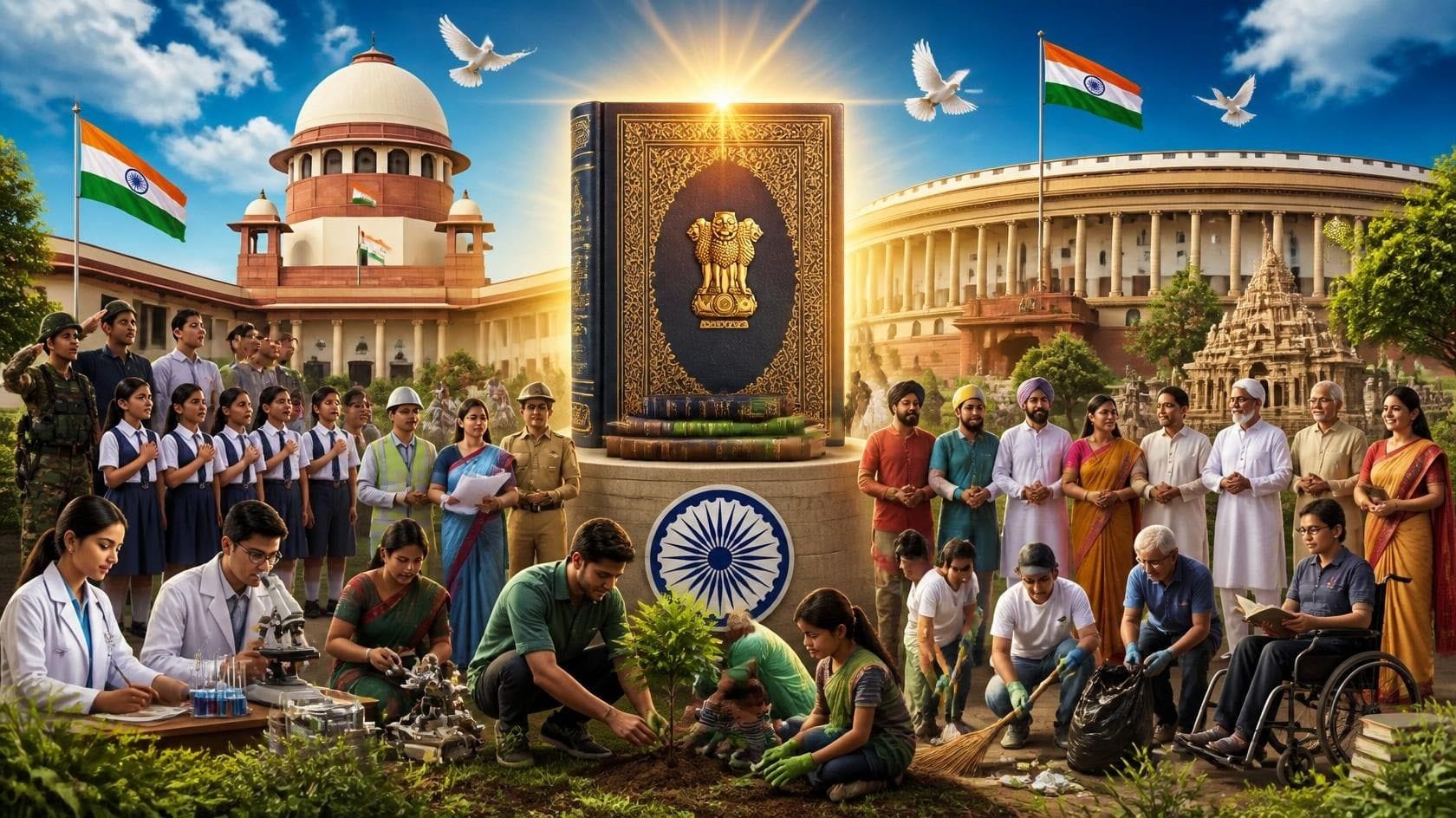
🇮🇳 Relationship with Fundamental Duties
The Fundamental Duties, incorporated under Part IVA (Article 51A) of the Constitution of India by the 42nd Constitutional Amendment Act, 1976, complement the ideals of Justice, Liberty, Equality, and Fraternity enshrined in the Preamble. While the Fundamental Rights guarantee the rights and freedoms of citizens, the Fundamental Duties remind every citizen that these rights are accompanied by corresponding responsibilities towards society, the Constitution, and the Nation. Together, rights and duties create a balanced constitutional democracy.
The framers of the original Constitution emphasised constitutional values through the Preamble, Fundamental Rights, and Directive Principles of State Policy. However, it was later recognised that citizens also have an important role in preserving these values. Therefore, the Fundamental Duties were introduced to encourage responsible citizenship, strengthen national unity, promote constitutional morality, and foster respect for democratic institutions.
🌟 Relationship Between Constitutional Ideals and Fundamental Duties
- Justice – Citizens contribute to justice by respecting the Constitution, protecting public property, promoting harmony, and upholding the rule of law.
- Liberty – Individual freedom must be exercised responsibly while respecting the rights, freedoms, and dignity of others.
- Equality – Fundamental Duties encourage citizens to reject discrimination and promote equal treatment, social harmony, and mutual respect.
- Fraternity – Duties promote the spirit of brotherhood, national integration, tolerance, and respect for India's rich cultural diversity.
The Fundamental Duties strengthen constitutional democracy by encouraging citizens to actively participate in nation-building. They inspire individuals to respect national symbols, safeguard public property, protect the environment, preserve cultural heritage, promote scientific temper, and strive for excellence in all spheres of life. These responsibilities help translate the constitutional ideals into everyday civic behaviour.
📜 Important Fundamental Duties Supporting Constitutional Values
- Article 51A(a) – To abide by the Constitution and respect its ideals, institutions, the National Flag, and the National Anthem.
- Article 51A(b) – To cherish and follow the noble ideals that inspired the national freedom struggle.
- Article 51A(c) – To uphold and protect the sovereignty, unity, and integrity of India.
- Article 51A(e) – To promote harmony and the spirit of common brotherhood transcending religious, linguistic, regional, and sectional diversities.
- Article 51A(f) – To value and preserve the rich heritage of India's composite culture.
- Article 51A(g) – To protect and improve the natural environment and show compassion for living creatures.
- Article 51A(h) – To develop scientific temper, humanism, and the spirit of inquiry and reform.
- Article 51A(i) – To safeguard public property and abjure violence.
- Article 51A(j) – To strive towards excellence in all spheres of individual and collective activity.
⚖️ Constitutional and Judicial Perspective
Although the Fundamental Duties are non-justiciable, they play a significant role in constitutional interpretation. The Supreme Court has frequently referred to these duties while deciding cases related to environmental protection, education, national integrity, and civic responsibility. Courts have recognised that Fundamental Duties reinforce constitutional values and help achieve the objectives of the Preamble by encouraging responsible citizenship.
💡 Exam Perspective (UPSC, State PCS, SSC & Judiciary)
- Relationship between the Preamble and Fundamental Duties.
- Connection between Fundamental Rights and Fundamental Duties.
- Important duties under Article 51A.
- Role of Fundamental Duties in promoting constitutional morality.
- Importance of responsible citizenship in strengthening democracy.
In conclusion, the Fundamental Duties provide the ethical and civic foundation of the Indian constitutional system. They complement the Fundamental Rights and the Directive Principles of State Policy by encouraging every citizen to uphold constitutional values, protect national unity, promote social harmony, and fulfil responsibilities towards society. Together, they ensure that the ideals of Justice, Liberty, Equality, and Fraternity are not only protected by the State but also actively preserved by the citizens of India.
⚖️ Supreme Court's Interpretation
The Supreme Court of India has played a pivotal role in interpreting and strengthening the constitutional ideals of Justice, Liberty, Equality, and Fraternity. Through judicial review and constitutional interpretation, the Court has ensured that these ideals are not merely aspirational principles mentioned in the Preamble but living constitutional values that guide governance and protect the rights of every citizen. Over the decades, landmark judgments have significantly expanded the scope of Fundamental Rights and reinforced the philosophy of the Constitution.
The Supreme Court has consistently held that the Constitution is a living document whose provisions must be interpreted in light of changing social, political, and economic realities. By adopting a progressive and purposive approach, the Court has safeguarded constitutional morality, the rule of law, and democratic governance while ensuring that individual dignity remains at the centre of constitutional interpretation.
🏛️ Landmark Supreme Court Judgments
- Kesavananda Bharati v. State of Kerala (1973) – The Supreme Court evolved the Basic Structure Doctrine, holding that Parliament cannot amend the basic structure of the Constitution. The Preamble was recognised as an integral part of the Constitution and a guide to constitutional interpretation.
- Maneka Gandhi v. Union of India (1978) – The Court expanded the meaning of Article 21, holding that the right to life and personal liberty includes a fair, just, and reasonable procedure, thereby strengthening justice, liberty, and human dignity.
- Minerva Mills v. Union of India (1980) – The Court ruled that harmony between Fundamental Rights and the Directive Principles of State Policy is a part of the Constitution's basic structure.
- S. R. Bommai v. Union of India (1994) – The Court reaffirmed that secularism is a basic feature of the Constitution and an essential element of equality, fraternity, and constitutional governance.
- K. S. Puttaswamy v. Union of India (2017) – The Supreme Court declared the Right to Privacy a Fundamental Right under Article 21, recognising privacy as an essential aspect of liberty, dignity, and personal autonomy.
- Navtej Singh Johar v. Union of India (2018) – The Court strengthened the constitutional principles of equality, liberty, dignity, and non-discrimination by recognising the rights of the LGBTQ+ community.
📜 Key Constitutional Principles Established by the Supreme Court
- The Preamble is an integral part of the Constitution and serves as a guiding principle for constitutional interpretation.
- The Basic Structure Doctrine limits Parliament's power to amend the Constitution.
- Fundamental Rights must receive a broad and liberal interpretation to protect individual liberty and dignity.
- Fundamental Rights and Directive Principles are complementary and must be interpreted harmoniously.
- Constitutional morality, the rule of law, secularism, democracy, and judicial review are essential constitutional values.
⚖️ Impact on Constitutional Governance
Through its dynamic interpretation of the Constitution, the Supreme Court has transformed constitutional ideals into practical guarantees. Judicial decisions have expanded the scope of Fundamental Rights to include privacy, education, environmental protection, dignity, legal aid, and access to justice. These interpretations ensure that the Constitution remains responsive to contemporary challenges while preserving its core democratic values.
💡 Exam Perspective (UPSC, State PCS, SSC & Judiciary)
- Importance of judicial interpretation in constitutional development.
- Landmark Supreme Court judgments on the Preamble and Fundamental Rights.
- Basic Structure Doctrine and its constitutional significance.
- Role of the Supreme Court in protecting Justice, Liberty, Equality, and Fraternity.
- Relationship between judicial review and constitutional democracy.
In conclusion, the Supreme Court of India has acted as the guardian of the Constitution by preserving and expanding the constitutional ideals of Justice, Liberty, Equality, and Fraternity. Its landmark judgments have ensured that these principles remain dynamic, enforceable, and relevant to changing societal needs, thereby strengthening constitutional democracy, protecting human dignity, and upholding the rule of law.
🏛️ Constitutional Amendments and the Basic Structure Doctrine
The Constitution of India is neither completely rigid nor entirely flexible. It allows Parliament to amend its provisions under Article 368 to meet changing social, political, and economic needs. However, the power of amendment is not unlimited. The Supreme Court of India, through the landmark judgment in Kesavananda Bharati v. State of Kerala (1973), evolved the Basic Structure Doctrine, holding that Parliament cannot alter or destroy the essential features of the Constitution. This doctrine ensures that the Constitution retains its identity and core values while allowing necessary reforms.
The ideals of Justice, Liberty, Equality, and Fraternity, embodied in the Preamble, form an integral part of the Constitution's basic structure. Therefore, although Parliament has wide powers to amend constitutional provisions, it cannot amend the Constitution in a manner that damages these foundational principles or undermines constitutional democracy.
🌟 Relationship Between Constitutional Amendments and the Basic Structure
- Article 368 empowers Parliament to amend the Constitution through a prescribed constitutional procedure.
- The Basic Structure Doctrine restricts Parliament from altering the Constitution's essential identity.
- The Preamble serves as a guiding principle for determining the Constitution's fundamental values.
- Justice, Liberty, Equality, and Fraternity are recognised as core constitutional ideals that cannot be destroyed through constitutional amendments.
- Judicial Review enables the Supreme Court to examine whether a constitutional amendment violates the basic structure.
Since the establishment of the Basic Structure Doctrine, the Supreme Court has maintained a constitutional balance between the powers of Parliament and the supremacy of the Constitution. Parliament may introduce reforms through constitutional amendments, but such amendments must preserve the democratic, secular, federal, and republican character of the Constitution.
📜 Essential Features Recognised as Part of the Basic Structure
- Supremacy of the Constitution.
- Republican and Democratic Form of Government.
- Rule of Law.
- Judicial Review.
- Separation of Powers.
- Federalism.
- Secularism.
- Free and Fair Elections.
- Independence of the Judiciary.
- Fundamental Rights.
- Harmony between Fundamental Rights and Directive Principles.
- Justice, Liberty, Equality, and Fraternity.
- Dignity of the Individual.
- Unity and Integrity of the Nation.
⚖️ Landmark Supreme Court Judgments
- Shankari Prasad v. Union of India (1951) – Held that Parliament could amend Fundamental Rights under Article 368.
- Golak Nath v. State of Punjab (1967) – Ruled that Parliament could not amend Fundamental Rights through constitutional amendments.
- Kesavananda Bharati v. State of Kerala (1973) – Introduced the Basic Structure Doctrine and held that Parliament cannot destroy the Constitution's basic structure.
- Indira Nehru Gandhi v. Raj Narain (1975) – Declared that free and fair elections are part of the Constitution's basic structure.
- Minerva Mills v. Union of India (1980) – Reaffirmed that limited amending power and harmony between Fundamental Rights and Directive Principles are part of the basic structure.
- I. R. Coelho v. State of Tamil Nadu (2007) – Held that laws placed in the Ninth Schedule are also subject to judicial review if they violate the basic structure.
💡 Exam Perspective (UPSC, State PCS, SSC & Judiciary)
- Article 368 and the constitutional amendment procedure.
- Origin and significance of the Basic Structure Doctrine.
- Important Supreme Court judgments related to constitutional amendments.
- Relationship between the Preamble and the Basic Structure Doctrine.
- Constitutional limitations on Parliament's amending power.
In conclusion, the Basic Structure Doctrine acts as the constitutional safeguard that protects the identity of the Indian Constitution from arbitrary amendments. While Article 368 empowers Parliament to amend the Constitution, the Supreme Court ensures that the essential constitutional values of Justice, Liberty, Equality, Fraternity, Democracy, Secularism, Federalism, and the Rule of Law remain intact. This balance between constitutional flexibility and constitutional supremacy has become one of the defining features of India's constitutional democracy.

⚠️ Current Challenges to Constitutional Ideals
Although the Constitution of India guarantees the ideals of Justice, Liberty, Equality, and Fraternity, their effective implementation continues to face several social, economic, political, and technological challenges. Rapid economic transformation, increasing social inequalities, communal tensions, misuse of digital platforms, and emerging governance issues have created new obstacles to the realization of constitutional values. Addressing these challenges is essential for strengthening constitutional democracy and ensuring inclusive development.
The Constitution provides a comprehensive framework for protecting human rights and promoting democratic governance. However, constitutional ideals can only be fully achieved when governments, institutions, civil society, and citizens collectively uphold constitutional morality, the rule of law, and democratic values.
🌟 Major Challenges to Constitutional Ideals
- Social Inequality – Persistent caste discrimination, gender inequality, and unequal access to education and healthcare continue to undermine the constitutional promise of equality.
- Economic Disparities – Income inequality, unemployment, poverty, and unequal distribution of resources affect social and economic justice.
- Communalism and Social Polarisation – Religious intolerance, communal violence, and identity-based conflicts weaken fraternity and national unity.
- Threats to Freedom of Expression – Misinformation, hate speech, censorship concerns, and misuse of digital platforms create challenges in balancing liberty with public order.
- Corruption and Weak Governance – Corruption, administrative inefficiency, and lack of accountability reduce public confidence in democratic institutions.
- Delay in Justice Delivery – Judicial backlog, lengthy litigation, and limited access to affordable legal services affect the realization of justice.
- Regionalism and Identity Politics – Excessive regional and sectional interests sometimes weaken national integration and constitutional fraternity.
- Environmental Challenges – Climate change, pollution, and unsustainable development increasingly affect the constitutional right to life and a healthy environment.
- Technological and Digital Challenges – Data privacy, artificial intelligence, cybercrime, and digital surveillance require continuous constitutional adaptation.
These challenges demonstrate that constitutional governance is a continuous process rather than a one-time achievement. Effective implementation of constitutional principles requires responsive institutions, informed citizens, transparent governance, judicial independence, and active public participation.
📜 Constitutional Values Affected by Contemporary Challenges
- Justice – Delayed justice, inequality, and corruption weaken public trust in the legal system.
- Liberty – Balancing individual freedoms with national security, public order, and digital regulation remains an ongoing challenge.
- Equality – Socio-economic disparities and discrimination continue to affect equal opportunities.
- Fraternity – Communal tensions, hate speech, and social divisions threaten unity and national integration.
- Constitutional Morality – Strengthening respect for constitutional institutions and democratic values remains essential.
⚖️ Role of Constitutional Institutions
Constitutional institutions such as the Supreme Court, Election Commission of India, Comptroller and Auditor General (CAG), National Human Rights Commission (NHRC), and independent constitutional bodies play a crucial role in protecting constitutional values. Their effectiveness depends on institutional independence, transparency, accountability, and public confidence.
💡 Exam Perspective (UPSC, State PCS, SSC & Judiciary)
- Contemporary challenges to Justice, Liberty, Equality, and Fraternity.
- Impact of technology and social media on constitutional values.
- Role of constitutional institutions in protecting democracy.
- Issues relating to constitutional morality and the rule of law.
- Current affairs-based questions linking constitutional values with governance.
In conclusion, the constitutional ideals of Justice, Liberty, Equality, and Fraternity remain as relevant today as they were at the time of the Constitution's adoption. However, emerging socio-economic, political, environmental, and technological challenges require continuous constitutional vigilance, institutional reforms, responsible governance, and active citizen participation. Upholding these constitutional values is essential for preserving democracy, protecting human dignity, and ensuring the long-term unity, integrity, and inclusive development of India.
💡 Solutions to Strengthen Constitutional Ideals
The constitutional ideals of Justice, Liberty, Equality, and Fraternity can be effectively realised only through continuous efforts by the State, constitutional institutions, civil society, and citizens. While the Constitution provides a strong legal and institutional framework, its success ultimately depends on responsible governance, constitutional morality, public participation, and the rule of law. Strengthening these constitutional values is essential for building an inclusive, democratic, and welfare-oriented society.
Addressing contemporary constitutional challenges requires a comprehensive approach that combines legal reforms, institutional accountability, social awareness, economic inclusion, technological governance, and active civic engagement. Every stakeholder has a shared responsibility to preserve the spirit and vision of the Constitution.
🌟 Key Measures to Strengthen Constitutional Values
- Promote Constitutional Literacy – Strengthen constitutional education in schools, colleges, and public institutions to create awareness about rights, duties, and democratic values.
- Ensure Access to Justice – Reduce judicial delays, improve legal aid services, promote alternative dispute resolution, and enhance access to affordable justice.
- Strengthen Democratic Institutions – Preserve the independence, transparency, and accountability of constitutional bodies such as the judiciary, Election Commission, and other oversight institutions.
- Reduce Social and Economic Inequalities – Implement inclusive development policies that improve education, healthcare, employment opportunities, and social security for disadvantaged communities.
- Promote Social Harmony – Encourage interfaith dialogue, communal harmony, gender equality, and respect for cultural diversity to strengthen fraternity.
- Protect Fundamental Rights – Ensure effective implementation of constitutional safeguards relating to liberty, equality, dignity, and privacy while maintaining public order.
- Improve Good Governance – Enhance transparency, accountability, anti-Corruption mechanisms, and citizen-centric public administration.
- Strengthen Digital Governance – Protect data privacy, regulate emerging technologies responsibly, and promote digital literacy while safeguarding constitutional freedoms.
- Encourage Active Citizenship – Promote civic participation, constitutional morality, volunteerism, and responsible exercise of Fundamental Rights and Duties.
The successful implementation of these measures requires cooperation among the legislature, executive, judiciary, media, educational institutions, civil society organisations, and citizens. constitutional democracy thrives when institutions remain independent and citizens actively participate in protecting democratic values.
📜 Constitutional Principles Supporting These Solutions
- Preamble – Provides the guiding constitutional philosophy of Justice, Liberty, Equality, and Fraternity.
- Fundamental Rights (Part III) – Protect individual freedoms, equality, and constitutional remedies.
- Directive Principles of State Policy (Part IV) – Guide the State in promoting social and economic welfare.
- Fundamental Duties (Part IVA) – Encourage responsible citizenship, constitutional morality, and national integration.
- Judicial Review – Ensures that constitutional values remain protected against arbitrary State action.
🏛️ Shared Responsibility of Stakeholders
- Parliament and State Legislatures – Enact laws consistent with constitutional values.
- Executive – Implement policies fairly, transparently, and efficiently.
- Judiciary – Protect constitutional rights and uphold the rule of law.
- Educational Institutions – Promote constitutional awareness and civic responsibility.
- Media and Civil Society – Encourage informed public debate and democratic accountability.
- Citizens – Respect the Constitution, perform Fundamental Duties, and actively participate in nation-building.
💡 Exam Perspective (UPSC, State PCS, SSC & Judiciary)
- Measures to strengthen Justice, Liberty, Equality, and Fraternity.
- Role of constitutional institutions in protecting democratic values.
- Importance of constitutional morality and responsible citizenship.
- Good governance and institutional accountability.
- Current affairs-based reforms relating to constitutional governance.
In conclusion, the constitutional vision of Justice, Liberty, Equality, and Fraternity can be achieved only through collective commitment to constitutional principles, democratic governance, and responsible citizenship. By strengthening institutions, ensuring social and economic inclusion, protecting Fundamental Rights, promoting constitutional morality, and encouraging active public participation, India can continue to realise the transformative vision envisioned by the framers of the Constitution and build a stronger, more inclusive constitutional democracy.
🎯 UPSC Examination Perspective
The constitutional ideals of Justice, Liberty, Equality, and Fraternity are among the most important topics in the Indian Polity syllabus for the UPSC Civil Services Examination. These values form the philosophical foundation of the Preamble and are closely linked with the Fundamental Rights, Directive Principles of State Policy (DPSPs), Fundamental Duties, the Basic Structure Doctrine, and landmark judgments of the Supreme Court. UPSC frequently tests both conceptual understanding and the practical application of these constitutional principles in governance and contemporary issues.
Aspirants should study this topic from constitutional, legal, administrative, and Current affairs perspectives. A clear understanding of the interrelationship between constitutional ideals and their implementation is essential for answering both objective and analytical questions in the examination.
📘 Importance in UPSC Syllabus
- Preliminary Examination – Questions on the Preamble, Fundamental Rights, DPSPs, Fundamental Duties, constitutional amendments, and landmark judgments.
- Mains GS Paper II – Constitutional philosophy, governance, Parliament, judiciary, constitutional morality, and public policy.
- Essay Paper – Themes relating to democracy, social justice, equality, liberty, constitutional values, and inclusive governance.
- Ethics (GS Paper IV) – Constitutional morality, justice, equality, integrity, accountability, and ethical governance.
- Interview (Personality Test) – Application of constitutional principles to current national and international issues.
📜 Important Areas for Preparation
- Meaning and significance of the Preamble.
- Justice, Liberty, Equality, and Fraternity as constitutional ideals.
- Relationship between the Preamble, Fundamental Rights, DPSPs, and Fundamental Duties.
- Basic Structure Doctrine and Parliament's amending power under Article 368.
- Landmark Supreme Court judgments including Kesavananda Bharati, Maneka Gandhi, Minerva Mills, and K. S. Puttaswamy.
- Constitutional morality and the Rule of Law.
- Current constitutional debates and governance reforms.
📝 Frequently Asked UPSC Themes
- Explain the significance of the Preamble as the key to the Constitution.
- Discuss the relationship between Justice, Liberty, Equality, and Fraternity.
- Examine the role of the Basic Structure Doctrine in preserving constitutional democracy.
- How do Fundamental Rights and Directive Principles complement each other?
- Evaluate the importance of constitutional morality in democratic governance.
- Discuss contemporary challenges in realizing constitutional ideals in India.
💡 Smart Preparation Tips
- Read the complete text of the Preamble and understand the meaning of each constitutional ideal.
- Prepare important Articles (14–32, 36–51, 51A, and 368) along with their practical significance.
- Revise landmark Supreme Court judgments with constitutional principles established in each case.
- Link constitutional provisions with current affairs, governance reforms, and recent judicial developments.
- Practise previous UPSC questions and write analytical answers with constitutional provisions, case laws, and contemporary examples.
- Use constitutional keywords such as constitutional morality, rule of law, judicial review, basic structure, welfare state, and inclusive democracy in Mains answers.
In conclusion, the constitutional ideals of Justice, Liberty, Equality, and Fraternity are among the most frequently tested themes in the UPSC Civil Services Examination. A strong conceptual understanding, supported by constitutional provisions, landmark judgments, committee recommendations, and current affairs, enables aspirants to write balanced, analytical, and high-scoring answers in both the Preliminary and Mains examinations while also preparing effectively for the Personality Test.
🏁 Conclusion
The ideals of Justice, Liberty, Equality, and Fraternity form the philosophical foundation and moral soul of the Constitution of India. Enshrined in the Preamble, these values reflect the vision of the Constitution's framers to establish a sovereign, democratic, inclusive, and welfare-oriented society where every individual enjoys dignity, equal opportunities, and freedom under the rule of law. These principles are not merely constitutional aspirations but enforceable guiding values that shape governance, legislation, judicial interpretation, and public policy.
The constitutional journey of India demonstrates that these ideals are closely interconnected with the Fundamental Rights, Directive Principles of State Policy, Fundamental Duties, and the Basic Structure Doctrine. Through landmark judgments, particularly those delivered by the Supreme Court, these constitutional values have evolved into living principles capable of addressing changing social, political, economic, and technological realities while preserving the identity of the Constitution.
🌟 Key Takeaways
- The Preamble expresses the constitutional philosophy and vision of the Indian State.
- Justice, Liberty, Equality, and Fraternity together ensure a balanced and inclusive democratic order.
- The Supreme Court has strengthened these constitutional ideals through progressive judicial interpretation and the Basic Structure Doctrine.
- Fundamental Rights, Directive Principles, and Fundamental Duties collectively promote constitutional governance and social transformation.
- Constitutional morality, responsible citizenship, and institutional accountability are essential for protecting constitutional democracy.
- Emerging challenges such as inequality, technological change, environmental concerns, and social polarisation require continuous constitutional adaptation and democratic vigilance.
📜 Final Constitutional Message
The Constitution is not merely a legal document but a living instrument that derives its true strength from the commitment of its citizens and institutions to constitutional values. The successful realization of Justice, Liberty, Equality, and Fraternity requires transparent governance, an independent judiciary, active public participation, social harmony, and unwavering respect for the rule of law. Only through collective adherence to these ideals can India continue to strengthen its constitutional democracy and fulfil the aspirations of its people.
🎯 UPSC Quick Revision
- Remember the four constitutional ideals: Justice, Liberty, Equality, and Fraternity.
- Link the Preamble with Fundamental Rights, DPSPs, and Fundamental Duties.
- Revise the Basic Structure Doctrine and landmark judgments such as Kesavananda Bharati, Maneka Gandhi, and Minerva Mills.
- Use constitutional concepts like constitutional morality, rule of law, judicial review, and inclusive democracy in Mains answers.
- Relate constitutional principles to contemporary governance and Current affairs for analytical and high-scoring answers.
Ultimately, the strength of the Indian Constitution lies not only in its written provisions but also in the collective determination of the State and its citizens to uphold its enduring ideals. As long as the principles of Justice, Liberty, Equality, and Fraternity continue to guide governance and public life, the Constitution will remain a dynamic instrument of democracy, social justice, national unity, and human dignity for generations to come.