
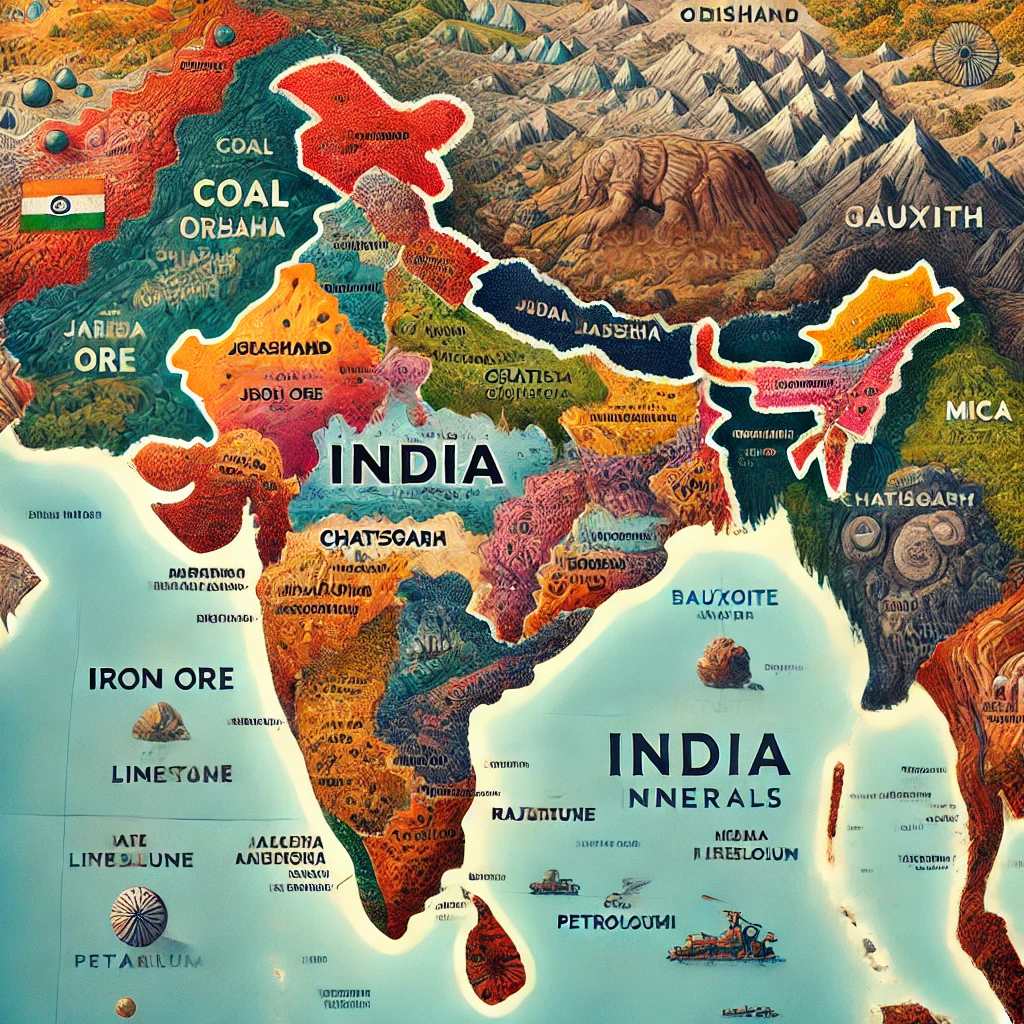
Mineral Resources of India: Types, Distribution, Uses & Challenges
When I first started understanding India’s geography and economy, one thing became very clear to me: beneath our soil lies an extraordinary wealth of mineral resources. In this article, I am sharing my learnings about how these minerals shape our industries, impact our environment, and contribute to India’s growth story.
Introduction
India is one of the richest countries in the world in terms of mineral resources. Various types of minerals are found here, which play an important role in the economic and industrial progress of the country. The mineral resources of India can be mainly classified into metallic, non-metallic and energy-related minerals.
These minerals form the backbone of key sectors such as steel, power, construction, and chemical industries. Below is a detailed description of India’s major mineral resources and their significance.
1. Metallic Minerals
Metallic minerals are those from which metals can be extracted. These minerals are crucial for the development of heavy industries and infrastructure.
1.1 Iron Ore
Main Areas
Jharkhand, Chhattisgarh, Odisha, Karnataka and Goa.
Use
Iron ore is primarily used in the steel and other metallurgical industries. India is also a major exporter of iron ore.
1.2 Bauxite
Main Areas
Odisha, Gujarat, Jharkhand and Maharashtra.
Use
Bauxite is the chief ore of aluminium and is mainly used in aluminium production.
1.3 Manganese
Main Areas
Madhya Pradesh, Karnataka and Maharashtra.
Use
Manganese is used in steelmaking and in various chemical industries. It is a key ingredient in improving the strength and durability of steel.
1.4 Copper
Main Areas
Rajasthan, Madhya Pradesh and Jharkhand.
Use
Copper is widely used in electrical equipment, wiring, electronics and construction due to its excellent electrical and thermal conductivity.
1.5 Gold
Main Areas
Karnataka (Kolar Gold Fields) and Andhra Pradesh.
Use
Gold is primarily used in jewellery manufacturing, investment and as a store of value.
2. Non-Metallic Minerals
Non-metallic minerals do not yield metals on smelting, but they are extremely important for various industries such as cement, glass, ceramics, chemicals and electronics.
2.1 Limestone
Main Areas
Madhya Pradesh, Rajasthan and Andhra Pradesh.
Use
Limestone is mainly used in cement manufacturing and in chemical industries.
2.2 Mica
Main Areas
Jharkhand, Bihar and Rajasthan.
Use
Mica is used in the electrical and electronics industry because of its insulating properties. India is one of the largest producers and exporters of mica in the world.
2.3 Graphite
Main Areas
Odisha and Jharkhand.
Use
Graphite is used in batteries, electroplating industry, lubricants and as a refractory material.
2.4 Dolomite
Main Areas
Chhattisgarh and Odisha.
Use
Dolomite is used in steel, glass and ceramic industries and also as a building material.
3. Energy Minerals
Energy minerals are used for the generation of power and fuel, making them vital for the modern economy and daily life.
3.1 Coal
Main Areas
Jharkhand (Jharia and Bokaro), Odisha and Chhattisgarh.
Use
Coal is used for power generation, in the steel industry and various other industries. India is among the leading countries in coal production.
3.2 Petroleum
Main Areas
Mumbai High, Gujarat and Assam.
Use
Petroleum is used to produce fuels (petrol, diesel, kerosene) and a wide range of petrochemicals.
3.3 Natural Gas
Main Areas
Assam, Tripura and Gujarat.
Use
Natural gas is used as cooking gas (LPG/CNG), in power plants and in fertilizer manufacturing.
3.4 Uranium
Main Areas
Jharkhand (Jaduguda).
Use
Uranium is used as fuel for nuclear power generation.
Characteristics of the Distribution of Mineral Resources of India
4.1 Uneven Distribution
Mineral resources are unevenly distributed across the country. They are mainly found in large quantities in eastern and central India, especially in states like Jharkhand, Chhattisgarh and Odisha.
4.2 Utilization of Mineral Resources
India’s mineral resources are utilised in both domestic and international markets. They support the country’s industrial growth and earn valuable foreign exchange through exports.
4.3 Impact on Industry
Mineral resources form the base for various industries of the country such as steel, power, construction, chemical and manufacturing industries. Without these minerals, India’s industrialisation and economic development would be severely limited.
4.4 Environmental Impacts
Mining activities can have negative impacts on the environment, such as deforestation, soil erosion, land degradation and water pollution. Therefore, there is a growing need for responsible mining practices and strong environmental protection measures.
Conclusion
India’s mineral resources are extremely important for the country’s economic prosperity. Through their proper use, value addition and conservation, the country’s industrial and social development can be further promoted.
At the same time, we must remember that minerals are finite and mining can harm the environment if not managed carefully. Keeping sustainable development in mind, it is important to maintain a balance between the mining industry and environmental protection. In my view, the real success of our mineral wealth will be measured not just by how much we extract, but by how wisely and responsibly we use it for current and future generations.

FAQs on Mineral Resources of India
Q1. What are the main types of mineral resources found in India?
The main types of mineral resources found in India are metallic minerals (such as iron ore, bauxite, manganese, copper, gold), non-metallic minerals (such as limestone, mica, graphite, dolomite) and energy minerals (such as coal, petroleum, natural gas and uranium).
Q2. Why are mineral resources important for India’s economy?
Mineral resources are important because they form the raw material base for key industries like steel, power, construction, chemicals and manufacturing. They support industrial growth, generate employment, contribute to infrastructure development and help earn foreign exchange through exports.
Q3. Which regions of India are rich in mineral resources?
Eastern and central India are particularly rich in mineral resources. States such as Jharkhand, Chhattisgarh, Odisha, West Bengal and parts of Madhya Pradesh and Karnataka have significant deposits of coal, iron ore and other minerals.
Q4. What are the major environmental impacts of mining in India?
Major environmental impacts of mining include deforestation, loss of biodiversity, soil erosion, land degradation, water pollution and air pollution. Unregulated mining can also affect local communities and their livelihoods.
Q5. How can India achieve sustainable use of its mineral resources?
India can achieve sustainable use of mineral resources by adopting scientific and eco-friendly mining practices, enforcing strict environmental regulations, promoting recycling and reuse of materials, encouraging value addition within the country and involving local communities in decision-making.
Q6. Which industries are most dependent on metallic minerals?
Industries such as the steel industry, engineering, construction, transport, shipbuilding, automotive and electrical equipment manufacturing are highly dependent on metallic minerals like iron ore, manganese, copper, aluminium and others.
Suggested Internal Links
Metallic Minerals in India: Types, Distribution, Uses & Importance
When I first began studying India’s mineral heritage, I realized how deeply metallic minerals shape our industries and economy. These minerals are not just resources—they are engines of growth, powering everything from steel plants to modern technology. In this article, I share a clear, informative understanding of India’s metallic minerals, their distribution, uses, challenges and future potential.
What Are Metallic Minerals?
Metallic minerals are those that contain metallic elements and are mainly used for the production of metals. They play a crucial role in India’s industrial and economic development.
Categories of Metallic Minerals
1. Ferrous Minerals
These minerals contain iron or ferrous elements and are vital for the steel industry.
2. Non-Ferrous Minerals
These minerals do not contain iron but include important metals like copper, aluminium, gold, etc.
1. Iron Ore
Importance
Iron ore is India’s most important ferrous mineral and the basic raw material for the steel industry.
Major Types
- Hematite: High iron content (60–70%)
- Magnetite: Very high iron content (up to 70%) with magnetic properties
Main Areas
- Jharkhand (Singhbhum)
- Odisha (Kendujhar, Sundergarh)
- Chhattisgarh (Bastar)
- Karnataka (Chikmagalur, Bellary)
Uses
Essential for manufacturing steel and various alloys.
2. Manganese
Importance
Manganese is crucial in steelmaking, battery production and chemical industries.
Main Areas
- Madhya Pradesh (Balaghat)
- Maharashtra (Nagpur)
- Karnataka (Udupi)
Uses
- Hardening of steel
- Chemical and glass industries
3. Bauxite
Importance
Bauxite is the principal ore used for aluminium production.
Main Areas
- Odisha (Kalahandi, Koraput)
- Gujarat
- Jharkhand
- Maharashtra
Uses
- Aluminium production
- Aircraft manufacturing
- Packaging industry
- Electrical equipment
4. Copper
Importance
Copper is extremely important for electrical, communication and construction industries.
Main Areas
- Rajasthan (Khetri)
- Madhya Pradesh (Balaghat)
- Jharkhand
Uses
- Electrical wires and cables
- Alloys such as brass and bronze
5. Gold
Importance
Gold is valuable for jewellery, investment, currency reserves and modern electronics.
Main Areas
- Karnataka (Kolar Gold Fields)
- Andhra Pradesh
- Jharkhand
Uses
- Jewellery and currency
- Electronics and medical equipment
6. Zinc and Lead
Importance
- Zinc prevents steel from rusting (galvanization)
- Lead is used in batteries and paint industries
Main Areas
- Rajasthan (Zawar Mines)
Uses
- Batteries
- Paints
- Various alloys
7. Chromite
Importance
Chromium obtained from chromite is used for hardening steel and in chemical industries.
Main Areas
- Odisha (Balasore, Cuttack)
Uses
- Stainless steel production
- Pigments and dyes
Areas of Use of Metallic Minerals
Industrial Sector
Used in steel, aluminium, cement and machinery industries.
Electrical Sector
Used in manufacturing electrical appliances, wires and transformers.
Chemical Industry
Used for fertilizers, pigments, paints and industrial chemicals.
Jewellery Industry
Gold, silver and platinum enhance India’s jewellery market and exports.
Importance of Metallic Minerals in India
1. Economic Contribution
Metallic minerals significantly contribute to India’s GDP.
2. Backbone of Industries
They form the raw material base for major industries, especially steel and manufacturing.
3. Exports
India exports many minerals such as iron ore, contributing to foreign exchange earnings.
4. Employment
The mining and processing sector provides jobs to millions of people across the country.
Challenges and Solutions
Challenges
- Uneven distribution of mineral resources
- Environmental degradation due to mining
- Illegal mining activities
Solutions
- Adoption of sustainable mining practices
- Efficient and scientific utilization of mineral resources
- Strict environmental regulations and monitoring
Conclusion
Metallic minerals play a central role in India’s industrial, economic and social progress. Their careful use, conservation and value addition will determine how successfully India harnesses its mineral wealth for future generations.
FAQs on Metallic Minerals of India
Q1. What are the main metallic minerals found in India?
The major metallic minerals include iron ore, manganese, bauxite, copper, gold, zinc, lead and chromite.
Q2. Which state is the largest producer of iron ore in India?
Odisha is the largest producer of iron ore in India.
Q3. Why are metallic minerals important?
They are essential for industries like steel, electrical equipment, chemicals and jewellery, making them vital for economic development.
Q4. What are the environmental impacts of metallic mineral mining?
Mining may lead to deforestation, soil erosion, water pollution and habitat destruction if not regulated.
Q5. How can India ensure sustainable use of metallic minerals?
By adopting eco-friendly mining, enforcing environmental laws, recycling metals and improving mining efficiency.

Suggested Internal Links for SEO
Non-Metallic Minerals in India: Types, Distribution, Uses & Importance
During my study of India’s mineral wealth, I realised that non-metallic minerals are just as vital as metallic ones. They may not contain metals, but they power our construction, agriculture, chemical and industrial processes in countless ways. Here, I share an organized, simplified and informative explanation of India’s major non-metallic minerals and their significance.
What Are Non-Metallic Minerals?
Non-metallic minerals are minerals in which metallic elements are absent. These minerals are essential for industries such as construction, agriculture, chemicals, glass, ceramics and manufacturing.
Characteristics of Non-Metallic Minerals
- They do not possess metallic lustre or high density.
- They are poor conductors of electricity and heat.
- Widely used in industrial and chemical processes.
1. Limestone
Importance
Limestone is mainly used in the production of cement and lime.
Main Areas
- Madhya Pradesh (Katni, Satna)
- Rajasthan (Chittorgarh)
- Andhra Pradesh
- Tamil Nadu
Uses
- Cement industry
- Lime manufacturing (chemical industry)
- Metal cleaning in the steel industry
2. Mica
Importance
Mica is an excellent electrical insulator and heat-resistant mineral.
Main Areas
- Jharkhand (Giridih)
- Rajasthan (Jaipur, Ajmer)
- Bihar
Uses
- Electrical equipment
- Cosmetics and paint industries
- Insulation material
India’s Contribution
India is the world’s largest producer and exporter of mica.
3. Graphite
Importance
Graphite is used in batteries, electrodes and electrical devices.
Main Areas
- Jharkhand
- Odisha
- Tamil Nadu
Uses
- Pencil tips
- Batteries and electrodes
- Lubricant and chemical industries
4. Dolomite
Importance
Dolomite is important for steel, glass and chemical industries.
Main Areas
- Chhattisgarh
- Odisha
- Rajasthan
Uses
- Steel industry
- Glass manufacturing
- Chemical industry
5. Silica
Importance
Silica is vital for the glass and cement industries.
Main Areas
- Rajasthan
- Gujarat
Uses
- Glass manufacturing
- Ceramics
- Cement production
6. Gypsum
Importance
Gypsum is used in fertilizer and cement industries.
Main Areas
- Rajasthan (Bikaner, Nagaur)
- Jammu and Kashmir
- Tamil Nadu
Uses
- Cement manufacturing
- Soil fertility improvement in agriculture
7. Fluorite
Importance
Fluorite is a major chemical mineral.
Main Areas
- Rajasthan
Uses
- Aluminium and steel industry
- Dental products
8. Asbestos
Importance
Asbestos is strong, flexible and heat-resistant.
Main Areas
- Rajasthan
- Jharkhand
Uses
- Insulation materials
- Roofing and pipe construction
9. Kaolin
Importance
Kaolin is useful in ceramic and paper industries.
Main Areas
- Rajasthan
- West Bengal
Uses
- Ceramics production
- Paper manufacturing
Importance of Non-Metallic Minerals in India
1. Industrial Base
These minerals form the foundation of cement, glass, ceramics, paint and other industries.
2. Chemical Uses
Limestone, gypsum and fluorite contribute significantly to the chemical industry.
3. Agriculture
Gypsum and other minerals help improve soil fertility.
4. Foreign Exchange
India earns foreign exchange by exporting minerals such as mica and graphite.
Challenges and Solutions
Challenges
- Uneven distribution of minerals
- Illegal mining and environmental damage
- Over-exploitation of mineral resources
Solutions
- Sustainable mining practices
- Mineral conservation and development of alternatives
- Environmental rehabilitation post-mining
Conclusion
Non-metallic minerals play a vital role in India’s industrial and economic development. Their proper use and conservation are essential for sustainable growth. By adopting environmentally responsible mining policies and efficient resource management, India can ensure long-term mineral security.
FAQs on Non-Metallic Minerals of India
Q1. What are non-metallic minerals?
Non-metallic minerals do not contain metal elements and are used mainly in industrial and chemical processes.
Q2. Which is the most important non-metallic mineral for the cement industry?
Limestone is the most important mineral used in cement manufacturing.
Q3. Why is mica important?
Mica is a good insulator, heat-resistant and widely used in electrical and cosmetic industries.
Q4. Which state is the largest producer of gypsum?
Rajasthan is the largest producer of gypsum in India.
Q5. What challenges are faced in non-metallic mineral mining?
Challenges include environmental damage, illegal mining and uneven distribution of resources.
Suggested Internal Links

Characteristics of the Distribution of Mineral Resources of India
India is one of the world’s richest nations in terms of mineral resources. These minerals are found in different regions depending on geography, climate, and geological structures. In this article, I share clear insights into how minerals are distributed across India, why distribution is uneven, and how this diversity shapes India’s economic development.
1. Uneven Distribution
Mineral resources in India are not evenly distributed. Eastern and central India contain the highest concentration of minerals, while western India is rich in non-metallic minerals.
Examples of Uneven Distribution
- Iron Ore: Odisha, Jharkhand, Chhattisgarh
- Coal: Jharkhand, West Bengal, Chhattisgarh
- Bauxite: Odisha, Gujarat
2. Major Mineral Belts of India
India’s mineral resources are mainly distributed across four significant mineral belts:
(a) North-Eastern Mineral Belt
States: Jharkhand, West Bengal, Odisha
Major Minerals: Coal, iron ore, manganese, bauxite
(b) Southern Mineral Belt
States: Karnataka, Andhra Pradesh, Tamil Nadu
Major Minerals: Gold, iron ore, chromite
(c) Western Mineral Belt
States: Rajasthan, Gujarat
Major Minerals: Limestone, gypsum, mica
(d) Central Indian Mineral Belt
States: Madhya Pradesh, Chhattisgarh, Maharashtra
Major Minerals: Manganese, coal, copper
3. Distribution According to Geological Structure
The geology of India plays a major role in mineral concentration:
- Dharwar Craton: Iron ore, manganese, gold
- Gondwana Rock Group: Coal reserves
- Vindhyan Rock Group: Limestone, dolomite
4. Regional Distribution of Metallic and Non-Metallic Minerals
Metallic Minerals
Mostly found in Jharkhand, Odisha, Chhattisgarh, and Karnataka.
Examples: Iron ore, manganese, copper
Non-Metallic Minerals
Mainly found in Rajasthan, Gujarat, and Tamil Nadu.
Examples: Limestone, gypsum, mica
5. Special Distribution of Energy Minerals
Coal
Located mainly in the Gondwana regions of Jharkhand, Odisha, West Bengal and Chhattisgarh.
Petroleum & Natural Gas
Found in Assam, Gujarat and Mumbai High.
Uranium
Major deposits are located in Jharkhand (Jaduguda).
6. Influence of Climatic and Geographical Factors
Northeast India
High rainfall impacts mining operations and mineral storage.
Thar Desert (Rajasthan)
Rich in non-metallic minerals like gypsum and mica.
7. Mineral Distribution in Major States
(a) Jharkhand
Iron ore, coal, manganese and mica.
Major areas: Singhbhum, Dhanbad
(b) Odisha
One of India’s top mineral-producing states.
Resources: Iron ore, chromite, bauxite, coal
(c) Rajasthan
Limestone, gypsum, fluorite; desert areas rich in non-metallic minerals.
(d) Karnataka
Gold (Kolar Gold Fields), iron ore
(e) Madhya Pradesh
Copper, manganese, dolomite
8. Problems Related to Mineral Distribution
- Uneven distribution of minerals
- Over-exploitation due to rising demand
- Environmental issues (deforestation, water pollution, soil erosion)
9. Measures to Improve Mineral Distribution
Balanced Mineral Policy
Ensures fair and sustainable utilization of mineral wealth.
Mineral Conservation
Encourages sustainable mining and development of alternatives.
Value Addition
Setting up mineral processing units to increase economic value.
Environmental Protection
Restoring land after mining and increasing afforestation.
Conclusion
The distribution of mineral resources in India is uneven, yet their diversity gives India a strong foundation for industrial and economic development. With sustainable mining, conservation strategies and environmental protection, India can ensure that its mineral wealth contributes to a brighter future.
FAQs on the Distribution of Mineral Resources in India
Q1. Why is the distribution of minerals uneven in India?
Due to geological variations, tectonic activity, climatic differences and historical rock formation processes.
Q2. Which mineral belt is the richest in India?
The North-Eastern Mineral Belt (Jharkhand, West Bengal, Odisha) is among the richest in mineral deposits.
Q3. Which states are rich in non-metallic minerals?
Rajasthan, Gujarat and Tamil Nadu contain the largest reserves of non-metallic minerals.
Q4. What factors influence mineral distribution in India?
Geological structure, climate, rock formation, tectonic movements and environmental conditions.
Q5. What are the major problems with mineral distribution in India?
Over-exploitation, uneven distribution and environmental pollution due to mining.
Suggested Internal Links

References
- Government of India, Ministry of Mines – Mineral Resource Reports
- Geological Survey of India (GSI) – Mineral Distribution Data
- National Mineral Development Corporation (NMDC) – Annual Reports
- NCERT Geography Textbooks – Chapters on Mineral and Energy Resources
- Economic Geography of India – Studies on Mineral and Energy Resources
- State Geological Departments – Published Mineral Survey Documents