
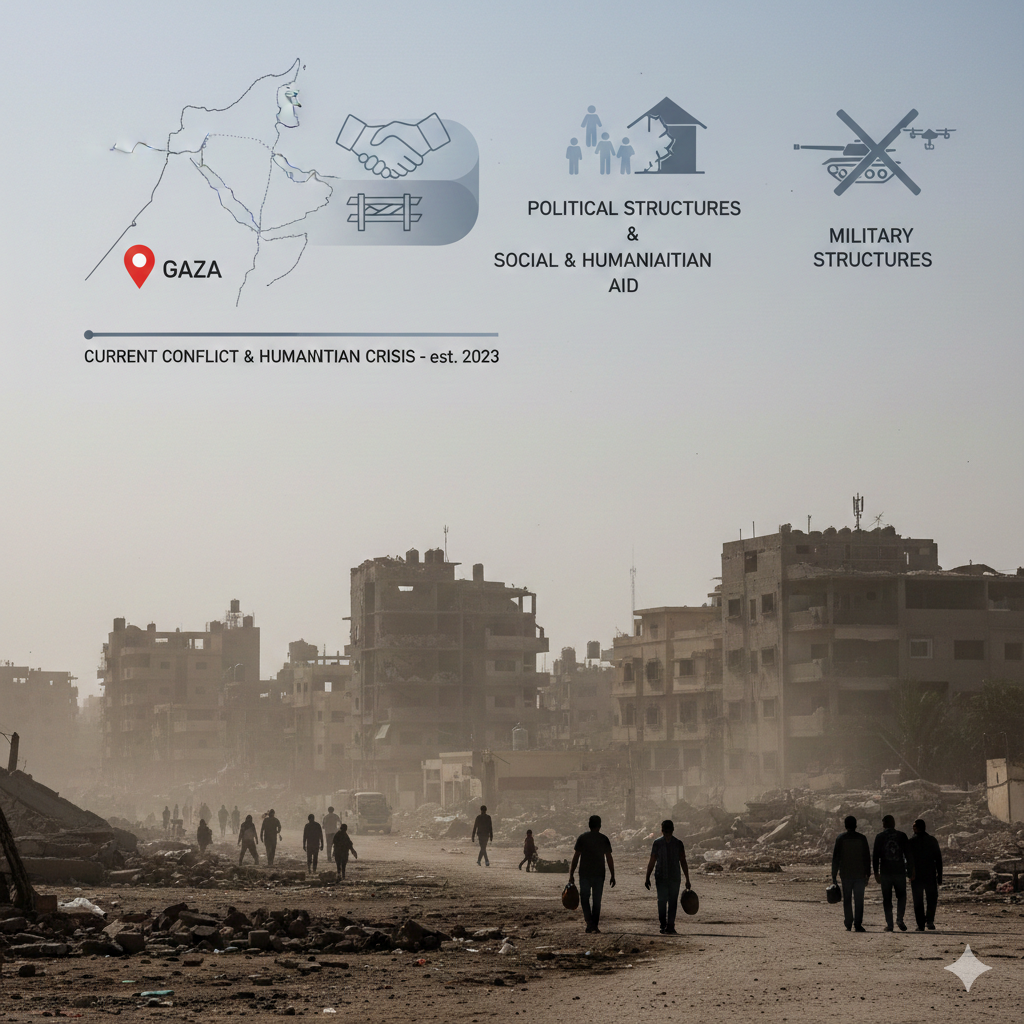
Introduction
This article presents a factual overview of Hamas, formally known as Harakat al-Muqawama al-Islamiya. It examines the organization's origins, ideology, structure, major events, international responses, and the humanitarian and political consequences associated with its activities.
Hamas is a Palestinian Islamist organization with political, social, and armed components. It has been primarily associated with the Gaza Strip and the wider Israeli-Palestinian conflict. Different governments and political groups view Hamas differently. Several countries designate the organization as a terrorist organization, while some political actors describe it as a resistance movement. Its attacks on civilians, armed activities, and governance in Gaza remain central to international debates about the organization.
Establishment and History of Hamas
Founding of Hamas
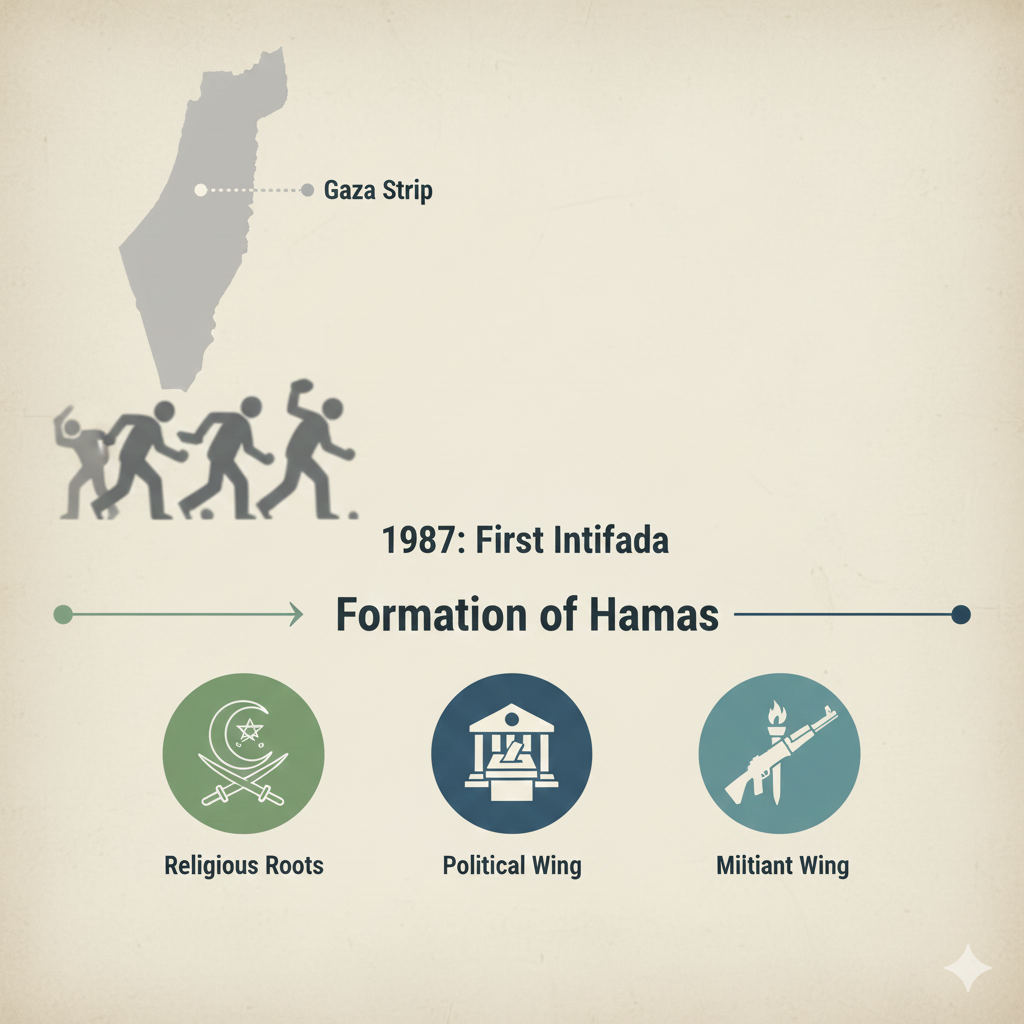
Hamas was established in December 1987 during the First Intifada, a Palestinian uprising against Israeli occupation. The organization emerged from the Palestinian branch of the Muslim Brotherhood and developed into an important actor in Palestinian political and armed activities.
Founders and Early Leadership
The early leadership of Hamas included Sheikh Ahmed Yassin, Abd al-Aziz al-Rantisi, and Mohammed Taha. These figures played important roles in shaping the organization's early ideology, political activities, social networks, and armed strategy.
Ideology and Objectives of Hamas
Hamas combines Sunni Islamist ideology with Palestinian nationalism. Its political objectives and stated positions have evolved over time. Important elements of its ideology and activities include:
- Establishing Palestinian self-determination and opposing Israeli control over Palestinian territories.
- Supporting armed resistance against Israel, including activities that have involved attacks on civilians.
- Promoting an Islamic political and social framework within Palestinian society.
- Maintaining political and social influence through its organizational networks and institutions.
Different observers emphasize different aspects of Hamas, including its political activities, governance, social services, ideology, and armed operations. These different dimensions contribute to the sharply divided international debate surrounding the organization.
Recommended Study Resource
Explore this resource on Amazon for additional reading and learning related to history, international relations, and contemporary political developments.
Affiliate Disclosure: This article contains an affiliate link. We may earn a commission if you make a purchase through this link, at no additional cost to you.
Structure of Hamas
Hamas has political, social, administrative, and military dimensions. Its organizational structure includes leadership bodies and different networks responsible for political activities, governance, and armed operations.
Political Leadership and Activities
The political leadership of Hamas has been involved in political decision-making, external relations, negotiations, and administrative activities. The organization has maintained political representatives and offices that engage with regional and international actors.
Military Wing – Izz ad-Din al-Qassam Brigades
The Izz ad-Din al-Qassam Brigades are the armed wing of Hamas. They have been responsible for the organization's military operations against Israel. The Brigades have carried out rocket attacks, armed assaults, and other military activities. Their operations, including attacks on civilians, have been a major factor in the international response to Hamas.
Major Events and Conflicts Involving Hamas
Since its establishment, Hamas has played a significant role in Palestinian politics and the Israeli-Palestinian conflict. The following timeline highlights important developments:
Key Historical Timeline
- 1987: Hamas was established during the First Intifada.
- 1993: Hamas opposed the Oslo Accords and remained outside the political framework established by those agreements.
- 2006: Hamas won the largest number of seats in the Palestinian Legislative Council elections and subsequently formed a government.
- 2007: Hamas took control of the Gaza Strip following violent conflict with Fatah forces, deepening the political division between Gaza and the West Bank.
- 2008–2009, 2012, 2014 and 2021: Major rounds of fighting between Israel and Palestinian armed groups, including Hamas, occurred in and around Gaza.
- 7 October 2023: Hamas-led armed groups launched a large-scale attack on Israel, killing civilians and military personnel and taking hostages. Israel subsequently launched a major military campaign in Gaza, resulting in extensive destruction, displacement, and a severe humanitarian crisis.
International Recognition and Controversy
International responses to Hamas vary according to national laws, political positions, and regional interests. Its designation, political engagement, and international relationships remain controversial.
- Terrorist Designations: The United States, the United Kingdom, Canada, the European Union, and several other jurisdictions designate Hamas as a terrorist organization. The precise legal scope and designation arrangements vary between jurisdictions.
- Regional Relations: Iran has provided support to Hamas. Qatar and Turkey have maintained different forms of political engagement with the organization, reflecting their respective regional policies.
- United Nations and Humanitarian Concerns: United Nations agencies and humanitarian organizations have repeatedly emphasized civilian protection, humanitarian access, and compliance with international humanitarian law in the Israeli-Palestinian conflict.
The international debate surrounding Hamas involves questions of terrorism, Palestinian political representation, regional security, international law, and the prospects for a peaceful settlement.
Current Influence of Hamas
Hamas has been a major force in Palestinian politics and has exercised governing authority in the Gaza Strip since 2007. However, its administrative and military position has been significantly affected by the war that followed the October 2023 attacks. Its actual level of control and influence has therefore been subject to major changes.
The future role of Hamas will depend on developments within Palestinian politics, Israeli security policy, regional diplomacy, and international efforts to address the conflict.
Conclusion
Hamas is a complex and controversial Palestinian Islamist organization with political, social, administrative, and military dimensions. Established during the First Intifada in 1987, it gradually became an influential force in Palestinian politics and the Israeli-Palestinian conflict. Its armed activities, political objectives, governance in Gaza, and international designations have made it a subject of continuing global debate.
Understanding Hamas requires examining its historical origins, ideological development, political activities, military operations, and relationships with regional and international actors. It is equally important to understand the broader historical and political context of the Israeli-Palestinian conflict.
Ultimately, civilians must remain at the centre of any discussion about the conflict. Protecting human life, ensuring humanitarian assistance, respecting international humanitarian law, and pursuing a just and lasting political settlement are essential for a peaceful future in the region.
Key Takeaways
- Hamas was established in 1987 during the First Intifada.
- Its origins are linked to the Palestinian branch of the Muslim Brotherhood.
- It has political and social networks as well as an armed wing known as the Izz ad-Din al-Qassam Brigades.
- Hamas won the 2006 Palestinian legislative elections and took control of Gaza in 2007.
- The 7 October 2023 attacks and the subsequent war in Gaza had major regional and humanitarian consequences.
- A balanced understanding requires historical context, factual analysis, and concern for civilian protection.
History of Hamas: Founding and Historical Background
The establishment of Hamas in 1987 was the result of political, religious, and social developments that had been taking place in Palestinian society for several decades. Its origins are closely connected with the Palestinian branch of the Muslim Brotherhood, the Israeli-Palestinian conflict, and the First Intifada.
Hamas gradually developed into an influential Palestinian organization with political, social, and armed components. Its emergence and subsequent activities significantly influenced Palestinian politics and the wider Middle East.
Establishment of Hamas: Historical Background
1. Beginning of the Arab-Israeli Conflict (1948)
The establishment of Israel in 1948 and the subsequent Arab-Israeli War transformed the political situation in Palestine. Hundreds of thousands of Palestinians fled or were expelled from their homes during the 1948 conflict, an event Palestinians refer to as the Nakba.
The Gaza Strip came under Egyptian administration, while the West Bank came under Jordanian control after the 1948 war. Israel captured the Gaza Strip, the West Bank, and East Jerusalem during the Six-Day War of 1967. These developments became important parts of the historical background of the Palestinian national movement.
2. Muslim Brotherhood and the Roots of Hamas
The ideological roots of Hamas are closely connected with the Muslim Brotherhood, an Islamic movement founded in Egypt in 1928. The movement promoted an Islamic social and political framework and sought to increase the role of Islamic principles in public life.
During the 1950s, 1960s, and subsequent decades, Muslim Brotherhood networks became active among Palestinians, particularly in the Gaza Strip. These networks established religious, educational, charitable, and social institutions. Sheikh Ahmed Yassin became one of the prominent figures associated with this movement in Gaza.
Establishment of Hamas: The First Intifada of 1987
1. 1987 – The First Intifada and the Birth of Hamas
The First Intifada began in December 1987 as a widespread Palestinian uprising against Israeli occupation. One of its immediate triggers was a road incident near the Erez crossing in which four Palestinian workers were killed when an Israeli vehicle struck their vehicle. The incident contributed to widespread protests in the Gaza Strip.
During this uprising, leaders associated with the Palestinian Muslim Brotherhood established Hamas as a separate political and Islamist organization. Hamas publicly announced its emergence in December 1987.
2. Founders and Early Leadership
Sheikh Ahmed Yassin was the central founding figure of Hamas. Other important figures associated with its early leadership included Abd al-Aziz al-Rantisi and Mohammed Taha.
- Sheikh Ahmed Yassin: A leading religious figure and central founder of Hamas.
- Abd al-Aziz al-Rantisi: An important early leader and spokesperson.
- Mohammed Taha: One of the figures associated with the organization's early formation.
3. Hamas's Initial Objectives
Hamas emerged with the objective of opposing Israeli control and promoting an Islamic political framework in Palestine. Its ideology differed from that of secular Palestinian nationalist organizations such as Fatah and from left-wing Palestinian political groups.
The organization's political vision combined Palestinian nationalism with Sunni Islamist principles. Its approach also included social and religious activities alongside political organization and armed struggle.

Recommended Study Resource
Explore this resource on Amazon for additional reading and learning related to history, international relations, and contemporary political developments.
Affiliate Disclosure: This article contains an affiliate link. We may earn a commission if you make a purchase through this link, at no additional cost to you.
Hamas's Early Period (1987–1993)
1. Armed Conflict Against Israel
In 1988, Hamas published its founding charter, which presented an Islamist political vision and rejected Israel's existence. The charter called for the establishment of an Islamic state in historic Palestine.
During its early years and subsequent decades, Hamas developed armed capabilities and carried out attacks against Israeli military personnel and civilians. Its use of suicide bombings and other attacks became a major source of controversy and international condemnation.
2. The Oslo Accords (1993) and Hamas's Opposition
In September 1993, Israel and the Palestine Liberation Organization (PLO) signed the Oslo Declaration of Principles. The agreement established a framework for limited Palestinian self-government and negotiations over the future of the territories.
The Palestinian Authority was subsequently established in 1994 as part of the Oslo process. Hamas strongly opposed the Oslo Accords, arguing that they did not achieve full Palestinian sovereignty or bring an end to Israeli occupation.
Political Evolution of Hamas (2000–2006)
1. Second Intifada (2000–2005)
The Second Intifada began in September 2000 following escalating tensions between Israelis and Palestinians. It involved widespread protests, armed confrontations, suicide bombings, and Israeli military operations.
Hamas intensified its armed activities during this period, including suicide bombings and rocket attacks. Israel targeted several Hamas leaders during the conflict.
- 22 March 2004: Sheikh Ahmed Yassin was killed in an Israeli airstrike in Gaza.
- 17 April 2004: Abd al-Aziz al-Rantisi was killed in an Israeli airstrike.
2. 2006 Palestinian Elections and Hamas's Victory
In January 2006, Hamas participated in the Palestinian legislative elections under the electoral list known as Change and Reform. It won 74 of the 132 seats in the Palestinian Legislative Council, giving it a majority of seats.
This electoral victory significantly changed Palestinian political dynamics. Hamas subsequently formed a government, marking its entry into formal Palestinian governmental leadership.
Hamas's Control Over Gaza (2007–Present)
1. Conflict Between Fatah and Hamas (2007)
Following the 2006 elections, political tensions between Hamas and Fatah increased. In 2007, violent clashes between the two Palestinian factions resulted in Hamas taking control of the Gaza Strip.
- Hamas established de facto governing authority in the Gaza Strip.
- The Palestinian Authority, led by Fatah, continued to exercise limited governing authority in parts of the West Bank.
- The political division between Gaza and the West Bank became a major obstacle to Palestinian political unity.
Since 2007, Hamas has exercised governing authority in Gaza, although the extent of its administrative and military control has been significantly affected by subsequent conflicts, particularly the war that began after 7 October 2023.
2. Major Wars and Conflicts Between Israel and Hamas (2008–2023)
Several major rounds of fighting between Israel and Palestinian armed groups, including Hamas, have taken place in and around Gaza. Important examples include:
- 2008–2009: Israel launched Operation Cast Lead in Gaza, resulting in extensive destruction and casualties.
- 2012: Operation Pillar of Defense led to another major round of fighting between Israel and Palestinian armed groups.
- 2014: A 50-day conflict, commonly known as the Gaza War of 2014, caused extensive destruction and significant casualties.
- 2021: An 11-day conflict between Israel and Hamas-led Palestinian armed groups took place in May.
- 7 October 2023: Hamas-led armed groups launched a large-scale attack on Israel, killing civilians and military personnel and taking hostages. Israel subsequently launched a major military campaign in Gaza, causing extensive destruction, displacement, and a severe humanitarian crisis.
Conclusion
The establishment of Hamas in 1987 was closely connected with the First Intifada, the Palestinian branch of the Muslim Brotherhood, and the wider history of the Israeli-Palestinian conflict. Over time, the organization developed political, social, administrative, and military dimensions.
Hamas's victory in the 2006 Palestinian legislative elections and its takeover of the Gaza Strip in 2007 marked major turning points in Palestinian political history. Its subsequent conflicts with Israel, particularly the events following 7 October 2023, have had far-reaching political, security, and humanitarian consequences.
Understanding the history of Hamas requires examining its ideological origins, political development, armed activities, and role in the broader Israeli-Palestinian conflict. The protection of civilians, respect for international humanitarian law, and the search for a lasting political settlement remain essential considerations for the future of the region.
Ideology of Hamas
Hamas is a Palestinian Islamist organization whose ideology combines Sunni Islamic principles, Palestinian nationalism, and the concept of armed resistance. Its ideological foundations are strongly influenced by the Palestinian branch of the Muslim Brotherhood.
The organization's political thinking has developed over time. Its original 1988 charter and its 2017 political document provide important insights into its ideological positions and objectives.
Important elements of Hamas's ideology include:
- Opposition to Israeli control over Palestinian territories.
- Support for Palestinian national self-determination.
- Promotion of an Islamic political and social framework.
- Support for armed resistance against Israel, including attacks that have targeted civilians.
- Use of religious and nationalist ideas to mobilize political support.
Key Points of Hamas's 1988 Charter
Hamas published its founding charter in August 1988. The document presented the organization's original ideological framework, religious outlook, and political objectives.
A. Opposition to Israel
The 1988 charter rejected Israel's existence and described the entire territory of historic Palestine as an Islamic land. It opposed political agreements that would recognize Israel or permanently divide the territory.
B. Jihad and Armed Struggle
The founding charter presented Jihad as a central religious and political concept in the struggle for Palestine. Hamas subsequently developed an armed wing and carried out attacks against Israeli military personnel and civilians. Suicide bombings and rocket attacks became prominent features of its armed campaign.
C. Establishment of an Islamic Political Order
The 1988 charter presented Palestine as an Islamic homeland and promoted an Islamic framework for Palestinian society and political life. Its ideological vision was rooted in the principles of the Muslim Brotherhood.
D. Antisemitism and Anti-Western Positions
The original 1988 charter contained antisemitic language, including conspiracy-based claims about Jewish people. These passages have been widely criticized. The charter also expressed opposition to Western political influence and international support for Israel.
Hamas's 2017 political document attempted to distinguish its conflict with Zionism and Israel from Judaism as a religion. However, the publication of this document did not erase the antisemitic content of the original charter.
Main Objectives of Hamas
A. Palestinian Self-Determination and the Question of Israel
The original Hamas charter called for the liberation of all historic Palestine and rejected Israel's existence. The organization's 2017 political document stated that it regarded the establishment of a Palestinian state within the 1967 borders as a formula of national consensus, without formally recognizing Israel.
B. Armed Resistance
Hamas supports armed resistance against Israel. Its military wing, the Izz ad-Din al-Qassam Brigades, has conducted rocket attacks, suicide bombings, and other armed operations. Attacks targeting civilians have been widely condemned and are subject to international humanitarian law.
C. Political Influence in Palestinian Territories
Hamas won the largest number of seats in the 2006 Palestinian legislative elections and took control of the Gaza Strip in 2007 following violent clashes with Fatah.
The organization has historically sought a major role in Palestinian political affairs. However, its political position in Gaza and the wider Palestinian territories has been affected by internal divisions, Israeli military operations, and regional political developments.
D. Building an Islamic Society
Hamas promotes an Islamic social and political framework. Its activities have included religious education, charitable networks, and social institutions. Its approach to governance and social regulation has also attracted criticism over restrictions on political freedoms and individual rights.
Recommended Study Resource
Explore this resource on Amazon for additional reading and learning related to History, political developments, and international affairs.
Affiliate Disclosure: This article contains an affiliate link. We may earn a commission if you make a purchase through this link, at no additional cost to you.
E. international relations and External Support
Hamas has maintained political and financial relationships with different regional actors. Iran has been an important source of military and financial support. Qatar has played a role in diplomatic engagement and financial assistance connected with Gaza, while Turkey has maintained political contacts with Hamas representatives.
The nature, scale, and purpose of external assistance have varied over time. Political engagement, humanitarian assistance to Gaza, and direct support to Hamas should not be treated as identical forms of involvement.
Changes in Hamas's Ideology After 2017
In May 2017, Hamas published a document titled A Document of General Principles and Policies. It presented revised political positions and provided a different formulation of some issues addressed in the 1988 founding charter.
- It stated that Hamas's conflict was with the Zionist project and not with Jewish people because of their religion.
- It accepted the idea of a Palestinian state within the 1967 borders as a formula of national consensus, without recognizing Israel.
- It expressed support for Palestinian national unity and cooperation among Palestinian political groups.
- It continued to support resistance against Israeli occupation.
The 2017 document did not formally replace the original 1988 charter. It represented a revised political presentation of Hamas's positions, while important disagreements with Israel and the organization's support for armed resistance continued.
Conclusion – Ideology and Objectives of Hamas
Hamas's ideology combines Palestinian nationalism, Sunni Islamist principles, and support for armed resistance. Its 1988 founding charter presented a hardline political and religious vision, while its 2017 political document introduced revised formulations on Palestinian statehood and the nature of its conflict with Israel.
Its objectives have included opposing Israeli control, establishing an Islamic political framework, and gaining political influence in Palestinian territories. Its armed activities, particularly attacks against civilians, have contributed to its designation as a terrorist organization by several countries and political jurisdictions.
Understanding Hamas requires distinguishing between its original charter, later political statements, governance activities, and military operations. These different dimensions are important for a balanced understanding of the organization.
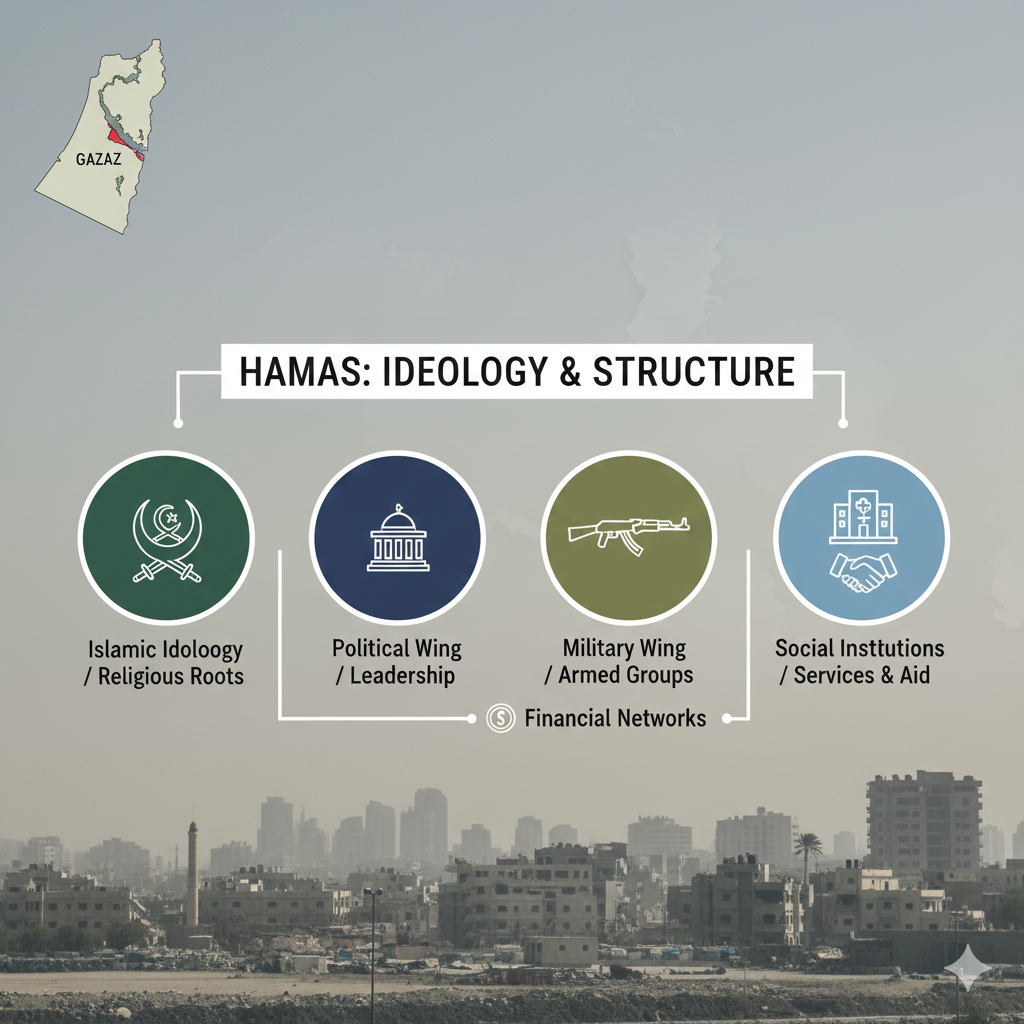
Structure of Hamas
Hamas has developed political, military, administrative, social, and religious networks. These components have contributed to its political influence and its ability to operate in Palestinian territories.
Its organizational structure has changed over time and has been affected by leadership changes, internal divisions, military conflict, and regional developments.
1. Political Structure of Hamas
Hamas has political leadership bodies responsible for organizational policies, internal decision-making, political relations, and strategic direction.
A. Shura Council
The Shura Council is an important consultative and decision-making institution within Hamas. It has been associated with internal consultation, organizational policy, and the selection of senior leadership.
Its membership and internal arrangements are not fully transparent to the public. Hamas has maintained leadership networks connected with Gaza, the West Bank, and its external political presence.
B. Political Bureau
The Political Bureau is a central leadership body involved in political strategy, external relations, organizational decisions, and negotiations.
Its leadership has changed over time. Ismail Haniyeh, who served as head of the Political Bureau, was killed in July 2024. Therefore, older descriptions identifying him as the current leader are outdated.
The identity and role of senior leaders should be checked against reliable, up-to-date sources before publication.
C. Administration in Gaza
After taking control of Gaza in 2007, Hamas established de facto governing institutions in the territory. These included ministries, police structures, courts, and other administrative bodies.
Gaza's governing arrangements have been severely affected by the war that began in October 2023. The extent of Hamas's actual administrative control has consequently changed and should not be described as unchanged or absolute.
2. Military Structure of Hamas
Hamas has maintained an armed wing that has carried out military operations against Israel. Its military activities have been a major part of the Israeli-Palestinian conflict.
A. Izz ad-Din al-Qassam Brigades
The Izz ad-Din al-Qassam Brigades are the armed wing of Hamas. They became established as an organized military structure in the early 1990s.
The Brigades have carried out rocket attacks, armed assaults, bombings, and other military operations. Their activities have included attacks on civilians, which have drawn international condemnation.
B. internal security and Police Structures
During its administration of Gaza, Hamas operated police and internal security institutions. These bodies were involved in law enforcement, internal security, and maintaining the organization's governing authority.
C. Tunnel Network
Hamas has developed an extensive underground tunnel network in and around the Gaza Strip. Public reporting has described the use of these tunnels for military movement, concealment, storage, and other operational purposes.
The tunnel network has become an important feature of the military dimension of the Gaza conflict.
4. Financial Structure of Hamas
Hamas has relied on a combination of external assistance, local revenue sources, private contributions, and financial networks. The scale and nature of these sources have changed over time.
A. International Funding and Support
Iran has been widely reported as an important source of financial and military support for Hamas. Other regional actors have maintained different forms of political engagement or financial involvement connected with Gaza.
It is important to distinguish direct organizational funding from humanitarian assistance intended for Palestinian civilians.
B. Local Revenue and Economic Activities
During its administration of Gaza, Hamas collected taxes and fees through governing institutions and economic activities. The impact of these revenue sources has been affected by restrictions, conflict, and changes in Gaza's economy.
C. Financial Networks and Smuggling
International reporting has described the use of financial networks, intermediaries, and smuggling channels connected with Hamas. These activities have been the subject of sanctions, investigations, and counter-financing measures by different governments.
The details and scale of individual financial networks are not always publicly verifiable and should be presented with appropriate attribution.
Conclusion – Structure of Hamas
Hamas has developed a multi-dimensional organizational structure involving political leadership, an armed wing, administrative institutions, and social and religious networks. Its Political Bureau and Shura Council have played important roles in internal decision-making, while the Izz ad-Din al-Qassam Brigades have carried out its armed operations.
Its governing role in Gaza since 2007, external relationships, financial networks, and military activities have made Hamas an important actor in the Israeli-Palestinian conflict. However, war, leadership changes, political divisions, and regional developments have significantly affected its organizational position.
A comprehensive understanding of Hamas requires examining its political, ideological, military, social, and financial dimensions separately, while also considering the wider humanitarian and political context of the region.
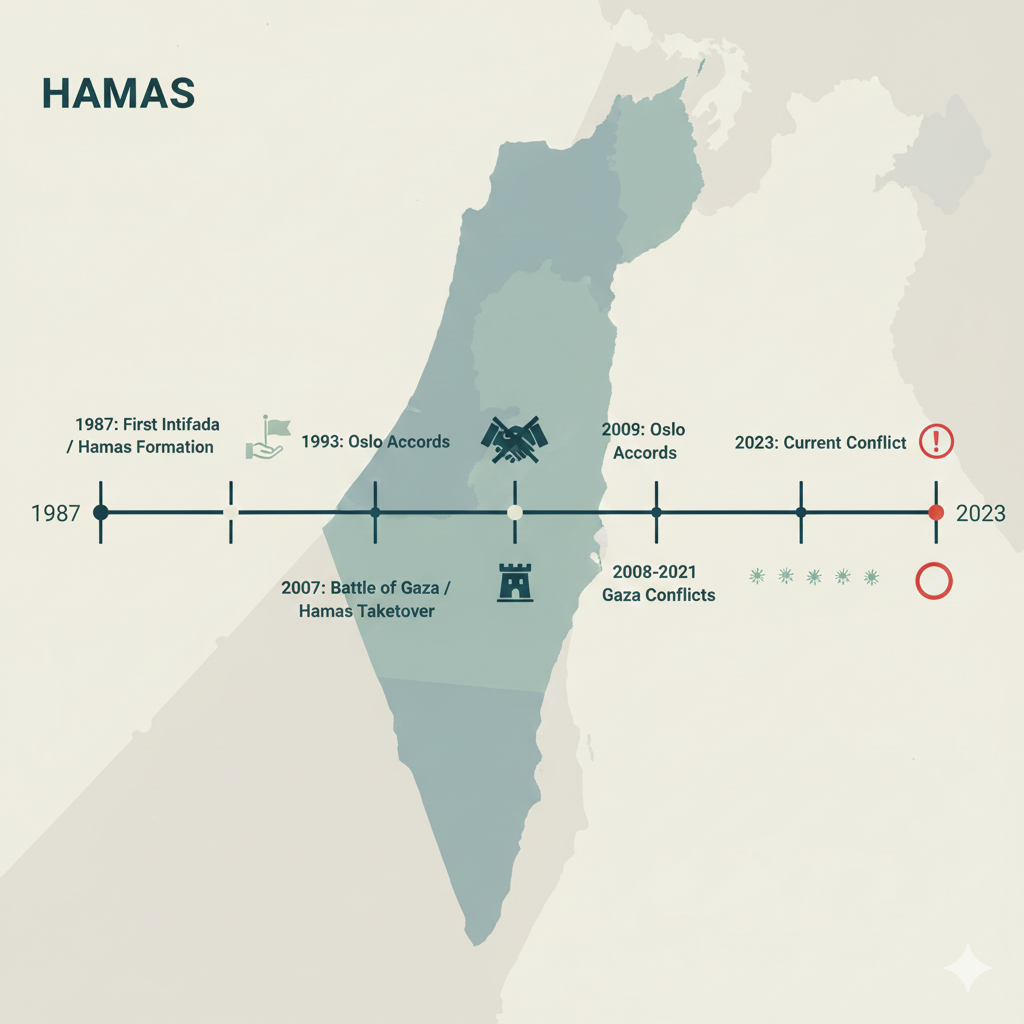
Major Events of Hamas
Since its establishment in 1987, Hamas has become an important actor in the Israeli-Palestinian conflict. Its political decisions, armed activities, and governance in Gaza have influenced regional security, diplomacy, and humanitarian conditions.
The following timeline highlights major historical developments involving Hamas and its relationship with Israel and other Palestinian political organizations.
1. Establishment of Hamas and the First Intifada (1987–1993)
- 1987: The First Intifada began as a widespread Palestinian uprising against Israeli occupation.
- December 1987: Hamas emerged from the Palestinian branch of the Muslim Brotherhood, with Sheikh Ahmed Yassin as its central founding figure.
- Hamas developed political, religious, social, and armed activities during the uprising.
- The organization gradually became an influential force in Palestinian politics and the conflict with Israel.
2. 1993: Oslo Accords and Opposition from Hamas
- 1993: Israel and the Palestine Liberation Organization (PLO) signed the Oslo Declaration of Principles.
- The agreement established a framework for limited Palestinian self-government and further negotiations.
- Hamas opposed the Oslo process because it rejected recognition of Israel and argued that the agreement did not achieve full Palestinian sovereignty.
- Hamas continued its opposition to the agreement and carried out attacks during the following years.
3. 1994–1996: Suicide Attacks and Israeli Response
- February 1994: Israeli extremist Baruch Goldstein killed 29 Palestinian worshippers at the Ibrahimi Mosque in Hebron.
- Hamas subsequently carried out suicide bombings in Israel, claiming retaliation and opposition to Israeli policies.
- These attacks killed Israeli civilians and intensified the conflict.
- Israeli security operations targeted Hamas members and networks.
4. 2000–2005: Second Intifada and Escalating Violence
- September 2000: The Second Intifada began amid escalating Israeli-Palestinian tensions. Ariel Sharon's visit to the Temple Mount/Haram al-Sharif was an immediate catalyst for protests, but the uprising had wider political and historical causes.
- Hamas carried out suicide bombings and other armed attacks during this period.
- March 2004: Sheikh Ahmed Yassin was killed in an Israeli airstrike.
- April 2004: Abd al-Aziz al-Rantisi was also killed in an Israeli airstrike.
- 2005: Israel completed its unilateral withdrawal of settlements and permanent ground forces from inside the Gaza Strip.

Recommended Study Resource
Explore this resource on Amazon for additional reading and learning related to History, international relations, and contemporary political developments.
Affiliate Disclosure: This article contains an affiliate link. We may earn a commission if you make a purchase through this link, at no additional cost to you.
5. 2006: Hamas Election Victory and Internal Conflict
- January 2006: Hamas won 74 of the 132 seats in the Palestinian Legislative Council elections through its Change and Reform list.
- The election result created a major shift in Palestinian political leadership and increased tensions between Hamas and Fatah.
- 2007: Violent clashes between Hamas and Fatah forces led to Hamas taking control of the Gaza Strip.
- Fatah-led Palestinian Authority institutions continued to operate in parts of the West Bank.
6. 2008–2009: Gaza War – Operation Cast Lead
- December 2008: Israel launched Operation Cast Lead following escalating rocket fire from Gaza and the collapse of a ceasefire.
- The conflict continued into January 2009 and caused extensive casualties and destruction.
- Palestinian and Israeli casualty figures differ across sources, particularly regarding combatants and civilians.
- Hamas remained the de facto governing authority in Gaza after the conflict.
7. 2012: Operation Pillar of Defense
- November 2012: Israel killed Ahmed Jabari, a senior military commander of Hamas, in an airstrike.
- The incident was followed by rocket fire from Gaza and Israeli airstrikes.
- The eight-day conflict caused casualties on both sides and further damaged conditions in Gaza.
- Egypt helped broker a ceasefire that ended the fighting.
8. 2014: Gaza War – Operation Protective Edge
- July–August 2014: Israel launched Operation Protective Edge after escalating tensions, rocket attacks, and other violent incidents.
- The conflict lasted approximately 50 days.
- Thousands of Palestinians and dozens of Israelis were killed, while homes and infrastructure in Gaza suffered extensive damage.
- The conflict generated international debate over civilian protection and the conduct of military operations.
9. 2021: Israel–Hamas Conflict
- May 2021: Escalating tensions in East Jerusalem, including events at Haram al-Sharif/Temple Mount, contributed to a major escalation.
- Hamas and other Palestinian armed groups fired thousands of rockets towards Israel.
- Israel carried out extensive airstrikes in Gaza.
- The 11-day conflict caused civilian casualties and damage to infrastructure on both sides.
10. 2023: October 7 Attacks and Israeli Response
- 7 October 2023: Hamas-led armed groups launched a large-scale attack on southern Israel, killing approximately 1,200 people and taking around 250 hostages, according to widely reported Israeli figures.
- The attacks included killings of civilians and military personnel, as well as hostage-taking.
- Israel launched an extensive military campaign in Gaza, including airstrikes and ground operations.
- The war caused widespread destruction, mass displacement, civilian deaths, and a severe humanitarian crisis in Gaza.
- The conflict also generated major international debate about hostages, civilian protection, humanitarian access, and international humanitarian law.
Conclusion – Major Events of Hamas
Since its emergence during the First Intifada in 1987, Hamas has played a significant role in the Israeli-Palestinian conflict. Its political rise, armed activities, conflict with Fatah, and governance in Gaza have shaped Palestinian political developments over several decades.
The wars and confrontations between Israel and Hamas, particularly the events following 7 October 2023, have resulted in serious security and humanitarian consequences. These developments demonstrate the complexity of the Israeli-Palestinian conflict and the importance of civilian protection and a lasting political settlement.
International Recognition and Controversy
International responses to Hamas differ according to national laws, security policies, diplomatic relationships, and regional interests. Some governments designate the organization as terrorist, while others maintain political contacts or relationships with its representatives.
It is important to distinguish between formal terrorist designations, diplomatic engagement, political support, and humanitarian assistance to Palestinian civilians.
1. Countries and Jurisdictions That Designate Hamas as a Terrorist Organization
Several governments and political jurisdictions have formally designated Hamas as a terrorist organization. Examples include:
- United States: Designated Hamas as a Foreign Terrorist Organization in 1997.
- European Union: Added Hamas to its terrorist list in 2003.
- United Kingdom: Proscribed Hamas in its entirety in 2021. Previously, its designation covered the military wing.
- Canada: Lists Hamas as a terrorist entity.
- Australia: Lists Hamas as a terrorist organization.
- Japan: Has imposed terrorism-related financial sanctions and restrictions connected with Hamas.
- Israel: Considers Hamas a terrorist organization and a major security threat.
The exact legal framework, scope, and consequences of these designations vary between jurisdictions. Some governments designate the entire organization, while historical arrangements in certain countries distinguished between its political and military components.
The United Nations Position
The United Nations does not maintain a single general consolidated list that formally designates Hamas as a terrorist organization. However, UN officials and bodies have condemned attacks against civilians, hostage-taking, and violations of international humanitarian law.
2. Countries and Regional Actors Maintaining Relations with Hamas
Some governments and regional actors have maintained political contacts, provided different forms of assistance, or engaged with Hamas for diplomatic and regional reasons. Their roles should not be treated as identical.
- Iran: Has been a major source of financial and military support for Hamas.
- Qatar: Has hosted Hamas political representatives and played a role in diplomatic mediation and financial arrangements related to Gaza.
- Turkey: Has maintained political contacts with Hamas representatives and has publicly engaged with the Palestinian issue.
- Russia: Has hosted Hamas representatives for diplomatic discussions, while maintaining its own relations with Israel and other regional actors.
- Hezbollah: The Lebanon-based organization has maintained close relations and cooperation with Hamas. This is distinct from the official position of the Lebanese state.
- Syria: Hamas previously maintained close relations with the Syrian government, although those relations became strained during the Syrian conflict.
Political contact or diplomatic engagement does not necessarily mean formal recognition of Hamas as the legitimate government of Palestine or endorsement of all its activities.
3. Countries with Mixed or Distinct Positions
- China: Maintains relations with Israel and Palestinian political representatives. It has called for ceasefires and a political settlement but does not formally designate Hamas as a terrorist organization.
- India: Condemned the 7 October 2023 attacks and has consistently supported a negotiated two-state solution. India does not formally list Hamas as a terrorist organization under its principal domestic terrorist designation framework.
- United Nations: Focuses on international law, civilian protection, humanitarian assistance, and political negotiations, while condemning attacks against civilians and hostage-taking.
4. Major Controversies Related to Hamas
A. Conflict and War with Israel
- Hamas and other Palestinian armed groups have launched rocket attacks against Israeli territory during several rounds of conflict.
- The 7 October 2023 attacks led to a major escalation and a prolonged Israeli military campaign in Gaza.
- Israel describes Hamas as a terrorist organization and a major security threat.
- Hamas describes its armed campaign as resistance against Israeli occupation, while its attacks against civilians have been widely condemned.
B. Suicide Attacks and Civilian Casualties
- Hamas carried out numerous suicide bombings during the 1990s and early 2000s.
- Rocket attacks and other armed operations have also caused civilian casualties.
- Deliberate attacks against civilians and hostage-taking are prohibited under international humanitarian law.
C. Governance and Human Rights Concerns in Gaza
- Hamas has exercised de facto governing authority in Gaza since 2007, although the extent of its control has been affected by subsequent wars.
- Human rights organizations and other observers have reported restrictions on political freedoms and the suppression of political opponents.
- Reports have also documented allegations of arbitrary detention, torture, and abuses by security forces in Gaza.
- These concerns form part of wider debates about accountability, governance, and human rights in Palestinian territories.
D. International Sanctions and Economic Restrictions
- The United States, European Union, United Kingdom, and other jurisdictions have imposed terrorist-related financial restrictions and sanctions on Hamas and associated networks.
- Restrictions on Gaza's movement of people and goods, including measures imposed by Israel and Egypt, have significantly affected its economy.
- International sanctions, border restrictions, armed conflict, and economic conditions have contributed to the complexity of financial activity in Gaza.
- Claims about specific covert funding channels should be supported by reliable evidence and clear attribution.
E. Power Struggle with Fatah and the Palestinian Authority
- The political division between Hamas and Fatah intensified after the 2006 Palestinian legislative elections.
- Hamas took control of Gaza in 2007, while the Fatah-led Palestinian Authority continued to exercise limited authority in parts of the West Bank.
- The division has weakened Palestinian political unity and complicated negotiations over governance and the future of Palestinian statehood.
Conclusion – International Recognition and Controversy
Hamas remains one of the most controversial organizations involved in the Israeli-Palestinian conflict. Several governments designate it as a terrorist organization, while other regional and international actors maintain political contacts or different forms of engagement.
Its armed operations, governance in Gaza, relations with regional actors, and human rights record have generated significant international debate. The distinctions between formal designation, political engagement, financial support, and humanitarian assistance are essential for understanding international responses to Hamas.
Ultimately, any lasting solution to the Israeli-Palestinian conflict requires attention to civilian protection, international humanitarian law, Palestinian political representation, Israeli security concerns, and a negotiated political settlement.
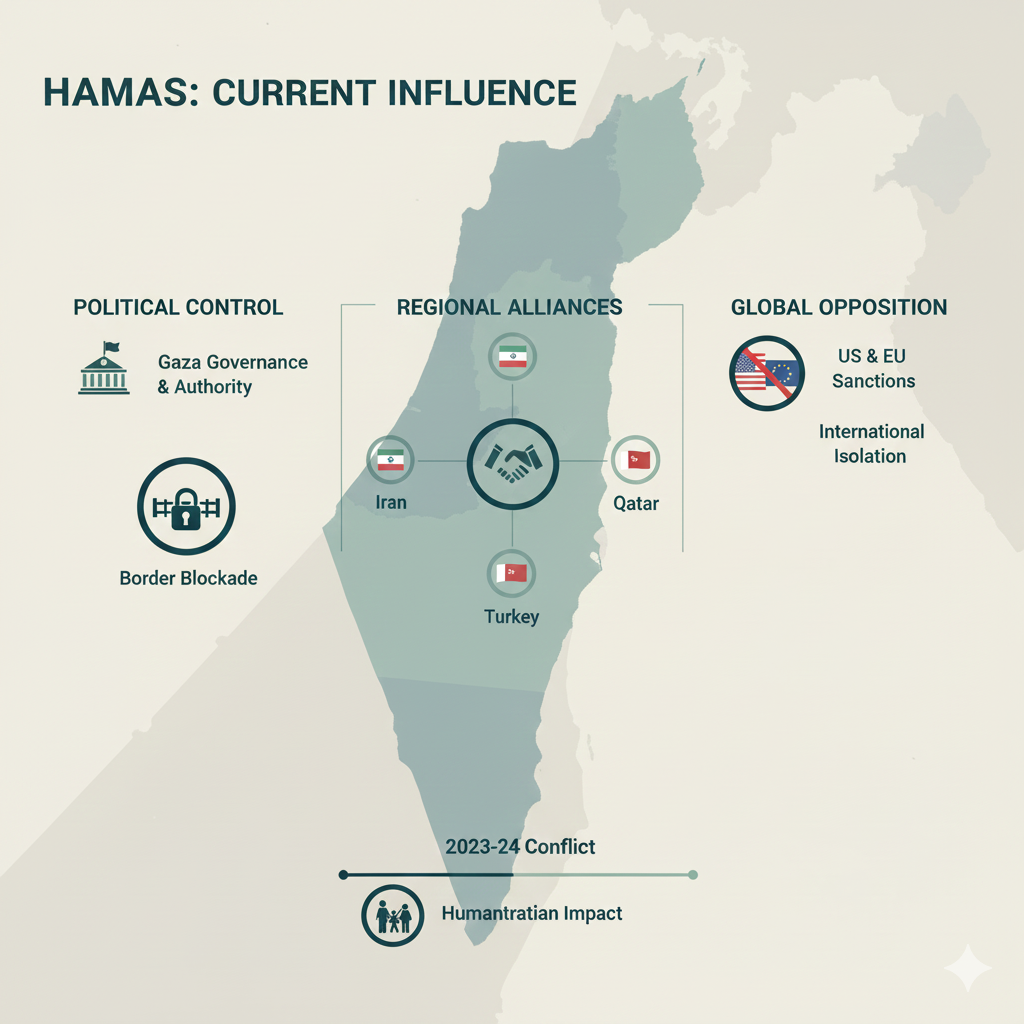
Current Influence of Hamas
Hamas remains an important actor in the Israeli-Palestinian conflict. Although its military capabilities and governing arrangements have been significantly affected by the war that followed the October 7, 2023 attacks, the organization continues to exercise political, organizational, and local influence in parts of the Gaza Strip.
The ceasefire agreement that took effect in October 2025 introduced a new framework for Gaza's administration. A transitional Palestinian technocratic body was established in 2026 to manage public services and reconstruction. However, disagreements over security, disarmament, and Hamas's future political role remain major challenges.
The current influence of Hamas must therefore be understood through its remaining organizational networks, military capabilities, regional relationships, and role in Palestinian politics.
1. Hamas's Influence Over the Gaza Strip
Hamas exercised de facto governing authority in Gaza after taking control of the territory in 2007. However, the war and subsequent political developments have significantly changed this arrangement.
- Hamas's centralized governing institutions have been severely weakened by the war.
- A Palestinian National Committee for the Administration of Gaza (NCAG) was established in January 2026 as part of the transitional administration framework.
- Hamas announced steps towards transferring civilian administrative responsibilities to the transitional body.
- Despite relinquishing formal governmental authority, Hamas has retained organizational networks and local influence in parts of Gaza.
- Israeli military control, restrictions on movement, and continuing security problems have affected the functioning of Gaza's administration.
Gaza's humanitarian situation remains extremely difficult. Damage to infrastructure, displacement, shortages of essential supplies, and restrictions on humanitarian access continue to affect civilian life.
The future administrative structure of Gaza depends on the implementation of the transitional arrangements, security conditions, reconstruction, and the role of Palestinian political institutions.
2. Regional Influence of Hamas
Hamas has maintained relationships with several regional actors. These relationships include political contacts, financial assistance, diplomatic engagement, and military support. The nature of these relationships differs considerably between countries.
A. Relations with Iran and Hezbollah
- Iran: Iran has been an important source of financial and military support for Hamas and has maintained relations with the organization for several years.
- Hezbollah: The Lebanon-based organization has maintained close political and military relationships with Hamas.
- Both organizations oppose Israeli policies and have been involved in the wider regional confrontation with Israel.
- The extent of coordination between them varies according to regional developments and security conditions.
B. Relations with Qatar and Turkey
- Qatar: Qatar has played an important role in diplomatic mediation, ceasefire negotiations, and humanitarian assistance related to Gaza. It has also maintained political contacts with Hamas representatives.
- Turkey: Turkey has maintained political relations with Hamas representatives and has supported Palestinian political demands. It has also participated in diplomatic efforts concerning Gaza.
- Political engagement and humanitarian assistance should not automatically be treated as direct military or financial support to Hamas.
C. Relations with Egypt and Saudi Arabia
- Egypt: Egypt has played an important role in ceasefire negotiations, border arrangements, and humanitarian discussions involving Gaza. It maintains strict security controls around the Rafah border crossing.
- Saudi Arabia: Saudi Arabia has emphasized Palestinian statehood and a two-state solution. Its humanitarian assistance to Palestinians should be distinguished from direct support for Hamas.

Recommended Study Resource
Explore this resource on Amazon for additional reading and learning related to international relations, Middle Eastern politics, and contemporary world affairs.
Affiliate Disclosure: This article contains an affiliate link. We may earn a commission if you make a purchase through this link, at no additional cost to you.
3. Recent Conflict Between Hamas and Israel
A. October 7, 2023 Attacks and Their Consequences
- On October 7, 2023, Hamas-led armed groups launched a large-scale attack on southern Israel.
- The attack involved rocket fire, armed incursions, killings of civilians and military personnel, and hostage-taking.
- Approximately 1,200 people were killed and around 250 people were taken hostage, according to widely reported Israeli figures.
- Israel responded with extensive airstrikes and ground operations in the Gaza Strip.
- The resulting war caused widespread destruction, displacement, civilian deaths, and a severe humanitarian crisis in Gaza.
B. 2023–2025 War and International Response
- Israel launched a large-scale military campaign with the stated objective of dismantling Hamas's military and governing capabilities and securing the release of hostages.
- The United States and several European governments supported Israel's security concerns while also facing growing pressure to address civilian suffering in Gaza.
- United Nations agencies and humanitarian organizations repeatedly called for civilian protection, humanitarian access, and compliance with international humanitarian law.
- Regional diplomatic efforts involving Qatar, Egypt, Turkey, and the United States contributed to negotiations over ceasefires and hostage releases.
- A ceasefire agreement took effect on October 10, 2025, although subsequent violence and disagreements over its implementation continued.
C. Developments During 2026
- A transitional administrative framework for Gaza was developed following the 2025 ceasefire.
- The National Committee for the Administration of Gaza was established in January 2026 to manage civilian administration and reconstruction-related responsibilities.
- Hamas announced steps towards transferring civilian governance, but disagreements over disarmament, security arrangements, and the future political role of the organization remained unresolved.
- Reports during 2026 indicated that Hamas continued to maintain local organizational and political influence despite losing formal governmental authority.
- Continuing security incidents and humanitarian difficulties have complicated the implementation of the transitional arrangements.
4. Global Support and Opposition to Hamas
International attitudes towards Hamas differ according to national security policies, legal frameworks, diplomatic relationships, and regional interests.
A. Countries and Actors Maintaining Relations with Hamas
- Iran: Has provided financial and military support to Hamas.
- Qatar: Has maintained political contacts and played an important role in mediation and humanitarian arrangements concerning Gaza.
- Turkey: Maintains political engagement with Hamas representatives and supports Palestinian political demands.
- Russia: Has hosted Hamas representatives for diplomatic discussions and maintains contacts with different regional actors.
- Hezbollah: Maintains close relations with Hamas. Its position should not be confused with the official position of the Lebanese government.
B. Countries That Designate Hamas as a Terrorist Organization
- United States: Designated Hamas as a Foreign Terrorist Organization in 1997.
- European Union: Added Hamas to its terrorist organization list in 2003.
- United Kingdom: Proscribed Hamas in its entirety in 2021.
- Canada: Lists Hamas as a terrorist entity.
- Australia: Lists Hamas as a terrorist organization.
- Israel: Considers Hamas a terrorist organization and a major security threat.
C. India's Position
India condemned the October 7, 2023 attacks and has consistently supported a negotiated two-state solution to the Israeli-Palestinian conflict. India has also emphasized humanitarian assistance and the protection of civilians in Gaza.
India does not formally list Hamas as a terrorist organization under its principal domestic terrorist designation framework. Its position should therefore not be inaccurately described as identical to that of countries that have formally designated Hamas.
D. United Nations Position
The United Nations does not maintain a single general consolidated list that formally designates Hamas as a terrorist organization. However, UN officials and bodies have condemned attacks against civilians, hostage-taking, and violations of international humanitarian law.
5. Political Influence of Hamas
- Hamas remains an important organization in Palestinian politics despite the major military and administrative changes caused by the war.
- It won the largest number of seats in the 2006 Palestinian legislative elections, securing 74 of the 132 seats.
- Its takeover of Gaza in 2007 created a long-standing political division between Gaza and the West Bank.
- The Palestinian Authority, led by Fatah, has continued to exercise limited administrative authority in parts of the West Bank.
- No new Palestinian general legislative elections have taken place since 2006.
- In 2021, President Mahmoud Abbas postponed the planned Palestinian elections, citing concerns over voting arrangements in East Jerusalem.
- The future political influence of Hamas will depend on the transitional administration, Palestinian political reconciliation, security arrangements, and the possibility of future elections.
6. Economic and Financial Influence of Hamas
Hamas's financial position has been affected by international sanctions, military operations, restrictions on Gaza's economy, and changes in its administrative arrangements.
- International Financial Networks: Iran has been an important source of financial support. International authorities have also investigated and sanctioned financial networks associated with Hamas.
- Gaza's Local Economy: During its period of governance, Hamas collected taxes and fees through administrative institutions and local economic activities.
- Financial Restrictions: The United States, European Union, United Kingdom, and other jurisdictions have imposed financial restrictions on Hamas and associated networks.
- Economic Conditions: War damage, restrictions on movement and trade, displacement, and the destruction of infrastructure have severely affected Gaza's economy.
- Humanitarian Assistance: International and regional assistance intended for Palestinian civilians should be distinguished from direct organizational funding to Hamas.
Claims about specific financial channels, amounts, or alleged profits should be supported by reliable documentary evidence rather than presented as established facts without attribution.
7. Future Influence of Hamas
Will the Conflict Between Hamas and Israel Continue?
The future of the conflict depends on whether the ceasefire arrangements can be implemented, whether armed groups disarm, and whether a stable political and security framework can be established in Gaza.
- Disagreements over Hamas's disarmament remain a major obstacle to a lasting settlement.
- Israel continues to emphasize security arrangements and the prevention of renewed attacks.
- Hamas's remaining organizational networks and military capabilities may continue to affect security conditions.
- Regional mediation and international diplomatic pressure will remain important in efforts to prevent renewed large-scale conflict.
Will Hamas Shape the Future of Palestine?
Hamas's future political role remains uncertain. Its influence will depend on the development of Palestinian governing institutions, political reconciliation, public opinion, and future elections.
- A credible Palestinian transitional administration could reduce Hamas's direct role in civilian governance.
- Political reconciliation between Hamas and Fatah could influence the future structure of Palestinian leadership.
- Future elections, if held, could reshape the balance of political power.
- Progress towards a negotiated political settlement will be important for long-term regional stability.
Conclusion
Hamas remains an influential but significantly weakened actor in the Israeli-Palestinian conflict. Its military capabilities, governing institutions, and political position have been affected by the war that followed the October 7, 2023 attacks and the subsequent transitional arrangements in Gaza.
Although Hamas has moved away from formal civilian governance under the post-2025 framework, it continues to maintain organizational networks and local influence. Its relationships with Iran, Qatar, Turkey, and other regional actors also remain relevant to understanding its political position.
The future of Hamas will depend on the implementation of Gaza's transitional administration, security and disarmament arrangements, Palestinian political developments, and regional diplomacy.
A lasting solution to the conflict will require civilian protection, humanitarian reconstruction, respect for international humanitarian law, and a credible political process addressing both Palestinian aspirations and Israeli security concerns.
Recommended Study Resource

Recommended Study Resource
Explore this study resource on Amazon. Check the product description, specifications, customer reviews, and current price before making a purchase.
Affiliate Disclosure: This article contains an Amazon affiliate link. We may earn a commission if you purchase through this link, at no additional cost to you.
References / Sources
- United Nations (UN) reports and official documents related to the Israel–Palestine conflict.
- International news agencies, including BBC, Al Jazeera, Reuters, Associated Press, and The Guardian.
- Research papers, analytical reports, and academic publications on Middle East politics.
- Reports published by Human Rights organizations, including Amnesty International and Human Rights Watch.
- Research and analysis from institutions such as Brookings Institution, Carnegie Endowment, and International Crisis Group.
- Books and expert analyses on Palestinian movements and regional geopolitics.
- Official government statements, policy documents, and verified press releases.
3. Social and Religious Structure of Hamas
A. Social Welfare Organizations
Hamas developed social and charitable networks, particularly through institutions connected with the Palestinian Muslim Brotherhood. These networks have included educational, religious, charitable, and community activities.
Some organizations associated with Hamas have provided assistance to families and vulnerable communities. However, the activities and affiliations of individual charities should be assessed separately rather than assuming that every social institution in Gaza is controlled by Hamas.
B. Religious Institutions
Religious institutions and Islamic educational networks have played a role in Hamas's social and ideological activities. Mosques, religious education, and public messaging have contributed to the organization's presence within Palestinian society.