
What is the Quit India Movement?
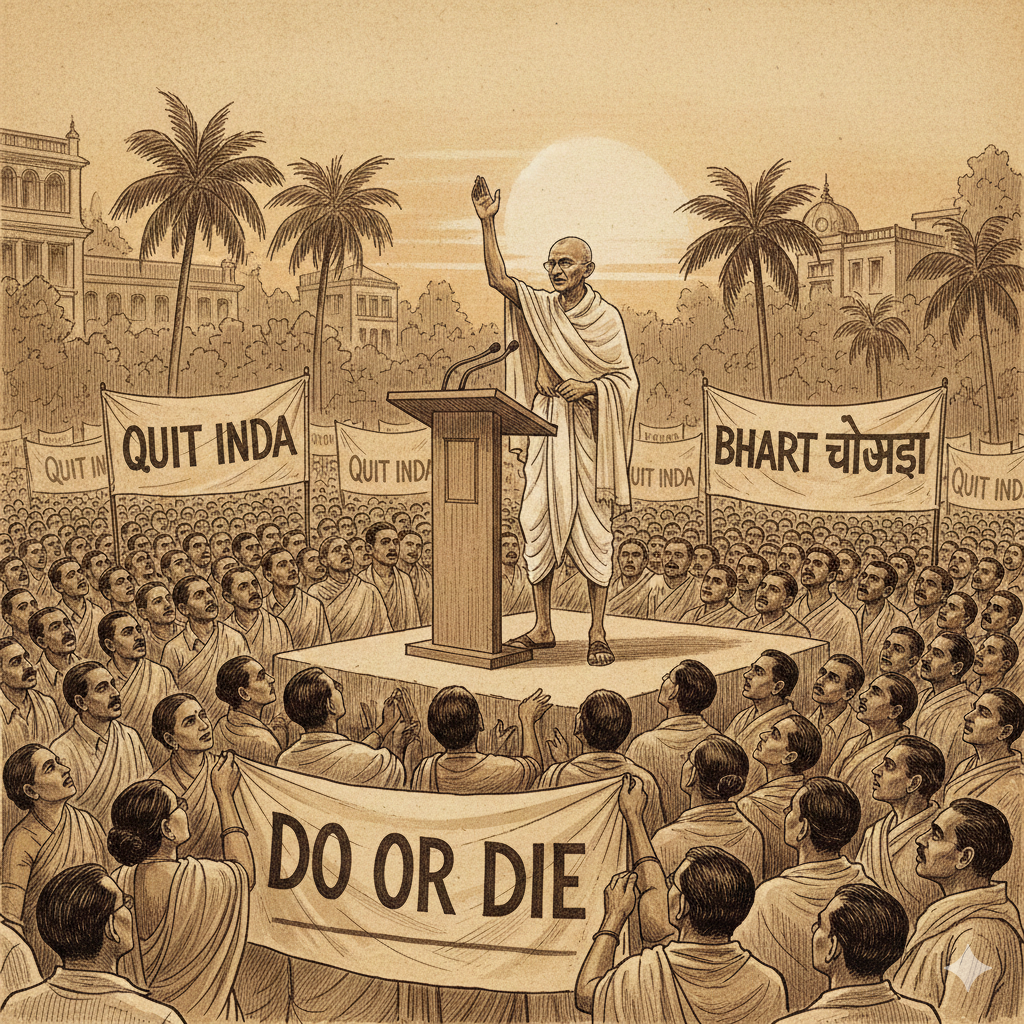
The Quit India Movement was a mass civil disobedience movement launched by Mahatma Gandhi on 8 August 1942 demanding an immediate end to British rule in India. It is also known as the August Kranti Movement.
Quit India Movement – A Detailed Description
Introduction
The Quit India Movement was a crucial phase in India's struggle for independence. Launched by Mahatma Gandhi on 8 August 1942 at the Gwalia Tank Ground (today's August Kranti Maidan) in Mumbai, it is also known as the August Revolution. The core objective of the movement was to end British rule in India.
The Main Reasons for the Movement
Several interlinked factors led to the launch of the Quit India Movement. Together they created a powerful nationwide demand for immediate and complete independence.
Overview (Detailed)
The movement was the largest and most decisive mass movement against British rule in 1942. Key reasons included: involuntary involvement in World War II, repressive British policies, the failure of the Cripps Mission, a growing national desire for freedom, and severe economic distress.
1. World War II and India’s Involuntary Participation (1939–1945)
The British government involved India in the Second World War (1939) without obtaining consent from Indian leaders.
Indian leaders and people strongly objected, since the decision affected India's resources, finances, and manpower during the war.
Congress and Mahatma Gandhi had initially said they would consider supporting the British war effort only if India was guaranteed independence after the war, but the British rejected this condition. This deepened Indian discontent.

✔ Useful for exam preparation
✔ Trusted educational resource
✔ Positive reader feedback
2. Failure of the Cripps Mission (1942)
In March 1942 the British sent Sir Stafford Cripps to India with proposals that promised a form of post-war dominion status but not immediate, full independence. The proposals were unacceptable to Indian leaders because:
- Real power would still remain with the British.
- Independence was not to be granted immediately.
- There was a possibility of partition in the proposals.
Congress and Gandhiji called the Cripps proposals a hoax and rejected them. The failure of the mission increased public anger.
3. Oppressive Policies of the British Government
The British Divide and Rule approach, limited provincial autonomy under the Government of India Act 1935, heavy wartime taxes, and restricted opportunities for Indians in administration all intensified anti-British feelings.
4. Growing Sense of Nationalism and Demand for Independence
The memory of the 1857 uprising, mass movements led by Gandhi (Non-cooperation 1920, Civil Disobedience 1930), and military efforts like Subhas Chandra Bose's Indian National Army strengthened national consciousness and the resolve for complete independence.
5. Adverse Economic Effects of British Rule
British policies had drained Indian wealth, hurt indigenous industries, and worsened living conditions. Wartime inflation, heavy taxation, unemployment, and tragedies such as the Bengal famine of 1943 intensified public resentment and urgency for change.
6. Non-violent Strategy of Congress and Gandhiji
After repeated failures to secure concessions, Gandhiji believed a mass movement was necessary to force British withdrawal. On 8 August 1942 he launched the final major push for independence with the rallying slogan: “Do or Die.”
Gandhiji’s Slogan and the Beginning of the Movement
At the All India Congress Committee meeting on 8 August 1942, Gandhiji gave the stirring slogan “Do or Die.” This call ignited a mass movement across the country seeking the immediate end of British rule.
Major Events of the Movement
Arrest of Gandhiji and Other Leaders (9 August 1942)
The very next day after the call to action, the British arrested major Congress leaders including Mahatma Gandhi, Jawaharlal Nehru, Sardar Vallabhbhai Patel, and Maulana Abul Kalam Azad. Gandhiji was interned at Aga Khan Palace in Pune.
Violent Public Demonstrations
The arrests provoked mass anger. Widespread protests erupted: railway lines were damaged, post offices and government buildings were attacked, and in some areas parallel governments were briefly formed (for example in Satara, Ballia and Midnapore).
Strict Repression by the British
The British government responded with severe measures to crush the movement: thousands were arrested, hundreds were shot, and military forces were deployed in many places to restore control.
Secret and Revolutionary Activities
While many Congress leaders were imprisoned, several leaders and revolutionary organizations continued underground work. Leaders like Jayaprakash Narayan, Ram Manohar Lohia, and Aruna Asaf Ali helped sustain resistance covertly.
Impact of the Movement
The Quit India Movement made the British government realize the depth of Indian determination. Although the movement was met with repression, it marked a decisive turning point and signaled the beginning of the end for colonial Rule.
The intensity of the struggle and the cost to British authority contributed to subsequent events that led to negotiations, the Cabinet Mission in 1946, and ultimately India's independence on 15 August 1947.
Conclusion
The Quit India Movement was one of the most decisive movements of the Indian freedom struggle. It sent a clear message to the British: Indians wanted freedom at any cost. Under Gandhiji’s leadership, the movement became a final, determined push that helped bring India to independence.
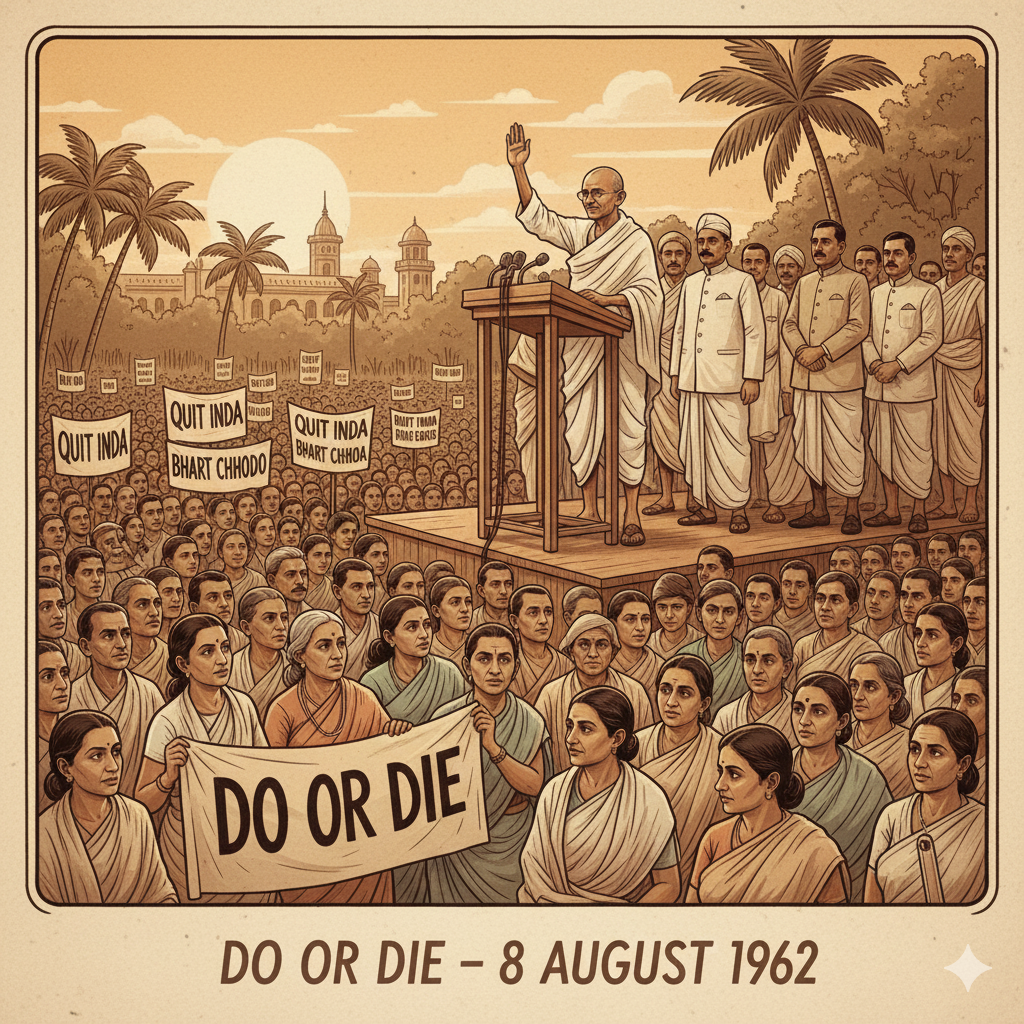
Quit India Movement (1942) was a mass civil disobedience movement launched by Mahatma Gandhi on 8 August 1942 demanding an immediate end to British rule in India. It is also known as the August Kranti Movement.
Gandhiji’s Slogan and the Beginning of the Movement
Detailed Description
Background of the Quit India Movement
The Quit India Movement was an important chapter of the Indian independence struggle, launched by Mahatma Gandhi on 8 August 1942 at the Gwalia Tank Ground (now August Kranti Maidan) in Mumbai. This movement became the final mass struggle against British rule and laid the foundation for India’s independence.
Gandhiji’s Historic Slogan – “Do or Die”
On 8 August 1942, during the All India Congress Committee (AICC) meeting at Gwalia Tank Ground, Mumbai, Mahatma Gandhi delivered a powerful speech declaring that India must free itself from British rule at any cost. He called upon the people to either achieve freedom or sacrifice their lives for it.
“We will fight for freedom, even if we have to sacrifice our lives for it. We cannot live in slavery. Now there is only one mantra — Do or Die.”
This slogan ignited the flames of revolution across the country, inspiring millions of Indians to join the movement with full determination.
Beginning of the Movement – 8 and 9 August 1942
1. Declaration of the Movement by Congress (8 August 1942)
In this historic meeting, major leaders such as Pandit Jawaharlal Nehru, Sardar Patel, Maulana Azad, Rajendra Prasad and Acharya Kripalani participated.
Gandhiji firmly declared that the time had come for Indians to fight till the end for their rights. Congress unanimously supported the movement and officially declared it as the Quit India Movement.
Gandhiji urged the public to follow the path of non-violence, stop cooperating with the British, and be prepared to sacrifice for Swaraj. The British immediately sensed that this movement could be a serious challenge to their rule.
2. Arrest of Gandhiji and Other Leaders (9 August 1942)
Soon after the announcement, the British government reacted by arresting major Congress leaders including Mahatma Gandhi, Jawaharlal Nehru, Sardar Patel and Maulana Azad. Gandhiji was put under house arrest at the Aga Khan Palace in Pune.
The Congress party was declared illegal and the government adopted suppressive measures. Despite the arrest of leaders, the public continued the movement on its own.
3. Spread of the Movement Across the Country
After the arrests, the movement spread nationwide. People attacked railway stations, post offices and government buildings. Students boycotted schools and colleges, leading anti-British demonstrations.
Parallel governments were formed in several places:
- Satara (Maharashtra) – Nana Patil established a parallel government.
- Ballia (Uttar Pradesh) – Chittu Pandey expelled British officials.
- Midnapore (Bengal) – A parallel administration was created.
To suppress the movement, the British used police and the army, committing widespread atrocities. Yet the people's courage remained unbroken.
Conclusion
The Quit India Movement began on 8 August 1942 with Gandhiji’s powerful slogan “Do or Die.” Despite the arrest of Gandhiji and other leaders on 9 August, the movement continued to spread across the country. Ultimately, it became the final phase of India’s independence struggle and contributed significantly to India achieving freedom on 15 August 1947.
Major Events of the Quit India Movement
Detailed Description
The Quit India Movement, launched on 8 August 1942, triggered revolutionary activities across the country. Below is a detailed description of the major events that shaped this historic movement.
1. AICC Meeting (8 August 1942)
- Place: Gwalia Tank Maidan, Mumbai (now August Kranti Maidan)
- Leadership: Mahatma Gandhi
In this meeting, Congress declared a decisive struggle against British rule. Gandhiji gave his famous slogan “Do or Die.” Congress demanded that the British leave India immediately.
2. Arrest of Gandhiji and Other Leaders (9 August 1942)
The British immediately reacted and arrested key Congress leaders including Mahatma Gandhi, Jawaharlal Nehru, Sardar Patel, Maulana Azad, Rajendra Prasad, Acharya Kripalani, Sucheta Kripalani and Aruna Asaf Ali.
Gandhiji was detained at the Aga Khan Palace in Pune, while Nehru and Patel were imprisoned at Ahmednagar Fort. Congress was outlawed and harsh measures were taken to crush the movement.
3. Public Resistance and Revolutionary Activities (Aug 1942 – 1943)
(i) Attacks on Railways and Communication Services
Youth and students targeted railway stations, post offices and telegraph lines to disrupt British communication systems. Major protests occurred in Patna, Varanasi, Allahabad, Bombay, Delhi and Calcutta.
(ii) Establishment of Parallel Governments
Examples include:
- Satara (Maharashtra): Nana Patil formed the “Prati Sarkar”.
- Ballia (Uttar Pradesh): Chittu Pandey removed British authorities.
- Tamluk (Bengal): Local people established independent administration.
- Midnapore (Bengal): A functioning parallel government was established.

✔ Useful for exam preparation
✔ Trusted educational resource
✔ Positive reader feedback
4. Repressive Actions by the British (1942–1944)
The British government used extreme force—shootings, mass arrests, curfews and public brutality. More than 10,000 protesters were killed and lakhs were imprisoned. Women and children also suffered under repressive measures.
5. Underground Movement and Secret Activities
Many leaders went underground to continue the movement. Jayaprakash Narayan, Ram Manohar Lohia, Achyut Patwardhan and Aruna Asaf Ali played key roles in keeping the resistance alive.
Subhas Chandra Bose, through the formation of the Azad Hind Fauj, put additional pressure on the British from outside India.
6. The Bengal famine (1943)
The devastating famine of 1943 killed around 30 lakh people. The British government failed to provide relief, worsening public anger and increasing the desire for freedom.
7. Impact of the Quit India Movement (1945–1947)
(i) End of World War II (1945)
After the war ended, the British found it increasingly difficult to maintain control over India. British citizens also began supporting Indian independence.
(ii) Acceptance of Indian Demands
In 1946, the British government sent the Cabinet Mission to India, marking the beginning of constitutional negotiations for independence.
(iii) Independence of India (15 August 1947)
In 1947, Lord Mountbatten became the last Viceroy of India. After discussions with Indian leaders, Britain finally granted independence on 15 August 1947.
Conclusion
The Quit India Movement was the most significant and decisive phase of India’s freedom struggle. Starting with Gandhiji’s “Do or Die” call on 8 August 1942, and continuing despite mass arrests, public uprisings and British repression, the movement shook the foundations of colonial Rule. Ultimately, it played a crucial role in India achieving independence on 15 August 1947.
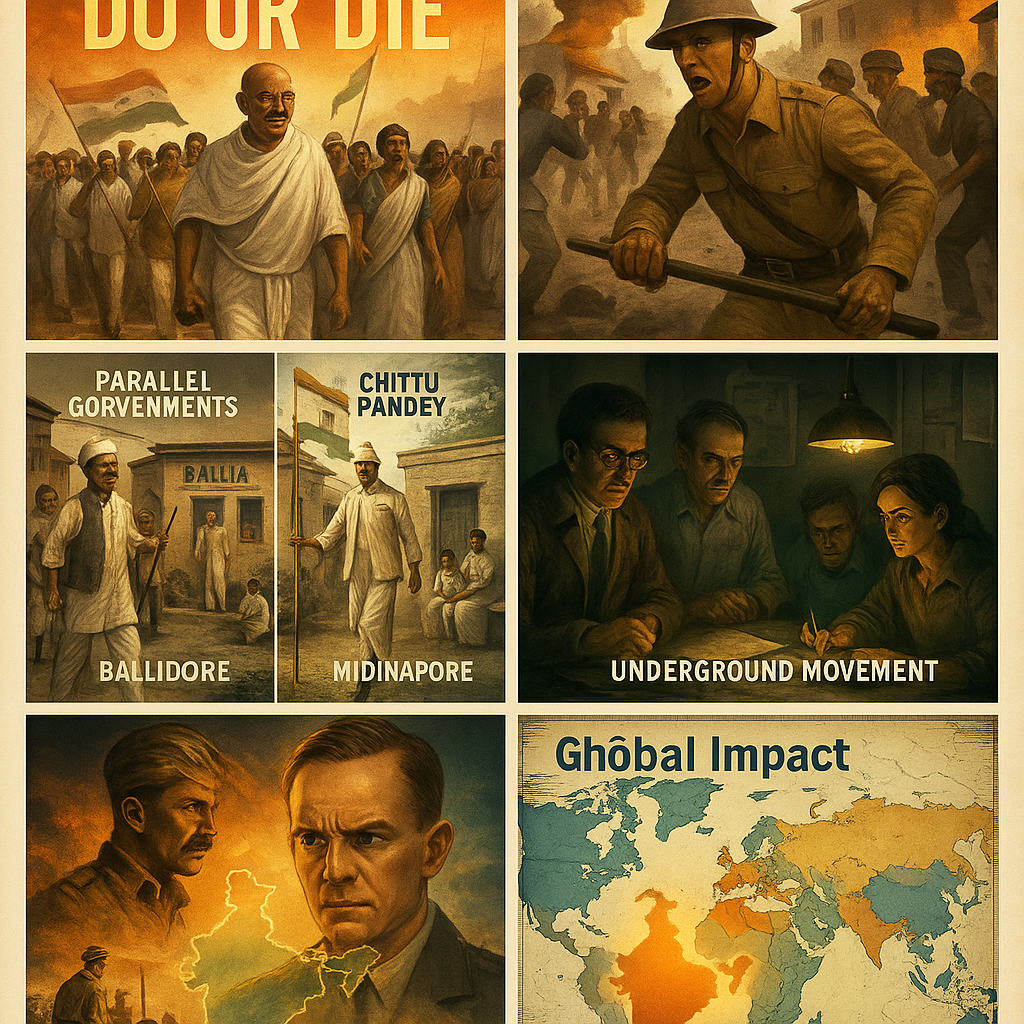
Impact of Quit India Movement
Detailed Description
The Quit India Movement (1942) proved to be a turning point in the Indian freedom struggle. It shook the foundations of British rule and laid the groundwork for both political and social transformation in India. The impact of this movement can be understood in two forms: Short-term and Long-term.
1. Short-term Impact
(i) Creation of a Revolutionary Atmosphere
Gandhiji’s slogan “Do or Die” filled Indians with renewed enthusIASm for independence. Every section of society—students, workers, farmers, women and traders—actively joined the movement. Despite the British government’s repressive policies, the spirit of the people remained strong.
(ii) Strict Repression by the British Government
On 9 August 1942, Gandhiji and all major Congress leaders were arrested. The British government ordered shootings, mass arrests, floggings and confiscation of property. More than 10,000 people were killed, thousands were injured and millions were imprisoned.
(iii) Formation of Parallel Governments
In many regions, people overthrew British administrative control and formed parallel governments:
- Ballia (Uttar Pradesh): British officers were expelled under Chittu Pandey.
- Satara (Maharashtra): Nana Patil established the Prati Sarkar.
- Midnapore (Bengal): An independent local administration was set up.
These actions clearly showed that Indians were no longer willing to accept British dominance.
(iv) Expansion of the Underground Movement
Many leaders led covert revolutionary activities:
- Jayaprakash Narayan and Ram Manohar Lohia operated secretly.
- Aruna Asaf Ali continued the struggle while underground.
- Usha Mehta established a secret radio station to mobilize people.
These underground actions became a major challenge for the British administration.

✔ Useful for exam preparation
✔ Trusted educational resource
✔ Positive reader feedback
(v) British Weakness During World War II
When the Quit India Movement started, World War II (1939–1945) was ongoing. Britain was already weakened and found it difficult to maintain control in India. This made the British government realize that continuing colonial Rule was becoming impossible.
2. Long-term Impact
(i) Forced the British Government to Consider Power Transfer
The Quit India Movement made it clear that British rule in India could not continue. After World War II ended in 1945, Britain had no choice but to discuss independence. In 1946, the Cabinet Mission Plan was sent to India, beginning the process of transferring power.
(ii) Rise in Political consciousness Among Indians
The movement strengthened the idea of liberty among people across India. Citizens in villages, towns and cities became politically aware and ready to fight for freedom. Congress gained massive nationwide support, making it impossible for the British to ignore Indian demands.
(iii) Weakening of British Administrative Control
The movement exposed weaknesses in British administration. Realizing the declining control, the British gradually increased the number of Indians in high administrative positions, including the IAS and IPS.
(iv) Decline in Loyalty of Indians Serving in the British Army
The Quit India Movement influenced Indian soldiers in the British Army. The efforts of the Indian National Army (INA) further inspired soldiers. In 1946, the Royal Indian Navy Mutiny marked a significant revolt against British rule.
(v) Inspiration for Subhash Chandra Bose and the INA
Subhash Chandra Bose moved outside India and strengthened the Azad Hind Fauj (INA). Supported by Japan and Germany, he attempted to militarily challenge British control. Inspired partly by the Quit India Movement, the INA launched campaigns against the British in 1944.
(vi) Paving the Way for India’s Independence
After the Quit India Movement, the British government accepted that India must be granted independence. In 1947, Lord Mountbatten was appointed the last Viceroy of India. Following discussions with Indian leaders, he announced India’s independence on 15 August 1947.
3. Global Impact
(i) Inspiration for Freedom Movements Worldwide
The Quit India Movement inspired many countries in Asia and Africa. After India’s path to independence, nations like Indonesia, Sri Lanka, Myanmar, Kenya and Nigeria intensified their own struggles for freedom.
(ii) Decline of the British Empire
India was the most important British colony. After the Quit India Movement, Britain realized that its empire was weakening. Over the next years, Britain began granting independence to many colonies.
Conclusion
The Quit India Movement was the most important and decisive part of India’s freedom struggle. It shook the British government, awakened the masses and paved the path to independence. The Cabinet Mission, the naval mutiny and ultimately the independence of India on 15 August 1947 were all influenced by the momentum created by this movement.
The Quit India Movement proved that India would no longer accept anything less than complete freedom.