
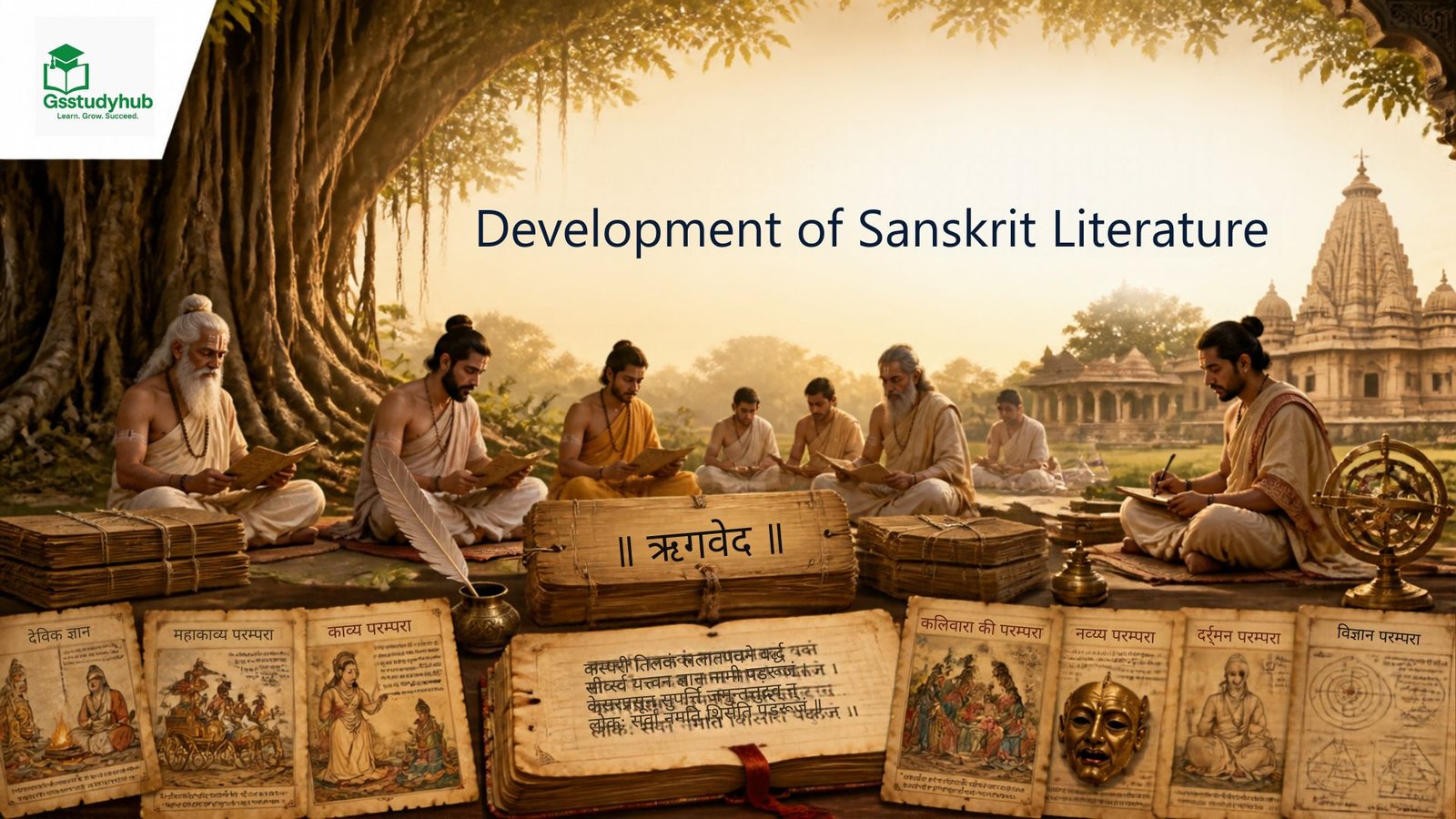
Development of Sanskrit Literature: Meaning, Nature, and Importance in Indian Culture
Sanskrit literature is one of the oldest and richest literary traditions in the world. It has played a fundamental role in shaping Indian culture, philosophy, religion, science, education, and intellectual traditions. From the sacred hymns of the Vedas to classical poetry, drama, grammar, and philosophical texts, Sanskrit literature reflects the evolution of Indian knowledge and civilization.
1. Meaning and Nature of Sanskrit Literature
Sanskrit literature refers to the vast body of literary works composed in the Sanskrit language. It includes religious scriptures, philosophical treatises, epics, poetry, dramas, grammar, scientific works, and texts related to mathematics, medicine, astronomy, politics, and ethics.
The word Sanskrit is associated with refinement, organization, and linguistic precision. Sanskrit became an important medium for preserving and transmitting knowledge across generations. Its structured grammatical system, rich vocabulary, and expressive literary forms contributed to its long-lasting influence on Indian intellectual life.
Key Definition
Sanskrit literature is the collection of religious, philosophical, literary, scientific, and cultural works composed in Sanskrit that preserve and express the intellectual heritage of India.
Sanskrit literature developed over many centuries. Its earliest surviving literary traditions are associated with the Vedas, while later periods witnessed the emergence of the Upanishads, epics such as the Ramayana and Mahabharata, classical poetry, drama, and numerous scholarly works.
2. Sanskrit Literature and ancient Indian Knowledge Traditions
Sanskrit literature is closely connected with the development of ancient Indian knowledge traditions. It served as a medium through which ideas about the universe, nature, human life, morality, society, and spiritual realization were explored and transmitted.
Ancient Indian scholars used Sanskrit to discuss a wide range of subjects. These included philosophy, logic, linguistics, mathematics, astronomy, Ayurveda, political thought, and literary criticism. The tradition encouraged debate, interpretation, memorization, and the systematic organization of knowledge.
Sanskrit texts also provide insights into the changing social and cultural life of ancient India. They reflect religious practices, educational traditions, ideals of conduct, and different understandings of the relationship between human beings and the natural world.
Key Point
Sanskrit literature is not limited to religious texts. It also represents an extensive intellectual tradition that contributed to the development of philosophy, language, literature, and scientific knowledge in India.
3. Vedic Literature: The Foundation of Sanskrit Literature
Vedic literature occupies the earliest and most foundational position in the history of Sanskrit literature. The Vedas are among the oldest surviving sources of Indian religious and intellectual traditions. They preserve hymns, prayers, ritual formulas, and reflections on the natural world and human existence.
The four Vedas are the Rigveda, Samaveda, Yajurveda, and Atharvaveda. Each has its own distinctive character and role within the Vedic tradition.
The Four Vedas
- Rigveda: Primarily consists of hymns praising various deities and reflecting on nature, existence, and cosmic order.
- Samaveda: Mainly associated with chants and melodies used in Vedic ritual traditions.
- Yajurveda: Contains ritual formulas and instructions associated with the performance of yajnas.
- Atharvaveda: Includes hymns, prayers, and materials relating to everyday concerns, well-being, protection, and ritual practices.
Together, the four Vedas form a central part of the Shruti tradition and provide an important foundation for understanding the development of Sanskrit literature.
4. Major Features of Vedic Literature
Vedic literature possesses several distinctive features that make it important in the history of Indian culture and thought.
4.1 Mantras and Hymns
Vedic texts contain mantras, hymns, and prayers composed in carefully preserved forms. These were recited during religious ceremonies and transmitted through established oral methods.
4.2 Nature and the Worship of Deities
Many Vedic hymns express reverence for natural forces and deities associated with them. Agni, Indra, Varuna, Surya, and Ushas are among the prominent figures mentioned in Vedic literature. These hymns reveal the significance of nature in early religious thought.
4.3 Yajna and Ritual Traditions
Yajna, or ritual sacrifice, held an important place in Vedic religious life. Certain Vedic texts describe prayers, offerings, chants, and formulas associated with these ceremonies.
4.4 Social Life and Cultural Practices
Vedic literature contains references to family life, community relationships, occupations, education, social responsibilities, and cultural practices. These references help researchers investigate aspects of early Indian society, although the texts must be interpreted in their historical context.
4.5 Philosophical Reflection
Alongside prayers and ritual practices, Vedic literature includes questions about creation, cosmic order, existence, and the origins of the universe. Such reflections contributed to the development of later Indian philosophical traditions.
5. Oral Tradition and Shruti
One of the most remarkable features of Vedic literature is its oral tradition. For centuries, Vedic knowledge was transmitted from teacher to student through memorization, recitation, and carefully developed methods of pronunciation and preservation.
The term Shruti means “that which is heard.” In the Indian religious tradition, the Vedas are regarded as Shruti because of their association with this ancient mode of transmission. Special recitation techniques helped preserve the words, sounds, accents, and sequence of Vedic passages with considerable precision.
This oral system demonstrates the importance attached to accurate transmission and disciplined learning. It also played a significant role in maintaining continuity within the Vedic tradition across generations.
Why Is the Oral Tradition Important?
The oral tradition helped preserve Vedic texts before and alongside their written transmission. It remains an important example of India's traditional systems of education, memorization, and knowledge preservation.
6. Importance of Sanskrit Literature in Indian Culture
Sanskrit literature has contributed significantly to India's cultural and intellectual heritage. It preserved religious traditions, encouraged philosophical inquiry, developed sophisticated literary forms, and provided a shared language for scholarly communication across different regions and historical periods.
Its influence can be seen in Indian philosophy, classical literature, traditional education, performing arts, linguistics, and several systems of scientific thought. Sanskrit works also interacted with regional languages and literary traditions, contributing to the broader cultural diversity of the Indian subcontinent.
The study of Sanskrit literature therefore helps us understand not only ancient texts but also the historical development of Indian ideas, institutions, cultural practices, and intellectual debates.
Conclusion
Sanskrit literature is a major foundation of India's literary, religious, and intellectual heritage. The Vedas represent its earliest central tradition, bringing together hymns, ritual practices, reflections on nature, and philosophical questions. The oral tradition of Shruti helped preserve this knowledge across generations.
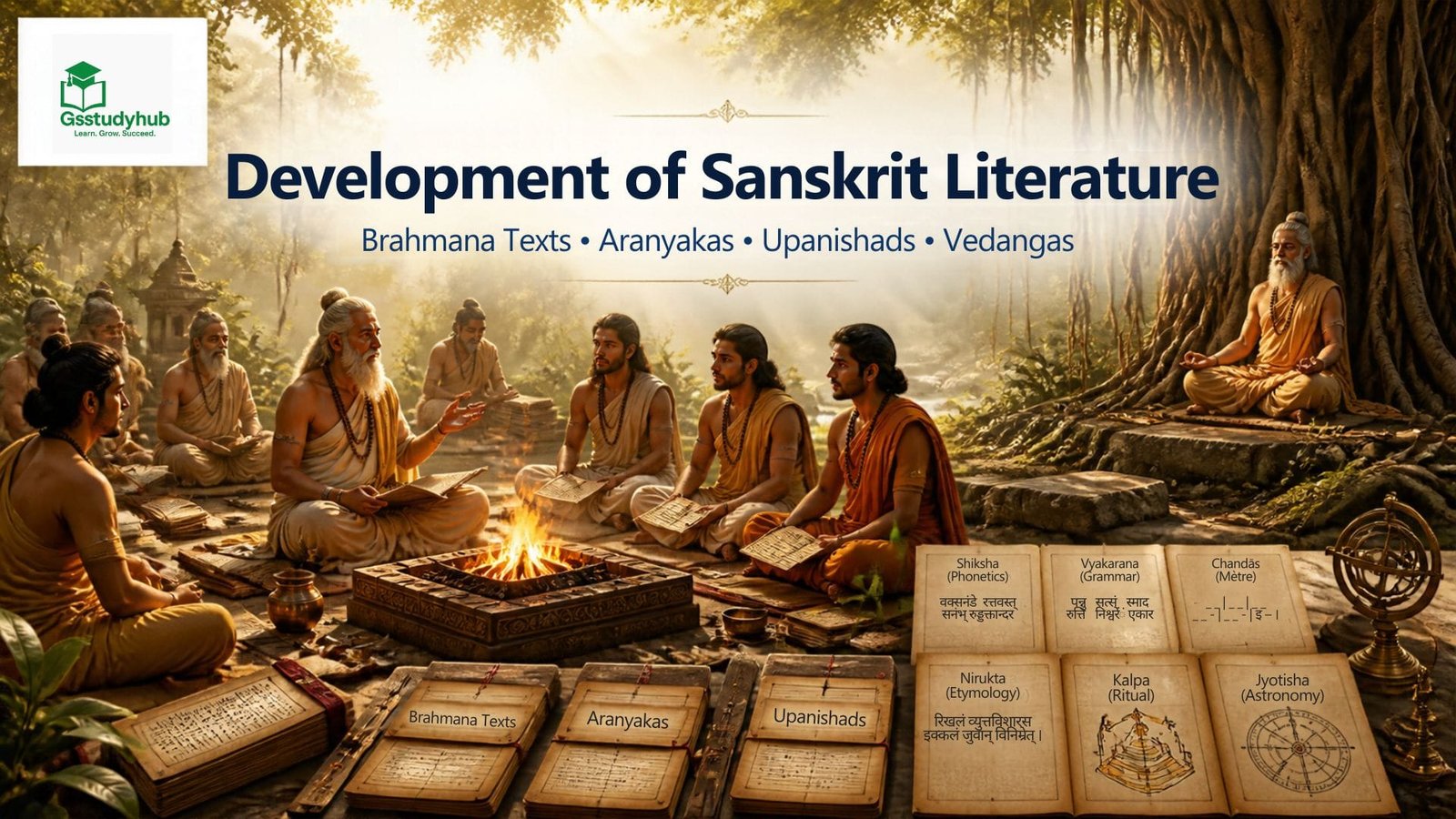
Development of Sanskrit Literature: Brahmana Texts, Aranyakas, Upanishads, and Vedangas
The Brahmana texts, Aranyakas, Upanishads, and Vedangas occupy a special place in the development of Vedic literature. These texts advanced Indian thought from the interpretation of yajnas and rituals to profound philosophical subjects such as the self, Brahman, knowledge, and liberation. They also provided a systematic foundation for the Sanskrit language, grammar, pronunciation, and intellectual traditions.
1. Brahmana Texts: Interpretation of Yajnas and Rituals
The Brahmana texts represent a tradition of Vedic literature that explains the mantras, yajnas, and religious rituals described in the Vedas. Their primary purpose was to clarify the procedures of yajnas, their various stages, the use of mantras, and their religious significance.
These texts explain how yajnas should be performed, the roles of priests in different rituals, and the significance traditionally associated with particular mantras and offerings. They also contain narratives and symbolic interpretations related to sacrificial ceremonies.
Important Examples
The Aitareya Brahmana and Kaushitaki Brahmana are associated with the Rigveda, the Shatapatha Brahmana with the Shukla Yajurveda, and the Taittiriya Brahmana with the Krishna Yajurveda.
2. Aranyaka Literature: From Rituals to Contemplation
The Aranyakas are a form of Vedic literature regarded as an important link between the ritual-oriented tradition of the Brahmana texts and the philosophical thought of the Upanishads. The word “Aranyaka” is associated with “Aranya,” meaning forest.
Alongside the external forms of yajnas, the Aranyakas explore their symbolic and spiritual meanings. They contain reflections on the inner significance of rituals, meditation, and spiritual practice. In this way, inner contemplation gradually gained importance alongside external ritual practices within the Vedic tradition.
Key Point
The Brahmana texts primarily explain yajnas and rituals, whereas Aranyaka literature gives greater attention to their symbolic meanings and spiritual contemplation.
3. Upanishads: The Philosophy of Atman, Brahman, and Moksha
The Upanishads form a major part of the philosophical tradition of Vedic literature. They examine fundamental questions concerning life, death, consciousness, Atman, Brahman, knowledge, and liberation. The presentation of complex philosophical ideas through dialogues between teachers and students is a distinctive feature of the Upanishadic tradition.
In the Upanishads, Atman relates to questions about the true nature of the individual, while Brahman refers to the ultimate reality or supreme truth. Different Upanishads explore these subjects from different philosophical perspectives.
Knowledge is presented as a means of overcoming ignorance and understanding reality. The concept of Moksha is associated with liberation from the cycle of birth and death. These questions subsequently influenced numerous traditions of Indian philosophy.
Important Upanishads
- Isha Upanishad: Ideas related to renunciation, action, and spiritual understanding.
- Kena Upanishad: Questions about consciousness and the power that enables the mind and senses to function.
- Katha Upanishad: Through the dialogue between Nachiketa and Yama, it explores death, the self, and knowledge.
- Chandogya Upanishad: Philosophical teachings concerning Atman, Brahman, and knowledge.
- Brihadaranyaka Upanishad: Extensive philosophical discussions about Atman, Brahman, and existence.
4. The Six Vedangas: Auxiliary Disciplines of Vedic Knowledge
The six Vedangas developed to systematize the correct study, pronunciation, interpretation, and ritual application of the Vedas. They played an important role in the development of the linguistic, practical, and intellectual traditions associated with Vedic literature.
| Vedanga | Main Subject |
|---|---|
| Shiksha | Sounds, pronunciation, and accents. |
| Kalpa | Ritual procedures, yajnas, and related rules. |
| Vyakarana | Word formation and the rules of grammar. |
| Nirukta | Etymology and interpretation of Vedic words. |
| Chandas | Poetic metres and the metrical structure of Vedic hymns. |
| Jyotisha | Determination of appropriate times for rituals and the study of calendrical calculations. |
Exam-Oriented Fact
The six Vedangas are Shiksha, Kalpa, Vyakarana, Nirukta, Chandas, and Jyotisha. They are regarded as six auxiliary disciplines of Vedic study.
5. Development of Religious, Linguistic, and Intellectual Traditions
The Brahmana texts systematically explained yajnas and religious rituals, the Aranyakas encouraged symbolic and spiritual contemplation, and the Upanishads emphasized questions concerning Atman, Brahman, and knowledge. Meanwhile, the Vedangas helped organize the study of pronunciation, grammar, word meanings, metres, and the calculation of time.
These traditions expanded Sanskrit literature beyond religious expression, making it an important medium for philosophical dialogue, linguistic analysis, and the preservation of knowledge. This development laid the foundation for later literary and intellectual achievements.
Conclusion
The Brahmana texts, Aranyakas, Upanishads, and Vedangas represent important successive layers in the development of Vedic literature. Together, they demonstrate the gradual development of ritual interpretation, spiritual contemplation, philosophical inquiry, and systematic linguistic study.
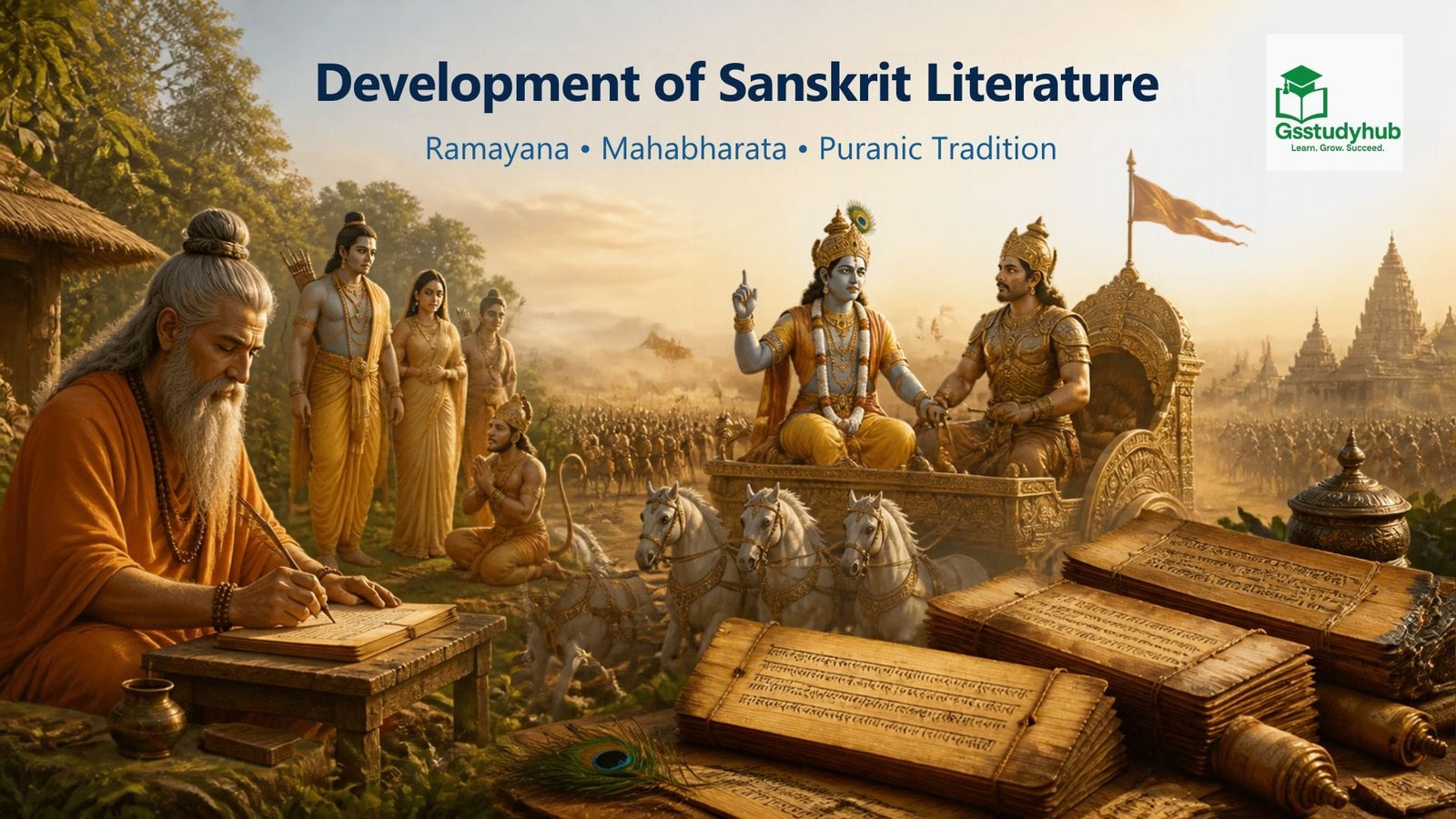
Development of Sanskrit Literature: Ramayana, Mahabharata, and Puranic Tradition
The Ramayana, Mahabharata, and Puranas represent major milestones in the development of Sanskrit literature. These works combine narrative, ethical reflection, social values, religious ideas, and cultural memory. Their influence extends beyond classical Sanskrit texts to Indian philosophy, performing arts, regional languages, folk traditions, and popular storytelling.
1. Ramayana: Ideals of Duty and Human Conduct
The Ramayana is one of India's two great Sanskrit epics. Traditionally attributed to Maharishi Valmiki, it narrates the life of Rama, his exile, Sita's abduction by Ravana, and the struggle to rescue her. Its narrative explores duty, loyalty, courage, sacrifice, and the responsibilities associated with family and society.
Rama is traditionally presented as an ideal of righteous conduct, while Sita represents strength, dignity, and steadfastness amid adversity. Lakshmana illustrates loyalty, and Hanuman exemplifies devotion, courage, and service. The epic also explores the complex relationship between personal feelings, family obligations, kingship, and social expectations.
The Ramayana's enduring appeal lies in its exploration of duty, relationships, sacrifice, and the challenges of ethical decision-making.
2. Mahabharata: Dharma, Politics, and Human Relationships
The Mahabharata is traditionally attributed to Maharishi Ved Vyasa. It centres on the conflict between the Pandavas and Kauravas, culminating in the great war of Kurukshetra. However, its scope extends far beyond warfare to include political authority, justice, family conflict, social responsibilities, and the difficulties of determining dharma in complicated situations.
Characters such as Yudhishthira, Arjuna, Draupadi, Bhishma, Karna, and Krishna represent different moral choices and conflicting obligations. The epic shows that decisions involving power, loyalty, truth, and justice can have far-reaching consequences. It is therefore both a narrative of dynastic conflict and a broad exploration of human behaviour and society.
Bhagavad Gita: A Philosophical Core
The Bhagavad Gita forms part of the Mahabharata, appearing in the Bhishma Parva. Through the dialogue between Krishna and Arjuna before the battle, it addresses moral uncertainty and the responsibilities of action.
- Karma Yoga: Performing one's duty without attachment to the fruits of action.
- Jnana Yoga: Seeking wisdom and understanding the nature of the self and reality.
- Bhakti Yoga: Developing devotion and surrender to the divine.
3. Puranic Literature: religion, Mythology, and Cultural Memory
Puranic literature comprises a large body of Sanskrit texts associated with religious traditions, cosmology, genealogies, sacred places, legends, and accounts of gods, sages, and dynasties. The Puranas helped communicate religious and philosophical ideas through stories and narratives that could reach audiences beyond specialised scholarly circles.
The eighteen Mahapuranas traditionally include texts such as the Vishnu Purana, Shiva Purana, Bhagavata Purana, and Markandeya Purana. They preserve diverse traditions concerning Vishnu, Shiva, Devi, creation, cosmic cycles, pilgrimage, and religious devotion.
Puranic accounts are valuable sources for studying religious beliefs and cultural traditions. However, their genealogies and narratives should not automatically be treated as verified historical records. Historians compare them with inscriptions, archaeology, literary evidence, and other sources.
Tradition and Historical Study
Traditional accounts associate the Ramayana with Valmiki and the Mahabharata with Vyasa. Modern scholarship studies the formation and transmission of these epics as complex processes that may have involved multiple stages over time. Traditional attribution and historical conclusions are therefore not necessarily identical.
4. Comparison of the Ramayana, Mahabharata, and Puranas
| Text | Main Focus | Major Contribution |
|---|---|---|
| Ramayana | Rama's life, duty, family, and kingship. | Ethical ideals and models of conduct. |
| Mahabharata | Dynastic conflict, dharma, politics, and relationships. | Moral debate, social reflection, and the Bhagavad Gita. |
| Puranas | Deities, cosmology, genealogies, legends, and sacred traditions. | Religious storytelling, devotional traditions, and cultural memory. |
5. Influence on Indian society, Arts, and Literature
These texts shaped Indian cultural life through storytelling, moral instruction, religious practice, and artistic expression. Episodes from the Ramayana and Mahabharata became subjects of classical dance, theatre, sculpture, painting, folk performances, and regional storytelling traditions.
Their narratives inspired literary works in many Indian languages, including Hindi, Tamil, Bengali, Telugu, and other regional traditions. Adaptations such as Tulsidas's Ramcharitmanas demonstrate how epic narratives were reinterpreted for different linguistic and cultural communities. Puranic stories likewise influenced temple traditions, festivals, devotional poetry, and local legends.
Together, these works strengthened the Sanskrit epic tradition by combining expansive narratives with ethical, philosophical, social, and religious themes. They also established storytelling models that influenced later poets, dramatists, and literary traditions.
Conclusion
The Ramayana, Mahabharata, and Puranas helped transform Sanskrit literature into a powerful medium for exploring human relationships, dharma, politics, religious belief, and cultural identity. Their influence continues through literature, art, performance, and living traditions across India.
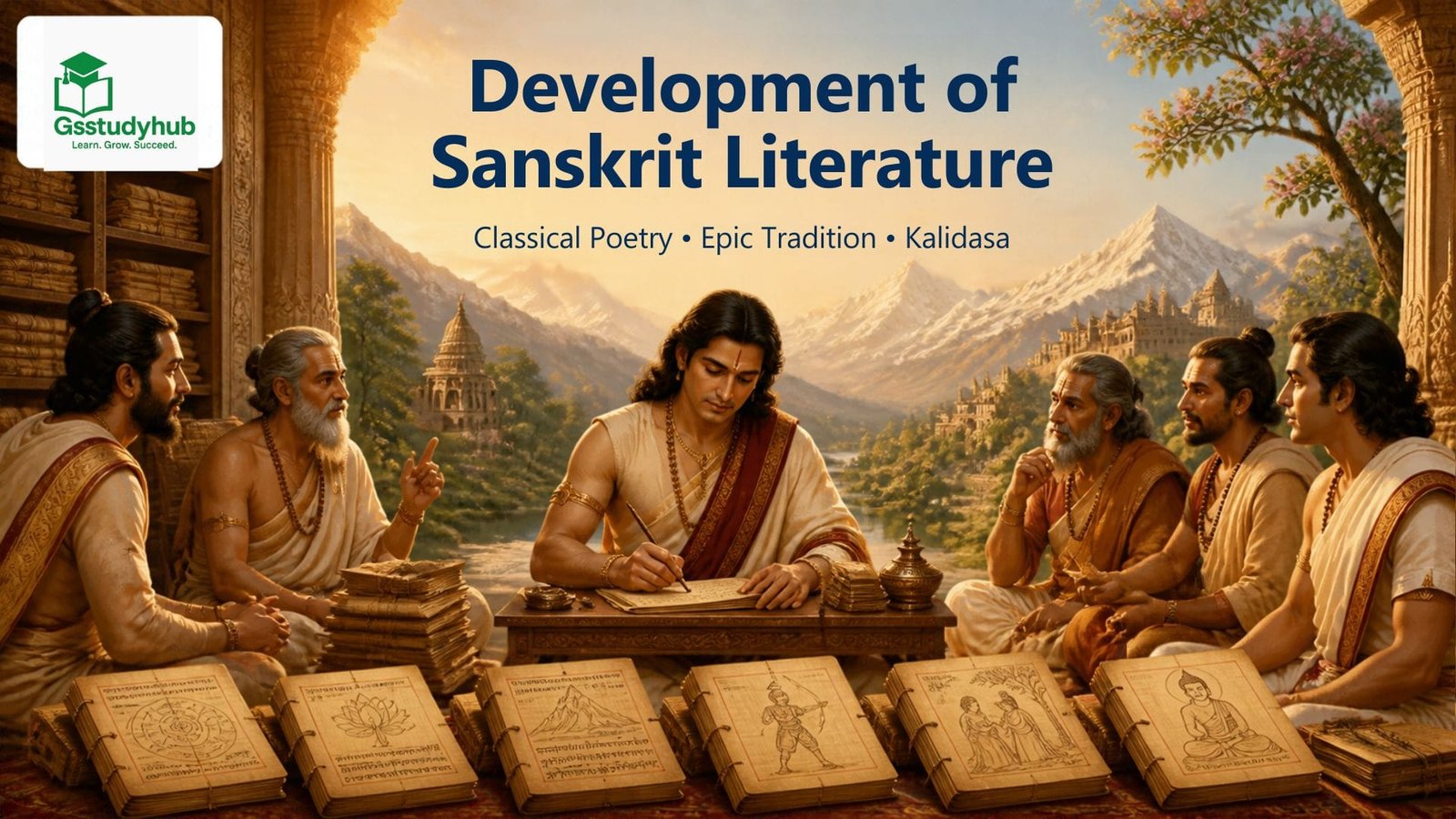
Development of Sanskrit Literature: Classical Poetry, Epic Tradition, and Kalidasa
After the Vedic literature and the great epics, Sanskrit literature acquired more refined literary forms during the classical period. During this era, traditions of grammar, mahakavya, poetics, and literary composition developed significantly. Writers such as Panini, Ashvaghosha, Bharavi, Magha, Sriharsha, and Kalidasa gave Sanskrit a distinctive identity through linguistic richness, poetic beauty, and intellectual depth.
1. Development and Characteristics of Classical Sanskrit Literature
Classical Sanskrit literature placed particular emphasis on linguistic precision, metrical structure, figures of speech, poetic sentiment, imagination, and thematic diversity. Alongside religious narratives, poets explored love, nature, heroism, royal duty, warfare, human relationships, and the complexities of life.
During this tradition, diverse literary forms developed, including mahakavya, shorter narrative poetry, lyrical poetry, drama, and prose. Writers presented mythological narratives and historical-cultural memories through artistic language and powerful descriptive styles.
Major Characteristics of Classical Poetry
- A systematic tradition of language, grammar, and metre.
- The use of poetic sentiment, figures of speech, similes, and imaginative descriptions.
- Expression of nature, love, heroism, ethics, and human emotions.
- Literary reinterpretation of mythological narratives and cultural ideals.
2. Panini and Sanskrit Grammar
Panini was one of the greatest grammarians of ancient India. His famous work, Ashtadhyayi, is an exceptionally systematic and influential text on Sanskrit grammar. Through approximately four thousand sutras, it presents the rules of word formation, sound changes, and linguistic structure in a concise and organised manner.
The Ashtadhyayi provided a strong foundation for the analysis and study of Sanskrit. Panini's rule-based approach influenced later grammatical traditions, and its significance continues to be recognised in modern linguistic studies.
Important Fact
The Ashtadhyayi is a foundational text of Sanskrit grammar. Panini's exact date is uncertain. He is generally associated with the ancient grammatical tradition of the middle or later part of the first millennium BCE, although scholars disagree about his precise chronology.
3. The Sanskrit Epic Tradition and Major Writers
The Sanskrit mahakavya tradition is characterised by expansive narratives, elevated characters, descriptions of nature, warfare, ethics, and literary craftsmanship. Ashvaghosha, Bharavi, Magha, and Sriharsha are notable poets of this tradition. Their works combine narrative development with linguistic artistry and scholarly sophistication.
| Literary Figure | Major Work | Distinctive Contribution |
|---|---|---|
| Ashvaghosha | Buddhacarita, Saundarananda | Buddhist philosophy and poetic narratives. |
| Bharavi | Kiratarjuniya | Heroism, depth of meaning, and powerful language. |
| Magha | Shishupalavadha | Figures of speech, verbal artistry, and rich descriptions. |
| Sriharsha | Naishadhiyacharita | Scholarly style and sophisticated poetic composition. |
| Kalidasa | Raghuvamsha, Kumarasambhava | Balanced expression of nature, emotions, and poetic beauty. |
Exam-Oriented Facts
Bharavi's Kiratarjuniya, Magha's Shishupalavadha, and Sriharsha's Naishadhiyacharita are famous Sanskrit mahakavyas. Ashvaghosha's Buddhacarita is an important poetic work associated with the Buddhist tradition.
4. Kalidasa: Poet of Nature, Love, and Human Emotions
Kalidasa is regarded as one of the most celebrated poets in Sanskrit literature. His works reveal a profound relationship between nature and human life. The beauty of his similes, natural expression of emotions, psychological portrayal of characters, and balanced use of language are defining features of his literary style.
Raghuvamsha narrates the story of the lineage of Raghu and associated kings. Through these accounts, it presents ideals of royal duty, heroism, sacrifice, and the responsibilities of kingship. Kumarasambhava poetically describes the narrative associated with Shiva and Parvati and the mythological background of the birth of Kumara.
Other famous works of Kalidasa include Abhijnanashakuntalam, Malavikagnimitram, Vikramorvashiyam, and Meghaduta. These works also demonstrate his dramatic talent and mastery of lyrical poetry.
5. Royal Patronage, Scholarly Traditions, and Literary Competition
Kings and elite patrons played an important role in the development of Sanskrit literature. Support for poets and scholars at royal courts encouraged the composition of mahakavyas, royal eulogies, dramas, and other literary works. Scholarly assemblies, intellectual debates, and the study of grammar and poetics also became important parts of intellectual life.
Competition among poets to establish literary excellence encouraged the use of complex metres, figures of speech, layered meanings, and powerful descriptive techniques. However, the development of Sanskrit literature was not limited to royal patronage. Religious institutions, educational traditions, and diverse intellectual communities also contributed to its growth.
Conclusion
Classical Sanskrit literature elevated linguistic precision, poetic craftsmanship, and thematic diversity. Panini systematised the grammatical tradition, while poets such as Kalidasa, Ashvaghosha, Bharavi, Magha, and Sriharsha enriched Sanskrit poetry through diverse literary forms and profound emotional expression.
Development of Sanskrit Literature: The Traditions of Drama, Prose, and Narrative Literature
Drama, prose, and narrative literature opened new directions for literary expression in classical Sanskrit literature. Playwrights presented human emotions, social life, politics, and moral conflicts through the stage, while prose writers and storytellers explored historical narratives, love stories, moral tales, and exciting adventures. These literary forms profoundly influenced Indian theatre, oral storytelling, and the literary traditions of regional languages.
1. The Tradition and Characteristics of Sanskrit Drama
Sanskrit drama is a highly developed literary form of Indian literature. It combines dialogue, acting, plot, characterisation, rasa, and emotional expression. Playwrights presented themes such as love, compassion, heroism, humour, politics, and family relationships through dramatic forms.
Sanskrit plays employ both prose and poetry. Depending on the social position of the characters and dramatic conventions, Sanskrit and various Prakrit languages are also used. Concepts associated with Bharata Muni's Natyashastra, particularly rasa, acting, and theatrical performance, have held special importance in the tradition of Sanskrit drama.
Major Characteristics of Sanskrit Drama
- Development of the story through dialogue and acting.
- Expression of rasa, emotions, and the psychological dimensions of characters.
- Contextual use of prose, poetry, Sanskrit, and Prakrit.
- Portrayal of love, politics, social life, and moral conflicts.
2. Major Sanskrit Playwrights and Their Works
| Playwright | Major Works | Literary Significance |
|---|---|---|
| Bhasa | Svapnavasavadattam, Pratijnayaugandharayanam | Powerful portrayals of political events, human relationships, and dramatic conflicts. |
| Kalidasa | Abhijnanashakuntalam, Malavikagnimitram, Vikramorvashiyam | Poetic expression of love, nature, and human emotions. |
| Shudraka | Mrichchhakatika | Portrayal of urban life, social diversity, love, and political events. |
| Vishakhadatta | Mudrarakshasa | A drama centred on politics, diplomacy, and struggles for power. |
| Bhavabhuti | Uttararamacharita, Malatimadhava | Expression of compassion, love, sacrifice, and profound human emotions. |
Significance of Major Plays
Abhijnanashakuntalam is famous for its story of love and reunion. Mrichchhakatika is notable for its portrayal of social life and diverse characters. Mudrarakshasa explores political strategy and diplomacy, while Uttararamacharita presents Rama's later life, separation from Sita, and deeply moving emotions.
3. Sanskrit Prose Literature and Banabhatta
Sanskrit prose literature is distinguished by descriptive writing, ornate language, extensive compound words, and detailed portrayals of characters and events. Historical narratives, romantic stories, biographies, and imaginative plots developed within this literary tradition.
Major Works of Banabhatta
Kadambari: One of the famous prose narratives in Sanskrit literature. It combines love, rebirth, mystery, and an intricate structure of interconnected stories. Banabhatta began composing it, and his son Bhushanabhatta is traditionally believed to have completed it.
Harshacharita: An important prose narrative associated with the life of King Harshavardhana and his period. It provides historical information alongside literary embellishments, so its accounts need to be compared with other historical sources.
4. Narrative Literature: Panchatantra, Hitopadesha, and Kathasaritsagara
Sanskrit narrative literature developed an influential means of presenting entertainment alongside ethics, practical wisdom, and lessons drawn from life. Many of its stories travelled into different languages and cultures over time.
Panchatantra
The Panchatantra uses stories involving animals and human characters to communicate lessons about friendship, politics, caution, and practical intelligence. Its narrative structure influenced moral-story traditions in numerous languages.
Hitopadesha
The Hitopadesha is a famous collection of moral tales. Through simple stories and instructive episodes, it explores friendship, wise conduct, conflict, and practical judgement.
Kathasaritsagara
Composed by Somadeva, the Kathasaritsagara is an extensive collection of Sanskrit narratives. It includes numerous interconnected stories, adventures, popular beliefs, and imaginative episodes.
The dramatic and narrative traditions of Sanskrit demonstrate that literature is not merely a source of knowledge and entertainment, but also a means of understanding society, human behaviour, and cultural memory.
5. Influence on Theatre, Storytelling, and Other Languages
Sanskrit drama enriched Indian theatre, acting, music, and dance traditions. Alongside episodes from epics such as the Ramayana and Mahabharata, stories from Sanskrit plays were adapted into stage performances and cultural events in different regions.
Stories from works such as the Panchatantra and Hitopadesha became popular in oral storytelling, children's literature, and moral education. Sanskrit narrative and dramatic traditions inspired writers in Hindi, Bengali, Tamil, Telugu, and other languages through their plots, characters, and literary forms.
Conclusion
Sanskrit drama presented human experiences through dialogue, acting, and rasa. Prose literature developed elaborate descriptions and complex narratives, while storytelling literature communicated ethics and practical wisdom through engaging tales. The influence of these literary forms remains visible in Indian literature and performing arts today.
Development of Sanskrit Literature: Poetics, Philosophy, Science, and Knowledge Traditions
The development of Sanskrit literature was not limited to poetry, drama, and stories. It also produced rich traditions of literary theory, philosophy, mathematics, astronomy, Ayurveda, medicine, politics, and economics. These works shaped Indian intellectual history and contributed to the preservation, analysis, and transmission of knowledge across different fields.
1. Sanskrit Poetics and the Natyashastra
Sanskrit poetics systematically examined the nature of poetry, language, rasa, figures of speech, suggestion, and literary beauty. The Natyashastra of Bharata Muni is a major text in the Indian traditions of drama and performing arts. It discusses acting, dance, music, theatre, and the theory of rasa.
Later scholars advanced this tradition by analysing different aspects of poetry. Bhamaha contributed to the study of figures of speech, Dandin discussed poetic qualities and style, Anandavardhana developed the theory of suggestion, Abhinavagupta made influential contributions to the interpretation of rasa and aesthetics, and Mammata presented a systematic discussion of major concepts of poetics.
Major Scholars of Sanskrit Poetics
- Bhamaha: Author of Kavyalankara and an important scholar of the alankara tradition.
- Dandin: Author of Kavyadarsha, known for his discussion of poetic qualities and style.
- Anandavardhana: Presented the theory of dhvani in Dhvanyaloka.
- Abhinavagupta: An influential interpreter of rasa theory and the Natyashastra.
- Mammata: Systematically discussed major concepts of poetics in Kavyaprakasha.
2. The Tradition of Sanskrit Philosophical Literature
Sanskrit philosophical literature explored profound questions concerning knowledge, reality, consciousness, logic, action, and liberation. The six major orthodox traditions of Indian philosophy are Nyaya, Vaisheshika, Samkhya, Yoga, Mimamsa, and Vedanta. Each has its own principles and methods of inquiry.
The Six Major Philosophical Traditions
- Nyaya: Logic, sources of knowledge, and the attainment of valid knowledge.
- Vaisheshika: Analysis of substances, qualities, and the structure of the world.
- Samkhya: A philosophical system based on the distinction between Purusha and Prakriti.
- Yoga: Regulation of mental activities and the tradition of spiritual discipline.
- Mimamsa: Vedic rituals, dharma, and the interpretation of sacred texts.
- Vedanta: Different interpretations of Brahman, Atman, and ultimate reality.
3. Mathematics and Astronomy
Sanskrit mathematical and astronomical texts contributed to the study of calculation, planetary motion, timekeeping, and celestial phenomena. These subjects were also connected with practical needs, including the determination of appropriate times for religious rituals.
Major Scholars and Their Works
Aryabhata: Composed the Aryabhatiya around the fifth century CE. It is an important text on mathematics and astronomy.
Varahamihira: A sixth-century scholar whose Brihat Samhita discusses astronomy, natural phenomena, architecture, and other subjects. His Panchasiddhantika is another major work.
4. Ayurveda and Medical Literature
Sanskrit texts associated with Ayurveda discuss health, the identification of diseases, diet, medicinal substances, treatment, and the structure of the human body. These works are important sources for studying ancient Indian medical traditions, although historical medical ideas must be distinguished from the conclusions of modern medicine.
Charaka and Sushruta
Charaka Samhita: An Ayurvedic text primarily concerned with internal medicine, diagnosis, diet, and principles of health.
Sushruta Samhita: Presents extensive material on surgery, anatomy, instruments, and treatment methods. These texts developed over extended periods and may preserve layers of material from different historical periods.
5. Politics and Economics
Sanskrit literature on political thought and administration examined governance, diplomacy, justice, taxation, and economic activities. The Arthashastra, traditionally associated with Kautilya, is an important work on state administration, public policy, the economy, security, and diplomacy.
The Arthashastra should not be understood as equivalent to the modern study of economics alone. It is a broader work concerned with statecraft and the management of government. Scholars continue to discuss its chronology and the process through which its surviving text took shape.
Exam-Oriented Facts
- Aryabhatiya — Aryabhata; mathematics and astronomy.
- Brihat Samhita — Varahamihira; astronomy and various traditional subjects.
- Charaka Samhita — Ayurveda and internal medicine.
- Sushruta Samhita — Ayurveda and surgery.
- Arthashastra — Traditionally associated with Kautilya; governance and statecraft.
6. Preservation and Changing Circumstances in Later Periods
In later periods, Sanskrit learning continued through traditional schools, monasteries, temples, scholarly assemblies, and various centres of education. Copying manuscripts, writing commentaries, conducting scholarly debates, and maintaining traditional teaching systems helped preserve many texts. Patronage from different regions and dynasties supported Sanskrit scholarship at various times.
Despite changing political, social, and linguistic circumstances, Sanskrit maintained connections with other Indian languages. Its concepts, vocabulary, and textual traditions influenced regional literature, religious thought, and education. However, the extent of this influence varied across different regions and historical periods.
Conclusion
Sanskrit literature developed distinct knowledge traditions in poetics and philosophy, alongside mathematics, astronomy, Ayurveda, and political thought. Understanding their historical significance requires maintaining a clear distinction between literary works, scientific ideas, and philosophical texts.
Development of Sanskrit Literature: Modern Revival, Preservation, and Cultural Significance
Sanskrit literature represents an enduring intellectual and cultural heritage of India. In the modern era, its study has expanded through universities, research institutions, manuscript preservation, translation projects, and digital technologies. Preserving this heritage requires not only protecting ancient texts but also interpreting them critically and making their literary, philosophical, and historical contributions accessible to new generations.
1. Sanskrit Literature in the Modern Era
Modern scholarship has introduced systematic methods for studying Sanskrit texts, including manuscript comparison, historical analysis, textual criticism, and translation. Researchers examine different versions of manuscripts to understand how texts were transmitted, edited, and interpreted across centuries.
Translation into Hindi, English, and other languages has made Sanskrit literature accessible to wider audiences. Critical editions and scholarly commentaries also help readers understand the language, historical context, philosophical arguments, and literary techniques of important works.
Why Manuscript Preservation Matters
Manuscripts preserve literary, philosophical, scientific, and historical knowledge. Their careful cataloguing, conservation, digitisation, and scholarly examination help protect this heritage from physical deterioration and loss.
2. Sanskrit in Education, Research, and Digital Media
Sanskrit continues to be studied in schools, colleges, universities, and specialised research institutions. Academic programmes examine Sanskrit grammar, literature, philosophy, linguistics, and traditional knowledge systems. Literary organisations and research centres also support publications, seminars, manuscript studies, and the teaching of Sanskrit.
Digital libraries, searchable text collections, online dictionaries, and digitised manuscripts have made many resources easier to access. Digital tools can assist with searching, cataloguing, and comparing texts, although accurate interpretation still requires linguistic expertise and careful scholarly review.
Modern Approaches to Sanskrit Studies
- Preservation and digitisation of manuscripts.
- Critical editions, translations, and scholarly commentaries.
- University teaching and interdisciplinary research.
- Digital archives and online learning resources.
- Connecting younger readers with Sanskrit literature through accessible educational materials.
3. Major Achievements and Cultural Contribution
Sanskrit literature has preserved a remarkable range of literary forms, including hymns, philosophical dialogues, epics, drama, poetry, prose, and narrative collections. Its grammatical and literary traditions contributed to the systematic study of language and the development of sophisticated methods of literary analysis.
Its influence is visible in Indian philosophy, religious traditions, classical performing arts, architecture-related texts, education, and regional literatures. The Ramayana, Mahabharata, Sanskrit plays, and collections such as the Panchatantra have travelled across linguistic and cultural boundaries through adaptations and retellings.
These achievements should be understood through careful historical study. Sanskrit literature reflects diverse periods, communities, ideas, and intellectual debates rather than a single unchanging cultural tradition.
4. Challenges in Preservation and Study
Sanskrit literature faces several challenges, including the deterioration of manuscripts, limited access to specialised training, difficulties in reading older scripts, and the cost of conservation and scholarly publication. Some texts remain unpublished or are available only in difficult-to-access editions.
Another challenge is making Sanskrit education engaging and accessible without oversimplifying complex texts. Reliable translations, historical context, critical interpretation, and responsible use of digital tools are essential for meaningful study. Collaboration among universities, libraries, traditional scholars, and technology specialists can help address these needs.
Preserving Sanskrit for Future Generations
Effective preservation requires protecting manuscripts, supporting rigorous research, improving access to trustworthy editions, and encouraging new readers to engage with Sanskrit literature critically and thoughtfully.
5. Conclusion: The Continuing Legacy of Sanskrit Literature
The development of Sanskrit literature extends from the Vedic tradition to philosophical works, epics, classical poetry, drama, prose, narrative literature, and specialised writings on knowledge and learning. Across these forms, Sanskrit became an important medium for literary creativity, intellectual debate, and cultural transmission.
Its continued relevance depends on preserving original texts, studying them in their historical contexts, producing reliable translations, and making research accessible to future generations. Sanskrit literature is not merely a record of the past; it is also a valuable resource for understanding India's literary history, philosophical diversity, and cultural connections with the wider world.
A balanced approach that combines respect for tradition with critical inquiry will help ensure that this extensive literary heritage remains available for study, discussion, and appreciation in the modern era.
Frequently Asked Questions (FAQs)
1. What is the earliest literary foundation of Sanskrit literature?
The Vedas form the earliest major literary foundation of Sanskrit literature. They preserve ancient hymns, ritual materials, and reflections associated with the Vedic tradition.
2. How many Vedangas are there?
There are six Vedangas: Shiksha, Kalpa, Vyakarana, Nirukta, Chandas, and Jyotisha. They support the study, interpretation, and transmission of Vedic knowledge.
3. What are the two major Sanskrit epics?
The Ramayana and the Mahabharata are the two great Sanskrit epics. They explore duty, relationships, ethical dilemmas, politics, and cultural ideals.
4. What is the contribution of Sanskrit literature to Indian Culture?
Sanskrit literature has contributed to Indian philosophy, poetry, drama, religious traditions, linguistic studies, scientific writing, performing arts, and regional literary traditions.
References and Further Reading
- The Vedas, Upanishads, Ramayana, and Mahabharata: Primary textual traditions for studying the development of Sanskrit literature.
- Bharata Muni, Natyashastra: A foundational work on Indian drama, performance, and aesthetic theory.
- Panini, Ashtadhyayi: A foundational work of Sanskrit grammar.
- Encyclopaedia Britannica: Scholarly reference articles on Sanskrit literature, Kalidasa, and major Indian literary traditions.
- Sanskrit Documents: A digital collection of Sanskrit texts and related resources available at sanskritdocuments.org.
- National Mission for Manuscripts, Government of India: Institutional resources relating to manuscript documentation, preservation, and awareness.