
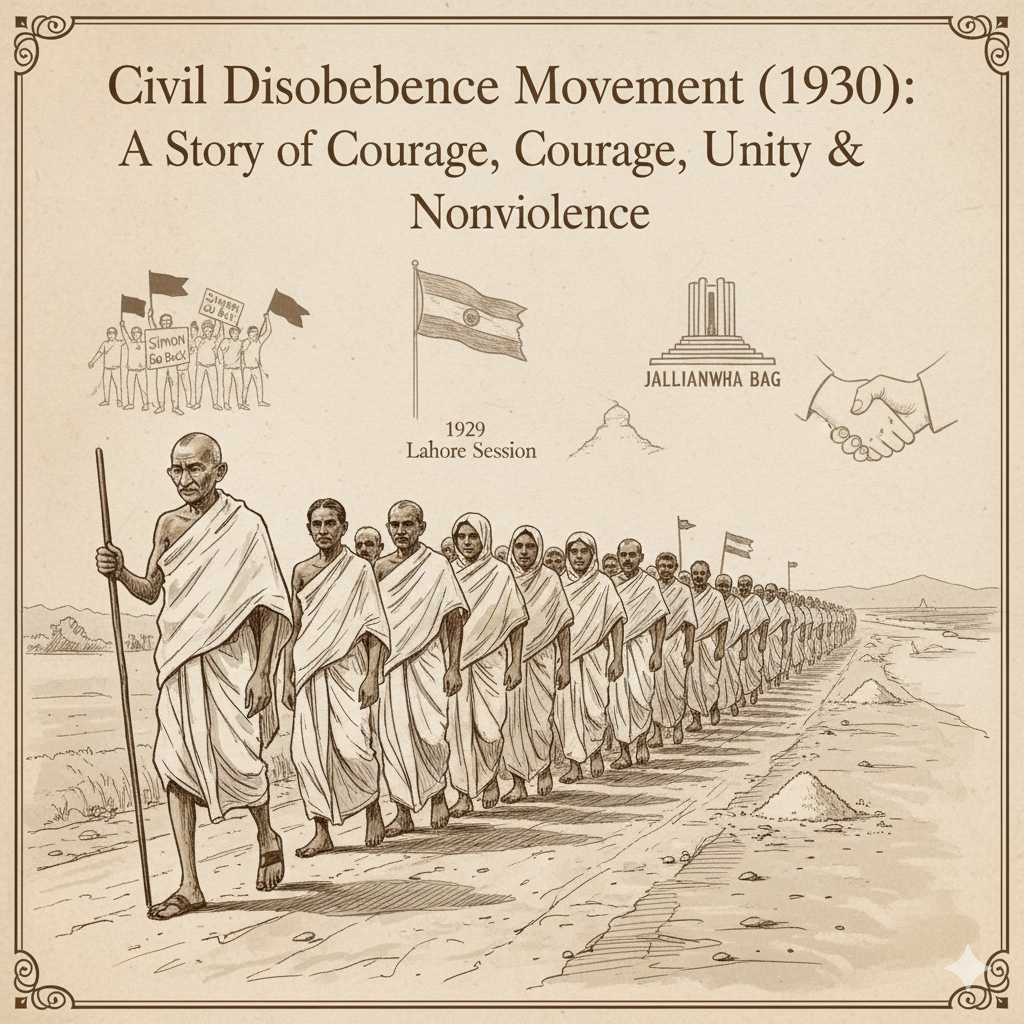
Civil Disobedience Movement: A Story of Courage, Unity and Nonviolence
The Civil Disobedience Movement was a defining chapter in India's freedom struggle. Launched under the leadership of Mahatma Gandhi on 12 March 1930, it aimed to oppose unjust British laws through nonviolent resistance. In this account I share the movement's background, the dramatic beginning at Dandi, how ordinary people joined the struggle, and the results that changed the course of history.
Background of the Civil Disobedience Movement
The Civil Disobedience Movement did not appear overnight — it grew from years of political, social and economic grievances. It was both a protest against specific unjust laws and a broader uprising against colonial exploitation. Several key developments set the stage:
Opposition to the Simon Commission (1927)
The British government appointed the Simon Commission in 1927 to review constitutional reform in India, but the commission had no Indian members. That exclusion sparked widespread protests and deepened national resentment.
Demand for Purna Swaraj (1929)
At the Lahore Session of the Indian National Congress in 1929, under the presidency of Pandit Jawaharlal Nehru, complete independence (Purna Swaraj) was formally declared. This declaration made the demand for full independence explicit and intensified the drive for mass action.
Opposition to the Salt Law and Economic Exploitation
The salt tax was a stark example of economic injustice: essential for life, salt was taxed heavily, placing an additional burden on the poor. Gandhi chose the salt laws as a symbol around which nonviolent protest could unite people across regions and classes.
Beginning of the Movement — The Dandi March
The movement's dramatic beginning is best remembered as the Dandi March (also called the Salt Satyagraha). Gandhi left the Sabarmati Ashram in Ahmedabad on 12 March 1930 with 78 satyagrahis and walked roughly 240 miles (about 385 km) toward the coastal village of Dandi.
Dandi — 6 April 1930
On 6 April 1930 Gandhi reached Dandi and deliberately broke the salt laws by making salt from seawater. This act of peaceful defiance ignited protests and salt-making acts across India, spreading the movement like a wave.
"Making salt from seawater was a small act of defiance but it turned into a giant step for the country's freedom movement."
Major Phases and Widespread Participation
The Civil Disobedience Movement developed rapidly through many phases, absorbing different social groups and tactics while remaining rooted in nonviolent resistance.

✔ Comfortable & easy daily use
✔ Excellent value for money
✔ Trusted choice among buyers
Widespread Public Participation
- Boycott of foreign clothes and goods.
- Non-payment of taxes and abandonment of government jobs and schools by some participants.
- Satyagrahis violated salt laws, forest laws, and restrictions on production and sale of certain goods.
Participation of Women
Women played an active and visible role. Leaders like Sarojini Naidu and Kasturba Gandhi inspired many to join protests and salt-making activities.
British Government’s Response
Authorities arrested thousands of freedom fighters, including prominent leaders such as Mahatma Gandhi, Jawaharlal Nehru and Sardar Vallabhbhai Patel. Repression and mass arrests were common tools to suppress the movement.
Violent Incidents
Although the movement emphasized nonviolence, there were pockets of violence in some regions. Notable among these was the Chittagong Armoury Raid (1930) led by Surya Sen — an episode that reflected the growing impatience and radical strands within the broader struggle.
Important Results and Negotiations
Gandhi–Irwin Pact (1931)
The Gandhi–Irwin Pact marked the first major negotiation between Gandhi and the British government. Under the pact Gandhi agreed to suspend the movement temporarily; in return the British released many political prisoners and permitted Indians to manufacture salt for domestic use.
Second Round Table Conference (1931)
Gandhi attended the Second Round Table Conference in London to discuss India’s future, but no concrete settlement on independence was reached at that time.
Relaunch and Continuation (1932–1934)
When the British failed to implement meaningful reforms, mass civil disobedience resumed. The movement continued in various forms and regions until around 1934.
Importance of the Civil Disobedience Movement
The Civil Disobedience Movement had several lasting impacts:
- It transformed the freedom struggle into a truly mass movement, involving peasants, workers, students, women and urban middle classes.
- It showcased the power and global relevance of nonviolence and Satyagraha.
- It increased pressure on British rule and helped create political conditions that eventually led to the Independence Act of 1947.
Why the Movement Started — Key Causes (Concise Timeline)
Several events and conditions converged to cause the Civil Disobedience Movement:
1. Consequences of the First World War (1914–1918)
Indians had cooperated during the war with expectations of reform. After the war, repressive policies, rising inflation, hunger and unemployment increased public discontent.
2. Rowlatt Act (1919) and Jallianwala Bagh
The Rowlatt Act allowed imprisonment without trial and sparked nationwide protests. The Jallianwala Bagh massacre (1919) under General Dyer deepened anger and alienation from British rule.
3. Khilafat Movement (1919–1924)
The Khilafat Movement briefly united diverse groups and showed the potential of mass mobilization. Its eventual failure, and incidents like Chauri Chaura (1922), led Gandhi to withdraw non-cooperation, shaping later strategies.
4. Simon Commission Opposition (1927)
The Simon Commission's lack of Indian members sparked nationwide demonstrations and further consolidated anti-colonial sentiment.
5. Declaration of Purna Swaraj (1929)
The formal proclamation for Complete Independence at the Lahore Session in 1929 gave a clear national aim and made civil disobedience a legitimate method of protest.
6. Salt Law and Economic Exploitation
Salt tax symbolized colonial exploitation. The Salt Satyagraha was a direct challenge to economic injustice and rallied people from all walks of life.
Conclusion — Legacy of the Movement
The Civil Disobedience Movement proved that even an empire’s laws could be challenged through organized, nonviolent resistance. It stands as a milestone in India’s march toward freedom — a testament to courage, perseverance and unity. The movement not only weakened colonial authority but also taught millions that moral force and mass participation together can change history.
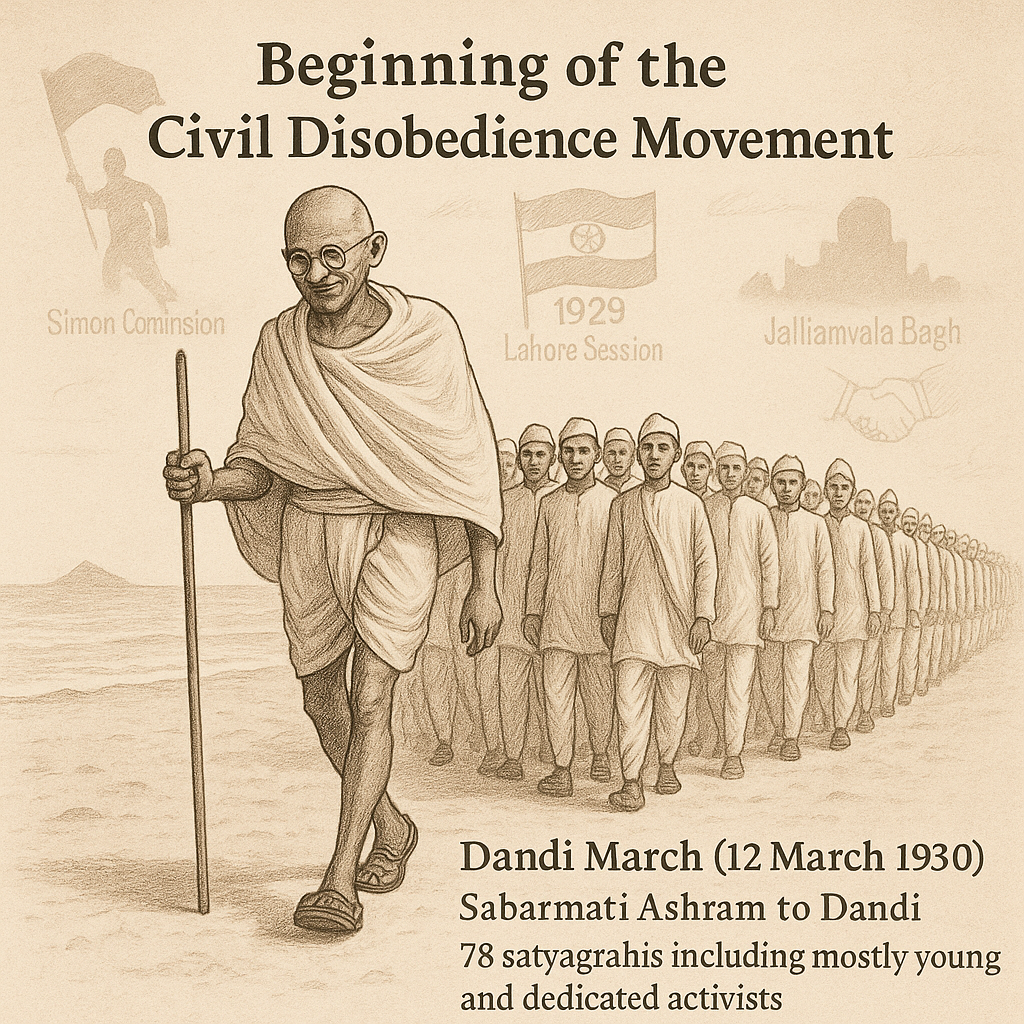
Beginning of the Civil Disobedience Movement
The beginning of the Civil Disobedience Movement is considered a milestone in the history of the Indian freedom struggle. This movement aimed to oppose the unjust laws of the British government through non-violent methods. Mahatma Gandhi gave it the form of a mass movement, connecting crores of Indians to the struggle for freedom.
Planning and Background of the Movement
Mahatma Gandhi warned the British government that he would launch a Civil Disobedience Movement if the rights and demands of Indians were not respected.
- In 1930, Gandhi wrote a letter to Viceroy Lord Irwin demanding basic rights for Indians.
- When the British government ignored these demands, Gandhi announced a non-violent nationwide movement.
Dandi March – Beginning of the Movement
The most important beginning of the Civil Disobedience Movement was the historic Dandi March (Salt March).
Key Details
- Date: 12 March 1930
- Place: Sabarmati Ashram (Ahmedabad), Gujarat
- Leadership: Mahatma Gandhi
- Companions: 78 satyagrahis (mostly young and dedicated activists)
Trip Details
- Gandhiji and his followers walked 240 miles (385 km).
- They stopped at many villages and made people aware of British injustices.
- After traveling for 24 days, they reached Dandi village on 6 April 1930.
Salt Satyagraha
At Dandi, Gandhiji picked up natural salt from the seashore and made salt from seawater, openly violating British law. This was a symbolic and powerful protest, as salt was an essential part of every Indian’s daily life.
Countrywide Expansion of the Movement
After the Dandi March, the Civil Disobedience Movement spread across the entire country.
- Violation of Salt Law: People began openly making salt from seawater.
- Boycott of Government Taxes: Land tax, liquor tax, and taxes on foreign goods were widely boycotted.
- Boycott of Foreign Clothes: Indians burned foreign clothes and promoted Swadeshi.
- Participation of Women: Sarojini Naidu, Kasturba Gandhi, and thousands of women played important roles.
- Boycott of British Institutions: Courts, government jobs, and schools were abandoned.
British Government’s Response
The British government grew alarmed due to the rising popularity of the movement.
- Mahatma Gandhi, Jawaharlal Nehru, Sardar Vallabhbhai Patel, and thousands of activists were arrested.
- Repressive measures such as lathi-charge, firing, and mass arrests were used to suppress the movement.
Gandhi-Irwin Pact (1931)
Seeing the impact of the movement, the British government agreed to negotiate with Gandhiji. In March 1931, the Gandhi-Irwin Pact was signed.
- The British government agreed to release political prisoners.
- Gandhiji agreed to suspend the movement temporarily.
- Under this pact, Gandhiji participated in the Second Round Table Conference.
Features of the Civil Disobedience Movement
- Non-violent protests: Based on the ideals of truth and non-violence.
- Mass movement: People from all sections—farmers, labourers, women, and students—participated.
- Economic non-cooperation: Boycott of foreign goods and taxes to weaken British economic power.
- Women Empowerment: Women participated on an unprecedented scale.
Conclusion
The Civil Disobedience Movement gave a new direction to India’s struggle for freedom. It proved that through Satyagraha and non-violence, even a tyrannical rule can be challenged. It remains a historical and inspiring chapter of India’s independence journey.
Major Phases of the Civil Disobedience Movement
The Civil Disobedience Movement, launched by Mahatma Gandhi on 12 March 1930, became an important chapter in India's freedom struggle. It aimed at opposing unjust British laws through non-violent means. The movement progressed through several major phases that strengthened the independence movement.
1. Dandi March – Beginning of the Movement (12 March 1930 – 6 April 1930)
✔ Comfortable & easy to use
✔ Great value for everyday use
✔ Popular choice among buyers
- Leadership: Mahatma Gandhi
- Route: From Sabarmati Ashram (Ahmedabad) to Dandi (Gujarat)
- Journey: 240 miles (385 km) with 78 satyagrahis
- Objective: Violation of the British salt law
Major Events
- Gandhiji held meetings in many villages to educate people about British injustices.
- On 6 April 1930, he reached the seashore and made salt, violating British law.
Importance: This event turned into a nationwide symbol of protest and transformed the movement into a massive people’s movement.
2. Countrywide Expansion of the Movement (April 1930 – December 1930)
Major Activities
- Violation of Salt Law: Mass production of salt across India.
- Boycott of Government Taxes: Land tax, liquor tax, and taxes on foreign goods were rejected.
- Boycott of British Institutions: Government jobs, courts, and schools were abandoned.
- Participation of Women: Women took part actively on a large scale.
Result: Lakhs of people were arrested, including Gandhiji, Nehru, and Patel.
3. Gandhi-Irwin Pact (March 1931)
With the pressure of the movement increasing, the British government began negotiations with Gandhiji.
- The British government agreed to release political prisoners.
- Indians were permitted to manufacture salt.
- Gandhiji agreed to suspend the movement temporarily.
Importance: Gandhiji participated in the Second Round Table Conference based on this agreement.
4. Second Phase of the Movement (1932 – 1934)
The failure of the Second Round Table Conference disappointed Indian leaders. Gandhiji relaunched the movement with renewed determination.
Major Activities
- New forms of Satyagraha were launched against British policies.
- Focus was placed on Dalit rights and the Poona Pact (1932).
British Response
- Gandhiji was arrested again.
- Strict measures were adopted to suppress the movement.
Result: The movement continued until 1934. Although it did not fully achieve its goals, it strengthened the freedom struggle.
Major Contributions of the Civil Disobedience Movement
- Mass Movement: Crores of Indians participated actively for the first time.
- Women’s Participation: Marked a historic change in their role.
- Non-violent Ideals: Satyagraha gained international recognition.
- Political Pressure: Forced the British to negotiate with Indian leaders.
Conclusion
The Civil Disobedience Movement brought new energy and unity to the freedom struggle. It proved that through non-violence and Satyagraha, even the greatest powers can be challenged.
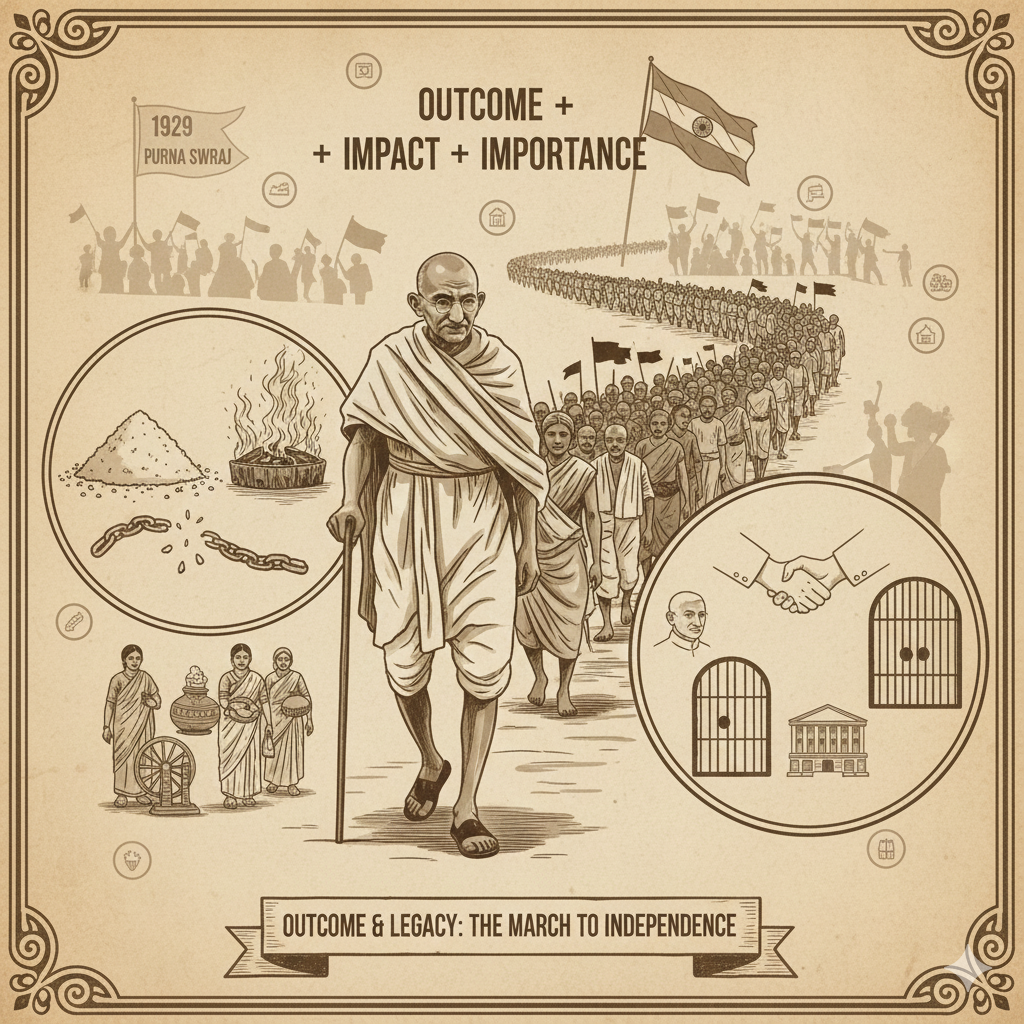
The Civil Disobedience Movement – Key Takeaways
Key Outcomes of the Civil Disobedience Movement
The Civil Disobedience Movement was a crucial phase of the Indian freedom struggle that shook the foundations of British rule. Although it did not immediately secure independence, it had far-reaching effects. This movement created self-confidence and an unwavering determination for freedom among Indians.
1. Profound Effect on British Government Policies
- The movement exposed widespread anger and dissatisfaction against British rule.
- The government realized that repression alone could not sustain its control over India.
- Harsh measures to suppress protests only strengthened Indian unity and resistance.
2. New Strength to the Indian National Movement
- It became the largest mass movement after the Non-Cooperation Movement.
- Farmers, labourers, women, students, and businessmen participated extensively.
- The movement fostered self-reliance, courage, and national determination.
3. Gandhi-Irwin Pact (1931)
- The movement forced the British government to negotiate with Mahatma Gandhi.
- Political prisoners were released under the pact.
- Indians were allowed to manufacture salt.
- Gandhiji suspended the movement temporarily.
4. Participation in the Second Round Table Conference
Gandhiji represented the Indian National Congress at the Second Round Table Conference in 1931. Although the demands were not fulfilled, India’s freedom struggle gained international recognition.

✔ Easy & comfortable daily use
✔ Great value for the price
✔ Highly popular among buyers
5. Historic Participation of Women
- Women displayed unprecedented courage and took active roles in the movement.
- Leaders like Sarojini Naidu, Kasturba Gandhi, and Kamla Nehru played key roles.
- The movement strengthened the foundation of women's empowerment in India.
6. Public Awareness and Discontent Against British Rule
- People from all sections united against colonial oppression.
- The idea of independence reached every village, strengthening nationalism.
- People lost their fear and began openly resisting British injustice.
7. Boycott of Foreign Clothes and British Goods
- Foreign clothes and goods were widely boycotted.
- Swadeshi products were promoted, boosting Indian industries.
- The boycott caused economic losses to the British government.
8. Mass Arrests and Repression
- Thousands of freedom fighters, including Nehru and Sardar Patel, were arrested.
- Despite severe repression, the movement remained strong and inspiring.
9. Laying the Foundation for Independence
- The movement strengthened the next phases of the freedom struggle.
- It proved that non-violent protest could challenge powerful regimes.
- It provided experience and strategies for future movements.
10. International Support and Recognition
- The movement gained global sympathy and attention.
- Foreign media coverage increased pressure on the British government.
- India’s freedom struggle earned worldwide recognition.
Conclusion
Although the Civil Disobedience Movement did not bring immediate independence, it transformed Indian society. It strengthened national integration, political awareness, and the principles of non-violence. This movement proved that when people unite against injustice, even the strongest empire can falter.
Importance of the Civil Disobedience Movement
The Civil Disobedience Movement was a historic and decisive stage in the freedom struggle. Led by Mahatma Gandhi, it represented not only non-violent protest against British rule but also became a symbol of national unity and freedom awareness. It brought new direction and strength to India’s independence movement.
1. Giving a New Direction to the Freedom Struggle
- The movement transformed the freedom struggle into an organized mass movement.
- For the first time, peasants, labourers, women, and youth participated in large numbers.
- It created a belief that independence was not just a dream but an achievable reality.
2. Demonstration of the Power of Non-Violence and Satyagraha
- The movement was fully based on truth and non-violence.
- Gandhi’s Satyagraha showed that tyranny could be challenged without violence.
- This established non-violence as a powerful political weapon.
3. Building National Unity and Awareness
- Hindus, Muslims, Sikhs, and Christians united against British rule.
- National unity strengthened as people stood together.
- National consciousness reached remote villages across India.
4. Active Participation of Women
- Women participated in large numbers for the first time.
- Prominent leaders like Sarojini Naidu, Kasturba Gandhi, and Kamala Nehru took leadership roles.
- This laid the foundation for future women’s empowerment in India.
5. Strengthening Public Sentiment Against British Rule
- The movement eliminated fear of repression among Indians.
- People openly violated unjust laws such as the Salt Law and taxes.
- It proved that the British Empire was not invincible.
6. Beginning of Political Dialogue with the British Government
- Under public pressure, the British government signed the Gandhi-Irwin Pact (1931).
- This forced the government to engage with Indian leaders.
- It highlighted the political importance of dialogue and negotiation.
7. International Recognition of India’s Freedom Struggle
- The Indian movement gained global support.
- Foreign media widely covered Gandhi and the protests.
- This increased international pressure on Britain.
8. Strengthening Swadeshi and Economic Independence
- Foreign goods were boycotted, promoting Indian industries.
- Khadi and Swadeshi products grew in popularity.
- Economic self-reliance gained new momentum.
9. Recognition of Rights of Political Prisoners
- Thousands of freedom fighters were jailed.
- British pressure led to recognition of political rights and release of many prisoners.
10. Inspiration for Future Movements
- Indians learned the importance of resisting injustice.
- The movement inspired the Quit India Movement of 1942.
- It made the struggle for independence unstoppable and invincible.
Conclusion
The Civil Disobedience Movement remains a historic landmark in India’s freedom struggle. It not only brought political awakening but built a strong, organised, and self-reliant nation. It teaches us that truth and non-violence can defeat even the greatest powers.
References

✔ Easy & comfortable for everyday use
✔ Great value for money
✔ Popular choice among Amazon buyers
- Official books and historical documents related to the Indian freedom struggle.
- Archives and verified materials from the National Archives of India, New Delhi.
- NCERT textbooks and other academic publications containing authenticated historical facts.
- Research papers and writings by reputed Indian historians and scholars.
- Study materials and research articles published by major universities and institutions.