
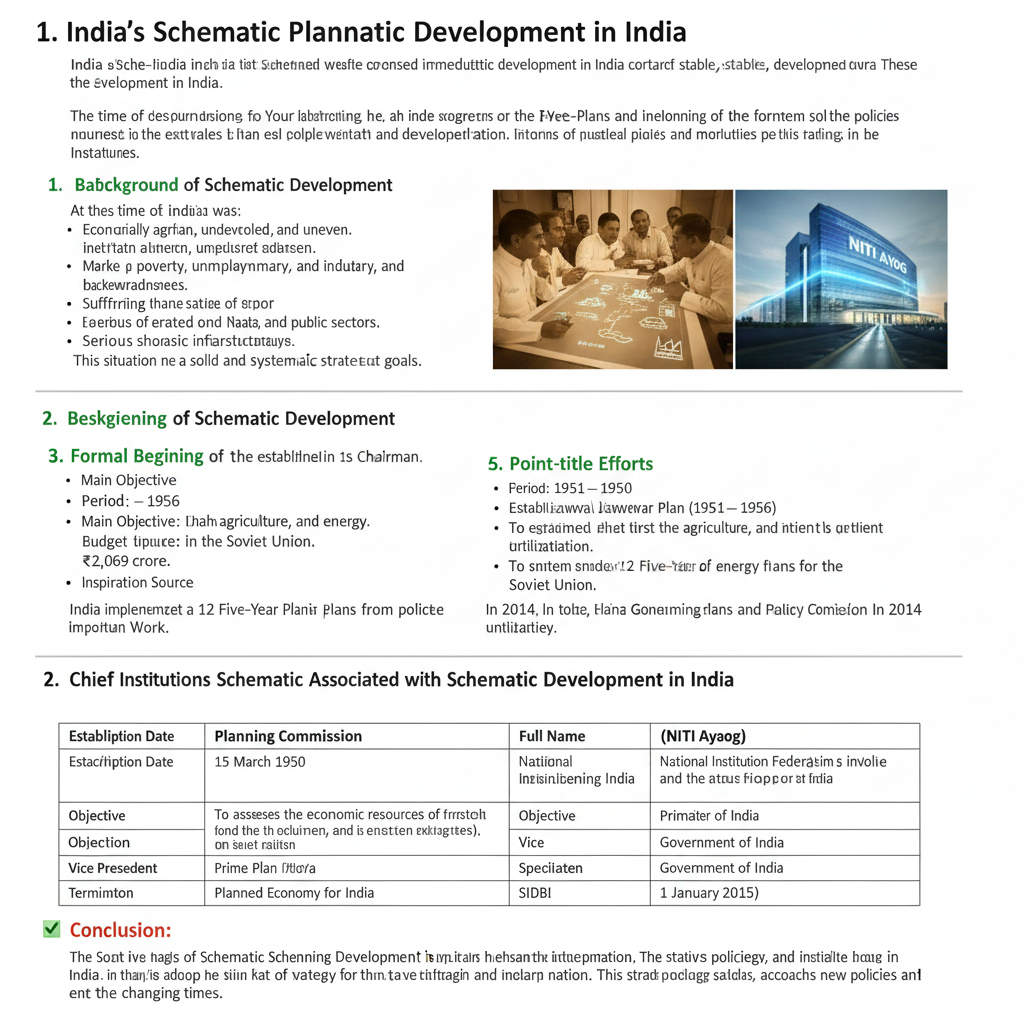
India’s Schematic Development – Beginning
The beginning of schematic or planned development in India took place soon after independence. To guide the nation towards organized, stable, and balanced development, it became essential to create plans and implement them in phases.
1. Background of Schematic Development
🔹 Situation of India at the Time of Independence
- Agriculture-dominated and underdeveloped economy
- High levels of poverty, unemployment, and illiteracy
- Industrial backwardness
- Severe lack of basic infrastructure
Because of these conditions, India urgently needed a strong and systematic development strategy. This thinking laid the foundation for planned development.
2. Formal Beginning of Planned Development
🗓 First Five-Year Plan (1951–1956)
- Period: 1951–1956
- Main Objectives: Agriculture, irrigation, and energy development
- Budget: ₹2,069 crore
- Model Inspired By: Soviet Union’s planning model
3. Establishment of the Planning Commission
The Planning Commission was established on 15 March 1950. Prime Minister Jawaharlal Nehru became its first chairman.
Work and Responsibilities
- Assessing economic resources
- Preparing Five-Year Plans based on national priorities
- Supervising and evaluating development objectives
4. Pre-Independence Planning Efforts
🔹 Bombay Plan (1944)
- Presented by industrialists like Tata, Birla, and Shriram
- Emphasized balance between private and public sector
🔹 National Plan (1946)
- Proposed by M. N. Roy
- Supported a socialist approach
🔹 Sir M. Visvesvaraya’s Plan (1934)
- Presented in the book Planned Economy for India
- Outlined early ideas for planned development
Although these were not formal plans, they significantly influenced the establishment of the Planning Commission in independent India.
5. Five-Year Plan Series
Between 1951 and 2017, India implemented a total of 12 Five-Year Plans. In 2014, the Planning Commission was abolished and replaced by the NITI Aayog, which now prepares flexible, target-based planning frameworks.
Conclusion
The beginning of planned development in India dates back to the 1950s with the establishment of the Planning Commission and the launch of the First Five-Year Plan. Its primary objective was to remove poverty, backwardness, and inequality and build a self-reliant and modern nation. Today, the process continues under NITI Aayog with new approaches suited to the changing era.
Major Institutions Associated with India’s Schematic Development
Several important institutions were established to implement and monitor planned development in India. These institutions played a vital role in plan formulation, policy creation, resource allocation, and continuous development.
1. Planning Commission
| Description | Information |
|---|---|
| Establishment | 15 March 1950 |
| Objective | Prepare and ensure implementation of Five-Year Plans |
| Chairman | Prime Minister of India |
| Work | Prepared 12 Five-Year Plans (1951–2012) |
| Termination | 2014 |
2. NITI Aayog (Policy Commission)
| Description | Information |
|---|---|
| Establishment | 1 January 2015 |
| Objective | Promote cooperative federalism; involve states in policymaking |
| Full Name | National Institution for Transforming India |
| Chairman | Prime Minister of India |
| Special Features | Flexible framework, data-driven policies, focus on SDGs |
3. Reserve Bank of India (RBI)
| Aspect | Information |
|---|---|
| Objective | Ensure economic stability through monetary policy |
| Role | Regulates banks, supports financial development, facilitates credit for development plans |
4. Indian Council of Agricultural Research (ICAR)
| Aspect | Information |
|---|---|
| Objective | Promote agricultural research and support Green Revolution |
| Work | Research, training, and development of new agricultural techniques |
5. Industrial Development Bank of India (IDBI)
| Aspect | Information |
|---|---|
| Objective | Provide financial assistance for industrial projects |
| Establishment | 1964 |
| Role | Promoting industrialization |
6. SIDBI (Small Industries Development Bank of India)
| Aspect | Information |
|---|---|
| Objective | Assist Micro, Small, and Medium Enterprises (MSMEs) |
7. NABARD (National Bank for Agriculture and Rural Development)
| Aspect | Information |
|---|---|
| Objective | Provide finance for agricultural and rural development |
| Work | Develop rural infrastructure, support SHGs and cooperative banks |
8. CSO / NSO (Central/National Statistics Office)
| Aspect | Information |
|---|---|
| Work | Compile data on national income, growth, population, poverty, etc. |
| Objective | Provide statistical support for plan evaluation and policymaking |
9. Finance Commission
| Objective | Information |
|---|---|
| Financial Distribution | Ensure equitable distribution of financial resources between Centre and States |
Conclusion
For the successful implementation of planned development, institutions like the Planning Commission, NITI Aayog, RBI, NABARD, SIDBI, ICAR, and various statistical organizations worked together. These institutions continue to play a crucial role in shaping India’s economic, social, and regional development.
Planning Commission – Detailed Information
1. Establishment
| Point | Description |
|---|---|
| Establishment Date | 15 March 1950 |
| Established By | Pandit Jawaharlal Nehru |
| Inspiration Source | Soviet Union’s Five-Year Plans |
| Main Objective | Evaluate economic resources and prepare development plans |
2. Objectives and Work
Major Objectives
- Assess resources and ensure their proper use
- Prepare Five-Year Plans based on national priorities
- Coordinate between ministries and states
- Reduce social and economic inequality
- Recommend measures to reduce poverty, unemployment, and backwardness
Main Work
- Construction of Five-Year Plans
- Preparation of Annual Plans
- Determining plan expenditure in the Central Budget
- Project evaluation reports
- Recommending financial assistance to states
3. Five-Year Plans Prepared by the Commission
| Plan | Main Features |
|---|---|
| First (1951–56) | Agriculture, irrigation, energy focus |
| Second (1956–61) | Mahalanobis model; industrial development |
| Third (1961–66) | Goal of self-reliance |
| Fourth–Twelfth | Poverty eradication, Green Revolution, HRD, infrastructure, IT, inclusive development |
4. Criticisms
- Centralized approach with limited role for states
- Gap between plan targets and actual achievements
- Slow processes and bureaucratic delays
- Weak ground-level implementation
- Inflexibility towards global economic changes
5. Termination and Replacement
| Point | Description |
|---|---|
| Termination | Announced on 17 August 2014 by PM Narendra Modi |
| New Institution | NITI Aayog (from 1 January 2015) |
| Main Difference | Planning Commission was centralized; NITI Aayog promotes cooperative federalism and state partnership |
Conclusion
The Planning Commission played a historic role in shaping India’s development path. It strengthened the economic structure, promoted social reforms, and provided a planned direction to nation-building. However, due to its limitations, it was replaced by NITI Aayog, a more flexible and adaptive institution suited for modern needs.

Policy Commission (NITI Aayog) – India’s New Generation Policy Manufacturer
NITI Aayog is the Government of India’s premier policy think tank, established in 2015 as the successor to the Planning Commission. Its objective is to promote inclusive, sustainable, and cooperative development in collaboration with state governments.
1. Establishment and Background
| Point | Description |
|---|---|
| Establishment Date | 1 January 2015 |
| Established By | Government of Prime Minister Narendra Modi |
| Replaced Institution | Planning Commission |
| Full Name | National Institution for Transforming India |
2. Objectives of NITI Aayog
- Develop a flexible and participatory model for national development.
- Strengthen cooperative federalism between Centre and States.
- Create data-driven and evidence-based policies.
- Support achievement of Sustainable Development Goals (SDGs).
- Enhance India's global competitiveness.
3. Organizational Structure
| Post | Responsibility |
|---|---|
| Chairman | Prime Minister of India |
| Vice President | Appointed by the Central Government |
| Members | Experts from economics, science, agriculture, technology, and social sectors |
| Secretariat | Handles daily operations of NITI Aayog |
4. Main Work of NITI Aayog
- Coordination between Centre and States on policy matters.
- Strategy and policy formulation for national development.
- Technical and developmental support to States.
- Monitoring of progress and evaluation of outcomes.
- Promotion of innovation, startups, and Digital India initiatives.
- Guidance to States on SDGs implementation.
5. Key Initiatives of NITI Aayog
- SDG India Index and State-level SDG frameworks.
- Policy support for Atmanirbhar Bharat (Self-Reliant India).
- Support to Digital India, Make in India, and Startup India programmes.
- Empowering states through State Innovation Councils.
- Recommendations based on data analytics and technology.
6. Difference Between Planning Commission & NITI Aayog
| Aspect | Planning Commission | NITI Aayog |
|---|---|---|
| Nature | Centralized planning body | Participatory policy think tank |
| Role of States | Limited partnership | Full partnership and collaboration |
| Flexibility | Less flexible | Highly flexible and adaptive |
| Work System | Five-Year Plans | Issue- and goal-based planning |
| Focus | Policy + Planning | Policy + Technology + Innovation |
Conclusion
NITI Aayog represents the modern and futuristic version of India's planning framework. It offers a more inclusive, innovation-driven, and sustainable development model suited to the needs of the 21st century.
India’s Five-Year Plans
India’s Five-Year Plans were a series of centrally formulated developmental programmes aimed at ensuring systematic, balanced, and goal-oriented national development. These plans utilized available resources to accelerate economic and social progress.
1. First Five-Year Plan (1951–1956)
Main Focus
- Agriculture and irrigation development
Major Achievements
- Bhakra Nangal Dam, Hirakud Dam, and other irrigation projects
- Increase in food grain production
- Rural development initiatives
Result: Plan considered successful due to rise in agricultural output.
2. Second Five-Year Plan (1956–1961)
Main Focus
- Heavy industries and rapid industrialization
Achievements
- Establishment of steel, machinery, and fertilizer industries
- Strengthening of the public sector
Result: Industrial growth gained momentum.
3. Third Five-Year Plan (1961–1966)
Main Focus
- Self-reliance and economic stability
Result: Plan failed due to Indo–Pakistan war and severe drought.
4. Fourth Five-Year Plan (1969–1974)
Main Focus
- Agricultural improvement and social justice
Achievement: Beginning of the Green Revolution.
5. Fifth Five-Year Plan (1974–1979)
Main Focus
- Poverty elimination and rural development
Result: Employment-oriented programmes launched.
6. Sixth Five-Year Plan (1980–1985)
Main Focus
- Industrial and social sector development
Result: Improvement in education, health and basic services.
7. Seventh Five-Year Plan (1985–1990)
Main Focus
- Speedy growth and economic improvement
Result: Growth in industrial production and rural development.
8. Eighth Five-Year Plan (1992–1997)
Main Focus
- Liberalization, privatization, and globalization (LPG Reforms)
Result: Economic reforms began; FDI increased.
9. Ninth Five-Year Plan (1997–2002)
Main Focus
- Poverty reduction and rural development
Result: Emphasis on social welfare schemes.
10. Tenth Five-Year Plan (2002–2007)
Main Focus
- Human resource development and agriculture improvement
Result: Progress in education and healthcare.
11. Eleventh Five-Year Plan (2007–2012)
Main Focus
- Inclusive development and social justice
Result: Implementation of MGNREGA and other welfare programmes.
12. Twelfth Five-Year Plan (2012–2017)
Main Focus
- Sustainable development, economic growth, and environmental protection
Achievements: Launch of Digital India and Swachh Bharat initiatives.
Summary Table
| Plan | Duration | Main Objective |
|---|---|---|
| 1st | 1951–56 | Agriculture Development |
| 2nd | 1956–61 | Industrialization |
| 3rd | 1961–66 | Self-Reliance |
| 4th | 1969–74 | Agriculture Improvement |
| 5th | 1974–79 | Poverty Elimination |
| 6th | 1980–85 | Social Sector Development |
| 7th | 1985–90 | Speedy Development |
| 8th | 1992–97 | Economic Improvement |
| 9th | 1997–02 | Rural Development |
| 10th | 2002–07 | Human Resource Development |
| 11th | 2007–12 | Inclusive Development |
| 12th | 2012–17 | Sustainable Development |
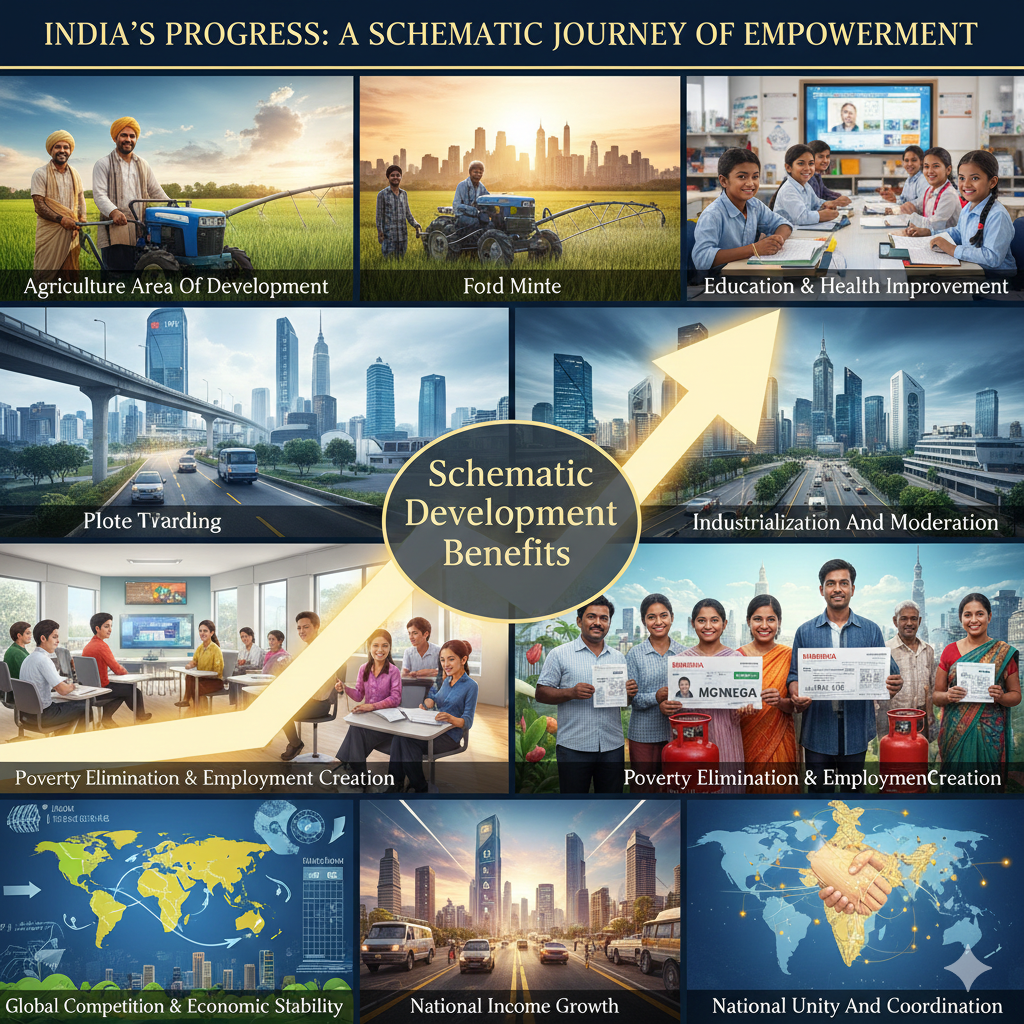
India in Schematic Development – Benefits
Through planned (schematic) development, India has achieved significant economic, social, and technological progress. This development model helped the country fight poverty, unemployment, and backwardness while creating a stronger and more balanced national framework.
1. Reduction in Social and Economic Inequality
- Special schemes were prepared for weaker sections of society.
- Expansion of social security, education, and healthcare reduced inequalities.
2. Poverty Elimination
- Employment generation programmes such as MGNREGA reduced poverty levels.
- The number of people living below the poverty line decreased significantly.
3. Industrialization and Modernization
- Growth of heavy industries, public undertakings, and technical education.
- Advancement in science, technology, and industrial processes.
4. Increase in National Income and Living Standards
- Rise in national income due to increased production.
- Improvement in health, education, and basic amenities enhanced living standards.
5. Skilled and Equitable Use of Resources
- Optimal use of natural and human resources through planned strategies.
- Reduction in resource wastage and promotion of Sustainable Development.
6. Agricultural Development
- Improvements in irrigation, seeds, fertilizers, and technology boosted production.
- The Green Revolution made India self-reliant in food production.
7. Creation of Employment Opportunities
- New jobs generated in industry, services, and agriculture.
- Unemployment levels decreased over time.
8. Economic Stability and Development
- Better control over inflation and economic imbalances.
- Creation of a strong foundation for long-term development.
9. National Unity and Coordination
- Special plans prepared to reduce regional development inequalities.
- Improved coordination between the Centre and the States.
10. Strengthening India’s Global Competitiveness
- Economic reforms and technological growth increased India’s global standing.
- Growth in foreign investment and international business partnerships.
Conclusion
Schematic development has played a vital role in making India economically stronger, socially empowered, and technologically advanced. It helped the nation address challenges such as poverty, unemployment, and inequality while setting a strong foundation for sustainable and inclusive growth.
Conclusion – India’s Schematic Development
Planned development has empowered India economically, socially, and regionally. It ensured optimal and equitable use of resources, reduced poverty and unemployment, minimized social inequalities, and promoted industrialization and modernization.
Planned development significantly improved national income and living standards, helping India take important steps toward becoming a modern and developed nation. Over time, improvements and flexibility were required in planning, which led to the replacement of the Planning Commission with NITI Aayog, a more dynamic and cooperative institution.
Thus, schematic development has acted as a strong foundation for India’s progress, guiding the country towards becoming a prosperous, modern, and equitable society.
Frequently Asked Questions (FAQs)
1. What is India's planned development?
India's planned development refers to the systematic economic and social development strategy adopted after Independence through Five-Year Plans. Its objective was to achieve balanced growth, reduce poverty, and promote national development.
2. When did planned development begin in India?
Planned development formally began with the establishment of the Planning Commission on 15 March 1950, followed by the launch of the First Five-Year Plan in 1951.
3. What was the main objective of the First Five-Year Plan?
The First Five-Year Plan (1951–1956) mainly focused on agriculture, irrigation, rural development, and increasing food production to strengthen India's economy after Independence.
4. What is the difference between the Planning Commission and NITI Aayog?
The Planning Commission prepared centralized Five-Year Plans, whereas NITI Aayog, established on 1 January 2015, functions as a policy think tank that promotes cooperative federalism, innovation, and flexible, data-driven development strategies.
5. How many Five-Year Plans were implemented in India?
India implemented a total of 12 Five-Year Plans between 1951 and 2017 before shifting to the policy framework of NITI Aayog.
6. What were the major achievements of India's planned development?
Planned development contributed to agricultural growth, industrialization, Poverty reduction, infrastructure development, employment generation, improvements in education and healthcare, and balanced regional development.
7. Why is India's planned development important for UPSC preparation?
It is an important UPSC topic because it covers the evolution of India's economic planning, Five-Year Plans, the Planning Commission, NITI Aayog, development policies, and their impact on economic and social progress.
References
- Planning Commission of India. “Five-Year Plans (1951–2017).” Government of India Archives.
- NITI Aayog. “Transforming India: Reports and Policy Frameworks.” Government of India, 2015–2024.
- MOSPI. “Statistical Year Book of India.” Ministry of Statistics and Programme Implementation.
- Reserve Bank of India. “Handbook of Statistics on Indian Economy.” RBI Publications.
- Economic Survey of India. Ministry of Finance, Government of India.
- NCERT. “Indian Economic Development.” Class XI Economics Textbook.
- Visvesvaraya, M. “Planned Economy for India.” Bangalore, 1934.
- Bombay Plan (1944). “A Plan of Economic Development for India.” Tata & Birla Group.