
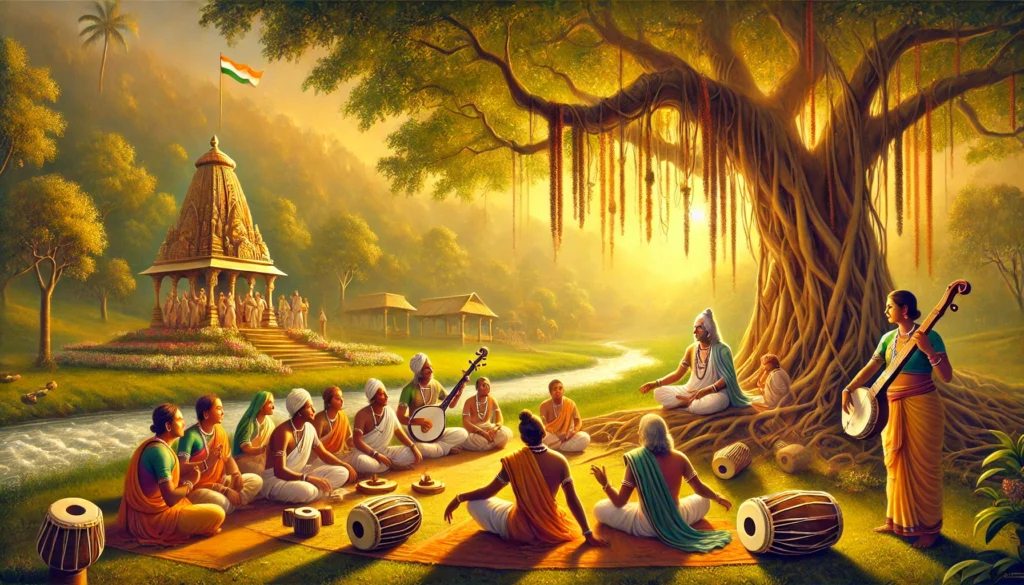
Bhakti and Sufi Movements in India: Teachings, Features and Impact
The Bhakti and Sufi movements were powerful spiritual and social forces that reshaped Indian society between the 7th and 17th centuries. Both movements emphasized inner devotion, love for God, social equality and human values over rigid rituals and social hierarchies. Understanding these movements helps us learn how faith can become a medium of change, harmony and compassion.
Bhakti Movement
The Bhakti movement was a major religious and social movement in India between the 7th and 17th centuries. It brought a message of new energy and equality within Hinduism. This movement started mainly in South India and gradually spread to North India. Its main aim was to make devotion to God simple and accessible to all, by challenging complex rituals and brahminical dominance in religion.
Key Features of the Bhakti Movement
- Emphasis on devotion to God: The movement gave importance to single-minded devotion (bhakti) to God instead of idol worship, sacrifices and complicated rituals.
- Message of equality: Rising above caste, religion, gender and social class, the Bhakti saints declared that everyone had the right to worship God.
- Simple form of language: Saints wrote their compositions in local or regional languages so that common people could easily understand their teachings.
Examples of Local Language Usage
- Tulsidas – Awadhi
- Kabir – Sadhukkari
- Meerabai – Rajasthani and other local dialects
Social Reform through Bhakti
- Raised a strong voice against superstition, casteism and social discrimination.
- Promoted a direct personal relationship with God, without the need for intermediaries.
- Encouraged compassion, humility and service towards all beings.
Glory of the Guru
In the Bhakti tradition, the Guru (spiritual teacher) was considered the medium of spiritual knowledge. The Guru guided the devotee towards God, removing ignorance and inner darkness through teachings and example.
Prominent Bhakti Saints
North Indian Bhakti Saints
- Kabir
- Surdas
- Tulsidas
- Meerabai
- Rahim
South Indian Bhakti Saints
- Alvars (Vaishnavite saints)
- Nayanars (Shaivite saints)
- Basavanna and other Veerashaiva saints
Contribution of the Bhakti Movement
- Promoted social equality and religious tolerance.
- Challenged social evils like caste-based discrimination and religious rigidity.
- Contributed significantly to the development of Indian languages and literature through devotional poetry and songs.
Sufi Movement
The Sufi movement emerged as a mystical stream within Islam between the 8th and 17th centuries. It was primarily based on the spirituality of Islam and aimed to establish a personal, loving and direct relationship with God (Allah). Sufis emphasized inner purity, love, and remembrance of God over mere external observance of religious rules.
Key Features of the Sufi Movement
- Message of love and service: Sufi saints gave priority to service to humanity and love for God. They believed that serving people is a way of serving God.
- Opposition to rigidity: They opposed excessive rationalism and strict rigidity in religious practices, and instead gave importance to Sufi meditation, remembrance of God (zikr) and divine love.
- Social equality: Rising above caste, class and religion, Sufis considered humanity as one. They welcomed all people, rich or poor, Hindu or Muslim, to their gatherings.
- Use of music and poetry: Qawwali, Sufi songs and poetry were used to express spiritual experiences and devotion.
- Khanqah and Dargah: The residences (khanqahs) and mausoleums (dargahs) of Sufi saints became important centres of faith, charity and communal harmony. Many of them continue to attract people of all religions even today.

Major Silsilas (Sufi Orders)
- Chishti Silsila: Associated with Khwaja Moinuddin Chishti of Ajmer, known for his message of love and service.
- Suhrawardi Silsila: Linked with Sheikh Bahauddin Zakariya.
- Naqshbandi Silsila: Associated with Khwaja Bahauddin Naqshbandi.
- Qadiri Silsila: Linked with Shaikh Abdul Qadir Jilani.
Contribution of the Sufi Movement
- Promoted cultural and religious harmony between Hindu and Muslim communities.
- Preached love, service, humility and tolerance as central values of spiritual life.
- Enriched Indian art and culture through qawwali, Sufi music, poetry and literature.
Similarities between Bhakti and Sufi Movements
Despite emerging from different religious traditions, the Bhakti and Sufi movements shared many common values and approaches. Together, they created a strong spiritual and social impact in India.
Common Spiritual and Social Ideals
- Emphasis on spirituality: Both movements stressed inner devotion, love and spiritual experience rather than external rituals and formalities.
- Social equality: Both opposed discrimination based on caste, religion or class, and supported the idea that every human being is equal in the eyes of God.
- Use of local languages: Bhakti and Sufi saints used local and regional languages to convey their message, making spiritual teachings accessible to the common people.
- Use of music and poetry: Both traditions used devotional songs, poetry and music to express their feelings of love and surrender to God.
Impact and Legacy of Bhakti and Sufi Movements
Social Reform
Both movements contributed to social reform by challenging caste inequality, religious fanaticism and blind rituals. Their teachings encouraged compassion, unity and respect for all.
Communal Harmony
The Bhakti and Sufi movements created an atmosphere of better understanding and peace between Hindu and Muslim communities. Their shared emphasis on love and devotion helped reduce tensions and encouraged mutual respect.
Development of Literature, Art and Music
Bhakti and Sufi literature enriched Indian languages, poetry and music. From bhajans and kirtans to qawwalis and Sufi songs, these traditions left a deep mark on India’s cultural heritage.
Enduring Message
These movements left a lasting impact on Indian society and promoted the message of religious tolerance, humanity and love. Even today, the teachings of Bhakti and Sufi saints inspire people to rise above narrow divisions and walk on the path of inner devotion, compassion and harmony.
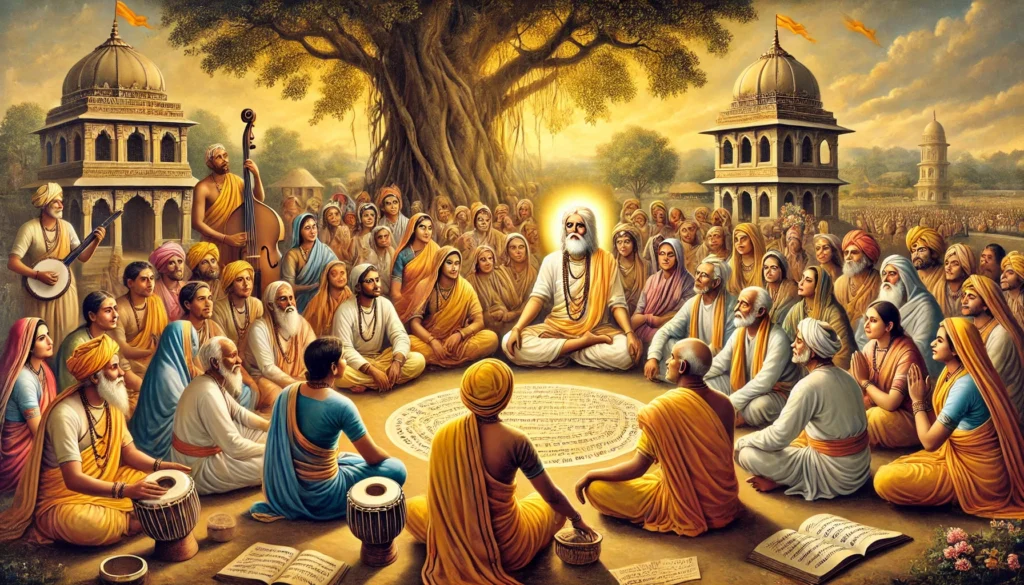
Bhakti Movement
The Bhakti Movement was an important religious and social reform movement of medieval India, which developed mainly between the 7th and 17th centuries. Its objective was to make devotion to God simple, personal, and universal by freeing religion from rituals, dogmatism, and brahminical domination.
Emergence of the Bhakti Movement
The roots of the Bhakti Movement lie in South India, where the Alvars (Vaishnavite saints) and Nayanars (Shaivite saints) promoted a devotional and spiritual ideology centered on love for God. Over time, the movement spread to North India, where saint poets, Sufis, and various devotional leaders carried forward its message.
Main Features of the Bhakti Movement
Sincere Devotion to God
- The Bhakti Movement placed supreme importance on love and devotion toward God.
- God was worshipped in a personal form, whether Nirguna (formless) like Brahma or Saguna (with form) like Rama and Krishna.
Opposition to Caste and Class Discrimination
- Bhakti saints strongly criticized the caste system, declaring that caste is not a barrier to devotion.
- As Kabir said: “No one cares about caste or creed; if one worships Hari, one belongs to Hari.”
Sectarian Harmony and Equality
- The movement upheld equal respect for all religions and supported social equality.
- Both Hindu and Muslim saints participated and contributed equally.
Language and Literature
- Bhakti saints used regional languages such as Awadhi, Braj, Tamil, Marathi, and Punjabi instead of Sanskrit so that common people could understand their teachings.
- This also enriched regional literature and encouraged devotional poetry.

Opposition to Ritualism and Brahminical Domination
- The movement rejected excessive ritualism, idol worship, and yajnas.
- Saints taught that devotion from the heart is the only path to attain God.
Glory of the Guru
The Guru was regarded as the guiding force of devotion. Kabir beautifully expressed this through the verse: “Guru and Govind both stand here — whom should I bow first? I bow to the Guru, for he showed me Govind.”
Major Saints of the Bhakti Movement and Their Contributions
South India
Alvars and Nayanars
- Alvars (Vaishnavite) and Nayanars (Shaivite) composed devotional literature in Tamil.
- Their works such as Divya Prabandham and Tevaram are famous.
Basavanna
- Founder of the Veerashaiva or Lingayat sect.
- Strongly opposed Brahminical dominance and social inequalities.
North India
Kabir (1440–1518)
- A leading saint of Nirguna Bhakti.
- Promoted Hindu-Muslim unity.
- His compositions are preserved in the Bijak.
Mirabai (1498–1547)
- A symbol of deep devotion to Krishna.
- A leading saint of Saguna Bhakti.
- Wrote devotional poems in Braj and Rajasthani.
Tulsidas (1532–1623)
- Greatest promoter of Rama devotion.
- Author of the famous Ramcharitmanas written in Awadhi.
Surdas (1478–1583)
- Renowned for describing the childhood episodes of Krishna.
- His major work is Sursagar.
Maharashtra
Dnyaneshwar (1275–1296)
- Wrote the Dnyaneshwari in Marathi.
Tukaram (1608–1649)
- Composed devotional songs in the Abhang style.
Punjab
Guru Nanak (1469–1539)
- Founder of Sikhism and a major figure of Nirguna Bhakti.
- His teachings are compiled in the Guru Granth Sahib.
Effects of the Bhakti Movement
Social Reform
- Strongly condemned casteism and untouchability.
- Helped establish the principle of equality among all classes.
Religious Tolerance
- Promoted Hindu-Muslim unity.
- Opposed religious fanaticism and rigid orthodoxy.
Development of Indian Languages
- Regional languages flourished due to the works of Bhakti saints.
- Strengthened devotional literature, poetry, and music.
Women Empowerment
- Saints like Mirabai inspired change in the social status of women.
Cultural Coordination
- The Bhakti and Sufi movements collectively encouraged cultural and religious synthesis in India.
Conclusion
The Bhakti Movement deeply influenced Indian society in religious, social, and cultural terms. Through its message of love, service, tolerance, equality, and devotion, it envisioned a society free from the constraints of caste, class, and religious division. Even today, the teachings and spirit of the Bhakti Movement continue to shape Indian culture and social life.
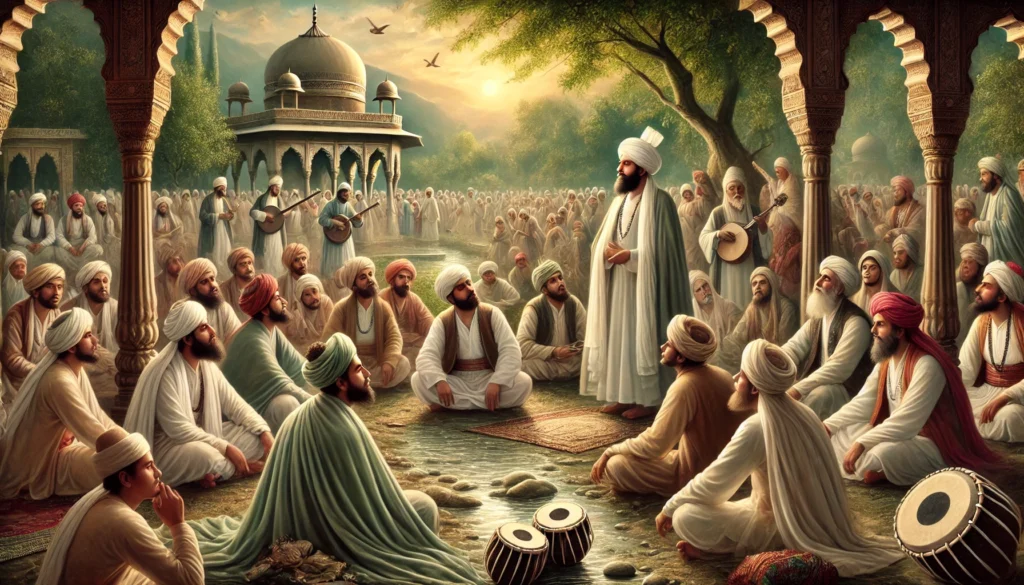
Sufi Movement
The Sufi Movement was a mystical and spiritual stream within Islam that originated in the 8th century and had a major influence in India from the 12th to the 17th centuries. Sufi saints went beyond the rigid religious rules of Islam (Sharia) and emphasized love, service, and inner devotion to God. This movement became a symbol of both religious and social reform.
Origin and Development of the Sufi Movement
Origin
- The Sufi movement originated in the Islamic world of Arabia.
- The word Sufi comes from the Arabic word Suf meaning “wool,” referring to the simple woolen garments Sufi saints wore.
Development
- The Sufi tradition developed the spiritual and mystical dimension of Islam.
- It prioritized love for God and spiritual experience over rigid laws and rituals of Sharia.
Arrival in India
- The Sufi tradition came to India with Muslim invasions in the 12th century and the arrival of Sufi saints.
- It grew parallel to the Hindu Bhakti movement and deeply influenced Indian society.
Main Features of the Sufi Movement
Principle of Love and Service
- Sufi saints saw God as the embodiment of love and believed that God can be attained through love and service.
- They taught: “The love of God is the only true religion.”
Social Equality
- The Sufi movement rejected discrimination based on caste, religion, and social class.
- Sufis believed that God is equal for all.
Opposition to Rationality and Rigour
- Sufis emphasized meditation, spirituality, and inner experience rather than strict legalism.
- Personal spiritual experience was considered more important than religious formality.
Music and Qawwali
- Music and Qawwali were used as mediums to express devotion and spiritual ecstasy.
- The tradition of Qawwali continues in Sufi shrines even today.
Khanqah and Dargah
- Khanqahs (residences) and dargahs (tombs) of Sufi saints became centres of social and religious harmony.
- People of all faiths visited these places seeking peace, blessings, and guidance.
Role of the Spiritual Guru
In the Sufi tradition, the guidance of the Guru or Pir is crucial. The disciple, known as the Murid, tries to move closer to God through the teachings, blessings, and spiritual discipline provided by the Master.
Sufi Orders (Silsilas)
Several major Sufi orders developed in India, each influencing society in different but significant ways.

Chishti Silsila
- The most famous Sufi order in India.
- Founder: Khwaja Moinuddin Chishti of Ajmer.
- Focused on love, service, charity, and humanity.
Suhrawardi Silsila
- Founder: Sheikh Bahauddin Zakariya.
- Emphasized spirituality while maintaining some adherence to Sharia.
Qadiri Silsila
- Founder: Shaikh Abdul Qadir Jilani.
- Promoted simple living, meditation, and devotion to God.
Naqshbandi Silsila
- Founder: Khwaja Bahauddin Naqshbandi.
- Stressed strict adherence to Islamic law (Sharia).
Major Sufi Saints and Their Contributions
Khwaja Moinuddin Chishti (1141–1236)
- Founder of the Chishti order in India and associated with the Ajmer Dargah.
- Known as “Gharib Nawaz” (Helper of the Poor).
- Promoted Hindu-Muslim unity and emphasized service to the poor and needy.
Baba Farid (1173–1265)
- A pioneer of devotional and Sufi poetry in Punjabi.
- Some of his verses are included in the Guru Granth Sahib.
Hazrat Nizamuddin Auliya (1238–1325)
- A leading saint of the Chishti order.
- His disciple Amir Khusro popularized Qawwali and enriched Indian music.
Sheikh Bahauddin Zakariya (1182–1262)
- Chief saint of the Suhrawardi order.
- Spread Sufi thought across northern India.
Hazrat Amir Khusro (1253–1325)
- One of the greatest Sufi poets and musicians of India.
- Known as the “Father of Qawwali.”
- Credited with developing musical forms like Qawwali, Khayal, and Tarana.
Influence of the Sufi Movement
Religious Tolerance
- Encouraged mutual respect and understanding between Hindus and Muslims.
- Helped reduce communal conflict through the message of love and compassion.
Social Equality
- Worked to end caste and class differences.
- Helped uplift the poor, marginalized, and backward communities.
Cultural Coordination
- Blended Indian and Islamic cultural traditions.
- Influenced architecture, music, literature, and art.
Influence on the Bhakti Movement
- Sufism and Bhakti mutually influenced each other.
- Both emphasized love, devotion, service, equality, and spirituality.
Development of Literature and Music
- Sufi poetry enriched Indian literature with devotional and mystical themes.
- Qawwali and Sufi songs remain popular even today.
Conclusion
The Sufi movement taught Indian society the values of spirituality, love, and service. It challenged religious fanaticism and promoted tolerance, compassion, and humanity. The impact of the Sufi movement continues to be felt even today in Indian society, art, and culture. Its centres (dargahs) still stand as strong symbols of peace and communal harmony.
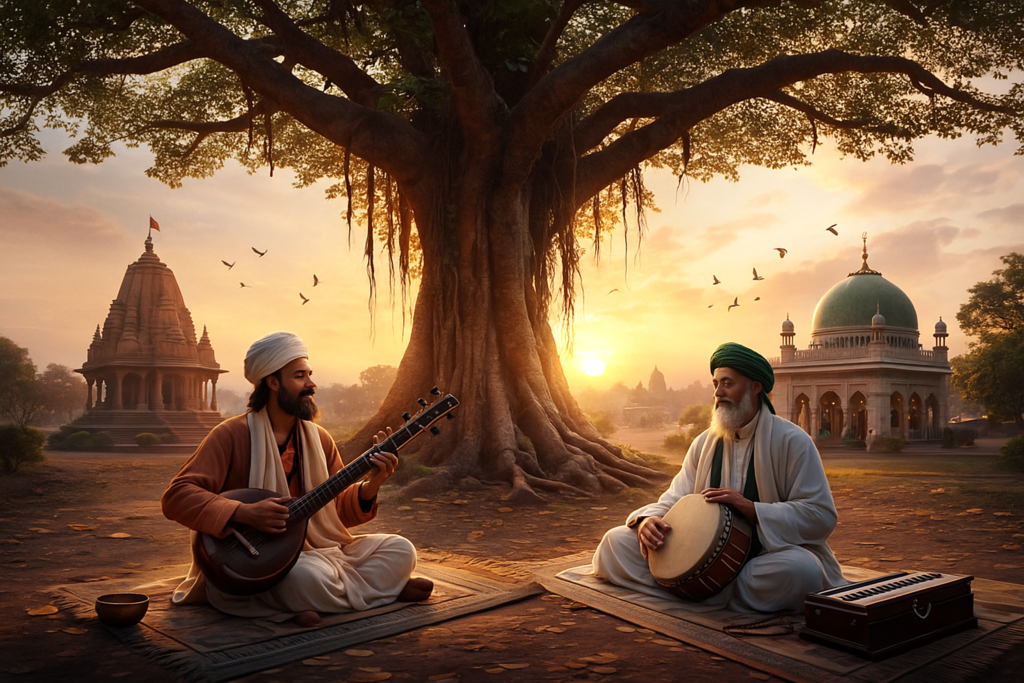
Similarities between Bhakti and Sufi Movements
The Bhakti and Sufi movements were two major spiritual and social forces in Indian history that left a deep impact between the 12th and 17th centuries. Both movements focused on spirituality, love, equality, and the rejection of religious fanaticism. They developed in parallel and established cultural harmony between Hindu and Muslim communities.
1. Emphasis on Devotion to God
Bhakti Movement
- Gave the highest place to personal devotion to God.
- Worshipped God in both Saguna (Rama, Krishna) and Nirguna (formless Brahma) forms.
Sufi Movement
- Prioritized deep love, surrender, and devotion to Allah.
- Viewed divine love as the path to spiritual realization.
Similarity
Both believed that devotion should be accessible to every person irrespective of caste, religion, or class.
2. Promotion of Social Equality
Bhakti Movement
- Opposed casteism and social discrimination.
- Kabir said: “Do not ask about caste or creed; one who worships Hari belongs to Hari.”
Sufi Movement
- Rejected caste and class distinctions.
- Khwaja Moinuddin Chishti considered helping the poor as the highest form of religion.
Similarity
Both movements gave equal rights of devotion and love to all sections of society.
3. Opposition to Religious Fanaticism and Rituals
Bhakti Movement
- Opposed excessive rituals, idol worship, and brahminical dominance.
- Promoted devotion as the simplest path to God.
Sufi Movement
- Emphasized inner love and spirituality over rigid Sharia rules.
Similarity
Both movements aimed to make religion simple, spiritual, and accessible.
4. Use of Local Languages
Bhakti Movement
- Used Awadhi, Braj, Tamil, Marathi, Punjabi etc.
- Tulsidas wrote Ramcharitmanas in Awadhi.
Sufi Movement
- Used Persian, Arabic, Urdu, and Indian languages like Punjabi and Sindhi.
- Baba Farid composed poems in Punjabi.
Similarity
Both spread their message through regional languages and enriched Indian literature.
5. Use of Music and Poetry
Bhakti Movement
- Used bhajans, kirtans, and devotional poetry.
- Mirabai’s hymns express deep devotion to Krishna.
Sufi Movement
- Used Qawwali, Ghazal, and Sufi poetry.
- Amir Khusro popularized the Qawwali tradition.
Similarity
Both used music and poetry as powerful mediums of expressing divine love.
6. Importance of Guru and Pir
Bhakti Movement
Kabir said: “Guru and Govind both are standing—whom should I bow first?”
Sufi Movement
Considered the Pir as the spiritual guide who leads the Murid toward God.
Similarity
Guru–disciple relationship was central in both movements.
7. Message of Love and Humanity
Bhakti Movement
Emphasized devotion along with service to humanity—seeing God in all beings.
Sufi Movement
Viewed love as the purest path to God and service to humanity as sacred.
Similarity
Both considered love and humanity as the foundation of religious life.
8. Religious Tolerance and Harmony
Bhakti Movement
Saints like Kabir and Guru Nanak opposed religious divisions.
Sufi Movement
Sufi saints encouraged Hindu–Muslim brotherhood.
Similarity
Both played a major role in reducing communal tensions.
9. Simple Life and Renunciation
Bhakti Movement
Encouraged simple living and renunciation of greed and ego.
Sufi Movement
Sufi saints practiced austerity, detachment, and simplicity.

Similarity
Both valued simplicity and inner devotion over material life.
Conclusion
The Bhakti and Sufi movements deeply influenced Indian religion, society, and culture. They promoted tolerance, equality, love, and service, inspiring people to rise above caste, religion, and class. Their message remains relevant in modern Indian society.
Influences of Bhakti and Sufi Movements
The Bhakti and Sufi movements profoundly shaped Indian society, religion, culture, and even politics. Between the 12th and 17th centuries, they introduced powerful ideas of equality, tolerance, and cultural harmony which continue to influence India today.
1. Religious Tolerance and Coordination
Bhakti Movement
- Promoted harmony between Hindus and Muslims.
- Opposed caste and religious discrimination.
- Kabir, Nanak, and Dadu stressed unity of all religions.
Sufi Movement
- Encouraged cultural coordination between Hindu and Muslim societies.
- Dargahs became symbols of peace and harmony.
Overall Impact
Both movements weakened religious fanaticism and promoted pluralism.
2. Promotion of Social Equality
Bhakti Movement
- Opposed casteism and Brahminical dominance.
- Supported lower castes and women.
Sufi Movement
- Gave equal respect to all classes and communities.
- Promoted dignity of the poor and marginalized.
Overall Impact
Cast, class, and gender discrimination weakened significantly.
3. Opposition to Religious Fanaticism
Bhakti Movement
- Opposed idol worship, rituals, and external show of religion.
Sufi Movement
- Emphasized meditation and spiritual love beyond the law.
Overall Impact
Religion became simple, accessible, and experience-based.
4. Influence on Music, Literature, and Art
Bhakti Movement
- Developed bhajans, kirtans, Ramleela, and devotional poetry.
Sufi Movement
- Developed Qawwali, Ghazal, and musical styles like Tarana and Khayal.
Overall Impact
Indian art, music, and literature flourished.
5. Support for Women’s Rights
Bhakti Movement
Saints like Mirabai encouraged equality for women.
Sufi Movement
Women participated in Sufi spiritual practices and dargahs.
Overall Impact
Society developed a more positive attitude toward women.
6. Message of Communal Harmony
Dargahs, bhajans, and devotional practices brought communities together and reduced social tensions.
7. Social and Religious Reforms
Both movements emphasized simplicity, service, and inner devotion, leading to major social reforms.
8. Impact on Politics
Sufi and Bhakti values influenced rulers—especially the Mughals like Akbar—to practice tolerance and good governance.
Conclusion
The Bhakti and Sufi movements played a transformative role in shaping Indian society by promoting religious tolerance, equality, love, and cultural unity. Their teachings continue to guide modern India toward peace, harmony, and spiritual growth.

References
- NCERT Class 12 – Medieval India (History Textbook).
- IGNOU Study Material – “Bhakti and Sufi Movements”.
- R. S. Sharma – “Indian Cultural History”.
- UPSC History Notes – Indian Society and Culture.
- Alok Kumar Mishra – “Sufi Tradition and Indian Culture”.
- Hazari Prasad Dwivedi – “History of Bhakti Literature”.
- B. L. Grover – “Medieval Indian Social and Religious History”.
- Indian Culture Portal – “Sufi Saints and Their Influence on India”.
- Teachings of Guru Nanak – Guru Granth Sahib (Selected Verses).
- Indian Music Research Centre – “Life and Works of Amir Khusro”.