
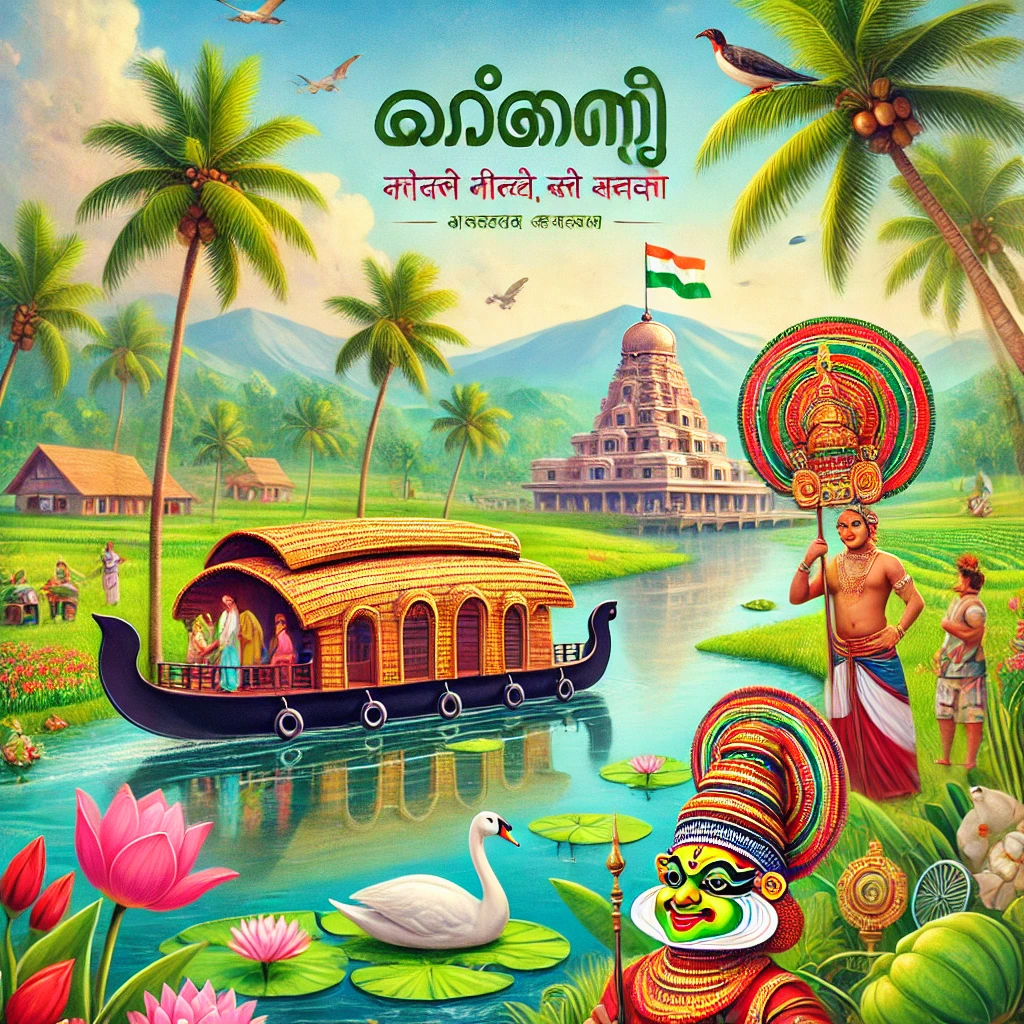
Kerala: God's Own Country
Kerala is a small but prosperous state located in the southwestern corner of India. It is known for its natural beauty, cultural heritage, and achievements in social development. Because of its scenic landscapes and rich traditions, Kerala is often called "God's Own Country."
Geographical Location and Climate of Kerala
Location: Kerala is situated between the Arabian Sea in the west and the Western Ghats in the east.
Area: Kerala covers approximately 38,863 square kilometres, accounting for about 1.18% of India's geographical area.
Number of Districts: Kerala has 14 districts, including Thiruvananthapuram, Ernakulam, Kozhikode, Thrissur, and Kasaragod.
Climate: Kerala has a tropical climate influenced by the Arabian Sea and the Western Ghats. The state receives substantial rainfall during the southwest monsoon and also receives rainfall from the northeast monsoon.
History of Kerala
Ancient Times
The history of Kerala dates back to the ancient Sangam period. The region was known for its spices, particularly black pepper. In ancient times, Kerala was an important centre of maritime trade, attracting Roman, Arab, and other foreign traders who came in search of pepper and other valuable products.
Colonial Period
Kerala came to the attention of European powers with the arrival of Vasco da Gama at Calicut (Kozhikode) in 1498. Subsequently, the Portuguese, Dutch, and British established their influence in different parts of the region.
Modern Period
Kerala was formed on 1 November 1956 under the States Reorganisation Act by integrating Malayalam-speaking regions, including Travancore-Cochin and the Malabar region. This gave Kerala a distinct administrative identity based on its language and cultural heritage.
Language and Culture of Kerala
Languages
Malayalam is the principal language of Kerala and is widely spoken throughout the state. English and Tamil are also used, particularly in educational, commercial, and border regions.
Religion and Society
Kerala has a diverse religious and cultural society. Hindu, Muslim, and Christian communities form important parts of its social and cultural life. The state has a long history of religious institutions, cultural interactions, and community traditions.
Cultural Heritage
Classical and Folk Dance
Kerala is famous for classical and traditional performance forms such as Kathakali, Mohiniyattam, and Koodiyattam. These art forms reflect the state's rich artistic and cultural heritage.
Music Traditions
Sopana Sangeetham and traditional temple music are important parts of Kerala's musical heritage. These musical traditions are associated with religious ceremonies, cultural performances, and festivals.
Festivals and Folktales
Onam, Vishu, Christmas, and Eid are celebrated across Kerala. The state also has a rich tradition of folktales, oral narratives, and regional stories passed down through generations.
Natural Beauty of Kerala
Kerala is globally known for its scenic landscapes, lush greenery, mountains, rivers, and serene water bodies. Its natural diversity makes it one of India's important tourism destinations.
Backwaters
The backwaters of Alappuzha (Alleppey) and Kumarakom are major attractions. Houseboat cruises provide visitors with an opportunity to experience Kerala's waterways, village life, and natural beauty.
Beaches
Kerala has several beautiful beaches, including Kovalam, Varkala, and Marari Beach near Mararikulam. These destinations attract domestic and international tourists.
Hill Stations
Hill destinations such as Munnar, Wayanad, and Thekkady are known for their green landscapes, tea plantations, forests, and pleasant climate.
Wildlife and Forests
Silent Valley National Park and Periyar Tiger Reserve are important protected areas known for their biodiversity and wildlife conservation efforts.
Economy and Industry of Kerala
Main Industries
Kerala's economy is diverse and depends on traditional industries, services, agriculture, trade, and tourism.
- Tourism: Kerala is a major tourist destination known for backwaters, beaches, Ayurveda, hill stations, and eco-tourism.
- Spice Production: The state is known for black pepper, cardamom, ginger, and other spices.
- Plantation Crops: Coconut, rubber, tea, and coffee are important agricultural and plantation products.
- Other Industries: Fishing, coir manufacturing, cashew processing, handicrafts, and the cooperative sector also contribute to the state's economy.
Recommended Product

Explore this recommended product for additional learning and everyday use.
Kerala's strategic location along the Arabian Sea enhances its geographical importance and supports maritime trade and commercial connections with other regions.
Education and Health in Kerala
Literacy Rate: Kerala recorded a literacy rate of approximately 94% in the 2011 Census, the highest among Indian states. Education has traditionally received high priority, and schools and colleges are widely accessible across the state.
Health Services: Kerala is known for its public healthcare system and traditional Ayurvedic medical practices. Primary health centres, hospitals, and other healthcare institutions contribute to the state's healthcare network.
Tourism in Kerala
Main Tourist Attractions
- Alappuzha backwater cruises
- Wildlife tourism in Thekkady
- Tea plantations and landscapes of Munnar
- Varkala and Kovalam beaches
- Houseboat experiences in Kumarakom
- Silent Valley National Park
Unique Tourism Features
Kerala tourism is also known for its houseboats, Ayurvedic wellness centres, and traditional cuisine. These experiences attract visitors interested in relaxation, wellness, nature, and cultural tourism.
Unique Features of Kerala
Onam Festival
Onam is the major traditional festival of Kerala. It is associated with the harvest season and the legend of King Mahabali. The festival is celebrated with floral decorations, traditional games, boat races, cultural programmes, and grand feasts.
Traditional Attire
Women traditionally wear the white and gold-bordered Kasavu saree, while men commonly wear the mundu, a traditional garment wrapped around the waist.
Food
A traditional Kerala feast called Sadya is served on a banana leaf. Kerala cuisine is known for coconut-based curries, rice dishes, spices, and a variety of vegetarian and seafood preparations.
Waterways
Kerala has an extensive network of rivers, lakes, canals, and backwaters. These waterways support transportation, irrigation, fishing, tourism, and local livelihoods.
Conclusion
Kerala is a state where tradition and modernity coexist. Its rich cultural heritage, natural beauty, diverse economy, and achievements in education and healthcare give it a distinctive place in India. From backwaters and beaches to festivals and social development, Kerala continues to attract attention as one of India's most distinctive states.
Frequently Asked Questions (FAQs) about Kerala
1. Why is Kerala called "God's Own Country"?
Kerala is called "God's Own Country" because of its lush green landscapes, backwaters, beaches, hill stations, and rich cultural heritage. Its natural beauty and tourism attractions have made this phrase widely associated with the state.
2. What is Kerala famous for?
Kerala is famous for its backwaters, Ayurveda, spices, classical art forms such as Kathakali, beaches such as Kovalam and Varkala, and hill stations such as Munnar and Wayanad. It is also known for its achievements in education and public healthcare.
3. Which language is mainly spoken in Kerala?
Malayalam is the principal language spoken in Kerala. English and Tamil are also used in different parts of the state.
4. What are the major tourist attractions in Kerala?
Major tourist attractions in Kerala include Alappuzha and Kumarakom backwaters, Munnar tea plantations, Thekkady wildlife attractions, Silent Valley National Park, and the beaches of Varkala, Kovalam, and Marari.
5. How does Kerala perform in education and healthcare?
Kerala is known for its high literacy rate and comparatively strong public healthcare system. The 2011 Census recorded a literacy rate of approximately 94%, the highest among Indian states. Its network of educational institutions and healthcare centres contributes to its social development.
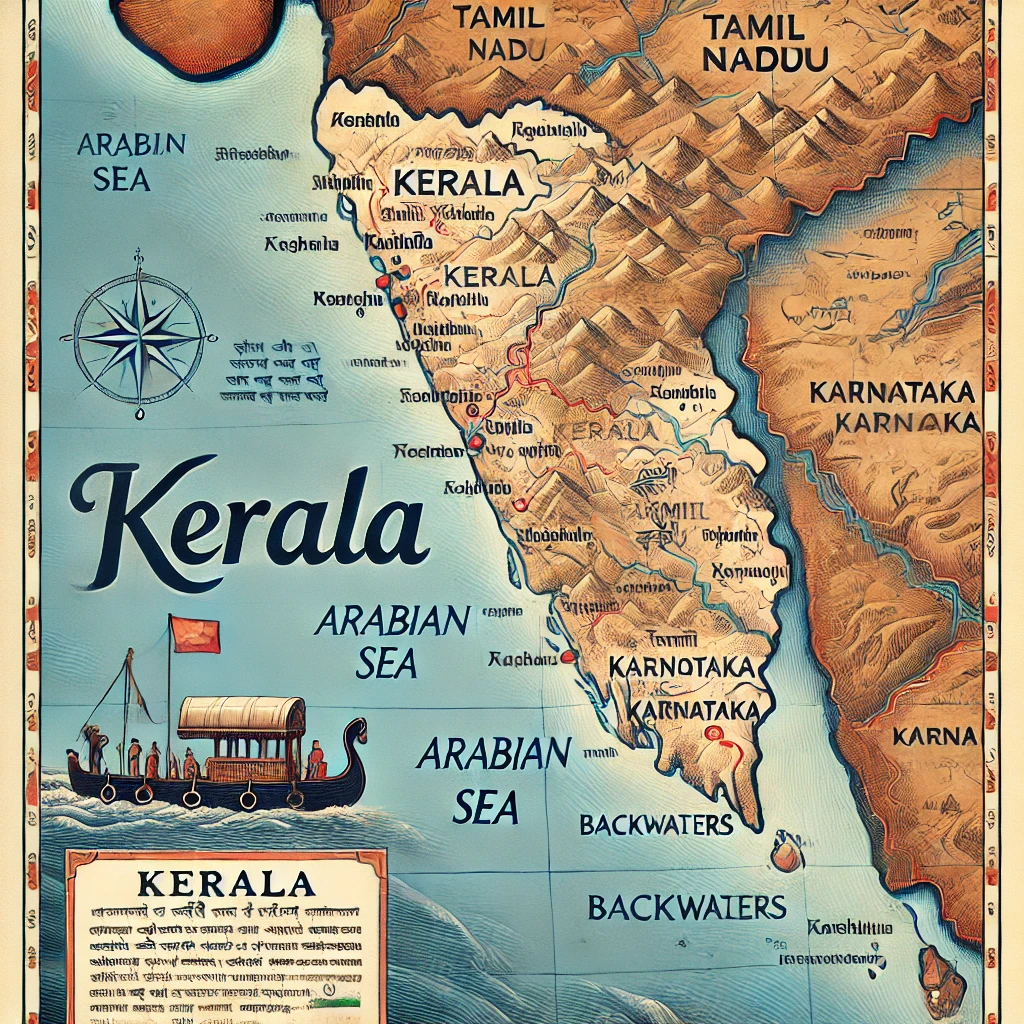
The geographical location of Kerala makes it a small yet geographically diverse state situated on the southwestern coast of India. The state is known for its distinctive geographical structure, lush greenery, and natural beauty. Its strategic location between the Arabian Sea and the Western Ghats gives Kerala a special geographical identity.
Status and Latitudinal–Longitudinal Location
Location
Kerala is located between 8°18′ North and 12°48′ North latitudes and 74°52′ East and 77°22′ East longitudes. It lies along the Arabian Sea in the southwestern part of India.
Boundaries
- North and North-East: Karnataka
- East: Tamil Nadu
- West: Arabian Sea
- South: Tamil Nadu
Coastline
Kerala has a coastline of approximately 590 kilometres along the Arabian Sea. The coastal region includes several beaches, fishing centres, and important maritime locations. Famous beaches include Kovalam, Varkala, and Marari Beach near Mararikulam.
Physiographic Structure of Kerala
The physiographic structure of Kerala is generally divided into three major regions: the highlands, midlands, and lowlands. Each region has distinct geographical, climatic, and economic characteristics.
1. Western Ghats (Highland Region)
The eastern part of Kerala is dominated by the Western Ghats, a mountain range that forms a natural boundary between Kerala and Tamil Nadu in several areas. The highlands contain mountains, valleys, forests, and important wildlife habitats.
Important Peaks
- Anamudi (2,695 metres): The highest peak in South India, located in the Idukki district of Kerala.
- Agasthyarkoodam: An important peak in the southern Western Ghats, located near the Kerala–Tamil Nadu border.
- Meesapulimala: A prominent high-altitude peak in the Munnar region.
The Western Ghats are an important source of many rivers of Kerala. They also support rich biodiversity, forest ecosystems, and plantation agriculture.
2. Central Midlands (Valleys and Rolling Uplands)
The central region of Kerala lies between the highlands and the coastal lowlands. It consists of rolling hills, valleys, lateritic uplands, and agricultural landscapes.
This region supports the cultivation of spices, rubber, coconut, and other plantation crops. Agriculture and settlements are important features of the central midlands.
3. Coastal Lowlands (Sea Plain)
The coastal lowlands form the western part of Kerala along the Arabian Sea. This region is characterized by sandy beaches, coastal plains, coconut plantations, wetlands, lagoons, and backwaters.
Backwaters in regions such as Alappuzha and Kumarakom are major attractions. They also support fishing, inland water transport, agriculture, and tourism.
Major Rivers and Lakes of Kerala
Rivers
Kerala has 44 rivers, of which 41 flow westward into the Arabian Sea and three flow eastward towards neighbouring states. Most of the rivers originate in the Western Ghats and play an important role in agriculture, drinking water supply, irrigation, and hydroelectric power generation.
Important Rivers
- Periyar (approximately 244 km): The longest river in Kerala and an important source of water for domestic, agricultural, and industrial purposes.
- Bharathapuzha: Also known as the Nila, it is one of the major rivers of Kerala.
- Pamba: An important river of central Kerala, associated with the Sabarimala region.
- Chaliyar: An important river flowing through the Malabar region.
- Kadalundi: A west-flowing river that drains into the Arabian Sea.
- Chalakudy: An important river known for its waterfalls and hydroelectric projects.
Lakes and Backwaters
- Vembanad Lake: The largest lake in Kerala and an important part of the state's backwater system.
- Ashtamudi Lake: A major backwater lake located in Kollam district.
- Sasthamkotta Lake: The largest freshwater lake in Kerala and an important source of drinking water.
- Kayamkulam Kayal: A coastal backwater lake located along the Arabian Sea.
These water bodies support tourism, fishing, agriculture, and inland water transport. They are also important ecological habitats for aquatic plants and wildlife.
Recommended Product
Explore this recommended product for additional learning and everyday use.
Soil and Vegetation of Kerala
Soil Types
Kerala has diverse soil types due to variations in topography, rainfall, geology, and drainage conditions. Important soil types include:
- Laterite Soil: Widely found in the midland regions and suitable for several plantation crops.
- Alluvial Soil: Found mainly in river valleys and coastal plains, where it supports paddy cultivation.
- Red Soil: Occurs in certain parts of the state and supports different agricultural activities.
- Coastal Sandy Soil: Found along the coastal belt and associated with coconut cultivation.
- Forest and Hill Soil: Found in the highland regions of the Western Ghats.
Vegetation and Wildlife
Kerala has rich forest resources, particularly in the Western Ghats. Its forests include tropical evergreen, semi-evergreen, moist deciduous, and other forest types.
The Western Ghats are recognized for their exceptional biodiversity and are an important part of a globally significant biodiversity hotspot.
Major Wildlife Species
- Asian elephant
- Bengal tiger
- Leopard
- Nilgiri tahr
- Lion-tailed macaque
- Malabar giant squirrel
- Numerous species of birds, reptiles, and amphibians
Protected areas such as Silent Valley National Park, Periyar Tiger Reserve, and Eravikulam National Park play an important role in wildlife conservation.
Climate of Kerala
Type of Climate
Kerala experiences a tropical monsoon climate. Its climate is influenced by the Arabian Sea, the Western Ghats, altitude, and seasonal monsoon winds.
Rainfall
Kerala receives rainfall mainly from the southwest monsoon, which generally occurs from June to September. The state also receives rainfall from the northeast monsoon, mainly during October and November.
The average annual rainfall is approximately 3,000 mm, although rainfall varies considerably across coastal, midland, and highland regions.
Temperature
Kerala generally experiences warm and humid weather in its coastal and lowland regions. Temperatures are comparatively lower in the high-altitude areas of the Western Ghats. Seasonal and regional variations occur throughout the state.
Geographical Importance of Kerala
Agriculture
Kerala's geographical conditions support the cultivation of paddy, coconut, tea, coffee, rubber, and a wide variety of spices. Its highlands are particularly suitable for plantation agriculture, while coastal plains and river valleys support paddy cultivation and other crops.
Tourism
Kerala's backwaters, beaches, hill stations, forests, and wildlife sanctuaries make it one of India's important tourist destinations. Its geographical diversity supports coastal tourism, nature tourism, wildlife tourism, and hill tourism.
Trade and Business
Kerala's coastal location has historically made it an important centre of India's spice trade. Its position along the Arabian Sea supported maritime connections with West Asia, Europe, and other regions.
Kochi Port is a major port on India's southwestern coast. It plays an important role in maritime trade, cargo handling, and commercial connectivity.
Conclusion
The geographical location and natural diversity of Kerala make it a distinctive state of India. Its Western Ghats, central midlands, coastal plains, rivers, lakes, and tropical monsoon climate support agriculture, tourism, biodiversity, and trade. The state's geographical features are therefore essential to understanding its economy, environment, and social development.
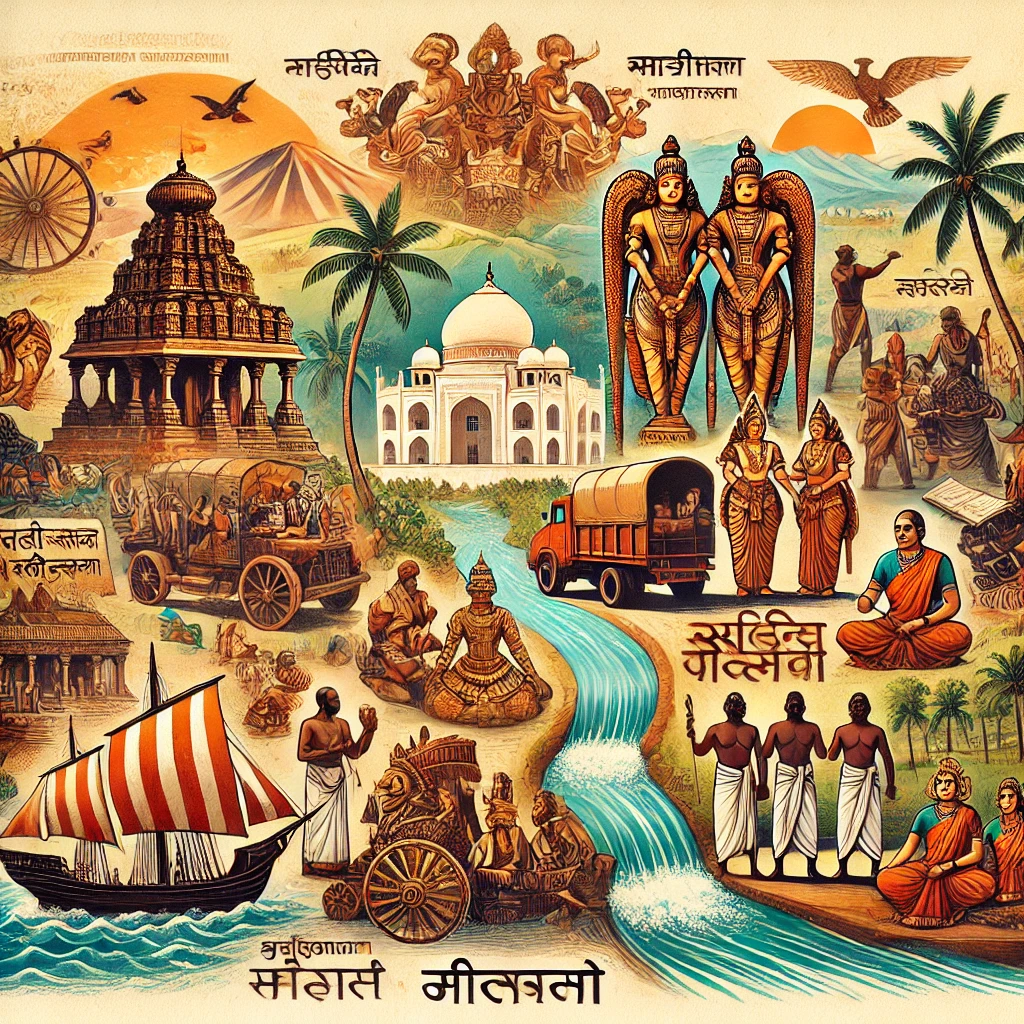
The history of Kerala is rich in ancient civilisations, cultural heritage, maritime trade, and powerful social reform movements. Since ancient times, the region has been an important centre of commerce, art, and religious activities. Over the centuries, Kerala witnessed the rule of different dynasties, foreign influences, and progressive social movements, all of which contributed to the development of modern Kerala.
Ancient Period
1. Mythological Stories and Origin of Kerala
The origin of Kerala is associated with several historical, linguistic, and mythological traditions. The name Kerala is traditionally associated with the Malayalam word Kera, meaning coconut, although the exact linguistic origin of the name is debated.
According to a popular Hindu legend, Kerala was reclaimed from the sea by Lord Parashurama. It is believed that Parashurama threw his axe into the sea, causing the waters to recede and creating new land. This story is an important part of Kerala's traditional cultural and religious heritage.
The Parashurama legend is a traditional account and should not be treated as established geological or historical evidence of the formation of Kerala.
2. Early Human Settlement
Evidence of human settlement in Kerala dates back to prehistoric times. Archaeological findings such as megalithic monuments, dolmens, burial sites, caves, and ancient pottery provide evidence of early human habitation in the region.
These archaeological remains help historians understand the social practices, burial traditions, material culture, and economic activities of early communities in Kerala.
3. Sangam Age (Approximately 300 BCE – 300 CE)
The Sangam Age is associated with the classical Tamil literary tradition. During this period, parts of present-day Kerala were associated with the Chera kingdom, which played an important role in the political and commercial history of southern India.
Chera Dynasty
The Cheras ruled over parts of present-day Kerala and adjoining regions of Tamil Nadu. They were among the important political powers of ancient southern India.
Chera rulers promoted trade, particularly in spices, pepper, and other valuable commodities. Their territories were connected with important inland and maritime trade networks, helping the region develop commercial relations with foreign traders.
4. Trade and Foreign Contacts
Kerala was an important centre of international maritime trade during ancient times. Roman, Greek, Arab, and other Mediterranean and West Asian traders visited the Malabar Coast to obtain spices, especially black pepper, along with other valuable goods.
Muziris Port
Muziris was one of the most important ancient trading ports associated with the Malabar Coast. It is generally identified with the region around present-day Kodungallur, although its precise location remains a subject of historical and archaeological discussion.
Muziris maintained important commercial connections with the Roman world and other ancient trading centres. Archaeological discoveries in the region provide evidence of Kerala's long history of overseas trade.
Recommended Product

Explore this recommended product for additional learning and everyday use.
Medieval Period
1. Second Chera Empire (9th–12th Century)
The Second Chera Empire, also known as the Kulasekhara dynasty, emerged as an important political power in Kerala from around the 9th century. Its rule continued until the early 12th century.
This period witnessed developments in administration, temple institutions, literature, trade, and regional political organisation. The influence of the Chera rulers contributed to the formation of Kerala's medieval political and cultural identity.
Important Rulers
Sthanu Ravi Kulasekhara was an important ruler of the Second Chera dynasty. His reign is associated with the growth of maritime trade and commercial relations.
Bhaskara Ravi Varman was another notable ruler associated with the later Chera period. Historical records and copper plate inscriptions provide information about the administration, trade, and social conditions of this era.
2. Bhakti Movement and Temple Culture
The Bhakti tradition influenced the religious and cultural development of Kerala. Devotional traditions associated with Shaivism and Vaishnavism contributed to the growth of religious literature, temple practices, music, and artistic traditions.
Important religious centres such as the Sree Padmanabhaswamy Temple in Thiruvananthapuram and the Guruvayur Temple became significant centres of religious and cultural life. Their histories developed over different periods.
Temple architecture, classical art forms, and regional cultural traditions also developed through interactions between local communities, rulers, and religious institutions.
3. Foreign Influence and Cultural Contacts
Arab and Chinese Traders
Arab and Chinese traders maintained important commercial connections with Kerala. Arab merchants played a particularly significant role in the development of maritime trade along the Malabar Coast.
These commercial and cultural interactions contributed to the development of Kerala's religious and social diversity. Islam became established in the region through historical contacts, trade, and the development of local Muslim communities.
Arrival and Growth of Christianity
According to the traditional belief of the Saint Thomas Christian community, Christianity reached Kerala through the arrival of St. Thomas the Apostle in the 1st century CE.
This account is an important part of Kerala's Christian tradition. Kerala subsequently became one of the historically significant centres of Christianity in the Indian subcontinent.
Importance of Calicut
Calicut (Kozhikode) emerged as a major port and international centre of the spice trade during the medieval period. Under the rule of the Zamorin, the city attracted traders from Arabia, Africa, China, and other regions.
Its commercial importance made Calicut one of the major maritime trading centres of the Malabar Coast.
Modern Period
1. European Colonialism
Portuguese Influence
In 1498, Vasco da Gama reached Calicut by sailing around the Cape of Good Hope. His voyage established a direct maritime connection between Europe and the Malabar Coast and marked the beginning of a new phase of European involvement in the region.
The Portuguese attempted to establish control over the spice trade and developed commercial and political influence along parts of the Kerala coast.
Dutch and British Rule
The Dutch arrived on the Malabar Coast during the 17th century and gradually challenged Portuguese influence in several areas. Their political and commercial activities became important in the regional history of Kerala.
Later, the British East India Company expanded its influence in the region during the 18th century. British authority gradually extended over Malabar, while Travancore and Cochin continued as princely states under British paramountcy.
2. Indigenous Rulers and Princely States
During the colonial period, the region of present-day Kerala was divided among different political territories. The two major princely states were Travancore and Cochin, while Malabar was brought under British administration.
Travancore was significantly strengthened under Maharaja Marthanda Varma (1729–1758). He expanded the kingdom, reorganised its military, and strengthened its administration.
Cochin also played an important role in regional trade, administration, and political developments during this period.
3. Social Reform Movements
The 19th and 20th centuries witnessed important social reform movements in Kerala. These movements challenged caste discrimination, social inequality, restrictions on education, and other forms of social exclusion.
Sree Narayana Guru
Sree Narayana Guru was one of Kerala's most influential social and spiritual reformers. He worked against caste discrimination and social inequality. His message, commonly expressed as "One Caste, One Religion, One God for Humankind", inspired social reform and equality.
Ayyankali
Ayyankali was a prominent social reformer who worked for the rights and upliftment of oppressed communities. He campaigned for access to education, freedom of movement, and social equality.
Vaikom Satyagraha (1924–1925)
The Vaikom Satyagraha was a historic movement against caste-based discrimination and restrictions on the use of public roads around the Vaikom Mahadeva Temple.
The movement became an important milestone in Kerala's struggle for social equality and influenced later campaigns against untouchability and caste discrimination.
Independence Movement and Formation of Kerala
People from different parts of Kerala participated in India's freedom struggle. The region witnessed political mobilisation, social reform campaigns, and movements against colonial rule.
After India's independence in 1947, Travancore and Cochin were integrated into the Travancore-Cochin state in 1949. Malabar remained part of the Madras State until the reorganisation of states.
Modern Kerala was formed on 1 November 1956 under the States Reorganisation Act, 1956, primarily on a linguistic basis.
The Malayalam-speaking regions of Travancore-Cochin and Malabar were integrated to form the present state of Kerala. Kasaragod was also included, while the southern Tamil-speaking areas of the former Travancore-Cochin state were transferred to Madras State.
Contemporary Kerala
After its formation, Kerala made significant progress in education, healthcare, public services, and social development. The state is known for its high literacy rate, comparatively high life expectancy, and achievements in human development.
Kerala's development experience is often discussed in relation to land reforms, public education, healthcare, social movements, and decentralised governance. At the same time, challenges such as unemployment, migration, and an ageing population remain important issues.
Conclusion
The history of Kerala reflects its cultural richness, long-standing role as a global trading centre, and tradition of social reform. From the ancient Chera kingdom and medieval maritime trade to European colonial influence and modern social movements, Kerala has experienced many important phases of historical development.
Its heritage, literature, art, social movements, and achievements in education and healthcare make Kerala a distinctive and important part of India's history.
Specialties of Kerala
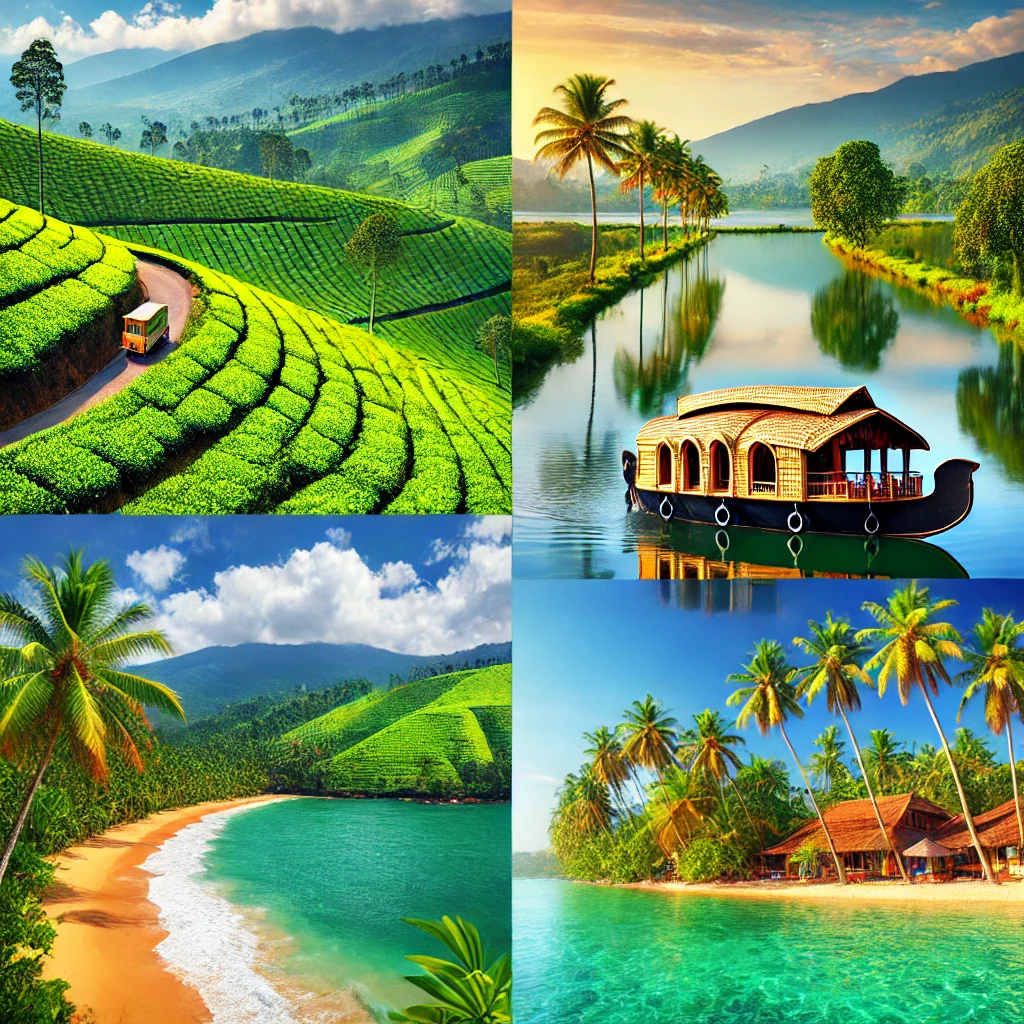
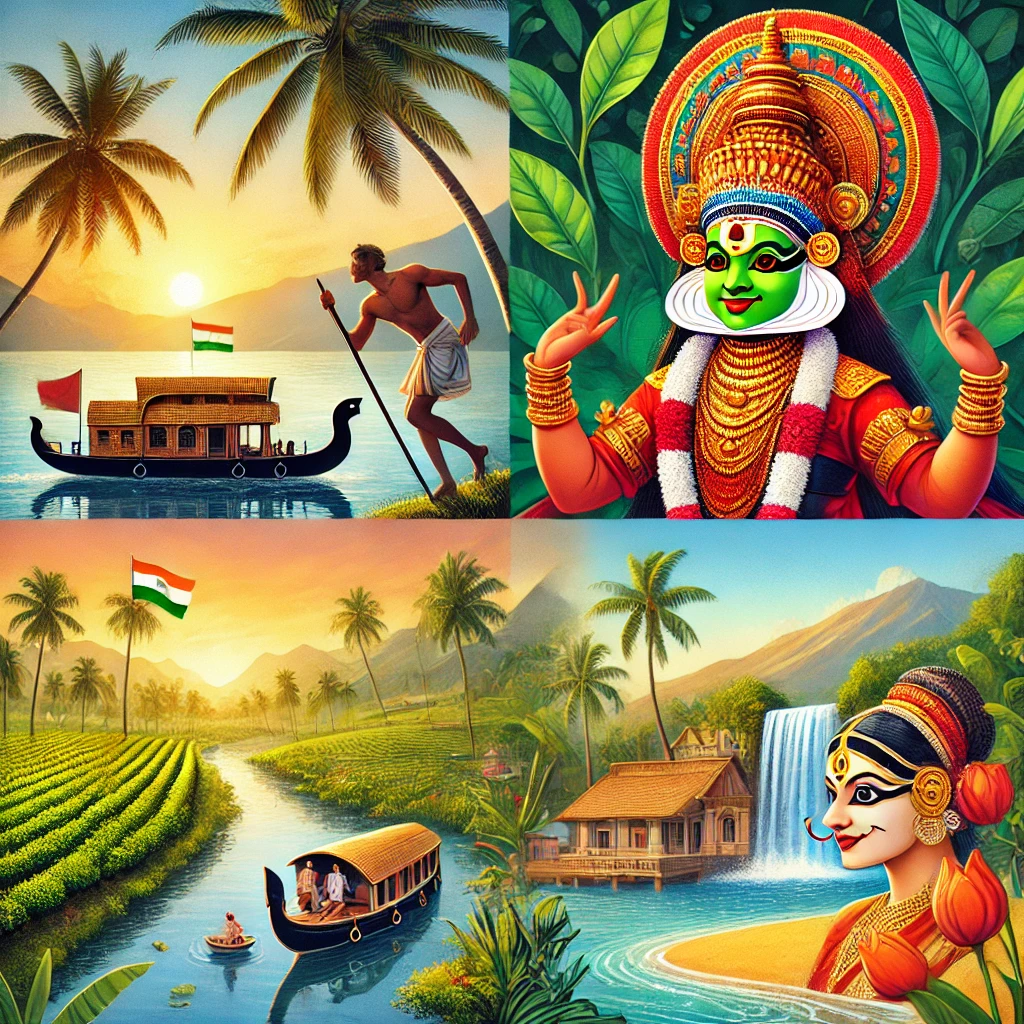
Kerala is known as "God's Own Country," a name that reflects its extraordinary natural beauty, rich cultural traditions, and achievements in social development. Its distinctive geographical features, cultural heritage, and economic activities give Kerala a special identity among the states of India.
1. Natural Features of Kerala
Geographical Diversity
Kerala is located between the majestic Western Ghats and the Arabian Sea. Hill stations, tranquil backwaters, scenic beaches, and forests together make its geographical landscape distinctive.
Backwaters and Waterways
The backwaters of Alappuzha (Alleppey) and Kumarakom are among Kerala's most famous natural attractions. They attract tourists from India and abroad for houseboat cruises, scenic landscapes, and traditional village life.
Beaches
Beaches such as Kovalam, Varkala, and Cherai are major tourist attractions. They are known for their coastal scenery, cliffs, and recreational activities.
Climate
Kerala has a tropical monsoon climate. Its seasonal rainfall, humid conditions, and varied topography support rich vegetation and diverse agricultural activities.
2. Cultural Characteristics of Kerala
Cultural Heritage
Kerala has a rich cultural heritage reflected in its performing arts, architecture, literature, festivals, and traditional practices. Important classical and traditional art forms include Kathakali, Mohiniyattam, Koodiyattam, and Theyyam.
Temples, churches, mosques, and traditional architectural structures also form an important part of Kerala's cultural landscape.
Festivals
Festivals such as Onam, Vishu, and Thiruvathira reflect Kerala's cultural traditions. Traditional dishes such as Payasam and floral decorations called Pookkalam are important features of Onam celebrations.
Language and Literature
Malayalam is the principal language of Kerala. Literary figures such as Kumaran Asan and Vaikom Muhammad Basheer have made significant contributions to Malayalam literature.
Ayurveda
Kerala has a long-standing tradition of Ayurveda. Ayurvedic institutions, traditional wellness practices, and related tourism activities have contributed to the state's reputation as an important destination for traditional wellness services.
3. Economic Characteristics of Kerala
Spice Production
Kerala is an important region for the cultivation of spices such as black pepper, cardamom, ginger, and nutmeg. Spice cultivation has historically contributed to its trade and agricultural economy.
Agriculture
Coconut, rice, rubber, tea, coffee, and spices are important agricultural crops of Kerala. Plantation agriculture is particularly significant in several highland regions.
Tourism
Tourism based on backwaters, hill stations, beaches, wildlife sanctuaries, cultural heritage, and wellness facilities is an important part of Kerala's economy.
Remittances
Non-Resident Indians (NRIs), particularly Malayali workers employed in Gulf countries, contribute to Kerala's economy through remittances. These overseas earnings support household consumption, education, housing, and investment.

Recommended Product
Explore this product on Amazon. Check its specifications, customer reviews, and current price before purchasing.
4. Social Characteristics of Kerala
Education and Literacy
Kerala has one of the highest literacy rates among Indian states. According to the 2011 Census of India, its literacy rate was approximately 94%, the highest among Indian states in that Census.
Health Services
Kerala is known for its public healthcare network and achievements in several health indicators. Its healthcare system includes primary health centres, community health institutions, hospitals, and private medical facilities. Ayurveda also has a significant place in the state's traditional healthcare heritage.
Women's Empowerment
Women's education, participation in social activities, and involvement in local governance have contributed to Kerala's social development. However, challenges related to employment opportunities and gender equality continue to require attention.
social equality
Social reform movements have played an important role in challenging caste-based discrimination and promoting education, equality, and social awareness in Kerala.
5. Tourism Specialties
Natural Attractions
Alappuzha's backwaters, Munnar's tea plantations, and the Periyar Tiger Reserve are among Kerala's popular tourist attractions. The state's beaches, waterfalls, forests, and hill stations also attract visitors.
Traditional Boat Races
Traditional boat races are an important part of Kerala's cultural and tourism identity. Events such as the Nehru Trophy Boat Race attract spectators and celebrate the state's traditional boat-racing culture.
Local Handicrafts
Bamboo products, coir items, coconut-based products, and traditional textiles such as Kasavu sarees are well-known examples of Kerala's handicrafts and traditional industries.
6. Environmental Awareness
Environmental protection
Environmental protection is important for Kerala because of its forests, rivers, wetlands, coastal ecosystems, and biodiversity. State-level initiatives such as the Haritha Keralam Mission focus on areas including sanitation, waste management, water conservation, and environmental improvement.
Biodiversity
Protected areas such as Silent Valley National Park, Periyar Tiger Reserve, and Eravikulam National Park reflect Kerala's ecological richness and biodiversity.
Conclusion
The specialties of Kerala make it a distinctive state of India. Its natural beauty, cultural heritage, spice cultivation, tourism, educational achievements, and social reform traditions contribute to its unique identity.
Geographical Location and Climate of Kerala
Geographical Location
1. Location
Kerala is located in the south-western part of India. It stretches as a relatively narrow strip of land between the Western Ghats in the east and the Arabian Sea in the west.
Latitude and Longitude
- Latitude: Approximately 8°18′ N to 12°48′ N.
- Longitude: Approximately 74°52′ E to 77°22′ E.
2. Area
The total geographical area of Kerala is 38,863 square kilometres. It accounts for approximately 1.18% of India's total geographical area.
3. Boundaries
- North: Karnataka.
- East: Tamil Nadu.
- West: Arabian Sea.
- South: Tamil Nadu.
4. Major Geographical Features
Western Ghats
The Western Ghats run along the eastern part of Kerala. They are known for their mountain ranges, forests, biodiversity, wildlife habitats, and plantation agriculture. The highlands also influence the state's rainfall and climate.
Midlands
The midland region lies between the highlands of the Western Ghats and the coastal lowlands. It contains undulating terrain, hills, valleys, plantations, agricultural land, and settlements.
Coastal Region
The coastal lowlands along the Arabian Sea are characterised by beaches, lagoons, backwaters, fishing settlements, and coconut cultivation. They are important for fisheries, transportation, and tourism.
Rivers and Lakes
Kerala has 44 rivers, of which 41 flow westward into the Arabian Sea and three flow eastward towards neighbouring states. Important rivers include Periyar, Bharathapuzha, Pamba, and Chaliyar.
Major lakes and backwater systems include Vembanad Lake, Ashtamudi Lake, and Kayamkulam Kayal.
5. Backwaters
Backwaters are among the most distinctive geographical features of Kerala. They consist of interconnected lakes, lagoons, canals, and waterways. These systems are influenced by freshwater flows and, in many areas, the mixing of freshwater and seawater.
Backwaters are important for transportation, fishing, tourism, and the livelihoods of local communities.
6. Flora and Wildlife
Kerala has diverse forest ecosystems, including tropical evergreen, semi-evergreen, and moist deciduous forests. These forests support rich biodiversity and provide habitats for many plant and animal species.
Major protected areas include Silent Valley National Park, Periyar Tiger Reserve, and Eravikulam National Park.
Climate of Kerala
Kerala has a tropical monsoon climate. The climate is generally warm and humid, although temperatures and rainfall vary across the coastal, midland, and highland regions.
1. Seasonal Division
Summer (March to May)
Summer is generally warm and humid in Kerala. Temperatures rise during this period, and pre-monsoon showers may occur in several parts of the state.
South-West Monsoon (June to September)
The south-west monsoon is the main rainy season in Kerala. The monsoon generally reaches the state in early June and brings substantial rainfall. The Western Ghats influence the distribution of rainfall across different regions.
North-East Monsoon (October to December)
The north-east monsoon contributes additional rainfall to Kerala, particularly during October and November. Rainfall patterns vary between districts and years.
Winter (December to February)
Winter is generally the relatively cooler and drier season in Kerala. Coastal areas remain comparatively warm, while highland regions experience cooler conditions.
2. Humidity
Humidity is generally high in Kerala, particularly in coastal areas and during the monsoon season. The level of humidity varies according to location, season, and weather conditions.
3. Rainfall
Kerala receives rainfall from both the south-west and north-east monsoons. The south-west monsoon contributes the major share of annual rainfall, while the north-east monsoon provides additional precipitation.
Rainfall is not uniform throughout the state. The windward slopes of the Western Ghats receive substantial rainfall, while regional variations occur in the eastern and coastal areas.
4. Special Climatic Effects
Influence of the Western Ghats
The Western Ghats play an important role in shaping Kerala's climate. They influence monsoon winds and cause orographic rainfall on their windward slopes.
Coastal Influence
The Arabian Sea influences the climate of Kerala's coastal areas. Sea breezes and maritime conditions affect local temperatures and humidity.
Natural Disasters
Heavy monsoon rainfall can sometimes lead to floods, landslides, and soil erosion. Coastal regions may also face hazards such as coastal erosion and storm-related impacts.
Importance of Geographical Location and Climate
Impact on Agriculture
Monsoon rainfall, varied terrain, and suitable climatic conditions support the cultivation of rice, coconut, rubber, tea, coffee, and spices in different parts of Kerala.
Impact on Tourism
Backwaters, beaches, forests, waterfalls, and mountain landscapes attract tourists. The diversity of landscapes makes Kerala an important destination for nature-based and cultural tourism.
wildlife conservation
Tropical forests, wetlands, and mountain ecosystems support rich biodiversity. Protected areas help conserve important habitats and wildlife species.
Impact on Lifestyle
Kerala's geography and climate influence its food habits, housing patterns, occupations, and settlement distribution. Rice, coconut, and fish are important components of the state's food culture.
Final Conclusion
Kerala's geographical location and tropical monsoon climate contribute to its natural beauty, biodiversity, and agricultural activities. The combination of coastal lowlands, midlands, and the Western Ghats creates a distinctive physical landscape.
These geographical and climatic features influence the state's economy, tourism, agriculture, wildlife conservation, and cultural life.
References
- Department of Tourism, Government of Kerala – Official information related to Kerala's natural beauty, tourism destinations, cultural heritage, and travel initiatives.
- Government of India Publications (Ministry of Information & Broadcasting) – Publications and reference material covering Kerala's geographical features, social structure, and economic conditions.
- National Informatics Centre (NIC) – Information on Kerala's geographical location, climate, administrative divisions, and digital governance.
- Kerala State Textbook and Education Board – Academic resources covering the History, geography, and social development of Kerala.
- NITI Aayog / Planning Commission Reports – Reports and analysis related to human development, literacy, healthcare indicators, and social progress in Kerala.
- Ministry of AYUSH, Government of India – Information on Ayurveda, traditional medical practices, and wellness-related initiatives in Kerala.
- Standard Geography and History Books – Reference books and academic publications covering Kerala's history, culture, economy, and natural resources.
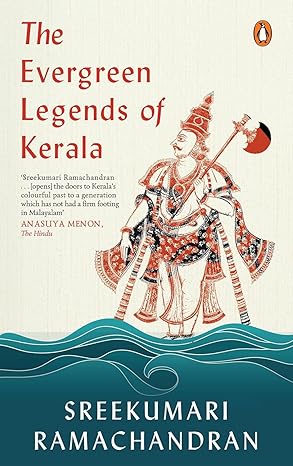
Recommended Product
Explore this product on Amazon. Check its specifications, customer reviews, and current price before purchasing.
Social Development in Kerala
Kerala performs well on several social development indicators in India. The state is known for its high literacy, comparatively high life expectancy, strong public healthcare network, and achievements in education and social welfare.
Women's participation in education, local governance, and social activities has also contributed to Kerala's development. However, challenges such as unemployment, ageing population, and regional inequalities remain important policy concerns.