
Tripura — Geographic Situation & History
A structured, easy-to-read summary of Tripura's geography, environment, resources and a concise historical timeline — written for clarity and SEO.
Geographic Situation
Tripura is a small but resource-rich state located in the northeastern region of India. Its geography forms an intimate and historic relationship with neighboring states and with Bangladesh. The following sections expand on Tripura's geographic setting and its physical and environmental characteristics.
Situation and Boundaries
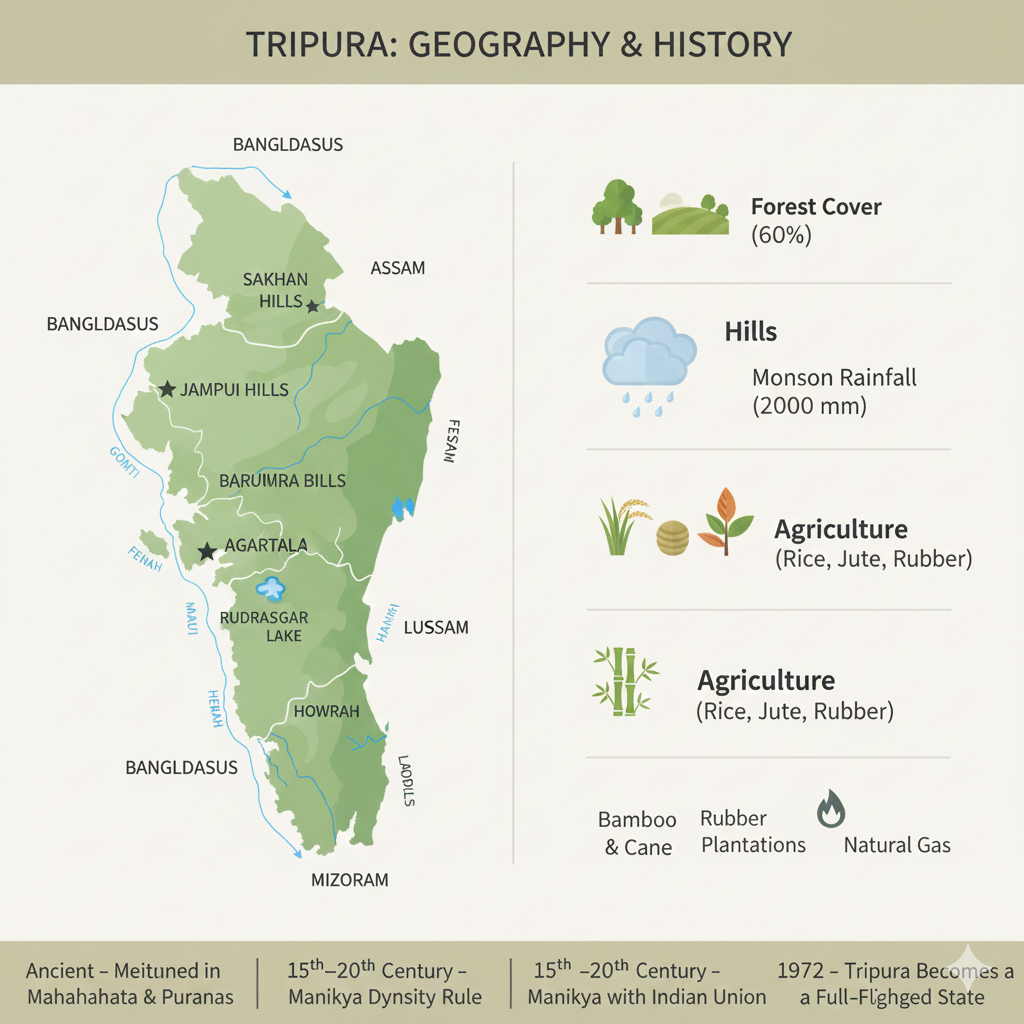
Tripura lies in northeastern India and is nearly surrounded on three sides by Bangladesh. To the west and much of the north and south the state borders Bangladesh; to the north-east it meets Assam, and to the south-east it borders Mizoram. Tripura shares about 856 km of international boundary with Bangladesh.
Area
Tripura covers a total area of approximately 10,491 square kilometres, making it one of the smaller states in India. It accounts for roughly 0.32% of India's total land area.
Physical Features
Mountain Ranges
Much of Tripura is hilly. The state contains several notable hill ranges that shape its landscape and contribute to its scenic beauty:
- Burma Hills
- Jampui Hills
- Baramura Hills
- Sakhan Hills
- Lushai Hills
Valleys and Plains
Between the hills are many valleys and pockets of flat land that are well suited for agriculture. These fertile valleys support crops such as paddy (rice), jute and vegetables.
Rivers
Rivers are important for Tripura's agriculture, water supply and local transport. Major rivers include:
- Gomti (the largest river in Tripura)
- Manu River
- Howrah River
- Katakhal River
- Feni River
Lakes
Tripura has several lakes, large and small. The most famous among them is Rudrasagar Lake, the site of the scenic Neermahal palace.
Vegetation and Biodiversity
Around 60% of Tripura is covered by forests. The state is rich in vegetation such as sal, bamboo, teak and other species. Tripura is also home to diverse wildlife, including elephants, deer, tigers and a variety of bird species, some of which are rare or endangered.
Climate
Tripura has a predominantly tropical climate. Summer temperatures may reach up to about 35°C, while winter temperatures can fall to around 10°C. Average annual rainfall is high (approximately 2,000 mm), supporting the state's agriculture and forest cover.
Natural Resources
Tripura's natural resource base includes extensive forest produce (bamboo and cane), rubber cultivation, and deposits of natural gas which contribute to the state's energy needs and potential industrial development.
Geographic Importance
Strategic Location
Tripura's position between northeastern India and Bangladesh makes it an important contact point for cross-border trade and cultural exchange. Agartala, the state capital, lies relatively close to Dhaka, Bangladesh's capital — the proximity enhances trade and connectivity.
Agriculture and Water Resources
The state's favorable climate and fertile valleys are well suited to agriculture. Major crops include rice, jute and rubber. Water resources in Tripura support not only farming but also domestic use and small-scale hydropower opportunities.
Geographic Challenges
The predominance of hilly terrain and limited flat land can pose constraints for large-scale development projects and infrastructure expansion. During the monsoon season, certain areas are at risk of flooding and landslides, which create additional development and disaster-management challenges.
Summary — Geographic Outlook
Tripura's physical geography — hills, rivers, lakes and lush forests — combined with its strategic location bordering Bangladesh, make it an important state in Northeast India. Its natural beauty, biodiversity and resource base position Tripura as a center for tourism and sustainable resource development.
History of Tripura
Tripura's history is rich, diverse and spans several millennia. The region is referenced in Indian epics, mythological accounts, ancient inscriptions and historical records. The following timeline summarizes Tripura's evolution from ancient times through the modern period.
Ancient Period
Mythical References
The name Tripura is derived from Sanskrit and is associated with the term "three cities" and with the goddess Tripurasundari. Tripura appears in the Mahabharata, the Puranas and in Ashokan inscriptions. Local tradition links the region to the goddess Tripurasundari, and important shrines such as the Tripureshvara Temple reflect this religious heritage.
Dynastic Rule
Tripura was ruled by several dynasties over the centuries. The most prominent among them is the Manikya dynasty, which established its rule from around the 14th century and shaped much of Tripura's historic culture and polity.
Medieval Period
Under the Manikya rulers, Tripura evolved into a well-organized and culturally active state. Kings such as Bir Chandra Manikya and other notable Manikya monarchs contributed significantly to social, cultural and religious development. Bengali cultural and Hindu religious influences deepened during this era, and constructions such as the Tripureshvara Temple date to these periods.
External Relations and Conflicts
Tripura's rulers maintained diplomatic and sometimes adversarial relations with neighboring powers, including the Nawabs of Bengal and the Mughals. The region experienced intermittent conflict as outside powers asserted influence or control.
Modern Period
British Era
In the 19th century Tripura became a princely state under British India. While the local rulers retained nominal autonomy, British administrative influence led to the introduction of modern education, administrative reforms and infrastructure development.
King Bir Bikram
Maharaja Bir Bikram Manikya (reigned 1923–1947) is credited with initiating several modernizing projects: improving infrastructure such as roads, schools and hospitals, and promoting Agartala as the state's administrative center. His reign laid foundations for later development.
Merger with India and Statehood
After Indian independence, Tripura acceded to the Indian Union on 15 October 1949. It was administered as a Union Territory initially and later granted full statehood on 21 January 1972.
Refugee Influx and Demographic Change
The 1947 Partition of India and the 1971 Liberation War of Bangladesh led to waves of refugees entering Tripura. These migrations significantly altered the state's demographic composition and social structure.
Tribal and Non-tribal Tensions
In the late 20th century, tensions rose between tribal and non-tribal communities in Tripura, culminating in periods of conflict during the 1980s. Efforts toward peace and political settlement, including accords in 1988, helped restore relative stability.
Culture, Heritage and Landmarks
Tripura's history is visible in its material culture — palaces, temples, rock carvings and monuments. Royal patronage supported art, literature and religious life, creating a distinctive cultural mix of tribal traditions and Bengali influence.
Key Historical Sites
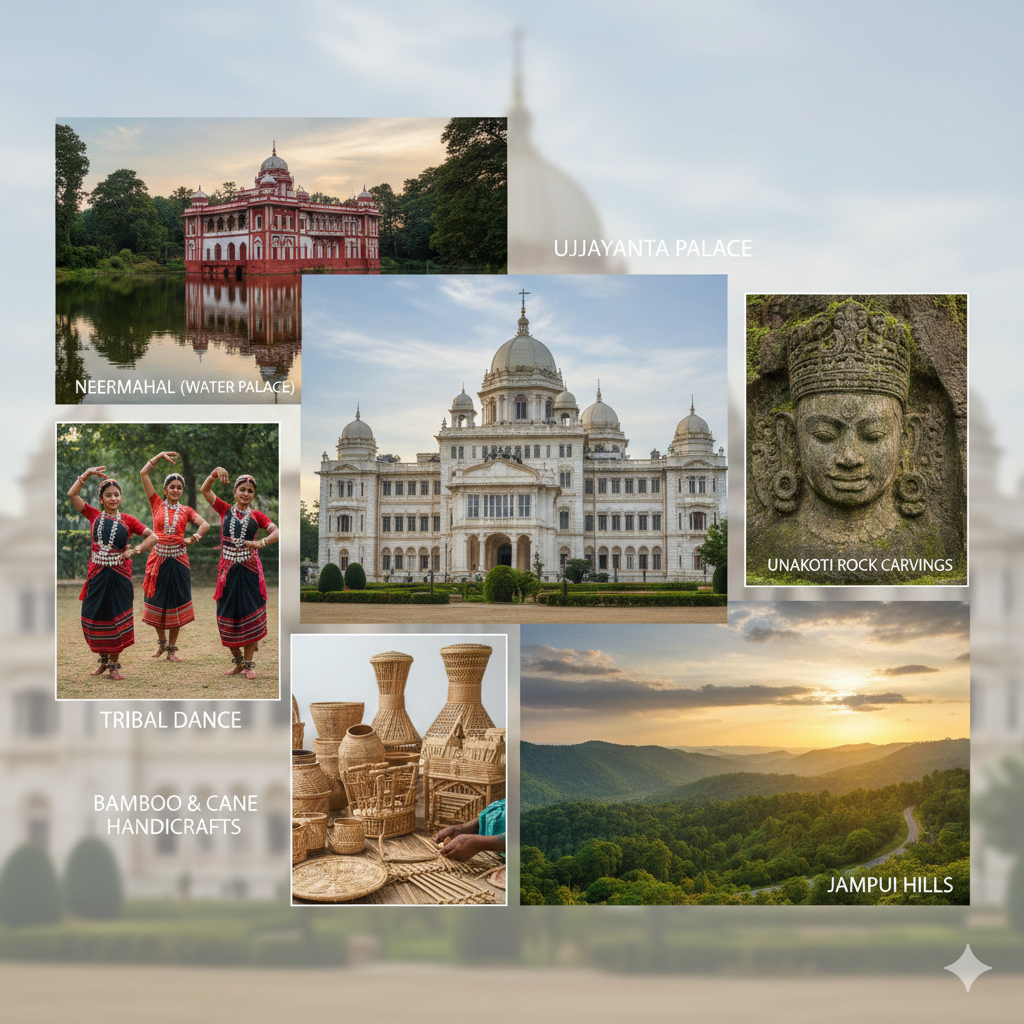
- Ujjayanta Palace — The former royal palace and an iconic landmark in Agartala.
- Neermahal — A water palace set in Rudrasagar Lake.
- Unakoti — An archaeological site known for massive ancient rock-carved statues.
- Tripureshvara Temple — An important religious and historic shrine.
Summary — Historical Arc
Tripura's history moves from mythical and early dynastic times through medieval consolidation under the Manikya dynasty to the modern era shaped by colonial influence, reformist rulers, political integration into India and social change from migration and local conflicts. The state's cultural tapestry and historical monuments continue to define its identity today.
Culture — Languages of Tripura
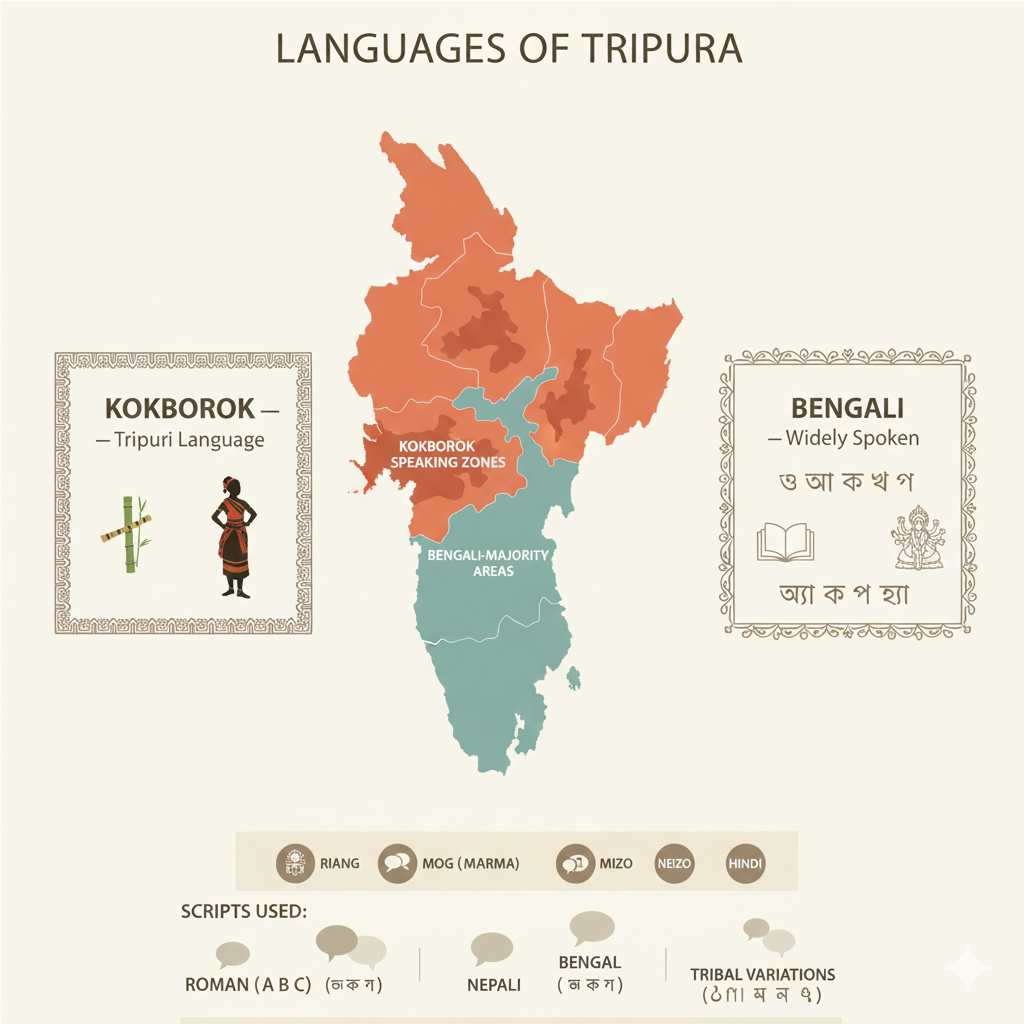
The linguistic landscape of Tripura reflects its cultural variety, historical traditions, and the coexistence of tribal and non-tribal communities. The state hosts several languages, with Kokborok and Bengali being the most prominent. Alongside these, various tribes speak their own mother tongues, contributing to Tripura's rich linguistic heritage.
Chief Languages of Tripura
1. Kokborok (Tripuri Language)
Introduction
Kokborok is the principal tribal language of Tripura and the mother tongue of the Tripuri community. It is often referred to as “the language of the Tripuris.”
Spread
Kokborok is widely spoken among many tribal communities across the state.
Script
Traditionally, Kokborok did not have its own script. Today it is written using both the Roman and Bengali scripts.
Government Recognition
In 1979, Kokborok was officially recognised as one of the state languages of Tripura.
Cultural Contribution
Kokborok folk songs, stories and oral traditions preserve the History, customs and culture of tribal society.
2. Bengali
Introduction
Bengali is the most widely spoken language in Tripura and is used extensively in administration, academics and daily communication.
Spread
Bengali is the principal language among non-tribal communities and represents a significant section of Tripura’s population.
Literary Contribution
Bengali literature and art have had a strong influence on Tripura. Several authors and poets from Tripura have contributed to Bengali literary traditions.
Religious and Cultural Influence
The influence of Bengali is visible in cultural practices such as Durga Puja, local art forms and music.
Other Languages in Tripura
Riang
The language of the Riang (Bru) tribe, one of Tripura's largest tribal groups. It is distinct from Kokborok and has its own unique identity.
Dodge
Spoken primarily in the southern parts of Tripura by the Dodge tribal community, which has historical and cultural ties to Buddhism.
Mog (Marma)
Spoken by the Mog (Marma) tribe, this language is influenced by Burmese (Myanmar) and the linguistic traditions of Chittagong.
Mizo
Mizo is spoken in specific regions of Tripura near the Mizoram border, especially in areas where ethnic groups live close to the state boundary.
Nepali and Hindi
Both languages are spoken by smaller communities in Tripura, particularly among groups who migrated from other regions.
Reasons Behind Linguistic Diversity

⭐ Recommended Study Resource
Explore a highly rated educational resource selected to support learning, revision, and exam preparation with trusted content and positive reader feedback.
Tribal Plurality
Tripura is home to more than 19 recognised tribes, each with its own language or dialect, creating a multilingual environment.
Proximity to Bangladesh
Tripura shares a long boundary with Bangladesh, which has influenced the spread and cultural impact of the Bengali language.
Migration and Integration
Large-scale migration from Bangladesh during the 1947 Partition and the 1971 Liberation War led to demographic changes, making Bengali a dominant language.
Scripts Used in Tripura
Kokborok and Tribal Languages
Kokborok and several other tribal languages use the Roman and Bengali scripts. Efforts continue to develop independent scripts for some of these languages.
Bengali Script
The Bengali script is widely used for government administration, education and publications in the state.
Social Aspects Linked to Language
Linguistic Identity
Kokborok is a marker of the cultural and historical identity of tribal communities, while Bengali represents unity and modernity among non-tribal groups.
Conflict and Adjustment
Linguistic and cultural issues contributed to tribal–non-tribal tensions during the 1980s. In response, the government took steps to promote Kokborok and encourage linguistic harmony.
Government Initiatives
Language Protection
The government implemented educational programs, revised syllabi and introduced Kokborok teaching in schools to preserve and promote tribal languages.
Cultural Programs
Festivals, folk-art activities and cultural events are organised to support Kokborok and other tribal languages.
Summary
Tripura’s linguistic diversity reflects its cultural richness. Kokborok stands as the symbol of tribal identity, while Bengali remains the foundation of administration and modern communication. Continuous efforts by the state to preserve and promote linguistic harmony strengthen Tripura’s cultural heritage and ensure a more inclusive future.
Tourism in Tripura
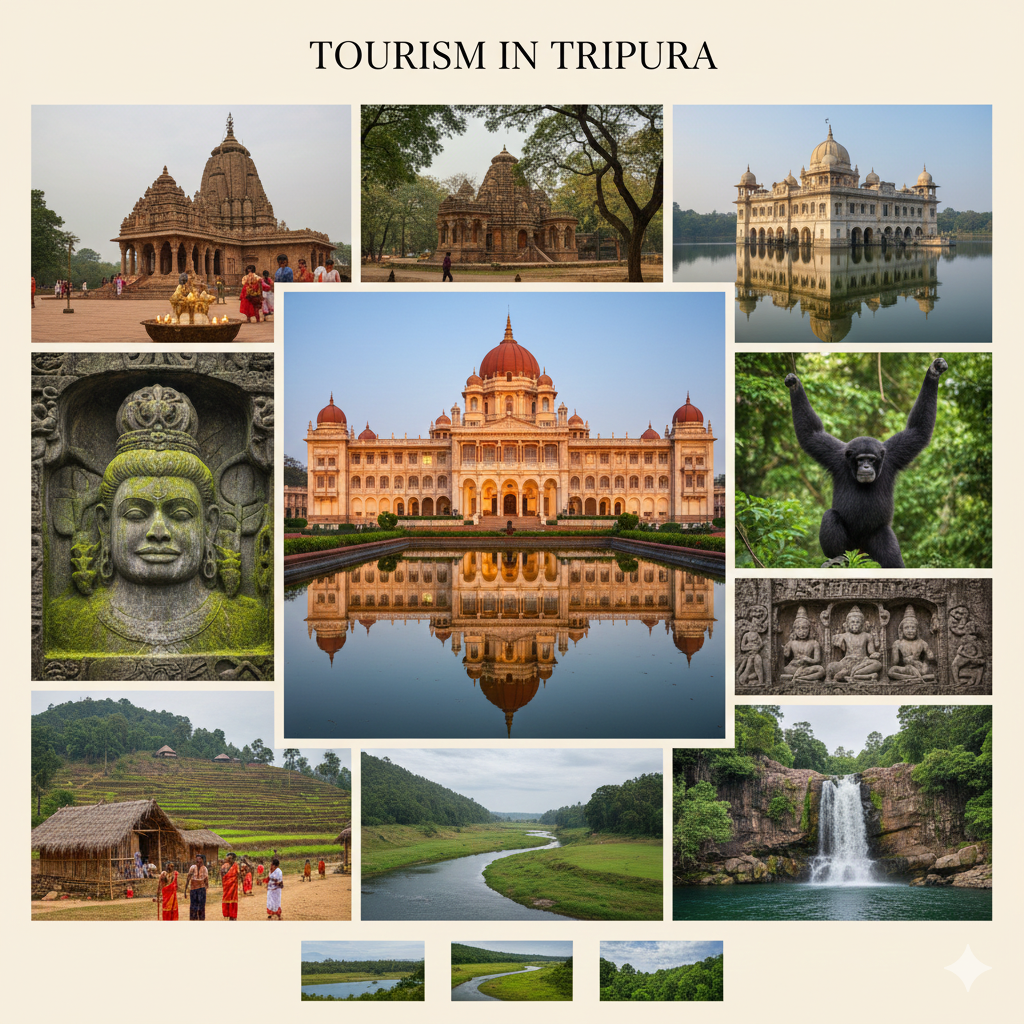
Tripura’s tourism represents a blend of natural beauty, cultural diversity, historical heritage and rich traditions. The state may be small in size but offers a unique travel experience through its hills, lakes, temples, wildlife sanctuaries and the untouched lifestyle of tribal communities. Below is an expanded overview of Tripura’s major tourist attractions.
Major Tourism Destinations
1. Agartala (Capital City)
Ujjayanta Palace
Once the royal residence of the Tripura kings, Ujjayanta Palace is now a museum showcasing royal traditions, art and culture. Its architecture makes it one of the most significant tourist landmarks in the state.
Jagannath Temple
A prominent Hindu pilgrimage site known for its unique architectural style and religious significance.
Laxman Temple
An ancient temple famous for its architectural beauty and historical importance.
2. Tripureshwari (Tripurasundari) Temple
Location: Udaipur
One of the 51 Shakti Peethas, this temple is dedicated to Goddess Tripurasundari. Thousands of devotees visit every year, especially during Diwali. It is both a religious and historic landmark.
3. Hoolock Gibbon (Hallock) Wildlife Sanctuary
An ideal destination for wildlife and bird lovers. The sanctuary is home to:
- Hoolock Gibbon (a rare primate species)
- Various bird and animal species
Surrounded by dense forests and greenery, it is a perfect spot for trekking and nature exploration.
4. Sepahijala Wildlife Sanctuary
Location: About 25 km from Agartala
Home to a wide variety of birds, animals and plants. A lake and botanical garden make it a great picnic spot for families and children.
5. Unakoti
An ancient archaeological site known for enormous rock-cut statues and petroglyphs, depicting forms of Shiva, Parvati and other deities.
According to legend, Unakoti (meaning 99,99,999) was once the resting place of gods, who turned to stone due to Shiva’s curse. This destination is ideal for History and archaeology lovers.
6. Neermahal
Location: Rudrasagar Lake
One of India’s few water palaces, Neermahal was built by Maharaja Bir Bikram Manikya as a summer retreat. Light-and-sound shows and boating facilities make it a vibrant tourist spot.
7. Jhoom Farming & Tribal Tourism
Tourists can explore traditional Jhoom (shifting) agriculture and experience the rich cultural lifestyle of tribal communities by visiting local villages.
8. Chabimura
Location: Along the Gomti River
Known for riverside rock carvings representing Hindu gods and goddesses. The peaceful natural surroundings make it an exceptional tourist experience.
9. Malangam Waterfalls
A scenic waterfall ideal for picnics with family and friends, offering a refreshing natural view.
Festivals and Cultural Events
- Garia Festival: The major tribal festival featuring traditional dance, music and rituals.
- Kharchi Puja: A unique festival dedicated to 14 deities of Tripura.
- Durga Puja & Diwali: Celebrated widely among the Bengali community.
Natural Attractions
Lakes and Rivers
Lakes like Rudrasagar, Gomti and Damboor attract tourists with boating, scenic views and serene environments.
Forests & Wildlife
Tripura’s lush green forests and rich biodiversity make it a paradise for nature lovers.
How to Reach Tripura
By Air
Maharaja Bir Bikram Airport (Agartala) connects Tripura with major Indian cities.
By Rail
Broad-gauge railway lines connect Tripura with various regions across India.
By Road
Well-maintained roads link the state with neighbouring states and Bangladesh.
Tourism Summary
Tripura’s tourism brings together nature, culture and history. Every destination offers a new perspective and a memorable experience. From temples and wildlife sanctuaries to peaceful lakes and cultural festivals, Tripura stands out as one of India’s most unique travel destinations.
Economy of Tripura
Tripura’s economy is primarily based on agriculture, forest resources, handicrafts, tourism and emerging industries. Despite its small geographical size, the state is rich in Natural Resources and skilled human labour. With steady development in horticulture, natural gas and IT services, Tripura’s economic landscape continues to evolve.
1. Agriculture and Horticulture
Importance
Agriculture forms the backbone of Tripura’s economy. Nearly 70% of the population is engaged in farming and related activities.
Major Crops
- Paddy (rice) — the main staple crop
- Maize, wheat, pulses
- Oilseeds: mustard, coconut, sunflower
Horticulture Produce
- Pineapple (Queen variety — famous in India and abroad)
- Rubber
- Bamboo
- Jackfruit
- Orange
- Banana
Jhoom Farming
Practised by tribal communities as a traditional shifting cultivation method. The government is gradually encouraging conversion from Jhoom to settled agriculture.
2. Rubber Production
Tripura is India’s second-largest rubber-producing state after Kerala. Rubber plantations and processing units significantly contribute to income and employment. Rubber goods are exported to various parts of India and international markets.
3. Forest Resources
With more than 60% forest cover, Tripura has abundant bamboo and cane resources.
Bamboo and Cane Industry
Bamboo is used in handicrafts, furniture and cottage industries. The state is also known for wooden products, resins and medicinal plants.
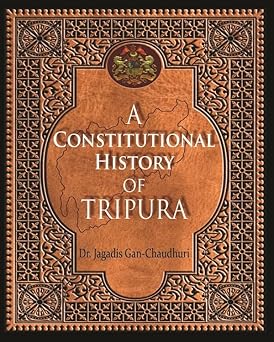
⭐ Recommended Study Resource
Explore a highly rated educational resource selected to support learning, revision, and exam preparation with trusted content and positive reader feedback.
4. Natural Gas
Tripura has sufficient natural gas reserves. ONGC and other companies use these reserves for electricity generation and industrial applications. Gas-based power plants provide significant revenue to the state.
5. Industry and Handicrafts
Handicrafts
Bamboo, cane and cotton-based handicrafts are signature products of Tripura. Traditional clothing, Tripuri bedsheets and decorative items are popular locally and internationally.
Small and Medium Industries (SME)
Sectors such as furniture, food processing and knitting are growing steadily. The Tripura industrial development Corporation (TIDC) supports entrepreneurs through various schemes.
6. Tourism as an Economic Driver
Tourism contributes significantly to the state’s revenue and job creation. Major attractions like Neermahal, Ujjayanta Palace, Tripureshwari Temple, Unakoti and Sepahijala Sanctuary draw domestic and international tourists.
7. Employment and Services Sector
Government services remain a major source of employment. Education, health services and IT-based jobs are growing areas. The establishment of IT Parks has created new opportunities.
8. Trade and Commerce
Trade with Bangladesh
Tripura’s proximity to Bangladesh supports cross-border trade, with several border trade centers operating actively.
Exports
Major export items include pineapple, bamboo products and rubber.
9. Government Economic Policies
- PM Mudra Yojana — financial support for small entrepreneurs
- National Bamboo Mission — incentives for bamboo-based industries
- Tripura Industrial Policy — encourages investment and industrial growth
- Integrated Rural Development — strengthens rural livelihoods
10. Challenges
- Under-utilisation of natural gas and bamboo resources
- Limited industrial and transport infrastructure
- Unemployment and poverty due to slow economic expansion
- Climate change affecting agriculture
Economy Summary
Agriculture, rubber, forests, natural gas and handicrafts form the core of Tripura’s economy. Tourism and industry are emerging growth sectors that contribute significantly to income and employment. Although challenges remain, government policies continue to promote economic development and a promising future for the state.
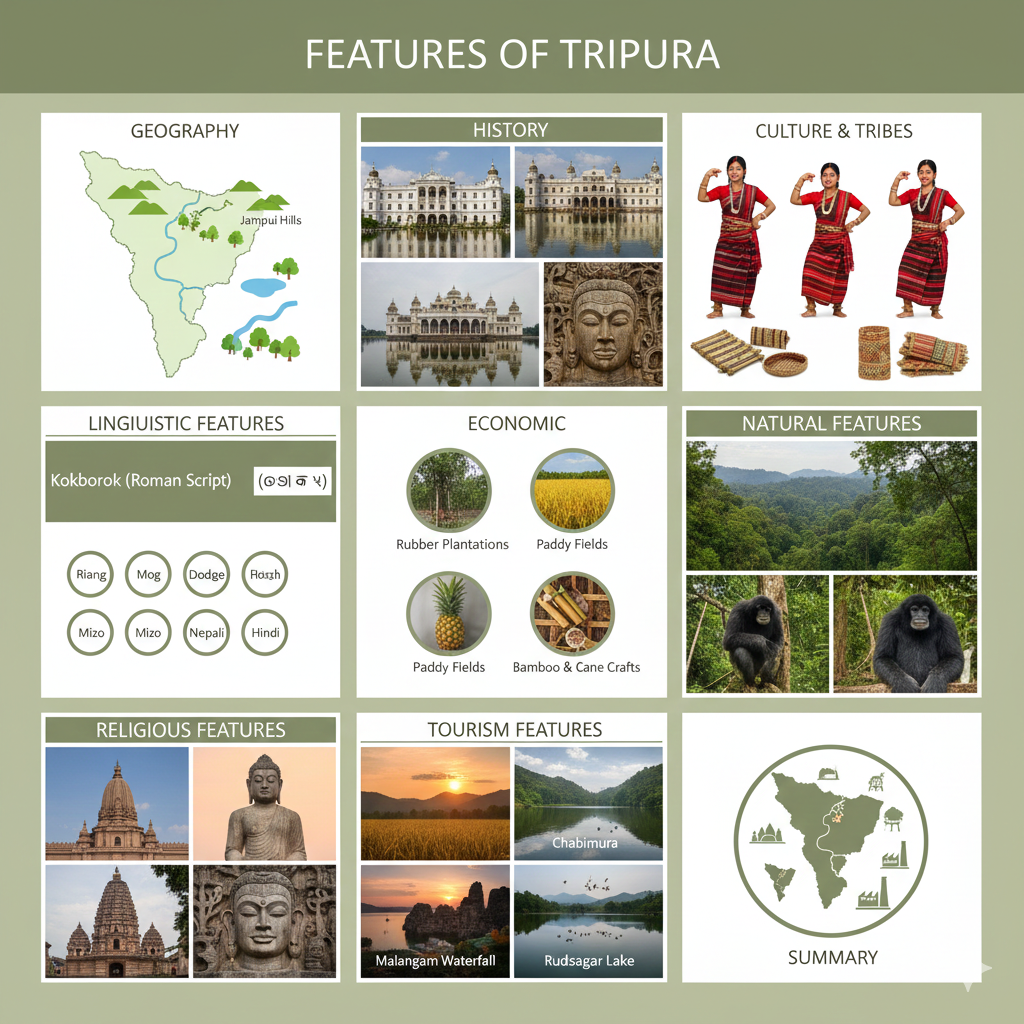
Features of Tripura
Tripura has unique characteristics that distinguish it from other Indian states. Its cultural, historical, geographical and natural diversity make it special. Tribal life, Natural Resources, historical importance and cultural heritage together shape the identity of Tripura. Below is an expanded overview of the major features.
1. Geographic Features
Location
Tripura is located in Northeast India and is surrounded on three sides by Bangladesh.
Natural Beauty
The state is known for its hills, greenery, lakes and dense forests, which are among its key natural features.
Climate
Tripura has a subtropical climate with hot summers, significant rainfall and pleasant winters.
Biodiversity
The state hosts many rare species of vegetation and wildlife, making it rich in ecological diversity.
2. Historical Features
Tripura’s history spans thousands of years. It was once referred to as the “Tripuri Empire,” ruled by the Manikya kings for nearly 500 years. Historical sites such as Ujjayanta Palace, Neermahal and Unakoti highlight the state’s glorious past.
3. Cultural and Social Features
Tribal Diversity
More than 19 tribes reside in Tripura, each with its own traditions, customs and languages. Tribal dances and music form an important part of the state’s cultural heritage.
Festivals
Major festivals include Garia Puja, Kharchi Puja, Durga Puja and Diwali, celebrated with great enthusiasm.
Traditional Dance and Music
Hojagiri and other tribal dances are valuable examples of Tripura’s folk art traditions.
4. Linguistic Features
Official Languages
Bengali and Kokborok (Tripuri language).
Linguistic Variety
Besides Bengali and Kokborok, Hindi, English and various tribal languages are spoken widely. Kokborok is especially significant as the language of the tribal communities.
5. Economic Features
Agriculture & Horticulture
Paddy, rubber and pineapple production form the backbone of the state's economy.
Rubber Industry
Tripura is India’s second-largest rubber producer after Kerala.
Natural Gas
The state has natural gas reserves which contribute to electricity production and industrial development.
Handicrafts
Bamboo, cane products and traditional clothing represent Tripura’s craftsmanship.
6. Natural Features
wildlife sanctuaries
Sanctuaries like Sepahijala and Hoolock Gibbon Reserve help protect Tripura’s biodiversity.
Lakes and Waterfalls
Rudrasagar Lake, Gomti River and other waterbodies maintain ecological balance.
Mountain Ranges
Hill ranges like Jampui Hills enhance the natural beauty of the state.
7. Religious and Spiritual Features
Tripureshwari Temple
One of the 51 Shakti Peethas and an important Hindu pilgrimage site.
Buddhist Culture
Many tribal communities follow Buddhist traditions, adding to the state's spiritual diversity.
Unakoti
Known for massive rock carvings and ancient statues of deities.
8. Tourism Features
Historical, religious and natural attractions make Tripura a major tourism hub. Popular sites include Neermahal, Ujjayanta Palace, Chabimura and Unakoti.
9. Climate and Environmental Features
Tripura’s climate supports agriculture and horticulture. Forests help maintain environmental stability and support medicinal plants and teak varieties.
10. Education and Culture
Tripura’s education level is comparatively better than many other states. Several programmes support tribal education. Traditional music and dance remain integral parts of the cultural identity.
Summary
Tripura’s features include cultural diversity, natural beauty, historical significance and economic activity. Its traditions, environmental stability and tourism attractions make it a unique state in India.
Agartala
Agartala is the capital and largest city of Tripura. It is the cultural, administrative and economic centre of the state. Situated near the Bangladesh border, Agartala plays an important role in Northeast India.
1. Geographic Situation
Location
Agartala is located in West Tripura district, just about 2 km from the Bangladesh border.
River
The Haora River flows near Agartala and is an important source of water supply.
Natural Beauty
The city is surrounded by green hills and dense forests.
2. Historical Importance
The name “Agartala” comes from the ancient Tripuri word “Agartala,” meaning “forest of reeds/bamboo.” The Manikya rulers developed it as an administrative centre, and in 1871 Maharaja Chandra Manikya declared it the capital of Tripura. The city also played an important role during India’s freedom struggle and the Bangladesh Liberation War.
3. Administrative and Political Importance
Agartala is the administrative hub of Tripura, hosting the Legislative Assembly, Secretariat and other key government offices. It is also central to regional politics and policy-making.
4. Culture and Society
Agartala is home to diverse ethnic communities. Languages spoken include Bengali, Kokborok and Hindi. The city showcases a blend of tribal and Bengali culture. Festivals like Durga Puja, Garia Puja and Kharchi Puja are celebrated with great enthusiasm.
5. Tourist Places in Agartala
Ujjayanta Palace
The former royal palace of Tripura’s kings, now a museum showcasing the state’s cultural heritage.

⭐ Recommended Study Resource
Explore a highly rated educational resource selected to support learning, revision, and exam preparation with trusted content and positive reader feedback.
Neermahal
A magnificent water palace located in Rudrasagar Lake near Agartala.
Tripureshwari Temple
Located around 55 km from Agartala, this Shakti Peeth is an important pilgrimage site.
Sepahijala Wildlife Sanctuary
Known for its diverse plant and animal species.
Chabimura
Famous for ancient rock carvings and scenic river views.
6. Education
Agartala is the educational hub of Tripura. It hosts Tripura University and several government and private institutions. Medical, engineering and general colleges attract students from across the region.
7. Economy
Agartala serves as the economic centre of Tripura, with major markets for agricultural products, handicrafts and rubber. Its proximity to Bangladesh boosts trade. The service sector and small industries also provide employment opportunities.
8. Transportation
Roadways
Agartala is well connected by road to Guwahati and other northeastern states via National Highway-8.
Railways
Agartala Railway Station is an important node in India’s rail network and a major station in Northeast India.
Airways
Maharaja Bir Bikram Airport connects Agartala with major cities across India.
Border Trade
The Agartala–Akhaura border acts as an important international trade point between India and Bangladesh.
9. Environmental Features
The city promotes greenery through various government initiatives. The Haora River and nearby lakes help maintain the local climate and ecological balance.
10. Modern Development
Agartala is witnessing rapid development with IT Parks, start-up growth and Smart City initiatives. Improvements in roads, electricity and water supply are ongoing.
Summary
Agartala is the cultural and historical heart of Tripura. Its natural beauty, rich history and modern development make it an important and attractive city in Northeast India.