
Introduction
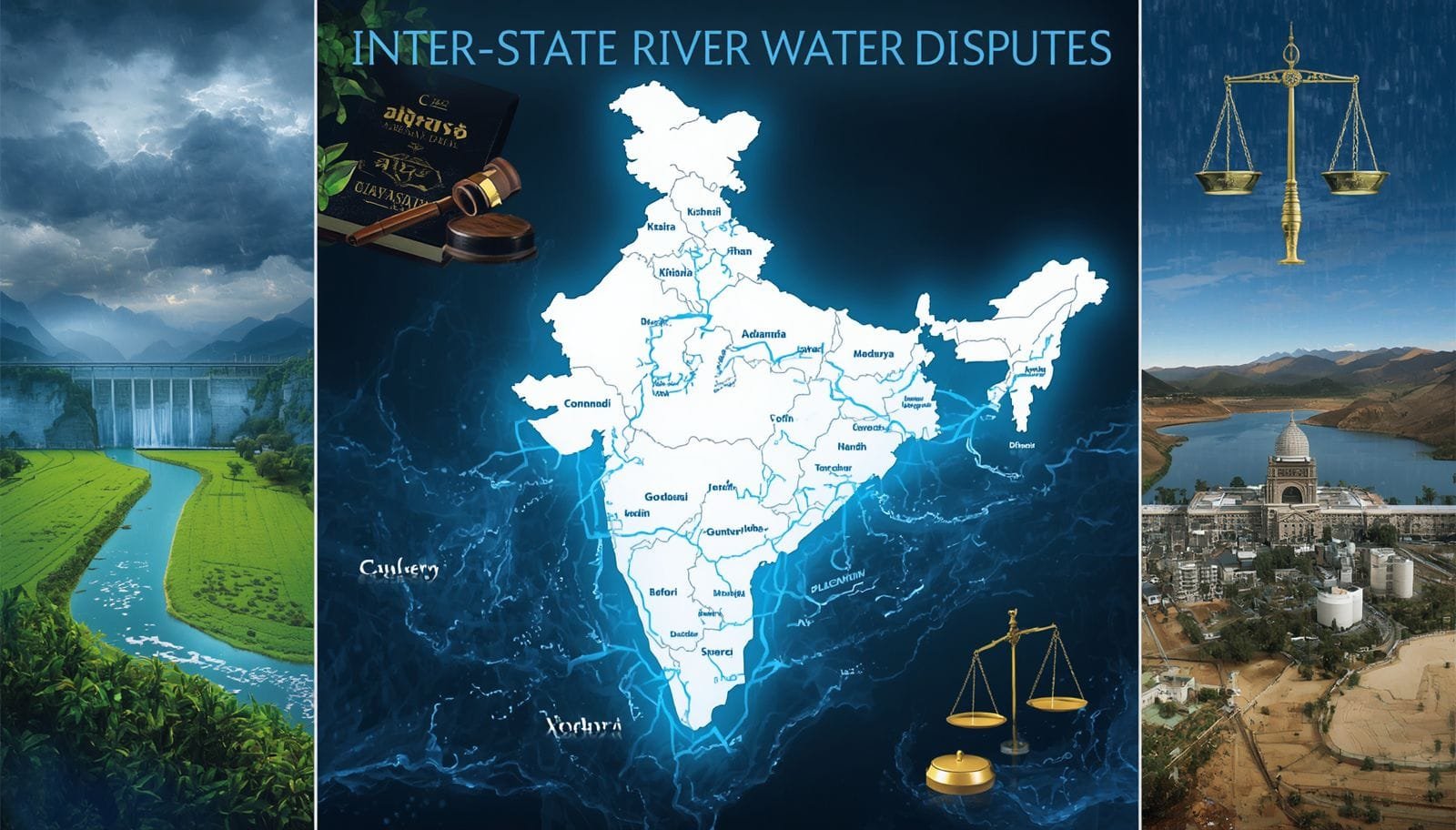
Water disputes in India (Inter-State River Water Disputes) are among the most significant issues related to the country's federal structure, water resource management, and sustainable development. Since most major rivers in India flow through more than one state, disagreements frequently arise over the allocation and utilisation of river water for irrigation, drinking water supply, hydropower generation, industrial use, and ecological conservation. Rapid population growth, urbanisation, climate change, and increasing water demand have further intensified these disputes.
The Constitution of India, under Article 262, empowers Parliament to enact laws for the adjudication of disputes relating to inter-state rivers and river valleys. Accordingly, the Inter-State River Water Disputes Act, 1956 was enacted to establish tribunals for resolving such disputes. In addition, the Central Government, the Supreme Court of India, and various river management authorities play crucial roles in ensuring equitable water sharing among states.
Some of the most prominent water disputes in India include the Cauvery, Krishna, Mahanadi, Mahadayi (Mandovi), Ravi-Beas, Sutlej-Yamuna Link (SYL), and Yamuna River Water Sharing disputes. These conflicts not only affect the concerned states but also have far-reaching consequences for agriculture, food security, industrial growth, environmental sustainability, and the livelihoods of millions of people.
This article provides a comprehensive understanding of Water Disputes in India, including their meaning, causes, constitutional provisions, major inter-state river disputes, dispute resolution mechanisms, challenges, recent developments, and possible solutions from both governance and examination perspectives.
What are Water Disputes in India?
Water Disputes in India (Inter-State River Water Disputes) refer to conflicts that arise between two or more states over the sharing, utilisation, management, or control of the waters of a common river or river basin. Since most of India's major rivers, such as the Ganga, Yamuna, Cauvery, Krishna, Godavari, Mahanadi, and Ravi, flow through multiple states, disagreements over the equitable distribution of river water are common.
These disputes generally emerge when an upstream state seeks to utilise a larger share of river water for irrigation, drinking water supply, hydropower generation, industrial development, or reservoir construction, while downstream states fear a reduction in water availability. Factors such as increasing population, rapid urbanisation, climate change, irregular monsoon patterns, and rising water demand have further intensified these conflicts.
An Inter-State River Water Dispute is a disagreement between two or more states regarding the allocation, utilisation, regulation, or management of the waters of an inter-state river or river valley.
What Issues Do Water Disputes Involve?
- Sharing of river water among states
- Water allocation for irrigation
- Drinking water supply
- Hydropower generation projects
- Construction and operation of dams and reservoirs
- Protection of environmental flows and river ecosystems
- water management during droughts and floods
Why Are Water Disputes Important?
Water is a vital resource for agriculture, industry, domestic consumption, and power generation. As India is home to one of the world's largest populations and has a predominantly agrarian economy, equitable distribution of river water is essential for food security, economic growth, environmental sustainability, and social stability. Therefore, water disputes are not merely legal or administrative issues but are closely linked to India's federal structure and the principle of cooperative federalism.
- Cauvery Water Dispute – Karnataka, Tamil Nadu, Kerala, and Puducherry.
- Krishna Water Dispute – Maharashtra, Karnataka, Telangana, and Andhra Pradesh.
- Mahanadi Water Dispute – Chhattisgarh and Odisha.
- Mahadayi (Mandovi) Water Dispute – Goa, Karnataka, and Maharashtra.
- Sutlej-Yamuna Link (SYL) Dispute – Punjab and Haryana.
Major Causes of Inter-State River Water Disputes in India
Inter-State River Water Disputes in India arise due to a combination of geographical, climatic, demographic, economic, and political factors.
1. Uneven Distribution of Water Resources
India's water resources are unevenly distributed across different regions. While some river basins receive abundant rainfall and have surplus water, others face chronic water shortages. This regional imbalance often leads to conflicts over water sharing between upstream and downstream states.
2. Growing Population and Water Demand
Rapid population growth has significantly increased the demand for drinking water, irrigation, sanitation, and industrial use. As the demand for freshwater continues to rise while river flows remain limited, competition among states has become more intense.
3. Agricultural Dependence on River Water
Agriculture accounts for nearly 80% of India's freshwater consumption. States often seek a larger share of river water to expand irrigation facilities, resulting in disputes with neighbouring states that depend on the same river system.
4. Construction of Dams and Reservoirs
The construction of dams, reservoirs, and diversion projects by upstream states can reduce the natural flow of rivers to downstream regions. This frequently becomes a major source of disagreement between the concerned states.
5. Climate Change and Irregular Monsoons
Climate change has altered rainfall patterns, increased the frequency of droughts and floods, and reduced the predictability of river flows. During years of deficient rainfall, competition over limited water resources becomes more severe.
6. Political and Regional Interests
Water is a politically sensitive issue in India. State governments often adopt region-specific positions to protect local interests, particularly during elections. Political considerations sometimes delay negotiations and hinder long-term solutions.
7. Absence of Effective River Basin Management
Many river basins lack integrated planning and coordinated management among the riparian states. Without a comprehensive basin-wide approach, disputes over water allocation, reservoir operations, and conservation become more frequent.
8. Industrialisation and Urbanisation
Rapid industrial growth and urban expansion have increased the demand for freshwater. Large metropolitan areas and industrial corridors require substantial quantities of water, placing additional pressure on shared river systems.
9. Groundwater Depletion
Excessive extraction of groundwater has reduced the availability of alternative water sources. As groundwater reserves decline, states become increasingly dependent on surface water from rivers, intensifying inter-state water disputes.
10. Legal and Administrative Challenges
Although India has constitutional provisions and specialised tribunals for resolving river water disputes, delays in tribunal awards, implementation issues, and prolonged litigation often prevent timely settlement of conflicts.
- Uneven distribution of water resources
- Rapid population growth
- Increasing irrigation requirements
- Construction of dams and reservoirs
- Climate change and irregular rainfall
- Political and regional interests
- Lack of integrated river basin management
- Industrialisation and urbanisation
- Groundwater depletion
- Legal and administrative delays

Major Inter-State Water Disputes in India
India has witnessed several inter-state river water disputes due to the sharing of rivers that flow across multiple states. These disputes primarily involve issues related to water allocation, irrigation, drinking water supply, hydropower generation, and reservoir management. To resolve such conflicts, the Government of India has constituted various tribunals under the Inter-State River Water Disputes Act, 1956.
Most major river water disputes in India involve interstate rivers whose basins extend across two or more states, making equitable water sharing a significant challenge.
1. Cauvery Water Dispute
The Cauvery Water Dispute is one of India's oldest and most prominent river water disputes. It mainly involves the states of Karnataka and Tamil Nadu, while Kerala and Puducherry are also stakeholders. The dispute concerns the sharing of Cauvery River water for irrigation, drinking water, and agriculture.
- States Involved: Karnataka, Tamil Nadu, Kerala, Puducherry
- River: Cauvery
- Main Issue: Allocation of river water during normal and drought years.
- Present Status: Managed under the Cauvery water management Authority (CWMA) following Supreme Court directions.
2. Krishna Water Dispute
The Krishna River dispute revolves around the distribution of water among Maharashtra, Karnataka, Telangana, and Andhra Pradesh. The dispute intensified after the formation of Telangana in 2014, leading to fresh demands for water allocation.
- States Involved: Maharashtra, Karnataka, Telangana, Andhra Pradesh
- River: Krishna
- Main Issue: Sharing of river water for irrigation and hydropower projects.
- Tribunal: Krishna Water Disputes Tribunal (KWDT).
3. Godavari Water Dispute
The Godavari River, India's second-longest river, flows through several states. Disputes mainly relate to water utilisation, irrigation projects, and reservoir development among the basin states.
- States Involved: Maharashtra, Telangana, Andhra Pradesh, Chhattisgarh, Odisha
- River: Godavari
- Main Issue: Water utilisation and irrigation projects.
- Status: Largely resolved through tribunal awards and interstate agreements.
4. Ravi-Beas Water Dispute
The Ravi-Beas dispute concerns the allocation of water from the Ravi and Beas rivers among the northwestern states. The issue has remained politically and legally sensitive for several decades.
- States Involved: Punjab, Haryana, Rajasthan
- Rivers: Ravi and Beas
- Main Issue: Distribution of river water among beneficiary states.
5. Sutlej-Yamuna Link (SYL) Dispute
The Sutlej-Yamuna Link (SYL) Canal dispute is closely associated with the Ravi-Beas water sharing issue. The canal was proposed to transfer surplus water from Punjab to Haryana, but its construction has remained incomplete due to prolonged legal and political disagreements.
- States Involved: Punjab and Haryana
- Main Issue: Construction and operation of the SYL Canal.
- Current Status: The matter continues to be monitored by the Supreme Court.
6. Mahadayi (Mandovi) Water Dispute
The Mahadayi River dispute concerns the diversion of water from the Mahadayi river basin. Goa opposes Karnataka's proposal to divert water, citing ecological and drinking water concerns.
- States Involved: Goa, Karnataka, Maharashtra
- River: Mahadayi (Mandovi)
- Main Issue: Diversion of river water for drinking water projects.
7. Mahanadi Water Dispute
The Mahanadi dispute arose due to the construction of barrages and reservoirs by Chhattisgarh, which Odisha argues has reduced downstream water availability, especially during the dry season.
- States Involved: Chhattisgarh and Odisha
- River: Mahanadi
- Main Issue: Construction of dams and equitable sharing of river water.
8. Vansadhara Water Dispute
The Vansadhara dispute involves the sharing of river water between Andhra Pradesh and Odisha. The disagreement mainly concerns the construction of barrages and diversion structures for irrigation purposes.
- States Involved: Andhra Pradesh and Odisha
- River: Vansadhara
- Main Issue: Barrage construction and water diversion.
9. Yamuna Water Dispute
The Yamuna River water sharing dispute involves several northern Indian states. Water allocation is governed by interstate agreements, but increasing water demand and declining river flows continue to create challenges.
- States Involved: Haryana, Uttar Pradesh, Rajasthan, Delhi, Himachal Pradesh
- River: Yamuna
- Main Issue: Allocation of river water for drinking, irrigation, and domestic use.
- Cauvery – Karnataka, Tamil Nadu, Kerala, Puducherry
- Krishna – Maharashtra, Karnataka, Telangana, Andhra Pradesh
- Godavari – Maharashtra, Telangana, Andhra Pradesh, Chhattisgarh, Odisha
- Ravi-Beas – Punjab, Haryana, Rajasthan
- SYL Canal – Punjab and Haryana
- Mahadayi – Goa, Karnataka, Maharashtra
- Mahanadi – Chhattisgarh and Odisha
- Vansadhara – Andhra Pradesh and Odisha
- Yamuna – Haryana, Uttar Pradesh, Rajasthan, Delhi, Himachal Pradesh
Constitutional Provisions Related to Water Disputes in India
The Constitution of India provides a comprehensive legal framework for the management and resolution of inter-state river water disputes. Since water is a vital natural resource shared by multiple states, the Constitution clearly defines the legislative powers of both the Union and the States and establishes mechanisms for resolving disputes arising from the use of inter-state rivers.
The constitutional framework governing water disputes is primarily based on Article 262, Entry 17 of the State List, and Entry 56 of the Union List under the Seventh Schedule of the Constitution.
1. Article 262 of the Constitution
Article 262 is the most important constitutional provision concerning inter-state river water disputes. It empowers Parliament to enact laws for the adjudication of disputes relating to the waters of inter-state rivers and river valleys.
- Empowers Parliament to legislate on inter-state river water disputes.
- Allows Parliament to establish tribunals for dispute resolution.
- Authorises Parliament to exclude the jurisdiction of the Supreme Court and other courts in matters covered under such laws.
- Provides a constitutional mechanism for peaceful dispute resolution.
- Promotes cooperative federalism among states.
- Reduces prolonged judicial intervention in technical water-sharing issues.
2. Entry 17 – State List (List II)
Under Entry 17 of the State List, state governments have the power to legislate on matters related to water supply, irrigation, canals, drainage, embankments, water storage, and water power within their respective territories.
However, this power is subject to the provisions of Entry 56 of the Union List, particularly when an inter-state river or river valley is involved.
3. Entry 56 – Union List (List I)
Entry 56 of the Union List empowers Parliament to regulate and develop inter-state rivers and river valleys whenever such regulation is declared to be in the public interest.
- Regulation of inter-state rivers.
- Development of river valleys in the national interest.
- Coordination among states for efficient water management.
4. Seventh Schedule of the Constitution
The Seventh Schedule distributes legislative powers between the Union and the States through the Union List, State List, and Concurrent List. Water is primarily a State subject, but inter-state rivers fall under the regulatory authority of the Union whenever national interest is involved.
5. Role of the Supreme Court
Although Parliament may restrict the jurisdiction of courts under Article 262 through legislation, the Supreme Court has continued to play an important role in interpreting tribunal awards, ensuring their implementation, and safeguarding constitutional principles in several major water disputes.
6. Cooperative Federalism
The constitutional provisions encourage states and the Union Government to resolve water disputes through consultation, negotiation, tribunals, and institutional mechanisms rather than prolonged political confrontation. This reflects the principle of Cooperative Federalism, which is essential for sustainable water governance in India.
- Article 262 – Adjudication of inter-state river water disputes.
- Entry 17 (State List) – Water, irrigation, canals, drainage, water storage, and water power.
- Entry 56 (Union List) – Regulation and development of inter-state rivers and river valleys.
- Seventh Schedule – Distribution of legislative powers between the Union and the States.
| Constitutional Provision | Purpose |
|---|---|
| Article 262 | Settlement of inter-state river water disputes. |
| Entry 17 (State List) | State control over water, irrigation, and related matters. |
| Entry 56 (Union List) | Union regulation and development of inter-state rivers. |
| Seventh Schedule | Division of legislative powers between the Union and the States. |
Inter-State River Water Disputes Act, 1956
The Inter-State River Water Disputes Act, 1956 (ISRWD Act) is the principal legislation enacted by the Parliament of India to provide a legal mechanism for the adjudication and resolution of disputes relating to the waters of inter-state rivers and river valleys. The Act was enacted under the powers granted by Article 262 of the Constitution of India, which authorises Parliament to establish procedures for resolving water disputes between states.
The primary objective of the Act is to ensure the fair, equitable, and peaceful sharing of river water among states while reducing prolonged political conflicts and promoting cooperative federalism.
- Act Name: Inter-State River Water Disputes Act, 1956
- Enacted: 1956
- Constitutional Basis: Article 262 of the Constitution of India
- Administered By: Ministry of Jal Shakti
- Purpose: Settlement of disputes relating to inter-state rivers and river valleys.
Objectives of the Act
- To provide a legal framework for resolving inter-state river water disputes.
- To ensure equitable distribution and utilisation of river water.
- To establish specialised tribunals for adjudicating water disputes.
- To promote cooperation among states in water resource management.
- To minimise political conflicts and ensure sustainable use of Water Resources.
Key Features of the Act
- Provides for the establishment of a Water Disputes Tribunal whenever negotiations between states fail.
- Each tribunal is constituted by the Central Government.
- The tribunal examines technical, legal, hydrological, and environmental aspects before delivering its award.
- The tribunal's decision (Award) is published by the Central Government and becomes binding on the concerned states.
- The Act aims to provide an institutional mechanism instead of resolving disputes solely through political negotiations.
Procedure for Settlement of Disputes
- A dispute arises between two or more states regarding an inter-state river.
- The concerned state submits a request to the Central Government.
- The Central Government first attempts to resolve the dispute through negotiations.
- If negotiations fail, a Water Disputes Tribunal is constituted under the Act.
- The tribunal hears all concerned parties, examines evidence, and delivers its award.
- The award is notified by the Central Government and becomes binding on the concerned states.
Major Tribunals Constituted Under the Act
| Tribunal | River | States Involved |
|---|---|---|
| Cauvery Water Disputes Tribunal | Cauvery | Karnataka, Tamil Nadu, Kerala, Puducherry |
| Krishna Water Disputes Tribunal | Krishna | Maharashtra, Karnataka, Telangana, Andhra Pradesh |
| Godavari Water Disputes Tribunal | Godavari | Maharashtra, Telangana, Andhra Pradesh, Chhattisgarh, Odisha |
| Mahanadi Water Disputes Tribunal | Mahanadi | Chhattisgarh and Odisha |
| Mahadayi Water Disputes Tribunal | Mahadayi (Mandovi) | Goa, Karnataka, Maharashtra |
| Vansadhara Water Disputes Tribunal | Vansadhara | Andhra Pradesh and Odisha |
Challenges in Implementation
- Delay in constituting tribunals.
- Lengthy adjudication process.
- Delay in implementation of tribunal awards.
- Political disagreements among states.
- Changing water availability due to climate change.
Recent Reforms
To improve the efficiency of dispute resolution, the Central Government proposed amendments to the Act for establishing a single permanent tribunal with multiple benches, reducing delays, and creating a structured dispute resolution mechanism supported by a dedicated data and information system.
- Provides a constitutional and legal mechanism for resolving water disputes.
- Promotes equitable sharing of river water.
- Strengthens cooperative federalism.
- Supports sustainable water resource management.
- Reduces prolonged inter-state conflicts.
- Enacted in 1956.
- Based on Article 262 of the Constitution.
- Provides for the constitution of Water Disputes Tribunals.
- Tribunal awards are binding after notification by the Central Government.
- Recent reform proposal aims to establish a Single Permanent Tribunal for faster dispute resolution.
River Boards Act, 1956
The River Boards Act, 1956 is an important legislation enacted by the Parliament of India to promote the integrated development and regulation of inter-state rivers and river valleys. The Act was enacted under the powers conferred by Entry 56 of the Union List (List I) of the Seventh Schedule of the Constitution, enabling the Central Government to establish River Boards for the effective management of shared river basins.
Unlike the Inter-State River Water Disputes Act, 1956, which focuses on resolving water disputes, the River Boards Act aims to facilitate coordinated planning, development, conservation, and utilisation of river Water Resources among the states sharing a river basin.
- Act Name: River Boards Act, 1956
- Year of Enactment: 1956
- Constitutional Basis: Entry 56, Union List (Seventh Schedule)
- Objective: Integrated development and regulation of inter-state rivers and river valleys.
- Administered By: Ministry of Jal Shakti
Objectives of the River Boards Act
- To promote integrated river basin planning.
- To encourage cooperation among states sharing a river.
- To ensure efficient utilisation of water resources.
- To advise governments on irrigation, flood control, hydropower, navigation, and water conservation.
- To support sustainable development of river valleys.
Key Features of the Act
- The Central Government may establish a River Board on the request of one or more state governments.
- Each River Board functions as an advisory body rather than a regulatory authority.
- The Board consists of experts in engineering, hydrology, irrigation, flood management, agriculture, navigation, and environmental conservation.
- It provides technical advice on the planning, development, and management of inter-state river basins.
- The recommendations of the Board are not legally binding on the states.
Functions of River Boards
- Preparation of integrated river basin development plans.
- Advising on irrigation and water resource management.
- Flood control and drought mitigation planning.
- Promotion of soil conservation and watershed management.
- Development of hydropower and navigation projects.
- Collection and sharing of hydrological data among states.
- Encouraging sustainable and equitable utilisation of river water.
Limitations of the Act
- No River Board has been formally established under the Act since its enactment.
- The Act provides only advisory powers and does not grant enforcement authority.
- Its recommendations are not binding on the participating states.
- Political disagreements among states often limit effective implementation.
- It does not provide a mechanism for adjudicating water disputes.
Difference Between River Boards Act, 1956 and Inter-State River Water Disputes Act, 1956
| Basis | River Boards Act, 1956 | Inter-State River Water Disputes Act, 1956 |
|---|---|---|
| Purpose | Integrated development and management of river basins. | Settlement of inter-state river water disputes. |
| Nature | Advisory | Adjudicatory |
| Authority | River Boards | Water Disputes Tribunals |
| Legal Status | Recommendations are not binding. | Tribunal awards are binding after notification. |
| Constitutional Basis | Entry 56, Union List | Article 262 of the Constitution |
Significance of the Act
Although no River Board has been constituted under this Act, it remains an important legislative framework for promoting cooperative river basin management. The Act reflects the importance of coordinated planning, scientific water management, and inter-state cooperation for achieving long-term water security and sustainable development in India.
- Encourages integrated river basin management.
- Promotes coordination between the Union and State Governments.
- Supports flood control, irrigation, and hydropower planning.
- Facilitates scientific and sustainable utilisation of water resources.
- Strengthens cooperative federalism in water governance.
- Enacted in 1956.
- Based on Entry 56 of the Union List.
- Provides for the establishment of River Boards as advisory bodies.
- No River Board has been constituted under this Act so far.
- Focuses on river basin development, not dispute adjudication.
Role of the Ministry of Jal Shakti
The Ministry of Jal Shakti is the apex government body responsible for the development, conservation, management, and sustainable utilization of India's Water Resources. Established in May 2019 by merging the Ministry of Water Resources, River Development and Ganga Rejuvenation with the Ministry of Drinking Water and Sanitation, the ministry plays a vital role in ensuring water security and resolving inter-state river water disputes.
- Established: May 2019
- Formed By: Merger of two ministries
- Primary Objective: Integrated management of India's water resources.
- Key Mission: Water conservation, river basin management, and ensuring safe drinking water for all.
Major Functions of the Ministry of Jal Shakti
- Formulates national policies for water resource management.
- Coordinates with state governments on inter-state river water issues.
- Facilitates the resolution of inter-state river water disputes.
- Implements river conservation and rejuvenation programmes.
- Promotes sustainable groundwater management.
- Supports irrigation development and water-use efficiency.
- Ensures safe and adequate drinking water supply across the country.
- Develops strategies for drought mitigation and flood management.
Role in Resolving Water Disputes
The Ministry acts as the coordinating authority between the Union Government and the concerned states whenever an inter-state river water dispute arises. It encourages negotiations among the states before recommending the constitution of a tribunal under the Inter-State River Water Disputes Act, 1956. The Ministry also assists in implementing tribunal awards and monitors compliance with water-sharing arrangements.
- Facilitates dialogue and negotiations among states.
- Recommends the constitution of Water Disputes Tribunals.
- Monitors implementation of tribunal awards.
- Provides technical and hydrological data for dispute resolution.
- Coordinates with river management authorities and state agencies.
Major Programmes and Initiatives
| Programme | Objective |
|---|---|
| Jal Jeevan Mission (JJM) | Providing Functional Household Tap Connections (FHTCs) to every rural household. |
| Namami Gange Programme | Conservation and rejuvenation of the River Ganga. |
| Atal Bhujal Yojana (Atal Jal) | Sustainable groundwater management through community participation. |
| National Water Mission | Promoting water conservation and improving water-use efficiency. |
| Pradhan Mantri Krishi Sinchayee Yojana (PMKSY) | Enhancing irrigation coverage and improving water efficiency in agriculture. |
Importance of the Ministry
- Ensures integrated water resources management.
- Promotes cooperative federalism in water governance.
- Supports sustainable development and climate resilience.
- Improves water security for agriculture, industry, and households.
- Strengthens river conservation and groundwater management.
- Acts as the nodal ministry for water governance in India.
- Coordinates inter-state river water management.
- Implements major national water conservation programmes.
- Supports equitable and sustainable utilization of water resources.
- Plays a crucial role in achieving long-term water security.
- Established in 2019.
- Created by merging two separate ministries.
- Nodal ministry for water resource management in India.
- Responsible for coordinating inter-state river water dispute resolution.
- Implements flagship programmes such as Jal Jeevan Mission and Namami Gange Programme.
River Water Disputes Tribunal
A River Water Disputes Tribunal is a specialized quasi-judicial body established by the Central Government under the Inter-State River Water Disputes Act, 1956 to adjudicate disputes relating to the sharing and utilization of waters of inter-state rivers and river valleys. These tribunals play a crucial role in ensuring the equitable distribution of river water and maintaining cooperative federalism among the states.
Tribunals are constituted only when negotiations between the concerned states fail to resolve the dispute. They examine legal, technical, hydrological, environmental, and socio-economic aspects before delivering their final award.
- Established Under: Inter-State River Water Disputes Act, 1956
- Constitutional Basis: Article 262 of the Constitution of India
- Constituted By: Central Government
- Nature: Quasi-Judicial Body
- Purpose: Adjudication of inter-state river water disputes.
Composition of the Tribunal
Each tribunal consists of a Chairperson and other members who are serving or retired judges of the Supreme Court of India or the High Courts. The members are appointed by the Central Government to ensure impartial and independent adjudication.
- Chairperson (Serving or Retired Supreme Court Judge)
- Two or more Judicial Members
- Technical experts may assist the tribunal in hydrology, engineering, and water management.
Functions of the Tribunal
- Adjudicates disputes relating to inter-state rivers and river valleys.
- Examines hydrological, legal, environmental, and technical evidence.
- Determines the equitable allocation of river water among states.
- Issues binding awards after completing the adjudication process.
- Helps reduce political conflicts through an institutional dispute-resolution mechanism.
Procedure for Adjudication
- A dispute arises between two or more states regarding an inter-state river.
- The concerned state submits a request to the Central Government.
- The Central Government first attempts to resolve the issue through negotiations.
- If negotiations fail, a River Water Disputes Tribunal is constituted.
- The tribunal examines evidence, hears all parties, and conducts technical assessments.
- The tribunal delivers its final award, which is notified by the Central Government.
Major River Water Disputes Tribunals in India
| Tribunal | River | States Involved |
|---|---|---|
| Cauvery Water Disputes Tribunal | Cauvery | Karnataka, Tamil Nadu, Kerala, Puducherry |
| Krishna Water Disputes Tribunal | Krishna | Maharashtra, Karnataka, Telangana, Andhra Pradesh |
| Godavari Water Disputes Tribunal | Godavari | Maharashtra, Telangana, Andhra Pradesh, Chhattisgarh, Odisha |
| Mahanadi Water Disputes Tribunal | Mahanadi | Chhattisgarh and Odisha |
| Mahadayi Water Disputes Tribunal | Mahadayi (Mandovi) | Goa, Karnataka, Maharashtra |
| Vansadhara Water Disputes Tribunal | Vansadhara | Andhra Pradesh and Odisha |
Challenges Faced by the Tribunals
- Delay in the constitution of tribunals.
- Lengthy adjudication process.
- Implementation challenges after tribunal awards.
- Political disagreements among states.
- Changing hydrological conditions due to climate change.
Recent Reforms
To improve the efficiency of dispute resolution, the Government of India has proposed amendments to establish a Single Permanent Inter-State River Water Disputes Tribunal with multiple regional benches. The proposed reform aims to reduce delays, improve coordination, and ensure faster disposal of water disputes.
- Provide an independent and impartial dispute-resolution mechanism.
- Promote equitable sharing of river water.
- Strengthen cooperative federalism.
- Reduce prolonged inter-state conflicts.
- Support sustainable management of Water Resources.
- Established under the Inter-State River Water Disputes Act, 1956.
- Constitutional basis is Article 262.
- Tribunals are constituted by the Central Government.
- Tribunal awards become binding after notification by the Central Government.
- A proposal exists to establish a Single Permanent Tribunal with multiple benches for quicker dispute resolution.
Impact of Water Disputes
Inter-state water disputes have far-reaching consequences that extend beyond the sharing of river water. These disputes affect agriculture, the economy, industries, drinking water supply, environmental sustainability, governance, and social harmony. Prolonged conflicts over water allocation often delay development projects and weaken cooperative federalism, making effective water resource management more challenging.
Water disputes are not merely legal or political issues—they have significant social, economic, environmental, and developmental implications for both the states involved and the nation as a whole.
1. Impact on Agriculture
Agriculture is the largest consumer of freshwater in India. Delays or reductions in water allocation can adversely affect irrigation, crop production, and farmers' livelihoods, particularly during drought years.
- Reduced irrigation facilities.
- Lower agricultural productivity.
- Crop failures during water shortages.
- Decline in farmers' income.
2. Impact on Drinking Water Supply
Water disputes often disrupt the availability of safe drinking water in cities and rural areas. Urban centres dependent on inter-state rivers may face water shortages during prolonged disputes or periods of low river flow.
- Shortage of drinking water.
- Increased dependence on groundwater.
- Higher cost of water supply.
3. Economic Impact
Unresolved water disputes can delay infrastructure projects, reduce industrial productivity, and discourage investment. They also increase the financial burden on governments due to prolonged legal proceedings and emergency water management measures.
- Loss of industrial output.
- Reduced economic growth.
- Increased public expenditure.
- Delayed infrastructure development.
4. Environmental Impact
Excessive extraction and diversion of river water can damage aquatic ecosystems, reduce environmental flows, degrade wetlands, and threaten biodiversity. Climate change further amplifies these environmental challenges.
- Degradation of river ecosystems.
- Loss of aquatic biodiversity.
- Declining groundwater recharge.
- Reduced environmental flow.
5. Political and Administrative Impact
Water disputes frequently become politically sensitive issues, leading to disagreements between state governments and the Union Government. They may also delay policy implementation and strain inter-governmental relations.
- Inter-state political tensions.
- Delay in policy implementation.
- Administrative challenges in water governance.
6. Social Impact
Prolonged disputes can trigger protests, public demonstrations, and regional tensions. In some cases, they may affect social harmony and the livelihoods of communities dependent on shared river systems.
- Public protests and demonstrations.
- Regional conflicts and social unrest.
- Migration due to water scarcity.
7. Impact on hydropower and Energy Production
River water disputes can affect the operation of dams and hydropower projects, leading to reduced electricity generation and challenges in energy planning for the affected states.
- Reduced hydropower generation.
- Operational challenges for reservoirs.
- Energy supply disruptions.
8. Impact on Cooperative Federalism
Frequent disputes may weaken the spirit of cooperative federalism by reducing trust and collaboration among states. At the same time, successful negotiations and tribunal decisions can strengthen institutional cooperation and promote better water governance.
- Agricultural losses and reduced crop productivity.
- Drinking water shortages.
- Economic slowdown and delayed investments.
- Environmental degradation and biodiversity loss.
- Political tensions between states.
- Social unrest and regional conflicts.
- Reduced hydropower generation.
- Challenges to cooperative federalism.
| Sector | Impact of Water Disputes |
|---|---|
| Agriculture | Reduced irrigation, crop losses, and lower farm income. |
| Drinking Water | Water shortages and higher supply costs. |
| Economy | Lower industrial productivity and delayed investments. |
| Environment | River degradation, biodiversity loss, and reduced environmental flow. |
| Society | Public protests, migration, and regional tensions. |
| Governance | Political conflicts and administrative challenges. |
Solutions to Water Disputes
Resolving inter-state water disputes requires a comprehensive approach that combines constitutional mechanisms, scientific water management, technological innovation, and cooperative governance. As water scarcity increases due to population growth, climate change, and rising demand, sustainable and equitable management of shared river resources has become essential for India's long-term water security.
The long-term solution to water disputes lies in cooperative federalism, integrated river basin management, scientific planning, and efficient water use rather than prolonged litigation and political confrontation.
1. Strengthening Cooperative Federalism
States should prioritize dialogue, consultation, and mutual cooperation while sharing river waters. Regular coordination between the Union Government and state governments can prevent disputes from escalating.
- Promote inter-state cooperation.
- Encourage consensus-based decision-making.
- Strengthen coordination through institutional mechanisms.
2. Timely Resolution Through Tribunals
Water disputes should be resolved quickly through specialized tribunals established under the Inter-State River Water Disputes Act, 1956. Fast-track adjudication can reduce uncertainty and political conflicts.
- Ensure timely constitution of tribunals.
- Implement tribunal awards without delay.
- Establish permanent institutional mechanisms for dispute resolution.
3. Integrated River Basin Management (IRBM)
Rivers should be managed as a single ecological unit rather than within state boundaries. Integrated River Basin Management ensures balanced water allocation while protecting ecological sustainability.
- Prepare basin-wide development plans.
- Coordinate water use among all basin states.
- Maintain ecological balance and environmental flows.
4. Scientific Data Sharing and Technology
Transparent sharing of hydrological data, satellite monitoring, GIS mapping, and real-time water assessment can improve trust among states and support evidence-based decision-making.
- Develop a common hydrological database.
- Use remote sensing and GIS technologies.
- Implement real-time river monitoring systems.
5. Efficient Water Use in Agriculture
Since agriculture consumes the majority of India's freshWater Resources, adopting water-efficient irrigation techniques can significantly reduce pressure on shared rivers.
- Promote drip and sprinkler irrigation.
- Encourage crop diversification.
- Improve irrigation efficiency.
- Reduce water-intensive cropping patterns.
6. Rainwater Harvesting and groundwater recharge
Enhancing rainwater harvesting and groundwater recharge reduces dependence on inter-state rivers and strengthens local water security.
- Construct rainwater harvesting structures.
- Restore lakes, ponds, and wetlands.
- Promote artificial groundwater recharge.
7. River Conservation and Environmental Protection
Protecting river ecosystems ensures sustainable water availability for future generations. Pollution control, afforestation, and maintaining environmental flows are essential for healthy rivers.
- Control river pollution.
- Maintain minimum ecological flow.
- Protect wetlands and biodiversity.
- Promote watershed management.
8. Climate Change Adaptation
Climate-resilient water management strategies should be adopted to address changing rainfall patterns, droughts, floods, and declining river flows.
- Improve drought preparedness.
- Develop climate-resilient water infrastructure.
- Strengthen flood forecasting systems.
9. Public Participation and Water Conservation
Community participation plays a crucial role in sustainable water management. Public awareness campaigns and local water governance can improve conservation efforts.
- Promote water conservation awareness.
- Encourage community participation.
- Support local water management initiatives.
- Strengthen cooperative federalism.
- Ensure speedy tribunal decisions.
- Adopt Integrated River Basin Management.
- Improve scientific data sharing.
- Promote efficient irrigation techniques.
- Expand rainwater harvesting and groundwater recharge.
- Protect river ecosystems.
- Adopt climate-resilient water management.
- Encourage public participation and water conservation.
| Solution | Expected Outcome |
|---|---|
| Cooperative Federalism | Better coordination among states. |
| Fast-Track Tribunals | Timely settlement of disputes. |
| Integrated River Basin Management | Sustainable and equitable water allocation. |
| Scientific Data Sharing | Transparent and evidence-based decisions. |
| Efficient Irrigation | Reduced water consumption in agriculture. |
| Rainwater Harvesting | Improved local water availability. |
| River Conservation | Healthy river ecosystems and long-term water security. |
| Climate Adaptation | Improved resilience against droughts and floods. |
Recent Developments in Water Disputes
In recent years, the Government of India has taken several initiatives to improve the management and resolution of inter-state river water disputes. These efforts focus on strengthening institutional mechanisms, promoting cooperative federalism, improving water governance, and ensuring the timely implementation of tribunal awards. Despite these measures, some major disputes remain under adjudication due to their legal, technical, and political complexities. :contentReference[oaicite:0]{index=0}
- Several inter-state water disputes are still pending before tribunals.
- The Central Government continues to promote negotiated settlements alongside legal adjudication.
- Water governance reforms and basin-level management are receiving greater policy attention.
1. Proposal for a Permanent Tribunal
The Government has proposed reforms to establish a Single Permanent Inter-State River Water Disputes Tribunal with multiple regional benches. The objective is to reduce delays, ensure faster adjudication, and create a more efficient dispute-resolution mechanism. :contentReference[oaicite:1]{index=1}
2. Pending Major River Water Disputes
- Krishna River Water Dispute
- Mahanadi River Water Dispute
- Ravi-Beas Water Dispute
- Mahadayi (Mandovi) Water Dispute
These disputes continue to involve issues relating to water allocation, reservoir operations, implementation of tribunal awards, and coordination among the concerned states. :contentReference[oaicite:2]{index=2}
3. Progress in Tribunal Proceedings
The Central Government has extended the tenure of certain tribunals to enable the completion of pending proceedings. For example, the Krishna Water Disputes Tribunal-II and the Mahanadi Water Disputes Tribunal continue their adjudication process, with hearings and examination of evidence still underway. :contentReference[oaicite:3]{index=3}
4. Strengthening Water Governance
The Ministry of Jal Shakti has introduced reforms aimed at improving integrated Water Resources management, promoting scientific data sharing, and encouraging coordinated river basin planning among states. The recently launched State Water Reforms Framework (SWRF) is intended to strengthen sustainable water governance across states. :contentReference[oaicite:4]{index=4}
5. Greater Emphasis on Cooperative Federalism
The Union Government continues to encourage dialogue and consensus-based solutions before resorting to tribunal proceedings. Negotiation remains an important tool for resolving disputes while preserving cooperative federalism. :contentReference[oaicite:5]{index=5}
- Proposal for a Single Permanent Tribunal.
- Continued progress in pending tribunal proceedings.
- Improved institutional coordination through the Ministry of Jal Shakti.
- Launch of the State Water Reforms Framework (SWRF).
- Greater emphasis on scientific and sustainable water management.
| Recent Development | Significance |
|---|---|
| Permanent Tribunal Proposal | Faster resolution of inter-state water disputes. |
| Ongoing Tribunal Proceedings | Adjudication of pending disputes such as Krishna and Mahanadi. |
| State Water Reforms Framework | Improves water governance and policy reforms. |
| Scientific Water Management | Supports evidence-based decision-making and transparency. |
| Cooperative Federalism | Encourages negotiated settlements among states. |
- Proposal for a Single Permanent Inter-State River Water Disputes Tribunal.
- Krishna and Mahanadi disputes remain under adjudication.
- State Water Reforms Framework (SWRF) launched to strengthen water governance.
- Greater focus on integrated river basin management and cooperative federalism.
- Recent questions frequently link water disputes with climate change and sustainable water management.
UPSC Important Facts
Inter-State River Water Disputes is an important topic for UPSC, State PCS, SSC, and other competitive examinations. Questions are frequently asked from constitutional provisions, major river disputes, tribunals, recent developments, and government initiatives related to water governance. Candidates should have a clear understanding of both static concepts and Current Affairs associated with river water disputes.
- Indian Polity
- Geography
- Environment & Ecology
- Current Affairs
- Governance and federalism
Constitutional Provisions
| Provision | Importance |
|---|---|
| Article 262 | Empowers Parliament to adjudicate inter-state river water disputes. |
| Entry 17 (State List) | Water, irrigation, canals, drainage, embankments, and water storage fall under the State List. |
| Entry 56 (Union List) | Allows the Union Government to regulate and develop inter-state rivers and river valleys. |
| Seventh Schedule | Defines the legislative powers of the Union and the States regarding Water Resources. |
Important Acts
- Inter-State River Water Disputes Act, 1956
- River Boards Act, 1956
Major River Water Disputes
- Cauvery Water Dispute
- Krishna Water Dispute
- Godavari Water Dispute
- Mahanadi Water Dispute
- Mahadayi (Mandovi) Water Dispute
- Ravi-Beas Water Dispute
- Sutlej-Yamuna Link (SYL) Canal Dispute
- Vansadhara Water Dispute
Important Government Initiatives
- Ministry of Jal Shakti
- Jal Jeevan Mission (JJM)
- Namami Gange Programme
- Atal Bhujal Yojana (Atal Jal)
- National Water Mission
- Pradhan Mantri Krishi Sinchayee Yojana (PMKSY)
Recent Developments
- Proposal for a Single Permanent Inter-State River Water Disputes Tribunal.
- Growing emphasis on Integrated river basin Management (IRBM).
- Promotion of scientific data sharing and digital water governance.
- Greater focus on climate-resilient water management.
- Strengthening cooperative federalism in river water sharing.
Frequently Asked UPSC Themes
- Constitutional framework governing water disputes.
- Role of Article 262 and the Supreme Court.
- River Boards Act vs. Inter-State River Water Disputes Act.
- Challenges in implementing tribunal awards.
- Impact of climate change on inter-state river water disputes.
- Integrated River Basin Management.
- Cooperative Federalism in water governance.
- Article 262 is the constitutional basis for resolving inter-state river water disputes.
- The Inter-State River Water Disputes Act, 1956 provides for Water Disputes Tribunals.
- The River Boards Act, 1956 focuses on integrated river basin development.
- The Ministry of Jal Shakti is the nodal ministry for water resource management.
- Cauvery, Krishna, Mahanadi, Ravi-Beas, and Mahadayi are among the most important river disputes for examinations.
- Cooperative Federalism and Integrated River Basin Management are key concepts in recent UPSC questions.
- Remember the constitutional provisions: Article 262, Entry 17, Entry 56, and the Seventh Schedule.
- Know the objectives of the Inter-State River Water Disputes Act, 1956 and the River Boards Act, 1956.
- Revise all major river disputes along with the states involved.
- Prepare current affairs related to tribunals, Jal Shakti Ministry, and water governance reforms.
- In Mains answers, include diagrams, maps, constitutional provisions, recent examples, and practical solutions for better scores.
Frequently Asked Questions (FAQs)
The following frequently asked questions provide quick and concise answers to some of the most common queries about Inter-State River Water Disputes in India. These questions are useful for UPSC, SSC, State PCS, and other competitive examinations.
1. What are inter-state river water disputes?
Inter-state river water disputes arise when two or more states disagree over the sharing, utilization, or management of the waters of a common river or river valley.
2. Which constitutional provision deals with inter-state river water disputes?
Article 262 of the Constitution of India empowers Parliament to enact laws for the adjudication of inter-state river water disputes and allows it to exclude the jurisdiction of the Supreme Court and other courts in such matters.
3. Which Act governs the settlement of inter-state river water disputes?
The Inter-State River Water Disputes Act, 1956 provides the legal framework for resolving disputes related to the waters of inter-state rivers and river valleys.
4. What is the River Boards Act, 1956?
The River Boards Act, 1956 provides for the establishment of advisory River Boards to promote the integrated development and management of inter-state river basins.
5. Which ministry is responsible for water resource management in India?
The Ministry of Jal Shakti is the nodal ministry responsible for water resource management, river development, drinking water supply, and the coordination of inter-state water issues.
6. What is a River Water Disputes Tribunal?
A River Water Disputes Tribunal is a quasi-judicial body constituted by the Central Government under the Inter-State River Water Disputes Act, 1956 to adjudicate disputes between states over the sharing of river water.
7. Which are the major inter-state river water disputes in India?
The major disputes include the Cauvery, Krishna, Godavari, Mahanadi, Mahadayi (Mandovi), Ravi-Beas, Sutlej-Yamuna Link (SYL), and Vansadhara river disputes.
8. Why do inter-state water disputes occur?
These disputes arise due to unequal water distribution, increasing demand, population growth, irrigation needs, construction of dams, climate change, political differences, and competing developmental priorities.
9. What are the major impacts of water disputes?
Water disputes can affect agriculture, drinking water supply, industries, hydropower generation, the environment, economic development, and cooperative federalism.
10. What are the solutions to inter-state river water disputes?
Key solutions include strengthening cooperative federalism, ensuring timely tribunal decisions, adopting Integrated River Basin Management (IRBM), improving scientific data sharing, promoting water conservation, and implementing sustainable water management practices.
Conclusion
Inter-State River Water Disputes remain one of the most significant challenges in India's federal governance. With increasing population, rapid urbanization, climate change, and rising demand for water, equitable and sustainable management of shared river resources has become more important than ever. While constitutional provisions, specialized tribunals, and legal frameworks provide mechanisms for dispute resolution, long-term success depends on cooperation among states and effective implementation of water-sharing agreements.
Strengthening cooperative federalism, adopting Integrated river basin Management (IRBM), improving scientific data sharing, promoting water conservation, and embracing climate-resilient policies are essential for ensuring sustainable water governance. A balanced approach that combines legal, technical, environmental, and socio-economic considerations will help minimize conflicts and ensure the equitable utilization of India's precious Water Resources.
As water becomes an increasingly strategic resource in the twenty-first century, collaborative governance and sustainable management will play a decisive role in achieving water security, environmental sustainability, and inclusive economic development. Effective resolution of inter-state river water disputes is therefore crucial for strengthening national unity and ensuring the long-term prosperity of the country.
- Inter-state river water disputes require constitutional, legal, and institutional solutions.
- Cooperative federalism is the foundation of equitable water sharing.
- Integrated River Basin Management (IRBM) promotes sustainable utilization of water resources.
- Scientific planning, transparent data sharing, and climate-resilient policies are essential for long-term water security.
- Efficient water governance contributes to agricultural growth, environmental conservation, and national development.
Water is a shared natural resource that transcends political boundaries. Sustainable management, mutual trust, and collaborative decision-making among states are the keys to transforming river water disputes into opportunities for national cooperation and inclusive development.