
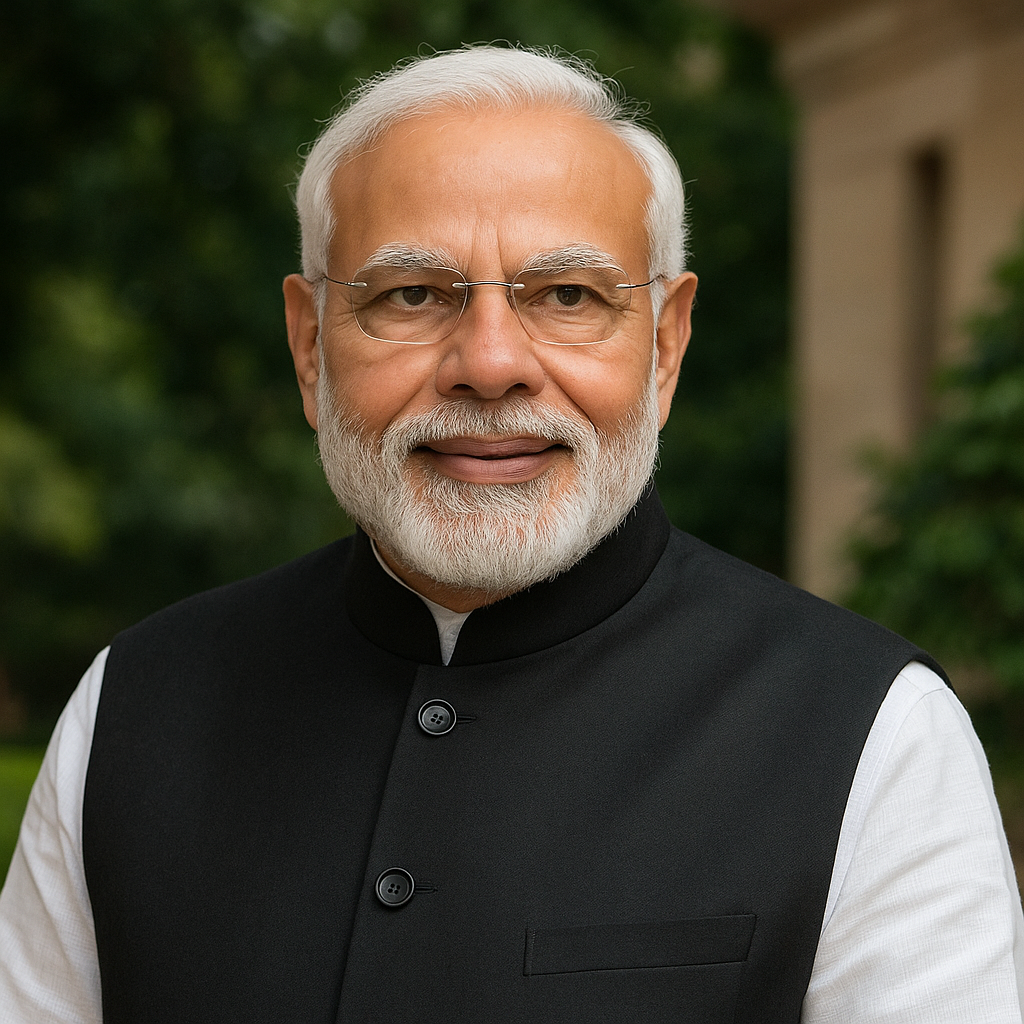
Full Name: Narendra Damodardas Modi
Born: 17 September 1950, Gujarat
Age: 75+
Education: MA in Political Science
Position: Prime Minister of India (Since 2014)
Party: BJP
Narendra Modi – Biography, Early Life, Education, Political Career & Achievements
Basic Information
- Full Name: Narendra Damodardas Modi
- Birth Date: 17 September 1950
- Birthplace: Vadnagar, District Mehsana, Gujarat
- Father’s Name: Damodardas Moolchand Modi
- Mother’s Name: Hiraben Modi
- Wife’s Name: Jashodaben Modi
- Political Party: Bharatiya Janata Party (BJP)
Education
- Graduation: B.A. in Political Science, Delhi University (School of Open Learning)
- Post Graduation: M.A. in Political Science, Gujarat University
Early Life
Narendra Modi was born into a middle-class Gujarati family. His father sold tea at the railway station, and young Modi helped him during childhood. He grew up in difficult circumstances and rose from humble beginnings to become one of India's most influential leaders.
Political Career
RSS (Rashtriya Swayamsevak Sangh)
Modi joined the RSS during his youth, where he began his journey of social service and nation-building. This association marked the beginning of his political life.
Entry into BJP
In 1987, Narendra Modi officially joined the Bharatiya Janata Party (BJP). Due to his dedication, organizational skills, and strategic thinking, he quickly rose to important positions within the party.
Chief Minister of Gujarat (2001–2014)
In 2001, Narendra Modi became the Chief Minister of Gujarat. He accelerated development activities in the state and built a strong pro-development image.
Major Achievements as Chief Minister
- Significant industrial growth
- Strong progress in infrastructure
- Improved electricity supply across the state
Prime Minister of India
2014 General Elections
Under Modi’s leadership, the BJP secured a historic victory in 2014. On 26 May 2014, Narendra Modi became the 15th Prime Minister of India.
2019 General Elections
In 2019, the BJP again won with a strong majority, and Narendra Modi took oath as Prime Minister for a second term.
Major Schemes and Initiatives
- Swachh Bharat Mission
- Make in India
- Jan Dhan Yojana
- Digital India
- Ujjwala Yojana
- Ayushman Bharat
- Atal Bhujal Yojana
- Namami Gange Project
Awards and Recognition
- “Champions of the Earth” Award – United Nations
- Global Leadership Awards
- Featured on the cover of TIME Magazine
- Highest civilian honors from countries like Saudi Arabia, Russia, and Afghanistan
Special Characteristics of Narendra Modi
- Known as a powerful speaker and strategist
- Believes in politics as a medium of service
- Strong advocate of technology and digital communication
- Promotes yoga, fitness, and an indigenous lifestyle
Narendra Modi’s Educational Journey
Early Education
Modi completed his schooling in Vadnagar, Gujarat. Though an average student academically, he actively participated in debates, drama, and scout activities.
Higher Education
Graduation
- Course: B.A. in Political Science
- University: Delhi University (School of Open Learning)
- Year: Approx. 1978
Post-Graduation
- Course: M.A. in Political Science
- University: Gujarat University, Ahmedabad
- Year: Approx. 1983
Academic Interests
During his studies, Narendra Modi took a deep interest in politics, governance, and the Indian political system. He completed his education through distance and correspondence modes while simultaneously remaining active in social and organizational work.
Early Life Details
Birth and Family Background
- Birth Date: 17 September 1950
- Birthplace: Vadnagar, District Mehsana, Gujarat
- Caste: Modh Ghanchi (OBC)
- Father: Damodardas Moolchand Modi
- Mother: Hiraben Modi
His family was financially modest. Modi helped his father sell tea at Vadnagar railway station during his childhood.
Childhood Traits
- Showed leadership qualities from a young age
- Actively participated in cultural and school activities
- Came in contact with RSS early in life and imbibed discipline and patriotism
A Life of Struggle
Due to economic hardships, Modi faced many challenges in his education and early life. He also ran a small tea stall with his brother. At one point, he traveled to the Himalayas, lived with sadhus, and learned meditation and yoga.
Inspiration and Ideology
Modi has always been inspired by patriotism, discipline, and service to society. He draws deep influence from Mahatma Gandhi and Swami Vivekananda.
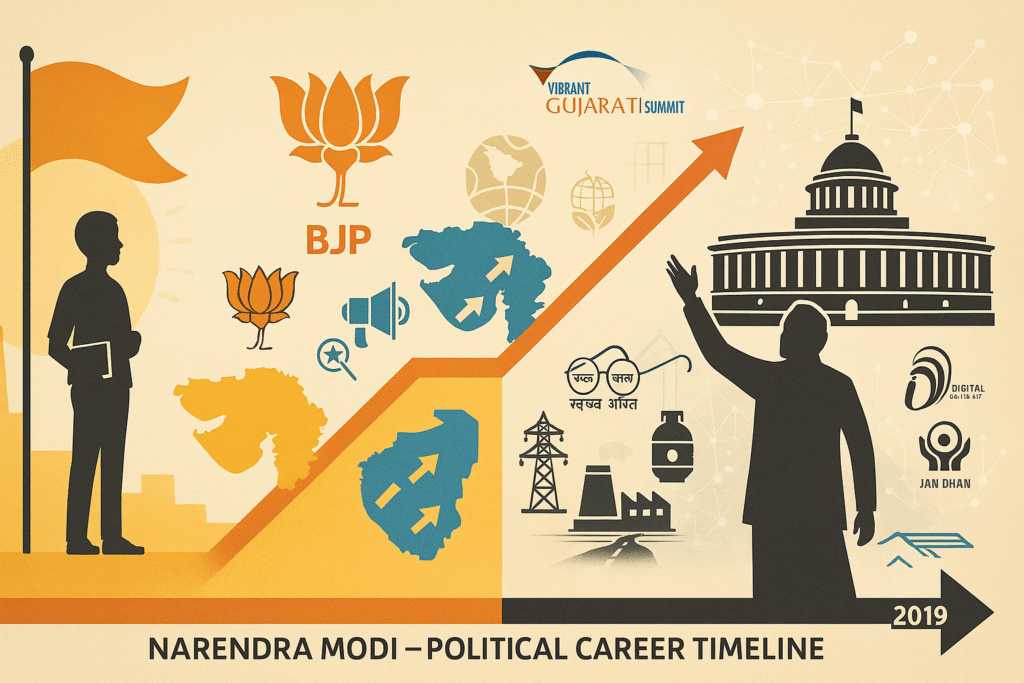
Narendra Modi – Political Career, RSS Journey, BJP Entry & Prime Ministerial Leadership
Narendra Modi’s Political Career
Narendra Modi’s political journey is an inspirational and historical rise from an ordinary worker to the Prime Minister of India. His life reflects discipline, struggle, dedication, and powerful leadership. Below is his political journey explained step by step:
1. Beginning with Rashtriya Swayamsevak Sangh (RSS)
Narendra Modi’s political life began with the RSS (Rashtriya Swayamsevak Sangh). He joined the RSS during adolescence and became actively involved in national service.
- Learned discipline, work ethics, and organizational skills.
- Worked underground during the Emergency (1975).
- Became a full-time RSS pracharak (campaigner).
2. Entry into Bharatiya Janata Party (BJP) – 1987
In 1987, Narendra Modi joined the Bharatiya Janata Party (BJP) at the direction of the RSS.
- Assigned organizational responsibilities, especially in Gujarat.
- Played a major role in strengthening BJP at the grassroots.
- Became National Secretary in 1995 and later National General Secretary of the BJP.
3. Chief Minister of Gujarat (2001–2014)
In 2001, after the resignation of Keshubhai Patel, Narendra Modi was appointed Chief Minister of Gujarat. He took oath on 7 October 2001 and won subsequent Assembly Elections in 2002, 2007, and 2012.
Major Achievements as Chief Minister
- Created the image of a “Development Leader”.
- Major progress in industrial development, roads, electricity, and water management.
- Introduced the Vibrant Gujarat Summit attracting global investors.
- Popularized the “Gujarat Model” nationwide.
4. Rise to Prime Minister of India (2014–Present)
2014 Lok Sabha Elections
- Declared BJP’s Prime Ministerial candidate in 2013.
- Ran large-scale nationwide campaigns with the slogan “Achhe Din Aane Wale Hain”.
- BJP won 282 seats — the first full majority by a non-Congress party.
- Modi took oath as India’s 15th Prime Minister on 26 May 2014.
2019 Lok Sabha Elections
- Campaign based on “Sabka Saath, Sabka Vikas, Sabka Vishwas”.
- BJP achieved an even bigger victory — 303 seats.
- Modi took oath again on 30 May 2019.
Major Schemes and Initiatives
| Scheme / Initiative | Objective |
|---|---|
| Swachh Bharat Abhiyan | Clean India and Open-Defecation-Free Nation |
| Jan Dhan Yojana | Bank accounts for all citizens |
| Ujjwala Yojana | Free LPG connections to poor women |
| Digital India | Technology-driven governance |
| Ayushman Bharat | Free health insurance for poor families |
| Make in India | Boost manufacturing sector |
| Namami Gange | Cleaning and conservation of Ganga River |

International Recognition
- Redefined India’s foreign policy.
- Strengthened ties with the USA, Russia, Japan, UAE, and others.
- Received highest civilian honors from several countries.
Conclusion
Narendra Modi’s political journey is a motivating example of how discipline, service, and leadership can take an individual from the grassroots to the highest office in the country. Today, he is recognized not only as a major leader in India but also as one of the most influential leaders globally.
RSS and Narendra Modi’s Relationship
What is RSS?
- Full Name: Rashtriya Swayamsevak Sangh
- Founded: 27 September 1925
- Founder: Dr. Keshav Baliram Hedgewar
- Headquarters: Nagpur, Maharashtra
The RSS is a nationalist volunteer organization focused on cultural unity, Indian values, social service, and nation-building. It is considered the ideological parent organization of the BJP.
Narendra Modi and RSS Affiliation
- Joined RSS shakha around the age of 8 in Vadnagar.
- Became a full-time RSS pracharak.
- Worked in Gujarat, Rajasthan, and the Himalayan regions.
Values Learned in RSS
- Simple and disciplined lifestyle
- Dedication to national service
- Leadership and organizational skills
Role of RSS in Modi’s Life
| Aspect | Influence |
|---|---|
| Discipline | Shaped work ethic and strict discipline |
| National Service | Strengthened commitment towards nation-building |
| Leadership Skills | Developed through organizational experiences |
| Organizational Skills | Enhanced ability to manage workers and campaigns |
Conclusion
The RSS laid the foundation for Narendra Modi’s personality, leadership, and sense of national duty. This training guided him throughout his journey from a volunteer to the Prime Minister of India.
Narendra Modi’s Entry into BJP
What is BJP?
- Full Form: Bharatiya Janata Party
- Founded: 6 April 1980
- Ideology: nationalism, cultural identity, development, and good governance
- Ideological Base: RSS Framework
How Modi Joined BJP (1987)
Following RSS guidance, Modi formally joined the BJP organization in 1987, starting with Gujarat state-level roles.
Early Responsibilities
- Strengthened BJP’s presence in rural Gujarat.
- Organized election strategies and campaigns.
- Worked closely in Advani’s Rath Yatra.
Rise in BJP Leadership
- Became BJP National Secretary in 1995.
- Later became National General Secretary handling multiple states.
- Became a key election strategist.
Conclusion
Narendra Modi’s entry into BJP was not just a career move but a transformation from a disciplined RSS worker to a strategic national political leader.
Narendra Modi as Chief Minister of Gujarat (2001–2014)
Beginning of Tenure
- Took oath as Chief Minister on 7 October 2001.
- Served continuously for 13 years — longest tenure in Gujarat’s history.
Election Victories
| Year | Election Situation | Result |
|---|---|---|
| 2002 | Post-Godhra tensions | Massive victory |
| 2007 | Development-focused campaign | Full majority |
| 2012 | Third consecutive election | Historic mandate |
Major Achievements
- Introduced the “Gujarat Model” of fast development.
- Attracted global investments through Vibrant Gujarat Summit.
- Improved roads, electricity, and water supply.
- Promoted girl education (Kanya Kelavani Campaign).
- Launched Sadbhavana Mission for unity and peace.
Conclusion
Modi’s Gujarat tenure transformed the state’s development and governance standards, setting the stage for his national leadership in 2014.
Prime Minister Narendra Modi – 2014 Lok Sabha Elections
Background
After 10 years of UPA government, India faced issues such as Corruption, inflation, unemployment, and policy paralysis. People desired strong leadership.
Modi as PM Candidate
On 13 September 2013, Narendra Modi was announced as BJP’s official PM candidate.
Election Campaign
- Popular slogan: “Achhe Din Aane Wale Hain”
- Use of social media, 3D holograms, and digital campaigns
- 7000+ rallies across India
Results – 16 May 2014
| Party | Seats |
|---|---|
| BJP | 282 |
| NDA | 336 |
| Congress | 44 |
Oath Ceremony
Modi took oath as India’s 15th Prime Minister on 26 May 2014 in the presence of SAARC leaders.
Conclusion
The 2014 elections marked a political revolution, elevating Modi from a party worker to national leadership.
Prime Minister Narendra Modi – 2019 Lok Sabha Elections
Background (2014–2019)
- Ujjwala Yojana
- Swachh Bharat Mission
- Jan Dhan Yojana
- Ayushman Bharat
- Surgical Strike (2016)
- Balakot Air Strike (2019)
Election Campaign
- Slogan: “Phir Ek Baar, Modi Sarkar”
- Focused on nationalism, security, and development
- Massive rallies and social media engagement
Results – 23 May 2019
| Party | Seats |
|---|---|
| BJP | 303 |
| NDA | 353 |
| Congress | 52 |
Conclusion
The 2019 elections reaffirmed public trust in Narendra Modi’s leadership, marking another landmark victory in Indian political history.
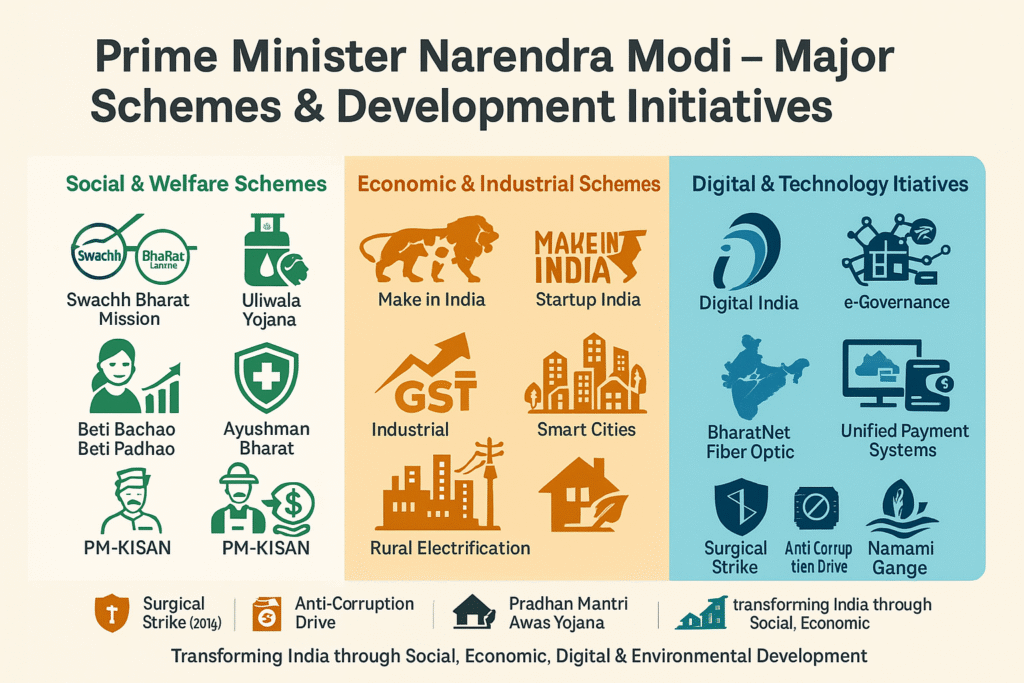
Prime Minister Narendra Modi – Major Schemes, Missions and Development Initiatives
Under the leadership of Prime Minister Narendra Modi, the Central Government launched several ambitious schemes and first-of-its-kind initiatives focusing on economic, social, and technological development. These initiatives aim to uplift the poor, youth, women, farmers, and entrepreneurs by improving their quality of life.
Major Schemes and Initiatives
| Name of Scheme / Initiative | Objective & Key Features |
|---|---|
| Swachh Bharat Mission (2014) | Make India open-defecation-free; improve cleanliness, waste management, and public hygiene. |
| Pradhan Mantri Jan Dhan Yojana (2014) | Ensure universal banking access; open bank accounts for every poor family. |
| Pradhan Mantri Ujjwala Yojana (2016) | Provide free LPG connections to poor women for clean cooking fuel. |
| Make in India (2014) | Boost manufacturing, create jobs, promote industry, and attract investments. |
| Digital India (2015) | Digitize government services, increase internet access, and strengthen digital infrastructure. |
| Ayushman Bharat (2018) | Provide ₹5 lakh annual health insurance to poor families. |
| Beti Bachao Beti Padhao (2015) | Promote girl child birth, safety, and education. |
| PM-KISAN (2019) | Direct income support of ₹6,000 per year to farmers. |
| Smart City Mission (2015) | Develop modern, smart, and sustainable urban infrastructure. |
| Rural Electrification | Provide electricity to every village and household. |
Special Government Initiatives
- Surgical Strike (2016): Strong military response against terrorism.
- GST Implementation (2017): Unified tax system across India.
- Anti-Corruption Campaign: Action against black money and corruption.
- Pradhan Mantri Awas Yojana: Affordable housing for the poor.
- Startup India: Support and growth opportunities for young entrepreneurs.
Conclusion
These initiatives by Prime Minister Narendra Modi have contributed toward building a prosperous, clean, safe, and digital India. They have positively impacted millions of lives and strengthened India’s global position.
Swachh Bharat Mission (Clean India Mission)
Introduction
Swachh Bharat Mission is one of the most ambitious initiatives launched on 2 October 2014 by Prime Minister Narendra Modi on the 150th birth anniversary of Mahatma Gandhi. Its aim was to make India clean, hygienic, and open-defecation-free.
Objectives
- Create a clean and healthy India.
- Eliminate open defecation.
- Improve cleanliness in public and private spaces.
- Strengthen waste management systems.
- Increase public awareness about hygiene.
Key Components
| Component | Description |
|---|---|
| Toilet Construction | Encouraging toilet construction in rural and urban areas. |
| Open Defecation Free Status | Declaring ODF villages, towns, and cities. |
| Waste Management | Scientific disposal, recycling, and better waste collection. |
| Public Awareness | Campaigns in schools, institutions, and public places. |
| Public Area Cleaning | Cleaning roads, drains, stations, and parks. |
Achievements
- More than 10 crore toilets built nationwide.
- ThoUSAnds of villages declared open-defecation-free.
- Improved waste management systems.
- Increased awareness among children and youth.
- Enhanced women’s health and safety.
Conclusion
Swachh Bharat Mission brought a revolutionary change in India’s cleanliness movement. It not only improved health and hygiene but also contributed to creating a modern and sustainable India.
Make in India
Introduction
Make in India is a major initiative launched on 25 September 2014 to transform India into a global manufacturing hub.
Objectives
- Encourage manufacturing in India.
- Attract domestic and foreign investors.
- Create employment opportunities.
- Increase exports and reduce imports.
- Boost overall economic growth.
Key Features
| Aspect | Description |
|---|---|
| Priority Sectors | 25 sectors including Automobiles, Electronics, Defence, Chemicals. |
| Ease of Regulation | Transparent, simplified investment processes. |
| FDI Boost | Liberalized foreign investment rules. |
| Innovation Promotion | Support for R&D and technology development. |
| Infrastructure Growth | Improved roads, ports, power supply. |
Achievements
- Rise in FDI inflows.
- Growth in manufacturing jobs.
- Increase in new factories and industrial units.
- Boost in domestic defence production.
Conclusion
Make in India has given new direction to the Indian economy and strengthened India’s position as a manufacturing power.
Pradhan Mantri Jan Dhan Yojana (PMJDY)
Introduction
Launched on 28 August 2014, PMJDY aims to provide universal access to banking facilities, especially to the poor and unbanked population.
Objectives
- Open bank accounts for every citizen.
- Provide savings, loans, insurance, and pension services.
- Promote digital and transparent banking.
Main Features
| Feature | Description |
|---|---|
| Zero Balance Accounts | No minimum balance required. |
| Free RuPay Debit Card | Issued to all account holders. |
| Overdraft Facility | Available on eligible accounts. |
| Insurance Benefits | Accident & life insurance included. |
| Direct Benefit Transfer | Government subsidies directly transferred. |
Achievements
- Millions of new bank accounts opened.
- Increased financial inclusion in rural India.
- Enhanced women’s participation in banking.
Conclusion
PMJDY transformed financial inclusion in India and empowered economically weaker sections.
Digital India
Introduction
Digital India, launched on 1 July 2015, aims to transform India into a digitally empowered society.
Objectives
- Provide digital infrastructure across India.
- Digitize government services.
- Promote transparency and reduce corruption.
- Increase digital literacy.
Key Components
- Broadband Highways
- Universal Mobile Connectivity
- E-governance & E-Services
- Digital Payment Systems
- BharatNet Fiber Network
Achievements
- Increased digital transactions.
- Improved access to government services.
- Growth in digital literacy.
Conclusion
Digital India is creating a smart, connected, and technologically advanced nation.
Pradhan Mantri Ujjwala Yojana (PMUY)
Introduction
PMUY was launched on 1 May 2016 to provide clean cooking fuel (LPG) to poor households.
Objectives
- Replace traditional cooking fuels.
- Improve women’s health.
- Reduce pollution and save forests.
Main Features
- Free LPG connections.
- Easy EMI options for refills.
- Rural household coverage.
Conclusion
PMUY significantly improved women’s lives and promoted clean energy usage across India.
Ayushman Bharat (PM-JAY)
Introduction
Launched on 23 September 2018, Ayushman Bharat provides ₹5 lakh annual health insurance to poor families.
Key Features
- Coverage for 10 crore+ families.
- Cashless treatment.
- Treatment available at private & government hospitals.
Achievements
- Millions of beneficiaries treated.
- Improved health access.
Conclusion
Ayushman Bharat is one of the world’s largest healthcare programs, supporting India’s poorest citizens.
Atal Bhujal Yojana (Atal Groundwater Scheme)
Introduction
Launched in 2019, the scheme aims to improve groundwater management in water-stressed regions.
Objectives
- Promote groundwater conservation.
- Encourage community-led water management.
- Improve irrigation and water efficiency.
Conclusion
Atal Bhujal Yojana is vital for long-term water security and sustainable development.
Namami Gange Programme
Introduction
Namami Gange is a flagship program launched in 2014 to rejuvenate the River Ganga.
Objectives
- Clean and rejuvenate the Ganga river.
- Reduce pollution sources.
- Strengthen sewage treatment infrastructure.
Main Components
- Sewage treatment plants
- River surface cleaning
- Riverfront development
- Public awareness
Achievements
- Reduction in pollution levels.
- Improved water quality.
- Greater public participation.
Conclusion
Namami Gange is one of India’s most important environmental initiatives aimed at restoring the ecological and cultural heritage of the Ganga.
Prime Minister Narendra Modi – Awards and Honours
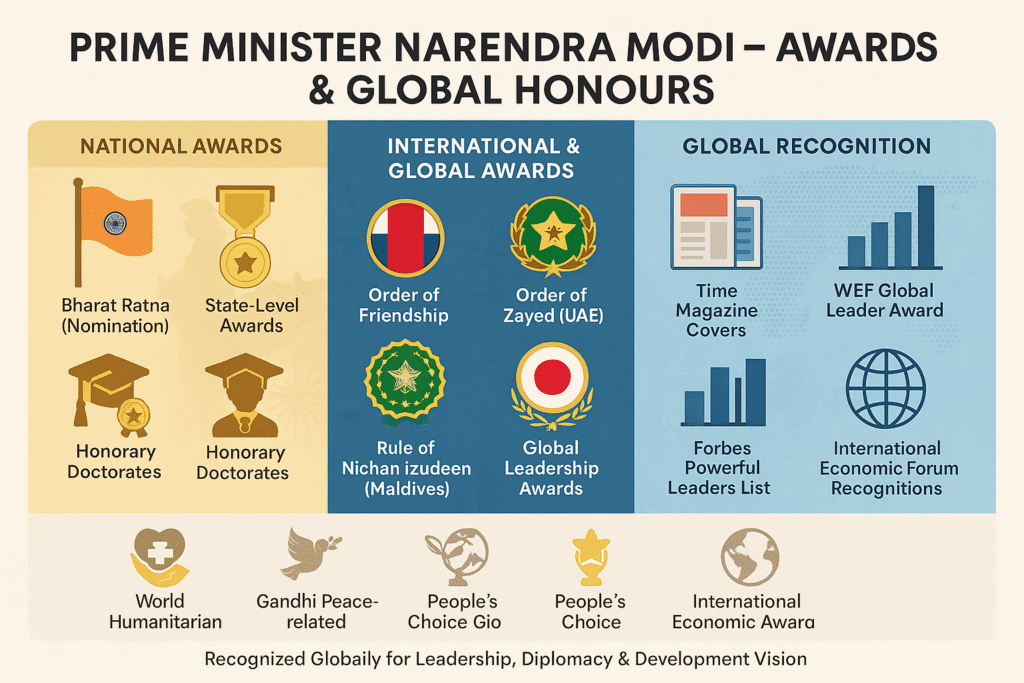
Prime Minister Narendra Modi has received numerous national and international awards for his leadership, development initiatives, diplomacy, and socio-economic reforms. Below is a detailed list of some of the most notable awards and honours he has received over the years.
Major Awards and Honours
| Award / Honour | Year | Description |
|---|---|---|
| Bharat Ratna (Nominated) | 2015 (Nomination) | Nominated for India’s highest civilian honour (not yet awarded). |
| State-Level Awards | Various | Received multiple development awards during his tenure as Gujarat Chief Minister. |
| World Economic Forum (WEF) – Global Leader Award | 2018 | Recognised for visionary global leadership by WEF. |
| Order of Friendship (Russia) | 2019 | Russia’s highest civilian honour for strengthening bilateral relations. |
| Best Leader Award (CII) | 2014, 2015 | Awarded by Confederation of Indian Industry for leadership and development. |
| Japan’s Goodwill Award | 2014 | Awarded for contributions to democratic values and development. |
| Fortune Global Leader Recognition | Multiple Years | Featured as one of the world’s most influential leaders. |
| Honorary Doctorates | Various Years | Received honorary doctorate degrees from several global universities. |
Other Notable Honours
- Gandhi Peace-related recognitions
- World Humanitarian Award
- Multiple Global Power Leader recognitions
Global Recognition
- Listed multiple times by Time Magazine among the world’s most influential people.
- Ranked by Forbes as one of the world’s most powerful leaders.
- Received several highest civilian awards from foreign nations.
Conclusion
These awards and recognitions reflect Narendra Modi’s significant contributions to nation-building, diplomacy, and global leadership. His role has strengthened India’s global presence and earned him widespread respect across the world.
Champions of the Earth Award
Introduction
The “Champions of the Earth” is the United Nations Environment Programme’s (UNEP) highest environmental honour. It is awarded to individuals, groups, or institutions that make outstanding contributions to environmental protection, sustainability, and climate change action.
Objectives of the Award
- Encourage global environmental protection.
- Recognize leadership, innovation, and inspiration.
- Promote sustainable development efforts.
- Motivate individuals and organizations to fulfil environmental responsibilities.

Award Categories
- Policy Leadership
- Science and Innovation
- Inspiration and Action
- Entrepreneurial Vision
- Lifetime Achievement
Narendra Modi and “Champions of the Earth”
In 2018, Prime Minister Narendra Modi received the prestigious “Champions of the Earth” award. It was granted to him for his contributions to environmental protection and climate change efforts.
Key Contributions Recognized
- Promotion of clean energy
- Leadership in Swachh Bharat Mission
- Global climate action partnerships
- Expansion of renewable energy initiatives
Importance of the Award
- Presented by the United Nations Environment Programme.
- Held annually with participation of world environmental leaders.
- Considered one of the most prestigious global environmental recognitions.
Conclusion
The award highlights Narendra Modi’s dedication to environmental protection and sustainable development. It serves as global acknowledgment of his environmental leadership.
Global Leadership Awards
What Are Global Leadership Awards?
Global Leadership Awards honour influential leaders worldwide for their positive impact, leadership capabilities, and contribution to development, diplomacy, and social reforms.
Narendra Modi’s Global Leadership Recognitions
- Named among “Global Leaders” by Fortune magazine (multiple years).
- Featured in Time Magazine’s list of the world’s most influential people (2018 and other years).
- Recognised by global institutions for contributions to economic reforms, climate action, and diplomacy.
Objectives of the Award
- Promote peace, development, and global cooperation.
- Highlight positive leadership models.
- Recognize contributions to economic, social, and environmental progress.
Other Significant Global Honours
- People’s Choice Global Leadership Award
- East–West Centre Global Leadership Award
- International Economic Forum recognitions
Conclusion
These global recognitions reflect Narendra Modi’s widespread acceptance as a global reform-driven leader whose work influences international politics, economics, and sustainability.
Narendra Modi on the Cover of Time Magazine
Introduction
Prime Minister Narendra Modi has appeared multiple times on the cover of Time Magazine, one of the world’s most influential publications.
Prominent Cover Appearances
| Year | Theme / Title | Description |
|---|---|---|
| 2014 | Person of the Year (Discussion) | Featured after becoming Prime Minister for the first time. |
| 2015 | “India’s Divider in Chief” | Analysis on Indian politics and Modi’s leadership style. |
| 2017 | “Modi Means Business” | Focus on economic reforms and Make in India campaign. |
| 2019 | “Modi Wins Big Again” | Coverage after Modi’s massive 2019 election victory. |
| 2021 | Global Leadership & COVID-19 | Analysis of India’s role during COVID-19 under Modi’s leadership. |
Importance of Being Featured
- Represents global recognition of leadership.
- Highlights India’s rise on the world stage.
- Reflects international interest in India’s policies and progress.
Conclusion
Multiple appearances in Time Magazine underscore Narendra Modi’s global influence and the growing significance of India in world affairs.
Highest Civilian Honours from Foreign Countries
Introduction
Narendra Modi has received numerous highest civilian honours from foreign nations, acknowledging his international diplomacy, peace efforts, and contributions to strengthening bilateral relations.
Major International Civilian Honours
| Country | Name of the Honour | Year | Description |
|---|---|---|---|
| Russia | Order of Friendship | 2019 | Awarded for advancing India–Russia relations. |
| Saudi Arabia | King Abdulaziz Order of Merit | 2016 | Given by the King of Saudi Arabia for strengthening bilateral ties. |
| Afghanistan | Highest Civilian Honour | 2018 | Awarded for India’s role in Afghan reconstruction and partnership. |
| UAE | Order of Zayed | 2019 | Given for promoting India–UAE strategic relations. |
| Maldives | Rule of Nishan Izzuddeen | 2019 | Recognises contributions to strengthening India–Maldives relations. |
Importance of These Honours
- Reflect Modi’s strong global diplomatic presence.
- Strengthen India’s international partnerships.
- Highlight India as a growing global power.
Conclusion
Prime Minister Narendra Modi’s international honours reflect India’s rising global stature and his impactful diplomatic leadership across regions.
