
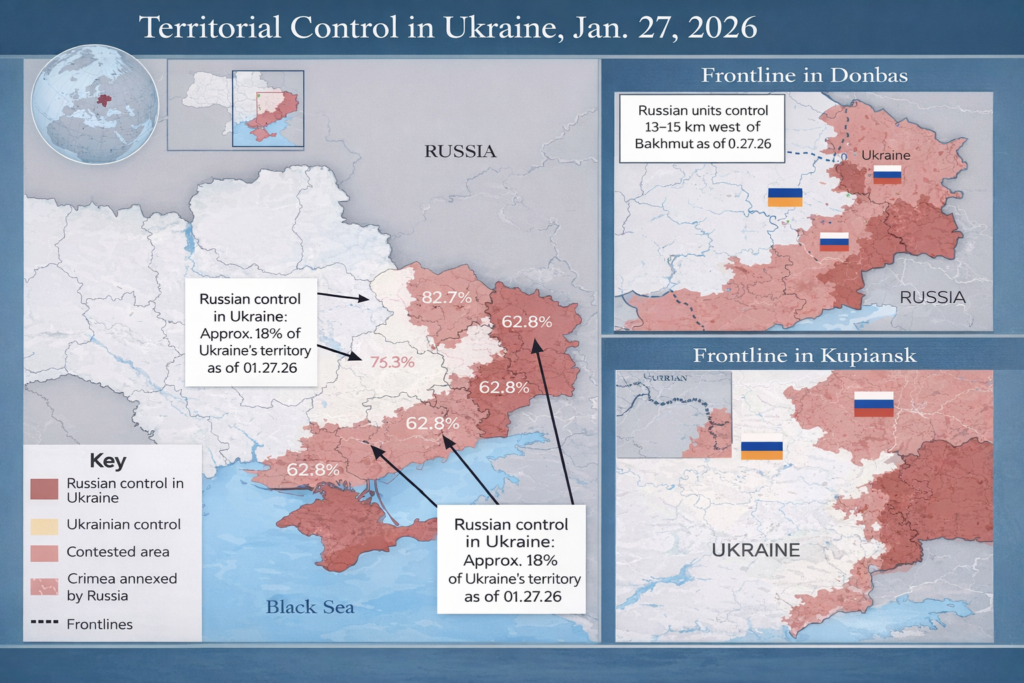
The above map clearly illustrates the current territorial control in the Russia–Ukraine War 2026, highlighting key frontline regions and strategic areas under conflict.
Introduction
The Russia-Ukraine War 2026 is one of the most critical geopolitical conflicts shaping the modern world today. From rising global inflation and energy crises to shifting alliances and security tensions, this war is redefining international power dynamics.
What started as a regional dispute has now evolved into a prolonged global crisis with far-reaching consequences. Countries across the world are facing economic pressure, supply chain disruptions, and strategic uncertainty due to this ongoing conflict.
The Russia-Ukraine War escalated dramatically on February 24, 2022, when Russia launched a full-scale invasion. Understanding this key event is essential to analyze the ongoing conflict in 2026.
👉 Read Full Event AnalysisIn this article, you will understand the complete timeline, key causes, military analysis, global impact, and India’s strategic position in a simple and clear way.
What is Russia-Ukraine War 2026?
The Russia-Ukraine War 2026 is an ongoing conflict between Russia and Ukraine that began in 2014 and escalated in 2022. It has major global impacts including economic instability, energy crisis, and geopolitical shifts.
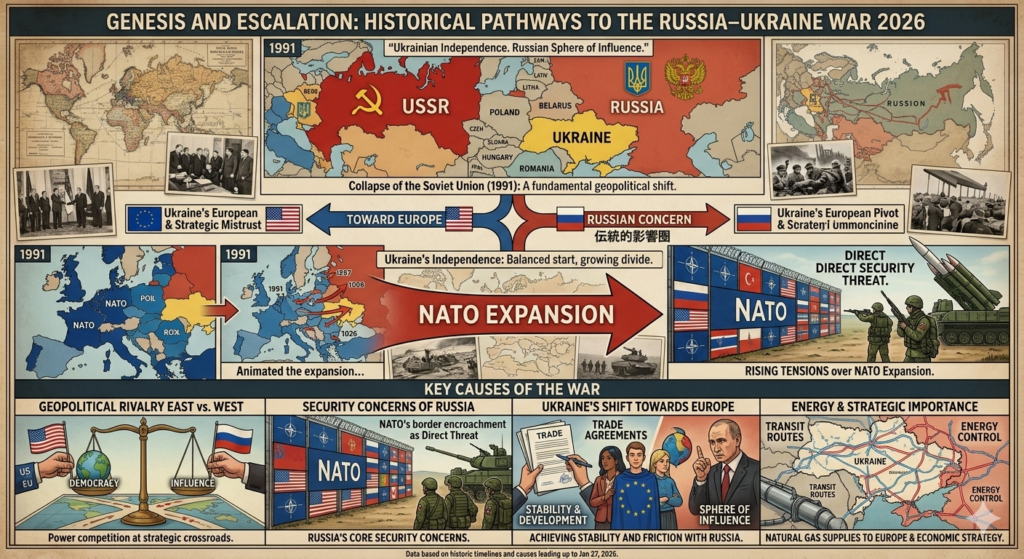
Historical Background of Russia–Ukraine Conflict
Collapse of the Soviet Union (1991)
The collapse of the Soviet Union in 1991 marked a major turning point in Eastern European politics. Ukraine emerged as an independent nation, but Russia continued to view it as part of its traditional sphere of influence. This historical connection laid the foundation for future tensions that eventually contributed to the Russia–Ukraine War 2026.
Ukraine’s Independence and Early Relations
After gaining independence, Ukraine initially maintained balanced relations with Russia while gradually strengthening ties with Western countries. Over time, Ukraine’s shift toward Europe and the United States created mistrust between the two nations, which became one of the key factors behind the Russia–Ukraine conflict.
The evolving security landscape in Europe is heavily influenced by NATO’s strategic expansion and military positioning in Eastern Europe.
NATO’s expansion in Eastern Europe is rapidly reshaping global power dynamics and intensifying Russia–West tensions. Understanding NATO’s strategy is essential to fully grasp the geopolitical context of the Russia-Ukraine War 2026.
👉 Read Full AnalysisNATO Expansion and Rising Tensions
The expansion of NATO into Eastern Europe was seen by Russia as a direct security threat. When Ukraine expressed interest in joining NATO, tensions escalated significantly. This growing rivalry between Russia and Western alliances played a crucial role in shaping the Russia–Ukraine War 2026.
Key Causes of the War
Geopolitical Rivalry Between East and West
The ongoing geopolitical rivalry between Russia and Western nations, particularly the United States and Europe, has been a major factor behind the Russia–Ukraine War 2026. Ukraine lies at a strategic crossroads between East and West, making it a focal point of influence and power competition.
Security Concerns of Russia
Russia has consistently expressed concerns over its national security, especially regarding nato’s expansion toward its borders. The possibility of Ukraine joining NATO was perceived as a direct threat, which significantly contributed to escalating tensions leading to the Russia–Ukraine conflict.
Ukraine’s Shift Towards Europe
Over the years, Ukraine has moved closer to Europe politically and economically. This shift was aimed at achieving greater stability and development, but it also created friction with Russia, which preferred Ukraine to remain within its sphere of influence.
Energy and Strategic Importance
Ukraine plays a crucial role in energy transit routes, especially for natural gas supplies to Europe. Control over this region has significant strategic and economic implications, making it a key factor in the Russia–Ukraine War 2026.
Timeline of the Conflict (2014–2026)
Annexation of Crimea (2014)
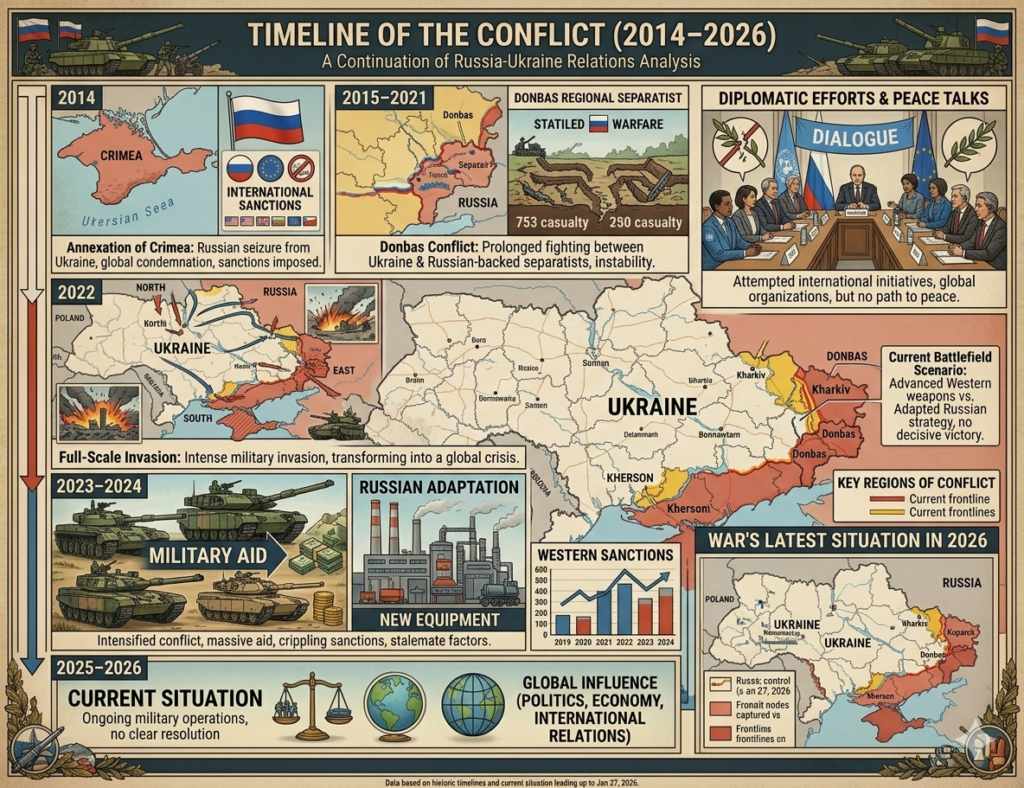
In 2014, Russia annexed the Crimean Peninsula from Ukraine, marking a major turning point in the Russia–Ukraine conflict. This move was widely condemned by the international community and led to the imposition of economic sanctions on Russia.
Donbas Conflict (2015–2021)
Following the annexation of Crimea, armed conflict broke out in the Donbas region of eastern Ukraine between Ukrainian forces and Russian-backed separatists. This prolonged conflict resulted in significant casualties and instability, laying the groundwork for the Russia–Ukraine War 2026.
Full-Scale Invasion (2022)
In February 2022, Russia launched a full-scale military invasion of Ukraine. This marked the most intense phase of the conflict and transformed it into a major global crisis, bringing widespread international attention and response.
Western Sanctions and Military Aid
In response to the invasion, Western countries imposed strict economic sanctions on Russia and provided military and financial support to Ukraine. These actions intensified the conflict and further escalated tensions between Russia and Western powers.
Current Situation (2025–2026)
As of 2025–2026, the war continues with no clear resolution. Both sides remain engaged in military operations and diplomatic efforts. The Russia–Ukraine War 2026 continues to influence global politics, economy, and international relations.
Latest Situation of the War in 2026
Current Battlefield Scenario
As of 2026, the Russia–Ukraine War continues with intense military engagements on multiple fronts. Ukraine is utilizing advanced weapons and technology supplied by Western nations, while Russia is adapting its strategies to maintain pressure on key areas. Despite ongoing operations, neither side has achieved a decisive victory.
Key Regions of Conflict
The conflict is mainly concentrated in eastern and southern Ukraine, including regions such as Donbas, Kharkiv, and Kherson. These areas are strategically and economically important, leading to continuous clashes between the two sides. Control over these regions remains a critical objective in the Russia–Ukraine War 2026.
Diplomatic Efforts and Peace Talks
Several diplomatic initiatives and peace talks have been attempted at the international level, but no lasting resolution has been achieved so far. Global organizations and mediators have tried to facilitate dialogue, yet the Russia–Ukraine War 2026 continues without a clear path to peace.
Military Analysis
Modern Warfare and Use of Technology
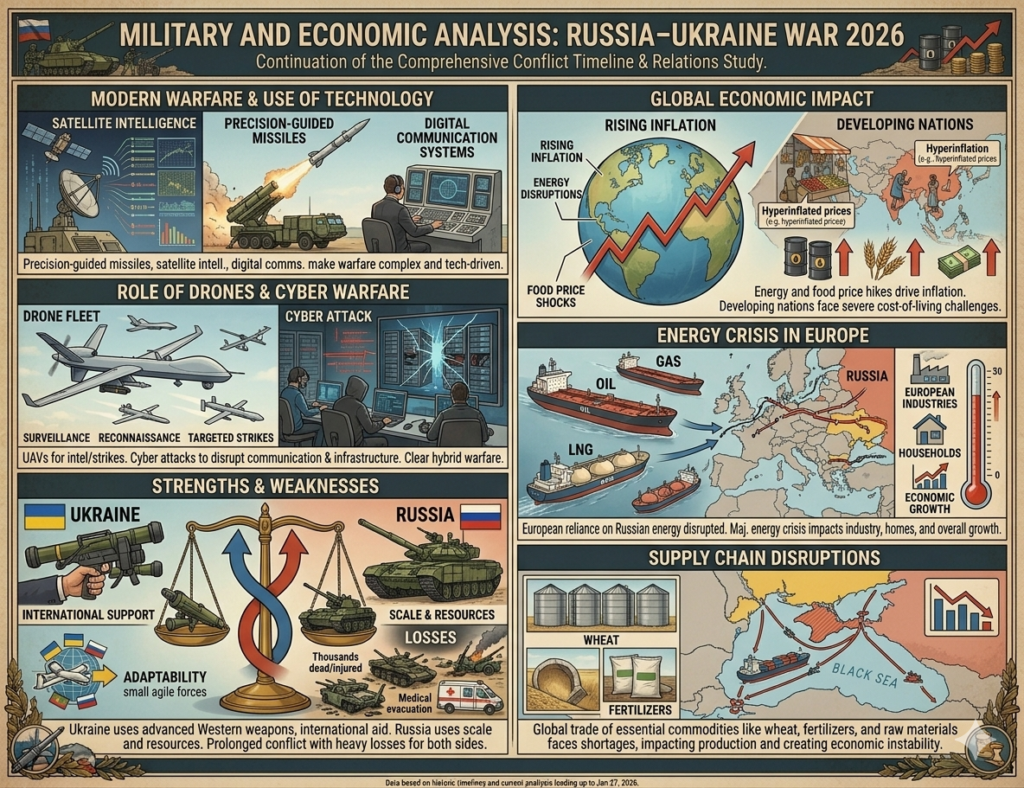
The Russia–Ukraine War 2026 highlights the growing importance of modern warfare and advanced technology. Both sides are using precision-guided missiles, satellite intelligence, and digital communication systems to enhance their operations. These developments have transformed the nature of warfare, making it more complex and technology-driven.
Role of Drones and Cyber Warfare
Drones and cyber warfare have played a crucial role in this conflict. Unmanned aerial vehicles (UAVs) are widely used for surveillance, reconnaissance, and targeted strikes. At the same time, cyber attacks are being conducted to disrupt communication networks, infrastructure, and information systems. This makes the Russia–Ukraine War 2026 a clear example of modern hybrid warfare.
Strengths and Weaknesses of Both Sides
Russia possesses a large and well-equipped military force, while Ukraine benefits from strong international support and advanced weapon systems from Western countries. Ukraine’s adaptability and strategic defense have been key strengths, whereas Russia’s scale and resources provide significant advantages. However, both sides have faced heavy losses, leading to a prolonged and intense conflict.
Global Economic Impact of Russia-Ukraine War 2026
Rising Inflation Worldwide
The Russia–Ukraine War 2026 has had a significant impact on the global economy, particularly in driving inflation across many countries. The disruption of energy supplies and rising food prices have contributed to increased living costs worldwide, with developing nations facing the most severe challenges.
Energy Crisis in Europe
Europe has been heavily dependent on Russian oil and gas for its energy needs. Due to the conflict and resulting sanctions, energy supplies have been disrupted, leading to a major energy crisis in the region. This has affected industries, households, and overall economic growth across European countries.
supply chain disruptions
The Russia–Ukraine conflict has also disrupted global supply chains. Essential commodities such as wheat, fertilizers, and raw materials have faced shortages, impacting international trade and production. These disruptions have further intensified economic instability in the global market.
Food Security and Agriculture Impact
Ukraine as a Global Wheat Supplier
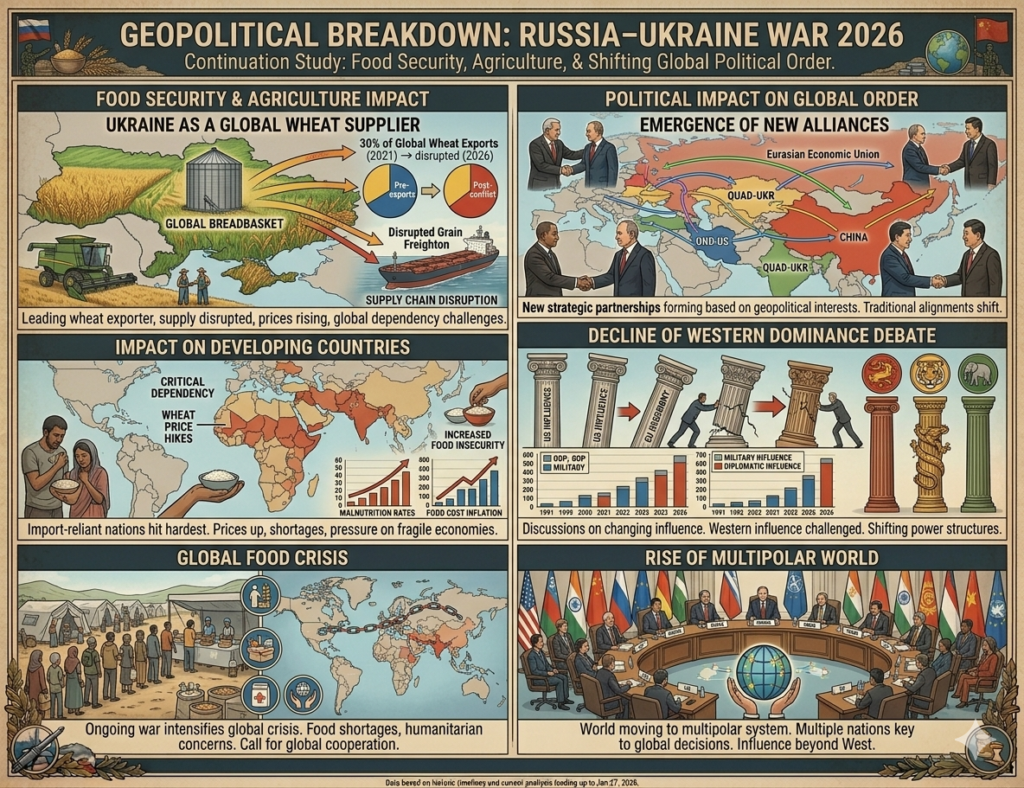
Ukraine is one of the world’s leading exporters of wheat and other agricultural products. Due to the Russia–Ukraine War 2026, the supply of these essential commodities has been disrupted, leading to rising food prices in global markets. This disruption has created significant challenges for countries dependent on Ukrainian exports.
Impact on Developing Countries
Developing countries that rely heavily on food imports have been the most affected by this crisis. Rising prices and shortages of essential food items have increased food insecurity in these regions. The Russia–Ukraine conflict has placed additional pressure on already fragile economies.
Global Food Crisis
The ongoing war has intensified the global food crisis, with supply chain disruptions affecting the availability of food worldwide. Millions of people are facing food shortages, and humanitarian concerns are growing. The Russia–Ukraine War 2026 highlights the urgent need for global cooperation to ensure food security.
Political Impact on Global Order
Emergence of New Alliances
The Russia–Ukraine War 2026 has led to the formation of new political and strategic alliances across the world. Countries are increasingly aligning themselves based on their geopolitical interests, resulting in a shift in traditional partnerships and global power structures.
Decline of Western Dominance Debate
The conflict has also sparked debates about the decline of Western dominance in global politics. With the rise of alternative powers and shifting alliances, many analysts argue that Western influence is being challenged. The Russia–Ukraine conflict has intensified discussions about a changing global order.
Rise of multipolar world
The world is gradually moving toward a multipolar system, where multiple nations play key roles in global decision-making. Countries like China and India are emerging as influential players, contributing to a more balanced distribution of power. The Russia–Ukraine War 2026 has accelerated this transition toward a multipolar world.
India’s Stand on Russia–Ukraine War
Neutral Foreign Policy
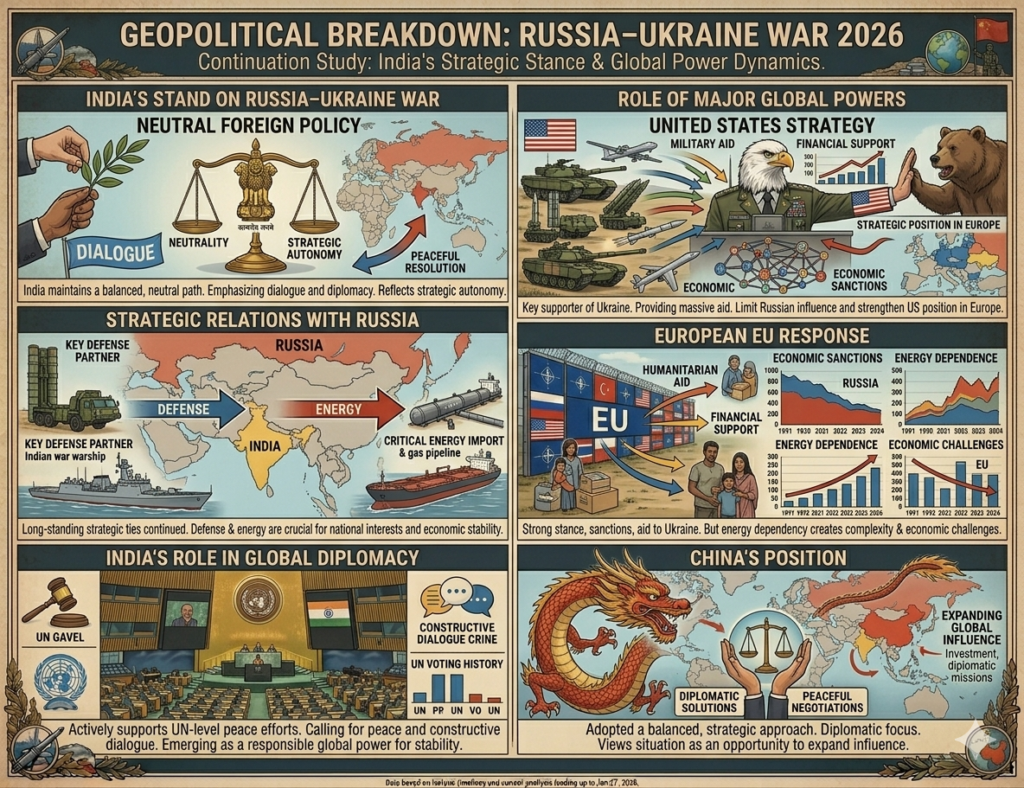
India has adopted a balanced and neutral foreign policy during the Russia–Ukraine War 2026. Rather than taking sides, India has consistently emphasized the importance of dialogue, diplomacy, and peaceful resolution. This approach reflects India’s strategic autonomy in global affairs.
The Russia-Ukraine conflict reached a major turning point on February 24, 2022, when Russia launched a full-scale invasion. This event reshaped global power politics, security strategies, and international alliances.
👉 Russia Invades Ukraine: February 24, 2022 Explained📊 Complete timeline and key events breakdown
Strategic Relations with Russia
India shares long-standing strategic relations with Russia, particularly in defense and energy sectors. Even during the Russia–Ukraine conflict, India has maintained these ties, including the continued import of energy resources. These relations are crucial for India’s national interests and economic stability.
India’s Role in Global Diplomacy
India has actively supported diplomatic efforts to resolve the conflict through international platforms. At forums such as the United Nations, India has called for peace and constructive dialogue. In the context of the Russia–Ukraine War 2026, India is seen as a responsible and emerging global power promoting stability.
Role of Major Global Powers
United States Strategy
In the Russia–Ukraine War 2026, the United States has played a key role by providing military and financial support to Ukraine. The primary objective of the U.S. is to limit Russia’s influence and strengthen its strategic position in Europe. This approach includes a combination of economic sanctions and defense cooperation.
European Union Response
The European Union has taken a strong stance by imposing economic sanctions on Russia and offering financial and humanitarian aid to Ukraine. However, due to its dependence on Russian energy, Europe has also faced significant economic challenges, making the situation more complex within the context of the Russia–Ukraine conflict.
China’s Position
China has adopted a balanced and strategic approach during the Russia–Ukraine War 2026. While avoiding direct support for either side, China has emphasized diplomatic solutions and peaceful negotiations. At the same time, it views the situation as an opportunity to expand its global influence.
Future Outlook of the War
Possibility of Peace Agreement
In the context of the Russia–Ukraine War 2026, the possibility of a peace agreement still exists, but it depends on several complex political and military factors. International pressure and diplomatic negotiations could play a crucial role, although no lasting resolution has been achieved so far.
Chances of Prolonged Conflict
Given the current situation, there is a significant possibility that the conflict may continue for an extended period. Ongoing military operations, strategic interests of both sides, and continued external support to Ukraine suggest that a quick resolution is unlikely. Prolonged conflict could lead to further economic strain, humanitarian crises, and geopolitical instability across the region and beyond.
Role of Global Powers
Global powers such as the United States, European Union, and China will continue to influence the direction of the war. Their policies, sanctions, and diplomatic interventions can either accelerate peace efforts or intensify tensions depending on their strategic interests.
Impact on Global Order
The war is reshaping the global political and economic order. It has already led to changes in energy policies, defense strategies, and international alliances. In the long term, it may contribute to a more multipolar world with shifting power dynamics.
Lessons from the War
Importance of Diplomacy
The Russia–Ukraine War 2026 clearly demonstrates the importance of diplomacy in preventing and resolving conflicts. Early dialogue and negotiations could have reduced escalation and minimized damage. This conflict highlights how the absence of effective communication can lead to prolonged and destructive outcomes.
Military vs Economic Power
The war has shown that military strength alone is not sufficient to determine outcomes, as economic power also plays a critical role. Sanctions imposed by Western countries have significantly impacted Russia’s economy, while financial and military support has helped Ukraine sustain its resistance. This balance reflects the complex nature of the Russia–Ukraine conflict.
Need for Global Stability
The Russia–Ukraine War 2026 has emphasized the need for global stability and cooperation. In an interconnected world, conflicts in one region can have far-reaching consequences worldwide. Ensuring peace and stability requires collective efforts and responsible actions from all nations.
Frequently Asked Questions (FAQ)
When did the war start?
The conflict between Russia and Ukraine began in 2014 with the annexation of Crimea, but it escalated into a full-scale war in February 2022. The Russia–Ukraine War 2026 is an ongoing continuation of this conflict.
What are the main causes?
The main causes of the war include Geopolitical Rivalry, nato expansion, Russia’s security concerns, and Ukraine’s shift toward Western countries. These factors collectively contributed to the Russia–Ukraine conflict.
What is India’s position?
India has maintained a neutral and balanced stance during the Russia–Ukraine War 2026. It has emphasized diplomacy and peaceful resolution while maintaining strategic relations with both sides.
What is the global impact?
The war has had significant global impacts, including rising inflation, energy crises, food shortages, and shifts in global political dynamics. The Russia–Ukraine War 2026 continues to influence economies and international relations worldwide.
Conclusion
Summary of Key Points
The Russia-Ukraine War 2026 is a complex and multi-dimensional conflict that has significantly impacted global politics, economy, and security. From its historical roots to the latest developments, this war continues to reshape international relations, energy markets, and global power dynamics. It is not just a regional crisis but a defining global event.
The world is rapidly moving toward a multipolar system where new global powers like India, China, and emerging economies are reshaping international influence. Understanding these rising powers is key to analyzing the long-term impact of the Russia-Ukraine War 2026.
👉 New Global Powers in Geopolitics Explained📊 In-depth analysis of emerging global leaders and power shifts
Final Analysis
In conclusion, the Russia-Ukraine War 2026 is a major turning point in modern geopolitics. Its impact on global economy, energy security, and international alliances will influence the future world order for years to come. Understanding this conflict is essential for anyone following global affairs, as it continues to shape a new multipolar world.