
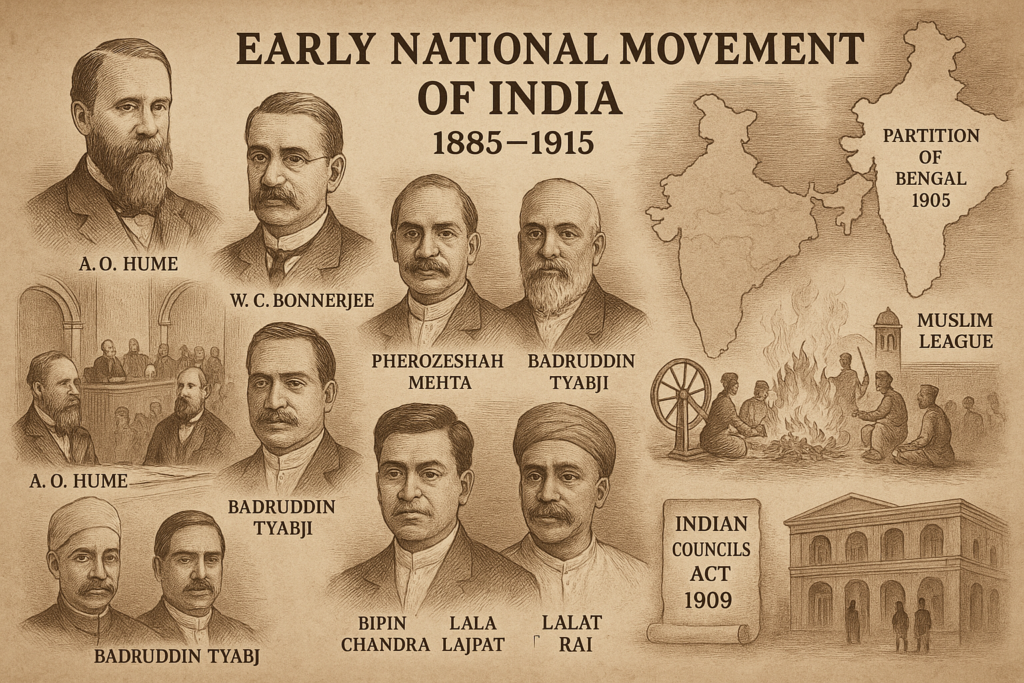
Early National Movement of India (1885–1915)
The Indian National Movement was one of the most important struggles in world History that led India toward independence in 1947. From the formation of the Indian National Congress in 1885 to revolutionary movements, Swadeshi campaigns, Gandhian mass movements, and the final freedom struggle, every phase played a crucial role in shaping modern India. This article explains the complete history of the Indian National Movement with important leaders, phases, movements, reforms, and UPSC-focused facts.
1. Establishment of the Indian National Congress (1885)
On 28 December 1885, the Indian National Congress (INC) was founded through the efforts of A.O. Hume. The first session was held in Bombay (Mumbai) and was presided over by Womesh Chandra Banerjee. The Congress initially aimed at securing greater participation for Indians in the administration and promoting constitutional reforms.
2. Moderate Phase (1885–1905)
This period is known as the Moderate phase. The leaders believed in peaceful methods such as petitions, requests, and constitutional reforms to persuade the British government.
Prominent Leaders
- Dadabhai Naoroji
- Gopal Krishna Gokhale
- Surendranath Banerjee
- Pherozeshah Mehta
- Badruddin Tyabji
Key Features of the Moderate Phase
- Demand for constitutional reforms
- Demand for freedom of press and expression
- Demand for educational and employment opportunities for Indians
- Dadabhai Naoroji’s “Drain Theory” explaining how British policies drained India’s wealth
- Indian Councils Act of 1892 granting limited representation to Indians
3. Partition of Bengal & Swadeshi Movement (1905–1911)
On 16 October 1905, Lord Curzon partitioned Bengal into two parts under the policy of “divide and rule.” This triggered the Swadeshi and Boycott movements in protest.
Main Features of the Movement
- Boycott of British goods, clothes, and institutions
- Promotion of indigenous industries and self-reliance
- Rise of economic nationalism among Indians
4. Rise of Extremists & Surat Split (1907)
Differences between Moderates and Extremists intensified, leading to the Congress split at the Surat Session in 1907.

Top Rated Amazon Product
High quality • Popular choice • Excellent performance
- ✔ 100% Genuine Product
- ✔ Fast & Secure Delivery
- ✔ Easy Return Policy
Prominent Extremist Leaders
- Bal Gangadhar Tilak
- Bipin Chandra Pal
- Lala Lajpat Rai
5. Establishment of the Muslim League (1906)
On 30 December 1906, the Muslim League was formed in Dhaka under the leadership of Aga Khan, Nawab Salimullah, and Mohsin-ul-Mulk. Its main aim was to safeguard the political rights and interests of the Muslim community.
6. Morley-Minto Reforms (1909)
The Indian Councils Act of 1909, also known as the Morley-Minto Reforms, introduced the system of separate electorates for Muslims. This was the first major constitutional step that institutionalized communal politics.
7. Ghadar Movement (1913–1915)
The Ghadar Party was founded in 1913 in the USA and Canada by leaders such as Lala Har Dayal, Kartar Singh Sarabha, and Baba Sohan Singh Bhakna. The movement aimed at launching an armed uprising against British colonial rule.
Characteristics of the Early National Movement
- Emphasis on constitutional reforms and peaceful methods
- Awareness campaigns on political and social issues
- Rise of Swadeshi and economic nationalism
- Growing unity, along with divisions due to British policies like Partition of Bengal and separate electorates
Conclusion
The period between 1885 and 1915 laid the foundation for India’s freedom struggle. Nationalism grew rapidly, and a mass awakening began against British rule. With the arrival of Mahatma Gandhi in 1915, the movement entered a new phase, leading to powerful mass movements such as the Non-Cooperation Movement and Civil Disobedience Movement.
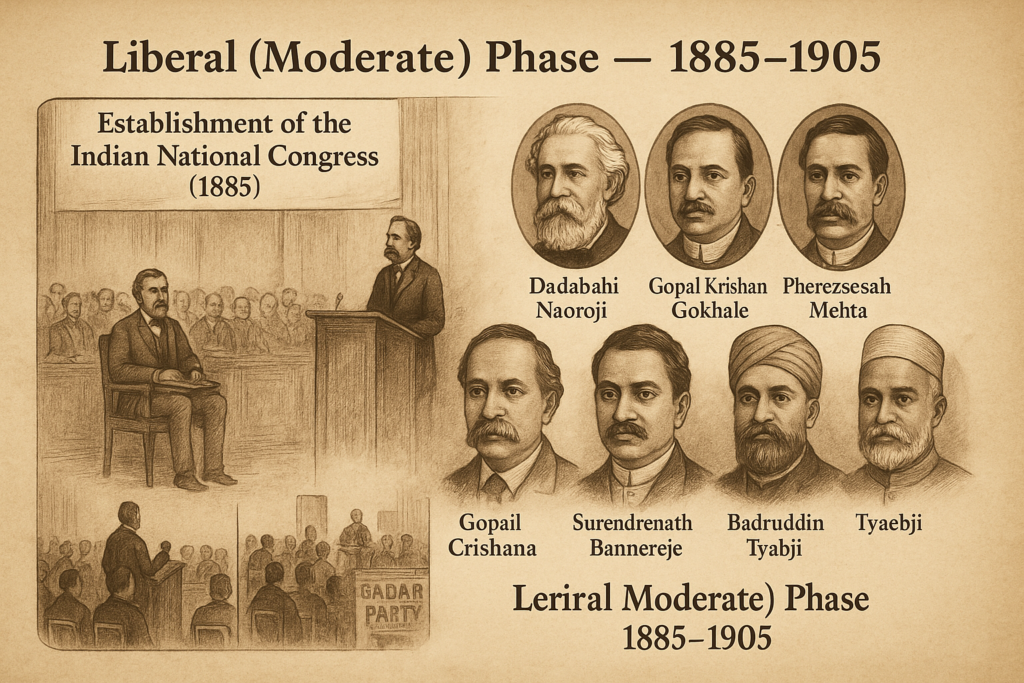
Establishment of the Indian National Congress (1885)
The Indian National Congress (INC) was established on 28 December 1885 due to the efforts of A.O. Hume (Allan Octavian Hume). This organisation was founded to protect the political rights of Indians and ensure their participation in the administration under British rule.
Main Objectives of the Establishment
- To establish a dialogue between Indians and the British government.
- To create awareness among Indians about their rights and political freedom.
- To promote national integration and political consciousness.
- To demand constitutional reforms and ensure the participation of Indians in the administration.
- To lay the foundation of a national movement by reducing social discrimination based on caste, religion, and language.
Founders and Key Personalities
- A.O. Hume – Founder, retired British officer
- Dadabhai Naoroji – Early nationalist leader, propounder of the “Drainage Theory”
- Surendranath Banerjee – Bengali leader and supporter of nationalist ideology
- Pherozeshah Mehta – Prominent Congress leader from Mumbai
- Gopal Krishna Gokhale – Advocate of constitutionalism and social reforms
First Session of the Congress (1885)
- The first session was held from 28–31 December 1885 in Bombay (Mumbai).
- It was presided over by Womesh Chandra Banerjee (W.C. Banerjee).
- A total of 72 delegates from across India participated.
Initial Phase (1885–1905) – The Moderate Policy
The early Congress leaders were known as Moderates. They believed in making demands through peaceful and constitutional methods such as petitions and appeals to the British government.
Main Demands of the Moderates
- Greater participation of Indians in the administration
- Freedom of press and expression
- Judicial and economic reforms
- Expansion of education
British Government’s Response
Initially, the British government saw Congress as a “Safety Valve.” Lord Dufferin, the then Viceroy, supported the Congress because it seemed harmless. But when Congress started questioning British policies, the government adopted a more hostile attitude.
Significance and Impact of the Congress
- Political consciousness increased among Indians after its formation.
- It became the first all-India organisation that laid the foundation of the national movement.
- It united Indians to organize and fight for their rights.
- Later, the Congress led major movements such as the Partition of Bengal (1905) protest and the Swadeshi Movement.
Highly Rated Amazon Product
Excellent value • Trusted performance • Great customer feedback
- ✔ 100% Genuine Item
- ✔ Fast & Secure Amazon Delivery
- ✔ Easy Returns & Refunds
Conclusion
The establishment of the Indian National Congress marked the beginning of an organised political struggle in India. Initially, it demanded reforms from the British, but after the arrival of Mahatma Gandhi in 1915, the Congress transformed into a mass movement and became the principal force behind India’s freedom struggle.
Top Rated Amazon Product
High quality • Popular choice • Excellent performance
- ✔ 100% Genuine Product
- ✔ Fast & Secure Delivery
- ✔ Easy Return Policy
Liberal Phase (1885–1905)
A Detailed Study of the Liberal (Moderate) Phase
The early phase of the Indian National Movement (1885–1905) is known as the Moderate Era. During this period, Indian leaders demanded reforms from the British through peaceful and constitutional means. These leaders were collectively known as Moderates.
1. Characteristics of the Liberal Phase
- Constitutional and peaceful methods – petitions, appeals, and dialogue with the British government.
- Faith in British rule – belief that the British would eventually introduce reforms.
- Demand for constitutional reforms – increased participation of Indians in administration.
- Development of nationalism – promoting unity above caste, religion, and language.
- Emphasis on social reforms – strengthening education, press freedom, and economic justice.
2. Prominent Liberal Leaders
- Dadabhai Naoroji – Presented the “Drainage Theory.”
- Gopal Krishna Gokhale – Advocated administrative and social reforms.
- Surendranath Banerjee – Emphasised press and education.
- Firozshah Mehta – Strong supporter of constitutional reforms.
- Badruddin Tyabji – Worked for Hindu–Muslim unity.
3. Major Demands and Struggles
(i) Political Reforms
- Greater participation of Indians in administration
- Appointment of Indians to higher posts
- Increase the number of Indians in Legislative Councils
(ii) Economic Reforms
- Stop the economic drain from India (Drainage Theory)
- Promote Indian industries
- Reduce heavy taxes on farmers
(iii) Social Reforms
- Expansion of higher education
- Freedom of press and expression
- Abolition of caste discrimination and communalism
4. Major Events (1885–1905)
(i) Indian Councils Act of 1892
- Increased the number of Indians in legislative councils
- Allowed Indians to debate the budget for the first time
- However, the reforms were still very limited
(ii) Drainage Theory (1901)
In 1901, Dadabhai Naoroji presented the “Drainage of Wealth” theory, stating that British rule continuously extracted India’s wealth, causing economic decline.
(iii) Partition of Bengal (1905) & Swadeshi Movement
- Lord Curzon partitioned Bengal on 16 October 1905.
- The Swadeshi Movement began in protest.
- Differences between Moderates and Extremists widened.
5. Limitations of the Liberal Phase
- Excessive faith in the British government
- Lack of organisational strength
- Limited connection with the masses
- Slow strategy relying only on petitions and appeals
- Neglect by the British government
6. Conclusion
The Liberal Phase (1885–1905) was an essential stage in the Indian National Movement. It promoted political awareness and nurtured nationalism among Indians. However, due to limited results and growing dissatisfaction, the rise of Extremists after 1905 became inevitable. Two ideologies emerged within Congress — Moderates who wanted reforms through peaceful means, and Extremists who believed in direct struggle. This phase laid the foundation for future nationalist movements in India.
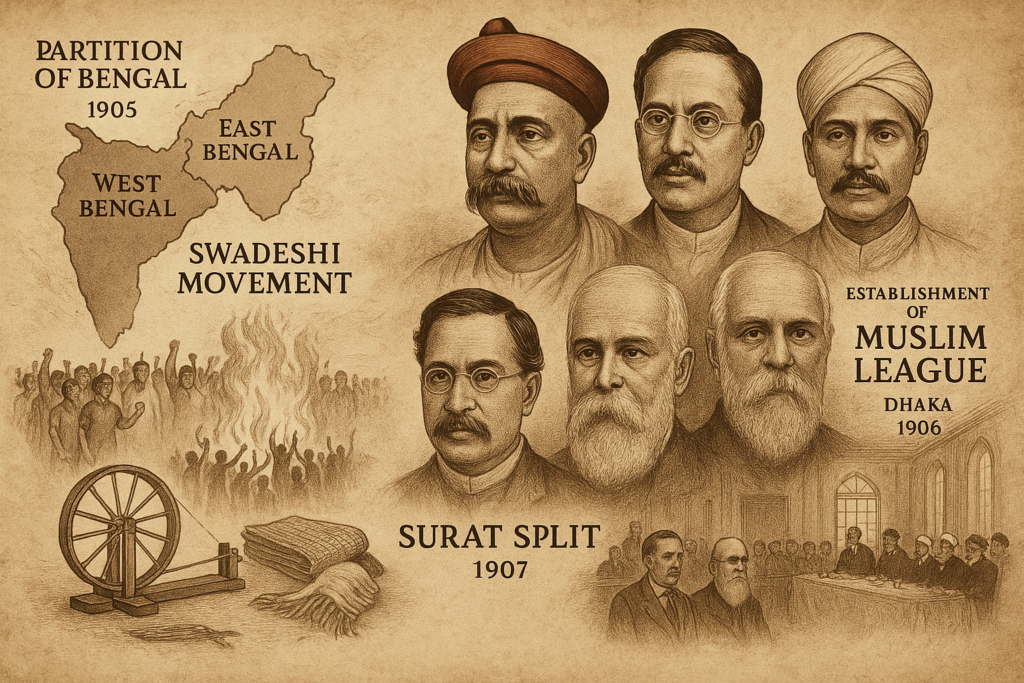
Partition of Bengal and Swadeshi Movement (1905–1911)
The Partition of Bengal (16 October 1905) and the Swadeshi Movement (1905–1911) were important milestones in the Indian freedom struggle. The Swadeshi Movement began across the country in protest against the Bengal partition and inspired Indians to become self-reliant and resist British rule.
1. Partition of Bengal (16 October 1905)
(i) Reasons for the Bengal Partition
- Bengal was the largest and most important administrative provINCe of British India.
- The British government claimed the division was for administrative convenience.
- However, the real objective was to implement the policy of “divide and rule.”
- The National Movement was strong in Bengal, and the British wanted to weaken it.
- Lord Curzon, Viceroy of India (1899–1905), announced the partition.
(ii) Partition Plan
- West Bengal – Bengali Hindu majority; Bihar and Orissa were also included.
- East Bengal and Assam – Muslim majority region.
- The British aimed to break Hindu-Muslim unity and weaken the Indian National Movement.
2. Opposition to the Bengal Partition
(i) Reaction of Indians
- The partition was called an “attack on national unity.”
- Strikes, meetings, and mass protests were organised across India.
- People observed 16 October 1905 as a Day of Mourning.
- Rabindranath Tagore organised the event “Rakhi Bandhan” to symbolise Hindu-Muslim unity.
- A nationwide movement against British rule began.
3. Swadeshi Movement (1905–1911)
(i) Beginning of the Swadeshi Movement
- Started as a response to the Partition of Bengal.
- Swadeshi means “self-made” — use of indigenous goods and boycott of foreign products.
- Its objective was to weaken the British economically and strengthen Indian industries.
(ii) Major Activities of the Swadeshi Movement
- Boycott of foreign goods — British cloth, salt, sugar, and other items.
- Promotion of indigenous goods — adoption of khadi and use of spinning wheels.
- National Education — establishment of Indian educational institutions.
- National Banks — establishment of Swadeshi banks such as “Bharatiya Janata Bank.”
- Active participation from students, women, farmers, and traders.
(iii) Prominent Leaders of the Swadeshi Movement
- Bal Gangadhar Tilak – gave the slogan “Swaraj is my birthright.”
- Lala Lajpat Rai – strengthened the movement in Punjab.
- Bipin Chandra Pal – led the movement in Bengal.
- Aurobindo Ghosh – promoted revolutionary ideas.
- Rabindranath Tagore – led the cultural movement against the partition.
4. Reaction of the British Government
- Use of repressive laws and police force.
- Support to the Partition and encouragement to the Muslim League.
- The Morley-Minto Reforms (1909) introduced separate electorates, deepening the Hindu-Muslim divide.
- Newspapers were censored and leaders were imprisoned.

Top Choice Amazon Product
Trusted quality • High performance • Excellent value for money
- ✔ 100% Genuine Product
- ✔ Amazon Fulfilled Delivery
- ✔ Easy Return & Refund
5. Revocation of the Bengal Partition (1911)
- Due to widespread protests, the British government cancelled the partition in 1911.
- Lord Hardinge announced the reunification of Bengal.
- The capital of India was shifted from Calcutta to Delhi.
6. Importance and Impact of the Swadeshi Movement
(i) Positive Impact
- Strengthened the national movement.
- Boosted Swadeshi industries and Indian textile production.
- Increased political consciousness among Indians.
- Promoted self-reliance and self-respect.
Limitations
- The movement was largely confined to urban areas.
- British repression weakened the movement.
- Differences between Moderates and Extremists led to the Surat Split (1907).
7. Conclusion
The Partition of Bengal and the Swadeshi Movement played a significant role in uniting Indians and promoting the spirit of self-reliance. Despite repression and internal divisions, the movement laid the foundation for future mass movements such as the Khilafat and Non-Cooperation Movements.
Extremist Group and Surat Split (1907)
A Detailed Study of the Extremist Group and the Surat Division
1. Rise of Extremists
(i) Leaders and Ideology
- Bal Gangadhar Tilak – “Swaraj is my birthright and I will have it.”
- Lala Lajpat Rai – led movements in Punjab.
- Bipin Chandra Pal – intensified the Swadeshi movement in Bengal.
- Aurobindo Ghosh – revolutionary thinker.
(ii) Main Ideas of the Extremists
- Demand for complete independence.
- Support for direct action and militant agitation.
- Strengthening the Swadeshi movement and boycott.
- Promoting revolutionary ideas among youth.
- Direct resistance against British oppression.
2. Moderates’ Views
(i) Moderate Party Leaders
- Gopal Krishna Gokhale – supporter of constitutional reforms.
- Dadabhai Naoroji – criticised economic exploitation.
- Surendranath Banerjee – believed in negotiation.
- Firozshah Mehta – demanded reforms through petitions.
(ii) Views of Moderates
- Belief in peaceful constitutional reforms.
- Demanding rights through petitions.
- Opposition to violence or confrontation.
- Promotion of education and press freedom.
3. Surat Split (1907)
(i) Causes of the Split
- Ideological differences between Moderates and Extremists.
- Differences on boycott and Swadeshi Movement.
- Leadership dispute — Moderates supported Rash Behari Ghosh, while Extremists wanted Tilak.
- British tactics to divide Congress.
(ii) Events at the Surat Session
- The session was held at Surat (Gujarat) in 1907.
- Heated arguments between the two groups.
- Extremists demanded a tougher stand against British rule.
- The Moderates opposed this approach.
- The Extremist leaders were expelled, leading to a split.
4. Effects of the Surat Split
(i) Impact on Congress
- The Congress became weak and ineffective.
- The British benefited from the internal division.
- Moderates collaborated with the British for reforms.
- Extremists moved toward revolutionary activities.
(ii) British Response
- Support for Moderates.
- Suppression of Extremists.
- Tilak was arrested in 1908 and sent to Burma.
(iii) Growth of Revolutionary Movements
- Formation of organisations like Anushilan Samiti and Yugantar Dal.
- Increased revolutionary activity in Punjab and Maharashtra.
5. Events After the Surat Split
- Morley-Minto Reforms (1909) – introduced separate electorates.
- Cancellation of Bengal Partition (1911) – British withdrew the decision.
- Reunion of Congress (1916) – through the Lucknow Pact; Congress and Muslim League united.
6. Conclusion
The Surat Split (1907) was a turning point in the Indian national movement. Although it weakened Congress temporarily, it strengthened the revolutionary movement. The reunification in 1916 gave new direction to the freedom struggle.
Establishment of the Muslim League (1906)
A Detailed Study
1. Background of the Establishment
The All India Muslim League was established in 1906 with the support of the British government and some Muslim leaders. Its main aim was to protect the political, social, and religious interests of Muslims.
(i) Reasons for Establishment
- British “divide and rule” policy.
- Effect of the Bengal Partition (1905).
- Dissatisfaction with Congress.
- Encouragement from the British government.
- Fear among Muslims regarding political insecurity.
2. Establishment of the Muslim League
(i) When and Where?
- Established on 30 December 1906 in Dhaka (now Bangladesh).
- The meeting was held at Bagh-e-Palace.
(ii) Founding Leaders
- Aga Khan III – First President.
- Nawab Salimullah of Dhaka.
- Viqar-ul-Mulk.
- Nawab Mohsin-ul-Mulk.
- Syed Ameer Ali.
3. Objectives of the Muslim League
- Maintain loyalty to the British government.
- Protect political, social, and religious rights of Muslims.
- Promote good relations between Muslims and the British.
- Demand separate political representation.
- Spread modern education and political awareness among Muslims.
4. Early Activities
(i) Morley-Minto Reforms (1909)
- Introduced separate electorates for Muslims.
- Weakened Hindu-Muslim unity.
(ii) Relation with Congress
- Initially, both organisations were not conflicting.
- In 1916, under the Lucknow Pact, both united to demand reforms.
5. Muslim League and Indian Independence
(i) Change of Policy (1913)
- Muhammad Ali Jinnah joined the League.
- The League became active in Indian politics.
(ii) Demand for Separate Nation (1930)
- Allama Iqbal proposed the idea of Pakistan.
(iii) Pakistan Resolution (1940)
- 23 March 1940 – Demand for Pakistan was formally adopted.
6. Effects of the Establishment of the Muslim League
(i) Positive Impact
- Provided political platform for Muslims.
- Increased political awareness.
- Encouraged modern education.
(ii) Negative Impact
- Weakened Hindu-Muslim unity.
- Conflict with Congress increased.
- Separate electorates promoted communal division.
- Ultimately contributed to India's partition.
7. Conclusion
The establishment of the Muslim League in 1906 was a significant turning point in Indian politics. Initially loyal to the British, the League later became a powerful political force advocating for a separate Muslim nation, ultimately leading to the creation of Pakistan in 1947.
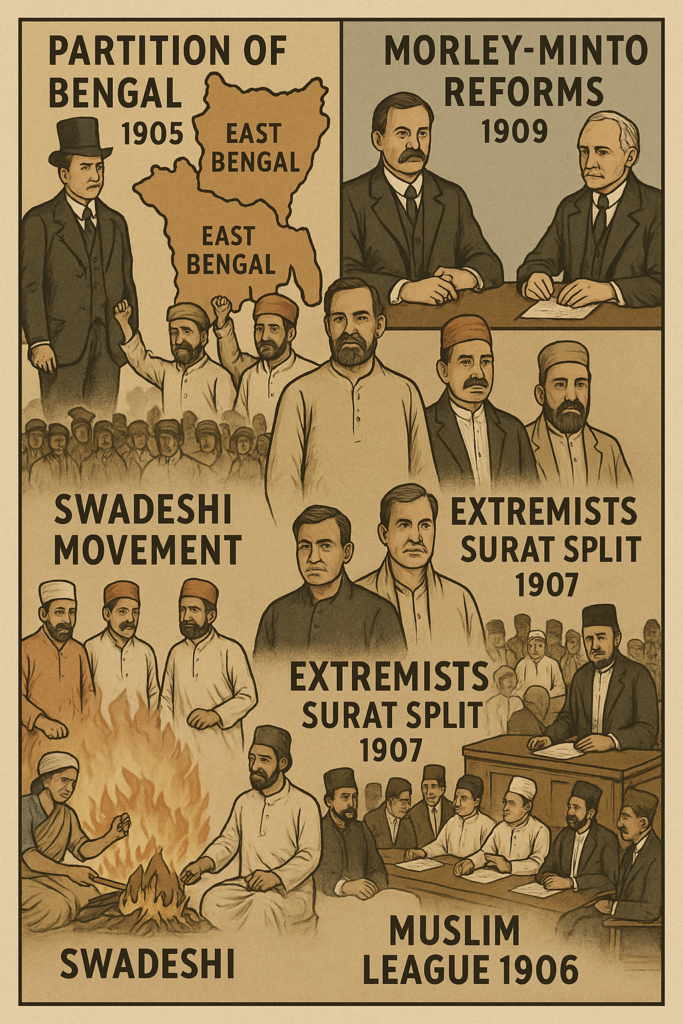
Morley-Minto Reforms (1909)
A Detailed Study
1. Introduction
The Morley-Minto Reforms of 1909 were an important constitutional step introduced by the British government. These reforms are also known as the Indian Councils Act, 1909.
Main Objectives
- To INCrease Indian participation in Government Administration.
- To weaken Hindu-Muslim unity by introducing separate representation for Muslims.
- To strengthen British political control in India.
Why Are They Called “Morley-Minto Reforms”?
- Lord Minto – Viceroy of India (1905–1910).
- John Morley – Secretary of State for India in Britain.
2. Major Provisions of the Morley-Minto Reforms
(i) Expansion of Legislative Councils
- The number of members in the Central Legislature increased from 16 to 60.
- Provincial Legislative Councils were also expanded.
(ii) Introduction of Separate Electorates
- Muslims were given the right to elect their own representatives.
- They could vote only for Muslim candidates.
- This system damaged Hindu-Muslim unity and promoted communal politics.
(iii) Limited Powers to Indians in Councils
- Indians could discuss government budgets and policies.
- However, they had no real decision-making power.
- The government was not bound to answer their questions.
(iv) Inclusion of Indians in the Executive Council
- For the first time, an Indian was included in the British Executive Council.
- Satyendra Prasanna Sinha became the Advocate General of India.
- This was symbolic, with no real authority given to Indians.
(v) No Reforms for Civil Liberties
- No protection was given for freedom of press or expression.
- The government continued to suppress nationalist activities.
3. Effects of the Morley-Minto Reforms
(i) Positive Impact
- Indians entered legislative councils for the first time.
- An Indian was included in the Executive Council.
- Indians could debate government policies.
(ii) Negative Impact
- Separate electorates broke Hindu-Muslim unity.
- The British successfully strengthened the policy of “Divide and Rule.”
- No real powers were given to Indians.
4. Reaction of Indian Leaders
(i) Reaction of the Congress
- Congress called the reforms “disappointing” and “inadequate.”
- Extremist leaders like Tilak rejected the reforms.
- Moderates accepted them partially but were still dissatisfied.
(ii) Reaction of the Muslim League
- The Muslim League welcomed the reforms.
- Separate electorates strengthened its political position.
- The League’s relations with the British became stronger.
5. Conclusion
The Morley-Minto Reforms (1909) were a major example of the British “Divide and Rule” policy. Though they offered limited political opportunities, the key outcome was the creation of separate electorates, which seriously damaged Hindu-Muslim unity and paved the way for the partition of India in 1947.
6. Main Points (in Brief)
- Implemented in 1909.
- Increased Indian representation in councils.
- Introduced separate electorates for Muslims.
- Indians included in the Executive Council.
- Indian leaders criticised the reforms as divisive.
Ghadar Movement (1913–1915)
A Detailed Study
The Ghadar Movement was a revolutionary movement led by Indian immigrants abroad, especially in the USA and Canada. It aimed to organise an armed revolt against British rule in India.
1. Background of the Ghadar Movement
(i) Condition of Indian Immigrants
- In the 19th and 20th centuries, thousands of Indians migrated to Canada, the USA, Southeast Asia, and Africa.
- They faced racial discrimination and were denied civil rights.
- Indians faced segregation in Canada and America.
(ii) Political Situation in India
- The Partition of Bengal (1905) intensified revolutionary activities.
- The Morley-Minto Reforms (1909) deepened communal divide.
- Leaders like Tilak and Lala Lajpat Rai faced British repression.
2. Establishment of the Ghadar Party (1913)

Amazon Choice Quality
Reliable performance • Popular seller • Great value for money
- ✔ 100% Genuine Product
- ✔ Fast & Secure Amazon Delivery
- ✔ Easy Return Policy
(i) When and Where?
- Founded on 15 July 1913 in San Francisco, USA.
- Formed by Indian immigrants to organise an armed revolution.
- Gurdwara Yugantar Ashram became the main headquarters.
(ii) Founders and Prominent Leaders
- Lala Hardayal – chief founder and ideologue.
- Sant Baba Sohan Singh Bhakna – first president.
- Bhagat Singh Thind – prominent leader in the USA.
- Kanshi Ram – military advisor.
- Kartar Singh Sarabha – young revolutionary leader.
(iii) Objectives of the Ghadar Party
- To free India from British rule.
- To unite Indian immigrants for revolution.
- To send weapons to India for rebellion.
- To inspire Indian soldiers to revolt against the British army.
3. Major Activities of the Ghadar Movement (1913–1915)
(i) Publication of “Gadar” Newspaper
- The Ghadar Party published a newspaper named Gadar.
- It was printed in Hindi, Punjabi, Urdu, and other languages.
- The paper exposed British atrocities and inspired revolution.
(ii) World War I and Plans for Rebellion
- World War I began in 1914.
- The British were busy in the war, encouraging Ghadar leaders to plan revolt.
- Around 8,000 Indians returned from abroad to join the movement.
- Attacks were planned in Punjab, Bengal, and North India.
(iii) The Failed Revolt of February 1915
- Leaders like Kartar Singh Sarabha and Rash Behari Bose planned a revolt for 21 February 1915.
- The plan involved Indian soldiers of the British Army.
- British intelligence discovered the plan and crushed the revolt.
4. Reasons for Failure
(i) Strong British Intelligence
- The British already had information about the revolt.
- Many leaders were arrested before action.
(ii) Failure to Mobilise Indian Soldiers
- The movement failed to gain widespread support in the army.
(iii) Lack of Resources
- Insufficient weapons and funds for a successful revolt.
(iv) Weak Leadership & Internal Differences
- Lala Hardayal was arrested in the USA in 1914.
- Lack of an organised and coordinated plan.
5. Impact and Importance of the Ghadar Movement
(i) Impact on Indian Freedom Struggle
- Inspired Indian revolutionaries like Bhagat Singh and Chandrashekhar Azad.
- Rash Behari Bose later assisted the formation of the Azad Hind Fauj.
(ii) British Repression
- The British conducted the Lahore Conspiracy Case (1915).
- Kartar Singh Sarabha and several others were executed.
- Press restrictions and imprisonment increased.
(iii) Rise of Nationalism Among Overseas Indians
- Created strong nationalist consciousness among NRIs.
- Support for the Indian independence struggle grew in the West.
6. Conclusion
The Ghadar Movement was an important but unsuccessful attempt to overthrow British rule through an armed uprising. Although it failed, it inspired widespread revolutionary spirit and showed that Indians abroad were ready to sacrifice for their homeland.
7. Main Points (in Brief)
- Founded in 1913 in San Francisco.
- Led by Hardayal, Sarabha, and Sohan Singh Bhakna.
- Published the revolutionary “Gadar” newspaper.
- Planned a mutiny in 1915, which failed.
- Inspired future revolutionary movements.
References
Customer Favorite Amazon Product
Excellent performance • Trusted quality • Great value for money
- ✔ 100% Genuine Product
- ✔ Amazon Fulfilled Delivery
- ✔ Easy Returns & Refunds
- NCERT History Textbooks – Class 8, 9, 10, and 12.
- Bipan Chandra – India’s Struggle for Independence.
- Rajiv Ahir (Spectrum) – Modern India.
- R.C. Majumdar – History of the Freedom Movement in India.
- B.L. Grover – A New Look at Modern Indian History.
- National Archives of India – Official historical documents.
- Various academic research papers and university publications on Modern Indian History.