Introduction: Setting the Stage and Roadmap of the Article
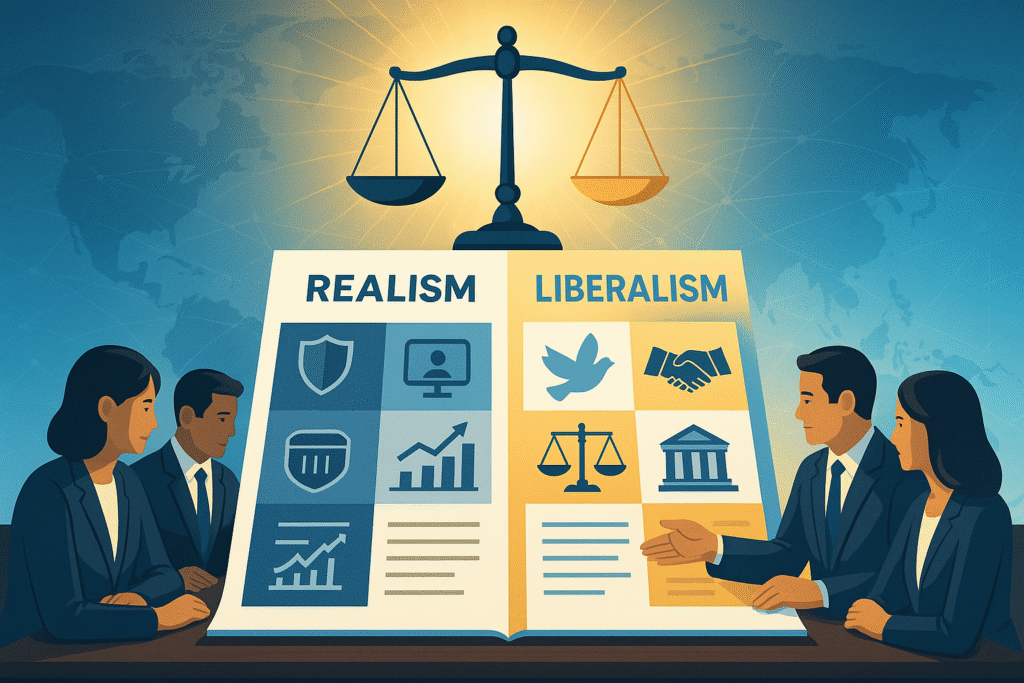
Realism vs Liberalism is one of the most enduring and influential debates in international relations. Throughout human history, ideas and ideologies have shaped the course of political systems and global affairs. Among the most powerful of these are Realism and Liberalism — two contrasting yet interconnected schools of thought that continue to define the modern political landscape.
In the debate of Realism vs Liberalism, the realist perspective is grounded in the belief that the world operates in a state of anarchy where power, security, and self-interest dominate. It argues that states act primarily to ensure their survival and enhance their strength, often at the expense of cooperation or morality. In contrast, Liberalism challenges this pessimistic worldview by emphasizing the potential for peace, progress, and cooperation through dialogue, institutions, and shared values.
The discussion of Realism vs Liberalism becomes even more relevant in the modern world — marked by climate change, economic inequality, technological rivalry, and geopolitical tension. Nations today face a constant dilemma: should they adopt a realist approach to safeguard national interests, or a liberal one to foster cooperation and long-term stability? Understanding Realism vs Liberalism helps clarify when and how each philosophy may be applied effectively.
This article aims to explore the philosophical foundations, historical evolution, and major proponents behind Realism vs Liberalism. It will examine how these theories influence contemporary global politics, highlighting real-world examples that demonstrate how states balance power with cooperation in decision-making.
If you are a student of politics, international relations, or simply someone curious about global affairs, this analysis of Realism vs Liberalism will serve as both a guide and reflection — helping you understand how these competing yet complementary ideas shape our personal, national, and international choices.
Why This Discussion Matters
In today’s world, where nations are deeply engaged in safeguarding their borders, security, and strategic interests, global challenges such as climate change, human rights crises, and economic inequality demand collective action. This raises a crucial question — should the world continue to follow the power-centric path of Realism or embrace the cooperation and ethical values of Liberalism?
This discussion extends far beyond international politics; it resonates with our personal lives as well. Each day, we face choices between being practical or staying true to our ideals. Understanding the balance between Realism and Liberalism, therefore, is not just a theoretical exercise — it is a reflection of human nature, ethical reasoning, and the constant search for harmony between self-interest and collective good.
Realism: Core Ideas, History, and Major Thinkers
Realism is one of the most influential schools of thought in political science and international relations. Its core premise is that human nature is inherently self-interested, and power is the central force driving politics. Realists believe that the international system is anarchic — meaning there is no central authority to govern or enforce rules among states. In such a world, every nation’s primary goal is to ensure its security and national interest.
Realism argues that morality and idealism play a limited role in politics, as decisions are ultimately driven by the balance of power and self-interest. States are viewed as rational actors that act strategically to survive and protect their sovereignty in an uncertain global environment.
The roots of Realism can be traced back to the ancient Greek historian Thucydides, who, in his account of the Peloponnesian War, emphasized that human conflict arises from fear, honor, and self-interest. Later, Niccolò Machiavelli, in his seminal work The Prince, asserted that political success depends on pragmatism and outcomes rather than moral intentions. In the 17th century, Thomas Hobbes in his work Leviathan described the state of nature as “a war of all against all,” arguing that only a powerful authority can maintain order.
In the 20th century, Realism was redefined by thinkers like Hans Morgenthau and Kenneth Waltz. Morgenthau developed the idea of “Political Realism,” emphasizing power as the main currency of international relations. Waltz later advanced the theory of Structural Realism or Neorealism, suggesting that the behavior of states is shaped more by the structure of the international system than by individual leaders’ intentions.
Thus, Realism is not merely a theory but a pragmatic worldview that explains why nations often prioritize competition over cooperation and why “power” remains the central element of global politics even today.
English/European Perspective
The emergence and evolution of Realism are deeply rooted in the European historical context, shaped by centuries of wars, imperial ambitions, and the constant struggle for power. From the 17th to the 19th century, nations like England, France, and Germany practiced power politics, where maintaining a Balance of Power became essential to prevent any single nation from dominating Europe.
British thinkers and diplomats refined this principle into a guiding doctrine for international stability. The Treaty of Westphalia (1648) — which ended the Thirty Years’ War — marked the birth of the modern nation-state system, enshrining the concept of sovereignty and non-interference. This treaty became a cornerstone of Realist political thought, asserting that states are independent and must rely on their own power to survive.
Throughout European history, the Realist mindset prevailed — moral or religious ideals were often set aside in favor of pragmatic decision-making. Power, not virtue, became the measure of success. This perspective laid the intellectual foundation for modern diplomacy, geopolitics, and international security policies that still dominate global relations today.
Practical Examples (Wars and Power Politics)
Several historical events demonstrate the practical application of Realist principles. The Second World War is a prime example — nations acted according to their security interests rather than moral concerns. Britain and France initially pursued appeasement with Germany to maintain peace, but when Hitler’s power grew uncontrollable, they were forced into war — a clear reflection of the Balance of Power principle.
The Cold War further solidified Realism’s dominance. The rivalry between the United States and the Soviet Union was not merely ideological but rooted in the pursuit of global influence and security. The nuclear arms race, formation of alliances such as NATO and the Warsaw Pact, and numerous proxy wars all stemmed from Realist logic — the relentless quest for power and deterrence.
Even today, when nations increase their defense budgets, engage in strategic alliances, or assert dominance in regional disputes, they are operating under Realist principles. Realism, therefore, remains not just a theory of the past but a living reality shaping global politics in the 21st century.

Liberalism: Theory, Development, and Key Arguments
Liberalism is an intellectual and political tradition that emphasizes the potential for cooperation, rule-based order, and progress through institutions, norms, and individual rights. At its core, liberalism argues that human beings are capable of mutual benefit, and that states — if embedded in supportive domestic and international institutions — can transcend zero-sum competition. Rather than treating international politics as driven solely by power, liberalism highlights how democracy, economic interdependence, legal frameworks, and transnational networks reduce incentives for conflict and create pathways for collective problem-solving.
The historical roots of liberal thought reach back to the Enlightenment. Thinkers such as John Locke articulated ideas of individual rights, consent of the governed, and limited government, while Immanuel Kant proposed a cosmopolitan vision where republican constitutions and a global federation of laws could produce durable peace. In the nineteenth and early twentieth centuries, liberalism influenced movements for constitutionalism, free trade, and the rule of law — all seen as foundations for more peaceful international relations.
In the twentieth century, liberal ideas informed the post-Second World War architecture: institutions like the United Nations, Bretton Woods organizations, and multilateral treaties reflected a belief that formal rules and organizations could manage inter-state relations and channel competition into stable, predictable forms. Scholars developed several strands of liberal thought — institutional, normative, and commercial — each stressing different mechanisms through which liberalism reduces conflict.
Key arguments in favor of liberalism include: first, that institutions matter, because they reduce uncertainty through rules, transparency, and repeated interactions; second, that democratic states are less likely to go to war with one another (the democratic peace thesis); third, that economic interdependence raises the costs of conflict and creates mutual stakes in stability; and fourth, that transnational actors — from NGOs to multinational corporations — shape state preferences and broaden the sphere of cooperation beyond narrow security concerns.
Critics correctly point out that liberalism can be overly optimistic: institutions sometimes fail, democracies may still engage in coercive behavior, and economic ties do not automatically prevent rivalry. Yet, empirical cases — from trade-driven rapprochement to cooperative responses to transnational threats — suggest that liberal mechanisms often make cooperation more feasible and sustainable than a purely power-centric view predicts. Thus, liberalism offers both normative reasons (justice, rights, dignity) and pragmatic tools (treaties, courts, intergovernmental organizations) for managing global problems.
Ultimately, liberalism frames international politics not as a single story of conflict but as a plural story in which rules, values, and shared interests create enduring possibilities for collective action. It does not deny power's role; rather, it argues that power can be harnessed more productively when embedded in institutions and guided by norms that elevate cooperation over perpetual antagonism.
Institutional Liberalism vs. Ideational (Normative) Liberalism
Institutional Liberalism emphasizes the role of formal structures — treaties, international organizations, dispute-resolution mechanisms, and legal regimes — in shaping state behavior. From this perspective, institutions reduce transaction costs, provide information that mitigates mistrust, and create enforcement or reputational incentives that make cooperation durable. For example, trade agreements with dispute-settlement provisions lower the risk that economic tensions will escalate into political conflict. Institutional liberals therefore focus on design features: repetition, monitoring, verification, and sanctions.
By contrast, Ideational or Normative Liberalism stresses the power of ideas, identities, and moral commitments. This strand argues that values such as human rights, democratization, and shared norms transform state preferences themselves — not just the context in which choices are made. According to ideational liberals, normative shifts (for instance, the delegitimization of colonialism or apartheid) can create lasting changes in international behavior because states internalize new standards and domestic constituencies demand different policies.
While institutional liberals highlight structures and incentive systems, ideational liberals highlight belief systems and identity formation. In practice, the two are complementary: institutions can help spread and consolidate norms, and norms can strengthen the legitimacy and effectiveness of institutions. Together they explain how rules and values work in tandem to produce more cooperative international outcomes.
Examples of Global Institutions and Cooperation
There are many concrete instances where liberal mechanisms have facilitated cooperation. The United Nations provides a forum for diplomacy, peacekeeping mandates, and humanitarian coordination, helping states manage disputes without resorting to force. The World Trade Organization (WTO) established binding dispute settlement procedures that have, in many cases, resolved trade conflicts through legal means rather than unilateral measures.
Climate governance illustrates institutional cooperation: the Paris Agreement created a common framework for nationally determined contributions, transparency, and reporting — encouraging states to coordinate mitigation and adaptation policies. In public health, institutions such as the World Health Organization (WHO) play a central role in disease surveillance, information-sharing, and technical assistance during pandemics.
Finally, regional bodies like the European Union demonstrate the depth of integration possible when economic interdependence, legal harmonization, and supranational institutions combine to lock in peace and cooperation among erstwhile rivals. These examples show how institutions and shared norms can convert potential conflict into sustained collaboration, illustrating the practical power of liberalism in today’s interconnected world.


Realism vs Liberalism: Comparison and Contestation
The debate of Realism vs Liberalism forms the core of much scholarship and policymaking in international relations. While Realism emphasizes power, survival, and the competitive nature of states operating in an anarchic international system, Liberalism highlights institutions, norms, and interdependence as pathways to cooperation and peace. The discussion of Realism vs Liberalism is not merely academic: it shapes defense budgets, treaty design, diplomatic posture, economic policy, and public rhetoric.
Theoretical Differences in Realism vs Liberalism
At a foundational level, the debate of Realism vs Liberalism revolves around contrasting assumptions about how the international system functions. Realism answers the question “what is” — describing an order defined by anarchy, where the absence of a central authority compels states to rely on self-help. Realists see states as unitary, rational actors whose primary objective is survival, leading to balance-of-power politics, deterrence, and security competition.
By contrast, Liberalism presents a more optimistic alternative within the Realism vs Liberalism debate. Liberals argue that domestic institutions, economic interdependence, and shared norms can transform state behavior. Where Realism focuses on material capabilities and structural constraints, Liberalism emphasizes repeated interaction, international organizations, and democratic governance as mechanisms for stability and cooperation.
Impact on Policy-Making
The influence of Realism vs Liberalism becomes visible in policy design. A realist-informed policymaker prioritizes military readiness, strategic alliances, and credible deterrence to secure national interests. Conversely, a liberal-oriented approach invests in international institutions, treaties, multilateral frameworks, and economic integration to reduce conflict and foster cooperation.
In practice, most governments blend both sides of the Realism vs Liberalism spectrum. They maintain robust defense postures while participating in global institutions such as trade regimes, climate agreements, and diplomatic forums. The balance often depends on strategic culture, threat perception, and domestic political pressures.
Example: Geopolitical Contestation
Geopolitical rivalries vividly illustrate the tension within Realism vs Liberalism. In disputes over strategic waterways or contested regions, a realist response typically emphasizes hard power — naval deployments, military alliances, and defense expansion. A liberal response, on the other hand, stresses legal arbitration, multilateral negotiation, and confidence-building measures to reduce escalation risks.
Ultimately, the Realism vs Liberalism framework reminds us that international politics is rarely governed by a single logic. Successful states often combine credible deterrence with institutional engagement, balancing power with cooperation. Understanding Realism vs Liberalism allows policymakers and scholars alike to navigate global complexity with greater clarity and strategic awareness.

My Experience: A Personal Struggle Within the Realism vs Liberalism Debate — and What I Learned
Over the course of my professional and community work, I have repeatedly confronted the practical meaning of the Realism vs Liberalism debate. More than once, I found myself oscillating between two instincts: a realist instinct to secure immediate order and safety, and a liberal instinct to build institutions, encourage dialogue, and cultivate shared values. This lived experience of Realism vs Liberalism taught me that neither approach alone is sufficient; the most durable results often come from a pragmatic blend of both.
Several years ago I was asked to lead a local economic-recovery initiative in a region marked by mistrust and sporadic violence. My initial strategy leaned toward the liberal side of the Realism vs Liberalism spectrum — focusing on inclusive forums, shared infrastructure, and trust-building mechanisms. I believed that dialogue and institutional cooperation would gradually restore stability.
At first, this liberal-oriented approach seemed promising. Stakeholder meetings were organized, cooperation agreements were signed, and a spirit of partnership emerged. Yet when implementation began — particularly around security guarantees and land disputes — deeper anxieties resurfaced. The Realism vs Liberalism tension became visible in practice: goodwill alone could not overcome entrenched fears about safety and power imbalance.
Recognizing this, I adopted more realist, short-term measures. We introduced monitored trade corridors, negotiated security protocols, and provided limited compensation mechanisms to reduce immediate risk. These steps reflected the realist logic within the Realism vs Liberalism framework — prioritizing order and predictability before broader cooperation.
However, relying solely on realist safeguards created new concerns about trust and autonomy. To balance this, we reinvested in liberal institutional mechanisms: transparent grievance systems, rotating leadership roles, and inclusive governance committees. Gradually, the hybrid approach began to work. The realist measures created stability, while liberal institutions nurtured long-term trust.
- Context matters: The Realism vs Liberalism debate is not theoretical abstraction — it plays out differently depending on security conditions and stakeholder incentives.
- Short-term security enables long-term cooperation: Realist protections can create the space needed for liberal institutions to develop.
- Institutions need credibility: Liberal ideals require practical enforcement mechanisms to sustain cooperation.
Ultimately, my experience taught me that the Realism vs Liberalism divide should not be viewed as a rigid choice but as a dynamic continuum. Realism provides urgency and protection; Liberalism provides vision and institutional durability. When applied thoughtfully and ethically, the balance between Realism vs Liberalism can produce outcomes that are both effective and sustainable.

Practical Policy Takeaways from the Realism vs Liberalism Debate
Designing effective public policy often requires navigating the core tensions of the Realism vs Liberalism debate. Policymakers must balance immediate security needs with long-term institutional development. A thoughtful approach to Realism vs Liberalism ensures that urgent stability concerns are addressed while also building transparent, inclusive systems that reduce future risks.
- Sequencing in Realism vs Liberalism: Begin with time-bound measures that reduce immediate risks (realist logic), then transition toward institution-building and legal frameworks (liberal logic) that lock in long-term gains.
- Hybrid policy design: The Realism vs Liberalism framework encourages combining deterrence, monitoring, and contingency planning with treaties, economic incentives, and dispute-resolution mechanisms so that security and cooperation reinforce each other.
- Local participation and subsidiarity: Within the Realism vs Liberalism approach, legitimacy is crucial. Engaging local stakeholders ensures that policies remain context-sensitive and sustainable.
- Clear metrics and monitoring: Effective application of Realism vs Liberalism requires measurable indicators for both short-term protection and long-term institutional strength.
- Proportionality and exit strategies: Realist instruments should include sunset clauses and clear exit criteria, preventing temporary safeguards from becoming permanent constraints.
- Inclusive institutions: Liberal elements within Realism vs Liberalism must be supported by grievance mechanisms, transparency tools, and enforceable frameworks.
- Policy adaptability: The Realism vs Liberalism balance should evolve as threat perceptions, economic shocks, and political dynamics change.
- Communication and narrative: Publics must understand why a Realism vs Liberalism hybrid approach is necessary — short-term security enables long-term cooperation.
In essence, Realism vs Liberalism should be seen not as a rigid choice but as complementary toolkits. Realist measures stabilize and protect; Liberal instruments build durable systems that reduce the future need for coercion.
When to Adopt a Realist Stance within Realism vs Liberalism
Within the Realism vs Liberalism spectrum, a realist posture is appropriate when immediate threats to security, territorial integrity, or economic stability are present. Armed conflict, cross-border incursions, or severe economic shocks often require decisive, time-bound measures. However, even in these scenarios, Realism vs Liberalism suggests pairing security action with a roadmap toward institutional stabilization.
When Liberal Values and Instruments Are Most Useful in Realism vs Liberalism
The liberal dimension of Realism vs Liberalism is most effective in addressing long-term, transnational challenges such as climate change, trade governance, and global health. Institutions, legal frameworks, and economic interdependence reduce long-term conflict risks and strengthen cooperation.
Ultimately, the Realism vs Liberalism framework demonstrates that durable governance requires both protective security measures and resilient institutions. Balancing Realism vs Liberalism allows policymakers to respond effectively to immediate crises while building systems that sustain peace and cooperation over time.
Major Criticisms and Challenges in the Realism vs Liberalism Debate
The debate of Realism vs Liberalism has deeply influenced international relations, yet both perspectives face substantial criticisms in an increasingly complex global order. Within the Realism vs Liberalism framework, Realism is often criticized for its narrow emphasis on power, security, and state survival, which can marginalize ethical concerns such as human rights, humanitarian protection, and democratic values.
Critics argue that in the Realism vs Liberalism debate, a strictly realist approach risks normalizing coercive measures and overlooking long-term social consequences like repression, displacement, or economic isolation. By prioritizing strategic advantage above normative considerations, Realism may provide short-term stability but weaken moral legitimacy.
On the other side of the Realism vs Liberalism spectrum, Liberalism is frequently challenged for its optimism regarding institutions and normative transformation. Skeptics contend that international institutions can be weak, politically captured, or ineffective—especially when major powers disregard established rules. Economic interdependence does not always prevent conflict, and democratic norms do not automatically guarantee peaceful foreign policy behavior.
Beyond these paradigm-specific critiques, the broader Realism vs Liberalism discourse faces shared contemporary challenges. Globalization, technological disruption, cyber warfare, climate change, pandemics, and non-state actors complicate traditional policy tools. The blurring of boundaries between security and economics makes the Realism vs Liberalism divide more complex than classical theory assumed.
Another limitation within the Realism vs Liberalism framework is theoretical incompleteness. Neither perspective fully accounts for identity politics, domestic polarization, or the expanding role of multinational corporations, digital platforms, and transnational networks. Overreliance on a single doctrine within the Realism vs Liberalism debate can produce rigid strategies that fail to adapt to evolving threats.
Ultimately, addressing the weaknesses of Realism vs Liberalism requires intellectual flexibility and policy pluralism. Policymakers must adopt context-sensitive, hybrid strategies that combine deterrence, diplomacy, institutional engagement, and normative commitments. The enduring relevance of Realism vs Liberalism lies not in choosing one over the other, but in understanding their limits and integrating their strengths.
Conclusion & Next Steps
The enduring relevance of Realism vs Liberalism lies in the powerful lenses each provides for interpreting world affairs: Realism underscores the importance of security, power, and pragmatic constraints, while Liberalism highlights institutions, norms, and the possibilities of cooperation. The most effective strategies often combine both — using short-term, targeted measures to manage immediate risks and investing in institutions and shared norms to reduce future conflicts. Context, sequencing, and adaptability are the real tools of wise policy-making.
FAQ — Frequently Asked Questions
1. What is the main difference between Realism and Liberalism?
In short: Realism emphasizes power, security, and state interests in an anarchic international system; Liberalism emphasizes institutions, norms, and interdependence as pathways to cooperation. Realism describes “what is”; Liberalism suggests “what can be.”
2. Is it ever safe to rely entirely on one theory?
No. Relying solely on Realism risks neglecting long-term cooperation and humanitarian costs, while relying only on Liberalism can leave states vulnerable to immediate threats. Most effective strategies combine elements of both, adapted to context.
3. Does the democratic peace theory prove Liberalism is correct?
Democratic peace theory shows that stable democracies are less likely to fight one another, which supports a core liberal claim. However, it is not universal—context, leadership, and external pressures also shape outcomes.
4. How do these theories matter in everyday life?
At the personal level, the debate mirrors choices between pragmatism and principle. Practically, it advises whether to prioritize immediate, security-oriented measures or invest in longer-term, institution-building solutions—and often both in sequence.
5. Which approach works better for modern challenges like climate change or cyber threats?
Transnational problems generally require liberal instruments—treaties, institutions, and cooperative frameworks—but they also often need immediate realist-style measures (rapid emergency responses, sanctions, or defensive capabilities). A hybrid, situational approach is typically most effective.
References
Note: The references below are sample entries — update publication years, translations, and URLs as per your use. Always include rel="noopener noreferrer" in external links for security and open them in a new tab with target="_blank".
- Thucydides. — The History of the Peloponnesian War. (Classical Text).
- Niccolò Machiavelli. — The Prince. (Translation and publication details).
- Thomas Hobbes. — Leviathan. (1651).
- Hans Morgenthau. — Politics Among Nations: The Struggle for Power and Peace. (Publication year, Publisher).
- Kenneth Waltz. — Theory of International Politics. (Publication year, Publisher).
- Immanuel Kant. — Perpetual Peace. (Essay).
- John Locke. — Two Treatises of Government. (For philosophical reference and analysis).
- United Nations (UN). — UN Charter. (1945). Read the UN Charter
- Paris Agreement. — UNFCCC, 2015. Official Paris Agreement Source
- World Health Organization (WHO). — Reports and global health policy frameworks (e.g., pandemic preparedness plans). WHO Official Website
- World Trade Organization (WTO). — Dispute settlement reports and trade governance documents. WTO Official Source
- Additional contemporary sources: — Include academic journal articles, policy briefs, and verified online publications used for analysis; cite them here in APA, MLA, or Chicago style as required.
Reference Style Tip: For academic or professional use, follow a consistent format (APA, Chicago, or MLA). When referencing websites, always include the publication date and the date accessed.