
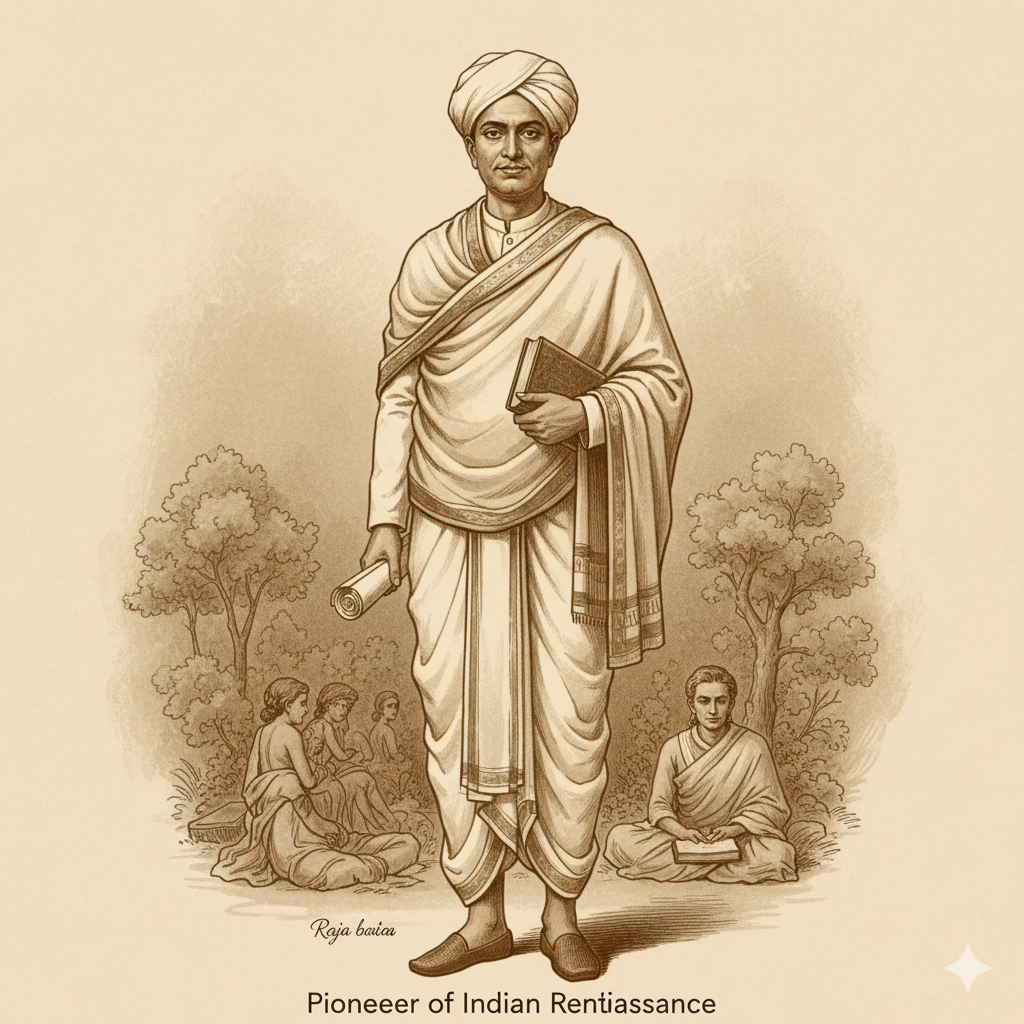
Raja Rammohan Roy: Social Reformer of India and Pioneer of Renaissance
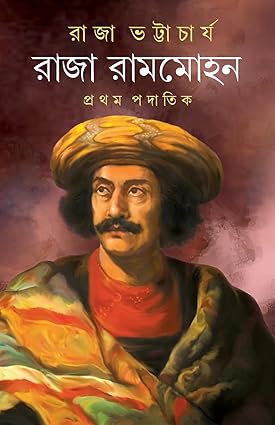
Raja Rammohan Roy (1772–1833) was one of India's greatest social reformers and is often regarded as the pioneer of the Indian Renaissance. He was a visionary thinker, educationist, religious reformer, and social worker whose life was dedicated to eliminating societal evils and laying the foundation of modern India.
Early Life and Education
Raja Rammohan Roy was born on 22 May 1772 in Radhanagar village (Murshidabad district) of West Bengal. His father, Ramkant Roy, was a high-caste Brahmin, and his mother, Tarini Devi, was a deeply religious woman.
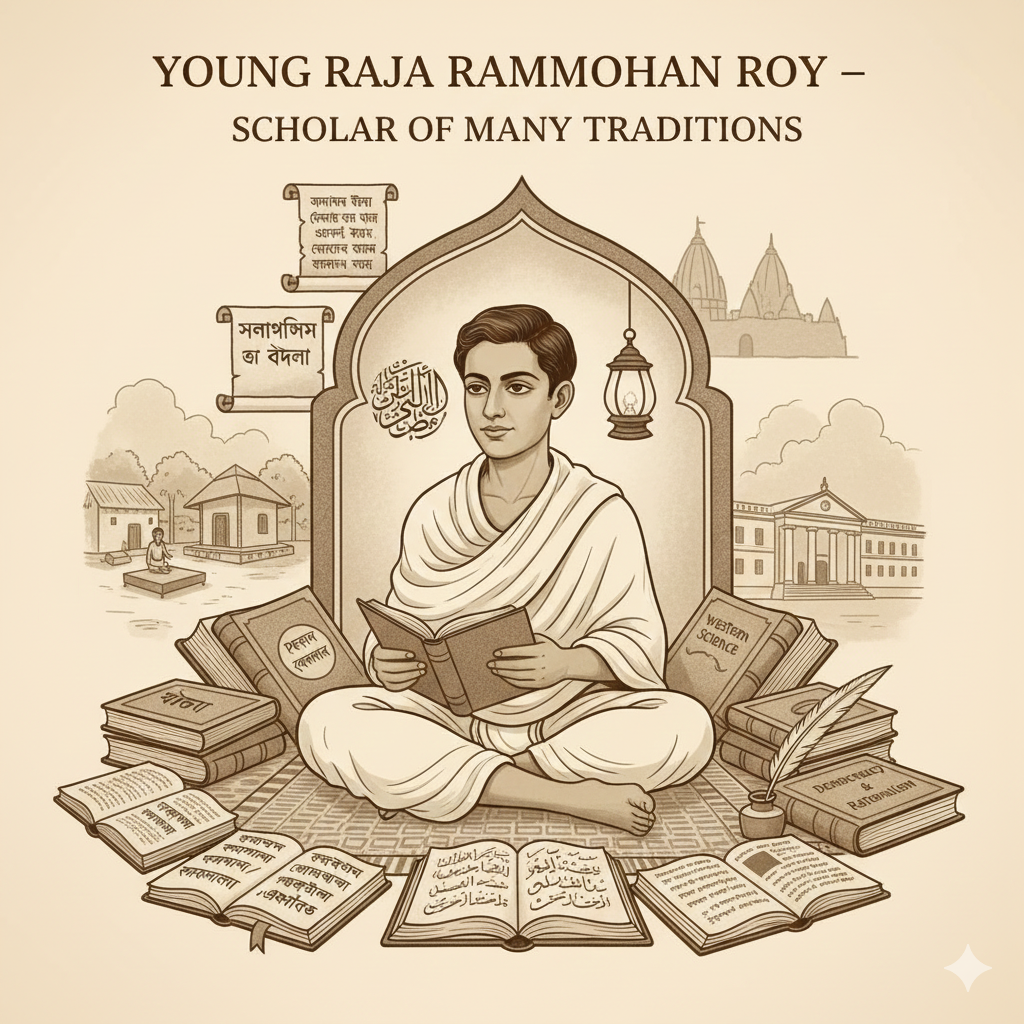
He studied Sanskrit, Persian, Arabic, and later English. His mastery of Sanskrit enabled him to study the Vedas and Upanishads in depth. Through his Persian and Arabic studies, he explored Islamic scriptures and Sufi philosophy. Learning English helped him understand Western civilization and modern thought.
Contribution to Social Reform
1. Abolition of the Practice of Sati
Raja Rammohan Roy devoted his life to improving the status of women. He strongly opposed the cruel practice of Sati, in which widows were forced to burn themselves on their husbands’ funeral pyres. Due to his continuous struggle and support from Lord William Bentinck, Sati was declared illegal in 1829.
2. Widow Remarriage and Women Empowerment
He encouraged widow remarriage and emphasized the importance of women’s education. Inspired by his thoughts, Ishwar Chandra Vidyasagar later played a major role in implementing the Widow Remarriage Act.
3. Movement Against Child Marriage and Caste System
Rammohan Roy campaigned against child marriage, caste-based discrimination, and other social evils. He called the caste system a major barrier to human progress and advocated for equality in society.
4. Promotion of Education and Modern Thinking
He laid the foundation for modern education in India. In 1817, he helped establish the “Hindu College,” which later became Presidency College. He promoted Western science, mathematics, and English education so that Indians could gain modern knowledge.
Religious Reforms and the Establishment of Brahmo Samaj
Raja Rammohan Roy opposed idol worship, superstition, and religious fanaticism. In 1828, he founded the “Brahmo Samaj,” a movement that advocated monotheism (belief in one God) and aimed at social and religious reform. The Brahmo Samaj encouraged rational thinking and rejected outdated customs.
Journalism and Freedom of the Press
He was one of the first journalists of India and worked tirelessly for press freedom. His major publications included:
- Samvada Kaumudi (Bengali)
- Mirat-ul-Akhbar (Persian)
- Bangadoot (multilingual)
He openly criticized unjust policies of the British government and fought strongly for the freedom of the press.
Title of Raja and Foreign Travel
Recognizing his contribution, the British government awarded him the title of “Raja.” In 1830, he traveled to England as the envoy of Mughal Emperor Akbar II. There he fought for the political rights of Indians and represented their concerns before the British authorities.
Death
Raja Rammohan Roy passed away on 27 September 1833 in Bristol, England. Even after his death, his thoughts and reforms continued to guide the Indian society toward progress and enlightenment.

✔ Comfortable & easy to use
✔ Excellent performance for the price
✔ Popular choice among buyers
Conclusion
Raja Rammohan Roy brought revolutionary changes to Indian society. Throughout his life, he worked tirelessly to create awareness, eradicate social evils, and introduce progressive ideas. His contribution to social reforms, women empowerment, modern education, and religious awakening made him a true pioneer of the Indian Renaissance. His legacy continues to inspire generations even today.
Frequently Asked Questions (FAQ)
1. Who was Raja Rammohan Roy?
He was a great social reformer, educationist, religious thinker, and pioneer of the Indian Renaissance.
2. Why is Raja Rammohan Roy called the 'Father of Modern India'?
Because he introduced modern education, fought social evils, promoted rational thinking, and laid the foundation of India’s socio-cultural transformation.
3. What was his biggest contribution?
The abolition of the practice of Sati in 1829 is considered his most significant achievement.
4. What is Brahmo Samaj?
Brahmo Samaj is a reformist religious movement founded by Rammohan Roy in 1828, promoting monotheism and rejecting superstition.
5. What newspapers did he publish?
Samvada Kaumudi, Mirat-ul-Akhbar, and Bangadoot were his major publications.
Raja Rammohan Roy: Early Life, Education and Contribution to Social Reform
Early Life and Education of Raja Rammohan Roy
Raja Rammohan Roy was born on 22 May 1772 in a Brahmin family in Radhanagar village (Murshidabad district), West Bengal. His father, Ramkant Rai, was a traditional Hindu Brahmin who believed in Vedic rituals, while his mother, Tarini Devi, was a woman of deep religious values.
Childhood and Family Influences
Rammohan Roy’s childhood was spent in a traditional Hindu environment where Vedic studies and religious rituals were considered essential. Initially, this upbringing shaped him as a ritualistic Brahmin, but later his thoughts evolved through education and exposure to different philosophies.
Education and Intellectual Development
From a young age, Rammohan Roy displayed a strong interest in learning. He mastered several languages and studied diverse subjects, which had a profound influence on his worldview.
1. Early Education in Bengali and Sanskrit
His foundational education took place in Radhanagar, where he studied Bengali and Sanskrit. At the Sanskrit school (Tol), he explored the Vedas, Upanishads, Ramayana, Mahabharata and Puranas.
2. Persian and Arabic Studies in Patna
Following his father’s wishes, he traveled to Patna (Bihar) for further studies. There he learned Persian and Arabic, both of which were essential administrative languages. He studied Islamic scriptures, Sufi philosophy and Arabic literature, gaining a deep understanding of the Islamic concept of monotheism (Tawheed), which significantly influenced his religious thinking.
3. Study of Sanskrit and Vedas in Varanasi
After completing his Persian and Arabic studies, he moved to Varanasi to again study Sanskrit deeply. Here he explored the Vedas, Upanishads, Smritis and other Hindu scriptures. During this period, he observed that Hindu scriptures originally supported monotheism but society had embraced idol worship and superstition.
4. English Language and Western Education
During British rule, the English language gained importance. Rammohan Roy learned English and studied Western science, mathematics and philosophy. He adopted modern ideas of democracy, liberty and rationalism.
Effect of Education and Transformation of Views
- Multilingual Scholar: He gained deep knowledge of Sanskrit, Persian, Arabic, Hindi, Bengali and English.
- Religious Awareness: He realized that the original Hindu scriptures supported monotheism, not idol worship or complex rituals.
- Islamic Influence: Islamic Tawheed and Sufi philosophy broadened his spiritual vision.
- Western Rationalism: English education inspired him to adopt logic, scientific thinking and progressive ideas.
Conclusion: Raja Rammohan Roy’s diverse education shaped him into a logical, progressive and farsighted reformer. His knowledge laid the foundation for major reforms such as the abolition of Sati, widow remarriage, educational improvements and the establishment of the Brahmo Samaj.
Contribution of Raja Ram Mohan Roy in Social Reform
Raja Rammohan Roy is known as the “Father of the Indian Renaissance.” He fought against social evils, blind beliefs, religious fanaticism and injustice. His contributions helped shape a modern and progressive India.
1. Abolition of the Practice of Sati
Sati was an inhuman practice in which widows were forced to burn themselves on the funeral pyre of their husbands. Rammohan Roy strongly condemned this cruel custom.
Main Contributions:
- Filed the first petition against Sati in 1818.
- Wrote logical articles criticizing Sati both socially and religiously.
- His efforts led to the 1829 law by Lord William Bentinck declaring Sati illegal.
This historic reform made him a champion of women’s rights.
2. Widow Remarriage and Women Empowerment
Widows faced severe discrimination and were prohibited from remarrying. Rammohan Roy fought for their dignity and rights.
Main Contributions:
- Advocated widow remarriage using religious and social arguments.
- Promoted women’s education to make them self-reliant.
- Inspired Ishwar Chandra Vidyasagar, who later implemented the Widow Remarriage Act.
3. Movement Against Caste System and Untouchability
The caste system caused deep social inequality. Rammohan Roy raised his voice against this discrimination.
Main Contributions:
- Declared caste discrimination a barrier to human progress.
- Promoted equal education and employment opportunities for all castes.
- Taught that a person should be judged by merit, not by caste or religion.

✔ Comfortable & easy to use daily
✔ Excellent performance & reliability
✔ Popular choice among Amazon buyers
4. Educational Reforms and the Foundation of Modern Education
He believed education was essential for a progressive India and supported modern, scientific learning.
Main Contributions:
- Co-founded the “Hindu College” (later Presidency College) in 1817.
- Promoted subjects like math, science, English and modern studies.
- Encouraged logical reasoning over ritualistic learning.
- Supported women’s education.
5. Religious Reforms and the Establishment of Brahmo Samaj
Rammohan Roy opposed blind rituals, idol worship and superstition. After deep study, he realized that all religions preach unity and humanity.
Main Contributions:
- Founded the “Brahmo Samaj” in 1828 to promote monotheism and religious reform.
- Preached against idol worship and sacrifice.
- Promoted religious tolerance and unity among all faiths.
6. Journalism and Freedom of the Press
He was one of India’s earliest journalists and believed in using journalism to awaken society.
Main Contributions:
- Started important journals such as:
- Samvada Kaumudi (Bengali)
- Mirat-ul-Akhbar (Persian)
- Bangadoot (multilingual)
- Opposed the suppressive press laws of the British.
- Used journalism for education, awareness and reform.
7. Opposition to British Policies and Advocacy for Indian Rights
Although he supported some useful British reforms, he never hesitated to protest injustice.
Main Contributions:
- Opposed exploitation of farmers by landlords.
- Raised his voice against unfair taxes and oppressive British policies.
- Demanded reforms in British laws to provide justice for Indians.
8. Ideas of Social Equality and Freedom
Rammohan Roy believed that every human being, regardless of caste, religion or gender, deserves equality and freedom.
Main Contributions:
- Advocated equality, liberty and human rights.
- Fought for the rights of women, Dalits and marginalized groups.
- Encouraged education to help Indians become self-reliant.
Conclusion
Raja Rammohan Roy’s contribution to social reform is priceless. He fought against Sati, child marriage, caste discrimination, superstition and inequality. He promoted modern education, women’s rights and freedom of the press. His efforts helped build the foundation of a progressive India. Even today, he remains one of the greatest social reformers in Indian history.
Frequently Asked Questions (FAQ)
1. What influenced Raja Rammohan Roy's early education?
His education was shaped by Sanskrit scriptures, Islamic philosophy and Western rationalist ideas, making him a multilingual and progressive scholar.
2. How did Rammohan Roy help abolish Sati?
He wrote petitions, articles and persuaded the British administration, leading to the historic 1829 ban on Sati.
3. What was the main aim of Brahmo Samaj?
To promote monotheism, remove superstitions and encourage social and religious reform.
4. Why is Raja Rammohan Roy called the Father of the Indian Renaissance?
Because he introduced modern education, fought social evils and initiated progressive reforms that transformed Indian society.
5. What journals did he publish?
Samvada Kaumudi, Mirat-ul-Akhbar and Bangadoot.
Raja Rammohan Roy: Key Social Reforms and Contribution to Modern India
1. Abolition of The Practice of Sati
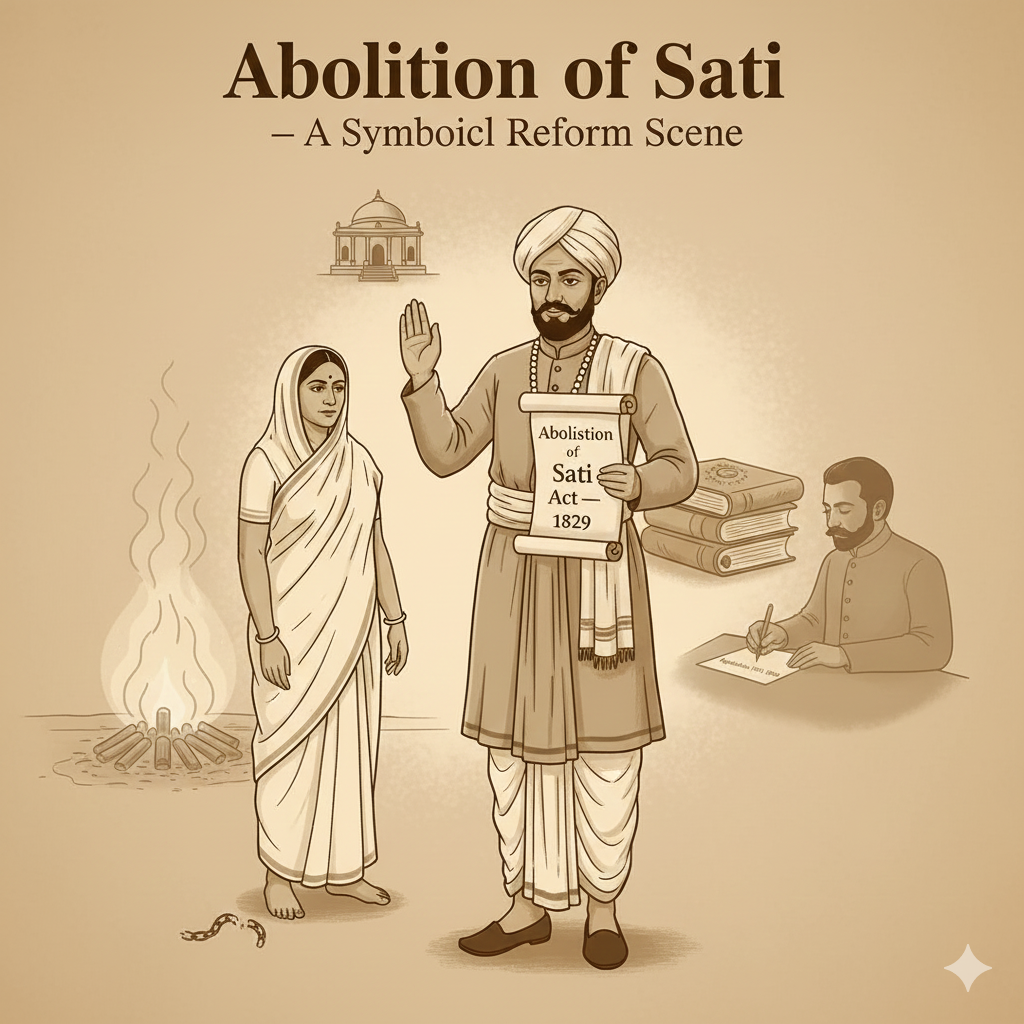
Sati Pratha was an inhuman and cruel social custom in ancient India. In this practice, after the death of a husband, his wife was forcibly or voluntarily burnt alive on his funeral pyre. This practice was recognized as a religious tradition, but in reality, it violated women’s rights and freedom.
Raja Rammohan Roy fought a long, courageous battle against Sati. Due to his continuous efforts, the British Government declared Sati illegal in 1829, giving women a new right—the right to live.
What Was the Practice of Sati?
Sati was a social custom in which a widow was made to sit on her husband's pyre and burnt alive. It was believed that the woman would attain heaven and purity in her next life.
Main Reasons Behind Sati:
- Religious Beliefs: Misinterpretations of Hindu texts promoted the practice.
- Social Pressure: Widows were forced to commit Sati to maintain family honor.
- Economic Factors: Widows were considered a financial burden.
- Patriarchal Society: Women had no social or legal rights.
Raja Rammohan Roy’s Struggle Against Sati
When Rammohan Roy witnessed Sati in society, he was deeply distressed. He called it inhuman, unjust and a misuse of religious faith. He began a strong movement against it.
Main Efforts:
- Religious Arguments: He studied the Vedas and Upanishads and proved that Hinduism does not support Sati.
- Social Awareness: He educated people that Sati is social injustice, not religious duty.
- Journalistic Protest: Through his newspaper Samvad Kaumudi, he wrote articles against Sati.
- Appeal to British Government: He convinced Governor-General Lord William Bentinck to abolish Sati.
Sati Abolition Act of 1829
On 4 December 1829, Lord William Bentinck passed a law banning Sati. It was declared a punishable offence.
Key Features of the Act:
- Anyone involved in Sati would be punished.
- Forcing a woman to commit Sati became a criminal offence.
- Supporters of Sati were also punishable.
Impact of Abolition of Sati
Positive Effects:
- Women gained the right to live.
- The status of women improved.
- Women’s education and widow remarriage movements gained momentum.
Opposition:
- Orthodox groups criticized Rammohan Roy.
- He was called anti-religion.
Conclusion: Raja Rammohan Roy played a historic role in ending Sati. His efforts created a new chapter in women’s rights and Indian social reform.
2. Widow Remarriage and Women Empowerment

✔ Easy & convenient for daily use
✔ Excellent performance & value
✔ Popular choice among buyers
Raja Rammohan Roy made significant contributions to widow remarriage, women’s education, property rights and gender equality. He believed that a society progresses only when its women are empowered.
Widow Remarriage: A Social Revolution
Condition of Widows at That Time:
- Widows were considered inauspicious.
- Remarriage was forbidden.
- They had to wear white clothes, shave their heads and live in social isolation.
- Many widows were abandoned or forced to beg.
Efforts of Raja Rammohan Roy
Key Contributions:
- Religious Arguments: He proved that Hindu scriptures do not forbid widow remarriage.
- Social Awareness: He wrote articles educating society about widows’ rights.
- Legal Reform: His ideas inspired Ishwar Chandra Vidyasagar, who helped pass the Widow Remarriage Act of 1856.
Contribution to Women Empowerment
1. Promotion of Women’s Education
- He advocated for girls’ schools.
- He emphasized teaching reading, writing, science and mathematics to women.
2. Property Rights for Women
- He urged the British government to give women legal property rights.
3. Social Freedom for Women
- He encouraged women to live independently.
- He opposed superstitions and restrictions placed on women.
Impact of His Contribution
- Widows gained the legal right to remarry.
- Women’s education strengthened the empowerment movement.
- Women's property rights improved economic independence.
- The social status of women rose significantly.
Conclusion
Raja Rammohan Roy became a leading voice for women’s rights. His work laid the foundation for women empowerment in India.
3. Movement Against Child Marriage and Caste System
Raja Rammohan Roy’s Campaign Against Child Marriage
Condition of Child Marriage:
- Girls were married at ages as low as 5–10 years.
- Child marriage destroyed education and health.
- Many young girls became widows early.
Efforts of Rammohan Roy:
- He spread awareness about its harmful effects.
- He promoted girls’ education before marriage.
- Through Brahmo Samaj, he campaigned to end child marriage.
- Requested the British for legal reforms.
Further Legal Reforms:
Inspired by his ideas, later reformers pushed for reforms. In 1929, the “Child Marriage Restraint Act” (Sarda Act) was passed.
Rammohan Roy’s Movement Against the Caste System
Status of the Caste System:
- Society was divided into strict caste lines.
- Lower castes faced untouchability and discrimination.
Anti-Caste Efforts:
- He proved through scriptures that caste discrimination has no religious basis.
- Founded Brahmo Samaj (1828), where people of all castes could worship together.
- He fought for equality and dignity of lower castes.
- Promoted education for all castes.
Later Developments:
Inspired by his ideas, leaders like Gandhi, Ambedkar and Phule continued the movement. In 1950, the Indian Constitution abolished caste discrimination.
Impact of His Contribution
- Child marriage reduced significantly over time.
- Anti-caste awareness increased.
- Brahmo Samaj strengthened anti-discrimination movements.
Conclusion
Raja Rammohan Roy fought against child marriage and caste injustice. His reforms transformed Indian society and paved the way for equality.
4. Promotion of Education and Modern Thinking
Raja Rammohan Roy believed that education is the most powerful tool for social progress. He promoted scientific thinking, women’s education and the introduction of modern subjects like English, Mathematics and Science in India.
Reforms in the Indian Education System
Status of Education in His Era:
- Education was limited to Gurukuls and Madrasas.
- Focus was on religious texts, Sanskrit, Persian and Arabic.
- Science and logic were ignored.
Efforts by Raja Rammohan Roy:
- Advocated English, Mathematics, Science and Geography.
- Helped establish Hindu College (1817) and Anglo-Hindu School (1822).
- Opposed opening traditional Sanskrit College and demanded modern education.
Promotion of Women’s Education
- He fought against the belief that women should not be educated.
- Encouraged the establishment of girls’ schools.
- Promoted women’s rights and empowerment.
Promotion of Modern Thinking and Scientific Outlook
- Opposed superstition and blind beliefs.
- Promoted logic-based education.
- Established Brahmo Samaj to promote rationalism and social reform.
Impact of His Contribution
- Modern education system developed in India.
- Women’s education expanded widely.
- Scientific temper and rational thinking flourished.
- Foundation of modern India was strengthened.
Conclusion
Raja Rammohan Roy is remembered as a pioneer of Indian education and the creator of modern thinking in India. His reforms initiated an intellectual revolution that shaped modern India.
Religious Reforms and the Establishment of Brahmo Samaj
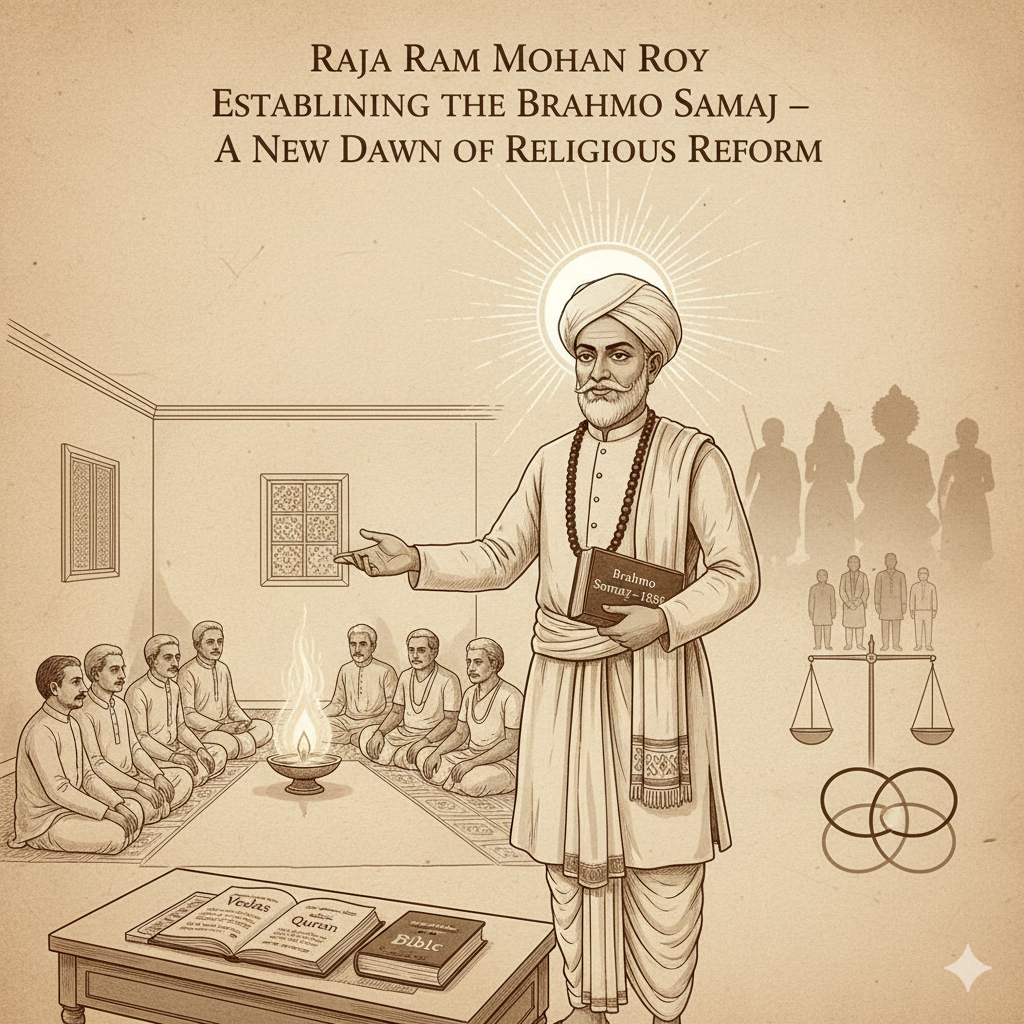
Raja Rammohan Roy was not only a social reformer and educationist but also a leading figure in India’s religious reform movement. He opposed superstition, religious fanaticism, idol worship and casteism that had spread widely in Indian society. To bring religious and social reforms, he established the Brahmo Samaj in 1828, which became a major center of religious transformation and social change.
1. Why Was There a Need for Religious Reforms?
During the time of Raja Rammohan Roy, Indian society was struggling with religious evils and orthodox practices. Superstitions and blind rituals became major barriers to the progress of society.
Main Religious Problems of the Time
- Idolatry and Superstition: External rituals were considered the core of religion, while morality and humanity were ignored.
- Hypocritical Priesthood: Many priests misled people and spread false beliefs in the name of religion.
- Casteism and Untouchability: Lower castes were denied education, temple entry and social rights.
- Inequality of Women: Women were denied religious rights and treated as inferior.
- Absence of Scientific Thinking: Religion had no connection with reason or science, making society intellectually backward.
Religious Views of Raja Rammohan Roy
He studied the Vedas, Upanishads, Quran and Bible and concluded that the core aim of religion is truth, morality and humanity, not rituals or fanaticism. This became the philosophical basis of Brahmo Samaj.
2. Establishment of Brahmo Samaj (1828)
On 20 August 1828, Raja Rammohan Roy established the Brahmo Samaj with the aim of reviving true religious values and promoting social reforms.
Main Principles of Brahmo Samaj
- Monotheism (One God): God is one, formless and universal.
- Religious Tolerance: All religions are different paths to the same truth.
- Opposition to Idol Worship: True religion lies in morality, not idol worship.
- Opposition to Casteism: All humans are equal; caste discrimination is invalid.
- Women's Rights: Supported widow remarriage, women’s education and abolition of child marriage.
- Use of Logic & Science: Religious teachings should be interpreted through logic and scientific reasoning.
3. Main Functions of Brahmo Samaj
Re-examination of Religious Texts
- Rammohan Roy deeply studied Vedas, Upanishads, Quran and Bible.
- He translated many Sanskrit and Persian texts into Bengali and English to make them accessible to the public.
Promotion of Religious Freedom and Humanity
- He opposed religious hypocrisy and fanaticism.
- He emphasized that the real purpose of religion is human welfare.
Eradication of Casteism and Untouchability
- People of all castes could worship together in Brahmo Samaj.
- Lower castes were given participation in education and religious activities.
Women Empowerment and Social Reform
- Campaigns were launched against Sati, child marriage and women's illiteracy.
- Promoted widow remarriage and women's rights.
Inter-Religious Harmony
- Brahmo Samaj encouraged harmony among Hindus, Muslims, Christians and others.
- Rammohan Roy emphasized accepting good ideas from all religions.
4. Influence and Legacy of Brahmo Samaj
Immediate Impact
- Created new thinking and awareness in India.
- Started a movement against superstition and religious fanaticism.
- Challenged casteism and untouchability.
- Improved the status and rights of women.
✔ Easy & comfortable to use
✔ Excellent performance & value
✔ Popular among Amazon buyers
Impact on Future Generations
The influence of Brahmo Samaj shaped great thinkers like:
- Ishwar Chandra Vidyasagar
- Swami Vivekananda
- Mahatma Gandhi
- Dr. B. R. Ambedkar
Inspired by Brahmo Samaj, several major reform movements emerged:
- Prarthana Samaj (1867, Mumbai)
- Arya Samaj (1875, Swami Dayanand Saraswati)
- Ramakrishna Mission (1897, Swami Vivekananda)
Its ideas also influenced the Indian freedom struggle, promoting justice, equality and human rights.
5. Conclusion
Raja Rammohan Roy initiated a new era of religious reform in India. He opposed idol worship, superstition and religious fanaticism while promoting monotheism, tolerance, equality and social justice. With the establishment of Brahmo Samaj, he laid the foundation of India’s religious renaissance and social transformation. He remains one of the greatest reformers in Indian history.
Journalism and Freedom of the Press
Raja Rammohan Roy was not only a social and religious reformer but also a pioneer in Indian journalism. He believed that journalism is a powerful tool for social change and public awareness. Through several newspapers and journals, he criticized British policies, fought for press freedom, and raised awareness against social evils.
1. Background of Indian Journalism
- British Censorship: The British imposed strict restrictions on newspapers.
- Suppression of Indian Voices: Indians had little freedom to express their opinions.
- Lack of Public Awareness: Social reforms could not reach the masses.
Rammohan Roy realized that only journalism could awaken society and build public opinion against injustice.
2. Contribution of Raja Rammohan Roy to Journalism
Father of Indian Journalism
He is known as the Father of Indian Journalism because he established the foundation of independent and socially conscious journalism in India.
Major Newspapers and Journals
1. Sambad Kaumudi (Bengali, 1821)
- Wrote on Sati, casteism, child marriage and women's education.
- One of the first newspapers to criticize British policies.
2. Mirat-ul-Akhbar (Persian, 1822)
- Aimed at Muslim readers.
- Focused on social, religious and political issues.
3. Brahmanical Magazine (English, 1821)
- Focused on religious reforms and social issues.
- Educated both Indians and Europeans about true religious philosophy.
4. Samvada Kaumudi (Hindi Version)
- Spread reformist ideas among Hindi-speaking people.
These newspapers became platforms for raising awareness about injustice, British exploitation, social evils and the condition of women.
3. Struggle for Freedom of the Press
British Censorship Policies
The British government imposed stringent restrictions on Indian publications.
The Licensing Regulation Act (1823)
- Newspapers required government permission for publication.
- Rammohan Roy opposed this act, calling it an attack on press freedom.
- He wrote petitions and letters demanding the withdrawal of this law.
Although the British did not withdraw the regulation, his protests laid the foundation of independent journalism in India.
4. Influence of Raja Rammohan Roy’s Journalism
- Laid the Foundation of Free Press: Encouraged bold, independent journalism.
- Raised Social Awareness: Newspapers educated people on reform issues.
- Opposed British Policies: Exposed injustice and advocated Indian rights.
- Inspired Freedom Fighters: Later leaders like Tilak and Gandhi used journalism as a weapon in the freedom struggle.
5. Conclusion
Raja Rammohan Roy laid the foundation of journalism and press freedom in India. He transformed journalism into a medium of social reform, political awareness and national awakening. His contribution is still remembered with respect in the Indian media and reform movements.
Title of Raja and Foreign Travel
Raja Rammohan Roy’s life was not limited to social reform, religious change and journalism. His outlook was global and he studied the social and philosophical ideas of the West to understand Indian society more deeply. His foreign travels exposed him to new perspectives, which helped him frame more effective reforms for India.
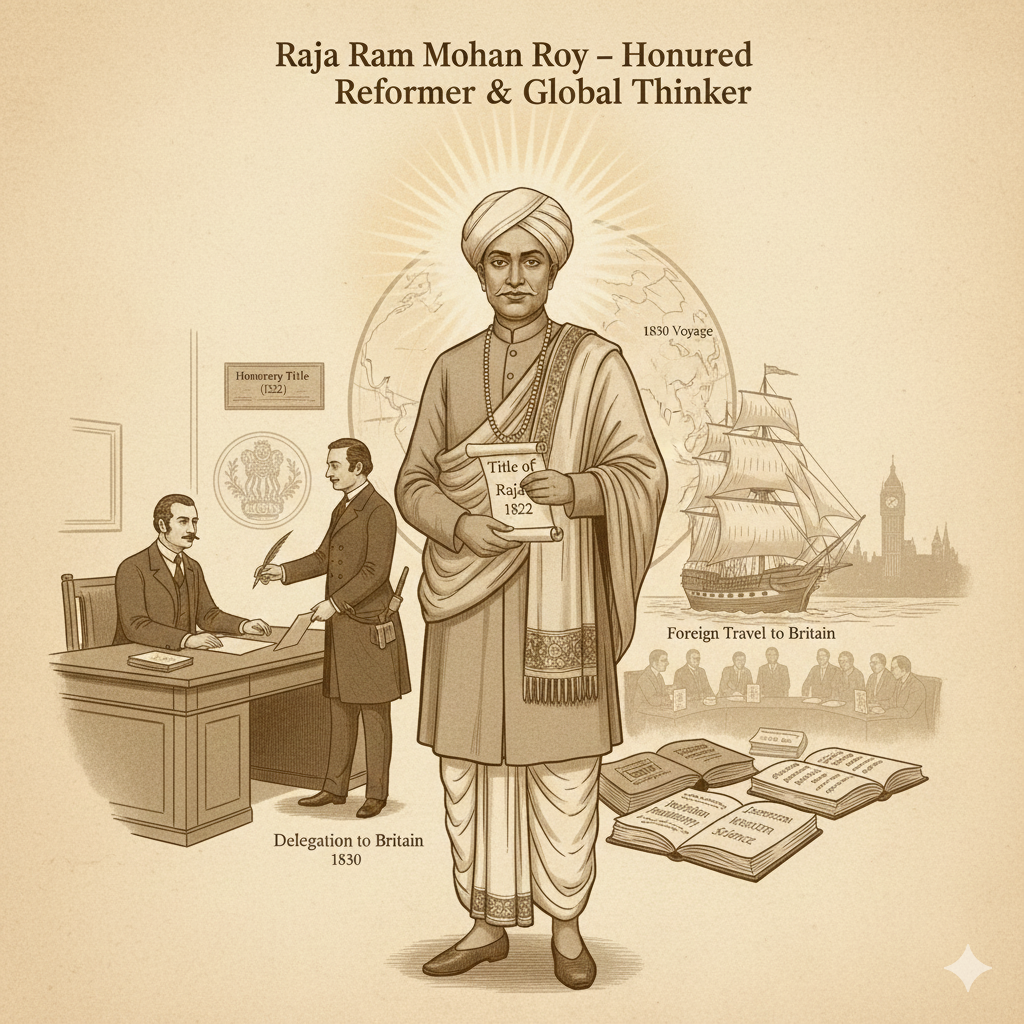
1. Title of Raja
In 1822, Raja Rammohan Roy was honored with the title “Raja” by the British Government. This was recognition of his influential role as a reformer and intellectual.
Importance of the Title
- The title acknowledged his contributions in social, religious and political spheres.
- It elevated his position in society, giving him greater influence and respect.
- Despite receiving this honor, Rammohan Roy remained committed to reform rather than prestige.
- The title provided him a stronger platform to interact with government officials and push for reforms.
2. Traveling Abroad
Raja Rammohan Roy’s foreign trip was a turning point in his life. It exposed him to Western philosophies and modern ideas, helping him develop a balanced perspective between Indian traditions and Western thought.
Visit to Britain (1830)
In 1830, he traveled to Britain as the representative of Mughal Emperor Akbar II. There he studied the political, cultural and religious systems of the West.
Main Objectives of His Visit
- Support for Abolition of Sati: His major goal was to secure British support for permanently banning the practice of Sati.
- He discussed the issue with British authorities and sought international backing.
- This effort supported the already passed Sati Regulation Act of 1829.
- Engaging with Western Thinkers: He interacted with intellectuals, scholars and reformers to share ideas on religion, democracy and social reform.

✔ Easy and comfortable to use daily
✔ Great performance & value
✔ Popular choice among buyers
Personal and Ideological Impact of the Trip
Political Views
- He deeply studied democracy, individual rights and political freedom.
- He wished to introduce such modern ideas into Indian society.
Religious Views
- He examined Christianity, Islam and Western ethical principles.
- He concluded that religion should promote morality and social discipline—not superstition or fanaticism.
3. Impact of Raja Rammohan Roy’s Foreign Travel
Rise in Reformist Attitudes
- He developed a balanced approach between ancient Indian traditions and Western modernity.
- His ideas strengthened reform movements related to women’s rights, Sati abolition, caste issues and superstition.
Promotion of Modernity
- He saw the importance of Western science, education and philosophy in building an enlightened society.
- He encouraged Indians to rethink outdated traditions and adopt rational, progressive ideas.
4. Conclusion
The title of “Raja” and his foreign travels were important aspects of Rammohan Roy’s life. The title gave him social prestige, while his foreign experiences gave him global insight. He successfully balanced Indian culture with Western thought, helping to promote modernity and reform in India.
Death of Raja Rammohan Roy
Raja Rammohan Roy passed away on 27 September 1833 in Bristol, Britain. His death marked the end of a revolutionary life dedicated to social reform, religious renaissance and educational upliftment. Even after his demise, his ideas continued to influence generations.
1. Last Days and Illness
During his stay in Britain, Rammohan Roy suffered from health complications, including a severe throat disease (angina). Despite illness, he continued advocating for Indian reforms and remained active in intellectual circles.
2. Cause and Time of Death
He died on 27 September 1833 in Bristol at the age of 61. His death resulted from complications of the throat disease he had been battling. His passing was mourned by intellectuals, reformers and British supporters who respected his contributions.
3. Impact and Memory After Death
- His death was a major loss for India’s reform movement.
- Though his body perished, his ideas, writings and reform efforts continued to inspire future generations.
- His influence shaped reformers like Mahatma Gandhi, Swami Vivekananda and Ishwar Chandra Vidyasagar.
- His work against Sati, child marriage, caste discrimination and superstition left a permanent impact on India.
4. Events After His Death
- Many social reformers carried forward his mission.
- The British government strengthened laws prohibiting Sati and introduced reforms for women's education.
- His ideas contributed greatly to the Indian Renaissance and inspired movements for equality and justice.
5. Conclusion
Raja Rammohan Roy may have died physically, but his ideological legacy continues to live in Indian society. His life proves that one individual, through determination and courage, can transform an entire society. He is remembered as a great social reformer, father of Indian journalism and pioneer of the Indian Renaissance.
References

✔ Comfortable & easy to use
✔ Excellent performance for daily use
✔ Popular choice among buyers
- “Raja Rammohan Roy – Life, Contribution and Reforms.” National Archives of India.
- “Social and Religious Reform Movements in India.” NCERT History Textbook.
- “Brahmo Samaj and Its Impact on Indian Society.” Ministry of Culture, Government of India.
- “Abolition of Sati Regulation Act, 1829.” Government of Bengal Records.
- “Raja Rammohan Roy’s Visit to England and His Reformist Ideas.” British Library Archives.
- Scholarly Articles on Raja Rammohan Roy and Indian Renaissance, JSTOR.