

Provincial Autonomy under the Government of India Act, 1935: Powers, Limitations and 1937 Elections
Provincial Autonomy in British India was one of the most significant constitutional reforms introduced under the Government of India Act, 1935. It aimed to provide greater administrative powers to provincial governments and increase the participation of Indian political leaders in governance. The system came into operation in 1937, replacing the earlier system of Dyarchy in the provinces. However, the powers of provincial Governors and the continued influence of British authorities placed important limitations on this autonomy.
The Act of 1935 emerged from the interaction of the Indian national movement, British constitutional policies, and the demands of Indian political organisations. It introduced responsible government at the provincial level, while substantial British control continued at the central level. Several provisions relating to the federal structure, the office of the Governor, Public Service Commissions, and the administrative framework of independent India were influenced by this Act.
1. Provincial Autonomy in British India: Historical Background
To understand the Government of India Act, 1935, it is essential to examine the political circumstances of the late nineteenth and early twentieth centuries. After 1858, the administration of India came directly under the British Crown. Subsequently, the British Government introduced several administrative and constitutional reforms. However, the political participation of Indians remained limited.
Through the Indian Councils Act of 1909, also known as the Morley-Minto Reforms, and the Government of India Act, 1919, also known as the Montagu-Chelmsford Reforms, Indians were given some additional representation in administration. The 1919 Act introduced the system of Dyarchy in the provinces. Under this arrangement, administrative subjects were divided into reserved and transferred categories. However, actual administrative authority largely remained in the hands of British officials.
The Indian National Congress and several other political organisations considered these reforms inadequate. Indian leaders demanded the establishment of responsible government and genuine participation of Indians in the administration of the country. Due to growing political pressure, the British Government was compelled to reconsider its constitutional policies.
2. Simon Commission and the Demand for Constitutional Reforms
The Simon Commission played an important role in the developments that eventually led to the Government of India Act, 1935. In November 1927, the British Government appointed a commission under the chairmanship of Sir John Simon. Its primary objective was to review the working of the Government of India Act, 1919 and recommend further constitutional reforms.
The Simon Commission did not include a single Indian member. As a result, it faced widespread opposition from Indian political organisations. When the commission arrived in India in 1928, protests were organised in different parts of the country under the slogan "Simon Go Back." During a protest in Lahore, Lala Lajpat Rai was seriously injured in a police lathi charge and subsequently died.
The Simon Commission submitted its report in 1930. It recommended the abolition of Dyarchy in the provinces and the introduction of provincial autonomy. It also suggested the establishment of a federal system of government in India. These recommendations helped prepare the constitutional foundation for the Government of India Act, 1935.
3. Round Table Conferences and India's Constitutional Framework
Following the Simon Commission's report, the British Government organised a series of Round Table Conferences in London to discuss India's constitutional future with Indian leaders and representatives of different political groups. The objective was to develop a framework for future governance, including federal arrangements, provincial autonomy, minority rights, and political representation.
The First Round Table Conference was held from November 1930 to January 1931. The Indian National Congress did not participate in it. The Second Round Table Conference took place between September and December 1931, in which Mahatma Gandhi participated as the representative of the Congress. The Third Round Table Conference was held from November to December 1932, but the participation of major Indian political organisations was limited.
These conferences discussed important issues such as the establishment of an Indian federation, provincial autonomy, the distribution of powers between the Centre and the provinces, and political representation for different communities. Although complete agreement could not be reached among all parties, the discussions helped the British Government formulate a new constitutional framework for India.
4. Final Steps Towards the Government of India Act, 1935
Following the Round Table Conferences, the British Government moved forward with proposals for constitutional reforms. In March 1933, the British Government published a White Paper containing proposals for India's future constitutional structure. Subsequently, a Joint Select Committee of the British Parliament examined these proposals and made several recommendations.
Based on the committee's report and the constitutional discussions, the British Government prepared a new legislative proposal for India. The Bill was introduced in the British Parliament and was eventually passed as the Government of India Act, 1935. It received Royal Assent on 2 August 1935.
Thus, the Government of India Act, 1935 was not the result of a single event. Rather, it emerged from the combined influence of the Indian national movement, demands for constitutional reforms, the Simon Commission's report, and discussions held during the Round Table Conferences.
5. Key Features of Provincial Autonomy under the Government of India Act, 1935
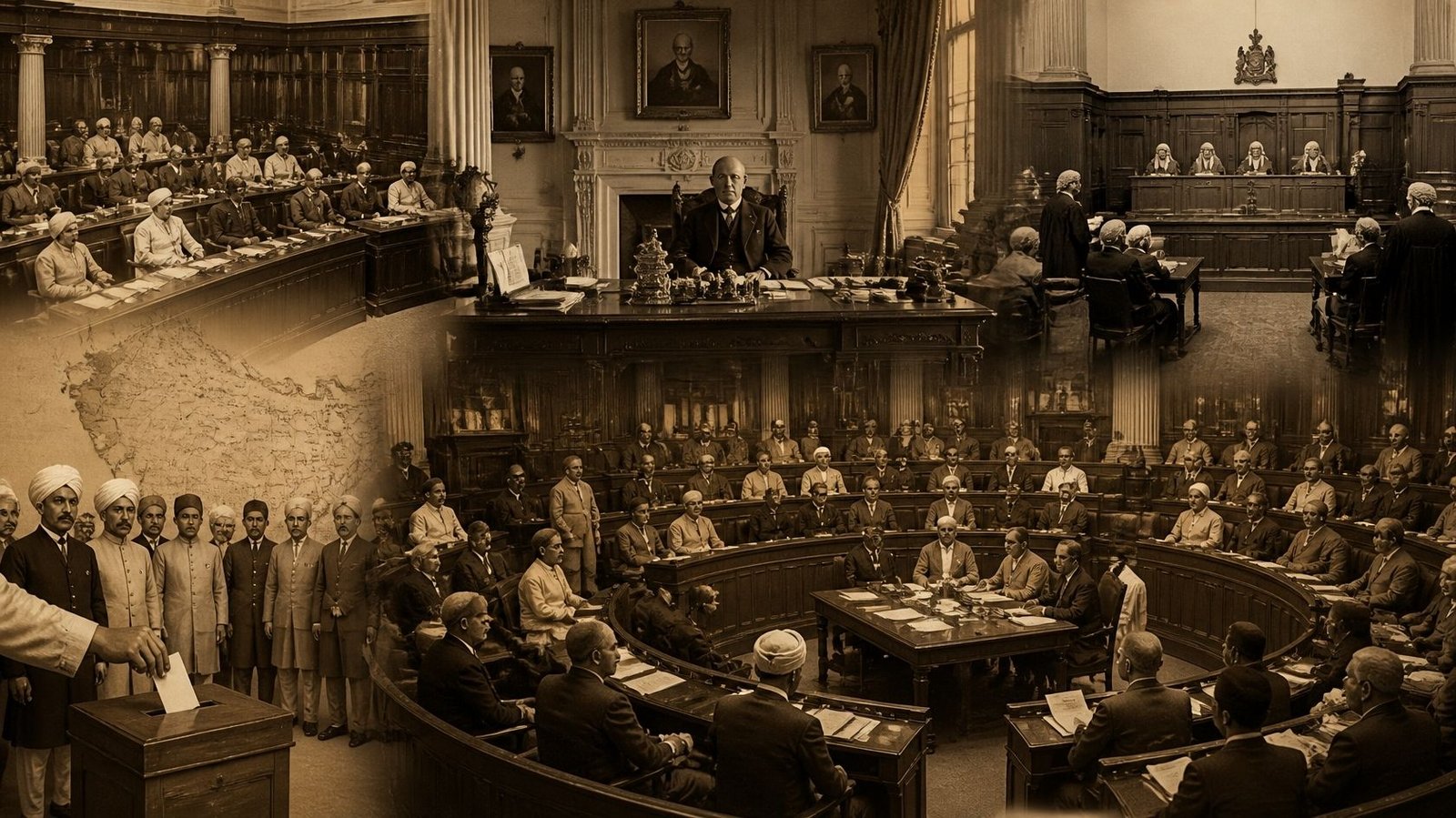
The Government of India Act, 1935 attempted to bring about comprehensive changes in India's constitutional system under British rule. It included important provisions relating to the federal system of government, provincial autonomy, distribution of powers between the Centre and the provinces, and reorganisation of administrative institutions. The major features of this Act are discussed below.
5.1 Proposal for the Establishment of an All India Federation
One of the major features of this Act was the proposal to establish an All India Federation. The proposed federation was intended to include British Indian provinces as well as the princely states. Its objective was to bring different political and administrative territories of India under a common federal framework.
Participation of British Indian provinces in the proposed federation was compulsory, whereas the participation of princely states depended on their willingness and consent. Since the required number of princely states did not agree to join the federation, the proposed All India Federation could not be established.
5.2 Provincial Autonomy
One of the most important features of this Act was the introduction of provincial autonomy. The system of Dyarchy, which had been introduced in the provinces under the Government of India Act, 1919, was abolished. It was replaced by a system of autonomous provincial administration.
Provincial ministers were made responsible to the provincial legislatures. They were given the authority to take administrative decisions on subjects such as education, health, agriculture, and local administration. Through this arrangement, Indian political leaders received greater participation in provincial governance.
However, provincial autonomy did not mean complete independence. Governors were given special discretionary powers and the authority to intervene under certain circumstances. Therefore, provincial governments were not entirely free from British control.
5.3 Introduction of Dyarchy at the Centre
The Government of India Act, 1935 provided for the introduction of Dyarchy at the Centre. Under this arrangement, central administrative subjects were to be divided into two categories: reserved subjects and transferred subjects.
The administration of reserved subjects was to remain under the control of the Governor-General and his appointed councillors, whereas transferred subjects were to be administered through ministers. The objective of this arrangement was to increase the participation of Indian representatives in central administration. However, since the proposed federal system was never implemented, Dyarchy at the Centre also did not come into operation.
5.4 Division of Powers
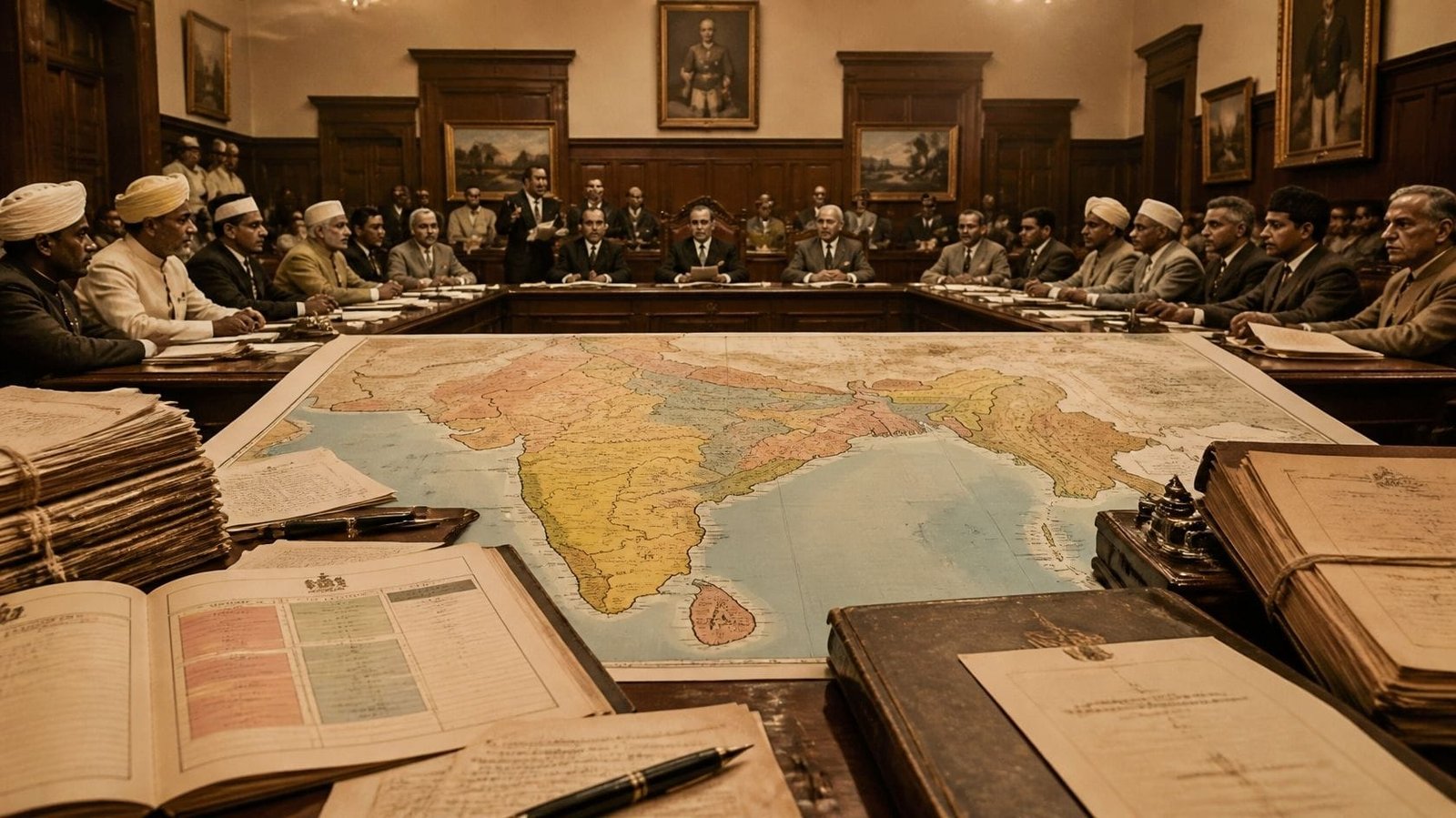
The Act attempted to establish a clear division of legislative powers between the Centre and the provinces. For this purpose, legislative subjects were divided into three separate lists. This arrangement played an important role in the development of India's federal administrative system.
- Federal List: It included subjects such as defence, foreign affairs, currency, railways, and communications. The Federal Legislature was authorised to make laws on these subjects.
- Provincial List: It included subjects such as police, education, public health, agriculture, and local administration. Provincial legislatures were given authority over these subjects.
- Concurrent List: It included subjects on which both the Centre and the provinces could make laws. These subjects included criminal law, marriage, divorce, and civil procedure.
Residuary powers were placed under the authority of the Governor-General. Thus, the Act divided legislative powers between the Centre and the provinces, while maintaining significant British influence over the administrative structure.
6. Establishment of the Federal Legislature
Under the Government of India Act, 1935, the proposed federal system provided for the establishment of a bicameral legislature at the central level. It consisted of two houses: the Council of State and the Federal Assembly. The objective was to organise legislative functions at the central level and provide representation to British Indian provinces and princely states.
6.1 Council of State
The Council of State was the upper house of the proposed federal legislature. It was designed to include representatives of British Indian provinces as well as princely states. The normal term of its members was fixed at five years. The purpose of this house was to provide representation to different units within the federal system of governance.
6.2 Federal Assembly
The Federal Assembly was the lower house of the proposed federal legislature. The term of its members was fixed at five years. Representatives of British Indian provinces were to be elected, while representatives of princely states were to be nominated by their respective states. However, since the All India Federation was never implemented, this federal legislature could not come into existence in its proposed form.
7. Powers and Role of the Governor-General
Under the Government of India Act, 1935, the Governor-General was designated as the head of the central government. He was appointed by the British Crown. Although the Act provided for a federal system and a council of ministers, the Governor-General was granted extensive special powers.
The Governor-General possessed important powers in administrative, legislative, and financial matters. He appointed ministers and, under certain special circumstances, could influence their decisions. He also had powers to give assent to bills, withhold assent, or return bills for reconsideration.
- Executive Powers: Important authority in central administration and the appointment of ministers.
- Legislative Powers: Authority to give or withhold assent to bills and, under certain circumstances, issue ordinances.
- Financial Powers: Significant control over central financial administration and budget-related matters.
- Discretionary Powers: Authority to take decisions using personal discretion under special circumstances.
8. Powers of Provincial Governors
The Act introduced provincial autonomy, but the office of the Governor remained important in every province. Provincial Governors were appointed by the British Crown. In ordinary administration, the Council of Ministers was expected to assist and advise the Governor. However, Governors were also given special responsibilities and discretionary powers.
Governors were authorised to intervene in provincial administration, take decisions independently of ministerial advice under certain circumstances, and exercise special powers to maintain the constitutional framework. If constitutional government in a province became difficult to operate, the Governor could assume control of the administration under the relevant special provisions.
Thus, despite the introduction of provincial autonomy, the powers of Governors provided the British Government with an important opportunity to maintain control over provincial administration.
9. Establishment of the Federal Court
One of the important features of the Government of India Act, 1935 was the provision for establishing a Federal Court. Its objective was to resolve constitutional disputes between the Centre and the provinces and strengthen the judicial system within the federal framework.
The Federal Court was established in New Delhi on 1 October 1937. It was given jurisdiction over disputes between central and provincial governments and matters relating to the interpretation of the constitutional framework. In certain cases, it was also authorised to hear appeals against decisions of High Courts.
The Federal Court played an important role in the development of India's constitutional judicial system. After independence, it continued to function as the country's highest judicial institution until the establishment of the Supreme Court in 1950.
10. Electoral System and Separate Electorates
The Government of India Act, 1935 expanded the electoral system in India. Compared to the earlier arrangements, a larger number of people were granted voting rights. However, universal adult franchise was not introduced. The right to vote was based on prescribed qualifications relating to property, tax payments, education, and other eligibility conditions.
The Act continued the system of separate electorates for different communities and extended its scope. Separate representation was provided for various communities, including Muslims, Sikhs, Europeans, Indian Christians, and Anglo-Indians.
The expansion of the electoral system increased the political participation of Indians. However, limited franchise and the communal electoral system also influenced social and political divisions within Indian politics.
11. Impact of the Government of India Act, 1935 on Indian Politics
The Government of India Act, 1935 had a significant impact on Indian politics and the administrative system. With the introduction of provincial autonomy under this Act, Indian political parties received an opportunity to participate in provincial governance. For the first time, Indian leaders were given greater responsibility in managing several important administrative departments and making policy decisions.
The Act provided Indian political organisations with opportunities to participate in electoral politics, legislative proceedings, and administrative activities. However, the British Government retained its powers through the Governor-General and Provincial Governors. Despite these limitations, the increasing participation of Indian leaders at the provincial level gave a new political dimension to the freedom movement.
12. Provincial Elections of 1937 and Congress Ministries
Under the provisions of the Government of India Act, 1935, provincial legislative elections were held in 1937. The objective of these elections was to form new governments under the system of provincial autonomy. The Indian National Congress actively participated in these elections and achieved considerable success in several provinces.
The Congress secured clear majorities in five provinces and eventually formed its ministries in seven provinces. These included Madras, Bombay, the United Provinces, Bihar, the Central Provinces, Orissa, and the North-West Frontier Province. These provincial governments worked in various areas, including education, agriculture, civil liberties, social reforms, and administrative improvements.
The Congress ministries took several steps, including the release of political prisoners, expansion of civil liberties, and attention to the problems of rural communities. These developments provided Indian leaders with administrative experience and increased their political popularity among the people.
13. Second World War and the Resignation of Congress Ministries
The Second World War began in September 1939. The then Viceroy, Lord Linlithgow, declared India a participant in the war on behalf of Britain without consulting Indian political leaders or the Central Legislature. The Congress opposed this decision and demanded a clear policy regarding India's independence and the objectives of the war.
The British Government did not accept the demands of the Congress. In protest, the Congress ministries resigned from their positions in different provinces during October and November 1939. This development clearly demonstrated that despite the introduction of provincial autonomy under the Government of India Act, 1935, the British Government continued to exercise ultimate control.
14. Major Achievements of the Government of India Act, 1935
Although the Act failed to establish a fully democratic system of government, it made an important contribution to India's constitutional development. Its major achievements were as follows:
- Provincial Autonomy: Dyarchy, introduced in the provinces under the 1919 Act, was abolished, and provincial ministries were given greater administrative responsibilities.
- Development of the Federal Structure: Powers were divided between the Centre and the provinces, and a system of three legislative lists was established.
- Judicial System: The Act provided for the establishment of a Federal Court, which came into existence in 1937.
- Expansion of the Electoral System: Compared to earlier arrangements, more Indians received voting rights, and representation in legislative institutions increased.
- Development of Administrative Institutions: Institutional arrangements relating to the Federal Public Service Commission and Provincial Public Service Commissions received a constitutional foundation.
- Political Experience: Indian political parties gained practical experience in contesting elections, forming ministries, and administering governments.
15. Major Limitations and Criticism of the Government of India Act, 1935
Although the Government of India Act, 1935 introduced several important reforms, it also had serious limitations. Leaders of the Indian national movement criticised it because it did not provide India with genuine self-government or complete democratic rights.
15.1 Real Power Remained with the British Government
Under this Act, the Governor-General and Provincial Governors were granted extensive special and discretionary powers. Under certain circumstances, they could interfere with the decisions of elected ministries. This weakened the concept of responsible government.
15.2 Failure to Implement the All India Federation
The Act proposed the establishment of an All India Federation, but the required participation of the princely states could not be secured. Consequently, the proposed federal system was never implemented.
15.3 Limited Franchise
The Act did not introduce universal adult franchise. Voting rights were based on property, education, tax payments, and other prescribed qualifications. As a result, the majority of India's adult population remained excluded from the electoral process.
15.4 Communal Electoral System
The Act continued the system of separate electorates. It maintained separate political representation for different religious and community groups. This arrangement further complicated communal divisions within Indian politics.
15.5 Absence of Responsible Government at the Centre
Despite the provision for Dyarchy at the Centre, the Governor-General was granted extensive powers. Consequently, a genuinely responsible government could not be established at the central level. Thus, Indians did not receive complete political and administrative authority.
16. Relationship Between the Government of India Act, 1935 and the Indian Constitution
The Government of India Act, 1935 was an important document in Indian constitutional history. This Act presented a comprehensive framework for the administrative and constitutional system in India. Although its primary objective was to maintain British rule while providing Indians with limited administrative participation, several of its provisions proved useful in the development of the constitutional system of independent India.
After independence, the Constituent Assembly studied Indian conditions, the experiences of the national movement, and the constitutional systems of various countries to frame the Indian Constitution. During this process, the Government of India Act, 1935 remained an important reference document.
16.1 Major Similarities Between the Two
Several important similarities can be observed between the Government of India Act, 1935 and the Indian Constitution. These mainly include the federal system, distribution of powers between the Centre and the States, the office of the Governor, Public Service Commissions, and the system of judicial institutions.
- Federal System: The Act of 1935 proposed an All-India Federation. The Indian Constitution adopted a federal system in which constitutional powers are divided between the Centre and the States.
- Distribution of Powers: The Act divided legislative powers into Federal, Provincial, and Concurrent Lists. The Indian Constitution also adopted a system of three lists.
- Office of the Governor: The Act of 1935 provided for Governors in the provinces. The Indian Constitution also established the constitutional office of the Governor for each State.
- Public Service Commissions: The Act provided for Federal and Provincial Public Service Commissions. The Indian Constitution established provisions for the Union Public Service Commission and State Public Service Commissions.
- Judicial System: The Federal Court was established under the Act of 1935. The Constitution of independent India provided for the establishment of the Supreme Court.
- Emergency Provisions: The Act contained provisions granting special administrative powers under emergency circumstances. The Indian Constitution also incorporated detailed constitutional provisions relating to emergencies.
16.2 Major Differences Between the Two
Along with similarities, there are also fundamental differences between the Government of India Act, 1935 and the Indian Constitution. The biggest difference lies in the nature of governance and the actual source of authority.
- Source of Authority: Under the Act of 1935, control over India remained with the British Parliament and the British Government. Under the Indian Constitution, the people of India are the source of authority.
- Sovereignty: India was not fully sovereign under the Act of 1935, whereas the Indian Constitution established India as a sovereign State.
- Democratic Governance: The Act of 1935 provided for limited franchise. The Indian Constitution adopted the principle of universal adult suffrage.
- Accountability of the Council of Ministers: Under the Act, the Governor-General and Governors possessed extensive discretionary and special powers. The Indian Constitution established parliamentary democracy and accountability of the elected government.
- Fundamental Rights: The Act of 1935 did not contain comprehensive constitutional provisions for Fundamental Rights like those found in the Indian Constitution. The Indian Constitution gave special importance to the Fundamental Rights of citizens.
- Supremacy of the Constitution: The Act of 1935 was a law enacted by the British Parliament. The Indian Constitution is the supreme legal framework of independent India.
17. Impact of the Government of India Act, 1935 on the Indian Constitution
The Government of India Act, 1935 is considered an important administrative and constitutional foundation of the Indian Constitution. The Constitution-makers studied several provisions of this Act and incorporated them into the new democratic framework wherever necessary.
17.1 Development of the Federal Structure
The Act of 1935 provided for the distribution of powers between the Centre and the Provinces. The Indian Constitution developed this idea by establishing a constitutional division of legislative and administrative powers between the Union and the States.
17.2 System of Three Lists
The concept of the Federal List, Provincial List, and Concurrent List was also present in the Act of 1935. The Indian Constitution incorporated these three lists under the Seventh Schedule. This determines the subjects on which Parliament and State Legislatures can make laws.
17.3 Development of Administrative Institutions
Institutions and arrangements such as Public Service Commissions, the office of the Governor, and the federal administration played an important role in the development of the administrative structure of independent India. The Indian Constitution provided these institutions with a clearer constitutional foundation.
17.4 Development of the Judicial System
The Federal Court was established under the Government of India Act, 1935 on 1 October 1937. It heard constitutional disputes between the Centre and the Provinces, along with other specified matters. In independent India, the establishment of the Supreme Court gave the judicial system a new constitutional form.
17.5 Emergency Arrangements
The Act of 1935 provided extensive powers to the central and provincial administrations under special circumstances. The Indian Constitution gave emergency provisions a more detailed and constitutional form. However, the objectives and democratic contexts of the two systems were not the same.
18. Historical Significance of the Government of India Act, 1935
The Government of India Act, 1935 was the most comprehensive constitutional law enacted for India during British rule. It organized the structure of governance, administrative powers, and Centre-Province relations at a new level. Although the Act failed to fulfil the Indian demand for complete self-government, it nevertheless played an important role in India's constitutional development.
18.1 Experience of Provincial Autonomy
The implementation of provincial autonomy provided Indian political parties with practical experience in running provincial governments. The ministries formed after the elections of 1937 gave Indian leaders an opportunity to work in the fields of administration, law-making, and public policy.
18.2 Development of Indian Political Leadership
Participation in provincial governments familiarized Indian leaders with the practical challenges of governance. This helped develop political and administrative experience for running democratic governments after independence.
18.3 Understanding of the Federal System
The Act clarified the concept of the distribution of powers between the Centre and the Provinces. It provided Indian political leaders and the Constitution-makers with an opportunity to understand the practical challenges of federal governance.
18.4 An Important Link in Constitutional Development
The process of constitutional development in India progressed continuously from the Regulating Act of 1773 to the Government of India Act, 1919, and then to the Act of 1935. In this sequence, the Act of 1935 represented an important stage, and the experiences gained under it influenced the framing of the Constitution of independent India.
18.5 Limitations and Failures
The biggest limitation of the Act was that real power remained under the control of the British Government. The proposed All-India Federation could not be implemented, a responsible government was not established at the Centre, and the franchise remained limited. Therefore, the Act failed to fulfil the demand for complete self-rule raised by the Indian national movement.
19. Overall Conclusion
The Government of India Act, 1935 was an important milestone in Indian history and constitutional development. The Act introduced significant provisions relating to federal governance, provincial autonomy, the distribution of legislative powers, and the development of administrative institutions in India.
Although many of its arrangements remained limited because of British control and the special powers of the Governor-General and Governors, the Act provided Indian leaders with practical experience in governance. The provincial elections and the formation of ministries in 1937 gave Indian politics a new administrative experience.
After independence, the Constituent Assembly studied the useful administrative and constitutional elements of this Act and developed them according to the requirements of Indian democracy. Thus, despite the limitations of colonial rule, the Government of India Act, 1935 became an important historical link in the development of the constitutional and administrative framework of modern India.
20. Important Facts for Competitive Examinations
- The Government of India Act, 1935 was passed by the British Parliament.
- The Act received Royal Assent on 2 August 1935.
- It was the most comprehensive constitutional Act enacted for India during British rule.
- It proposed the establishment of an All-India Federation.
- The scheme of the All-India Federation was never implemented.
- Dyarchy in the Provinces was abolished and Provincial Autonomy was introduced.
- Dyarchy at the Centre was proposed but never implemented.
- Legislative powers were divided into the Federal List, Provincial List, and Concurrent List.
- Residuary powers were vested in the Governor-General.
- Provincial elections were held in 1937.
- The Federal Court was established on 1 October 1937.
- The Act continued the system of limited franchise and separate electorates.
- The Act contained 321 sections and 10 schedules.
- The Act had a significant influence on the framing of the Indian Constitution.
21. Frequently Asked Questions (FAQs)
Question 1. When was the Government of India Act, 1935 passed?
Answer: The Government of India Act, 1935 was passed by the British Parliament and received Royal Assent on 2 August 1935.
Question 2. What was the most important feature of the Government of India Act, 1935?
Answer: Its major features included the proposal for an All-India Federation, Provincial Autonomy, the distribution of powers between the Centre and the Provinces, and the establishment of a Federal Court.
Question 3. Was the All-India Federation established under the Government of India Act, 1935?
Answer: No. The Act proposed the establishment of an All-India Federation, but the scheme could not be implemented because the required participation of the Princely States was not secured.
Question 4. When was Provincial Autonomy introduced?
Answer: The provincial provisions of the Government of India Act, 1935 came into force on 1 April 1937. Provincial Autonomy was introduced in the Provinces thereafter.
Question 5. When was the Federal Court established?
Answer: The Federal Court was established in New Delhi on 1 October 1937.
Question 6. How many lists were included in the Government of India Act, 1935?
Answer: The Act divided legislative powers into three lists—the Federal List, the Provincial List, and the Concurrent List.
Question 7. What is the relationship between the Government of India Act, 1935 and the Indian Constitution?
Answer: Several administrative and constitutional provisions of the Indian Constitution reflect the influence of the Act of 1935. However, the Indian Constitution is an independent and comprehensive democratic document.
Question 8. What was the major limitation of the Government of India Act, 1935?
Answer: Its biggest limitation was that real power remained under the control of the British Government. No responsible government was established at the Centre, and Indians were not granted complete self-government.
Question 9. How many sections and schedules were included in the Government of India Act, 1935?
Answer: The Act contained 321 sections and 10 schedules.
Question 10. What was the significance of the Government of India Act, 1935 in the framing of the Indian Constitution?
Answer: The Act provided an important foundation for subjects such as the federal structure, distribution of powers, Governors, Public Service Commissions, and administrative arrangements. The Constituent Assembly studied these arrangements and developed constitutional provisions according to the requirements of independent India.
22. References
- Government of India Act, 1935 – Original Act, British Parliament.
- Constituent Assembly Debates – Constituent Assembly of India.
- The Constitution of India – Legislative Department, Government of India.
- Bipan Chandra – India's Struggle for Independence.
- NCERT – Themes in Indian History and relevant Political Science textbooks.
- Granville Austin – The Indian Constitution: Cornerstone of a Nation.
The study of the Government of India Act, 1935 is extremely important for understanding the Indian national movement, modern Indian history, and the development of the Indian Constitution. This Act represents an important historical link between the limitations of colonial rule and the constitutional journey of independent India.