
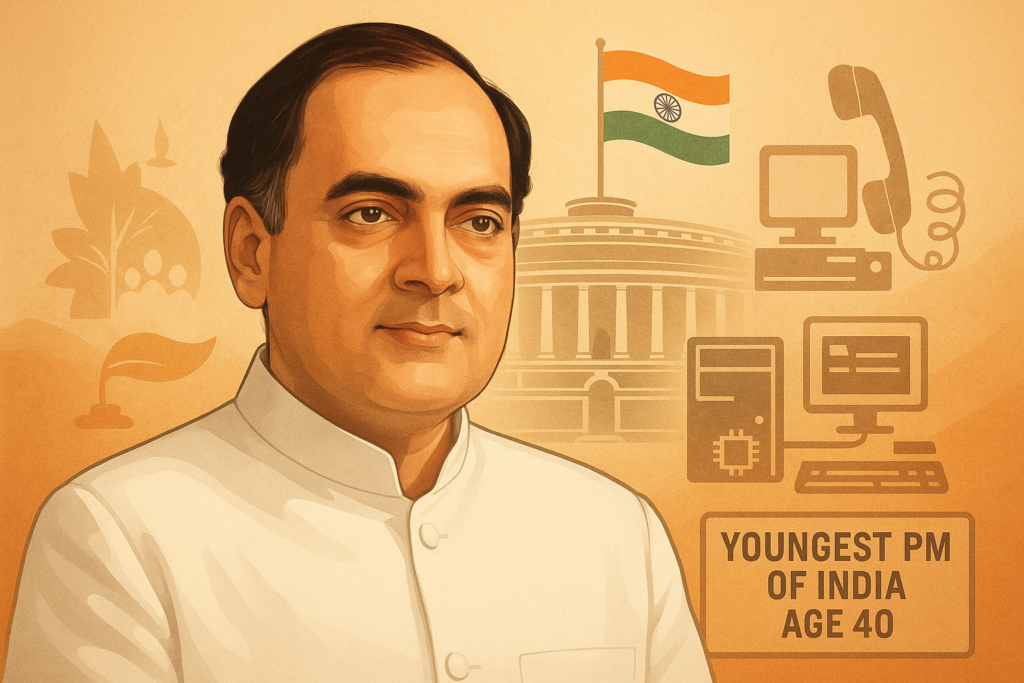
Biography of Shri Rajiv Gandhi
🛒 Buy Now on AmazonPersonal Details
- Full Name: Rajiv Ratna Gandhi
- Born: 20 August 1944, Mumbai (then Bombay), Maharashtra
- Died: 21 May 1991, Sriperumbudur, Tamil Nadu
- Father: Shri Feroze Gandhi
- Mother: Mrs. Indira Gandhi
- Wife: Mrs. Sonia Gandhi
- Children: Rahul Gandhi and Priyanka Gandhi Vadra
Early Life and Education
Rajiv Gandhi was born into a prominent political family of India. He was the elder son of India’s first woman Prime Minister, Mrs. Indira Gandhi. His early education took place in Dehradun at The Doon School. After this, he went to England for higher studies and enrolled at Imperial College London and later at Trinity College, University of Cambridge. He also studied Mechanical Engineering and Computer Science, although he could not complete his degree.
Private Life
Rajiv Gandhi met Sonia Maino from Italy, and the two were married in 1968. He initially wished to stay away from politics and began his professional career as a pilot with Indian Airlines. He enjoyed a simple and peaceful personal life, valuing family and privacy.
Political Career
Rajiv Gandhi’s entry into politics was unexpected. He became active after the tragic death of his younger brother, Sanjay Gandhi, in a plane crash in 1980. After the assassination of his mother, Prime Minister Indira Gandhi, on 31 October 1984, he took charge and became the 6th Prime Minister of India. At the age of 40, he became the youngest Prime Minister in the history of India.
Tenure as Prime Minister of India
Major Initiatives and Reforms
- Laid the foundation for India’s Information Technology and Telecom Revolution.
- Encouraged youth participation in politics and strengthened the Panchayati Raj system.
- Focused on reforms in education, science, technology, and modernization.
Foreign Policy and Controversies
- Sent the Indian Peace Keeping Force (IPKF) to Sri Lanka to help establish peace, which later became controversial.
Assassination and Death
On 21 May 1991, while campaigning for the Lok Sabha elections in Sriperumbudur, Tamil Nadu, Rajiv Gandhi was assassinated in a suicide bombing. The attack was carried out by the Liberation Tigers of Tamil Eelam (LTTE).
Legacy
Rajiv Gandhi is remembered as a modern-thinking leader who laid the foundation for India’s growth in the field of Information Technology. In his memory, 21 May is observed as Anti-Terrorism Day in India.
Detailed Early Life – Shri Rajiv Gandhi
Childhood and Family Background
Rajiv Gandhi was born on 20 August 1944 in Mumbai (then Bombay). He was the elder son of Prime Minister Indira Gandhi and freedom fighter Feroze Gandhi. Despite being part of a powerful political family, he initially showed little interest in politics.
Education Journey
Rajiv Gandhi studied at The Doon School in Dehradun, where his younger brother Sanjay Gandhi also studied. Later, he went to England and attended Imperial College London and Trinity College, University of Cambridge. He studied subjects like engineering and computer science but could not complete his degree.
Interest in Technology and Aviation
Rajiv Gandhi had a keen interest in music and machines. After returning to India without completing his studies, he joined Indian Airlines as a professional pilot.
Personal Life and Marriage
In 1968, he married Sonia Maino, an Italian woman. The couple had two children—Rahul Gandhi and Priyanka Gandhi Vadra. Rajiv Gandhi preferred a simple lifestyle and lived like an ordinary citizen until circumstances eventually drew him into the political arena.
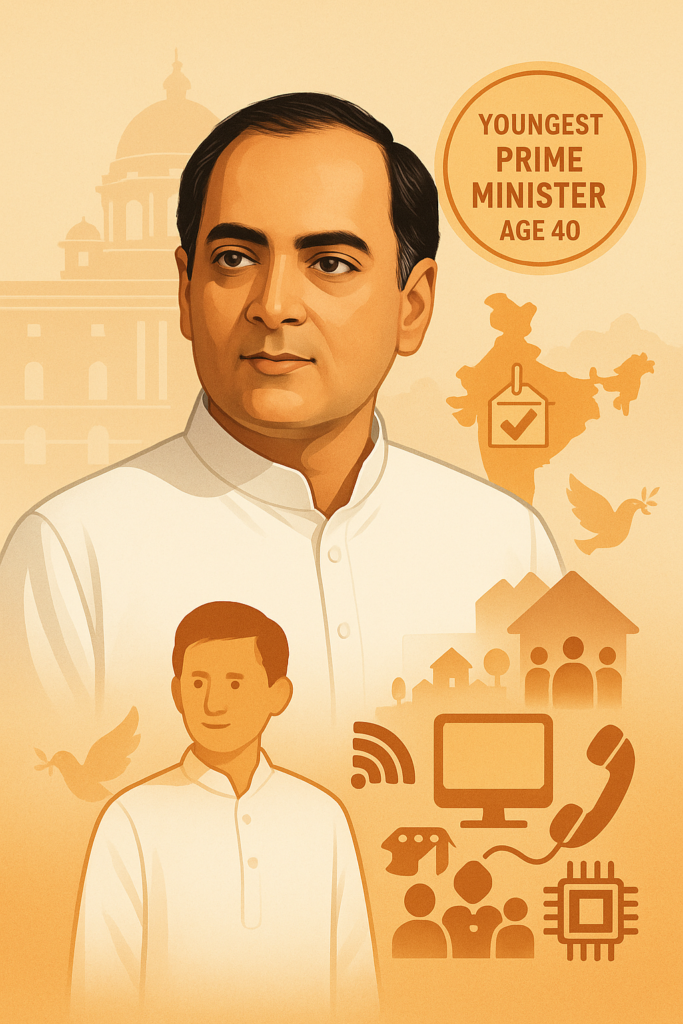
Education, Personal Life & Political Career — Shri Rajiv Gandhi
A concise and readable account of Rajiv Gandhi’s formative years, family life, and political journey.
Education – Shri Rajiv Gandhi
Rajiv Gandhi received a prestigious and partly international education. From an early age he was inclined toward technical subjects and science, though during his student years he stayed away from active politics.
🛒 Buy Now on AmazonElementary education
Rajiv Gandhi’s early schooling took place in the Indian state of Uttarakhand at The Doon School, Dehradun. This institution is regarded as one of the country’s most prestigious schools, where he learned discipline, leadership and participated in various cultural activities. His younger brother Sanjay Gandhi also studied there.
Higher education
After completing his schooling at The Doon School, Rajiv Gandhi went abroad for higher studies. He first studied at Imperial College, London, where he pursued engineering-related subjects. Later he enrolled at Trinity College, University of Cambridge, receiving education in modern subjects such as computer science and mechanical engineering.
Although he did not obtain a formal degree from any university, his outlook remained modern and he maintained a keen interest in science, technology, computers and communication systems. This perspective later influenced his policies as Prime Minister and contributed significantly to the beginnings of India’s information technology and telecom revolutions.
Summary: Rajiv Gandhi’s education gave him a balanced perspective of tradition and modernity, preparing him intellectually for later national leadership and reforms.
Personal Life – Shri Rajiv Gandhi
Rajiv Gandhi’s personal life was marked by simplicity, affection and strong family values. He preferred a quiet, ordinary life and originally wished to remain away from active politics, but family and national circumstances later drew him into public life.
Marriage
Rajiv Gandhi met Sonia Maino during her studies in England. The couple married in 1968 with family consent. After marriage Sonia Gandhi embraced Indian culture and started living the life of an Indian daughter-in-law.
Family
- Rahul Gandhi (born 1970)
- Priyanka Gandhi Vadra (born 1972)
Rajiv Gandhi was a loving father and a simple person. He enjoyed music, photography and had an interest in technical matters. He was also a professional pilot — serving with aviation organizations before entering politics, and he worked for many years with Indian Airlines.
Distance from politics
Initially, Rajiv intended to remain distant from political life. He and his younger brother Sanjay Gandhi were seen as different in temperament: Rajiv preferred privacy and a quiet life. However, the sudden death of Sanjay Gandhi in a plane crash in 1980 and later family responsibilities shifted Rajiv toward active politics.
Overall: Rajiv Gandhi’s personal life exemplified normalcy, warmth and responsibility — qualities he carried into public service when duty called.
Political Career – Shri Rajiv Gandhi
Rajiv Gandhi’s move into politics followed personal tragedy and national need. Though he had no initial plan to become a politician, events within his family and the country led him to take on public responsibility.
Entry into politics
In 1980, Rajiv’s younger brother Sanjay Gandhi died in a plane crash. Sanjay had been widely viewed as Indira Gandhi’s political successor. After this tragic incident, and with encouragement from his family, Rajiv entered active politics. He joined the Indian National Congress and later contested from the Amethi Lok Sabha seat, becoming its Member of Parliament.
Role in Congress
After joining politics, Rajiv Gandhi was given important responsibilities within the Congress party. He promoted a modern, technocratic approach to governance, emphasized transparency, and sought to bring younger people into political life.
Becoming Prime Minister
Following the assassination of Prime Minister Indira Gandhi on 31 October 1984, Rajiv Gandhi assumed the leadership of the country and became the Prime Minister of India. At around 40 years of age, he became the youngest Prime Minister of the nation.
1984 General Election
The assassination of Indira Gandhi created a widespread sympathy wave across the country. In the subsequent 1984 Lok Sabha elections, the Congress party won a historic majority, securing 404 out of 543 seats, one of the largest mandates in Indian electoral history.
Key achievements
- Laid the groundwork for the IT and telecom revolution in India.
- Promoted Panchayati Raj and encouraged youth participation in politics.
- Proposed new directions in education and emphasized modernization, science and technology.
- Led peace efforts by deploying the Indian Peace Keeping Force (IPKF) to Sri Lanka in an attempt to halt the civil war.
- Took a public stance against corruption, although his image was later affected by controversies.
Challenges and controversies
- 1984 Sikh riots: The communal violence that followed Indira Gandhi’s assassination remained a major blot on the period.
- Bofors scandal: The arms procurement controversy damaged public trust and tarnished Rajiv Gandhi’s government.
Later years and final campaign
After the turbulent years and the 1989 electoral defeat of Congress, Rajiv Gandhi remained politically active. He stood again as the Congress candidate for the 1991 Lok Sabha elections.
Assassination and death
On 21 May 1991, while campaigning in Sriperumbudur, Tamil Nadu, Rajiv Gandhi was assassinated in a suicide bomb attack. The attack was carried out by operatives of the Liberation Tigers of Tamil Eelam (LTTE).
Conclusion: Though Rajiv Gandhi’s political career was relatively short, he is remembered as a young, visionary leader who pushed India toward modernization and technological development.
Legacy
Rajiv Gandhi is recalled for bringing a modern, technology-friendly outlook to Indian governance. Many of the early steps that led to India’s IT and communications expansion originated during his tenure. His life and tragic death continue to shape debates on politics, security and modernization in India.
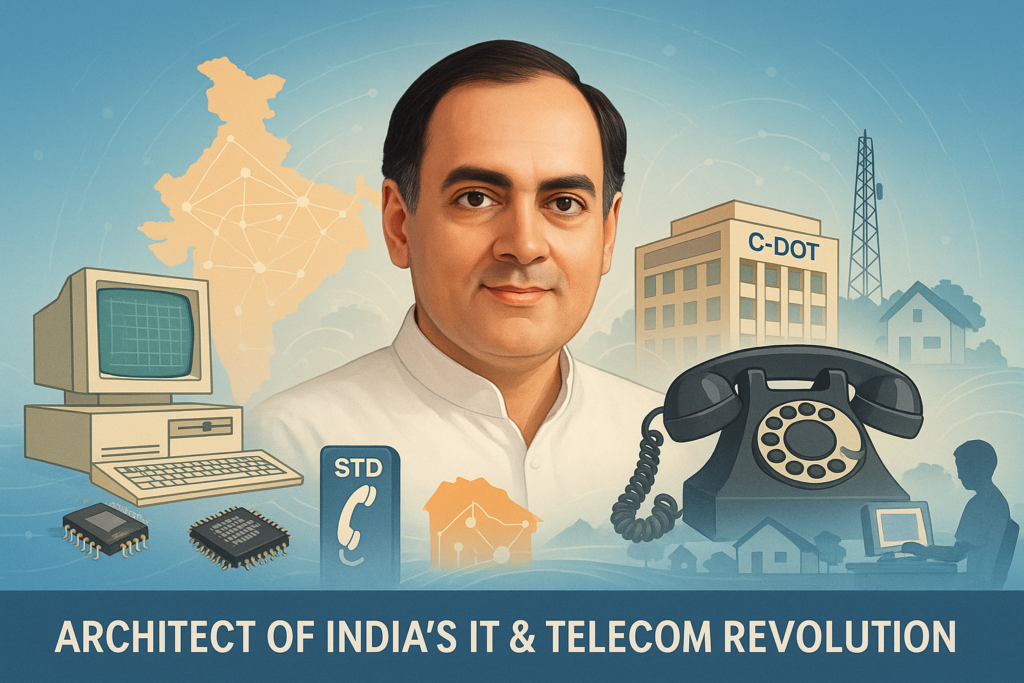
Tenure as Prime Minister – Shri Rajiv Gandhi
Rajiv Gandhi took over as the Prime Minister of India on 31 October 1984. At that time, he was only 40 years old, making him India’s youngest Prime Minister. His tenure became a crucial phase in laying the foundation of modern India.
His time in office (1984–1989) was historic in many ways, as he introduced modern reforms in science, technology, communication, education, and administration.
🛒 Buy Now on AmazonMajor Achievements
1. Beginning of the Information Technology (IT) and Telecom Revolution
- Rajiv Gandhi promoted the use of computers and information technology across India.
- He established institutions like C-DAC.
- He modernized digital networks and telephone systems across the country.
- He worked with experts such as Sam Pitroda to transform India’s telecom sector.
2. Improvements in Education
- Implemented the New National Policy on Education (1986).
- Started education schemes and Navodaya Vidyalayas to promote rural education.
- Emphasized scientific and technical education at all levels.
3. Panchayati Raj and Decentralisation of Power
- Proposed the historic 73rd and 74th Constitutional Amendments to empower panchayats and urban bodies.
- Strengthened democracy at the village level.
4. Engaging Youth in Politics and Development
- Believed that youth participation was essential for nation-building.
- Gave the right to vote at the age of 18.
- Formulated the National Youth Policy.
5. Promotion of Science and Modern Technology
- Developed technical institutions to international standards.
- Increased government investment in computers and scientific research.
Challenges and Controversies
1. Bofors Scandal (1986)
The Swedish arms deal became embroiled in corruption allegations, severely tarnishing Rajiv Gandhi’s public image.
2. IPKF Mission in Sri Lanka
Rajiv Gandhi sent the Indian Peace Keeping Force (IPKF) to establish peace between Tamil rebels and the Sri Lankan government. The decision was controversial and received criticism within India.
3. 1984 Anti-Sikh Riots
The government faced strong criticism for its handling of the riots that occurred after the assassination of Indira Gandhi. This incident became a major shadow over his tenure.
End of Term
Rajiv Gandhi’s tenure lasted until December 1989. Due to the Bofors controversy and other issues, the popularity of his government declined, and Congress lost the 1989 Lok Sabha elections.
Although he was campaigning to become Prime Minister again in 1991, he was assassinated on 21 May 1991 in a suicide bomb attack.
Conclusion
Rajiv Gandhi is remembered as a Maker of Modern India. He laid the foundation that pushed India toward the 21st century. His tenure is seen as a historic period marked by technological advancement, youth empowerment, and democratic reforms.
Information Technology and Telecom Revolution – Shri Rajiv Gandhi
Rajiv Gandhi’s tenure as Prime Minister is especially remembered for bringing revolutionary changes in India’s Information Technology (IT) and Telecommunications sectors. At a time when computers and digital communication were new concepts, Rajiv Gandhi recognized their importance for India’s future.
Major Contributions
1. Development of Computers and IT
- Promoted computerisation in government, education, and industries.
- Laid the foundation of India’s modern software industry.
- Created policies that later helped India emerge as a global IT leader.
2. Sam Pitroda and the Establishment of C-DOT
- Brought visionary technologist Sam Pitroda to India’s telecom mission.
- Established C-DOT (Centre for Development of Telematics).
- Modernized telephone networks through digital exchange systems.
3. Expansion of Telecommunication Network
- Transformed telephone services from a luxury into an accessible utility.
- Laid the foundation of STD booths, digital exchanges, and early cellular networks.
- Set the stage for today’s mobile and internet revolution.
4. Integration of Education and Technology
- Introduced computer education in schools and colleges.
- Strengthened technical education to create a new, tech-oriented generation.
Long-Term Effects
- Laid the foundation for India becoming the IT Hub of the World.
- Cities like Bengaluru, Hyderabad, and Pune emerged as major IT hubs.
- Created employment opportunities for millions of Indian youth.
- Gave India the early digital mindset that led to programs like Digital India, Startup India, and Make in India.
Conclusion
Rajiv Gandhi played a key role in launching India’s IT and telecom revolution. His modern and technological vision gave India a new identity on the global stage and prepared the nation for the digital age.
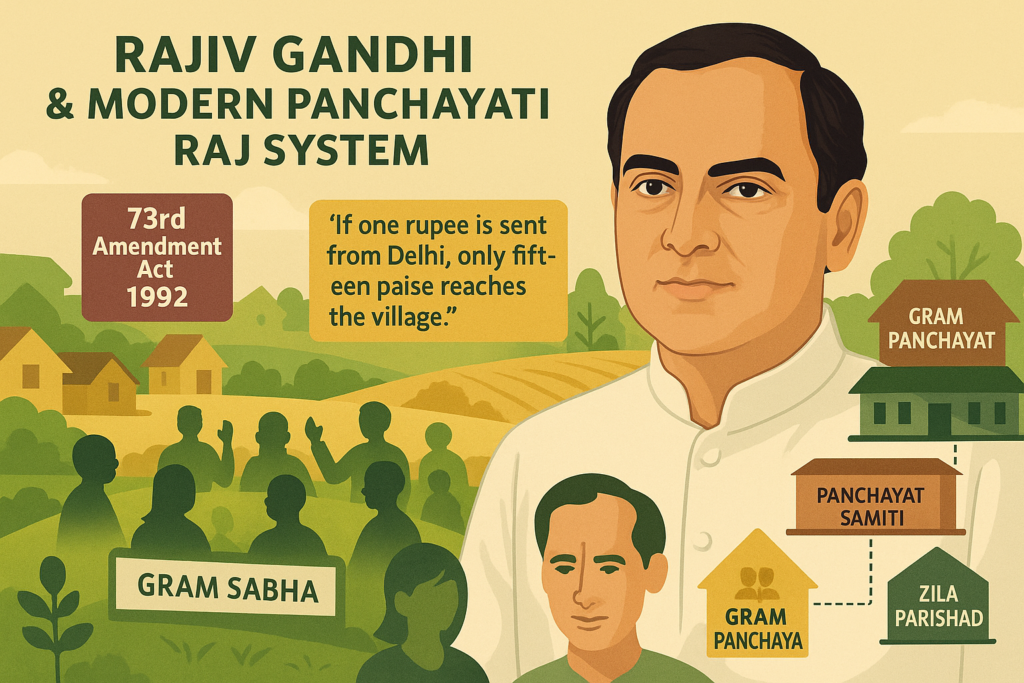
Panchayati Raj – Contribution of Shri Rajiv Gandhi
Rajiv Gandhi believed that democracy becomes strong only when power reaches the common people. With this vision, he took major steps to strengthen the Panchayati Raj system. His aim was to give village residents greater decision-making power and responsibility for development.
🛒 Buy Now on AmazonKey Initiatives
1. Decentralization of Power
Rajiv Gandhi recognized that central and state governments could not effectively address small, local problems. Therefore, he aimed to strengthen governance at the village level.
2. 73rd Constitutional Amendment (1992)
This historic act was prepared under Rajiv Gandhi’s leadership and passed in 1992 after his death.
- Gram Panchayat, Panchayat Samiti, and Zila Parishad were granted constitutional status.
- Panchayats received fixed tenure, regular elections, financial powers, and reservation for weaker sections, including women.
3. Establishment of Gram Sabha
Rajiv Gandhi emphasized the importance of the Gram Sabha—in which all adult citizens of a village could participate in deciding development plans. This increased public participation and transparency.
4. Transfer of Financial Powers
Rajiv Gandhi ensured that development funds and resources were transferred directly to Panchayat institutions. His aim was to make sure that money intended for development actually reached village-level bodies.
Rajiv Gandhi’s Viewpoint
His famous statement:
“If one rupee is sent from Delhi, only fifteen paise reaches the village.”
This highlighted corruption and inefficiency in the system before decentralization. Rajiv Gandhi attempted to change this fundamental problem.
Effect
- India’s present three-tier Panchayati Raj system (village–block–district) is the result of his vision.
- Millions of sarpanches, women representatives, and local leaders now drive development across rural India.
- The system strengthened women’s empowerment, rural participation, and local development.
Conclusion
Rajiv Gandhi is considered the architect of modern Panchayati Raj. His dream of empowering the grassroots level has become a pillar of Indian democracy.
Education, Science and Technology, and Modernization – Shri Rajiv Gandhi
Rajiv Gandhi believed that for India to become strong and developed in the 21st century, it must be self-reliant and advanced in education, science, and technology. During his tenure, he introduced several historic reforms.
1. Reforms in the Field of Education
New National Policy on Education (1986)
- Introduced the New Education Policy (1986) to ensure equal and quality education for all.
- Promoted girl child education, rural education, and education for underprivileged groups.
Establishment of Navodaya Vidyalayas
- Started Jawahar Navodaya Vidyalayas to provide quality education to talented rural students.
- These schools offer free residential education and continue to play a vital role today.
Promotion of Technical Education
- Encouraged engineering, science, and computer education.
- Increased the number of engineering colleges and IT institutes.
2. Promotion of Science and Technology
Expansion of Scientific Thinking
- Launched the National Science and Technology Mission to promote scientific outlook.
- Strengthened science teaching in schools and colleges.
Establishment of C-DAC
- Founded C-DAC (Centre for Development of Advanced Computing) for supercomputer development.
- India’s first supercomputer, PARAM 8000, was developed by C-DAC.
Support to Defence, Space, and Research
- Strengthened ISRO with additional resources and technology.
- India made progress in telemedicine, satellite communication, and remote sensing.
3. Modernization and Digital Transformation
Entry of Computers and IT
- Expanded computer education and introduced computers in government institutions, banks, and schools.
- Faced criticism at the time but took bold steps toward modernization.
Use of Modern Technology in Administration
- Introduced digital filing systems and database management in government offices.
- Improved transparency and reduced corruption.
Conclusion
Rajiv Gandhi aimed to transform India through education, science, and technology. His emphasis on innovation, modernization, and self-reliance laid the foundation for a young and technologically strong India.
Death – Shri Rajiv Gandhi
Rajiv Gandhi’s death remains one of the most tragic and shocking events in modern Indian political history. It was a deep loss for the Congress party and the entire nation.
Background to the Assassination
In 1991, Rajiv Gandhi was campaigning for the Lok Sabha elections. He was addressing rallies across South India, especially in Tamil Nadu.
Sri Lanka and LTTE Connection
- During his tenure as Prime Minister, he attempted to bring peace between the Sri Lankan government and the Tamil rebel group LTTE (Liberation Tigers of Tamil Eelam).
- He sent the Indian Peace Keeping Force (IPKF) to Sri Lanka.
- The LTTE viewed this as a betrayal and considered Rajiv Gandhi an enemy.
The Assassination
Date: 21 May 1991
Place: Sriperumbudur, Tamil Nadu
Rajiv Gandhi had arrived to address an election rally. While meeting supporters, a woman suicide bomber associated with the LTTE approached him under the pretext of garlanding him. She detonated an explosive belt, killing Rajiv Gandhi and 18 others on the spot.
Results and Aftermath
- The assassination shocked the entire nation.
- The government formed a CBI-SIT Special Investigation Team to investigate.
- After investigation, it was proved that LTTE was responsible.
- Seven people were convicted—some sentenced to death, others to life imprisonment.
Conclusion
Rajiv Gandhi was not only a political leader but also a young visionary and a major architect of modern India. His assassination exposed the dangers of extremism and left a deep impact on Indian politics. His legacy continues to shape India’s democratic and technological strides.
Conclusion
Shri Rajiv Gandhi emerged as one of India’s most influential and forward-looking leaders. His vision for a modern, technologically advanced, decentralized and youth-driven India laid the foundation for many reforms that continue to shape the nation today. Whether it was the strengthening of Panchayati Raj, promotion of science and technology, the introduction of computers and telecommunications, or educational modernization, his policies pushed India towards the 21st century with confidence.
🛒 Buy Now on AmazonHis tragic assassination cut short a promising journey, but his contributions continue to guide India’s democratic, digital and developmental progress. Rajiv Gandhi is remembered not just as a political leader, but as a visionary who believed in empowering people, modernizing governance, and building a strong future for the nation.
References
- Government of India – Ministry of Panchayati Raj Reports
- National Policy on Education (1986) – Government Publications
- Rajiv Gandhi Foundation – Official Documents
- Lok Sabha Secretariat – Parliamentary Records
- Historical Archives on Rajiv Gandhi’s Prime Ministerial Tenure
- Official Data on 73rd Constitutional Amendment Act (1992)
- Research documents on India’s IT & Telecom Revolution (C-DAC & C-DOT)
- News archives: The Hindu, Times of India, Indian Express (1984–1991)