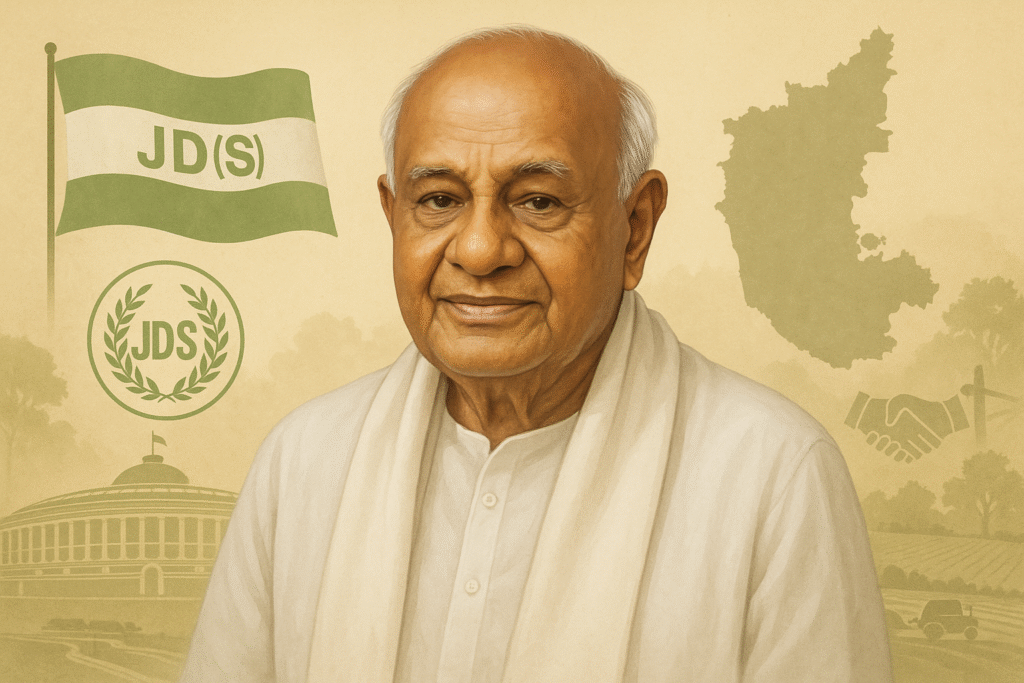
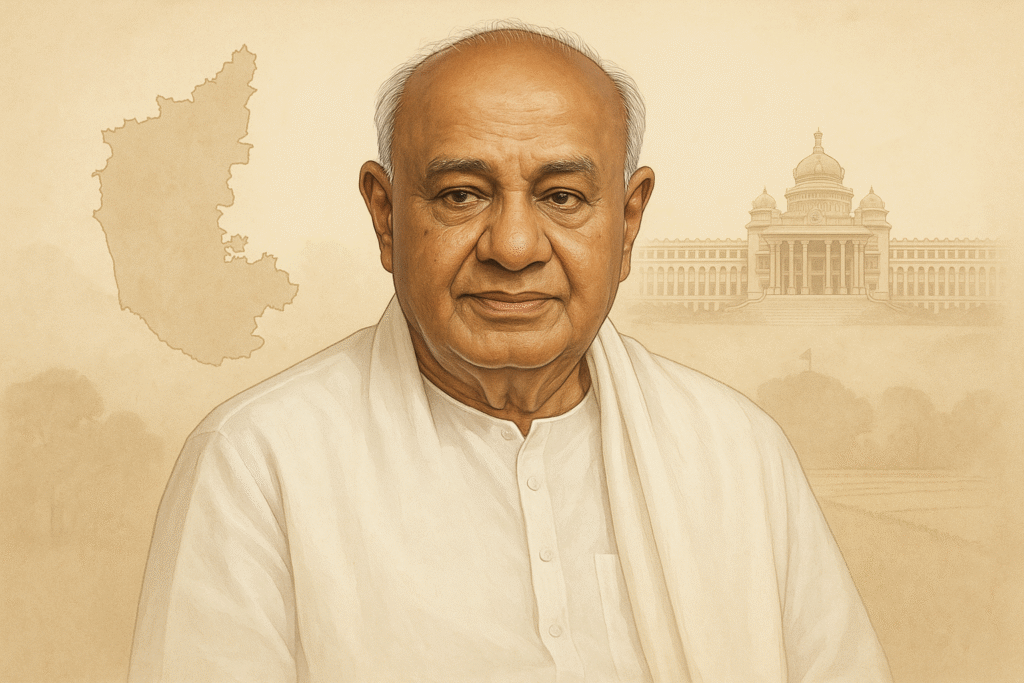
HD Deve Gowda Biography

Haradanahalli Doddegowda Deve Gowda – Biography

Personal Information

  • Full Name: Haradanahalli Doddegowda Deve Gowda
  • Born: 18 May 1933
  • Place of Birth: Haradanahalli, Holenarasipur Taluk, Hassan District, Mysore State (present-day Karnataka), India
  • Party: Janata Dal (Secular)
  • Wife’s Name: Channamma Devegowda
  • Children: 6 (including former Chief Minister H. D. Kumaraswamy)

Early Life and Education

HD Deve Gowda was born in a simple farmer family. He studied civil engineering, but soon became active in politics. Discipline, hard work and honesty left a deep impression in his life since childhood.

Political Career

State Politics

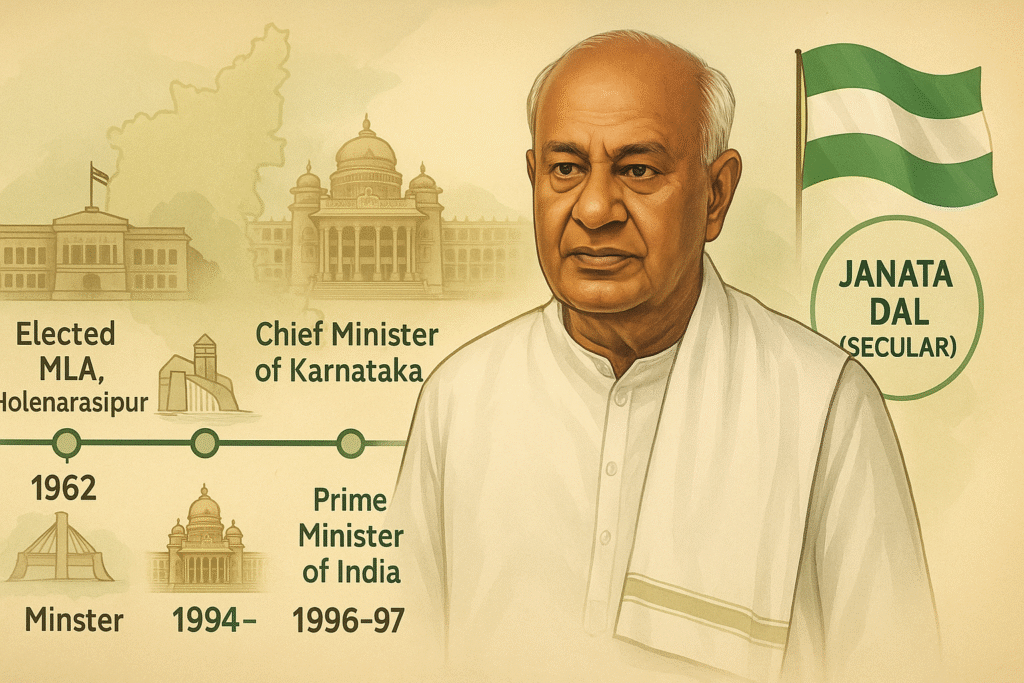
Deve Gowda started his political career with the Congress Party in the 1950s but later also contested elections as an independent candidate. He became a member of the Karnataka Legislative Assembly for the first time in 1962. He has served as Minister of State and Leader of the Opposition several times.

Chief Minister of Karnataka

After the formation of the Janata Dal government in 1994, he became the Chief Minister of Karnataka and remained in this position till 1996.

Prime Minister of India

On 1 June 1996, he became the 11th Prime Minister of India. He became the Prime Minister under the United Front government and remained in this position till 21 April 1997.

Later Life

He remained active in politics even after becoming Prime Minister. He has been a member of both the Rajya Sabha and the Lok Sabha. He is one of the founding leaders of the Janata Dal (Secular) party.

Achievements and Contributions

  • Deve Gowda is known as a farmer leader.
  • He paid special attention to rural development, irrigation, and farmers’ problems.
  • During his tenure, the Central Government saw several coalition experiments.

Personal Life

HD Deve Gowda is a simple living leader. He is known for his simplicity, honesty and humility in political life. His son HD Kumaraswamy has also been the Chief Minister of Karnataka.

Conclusion

HD Deve Gowda is a leader of Indian politics who rose from the grassroots level to become the Prime Minister of the country. His life is an inspiration for farmers and common people.

Early Life of HD Deve Gowda

Birth and Background

Deve Gowda was born on 18 May 1933 in Haradanahalli village of Hassan district, Karnataka, in an ordinary farmer family. His full name is Haradanahalli Doddegowda Deve Gowda. He belongs to the Vokkaliga community.

Top Amazon Product

Top Amazon Product

Discover this product on Amazon. Click below to view the latest price, key features, and customer reviews.

View on Amazon

Amazon Affiliate Link – Thank you!

Childhood and Education

Deve Gowda’s childhood was full of difficulties, as his family was not financially well off. Despite this, he tried to complete his education. He did a diploma in civil engineering from Mysore University, but along with studies, his inclination towards social service and politics also increased.

Inclination Towards Politics

From his youth, he was concerned about rural problems, farmers’ issues and social justice. Due to this emotional attachment, he chose politics as a medium through which he could serve society.

Values and Character

Deve Gowda had made honesty, simplicity and hard work his identity in his early life itself, which later became visible in his entire political life.
Education of H. D. Deve Gowda

H. D. Deve Gowda received his early education in his native village Haradanahalli. He completed his education in 1938. At that time, there were limited educational facilities in villages, but he did not give up his resolve to get an education despite difficult circumstances.

He later received his secondary education from Lakshmisagar Government High School, Holenarsipur. After this, he took admission in a technical institute in Mysore to pursue a Diploma in Civil Engineering.

Though he could have become a trained engineer, his inclination was more towards social service and politics. So instead of making a career in engineering, he selected public service and politics.

His educational experience taught him practical thinking, problem-solving, and a planned work style, which later proved helpful to him in his administrative and political life.

Political Career of H. D. Deve Gowda

H. D. Deve Gowda’s political career has been very long. He entered politics in the 1950s. He was initially a member of the Congress Party, but later started contesting elections independently.

1. Debut as MLA

In 1962, Deve Gowda contested from the Holenarasipur Assembly Seat as an Independent candidate and won the election. Thereafter, he was elected to the Karnataka Legislative Assembly six times in a row.

2. Ministerial Roles and Leader of the Opposition

He served as a member of the Karnataka Government in departments such as the Public Works Department (PWD) and Water Resources. For some time, he also served as the Leader of the Opposition in the Karnataka Legislative Assembly and openly criticized the policies of the government.

3. As Chief Minister

After the victory of Janata Dal in 1994, Deve Gowda became the Chief Minister of Karnataka. As Chief Minister, he paid special attention to farmers, rural development, and irrigation schemes.

4. Prime Minister of India

On 1 June 1996, H. D. Deve Gowda became the 11th Prime Minister of India. He became Prime Minister under the leadership of the United Front, which was a coalition of several regional parties. His tenure continued till 21 April 1997.

5. After Becoming Prime Minister

Even after leaving the post of Prime Minister, he remained active in politics. Many times, he was a member of the Lok Sabha and the Rajya Sabha. He formed his own separate party, Janata Dal (Secular), and gave this party an important place in the politics of Karnataka.

Key Features

  • Deve Gowda is famous as a farmer leader.
  • He has always given priority to issues related to rural India, farmers’ rights, and social justice.
  • His political life is associated with simplicity, struggle, and honesty.
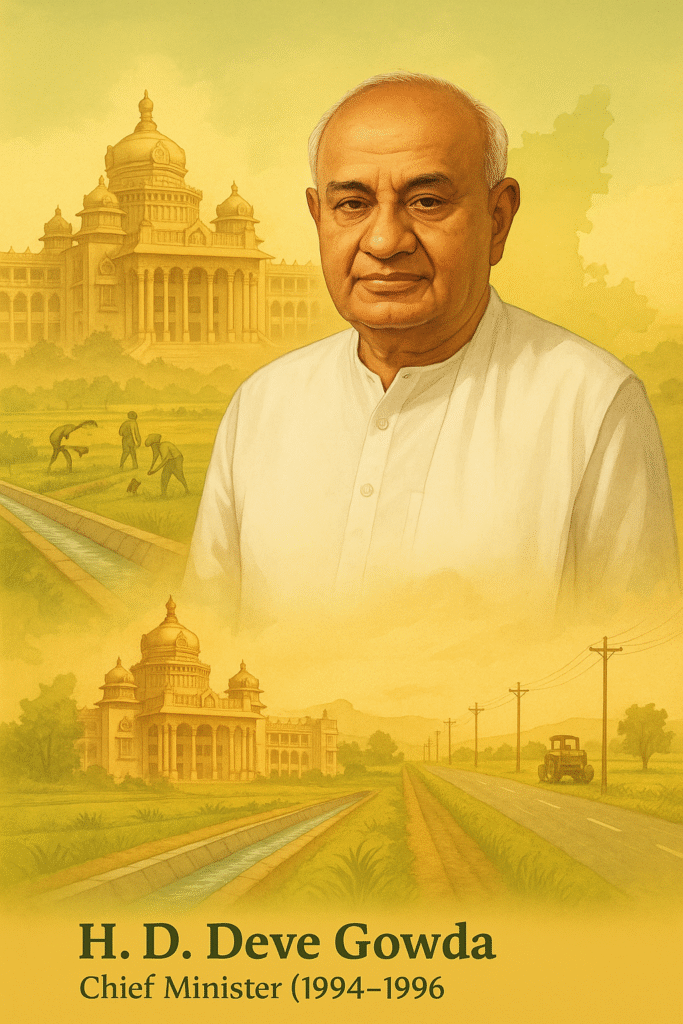
“Chief Minister (Karnataka) – H. D. Deve Gowda (1994–1996)”

Chief Minister of Karnataka – H. D. Deve Gowda

H. D. Deve Gowda served as the Chief Minister of Karnataka from 1994 to 1996. At that time, he was a senior leader of the Janata Dal, which achieved significant success in the Assembly elections. His image as a hardworking and farmer-friendly leader contributed to his popularity among the public.

Background of Becoming Chief Minister

  • In the 1994 Assembly elections, the Janata Dal secured a majority in Karnataka.
  • Deve Gowda was given the responsibility of Chief Minister due to his position within the party and public support.

Major Works and Achievements as Chief Minister

Farmer Welfare

During his tenure, Deve Gowda gave priority to farmers' problems. He promoted irrigation schemes and tried to provide relief in agricultural loans.

Rural Development

In rural areas, his government focused on improving infrastructure such as roads, electricity and water facilities.

Water Resources Management

He adopted a balanced stand on sensitive issues such as the Cauvery water dispute. He also played a role in advancing irrigation projects in the state.

Transparency in Governance

Administrative integrity was emphasized during his tenure. Efforts were made to control corruption and ensure accountability.

Resignation from the Post of Chief Minister

In 1996, when the United Front government was formed at the Centre, Deve Gowda was unanimously elected as its leader. After this, he resigned from the post of Chief Minister and became the Prime Minister of India.

H. D. Deve Gowda's tenure as Chief Minister was relatively brief. His political career in Karnataka was followed by his elevation to the post of Prime Minister.

United Front – Contribution of H. D. Deve Gowda

The United Front was a political alliance that came into existence in India in 1996. This front was formed by regional parties and left parties. It brought together several political groups that sought to form a government at the Centre with support from outside the Congress Party.

Background of the United Front

  • In the 1996 general elections, the Bharatiya Janata Party (BJP) emerged as the largest party but did not secure a majority.
  • The BJP government lasted for 13 days because it could not secure sufficient support in Parliament.
  • After this, 13 political parties came together to form a coalition called the United Front. These included:
    • Janata Dal
    • Telugu Desam Party (TDP)
    • Dravida Munnetra Kazhagam (DMK)
    • Assam Gana Parishad (AGP)
    • Samajwadi Party
    • Communist parties, including CPI and CPI(M)

Deve Gowda Becoming the Prime Minister

When the United Front got the opportunity to form the government, the Congress Party decided to provide support from outside. H. D. Deve Gowda was unanimously selected as the leader of the United Front and became the 11th Prime Minister of India on 1 June 1996. He emerged as a regional political leader who reached the highest executive office in the country.

Main Highlights of Deve Gowda's Prime Ministerial Tenure

Coalition Politics

He tried to bring together parties with different ideologies and worked within the framework of coalition politics.

Agriculture and Rural Development

Like his tenure as Chief Minister, at the Centre too, he emphasized farmers' issues and the development of rural India.

Foreign Policy

He represented India at international forums and emphasized the country's independence in foreign policy and national sovereignty.

End of Tenure

The Congress Party was providing external support to the United Front government. It withdrew its support in April 1997. Following this development, Deve Gowda had to resign from the post of Prime Minister.

Conclusion

Leading the United Front government was an important phase in H. D. Deve Gowda's political career. His tenure reflected the coalition-based nature of Indian politics during the 1990s. He led a government formed by several parties with different political ideologies and worked within the challenges of coalition governance.

“Later Life of H. D. Deve Gowda”

Later Life of H. D. Deve Gowda

Even after resigning from the post of Prime Minister, H. D. Deve Gowda remained active in Indian politics. He continued to play a role in both national and Karnataka politics.

1. Establishment of Janata Dal (Secular)

  • After his tenure as Prime Minister, differences emerged within the Janata Dal.
  • In 1999, Deve Gowda separated from the Janata Dal and became associated with the formation of Janata Dal (Secular), commonly known as JD(S).
  • The party became an important political force in Karnataka and participated in state-level coalition politics.

2. Active Role in Karnataka Politics

  • He encouraged his son, H. D. Kumaraswamy, to participate in politics. Kumaraswamy later became the Chief Minister of Karnataka.
  • Through his party, Deve Gowda played a role in the formation and functioning of coalition governments in Karnataka.

3. Service as a Member of Parliament

  • Deve Gowda served as a member of both the Lok Sabha and the Rajya Sabha.
  • He raised issues related to farmers, rural development, and constitutional principles in Parliament.

4. Simple Living and Public Image

  • Deve Gowda has often been associated with a simple lifestyle.
  • His public image has been linked with simplicity and humility in political life.

5. Respect and Recognition

  • Deve Gowda has received recognition for his long career in Indian politics.
  • He continues to be associated with discussions on Indian democracy, coalition politics, and farmers' interests.

Conclusion

The later life of H. D. Deve Gowda reflects his continued participation in politics and public affairs after serving as Prime Minister. His political journey connects state-level leadership with national coalition politics.

Achievements of H. D. Deve Gowda

The political career of H. D. Deve Gowda includes several important roles at the state and national levels. His major political achievements and contributions are discussed below.

1. Becoming the Prime Minister of India (1996–1997)

  • Deve Gowda became the 11th Prime Minister of India in 1996.
  • He led the United Front government, which brought together several parties with different political ideologies.

2. Chief Minister of Karnataka (1994–1996)

  • During his tenure as Chief Minister, he emphasized farmers' issues, rural development, and irrigation projects.
  • His government also focused on administrative functioning and development programmes in Karnataka.

3. Establishment of Janata Dal (Secular)

  • Deve Gowda played a central role in the formation and development of Janata Dal (Secular).
  • The party became an important participant in Karnataka's coalition politics and state governments.

4. Identity as a Farmer Leader

  • Throughout his political career, he raised issues concerning farmers in Parliament and other public forums.
  • His political activities have frequently focused on farmers, agricultural development, and rural India.

5. India's Representation at National and International Forums

  • As Prime Minister, he represented India at national and international forums and participated in diplomatic engagements with other countries.

6. Long and Continuing Political Career

  • He served as a member of the Karnataka Legislative Assembly and the Indian Parliament, including the Lok Sabha and Rajya Sabha.
  • His political career spans several decades, covering state politics, national leadership, and coalition governments.

Conclusion

The political journey of H. D. Deve Gowda demonstrates how a leader from a farming family reached the highest executive office in India. His career includes leadership in Karnataka, service as Prime Minister, and continued participation in parliamentary and state politics. His life remains an important subject for understanding Indian coalition politics and regional leadership.

Contribution of H. D. Deve Gowda

H. D. Deve Gowda played an important role in Indian politics, particularly in raising issues related to small farmers, rural communities, and coalition politics. His political contribution extended beyond holding public offices and included participation in policy discussions and democratic processes.

1. Voice of Farmers' Interests

  • Throughout his political career, Deve Gowda raised issues concerning farmers, especially agricultural loans, irrigation, and Minimum Support Price (MSP).
  • He supported an agriculture-based economy and policies aimed at improving the conditions of farmers.

2. Strengthening Coalition Politics

  • He became Prime Minister during a period when coalition governments were an important feature of Indian politics.
  • He led the United Front government, which brought together regional and ideological parties under a common political arrangement.

3. Contribution to the Development of Karnataka

  • As Chief Minister, he focused on roads, irrigation projects, rural employment, and infrastructure development.
  • He was also associated with issues concerning water management and environmental protection.

4. Active Role in Parliament

  • As a member of both the Lok Sabha and Rajya Sabha, he participated in discussions on public policy and national issues.
  • He raised matters concerning development and social justice.

5. Public Image and Political Leadership

  • Deve Gowda has often been associated with a simple lifestyle and a long career in public service.
  • His political career includes leadership at the state and national levels, as well as participation in coalition governments.

Conclusion

H. D. Deve Gowda's contribution to Indian politics includes his role in raising farmers' issues, participating in democratic institutions, and leading a coalition government. His political career is also significant for understanding regional leadership and coalition politics in India.

Personal Life of H. D. Deve Gowda

The personal life of H. D. Deve Gowda has often been associated with simplicity, family values, and a modest lifestyle. His family has also had a significant presence in Karnataka's political life.

Family

  • H. D. Deve Gowda was born on 18 May 1933 in Haradanahalli village of Hassan district, Karnataka, in a farming family.
  • His wife's name is Channamma.
  • He has six children, including his son H. D. Kumaraswamy, who has served as the Chief Minister of Karnataka.
  • Several members of his family have been associated with politics, particularly in Karnataka.

Religious Beliefs

  • Deve Gowda has been associated with Hindu religious traditions.
  • He has participated in religious events and worship.
  • His public image has often been associated with a simple and modest lifestyle.

Interests and Hobbies

  • Deve Gowda has maintained a strong interest in agriculture and farmers' issues.
  • He has been associated with discussions on agricultural policy, water management, and rural development.
  • His public speeches and political activities have frequently focused on rural communities and agricultural concerns.

Lifestyle and Personality

  • Deve Gowda has often been described as a leader with a simple and modest lifestyle.
  • His long political career has included participation in public service and democratic institutions.

Conclusion

The personal life of H. D. Deve Gowda provides an insight into his family background, religious beliefs, and public image. His journey from a farming family to the office of Prime Minister remains an important part of his political biography.

Conclusion of H. D. Deve Gowda's Life

The life of H. D. Deve Gowda reflects a journey of political participation, public service, and leadership. He is recognized in Indian politics for his role in representing farmers' interests, leading a coalition government, and serving in important political positions. His career highlights the role of public leadership and democratic institutions in shaping society.

Contribution as a Farmer Leader

Throughout his political career, Deve Gowda remained associated with issues concerning farmers and rural communities. He raised matters related to agriculture, irrigation, and water resources and supported initiatives aimed at improving rural livelihoods.

Political Leadership

As the Chief Minister of Karnataka and the 11th Prime Minister of India, Deve Gowda held important positions in Indian politics. His political career included participation in state administration, national governance, and coalition politics.

Role in Coalition Politics

Deve Gowda led the United Front government and became an important figure during the coalition era of Indian politics. He worked with parties representing different political ideologies and regional interests during his tenure as Prime Minister.

Personal Life

Deve Gowda has often been associated with a simple and modest lifestyle. His personal life and public career have been closely connected with his family background and long involvement in politics.

The life of H. D. Deve Gowda highlights the importance of public service, democratic participation, and farmers' interests in Indian politics. His journey from a farming family in Karnataka to the office of Prime Minister remains a significant part of India's political history.

Frequently Asked Questions (FAQs)

1. Who is H. D. Deve Gowda?

H. D. Deve Gowda (Haradanahalli Doddegowda Deve Gowda) is an Indian politician who served as the 11th Prime Minister of India from 1 June 1996 to 21 April 1997. He is also known for serving as the Chief Minister of Karnataka and as a prominent farmers' leader.

2. When and where was H. D. Deve Gowda born?

H. D. Deve Gowda was born on 18 May 1933 in Haradanahalli village, Holenarasipur taluk, Hassan district, Karnataka (then Mysore State), India. He was born into a farming family.

3. What were the major achievements of H. D. Deve Gowda?

His major achievements include serving as Chief Minister of Karnataka, becoming the 11th Prime Minister of India, promoting irrigation and rural development, supporting farmers' welfare, and participating in coalition politics in India.

4. Why is H. D. Deve Gowda known as a farmers' leader?

Throughout his political career, Deve Gowda focused on farmers' welfare, irrigation projects, rural infrastructure, agricultural development, and policies aimed at improving the lives of rural communities.

5. Which political party does H. D. Deve Gowda belong to?

H. D. Deve Gowda is the founder and senior leader of the Janata Dal (Secular) [JD(S)] party. The party has played a significant role in Karnataka politics and coalition governments.

6. How long did H. D. Deve Gowda serve as Prime Minister?

H. D. Deve Gowda served as the Prime Minister of India from 1 June 1996 to 21 April 1997, leading the United Front coalition government with outside support from the Congress Party.

7. What is the legacy of H. D. Deve Gowda?

H. D. Deve Gowda is associated with farmers' issues, rural development, and coalition politics in India. His journey from a farming family to the Prime Minister's office is an important part of India's political history.

References

  • Official Government Records
  • Parliament of India – Member Profiles
  • Lok Sabha and Rajya Sabha Debates Archive
  • Janata Dal (Secular) Party Information
  • News Articles, Interviews, and Public Speeches of H. D. Deve Gowda

Leave a Comment

Your email address will not be published. Required fields are marked *

Scroll to Top