
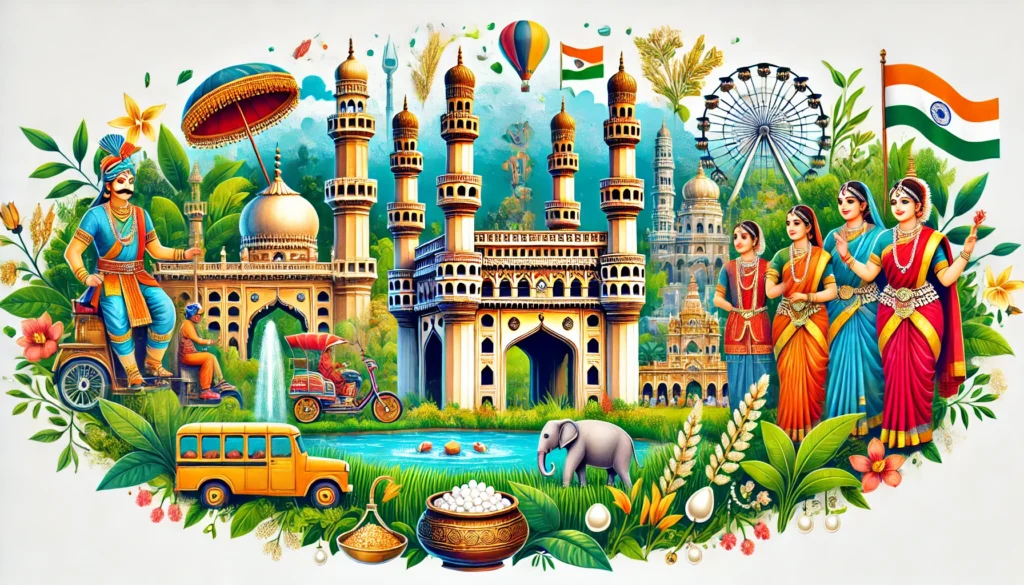
Telangana: A Journey Through History, Culture, and Modern Growth
Telangana is the 29th state of India, formed on 2 June 2014 after its separation from Andhra Pradesh. The name Telangana is derived from the Telugu word “Telang”, meaning a Telugu-speaking land. The capital city, Hyderabad, is renowned for its historical legacy, cultural richness, and rapid modernization.
Geographical Location of Telangana
Telangana is located on the Deccan Plateau in South India. Its geographical position has played a significant role in shaping its climate, agriculture, and economy.
- North: Maharashtra
- North-East: Chhattisgarh
- East: Andhra Pradesh
- South: Karnataka
- West: Goa
Geographical Highlights
Total Area: 1,12,077 sq km
Major Rivers: Godavari, Krishna, Manjira, and Musi
Historical Background of Telangana
The history of Telangana is ancient and deeply rooted in Indian civilization. The region has witnessed the rule of several powerful dynasties, including the Maurya, Satavahana, Chalukya, Kakatiya, and Qutubshahi empires.
The Kakatiya Empire was particularly influential, contributing significantly to trade, art, and architecture. Later, the region came under the rule of the Nizams of Hyderabad. After India’s independence, Telangana became part of Andhra Pradesh. Following a long and determined public movement, it finally achieved statehood in 2014.
Administrative Structure
Political and Administrative Details
- Capital: Hyderabad
- Total Districts: 33
- Governor: Constitutional Head of the State
- Chief Minister: Executive Head of the State
- Assembly Seats: 119
- Lok Sabha Seats: 17
Economy of Telangana
Telangana’s economy is based on a balanced mix of agriculture, industry, and the service sector.
Agriculture
Agriculture remains a backbone of the state’s economy. Major crops include paddy, cotton, chilli, and pulses.
Industries
Telangana has emerged as a major industrial hub, with strong presence in information technology, pharmaceuticals, textiles, and mineral-based industries.
IT Sector
Hyderabad is one of India’s leading IT hubs and is popularly known as “Cyberabad”. It attracts global investments and provides employment to millions.
Culture and Traditions
Telangana has a distinct cultural identity shaped by centuries of tradition, folk arts, and regional customs.
Folk Dances
- Perini Shivatandavam
- Gusadi
Major Festivals
- Bathukamma
- Bonalu
- Sankranti
- Dussehra
Languages Spoken
Telugu is the primary language, while Urdu and Hindi are also widely spoken.
Tourist Attractions in Telangana
Telangana offers a wide range of historical, religious, and natural tourist destinations.
Major Tourist Spots
- Charminar: The iconic symbol of Hyderabad
- Golconda Fort: A magnificent example of ancient architecture
- Ramoji Film City: The world’s largest film city complex
- Warangal Fort: A proud symbol of the Kakatiya Empire
- Yogi Vemana University and other educational institutions
Key Features of Telangana
- India’s largest lift irrigation project, Kaleshwaram Project, is located in Telangana.
- Bathukamma festival is included in the UNESCO cultural heritage list.
- Hyderabadi Biryani and Irani Tea are world-famous.
Conclusion
Telangana is a state that beautifully blends ancient heritage with modern development. Its cultural diversity, historical significance, and economic growth make it one of India’s most dynamic states. With rapid progress across sectors, Telangana continues to contribute significantly to the cultural and economic development of India.

Premium Amazon Product
High quality, dependable performance and excellent durability — a great choice for everyday needs.
Buy on AmazonFrequently Asked Questions (FAQs)
When was Telangana formed?
Telangana was formed on 2 June 2014 as the 29th state of India.
What is the capital of Telangana?
Hyderabad is the capital city of Telangana.
Which rivers flow through Telangana?
Major rivers include Godavari, Krishna, Manjira, and Musi.
Why is Hyderabad called Cyberabad?
Hyderabad is known as Cyberabad due to its strong presence in the information technology sector.
Which festival of Telangana is recognized by UNESCO?
Bathukamma festival has been included in the UNESCO cultural heritage list.
Internal Links
Read more about Indian states here: Complete Guide to Indian States
Geographical Location and History of Telangana
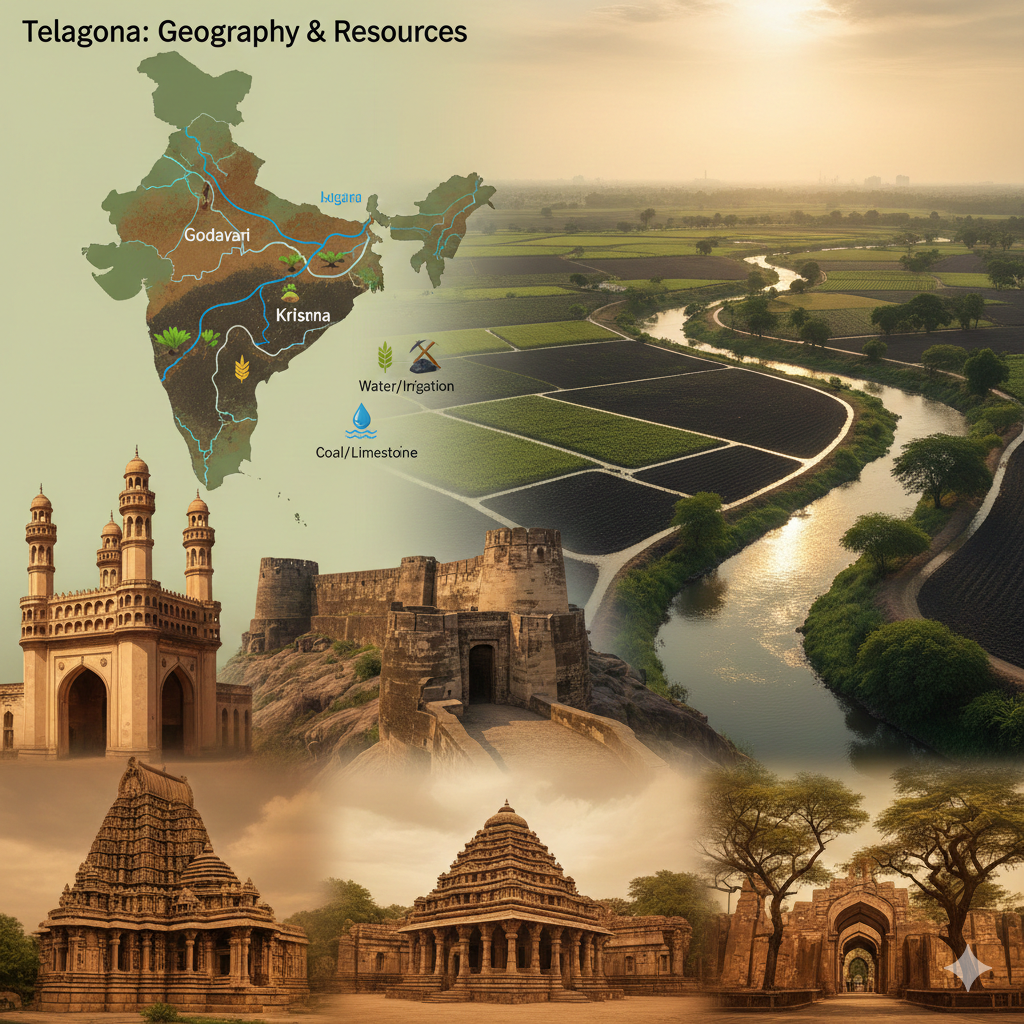
Telangana is the 11th largest state in India by area. Its geographical position makes it extremely important from the perspective of agriculture, mineral wealth, water resources, and overall economic development. Along with geography, the history of Telangana reflects centuries of political change, cultural richness, and social movements that shaped its modern identity.
Geographical Location of Telangana
Telangana is situated in the south-central part of India on the Deccan Plateau. Its location has a direct influence on its climate, soil types, river systems, and agricultural patterns.
Status and Extent
- Longitude: 77° to 81° East
- Latitude: 15° to 19° North
Boundaries
- Maharashtra to the north
- Chhattisgarh to the north-east
- Andhra Pradesh to the east and south-east
- Karnataka to the south-west
Natural Terrain
The terrain of Telangana is dominated by the Deccan Plateau, which is rich in black and red soils and supports extensive agricultural activities.
- Plateau Region: Most of the state consists of plateau land suitable for farming.
- River System: Major rivers include the Godavari and Krishna, along with tributaries such as Manjira, Musi, and Pranahita.
Forest Area
Nearly 24% of Telangana’s total area is covered by forests.
- Main vegetation: Teak, bamboo, and rosewood
Soil and Minerals
Soil Types
- Black Soil: Suitable for cotton and pulses
- Red Soil: Ideal for paddy and sugarcane
- Sandy Soil: Helpful for fruits and vegetables
Mineral Resources
Telangana is rich in mineral wealth. Important minerals found here include coal (Singareni coalfields), limestone, marble, and uranium.
Climate of Telangana
- Climate Type: Tropical
- Summer: 40°C to 45°C
- Winter: Minimum temperature around 12°C
- Average Annual Rainfall: 750 mm to 1150 mm
- Main source of rainfall: South-West Monsoon
Rivers and Irrigation
- Godavari River: Longest river, vital for agriculture and hydropower
- Krishna River: Second major river supporting south-western regions
Kaleshwaram Irrigation Project
The Kaleshwaram Project is one of the largest lift irrigation projects in the world. It utilizes Godavari river water for irrigation and drinking water supply.
Natural Resources and Geographical Importance
- Agriculture: Suitable for paddy, cotton, chilli, and sugarcane
- Industrial Development: Minerals and hydropower support industries
- Tourism: Hills, waterfalls, and forest regions attract visitors
Conclusion: Geographical Significance
The geographical location of Telangana makes it prosperous from an economic, agricultural, and industrial point of view. Its rivers, plateau terrain, and mineral wealth play a crucial role in the state’s self-sufficiency and contribute significantly to India’s development.
History of Telangana
The history of Telangana is culturally, politically, and socially diverse. Over centuries, many empires ruled this land, leaving behind a legacy of art, architecture, and governance. The modern history of Telangana is marked by a powerful movement for statehood.
Ancient Period (500 BC – 300 AD)
Maurya and Satavahana Empires
- Parts of Telangana were under the Maurya Empire during Chandragupta Maurya’s reign.
- Buddhism was widely propagated.
- The Satavahanas promoted trade, arts, and the Silk Route.
- Amaravati and Nagarjunakonda became major Buddhist centers.
Medieval Period (300 AD – 1700 AD)
Kakatiya Empire (12th – 14th Century)
- Capital: Warangal
- Major rulers: Ganapati Dev and Queen Rudramma Devi
- Warangal Fort and Ramappa Temple reflect architectural excellence
- Advanced lake-building and water management systems
Bahmani and Qutb Shahi Rule
- Region came under Bahmani Sultanate after Kakatiyas
- Qutb Shahi dynasty made Hyderabad its capital
- Charminar and Golconda Fort are iconic monuments
Modern Period (1700 AD – 1947)
Nizam Rule (1724 – 1948)
- Asaf Jahi dynasty ruled Hyderabad
- Hyderabad emerged as a cultural and literary center
- Patronage of Persian, Urdu, and Telugu literature
British Period and Integration with India
After India’s independence in 1947, the Nizam refused to join the Indian Union. In 1948, Hyderabad was integrated into India through Operation Polo.
Present Period (1948 – Present)
Formation of Andhra Pradesh (1956)
Telangana was merged into Andhra Pradesh based on linguistic reorganization.
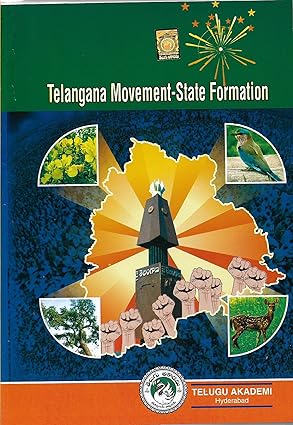
Telangana Movement (1956 – 2014)
- 1969: Telangana movement began
- 2001: Formation of Telangana Rashtra Samithi (TRS)
- 2014: Telangana became the 29th state of India on 2 June
After Formation (2014 – Present)
Telangana witnessed rapid growth in agriculture, industry, and IT. Projects like the Kaleshwaram Irrigation Project and Hyderabad’s rise as an IT hub transformed the state.
Premium Amazon Product
High-quality product with reliable performance and excellent durability — ideal for everyday use.
Buy on AmazonInfluence of Culture and Heritage
- Festivals like Bathukamma and Bonalu preserve ancient traditions
- Kakatiya and Nizam architecture defines regional identity
Conclusion: Historical Perspective
The history of Telangana reflects ancient civilizations, powerful empires, and strong social movements. This rich past, combined with modern development, has given Telangana a unique and proud identity in India.
Frequently Asked Questions (FAQs)
Why is Telangana geographically important?
Telangana’s plateau terrain, river systems, and mineral resources make it significant for agriculture, irrigation, and industrial development.
Which rivers are most important in Telangana?
The Godavari and Krishna rivers, along with tributaries like Manjira and Musi, are vital for irrigation and water supply.
Which empire contributed most to Telangana’s architecture?
The Kakatiya Empire made major contributions, especially in temple architecture and water management.
When did Telangana become a separate state?
Telangana became India’s 29th state on 2 June 2014.
Related Reading
Explore more about Indian states: Geography and History of Indian States
Administrative Structure and Economy of Telangana
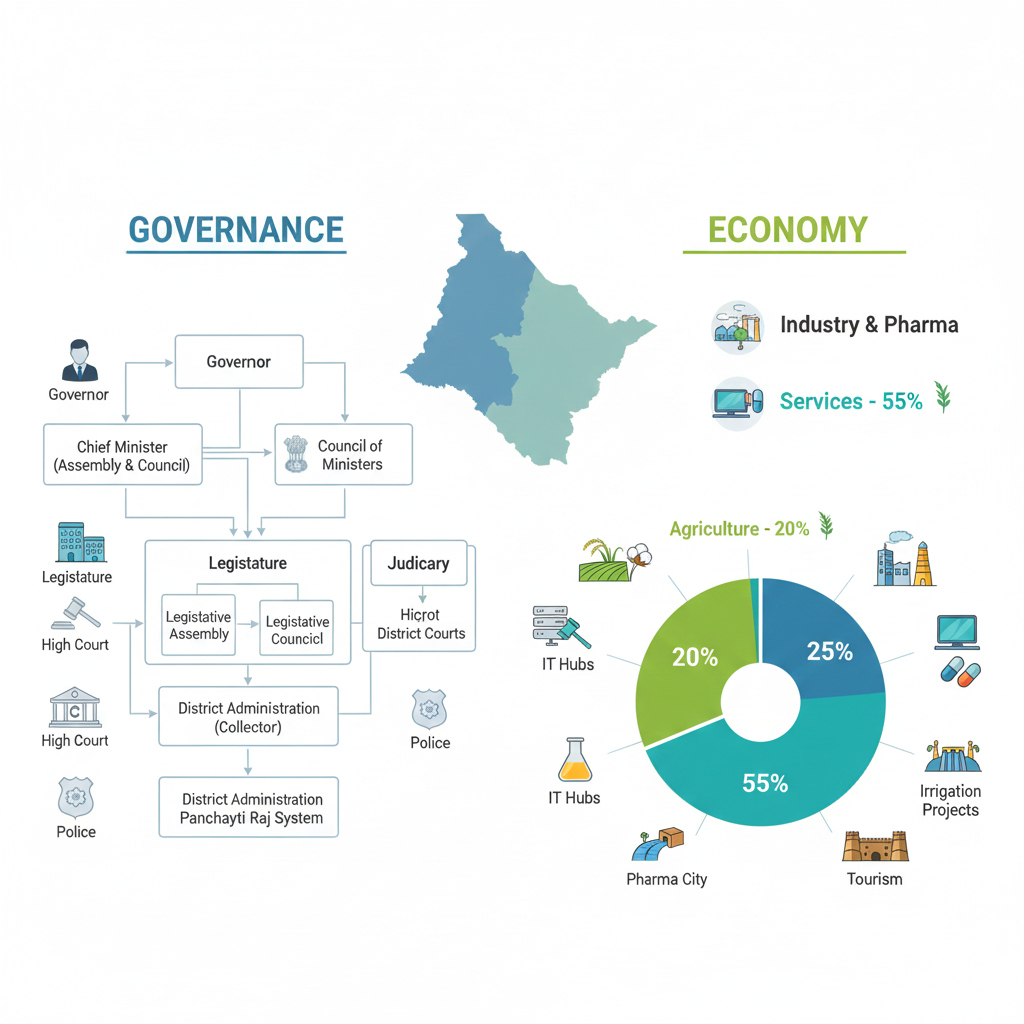
Telangana is a constitutional state of India whose administrative system is based on the federal structure of the Indian Constitution. Its governance framework and economic model together reflect a balance between democratic values, development goals, and public welfare.
Administrative Structure of Telangana
The administrative structure of Telangana is divided into three main organs — Executive, Legislature, and Judiciary. These institutions work together to ensure smooth governance and effective administration.
1. Executive
The executive branch is responsible for implementing laws and managing day-to-day administration.
Governor
- Constitutional head of the state
- Appointed by the President of India
- Approves important bills, dissolves the Legislative Assembly, and can impose emergency in special circumstances
Chief Minister
- Head of the state executive
- Chosen by the majority party or coalition in the Legislative Assembly
- Leads the Council of Ministers
Council of Ministers
- Consists of the Chief Minister and other ministers
- Each minister is responsible for a specific department such as Education, Health, or Agriculture
2. Legislature
Telangana has a bicameral legislature consisting of two houses.
Legislative Assembly
- Total members: 119
- Members are directly elected by the people
- Responsible for law-making and policy formulation
Legislative Council
- Permanent house
- Total members: 40
- Members are partly nominated by the Governor and partly elected by various bodies
3. Judiciary
The judiciary ensures that governance functions in accordance with the Constitution and the rule of law.
Telangana High Court
- Highest judicial authority in the state
- Located in Hyderabad
- Judges are appointed by the President of India
District and Subordinate Courts
- Handle civil and criminal cases
- Operate at the district and lower levels
4. District Administration
- Total districts: 33
- District Collector: Head of district administration
- Responsible for revenue collection, law and order, and development programs
Panchayati Raj System
- Ensures local self-governance
- Includes Gram Panchayat, Mandal Council, and Zilla Parishad
5. Police and Law & Order
- DGP (Director General of Police): Head of state police
- SP: Maintains law and order at district level
- Cyberabad and Hyderabad Police handle IT and cyber-related crimes
6. Administrative Departments and Major Policies
Important Departments
- Agriculture and Irrigation
- Information Technology
- Education
- Health
- Industry
Key Government Policies
- Raitu Bandhu Yojana: Financial assistance to farmers
- Mission Bhagiratha: Drinking water supply scheme
- Kaleshwaram Project: Irrigation development
Conclusion: Administrative Structure
The administrative framework of Telangana emphasizes development, transparency, and public welfare. It follows democratic principles while addressing local needs in coordination with the central government.
Economy of Telangana

Premium Amazon Product
High-quality product with reliable performance and great value — perfect for everyday use.
Buy on AmazonThe economy of Telangana is among the fastest growing in India. It is supported by agriculture, industry, and service sectors, along with a strong IT base and modern infrastructure.
1. Sectoral Breakdown of Economic Contribution
Agriculture and Allied Sectors
- Contribution: ~20%
- Main crops: Paddy, cotton, sugarcane, chilli
- Cash crops: Oilseeds, tobacco
- Key schemes: Raitu Bandhu Yojana, Raitu Bima Yojana
Industry
- Contribution: ~25%
- IT Sector: Hyderabad (Cyberabad), HITEC City, Genome Valley
- Major companies: Google, Microsoft, Amazon, Facebook
- Pharma & Biotechnology: Dr. Reddy’s, Biocon, Apollo
- Mineral-based industries: Coal (Singareni), limestone, marble
- Innovation hubs: T-Hub, Pharma City, Textile Parks
Service Sector
- Contribution: ~55%
- IT exports in 2023 exceeded ₹1.8 lakh crore
- Tourism, hospitality, banking, and insurance play major roles
2. Revenue Sources
- Tax revenue: GST, excise duty, stamp duty
- Non-tax revenue: Minerals, electricity, water services
- Grants from Central Government
3. Agriculture and Irrigation Contribution
- 60% of the state’s area depends on agriculture
- Major rivers: Godavari and Krishna
- Key projects: Kaleshwaram Project, Mission Kakatiya
4. Industrial Growth
- Hyderabad as a pharma and biotech hub
- Over 500 multinational IT companies operating
- Pochampalli sarees and handloom industry are globally recognized
5. Service Sector Development
- Tourism: Charminar, Golconda Fort, Ramoji Film City
- Cultural festivals like Bathukamma boost tourism
- Education: IIT Hyderabad, University of Hyderabad
- Health: Apollo and other major hospitals
6. Development Initiatives
- Mission Bhagiratha for drinking water
- Mission Kakatiya for water reservoir revival
- Promotion of startups and IT hubs
7. Major Challenges
- Agricultural dependence on rainfall
- Farmer debt issues
- Urban infrastructure pressure due to rapid urbanisation
- Rural-urban economic inequality
8. Future Prospects
- Continued growth in IT and pharma sectors
- Technological advancement in agriculture
- Expansion of tourism and handicrafts
- Rural development through infrastructure projects
Conclusion: Economy of Telangana
Telangana’s economy is built on a balanced integration of agriculture, industry, and services. Since its formation, the state has shown remarkable progress through visionary policies, efficient governance, and sustainable development strategies.
Frequently Asked Questions (FAQs)
Is Telangana a bicameral state?
Yes, Telangana has a bicameral legislature with a Legislative Assembly and a Legislative Council.
Why is Hyderabad important to Telangana’s economy?
Hyderabad is a major IT, pharma, and financial hub, contributing significantly to state revenue.
Which sector contributes the most to Telangana’s economy?
The service sector contributes around 55% of the state’s economy.
Which irrigation project is most important in Telangana?
The Kaleshwaram Lift Irrigation Project is the most significant irrigation initiative.
Related Articles
Learn more about Telangana: History and Geography of Telangana
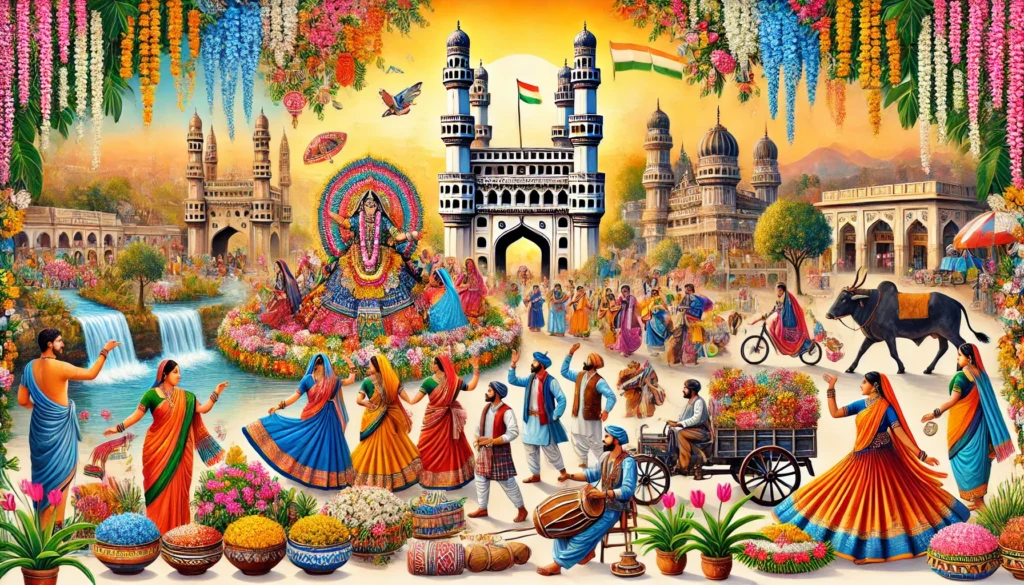
Culture and Tradition of Telangana
The culture and tradition of Telangana reflect its rich historical background, the influence of various dynasties, and vibrant folk traditions. The region is known for its unique art forms, dance, music, literature, cuisine, and festivals. This cultural diversity makes Telangana one of the most colorful and fascinating states of India.
1. Historical and Cultural Heritage
Telangana’s culture has been deeply shaped by powerful empires such as the Satavahana, Kakatiya, Bahmani, Qutb Shahi, and Nizam rulers. Each dynasty contributed to the region’s art, architecture, and social traditions.
Kakatiya Empire
- Architecture: Ramappa Temple and Warangal Fort
- Water Management: Construction of lakes and ponds for irrigation
Qutb Shahi and Nizam Rule
- Promotion of Persian, Urdu, and Telugu literature
- Architectural marvels such as Charminar and Golconda Fort
2. Language and Literature
Languages
- Telugu is the official language of Telangana
- Urdu is also widely spoken and written
Literature
- Telugu literature includes poets like Kavi Kannandeshwar and Mallikarjuna Pandit
- Urdu poetry and Shayari flourished during the Nizam period
3. Arts and Crafts
Handicrafts
- Pochampalli Sarees: A symbol of Telangana’s weaving excellence
- Bidri Work: Intricate metal carving, famous in Hyderabad
- Wood Carvings and Toys: Traditional carved wooden products
Paintings
Telangana paintings often depict mythological stories and folk tales, reflecting rural life and spiritual themes.
4. Dance and Music
Traditional Dances
- Perini Shivatandava: An ancient warrior dance dedicated to Lord Shiva, dating back to the Kakatiya era
- Bonalu Dance: A folk dance performed by women during festivals
Music
- Combination of folk and classical traditions
- Oggu Katha: A traditional musical storytelling form narrating religious legends
5. Festivals and Celebrations
Festivals in Telangana symbolize cultural richness, devotion, and social harmony.

High-Quality Amazon Product
Reliable performance with solid build and great value — perfect choice for everyday use.
Buy on AmazonMajor Festivals
- Bathukamma: A floral festival dedicated to Goddess Gauri, celebrated by women with songs and dances
- Bonalu: Dedicated to Goddess Mahakali, marked by colorful processions
- Ramoji Film City Festival: Celebration of cinema and cultural programs
- Harvest Festivals: Celebrated mainly in rural areas
6. Food and Drinks
Telangana cuisine is known for its bold spices and rich flavors.
Main Dishes
- Hyderabadi Biryani
- Sarva Pachadi (lentil and sesame chutney)
- Pulihora (tamarind rice)
Sweets
- Cashew Katli
- Polelu (sweet stuffed flatbread)
Drinks
- Irani Tea – a signature drink of Hyderabad
7. Religion and Spirituality
Telangana reflects religious harmony and coexistence of multiple faiths.
- Hinduism: Yadadri Temple, Bhadrachalam Temple
- Islam: Mecca Masjid, Charminar
- Buddhism: Nagarjunakonda and Amaravati monuments
8. Films and Entertainment
- Telangana is the center of the Telugu film industry (Tollywood)
- Ramoji Film City is the largest film studio complex in the world
9. Traditional Costumes
Women
Sarees, especially Pochampalli and Gadwal sarees, are traditional attire.
Men
Dhoti and kurta are commonly worn traditional garments.
10. Tribal Culture
Tribes such as Gond, Koya, and Lambadi form an important part of Telangana’s cultural fabric.
- Known for unique customs, dances, and art forms
- Folk songs and dances of the Gond tribe enrich regional culture
Conclusion
The culture and tradition of Telangana represent a harmonious blend of ancient heritage and vibrant folk life. Its festivals, arts, and traditions not only strengthen regional identity but also contribute significantly to India’s cultural diversity.
Frequently Asked Questions (FAQs)
What makes Telangana culture unique?
Telangana’s culture is unique due to its blend of Kakatiya, Nizam, and folk traditions.
Which festival is most important in Telangana?
Bathukamma is one of the most important and symbolic festivals of Telangana.
What is Perini Shivatandava?
It is an ancient warrior dance dedicated to Lord Shiva, dating back to the Kakatiya era.
Which saree is famous in Telangana?
Pochampalli sarees are the most famous traditional sarees of Telangana.
Related Reading
Learn more about Telangana: History and Administration of Telangana
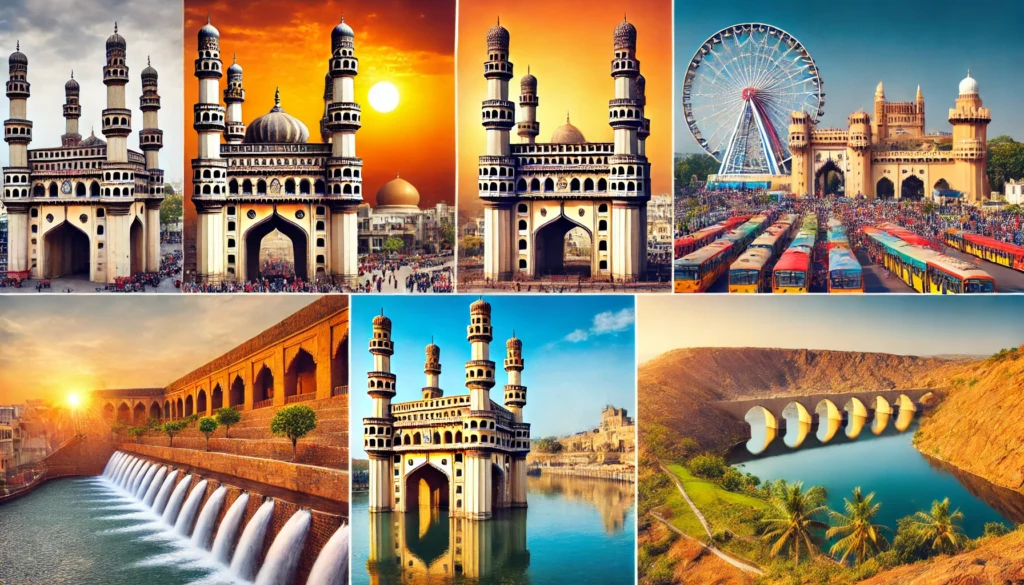
Major Tourist Places in Telangana
Telangana is famous for its historical heritage, cultural diversity, and natural beauty. The state offers a unique confluence of religious centers, ancient forts, lush green forests, wildlife sanctuaries, and modern technological landmarks, making it an attractive destination for all kinds of travelers.
1. Historical Places
Charminar (Hyderabad)
- Built in 1591 by Sultan Muhammad Quli Qutb Shah of the Qutb Shahi dynasty
- A monument with four grand minarets
- Symbol of Hyderabad’s cultural identity
Golconda Fort (Hyderabad)
- Former headquarters of the Qutb Shahi Empire
- Famous for its advanced sound engineering and architecture
- Light and sound show is a major tourist attraction
Ramappa Temple (Warangal)
- UNESCO World Heritage Site
- Built by the Kakatiya dynasty
- Renowned for exquisite carvings and architectural excellence
Warangal Fort (Warangal)
- Symbol of the grandeur of the Kakatiya Empire
- Stone carvings and majestic archways are key highlights
2. Religious Places
Yadadri Temple (Bhongir)
- Dedicated to Lord Lakshmi Narasimha
- Situated on a hilltop
- Popularly known as the “Tirupati of Telangana”
Bhadrachalam Temple (Bhadradri Kothagudem)
- Dedicated to Lord Rama
- Located on the banks of the Godavari River
- Associated with events from the Ramayana
Chilkur Balaji Temple (Hyderabad)
- Also known as the “Visa Balaji Temple”
- Devotees believe prayers here help in obtaining foreign visas
Mecca Masjid (Hyderabad)
- One of the oldest and largest mosques in India
- Constructed during the Qutb Shahi period
3. Natural Tourist Attractions
Kotpalli Waterfalls (Adilabad)
- A scenic waterfall surrounded by forests
- Especially attractive during the monsoon season
Nagarjuna Sagar Dam (Nalgonda)
- One of the largest dams in India
- A major tourist and picnic destination
Pakal Lake (Warangal)
- Known for its greenery and peaceful surroundings
- An ideal destination for bird watchers
Annaram Wildlife Sanctuary (Mahabubnagar)
- Rich in diverse flora and fauna
- Popular among nature and wildlife enthusiasts
4. Modern Structures and Attractions
Ramoji Film City (Hyderabad)
- The largest film studio complex in the world
- Known for film shootings, cultural shows, and entertainment
Hussain Sagar Lake (Hyderabad)
- Features a massive statue of Lord Buddha at its center
- Boating and water sports are popular activities
Nehru Zoological Park (Hyderabad)
- Spread across 380 acres
- Home to a wide variety of animal species
Cyber Towers (Hyderabad)
- Represents Hyderabad’s status as an IT hub
- Symbol of modern technological progress
5. Rural and Tribal Tourism
Eturnagaram Wildlife Sanctuary (Jayashankar Bhoopalpally)
- Home to tigers, deer, and diverse wildlife
- Offers trekking and jungle safari experiences
Medaram Jatra (Mahabubabad)
- Largest tribal festival in India
- Dedicated to goddesses Samakka and Sarakka
6. Cultural and Educational Sites
Salar Jung Museum (Hyderabad)
- One of the largest museums in India
- Houses ancient paintings, sculptures, and artifacts
B. M. Birla Planetarium (Hyderabad)
- A major attraction for science and astronomy lovers
Kuchipudi Dance Schools
- Preserve and promote the Kuchipudi dance tradition in Telangana
7. Unique and Hidden Gems
Bhongir Fort (Bhongir)
- Located atop a hill
- Ideal destination for trekking enthusiasts
Vemulawada Temple (Rajanna Sircilla)
- Dedicated to Lord Raja Rajeswara (Shiva)
- A major pilgrimage center for local devotees
8. Telangana Tourism Industry and Schemes
- Haritha Resorts: Eco-friendly accommodations with modern facilities
- Telangana Tourism App & Portal: Travel guidance and booking services
- Forest and wetland conservation to promote eco-tourism
Conclusion
Telangana is an ideal tourism destination due to its diverse range of historical monuments, religious centers, natural landscapes, and modern attractions. The state appeals not only to history lovers and pilgrims but also to nature enthusiasts and modern travelers, making Telangana a significant tourism hub in India.

Premium Amazon Product
High quality, reliable performance and excellent durability — a great choice for everyday use.
Buy on AmazonFrequently Asked Questions (FAQs)
Which is the most famous tourist place in Telangana?
Charminar in Hyderabad is the most iconic tourist attraction of Telangana.
Which UNESCO site is located in Telangana?
Ramappa Temple in Warangal is a UNESCO World Heritage Site.
What is the largest film city in Telangana?
Ramoji Film City is the largest film studio complex in the world.
Which festival attracts tribal tourism in Telangana?
Medaram Jatra is the largest tribal festival and attracts millions of visitors.
Related Reading
Read more about the state: Culture and Tradition of Telangana
References

Premium Amazon Product
Reliable performance and quality build — ideal choice for everyday use with excellent value.
Buy on Amazon- Telangana State Tourism Development Corporation (TSTDC) – Official Tourism Information
- Government of Telangana – Culture, Heritage and Tourism Department Publications
- UNESCO World Heritage Centre – Ramappa Temple, Telangana
- Archaeological Survey of India (ASI) – Monuments and Forts of Telangana
- District Administration Portals of Telangana State
- Historical and Cultural Records related to Qutb Shahi and Kakatiya Dynasties