
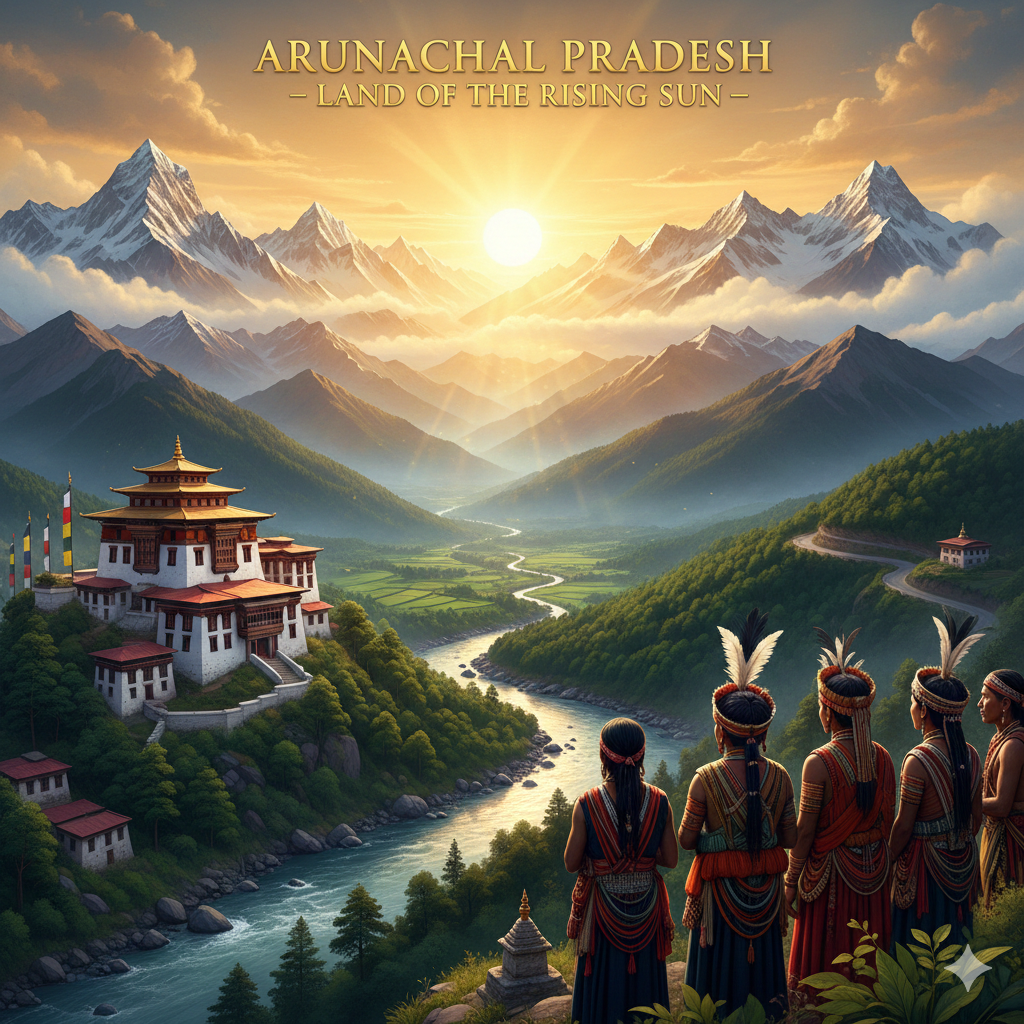
Arunachal Pradesh – Land of the Rising Sun
Arunachal Pradesh, one of India’s most enchanting northeastern states, is often referred to as the “Land of the Rising Sun.” During my exploration of this beautiful region, I discovered its deep cultural roots, untouched natural landscapes, and inspiring stories of tribal harmony. This article shares those learnings through an informative and engaging narrative.
Geographical and Political Overview
Location and Borders
Arunachal Pradesh is strategically located in the northeastern part of India and shares international borders with three countries:
- China to the north
- Myanmar to the east
- Bhutan to the west
Capital City
The capital of Arunachal Pradesh is Itanagar, a peaceful town surrounded by scenic hills and vibrant tribal culture.
Major Rivers
The state is enriched by several important rivers that shape its ecology and lifestyle:
- Brahmaputra
- Siang
- Subansiri
- Dihang
Cultural Diversity and Tribal Heritage
One of the most beautiful discoveries in Arunachal Pradesh is its extraordinary tribal diversity. More than 26 major tribes and over 100 sub-tribes coexist here, each preserving its own heritage and traditions.
Major Tribes
- Adi
- Nisi
- Apatani
- Monpa
- Tagin
- Mishmi
Traditional Festivals
The people of Arunachal Pradesh celebrate their culture through vibrant festivals such as:
- Losar
- Solung
- Dri
- Reh
Major Tourist Attractions
Tawang Monastery
The Tawang Monastery is the largest Buddhist monastery in Asia and the second-largest in the world. Visiting this peaceful spiritual site was a mesmerizing experience.
Ziro Valley
Ziro Valley is world-famous for its natural beauty and the unique lifestyle of the Apatani tribe.
Namdapha National Park
Namdapha National Park is a biodiversity hotspot, home to rare wildlife species and dense forests.
Sela Pass
The magnificent Sela Pass offers breathtaking Himalayan views and remains one of the most beautiful high-altitude passes in India.
Languages and Religion
Languages Spoken
Arunachal Pradesh is linguistically rich, with several local languages such as:
- Nisi
- Monpa
- Mishmi
- Apatani
Religious Diversity
The state is home to diverse faiths, with people predominantly following:
- Hinduism
- Buddhism
- Traditional tribal religions
Important Facts About Arunachal Pradesh
Premium Amazon Product
यह प्रोडक्ट high-quality build, sleek design और reliable performance के लिए जाना जाता है। रोज़मर्रा के उपयोग और gifting दोनों के लिए एक शानदार विकल्प है।
Buy on AmazonKey Highlights
- Arunachal Pradesh became a full-fledged state of India on 20 February 1987.
- Over 80% of the region is covered with dense forests.
- The state is known for its beautiful handicrafts, bamboo works, and cane products.
Conclusion
Arunachal Pradesh is not just a state; it is an experience of serenity, tradition, and nature at its finest. From its ancient monasteries to its vibrant tribal festivals, every aspect of this land teaches us the value of harmony and cultural pride. My journey through this beautiful state has been both enlightening and inspiring, offering lessons that stay with me forever.
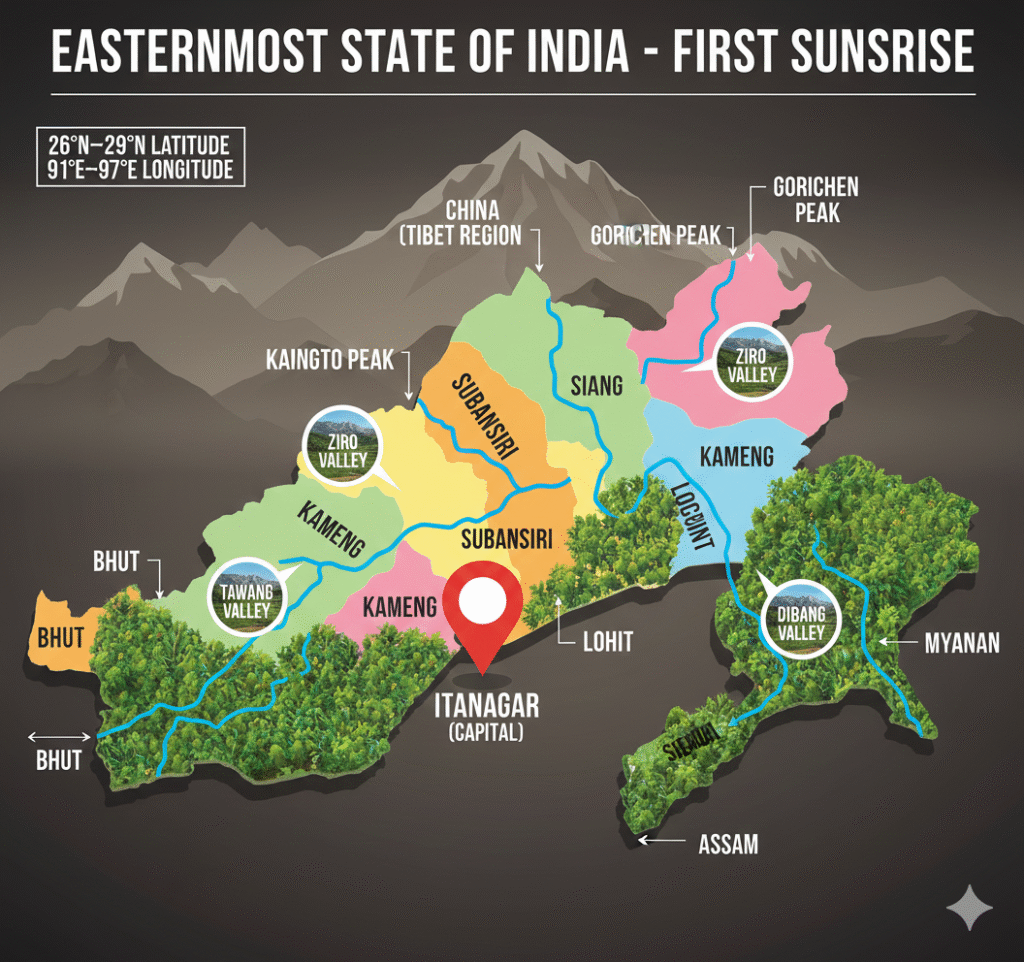
Geographical Location of Arunachal Pradesh
Arunachal Pradesh is a beautiful, naturally diverse state located in the northeastern part of India. Its geographical uniqueness gives it a special place in India’s cultural and environmental landscape. Let’s understand it in detail.
Status and Boundaries
Latitude and Longitude
Arunachal Pradesh lies approximately between 26° to 29° N latitude and 91° to 97° E longitude.
Boundaries
- North: China (Tibet region)
- East: Myanmar
- West: Bhutan
- South: Indian state of Assam
It is also the easternmost state of India, where the sun rises first.
Area
The total geographical area of Arunachal Pradesh is approximately 83,743 square kilometres, making it the sixth largest state of India.
Geographical Structure
Mountainous Terrain
- The state is largely covered by the Himalayan mountain ranges.
- Major peaks include Kangto, Nyegi Kangsang, and Gorichen Peak.
- The elevation varies between 1,000 to 3,000 metres above sea level.
Rivers
The Brahmaputra and its tributaries flow through the state. Major rivers include:
- Siang River (upper course of the Brahmaputra)
- Subansiri River
- Kameng River
- Lohit River
- Tirap River
Valleys
Arunachal Pradesh is home to beautiful valleys such as:
- Tawang Valley
- Ziro Valley
- Dibang Valley
Forests and Biodiversity
- Almost 80% of the state is covered with dense forests.
- The region is extremely rich in biodiversity with many rare plant and animal species.
Climate
Altitude-wise Variation
- Tropical climate in lower regions.
- Temperate climate in mid-altitude regions.
- Alpine climate at high altitudes.
Rainfall
The state receives heavy rainfall, with an annual average of 2,000 to 5,000 mm.
Natural Resources
- The state is rich in mineral and water resources.
- There is tremendous potential for hydroelectric power generation.
Strategic Importance
The geographical location of Arunachal Pradesh makes it strategically important for India. Its border with China increases its significance in terms of defence and national security.
Thus, the geography of Arunachal Pradesh not only blesses it with natural beauty but also makes it culturally, environmentally, and strategically vital for India.

Premium Amazon Product
यह प्रोडक्ट excellent quality, modern design और reliable performance के लिए जाना जाता है। रोज़मर्रा के उपयोग और gifting दोनों के लिए एक बेहतरीन विकल्प है।
Buy on AmazonItanagar
Itanagar is the capital of Arunachal Pradesh. Known for its natural beauty, cultural heritage, and administrative importance, it lies in the western part of the state and is one of its most prominent cities.
Geographical Location
- Place: Situated in the foothills of the Himalayas
- Elevation: Approximately 440 metres (1,440 ft) above sea level
- Nearest River: Ita Fort River
History
The name Itanagar comes from the words “Ita” (brick) and “Nagar” (city), meaning “City of Bricks.” The city is named after the ancient Ita Fort, built during the Ahom rule in the 14th–15th century.
Administrative Importance
- On 20 February 1987, Arunachal Pradesh became a full-fledged state with Itanagar as its capital.
- It serves as the administrative, political, and cultural centre of the state.
Tourist Spots
Ita Fort
A 14th-century brick fort after which the city was named.
Gaumukh Nath Temple
A popular religious site attracting locals and tourists alike.
Indira Gandhi Park
A scenic park ideal for relaxation and picnics.
State Museum
Also known as the Jawaharlal Nehru State Museum, it showcases the tribal culture, art, and crafts of Arunachal Pradesh.
Ganga Lake (Gyakar Sini)
A beautiful lake near Itanagar, known for its calm surroundings.
Buddha Temple
A well-known Buddhist monastery established by the Dalai Lama.
Culture and Tribes
Itanagar is primarily inhabited by the Nishi tribe. Traditional festivals, dances, and customs form an essential part of the city’s culture.
Climate
Itanagar has a subtropical climate.
- Summer temperatures: 22°C to 40°C
- Winter temperatures: 6°C to 20°C
- Heavy monsoon rainfall
Roads and Transport
- Road: Well-connected through National Highways
- Railway Station: Nearest station is Harmuti (Assam)
- Airport: Hollongi Greenfield Airport (recently operational)
Development and Significance
- Itanagar is emerging as an important educational, cultural, and tourism hub.
- It is a blend of modernity and traditional heritage.
Itanagar stands as the administrative heart of Arunachal Pradesh and symbolizes the state’s rich cultural and natural heritage.
Brahmaputra River
The Brahmaputra is one of the most important rivers of India and South Asia. Known as the “Lifeline of Northeast India,” it is famous for its immense water flow, cultural significance, and economic contribution.
Geographical Details
Origin
The Brahmaputra River originates in Tibet near Mansarovar Lake from the Chemayungdung Glacier. In Tibet, it is known as Yarlung Tsangpo.
Course of Flow
- Flows east to west for about 1,625 km in Tibet
- Enters Arunachal Pradesh as the Siang or Dihang River
- Flows through Assam as the Brahmaputra
- In Bangladesh, it is known as the Jamuna
- Joins the Ganges (Padma) and Meghna before entering the Bay of Bengal
Total Length
Approximately 2,900 km.
Countries Covered
The Brahmaputra flows through three countries: China (Tibet), India, and Bangladesh.
Key Features
Breadth and Depth
One of the widest rivers in the world, expanding several kilometres during monsoon.
Water Flow
Known for its powerful water discharge and strong current.
Flood-Prone Regions
Assam and Bangladesh often face devastating floods during monsoon season.
Hydroelectric Potential
The river has immense hydroelectric project possibilities.
Major Tributaries
Rivers from the North
- Siang
- Subansiri
- Kameng
Rivers from the South
- Dihing
- Dhansiri
- Burhi Dihing
Assam and the Brahmaputra
- The river flows through the plains of Assam.
- Major cities along its banks: Guwahati, Tezpur, Dibrugarh.
- Majuli Island, the world’s largest river island, lies in the Brahmaputra.
Cultural and Religious Significance
Unlike most rivers described in feminine form, the Brahmaputra is considered a male river. Its name comes from the Sanskrit words “Brahma” and “Putra”, meaning “Son of Brahma.”
Economic and Environmental Importance
- Irrigation: Essential for agriculture in Assam and neighbouring regions.
- Tourism: River cruises are popular among visitors.
- Biodiversity: Home to river dolphins and many aquatic species.
Challenges
- Severe flooding during monsoons
- Riverbank erosion destroying land and settlements
- Water disputes between India and China over dam construction
Interesting Facts
- The Brahmaputra is one of the few rivers in the world that cuts through the Outer Himalayas.
- Its strong flow has carved out massive valleys over time.
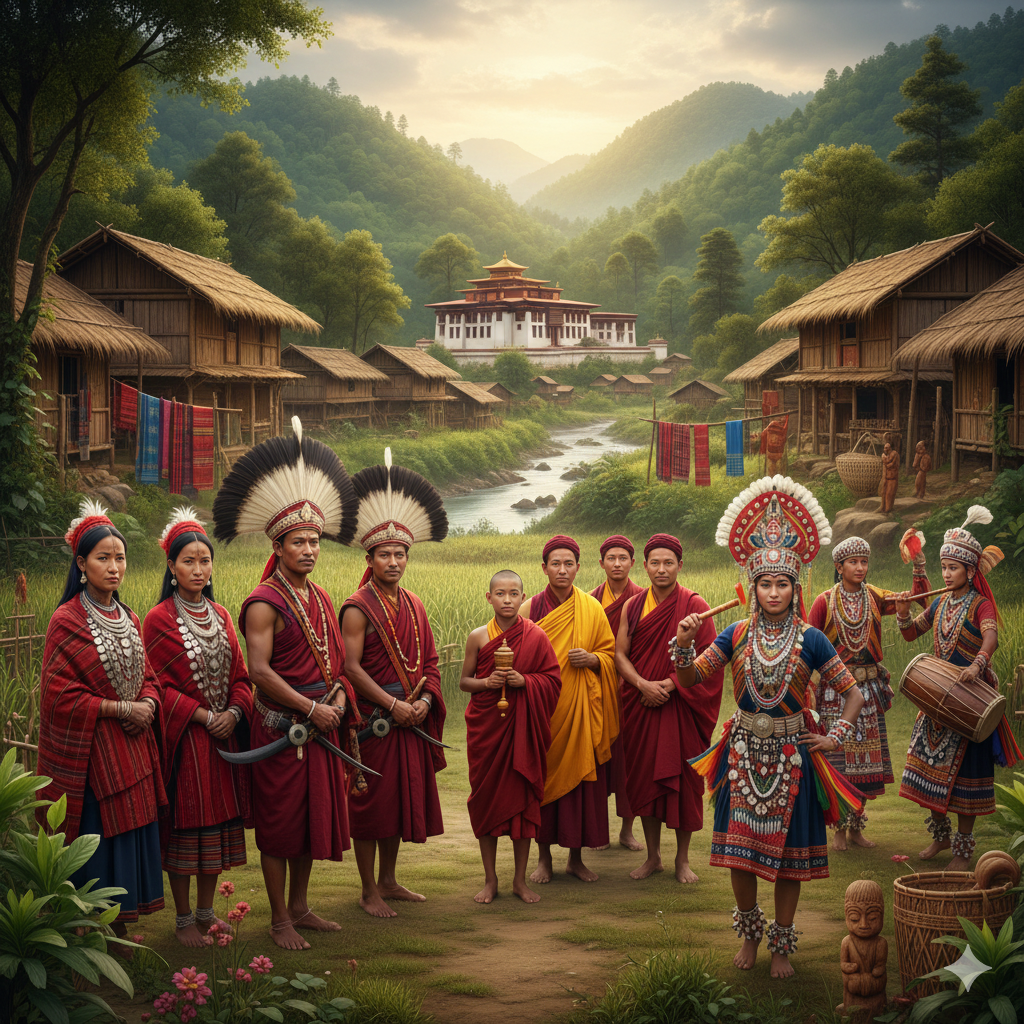
Culture and Tribes of Arunachal Pradesh
The culture of Arunachal Pradesh is extremely diverse and is shaped by the rich traditions, festivals, art, music, and daily life of the tribes living in the state. With about 26 major tribes and more than 100 sub-tribes, each community has its own unique culture, language, customs, and lifestyle.
Major Cultural Groups
1. Monpa and Sherdukpen Groups (Buddhist)
Location
Mainly found in western Arunachal Pradesh, including Tawang and West Kameng districts.
Major Tribes
- Monpa: Largest Buddhist tribe of the state.
- Sherdukpen: Culturally related to the Monpa tribe.
Religious Influence
- Followers of Tibetan Buddhism
- Tawang Monastery is a major religious centre
Cultural Traits
They celebrate major Buddhist festivals like Losar (New Year) and follow traditional Tibetan customs.
2. Central Tribal Groups (Religious Diversity)
Location
Primarily located in the central regions of Arunachal Pradesh.
Major Tribes
- Nishi: Largest tribe of the state
- Apatani: Known for unique paddy cultivation in Ziro Valley
- Adi: Major tribe in Siang region
- Tagin: Lives in the Subansiri region
Religious Traditions
Mainly follow traditional nature-worshipping beliefs such as reverence for the sun, moon, trees, and animals. Many members now follow Christianity or Hinduism as well.
Cultural Features
- Agriculture and handicrafts form their livelihood
- Major festivals include Dree (Apatani), Solung (Adi), and Nyokum (Nishi)
3. Tribal Groups of Tirap and Changlang (Traditional Beliefs)
Location
Found in the south-eastern part of Arunachal Pradesh.
Major Tribes
- Nocte: Inhabits Tirap district
- Wancho: Lives in Changlang and Tirap
- Singpho: Known for tea cultivation
Religious Practices
These tribes practice nature worship, ancestor worship, and traditional rituals.
Cultural Features
Important festivals include Ojale and Moloch.
Main Features of the Culture
1. Language and Literature
- More than 50 languages and many dialects are spoken.
- Major languages include Nishi, Monpa, Apatani, Adi, and Mishmi.
- Most languages are unwritten; traditions are preserved orally.
2. Outfits and Jewellery
- Women: Wear beautiful handwoven dresses and jewellery made from silver, beads, and metals.
- Men: Wear traditional lungis, jackets, and turbans.
3. Festivals and Celebrations
Festivals reflect agricultural activities, nature worship, and community values.
- Solung – Adi harvest festival
- Nyokum – Festival of the Nishi tribe
- Dree – Apatani agricultural festival
- Losar – Buddhist New Year of Monpa tribe
4. Dance and Music
Dances narrate stories of daily life, war, love, and festivals. Traditional instruments include bamboo flutes, drums, and sitar-like instruments.
5. Handicrafts and Art
The tribes are skilled in wood carving, bamboo and cane craft, pottery, and handloom weaving. The Apatani tribe is especially known for intricate textile designs.
6. Social Structure and Beliefs
- Community-based social structure
- Village councils called Kebang decide social matters
- Deep respect for nature and environment
7. Modern Changes
Education and modernization are influencing the lifestyle of tribes. Many now follow Hinduism, Buddhism, or Christianity along with traditional beliefs.
The tribes of Arunachal Pradesh are the backbone of its cultural identity, showcasing India’s rich diversity.
Tribes of Arunachal Pradesh
With about 26 major tribes and more than 100 sub-tribes, Arunachal Pradesh stands as a vibrant example of cultural diversity. These tribes differ in language, customs, festivals, and lifestyle.
Classification of Tribes

Featured Amazon Product
यह प्रोडक्ट premium quality, stylish डिजाइन और dependable performance के लिए लोकप्रिय है। डेली use और gifting दोनों के लिए एक बेहतरीन विकल्प है।
Buy on Amazon1. Mon-Buddhist Group (Tawang & West Kameng)
Strongly influenced by Tibetan Buddhism.
Major Tribes
- Monpa: Largest Buddhist tribe; celebrates Losar festival.
- Sherdukpen: Found in West Kameng; skilled in farming and trade.
- Khamba & Memba: Inhabit upper Tawang; followers of Lama culture.
2. Adi-Assamese Group (Central Arunachal)
Tribes dependent on agriculture and nature worship.
Major Tribes
- Adi: Resides in Siang region; celebrates Solung festival.
- Apatani: Inhabits Ziro Valley; skilled in wet paddy cultivation.
- Nishi: Largest tribe; celebrates Nyokum festival.
- Mishmi: Found in Dibang & Lohit districts; celebrates Reh festival.
3. Naga-influenced Groups (Tirap & Changlang)
Major Tribes
- Nocte: Depends on agriculture and hunting.
- Wancho: Lives in bamboo-wood houses; celebrates Ojale festival.
- Singpho: Skilled in tea cultivation and trade.
Characteristics of the Tribes
1. Religion and Beliefs
- Most tribes follow nature worship.
- Many follow Buddhism, Christianity, or Hinduism.
2. Languages
- More than 50 spoken languages.
- Major languages: Nishi, Monpa, Adi, Apatani, Mishmi.
3. Outfits and Jewellery
- Colourful traditional dresses
- Jewellery using silver, metals, and beads
4. Festivals and Dances
- Festivals based on agriculture and nature
- Major festivals: Solung, Nyokum, Dree, Losar
5. Livelihood
Agriculture, hunting, and handicrafts dominate their economy.
6. Handicrafts and Art
Expertise in bamboo, cane, wood carving, and textile weaving.
The tribal culture of Arunachal Pradesh adds a vibrant identity to the state.
Traditional Festivals of Arunachal Pradesh
The traditional festivals of Arunachal Pradesh form an essential part of tribal life. These festivals reflect agricultural cycles, nature worship, religious beliefs, and community bonding.
Major Traditional Festivals
1. Solung Festival (Adi Tribe)
- Time: August–September
- Purpose: Agricultural celebrations during harvest season
- Features: Five-day celebration, rituals, animal sacrifice, music, and dance
2. Nyokum Festival (Nishi Tribe)
- Time: Late February
- Purpose: Nature worship and prayer for prosperity
- Features: Worship of goddess Nyokum, traditional songs and rituals
3. Dree Festival (Apatani Tribe)
- Time: July
- Purpose: Prayer for good harvest and peace
- Features: Rituals, dances, and community feasts
4. Losar Festival (Monpa Tribe)
- Time: February–March
- Purpose: Buddhist New Year
- Features: Cleaning homes, prayers, special dishes, ceremonies at Tawang Monastery
5. Reh Festival (Mishmi Tribe)
- Time: February
- Purpose: Prosperity and happiness
- Features: Nature worship, traditional dances, feasts
6. Mopin Festival (Galo Tribe)
- Time: April
- Purpose: Protection from evil and good harvest
- Features: Rice beer “pangi,” group dance “Ponga,” white attire symbolizing purity
7. Sangken Festival (Khampti Tribe)
- Time: April
- Purpose: Buddhist New Year
- Features: Water festival, temple rituals, traditional dances
8. Ojale Festival (Wancho Tribe)
- Time: April–May
- Purpose: Honour ancestors
- Features: Group dances, songs, symbol of unity
9. Bokar Festival (Tagin Tribe)
- Time: March–April
- Purpose: Community protection and prosperity
- Features: Traditional games, rituals, feasts
Common Features of the Festivals
- Nature and agricultural connection
- Community participation
- Traditional dance and music
- Special food and rice beer (pangi)
The traditional festivals of Arunachal Pradesh reflect its cultural richness and the strong connection between nature, religion, and community life.
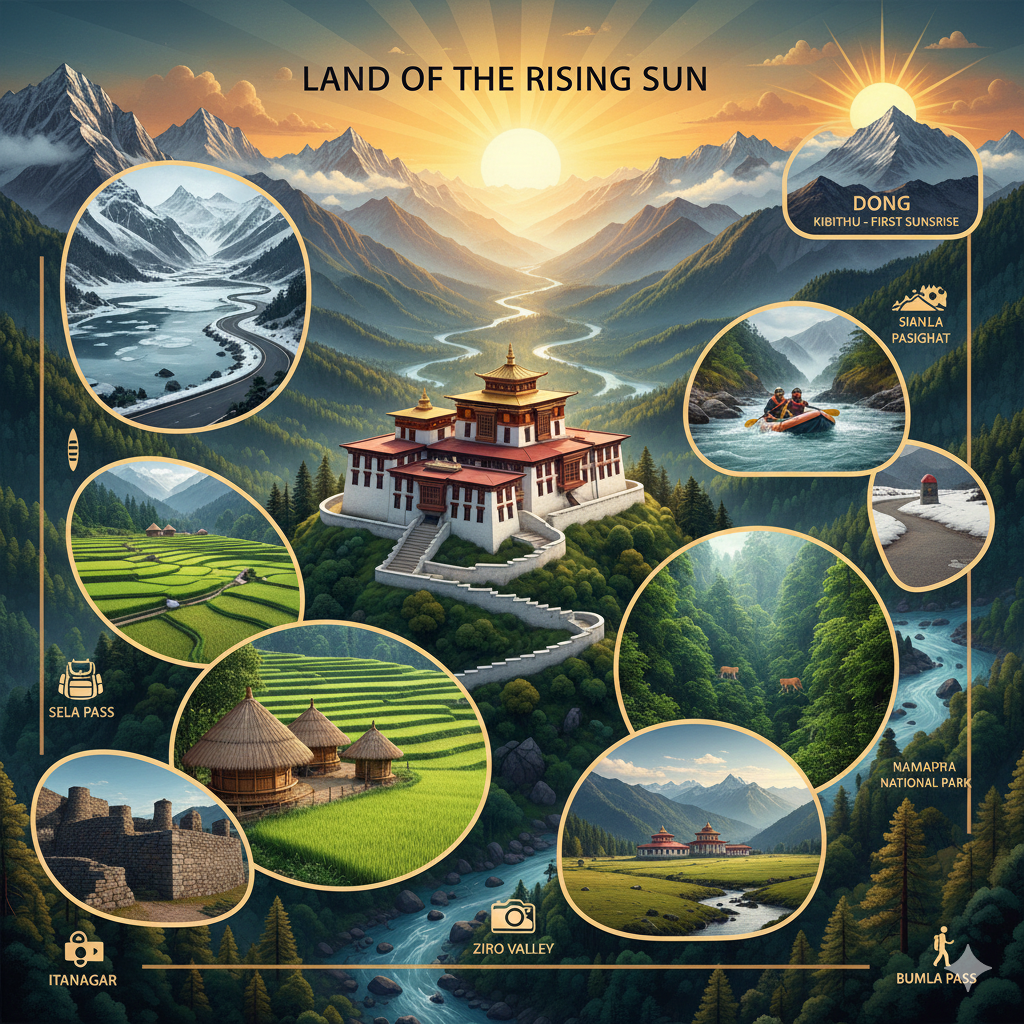
Major Tourist Places in Arunachal Pradesh
Arunachal Pradesh is known as the “Northeast Gateway of India.” The state is famous for its natural beauty, rich culture, historical landmarks, and unique tribal heritage. Its scenic landscapes attract nature lovers, history enthusiasts, and adventure seekers from across the world.
1. Tawang
Speciality
Tawang is famous for its breathtaking valleys, snow-covered mountains, and iconic Buddhist monasteries.
Main Attractions
- Tawang Monastery: The largest Buddhist monastery in India and the second largest in the world, also known as Galden Namgyal Lhatse.
- Sela Pass: A stunning snow-covered mountain pass with the beautiful Sela Lake.
- Jaswant Garh War Memorial: Built in memory of the 1962 India–China war hero, Jaswant Singh Rawat.
Adventure Activities
- Trekking
- Mountain biking
2. Ziro Valley
Speciality
Home to the Apatani tribe, Ziro Valley is known for its unique farming traditions and cultural richness.
Main Attractions
- Paddy cultivation: Apatani tribe’s famous bamboo-based irrigation farming system.
- Talle Valley Wildlife Sanctuary: A biodiversity-rich sanctuary with rare birds and plants.
- Dree Festival: Major festival celebrated by the Apatani tribe.
Adventure Activities
- Nature trekking
- Birdwatching
3. Pasighat
Speciality
The oldest town in Arunachal Pradesh, located along the scenic Siang River.
Main Attractions
- Siang River: Known for river rafting and fishing.
- Daying Ering Wildlife Sanctuary: A paradise for bird watchers.
Adventure Activities
- Camping
- River rafting
- Trekking
4. Namdapha National Park
Speciality
One of India's largest national parks, known for its extraordinary biodiversity.
Main Attractions
- Home to the Snow Leopard, Red Panda, and Asian Elephant
- Ideal destination for bird lovers
- Popular for wildlife photography
Adventure Activities
- Jungle safari
- Trekking
- Wildlife photography
5. Itanagar
Speciality
The capital city of Arunachal Pradesh, known for its cultural and historical significance.
Main Attractions
- Ita Fort: An ancient fort built during the Ahom dynasty.
- Gompa Buddhist Temple: Known for its Tibetan-style architecture.
- Itanagar Zoological Park: Created for wildlife conservation and education.
6. Bhishmaknagar
Speciality
The oldest archaeological site in Arunachal Pradesh.
Main Attractions
- Bhishmaknagar Fort (8th century)
- Ancient architecture and excavated ruins
7. Roing
Speciality
A serene destination located in the Dibang Valley.
Main Attractions
- Mishmi Hills: Famous for natural beauty and trekking trails
- Mehao Lake: A picturesque natural lake
Adventure Activities
- Trekking
- Photography
8. Mechuka Valley
Speciality
Popularly known as the “Paradise of Arunachal.”
Main Attractions
- Rolling meadows, grasslands, and traditional tribal villages
- Samten Yongcha Gompa: A 400-year-old monastery
Adventure Activities
- Trekking
- Camping
- Mountain biking
9. Bumla Pass
Speciality
A historical and scenic pass located on the India–China border.
Main Attractions
- Snow-covered roads
- Historical relevance to the 1962 war
10. Anjaw District & Kibithu–Dong Region
Speciality
Easternmost corner of India.
Main Attractions
- Kibithu and Dong Village
- Dong is the first place in India to receive sunrise
Adventure Tourism in Arunachal Pradesh
- Trekking: Tawang, Sela Pass, Talle Valley
- River Rafting: Siang and Subansiri Rivers
- Jungle Safari: Namdapha and Pakhui Wildlife Sanctuaries
- Camping & Hiking: Multiple mountain trails
Experience Tribal Culture
Traditional villages offer a deep cultural experience through fairs, handicrafts, and tribal dances. Tourists can explore unique lifestyles and rituals of the local communities.
Summary
Arunachal Pradesh is one of the most captivating states in India. Its natural beauty, cultural diversity, wildlife, and adventure opportunities make it a dream destination for travellers. Every location here offers a distinctive experience worth cherishing.
Tawang Monastery

Premium Amazon Product
यह प्रोडक्ट excellent quality, durable design और reliable performance के लिए जाना जाता है। रोज़मर्रा के उपयोग और gifting दोनों के लिए एक बेहतरीन विकल्प है।
Buy on AmazonTawang Monastery, also known as Galden Namgyal Lhatse, is located in the Tawang district of Arunachal Pradesh. Sitting at an altitude of nearly 10,000 feet, it is the largest Buddhist monastery in India and the second largest in the world.
History
- Founded in 1680–81 by Merak Lama Lodre Gyatso
- Follows the Gelugpa sect of Mahayana Buddhism
- Built according to the wishes of the 5th Dalai Lama, Ngawang Lobsang Gyatso
Architecture
- Spread across 135 square meters
- Contains 65 residential buildings
- Main Temple (Dukhang): Houses a 28-feet-high statue of Lord Buddha
- Library: Preserves rare manuscripts, including “Kanjur” and “Tenjur”
- Traditional Tibetan-style entry gate
Religious Importance
- Major centre of Tibetan Buddhism
- Over 500 monks reside here
- Important site for Buddhist learning and meditation
Festivals
- Tawang Festival: Held in October with cultural and religious programs
- Losar: Tibetan New Year celebrated with rituals, dances, and prayers
Attractions & Activities
- Morning and evening prayer sessions
- Monastery museum with ancient art and relics
- Scenic Himalayan views
- Chance to observe monastic life
How to Reach
- Nearest Airport: Tezpur (320 km)
- Nearest Railway Stations: Tezpur, Guwahati
- Road: Well-connected by highways
Important Note
Carry warm clothes due to the cold climate. An Inner Line Permit (ILP) is mandatory for visitors.
Summary
Tawang Monastery is not only a spiritual site but also a symbol of India's ancient Buddhist heritage. Its peaceful environment and majestic views offer an unforgettable experience.
Ziro Valley
Ziro Valley, located in the Lower Subansiri district, is one of India’s most serene and culturally rich destinations. It is best known for the Apatani tribe and its harmonious blend of nature and tradition.
Geographical Location
- Located at an altitude of approx. 1,500 meters
- Surrounded by forests, grasslands, and paddy fields
- Pleasant climate throughout the year
Main Attractions
1. Life of the Apatani Tribe
- Unique lifestyle and agricultural expertise
- Known for nose plugs and facial tattoos (traditional identity)
- Practice paddy–fish farming without machines or animals
2. Talle Valley Wildlife Sanctuary
- Rich biodiversity
- Home to rare birds and flora
- Popular trekking destination
3. Agriculture & Paddy Fields
Traditional paddy fields with flowing water channels create beautiful landscapes.
4. Hong/Japo Village
- Largest Apatani village
- Wooden and bamboo huts reflecting traditional life
Festivals
Dree Festival
- Held in July
- Prayers for a good harvest
- Traditional songs, dances, and feasts
Myoko Festival
- Held in March
- Strengthens social bonds
- Includes rituals and performances
Adventure Activities
- Trekking
- Birdwatching
- Nature photography
How to Reach
- Nearest Airport: Lilabari (Assam) – 100 km
- Nearest Railway Station: Naharlagun – 100 km
- By Road: 115 km from Itanagar
Summary
Ziro Valley offers a perfect blend of natural beauty, cultural richness, and peaceful surroundings—making it one of the most charming destinations in India.
Namdapha National Park
Namdapha National Park, located in eastern Arunachal Pradesh, is the largest national park in the state. It is renowned for its rich biodiversity, wildlife, and untouched natural landscapes.
Geographical Location
- Located in Changlang district
- Sits between the Siang River and Patkai Hills
- Borders Myanmar
- Total area: 1,985 sq km
Natural Diversity
Vegetation
- Dense tropical rainforest
- Subtropical pine forests
- High-altitude alpine forests
Wildlife
- Rare species such as Snow Leopard, Red Panda, Asian Elephant, Goral, and wild cats
- Home to many reptiles and amphibians
Birdlife
- Over 300 bird species
- Includes Hornbill, Indian Pitta, Blue Rock Thrush
Important Attractions
1. Namdapha River
Offers spectacular views, river safari, and canoeing.
2. Biodiversity Hotspot
One of India’s richest biodiversity zones—ideal for researchers and wildlife lovers.
3. Trekking Routes
Popular treks like Hoolong and Saglu take travellers deep into the forest.
Adventure Activities
- Trekking
- Jungle safari
- Birdwatching
- Camping
How to Reach
- Nearest Airport: Dimapur (Nagaland) – 150 km; Guwahati Airport also accessible
- Nearest Railway Stations: Dimapur and Guwahati
- By Road: Connected via Changlang and Tinsukia
Summary
Namdapha National Park is a paradise for wildlife and adventure lovers. Its rich natural environment and scenic beauty make it a remarkable destination for unforgettable experiences.
Language and Religion of Arunachal Pradesh
Arunachal Pradesh is one of India’s most culturally diverse states. Its various tribes and communities speak distinct languages and follow different religions, contributing to the state's rich cultural identity.
Languages of Arunachal Pradesh
The linguistic diversity of Arunachal Pradesh is vast, with more than 30 languages and dialects spoken across different regions.
1. Main Languages
- Hindi: The official language of Arunachal Pradesh, used widely in administration.
- English: Commonly used in education, government, and urban communication.

Top Rated Amazon Product
यह प्रोडक्ट high quality, modern design और reliable performance के लिए जाना जाता है। रोज़मर्रा के उपयोग और gifting दोनों के लिए एक शानदार विकल्प है।
Buy on Amazon2. Major Tribal Languages
- Apatani: Spoken in Lower Subansiri district.
- Mishmi: Spoken in Tawang and Lohit districts.
- Nishi (Nyishi): Spoken in Papum Pare and Siang regions.
- Singpho: Spoken in Changlang and Namsai districts.
- Galo: Spoken in West Siang district.
- Tangsa: Spoken near Tinsukia region.
3. Other Languages and Dialects
Many smaller tribes speak languages such as Tangku, Reang, Sajolang, Anjaw dialects, Sejong, and Burmese-influenced dialects near the Myanmar border.
Religions of Arunachal Pradesh
Arunachal Pradesh displays remarkable religious diversity, with communities practicing various faiths.
1. Buddhism
- Prominent in western Arunachal, especially Tawang, Bumla, and surrounding regions.
- Mahayana Buddhism is followed widely.
- Buddhist monasteries such as Tawang Monastery and places like Kameng are important spiritual centers.
- Tibetan Buddhist sects, especially the Gelugpa tradition, are dominant.
2. Christianity
- Christianity has a significant presence in districts such as Changlang, Lohit, Tinsukia, and Namsai.
- Most followers belong to Protestant denominations.
- Missionary activities have contributed to its spread.
3. Hinduism
- Practiced mainly in lower and western regions.
- Communities like Bommies and some NGOs follow Hindu traditions.
- Deities such as Shiva, Vishnu, and Durga are worshipped.
4. Natural and Tribal Religions
- Many tribes practice their traditional belief systems.
- Nature worship is prominent—trees, rivers, mountains, sun, moon are revered.
- Practices like ancestor worship, spirit worship, and rituals for natural forces are common.
5. Religious Harmony
The people celebrate festivals from all religions—Losar (Buddhist), Dussehra (Hindu), and Christmas (Christian), reflecting peaceful coexistence.
Conclusion
The languages and religions of Arunachal Pradesh reflect its deep cultural heritage. These diverse traditions give the state a unique identity and represent its rich history and social harmony.
Important Facts about Arunachal Pradesh
Arunachal Pradesh, located in the northeastern region of India, is known for its natural beauty, cultural richness, and strategic importance. Most of the state is covered with mountains, forests, and tribal settlements.
1. Geographical Location
- Position: Located near the India–China border.
- Borders: Tibet (China) to the north, Assam to the south, Nagaland to the west, and Myanmar to the east.
- Area: Approximately 83,743 sq km (2.5% of India’s total area).
- Elevation: Ranges from 50 meters to 7,000 meters above sea level.
- Major Rivers: Brahmaputra, Siang, Lohit, Kamlang, and Subansiri.
2. Capital and Administration
- Capital: Itanagar
- Legislative Assembly: A single-house assembly with 60 members
- High Court Branch: Located in Itanagar
3. Languages
- More than 30 languages and dialects are spoken in the state.
- Official language: Hindi; English widely used in education and administration.
- Major tribal languages: Apatani, Nyishi, Galo, Mishmi, and Boro.
4. Religion
- Followers of Buddhism, Christianity, Hinduism, and traditional nature-based religions.
- Buddhism is dominant in western regions such as Tawang and Bumla.
- Christianity is more common in Changlang, Lohit, and nearby districts.
- Traditional tribal beliefs remain deeply influential.
5. Natural Resources and Biodiversity
- Vast forest cover and exceptional biodiversity
- Major wildlife locations: Namdapha National Park, Ziro Valley, Kibithu Wildlife Sanctuary
- Rare animals like elephants, red pandas, snow leopards, and hoolock gibbons
- Diverse agriculture such as paddy, tea, fruits, and traditional fisheries
6. Culture and Tribes
- Home to 26+ major tribes such as Apatani, Nyishi, Galo, Mishmi, Adi, Tangsa, and more
- Each tribe has unique customs, dresses, festivals, and beliefs
- Major festivals include Dree, Losar, Myoko, and Sangken
- Famous for bamboo/wood handicrafts, textiles, and traditional dances
7. Historical and Political Significance
- A sensitive border region due to the India–China boundary dispute
- Held strategic importance after the 1962 Indo-China war
- Strong influence of Tibetan Buddhism in the western areas
8. Tourist Attractions
- Tawang Monastery – Major Buddhist center
- Ziro Valley – Known for the Apatani tribe and natural beauty
- Namdapha National Park – Rich wildlife diversity
- Bomdila – Offers stunning Himalayan views
- Changlang & Lohit – Popular for adventure tourism
9. Economy
- Agriculture and forest-based economy
- Major crops include tea, fruits, vegetables, and herbs
- Hydropower contributes significantly to the state's development
- Handicrafts and tribal art boost the local economy
10. Connectivity and Transport
- Air: Airports near Itanagar; improved connectivity through new airports nearby
- Rail: Railway network growing; Naharlagun is the closest major station
- Road: Well-connected highways across major towns and villages
Conclusion
Arunachal Pradesh stands out for its natural beauty, cultural traditions, biodiversity, and religious harmony. Its languages, tribes, economy, and geography make it one of India’s most vibrant and unique states. Understanding its diversity offers deep insight into the culture and heritage of Northeast India.
References

Featured Amazon Product
यह प्रोडक्ट quality build, practical design और reliable performance के लिए जाना जाता है। दैनिक उपयोग और gifting दोनों के लिए यह एक अच्छा विकल्प है।
Buy on Amazon- Government of Arunachal Pradesh – Official Portal
- Ministry of Tourism, Government of India
- Census of India & Tribal Research Reports
- Arunachal Pradesh Tourism Department Publications
- General knowledge and cultural studies on Arunachal Pradesh