Jaipur: The Pink City – A Journey Through History, Culture, and Geographical Splendor
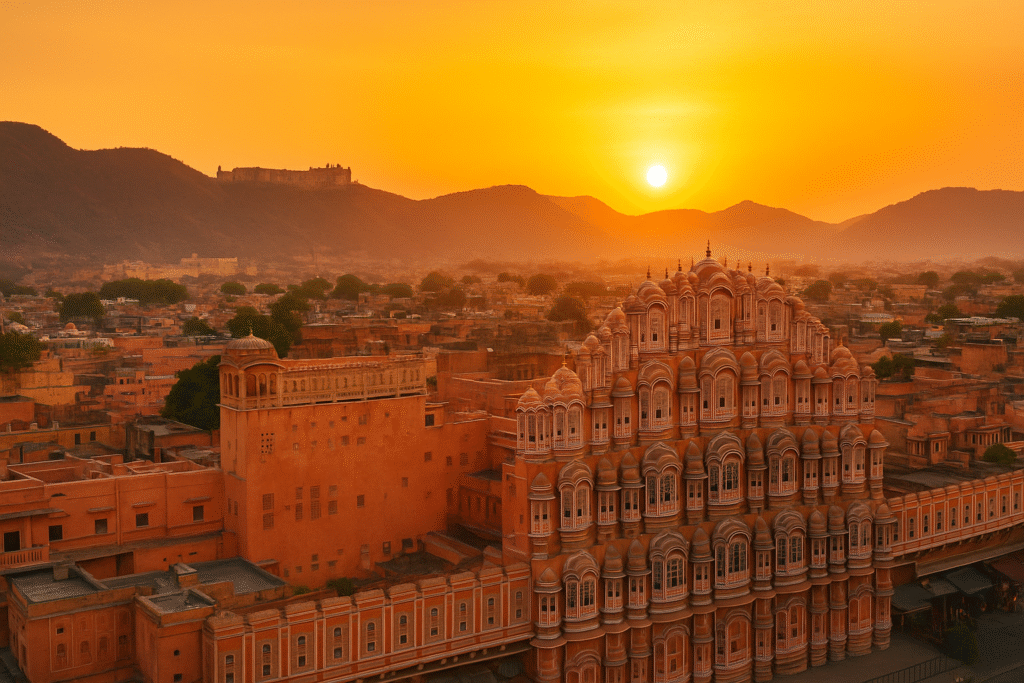
Jaipur, popularly known as the “Pink City”, is the capital of Rajasthan and a vibrant blend of historical heritage, rich culture, and unique architecture. Founded in 1727 by Sawai Jai Singh II, Jaipur is celebrated as India’s first planned city. Through my own visits and experiences, the city has always felt like a beautiful story woven with royal charm, warm hospitality, and unforgettable sights.
Geographical Location
Jaipur is situated in the northwestern part of India, embraced by the Aravalli mountain range. With an elevation of approximately 431 meters above sea level, the city enjoys a distinctive natural landscape influenced by surrounding desert regions.
History
The city of Jaipur was founded by Sawai Jai Singh II, the ruler of Amer. Designed with the principles of Vastu Shastra and Shilpa Shastra, Jaipur is one of the earliest examples of meticulously planned urban development. The signature pink color of its buildings symbolizes respect, joy, and hospitality—values that still define the city today.
Culture and Tradition
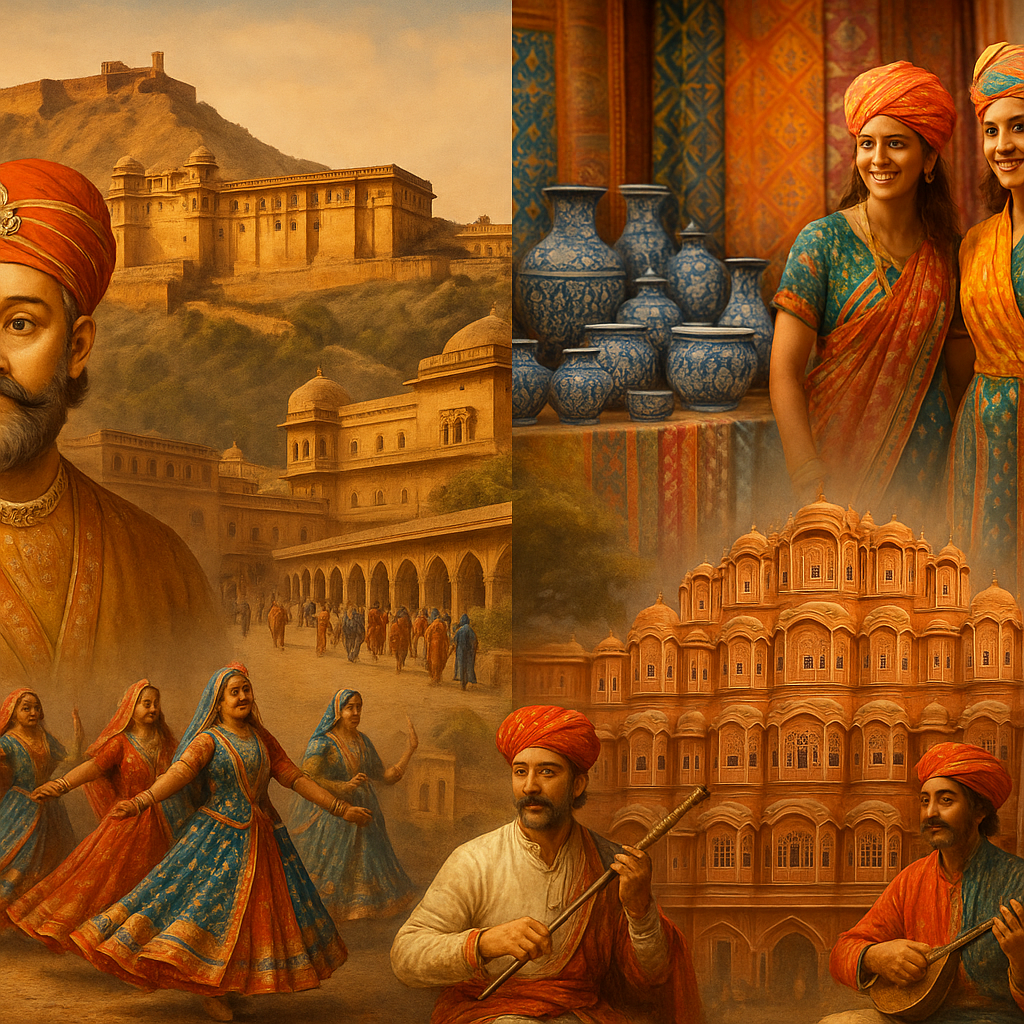
Jaipur’s cultural richness shines through its traditional attire, art forms, music, and folklore. Women traditionally wear Ghaghra-Choli, while men proudly wear the colorful Safa. Folk dances such as the famous Ghoomar showcase the vibrant heritage of Rajasthan.
Major Tourist Attractions
Jaipur is a treasure trove for travelers, offering grand forts, palaces, museums, and breathtaking views. Some of the most iconic destinations include:
Amer Fort
A majestic hilltop fort known for its artistic gateways, stunning courtyards, and the enchanting Sheesh Mahal.
Jaigarh Fort
Home to the world’s largest cannon on wheels, the legendary Jaivana Cannon.

Nahargarh Fort
Famous for its panoramic view of the city, especially mesmerizing during sunset.
City Palace
A stunning palace complex that serves as both a royal residence and a museum.
Hawa Mahal
The iconic “Palace of Winds” with 953 intricately designed windows built for royal women.
Jal Mahal
A captivating palace situated in the middle of Man Sagar Lake, offering a serene view.
Jantar Mantar
A UNESCO World Heritage Site known for its advanced astronomical instruments.
Food & Drink
The cuisine of Jaipur is a delightful reflection of Rajasthani flavors and authenticity. Some must-try dishes include:
- Dal-Baati-Churma
- Ghevar
- Kesariya Lassi
- Mirchi Bada
- Onion Kachori
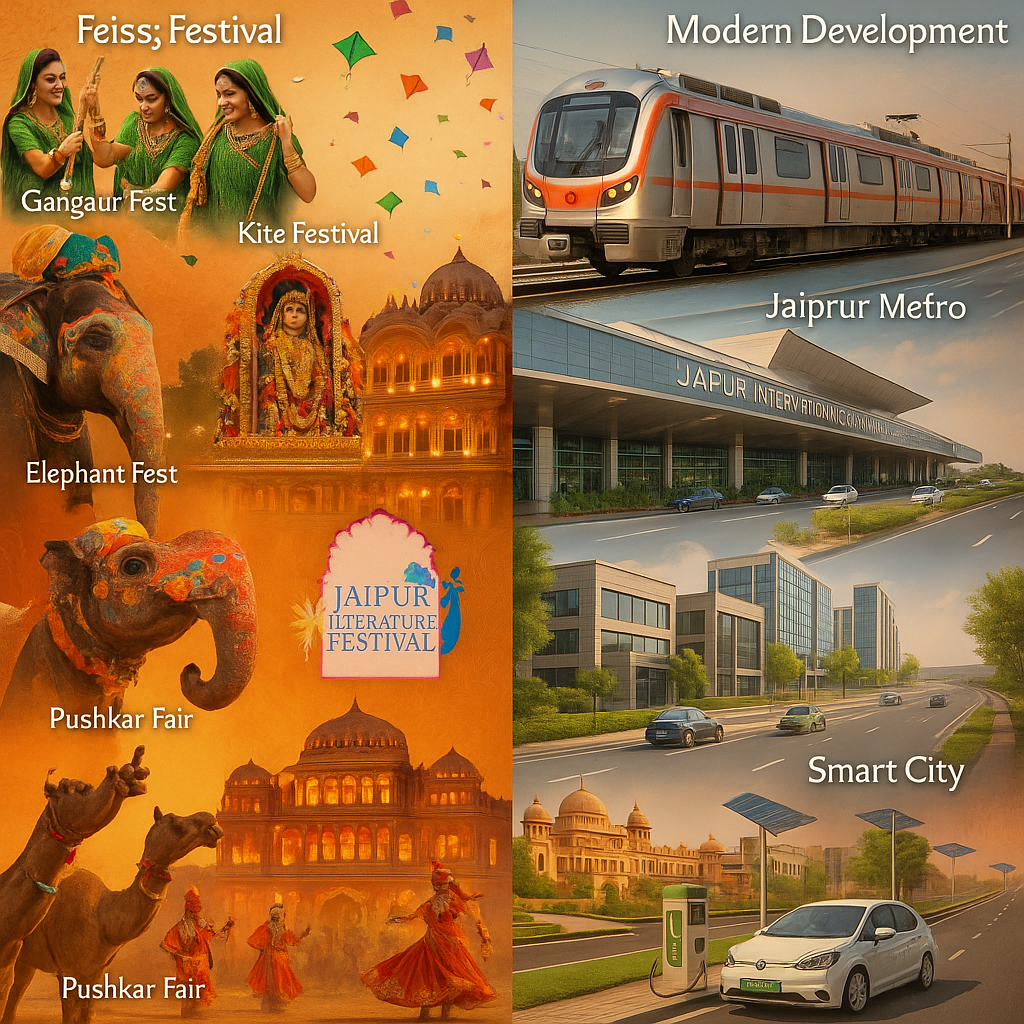
Festivals and Fairs
Jaipur hosts numerous colorful festivals throughout the year, each adding joy and cultural charm:
- Gangaur Festival – A traditional celebration dedicated to marital harmony.
- Teej Festival – Celebrated during the monsoon season by women.
- Jaipur Literature Festival – A world-renowned literary gathering.
- Elephant Festival – A unique celebration featuring beautifully adorned elephants.
Modernity and Development
Jaipur continues to evolve as a modern metropolitan city. As part of the Golden Triangle (Delhi–Agra–Jaipur), it offers excellent infrastructure such as metro rail, an international airport, and a thriving IT sector.
Conclusion
Jaipur stands as a stunning blend of cultural heritage and modern progress. With its royal forts, lively markets, mouthwatering cuisine, and welcoming people, the city represents the soul of Rajasthan. Every visit to Jaipur leaves behind a trail of unforgettable memories and a deeper appreciation for India’s rich heritage.
Detailed Geographical Description of Jaipur
Overview
Jaipur is the largest city and the capital of Rajasthan. Located in North-West India, it holds strategic geographical importance due to its proximity to the Aravalli range and its position between desert terrain and fertile plains.
Latitude and Longitude
Jaipur lies at a latitude of 26.92° N and longitude of 75.82° E, positioned at an altitude of 431 meters. This strategic placement makes it well-connected to major Indian cities like Delhi and Agra.
Environmental Structure
1. Aravalli Range
The Aravalli hills provide a natural boundary and play a vital role in moderating Jaipur’s climate. They help balance conditions between the arid and semi-arid zones of Rajasthan.
2. Desert Region
Its proximity to the Thar Desert gives Jaipur a semi-arid climate. However, the Aravalli range shields it from extreme desert expansion.
3. Water Resources
Main water sources include Man Sagar Lake and other smaller reservoirs. Monsoon rainwater is collected in traditional and modern structures, supplemented by Rajasthan’s canal systems.
Climate
Jaipur experiences a semi-arid climate with three major seasons:
Summer (March to June)
Temperatures range from 30°C to 45°C, accompanied by dry winds.
Monsoon (July to September)
Average rainfall is around 600–650 mm, influenced by the Aravalli range.
Winter (November to February)
Temperatures range from 8°C to 22°C, making this the best time for tourism.
Geographical Features
Biodiversity
The surrounding Aravalli region hosts a variety of flora and fauna. Wildlife destinations like Sariska Tiger Reserve and Jhalana Leopard Safari lie close to Jaipur.
Soil
The city features primarily sandy soil, typical of arid regions. Traditional structures like stepwells highlight ancient water-conservation techniques.
Seismic Zone
Jaipur lies in seismic zones II and III, indicating moderate vulnerability to earthquakes.
Location and Connectivity
Jaipur is well connected to major cities:
- Delhi – 268 km via NH 48
- Agra – 240 km via NH 21
- Udaipur – 400 km away
This connectivity makes Jaipur an essential part of the Golden Triangle, significant for tourism and business.
Final Conclusion
Jaipur’s geographical location, cultural heritage, and historical prominence make it one of India’s most treasured cities. With its balance of natural beauty, royal history, and modern development, Jaipur shines as a jewel of Rajasthan and a major destination on both national and international maps.
History of Jaipur
Jaipur, known as the “Pink City”, is renowned for its historical heritage, architectural excellence, and Rajput bravery. It is India’s first planned city, designed in the 18th century by Sawai Jai Singh II. The history of Jaipur is shaped by Rajput, Mughal, and British influences, giving it a rich and diverse legacy.
Founding of Jaipur
Sawai Jai Singh II (1688–1743)
Jaipur was founded in 1727 by Sawai Jai Singh II, the ruler of the Kachchwaha dynasty of Amer. He realized that Amer Fort could no longer support the rapidly growing population and administration. Therefore, he decided to establish a new city near the Aravalli Hills. Jai Singh was known for his deep knowledge of astronomy, mathematics, and architecture.
Planned City
Jaipur is recognized as India’s first planned city. It was designed by the famed Bengali architect Vidyadhar Bhattacharya, who used the principles of Shilpa Shastra (ancient architectural texts). The city layout was divided into nine sections, representing the traditional concept of “Navagraha.”
Identity as the Pink City
In 1876, during the visit of the Prince of Wales (later King Edward VII), Maharaja Sawai Ram Singh ordered the entire city to be painted pink. The color symbolized hospitality and warmth. Since then, Jaipur earned the global identity of the “Pink City.”
Major Dynasties and Their Contributions
Kachchwaha Dynasty
The Kachchwaha Rajputs ruled Amer and Jaipur from the 10th century. Their political strategies and alliances made Jaipur a powerful center. Their partnership with the Mughals further strengthened their economic and cultural status.
Mughal Influence
The Kachchwaha rulers maintained strong ties with the Mughal Empire. Sawai Jai Singh II held prestigious positions in the Mughal court under Aurangzeb and his successors. This alliance contributed significantly to Jaipur’s cultural flourishing.
British Raj
In 1818, Jaipur entered into a treaty with the British East India Company and became a princely state. The region enjoyed stability and administrative development under British protection.
Relation Between Amer and Jaipur
Before Jaipur’s establishment, Amer was the primary capital of the Kachchwaha dynasty. Located 11 km from Jaipur, Amer Fort—built by Raja Man Singh I—served as the royal residence. After Jaipur was founded, most administrative activities gradually shifted from Amer to the new city.
Golden Age of Jaipur
The reign of Sawai Jai Singh II is considered Jaipur’s golden era. He actively promoted sciences, astronomy, architecture, and arts. He built several astronomical observatories (Jantar Mantar), including the Jaipur observatory—now a UNESCO World Heritage Site. He also constructed iconic buildings like the City Palace and Hawa Mahal.
British Era and Freedom Struggle
British Subjugation
During the 19th century, Jaipur functioned as a princely state under British rule. Many reforms and developments took place during this period.
Role in the Indian Freedom Struggle
Jaipur played an indirect yet significant role in the Indian independence movement. Several local leaders and freedom fighters participated in national movements.
Jaipur After 1947
After India gained independence, Jaipur became the capital of Rajasthan. The former princely state played a crucial role in unifying the region into modern-day Rajasthan.
Cultural Heritage of Jaipur
Jaipur’s forts, palaces, temples, and artistic traditions form an essential part of India's cultural footprint. The city has long been a center of literature, science, art, and architecture.
Conclusion
Jaipur is a remarkable blend of Rajput valor, Mughal artistic influence, and British administrative contributions. Its historical richness, planned architecture, and cultural vibrancy make it one of the most significant heritage cities in India—truly the Pride of Rajasthan and the Pride of India.
Culture and Tradition of Jaipur
Jaipur, the “Pink City,” is a cultural heart of Rajasthan. Its traditions, festivals, folk arts, and hospitality reflect its rich heritage. The culture of Jaipur beautifully blends Rajput courage, desert lifestyle, and age-old customs.
Language and Colloquialisms
Rajasthani Language
People in Jaipur primarily speak Marwari and Dhundhari, both sublanguages of Rajasthani.
Hindi and English
Hindi is widely used for daily communication, while English is commonly used in tourism and business.
Traditional Attire
Men’s Attire
- Safa: A colorful turban symbolizing pride.
- Angrakha: Traditional upper garment.
- Dhoti: Worn around the waist.
Women’s Attire
- Ghaghra-Choli: Traditional women’s outfit.
- Odhani: A colorful veil worn over the head and shoulders.
- Features intricate Gota, Zari, and embroidery work.

Folk Arts and Crafts
- Blue Pottery: Jaipur’s globally renowned craft.
- Bandhani & Lahariya: Traditional tie-dye textiles of Rajasthan.
- Kundan, Meenakari & Polki Jewellery: Iconic craft forms of Jaipur.
- Handloom Fabrics: Known for traditional Rajasthani weaving styles.
Music and Dance
Folk Music
Folk songs are based on stories of bravery, love, and rural life. Traditional instruments include Morchang, Ravanhatha, and Khadtal.
Folk Dances
- Ghoomar: A graceful dance performed by women.
- Kachhi Ghodi: Dance portraying Rajput bravery.
- Kalbelia: A famous dance of the snake-charmer community.
Food & Drink
Rajasthani cuisine is an inseparable part of Jaipur’s cultural identity.
- Daal-Baati-Churma
- Gatta ki Sabzi
- Kadhi & Bajra Roti
- Ghevar
- Feeni
- Churma Ladoo
- Mirchi Bada
- Onion Kachori
- Kesariya Lassi
Festivals and Celebrations
- Gangaur Festival: Celebrated by women in devotion to Goddess Gauri.
- Teej: Celebrated during Sawan with swings and folk music.
- Jaipur Literature Festival: World’s largest literary event.
- Elephant Festival: Celebrated during Holi.
- Makar Sankranti: Popularly known as the Kite Festival.
Architecture and Tradition
The architecture of Jaipur showcases the best of Rajput and Mughal influences.
- Hawa Mahal: Palace with 953 windows.
- Amer Fort: Example of royal Rajput craftsmanship.
- Jal Mahal: Palace in the middle of Man Sagar Lake.
- City Palace
- Jantar Mantar: Astronomical observatory built by Sawai Jai Singh II.
Handicrafts and Markets
- Johari Bazaar: Famous for jewellery and enameling work.
- Bapu Bazaar: Known for traditional clothes and footwear.
- Chandpole Bazaar: Wooden handicrafts and artifacts.
- Tripolia Bazaar: Brass utensils and decorative items.
Hospitality
Jaipur follows the principle of “Atithi Devo Bhava” (Guest is God). Tourists are welcomed with warmth, music, dance, and traditional food—offering a delightful cultural experience.
Conclusion
The culture and traditions of Jaipur represent a rich fusion of heritage, art, festivals, hospitality, and architecture. The Pink City stands as a cultural icon of Rajasthan and India, making it a must-visit destination for travelers and history enthusiasts.
Tourist Places of Jaipur
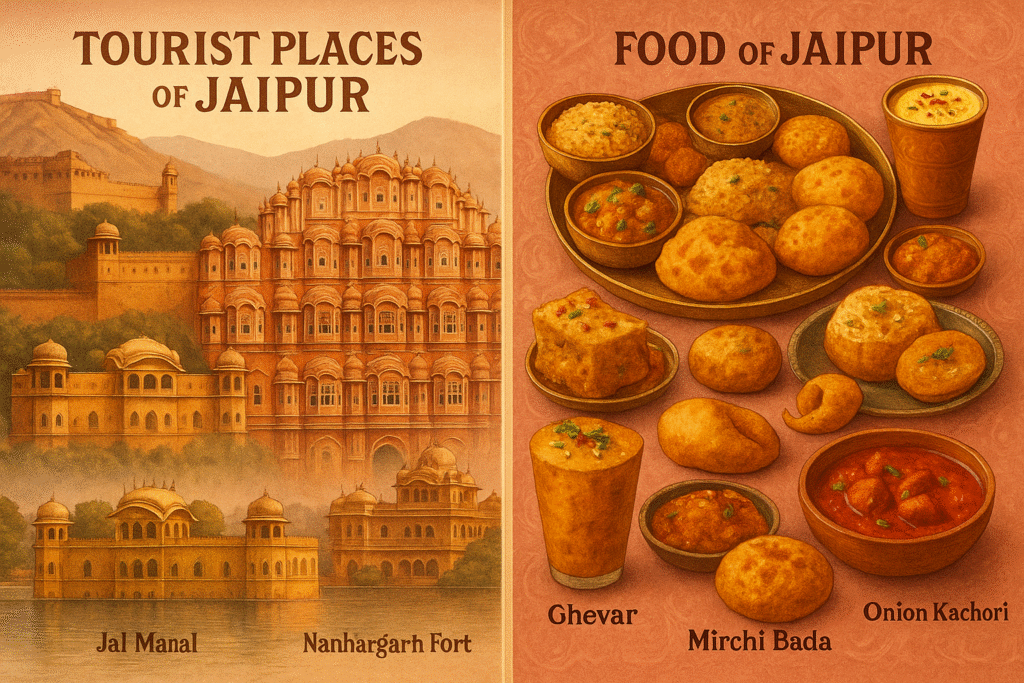
Jaipur, known as the “Pink City”, is not only the capital of Rajasthan but also one of India’s most famous tourist destinations. The city is admired worldwide for its majestic forts, royal palaces, museums, and vibrant traditional markets. Jaipur offers a unique blend of architecture, art, culture, and heritage.
1. Amber Fort
Location: Situated in the Aravalli Hills, 11 km from Jaipur.
Speciality:
- Built by Maharaja Man Singh I.
- Blend of Rajput and Mughal architectural styles.
- Main attractions: Sheesh Mahal, Diwan-i-Aam, Diwan-i-Khas.
- Famous for Elephant Safari and Light & Sound Show.
2. Hawa Mahal
Location: Heart of Jaipur.
Speciality:
- Known as the “Palace of Winds”.
- Built by Maharaja Sawai Pratap Singh in 1799.
- 953 beautifully designed jharokhas (windows).
- Built for royal women to observe outdoor activities without being seen.
- Iconic structure made of red and pink sandstone.
3. City Palace
Location: Central Jaipur.
- Built by Maharaja Sawai Jai Singh II in 1732.
- Combination of Rajput, Mughal, and European architecture.
- Main parts include Chandra Mahal and Mubarak Mahal.
- Museum showcases royal clothing, weapons, and ancient paintings.
- Chandra Mahal is still the royal family’s residence.
4. Jantar Mantar
Location: Near City Palace.
- Built in 1734 by Sawai Jai Singh II.
- A UNESCO World Heritage Site.
- Houses 19 astronomical instruments.
- Used to measure time, track planetary motions, and study celestial events.
- Samrat Yantra is the largest instrument here.
5. Jaigarh Fort
Location: Near Amber Fort.
- Built in 1726 by Sawai Jai Singh II.
- Known as the “Fort of Victory”.
- Home to the world’s largest wheeled cannon, Jaivana.
- Features massive water tanks, armoury, and secret passages.
6. Nahargarh Fort
Location: Aravalli Hills.
- Built in 1734 by Sawai Jai Singh II.
- Constructed for the defense of Jaipur.
- Offers stunning views of Jaipur city.
- Famous Bollywood film “Rang De Basanti” was shot here.
- Popular sunset point.
7. Jal Mahal (Water Palace)
Location: Middle of Man Sagar Lake.
- Built by Sawai Madho Singh in the 18th century.
- Five-story palace, with four floors submerged underwater.
- A blend of Mughal and Rajput architecture.
- Bird watching and boating are popular activities.
8. Albert Hall Museum
Location: Ram Niwas Garden.
- Oldest museum in Rajasthan, built in 1887.
- Exhibits ancient artifacts, textiles, weapons, and paintings.
- Famous for its Egyptian mummy.
9. Birla Temple
Location: Below Moti Dungri Hill.
- Dedicated to Lord Vishnu and Goddess Lakshmi.
- Made entirely of white marble.
- Beautiful lighting at night.
- Known for peace, spirituality, and modern architecture.
10. Galta Ji Temple
Location: Aravalli Hills.
- Also known as the “Monkey Temple”.
- Famous for natural water springs.
- Dedicated to Lord Rama and Krishna.
11. Chokhi Dhani
Location: Outskirts of Jaipur.
- A theme-based village resort showcasing Rajasthani lifestyle.
- Offers folk music, puppet shows, camel rides, and traditional food.
- Highly popular among tourists.
12. Rambagh Palace
Location: Center of Jaipur.
- Former royal residence converted into a luxury hotel.
- Experience the grandeur of Rajput royalty.
13. Jawahar Circle
Location: Near Jaipur Airport.
- Largest circular park in Asia.
- Patrika Gate is the main attraction here.
Experience of Traveling to Jaipur
The tourist places of Jaipur not only showcase its royal heritage but also offer a deep experience of its culture, traditions, and architecture. Each place tells a story of its own. Shopping in local markets, tasting Rajasthani food, and exploring folk arts make the visit memorable.
Conclusion
Jaipur’s rich history, architectural beauty, and cultural heritage make it one of India’s top tourist destinations. The forts, palaces, museums, and markets of the Pink City offer a perfect blend of tradition and modernity, giving every traveler an unforgettable experience.

Food & Drink in Jaipur
Jaipur’s cuisine is a delightful journey into the traditional flavors of Rajasthan. The food reflects the culture, royal heritage, and rural traditions of the region. From royal dishes to street snacks, Jaipur offers a taste that is truly unique.
1. Rajasthani Thali – The Complete Dining Experience
- Dal Baati Churma: Baati dipped in ghee, served with spicy dal and sweet churma.
- Gatta ki Sabzi: Gram flour dumplings cooked in spicy gravy.
- Kadhi: Mildly sour curry made from yogurt and gram flour.
- Bajra Roti with Garlic Chutney: Traditional winter specialty.
2. Sweets of Jaipur
- Ghevar: Crispy honeycomb sweet topped with cream and dry fruits.
- Feeni: Fine vermicelli sweet eaten with rabri.
- Malpua: Sweet pancakes served with kheer or rabri.
- Mawa Kachori: Sweet kachori stuffed with khoya and nuts.
- Churma Ladoo: Made from wheat, jaggery, and ghee.
3. Breakfast and Snacks
- Onion Kachori: Deep-fried kachori filled with spicy onion mixture.
- Mirchi Bada: Large green chillies stuffed and fried in gram flour batter.
- Dahi Bade: Soft vadas dipped in chilled yogurt.
- Crispy Kachori: Filled with moong dal or potatoes.
4. Beverages
- Kesariya Lassi: Sweet lassi topped with saffron and nuts.
- Matka Kulfi: Traditional clay-pot frozen dessert.
- Masala Tea & Masala Milk: Rich with ginger and aromatic spices.
5. Special Rajasthani Dishes
- Ker Sangri: Traditional desert beans cooked in spices and ghee.
- Lal Maas (Red Meat): Spicy mutton curry cooked in red chillies.
- Mohan Maas: Creamy royal-style mutton dish.
- Pitore Ki Sabzi: Gram flour cubes cooked in tangy gravy.
- Fusion Dal Baati Churma: A modern twist on a classic Rajasthani dish.
6. Traditional Rotis and Rice
- Bajra Roti: Winter specialty eaten with ghee & jaggery.
- Makai Roti: Enjoyed with sarson ka saag.
- Masala Baati: Spiced baati cooked in a tandoor.
7. Modern and Street Food
- Pav Bhaji and Chole Bhature
- Golgappa and Dahi Puri
- Fusion foods like Pizza and Burgers
8. Famous Food Places in Jaipur
- Laxmi Mishthan Bhandar (LMB): Famous for thalis and sweets.
- Chokhi Dhani: Authentic Rajasthani dining experience.
- Fat King: Popular for Rajasthani thali.
- Bapu Bazaar & Johari Bazaar: Known for traditional street food.
Conclusion
Jaipur’s food is not just a meal—it is a celebration of Rajasthan’s culture, tradition, and history. From spicy curries to sweet delicacies, every dish carries the essence of local flavors. Whether you prefer traditional cuisine or modern street food, Jaipur has something special for everyone.