
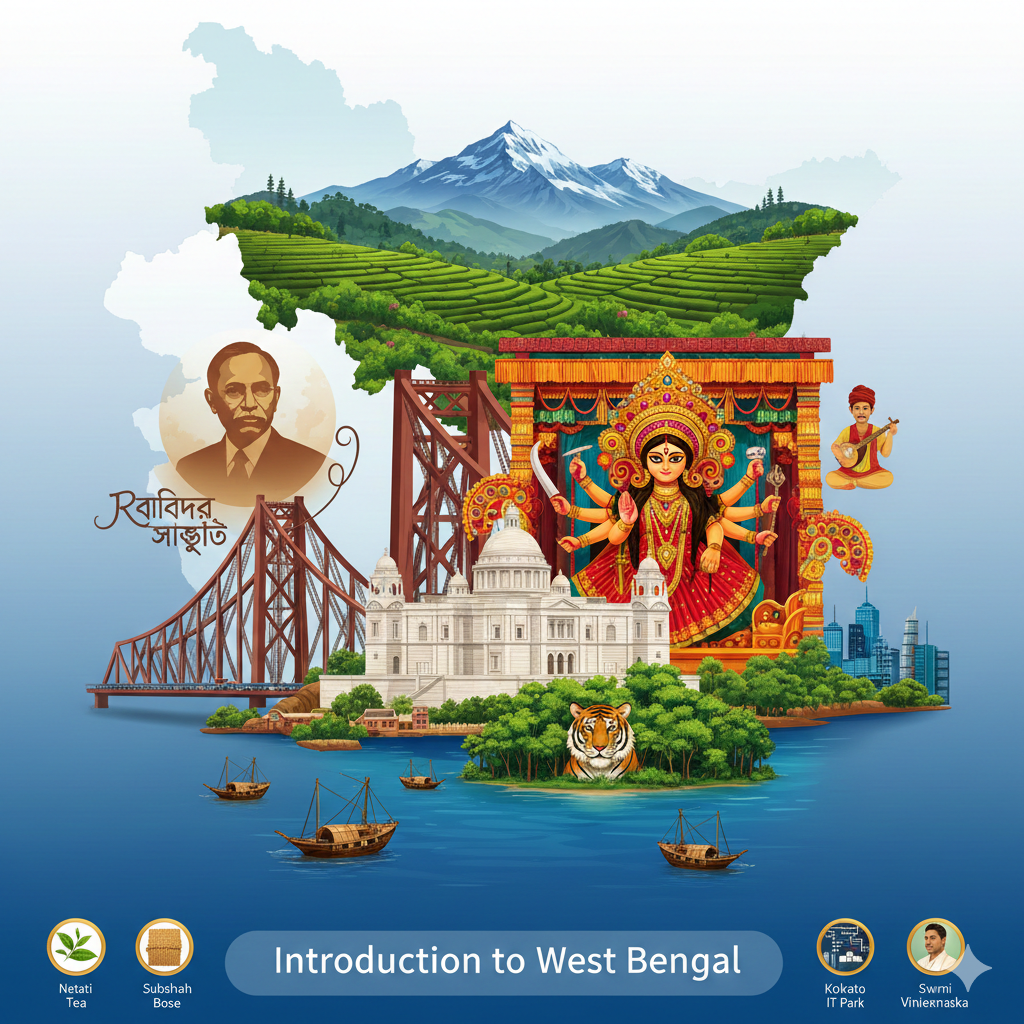
Introduction of West Bengal
West Bengal is a historically, culturally, and economically rich state located in the eastern part of India. The state is widely known for its unique cultural heritage, literature, art, music, and influential political movements. This article narrates these aspects in a clear and inspiring manner.
1. Geographical Location
Location
West Bengal lies in the eastern region of India. It is bordered by Sikkim and Bhutan in the north, the Bay of Bengal in the south, Bangladesh in the east, and the states of Jharkhand, Odisha, and Bihar in the west.
Area
The total area of West Bengal is approximately 88,752 square kilometers.
Major Rivers
The major rivers flowing through the state are the Ganga, Hooghly, Teesta, Damodar, and Ajay.
Climate
The state experiences a tropical climate with clearly defined summer, monsoon, and winter seasons.
2. History
The history of West Bengal is ancient, diverse, and glorious. Over different eras, the region has witnessed significant cultural, political, and social transformations.
Ancient Period
Historical references from the Vedic era mention this region as Vanga, Pundra, and Sumha. It was also an important part of the Maurya and Gupta Empires.
Medieval Period
During the reign of Shashank, the Pala dynasty, and the Sena dynasty, Bengal evolved into a major centre of art, culture, and trade.
Mughal and British Period
After the Mughals, British rule brought major changes in education, commerce, administration, and political awakening in Bengal.
Freedom Struggle
Bengal played a pivotal role in India's independence movement. The Swadeshi Movement began here, while leaders like Netaji Subhash Chandra Bose and Rabindranath Tagore shaped national consciousness.
Partition
During the partition of India in 1947, East Bengal became part of Pakistan (now Bangladesh), while West Bengal remained in India.
3. Population and Language
Population
As of the 2021 census, West Bengal has a population of around 10 crore, making it one of India's most densely populated states.

Amazon Product Title Here
High quality product with excellent features. Best for daily use and great value for money.
Language
Primary Language: Bengali
Other Languages: Hindi, Urdu, English, and Santhali
Religion
Hinduism is the predominant religion, followed by significant Muslim, Christian, Buddhist, and other minority communities.
4. Cultural Heritage
Literature
West Bengal has given India some of its greatest literary icons, including Rabindranath Tagore, Bankim Chandra Chatterjee, and Sharat Chandra Chatterjee.
Music
Rabindra Sangeet, Baul folk music, and various Bengali folk traditions form essential elements of the state's musical heritage.
Dance and Drama
The state has a vibrant theatre culture and diverse folk dance traditions.
Festivals
Durga Puja is the most celebrated festival in Bengal. Other major festivals include Saraswati Puja, Kali Puja, and Poila Baishakh (Bengali New Year).
5. Economic Profile
Agriculture
West Bengal is an agriculture-rich state, leading in the production of rice, jute, tea, and fish.
Industries
Kolkata, Durgapur, and Haldia are prominent industrial centres of the state.
Tea Production
Darjeeling tea is globally renowned for its quality, flavour, and aroma.
Software & Services Sector
Kolkata has rapidly developed as an important IT and service-sector hub in India.
6. Tourist Attractions
Kolkata
Famous sites include Howrah Bridge, Victoria Memorial, and the Indian Museum.
Darjeeling
Known for its Himalayan landscapes and world-famous tea plantations.
Sunderbans
A UNESCO World Heritage site, home to the Royal Bengal Tiger and rich biodiversity.
Shantiniketan
The location of Visva-Bharati University, founded by Rabindranath Tagore.
7. Key Personalities & Contributions
Rabindranath Tagore
Nobel Prize-winning poet, philosopher, and global cultural icon.
Netaji Subhash Chandra Bose
Founder of the Indian National Army (Azad Hind Fauj) and an important freedom fighter.
Swami Vivekananda
A spiritual leader who introduced Indian philosophy and culture to the world.
8. Political Landscape
West Bengal has always had a dynamic political atmosphere. After independence, the state witnessed the long rule of leftist parties, followed by the rise of the Trinamool Congress as a dominant force.
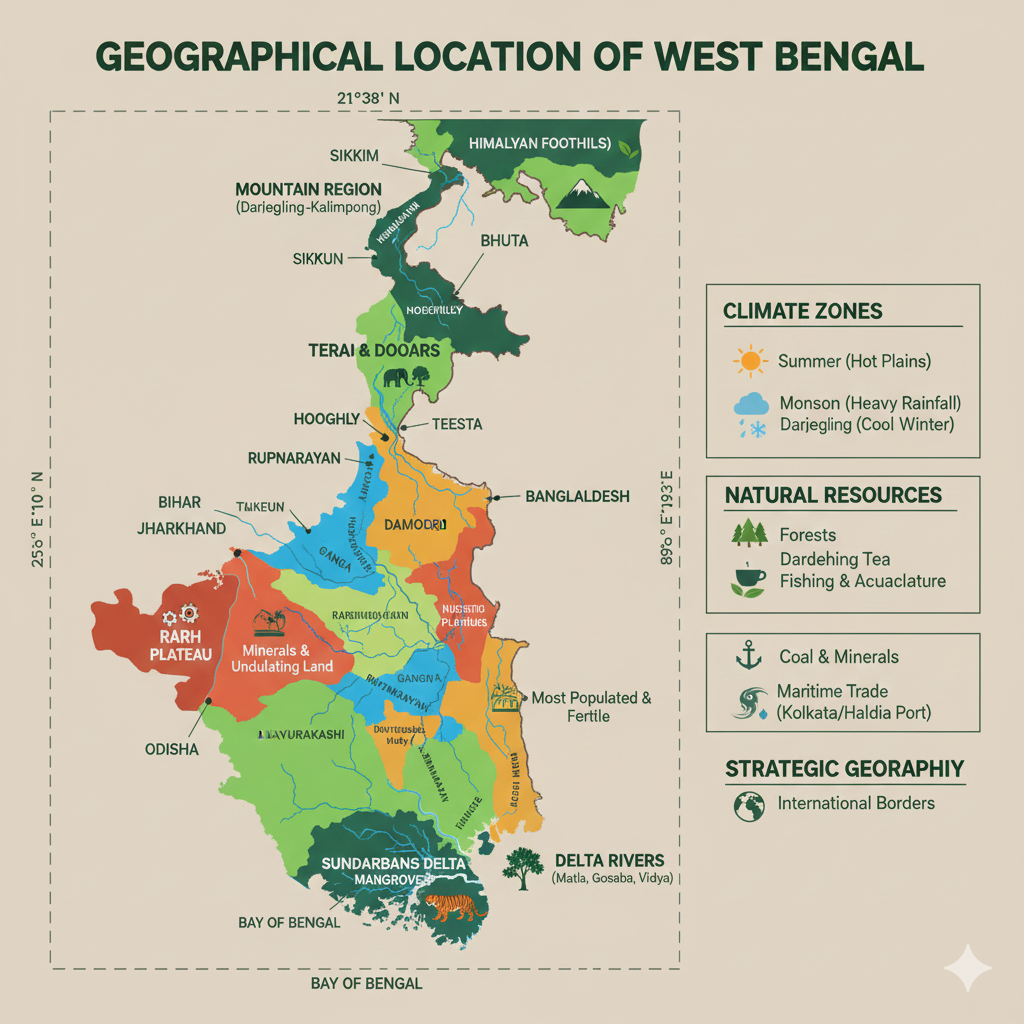
Geographical Location of West Bengal
West Bengal lies in the eastern region of India and is one of the country's most naturally diverse and culturally rich states. Its geographic span — from the high Himalaya foothills in the north to the vast mangrove delta in the south — shapes its history, economy and way of life. This article provides a clear, detailed and inspiring description of West Bengal's geography, climate, rivers, natural resources and their influence on the state.
Detailed introduction to the geographical location of West Bengal
1. Geographical extent
Latitude: between 21°38′ N to 27°10′ N
Longitude: between 85°50′ E to 89°53′ E
Total area: approximately 88,752 square kilometres — the 13th largest state in India by area.
Boundaries
- North: Sikkim and Bhutan
- East: Bangladesh
- West: Bihar and Jharkhand
- South: Odisha and the Bay of Bengal
2. Natural terrain — five major regions
West Bengal's landscape can be divided into five major geographic regions, each with distinct features, livelihoods and ecosystems.
Mountainous areas (Darjeeling & Kalimpong)
- These districts form the northern highlands and include the Himalayan foothills.
- Famous for Darjeeling tea plantations, steep slopes and scenic valleys.
- Mount Kanchenjunga — the third highest peak in the world — dominates the skyline and attracts tourists and mountaineers.
Terai and Dooars
- Fertile lowland belt at the base of the Himalayas, stretching across North Bengal.
- Rivers such as Teesta, Torsa and Raidak flow through this zone.
- The Dooars area is renowned for tea gardens, forests and wildlife corridors.
Gangetic (Alluvial) Plains
- The most fertile and densely populated region — central and southern West Bengal.
- Major rivers — Ganga, Hooghly, Damodar, Rupnarayan and Ajay — irrigate these plains, supporting intensive agriculture and trade.
Rarh (Plateau) Area
- Part of the Chota Nagpur plateau extension in western West Bengal.
- Characterised by red soil, undulating terrain and mineral deposits.
- Important for mining and certain industrial activities.
Sundarbans Delta
- Located in the Ganges delta and stretching to the Bay of Bengal.
- Home to the UNESCO-listed Sundarbans mangrove forest and the Royal Bengal Tiger.
- High biodiversity and crucial coastal protection, fisheries and tidal ecosystems.
3. Climate
West Bengal experiences a tropical monsoon climate with three distinct seasons: summer, monsoon and winter. Climate varies considerably between the highlands, plains, coastal areas and delta.
Summer (March to June)
- Plains: average 30°C to 40°C
- Hilly areas: average 15°C to 25°C
- Coastal and plain regions are hot and humid.
Monsoon (June to September)
- Average annual rainfall: 1,500–2,000 mm; some hill areas receive up to 2,500 mm.
- Rain-bearing south-westerly winds from the Bay of Bengal drive the monsoon.
- Heavy rainfall can cause floods in rivers such as the Ganga and Damodar.
Winter (November to February)
- Plains: average 10°C to 20°C
- Hilly areas: average 2°C to 10°C
- Generally pleasant, lower humidity and cooler nights; occasional frost in high hills.
Regional climatic differences
- North Bengal (Darjeeling, Kalimpong): cooler, more temperate climate year-round.
- Sundarbans & coastal belt: humid with high cyclone risk during the monsoon and post-monsoon seasons.
- Plateau (Purulia, Bankura): hotter summers, drier conditions relative to the plains.
4. Major rivers and water sources
Rivers are central to West Bengal's economy, culture and ecology. They provide irrigation, fisheries, transport routes and scenic value.
Key rivers
- Ganges (Ganga): the lifeline — enters the state and branches; the Hooghly is its main distributary in West Bengal.
- Hooghly: flows through Kolkata; vital for water supply, navigation and trade. Iconic bridges include Howrah Bridge and Vidyasagar Setu.
- Teesta: north Bengal river, important for irrigation and hydro projects.
- Damodar: historically called the "Sorrow of Bengal" for floods; the Damodar Valley Project reduced floods and provides power and irrigation.
- Rupnarayan & Ajay: important for southwestern plains — irrigation and fisheries.
- Mayurakshi and other tributaries: support local irrigation works and reservoirs.
Rivers in the Sundarbans
In the delta region many tidal channels and distributaries combine to form the Sundarbans network. Important channels include the Matla, Gosaba and Vidya rivers; together they form part of the world's largest delta.
Amazon Product Title Here
Premium quality product with excellent durability and performance. Perfect for daily use.
Economic roles of rivers
- Agriculture: irrigation across the Gangetic plains.
- Hydropower: projects on rivers such as Teesta and Damodar.
- Fisheries: riverine and delta fisheries sustain livelihoods.
- Transportation & ports: the Hooghly serves Kolkata's port and inland navigation.
- Tourism: river landscapes, the Sundarbans and hill streams attract visitors.
5. Natural resources and biodiversity
- Forest cover: roughly 15% of the state; includes Himalayan forests in the north and Sundarbans mangroves in the south.
- Minerals: coal, iron ore, and other minerals occur especially in the Rarh/plateau region.
- Biodiversity: Sundarbans houses Royal Bengal tigers, estuarine crocodiles, turtles and many bird species; hill forests support a variety of flora and fauna.
6. Impact on the economy
West Bengal's geography is a major engine of its economy:
- Agriculture: fertile alluvial plains support paddy, jute, vegetables and fisheries.
- Industry: mineral deposits, river ports and industrial belts (Kolkata, Durgapur, Haldia) boost manufacturing and logistics.
- Tourism: mountain tourism in Darjeeling, cultural tourism in Kolkata and Shantiniketan, and eco-tourism in the Sundarbans.
7. Strategic importance
- International borders: adjacency to Bangladesh, Nepal (via Sikkim) and Bhutan supports cross-border trade, cultural exchange and geopolitical significance.
- Maritime access: Bay of Bengal coastline underpins eastern seaport activity and maritime commerce.
Area of West Bengal — distribution and comparisons
Total area: 88,752 sq. km (about 2.7% of India's geographical area).
Distribution by region
- Hilly area (north): Darjeeling and Kalimpong districts — small in area but significant for ecology and tourism.
- Gangetic plain (middle): fertile, densely populated agricultural heartland.
- Sundarbans delta (south): the coastal mangrove expanse and tidal plains.
- Plateau/ Rarh (west): undulating land with mineral resources and mining activity.
Area comparison with neighbouring states
| State | Area (sq. km.) |
|---|---|
| Jharkhand | 79,716 |
| Bihar | 94,163 |
| Odisha | 155,707 |
| West Bengal | 88,752 |
Although West Bengal is smaller than very large states like Rajasthan, Madhya Pradesh or Maharashtra, its geographic diversity and high population density make it critical to India's economy and culture.
Major rivers of West Bengal — overview and significance
West Bengal's rivers support agriculture, power generation, fisheries, inland transport and tourism. The list below summarises the most important river systems.
1. River Ganges (Ganga)
The Ganga is the principal river that nourishes West Bengal's plains. In the state it often splits into distributaries; the Hooghly is the primary branch that flows past Kolkata and continues to the Bay of Bengal.
2. Hooghly River
Important for city water supplies, navigation, port access and trade. Major bridges — Howrah Bridge and Vidyasagar Setu — connect waterways to the urban fabric.
3. Teesta River
A key river in North Bengal originating in Sikkim; crucial for irrigation and hydropower schemes.
4. Damodar River
Flows across the western part of the state; historically flood-prone, the Damodar Valley Project now helps in flood control, power generation and irrigation.
5. Rupnarayan, Ajay and Mayurakshi
Important southern and western rivers that sustain irrigation, fisheries and regional agriculture.
6. Sundarbans waterways
The Sundarbans delta comprises a complex network of tidal channels and distributaries (Matla, Gosaba, Vidya and many more) instrumental for tidal ecology, fisheries and estuarine dynamics.
Climate of West Bengal — patterns and special effects
The tropical monsoon climate varies widely across West Bengal. Below is a concise seasonal summary and the special climatic effects the state faces.
Summer (March to June)
- Plains: 30°C–40°C; hill areas: 15°C–25°C.
- Hot and humid conditions in coastal and plain zones; heat waves may occur in some districts.
Monsoon (June to September)
- Annual rainfall typically 1,500–2,000 mm (higher in parts of North Bengal).
- Monsoon rains sustain agriculture but can also cause floods in major rivers.
Winter (November to February)
- Plains: 10°C–20°C; hills: 2°C–10°C.
- Most pleasant season with reduced humidity and cooler temperatures.
Regional diversity & special climatic effects
- North Bengal: cooler and wetter parts — heavy rainfall in hilly zones.
- Coastal & Sundarbans: high humidity and vulnerability to cyclones and storm surges (for example Cyclones Amphan and Yaas in recent years highlighted coastal vulnerability).
- Rarh Plateau: hotter and drier summers with different agricultural cycles.
- Floods & cyclones: seasonal floods (Ganga, Damodar, Teesta) and cyclones from the Bay of Bengal significantly influence livelihoods, agriculture and infrastructure planning.
Conclusion
The geographical location of West Bengal — stretching from the Himalayan foothills to the mangrove Sundarbans — makes it uniquely diverse in natural beauty, resources and livelihoods. Its rivers, fertile plains, tea hills and coastal ecosystems together shape a rich cultural and economic tapestry. While geography offers immense advantages for agriculture, industry and tourism, it also brings challenges such as floods, cyclones and coastal vulnerability that require careful planning and conservation.
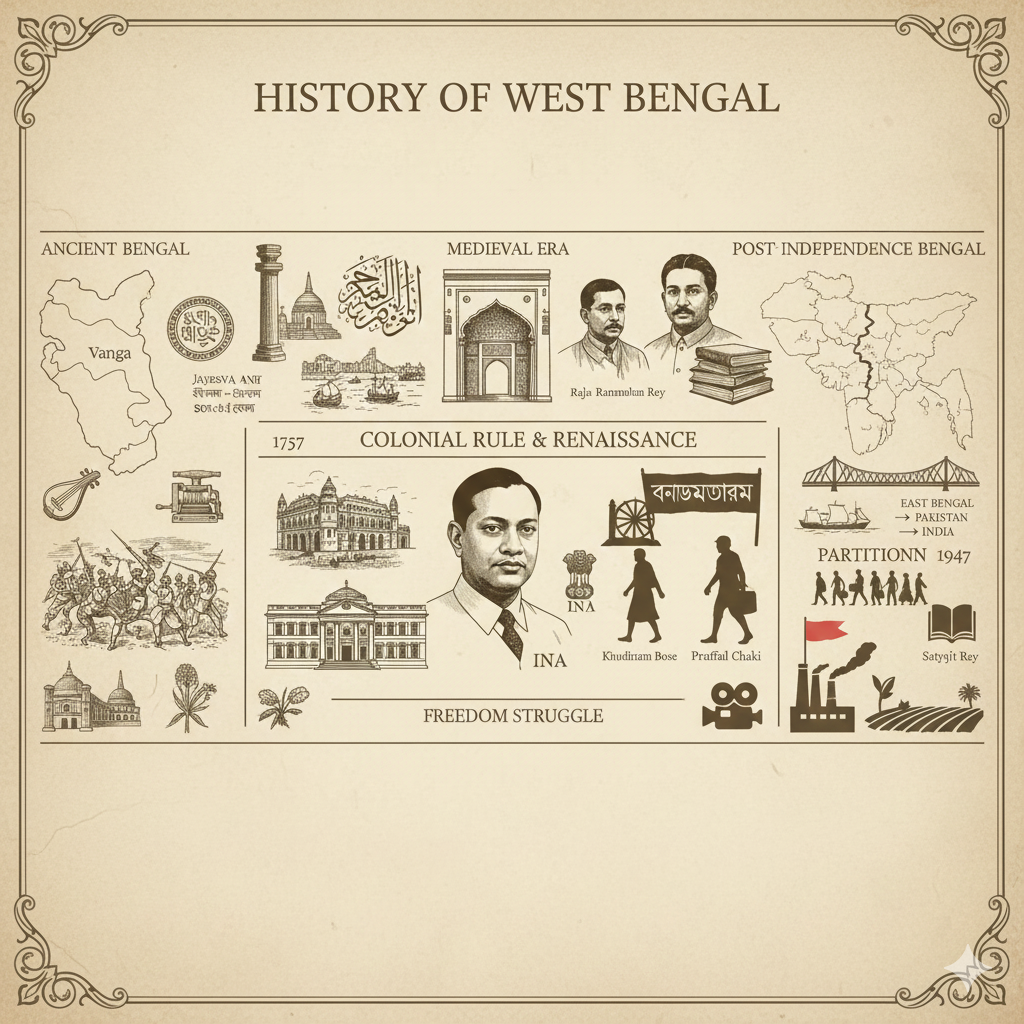
History of West Bengal — A Detailed Introduction
The history of West Bengal reflects centuries of cultural, political and social development on the Indian subcontinent. From ancient maritime contacts and imperial centres of learning to vibrant modern movements for social reform and independence, Bengal has shaped and been shaped by many currents of South Asian history.
1. Ancient History
West Bengal’s ancient past is deeply embedded in Vedic literature, epic traditions and early imperial histories.
Vedic and Epic period
- Early texts mention the region as Vanga, and it appears in Vedic literature and epic narratives such as the Mahabharata and Ramayana.
- Maritime trade and riverine navigation were important — Bengal engaged with South and Southeast Asia through sea routes.
Mauryan and Gupta Empires
- During the Mauryan period (c. 322–185 BCE) Bengal was an integral part of the empire; under Ashoka, Buddhism spread widely.
- In the Gupta era (4th–6th centuries CE) Bengal participated in the broader “Golden Age” of Indian culture, with advances in literature, art and learning.
Pala and Sena dynasties
- Pala dynasty (c. 8th–12th centuries): patrons of Buddhism; Bengal became associated with major centres of learning such as Nalanda and Vikramashila.
- Sena dynasty (c. 11th–12th centuries): saw a revival of Hindu religious and literary life; poets like Jayadeva contributed to cultural life.
2. Medieval History
Medieval Bengal underwent political shifts, religious movements and economic prosperity that set the stage for later developments.
Delhi Sultanate and cultural movements
- From the 13th century Bengal came under the influence of northern sultanates; Sufi and Bhakti movements brought social and religious reform and syncretic traditions.
Mughal period
- Under Mughal rule (16th–18th centuries) Bengal emerged as a prosperous and administratively important province.
- Mughal administration promoted agriculture, trade and urban centres such as Hooghly and Murshidabad; Persianate culture blended with local Bengali traditions.
Independent Nawabs
- With imperial weakening in the early 18th century, local Nawabs established relative autonomy. Murshid Quli Khan and others consolidated regional power.
- The last independent Nawab, Siraj-ud-Daulah, was defeated at the Battle of Plassey (1757), a turning point that opened the way for British dominance.
3. Modern History — British Period and Responses
The colonial era brought profound economic, social and political changes; Bengal also became a crucible of reform and resistance.
British conquest and administration (1757 onwards)
- The Battle of Plassey (1757) marked the beginning of firm British control; the East India Company established Bengal as a major revenue and trade base.
- Calcutta (Kolkata) became the capital of British India (1773), and Bengal’s textiles and handicrafts were transformed — often to the detriment of local artisans — by colonial economic policies.

Amazon Product Title Here
High quality product with great durability and excellent performance. Perfect choice for daily use.
Economic and social impact
- Colonial policies, forced indigo cultivation, and exploitative land systems such as the zamindari system weakened rural economies.
- Famines, notably the Bengal famine of 1943, had catastrophic human consequences during the colonial era.
Bengal Renaissance and social reform (19th century)
- The 19th century saw a cultural and intellectual revival known as the Bengal Renaissance.
- Reformers like Raja Rammohan Roy and Ishwar Chandra Vidyasagar championed social and educational reforms, while literary and artistic figures such as Rabindranath Tagore enriched Bengal’s cultural life.
4. Freedom Movement and Revolutionary Activity
Bengal played a central role in India’s struggle for independence through both non-violent mass movements and revolutionary activities.
Swadeshi Movement and the 1905 Partition
- The 1905 partition of Bengal by Lord Curzon triggered the Swadeshi movement — a powerful campaign of boycott, indigenous enterprise and political mobilisation — eventually leading to the annulment of the partition in 1911.
- Leaders such as Aurobindo Ghosh, Surendranath Banerjee and Rabindranath Tagore were prominent voices in this phase.
Revolutionary organisations
- Groups such as Anushilan Samiti and Yugantar pursued armed resistance; noted revolutionaries included Khudiram Bose, Prafulla Chaki, and the trio Binoy–Badal–Dinesh.
- Key episodes include the Alipore Conspiracy Case (1908) and the Chittagong Armoury Raid (1930).
Mass movements and national leaders
- Mahatma Gandhi’s non-cooperation and Quit India movements had deep resonance in Bengal, mobilising workers, students and peasants.
- Subhash Chandra Bose emerged as an influential leader who formed the Forward Bloc and later the Indian National Army (Azad Hind Fauj), invoking a more militant approach to liberation.
5. Partition (1947) and Its Aftermath
The 1947 Partition devastated Bengal: division, communal violence and large-scale migration reshaped the region’s demography and politics.
- East Bengal became part of Pakistan (later independent Bangladesh in 1971).
- West Bengal remained in the Republic of India, but experienced an influx of refugees, social upheaval and economic strain.
6. Post-Independence West Bengal — Politics, Economy and Culture
After 1947, West Bengal underwent political realignments, socio-economic reforms and cultural consolidation.
Political developments
- Post-independence West Bengal saw varied political experiments — from the early Congress dominance to the long rule of leftist parties and later the rise of regional formations such as the Trinamool Congress.
- The Naxalite movement in the 1960s–70s marked a period of radical rural unrest and ideological challenge.
Economic and social change
- Land reforms and initiatives in rural development reshaped agrarian relations in many districts.
- Although industrialisation lagged in some sectors, cultural industries, education and services continued to be major strengths.
Cultural revival and legacy
- The legacy of the Bengal Renaissance continued through writers, filmmakers and thinkers — figures such as Rabindranath Tagore, Satyajit Ray and others placed Bengal prominently on the global cultural map.
- Bengali literature, theatre, music and visual arts remain vibrant and influential.
7. Cultural and Religious Influences Across Periods
Throughout its history Bengal has been a meeting point of diverse religious traditions and cultural currents.
- Religious pluralism: Hinduism, Buddhism, Islam, Jainism and later European influences coexisted and influenced each other.
- Language and literature: Bengali developed rich literary forms. Tagore’s Gitanjali won the Nobel Prize and brought global recognition to Bengali literature.
- Architecture and art: remnants of Buddhist stupas and viharas, Mughal mosques and tombs, and British colonial architecture together form a layered heritage.
8. Economic Impact of Historical Processes
Historical events shaped Bengal’s economic trajectory.
- Colonial economic policies undermined indigenous industries (notably textiles), while creating new port, rail and administrative infrastructures centred on Kolkata.
- Famines, especially the Bengal famine of 1943, were tragic consequences of wartime and colonial mismanagement.
- Post-independence policies attempted land reforms and rural rehabilitation, with mixed outcomes for industrial revival.
Conclusion
The history of West Bengal is a long, layered narrative of cultural brilliance, economic transformations and political movements. From ancient maritime traders and great centres of learning to renaissance thinkers and freedom fighters, Bengal’s past continues to inform its present identity. Understanding this history helps us appreciate Bengal’s unique contributions to literature, art, politics and social reform — as well as the challenges the region has faced and continues to address.

Partition of India and West Bengal
With India’s independence in 1947 the subcontinent was partitioned into two nations — India and Pakistan. The Partition, largely driven by religious politics, divided Bengal into western and eastern parts and left a deep and lasting impact on Bengal’s society, economy and politics.
1. Reasons for Partition
Religious tensions
Communal tensions between Hindu and Muslim communities grew through the early 20th century. In Bengal, where the Hindu and Muslim populations were nearly balanced, these tensions were particularly intense.
Earlier partition of Bengal (1905)
The 1905 partition of Bengal by Lord Curzon on communal lines (Hindu-majority and Muslim-majority areas) — though annulled in 1911 — deepened religious divisions and left a legacy of mistrust.
Role of political parties
The Muslim League’s demand for a separate Muslim state (Pakistan) and the growing estrangement between the Muslim League and the Indian National Congress made partition increasingly likely. In Bengal, the demand was to include Muslim-majority areas within Pakistan.
2. Partition of Bengal (1947)
The division followed the Mountbatten Plan. The Hindu-majority western part became West Bengal (in India), and the Muslim-majority eastern part became East Bengal (in Pakistan, later Bangladesh).
Basis of division
The central criterion for the division was religious demography. Prior to partition Bengal had been a single cultural and economic entity; partition split communities, resources and institutions.
3. Effects of Partition
Sectarian violence
Partition unleashed widespread communal violence in both West and East Bengal. Thousands were killed and millions displaced. Cities and districts such as Kolkata and Noakhali witnessed intense violence and upheaval.
Refugee crisis
Millions of Hindu refugees fled East Bengal for West Bengal. Resettling them was a monumental challenge — straining housing, employment and public services. Kolkata and other urban areas faced severe population pressure.
Cultural and social impact
The partition fragmented Bengal’s shared cultural life. West Bengal gradually became Hindu-majority in public life while East Bengal’s cultural milieu changed with a Muslim-majority influence. Nevertheless, shared traditions and cultural ties continued across the border.
Economic impact
The economic consequences were severe: agricultural and industrial balances were upset. East Bengal retained large agricultural areas (including jute cultivation) while many processing industries, mills and commercial centres remained in West Bengal, creating mismatches — for example, jute-producing areas in the east and jute mills in the west.
4. Challenges after Partition
Political instability
Political instability and communal tensions rose in the immediate post-partition years. The refugee influx created social and political stresses that required urgent administrative action.
Urban pressure
Cities, especially Kolkata, experienced overcrowding, housing shortages, unemployment and expanded informal settlements.
Cultural integration
Integrating refugees and rebuilding community life was a major task. The government and civil society worked on rehabilitation and livelihood measures, but social integration remained complex.
5. Reorganization and later developments

Amazon Product Title Here
Premium quality product with excellent performance and durability. Ideal choice for daily use.
Transformation of East Bengal
East Bengal later became East Pakistan and, after the 1971 Liberation War, emerged as the independent nation of Bangladesh. Bangladesh’s independence significantly altered regional geopolitics and cross-border relations.
Development of West Bengal
West Bengal focused on rebuilding its industry, education and cultural institutions. Kolkata remained a major economic and cultural hub.
6. Cultural impact
Despite partition, cultural continuity remained strong across Bengal. Literary and musical traditions, and mutual respect for great cultural figures such as Rabindranath Tagore and Kazi Nazrul Islam, continue to link West Bengal and Bangladesh.
West Bengal — Population and Language
West Bengal’s population and language landscape give the state a distinct cultural identity. The state is densely populated, linguistically rich and religiously diverse.
1. Population
Size and density
Total population: According to the 2021 / recent estimates, the population of West Bengal is approximately 9.6–10 crore.
Population density: West Bengal is one of India’s most densely populated states, with roughly ~1,000 persons per sq. km.
Urban and rural distribution
- Urbanisation: Urbanisation is growing rapidly. Kolkata is the largest urban centre; the Kolkata metropolitan area is home to millions.
- Rural population: A significant portion still lives in rural areas, where agriculture remains a major livelihood.
Religious composition
- Hindus: Majority community in West Bengal (~70%).
- Muslims: Significant minority (~27%), concentrated in districts such as Murshidabad, Malda and North Dinajpur.
- Others: Christians, Sikhs, Jains and tribal religious communities together form a small percentage.
2. Language
Bengali (Bangla)
Bengali is the principal and official language of West Bengal and a core element of the state’s cultural identity. It is one of India’s scheduled languages and is also the national language of Bangladesh. An estimated ~85% of the population speaks Bengali in daily life.
Script and literature
Bengali script evolved from the Brahmi family. Bengali literature is rich — with towering figures like Rabindranath Tagore, Kazi Nazrul Islam and Sarat Chandra Chattopadhyay shaping modern Bengali thought and art.
Other languages
- Hindi: Widely spoken among migrants and non-Bengali communities, especially in urban areas.
- Urdu: Used notably in Muslim-majority pockets such as parts of Kolkata, Murshidabad and Malda.
- Nepali: Spoken in hill districts like Darjeeling and Kalimpong by the Gorkha community.
- Tribal languages: Santali, Mundari and Kurukh are used in tribal areas such as Purulia, Jhargram and Birbhum.
- English: Important for administration, higher education and business, especially in urban centres.
Official linguistic recognition
In addition to Bengali, certain regions officially recognise other languages — for example, Nepali in parts of North Bengal, Urdu in designated areas, and Santali among scheduled languages — reflecting the state’s multilingual character.
3. Detailed population profile
Size and distribution (estimates)
2011 census: ~9.13 crore.
Recent estimates (2023): around 10 crore.
Population density: approximately 1,029 persons per sq. km (one of the highest in India).
Rural–urban split
- Rural population: ~68% (major agricultural workforce).
- Urban population: ~32% (concentrated in Kolkata and other towns).
Demographic indicators
- Sex ratio: ~950 females per 1000 males (slightly above the national average).
- Literacy rate: ~77.08% (2011 census) — male literacy ~81.7%, female literacy ~70.5%.
- Age structure: A large working-age population (15–59 years) forms the bulk of the demographic profile.
4. Ethnic, tribal and cultural diversity
Tribal communities
Tribal communities make up about 5.8% of West Bengal’s population. Major tribal groups include the Santals, Oraons and others, primarily settled in districts such as Purulia, Jhargram and parts of Birbhum.
Other ethnic groups
The state has a strong Bengali majority, alongside communities such as Marwaris, Biharis, Odias and Nepalis — each contributing to the multi-layered cultural fabric.
5. Population growth, migration and urbanisation
Growth trends
West Bengal’s population growth rate slowed between 2001–2011 (~13.84%), influenced by urbanisation, rising literacy and changing socio-economic patterns.
Migration & refugees
The state has seen significant migration: refugee waves after the 1947 Partition and 1971 Bangladesh Liberation War, as well as migration from neighbouring Indian states for work and settlement.
6. Economic implications of population
Dense population supports large agricultural markets, labour supply for industry and services, but also creates stresses: housing shortages, strain on health and education services, and pressure on urban infrastructure.
7. Languages in practice — examples
Kolkata
Kolkata is highly multilingual — Bengali, Hindi, English and Urdu are commonly heard in markets, media and institutions.
Darjeeling & North Bengal
Nepali is widely used; the Gorkha community maintains strong linguistic and cultural traditions.
Tribal districts
Santali and other tribal languages continue to be central to local identity and folk culture in districts like Purulia.
Conclusion
The Partition of 1947 reshaped Bengal politically, economically and culturally, leaving a legacy of displacement and transformation. West Bengal’s population and linguistic diversity — dominated by Bengali but enriched by many other languages — are central to its cultural identity and social resilience. The state remains a vivid example of pluralism, where language, religion and migration together form a dynamic and evolving social landscape.
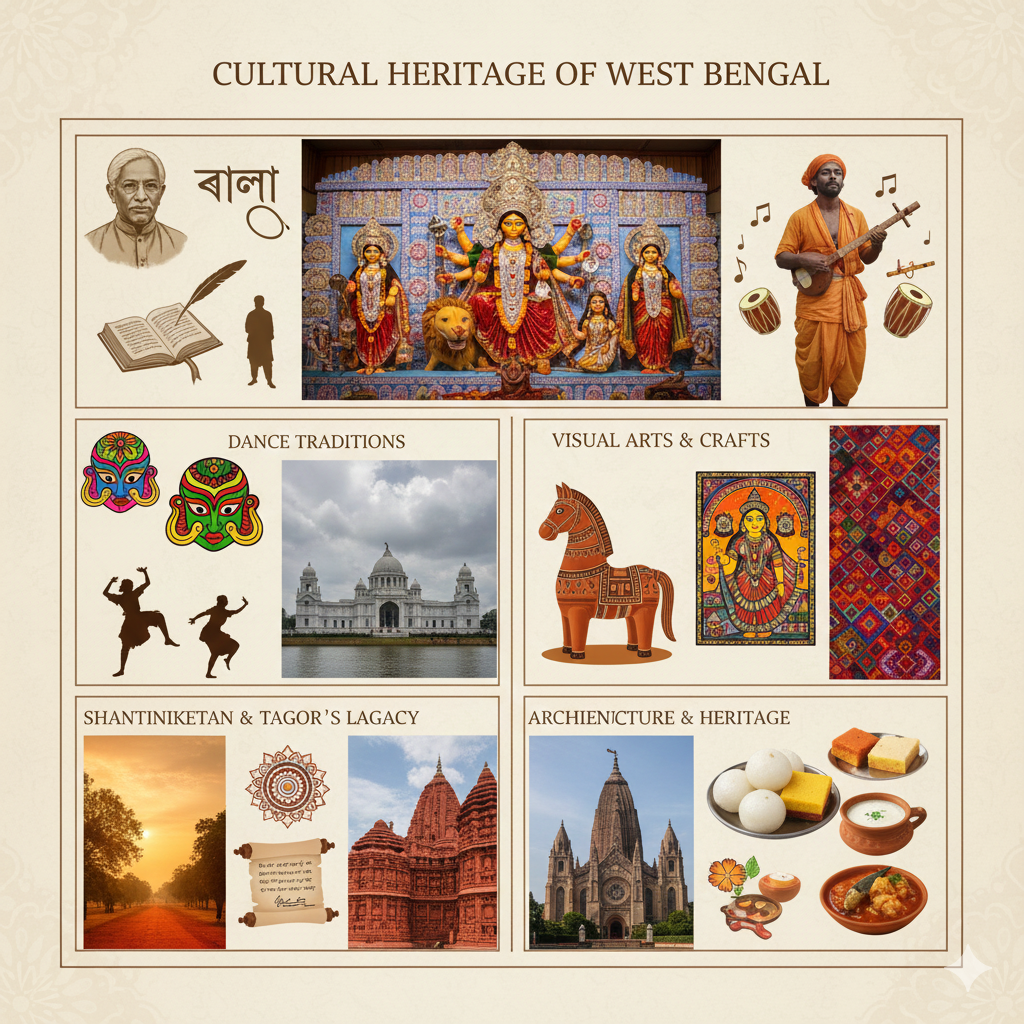
Cultural Heritage of West Bengal
West Bengal’s cultural heritage is rich, varied and widely admired. From world-class literature and classical as well as folk music to vibrant festivals, unique crafts and dynamic theatre traditions — the state’s cultural life has shaped both regional identity and India’s broader cultural map.
1. Literature and Language
Bengali literature
Bengali literature has global recognition. Legendary figures such as Rabindranath Tagore (Nobel laureate) and Kazi Nazrul Islam brought Bengali literature and music to new heights. Novelists like Sarat Chandra Chattopadhyay created enduring works (e.g., Devdas, Parineeta).
Bengali language
The Bengali language is central to West Bengal’s cultural identity. It expresses regional thought through poetry, prose and song, and remains a living vehicle for artistic and intellectual expression.
2. Festivals and Traditions
Durga Puja
Durga Puja is the most celebrated festival of West Bengal. Elaborate pandals, artistic idol-making, cultural performances and community gatherings make it a showcase of artistic skill and social life.
Poush Mela & Spring Festival (Shantiniketan)
Poush Mela and the spring celebrations initiated by Tagore at Shantiniketan highlight music, dance, handicrafts and the ethos of open-air learning.
Rath Yatra, Eid and communal traditions
Religious festivals such as Rath Yatra and Eid are celebrated with enthusiasm, demonstrating Bengal’s syncretic social fabric and cultural pluralism.
3. Arts and Crafts
Kalighat painting
Kalighat paintings are a distinctive school of Bengal art, historically produced near the Kalighat Kali Temple and often depicting religious and social themes.
Terracotta art
Terracotta temples and sculptures, notably from Bankura and Bishnupur, reflect Bengal’s rich temple architecture and artisanal traditions.
Kantha embroidery
Kantha is traditional running-stitch embroidery used on sarees, quilts and shawls — a craft mainly practised by rural women and celebrated for its simple elegance.
4. Music and Dance
Rabindra Sangeet
Songs written and composed by Rabindranath Tagore form a backbone of Bengali musical culture, exploring nature, love, devotion and philosophy.
Baul music
Baul is a mystic folk tradition sung by wandering minstrels; it merges Sufi and Vaishnav elements and conveys spiritual and humanist themes.
Classical & folk dances
Classical forms like Kathak coexist with regional dances such as Chhau (Purulia and Jhargram) and tribal/folk dances performed during festivals and harvests.
5. Architectural & Historical Heritage
Kolkata’s colonial architecture
Kolkata preserves major British-era landmarks — Victoria Memorial, Howrah Bridge and St. Paul’s Cathedral — which tell stories of the city’s historic cosmopolitanism.
Temples, mosques and nawabi heritage
Religious monuments like Dakshineswar Kali Temple and the historic mosques and nawabi palaces of Murshidabad show the layered architectural influences — Mughal, regional and colonial.
6. Folklore, Theatre & Village Traditions
Folk tales and Jatra
Folklore, village fairs and Jatra (open-air folk theatre) transmit local stories, social values and religious narratives across generations.
Folk theatre & Pala
Pala and other folk dramatic forms mix music, narrative and satire and remain central to rural cultural life.
7. Food & Sweets
Traditional dishes
- Macher Jhol (fish curry)
- Shukto and Payesh (traditional vegetarian & sweet dishes)

Amazon Product Title Here
High quality product with excellent features and reliable performance. Best choice for daily use.
Sweets
Bengali sweets such as Roshogulla, Sandesh and Mishti Doi are central to the culinary identity of the region.
8. Shantiniketan & Tagore’s Contribution
Shantiniketan (Bolpur)
Founded by Rabindranath Tagore, Visva-Bharati University at Shantiniketan remains a living centre for arts, open-air education and intercultural exchange.
Tagore’s legacy
Tagore’s pedagogy, music and literary output shaped modern Bengali culture and positioned it on the global stage.
9. Literature — From Charyapada to Contemporary Voices
Ancient & medieval literature
Works such as the Charyapada and the Mangal Kavya corpus show early devotional and narrative traditions. Vaishnava padavali and translations like Krittivasa’s Ramayana enriched literary life.
Modern literature
Modern Bengali literature includes giants such as Tagore, Bankim Chandra Chattopadhyay and Sarat Chandra Chattopadhyay. Their novels, poems and essays combined social critique with artistic depth.
Folk & contemporary literature
Baul songs, folk tales and later writers like Mahasweta Devi, Sunil Gangopadhyay and Buddhadev Guha expanded themes to include tribal voices, urban life and social justice.
10. Music — Traditions, Instruments & Festivals
Genres and features
- Traditional: Baul, Kirtan, Bhatiali and Jatra music.
- Classical: Dhrupad, Khayal and Hindustani classical traditions with strong Kolkata centres.
- Modern: Film songs, band music and contemporary adaptations of Rabindra Sangeet.
Common instruments
Typical instruments include the ektara, dhol, tabla, sarangi, flute and modern additions like guitars and keyboards.
Festivals and events
Music festivals such as the Kolkata Music Festival and Shantiniketan events celebrate classical and folk traditions every year.
11. Dance & Drama
Folk dances
- Chhau: mask-based martial dance from Purulia and Jhargram.
- Baul dance: devotional movement paired with Baul songs.
- Kumar and harvest dances: performed during agrarian festivals.
Theatre & modern drama
Kolkata is India’s major urban theatre hub. From Tagore’s dance-dramas to contemporary political and social plays, theatre remains a lively medium for ideas and performance.
Conclusion
West Bengal’s cultural heritage is a layered, living tradition — where ancient literature and folk forms stand alongside modern novels, classical music, vibrant festivals and dynamic theatre. The state’s arts and practices continue to evolve while preserving deep roots in history, community and shared celebration.
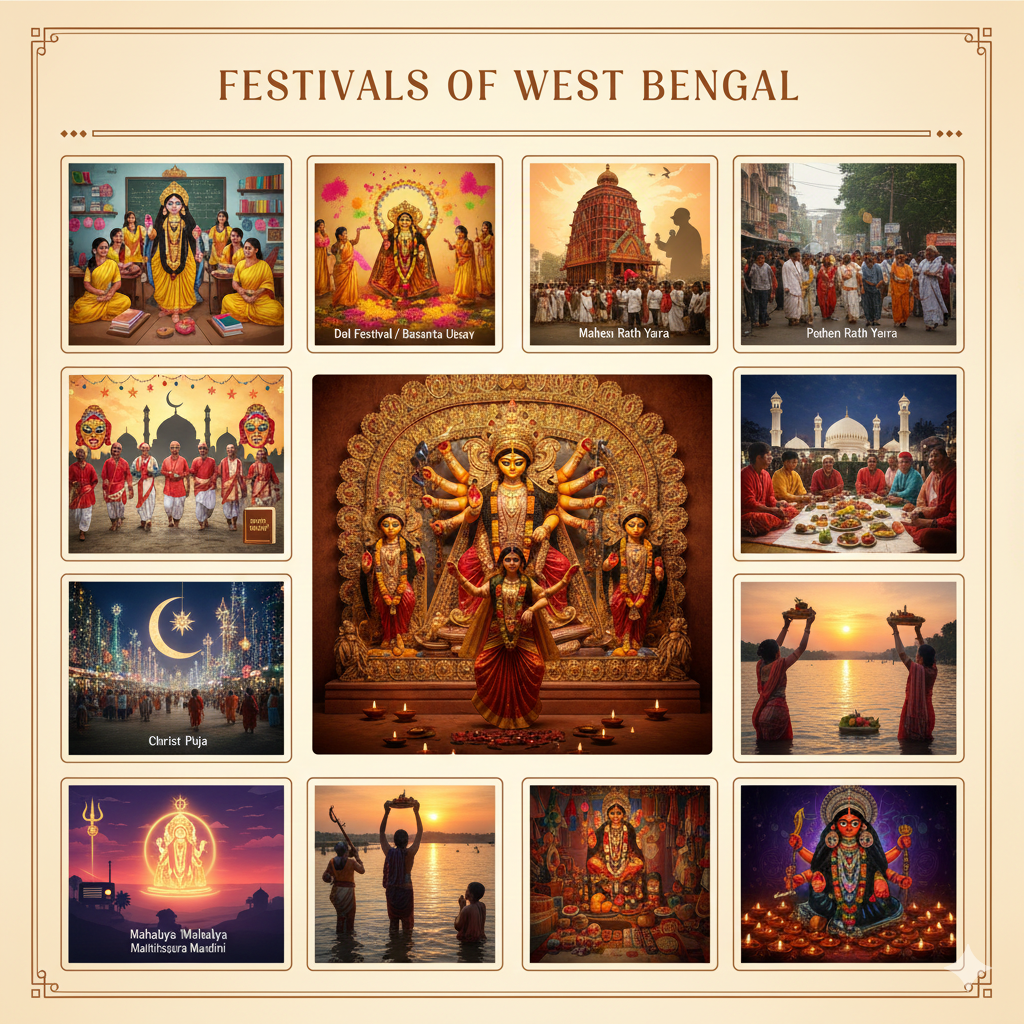
Festivals of West Bengal
The cultural and social life of West Bengal is woven with festivals. These celebrations reflect religious devotion, communal harmony, artistic excellence and deep-rooted traditions. Each festival connects communities, supports local artisans and showcases Bengal’s diversity.
Major Festivals
1. Durga Puja
Durga Puja is the grandest festival of West Bengal. It honours Goddess Durga and is celebrated across cities and villages with elaborate pandals, artistic idol-making, cultural programmes and community feasts. Kolkata’s Durga Pujas are internationally famous and have been recognised for their cultural importance.
Key elements: idol installation, pandal art, adda (social gatherings), cultural shows and bhog (community food).
2. Kali Puja
Kali Puja (coinciding with Diwali in many places) is devoted to Goddess Kali. Homes and temples are lit with lamps, and devotees perform night-long prayers and rituals. In urban areas fireworks and light displays are common.
3. Saraswati Puja
Dedicated to Saraswati, the goddess of learning, Saraswati Puja is widely observed in schools, colleges and households. Students and teachers seek blessings for knowledge; wearing yellow and devotional music are typical.
4. Rath Yatra
Rath Yatra honours Lord Jagannath. Deities are mounted on a decorated chariot and pulled in procession. The Rath Yatra of Mahesh is particularly famous in Bengal, attracting large crowds and religious fervour.
5. Dol Festival (Holi)
In Bengal the Holi spirit appears as the Dol Festival. At Shantiniketan, Tagore’s distinctive way of celebrating Dol blends music, dance and colour — creating a poetic springtime festival.
6. Nabavarsha (Pohela Boishakh)
Pohela Boishakh celebrates the Bengali New Year in April. People wear new clothes, clean homes and shops, hold cultural events and businesses open new account books (Haal Khata). It’s a day of community optimism and cultural fairs.
7. Eid
Eid is celebrated with devotion and community spirit. Mosques fill for prayers, families visit and feasts are shared — highlighting Bengal’s communal harmony.
8. Christmas
Christmas is celebrated with festive lights and decorations — Park Street in Kolkata is a seasonal attraction. Churches hold services and communities exchange greetings, reflecting the city’s pluralistic culture.
9. Chhath Puja
Celebrated mainly by migrant communities from Bihar and eastern Uttar Pradesh, Chhath Puja involves riverbank rituals and offerings to the Sun God. It is observed with devotion along the state’s waterways.
10. Flower Fair & Shantiniketan Festival
The Flower Fair and Tagore’s spring festival at Shantiniketan celebrate nature, music, folk crafts and open-air performances — a joyful cultural gathering that welcomes spring.

Amazon Product Title Here
Premium quality product with excellent durability and performance. Perfect for daily use.
11. Ganga Sagar Mela
Held on Makar Sankranti, the Ganga Sagar Mela draws thousands of pilgrims to the confluence of the Ganges and the Bay of Bengal to take a holy dip. It is one of India’s largest pilgrimage fairs.
12. Mahalaya
Mahalaya marks the beginning of the Durga Puja season. On this day, radio broadcasts such as Mahishasura Mardini have deep sentimental value and ancestral offerings are performed to herald the goddess’s arrival.
13. Titu Puja
Titu Puja honours a local folk deity and is especially popular in rural areas. It emphasises social unity and communal participation through traditional rituals and village gatherings.
14. Paush Mela
The Paush Mela at Shantiniketan (in the month of Pausha) follows Tagore’s traditions — showcasing folk music, dance, crafts and cultural exchanges in an open-air fair atmosphere.
Characteristics of Bengal’s Festivals
- Communal participation: People from different communities join celebrations together.
- Art & craftsmanship: Festivals sustain local artisans — idol-makers, pandal artists, weavers and sweet-makers receive large seasonal demand.
- Music & performance: Songs, dance and drama are integral to festival life.
- Economic impact: Festivals boost local trade, tourism and seasonal employment.
- Social cohesion: Shared rituals and community feasts strengthen neighbourhood bonds and cultural continuity.
Conclusion
The festivals of West Bengal are a living expression of its culture — combining devotion, artistry, social life and economic activity. They connect generations, celebrate diversity and make Bengal a vibrant cultural destination. The grandeur, warmth and inclusivity of these festivals give West Bengal a special place on India’s cultural map.
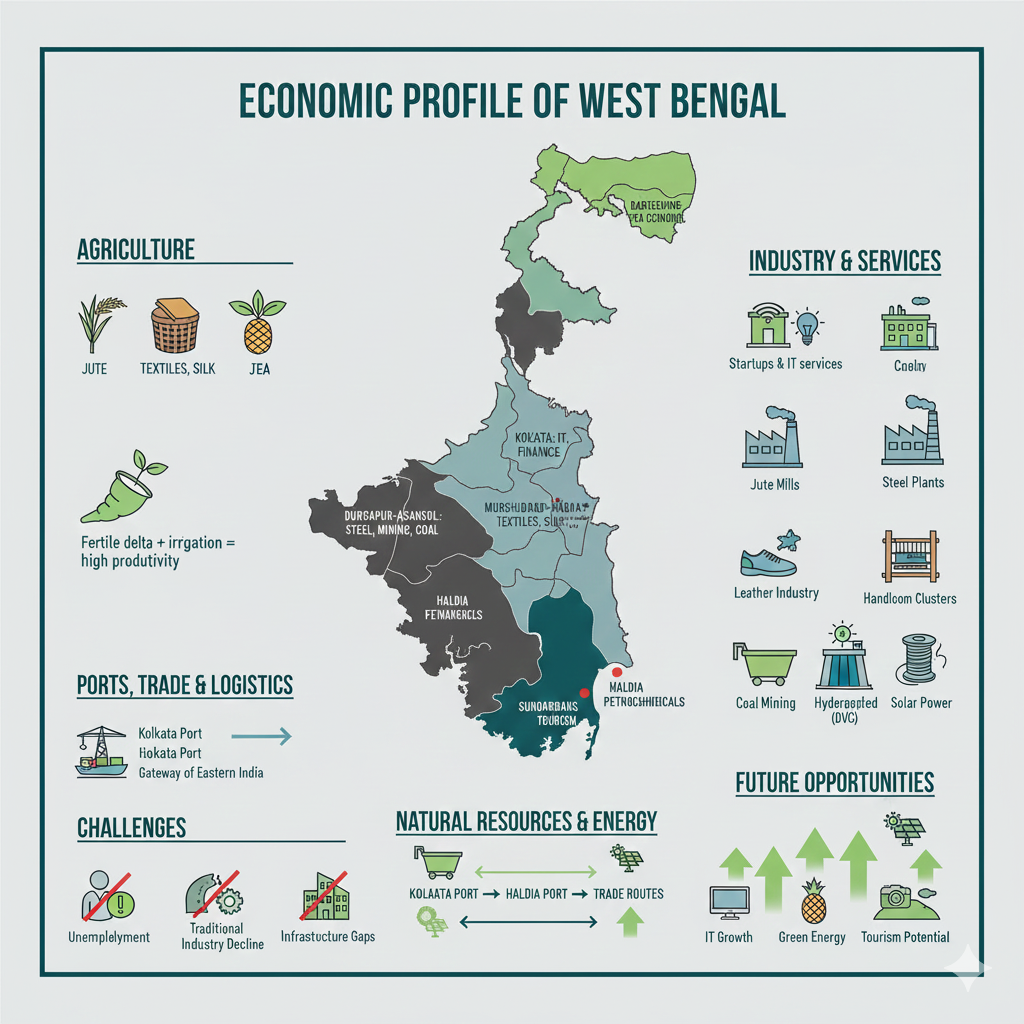
Economic Condition of West Bengal
West Bengal has a diversified and historically important economic structure. A balance of agriculture, industry, services and trade — combined with strategic geography and rich cultural capital — makes the state a key economic hub of eastern India. Below is a structured, detailed overview of its sectors, resources, policies, challenges and future prospects.
1. Agriculture — The backbone of the economy
Agriculture remains central to West Bengal’s economy. The fertile Ganges–Brahmaputra delta, extensive irrigation and favourable climate support high agricultural productivity and a large rural workforce.
Key features
- Rice: West Bengal is a leading rice producer — often called India’s “rice bowl.”
- Jute: Significant jute cultivation; historically called the “Jute Bowl.”
- Tea: Darjeeling tea and tea from Jalpaiguri/Cooch Behar are important for export and employment.
- Other crops: maize, wheat, pulses; horticulture crops such as mango, litchi, potato.
Irrigation, technology & schemes
Major rivers, canals, the Damodar Valley Project (DVC) and barrages (e.g., Teesta) support irrigation. The government promotes modern techniques, organic farming, soil testing, crop diversification, subsidised inputs and crop insurance to stabilize farm incomes.
Challenges in agriculture
- Small and fragmented land holdings.
- Dependence on monsoon and vulnerability to floods/cyclones.
- Insufficient investment in mechanisation and value-chain processing.
2. Industry — From traditional mills to modern manufacturing
West Bengal’s industrial base spans traditional sectors (jute, tea, handloom) to heavy industries (steel, coal), petrochemicals and a growing services-linked industrial cluster.
Main industrial sectors
| Industry | Notes |
|---|---|
| Jute | Concentrated around Kolkata and Hooghly; historically important for exports and employment. |
| Tea | Darjeeling, Jalpaiguri, Cooch Behar — high-value tea for export and tourism-linked jobs. |
| Steel & Mining | Durgapur–Asansol–Raniganj belt: steel plants, coalfields and heavy industry. |
| Petrochemicals & Refining | Haldia is a major refinery and petrochemical hub. |
| Leather | Kolkata (Tangra) is known for leather tanning and exports. |
| Textiles & Handloom | Silk weaving (Murshidabad), handloom clusters and traditional crafts. |
| Pharma & Chemicals | Emerging clusters around Kolkata and Haldia. |
| IT & Services | Salt Lake (Sector V) hosts IT/ITES firms and growing startup activity. |
Industrial hubs
- Kolkata: Financial, trading and service centre.
- Durgapur & Asansol: Heavy industry, steel and power.
- Haldia: Petrochemical and port-based industry.
- Darjeeling & Jalpaiguri: Tea production and tourism-linked economic activity.
3. Service sector — Finance, IT, tourism and education
The service sector contributes substantially to the state GDP and employment. Kolkata is the primary hub for banking, finance, education and healthcare.
Key sub-sectors
- Banking & Finance: Kolkata serves eastern India’s finance needs.
- IT & Software: Sector V (Salt Lake) is the main IT corridor with national firms and startups.
- Tourism: Darjeeling, Sundarbans and cultural tourism in Kolkata generate significant revenue.
- Education & Health: Prominent universities and medical institutions attract domestic and regional demand.
4. Ports, trade & external commerce
Kolkata Port & Haldia
Kolkata Port (one of India’s oldest) and Haldia handle exports like jute, tea and petrochemical products. These ports are vital for trade with South and Southeast Asia.
5. Natural resources & energy
- Minerals: Coal (Raniganj), limestone, dolomite and silica support mining and manufacturing.
- Energy: Thermal power plants, hydro projects and growing investments in solar power and renewable energy.
6. Tourism and cultural economy
Amazon Product Title Here
High quality product with reliable performance and excellent build quality. Perfect for daily use.
Tourism adds economic value through employment, hospitality and allied sectors. Attractions include Darjeeling’s hills, the Sundarbans mangroves, Kolkata’s colonial and cultural landmarks, and Shantiniketan’s cultural festivals.
7. Government policies & schemes
- Agricultural support: subsidies, loans, crop insurance, market modernization.
- Industrial promotion: WBIDC-led initiatives, SEZs, Ease of Doing Business reforms and incentives for MSMEs.
- IT & Startup policies: support for incubation, infrastructure and investment promotion.
- Tourism and renewable energy promotion to diversify economic base.
8. Trade, foreign investment & business climate
Kolkata is an important business and logistics centre for eastern and north-eastern India. Recent government efforts aim to attract foreign direct investment by improving infrastructure and regulatory ease, though competition with other states remains strong.
9. Major challenges
- Unemployment and underemployment in urban and rural areas.
- Infrastructure gaps: roads, port modernization, rail connectivity and power supply.
- Urban poverty and housing shortages due to population density and migration.
- Decline in traditional industries like jute because of cheaper synthetic alternatives.
- Need for technological upgradation in many legacy industries.
10. Future prospects & opportunities
- IT & Startups: Growing opportunity to expand software, BPO and startup ecosystems.
- Tourism & Cultural Economy: Potential to scale heritage and eco-tourism with private investment.
- Agri-processing & Food Technology: Value-addition of potatoes, fruits, tea and jute products.
- Green Energy: Investment potential in solar, wind and distributed renewables.
- Skill development: Bridging the skill gap for manufacturing and services to enhance employability.
Sectoral Focus — Agriculture (Detailed)
Agriculture supports a large portion of the population and remains a priority for inclusive growth. Strategies include mechanisation, irrigation expansion, organic farming, crop diversification and strengthening food processing industries.
Main crops & contributions
- Food crops: Rice (staple), wheat, maize, pulses.
- Cash crops: Jute and tea (Darjeeling enjoys global brand value).
- Horticulture: Mango, litchi, potato, vegetables — high scope for processing industries.
Irrigation & infrastructure
A mix of canal-based, river-fed and reservoir irrigation (e.g., DVC) supports cultivation, but many areas remain rain-fed and vulnerable to climatic shocks.
Constraints & solutions
- Land fragmentation and small holdings — solutions: cooperative farming, aggregation and contract farming models.
- Post-harvest losses — solutions: cold chains, processing units and improved market linkages.
Conclusion
West Bengal’s economy is diverse: rich agricultural plains, traditional and heavy industries, growing services and strategic ports make it an important regional economy. While it faces challenges in employment, infrastructure and industrial modernisation, targeted policies — in IT, green energy, agri-processing and tourism — can leverage existing strengths to promote inclusive growth. With sustained investment, skills development and infrastructure upgrades, West Bengal can strengthen its position as a major economic hub in India and beyond.
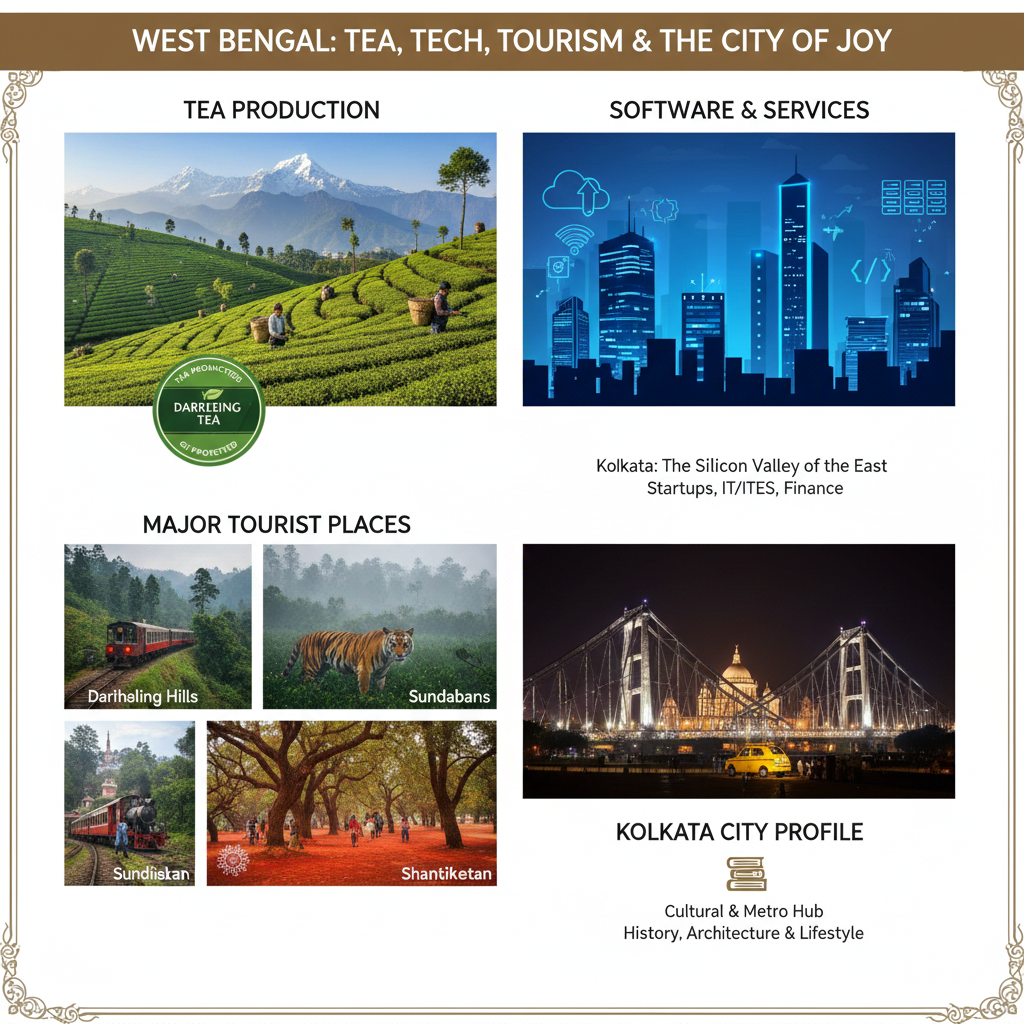
West Bengal — Tea Production, Software & Services, Major Tourist Places and Kolkata
This consolidated guide covers key aspects of West Bengal: renowned tea production (with a focus on Darjeeling), the growing software & services sector, major tourist destinations across the state, and a city profile of Kolkata — its history, culture and practical travel tips.
Tea Production in West Bengal
West Bengal is a leading tea-producing state in India. Regions such as Darjeeling, Jalpaiguri, Cooch Behar and Alipurduar are famous for tea cultivation. The teas from these areas are prized for their aroma, flavour and export quality.
1. Darjeeling Tea — the "Champagne of Teas"
- Specialty: Darjeeling tea is celebrated for its delicate aroma, golden liquor and distinctive muscatel flavour.
- Types: Black, green, white and oolong varieties are produced.
- GI Tag: Darjeeling tea is the first Indian agricultural product to receive a Geographical Indication (GI).
2. Tea-producing regions
Darjeeling
Altitude: 600–2,000 m. Cool climate and fertile soils support about ~87 tea gardens with annual production around 10–12 million kg.
Jalpaiguri & Alipurduar
Lower-altitude plains producing large quantities of CTC (Cut, Tear, Curl) teas; these regions supply bulk and commercial blends.
Cooch Behar
Primarily plain-area cultivation with large-scale commercial tea estates.
3. Tea production process (overview)
- Plantation: Tea plants are grown in well-drained soil in tropical/subtropical climates.
- Plucking: Tender leaves and buds are hand-plucked; main harvesting season ranges March–November.
- Processing: Withering, oxidation (to different degrees depending on tea type), drying and packing.
4. Economic importance
- Employment: Tea gardens provide jobs to millions, especially women.
- Exports: Over 50% of Darjeeling tea is exported to markets such as the USA, Europe and Japan.
- Income: Tea contributes significantly to the rural and state economy.
5. Government initiatives
- Tea Board of India support for quality improvement and marketing.
- GI protection for Darjeeling tea to safeguard brand value.
- Worker welfare schemes: health, education and social security for plantation workers.
- Promotion of tea tourism in Darjeeling and Jalpaiguri.
6. Challenges
- Climate change affecting yield and quality.
- Competition from other Indian states (Assam, Nilgiris) and international producers (China, Sri Lanka).
- Worker wages and living conditions need continuous improvement.
- Soil degradation in intensive cultivation zones.
7. Future prospects
- Expansion of organic tea and specialty value chains.
- Product diversification: tea bags, instant teas, flavored teas and ready-to-drink formats.
- Tea tourism, homestays and experiential travel in garden estates.
- New export markets in Africa, Latin America and Central Asia.
Conclusion: Tea production is a core economic and cultural asset of West Bengal; Darjeeling tea remains an iconic global brand.
Software & Services Sector in West Bengal
West Bengal’s IT and services sector (IT/ITES) is growing rapidly, centered on Kolkata and emerging hubs such as New Town (Rajarhat). The state is building infrastructure, promoting startups and expanding digital services.
1. Major IT hubs
- Salt Lake (Sector V): Primary IT hub hosting firms like TCS, Wipro, IBM, Capgemini and others.
- New Town, Rajarhat: Emerging IT & business district with modern parks and smart-city projects.
- Durgapur & Siliguri: Growing secondary hubs with BPO/KPO activity and local IT initiatives.
2. Key services and contributions
- Software development, mobile & web applications, cloud services, AI and data analytics.
- BPO/KPO operations for finance, healthcare, telecom and other sectors.
- Digital marketing, content creation and freelance ecosystems.
3. Government initiatives
- Ease of Doing Business reforms and single-window clearances.
- "Bengal Silicon Valley" and IT/Startup policies offering incentives and incubation support.
- Digital Bengal mission for e-governance and rural digital inclusion.
4. Major companies & employment
National and multinational companies (TCS, Wipro, Infosys, IBM, Capgemini, Cognizant) employ thousands; the sector creates opportunities for developers, analysts, project managers and creative professionals.
5. Challenges
- Competition from established IT hubs (Bengaluru, Hyderabad, Pune).
- Infrastructure gaps in some areas and talent migration to larger cities.
- Need for upskilling in emerging technologies (AI, blockchain, cybersecurity).
6. Future prospects
- Focus on AI/ML, fintech, blockchain and cybersecurity services.
- Expansion of IT services into Tier-2 and Tier-3 towns.
- Growth of startup ecosystems supported by policy and incubation.
Conclusion: With focused policies and skills development, West Bengal can strengthen its position as a competitive IT & services hub in eastern India.
Major Tourist Places in West Bengal
West Bengal offers a wide range of tourist experiences — Himalayan hill stations, mangrove forests, historic cities, coastal beaches and spiritual sites.
1. Darjeeling
Highlights: "Queen of the Hills", famous for tea gardens. Attractions include Tiger Hill (sunrise views of Kanchenjunga), Batasia Loop, Darjeeling Himalayan Railway (toy train, UNESCO site), and Himalayan Zoological Park.
Best months: March–May, October–December.

Amazon Product Title Here
Premium quality product with excellent durability and performance. A perfect choice for everyday use.
2. Kolkata (Calcutta)
Highlights: Cultural capital — Victoria Memorial, Howrah Bridge, Dakshineswar Kali Temple, Belur Math, Indian Museum, Science City. Famous for Durga Puja and rich literary & cinematic heritage.
Best months: October–March (pleasant weather and festival season).
3. Sundarbans
Highlights: The world’s largest mangrove delta and a UNESCO World Heritage site; home to Royal Bengal Tiger, estuarine ecosystems and river-cruise safaris.
Best months: November–February.
4. Shantiniketan (Bolpur)
Highlights: Founded by Rabindranath Tagore; Visva-Bharati University, Poush Mela and the spring festival highlighting art, music and crafts.
Best months: November–February.
5. Kalimpong
Highlights: Near Darjeeling; Tibetan culture, Deolo Hill, orchid gardens and handicrafts.
Best months: March–June, September–December.
6. Malda & Murshidabad
Malda: Historic Gaur and Pandua ruins, Adina Mosque.
Murshidabad: Nawabi heritage — Hazarduari Palace, Katra Mosque and historic waterways.
Best months: October–March.
7. Digha & Mandarmani
Highlights: Popular seaside resorts with beaches, water sports and resorts — ideal for short coastal getaways.
Best months: November–February.
8. Bishnupur
Highlights: Famous for terracotta temples (Rasmancha), Baluchari sarees and classical temple architecture.
Best months: October–March.
9. Jhargram
Highlights: Dense forests, waterfalls, Jhargram Palace and wildlife; ideal for eco-tourism and jungle safaris.
Best months: October–March.
Whether you seek mountain landscapes, wildlife, cultural festivals or colonial heritage, West Bengal offers memorable experiences across seasons.
Kolkata — City Profile (Overview)
Kolkata (formerly Calcutta) is the capital of West Bengal and a cultural, historical and educational hub. Known as the "City of Joy", Kolkata blends colonial architecture, literary traditions and modern urban life.
1. Geography
Located on the eastern bank of the Hooghly River, approximately 80 km inland from the Bay of Bengal. The city serves as the commercial and cultural centre of eastern India.
2. History
Founded as a major British trading post in the 17th century, Kolkata became the capital of British India (1772–1911). It played a crucial role in the freedom movement and in early modern industrialisation in India.
3. Major attractions
- Victoria Memorial: Marble museum and gardens.
- Howrah Bridge: Iconic engineering landmark over the Hooghly.
- Dakshineswar Kali Temple & Belur Math: Important religious and spiritual centres.
- Indian Museum & Science City: Cultural and educational institutions.
4. Culture, arts & education
Kolkata is a major centre for literature, music (Rabindra Sangeet), theatre and cinema (Satyajit Ray, Ritwik Ghatak). Premier educational institutions include the University of Calcutta, Presidency University, Jadavpur University and the Indian Statistical Institute.
5. Food & cuisine
Renowned for sweets such as rosogolla, sandesh and mishti doi; seafood preparations (macher jhol) and street foods like phuchka (pani puri) and Kolkata rolls are local favourites.
6. Transport & logistics
- Metro: India’s first metro system (Kolkata Metro).
- Trams: Historic tram network still operates in parts of the city.
- Ferries: Regular river ferry services on the Hooghly.
- Road & Rail: Well-connected by expressways and major rail terminals.
7. Best time to visit
October to March — pleasant weather and major cultural festivals (especially Durga Puja) make this the ideal season for visitors.
Conclusion: Kolkata remains a vibrant blend of history, culture and modern urban life — a gateway to explore West Bengal’s rich heritage.
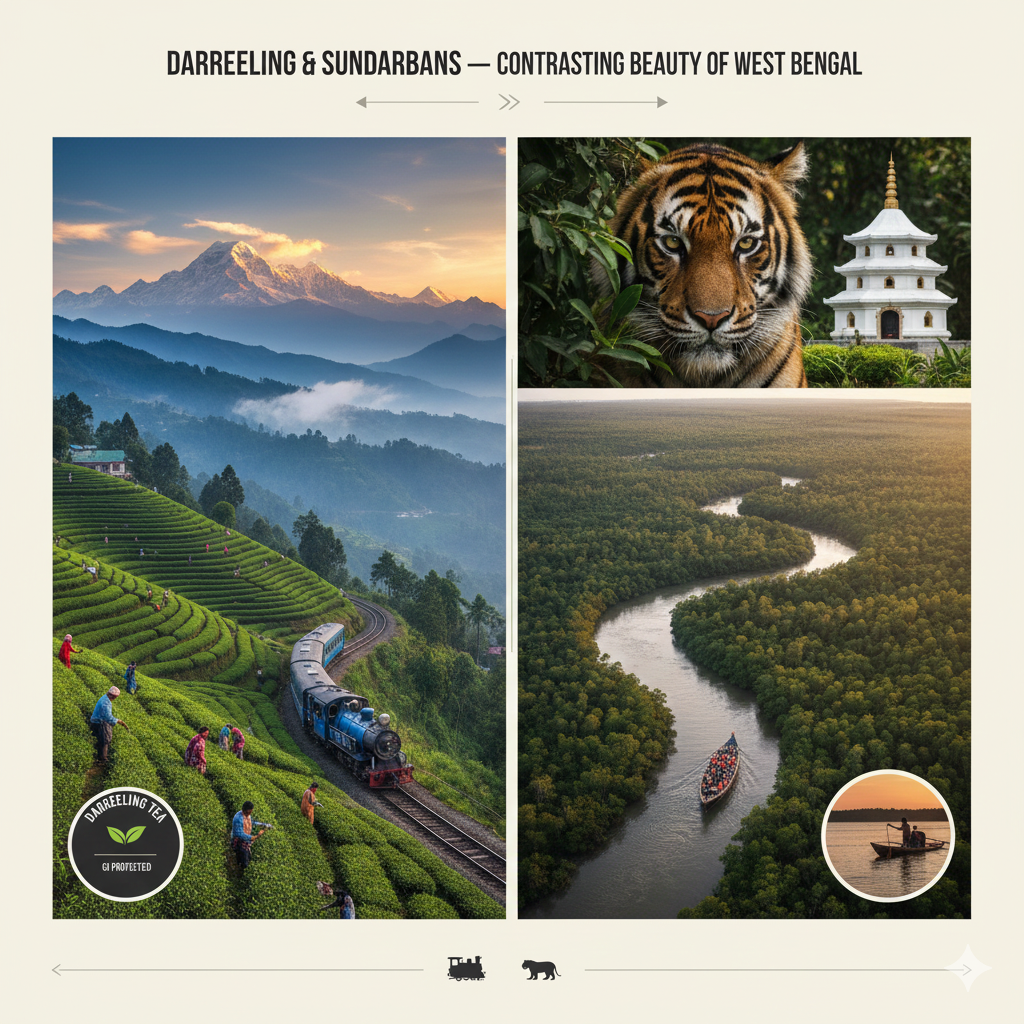
Darjeeling & Sundarbans — A Detailed Guide
This article presents two of West Bengal’s most iconic destinations: Darjeeling, the "Queen of the Hills", known for tea gardens, scenic Himalayan vistas and the historic toy train; and the Sundarbans, the world’s largest mangrove delta and a UNESCO World Heritage Site, famous for its unique biodiversity and the Royal Bengal Tiger.
Darjeeling — The "Queen of the Hills"
Darjeeling is a major hill station and tourist destination in northern West Bengal. Famous for its natural beauty, tea plantations and views of the high Himalaya, it offers a unique blend of culture, history and scenic experiences.
1. Geographical location
Darjeeling is located in the Himalayan foothills at an altitude of approximately 2,042 metres (6,700 ft) above sea level. On clear days, majestic peaks such as Kanchenjunga (the third highest mountain in the world) are visible from vantage points here.
2. History
- The name "Darjeeling" derives from the Tibetan word Dorje-ling, meaning "Land of the Thunderbolt" or "Land of Lightning".
- In the 19th century the British developed Darjeeling as a hill sanatorium and summer resort.
- The Darjeeling Himalayan Railway (built in 1881) is a UNESCO World Heritage Site and one of the region’s most cherished historic attractions.
3. Main attractions
Tiger Hill
Famous for spectacular sunrise views over Kanchenjunga and distant Himalayan peaks; many visitors rise early to witness the dawn panorama.
Darjeeling Himalayan Railway (Toy Train)
The narrow-gauge "toy train" offers an unforgettable ride through tea gardens and mountain curves — a UNESCO-listed heritage experience.
Tea Plantations
Darjeeling tea is world famous for its aroma and muscatel flavour. Many gardens such as Happy Valley welcome visitors for guided tours and tastings.
Padmaja Naidu Himalayan Zoological Park
Specialised in high-altitude fauna; home to species such as the red panda, snow leopard and Tibetan wolf.
Japanese Peace Pagoda
A serene spot symbolising peace and offering panoramic views of Darjeeling and surrounding hills.
Rock Garden & Ganga Maya Park
Scenic gardens with waterfalls, ideal for relaxed walks and family outings.
4. Culture and tradition
Darjeeling’s culture blends Nepali, Tibetan and Bengali traditions. Local communities include Gorkha, Sherpa and Bhutia peoples, who maintain distinct festivals, dances and musical traditions.
5. Main festivals
- Dussehra & Tihar (Diwali): Major Nepali festivals celebrated with rituals and community events.
- Losar: Tibetan New Year celebrated by Tibetan and Buddhist communities.
- Other local festivals: Maghe Sankranti, Bhutia festivals and community fairs.
6. Food
- Momos: Tibetan-style dumplings, widely popular.
- Thukpa: Hearty noodle soup.
- Phapru: Traditional Gorkha dish.
- Darjeeling tea: A must-try, available fresh at plantations and local cafés.
7. Best time to visit
March–May (spring) and October–December (early winter) are ideal: pleasant weather and clear views of the mountains.
8. Transport
- By air: Nearest airport is Bagdogra (~88 km).
- By rail: New Jalpaiguri (NJP) is the nearest major railway station.
- By road: Well-connected to Siliguri and other regional hubs by motorable roads.
9. Darjeeling Tea
Renowned as the "Champagne of Teas", Darjeeling produces black, green, white and oolong varieties. Organic and specialty teas are an expanding segment, adding value and tourism appeal.
10. Other places worth visiting
- Batasia Loop: Scenic railway loop with a war memorial and panoramic views.
- Happy Valley Tea Plantation: Guided tours and tea-tasting experiences.
- St. Joseph’s College: Noted for colonial architecture and heritage campus.
Conclusion: Darjeeling is ideal for travellers seeking cool mountain air, tea-culture experiences, Himalayan vistas and a peaceful atmosphere.
Sundarbans — The Great Mangrove Delta
The Sundarbans form a spectacular and fragile ecosystem at the mouth of the Ganges, Brahmaputra and Meghna rivers. The Indian Sundarbans, part of a larger delta shared with Bangladesh, are famous for mangrove forests, tidal waterways and the Royal Bengal Tiger.
1. Geographical location
Situated along the Bay of Bengal coastline, the Sundarbans are shared between India and Bangladesh. The Indian Sundarbans cover approximately 4,200 sq. km and feature extensive mangrove forests, tidal creeks and marshlands.
2. Name and meaning
The name "Sundarban" combines "Sundar" (referring to the Sundari tree, a mangrove species) and "ban" (forest) — literally "beautiful forest".

Amazon Product Title Here
High quality product with excellent performance and great value for money. Perfect for daily use.
3. Natural features
- Delta: The largest delta in the world, formed by major river systems.
- Mangrove forests: Dense salt-tolerant vegetation that stabilises the coastline and supports unique wildlife.
- Tidal influence: The area is shaped by tidal currents and saline water, creating specialised habitats.
4. Biodiversity
Royal Bengal Tiger
The Sundarbans host one of the world’s largest populations of the Royal Bengal Tiger, famed for its partial adaptation to estuarine environments and swimming ability.
Other wildlife
- Deer species (sambar, spotted deer), wild boar.
- Estuarine crocodiles, olive ridley turtles and multiple fish and crustacean species.
- Dolphins (Ganges and Irrawaddy), various reptiles, and rich birdlife including flamingos, kingfishers and brahminy kites.
5. Conservation & protected areas
The Sundarbans National Park is a protected biosphere reserve and tiger reserve. Conservation efforts focus on habitat protection, anti-poaching, community involvement and scientific monitoring.
6. Tourist spots & activities
- Sundarban Tiger Reserve: Boat safaris and guided forest excursions to observe wildlife (with strict regulations for safety and conservation).
- Sajankhali Bird Sanctuary: Prime spot for birdwatching and seasonal migrations.
- Dobanki & Sudarkhali watch towers: Elevated viewpoints for wildlife spotting.
- Black Tiger Island: Known locally for tiger sightings and scenic riverine landscapes.
7. Local life & livelihoods
Communities in the Sundarbans rely on fishing, honey collection, crab and shrimp harvesting, and limited agriculture. Life here is shaped by tidal cycles, and households regularly navigate risks associated with storms, floods and wildlife.
8. Threats & challenges
- Climate change: Sea-level rise, stronger cyclones and saline intrusion threaten ecosystems and livelihoods.
- Habitat loss & poaching: Illegal activities and land-use change endanger species.
- Human–wildlife conflict: Encounters between people and tigers or crocodiles create safety and conservation dilemmas.
9. Best time to visit
October–March offers pleasant weather and optimal wildlife-viewing conditions for tourists and researchers.
10. Special experiences
Boat safaris through the network of creeks, mangrove walks, birdwatching and local village interactions provide unique, immersive experiences of Sundarbans ecology and culture.
11. How to reach
- By air: Netaji Subhas Chandra Bose International Airport, Kolkata (gateway).
- By rail: Train connections from Kolkata to access points such as Canning and Kakdwip.
- By road & boat: Road transfer from Kolkata to launch points, followed by regulated boat trips into the reserve.
12. Economic contribution
The Sundarbans support fisheries, apiculture (honey), eco-tourism and local crafts — contributing to coastal livelihoods while also providing invaluable ecosystem services like storm protection and carbon sequestration.
Conclusion: The Sundarbans are a global natural treasure that demand balanced conservation and community-sensitive development. Protecting this unique mangrove ecosystem is vital for biodiversity, coastal resilience and the wellbeing of local communities.

Amazon Product Title Here
High quality product with excellent performance and long-lasting durability. Perfect for everyday use.
References
- Tagore, Rabindranath — Collected Works, Visva-Bharati Publications.
- Subhash Chandra Bose — National Archives of India, Historical Records.
- Vivekananda, Swami — Complete Works of Swami Vivekananda, Advaita Ashrama.
- Indian Freedom Movement Documents — Government of India Publications.
- “Gitanjali” by Rabindranath Tagore — Macmillan & Co., 1913.
- World Parliament of Religions Records, Chicago — 1893 Archives.
- Biographical Studies from Netaji Research Bureau, Kolkata.