

India in Schematic Development
India’s schematic or planned development refers to the overall and balanced development of the country within a fixed timeline, based on determined goals and policies. This process is executed by the government, aiming for social, economic, industrial, agricultural, and human resource development.
Need for Schematic Development in India
Schematic development in India was required due to several social and economic reasons. It helped in:
- Removing social and economic inequality
- Solving issues of poverty, unemployment, and backwardness
- Ensuring skilled and equitable use of resources
- Promoting industrialization and modernization
- Increasing national income and improving living standards
Beginning of Schematic Development in India
The process of schematic development in India began in 1951 with the launch of the First Five-Year Plan. Its major credit goes to Pandit Jawaharlal Nehru. After independence, the country needed a well-planned development path, which was implemented through five-year plans.
Major Institutions
1. Planning Commission
Established in 1950, it was responsible for preparing and supervising the Five-Year Plans.
2. NITI Aayog
Established on 1 January 2015, replacing the Planning Commission. It focuses on cooperative federalism, policy formulation, and ensuring partnership with states.
Five-Year Plans: A Brief Overview
| Plan | Duration | Main Objective |
|---|---|---|
| First Plan | 1951–1956 | Agricultural development and irrigation |
| Second Plan | 1956–1961 | Industrialization (Nehru–Mahalanobis Model) |
| Third Plan | 1961–1966 | Self-reliance and food production |
| Fourth to Twelfth Plans | 1969–2012 | Poverty reduction, employment, infrastructure, education & health |
| Twelfth Plan | 2012–2017 | Fast, inclusive, and sustainable development |
Note: After 2017, India discontinued the traditional Five-Year Plans and adopted a target-based planning process through NITI Aayog.
Benefits of Schematic Development
- Increase in economic growth rate
- Development of essential infrastructure (roads, electricity, water, education, health)
- Balanced development of rural and urban areas
- Encouragement to science and technology
Challenges in Planned Development
- Corruption and administrative hurdles in plan execution
- Rural–urban inequality
- Political influence affecting plan outcomes
- Some regions and communities remaining underdeveloped
Conclusion
Schematic development has played a crucial role in India’s progress. Although the Five-Year Plan system has ended, NITI Aayog continues to promote target-based and result-oriented development. In the future, schematic development will remain essential for ensuring continuous growth and inclusive progress.
Why India Needed Schematic Development
India's need for schematic development arose from various social, economic, and geographical conditions. At the time of independence, India was a poor, uneducated, and underdeveloped nation. Most of the population depended on agriculture, and industrial growth was minimal. A planned and organized development roadmap became necessary.
Major Reasons for the Need for Schematic Development
1. Eliminating Economic Backwardness
India’s economy was weak at independence. Industrial and agricultural output was very low. Planned development helped in revitalizing these sectors by setting clear priorities.
2. Better Use of Resources
India had enough natural resources, but their proper and balanced utilization was necessary. The plans ensured optimal use of these resources.
3. Poverty and Unemployment Reduction
A large part of the population lived below the poverty line. Planned development helped increase employment opportunities and implemented poverty reduction programs.
4. Social Justice and Equality
To reduce caste, class, and regional inequalities, inclusive development programs were introduced through various plans.
5. Balanced Rural and Urban Development
Since most Indians lived in rural areas, the plans focused on providing essential facilities such as roads, electricity, water, health, and education in villages.
6. Encouragement to Industrialization
To make India self-reliant and modern, industrialization was essential. Planned development helped create a stronger industrial base.
7. Education, Health, and Population Control
Human resource development required expansion of education and health services. Programs for population control were also implemented through planned development.
8. Long-Term National Goals
Plans helped India set long-term strategies in defense, science, technology, and space research.
Final Conclusion
As a large and diverse country, India relies on schematic development as a direction-giving tool. It not only ensures economic growth but also promotes social justice, equality, and sustainable development. Thus, schematic development is essential for the nation’s overall progress.
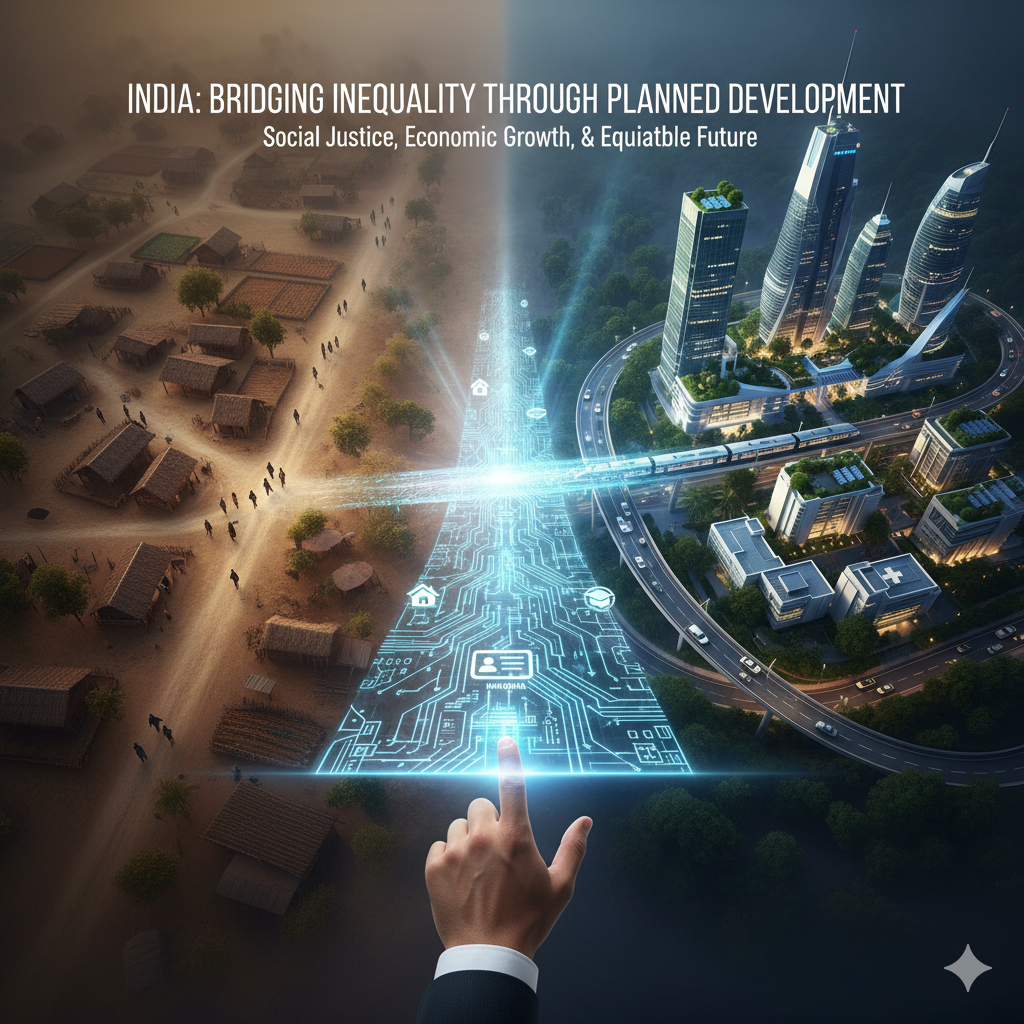
Social and Economic Inequality – Elaborate Analysis
🛒 Buy Now on AmazonIndia is a highly diversified country where caste, religion, language, region, and economic status create deep social and economic inequalities. These inequalities become obstacles to national development and generate dissatisfaction within society. One of the primary objectives of planned or schematic development is to reduce or eliminate such inequalities.
1. Social Inequality Reduction Efforts
🔹 Reducing Caste and Community-based Discrimination
- Reservation for Scheduled Castes (SC), Scheduled Tribes (ST), and Other Backward Classes (OBC) in education, employment, and social sectors.
- Specific schemes implemented by the Ministry of Social Justice and state governments.
🔹 Expansion of Education
- Education made a fundamental right to bring backward sections into the mainstream.
- Programs like Sarva Shiksha Abhiyan, Mid-Day Meal Scheme, Pradhan Mantri Vidya Lakshmi Scheme helped deprived communities access education.
🔹 Women Empowerment
- Programs such as Beti Bachao Beti Padhao, Matru Suraksha Yojana, and women reservation promoted gender equality.
- Women Self-Help Groups (SHGs) strengthened social and economic participation.
2. Financial Inequality Reduction Efforts
🔹 Poverty Alleviation Programs
- MGNREGA ensuring minimum income through guaranteed employment.
- PM Awas Yojana, Ujjwala Yojana, and Jan Dhan Yojana provided support to poor households.
🔹 Rural Development Schemes
- PM Gram Sadak Yojana, Village Industry Schemes, and PM Krishi Sinchai Yojana improved rural infrastructure.
🔹 Tax and Subsidy Framework
- Redistributive taxation — higher taxes from the rich, subsidies for the poor.
🔹 Boosting Self-Employment
- Programs like Mudra Yojana, Startup India, and Digital India increased employment opportunities.
3. Relationship Between Planned Development and Inequality
Planned development not only builds infrastructure or improves the economy but also ensures that all sections of society receive equal opportunities. Without social and economic equality, inclusive growth cannot be achieved.
Conclusion
Social and economic inequality remains one of the biggest challenges in a large democracy like India. Through planned development, many strong steps have been taken to reduce such inequalities. Although some communities still lack full development, continuous efforts and goal-based planning are guiding India towards equality and progress.
Poverty, Unemployment and Backwardness – Solutions Through Planned Development
Poverty, unemployment, and backwardness have long been serious socio-economic challenges in India. These problems not only affect the quality of life but also hinder the nation’s overall development. Hence, solving these issues has been a major objective of schematic development.
1. Poverty – Problems and Solutions
Problem
- A large population lived below the poverty line at independence.
- Malnutrition, lack of healthcare, and deprivation of education were common markers of poverty.
Schematic Solutions
🔹 Poverty Alleviation Programs
- Garibi Hatao campaign (1970s) initiated by Indira Gandhi.
- National Rural Livelihood Mission (NRLM) — employment and income enhancement through SHGs.
- PM Awas Yojana — ensuring housing for the poor.
- Antyodaya Anna Yojana — subsidized food grains for the extremely poor.
🔹 Direct Benefit Transfer (DBT)
- Direct transfer of subsidies into beneficiaries' accounts, reducing intermediaries and increasing transparency.
2. Unemployment – Problems and Solutions
Problem
- Educated youth facing lack of employment.
- Seasonal and limited job opportunities in rural areas.
- Skill shortages and uneven industrial growth.
Schematic Solutions
🔹 MGNREGA
- Guarantees 100 days of employment to every rural household.
🔹 National Skill Development Mission (NSDM)
- Training youth in multiple industrial and service sectors.
🔹 PM Mudra Yojana (PMMY)
- Promotes self-employment by providing easy loans.
🔹 Startup India & Stand-Up India
- Encourages innovation, entrepreneurship, and job creation.
3. Backwardness – Problems and Solutions
Problem
- Lack of education, health services, and infrastructure.
- Backward states, districts, and tribal regions deprived of development.
Schematic Solutions
🔹 Backward Regions Grant Fund (BRGF)
- Special financial assistance to backward districts.
🔹 Tribal Sub Plan (TSP) & Scheduled Caste Sub Plan (SCSP)
- Separate allocations and focused programs for SC/ST communities.
🔹 Aspirational Districts Programme (2018)
- Launched by NITI Aayog to rapidly improve development indicators in 112 backward districts.
Conclusion
Through planned development, India has implemented numerous effective programs to address poverty, unemployment, and backwardness. While challenges still remain, continuous policy reforms and participatory development approaches are making significant progress possible.
Skilled and Equitable Use of Resources — A Key Objective of Planned Development
India has abundant natural, human, and physical resources. However, due to improper, unequal, and inefficient use, development was hindered for decades. Planned development aims to ensure efficient and equitable utilization of these resources.
1. Efficient Use of Resources
Meaning
Using resources in a manner that maximizes utility, minimizes wastage, and considers future needs.
How Planned Development Ensures This
- Science and technology-based schemes such as drip irrigation, improved fertilizers, and modern machinery.
- Industrial policies supporting industries in resource-rich regions (e.g., mining-based industries in mineral-rich areas).
- Balanced use of energy resources by promoting renewable energy (solar, wind, hydro).
- Urban planning and Smart Cities Mission for optimal use of land, water, transport, and waste systems.
2. Equitable Use of Resources
Meaning
Ensuring fair distribution of resources so that all groups, regions, and states receive equal opportunities and benefits.
How Planned Development Ensures This
- Programs reducing regional disparities such as BRGF and the Aspirational Districts Programme.
- Targeted schemes for SC/ST, women, and rural populations.
- Public Distribution System (PDS) for equitable access to essential resources.
- Water and land reforms through national water policies and integrated resource management.
Example Table
| Area | Efficient Use | Equitable Use |
|---|---|---|
| Water | Drip irrigation, rainwater harvesting | Drinking water schemes for every village |
| Energy | LED lights, energy-saving devices | Free gas connections under Ujjwala Yojana |
| Education | Digital classrooms, online courses | Free schooling and Mid-Day Meal Scheme |
| Land | Land-use planning | Land leases and housing schemes for the landless |
Conclusion
Through planned development, India has moved towards efficient, sustainable, and equitable use of resources. This approach benefits the present generation while also safeguarding resources for future generations.
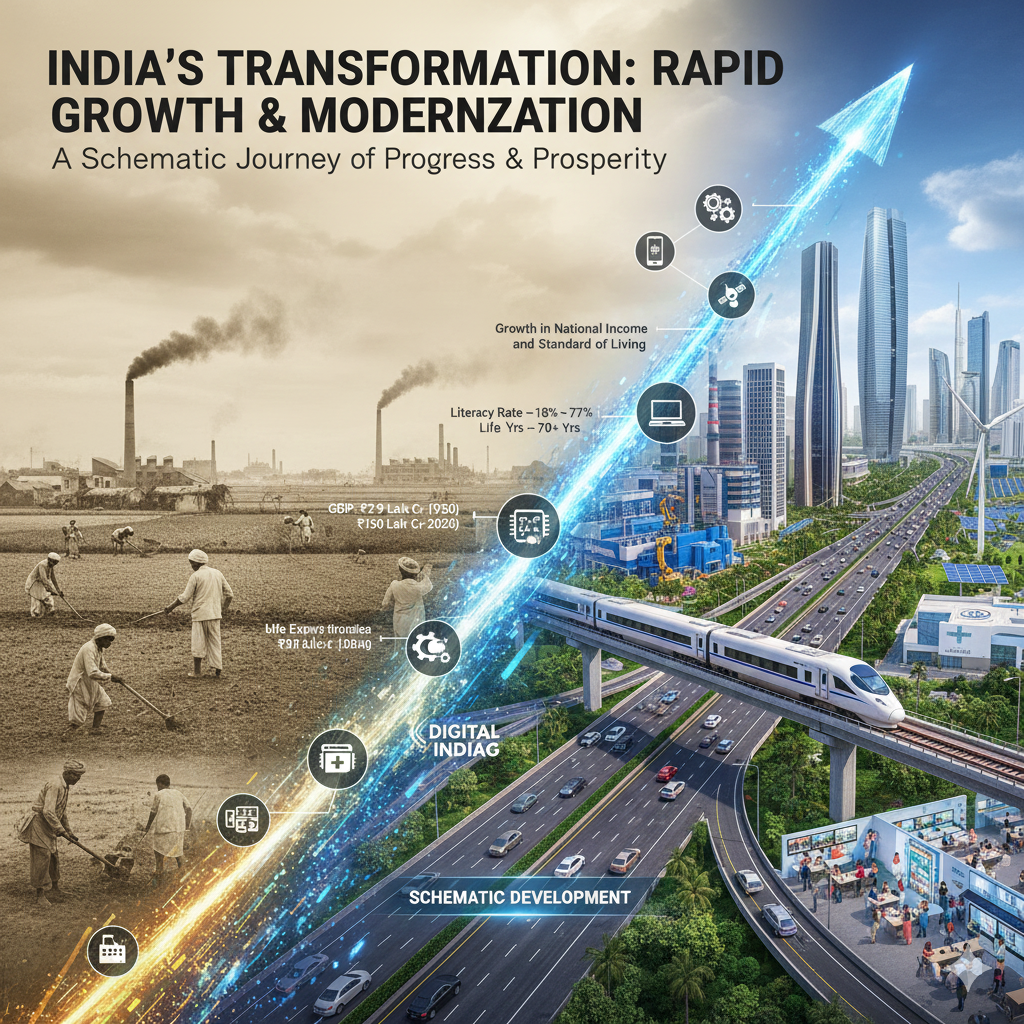
Speedy Industrialization and Modernization – A Key Direction of India’s Planned Development
After gaining independence, one of India’s major goals was to transform the nation into a self-reliant, modern, and developed country. For this, rapid industrialization and modernization were necessary. Through schematic development, India adopted clear strategies and implemented various policy-based initiatives to achieve this target.
🛒 Buy Now on Amazon1. Rapid Industrialization
Objectives
- Transform the agriculture-dominated economy into an industrial economy.
- Create employment opportunities.
- Increase exports and earn foreign exchange.
- Strengthen basic infrastructure and production capacity.
Major Initiatives
🔹 Second Five-Year Plan (1956–61)
- Mahalanobis Model prioritized heavy industries.
- Government investment in steel, coal, machinery, and fertilizers.
🔹 Nationalization of Banks & Insurance (1969)
- Improved access to industrial credit.
🔹 Boost to Small, Cottage & Medium Industries
- MSME schemes supporting small and rural industries.
🔹 Post-1991 Liberalization
- Privatization, foreign investments, and technological upgrades.
- Reforms in the industrial licensing system.
🔹 Make in India (2014)
- Encouraging India as a global manufacturing hub.
- Boosting sectors like automobile, electronics, and defense production.
2. Modernization
Meaning
Modernization refers to shifting from traditional systems to modern social, administrative, technological, and economic arrangements.
Major Areas of Modernization
🔹 Technological Upgradation
- Digital India.
- Smart factories, automation, and artificial intelligence.
🔹 Modernization in Education
- National Education Policy (NEP 2020).
- E-learning platforms, digital classrooms, skill-based learning.
🔹 Agricultural Modernization
- Use of tractors, threshers, drip and sprinkler irrigation.
- Soil Health Cards and agri-tech startups.
🔹 E-Governance
- Online services, digital payments, Aadhaar, DBT.
- Greater transparency and administrative efficiency.
🔹 Social Transformation
- Women empowerment and gender equality.
- Promotion of scientific and rational thinking.
3. Benefits of Industrialization & Modernization
- Faster economic development.
- Growth in exports and foreign investment.
- Employment generation.
- Improvement in living standards.
- Strengthening scientific outlook and global competitiveness.
Conclusion
Rapid industrialization and modernization form two major pillars of India's planned development. They strengthened the economy and brought positive social transformation. However, continued progress must balance development with environmental sustainability and social equity.
National Income and Living Standards – Major Objectives of Planned Development
One of the primary goals of India’s planned development was to increase national income and improve the living standards of citizens. At independence, India’s economy was agriculture-based, underdeveloped, and lacked essential resources. Five-Year Plans attempted to transform the economy and improve the quality of life for the masses.
1. Growth in National Income
What is National Income?
National Income refers to the total value of goods and services produced within a country in a year. It is considered a major indicator of economic progress.
Efforts Made Through Planned Development
🔹 Agricultural & Irrigation Development
- Green Revolution (1960s) increased agricultural productivity.
- Major irrigation projects like Bhakra Nangal, Narmada, and Damodar Valley.
🔹 Development of Industries & Service Sector
- Establishment of heavy industries such as steel, machinery, and fertilizers.
- Rapid development in information technology, telecom, and banking (especially post-1991).
🔹 Innovation & Investment
- Liberalization, privatization, and globalization policies attracted foreign investment.
- Make in India, Startup India boosted production and innovation.
🔹 Fiscal & Monetary Reforms
- Increased revenue, controlled expenditure, and reduced inflation.
Result
- India’s GDP grew from approx. ₹2.9 lakh crore (1950) to over ₹150 lakh crore (2020).
- The services sector now contributes over 55% to India’s national income.
2. Improvement in Living Standards
What is Standard of Living?
It refers to the physical, social, and mental well-being of people—including income, health, education, housing, electricity, food, and employment.
Efforts Through Planned Development
🔹 Education & Health
- Sarva Shiksha Abhiyan, National Health Mission, Ayushman Bharat.
- Improved school and healthcare access in rural areas.
🔹 Poverty Alleviation & Social Security
- MNREGA, Ujjwala Yojana, Jan Dhan Yojana, housing and pension schemes.
🔹 Infrastructure Development
- Expansion of roads, electricity, water supply, transport, and communication.
- Digital India reduced rural–urban gaps.
🔹 Food Security Measures
- PDS, Antyodaya Anna Yojana ensuring affordable food grains to millions.
Results
- Life expectancy increased from 32 years (1950) to 70+ years.
- Literacy rose from 18% (1951) to over 77%.
- Urbanization and new employment opportunities improved lifestyles.
3. Comparative Progress: 1950 vs Today
| Area | 1950s | Present (2020s) |
|---|---|---|
| GDP | ₹2.9 lakh crore | ₹150+ lakh crore |
| Life Expectancy | ~32 years | ~70 years |
| Literacy Rate | ~18% | ~77% |
| Rural Electricity Access | <20% | ~98% |
| Mobile/Internet Users | No | 100+ crore users |
Conclusion
Planned development in India has significantly increased national income and improved living standards. Although regional inequality and poverty challenges still remain, continuous reforms, technological advancement, and strong policy initiatives are helping India move towards a prosperous and inclusive future.
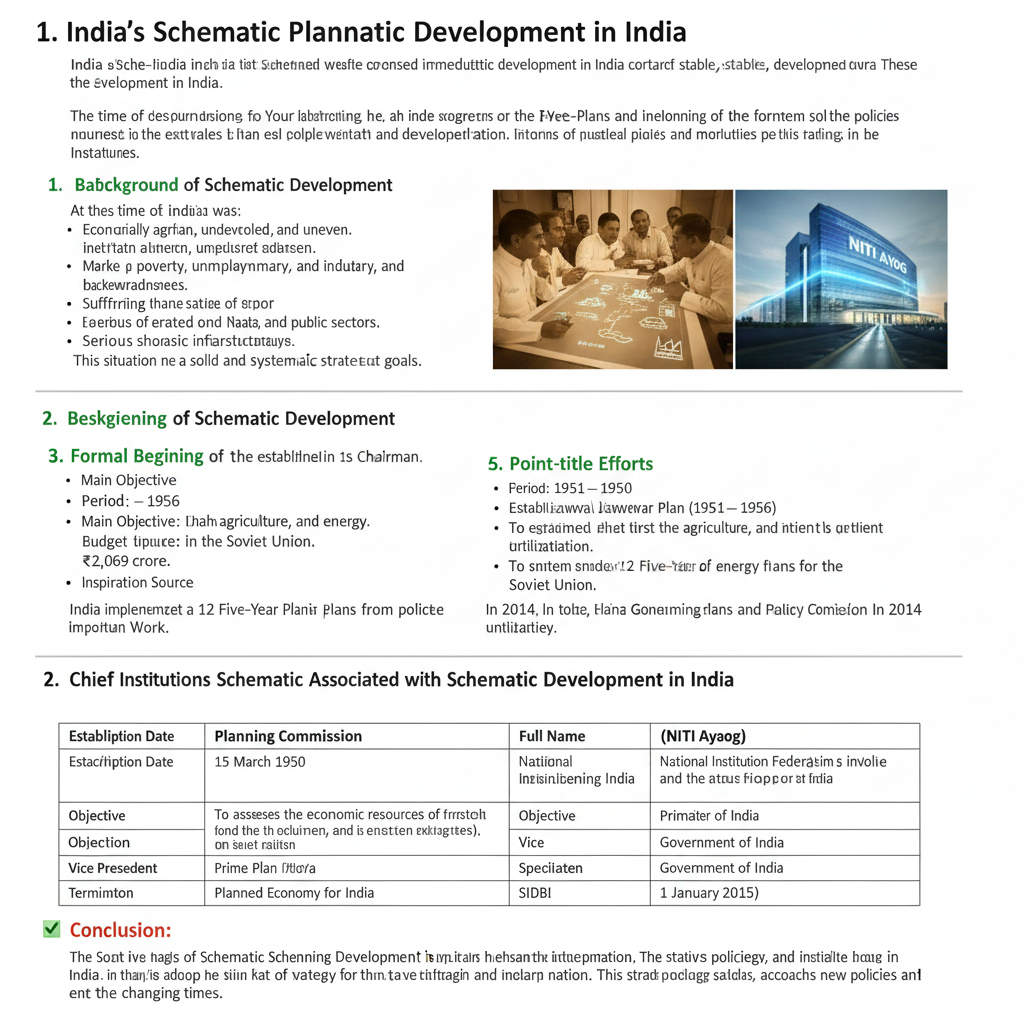
India’s Schematic Development – Beginning
The beginning of schematic or planned development in India took place soon after independence. To guide the nation towards organized, stable, and balanced development, it became essential to create plans and implement them in phases.
1. Background of Schematic Development
🔹 Situation of India at the Time of Independence
- Agriculture-dominated and underdeveloped economy
- High levels of poverty, unemployment, and illiteracy
- Industrial backwardness
- Severe lack of basic infrastructure
Because of these conditions, India urgently needed a strong and systematic development strategy. This thinking laid the foundation for planned development.
2. Formal Beginning of Planned Development
🗓 First Five-Year Plan (1951–1956)
- Period: 1951–1956
- Main Objectives: Agriculture, irrigation, and energy development
- Budget: ₹2,069 crore
- Model Inspired By: Soviet Union’s planning model
3. Establishment of the Planning Commission
The Planning Commission was established on 15 March 1950. Prime Minister Jawaharlal Nehru became its first chairman.
Work and Responsibilities
- Assessing economic resources
- Preparing Five-Year Plans based on national priorities
- Supervising and evaluating development objectives
4. Pre-Independence Planning Efforts
🔹 Bombay Plan (1944)
- Presented by industrialists like Tata, Birla, and Shriram
- Emphasized balance between private and public sector
🔹 National Plan (1946)
- Proposed by M. N. Roy
- Supported a socialist approach
🔹 Sir M. Visvesvaraya’s Plan (1934)
- Presented in the book Planned Economy for India
- Outlined early ideas for planned development
Although these were not formal plans, they significantly influenced the establishment of the Planning Commission in independent India.
5. Five-Year Plan Series
Between 1951 and 2017, India implemented a total of 12 Five-Year Plans. In 2014, the Planning Commission was abolished and replaced by the NITI Aayog, which now prepares flexible, target-based planning frameworks.
Conclusion
The beginning of planned development in India dates back to the 1950s with the establishment of the Planning Commission and the launch of the First Five-Year Plan. Its primary objective was to remove poverty, backwardness, and inequality and build a self-reliant and modern nation. Today, the process continues under NITI Aayog with new approaches suited to the changing era.
Major Institutions Associated with India’s Schematic Development
Several important institutions were established to implement and monitor planned development in India. These institutions played a vital role in plan formulation, policy creation, resource allocation, and continuous development.
1. Planning Commission
| Description | Information |
|---|---|
| Establishment | 15 March 1950 |
| Objective | Prepare and ensure implementation of Five-Year Plans |
| Chairman | Prime Minister of India |
| Work | Prepared 12 Five-Year Plans (1951–2012) |
| Termination | 2014 |
2. NITI Aayog (Policy Commission)
| Description | Information |
|---|---|
| Establishment | 1 January 2015 |
| Objective | Promote cooperative federalism; involve states in policymaking |
| Full Name | National Institution for Transforming India |
| Chairman | Prime Minister of India |
| Special Features | Flexible framework, data-driven policies, focus on SDGs |
3. Reserve Bank of India (RBI)
| Aspect | Information |
|---|---|
| Objective | Ensure economic stability through monetary policy |
| Role | Regulates banks, supports financial development, facilitates credit for development plans |
4. Indian Council of Agricultural Research (ICAR)
| Aspect | Information |
|---|---|
| Objective | Promote agricultural research and support Green Revolution |
| Work | Research, training, and development of new agricultural techniques |
5. Industrial Development Bank of India (IDBI)
| Aspect | Information |
|---|---|
| Objective | Provide financial assistance for industrial projects |
| Establishment | 1964 |
| Role | Promoting industrialization |
6. SIDBI (Small Industries Development Bank of India)
| Aspect | Information |
|---|---|
| Objective | Assist Micro, Small, and Medium Enterprises (MSMEs) |
7. NABARD (National Bank for Agriculture and Rural Development)
| Aspect | Information |
|---|---|
| Objective | Provide finance for agricultural and rural development |
| Work | Develop rural infrastructure, support SHGs and cooperative banks |
8. CSO / NSO (Central/National Statistics Office)
| Aspect | Information |
|---|---|
| Work | Compile data on national income, growth, population, poverty, etc. |
| Objective | Provide statistical support for plan evaluation and policymaking |
9. Finance Commission
| Objective | Information |
|---|---|
| Financial Distribution | Ensure equitable distribution of financial resources between Centre and States |
Conclusion
For the successful implementation of planned development, institutions like the Planning Commission, NITI Aayog, RBI, NABARD, SIDBI, ICAR, and various statistical organizations worked together. These institutions continue to play a crucial role in shaping India’s economic, social, and regional development.
Planning Commission – Detailed Information
1. Establishment
| Point | Description |
|---|---|
| Establishment Date | 15 March 1950 |
| Established By | Pandit Jawaharlal Nehru |
| Inspiration Source | Soviet Union’s Five-Year Plans |
| Main Objective | Evaluate economic resources and prepare development plans |
2. Objectives and Work
Major Objectives
- Assess resources and ensure their proper use
- Prepare Five-Year Plans based on national priorities
- Coordinate between ministries and states
- Reduce social and economic inequality
- Recommend measures to reduce poverty, unemployment, and backwardness
Main Work
- Construction of Five-Year Plans
- Preparation of Annual Plans
- Determining plan expenditure in the Central Budget
- Project evaluation reports
- Recommending financial assistance to states
3. Five-Year Plans Prepared by the Commission
| Plan | Main Features |
|---|---|
| First (1951–56) | Agriculture, irrigation, energy focus |
| Second (1956–61) | Mahalanobis model; industrial development |
| Third (1961–66) | Goal of self-reliance |
| Fourth–Twelfth | Poverty eradication, Green Revolution, HRD, infrastructure, IT, inclusive development |
4. Criticisms
- Centralized approach with limited role for states
- Gap between plan targets and actual achievements
- Slow processes and bureaucratic delays
- Weak ground-level implementation
- Inflexibility towards global economic changes
5. Termination and Replacement
| Point | Description |
|---|---|
| Termination | Announced on 17 August 2014 by PM Narendra Modi |
| New Institution | NITI Aayog (from 1 January 2015) |
| Main Difference | Planning Commission was centralized; NITI Aayog promotes cooperative federalism and state partnership |
Conclusion
The Planning Commission played a historic role in shaping India’s development path. It strengthened the economic structure, promoted social reforms, and provided a planned direction to nation-building. However, due to its limitations, it was replaced by NITI Aayog, a more flexible and adaptive institution suited for modern needs.

Policy Commission (NITI Aayog) – India’s New Generation Policy Manufacturer
NITI Aayog is the Government of India’s premier policy think tank, established in 2015 as the successor to the Planning Commission. Its objective is to promote inclusive, sustainable, and cooperative development in collaboration with state governments.
🛒 Buy Now on Amazon1. Establishment and Background
| Point | Description |
|---|---|
| Establishment Date | 1 January 2015 |
| Established By | Government of Prime Minister Narendra Modi |
| Replaced Institution | Planning Commission |
| Full Name | National Institution for Transforming India |
2. Objectives of NITI Aayog
- Develop a flexible and participatory model for national development.
- Strengthen cooperative federalism between Centre and States.
- Create data-driven and evidence-based policies.
- Support achievement of Sustainable Development Goals (SDGs).
- Enhance India's global competitiveness.
3. Organizational Structure
| Post | Responsibility |
|---|---|
| Chairman | Prime Minister of India |
| Vice President | Appointed by the Central Government |
| Members | Experts from economics, science, agriculture, technology, and social sectors |
| Secretariat | Handles daily operations of NITI Aayog |
4. Main Work of NITI Aayog
- Coordination between Centre and States on policy matters.
- Strategy and policy formulation for national development.
- Technical and developmental support to States.
- Monitoring of progress and evaluation of outcomes.
- Promotion of innovation, startups, and Digital India initiatives.
- Guidance to States on SDGs implementation.
5. Key Initiatives of NITI Aayog
- SDG India Index and State-level SDG frameworks.
- Policy support for Atmanirbhar Bharat (Self-Reliant India).
- Support to Digital India, Make in India, and Startup India programmes.
- Empowering states through State Innovation Councils.
- Recommendations based on data analytics and technology.
6. Difference Between Planning Commission & NITI Aayog
| Aspect | Planning Commission | NITI Aayog |
|---|---|---|
| Nature | Centralized planning body | Participatory policy think tank |
| Role of States | Limited partnership | Full partnership and collaboration |
| Flexibility | Less flexible | Highly flexible and adaptive |
| Work System | Five-Year Plans | Issue- and goal-based planning |
| Focus | Policy + Planning | Policy + Technology + Innovation |
Conclusion
NITI Aayog represents the modern and futuristic version of India's planning framework. It offers a more inclusive, innovation-driven, and sustainable development model suited to the needs of the 21st century.
India’s Five-Year Plans
India’s Five-Year Plans were a series of centrally formulated developmental programmes aimed at ensuring systematic, balanced, and goal-oriented national development. These plans utilized available resources to accelerate economic and social progress.
1. First Five-Year Plan (1951–1956)
Main Focus
- Agriculture and irrigation development
Major Achievements
- Bhakra Nangal Dam, Hirakud Dam, and other irrigation projects
- Increase in food grain production
- Rural development initiatives
Result: Plan considered successful due to rise in agricultural output.
2. Second Five-Year Plan (1956–1961)
Main Focus
- Heavy industries and rapid industrialization
Achievements
- Establishment of steel, machinery, and fertilizer industries
- Strengthening of the public sector
Result: Industrial growth gained momentum.
3. Third Five-Year Plan (1961–1966)
Main Focus
- Self-reliance and economic stability
Result: Plan failed due to Indo–Pakistan war and severe drought.
4. Fourth Five-Year Plan (1969–1974)
Main Focus
- Agricultural improvement and social justice
Achievement: Beginning of the Green Revolution.
5. Fifth Five-Year Plan (1974–1979)
Main Focus
- Poverty elimination and rural development
Result: Employment-oriented programmes launched.
6. Sixth Five-Year Plan (1980–1985)
Main Focus
- Industrial and social sector development
Result: Improvement in education, health and basic services.
7. Seventh Five-Year Plan (1985–1990)
Main Focus
- Speedy growth and economic improvement
Result: Growth in industrial production and rural development.
8. Eighth Five-Year Plan (1992–1997)
Main Focus
- Liberalization, privatization, and globalization (LPG Reforms)
Result: Economic reforms began; FDI increased.
9. Ninth Five-Year Plan (1997–2002)
Main Focus
- Poverty reduction and rural development
Result: Emphasis on social welfare schemes.
10. Tenth Five-Year Plan (2002–2007)
Main Focus
- Human resource development and agriculture improvement
Result: Progress in education and healthcare.
11. Eleventh Five-Year Plan (2007–2012)
Main Focus
- Inclusive development and social justice
Result: Implementation of MGNREGA and other welfare programmes.
12. Twelfth Five-Year Plan (2012–2017)
Main Focus
- Sustainable development, economic growth, and environmental protection
Achievements: Launch of Digital India and Swachh Bharat initiatives.
Summary Table
| Plan | Duration | Main Objective |
|---|---|---|
| 1st | 1951–56 | Agriculture Development |
| 2nd | 1956–61 | Industrialization |
| 3rd | 1961–66 | Self-Reliance |
| 4th | 1969–74 | Agriculture Improvement |
| 5th | 1974–79 | Poverty Elimination |
| 6th | 1980–85 | Social Sector Development |
| 7th | 1985–90 | Speedy Development |
| 8th | 1992–97 | Economic Improvement |
| 9th | 1997–02 | Rural Development |
| 10th | 2002–07 | Human Resource Development |
| 11th | 2007–12 | Inclusive Development |
| 12th | 2012–17 | Sustainable Development |
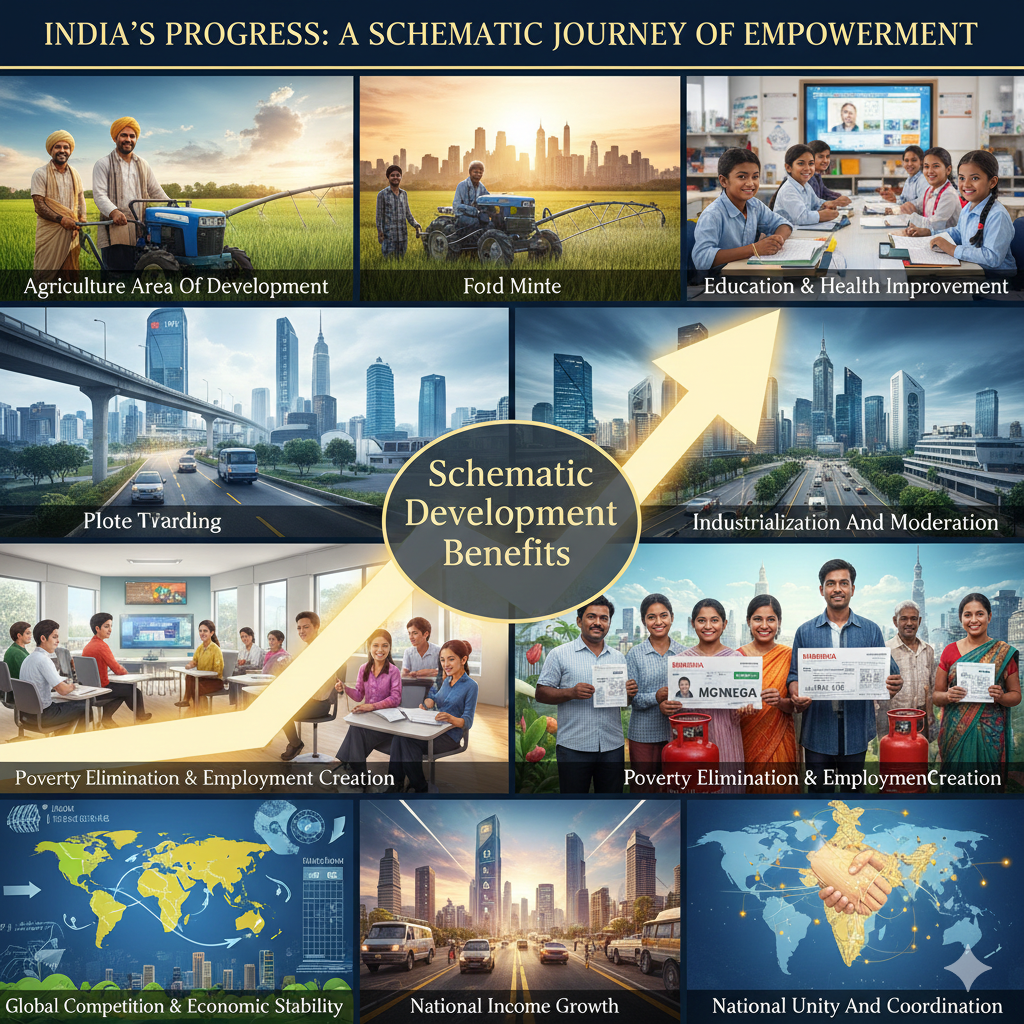
India in Schematic Development – Benefits
Through planned (schematic) development, India has achieved significant economic, social, and technological progress. This development model helped the country fight poverty, unemployment, and backwardness while creating a stronger and more balanced national framework.
1. Reduction in Social and Economic Inequality
- Special schemes were prepared for weaker sections of society.
- Expansion of social security, education, and healthcare reduced inequalities.
2. Poverty Elimination
- Employment generation programmes such as MGNREGA reduced poverty levels.
- The number of people living below the poverty line decreased significantly.
3. Industrialization and Modernization
- Growth of heavy industries, public undertakings, and technical education.
- Advancement in science, technology, and industrial processes.
4. Increase in National Income and Living Standards
- Rise in national income due to increased production.
- Improvement in health, education, and basic amenities enhanced living standards.
5. Skilled and Equitable Use of Resources
- Optimal use of natural and human resources through planned strategies.
- Reduction in resource wastage and promotion of sustainable development.
6. Agricultural Development
- Improvements in irrigation, seeds, fertilizers, and technology boosted production.
- The Green Revolution made India self-reliant in food production.
7. Creation of Employment Opportunities
- New jobs generated in industry, services, and agriculture.
- Unemployment levels decreased over time.
8. Economic Stability and Development
- Better control over inflation and economic imbalances.
- Creation of a strong foundation for long-term development.
9. National Unity and Coordination
- Special plans prepared to reduce regional development inequalities.
- Improved coordination between the Centre and the States.
10. Strengthening India’s Global Competitiveness
- Economic reforms and technological growth increased India’s global standing.
- Growth in foreign investment and international business partnerships.
Conclusion
Schematic development has played a vital role in making India economically stronger, socially empowered, and technologically advanced. It helped the nation address challenges such as poverty, unemployment, and inequality while setting a strong foundation for sustainable and inclusive growth.
Conclusion – India’s Schematic Development
Planned development has empowered India economically, socially, and regionally. It ensured optimal and equitable use of resources, reduced poverty and unemployment, minimized social inequalities, and promoted industrialization and modernization.
Planned development significantly improved national income and living standards, helping India take important steps toward becoming a modern and developed nation. Over time, improvements and flexibility were required in planning, which led to the replacement of the Planning Commission with NITI Aayog, a more dynamic and cooperative institution.
Thus, schematic development has acted as a strong foundation for India’s progress, guiding the country towards becoming a prosperous, modern, and equitable society.
References
- Planning Commission of India. “Five-Year Plans (1951–2017).” Government of India Archives.
- NITI Aayog. “Transforming India: Reports and Policy Frameworks.” Government of India, 2015–2024.
- MOSPI. “Statistical Year Book of India.” Ministry of Statistics and Programme Implementation.
- Reserve Bank of India. “Handbook of Statistics on Indian Economy.” RBI Publications.
- Economic Survey of India. Ministry of Finance, Government of India.
- NCERT. “Indian Economic Development.” Class XI Economics Textbook.
- Visvesvaraya, M. “Planned Economy for India.” Bangalore, 1934.
- Bombay Plan (1944). “A Plan of Economic Development for India.” Tata & Birla Group.