
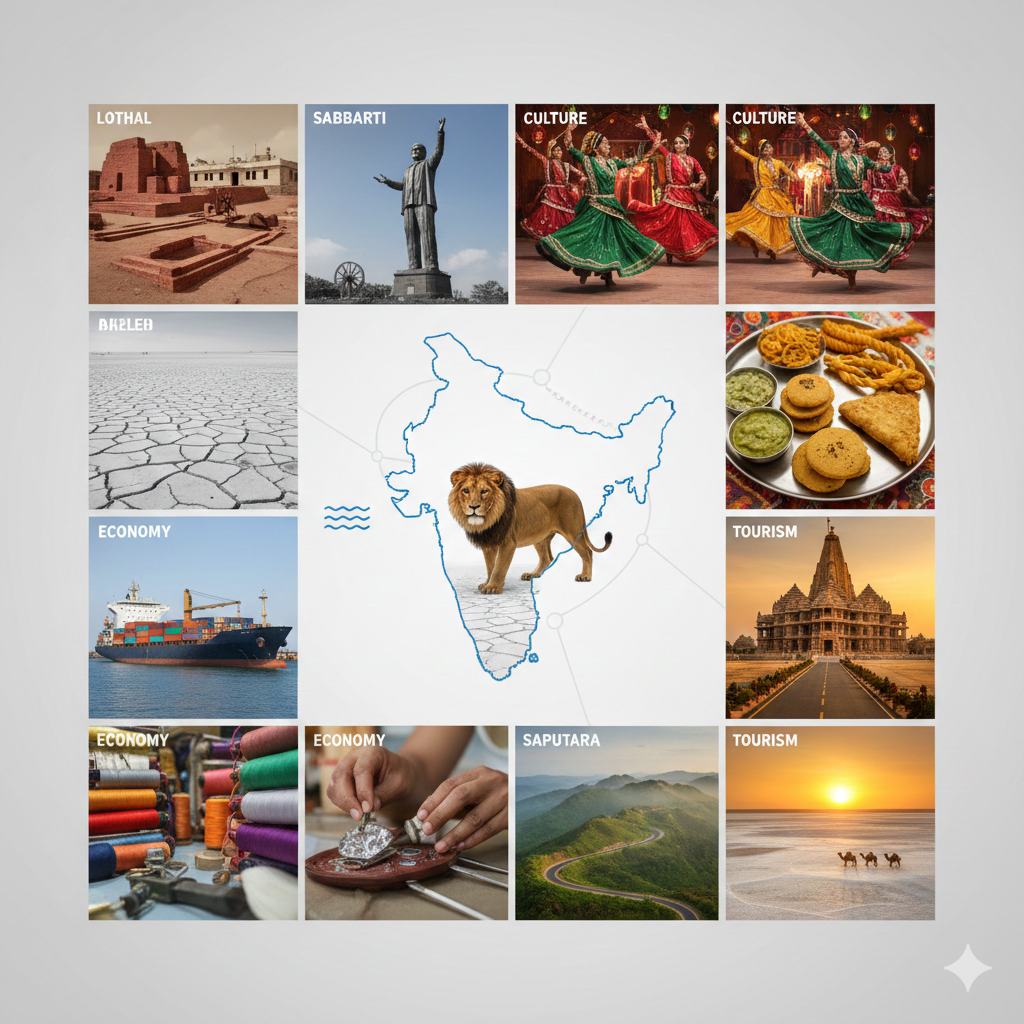
Gujarat: History, Culture, Geography and Economic Development
Gujarat is a major state of India, located in the western part of the country. The state is famous for its rich cultural heritage, historical sites, and rapid economic development. The capital of Gujarat is Gandhinagar, while its largest city is Ahmedabad. Situated along the Arabian Sea, Gujarat shares its borders with Pakistan, Rajasthan, Madhya Pradesh, and Maharashtra.
History of Gujarat
The history of Gujarat is ancient and culturally rich. It has been a part of the Indus Valley Civilisation and is home to important archaeological sites like Lothal. Over time, this region was ruled by the Maurya, Solanki, Mughal, and Maratha empires. In the modern era, Gujarat played a major role in India’s independence movement as the birthplace of Mahatma Gandhi.
Geographical Location
- Gujarat has a coastline of approximately 1,600 kilometres, making it important for maritime trade and fisheries.
- The climate ranges from dry to semi-arid and tropical.
- The state is home to Gir Forest, the only natural habitat of Asiatic lions.
Culture of Gujarat
- Gujarat is known for its vibrant culture and colorful traditions.
- Major festivals include Navratri, Uttarayan (Makar Sankranti), and Diwali.
- Garba and Dandiya are the popular folk dances.
- Famous Gujarati dishes include dhokla, khakhra, fafda, and thepla.
Economic Development
Gujarat is one of the most prosperous and industrially developed states of India. It is known for its chemicals, petroleum, textiles, and diamond-cutting industries. The Kandla and Mundra ports are among the busiest ports in the country.
Major Tourist Places
- Ahmedabad – Sabarmati Ashram, Akshardham Temple
- Gir National Park – Home of the Asiatic Lions
- Dwarka – The City of Lord Krishna
- Saputara – The only hill station in Gujarat
- Rann of Kutch – White Desert and Rann Utsav
Important Personalities
- Mahatma Gandhi
- Sardar Vallabhbhai Patel
- Dinkar Rao Makrand
Detailed History of Gujarat
The history of Gujarat spans ancient civilizations to modern political developments. It includes the Indus Valley Civilization, Rajput dynasties, Mughal rule, Maratha dominance, British colonial rule, and the Indian independence movement.
Ancient Period
Indus Valley Civilization (c. 2500–1700 BCE)
- Lothal, Dholavira, and Rangpur in Gujarat were major Harappan sites.
- Lothal is considered one of the world’s earliest dockyards.
- Dholavira reveals advanced planning, including water management and unique city design.
Epic Period (Ramayana and Mahabharata)
According to mythology, Dwarka is considered the city of Lord Krishna. Modern archaeology has found evidence of submerged structures believed to be ancient Dwarka.
Maurya Empire (321–185 BCE)
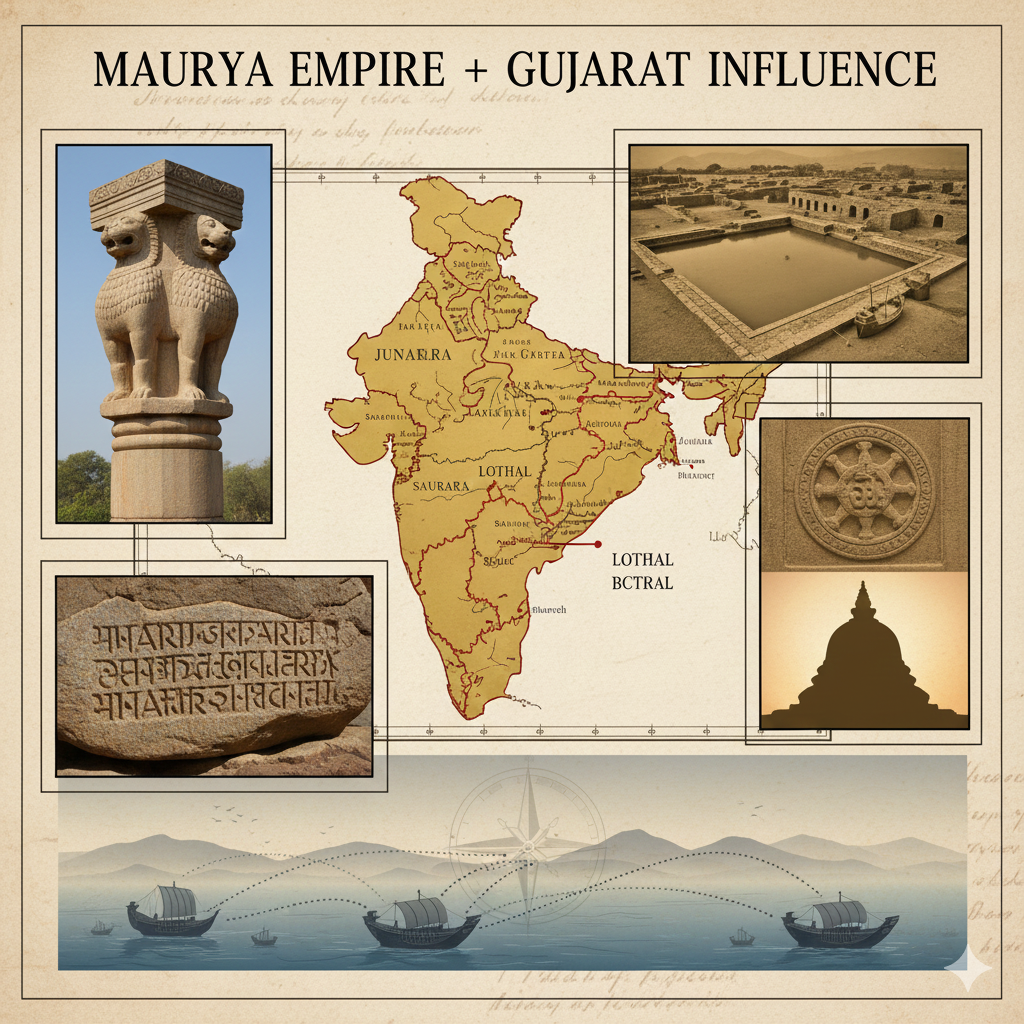
During the reigns of Chandragupta Maurya and Ashoka, Gujarat was part of the Maurya Empire, and Buddhism spread in the region.
Rule of Shakas and Kushans
After the Mauryas, the Shaka (Scythian) and Kushan rulers controlled Gujarat. Trade and culture flourished during this era.
Medieval Period
Gurjara-Pratihara Empire (8th–10th century)
This period saw the development of temple architecture and Hindu art.
Solanki Dynasty (945–1243)
The Solanki era is considered the golden age of Gujarat, marked by temple construction and cultural development. Famous monuments include Somnath Temple and Rani ki Vav (Patan).
Delhi Sultanate & Bahmani Rule (13th–15th century)
Alauddin Khilji and Muhammad bin Tughlaq annexed Gujarat. In 1411, Ahmed Shah founded Ahmedabad.
Mughal Period (16th–18th century)
In 1572, Akbar annexed Gujarat. Surat became an important port for cotton, spices, and silk trade.
Maratha Rule (18th century)
After the Mughals, Gujarat came under Maratha control, with several princely states emerging during this period.
British Period (19th–20th century)
- Gujarat came under British rule in 1818.
- Surat, Ahmedabad, and Bhavnagar became major trading centres.
- Gujarat took part in the 1857 uprising, though the revolt was limited here.
Contribution to the Freedom Struggle
- Gujarat is the birthplace of Mahatma Gandhi (Porbandar, 1869).
- Sabarmati Ashram became a centre of political activism.
- The Dandi March (1930) became a symbol of peaceful resistance.
Modern Period
- After independence, Gujarat was part of the Bombay Province.
- In 1960, Gujarat became a separate state.
- Gandhinagar became the new capital.
- Today, Gujarat is known for industry, tourism, and cultural heritage.
Historical Heritage of Gujarat
- Lothal – Ancient port of the Indus Valley Civilization.
- Somnath Temple – One of the twelve Jyotirlingas.
- Rani ki Vav – UNESCO World Heritage Site.
- Dwarka – Legendary city of Lord Krishna.
- Gir National Park – Home of Asiatic lions.
Indus Valley Civilization (c. 2500–1700 BCE)
The Indus Valley Civilization was one of the world’s earliest civilizations, spread across present-day Pakistan, northwest India, and parts of Afghanistan. Gujarat’s sites—Lothal, Dholavira, and Rangpur—played a significant role in its development.
Main Features of the Indus Valley Civilization
1. Town Planning
- Harappan cities were well-planned with grid-pattern streets and advanced drainage systems.
- Houses were constructed with baked bricks and often had private wells.
2. Major Sites
- Harappa – Known for agriculture and grain storage.
- Mohenjo-daro – Famous for the Great Bath.
- Lothal (Gujarat) – Port city with dockyards and bead industry.
- Dholavira (Gujarat) – Known for reservoirs and unique architecture.
- Kalibangan – Known for irrigation and agriculture.
- Rangpur (Gujarat) – Centre for cotton production.
3. Economy
Agriculture was the backbone of this civilization, with crops like wheat, barley, cotton, and sesame. Maritime trade was extensive, especially through Lothal.
4. Script and Writing
The Harappan script remains undeciphered and used pictographic signs.
5. Religious Beliefs
People worshipped nature, Mother Goddess figures, Pashupati-like deities, sacred animals (such as bull), and the Peepal tree.
6. Science and Technology
The Harappans excelled in drainage systems, brick-making, and water management.
7. Social System
The society had occupational specialisation—farmers, traders, craftsmen, and textile workers.
8. Reasons for Decline
- Possible drying of the Saraswati River
- Climate change
- Invasions
- Collapse of agriculture and trade
Indus Valley Civilization in Gujarat
Gujarat’s Harappan sites—Lothal, Dholavira, and Rangpur—were highly advanced trade and urban centres.
- Lothal – Considered one of the world’s oldest dockyards.
- Dholavira – Known for massive water reservoirs and city planning.
Importance
The Indus Valley Civilization laid the foundation of India’s ancient cultural, architectural, and trade systems. The discoveries in Gujarat remain vital to understanding India’s history.
The Maurya Empire (321–185 BCE)
The Maurya Empire (321–185 BCE) was the first pan-Indian empire that unified large parts of the Indian subcontinent. Founded by Chandragupta Maurya, it reached its peak under Emperor Ashoka. The empire became famous for its efficient administration, strong military, economic prosperity, and the widespread promotion of Buddhism.
Gujarat was also a significant part of the Maurya Empire and flourished culturally and economically during this period.
Establishment of the Maurya Empire
- Chandragupta Maurya founded the Maurya Empire in 321 BCE.
- He defeated Dhanananda, the last king of the Nanda dynasty, and made Pataliputra (modern Patna) his capital.
- His prime minister Chanakya (Kautilya) played a major role in strengthening the empire and wrote the famous text "Arthashastra".
Major Rulers of the Maurya Empire
1. Chandragupta Maurya (321–297 BCE)
- Defeated the generals of Alexander and took control of northwestern India and Punjab.
- Added western India, including parts of Gujarat, to his empire.
- The Greek historian Megasthenes documented the court of Chandragupta.
- In his final years, Chandragupta adopted Jainism and attained death through sallekhana at Shravanabelagola (Karnataka).
2. Bindusara (297–273 BCE)
- Maintained and expanded the empire inherited from Chandragupta.
- Strengthened administration in regions including Gujarat.
3. Ashoka the Great (273–232 BCE)
- Considered the greatest Mauryan ruler; his reign marked the golden age of the empire.
- Adopted Buddhism after the Kalinga War (261 BCE) and promoted non-violence.
- Appointed "Dhamma Mahamatras" to spread moral values among people.
- Ashoka’s inscriptions found in Junagadh (Gujarat) reflect his administration and the spread of Buddhism.
Maurya Empire in Gujarat
- Gujarat was an important part of the western region of the Mauryan Empire.
- Chandragupta added Saurashtra and Kathiawar to the empire.
- Ashoka’s Junagadh inscription shows strong Mauryan governance in Gujarat.
- Lothal, Bharuch, and Saurashtra were major trade centres connected to international routes.
Administration and Governance
- The Maurya Empire had a strong centralized administrative structure.
- The empire was divided into provinces governed by princes (Kumars) or Mahamatras.
- Gujarat was part of the western province.
- Roads and trade routes were developed, improving commerce and agriculture.
Economic and Social Development
- Agriculture and trade were promoted across Gujarat.
- Lothal and Bharuch played key roles in maritime trade.
- Agricultural taxes formed the major revenue of the state.
- Society followed the caste system but merchants and craftsmen enjoyed high status.
Religion and Culture
- Buddhism spread extensively in Gujarat during Ashoka’s reign.
- Stupas and viharas were constructed in Saurashtra.
- Ashoka propagated non-violence and moral conduct.
Decline of the Maurya Empire
- In 185 BCE, Brihadratha, the last Mauryan king, was killed by his general Pushyamitra Shunga.
- The empire collapsed and several small kingdoms emerged in Gujarat.
- Later, Gujarat came under Shaka and Kushan rule.
Importance of the Maurya Empire for Gujarat
- Provided strong administrative systems and trade connections.
- Helped Gujarat flourish as a center of commerce and culture.
- Ashoka’s inscriptions and Buddhist remains highlight its historical significance.
Medieval Period of Gujarat
The medieval period (8th to 18th century) was a major phase in India’s political and cultural evolution. Gujarat experienced the rise of Rajput dynasties, the Delhi Sultanate, the Gujarat Sultanate, and the Mughal empire. During this period, Gujarat became a hub of trade, architecture, cultural growth, and religious harmony.
1. Rajput Dynasties & Solanki/Chalukya Rule (945–1243)
The Solanki (Chalukya) dynasty is considered the golden age of medieval Gujarat. Founded by Moolraj Solanki in the 10th century, this dynasty contributed greatly to architecture, trade, and culture.
Prominent Solanki Rulers
- Bhimdev I – Ruled during the attack of Mahmud Ghazni (1025 CE) on Somnath Temple.
- Karnadev Solanki – Strengthened Anahilwara (Patan) as a prosperous capital.
- Siddharaj Jaisingh (1094–1143) – Greatest ruler of the Solanki dynasty; promoted art, literature, and architecture. The Rudramahalaya Temple was built during his reign.
- Kumarpal – Patron of Jainism; promoted religious harmony.
Characteristics of the Solanki Period
- Flourishing of Jainism and temple architecture.
- Famous monuments: Somnath Temple, Rani ki Vav (Patan), Sun Temple (Modhera).
2. Mahmud Ghazni’s Invasion (1025 CE)
Turk ruler Mahmud Ghazni attacked and looted the Somnath Temple. Despite destruction, the temple was rebuilt several times, showing Gujarat’s resilience.
3. Delhi Sultanate Rule (13th–15th Century)
- Alauddin Khilji invaded Gujarat in 1298 and annexed it.
- Muhammad bin Tughlaq later reinforced control over Gujarat.
4. Gujarat Sultanate (1407–1573)
The Gujarat Sultanate was founded by Zafar Khan Muzaffar in 1407.
Prominent Rulers
- Ahmed Shah (1411–1443) – Founded Ahmedabad; made it a center of trade & culture.
- Mahmud Begada (1458–1511) – A powerful Sultan; conquered Junagadh, Champaner, and Diu; expanded maritime trade.
- Bahadur Shah – Faced Mughal invasion in 1535.
Characteristics of the Sultanate Period
- Construction of Jama Masjid and Sidi Saiyyed’s Jali in Ahmedabad.
- Growth of maritime trade with Arab, African, and European merchants.
5. Mughal Empire in Gujarat (1573–1707)
In 1573, Akbar annexed Gujarat into the Mughal Empire. Gujarat became a major port region and commercial center.
- Surat and Ahmedabad became global trading hubs.
- European merchants (Portuguese, Dutch, British) established strong trading networks.
Contributions of Mughal Rulers
- Akbar – Organized the administration of Gujarat.
- Jahangir & Shah Jahan – Strengthened trade in Surat and Ahmedabad.
6. Maratha Rule (18th Century)
- After Mughal decline, Gujarat came under Maratha influence.
- Gujarat was divided into several principalities.
- Trade and agriculture weakened during this period.
Characteristics of Medieval Gujarat
- Religious harmony among Hindus, Jains, and Muslims.
- Fusion of Rajput and Islamic architecture.
- Major trading ports: Surat, Bharuch, and Kathiawar.
- Growth of Gujarati literature and Jain texts.
Modern Period of Gujarat
The modern period (mid-18th to mid-20th century) marked British rule, social reforms, rise of nationalism, and ultimately the independence struggle. Gujarat emerged as a major center of India’s freedom movement.
1. Beginning of British Rule (18th Century)
- In 1612, the East India Company established its first factory in Surat.
- After the Third Anglo-Maratha War (1818), the British took full control over Gujarat.
2. Economic Development & Colonial Exploitation
- The textile industry began flourishing in the 19th century.
- Surat, Bhavnagar, and Kandla became major trade centers.
- British taxation and policies harmed local industries despite commercial growth.
3. Social Reform Movements (19th Century)
- Reformers challenged practices like caste discrimination, sati, and child marriage.
- Mahatma Gandhi’s ideas of equality and non-violence influenced Gujarat greatly.
4. Gujarat’s Contribution to the Indian Freedom Struggle
Mahatma Gandhi & Satyagraha
- Founded Sabarmati Ashram in Ahmedabad in 1915.
- Led the Kheda Satyagraha (1918) supporting farmers.
- Launched the Dandi March (1930), a major symbol of peaceful protest.
Sardar Vallabhbhai Patel
- Leader of Bardoli Satyagraha (1928).
- Unified more than 500 princely states after independence, earning the title “Iron Man of India”.
Other Important Leaders
- Mohanlal Pandya
- Ravishankar Maharaj
- Narhari Parikh
- Mahadev Desai
5. Educational and Social Development
- Gujarat Vidyapeeth founded by Mahatma Gandhi.
- Reforms for women’s education and eradication of untouchability.
6. Partition and Independence (1947)
- Ahmedabad, Surat, and Vadodara contributed to post-independence industrial growth.
- Sardar Patel played a key role in nation-building.
7. Reorganisation of Gujarat (1960)
- The state of Gujarat was formed on 1 May 1960 after separating from Maharashtra.
- Ahmedabad was the first capital, later shifted to Gandhinagar.
Modern Era Characteristics
- Rapid industrial and economic development—especially in textiles, trade, and salt production.
- Major role in the Indian freedom struggle.
- Cultural growth in Gujarati literature, art, and social reform.
- Strong tradition of religious tolerance and Gandhian values.
Conclusion
Gujarat has been a prominent political, economic, and cultural center of India from ancient times to the modern era. From the Maurya Empire to the medieval kingdoms and then to the Indian independence movement, Gujarat has played a transformational role in shaping the history and development of India.
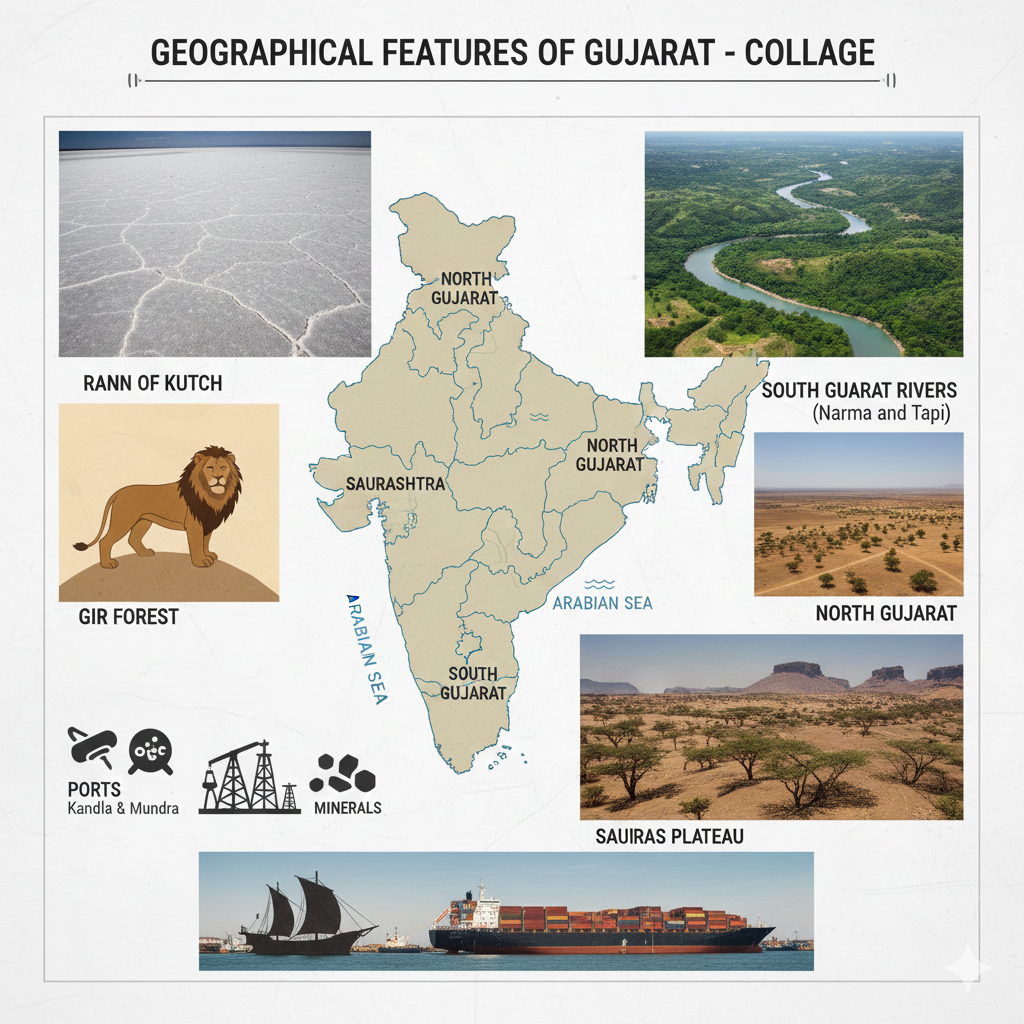
Geographical Features of Gujarat
Gujarat is an important state located in the western part of India, known for its geographical and cultural diversity. The region presents a unique blend of sea, plains, mountains, plateaus, and deserts. Let us understand the geographical features of Gujarat in detail.
Geographical Location and Boundaries of Gujarat
Latitude and Longitude
- Gujarat extends from 20°1′ North to 24°7′ North latitude.
- It stretches between 68°4′ East to 74°4′ East longitude.
- The state is entirely located in the Northern Hemisphere.
Boundaries
- North: Rajasthan
- South: Maharashtra
- East: Madhya Pradesh
- West: Arabian Sea
- Northwest: Sindh province of Pakistan
Area and Population
- Total area of Gujarat: 1,96,024 sq. km (6th largest state of India)
- According to the 2021 India Census, Gujarat is one of the densely populated states.
Geographical Regions of Gujarat
Gujarat can be divided into four main geographical regions:
1. Rann of Kutch
- Located in the northwestern part of Gujarat, consisting of desert and semi-desert terrain.
- Divided into:
- Great Rann: Known for its vast salt desert.
- Little Rann: Famous for the Indian Wild Ass.
- The land gets flooded during monsoon and remains dry otherwise.
- The famous Rann Utsav takes place here.
2. Peninsula of Saurashtra
- Saurashtra, also known as Kathiawar, is the central peninsula of Gujarat.
- Surrounded by the sea and crossed by rivers like Shetrunji and Bhadrakali.
- The terrain includes hills and plateaus.
- Famous for the Gir Forest, the only habitat of Asiatic lions.
3. South Gujarat
- Blessed with rivers such as Narmada, Tapi, and Damanganga.
- Fertile land suitable for sugarcane, cotton, and rice cultivation.
- Industrial development is high, especially in Surat and Valsad.
4. North Gujarat
- A semi-arid region dependent mainly on agriculture.
- Includes districts like Banaskantha, Patan, and Mehsana.
- Faces water scarcity and has large stretches of barren land.
Natural Resources of Gujarat
Mineral Resources
- Oil and Natural Gas: Found in Kutch and Ankleshwar regions.
- Salt: Rann of Kutch is India’s largest salt-producing region.
- Limestone, bauxite, and fluorite are also found.
Forests and Wildlife
- Gir Forest is world-famous for Asiatic lions.
- Blackbuck, Indian Wild Ass, and various bird species are found.
- Main forest regions: Gir, Kutch, and South Gujarat.
- Important National Parks:
- Gir National Park
- Velavadar National Park
- Rann of Kutch Wildlife Sanctuary
Water Resources
- Major rivers: Narmada, Sabarmati, Tapi, Mahi, and Damanganga.
- The Sardar Sarovar Dam on the Narmada River supports irrigation and hydroelectricity.

Climate of Gujarat
The climate of Gujarat can be divided into three main types:
- Tropical Climate: Hot and dry summers.
- Monsoon Climate: Rainfall mainly between June and September.
- Winter Climate: Mild and cool weather from November to February.
Rainfall Distribution
- Kutch and North Gujarat receive low rainfall.
- Saurashtra and South Gujarat receive moderate to heavy rainfall.
Land and Agriculture
Types of Soil
- Alluvial Soil: Found in the plains of Narmada and Tapi.
- Black Soil: Suitable for cotton cultivation, mainly in Saurashtra.
- Sandy Soil: Found in Kutch region.
- Saline Soil: Present in coastal areas.
Main Crops
- Food grains: Wheat, millet, sorghum.
- Cash crops: Cotton, sugarcane, tobacco.
- Other crops: Peanuts and oilseeds.
Coastal Areas and Ports
- Gujarat's coastline is approximately 1,600 km, the longest in India.
- Major ports include:
- Kandla: Leading commercial port.
- Porbandar: Birthplace of Mahatma Gandhi.
- Dahej & Hazira: Important industrial and shipping hubs.
Important Geographical Features of Gujarat
- Rann Utsav: Celebrated in the Rann of Kutch for its natural beauty and culture.
- Gir Forest: Home to the last population of Asiatic lions.
- Rivers: Narmada and Sabarmati play a major role in drinking water and irrigation.
- Industrial Growth: Major industrial belts in Surat, Dahej, and Valsad.
- Maritime Trade: Gujarat acts as India’s maritime gateway.
Conclusion
Gujarat’s geographical diversity—ranging from deserts to coastal areas, fertile plains to forests—makes it one of India’s most unique and resource-rich states. Its strategic coastal position, natural resources, and varied climate contribute to its economic, cultural, and environmental importance.
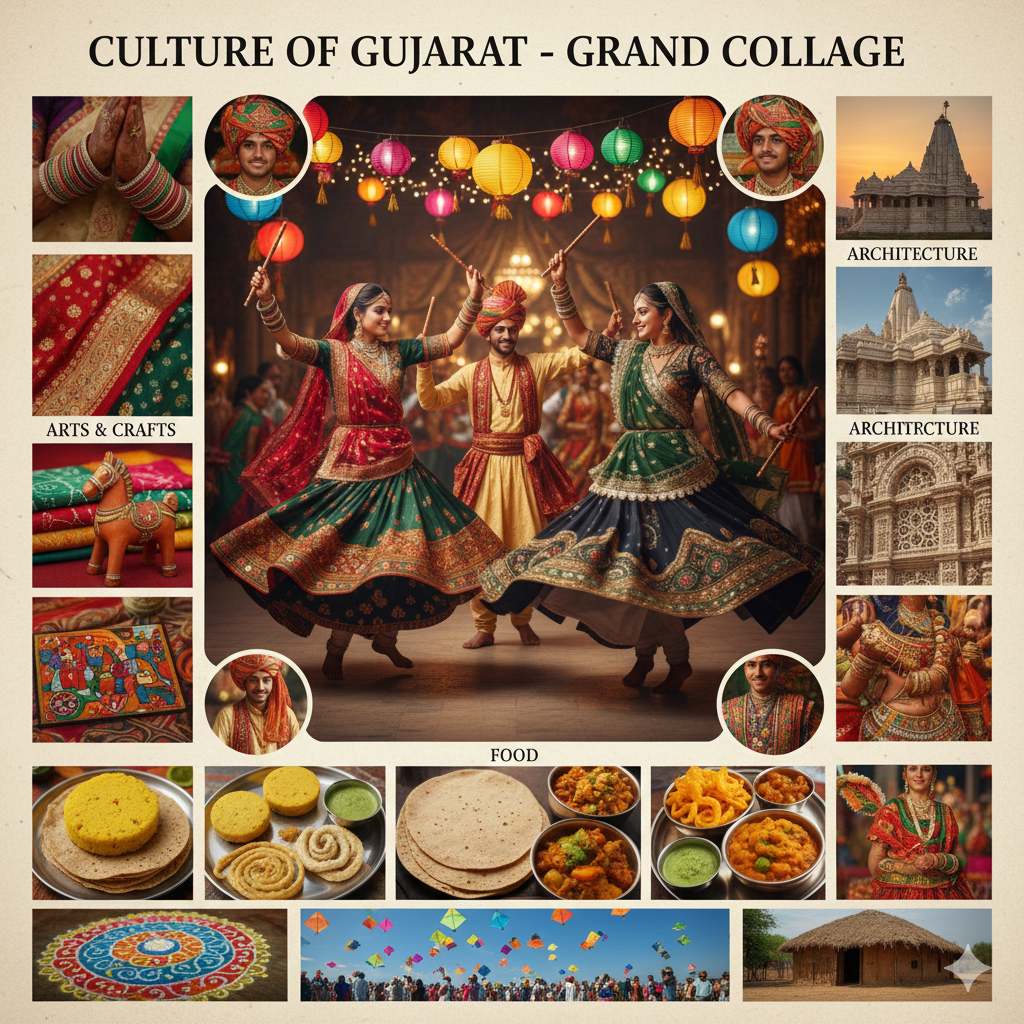
Culture of Gujarat
The culture of Gujarat is famous for its rich traditions, colorful festivals, unique arts, and unity in diversity. The state is not only an economic hub but also a land of glorious cultural heritage. Let us explore the culture of Gujarat in detail.
1. Language and Literature
Gujarati Language
- The main language of Gujarat is Gujarati, one of the 22 recognized languages of India.
- It is an Indo-Aryan language and the mother tongue of great personalities like Mahatma Gandhi.
- Other spoken languages include Hindi, English, Sindhi, and Kutchi.
Gujarati Literature
- Gujarat has a long and rich literary tradition.
- Notable writers include Narsinh Mehta, Dayanand Saraswati, Premchand, and Umashankar Joshi.
- Bhakti-era saints like Narayandas and Kabirdas influenced devotional literature.
- Modern Gujarati novels, dramas, and poetry remain popular today.
2. Religion and Spirituality
Gujarat is a confluence of diverse religions—Hinduism, Jainism, Islam, Buddhism, and Zoroastrianism.
Hinduism
- Dwarka in Saurashtra is considered the ancient residence of Lord Krishna.
- Major temples: Dwarkadhish Temple, Somnath Temple, Ambaji Temple.
Jainism
- Gujarat is a major center of Jain culture.
- Famous temples: Palitana, Girnar, and Shyamala Tirtha.
Islam
- Islamic architecture flourished in Gujarat.
- Examples include the Sidi Sayyed Jali and Jama Masjid in Ahmedabad.
Zoroastrianism
- A significant Parsi community lives in Surat and Navsari.
3. Arts and Crafts of Gujarat
i. Textiles and Handicrafts
- Patola of Patan: A rare double-ikat weaving technique.
- Bandhani (Bandhej): Famous for colorful tie-dye sarees and dupattas.
- Zari and Zardosi: Surat is well-known for intricate zari embroidery.
ii. Clay and Metal Crafts
- Terracotta art is popular in rural regions of Kutch and Saurashtra.
- Brass and bronze sculptures represent the metal craft heritage.
iii. Wood and Stone Carving
- Temples and old mansions display exquisite wooden and stone carvings.
iv. Painting
- Warli and Pithora art is practiced in tribal areas.
- Rangoli is created outside homes during festivals.
4. Dance and Music
Traditional Dance
- Garba: The most famous dance form, performed during Navratri.
- Dandiya Raas: Performed using wooden sticks, symbolizing Krishna and Radha’s love.
- Tipani Dance: Traditionally performed by women during farming activities.
Music
- Gujarati music includes devotional, folk, and classical influences.
- Folk songs include Charan Geet, Raas Geet, and Garbi.
- Saint-poet Narsinh Mehta's compositions remain culturally significant.
5. Food of Gujarat
Gujarat’s cuisine is mainly vegetarian and known for its balanced sweet, sour, and spicy flavors.
Main Dishes
- Dhokla
- Khandvi
- Thepla
- Undhiyu
- Fafda-Jalebi
Sweets
- Ghevar
- Mohanthal
- Surat’s famous Ghari
Drinks
- Buttermilk
- Lemonade
6. Festivals of Gujarat
- Navratri: Nine nights of Garba and devotion.
- Makar Sankranti (Uttarayan): Statewide kite festival.
- Rath Yatra in Ahmedabad.
- Diwali
- Rann Utsav in Kutch.
- Janmashtami celebrations in Dwarka.
7. Costumes
- Men: Kurta-pyjama, dhoti, and turban.
- Women: Chaniya-choli adorned with traditional jewelry.
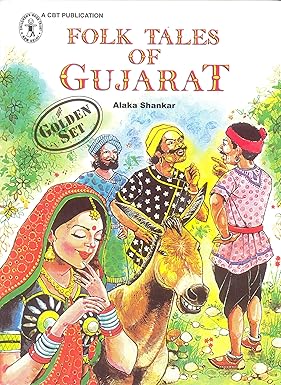
8. Folktales and Traditional Stories
- Stories of Krishna Leela.
- Devotional tales of saint-poet Narsinh Mehta.
- Folk songs of Kutch and Saurashtra portraying bravery and sacrifice.
9. Architecture and Sculpture
- Hindu temples: Somnath Temple, Dwarkadhish Temple.
- Islamic architecture: Sidi Sayed Mosque, Jama Masjid.
- Ahmedabad: Declared a UNESCO World Heritage City.
10. Tribal Culture
- Major tribes: Bhil, Rathwa, Garasia, Koli.
- Their art, music, and handicrafts form an important part of Gujarat's cultural identity.
Conclusion
The culture of Gujarat is a vibrant blend of traditions, festivals, food, art, and social values. It represents unity, tolerance, and a deep cultural heritage that influences India and the world.
Economic Development of Gujarat
Gujarat is one of India’s strongest and fastest-growing states economically. Its economy is driven by agriculture, industry, trade, and the service sector. Gujarat's economic model is known for entrepreneurship, balanced development, and global business integration.
1. Historical Background
Contribution in History
- Since ancient times, Gujarat has been a major center of trade.
- During the Indus Valley Civilization, Lothal was a major port.
- In the medieval era, ports like Surat and Bhavnagar were international trade centers.
- During British rule, Gujarat became strong in textiles and maritime commerce.
Modern Foundations
- After independence, Gujarat focused on industrialization and port development.
- In 1960, Gujarat became a separate state and introduced progressive economic policies.
2. Nature of the Economy
Gross State Domestic Product (GSDP)
- GSDP (2022–23): Approximately ₹16 lakh crore.
- Per capita income is higher than the national average.
- Industrial growth rate: Over 10%.
Sectoral Contribution
- Agriculture: 18–20%
- Industry: 45–50%
- Service Sector: 30–35%
3. Agriculture Sector
Major Crops
- Cotton: Gujarat is called the “Cotton Heartland of India”.
- Peanuts: Gujarat produces the highest quantity of peanuts in India.
- Oilseeds: Soybean, sesame.
- Food grains: Millet, wheat, sorghum, and paddy (in South Gujarat).
Irrigation and Water Management
- The Sardar Sarovar Dam has revolutionized irrigation.
- Drip irrigation and modern techniques are widely used.
Milk Production
- Gujarat is a leader in milk production.
- AMUL is a globally recognized dairy brand headquartered in Gujarat.
4. Industrial Development
Gujarat is known as the “Growth Engine of India” due to its strong industrial base.
Major Industries
- Textiles: Ahmedabad is called the “Manchester of India”.
- Chemical & Petrochemical: 62% of India’s petrochemical output.
- Automobiles: Plants of Tata, Ford, Maruti Suzuki.
- Pharmaceuticals: Major hubs in Ahmedabad and Vadodara.
Industrial Hubs
- Vadodara-Ankleshwar Industrial Corridor
- Dahej & Hazira
- Kandla & Mundra Port-based industries
5. Trade and Commerce
Ports and Maritime Trade
- Gujarat handles 40% of India’s maritime trade.
- Major ports:
- Kandla Port
- Mundra Port
Business Centres
- Surat – Diamond and textiles.
- Ahmedabad – Industrial and commercial hub.
- Rajkot – Machinery and tools.
Exports
- Contributes over 25% of India’s total exports.
- Key exports: Chemicals, petrochemicals, diamonds, textiles, agricultural goods.
6. Service Sector
IT & Digital Economy
- GIFT City is India’s first International Financial Services Center.
- Focus on startups and digital innovation.
Banking & Finance
- Ahmedabad is a major financial hub.
Tourism
- Religious tourism: Somnath, Dwarka, Statue of Unity.
- Rann Utsav attracts global tourists.
- Wildlife tourism: Gir National Park.
7. Energy and Infrastructure
Energy Sector
- Leader in solar and wind energy.
- Asia's largest solar park at Kankaria.
Infrastructure
- Smart city projects in Ahmedabad, Surat, Vadodara, and Rajkot.
- Delhi-Mumbai Industrial Corridor (DMIC) passes through Gujarat.
8. Policy and Governance
- Business-friendly policies like tax benefits & industrial subsidies.
- Vibrant Gujarat Summit attracts global investments.
- Major partner in Make in India initiative.
9. Challenges and Opportunities
Challenges
- Industrial pollution.
- Water scarcity in Kutch and Saurashtra.
- Regional inequality.
Opportunities
- Green energy expansion.
- Rural infrastructure development.
- Increasing FDI and global partnerships.
Conclusion
Gujarat’s economic success is shaped by visionary policies, entrepreneurship, and strategic use of resources. With balanced growth in agriculture, industry, trade, and services, Gujarat stands not only as India’s economic engine but as a globally competitive region.

Tourism in Gujarat
Tourism in Gujarat reflects its rich cultural, historical, religious, and natural heritage. As one of India's major tourist destinations, Gujarat attracts millions of visitors every year. Its diversity is visible in its temples, wildlife, festivals, historical monuments, and coastal beauty. Let us explore the major tourist attractions of Gujarat.
1. Historical and Cultural Sites
i. Ahmedabad (UNESCO World Heritage City)
- Sabarmati Ashram: Founded by Mahatma Gandhi, it played a central role in India’s freedom struggle.
- Sidi Sayed Mosque (Jali): A masterwork of Islamic stone lattice art.
- Jama Masjid: A 15th-century architectural marvel.
- Kalupur Swaminarayan Temple: Known for its beautiful architecture.
ii. Patan
- Rani ki Vav: A UNESCO World Heritage Site and one of India’s most stunning stepwells.
- Patola Weaving: Patan is famous for its ancient Patola double-ikat weaving tradition.
iii. Saurashtra Region
- Champaner-Pavagadh Archaeological Park: UNESCO World Heritage Site featuring temples and historical structures.
- Junagadh: Famous for Girnar Hills and Nawabi monuments.
2. Religious Places
i. Dwarka (Char Dham)
- Dwarkadhish Temple: Dedicated to Lord Krishna and one of the Char Dham pilgrimages.
- Rukmini Temple: Temple of Goddess Rukmini.
ii. Somnath (Jyotirlinga)
- Somnath Temple: One of the twelve Jyotirlingas of Lord Shiva.
iii. Ambaji Temple
- One of the Shakti Peethas located in Banaskantha district.
iv. Shatrunjaya (Palitana)
- A sacred Jain pilgrimage site with more than 900 temples on the hill.
v. Modhera Sun Temple
- An architectural masterpiece dedicated to the Sun God.
3. Wildlife and Nature Tourism
i. Gir National Park
- The only natural habitat of the Asiatic Lion.
- Home to leopards, jackals, deer, and numerous bird species.
ii. Rann of Kutch
- Rann Utsav: A grand cultural celebration held every year on the white desert.
- Dholavira: One of the major Indus Valley Civilization sites.
iii. Blackbuck National Park (Velavadar)
- Famous for the rare Blackbuck deer.
iv. Nalsarovar Bird Sanctuary
- A winter home to thousands of migratory birds.
v. Marine National Park (Jamnagar)
- India’s first marine national park with coral reefs and rare marine species.
4. Beaches and Coastal Sites
i. Mandvi Beach
- Located in Kutch; known for white sands and historic palaces.
ii. Daman and Diu
- Known for beaches, Portuguese forts, and ancient churches.
iii. Bet Dwarka
- An island associated with the legends of Lord Krishna.
5. Modern Sites and Monuments
i. Statue of Unity
- World’s tallest statue (182 metres), dedicated to Sardar Vallabhbhai Patel.
- Located in Kevadia on the Narmada River.
- Includes eco-tourism parks, jungle safaris, and museums.
ii. GIFT City
- India’s first International Financial Services Centre located in Gandhinagar.
6. Folk Culture and Festivals
- Navratri & Garba: World-famous dance festival celebrated for nine nights.
- Uttarayan (Kite Festival): The largest kite festival celebrated across the state.
- Rann Utsav: Showcases culture, crafts, music, and dance of Kutch.
- Shatrunjay Fair: Major Jain festival in Palitana.
7. Other Important Sites
- Sardar Sarovar Dam: A major tourist and engineering marvel.
- Girnar Hills: A spiritual and natural attraction.
- Rathwa and Dandiya Folk Arts: Traditional tribal arts promoting cultural tourism.
Conclusion
Gujarat offers something for every kind of tourist—pilgrims, wildlife enthusiasts, historians, and culture lovers. The state’s diverse attractions make tourism not just a trip, but a rich cultural experience.
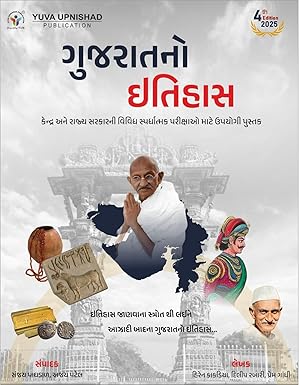
Important Personalities of Gujarat
Gujarat has produced many great personalities who influenced India’s social, political, and cultural history. Among them, Mahatma Gandhi, Sardar Vallabhbhai Patel, and Dinkar Rao Makarand are particularly significant.
1. Mahatma Gandhi (1869–1948)
i. Birth and Early Life
- Born on 2 October 1869 in Porbandar, Gujarat.
- Parents: Karamchand Gandhi and Putlibai Gandhi.
- Developed strong values of truth and morality in childhood.
ii. Education and Life Abroad
- Studied in Porbandar and Rajkot.
- Went to England to study law and became a barrister.
- Exposure to global culture shaped his later philosophy.
iii. Role in South Africa
- Fought against racial discrimination.
- Developed principles of Satyagraha and non-violent resistance.
iv. Contribution to Indian Freedom Struggle
- Returned to India in 1915 and joined the Indian National Congress.
- Led major movements: Swadeshi, Salt Satyagraha (1930), Quit India Movement (1942).
- Promoted truth, non-violence, and civil disobedience.
v. Independence and Contribution
- His leadership played a vital role in India’s independence in 1947.
- His teachings influenced global civil rights movements.
vi. Death
- Assassinated on 30 January 1948 by Nathuram Godse.
2. Sardar Vallabhbhai Patel (1875–1950)
i. Birth and Early Life
- Born on 31 October 1875 in Nadiad, Gujarat.
- Belonged to a simple farmer family; studied law and became a barrister.
ii. Entry into Politics
- Joined Indian National Congress under Gandhi’s guidance.
- Prominent role in Ahmedabad and Kheda movements.
iii. Integration of India
- After independence, Patel integrated 565 princely states into India.
- He ensured India’s political unity using diplomacy and firmness.
iv. Contribution and Legacy
- First Home Minister of India; strengthened administrative structure.
- Played a key role in implementing the Constitution.
v. Statue of Unity
- A 182-metre tall statue built in his honor in Kevadia, Gujarat.
3. Dinkar Rao Makarand
i. Life and Work
- Well-known social worker, writer, and journalist.
- Worked for social reform and education in Indian society.
ii. Contribution
- Advocated for women's rights and rural upliftment.
- Actively opposed caste discrimination and inequality.
iii. Literary Work
- Authored books, poems, and articles on social issues.
- His writings reflect deep understanding and reformist ideology.
Conclusion
Mahatma Gandhi and Sardar Vallabhbhai Patel played unmatched roles in India’s freedom and unity. Social reformers like Dinkar Rao Makarand contributed greatly to awareness, education, and social equality. Their legacy continues to inspire India and the world.
References

- Government of Gujarat – Official State Portal
- Gujarat Tourism Department – Official Tourism Information
- Archaeological Survey of India (ASI) – Reports on Lothal, Dholavira & Champaner
- Ministry of Culture, Government of India – Heritage and Historical Records
- Census of India – Population & Demographic Data (2021)
- UNESCO World Heritage Centre – Rani ki Vav, Champaner-Pavagadh, Ahmedabad
- “The Story of Civilization in India” — General Historical Reference
- Gujarat Economic Review (Government Publications)
- History Books on Maurya Empire, Medieval Gujarat & Modern Indian Freedom Movement
- Official Reports & Publications from Tourism, Forest, and Industries Departments of Gujarat