
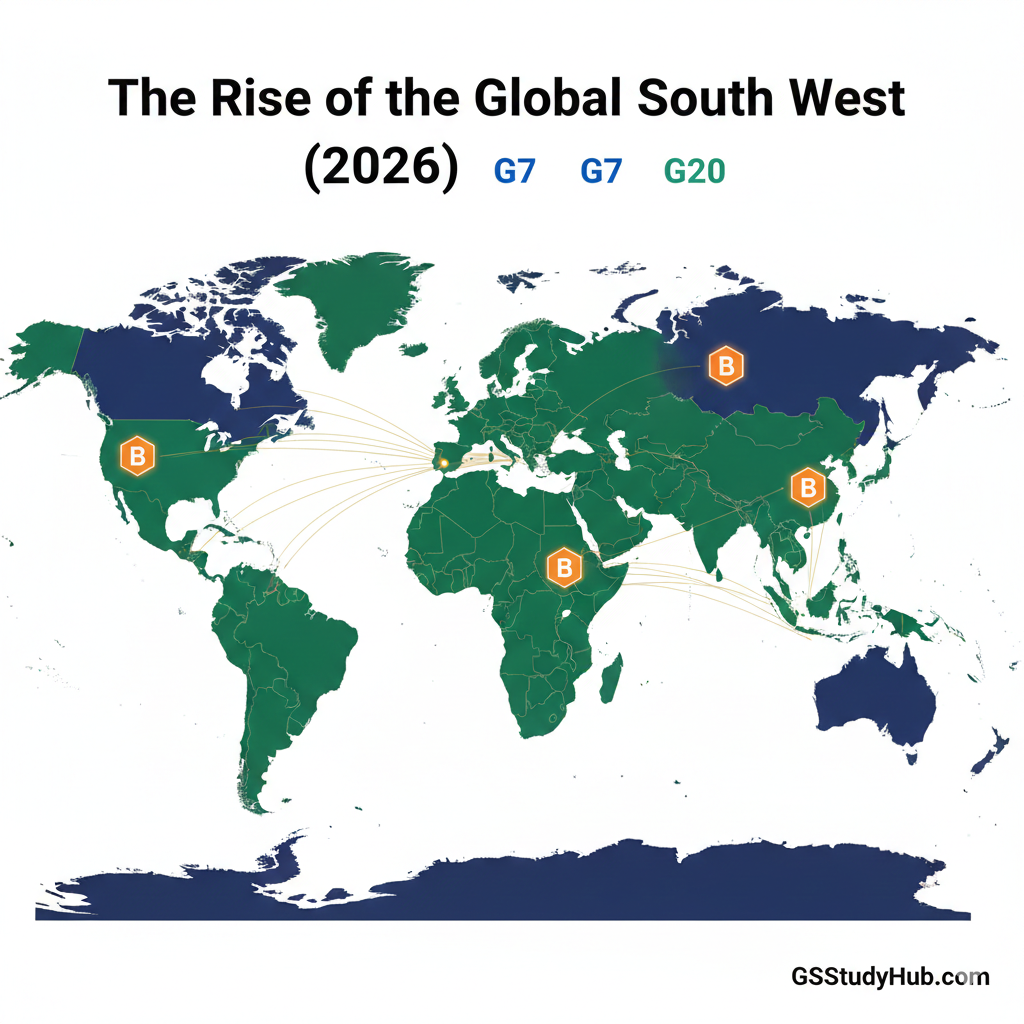
Global South vs. West: Is a New Cold War Emerging?
1. Introduction: The Great Global Re-alignment
For decades, the global hierarchy was dominated by the G7 and Western institutions. However, the Russia-Ukraine conflict, the expansion of BRICS+, and the rising influence of India have signaled the end of unipolarity. We are witnessing a transition from a West-centric world to a Multipolar Reality.
The emerging Global South vs West New Cold War narrative highlights the structural transformation of global alliances in the 21st century.2. Defining the "Global South"
The Global South isn't just a geographic term for the southern hemisphere. It represents a political and economic identity of nations in Africa, Latin America, and Asia that were once sidelined but are now the primary engines of global growth.
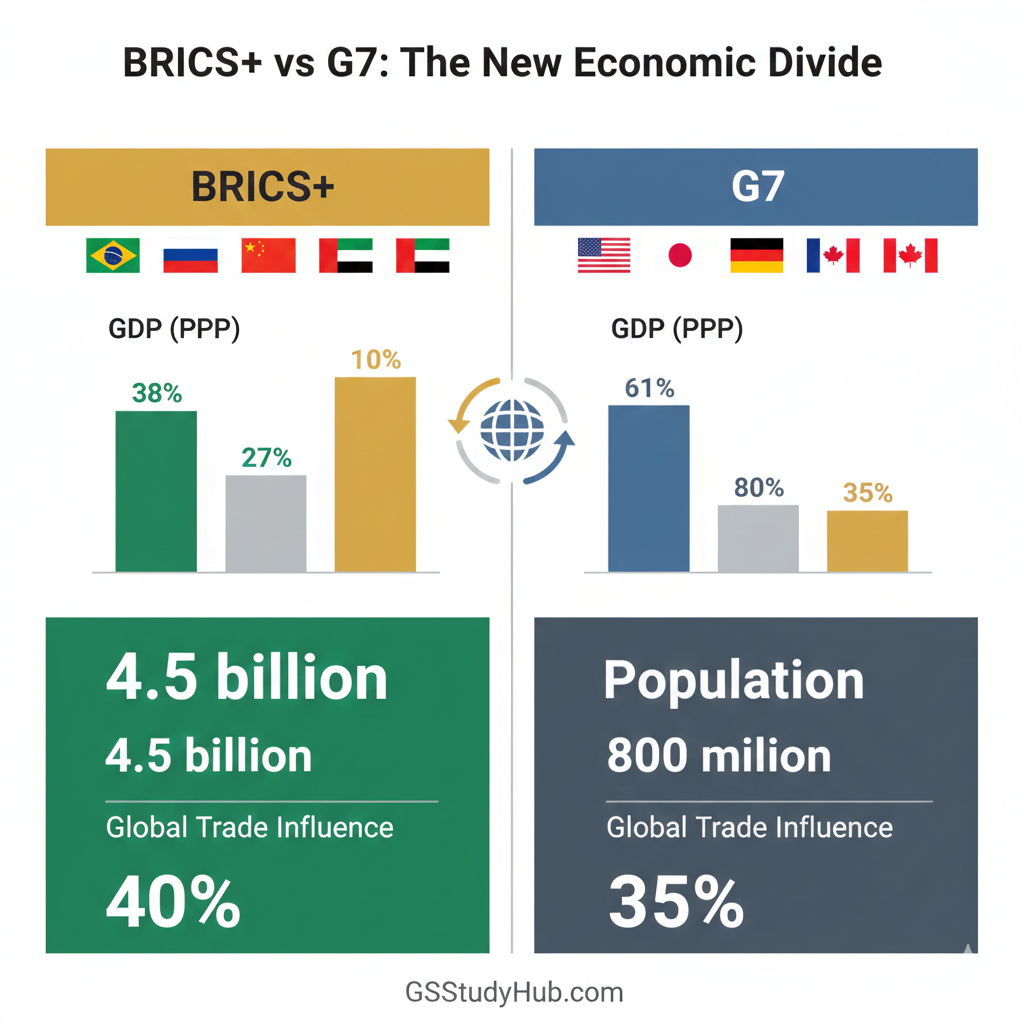
- Economic Weight: BRICS+ now surpasses the G7 in terms of GDP based on Purchasing Power Parity (PPP).
- Resource Sovereignty: Control over critical minerals needed for the green transition (Lithium, Cobalt) lies largely in the South.
3. Old Cold War vs. New Cold War
| Feature | Cold War 1.0 (US-USSR) | The New Era (South vs. West) |
|---|---|---|
| Conflict Drivers | Ideology & Nuclear Arms | Trade, AI, & Semiconductors |
| Economic Linkage | Zero (Two Separate Blocks) | Hyper-Interdependent |
| Global Role | Proxy Wars | Strategic Neutrality |
4. The Major Friction Points
A. De-dollarization
The "weaponization of finance" through sanctions has pushed nations like India, Brazil, and China to explore trade in local currencies. The South is actively seeking to reduce its vulnerability to the US Dollar.
B. Institutional Hypocrisy
There is a growing resentment in the South regarding "Double Standards"—where Western interventionism is framed as upholding democracy, while the concerns of developing nations (like the debt crisis or climate finance) are ignored.
5. India: The Voice of the Global South
India has emerged as the "Centre of Gravity" in this new dynamic. By securing permanent membership for the African Union in the G20, India proved it doesn't just talk about the Global South—it leads it. India’s "Vishwa Mitra" policy allows it to bridge the gap between the G7 and the developing world.
6. Conclusion: A New Era of Multi-Alignment
The rise of the Global South is not necessarily a threat to the West, but a demand for a seat at the table. We are moving toward a world where nations will no longer be forced to choose sides, but will instead practice Multi-Alignment based on national interest.
🚀 Want to learn how AI and Digital India initiatives are reshaping the nation? Check out Digital India & AI Revolution 2026 for detailed insights and future perspectives.
The Global South: Decoding the Architect of a New World Order
The term "Global South" has transitioned from a mere academic footnote to the most consequential phrase in 21st-century diplomacy. Far from being a rigid, formal organization like the European Union, it functions as a dynamic mosaic of nations spanning Asia, Africa, and Latin America. These countries are no longer content with being the "periphery" of global politics; they are now claiming the center stage.
I. Definition & Historical Context
The Global South is not a geographical absolute. It is a Geopolitical Identity rooted in shared histories of colonialism and a collective struggle for economic sovereignty. While "The West" refers to a group of developed, high-income nations largely in the Northern Hemisphere, the Global South represents the vanguard of emerging economies.
II. The Pillars of Power: Major Groupings
To understand the Global South, one must analyze the formal and informal structures that give it voice. These groups act as the diplomatic battering ram against the status quo.
1. BRICS+
Once an economic acronym, it is now a strategic heavyweight. With the recent expansion to include nations like Egypt, Ethiopia, and Iran, BRICS+ aims to create a "Counter-Weight" to the G7, focusing on local currency trade and financial independence.
2. The G77 + China
The largest intergovernmental organization of developing countries in the UN. It provides the collective bargaining power necessary to push for fairer climate finance and trade regulations at the United Nations.
3. African Union (AU)
Representing 55 member states, the AU has moved from regional cooperation to global influence. Its recent inclusion as a permanent member of the G20 (championed by India) marks a tectonic shift in global representation.
4. ASEAN & Mercosur
Regional blocks in Southeast Asia and South America that have turned their territories into global manufacturing hubs and agricultural powerhouses.
III. The "Triple-Threat" of Southern Strength
Why is the West suddenly so focused on the Global South? It comes down to three irresistible forces that are reshaping the global landscape:
1. The Demographic Dividend
While Western populations face an "ageing crisis," the Global South is home to a surging youth population. Africa and India, in particular, possess the workforce that will drive global consumption and innovation for the next fifty years.
2. Resource Sovereignty
The "Green Revolution" cannot happen without the Global South. From the Lithium triangle in South America to the Cobalt mines of the DRC and the rare earth minerals of Asia, the South holds the keys to the future of energy.
3. High-Velocity Economic Growth
The growth rates in the Global South are consistently outpacing the developed world. This economic gravity is pulling investments away from traditional capitals like London and New York toward vibrant hubs like Mumbai, Jakarta, and Lagos.
IV. The Demand for Reform: Representation
| Institution | The Current Reality | The South's Demand |
|---|---|---|
| UN Security Council | Reflects 1945 Power Balance | Permanent seats for India & Africa |
| IMF / World Bank | Western-led leadership | Quota reforms based on current GDP |
| Global Finance | Dollar Dominance | Diversified Multi-currency Trade |
V. Conclusion: Beyond the Cold War Binary
The Global South does not want a "New Cold War." It seeks a Multipolar Harmony. These nations are practicing "Strategic Autonomy"—the ability to trade with China, cooperate with the West, and maintain their own national interests simultaneously.
As we move deeper into 2026, the question is no longer whether the Global South will rise, but how the West will adapt to a world where it is no longer the sole architect of the rules.
🌏 For insights into rising tensions in East Asia and their global repercussions, explore Taiwan Strait Crisis 2026 – Is Taiwan the Next Ukraine?.
The Western Bloc: Architecture of Modern Global Power
In the theater of international relations, "The West" is more than a compass direction. It is a formidable collective of nations bound by shared democratic values, capitalist markets, and a post-WWII security architecture.
The expansion of BRICS strengthens the perception of a Global South vs West New Cold War realignment in global governance structures.I. Defining the Western Bloc
The Western Bloc, often called the Western World, primarily comprises North America, Western Europe, and parts of Oceania. However, in modern geopolitics, it is defined by membership in key alliances rather than strict geography. Key members include:
- North America: The United States and Canada.
- Europe: The United Kingdom, France, Germany, and the wider European Union.
- Oceania: Australia and New Zealand.
- Strategic Partners: Japan and South Korea (The "Global West" in Asia).
II. Pillars of Western Influence
Western dominance is sustained through a "Triple Pillar" system: Military, Economic, and Financial. These institutions enforce the Rules-Based International Order.
NATO
The North Atlantic Treaty Organization is the world's most powerful military alliance. It ensures that an attack on one member is treated as an attack on all, maintaining a security umbrella over Europe and North America.
G7 (Group of Seven)
A forum of the world's seven most advanced economies. They coordinate global economic policy, energy security, and international financial regulations.
IMF & World Bank
While global in scope, these "Bretton Woods" institutions are historically influenced by Western capital and leadership, promoting market-oriented reforms worldwide.
III. Core Characteristics of Western Nations
What binds these diverse nations together? It is the adherence to three fundamental pillars:
- Liberal Democracy: Emphasis on individual rights, freedom of speech, and the "Rule of Law."
- Free-Market Capitalism: A belief in private property, competition, and minimal state interference in trade.
- Interconnected Security: A reliance on US-led military structures and intelligence sharing (like the "Five Eyes").
IV. Competitive Analysis: West vs. Others
| Category | The Western Bloc | Emerging Challenges |
|---|---|---|
| Leadership | US-Centric / Multilateral | Multipolar (BRICS+) |
| Currency | USD & Euro Dominance | Local Currency Trading |
| Strategy | Preserving Global Order | Reforming Global Order |
V. The Future: A Unipolar Past or a Multipolar Future?
As we move through 2026, the Western Bloc faces unprecedented challenges. Internal political shifts, the rise of China, and the collective bargaining power of the Global South are testing the resilience of Western institutions. However, with the largest share of global wealth and military technology, the West remains the primary architect of current international relations.
📊 Want to understand how the role of the US dollar is changing globally? Check out De-dollarization 2026 – Global Shift & Economic Insight for detailed coverage.
Is it really a "New Cold War"?
Past vs. Present
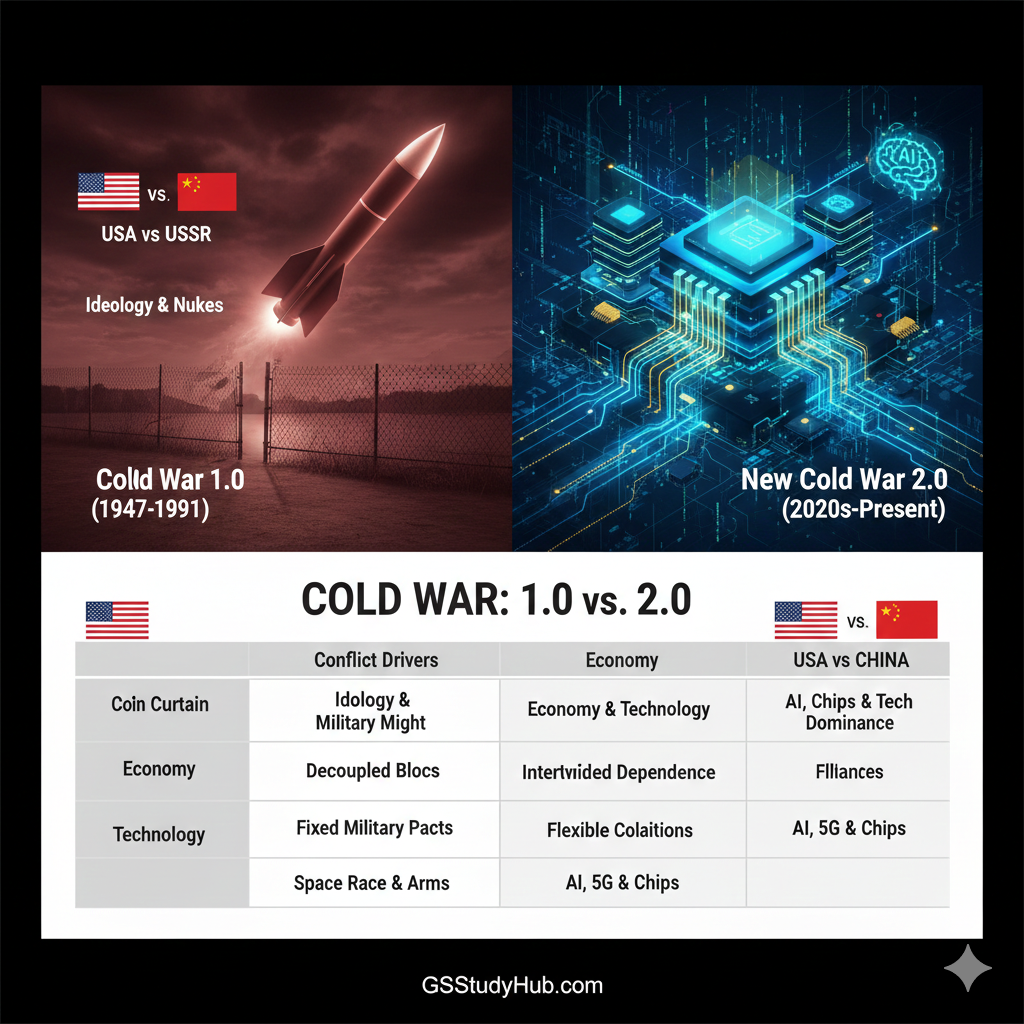
🆚 The Great Comparison: 1.0 vs. 2.0
| Feature | The Old Cold War (1947-1991) | The New Cold War (2020s-Present) |
|---|---|---|
| Primary Rivals | USA vs. USSR | USA vs. China (Strategic Competition) |
| World Order | Bipolar: Two rigid blocks. | Multipolar: Rise of India, EU, & Middle East. |
| Conflict Nature | Ideological: Capitalism vs. Communism. | Technological: AI, Chips, & Supply Chains. |
| Alliance System | Explicit Military Blocks (NATO/Warsaw). | Flexible & Overlapping (BRICS, Quad, SCO). |
| Economy | Decoupled (No trade between blocks). | Hyper-Interdependent (Deep trade ties). |
I. Why Today’s Conflict is "Fluid"
Unlike the 1960s, where nations had to choose a side, today we live in an era of "Multi-alignment." Most countries in the Global South maintain deep security ties with the West while keeping critical trade channels open with China. There are no longer "Iron Curtains," but rather "Digital Walls" and "Trade Barriers."
II. The New Frontlines: Technology & Supply Chains
The weapons of choice have shifted from nuclear warheads to Semiconductors and Data Algorithms. Control over the global supply chain for Lithium or the manufacturing of AI chips is the new "Arms Race."
III. De-dollarization & Financial Warfare
Financial sanctions have become the "nuclear option" of modern diplomacy. In response, the Global South is aggressively pursuing De-dollarization, seeking to settle trade in local currencies to bypass Western financial leverage. This economic friction is a defining characteristic of the 2.0 era.
IV. Conclusion: India's Strategic Autonomy
In this "New Cold War," India acts as a Stabilizing Power. By refusing to join a specific block, India leverages its position to lead the Global South while maintaining high-tech partnerships with the West. This "Strategic Autonomy" is the blueprint for thriving in a fragmented world.
To understand how geopolitical tensions are disrupting global supply chains and commerce, read our analysis on Red Sea Crisis 2026 – Global Trade Impact & Strategic Insights, which explains key causes, global repercussions and economic implications.
China's Grand Ambition:
The Strategy of Global Redesign
I. The Belt and Road Initiative (BRI)
The BRI is the centerpiece of China’s foreign policy—a multi-trillion dollar infrastructure project that functions as a 21st-century Silk Road. It connects China with Asia, Europe, and Africa through a massive network of ports, railways, and highways.
● Geopolitical Leverage: By funding infrastructure in developing nations, China gains significant political influence, often leading to "Debt-Trap Diplomacy."
● Strategic Access: Control over ports like Gwadar (Pakistan) and Hambantota (Sri Lanka) allows China to project maritime power far beyond its shores.
II. Challenging Dollar Hegemony
Xi Jinping is leading a global charge for De-dollarization. By creating alternatives to the Western-dominated SWIFT system, China aims to insulate itself and its allies from US-led sanctions.
- Petroyuan: China is encouraging major oil producers like Saudi Arabia and Russia to settle trades in the Yuan instead of the Dollar.
- Digital Yuan (e-CNY): The rollout of a sovereign digital currency allows China to facilitate international trade without relying on Western financial infrastructure.
III. Leading the Global South via BRICS+
China is the primary architect behind the expansion of BRICS. By transforming the group into a "G7 Alternative," China positions itself as the natural leader of the developing world.
Institutional Rivalry
Through the New Development Bank (NDB), China provides a credit alternative to the IMF and World Bank, reducing the West's ability to dictate global financial terms.
Political Alignment
China uses expanded BRICS to build a coalition that resists Western "values-based" diplomacy, focusing instead on "Sovereign Equality."
IV. The Tech Frontier: A Strategic Challenge
The rivalry with the West has moved into the "Fourth Industrial Revolution." China is investing billions to dominate the standards for AI, Quantum Computing, and 6G. Its monopoly over Rare Earth Minerals processing gives it a stranglehold on the global Green Energy transition.
V. Conclusion: The Roadmap to 2049
China’s "National Rejuvenation" goal for 2049 seeks to establish it as the preeminent global power. For the West and neighbors like India, this represents a fundamental strategic challenge. Countering China requires not just military strength, but a robust alternative to its economic and technological offerings.
🤖 To explore how AI and tech competition are influencing global power dynamics, discover AI Arms Race – US-China Tech War & Global Power Shift for insights and key implications.
India's Balance Strategy:
The Era of Multi-Alignment
I. From Non-Alignment to Multi-Alignment
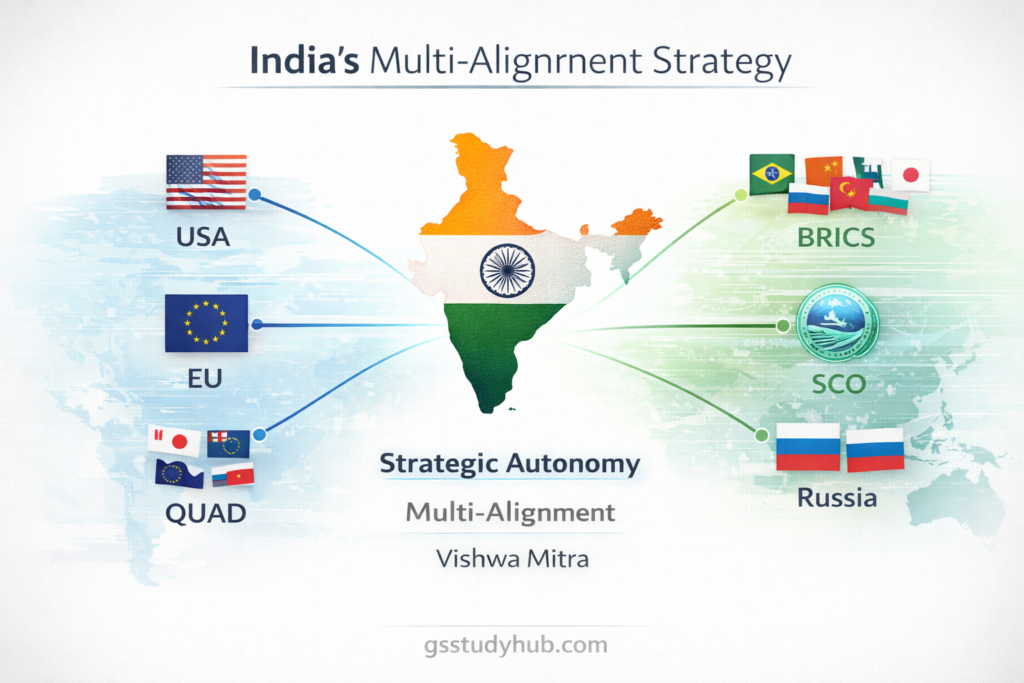
In the 20th century, India’s "Non-Alignment" was often perceived as keeping a distance from power blocs. Today, Multi-Alignment means engaging with all major powers simultaneously to secure India’s national interest. It is a strategy of Strategic Autonomy—choosing partners based on the issue rather than the ideology.
II. Balancing the Titans: Russia vs. the West
India’s most impressive diplomatic feat is maintaining deep-rooted ties with Russia while building a futuristic strategic partnership with the United States.
Russia: The Time-Tested Ally
Despite Western pressure, India maintains defense cooperation (S-400 deals) and energy ties with Russia. This ensures a stable Eurasian frontier and reliable energy security for 1.4 billion people.
USA: The Strategic Partner
Simultaneously, India has elevated its ties with the US to a "Comprehensive Global Strategic Partnership," focusing on iCET (Initiative on Critical and Emerging Technology), space exploration, and Indo-Pacific security.
III. A Member of Every Table
India’s presence in conflicting groups showcases its unique position as a Global Bridge:
- BRICS & SCO: Engaging with China and Russia to amplify the voice of the Global South.
- G20 & QUAD: Collaborating with the West (US, Japan, Australia) to ensure a "Free and Open Indo-Pacific."
IV. Strategic Consistency
| Vertical | Strategy | National Interest |
|---|---|---|
| Defense | Diversifying from Russia to France & USA | Self-reliance (Atmanirbhar Bharat) |
| Economy | Trade with both West and East | Becoming a $5 Trillion Economy |
| Diplomacy | Leading the Global South | UNSC Permanent Seat Claim |
V. Leading the Global South
India’s balance policy isn't just about managing superpowers; it’s about empowering the developing world. By including the African Union in the G20, India proved it is the credible leader that can bridge the gap between the "High-Income West" and the "Emerging South."
Conclusion: The "Indispensable" Power
India’s policy is a masterclass in pragmatism. By practicing Multi-Alignment, India ensures that it is not a pawn in the "New Cold War," but a grandmaster on the global chessboard. This policy provides the stability India needs to focus on its domestic growth while becoming an indispensable pillar of the new world order.
🌍 For historical lessons that shape current global power plays, explore Lessons from The Cold War for Today’s Geopolitics for key insights and strategic takeaways.
Dollarization vs. De-dollarization:
The Battle for Global Currency Supremacy
I. Understanding the Shift: What is De-dollarization?
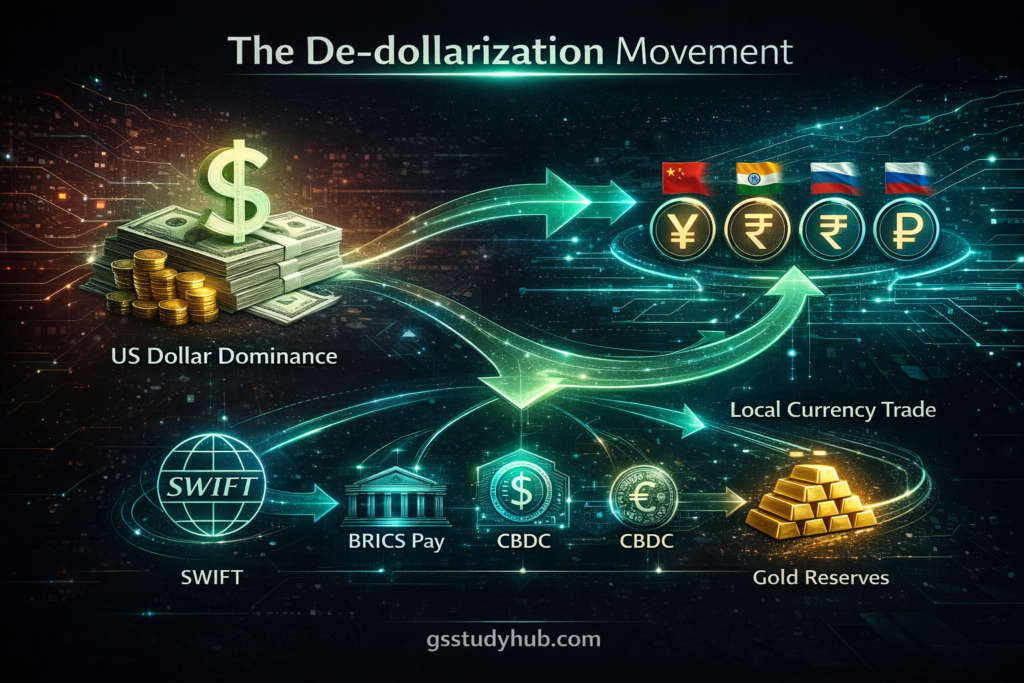
De-dollarization is the process of reducing a country's reliance on the US Dollar as a reserve currency, a medium of exchange, and a unit of account. For decades, the world accepted the Dollar's dominance as a given. However, the "Weaponization of Finance" has fundamentally altered this perception.
II. The Trigger: Western Sanctions & Financial Warfare
The turning point occurred after the Russia-Ukraine conflict, when Western powers froze nearly $300 billion of Russia's foreign reserves and cut off its banks from the SWIFT system. This sent a shockwave through the Global South. Nations realized that if their interests clashed with the West, their wealth could be rendered inaccessible overnight.
Weaponized Finance
Using the dollar as a tool for sanctions has turned it from a "neutral global asset" into a geopolitical lever, forcing nations to find alternatives.
Sino-Russian Synergy
China and Russia now conduct over 90% of their bilateral trade in Yuan and Rubles, successfully creating a "Dollar-free" trade zone.
III. BRICS & The Alternative Payment Architecture
The expanded BRICS+ block is leading the charge in building a parallel financial universe. The goal is simple: Autonomy.
- BRICS Pay: A decentralized multicurrency digital payment system aimed at bypassing Western-controlled payment rails.
- Local Currency Trade: India and the UAE have begun settling oil trades in Rupees/Dirhams, signaling that even "Petrodollars" are no longer the only option.
- CBDCs: Central Bank Digital Currencies are providing the technical infrastructure to settle international trades instantly without a third-party intermediary like a US-based clearinghouse.
IV. Strategic Comparison: The Old vs. The New
| Economic Indicator | Dollar Dominance Era | The De-dollarization Era |
|---|---|---|
| Reserve Strategy | High USD Concentration | Diversification into Gold & Yuan |
| Payment Infrastructure | SWIFT (Western Managed) | Local Payment Systems (CIPS, UPI) |
| Geopolitical Impact | Unipolar Stability | Economic Polarization (Two Blocs) |
V. The Future: Economic Polarization?
Is the Dollar's reign over? Not quite yet. The Dollar still accounts for roughly 50% of global trade invoicing and remains the world's most liquid asset. However, we are moving toward a Bifurcated Global Economy. One side will remain dollar-centric (The West), while the other (The Global South) will operate in a multicurrency, digital-first environment.
Strategic Risks
This polarization increases transaction costs and creates financial friction. However, for nations seeking Strategic Autonomy, this is a price worth paying to avoid the threat of total financial exclusion.
🌍 For an in-depth look at NATO’s strategy and its broader global consequences, explore NATO Strategy in Eastern Europe & Its Global Impact.
Potential Threats: Navigating a Fragmented World Order
I. Global Supply Chain Fragmentation
The era of hyper-globalization, where efficiency and cost were the only priorities, is ending. Geopolitical rivalry has weaponized trade, forcing a massive shift in how the world produces and moves goods.
Just-in-Case Model
Companies are moving from "Just-in-Time" (efficiency) to "Just-in-Case" (security), leading to higher costs and global inflationary pressures.
Friend-Shoring
Nations are now restricting trade to "trusted partners," effectively breaking the world into competing trade blocs that reverse decades of free-market progress.
II. The Formation of Technology Blocs
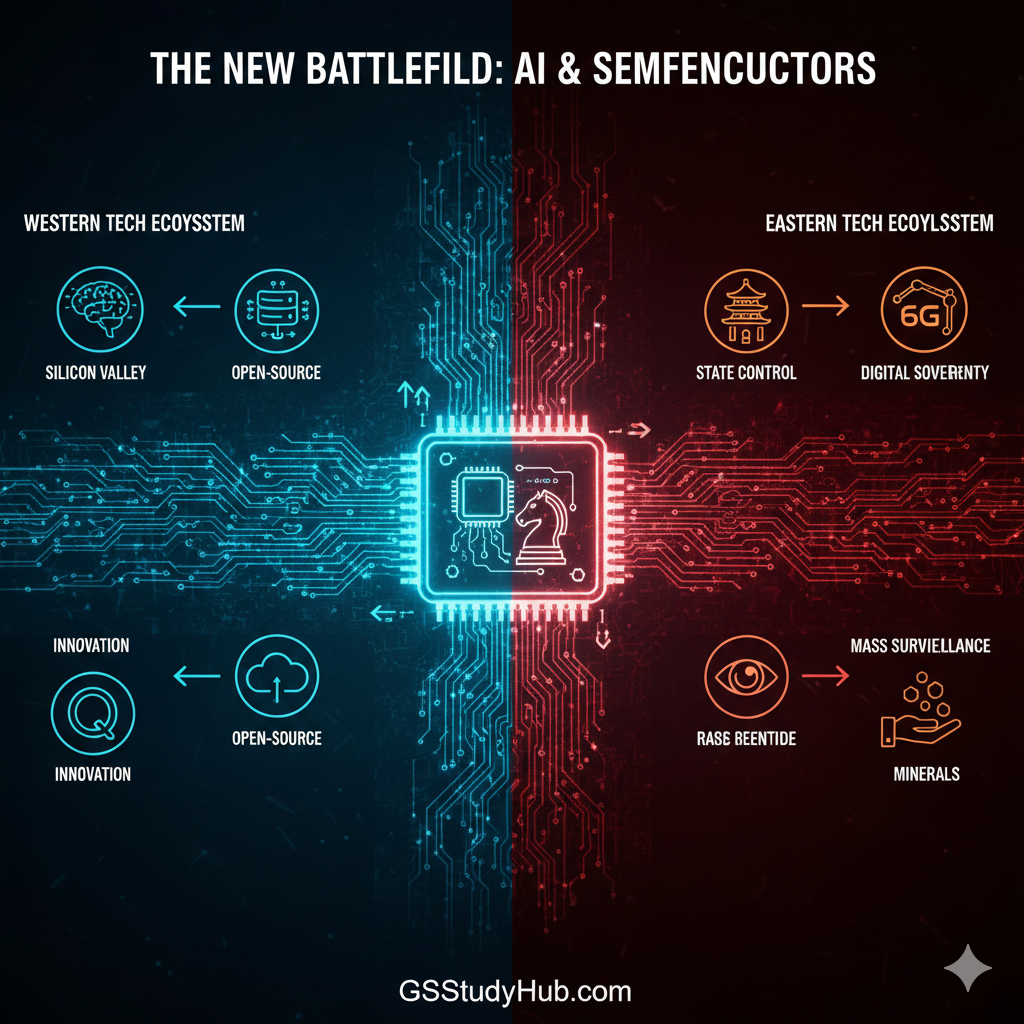
A "Digital Iron Curtain" is descending. The battle for the future is being fought in semiconductor labs and server rooms. We are seeing the emergence of two distinct tech ecosystems:
- Western Ecosystem: Led by the US, focusing on democratic values, strict data privacy, and open-market standards.
- Eastern Ecosystem: Led by China, centered on "Digital Sovereignty," state-controlled infrastructure, and domestic tech self-reliance.
This Bifurcation means that in the near future, everything from 6G networks to AI algorithms may be incompatible between these two blocs.
III. Escalating Geopolitical Tensions
The friction between the Global South and the West is intensifying regional flashpoints. When superpowers compete, regional conflicts often turn into Proxy Wars, fueled by competing strategic interests.
| Region of Concern | Primary Driver | Global Impact |
|---|---|---|
| Indo-Pacific | Control of Maritime Routes | Disruption of 60% of Global Trade |
| The Middle East | Energy & Strategic Transit | Oil Price Volatility & Inflation |
| Eastern Europe | Territorial Expansionism | Complete Shift in European Security |
IV. The Probability of Full-Scale Military Conflict
Despite these rising threats, experts agree that a full-scale military confrontation between major powers remains unlikely. Several factors act as a "strategic brake" on total war:
- Nuclear Deterrence: The "Mutually Assured Destruction" (MAD) principle still makes direct war a suicidal option for all parties.
- Economic Interdependence: Despite the talk of "decoupling," the major economies are too deeply intertwined. A total war would mean instant economic collapse for both the victor and the vanquished.
- The Rise of Hybrid Warfare: Cyber-attacks and economic sanctions offer a way to inflict massive damage without the high political and human cost of a kinetic war.
Conclusion: A World of High Friction
We are entering a world that is more expensive, more divided, and more volatile. For emerging powers like India, the challenge is to navigate these "Tech and Trade Blocs" without losing strategic autonomy. Success in this era will depend on being strategically agile rather than just militarily strong.
🌏 For comprehensive insights into how BRICS expansion is reshaping global order and economic influence, check out BRICS Expansion and the Changing World Order – Full Analysis.
Frequently Asked Questions
G7: A group of advanced Western economies that currently lead the global financial infrastructure.
🌏 For an in-depth look at the diplomatic strategy and future trajectory of India-China ties, explore India-China Relations: Diplomatic Strategy & Analysis.
Conclusion: New Cold War or
A New World Order?
Whether temporary or structural, the Global South vs West New Cold War debate will define geopolitical discourse in the coming decade.I. Why It Is Not a Traditional Cold War
The 20th-century Cold War was defined by "Decoupling"—two worlds that didn't trade, didn't talk, and didn't share technology. Today, the world is Hyper-Interdependent. Even the fiercest rivals are bound by shared supply chains and massive trade volumes. This tension is not about total destruction, but about Strategic Supremacy.
Strategic Competition
The new battlefield is made of Silicon and Algorithms. Dominance is now measured by AI breakthroughs, 6G networks, and semiconductor self-reliance.
Multipolar Dynamics
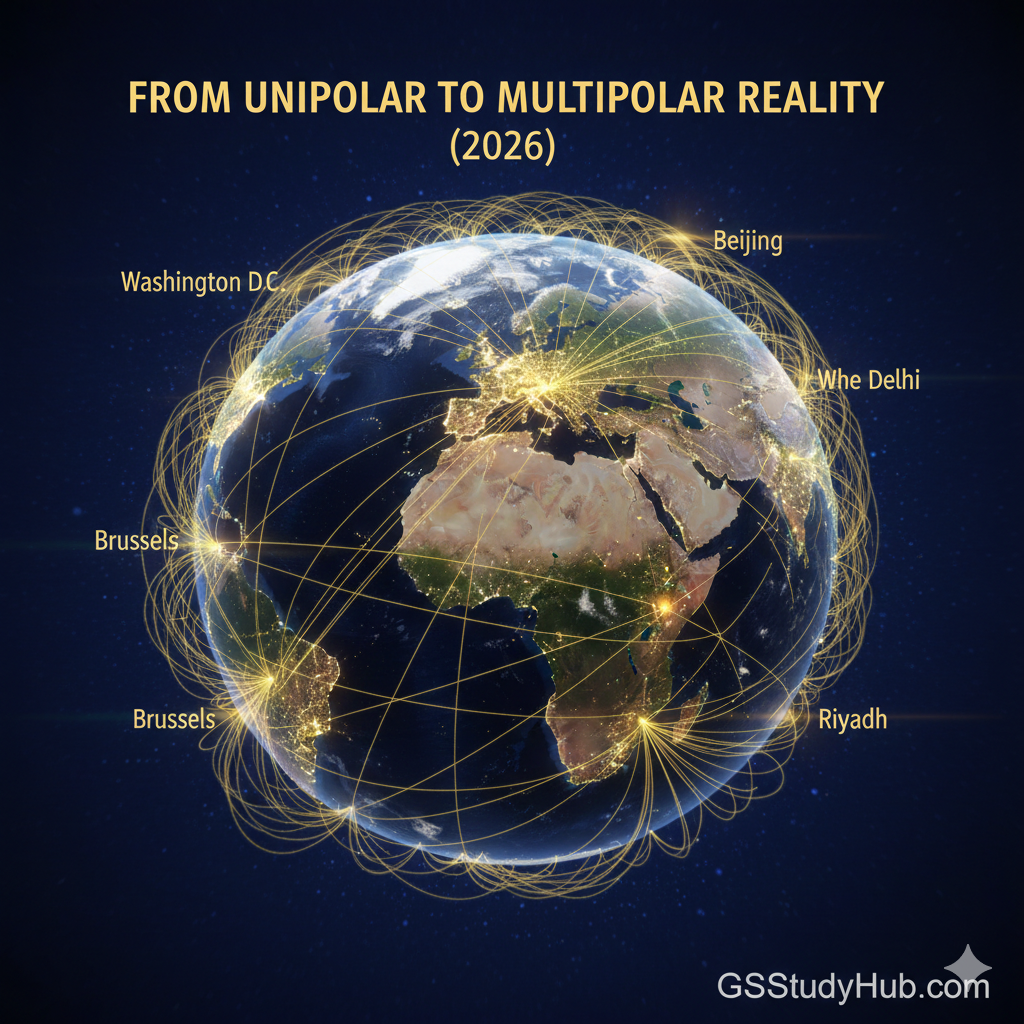
Unlike the bipolar past, today we have multiple poles. Power is distributed across Washington, Beijing, New Delhi, Brussels, and Riyadh.
II. The Collective Voice of the Global South
The most significant shift in 2026 is the Sovereign Resurgence of the Global South. Developing nations are no longer passive bystanders in great-power games. They are leveraging their resources, demographics, and market size to demand institutional reforms.
- Autonomy: The South is pursuing "Strategic Autonomy," refusing to be coerced into joining any single bloc.
- Reform: The inclusion of the African Union in the G20 and the expansion of BRICS signal the end of the exclusive "G7 Era."
III. A World of High Friction
While a full-scale military conflict remains unlikely due to the high cost of economic suicide, we are entering an era of Continuous Friction. This will manifest as trade barriers, cyber skirmishes, and currency competition. Success will depend on Multi-Alignment—the ability to engage with everyone without losing one's own identity.
The Final Verdict
This is not a Cold War; it is a Global Redesign. The era of the "Single Superpower" has evolved into a "Shared World Order." It is a future that is more expensive and more fragmented, but also more inclusive of the majority of the world's population.