
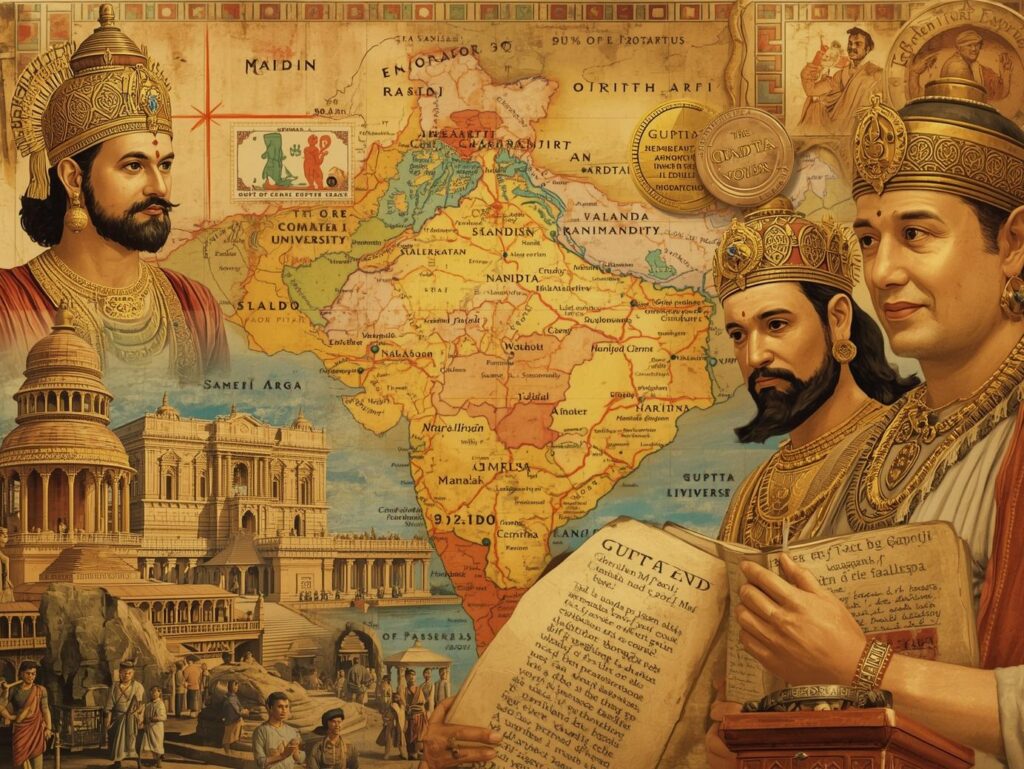
The Gupta Period (320–550 A.D.) — India’s Golden Era
The Gupta Period (c. 320–550 A.D.) is regarded as one of the most important eras in ancient Indian history — often called a "Golden Age." It was a time of political stability, economic prosperity, and significant development in arts, literature, science, and culture.
Establishment of the Gupta Empire
The Gupta Empire was established by Chandragupta I around 320 A.D., with his capital at Pataliputra (present-day Patna). Chandragupta I strengthened his position through marriage to Kumaradevi, a princess of the Licchavi lineage, which created a strong political alliance and added prestige to the emerging Gupta dynasty.
Chandragupta I (reign: 320–335 A.D.)
Chandragupta I is credited with founding the Gupta Empire. He adopted the title "Mahādhirāja," indicating his high status and authority. During his reign the Guptas consolidated power in key regions such as Magadha, Prayaga (Allahabad), and Saketa (Ayodhya), often by asserting taxation rights and political influence.
Coins and Symbolism
Under Chandragupta I, gold and other coins were issued. Some coins bore the images of Chandragupta and Kumaradevi, reflecting the political alliance and royal authority.
Importance of the Foundation
The establishment of the Gupta Empire marked the beginning of an era considered central to the chronology of ancient India. It laid the foundation for a well-organized and powerful state that would contribute significantly to India’s cultural and intellectual development.
Major Rulers
Chandragupta I (320–335 A.D.)
Founder of the Gupta dynasty who consolidated and enhanced political strength through strategic alliances and governance.
Samudragupta (335–375 A.D.)
Often compared to a military genius in Indian history, Samudragupta led numerous victorious campaigns and significantly expanded the empire. His reign is noted for both military success and patronage of culture.
Chandragupta II (Vikramaditya) (375–415 A.D.)
Chandragupta II's reign saw flourishing art and culture. The Chinese pilgrim Fa-hien (Faxian) traveled in India during a later period and described the prosperity and stability of the region.
Kumaragupta I (415–455 A.D.)
During Kumaragupta I's reign, Nalanda University was established, marking a major milestone for higher education and Buddhist learning.

Popular Amazon Product
A trusted choice with great performance, excellent build quality and positive customer feedback — ideal for daily use and long-term satisfaction.
Check Price on AmazonSkandagupta (455–467 A.D.)
Skandagupta successfully confronted invasions by the Huns and worked to defend the empire during a period of external pressure.
Key Features of the Gupta Period
1. Politics and Administration
The Gupta state was characterized by a relatively centralized administration. The empire was divided into provinces for effective governance, and a reasonably organized revenue system supported state functions.
2. Economic Development
Trade and agriculture developed during this period. Gold coins (dinars) and silver coins were widely used, reflecting economic prosperity and the monetization of the economy.
3. Literature and Education
The Gupta Age saw remarkable literary and scholarly activity. Notable works and contributions include:
- Kalidasa — author of dramatic and poetic works such as Abhijñānaśākuntalam, Meghadūta, and Raghuvaṃśa.
- Amarasimha — compiler of the lexicon Amarakosha.
- Vishnu Sharma — traditionally credited with composing the Pañchatantra.
4. Art and Architecture
Gupta sculpture and architecture reached high levels of refinement. Important monuments and cave complexes associated with this era include the Ajanta caves and works at Sarnath and Udayagiri, which reflect the period’s artistic excellence.
5. Religion and Culture
The Gupta period witnessed a revival and consolidation of Hinduism, with popular worship of deities such as Viṣṇu and Śiva. Buddhism and Jainism continued to receive patronage and support as well.
Decline and Downfall
The decline of the Gupta Empire had several causes. Repeated invasions by the Hunas (Huns) weakened the empire, and weak successors along with internal rebellions further contributed to its collapse.
Conclusion
The Gupta Period (320–550 A.D.) remains one of the most important eras in Indian history from cultural, literary, and scientific perspectives. Often termed India’s "Golden Age," this period made lasting contributions to the subcontinent’s civilization.
Quick summary
The Gupta dynasty, founded by Chandragupta I around 320 A.D., produced several notable rulers — Samudragupta, Chandragupta II (Vikramaditya), Kumaragupta I, and Skandagupta — under whom India experienced a high degree of cultural and intellectual flourishing before decline due to external invasions and internal weaknesses.

Chandragupta I (320–335 A.D.)
Chandragupta I was the founder of the Gupta Empire, and his reign is considered a turning point in Indian history. He laid the foundation of a powerful empire that later brought stability and prosperity to the Indian subcontinent.
1. Establishment of Power
Around 320 A.D., Chandragupta I established the Gupta Empire. Before his rise, the Gupta lineage was only a local power, but he transformed it into a major empire.
- He gained control over important regions such as Magadha, Prayag (present-day Allahabad), and Saket (Ayodhya).
- The core territory of his empire lay in the fertile Ganges region, which was crucial for agriculture and trade.
2. Marriage with Licchavi Princess
Chandragupta I married Kumaradevi, a princess of the Licchavi lineage. This marriage had strong political significance:
- He received support and prestige from the powerful Licchavi clan.
- The Licchavi territories in Vaishali and northern Bihar strengthened the Gupta Empire’s expansion.
3. Title of "Mahadhiraja"
He assumed the title “Mahadhiraja” (the Great King), which reflects his growing power and expanding dominion.
4. Coins and Currency
During his reign, Chandragupta I issued gold coins. Many coins featured images of himself and Queen Kumaradevi, symbolizing political alliance and prosperity.
5. Capital at Pataliputra
Pataliputra (modern Patna) served as the capital, functioning as an important administrative and cultural hub of the time.
6. Beginning of the Gupta Era
Chandragupta I is believed to have started the Gupta Era, an important chronological system in ancient India.
7. Administrative System
- A centralized administrative structure was adopted.
- The empire was divided into provinces for effective governance.
- Local administration was well organized and disciplined.
8. Religious and Cultural Policies
Although he supported Hinduism, his rule reflected religious tolerance. Buddhism and Jainism were also protected and respected.
9. Succession
After the death of Chandragupta I, his son Samudragupta ascended the throne and became one of the greatest monarchs of the Gupta dynasty.
Conclusion
Chandragupta I’s reign laid the strong foundation of the Gupta Empire. His leadership and political strategies helped shape the beginning of India’s Golden Age.
Samudragupta (335–375 A.D.)
Samudragupta, the son of Chandragupta I, is counted among the greatest rulers of Indian history. Known as the “Napoleon of India,” he was a brilliant conqueror, capable administrator, and patron of arts and culture.
1. Ascension to the Throne
It is believed that Samudragupta defeated his brother Ramagupta to claim the throne. His military talent and administrative ability made him one of the greatest Gupta rulers.
2. Military Campaigns and Victories
Details of his victories are recorded in the Prayag Prashasti (Allahabad inscription) written by his court poet Harishena.
(A) Northern Campaign
- Samudragupta defeated several northern kingdoms.
- He conquered 12 Aryavarta kings including Kosala, Padmaka, Malwa, and the ruler of Prayag.
(B) Southern Campaign
- He defeated many rulers of South India such as Kanchi, Pallava, Chera, and Pandya kings.
- He did not annex these states but allowed their rulers to govern in return for acknowledging his supremacy.
3. Prayag Prashasti (Allahabad Inscription)
This inscription is an important historical record describing Samudragupta’s military achievements, conquests, and policies. It is composed by Harishena.
Amazon Echo Dot
Smart speaker with Alexa — voice control for music, info, news & more. Compact, quality sound for daily smart home use.
Check Price on Amazon4. Diplomacy and Administration
- Samudragupta allowed conquered kings to retain their territories under Gupta suzerainty.
- He established an effective administrative system balancing control with regional autonomy.
5. Cultural and Artistic Contributions
- He was titled “Kaviraja” (King of Poets).
- He excelled in music and is often depicted playing the Veena on his coins.
6. Religious Tolerance
Samudragupta followed a policy of religious tolerance and supported various faiths. Chinese traveler Fa-Hien also mentioned his generosity toward Buddhism.
7. Coins and Currency
He issued several types of coins, depicting him as a warrior, a Veena player, and a performer of the Ashwamedha Yagya.
8. Ashwamedha Yajna
Samudragupta performed the Ashwamedha Yajna to celebrate his victories. Special coins were issued to commemorate this event.
9. Foreign Relations
The king of Sri Lanka sought Samudragupta’s permission to build a Buddhist monastery in India, indicating his influence abroad.
10. Death and Succession
After Samudragupta’s death, his son Chandragupta II (Vikramaditya) succeeded him and further strengthened the empire.
Conclusion
Samudragupta’s reign represents the height of the Gupta Empire’s power and prestige. His military achievements, diplomatic skills, and cultural patronage place him among the greatest rulers in Indian history.
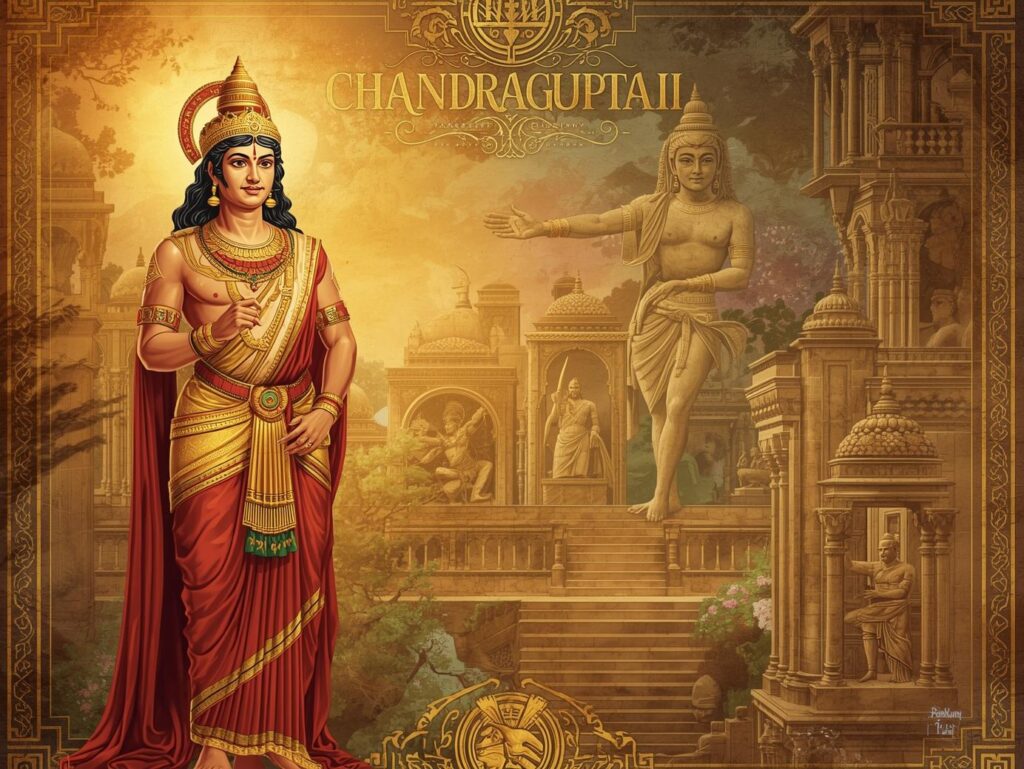
Chandragupta II (Vikramaditya) (375–415 A.D.)
Chandragupta II, also known as Vikramaditya, was one of the greatest and most celebrated rulers of the Gupta Empire. His reign is regarded as the peak of the Indian Golden Age. He strengthened the empire politically, culturally, and militarily.
1. Accession to the Throne
Chandragupta II was the son of Samudragupta. He gained power after defeating his elder brother Ramagupta, whose rule was considered weak. Using his capability and leadership, he revitalized the Gupta Empire.
2. Expansion of the Empire
During his reign, Chandragupta II significantly expanded the Gupta Empire. His most notable victories were over the Shaka Satraps.
(a) Victory over Shaka Satraps
- He defeated the Western Shaka Satraps and took control over Gujarat, Malwa, and Saurashtra.
- He made Ujjain an important capital, which soon became a major commercial and cultural center.
- This victory earned him the famous title “Vikramaditya.”
3. Administration and Justice
- Chandragupta II established a strong and just administration.
- His reign was known for peace, stability, and prosperity.
- He organized the taxation system and local administration with great efficiency.
- Justice was symbolically represented as a divine virtue in his empire.
4. Foreign Relations
During his reign, the Chinese pilgrim **Fa-Hien (Faxian)** visited India. He praised the peace, prosperity, and religious tolerance of the Gupta Empire.
International trade relations also flourished with Rome, China, and Southeast Asian regions.
5. Cultural and Scientific Contributions
(a) Navratnas (Nine Gems)
Chandragupta II’s court was adorned with great scholars, poets, and scientists known as the “Navratnas,” including:
- Kalidasa – Greatest Sanskrit poet and playwright (works: Abhijnanashakuntalam, Meghdoot)
- Varahamihira – Renowned astronomer and astrologer
- Aryabhatta – Great mathematician and astronomer
- Dhanvantri – Pioneer of Ayurveda
- Amarasimha – Author of the famous lexicon Amarakosha
(b) Literature and Art
Under Chandragupta II, Sanskrit literature reached new heights through Kalidasa. Art and architecture flourished, especially in sculpture and temple construction.
(c) Coins
He issued gold and silver coins depicting himself performing Ashwamedha Yajna, holding weapons, and other symbolic postures.
6. Religious Policy
- He strongly supported Hinduism, especially the worship of Vishnu and Shiva.
- He maintained religious tolerance and respected Buddhism and Jainism as well.
7. Fa-Hien’s Account
Fa-Hien’s writings describe Chandragupta II’s reign as a period of peace, prosperity, and justice. Crime was low, and people lived in harmony.
8. Ashwamedha Yajna
To demonstrate his power, Chandragupta II performed the Ashwamedha Yajna and issued special coins to commemorate the event.
9. Succession
After his death, his son Kumaragupta I succeeded him and continued strengthening the Gupta Empire.
10. Conclusion
Chandragupta II’s reign represents the climax of the Gupta Empire. His victories, strong administration, cultural achievements, and prosperity justify his title “Vikramaditya” and make his era the true Golden Age of India.
Kumaragupta I (415–455 A.D.)
Kumaragupta I, the son of Chandragupta II (Vikramaditya), was an important Gupta ruler. His period witnessed stability, prosperity, and progress in administration, education, and religion.
1. Accession to the Throne
After the death of Chandragupta II in 415 A.D., Kumaragupta I ascended the throne. His mother was Queen Dhruvadevi. He maintained the empire’s strength and stability with skill.

Featured Amazon Product
A reliable and high-quality choice with excellent performance and strong customer satisfaction — perfect for everyday use and trusted results.
Check Price on Amazon2. Security and Expansion of the Empire
- Kumaragupta protected and maintained the vast boundaries of the Gupta Empire.
- Though his reign witnessed external invasions and internal revolts, he handled them efficiently.
The Huns' Invasion
Toward the end of his reign, the Huns invaded India. Although Kumaragupta resisted, the final defeat of the Huns was later achieved by his successor Skandagupta.
3. Establishment of Nalanda University
Kumaragupta I is credited with founding the world-famous Nalanda University.
- Nalanda became a major center of Buddhist learning.
- Students from India and abroad came to study religion, science, mathematics, and astronomy.
4. Religious Policy and Ashwamedha Yajna
- He supported Hinduism and especially worshipped Kartikeya (Skanda).
- He performed an Ashwamedha Yajna to demonstrate his power and imperial status.
5. Coins and Currency
Kumaragupta issued several coins showing his military and religious achievements.
- Coins bearing the image of Kartikeya became famous.
- Coins issued after the Ashwamedha Yajna were also notable.
- Titles like “Mahendraditya” and “Shri Kumaragupta” appeared on his coins.
6. Administration and Justice
- He strengthened the administration and improved the taxation system.
- His reign is noted for peace, prosperity, and efficient justice.
7. Succession
After Kumaragupta I, his son Skandagupta took over the throne. Skandagupta successfully repelled the Huns and preserved the Gupta Empire.
8. Conclusion
Kumaragupta I’s reign was marked by prosperity, cultural development, and administrative excellence. His contributions to education, religion, and military strength make his rule an important part of the continuing Golden Age of the Gupta Empire.
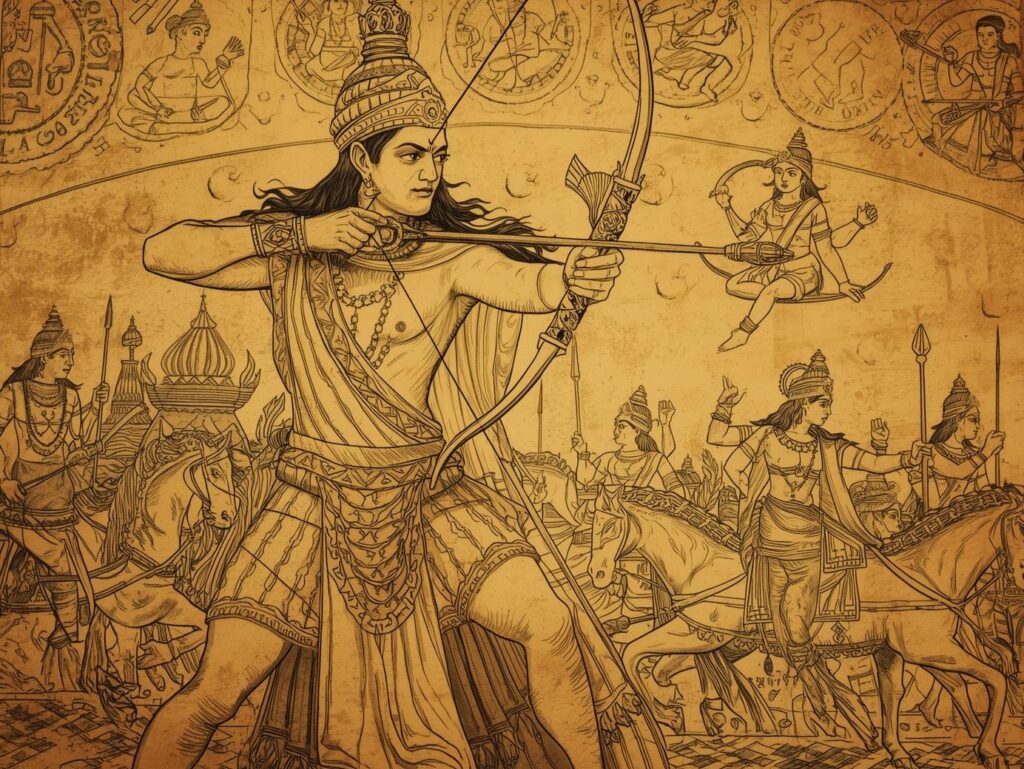
Skandagupta (455–467 A.D.)
Skandagupta, who ruled from 455 to 467 A.D., is considered the last great ruler of the Gupta Empire. His reign was marked by severe challenges, especially the invasions of the Huns, which threatened the very foundation of the empire. Through his bravery and military skill, Skandagupta protected the Gupta kingdom and secured a distinct place in Indian history.
1. Accession to the Throne
Skandagupta was the son of Kumaragupta I. Historical evidence suggests that he faced conflict during succession:
- He had to fight for the throne due to challenges from within the royal family.
- He defeated a rival (possibly his own brother) and ascended the Gupta throne as the rightful king.
2. Attacks of the Huns and Skandagupta’s Victory
The greatest achievement of Skandagupta’s reign was his victory over the Huns, especially the fierce Huna chief Toramana.
- Around 455–456 A.D., the Huns invaded the Gupta Empire.
- Skandagupta defeated them decisively, preventing their incursion into the heart of the empire.
- This victory was extremely significant because the Huns had already destroyed several empires of Central and Western Asia.
- After this major triumph, Skandagupta was honoured with the title “Vikramaditya.”
3. Administrative Improvements and Challenges
Although Skandagupta successfully repelled external threats, he had to deal with multiple internal challenges:
- The Hunnic invasions weakened the economic condition of the empire.
- Skandagupta worked to reform and strengthen the taxation and administrative system.
- He improved the army and secured the empire’s frontiers.
4. Religious Policy
- Skandagupta was a follower of Hinduism and especially devoted to Lord Vishnu.
- His inscriptions carry the title “Param Bhagavata”, indicating deep devotion.
- Despite being a Hindu ruler, he maintained religious tolerance and respected Buddhism as well.
5. Coins and Currency
During his reign, Skandagupta issued gold, silver, and copper coins.
- Many of his coins depict him holding a bow and arrow, symbolizing strength and warrior spirit.
- The coins highlight his victories and military achievements.

Top Amazon Product
A highly rated and reliable product with strong performance and excellent user satisfaction — ideal for everyday use and trusted quality.
Check Price on Amazon6. Junagadh Inscription
One of the most important sources of Skandagupta’s reign is the Junagadh Inscription.
- It records his reconstruction of the ancient Sudarshana Lake.
- The inscription also reflects his administrative skills and concern for public welfare.
7. Death and Succession
Skandagupta died in 467 A.D. After his death, the Gupta Empire began to weaken rapidly.
- Continuous Hunnic invasions and internal revolts weakened the empire.
- His successors struggled to maintain stability, and the once-powerful Gupta Empire eventually declined.
8. Conclusion
Skandagupta is remembered as a courageous and capable ruler who defended the Gupta Empire during its most difficult period. His successful defeat of the Huns demonstrates his military brilliance. Although the empire declined after him, Skandagupta holds a special place as the last great emperor of the Gupta dynasty.
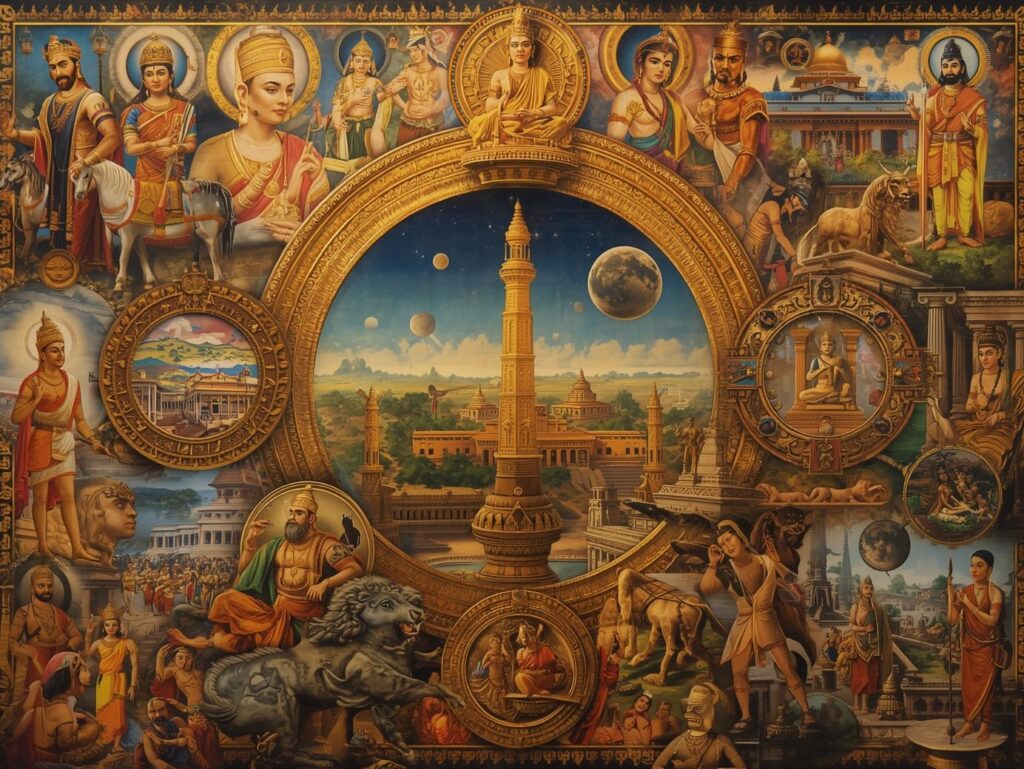
Features of the Gupta (Secret) Period
The Gupta Period (c. 320–550 A.D.) is widely regarded as the Golden Era of Indian history. During this age, India witnessed remarkable progress in civilization, culture, art, science, literature, and governance. The efficient administration and welfare policies of Gupta rulers gave this era a distinguished place in ancient Indian history.
1. Political Features
- The Gupta rulers established a strong central administration while allowing autonomy to local rulers.
- The government was monarchical, with the king regarded as supreme and often considered equal to divine authority.
- Rituals such as the Ashwamedha Yajna were performed to display imperial power.
- The empire extended from the Himalayan region in the north to the Narmada River in the south, and from Gujarat in the west to Bengal in the east.
2. Social Features
- The caste system became more rigid, though society remained relatively stable.
- The influence of Brahmins increased significantly in religious and social matters.
- The status of women declined, although they continued to be respected within families.
- Social practices like Sati and child marriage gradually began to appear.
3. Religious Features
- Hinduism emerged as the dominant religion of the period.
- Vaishnavism and Shaivism developed significantly, and worship of Vishnu, Shiva, Durga, and Lakshmi became widespread.
- Buddhism and Jainism continued to exist with state tolerance and support.
- The tradition of temple construction began during this era.
- There was religious harmony, and all faiths received protection.
4. Economic Features
- The Gupta period saw unprecedented growth in agriculture and trade.
- Internal and external trade flourished, especially with the Roman Empire, China, and Southeast Asia.
- Gold (Dinar), silver, and copper coins were widely used.
- Land grants became common, with Brahmins and temples receiving donated lands.
5. Education and Knowledge–Science
This period witnessed extraordinary advancements in education, science, and knowledge systems.
Major Education Centers
- Nalanda University – a world-renowned Buddhist learning center.
- Taxila – a major center of learning in northwestern India.
Contributions in Science
- Aryabhata – contributed greatly to mathematics and astronomy; author of the famous work Aryabhatiya.
- Varahamihira – renowned astronomer and astrologer; wrote Brihat Samhita.
- Dhanvantri – pioneer in Ayurveda.
- Charaka and Sushruta – authorities in ancient medical science.
- Nagarjuna – contributed to ancient chemistry.
6. Literature and Art
The Gupta Period is known for its exceptional development in literature and arts.
Literature
- Sanskrit literature flourished and became the official language of administration.
- Kalidasa, one of the greatest poets and playwrights, wrote Abhijnanashakuntalam, Meghaduta, and Raghuvansham.
- Visakhadatta wrote Mudrarakshasa.
- Amarasimha wrote the famous lexicon Amarakosha.
Art
- Sculpture and painting reached high levels of excellence.
- The Ajanta cave paintings are a major artistic achievement of this period.
- Buddha statues from Sarnath and Mathura became world-famous.

Featured Amazon Product
A reliable and highly recommended product with excellent build quality and strong performance — great for daily use and customer satisfaction.
Check Price on Amazon7. Temple Construction
- The Gupta period marked the beginning of temple architecture in India.
- The Nagara style of temple architecture developed.
- Important temples include the Bhitargaon Temple and the Dashavatara Temple (Deogarh).
- The temples displayed intricate sculptures and beautiful wall carvings.
8. Administrative Arrangement
- The administration was monarchical and well-organized.
- The empire was divided into provinces called Bhuktis, administered by high-ranking officers.
- Important officials included Mahadandanayaka and Amatyas.
- Land revenue was the main source of income.
- Local administration was strengthened for better governance.
9. Scientific Development
- The development of the concept of zero and the decimal system took place during this era.
- Aryabhata calculated the Earth's circumference and explained planetary motion.
- Metallurgy saw major progress, with the Iron Pillar of Delhi being a notable example—it remains rust-free even today.
Conclusion
The Gupta Period stands as one of the most glorious eras in Indian history. It witnessed extraordinary achievements in art, culture, science, religion, and literature. Due to the Gupta rulers' efficient administration, military strength, and cultural patronage, this period is rightfully known as the Golden Age of India.
Downfall of the Gupta (Secret) Empire
The decline of the Gupta Empire (c. 320–550 A.D.) is one of the major turning points in ancient Indian history. Although the Gupta Age is known as the Golden Era of India, by the end of the 5th century the empire gradually weakened and eventually collapsed. The downfall occurred due to a combination of internal and external factors.
Major Causes of the Downfall of the Gupta Empire
1. Attacks of the Huns
- The greatest external cause of the Gupta decline was the invasion of the Huns.
- The Huns were an aggressive Central Asian tribe that began attacking India in the late 5th century.
- Skandagupta defeated the Huns in 455 A.D., but the continuous invasions weakened the military and economy.
- After Skandagupta’s death, Huna leaders like Toramana and Mihirkula attacked again, causing severe destruction.
2. Internal Rebellions and Weak Successors
- The rulers after Skandagupta lacked leadership qualities.
- Weak rulers led to political instability across the empire.
- Provincial governors and local rulers began asserting independence.
- This internal rebellion weakened the unity and strength of the empire.
3. Economic Decline
- Continuous wars and Hunnic invasions drained the empire’s treasury.
- Trade and agriculture suffered, resulting in reduced revenue.
- Heavy taxation was imposed to maintain the military, causing public dissatisfaction.
- Land grants (mostly to Brahmins and temples) reduced state income and weakened the economic foundation.
4. Overexpansion of the Empire
- The Gupta Empire became too large to manage effectively.
- Maintaining control over distant regions became difficult.
- The administrative system weakened, and local rulers became more autonomous.
5. Decline of Military Strength
- Earlier Gupta rulers maintained a strong army, but later rulers failed to strengthen it.
- The standing army weakened due to frequent wars and lack of resources.
- Insufficient military power made it difficult to defend against foreign invasions.
6. Political Instability and Fragmentation
- Succession disputes increased during the later Gupta period.
- Several provinces declared independence from the central authority.
- The empire gradually broke into many smaller states.
7. Impact of Religious and Social Changes
- The increased dominance of Brahmanism and rigid social structure caused dissatisfaction among lower castes.
- The decline in popularity of Buddhism and Jainism weakened earlier social harmony.
- These religious and cultural shifts weakened societal unity.
8. Natural Disasters and Population Decline
- Some historians believe natural disasters such as droughts, famines, and diseases contributed to the empire’s decline.
- These factors reduced population and agricultural productivity.
Conclusion
The downfall of the Gupta Empire resulted from a combination of external invasions, internal conflicts, administrative weakness, and economic decline. The rulers after Skandagupta were unable to manage these challenges effectively. By the mid-6th century, the empire disintegrated completely. However, the cultural, scientific, and artistic achievements of the Gupta Era continue to be remembered as one of the most glorious phases in Indian history.

Featured Amazon Product
A quality product available on Amazon — click below to view full details, price and customer reviews on the Amazon listing.
Check Price on AmazonReferences
- R. C. Majumdar – The Classical Age (Bharatiya Vidya Bhavan, 1954)
- Romila Thapar – Early India: From the Origins to AD 1300 (Penguin Books, 2002)
- Upinder Singh – A History of Ancient and Early Medieval India (Pearson, 2009)
- D. N. Jha – Ancient India: An Introductory Outline
- K. A. Nilakanta Sastri – History of India
- Encyclopaedia Britannica – Gupta Dynasty
- National Portal of India
- Archaeological Survey of India (ASI)
- UNESCO World Heritage Centre – Ajanta Caves
- UNESCO World Heritage Centre – Ellora Caves