
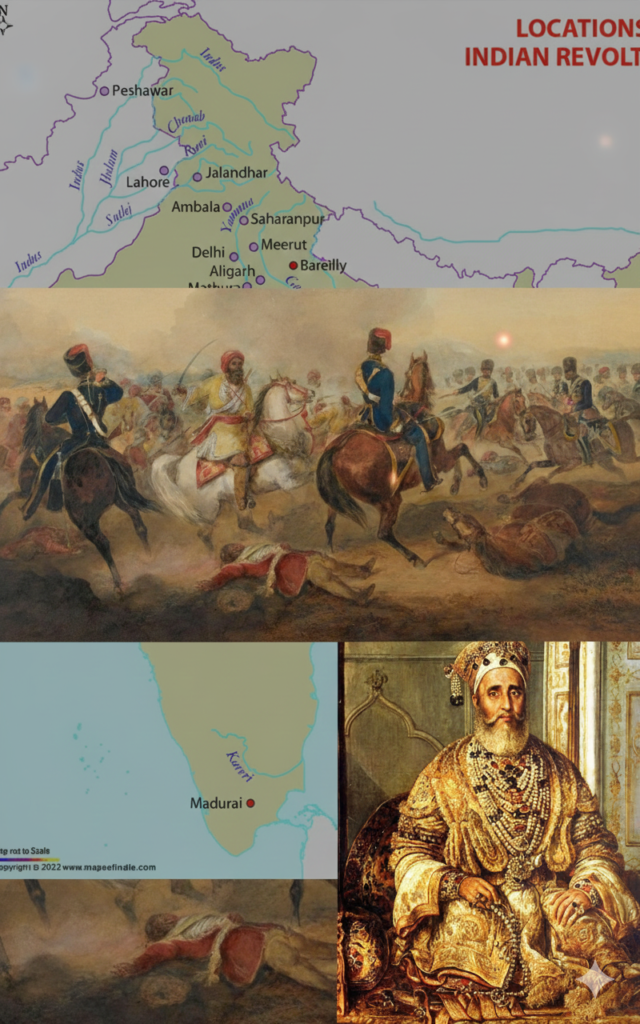
Revolt of 1857 — The First War of Independence
Overview
The Revolt of 1857 — often called the First War of Independence, the Sepoy Mutiny, or the Indian Rebellion of 1857 — was a widespread and significant uprising against the rule of the British East India Company. It began in Meerut on and gradually spread to many parts of India.
Main reasons for the revolt
Political reasons
- Doctrine of Lapse: Under this policy, princely states such as Jhansi, Satara, and Nagpur were annexed by the British, creating deep resentment among Indian rulers.
- The powers of many Indian rulers were curtailed, leaving them dissatisfied and politically vulnerable.

Amazon Choice Product
Premium quality • Customer favorite • Great value for money
- ✔ 100% Genuine Product
- ✔ Fast & Secure Delivery
- ✔ Easy Return Policy
Economic / Commercial reasons
- Heavy taxes were imposed on farmers; in many cases land was confiscated.
- Traditional artisans and traders lost livelihoods as cheap British manufactured goods flooded the market, making local products uncompetitive.
Social and religious reasons
- Some British reforms and social changes — often seen as being imposed by force — created anxiety (for example, changes connected to practices like Sati and the Widow Remarriage Act were perceived by many as cultural interference).
- There were widespread fears that the British intended to convert Indians to Christianity, which heightened communal anxieties.
Discontent in the Army
- Indian sepoys faced discrimination in pay, promotion, and treatment.
- A key immediate trigger was the controversy over the new Enfield rifle. The cartridges were rumored to be greased with cow and pig fat, which offended both Hindu and Muslim religious sensibilities and became a flashpoint for revolt.
Major events of the revolt
10 May 1857: Soldiers in Meerut revolted and marched to Delhi.
Bahadur Shah Zafar, the Mughal emperor in Delhi, was proclaimed a symbolic leader of the uprising.
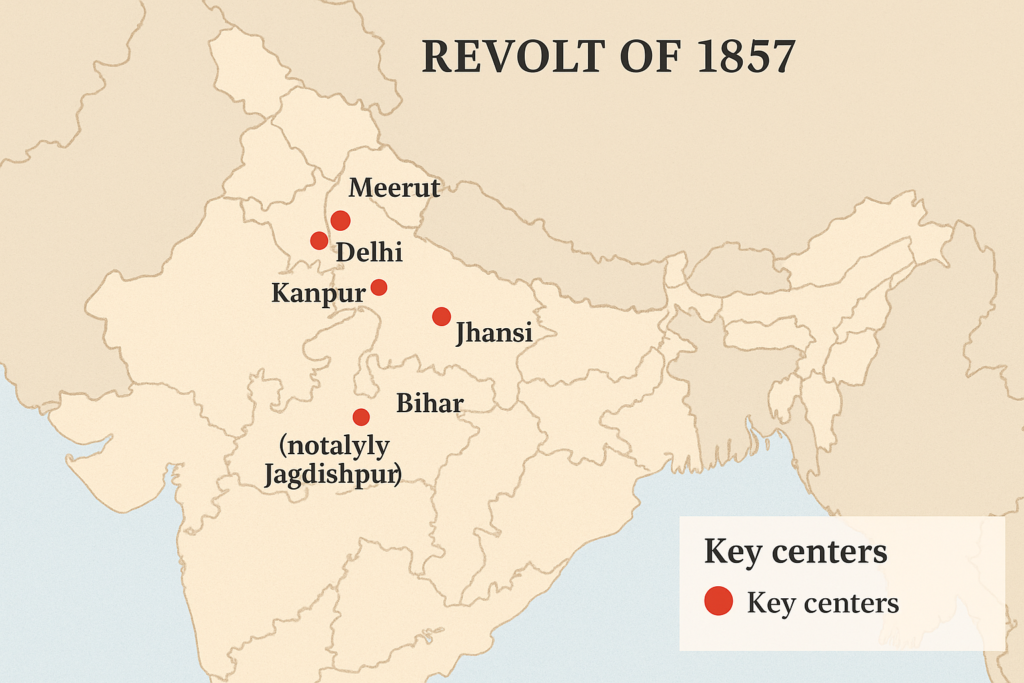
Key centers of the uprising
- Delhi
- Kanpur
- Jhansi
- Lucknow
- Bihar (notably Jagdishpur)
Prominent leaders
- Delhi: Bahadur Shah Zafar
- Kanpur: Nana Saheb, Tatya Tope
- Jhansi: Rani Laxmibai
- Lucknow: Begum Hazrat Mahal
- Bihar: Kunwar Singh
Why the revolt failed
- Lack of unified leadership: The uprising was not centrally coordinated and different regions fought independently.
- Insufficient resources: The rebels lacked modern weaponry, ammunition, and supplies compared to the British forces.
- Communication and coordination difficulties: Long distances and poor communication impeded joint action.
- Alliances: Several princely states and rulers supported the British or chose neutrality (for example, Hyderabad and Kashmir), denying the rebels crucial support.
Consequences of the uprising
- End of the East India Company: The British East India Company's rule formally ended in 1858; power transferred to the British Crown.
- Administrative reforms: The British government reorganized the army, administration, and revenue systems to prevent such revolts in the future.
- National awakening: The revolt fostered new political awareness and unity among many Indians; it is often seen as a foundational moment in India’s long struggle for independence.
- Legacy of sacrifice: The bravery and sacrifice of leaders such as Rani Laxmibai and Tatya Tope inspired later generations and strengthened the feeling of freedom in the hearts of Indians.
Conclusion
Main Reasons for the Revolt of 1857
📍 Main reasons of the Revolt of 1857 (Detailed Description)
The Revolt of 1857 was not a sudden or isolated event. It was the outcome of multiple political, economic, social, religious, and military factors that created widespread dissatisfaction across India. Let us understand these reasons in detail:
1. Political Reasons
The expansionist policies and unjust rule of the British East India Company created deep resentment among Indian kings and nawabs.
Doctrine of Lapse
- Lord Dalhousie implemented the Doctrine of Lapse, under which princely states without a legitimate heir were annexed by the British.
- States like Jhansi, Satara, Nagpur, and Awadh were merged into British rule.
- The famous quote by Rani Lakshmibai — “I will not give up my Jhansi” — became a strong symbol of protest.
Insult and Humiliation of Indian Rulers
- The prestige and authority of traditional Indian kings and nawabs were systematically weakened.
- Bahadur Shah Zafar was stripped of his position as the last Mughal emperor in Delhi.
- Indian kings were forced to live under British control, which caused deep dissatisfaction.
2. Economic Reasons
The exploitative economic policies of the British weakened the financial structure of Indian farmers, artisans, and traders.
Exploitation of Farmers
- Heavy and unfair tax systems were imposed on farmers, often exceeding their income.
- Land was confiscated if farmers failed to pay taxes.
- Farmers fell into debt traps, leading to poverty and starvation.
Top Rated Amazon Product
Trusted quality • Excellent performance • Great value for money
- ✔ 100% Genuine Product
- ✔ Amazon Delivered Fast
- ✔ Easy Return & Refund
Destruction of Artisans and Handicraft Industries
- The British ruined India’s traditional industries.
- Indian weavers lost employment due to cheap, machine-made British cloth.
- Metal, glass, textile, and other handicraft industries were badly affected.
British Business Policies
- The British opened Indian markets for their own products.
- Exports of Indian goods were restricted, weakening Indian merchants.
3. Social and Religious Reasons
The social reforms and religious interference of the British created fear and resentment in Indian society.
Opposition to Social Reforms
- Laws such as the abolition of Sati (1829) and the Widow Remarriage Act (1856) were seen as forced reforms.
- Although progressive, Indians perceived these reforms as interference in their traditions.
Religious Interference
- Many Indians believed the British wanted to convert them to Christianity.
- Missionary activities increased fears of forced conversion.
- Railways and telegraph systems were also viewed with suspicion as potential religious threats.
4. Military Reasons (Discontent Among Soldiers)
The British Army’s discriminatory policies created deep resentment among Indian soldiers (sepoys).
Discrimination and Injustice
- Indian soldiers received lower salaries than British soldiers.
- They faced limited promotion opportunities.
- Sepoys were posted in difficult and distant regions under harsh conditions.
The Greased Cartridges Issue
- A rumour spread that the Enfield rifle cartridges were coated with cow and pig fat.
- Cows were sacred to Hindus, and pigs were forbidden for Muslims.
- Cartridges had to be bitten open, which deeply hurt religious sentiments.
- This incident became the immediate spark of the revolt in Meerut.
5. Immediate Cause (Trigger Event)
- On 29 March 1857, Mangal Pandey attacked British officers in the Barrackpore cantonment.
- He was executed, which angered soldiers even more.
- On 10 May 1857, the soldiers of Meerut openly revolted, marking the official beginning of the movement across India.
Conclusion
The Revolt of 1857 was the outcome of anger and dissatisfaction across all sections of Indian society—farmers, soldiers, kings, merchants, artisans, and the common people. It was not merely a military rebellion but the first major collective uprising against British rule. It became a symbol of national unity and the growing desire for freedom.
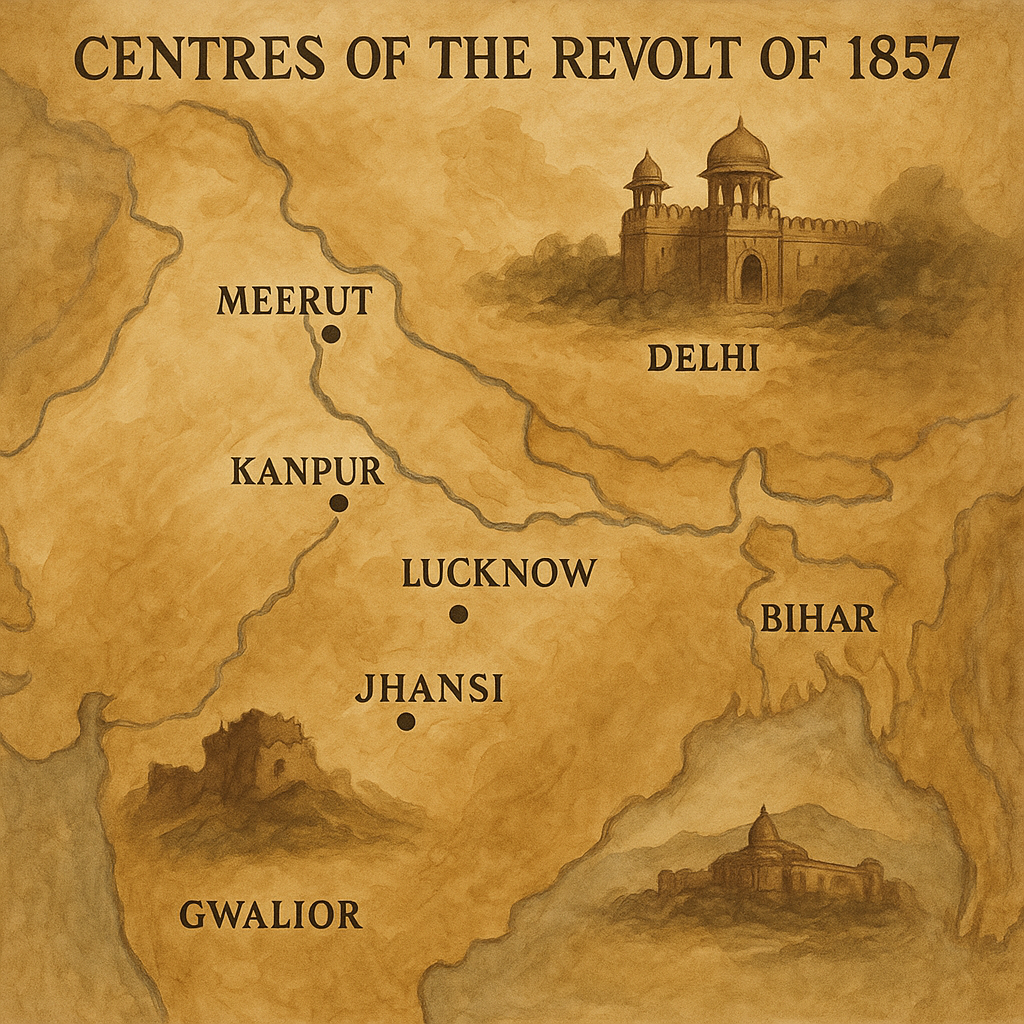
Major Events of the Revolt of 1857
📜 Major events of the Revolt of 1857 (Detailed Description)
The Revolt of 1857 spread rapidly across North India and was led by different leaders in different regions. Beginning from Meerut, it extended to major centres such as Delhi, Kanpur, Jhansi, Lucknow, Bihar, and Awadh. Below is a detailed sequence of the important events of the rebellion:
1. The Rebellion Begins at Meerut (10 May 1857)
- Date: 10 May 1857
- Event: Indian soldiers in Meerut revolted against British officers due to the cartridge controversy.
- Prominent Figures: Mangal Pandey (first instigator at Barrackpore), soldiers of Meerut.
- Rebel sepoys freed imprisoned soldiers and killed British officers.
- The soldiers then marched towards Delhi, spreading the fire of rebellion.
2. Rebels Capture Delhi (11 May 1857)
- Rebel soldiers reached Delhi and proclaimed Mughal Emperor Bahadur Shah Zafar as the Emperor of India.
- This gave the revolt a strong political leadership.
- Delhi became the main centre of the rebellion, but the British recaptured it by October 1857.
3. Cawnpore (Kanpur) Mutiny (June 1857)
- Prominent Leaders: Nana Saheb, Tatya Tope, Azimullah Khan.
- Nana Saheb expelled the British from Kanpur and declared himself Peshwa, attempting to revive Maratha pride.
- Sati Chaura Ghat Incident: Many British women and children were killed, prompting harsh British retaliation.
- The British later regained Kanpur and brutally punished the rebels.
4. Jhansi Rebellion (March–June 1858)
- Prominent Leader: Rani Laxmibai.
- When the British attempted to seize Jhansi, she declared, “I will not give away my Jhansi.”
- She fought valiantly and expanded the rebellion to Gwalior with the help of Tatya Tope.
- Rani Laxmibai attained martyrdom on 18 June 1858, becoming an everlasting symbol of bravery.

Amazon Recommended Product
Trusted quality • Excellent performance • Great value for money
- ✔ 100% Genuine Product
- ✔ Fast & Secure Amazon Delivery
- ✔ Easy Return Policy
5. Lucknow Rebellion (June 1857 – March 1858)
- Prominent Leaders: Begum Hazrat Mahal and her son Birjis Qader.
- After the removal of Nawab Wajid Ali Shah, Lucknow became a major centre of revolt.
- Rebels surrounded the British Residency, where hundreds of British officers and families had taken refuge.
- Despite strong leadership from Begum Hazrat Mahal, the British eventually regained control of Lucknow.
6. Kunwar Singh’s Rebellion in Bihar (1857–1858)
- Prominent Leader: Kunwar Singh, the 80-year-old landlord of Jagdishpur.
- Despite his age, he led the revolt in Bihar and eastern Uttar Pradesh with exceptional courage.
- Even after being severely injured, he continued fighting until he attained martyrdom.
7. Battle of Gwalior (June 1858)
- Rani Laxmibai and Tatya Tope led the rebellion in Gwalior.
- They captured the Gwalior Fort and made it a major rebel stronghold.
- The British launched a fierce attack; Rani Laxmibai was martyred, and Tatya Tope was later captured and executed.
End of the Revolt (1858)
- 21 June 1858: The major phase of the rebellion ended with the defeat of the rebels at Gwalior.
- Tatya Tope and other prominent leaders were captured and executed.
- In 1858, the British government abolished the East India Company's rule and brought India directly under the British Crown.
Important Points
- Epicenters of the Revolt: Meerut, Delhi, Kanpur, Jhansi, Lucknow, Bihar, Gwalior.
- Prominent Leaders: Bahadur Shah Zafar, Rani Laxmibai, Nana Saheb, Tatya Tope, Begum Hazrat Mahal, Kunwar Singh.
- Nature of the Revolt: It was not limited to soldiers alone; farmers, kings, landlords, artisans, and common people also participated.
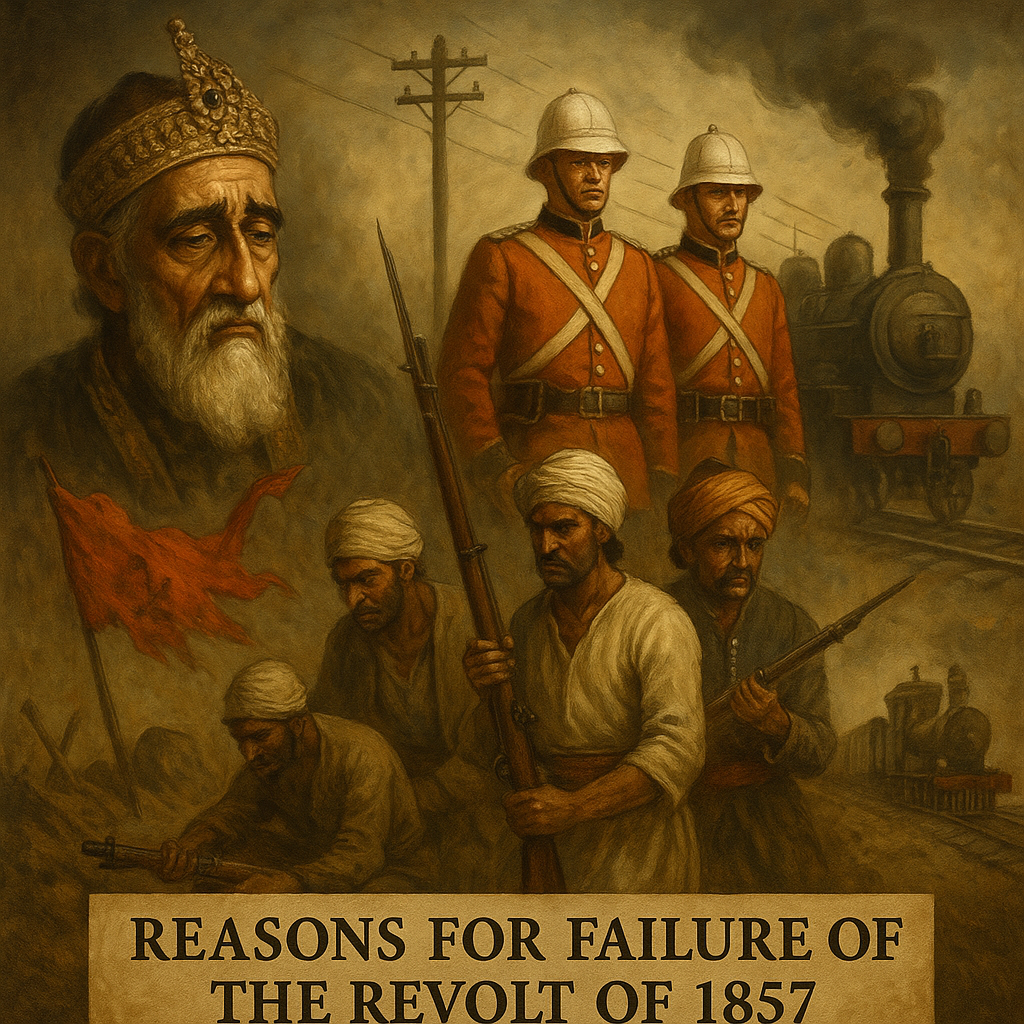
Reasons for Failure of the Revolt of 1857
🚩 Main Reasons for the Failure of the Revolt of 1857 (Detailed Description)
The Revolt of 1857, also known as the First War of Independence, was a major turning point in Indian history. Although the rebellion shook British rule, it ultimately failed due to several critical factors. These reasons can be divided into political, social, military, and strategic aspects:
1. Lack of Unified Leadership
- The rebels did not have a strong and organized national leadership.
- Bahadur Shah Zafar acted only as a symbolic leader; there was no central military command.
- Revolutionary leaders like Rani Laxmibai, Nana Saheb, Tatya Tope, and Begum Hazrat Mahal fought heroically but remained confined to their regions.
- In contrast, the British had experienced leaders such as Lord Canning, Lord Dalhousie, and Sir Colin Campbell, who coordinated effectively to crush the rebellion.
2. Lack of Organization and Unity
- The revolt was largely unorganized and lacked a coordinated nationwide plan.
- There were religious, caste-based, and regional differences among the rebels.
- Cooperation between Hindu and Muslim leaders was limited, while the British exploited these divisions.
- Many regions, especially in South India and Punjab, did not participate, reducing the overall impact of the movement.
3. Military Weakness
- Many Indian soldiers lacked formal military training, discipline, and coordination.
- The rebels had old, outdated weapons and limited artillery, whereas the British possessed modern rifles, artillery, and a highly organized army.
- The British were supported by loyal groups such as Sikhs, Gurkhas, and the Madras Army.

Amazon Recommended Pick
Trusted quality • Excellent performance • Great value for money
- ✔ 100% Genuine Product
- ✔ Fast & Secure Amazon Delivery
- ✔ Easy Return & Refund
4. British Diplomacy and Divide-and-Rule Policy
- The British successfully applied the “Divide and Rule” strategy.
- They won over many kings and landlords by offering rewards and protection.
- Prominent rulers like the Scindias of Gwalior, Raja Jayaji Rao, and the Nizam of Hyderabad supported the British instead of joining the rebels.
- This left the rebels isolated and forced to fight alone.
5. Limited Geographical Spread
- The revolt remained largely confined to North India.
- Regions such as Bengal, Punjab, South India, and Maharashtra remained mostly unaffected.
- The southern Indian army sided with the British, giving them a significant strategic advantage.
6. Mixed Public Support
- The rebellion did not receive widespread support from the entire Indian population.
- Many landlords and wealthy merchants supported the British to protect their property and trade interests.
- Groups like Sikhs, Pathans, and Gurkha soldiers fought on the British side.
- Support from peasants and common people was divided, as many leaders of the revolt were former rulers who had previously oppressed them.
7. Lack of Communication and Resources
- The rebels lacked an effective communication network.
- Coordination between different rebel groups was weak and inconsistent.
- Modern facilities such as railways and telegraphs were under British control, allowing them to mobilize troops quickly.
- The rebels lacked financial resources, logistics, and long-term supplies.
8. Brutal Repression by the British
- The British adopted extremely harsh and brutal suppression tactics.
- Rebels were publicly hanged, tied to cannons and blown apart, and entire populations were massacred in some regions.
- This atmosphere of terror discouraged many Indians from joining or continuing the rebellion.
Conclusion
Although the Revolt of 1857 ended in failure, it became a landmark event in India’s freedom struggle. After the revolt, the British government dissolved the East India Company and placed India directly under the British Crown. The rebellion ignited a deep and lasting nationalistic feeling in the hearts of Indians and laid the foundation for future movements that ultimately led to India’s independence.
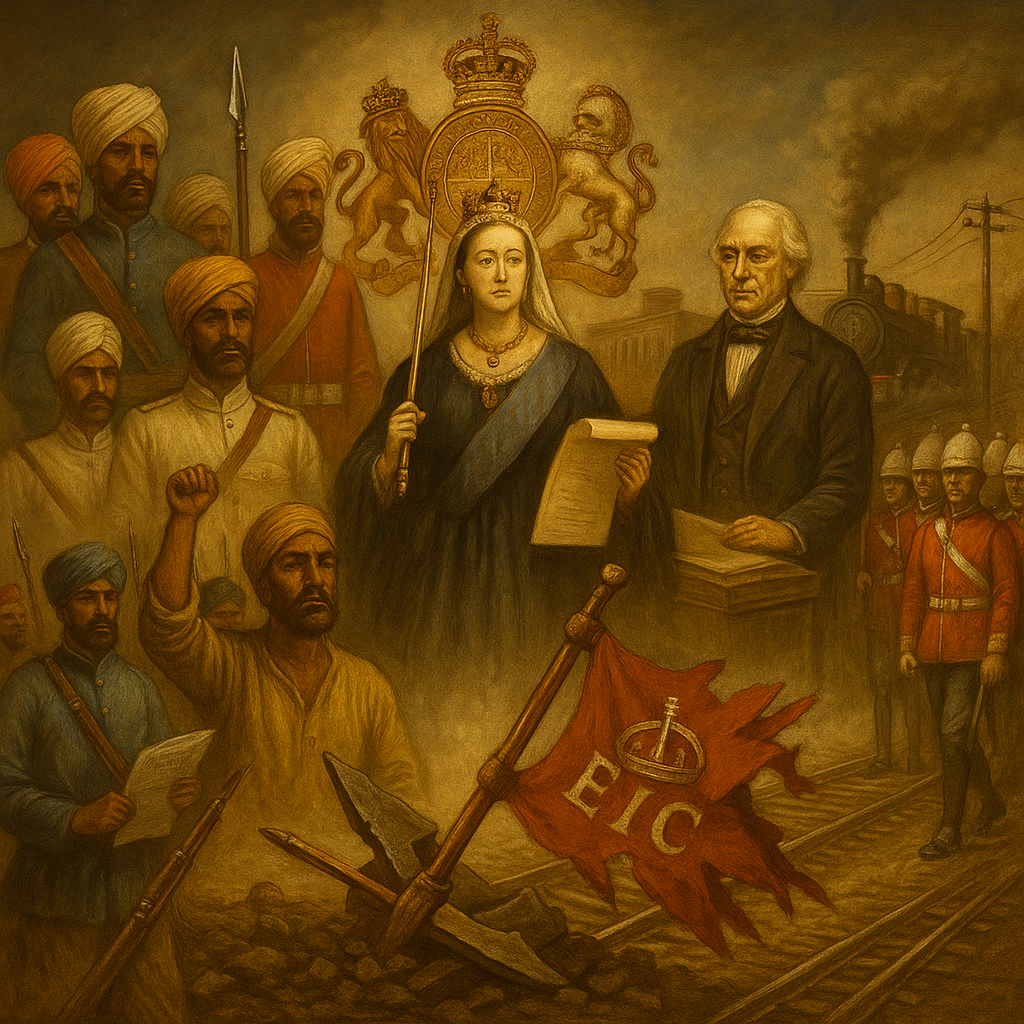
Consequences of the Revolt of 1857
The Revolt of 1857 was a historic turning point in Indian history. Although the rebellion failed, it led to significant political, social, economic, and administrative changes across the country. Its impact was so profound that it transformed both British rule and Indian society.
1. India Came Under the British Crown (End of Company Rule)
- After the rebellion, the Government of India Act 1858 was passed.
- The rule of the East India Company ended and all powers were transferred directly to the British Crown.
- A representative of the British monarch, known as the Viceroy of India, was appointed.
- Lord Canning became the first Viceroy of India.
- The British government began direct interference in Indian administration and governance.
2. Queen Victoria’s Proclamation (1858)
- Queen Victoria’s Proclamation promised religious freedom to Indians.
- It assured fair treatment and equality before law.
- Indian kings were promised protection of their princely rights and territories.
- The British officially ended the policy of annexation (Doctrine of Lapse).
- However, in reality, the manifesto was largely symbolic as British rule became stricter and more oppressive.
3. Changes in the Princely States
- Princely states that supported the British during the revolt were rewarded with greater autonomy.
- Rulers who participated in the revolt were punished, removed, or stripped of their powers.
- The British strengthened their control over Indian princely states, making them subordinate to British authority.
- Although the Doctrine of Lapse was abolished, real power remained with the British.
4. Reorganization of the Army
- Realizing that the Indian army played a central role in the uprising, the British reorganized it completely.
- The number of British soldiers was increased compared to Indian sepoys.
- The British adopted the divide-and-rule strategy among Indian soldiers to prevent unity.
- More Sikhs, Gurkhas, Pathans, and South Indian soldiers were recruited because they had supported the British during the revolt.
- Only British officers were appointed to high military ranks and key positions.
5. Impact on Hindu-Muslim Unity
- During the revolt, Hindus and Muslims fought together, which threatened British control.
- After the revolt, the British strengthened their Divide-and-Rule policy.
- They encouraged religious differences to prevent unity among Indians.
- This deepened communal divisions, which later caused major social and political challenges.
6. Rise of Political Consciousness and Nationalism
- Despite its failure, the revolt left a lasting emotional and psychological impact on Indians.
- It awakened the spirit of nationalism.
- People realized that a united and organized national movement was necessary to remove British rule.
- This awareness contributed to the formation of the Indian National Congress in 1885.
- The revolt inspired future political movements that ultimately led to India’s independence in 1947.
7. Economic and Social Changes
- After the rebellion, British economic policies became even more rigid and exploitative.
- Agricultural taxes increased, worsening farmers’ financial conditions.
- Indian industries and trade suffered under new policies that favored British goods.
- Railway, telegraph, and communication systems were expanded to help the British quickly suppress any future revolts.
- British social reforms were imposed in the name of modernity but often weakened Indian culture and traditions.
8. Changes in Education Policy
- The British promoted English education to create a class of Indians loyal to British ideology.
- Indians were appointed to minor administrative roles, while higher posts were reserved for the British.
- This new education system introduced modern ideas but also served British interests.

Top Rated Amazon Product
Excellent quality • Popular choice • Great value
- ✔ 100% Genuine & Verified
- ✔ Fast & Secure Amazon Delivery
- ✔ Easy Returns Available
Conclusion
Although the Revolt of 1857 failed, it left a deep and permanent impact on Indian society. It exposed the reality of colonial exploitation and sowed the seeds of nationalism across India. The revolt proved that for India to achieve independence, unity among all communities—Hindus, Muslims, Sikhs, peasants, rulers, and common people—was essential.