

Science Behind Climate Change and Global Warming: What Is Happening and Why?
Rising Global Temperatures and Their Link to Climate Change and Global Warming
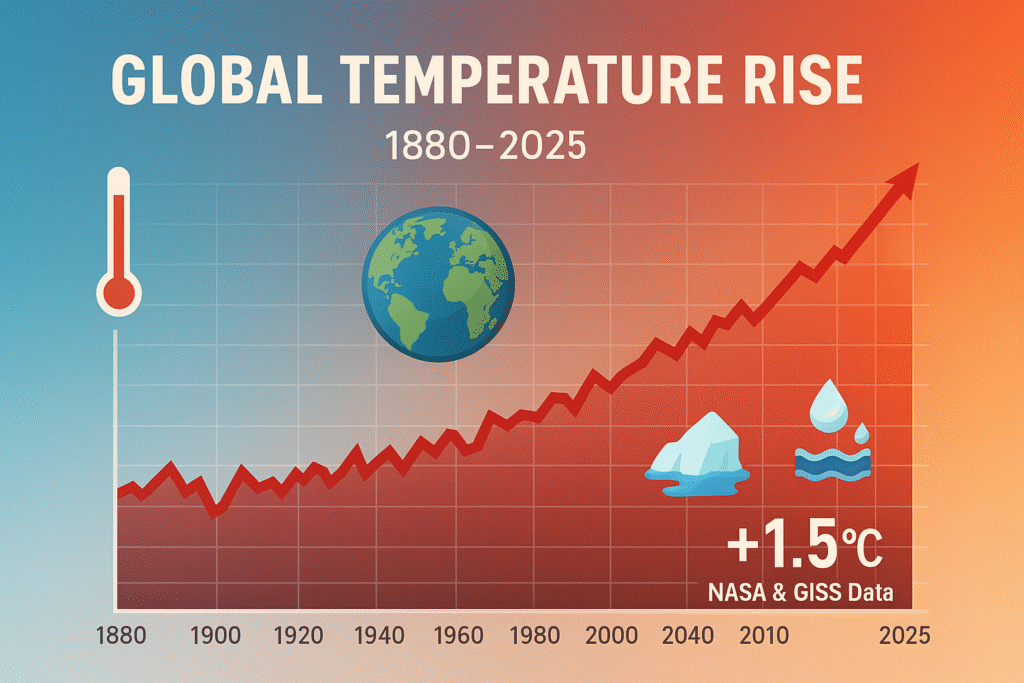
Over the past century, Earth’s average temperature has increased at an unprecedented rate. According to NASA Science and the World Meteorological Organization (WMO), the planet’s average surface temperature has risen by approximately 1.4°C to 1.6°C since the pre-industrial era (1850–1900). This measurable rise clearly reflects the accelerating impact of Climate Change and Global Warming on Earth’s climate system.
NASA’s Goddard Institute for Space Studies (GISS) confirms that 2024 and 2025 rank among the warmest years ever recorded. The Arctic is warming at nearly twice the global average rate, disrupting ecosystems, sea ice formation, and global weather patterns. These facts highlight that Climate Change and Global Warming are not distant threats — they are measurable realities reshaping the planet today.
Source: NASA Global Climate Change – https://climate.nasa.gov/vital-signs/global-temperature/
Greenhouse Gases and Human Activities Driving Climate Change and Global Warming
The primary driver of modern Climate Change and Global Warming is the increase in greenhouse gases (GHGs) such as carbon dioxide (CO₂), methane (CH₄), nitrous oxide (N₂O), and industrial gases like CFCs. These gases trap heat in Earth’s atmosphere — a process known as the greenhouse effect — which keeps our planet habitable but becomes dangerous when intensified by human activity.
Since the mid-20th century, industrialization, deforestation, rapid urbanization, and the massive burning of fossil fuels (coal, oil, and natural gas) have sharply increased the concentration of these gases. Carbon dioxide mainly comes from fossil fuel combustion and deforestation, while methane is released from livestock, waste landfills, and rice cultivation. Nitrous oxide largely comes from fertilizers and industrial processes.
Scientists warn that if current emission trends continue, global temperature rise could exceed 1.5°C by the early 2030s. Beyond this threshold, many climate impacts — such as coral bleaching, heatwaves, crop failures, and ice melt — could become irreversible. That’s why reducing emissions immediately is critical for a livable future.
Scientific Indicators of Warming: Oceans, Ice, and Sea Levels
Climate change is not just about air temperature — it’s visible across every part of Earth’s system. Oceans, which absorb more than 90% of the excess heat trapped by greenhouse gases, are now warming at record levels. According to NOAA (National Oceanic and Atmospheric Administration), global ocean surface temperatures in 2023 reached the highest levels ever observed.
This ocean warming leads to massive coral bleaching, disrupts marine food chains, and intensifies storms and cyclones. Meanwhile, polar regions are experiencing unprecedented ice loss. Satellite data show that the Arctic sea ice has declined by nearly 40% since 1980, while glaciers worldwide are retreating at alarming rates.
As ice sheets melt, sea levels are rising approximately 3.3 millimeters per year. This slow but steady rise threatens coastal megacities such as Mumbai, New York, and Dhaka, putting millions of people at risk of flooding, habitat loss, and migration crises. These indicators prove that warming is not an isolated event but a global chain reaction affecting water, land, air, and life itself.
Info Box: What Does 1.5°C Mean?
Science Behind Climate Change and Global Warming: What Is Happening and Why?
Rising Global Temperatures and Their Link to Climate Change and Global Warming
Over the past century, Earth’s average temperature has increased at an unprecedented rate. According to NASA Science and the World Meteorological Organization (WMO), the planet’s average surface temperature has risen by approximately 1.4°C to 1.6°C since the pre-industrial era (1850–1900). This measurable rise clearly reflects the accelerating impact of Climate Change and Global Warming on Earth’s climate system.
NASA’s Goddard Institute for Space Studies (GISS) confirms that 2024 and 2025 rank among the warmest years ever recorded. The Arctic is warming at nearly twice the global average rate, disrupting ecosystems, sea ice formation, and global weather patterns. These facts highlight that Climate Change and Global Warming are not distant threats — they are measurable realities reshaping the planet today.
Source: NASA Global Climate Change – https://climate.nasa.gov/vital-signs/global-temperature/
Greenhouse Gases and Human Activities Driving Climate Change and Global Warming
The primary driver of modern Climate Change and Global Warming is the increase in greenhouse gases (GHGs) such as carbon dioxide (CO₂), methane (CH₄), nitrous oxide (N₂O), and industrial gases like CFCs. These gases trap heat in Earth’s atmosphere — a process known as the greenhouse effect — which keeps our planet habitable but becomes dangerous when intensified by human activity.
Since the mid-20th century, industrialization, deforestation, rapid urbanization, and the massive burning of fossil fuels (coal, oil, and natural gas) have sharply increased the concentration of these gases. Carbon dioxide mainly comes from fossil fuel combustion and deforestation, while methane is released from livestock, waste landfills, and rice cultivation. Nitrous oxide largely comes from fertilizers and industrial processes.
Scientists warn that if current emission trends continue, global temperature rise could exceed 1.5°C by the early 2030s. Beyond this threshold, many climate impacts — such as coral bleaching, heatwaves, crop failures, and ice melt — could become irreversible. That’s why reducing emissions immediately is critical for a livable future.
Scientific Indicators of Warming: Oceans, Ice, and Sea Levels
Climate change is not just about air temperature — it’s visible across every part of Earth’s system. Oceans, which absorb more than 90% of the excess heat trapped by greenhouse gases, are now warming at record levels. According to NOAA (National Oceanic and Atmospheric Administration), global ocean surface temperatures in 2023 reached the highest levels ever observed.
This ocean warming leads to massive coral bleaching, disrupts marine food chains, and intensifies storms and cyclones. Meanwhile, polar regions are experiencing unprecedented ice loss. Satellite data show that the Arctic sea ice has declined by nearly 40% since 1980, while glaciers worldwide are retreating at alarming rates.
As ice sheets melt, sea levels are rising approximately 3.3 millimeters per year. This slow but steady rise threatens coastal megacities such as Mumbai, New York, and Dhaka, putting millions of people at risk of flooding, habitat loss, and migration crises. These indicators prove that warming is not an isolated event but a global chain reaction affecting water, land, air, and life itself.
Info Box: What Does 1.5°C Mean?


Solutions: Policies, Technology, and Behavior
Global Policy: The Paris Agreement and Net-Zero Targets
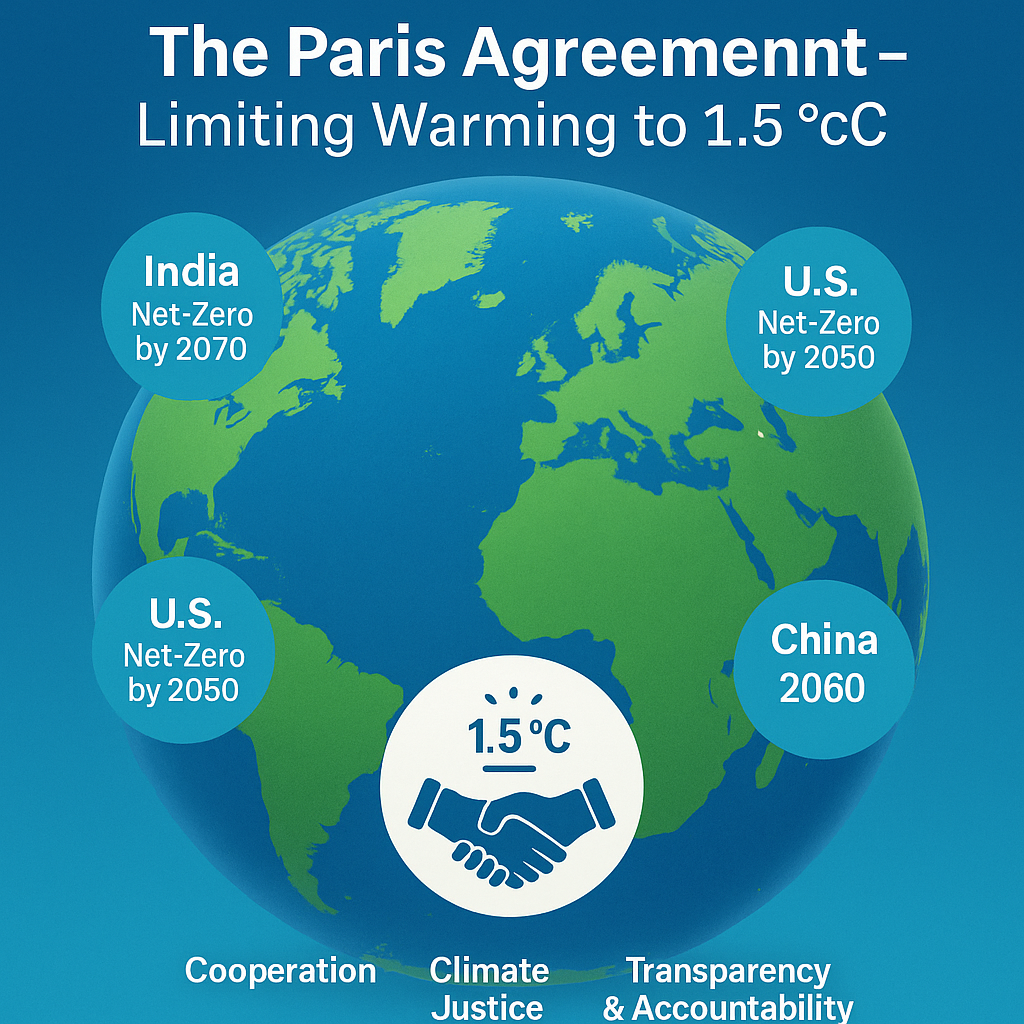
Combating climate change requires collective global action. No single country can tackle this challenge alone. The Paris Agreement, adopted in 2015, marked a historic moment in global cooperation. Under this accord, nations agreed to keep the rise in global average temperature well below 2°C above pre-industrial levels and pursue efforts to limit it to 1.5°C.
The central principle of the Paris Agreement is “common but differentiated responsibilities” — meaning every country contributes according to its capabilities and circumstances. Following this, many nations announced net-zero targets — committing to balance their greenhouse gas emissions with carbon absorption or removal. India, for example, has pledged to achieve net-zero by 2070, while the United States and the European Union aim for 2050.
These global policies highlight that coordinated international efforts and transparent accountability are the foundations of a sustainable future.

Energy Transition: Renewables, Electric Transport, and Energy Efficiency
One of the most powerful ways to address global warming is through an energy transition — shifting away from fossil fuels toward clean and renewable sources of energy. Currently, nearly 70% of the world’s energy still comes from coal, oil, and gas, which are responsible for most carbon emissions. Renewable energy sources such as solar, wind, hydro, and bioenergy provide clean, sustainable alternatives.
India has emerged as a global leader in renewables, ranking as the fourth-largest solar energy producer. The government aims to generate 50% of its total electricity from renewable sources by 2030. Initiatives like the National Solar Mission and the Bureau of Energy Efficiency (BEE) are crucial steps toward this transformation.
In the transport sector, the adoption of Electric Vehicles (EVs) is rapidly increasing. The FAME India Scheme (Faster Adoption and Manufacturing of Hybrid and Electric Vehicles) has provided subsidies and infrastructure to accelerate this change. At the same time, improving energy efficiency in industries, homes, and public buildings can drastically cut emissions and reduce energy costs.
This energy shift is not just about technology — it’s also an economic opportunity. It creates new jobs, drives innovation, and strengthens rural economies, leading to a cleaner, more resilient energy future.
Nature-Based Solutions: Reforestation and Soil Carbon
Nature itself offers some of the most effective and affordable solutions to the climate crisis. Reforestation and forest restoration help absorb carbon dioxide from the atmosphere, creating powerful carbon sinks. According to the United Nations, restoring forests on a global scale could offset up to 25% of annual carbon emissions.
Similarly, improving soil health through soil carbon sequestration enhances agricultural productivity while locking carbon into the ground. India’s programs such as the Green India Mission and the Compensatory Afforestation Fund (CAMPA) are significant initiatives in this regard.
These natural approaches also strengthen biodiversity, regulate rainfall, and support rural livelihoods, creating a synergy between ecology and economy.
Responsibilities of Developed and Developing Nations
While climate change is a global problem, the responsibility to address it is not equally distributed. Developed nations such as the United States, China, and European countries have historically emitted the most greenhouse gases and therefore carry greater responsibility for reducing emissions and supporting others.
On the other hand, developing nations like India and many African countries still struggle with poverty, infrastructure, and the need for sustainable growth. Hence, the concept of “Climate Justice” emphasizes that wealthier nations must provide financial and technological assistance to developing ones to help them transition to clean energy without compromising development goals.
Only through such equitable cooperation can the world move toward a truly sustainable and fair future.

